Скачать презентацию 2010 National Taiwan University International Conference on Finance
a88bfaff19ef138f9313ebd4924bba15.ppt
- Количество слайдов: 29
 2010 National Taiwan University International Conference on Finance Do Analysts Overreact to Good News and Underreact to Bad News: A Hazard Model Approach Ruei-Shian Wu Yuan Ze University Hsiou-wei Lin National Taiwan University
 Outlines n n n Motivation and Literature Review Hypothesis Research Model Empirical Result Summary 2
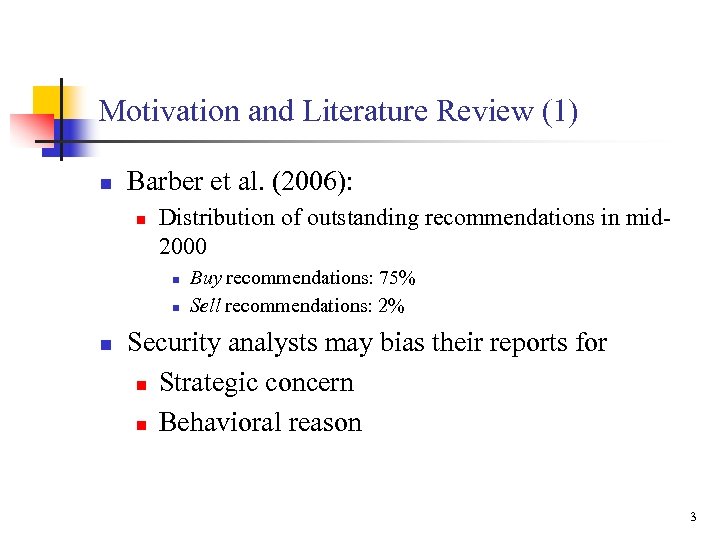 Motivation and Literature Review (1) n Barber et al. (2006): n Distribution of outstanding recommendations in mid 2000 n n n Buy recommendations: 75% Sell recommendations: 2% Security analysts may bias their reports for n Strategic concern n Behavioral reason 3
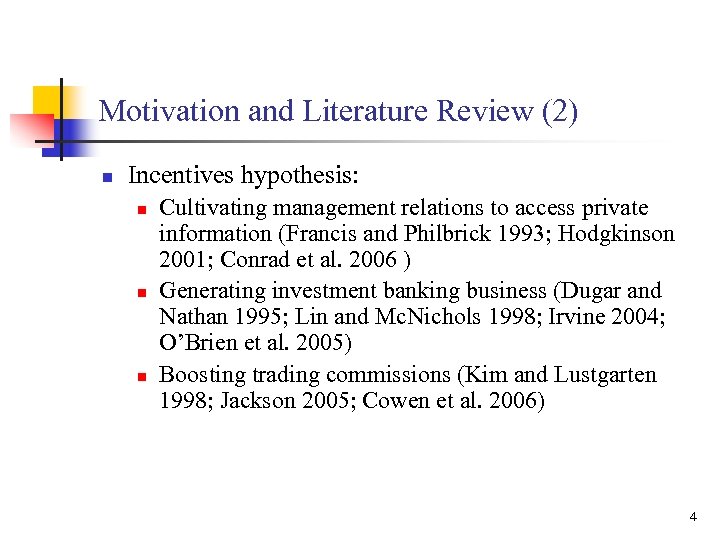 Motivation and Literature Review (2) n Incentives hypothesis: n n n Cultivating management relations to access private information (Francis and Philbrick 1993; Hodgkinson 2001; Conrad et al. 2006 ) Generating investment banking business (Dugar and Nathan 1995; Lin and Mc. Nichols 1998; Irvine 2004; O’Brien et al. 2005) Boosting trading commissions (Kim and Lustgarten 1998; Jackson 2005; Cowen et al. 2006) 4
 Motivation and Literature Review (3) n Cognitive processing biases hypothesis: n Cognitive dissonance: n n n The unconscious tendency to process information in a manner that supports one's prior beliefs (Festinger, 1957) Psychological discomfort that accompanies evidence contradicting to prior beliefs. To avoid this discomfort, people tend to forget dissonant—albeit salient—information (Wicklund and Brehm, 1976) Conservatism: n Another cognitive processing bias regarding underreaction to new information, suggests that individuals do not update their beliefs adequately in the face of new evidence if they believe that the evidence is not representative (Edwards, 1968) 5
 Motivation and Literature Review (5) n n n Analysts are reluctant to recognize negative changes in corporate fundamentals (Cornell 2001) When generating earnings forecasts, analysts tend to process information in a manner that biases forecasts in the direction that supports their investment recommendation (Eames et al. 2002) Cognitive obstacles prevent analysts from revising their forecasts downward (Abarbanell and Lehavy 2003) Analysts are overconfident regarding the precision of their own information and are also subject to cognitive dissonance bias (Friesena and Wellerb 2006) The premise of investor conservatism stems from a number of studies reporting investors’ underreaction to new information (Abarbanell and Bernard, 1992; Barberis, Shleifer, and Vishny, 1998) 6
 Hypothesis (1) n The incentives hypothesis: n n asserts that analysts issue unduly optimistic opinions regardless of their prior cognition; that is, they tend, in general, to underreact to bad news The cognitive processing biases hypothesis: n n stresses analysts’ unconscious tendency to underreact to information with certain characteristics. In the case of cognitive dissonance, analysts are prone to underreact to bad (good) news if their prior beliefs are positive (negative) 7
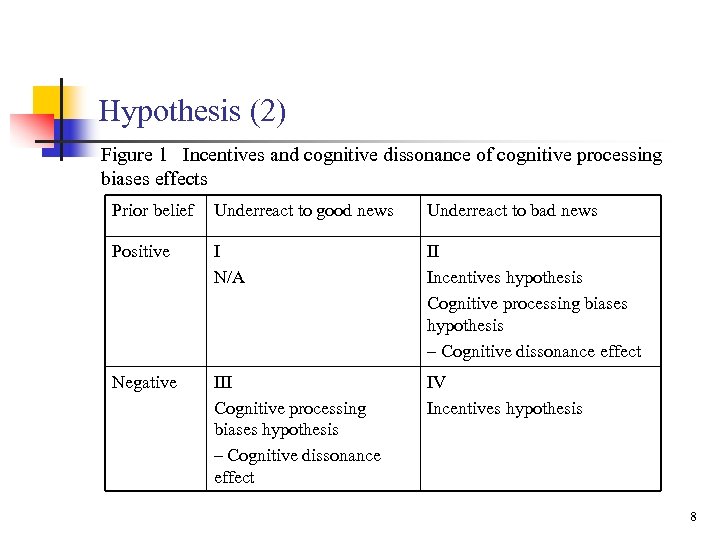 Hypothesis (2) Figure 1 Incentives and cognitive dissonance of cognitive processing biases effects Prior belief Underreact to good news Underreact to bad news Positive I N/A II Incentives hypothesis Cognitive processing biases hypothesis – Cognitive dissonance effect Negative III Cognitive processing biases hypothesis – Cognitive dissonance effect IV Incentives hypothesis 8
 Hypothesis (3) H 1: Following a favorable preceding recommendation, analysts reiterate upward recommendations in a more timely fashion than they make downward recommendation revisions, while following an unfavorable preceding recommendation, analysts issue upward recommendation revisions in a more timely fashion than they reiterate unfavorable recommendations, which is consistent with the incentive explanation. 9
 Hypothesis (4) H 2: Following a favorable preceding recommendation, analysts reiterate upward recommendations in a more timely fashion than they make downward recommendation revisions, while following an unfavorable preceding recommendation, analysts reiterate unfavorable recommendation revisions in a more timely fashion than they issue upward recommendations, which is consistent with cognitive dissonance explanations. 10
 Hypothesis (5) n An alternative explanation for analysts delay conveying good news conditions on an unfavorable preceding recommendation n n firms’ slow recovery a sluggish stock market 11
 Hypothesis (6) H 3: Following analysts’ unfavorable preceding recommendation, analysts issue upward recommendation revisions in a more timely fashion for underperformers than for outperformers. 12
 Hypothesis (7) n Conservatism: n n If new information is not representative, people underreact to new information and overrely on their prior beliefs. We use the prior recommendation reversal as an indicator of less representative information. 13
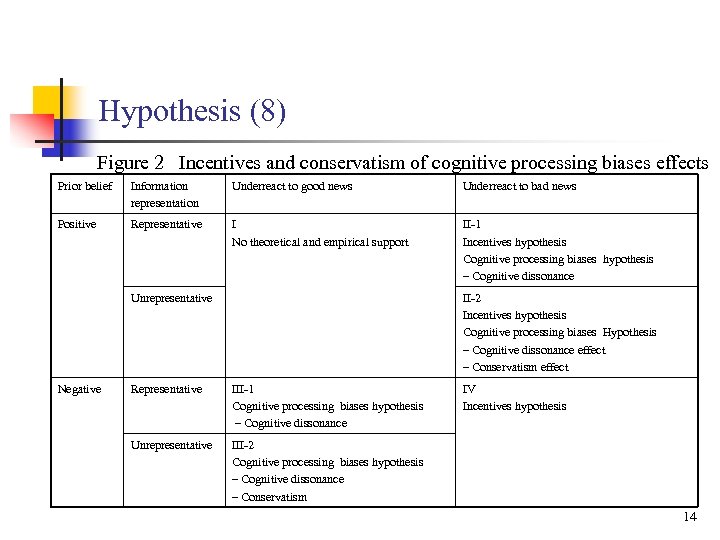 Hypothesis (8) Figure 2 Incentives and conservatism of cognitive processing biases effects Prior belief Information representation Underreact to good news Underreact to bad news Positive Representative I No theoretical and empirical support II-1 Incentives hypothesis Cognitive processing biases hypothesis – Cognitive dissonance Unrepresentative Negative II-2 Incentives hypothesis Cognitive processing biases Hypothesis – Cognitive dissonance effect – Conservatism effect Representative III-1 Cognitive processing biases hypothesis – Cognitive dissonance Unrepresentative IV Incentives hypothesis III-2 Cognitive processing biases hypothesis – Cognitive dissonance – Conservatism 14
 Hypothesis (9) H 4: Following analysts’ unfavorable preceding recommendation, analysts issue upward recommendation revisions in a more timely fashion for outperformers with recommendation reiterations than for outperformers with recommendation reversals. 15
 Research Model (1) n n This study examines evidence concerning the time it takes for sell-side analysts to convey good news by issuing favorable recommendation revisions relative to convey bad news by issuing unfavorable recommendation revisions. Right censored observations n n Longer lived prior opinions are more likely to be censored Duration cannot be negative 16
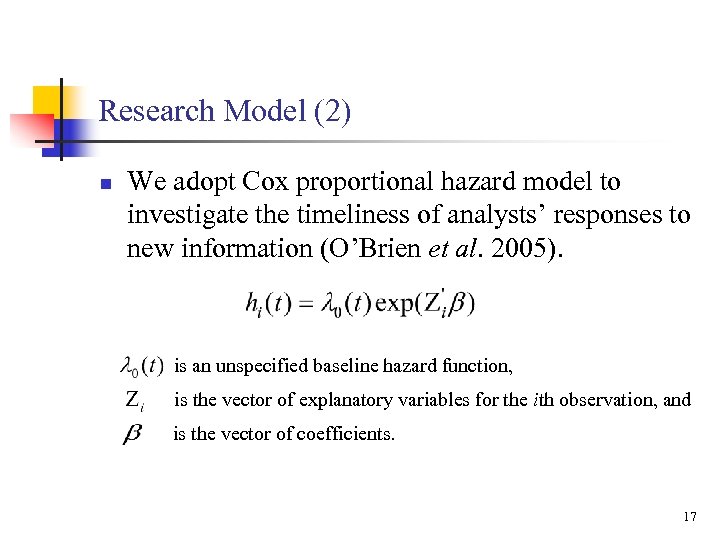 Research Model (2) n We adopt Cox proportional hazard model to investigate the timeliness of analysts’ responses to new information (O’Brien et al. 2005). is an unspecified baseline hazard function, is the vector of explanatory variables for the ith observation, and is the vector of coefficients. 17
 Research Model (3) n Sample: n n n S&P 500 companies January 1995 to May 2002 recommendations from First Call stock returns from CRSP earnings data from COMPUSTAT 18
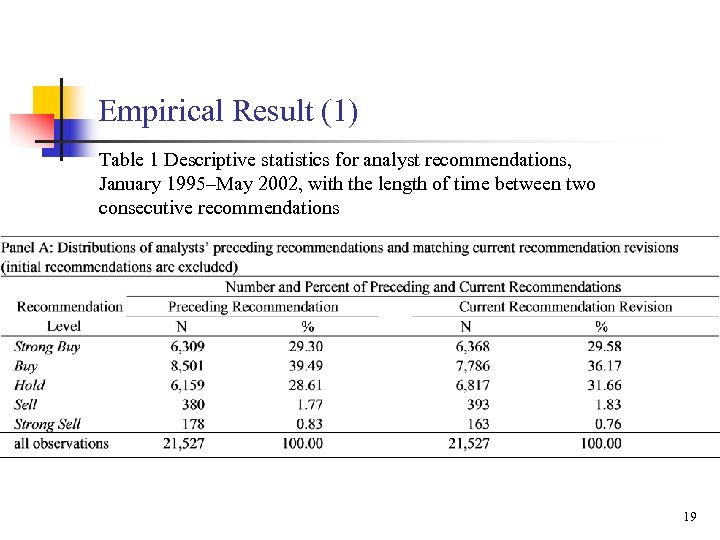 Empirical Result (1) Table 1 Descriptive statistics for analyst recommendations, January 1995–May 2002, with the length of time between two consecutive recommendations 19
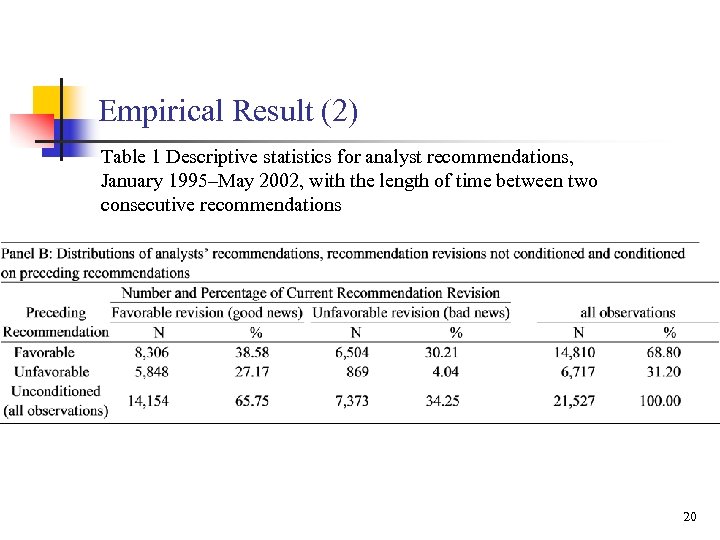 Empirical Result (2) Table 1 Descriptive statistics for analyst recommendations, January 1995–May 2002, with the length of time between two consecutive recommendations 20
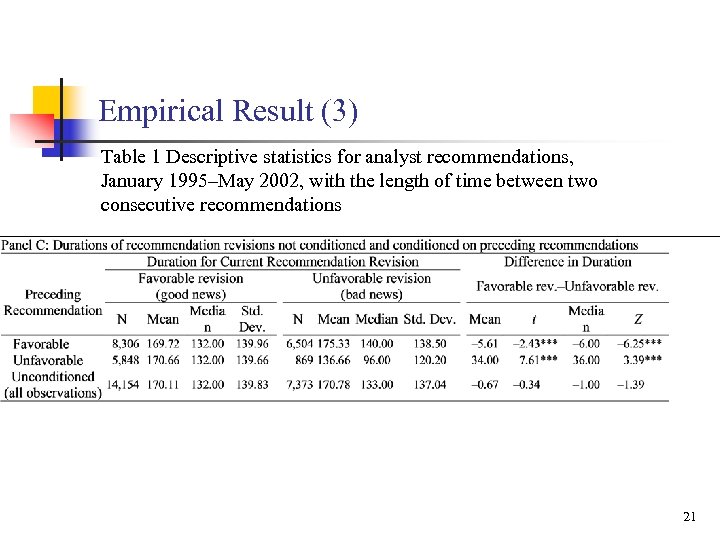 Empirical Result (3) Table 1 Descriptive statistics for analyst recommendations, January 1995–May 2002, with the length of time between two consecutive recommendations 21
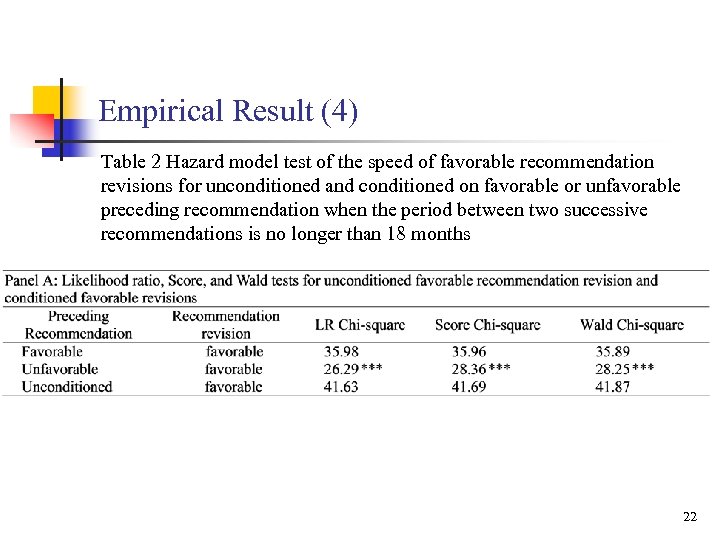 Empirical Result (4) Table 2 Hazard model test of the speed of favorable recommendation revisions for unconditioned and conditioned on favorable or unfavorable preceding recommendation when the period between two successive recommendations is no longer than 18 months 22
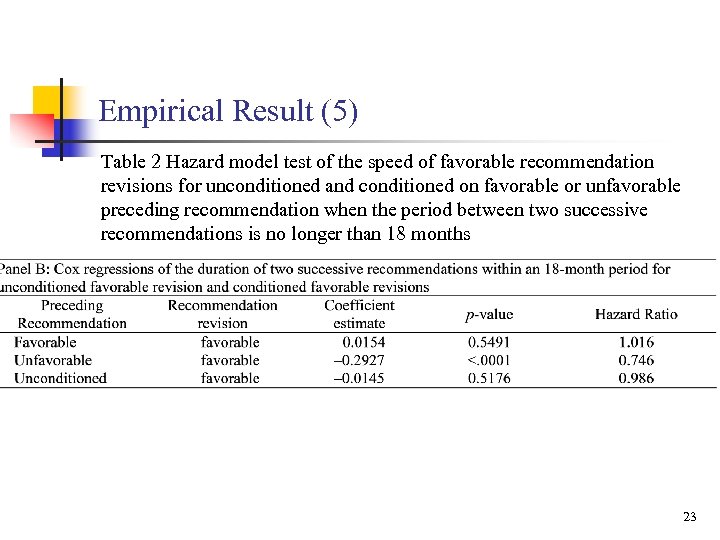 Empirical Result (5) Table 2 Hazard model test of the speed of favorable recommendation revisions for unconditioned and conditioned on favorable or unfavorable preceding recommendation when the period between two successive recommendations is no longer than 18 months 23
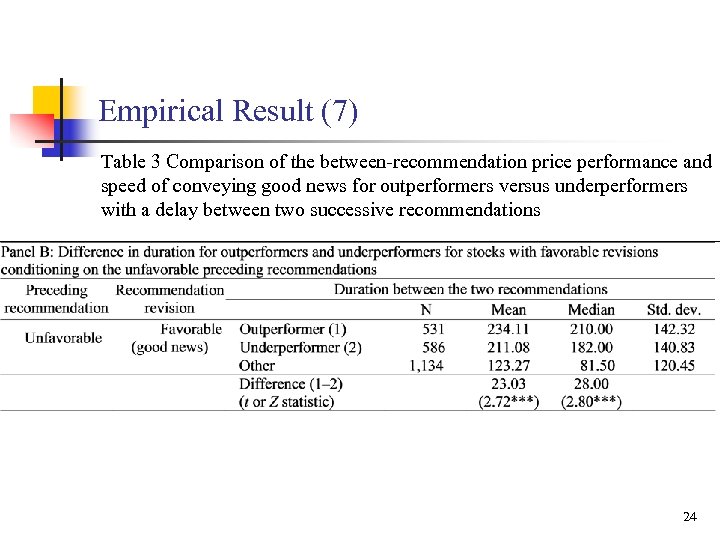 Empirical Result (7) Table 3 Comparison of the between-recommendation price performance and speed of conveying good news for outperformers versus underperformers with a delay between two successive recommendations 24
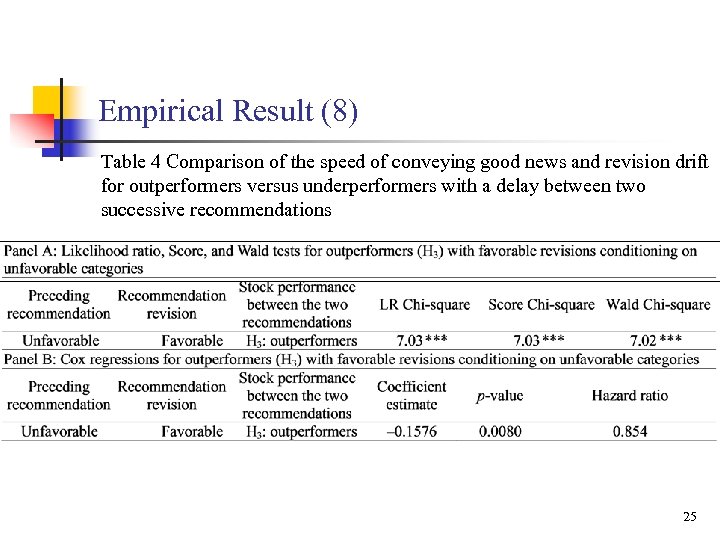 Empirical Result (8) Table 4 Comparison of the speed of conveying good news and revision drift for outperformers versus underperformers with a delay between two successive recommendations 25
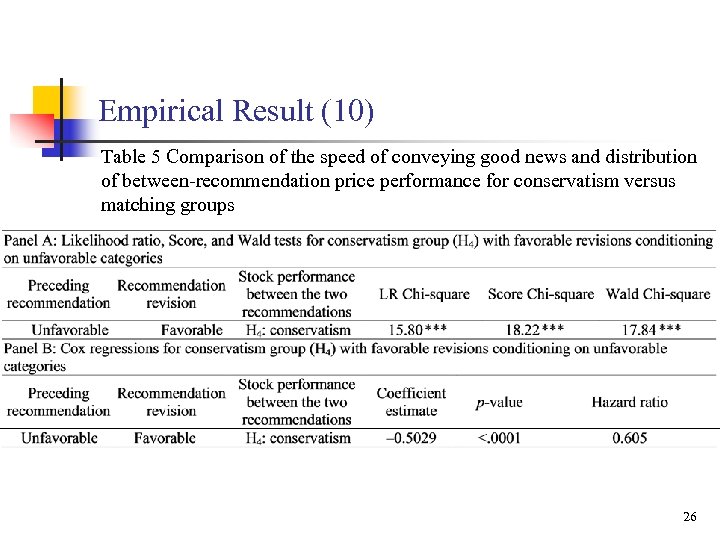 Empirical Result (10) Table 5 Comparison of the speed of conveying good news and distribution of between-recommendation price performance for conservatism versus matching groups 26
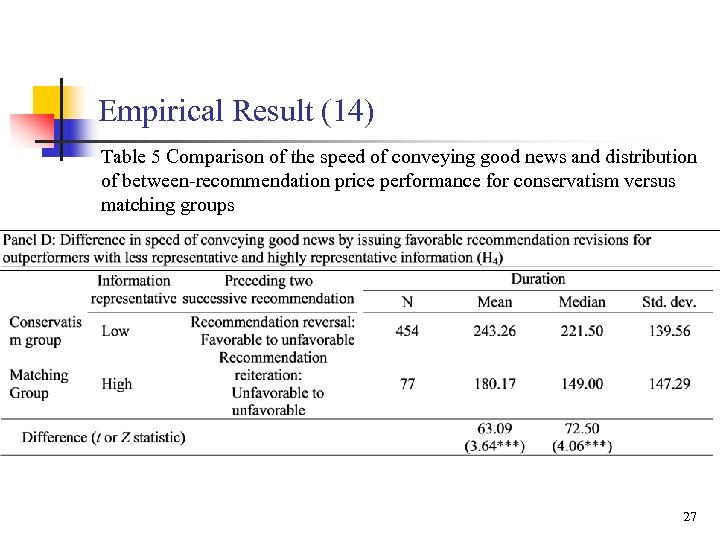 Empirical Result (14) Table 5 Comparison of the speed of conveying good news and distribution of between-recommendation price performance for conservatism versus matching groups 27
 Summary n This study isolates effects of incentives and cognitive processing biases and directly tests analysts’ underreaction to new information when updating their opinions through recommendation revisions. n n n When we control for favorable preceding recommendations, analysts underreact to bad news, which is consistent with the existence of incentives and cognitive processing biases. When we control for unfavorable preceding recommendations, less time passes before analysts convey good news, which is consistent only with the hypothesis of cognitive processing biases. We also find evidence for the conservatism bias proposed by Edwards (1968), under which analysts delay their response to new favorable information for outperformers when they have processed less representative information as compared with highly representative information. 28