


 Скачать презентацию 2010 Mississippi Alternate Assessment of Extended Curriculum Frameworks
f54c0107dbb0c0ffced2c5f42b18d4f7.ppt
- Количество слайдов: 42
 2010 Mississippi Alternate Assessment of Extended Curriculum Frameworks A TEACHER’S GUIDE TO GETTING ON TRACK, STAYING ON COURSE, AND AVOIDING THE PITFALLS 2009 Assessing Educational Competencies
 Brief Review of MAAECF 2009 Assessments were scored at the Research & Curriculum Unit at Mississippi State University. The independent state raters (R 1) were highly trained state educators. Every teacher (R 0) in the state had one assessment scored by an Independent State Rater (R 1) If Rater 1 (R 1) score did not match the teacher’s score, another rater (R 2) scored the same assessment. If R 2 agreed with the teacher, the teacher’s score was used. If R 1 & R 2 scores agreed, the R 1 score was used, and all other assessments from that teacher were scored. 2009 Assessing Educational Competencies
 Brief Review: Concluded Reliability criteria determined for state raters Every effort made to find the teacher reliable Evidence quality rated --- MDE District Report 2009 Assessing Educational Competencies
 What is new for MAAECF 2010 Procedurally the SAME! However, Tighter Rating Criteria! 2009 Assessing Educational Competencies
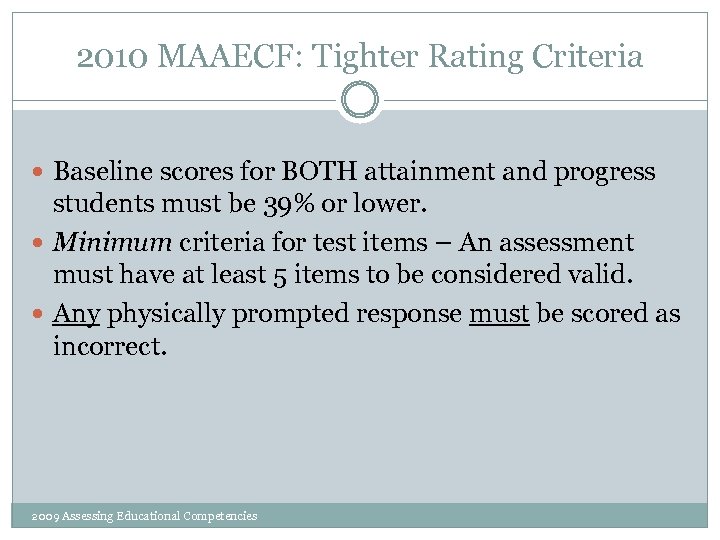 2010 MAAECF: Tighter Rating Criteria Baseline scores for BOTH attainment and progress students must be 39% or lower. Minimum criteria for test items – An assessment must have at least 5 items to be considered valid. Any physically prompted response must be scored as incorrect. 2009 Assessing Educational Competencies
 The New MAAECF 2010 Forum An on-line forum moderated by the MAAECF trainer is available for all teachers. Teachers are able to post questions about the assessment, look at previous posts, and participate in weekly online chat sessions about the MAAECF. You may access the forum by going to: www. aecnow. com. 2009 Assessing Educational Competencies
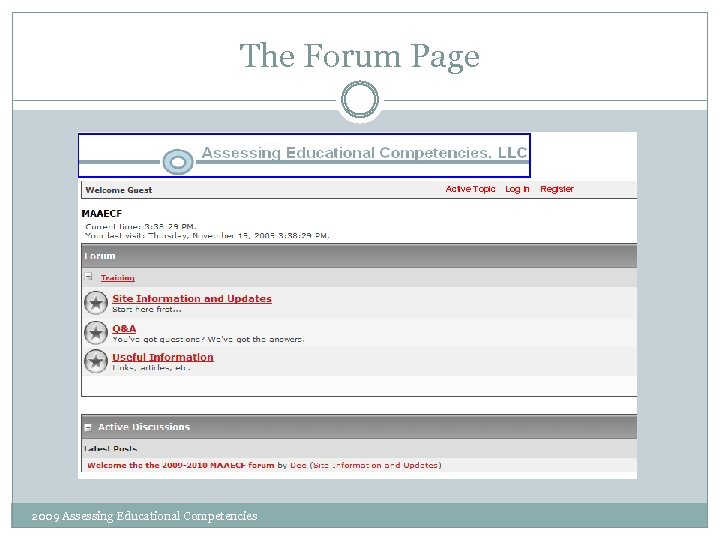 The Forum Page Active Topic 2009 Assessing Educational Competencies Log In Register
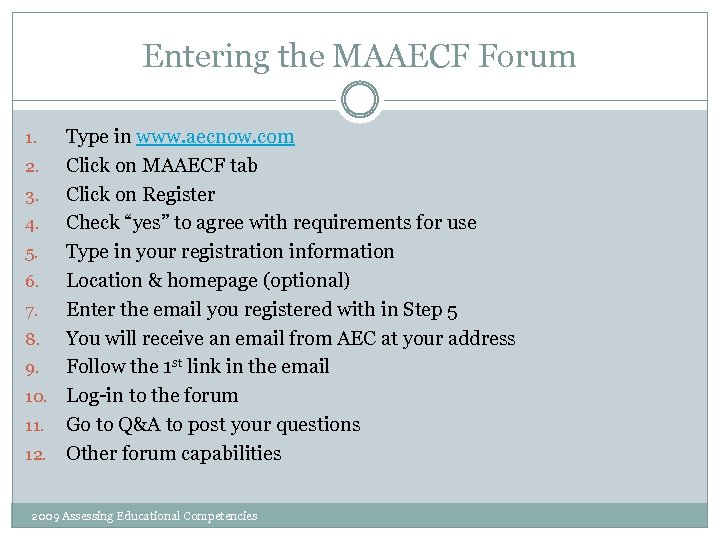 Entering the MAAECF Forum Type in www. aecnow. com 2. Click on MAAECF tab 3. Click on Register 4. Check “yes” to agree with requirements for use 5. Type in your registration information 6. Location & homepage (optional) 7. Enter the email you registered with in Step 5 8. You will receive an email from AEC at your address 9. Follow the 1 st link in the email 10. Log-in to the forum 11. Go to Q&A to post your questions 12. Other forum capabilities 1. 2009 Assessing Educational Competencies
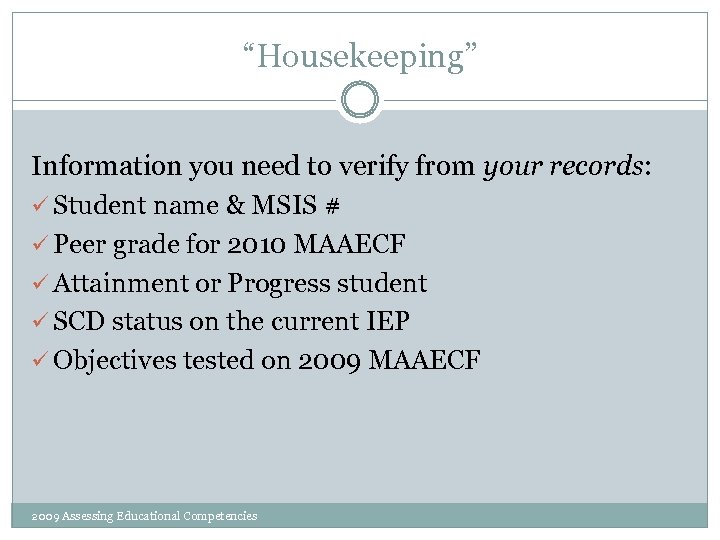 “Housekeeping” Information you need to verify from your records: ü Student name & MSIS # ü Peer grade for 2010 MAAECF ü Attainment or Progress student ü SCD status on the current IEP ü Objectives tested on 2009 MAAECF 2009 Assessing Educational Competencies
 “Housekeeping” Information to verify with your Special Education Director: ü Student name & MSIS # ü Student peer grade in MSIS ü SCD indicator in MSIS ü Peer grade for 2010 MAAECF ü Teacher of record 2009 Assessing Educational Competencies
 Identifying the Participants: Who takes the MAAECF “An alternate assessment is an assessment designed for the small number of students with disabilities who are unable to participate in the regular State assessment, even with appropriate accommodations. ” This regulation clarifies the Department’s position that alternate achievement standards are acceptable only for the small number of students with the most significant cognitive disabilities. From The Federal Register 2009 Assessing Educational Competencies
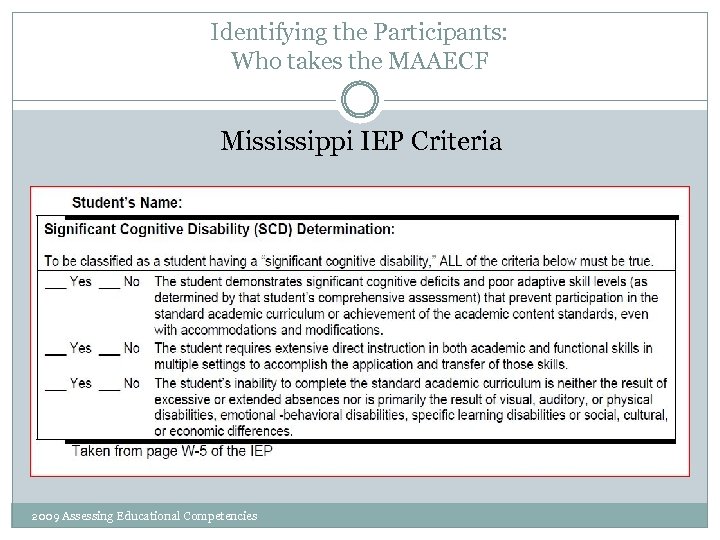 Identifying the Participants: Who takes the MAAECF Mississippi IEP Criteria 2009 Assessing Educational Competencies
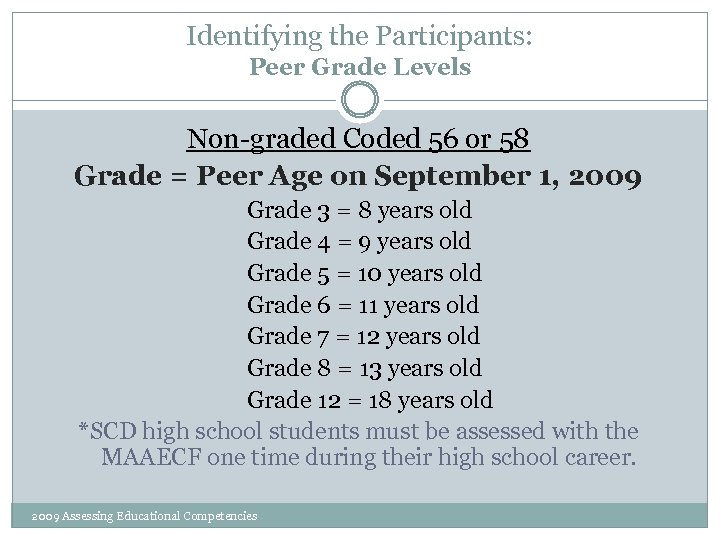 Identifying the Participants: Peer Grade Levels Non-graded Coded 56 or 58 Grade = Peer Age on September 1, 2009 Grade 3 = 8 years old Grade 4 = 9 years old Grade 5 = 10 years old Grade 6 = 11 years old Grade 7 = 12 years old Grade 8 = 13 years old Grade 12 = 18 years old *SCD high school students must be assessed with the MAAECF one time during their high school career. 2009 Assessing Educational Competencies
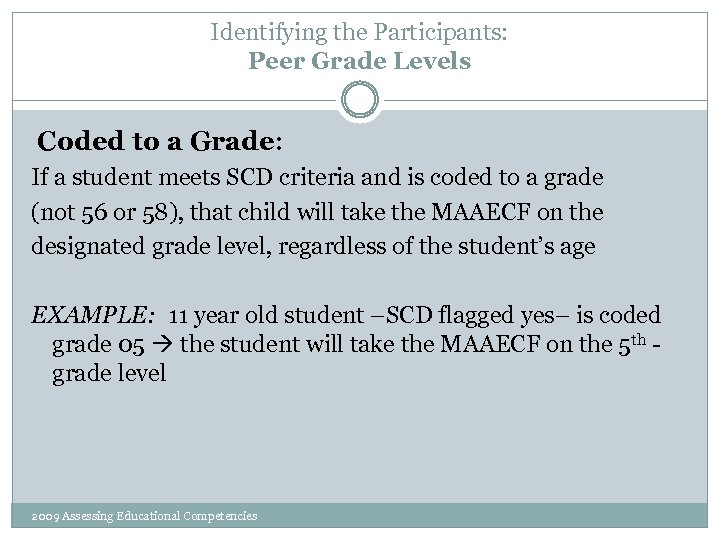 Identifying the Participants: Peer Grade Levels Coded to a Grade: If a student meets SCD criteria and is coded to a grade (not 56 or 58), that child will take the MAAECF on the designated grade level, regardless of the student’s age EXAMPLE: 11 year old student –SCD flagged yes– is coded grade 05 the student will take the MAAECF on the 5 th grade level 2009 Assessing Educational Competencies
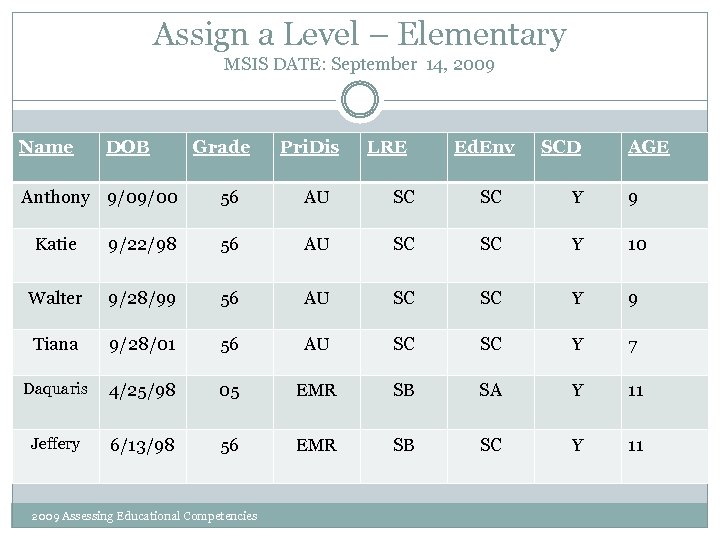 Assign a Level – Elementary MSIS DATE: September 14, 2009 Name DOB Anthony 9/09/00 Grade Pri. Dis LRE Ed. Env SCD AGE 56 AU SC SC Y 9 Katie 9/22/98 56 AU SC SC Y 10 Walter 9/28/99 56 AU SC SC Y 9 Tiana 9/28/01 56 AU SC SC Y 7 Daquaris 4/25/98 05 EMR SB SA Y 11 Jeffery 6/13/98 56 EMR SB SC Y 11 2009 Assessing Educational Competencies
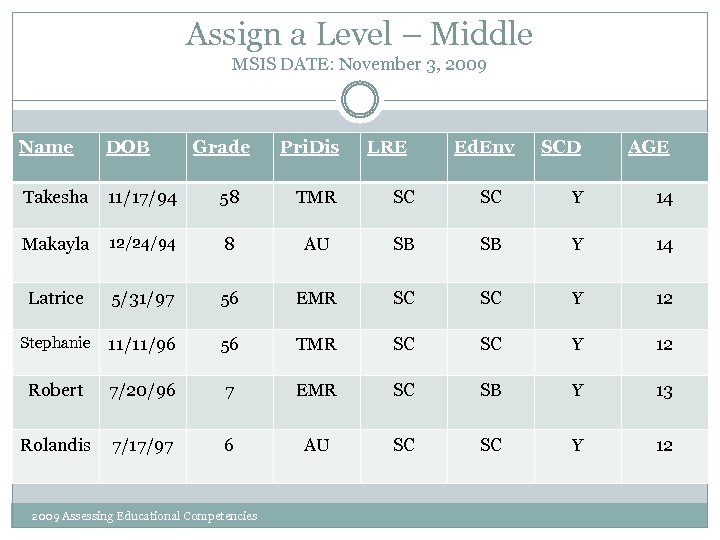 Assign a Level – Middle MSIS DATE: November 3, 2009 Name DOB Grade SCD AGE Takesha 11/17/94 58 TMR SC SC Y 14 Makayla 12/24/94 8 AU SB SB Y 14 Latrice 5/31/97 56 EMR SC SC Y 12 Stephanie 11/11/96 56 TMR SC SC Y 12 Robert 7/20/96 7 EMR SC SB Y 13 Rolandis 7/17/97 6 AU SC SC Y 12 2009 Assessing Educational Competencies Pri. Dis LRE Ed. Env
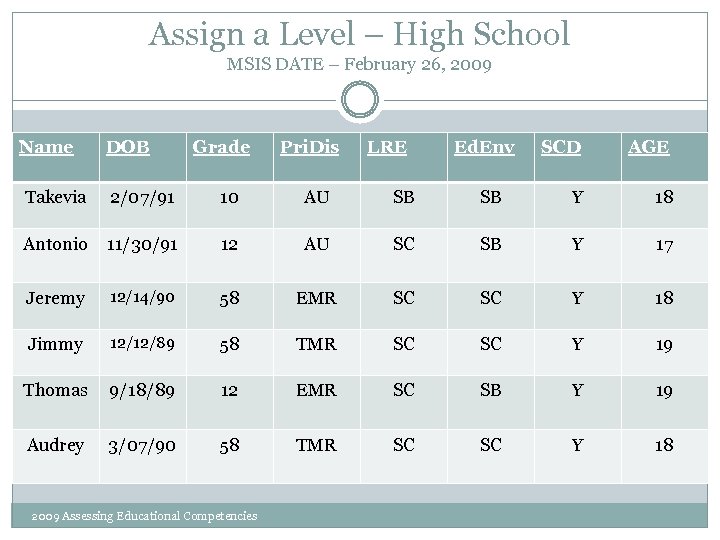 Assign a Level – High School MSIS DATE – February 26, 2009 Name DOB Grade SCD AGE Takevia 2/07/91 10 AU SB SB Y 18 Antonio 11/30/91 12 AU SC SB Y 17 Jeremy 12/14/90 58 EMR SC SC Y 18 Jimmy 12/12/89 58 TMR SC SC Y 19 Thomas 9/18/89 12 EMR SC SB Y 19 Audrey 3/07/90 58 TMR SC SC Y 18 2009 Assessing Educational Competencies Pri. Dis LRE Ed. Env
 SENIOR SNAPSHOT Begin with the Current Live Data and highlight all seniors and/or peer group seniors. Match this list to the MDE’s “Preliminary Senior Snapshot. If students are not listed on the snapshot, check with the high school to see if they exited in 2009. (If they were given a certificate and did NOT test, they count against you this year. ) Confirm with your high school personnel any students who ARE NOT listed as seniors that the school plans to exit in 2010. These students MUST participate in assessments. 2009 Assessing Educational Competencies
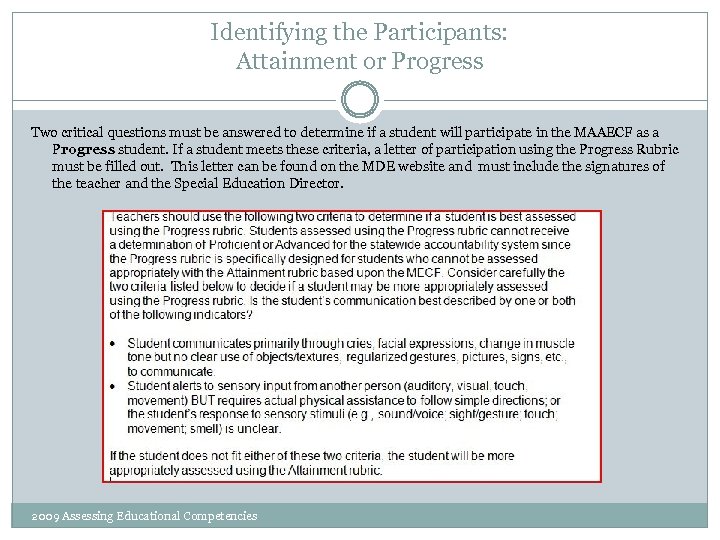 Identifying the Participants: Attainment or Progress Two critical questions must be answered to determine if a student will participate in the MAAECF as a Progress student. If a student meets these criteria, a letter of participation using the Progress Rubric must be filled out. This letter can be found on the MDE website and must include the signatures of the teacher and the Special Education Director. 2009 Assessing Educational Competencies
 Getting On the Right Track Step 1: Print a copy of the Mississippi Extended Curriculum Frameworks (revised December 2008) and the MAAECF Item Cluster sheets for your grade(s). Step 2: Review last year’s MAAECF results. Step 3: Write down objectives that were assessed on the 2009 MAAECF. Step 4: Choose objectives for the 2010 MAAECF for each student at the appropriate peer grade using the MAAECF Item Clusters: Data Collection Requirements Forms. Link for MAAECF Information and forms: http: //www. mde. k 12. ms. us/maaecf/ 2009 Assessing Educational Competencies
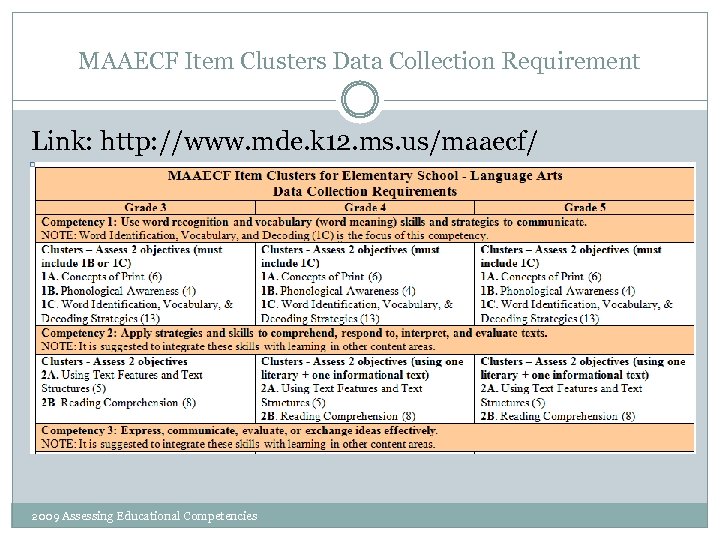 MAAECF Item Clusters Data Collection Requirement Link: http: //www. mde. k 12. ms. us/maaecf/ 2009 Assessing Educational Competencies
 Getting on the Right Track Evidence Collection: Ø When can evidence collection begin? Ø How much evidence is enough? Ø What types of evidence are appropriate to submit? Ø Why is the BASELINE important? Evidence Documentation Forms: Ø Use the correct form! Ø Fill out completely and correctly! 2009 Assessing Educational Competencies
 Beginning with the BASELINE STOP NOW! 1. 2. 2. 3. 4. If your baseline score is over 39%! If your baseline has fewer than five items! If your baseline evidence is not dated! If your baseline is prompted! If there is no student name on the evidence! 2009 Assessing Educational Competencies
 Staying on Course: Keeping between the lines The ALIGNMENT Issue ü Evidence must be aligned to the MECF. ü Both baseline and final must be aligned. ü If text is required on MECF objective – use text! ü Provide “other supporting” evidence as secondary evidence. 2009 Assessing Educational Competencies
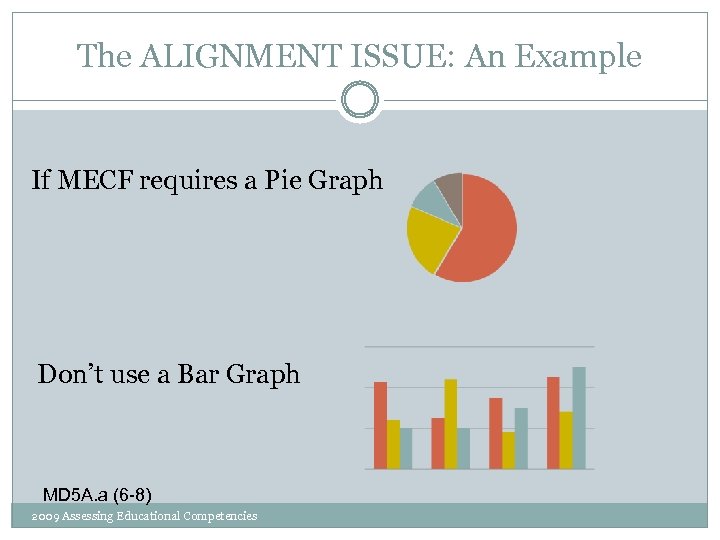 The ALIGNMENT ISSUE: An Example If MECF requires a Pie Graph Don’t use a Bar Graph MD 5 A. a (6 -8) 2009 Assessing Educational Competencies
 The ALIGNMENT ISSUE: Again When the MECF objective requires skip counting for 2’s, 3’s, 5’s and 10’s Don’t stop at 2’s ! MA 2 A. d (3 -5) 2009 Assessing Educational Competencies
 The ALIGNMENT ISSUE: Once More… When the MECF objective is to compose a letter, don’t just identify the parts of a letter. W 3 A. a (12) 2009 Assessing Educational Competencies
 Alignment: Don’t Forget! Safety in the Science Lab Grades 5, 8, and 12 SI 1 A. a (5, 8, 12) 2009 Assessing Educational Competencies
 Staying on Course: Collaborate o If the student has other teachers for Language, Math, or Science, work with them to achieve maximum benefit on student objectives. o Share specific objectives with the student’s other teachers. o Ask another teacher giving the MAAECF to review and critique your assessment. 2009 Assessing Educational Competencies
 Staying on Course: Tasks o Collect secondary evidence when you can. o Teach the objectives selected every chance you can. o Meet the deadlines provided by your Special Education Director. o Ask questions when you are not sure. o Become very familiar with the scoring rubrics! 2009 Assessing Educational Competencies
 The Final Performance REQUIREMENTS ü Minimum 15 days between baseline and final evidence collection ü MUST be aligned to MECF ü MUST NOT be the same assessment as the baseline, BUT… ü ü MUST have the same or close to the same number of items for scoring. MUST have a minimum of 5 items on a submitted task in order for the objective to be rated. 2009 Assessing Educational Competencies
 Interpreting the Signs: The Performance & Complexity Rubrics Ø Use the correct performance rubric The rubrics are different for Attainment and Progress students. Ø Use correct scoring procedures These are different for Attainment and Progress students. Ø Follow the prompt rule! Ø Evaluate Complexity = Complexity must be based upon the task presented. 2009 Assessing Educational Competencies
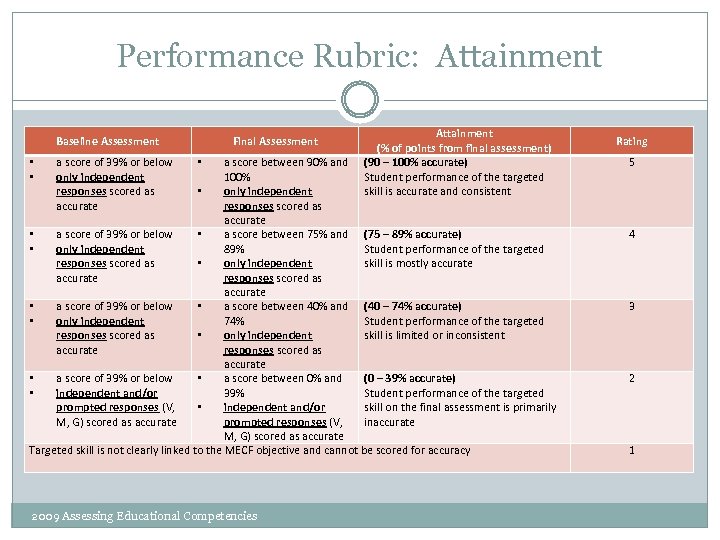 Performance Rubric: Attainment Baseline Assessment Attainment (% of points from final assessment) (90 – 100% accurate) Student performance of the targeted skill is accurate and consistent a score between 90% and 100% • only independent responses scored as accurate • a score of 39% or below • a score between 75% and (75 – 89% accurate) • only independent 89% Student performance of the targeted responses scored as • only independent skill is mostly accurate responses scored as accurate • a score of 39% or below • a score between 40% and (40 – 74% accurate) • only independent 74% Student performance of the targeted responses scored as • only independent skill is limited or inconsistent accurate responses scored as accurate • a score of 39% or below • a score between 0% and (0 – 39% accurate) • independent and/or 39% Student performance of the targeted prompted responses (V, • independent and/or skill on the final assessment is primarily M, G) scored as accurate prompted responses (V, inaccurate M, G) scored as accurate Targeted skill is not clearly linked to the MECF objective and cannot be scored for accuracy • • a score of 39% or below only independent responses scored as accurate Final Assessment • 2009 Assessing Educational Competencies Rating 5 4 3 2 1
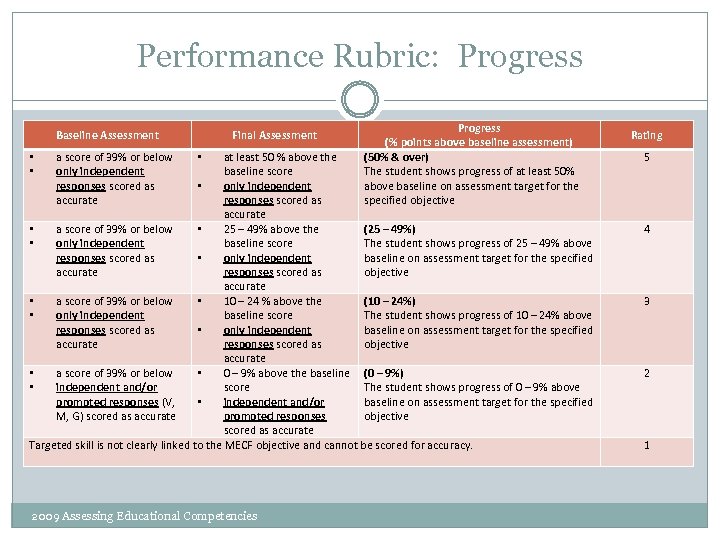 Performance Rubric: Progress Baseline Assessment Progress (% points above baseline assessment) (50% & over) The student shows progress of at least 50% above baseline on assessment target for the specified objective at least 50 % above the baseline score • only independent responses scored as accurate • a score of 39% or below • 25 – 49% above the (25 – 49%) • only independent baseline score The student shows progress of 25 – 49% above responses scored as • only independent baseline on assessment target for the specified accurate responses scored as objective accurate • a score of 39% or below • 10 – 24 % above the (10 – 24%) • only independent baseline score The student shows progress of 10 – 24% above responses scored as • only independent baseline on assessment target for the specified accurate responses scored as objective accurate • a score of 39% or below • 0 – 9% above the baseline (0 – 9%) • independent and/or score The student shows progress of 0 – 9% above prompted responses (V, • independent and/or baseline on assessment target for the specified M, G) scored as accurate prompted responses objective scored as accurate Targeted skill is not clearly linked to the MECF objective and cannot be scored for accuracy. • • a score of 39% or below only independent responses scored as accurate Final Assessment • 2009 Assessing Educational Competencies Rating 5 4 3 2 1
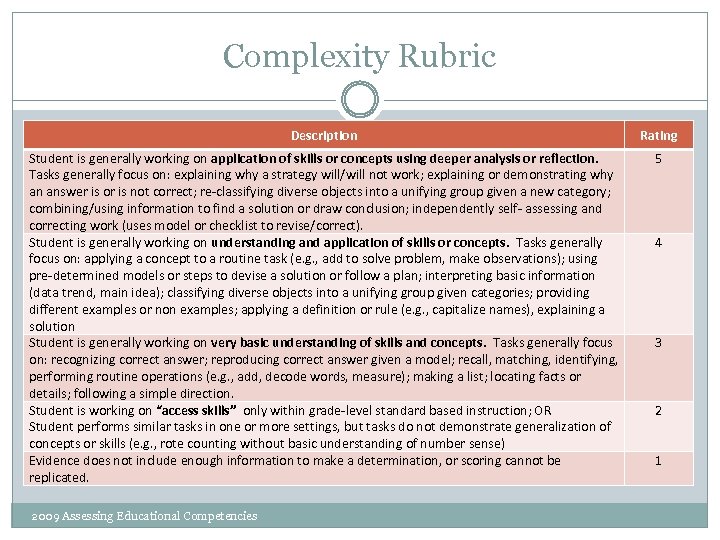 Complexity Rubric Description Rating Student is generally working on application of skills or concepts using deeper analysis or reflection. Tasks generally focus on: explaining why a strategy will/will not work; explaining or demonstrating why an answer is or is not correct; re-classifying diverse objects into a unifying group given a new category; combining/using information to find a solution or draw conclusion; independently self- assessing and correcting work (uses model or checklist to revise/correct). Student is generally working on understanding and application of skills or concepts. Tasks generally focus on: applying a concept to a routine task (e. g. , add to solve problem, make observations); using pre-determined models or steps to devise a solution or follow a plan; interpreting basic information (data trend, main idea); classifying diverse objects into a unifying group given categories; providing different examples or non examples; applying a definition or rule (e. g. , capitalize names), explaining a solution Student is generally working on very basic understanding of skills and concepts. Tasks generally focus on: recognizing correct answer; reproducing correct answer given a model; recall, matching, identifying, performing routine operations (e. g. , add, decode words, measure); making a list; locating facts or details; following a simple direction. Student is working on “access skills” only within grade-level standard based instruction; OR Student performs similar tasks in one or more settings, but tasks do not demonstrate generalization of concepts or skills (e. g. , rote counting without basic understanding of number sense) Evidence does not include enough information to make a determination, or scoring cannot be replicated. 5 2009 Assessing Educational Competencies 4 3 2 1
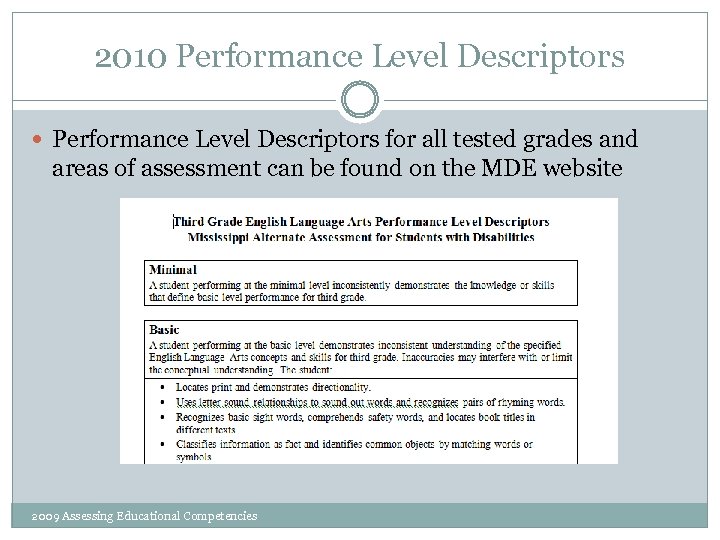 2010 Performance Level Descriptors for all tested grades and areas of assessment can be found on the MDE website 2009 Assessing Educational Competencies
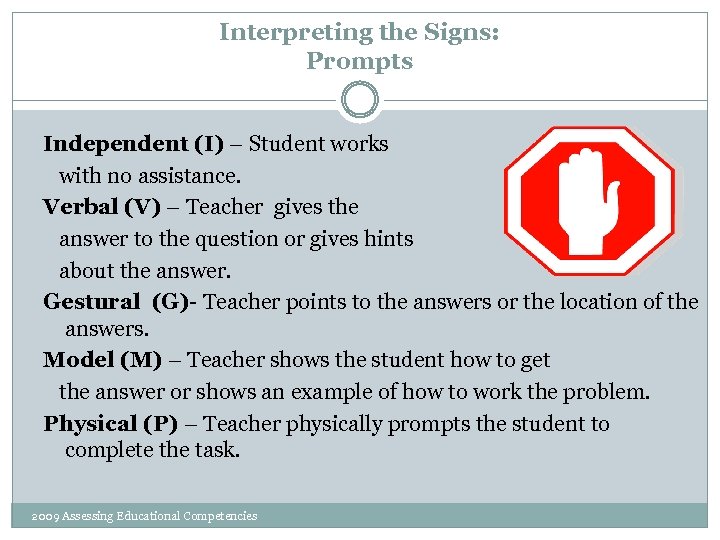 Interpreting the Signs: Prompts Independent (I) – Student works with no assistance. Verbal (V) – Teacher gives the answer to the question or gives hints about the answer. Gestural (G)- Teacher points to the answers or the location of the answers. Model (M) – Teacher shows the student how to get the answer or shows an example of how to work the problem. Physical (P) – Teacher physically prompts the student to complete the task. 2009 Assessing Educational Competencies
 Avoiding the Pitfalls Score student work correctly. Assign correct rubric scores. Know your prompts. Date everything. Completely fill out the Evidence Documentation Form for each objective. 6. Use informational and literary text when required. 7. Align Science to Math objective 5. 8. Write clear observations. 1. 2. 3. 4. 5. 2009 Assessing Educational Competencies
 Avoiding the Pitfalls 8. Do NOT use objectives from last 9. 10. 11. 12. 13. 2009 Assessing Educational Competencies year. Do NOT use evidence dated last school year. Do NOT record on the evidence that the student was physically prompted and then check the independent box on the Evidence Documentation sheet. Do not forget to record prompts. Clearly label and firmly attach all media. PROVIDE EVIDENCE!
 The Finish Line ü Signed ethics form ü Completed EDF ü Evidence for every objective ü Submission to your Sp. Ed Director by deadline set by your district. Deadline for all submissions (both online scoring and evidence documentation) to the RCU is by 5 PM Central Daylight Time is April 30, 2010! Anything submitted after this deadline will NOT be scored. 2009 Assessing Educational Competencies
 A Look at the 2009 Assessment: What was good & What can be improved upon Purpose for looking back 1. To critique 2. To ask questions 3. To plan for this year 2009 Assessing Educational Competencies Goal for looking back 1. To have an error free assessment 2. To improve evidence quality 3. To improve student performance
 Ready to GO! For answers to questions: dionaberry@aecnow. com donna@aecnow. com 2009 Assessing Educational Competencies