


 Скачать презентацию 2010 Long-Term Surveillance and Maintenance Conference Applied Science
82c40277c45d34c08c966c1c1bbf8e56.ppt
- Количество слайдов: 29
 2010 Long-Term Surveillance and Maintenance Conference Applied Science and Technology for the U. S. Department of Energy Office of Legacy Management Grand Junction, Colorado November 2010
 2010 Long-Term Surveillance and Maintenance Conference Today’s Format n n n n Two-hour session to accommodate facilitated discussion Presentation on the U. S. Department of Energy’s Office of Legacy Management (LM) Applied Science & Technology (AS&T) program Introduce Panel – brief summaries Break? Proposed discussion topics Full audience participation Goal: discuss opinions on future direction of groundwater research for long-term surveillance and maintenance (LTS&M) Product: chart of favorable areas for applied research for groundwater remediation 2
 2010 Long-Term Surveillance and Maintenance Conference AS&T Subtask LM provides funding through AS&T to: n Evaluate technologies to improve LTS&M remediation strategies. n Solve mechanical and chemical problems in LM activities at sites. n Use technologies to make remedies more sustainable. 3
 2010 Long-Term Surveillance and Maintenance Conference Two Main Areas of Emphasis n Groundwater projects n Surface projects (disposal cell covers, phytoremediation) 4
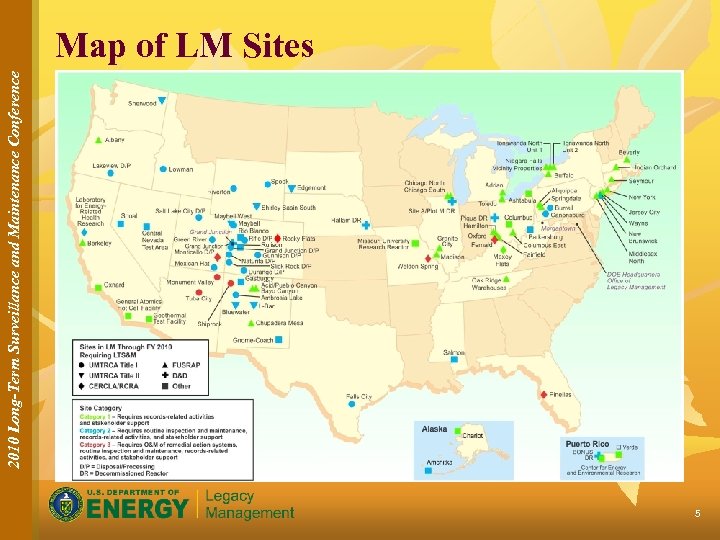 2010 Long-Term Surveillance and Maintenance Conference Map of LM Sites 5
 2010 Long-Term Surveillance and Maintenance Conference Main Contaminants n Uranium n Nitrate n Sulfate n Ammonium n Vanadium n Molybdenum n Selenium n Arsenic n Volatile organic compounds (VOCs) n Fission products (e. g. , tritium) 6
 2010 Long-Term Surveillance and Maintenance Conference AS&T Projects Analysis Charts n Only includes projects within AS&T; includes some projects from LM predecessor [Office of Environmental Management (EM)] n Includes many other projects in LM that have technology innovations; e. g. , Rocky Flats, Pinellas, Central Nevada Test Area n There are lumpers and splitters; organized by project reports 7
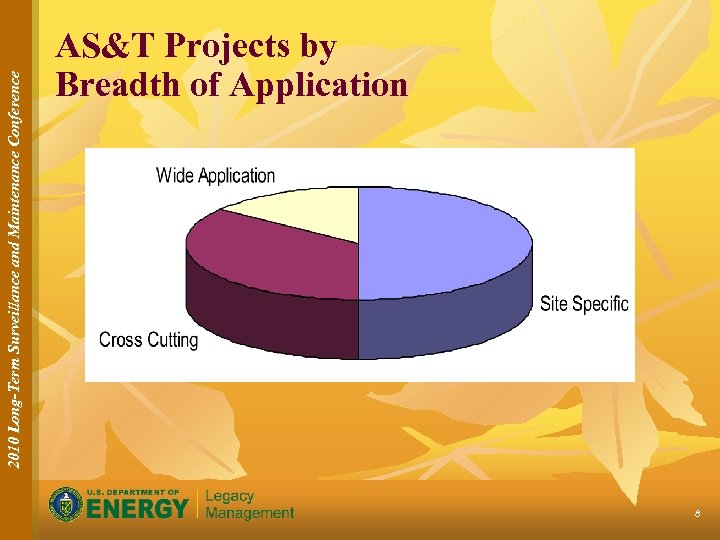 2010 Long-Term Surveillance and Maintenance Conference AS&T Projects by Breadth of Application 8
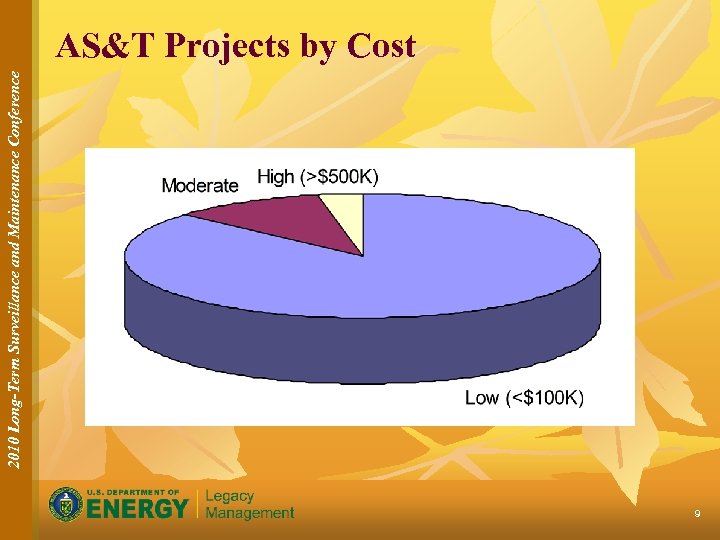 2010 Long-Term Surveillance and Maintenance Conference AS&T Projects by Cost 9
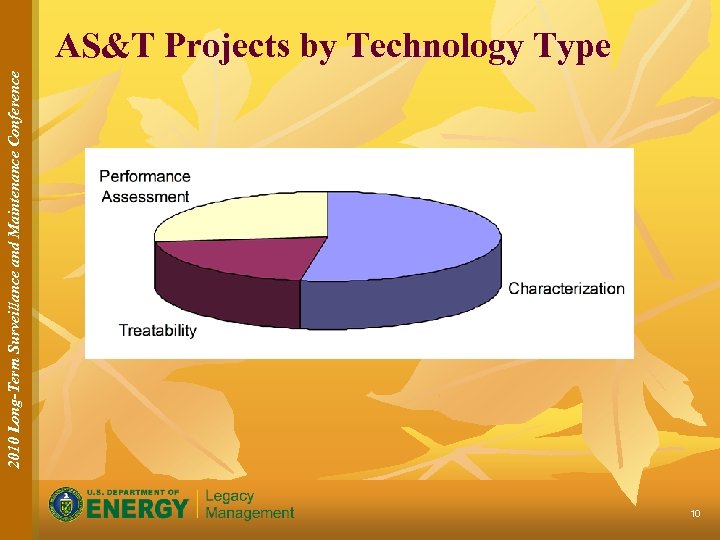 2010 Long-Term Surveillance and Maintenance Conference AS&T Projects by Technology Type 10
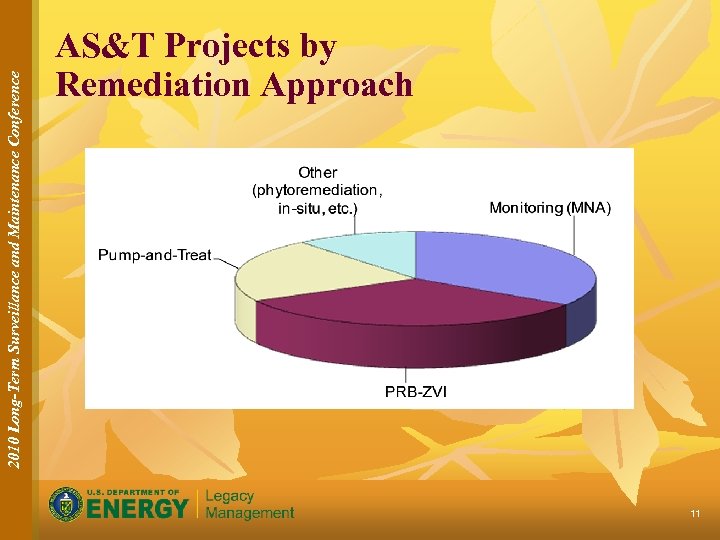 2010 Long-Term Surveillance and Maintenance Conference AS&T Projects by Remediation Approach 11
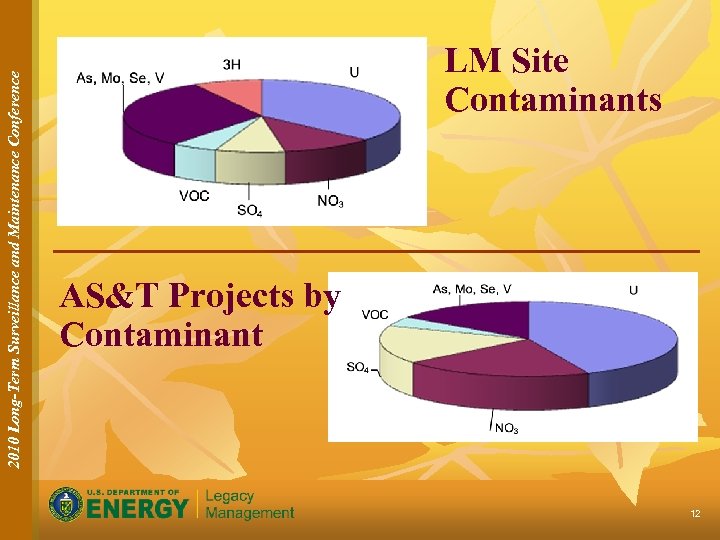 2010 Long-Term Surveillance and Maintenance Conference LM Site Contaminants AS&T Projects by Contaminant 12
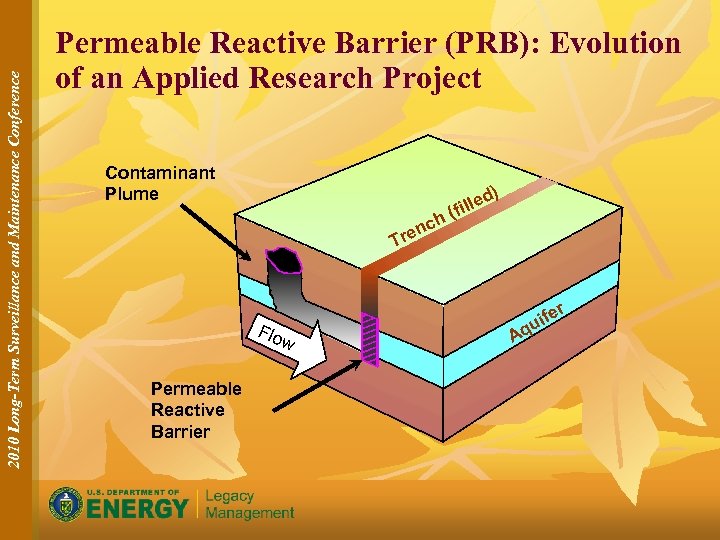 2010 Long-Term Surveillance and Maintenance Conference Permeable Reactive Barrier (PRB): Evolution of an Applied Research Project Contaminant Plume ch n Tre d ille (f ) r Flo Permeable Reactive Barrier w Aq e uif
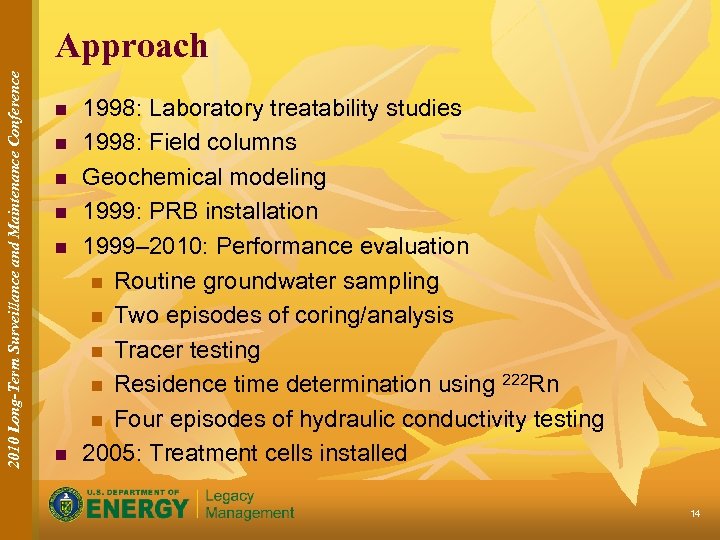 2010 Long-Term Surveillance and Maintenance Conference Approach n n n 1998: Laboratory treatability studies 1998: Field columns Geochemical modeling 1999: PRB installation 1999– 2010: Performance evaluation n Routine groundwater sampling n Two episodes of coring/analysis n Tracer testing n Residence time determination using 222 Rn n Four episodes of hydraulic conductivity testing 2005: Treatment cells installed 14
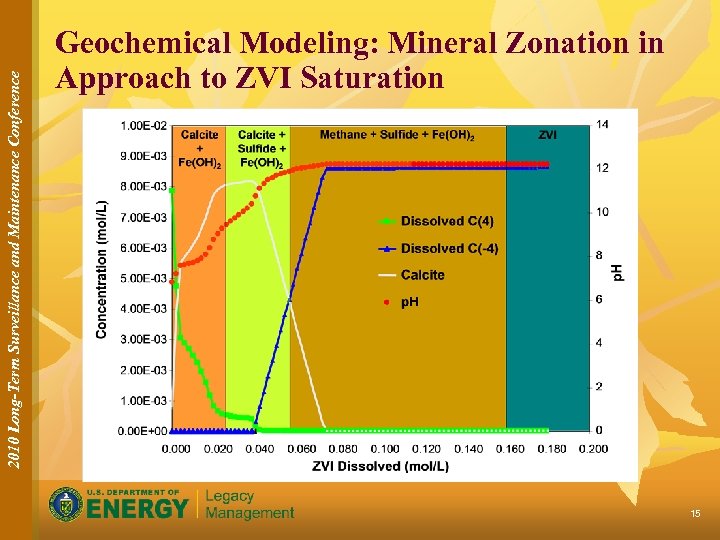 2010 Long-Term Surveillance and Maintenance Conference Geochemical Modeling: Mineral Zonation in Approach to ZVI Saturation 15
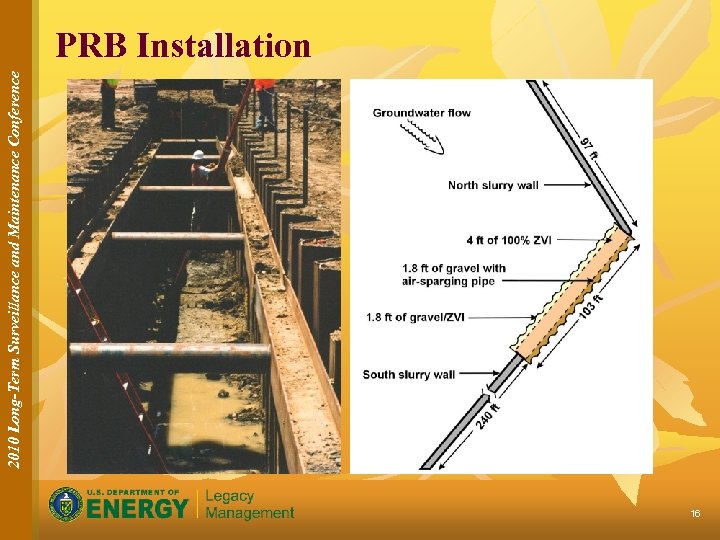 2010 Long-Term Surveillance and Maintenance Conference PRB Installation 16
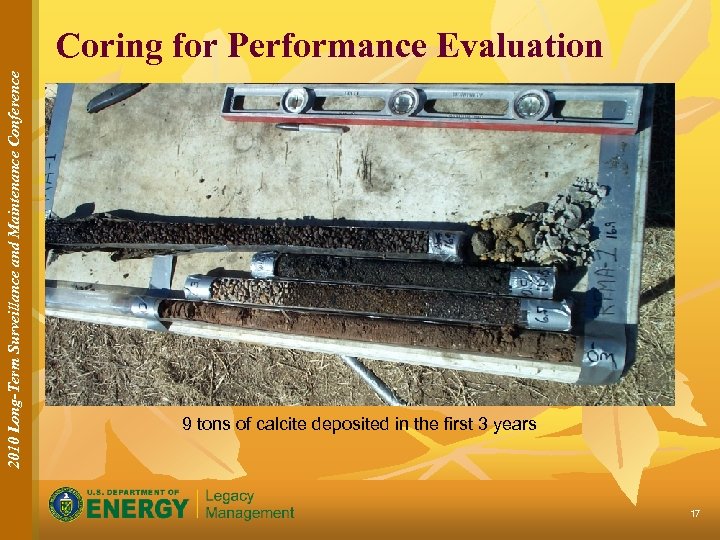 2010 Long-Term Surveillance and Maintenance Conference Coring for Performance Evaluation 9 tons of calcite deposited in the first 3 years 17
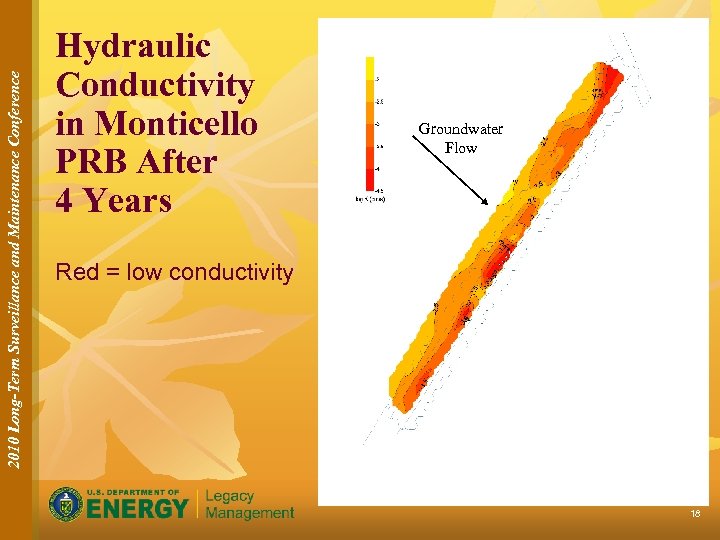 2010 Long-Term Surveillance and Maintenance Conference Hydraulic Conductivity in Monticello PRB After 4 Years Groundwater Flow Red = low conductivity 18
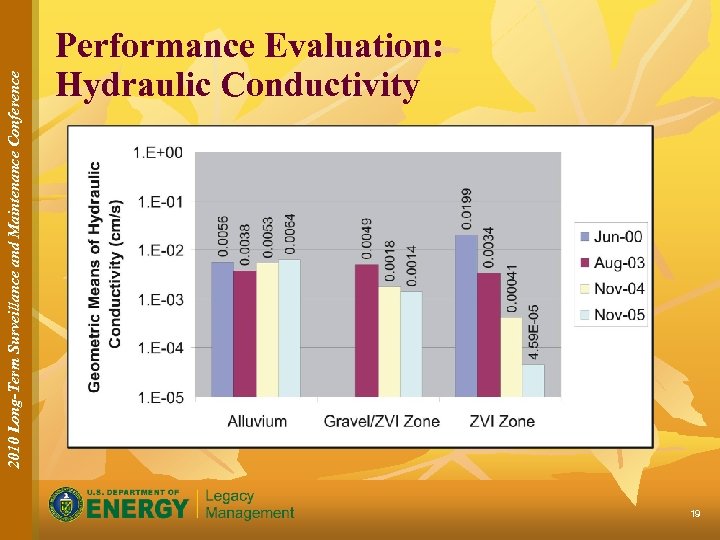 2010 Long-Term Surveillance and Maintenance Conference Performance Evaluation: Hydraulic Conductivity 19
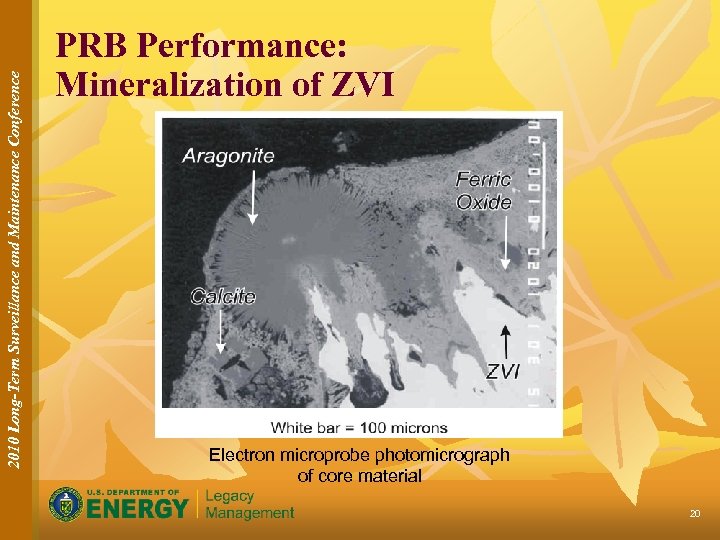 2010 Long-Term Surveillance and Maintenance Conference PRB Performance: Mineralization of ZVI Electron microprobe photomicrograph of core material 20
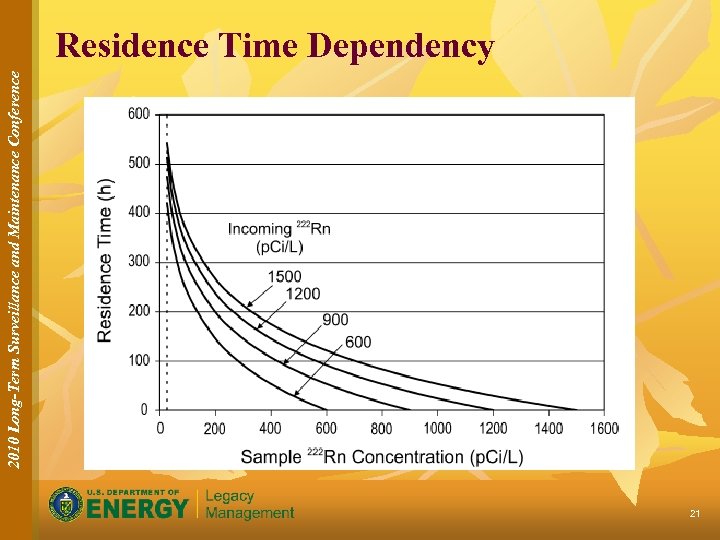 2010 Long-Term Surveillance and Maintenance Conference Residence Time Dependency 21
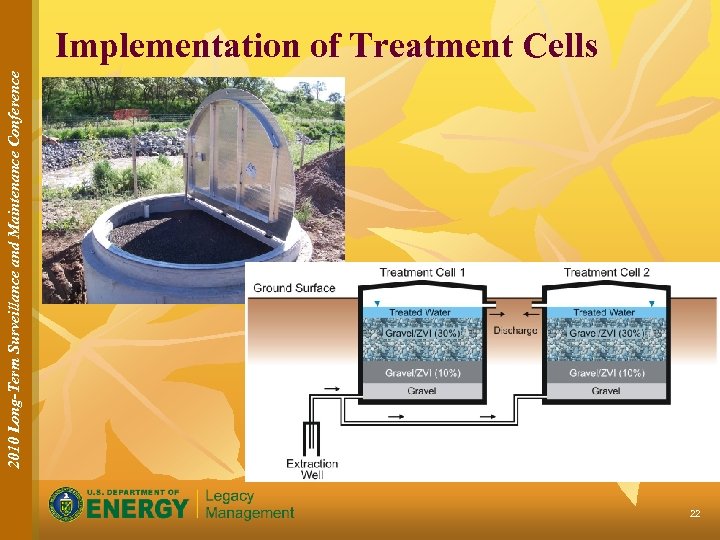 2010 Long-Term Surveillance and Maintenance Conference Implementation of Treatment Cells 22
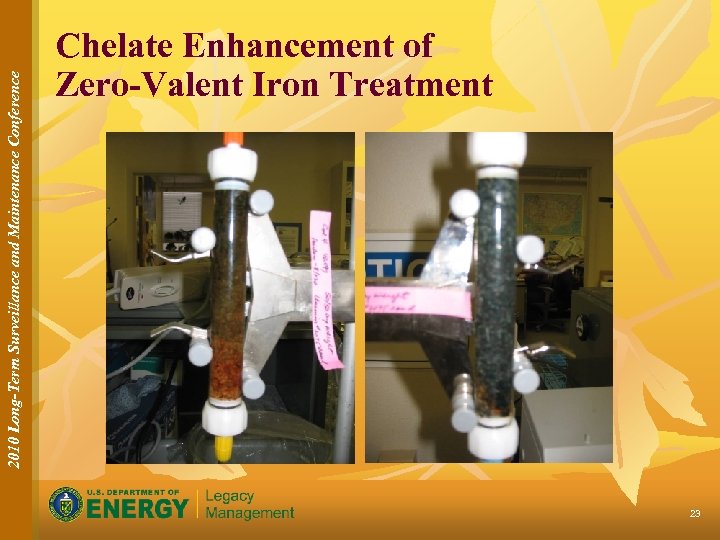 2010 Long-Term Surveillance and Maintenance Conference Chelate Enhancement of Zero-Valent Iron Treatment 23
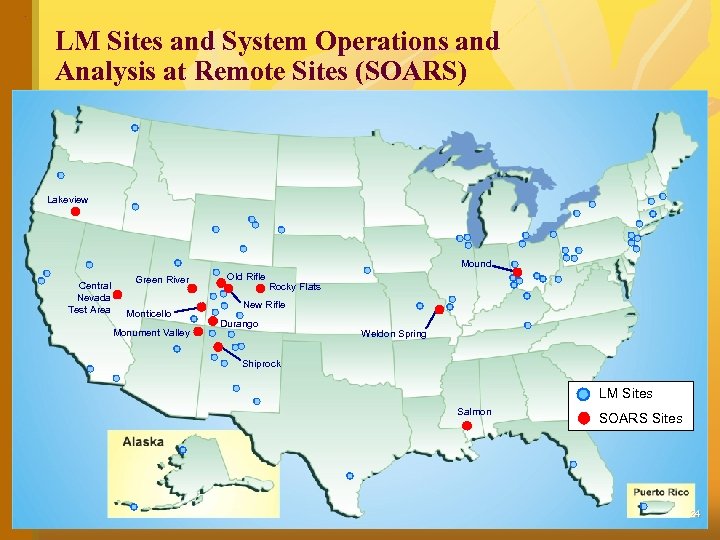 LM Sites and System Operations and Analysis at Remote Sites (SOARS) Lakeview Mound Central Nevada Test Area Green River Monticello Monument Valley Old Rifle Rocky Flats New Rifle Durango Weldon Spring Shiprock LM Sites Salmon SOARS Sites 24
 2010 Long-Term Surveillance and Maintenance Conference SOARS System Innovations n Post processor allows instant access by all LM personnel; reliable means to record notes on activities n Use of three-point calculations that automatically plot the orientation and velocity of groundwater n Remote collection of tracer data (rhodamine) n Remote operation of well pumps (automated pump tests) 25
 2010 Long-Term Surveillance and Maintenance Conference Summary: LM’s AS&T Program (Groundwater) 1. Operate geochemical/ecological laboratory 2. Operate SOARS telemetry system 3. Conduct applied scientific research 4. Directions to date have emphasized: n Low cost n Site-specific projects n Radionuclide/sulfate/nitrate/oxyanion contaminants n Site characterization/remediation What directions should applied science for legacy management be going? 26
 2010 Long-Term Surveillance and Maintenance Conference Start of Facilitated Session 27
 2010 Long-Term Surveillance and Maintenance Conference Suggested Discussion Topics n Big or small science n Promising technologies for groundwater remediation. What should LM’s role be? n What are other agencies (e. g. , DOE-EM, DOE Office of Science, U. S. Department of Defense, Armys Corps, U. S. Geological Survey, U. S. Environmental Protection Agency) doing? Overlap? n Basic research vs. applied research vs. project support n Groundwater remediation vs. point-of-use treatment 28
 2010 Long-Term Surveillance and Maintenance Conference Suggested Discussion Topics (continued) n Groundwater contamination n n Is it better to stabilize groundwater contamination (e. g. , acetate injection) or enhance removal (e. g. , in-situ leaching with oxidant and carbonate for uranium)? Monitored natural attenuation (MNA) n n Is this going to be the future? n How to approach MNA? n n How much emphasis? Major issues and future of research? Technical impracticability n What is it and what role does it play? 29