


 Скачать презентацию 2009 AAG Annual Meeting Las Vegas March 25
465f1d36fcb96f8e9bc7f34839894b36.ppt
- Количество слайдов: 18
 2009 AAG Annual Meeting, Las Vegas March 25, 2009 Creating a Virtual Organization (VO) for Digital Earth Research by Dr. Ming-Hsiang (Ming) Tsou Associate Professor E-mail: mtsou@mail. sdsu. edu The Department of Geography, San Diego State University
 What is a Virtual Organization? • Virtual Organization (a fundamental to modern computing): “enable disparate groups of organizations and/or individuals to share resources in a controlled fashion, so that members may collaborate to achieve a shared goal. ( Foster et al. , The Anatomy of the Grid, Enabling Scalable Virtual Organizations, Intl. J. Supercomputer Applications, 2001, p. 5. ). • Grid computing will facilitate the establishment of VOs. • Virtual Organization is utilizing Cyberinfrastructure to perform tasks. • VOs have the potential to change dramatically the way we use computers to solve problems. (similar to the web for exchanging problems information).
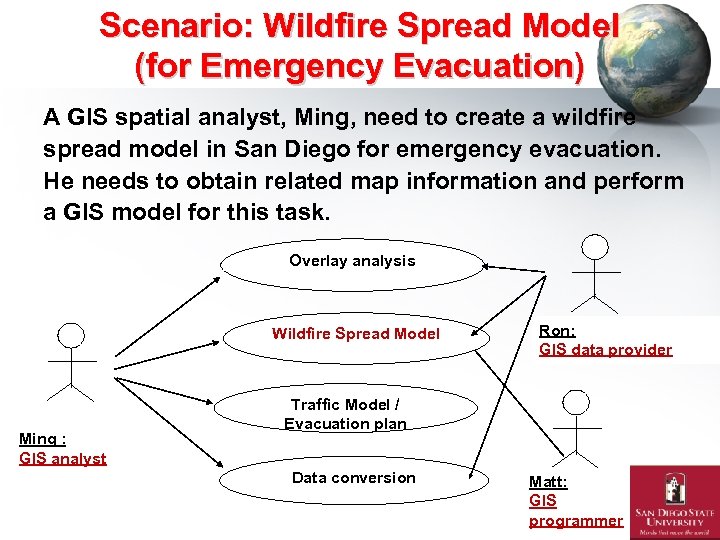 Scenario: Wildfire Spread Model (for Emergency Evacuation) A GIS spatial analyst, Ming, need to create a wildfire spread model in San Diego for emergency evacuation. He needs to obtain related map information and perform a GIS model for this task. Overlay analysis Wildfire Spread Model Ming : GIS analyst Ron: GIS data provider Traffic Model / Evacuation plan Data conversion Matt: GIS programmer
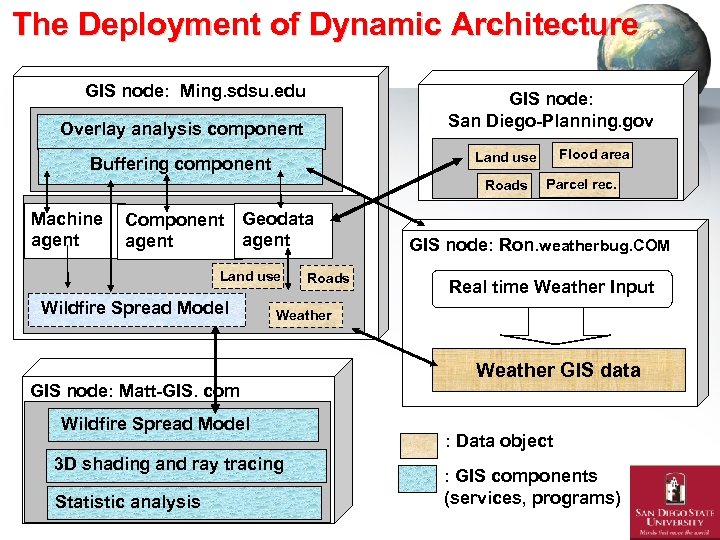 The Deployment of Dynamic Architecture GIS node: Ming. sdsu. edu GIS node: San Diego-Planning. gov Overlay analysis component Roads Machine agent Component Geodata agent Land use Wildfire Spread Model Roads Parcel rec. GIS node: Ron. weatherbug. COM Real time Weather Input Weather GIS node: Matt-GIS. com Wildfire Spread Model 3 D shading and ray tracing Statistic analysis Flood area Land use Buffering component Weather GIS data : Data object : GIS components (services, programs)
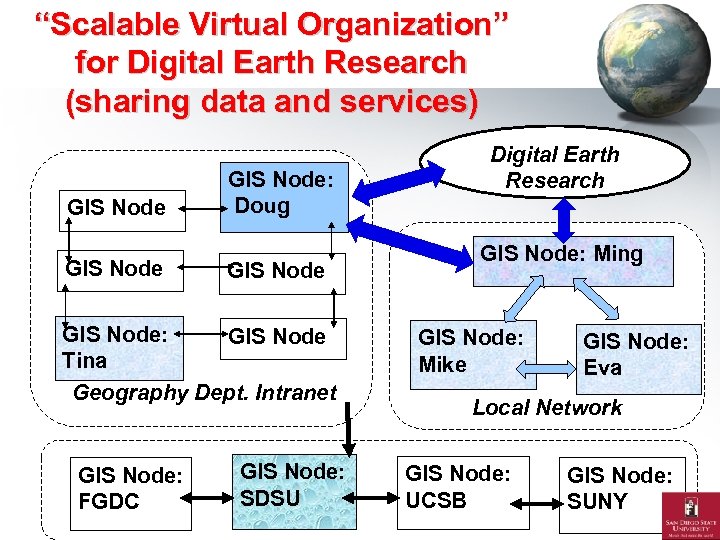 “Scalable Virtual Organization” for Digital Earth Research (sharing data and services) GIS Node: Doug GIS Node: GIS Node Tina Geography Dept. Intranet GIS Node: FGDC GIS Node: SDSU Digital Earth Research GIS Node: Ming GIS Node: Mike GIS Node: Eva Local Network GIS Node: UCSB GIS Node: SUNY
 Why Digital Earth (DE) Research need Virtual Organizations ? • The Grand Challenge of GIScience (Goodchild. 2008). • Many DE research problems can not be solved by a single person or a single organization – Dynamic Visualization of Climate Changes. – GIS Simulation for population changes. – Disaster responses and recovery.
 Virtual Organization from a computer science perspective • Flexible networks of independent, globally distributed entities (individuals or institutions) that share knowledge and resources and work toward a common goal. (Ripeanu, et al. , 2008, IEEE Internet Computing March/April). • A VO aggregates services and computing resources to meet the needs of a distributed user community. (shared goal) (Qi et al. , 2008 IEEE Internet Computing). • Dynamic Instantiation of Community Services (Qi et al. 2008) • A container in a Web service-based system must support on-demand provisioning. (Qi et al. 2008)
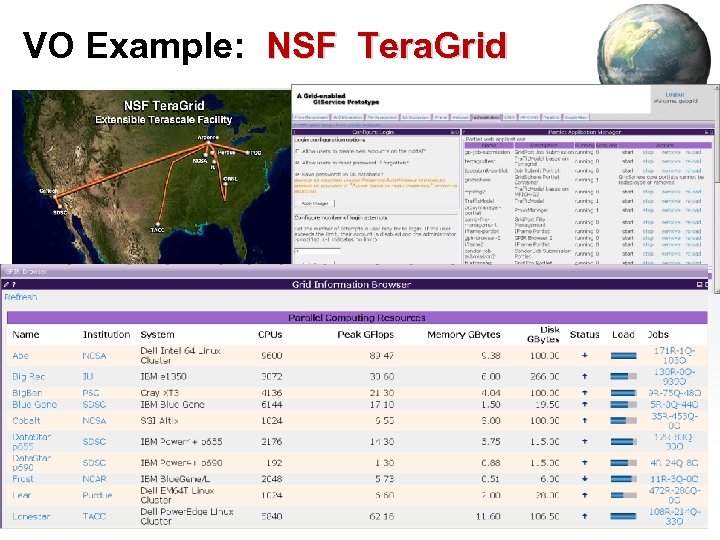 VO Example: NSF Tera. Grid
 Virtual Organization from a business perspective (contract) • VOs as coordinated collaborations among business entities that share common goals. Upon join the “enterprise network”, organizations must agree to a series of terms and conditions. (Aernas, et al. , 2008, IEEE Internet Computing March/April) • VO can pull together sufficient resources to exploit opportunities that no organization could tackle alone. • Trust among VO members can be supported if each is transparently aware of the others’ obligations and performance. • Legal contracts. - reduce the risks of collaboration.
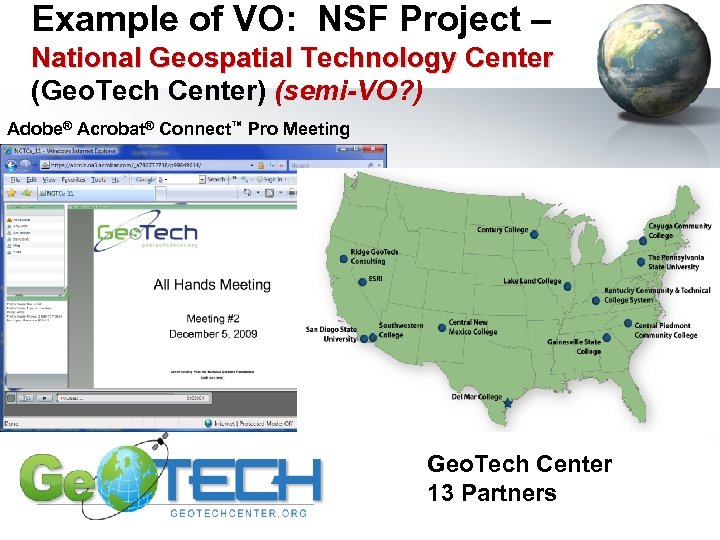 Example of VO: NSF Project – National Geospatial Technology Center (Geo. Tech Center) (semi-VO? ) Adobe® Acrobat® Connect™ Pro Meeting Geo. Tech Center 13 Partners
 Virtual Organization Criteria: • Dynamic formalize the relationships among partners (contracts). • Resource aggregation (computing resources) • Tool integration (models, functions, services) • Dynamic creation and termination of VO • Reliable performance (Quality of Services) • Dynamic sharing relationship (a client can become a server, a server can become a client). • Discovering the relationships that exist at a particular point in time.
 Challenges for Digital Earth Research VO • • Efficiency (GIS models are computation-intensive) Service isolation (quality of services), Correctness (geospatial data accuracy in VO), Security (sensitive geodata) • Derived from (Qi et al, 2008). • • Interoperability (different data format, service formats). Access control (user groups and privileges) Scalability (How many participants for each VO? ) Ease of use and management (interface design) • (Coppola et al, 2008).
 The uniqueness of a geospatial Virtual Organization • From the perspective of a geospatial Virtual Organization, the grid-enabled GIServices will support highly scalable operations like efficient query of geospatial resources, fast and interoperable geospatial data transfer, geospatially oriented parallel processing and powerful fault-tolerance capabilities. (Armstrong et al. 2008).
 Creating VO based on today’s papers. • Virtual Geographic Environment for Pearl River Delta Air pollution Simulation (Hui Lin) • Map Impervious Surface Globally (Benjamin Tuttle) • Three Dimensional Mapping Tools (Joshua) • Water and Energy Cycle EOS House (Zhenlong Li) VOs have the potential to change dramatically the way we use computers to solve problems.
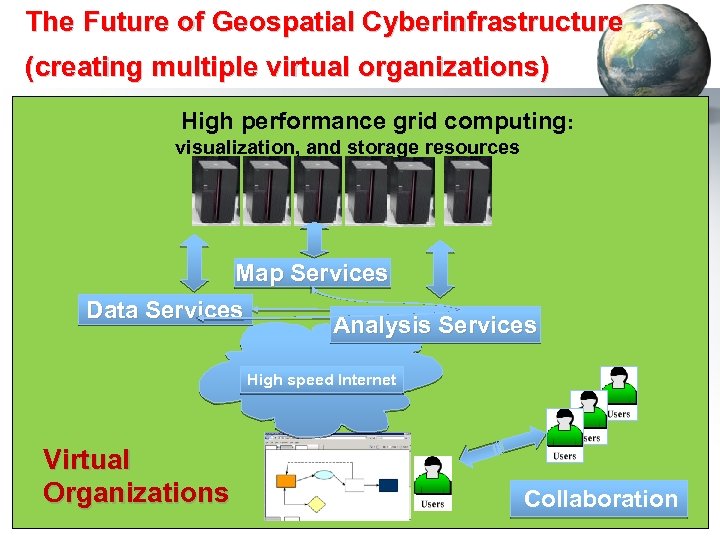 The Future of Geospatial Cyberinfrastructure (creating multiple virtual organizations) High performance grid computing: visualization, and storage resources Map Services Data Services Analysis Services High speed Internet Virtual Organizations Collaboration
 Some Suggestions for Digital Earth Research: • Business community and computer science community provide a good guidance for developing VO for Digital Earth and GIScience. • Many detail implementation issues need to be solved (GIS containers, operational metadata, interoperability, etc). Some problems are “unique” for GIS and geodata. • Volunteer Geographic Information (VGI) might need to form VO with more concrete “contracts” and legal bindings for the “volunteers” to control the quality of information in VGI. • Digital Earth Research needs two types of VO – • Task-oriented VO (actual collaboration on tasks and projects) • Social networking (just sharing information)
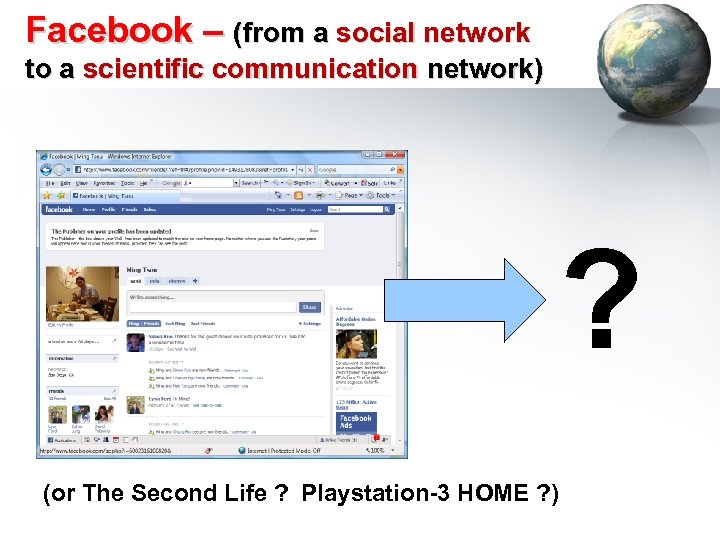 Facebook – (from a social network to a scientific communication network) ? (or The Second Life ? Playstation-3 HOME ? )
 Thank You Q&A Ming-Hsiang (Ming) Tsou E-mail: mtsou@mail. sdsu. edu