 Скачать презентацию 2008 Quebec Forum on Electricity Business Opportunities in
cf2511842d629cee0cdbe817d96bd173.ppt
- Количество слайдов: 47



2008 Quebec Forum on Electricity: Business Opportunities in the Rest of Canada RON EZEKIEL Fasken Martineau Tel: 604 631 4708 Email: rezekiel@fasken. com With the assistance of: Brenden Hunter, Calgary Raziel Zisman, Toronto
Outline Markets Participants Structure Opportunities Challenges Transmission NIMBYism First Nations
Markets: Participants BC BC Hydro managed most of BC’s generation, transmission and distribution In 2002 (and subsequent) energy plans and 2003 Transmission Corporation Act: BC Hydro’s role in new generation is limited, with most new generation to come from IPPs. BC Hydro’s transmission role transferred to new Crown corporation, British Columbia Transmission Corporation
Markets: Participants Alberta Historically, no one dominant vertically integrated utility, but a variety with an integrated transmission network (ATCO, Trans. Alta, EPCOR) 1995 Electricity Utilities Act established: independent entity, Power Pool, to administer hourly wholesale market Transmission Administrator role to operate Tx system
Markets: Participants Alberta New 2003 Electricity Utilities Act consolidated Power Pool and Transmission Administrator functions into AESO
Markets: Participants Ontario Hydro managed most of Ontario’s generation, transmission and distribution In 1998 Electricity Act, Ontario Hydro’s role was divided up: Generation: OPG and IPPs Transmission: Hydro One Distribution: Hydro One and other D COs. Market: IESO
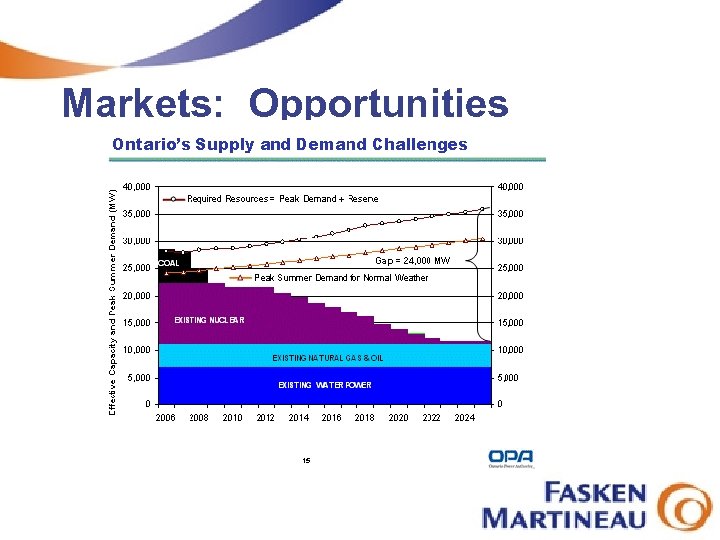
Markets: Participants Ontario System Planning left to market, resulted in demand supply gap in 2002 Electricity Restructuring Act of 2004 created the OPA, responsible for ensuring long term supply, including through planning and DSM/conservation
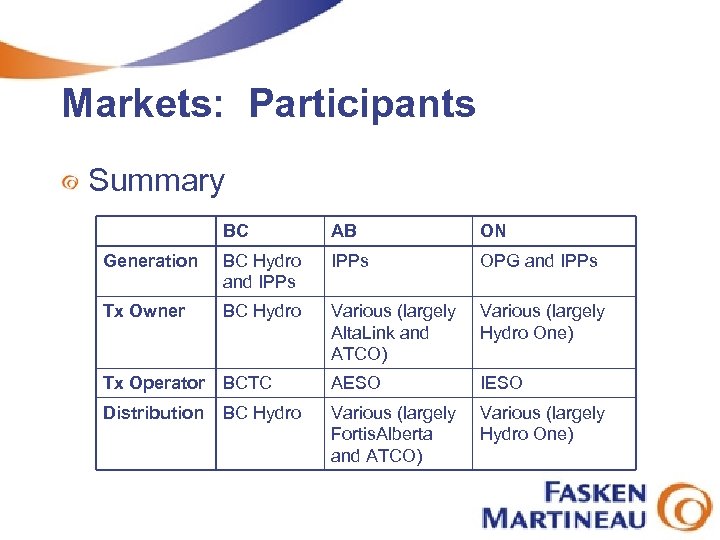
Markets: Participants Summary BC AB ON Generation BC Hydro and IPPs OPG and IPPs Tx Owner BC Hydro Various (largely Alta. Link and ATCO) Various (largely Hydro One) Tx Operator BCTC AESO IESO Distribution BC Hydro Various (largely Fortis. Alberta and ATCO) Various (largely Hydro One)
Markets: Structure BC No real wholesale market BC Hydro predominant buyer In 2005, BCUC approved BC Hydro tariff permitting industrials to purchase electricity from third parties, but stepped rates and uncertainty over assured supply limit attractiveness Export opportunities limited; limited availability on interties; Powerex an option
Markets: Structure Alberta Pool system One hour bids for rolling 7 day periods AESO develops a merit order, taking into account congestion and constraints Scheduling is day-ahead Pool price is weighted average marginal price over the hour – all sellers receive and all buyers pay the pool price
Markets: Structure Ontario Pool System - similar to Alberta IESO balances supply and demand dispatches generation accordingly Pool price is weighted average marginal price over the hour – all sellers receive and all buyers pay the pool price Where pool price less than PPA price, there may be a top up from OPA to seller
Markets: Opportunities BC 2007 Energy Plan Energy self-sufficiency, through Special Direction No. 10, directs BCUC to regulate BC Hydro to achieve electricity self-sufficiency by 2016 and each year thereafter
Markets: Opportunities BC Bill 15, Utilities Commission Amendment Act, 2008 BCUC must consider the “government’s energy objectives” in assessing long term resource plans reduce greenhouse gas emissions demand-side management produce, generate and acquire electricity from clean or renewable sources
Markets: Opportunities BC Bill 31, Greenhouse Gas Reduction (Emission Standards) Statutes Amendment Act, 2008 requires: CCS of GHG emissions at least equal to emissions of prescribed GHGs attributable to use of coal for generation Net zero GHG emissions from natural gasfired generation facilities; existing facilities given until 2016 to comply
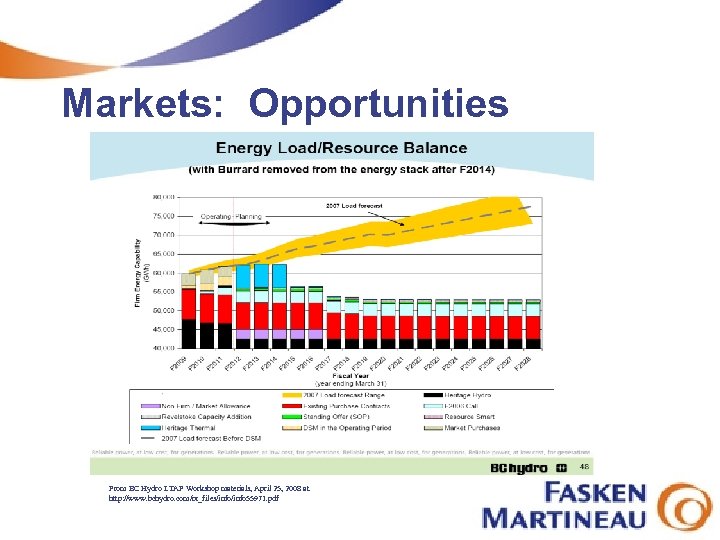
Markets: Opportunities From BC Hydro LTAP Workshop materials, April 25, 2008 at http: //www. bchydro. com/rx_files/info 55971. pdf
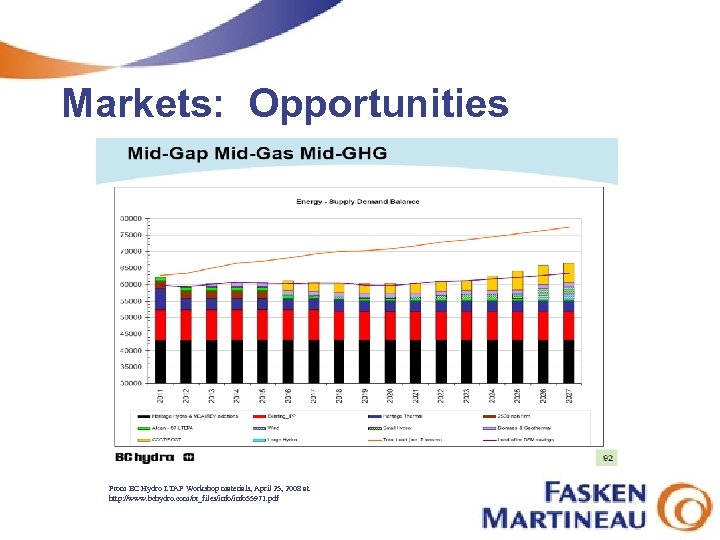
Markets: Opportunities From BC Hydro LTAP Workshop materials, April 25, 2008 at http: //www. bchydro. com/rx_files/info 55971. pdf
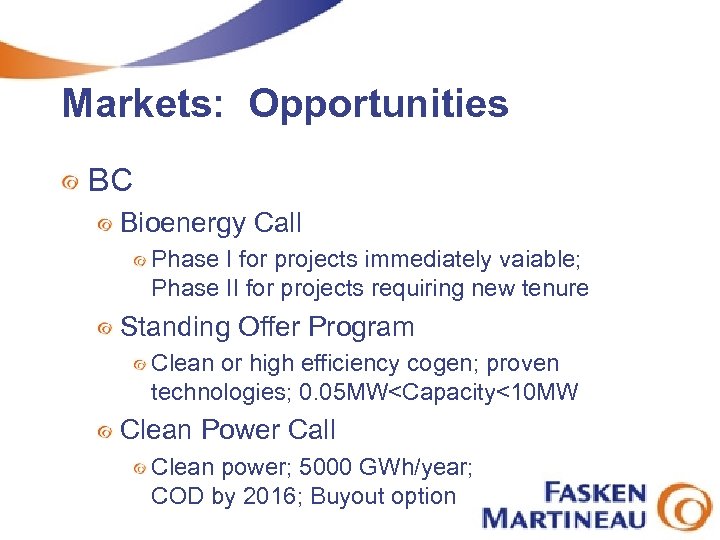
Markets: Opportunities BC Bioenergy Call Phase I for projects immediately vaiable; Phase II for projects requiring new tenure Standing Offer Program Clean or high efficiency cogen; proven technologies; 0. 05 MW<Capacity<10 MW Clean Power Call Clean power; 5000 GWh/year; COD by 2016; Buyout option
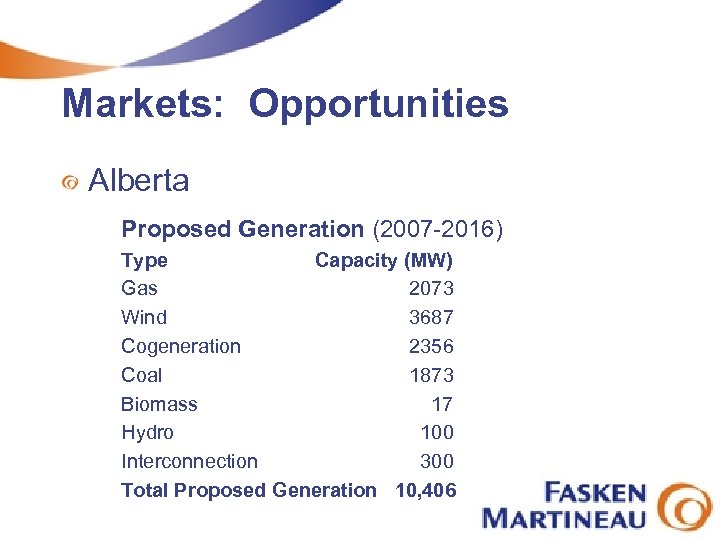
Markets: Opportunities Alberta Proposed Generation (2007 -2016) Type Capacity (MW) Gas 2073 Wind 3687 Cogeneration 2356 Coal 1873 Biomass 17 Hydro 100 Interconnection 300 Total Proposed Generation 10, 406
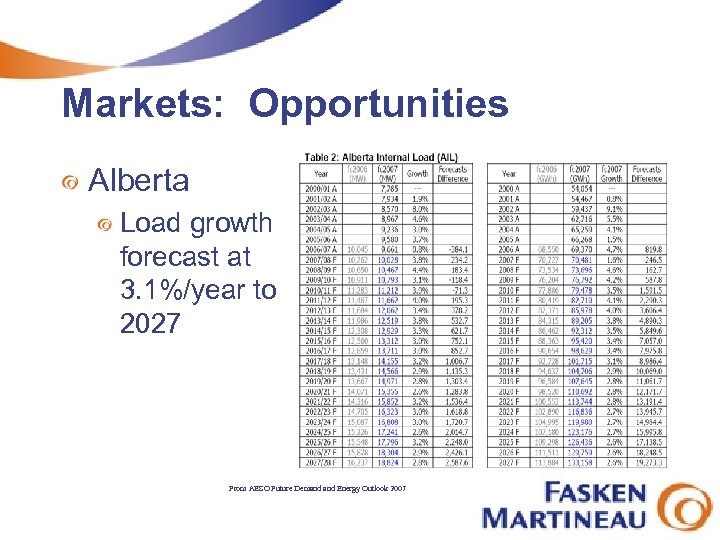
Markets: Opportunities Alberta Load growth forecast at 3. 1%/year to 2027 From AESO Future Demand Energy Outlook 2007
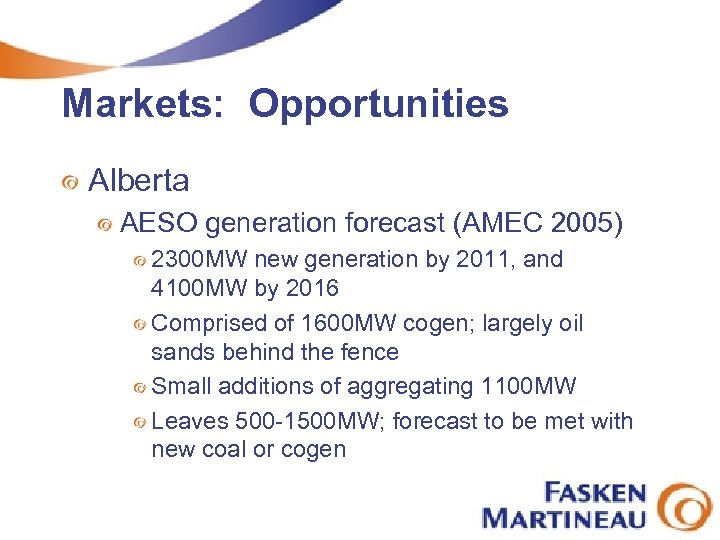
Markets: Opportunities Alberta AESO generation forecast (AMEC 2005) 2300 MW new generation by 2011, and 4100 MW by 2016 Comprised of 1600 MW cogen; largely oil sands behind the fence Small additions of aggregating 1100 MW Leaves 500 -1500 MW; forecast to be met with new coal or cogen
Markets: Opportunities Alberta Bioenergy Plan 9 point plan aimed at developing and expanding biodiesel, biogas and ethanol Wind 2006 cap of 900 MW eliminated
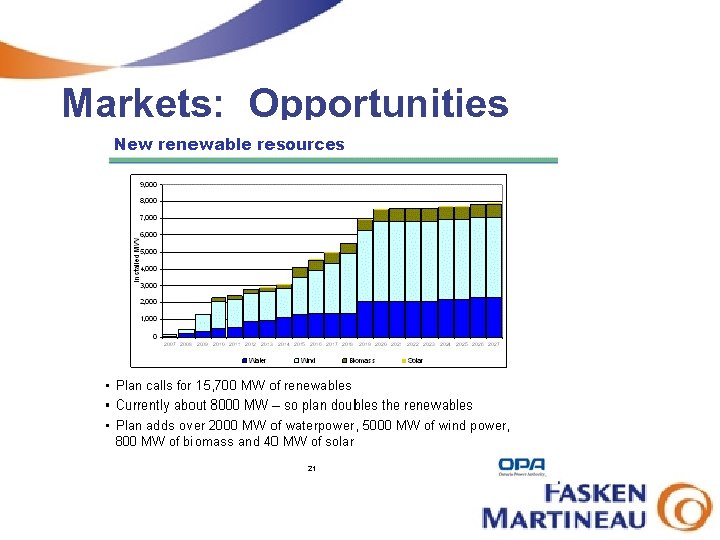
Markets: Opportunities Ontario Government’s 2006 Supply Mix Directive 6300 MW peak reduction through DSM by 2025 10, 402 MW of renewables by 2010, and 15, 700 MW by 2025 Limit nuclear to 14000 MW Phase-out coal ASAP Gas for peak, high value applications Build transmission
Markets: Opportunities Ontario OPA filed Integrated Power System Plan in 2007 to implement Directive OEB Issue List decision March 2008 Review expected to commence mid-2008
Markets: Opportunities
Markets: Opportunities
Markets: Opportunities Ontario OPA is responsible for procurement of supply, but PPAs only provide for a revenue floor -- set to stimulate investment, but not to prop up or subsidize uneconomic generation Generators, distributors, wholesale customers and retailers sell and buy energy through the IESO market
Markets: Opportunities Ontario OPA procurement activities, largely competitive (RFP, RFQ, etc. ) Standard Offer Program Wind, hydro, solar, biomass Capacity<10 MW 20 year EPA Solar @ $0. 42/k. Wh; others @ $0. 11/k. Wh (20% indexed for inflation) + $0. 0352/k. Wh for reliable peak deliveries
Challenges: Transmission BC
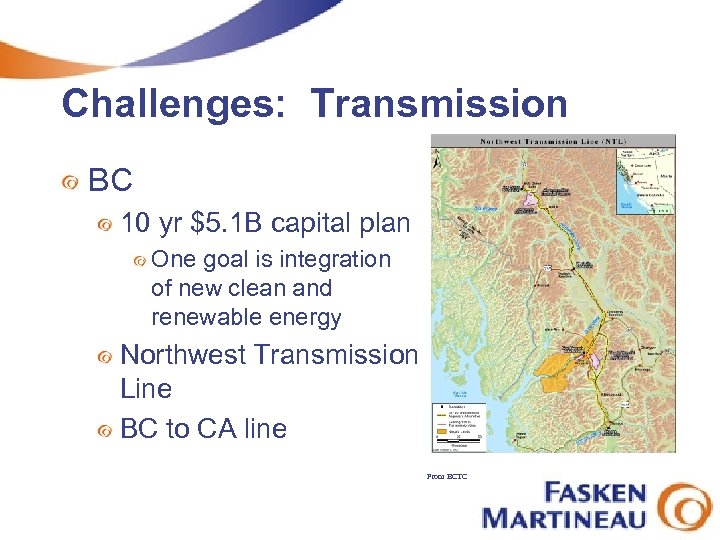
Challenges: Transmission BC 10 yr $5. 1 B capital plan One goal is integration of new clean and renewable energy Northwest Transmission Line BC to CA line From BCTC
Challenges: Transmission Alberta The high cost of suboptimal generation being developed in response to transmission constraints is a substantial burden to customers that can be avoided if congestion is eliminated
Challenges: Transmission Alberta Examples Restricted development of low-cost cogen potential in the Fort Mc. Murray because of lack of transmission infrastructure Development of uneconomic TMR and other Southern AB generation because of constraints on the north-south system Source: http: //www. crhnet. ca/casestudies/blackout/ alberta_restructuring. pdf
Challenges: Transmission Alberta Examples Exhaustion of existing system capacity under normal conditions in Southern Alberta; RAS relied on to support the operation of existing generation; market has expressed strong interest in developing wind generation in this region, but no further generation development until the transmission system is expanded Source: http: //www. crhnet. ca/casestudies/blackout/ alberta_restructuring. pdf
Challenges: Transmission Ontario From OPA
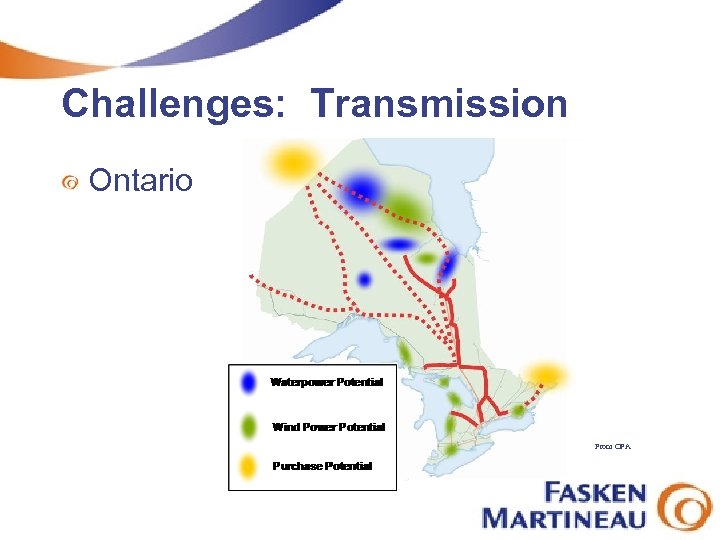
Challenges: Transmission Ontario From OPA
Challenges: NIMBYism Not In My Back Yard (NIMBY) Build Absolutely Nothing Anywhere Near Anything (BANANA)
Challenges: NIMBYism Examples The Edmonton-Calgary 500 k. V In May 2004 AESO submitted 13 “concepts” for a new tx line between Edm and Cgy In April 2005 EUB approved the need for AESO's preferred 500 k. V line After the decision was issued, NIMBY opposition groups were formed, including LAVESTA Area Group and 566 Corridor Group
Challenges: NIMBYism Examples The Edmonton-Calgary 500 k. V Because the NIMBY groups did not participate in the proceeding, the EUB granted their application for a review and variance (R&V) hearing to consider issues like land density and agricultural impacts On December 6, 2005, the R&V Panel affirmed the earlier decision
Challenges: NIMBYism Examples The Edmonton-Calgary 500 k. V In April 2006, the hearing for Alta. Link’s facilities application commenced, but was postponed due to security concerns On June 18, 2007, the EUB admitted hiring four private investigators to spy on landowners during the facilities application
Challenges: NIMBYism Examples The Edmonton-Calgary 500 k. V On September 30, 2007, on its own motion, EUB voided all previous decisions related to the proposed 500 k. V line On November 20, 2007, after approximately 3. 5 years of regulatory proceedings and despite EUB’s September 30 th decision, the Court of Appeal quashed all prior EUB decisions relating to 500 k. V line on the basis of reasonable apprehension of bias
Challenges: NIMBYism Examples Upper Pitt River IPP, BC Required change of boundaries of provincial park to accommodate Tx line Local government (Squamish) voted against project, but insufficient – local governments lost control over IPP approvals in 2006 through legislative amendment responding to blocking of Ashlu project Minister refused park boundary adjustment
First Nations Sparrow (SCC 1990) Aboriginal rights still exist – constitutionally protected under section 35 Aboriginal rights are not absolute – can be infringed by government Government must be able to justify infringement – duty to consult
First Nations Badger (SCC 1996) Treaty rights also constitutionally protected Government must also justify infringement of treaty rights
First Nations Haida (SCC 2004) Crown may have to consult (and accommodate) prior to rights being formally established No independent duty on industry but can be delegated certain aspects Content of duty depends on circumstances
First Nations Haida (SCC 2004) Crown may have to consult (and accommodate) prior to rights being formally established No independent duty on industry but can be delegated certain aspects Content of duty depends on circumstances
First Nations Many different paths to take in the building a relationship with First Nations Various agreements may be used in the course of relationship-building and which, in some cases, can be relied on by the Crown to assist in fulfilling its consultation and accommodation obligations
Conclusion Considerable need for new supply Renewables preferred, but challenges including transmission, ability to serve base load and ability to meet demand May leave opportunities for other generation
Questions? Ron Ezekiel
Скачать презентацию 2008 Quebec Forum on Electricity Business Opportunities in
cf2511842d629cee0cdbe817d96bd173.ppt