


 Скачать презентацию 2007 Thomson South-Western A Macroeconomics Theory
bfd3af65c1c99ee0f92648557159e42b.ppt
- Количество слайдов: 38
 © 2007 Thomson South-Western
 A Macroeconomics Theory of the Open Economy Open Economies An open economy is one that interacts freely with other economies around the world. © 2007 Thomson South-Western
 A Macroeconomics Theory of the Open Economy • Key Macroeconomic Variables in an Open Economy – The important macroeconomic variables of an open economy include: – net exports – net foreign investment – nominal exchange rates – real exchange rates © 2007 Thomson South-Western
 A Macroeconomics Theory of the Open Economy • Basic Assumptions of a Macroeconomic Model of an Open Economy – The model takes the economy’s GDP as given. – The model takes the economy’s price level as given. © 2007 Thomson South-Western
 The Market for Loanable Funds • The supply of loanable funds comes from national saving (S). • The demand for loanable funds comes from domestic investment (I) and net capital outflows (NCO). © 2007 Thomson South-Western
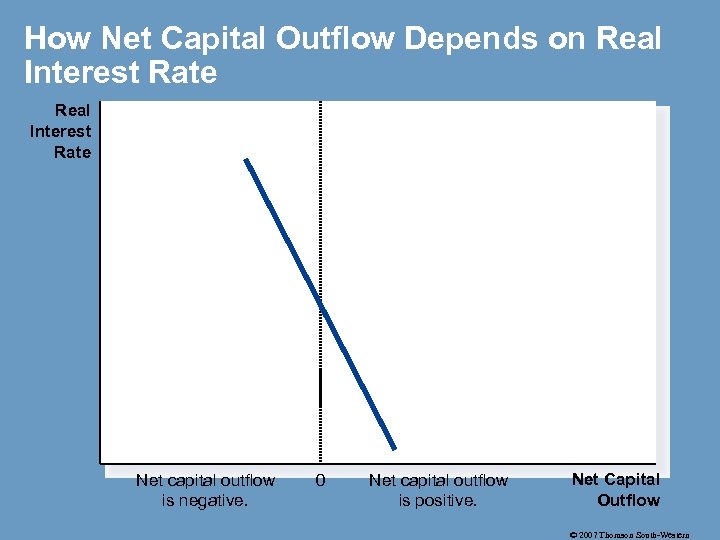 How Net Capital Outflow Depends on Real Interest Rate Net capital outflow is negative. 0 Net capital outflow is positive. Net Capital Outflow © 2007 Thomson South-Western
 The Market for Loanable Funds • The supply and demand for loanable funds depend on the real interest rate. • A higher real interest rate encourages people to save and raises the quantity of loanable funds supplied. • The interest rate adjusts to bring the supply and demand for loanable funds into balance. © 2007 Thomson South-Western
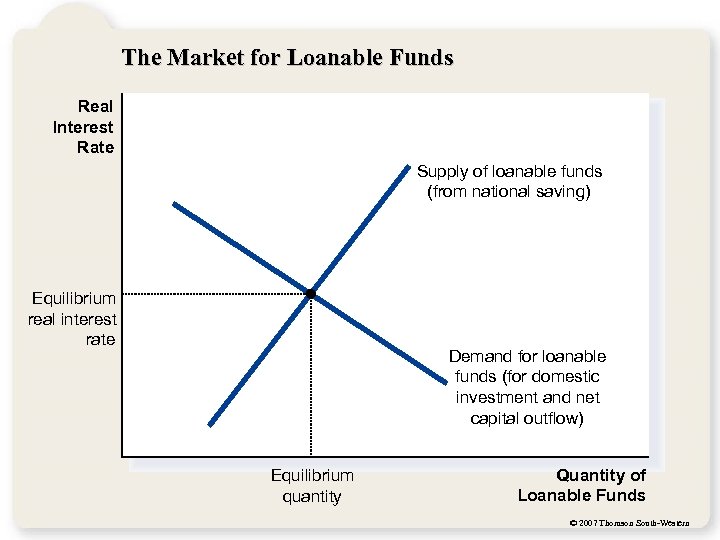 The Market for Loanable Funds Real Interest Rate Supply of loanable funds (from national saving) Equilibrium real interest rate Demand for loanable funds (for domestic investment and net capital outflow) Equilibrium quantity Quantity of Loanable Funds © 2007 Thomson South-Western
 Equilibrium in the Loanable Funds Market • In equilibrium, the market for loanable funds implies S = I + NCO • At the equilibrium real interest rate, the amount that people want to save exactly balances the desired quantities of investment and net capital outflows. © 2007 Thomson South-Western
 The Market for Foreign-Currency Exchange • In the market foreign-currency exchange, NT dollars are traded foreign currencies. • The demand supply sides of the foreigncurrency exchange market are represented by NX and NCO respectively. • NCO represents the imbalance between the purchases and sales of capital assets. • NX represents the imbalance between exports and imports of goods and services. © 2007 Thomson South-Western
 The Market for Foreign-Currency Exchange • The demand curve foreign currency is downward sloping because a higher real exchange rate makes domestic goods more expensive. As net exports decreases, less amount of foreign commences are trade for NT dollars. • The supply curve is vertical because the quantity of NT dollars supplied for net capital outflow is unrelated to the real exchange rate. © 2007 Thomson South-Western
 The Market for Foreign-Currency Exchange • For an economy as a whole, NCO and NX must balance: NCO = NX • The price that balances the supply and demand foreign-currency is the real exchange rate. © 2007 Thomson South-Western
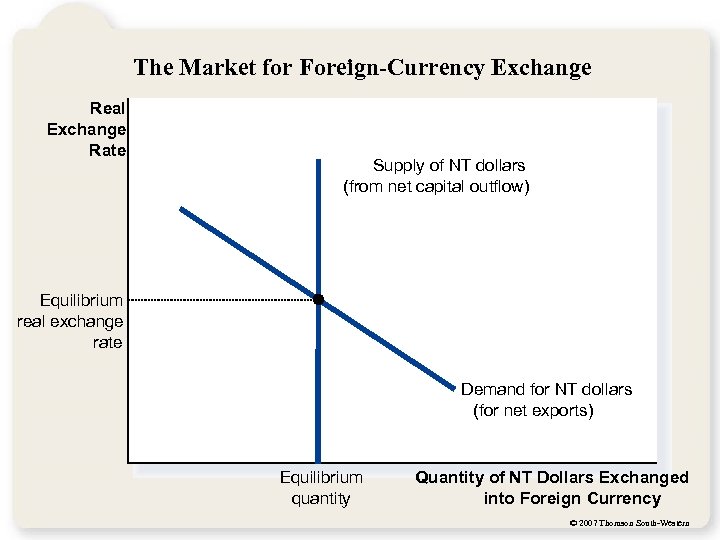 The Market for Foreign-Currency Exchange Real Exchange Rate Supply of NT dollars (from net capital outflow) Equilibrium real exchange rate Demand for NT dollars (for net exports) Equilibrium quantity Quantity of NT Dollars Exchanged into Foreign Currency © 2007 Thomson South-Western
 The Market for Foreign-Currency Exchange • The real exchange rate adjusts to balance the supply and demand for NT dollars. • At the equilibrium real exchange rate, the demand for NT dollars to buy net exports exactly balances the supply of NT dollars to be exchanged into foreign currency to buy assets abroad. © 2007 Thomson South-Western
 EQUILIBRIUM IN THE OPEN ECONOMY • In the market for loanable funds, supply comes from national saving(S) and demand comes from domestic investment(I) and net capital outflow(NCO). • In the market foreign-currency exchange, supply comes from net capital outflow(NCO) and demand comes from net exports(NX). © 2007 Thomson South-Western
 EQUILIBRIUM IN THE OPEN ECONOMY • Net capital outflow links the loanable funds market and the foreign-currency exchange market. – The key determinant of net capital outflow is the real interest rate. © 2007 Thomson South-Western
 Simultaneous Equilibrium in Two Markets • Prices in the loanable funds market and the foreign-currency exchange market adjust simultaneously to balance supply and demand in these two markets. • As they do, they determine the macroeconomic variables of national saving, domestic investment, net capital outflow(net foreign investment), and net exports. © 2007 Thomson South-Western
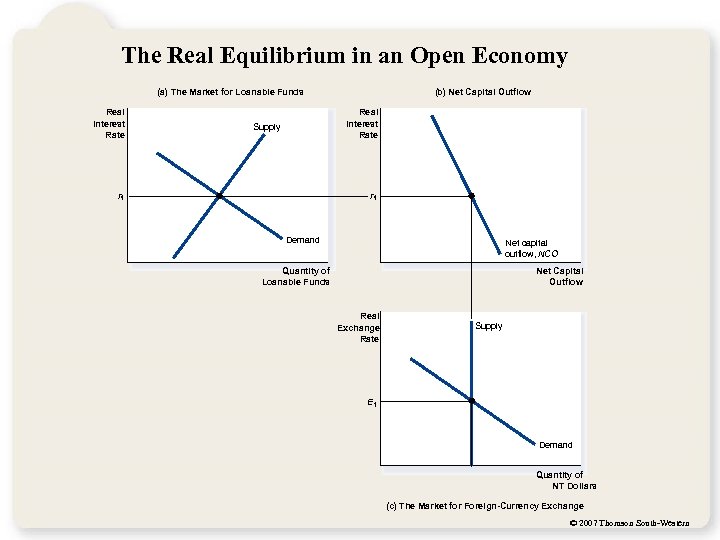 The Real Equilibrium in an Open Economy (a) The Market for Loanable Funds Real Interest Rate (b) Net Capital Outflow Real Interest Rate Supply r r Demand Net capital outflow, NCO Quantity of Loanable Funds Net Capital Outflow Real Exchange Rate Supply E Demand Quantity of NT Dollars (c) The Market for Foreign-Currency Exchange © 2007 Thomson South-Western
 HOW POLICIES AND EVENTS AFFECT AN OPEN ECONOMY • The magnitude and variation in important macroeconomic variables depend on the following: – Government budget deficits – Trade policies – Political and economic stability © 2007 Thomson South-Western
 Government Budget Deficits • Effect of Budget Deficits on the Loanable Funds Market • A government budget deficit reduces national saving, which. . . • shifts the supply curve for loanable funds to the left, which. . . • raises real interest rates. © 2007 Thomson South-Western
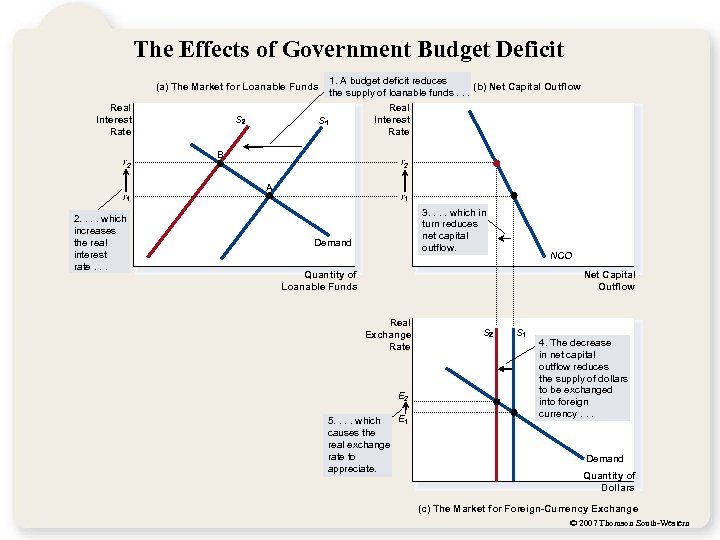 The Effects of Government Budget Deficit (a) The Market for Loanable Funds Real Interest Rate r 2. . which increases the real interest rate. . . S 1. A budget deficit reduces (b) Net Capital Outflow the supply of loanable funds. . . Real Interest Rate S B r 2 A r 3. . which in turn reduces net capital outflow. Demand NCO Quantity of Loanable Funds Net Capital Outflow Real Exchange Rate E 2 E 1 5. . which causes the real exchange rate to appreciate. S S 4. The decrease in net capital outflow reduces the supply of dollars to be exchanged into foreign currency. . . Demand Quantity of Dollars (c) The Market for Foreign-Currency Exchange © 2007 Thomson South-Western
 Government Budget Deficits • Effect of Budget Deficits on Net Foreign Investment • Higher real interest rates reduce net foreign investment (net capital outflow). • Effect on the Foreign-Currency Exchange Market • A decrease in net foreign investment reduces the supply of NT dollars to be exchanged into foreign currency. • This causes the real exchange rate to appreciate. © 2007 Thomson South-Western
 Government Budget Deficits • In an open economy, government budget deficits. . . • • reduce the supply of loanable funds, drive up the interest rate, crowd out domestic investment, cause net foreign investment to fall. © 2007 Thomson South-Western
 Trade Policy • A trade policy(貿易政策) is a government policy that directly influences the quantity of goods and services that a country imports or exports. • Tariff(關稅): A tax on an imported good. • Import quota(進口商品數量限制): A limit on the quantity of a good produced abroad and sold domestically. © 2007 Thomson South-Western
 Trade Policy • Because they do not change national saving or domestic investment, trade policies do not affect the trade balance (net capital outflow). • For a given level of national saving and domestic investment, the real exchange rate adjusts to keep the trade balance the same. • Trade policies have a greater effect on individual markets than on agreement economy. © 2007 Thomson South-Western
 Trade Policy • Effect of an Import Quota • Trade policies do not affect the trade balance. © 2007 Thomson South-Western
 Trade Policy • Effect of an Import Quota • Because foreigners need NT dollars to buy Taiwan net exports, there is an increased demand for NT dollars in the market foreign -currency. • This leads to an appreciation of the real exchange rate. © 2007 Thomson South-Western
 Trade Policy • Effect of an Import Quota • There is no change in real interest rate because nothing happens in the loanable funds market. • There will be no change in net exports. • There is no change in net foreign investment even though an import quota reduces imports. © 2007 Thomson South-Western
 Trade Policy • Effect of an Import Quota • An appreciation of the NT dollar in the foreign exchange market encourages imports and discourages exports. • This offsets the initial increase in net exports due to the import quota. © 2007 Thomson South-Western
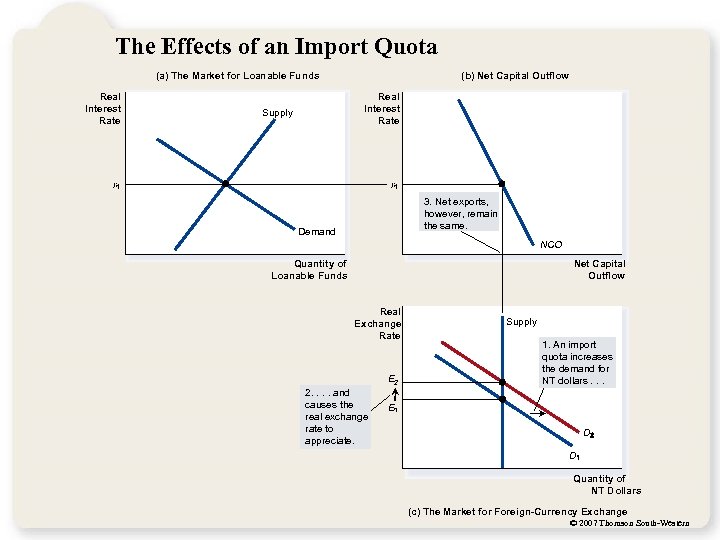 The Effects of an Import Quota (a) The Market for Loanable Funds Real Interest Rate (b) Net Capital Outflow Real Interest Rate Supply r r 3. Net exports, however, remain the same. Demand NCO Quantity of Loanable Funds Net Capital Outflow Real Exchange Rate E 2 2. . and causes the real exchange rate to appreciate. Supply 1. An import quota increases the demand for NT dollars. . . E D D Quantity of NT Dollars (c) The Market for Foreign-Currency Exchange © 2007 Thomson South-Western
 Political Instability and Capital Flight • Capital flight(資本外逃) is a large and sudden reduction in the demand for assets located in a country. • Capital flight has its largest impact on the country from which the capital is fleeing, but it also affects other countries. • If investors become concerned about the safety of their investments, capital can quickly leave an economy. © 2007 Thomson South-Western
 Political Instability and Capital Flight • When investors around the world observed political problems in Mexico in 1994, they sold some of their Mexican assets and used the proceeds to buy assets of other countries. • This increased Mexican net capital outflow. • The demand for loanable funds in the loanable funds market increased, which increased the real interest rate. • This increased the supply of pesos in the foreigncurrency exchange market. © 2007 Thomson South-Western
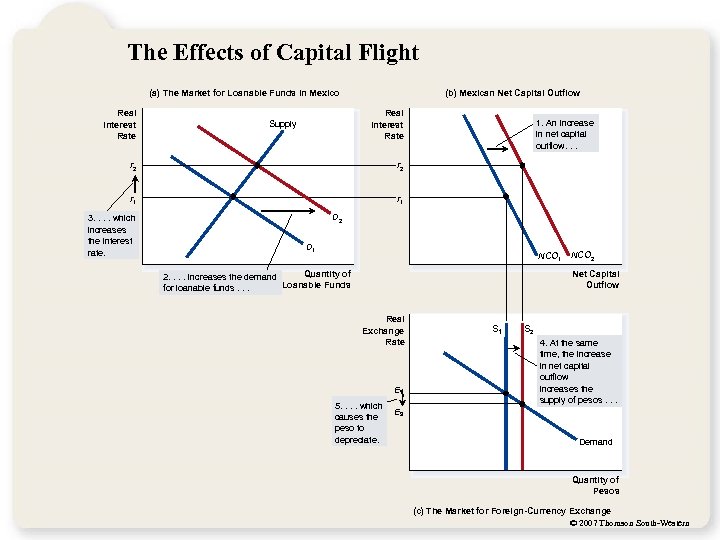 The Effects of Capital Flight (a) The Market for Loanable Funds in Mexico Real Interest Rate (b) Mexican Net Capital Outflow Real Interest Rate Supply r 2 r 1 1. An increase in net capital outflow. . . r 1 3. . which increases the interest rate. D 2 D 1 NCO 1 Quantity of 2. . increases the demand Loanable Funds for loanable funds. . . NCO 2 Net Capital Outflow Real Exchange Rate E 5. . which causes the peso to depreciate. S S 2 4. At the same time, the increase in net capital outflow increases the supply of pesos. . . E Demand Quantity of Pesos (c) The Market for Foreign-Currency Exchange © 2007 Thomson South-Western
 Summary • To analyze the macroeconomics of open economies, two markets are central—the market for loanable funds and the market foreign-currency exchange. • In the market for loanable funds, the interest rate adjusts to balance supply for loanable funds (from national saving) and demand for loanable funds (from domestic investment and net capital outflow). © 2007 Thomson South-Western
 Summary • In the market foreign-currency exchange, the real exchange rate adjusts to balance the supply of dollars (for net capital outflow) and the demand for dollars (for net exports). • Net capital outflow is the variable that connects the two markets. © 2007 Thomson South-Western
 Summary • A policy that reduces national saving, such as a government budget deficit, reduces the supply of loanable funds and drives up the interest rate. • The higher interest rate reduces net capital outflow, reducing the supply of dollars. • The dollar appreciates, and net exports fall. © 2007 Thomson South-Western
 Summary • A trade restriction increases net exports and increases the demand for dollars in the market foreign-currency exchange. • As a result, the dollar appreciates in value, making domestic goods more expensive relative to foreign goods. • This appreciation offsets the initial impact of the trade restrictions on net exports. © 2007 Thomson South-Western
 Summary • When investors change their attitudes about holding assets of a country, the ramifications for the country’s economy can be profound. • Political instability in a country can lead to capital flight. • Capital flight tends to increase interest rates and cause the country’s currency to depreciate. © 2007 Thomson South-Western