 Скачать презентацию 2007 Liz Cohen and BBB Autism Support
8d8dad39c3d81bf86548a5a255b9624f.ppt
- Количество слайдов: 48



© 2007 Liz Cohen and BBB Autism Support Network Traveling With ASD Presented by Liz Cohen and Micole Ongman
2
What can make traveling with your child unsuccessful? Lack of ability/tools to communicate wants/needs l Sensory issues l ‘Strange’ food l Not knowing what will come next l No set schedule l 3
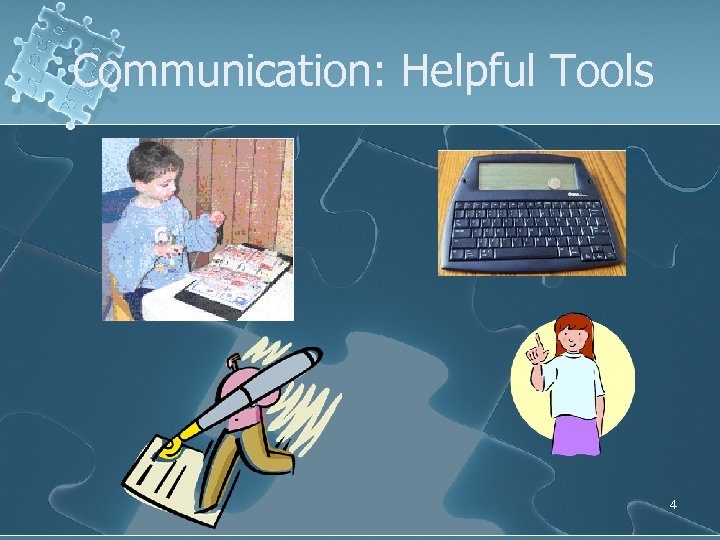
Communication: Helpful Tools 4

Communication One of the main causes of inappropriate behaviours in ASD (even in ‘verbal’ individuals l To keep these behaviours to a minimum, you must include a reliable method of communication in your carry on luggage and during day trips l It must be available at all times l 5
Augmentative Communication (a brief digression) Written by Susan Stokes under a contract with CESA 7 and funded by a discretionary grant from the Wisconsin Department of Public Used to improve: l Overall understanding of their environment; l Expressive communication skills; l Social interaction skills; l Attention skills; Instruction. 6
Augmentative Communication (a brief digression) Written by Susan Stokes under a contract with CESA 7 and funded by a discretionary grant from the Wisconsin Department of Public Used to improve: l Motivation skills; l Organization skills; l Academic skills; l Self help skills; l Overall independent daily functioning skills. Instruction. 7
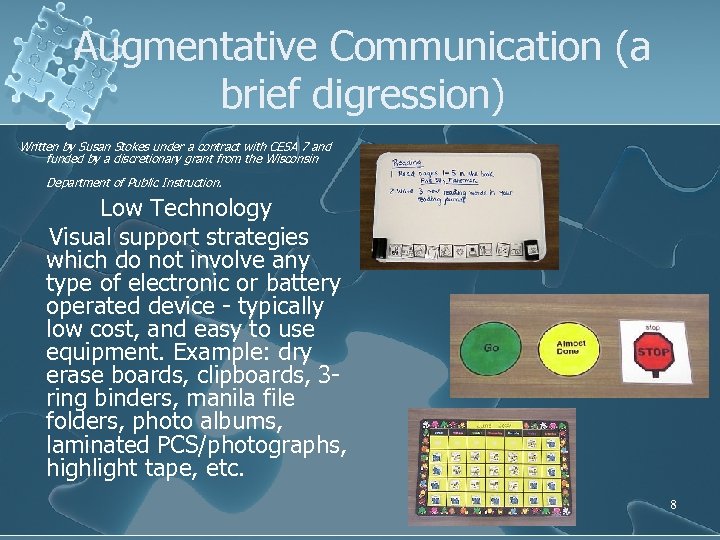
Augmentative Communication (a brief digression) Written by Susan Stokes under a contract with CESA 7 and funded by a discretionary grant from the Wisconsin Department of Public Instruction. Low Technology Visual support strategies which do not involve any type of electronic or battery operated device - typically low cost, and easy to use equipment. Example: dry erase boards, clipboards, 3 ring binders, manila file folders, photo albums, laminated PCS/photographs, highlight tape, etc. 8
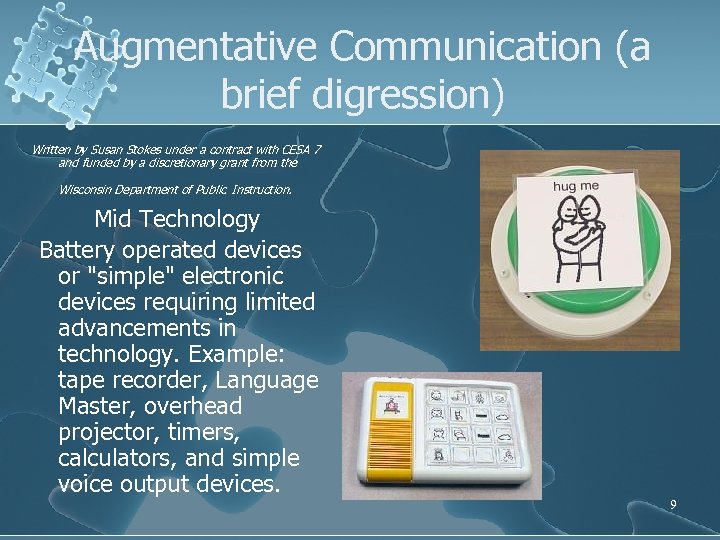
Augmentative Communication (a brief digression) Written by Susan Stokes under a contract with CESA 7 and funded by a discretionary grant from the Wisconsin Department of Public Instruction. Mid Technology Battery operated devices or "simple" electronic devices requiring limited advancements in technology. Example: tape recorder, Language Master, overhead projector, timers, calculators, and simple voice output devices. 9
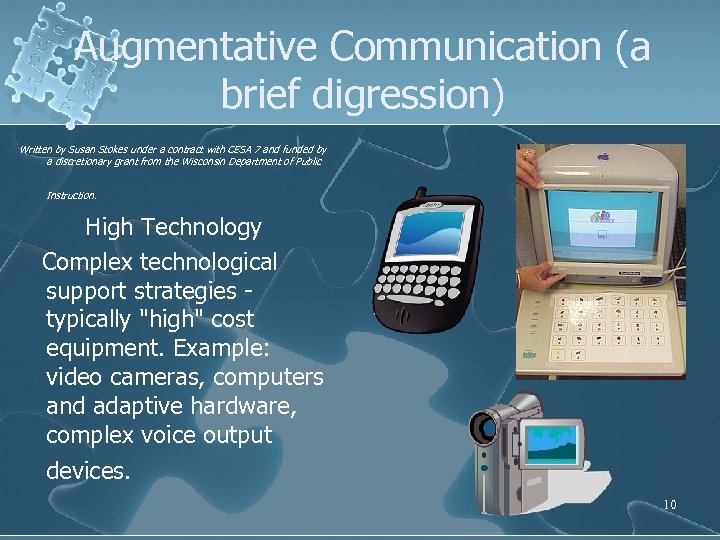
Augmentative Communication (a brief digression) Written by Susan Stokes under a contract with CESA 7 and funded by a discretionary grant from the Wisconsin Department of Public Instruction. High Technology Complex technological support strategies - typically "high" cost equipment. Example: video cameras, computers and adaptive hardware, complex voice output devices. 10
Sensory Issues Sensory issues are another big problem which can result in behaviours l This can be caused by everything from standing in line to new clothing l Pack a very portable fidget kit to help address sensory needs l Keep the kit available at all times l 11
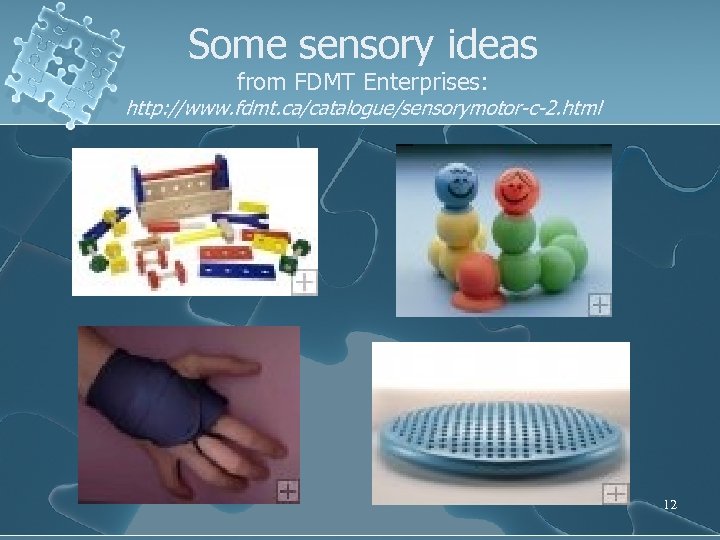
Some sensory ideas from FDMT Enterprises: http: //www. fdmt. ca/catalogue/sensorymotor-c-2. html 12
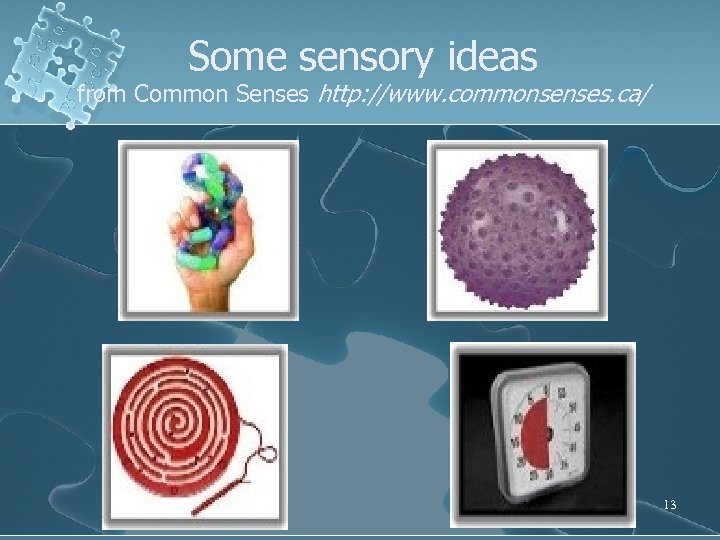
Some sensory ideas from Common Senses http: //www. commonsenses. ca/ 13
Preparing for the trip Planning, planning l And more planning l 14
MICOLE’S TIPS He packed his own carry on, with help from me, so he had all the things he thought he would need. We actually ended up bringing a second one (my carry one) that had ALL his sleep toys in it. He didn’t want them to be left at home alone and felt better having them with him. 15
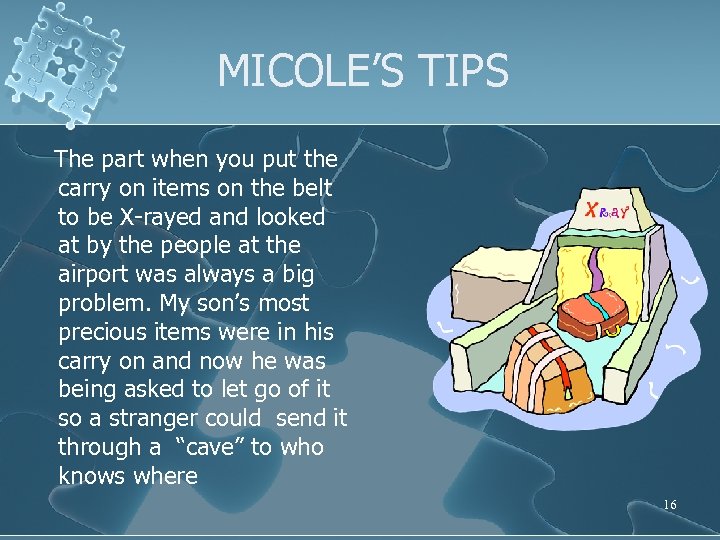
MICOLE’S TIPS The part when you put the carry on items on the belt to be X-rayed and looked at by the people at the airport was always a big problem. My son’s most precious items were in his carry on and now he was being asked to let go of it so a stranger could send it through a “cave” to who knows where 16
MICOLE’S TIPS We learned that one of us parents needed to go ahead to let the staff know that our son had ASD and that this may be an issue. They were always very understanding and in one case even opened another lane for people behind us to go to because he wouldn’t give up his bag. 17
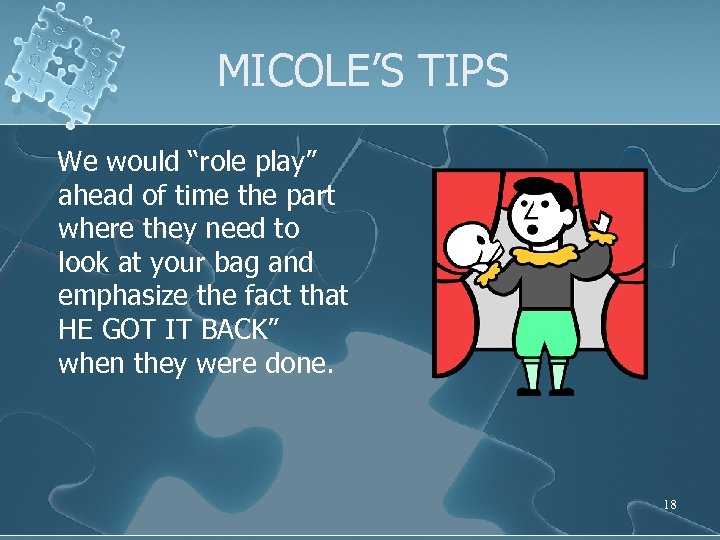
MICOLE’S TIPS We would “role play” ahead of time the part where they need to look at your bag and emphasize the fact that HE GOT IT BACK” when they were done. 18
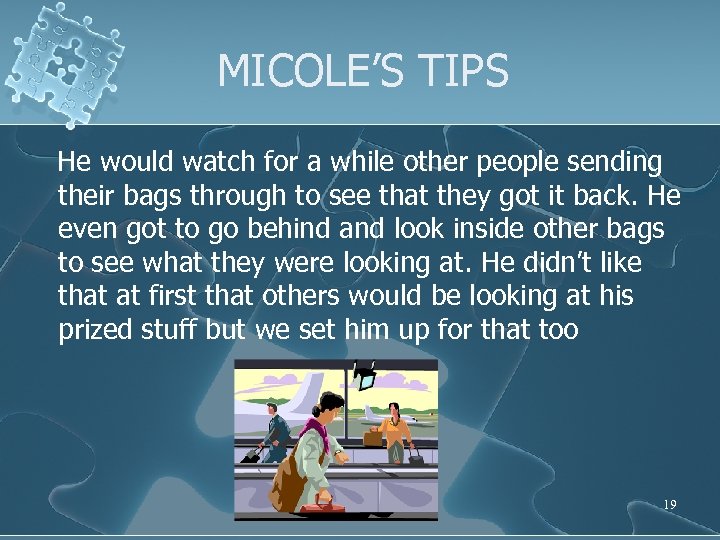
MICOLE’S TIPS He would watch for a while other people sending their bags through to see that they got it back. He even got to go behind and look inside other bags to see what they were looking at. He didn’t like that at first that others would be looking at his prized stuff but we set him up for that too 19
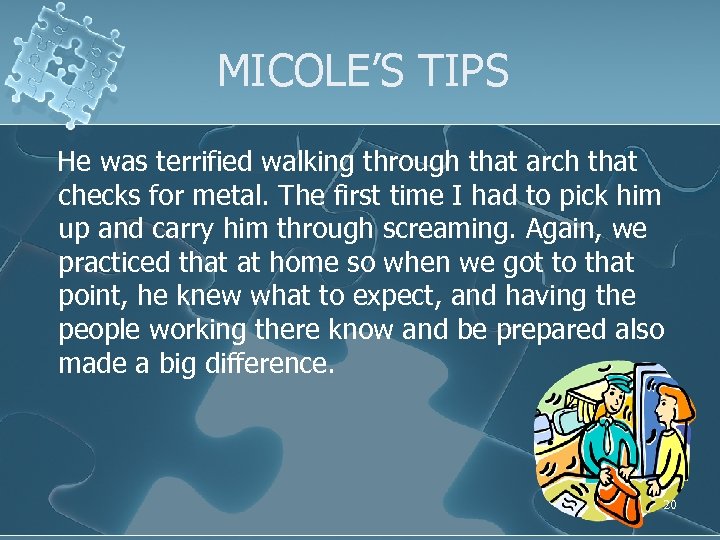
MICOLE’S TIPS He was terrified walking through that arch that checks for metal. The first time I had to pick him up and carry him through screaming. Again, we practiced that at home so when we got to that point, he knew what to expect, and having the people working there know and be prepared also made a big difference. 20
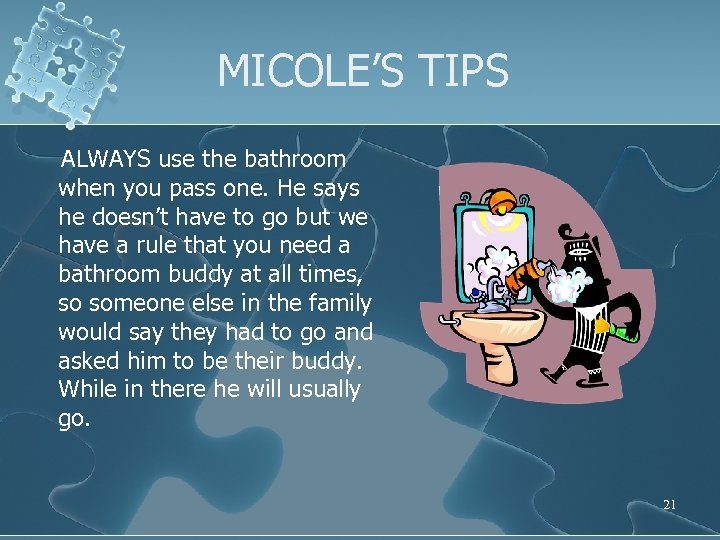
MICOLE’S TIPS ALWAYS use the bathroom when you pass one. He says he doesn’t have to go but we have a rule that you need a bathroom buddy at all times, so someone else in the family would say they had to go and asked him to be their buddy. While in there he will usually go. 21
MICOLE’S TIPS ALWAYS have food, drink, a variety of stuff to do. You don’t know how long it will take to be fed on plane or how long a line will be at the bathroom. Even when touring around, having a treat or drink when he was hungry gave him something until we reached somewhere to better fill that need. Just like at home. 22
MICOLE’S TIPS l l One of our best investments ever was one of those portable DVD players. For long car rides, waits, whatever, it is always a great distraction when you need something to keep him occupied for a long period of time. My son likes to collect things, so we would always look for the brochures at places so he would be involved in getting them and putting them together and have an interest in where we were going, even if it just meant to look where they keep the brochures. We could then use those at the end of the day to remember where we were and what we saw. 23
MICOLE’S TIPS l l Digital cameras are great and they don’t cost anything for a child to click away. When my son would be getting restless or bored, we would give him the camera and let him take pictures of us. Then he had a job to do and a special task and he would be distracted for long periods of time. He would even start to seek out photo opportunities and get into what ever it was we were doing. Don’t forget extra batteries and an extra memory card. Anywhere you think there may be a line up, you can usually bypass it if needed. We would go to whoever was in charge of the line or the venue and let them know about our son, and most places are pretty educated about our kids these days, so we would be able to bypass the line and go ahead. 24
MICOLE’S TIPS l l Amusement parks are great for that. Disney was totally amazing. You go to the customer service desk and let them know about your son, and you get a card that lets you bypass line ups. At Disney, we were able to just show our pass and, no questions asked, we would be able to go to an alternate entrance (fast pass lane most times, but we didn’t have to get a specific time, just when we were there) and go right on the ride. I have seen many variations of business cards people have that will educate people should a child have a meltdown for some reason. Just hand them the card that says something to the effect of “you have just encountered a young person with autism, thank you for your understanding and patience”. It reduces the stress a parent may have getting those “looks” from others. 25
MICOLE’S TIPS l l Sometimes you just have to ask yourself “how important is thing we want to do right now? ” if your son is acting up. Can you go back later or another day? Do you need to do it at all? Are you doing this for him or for you, he may not care as much as you want him to. If you do need to go forward, maybe just wait a few minutes or have a bite to eat first to get the mood back on track. I would always put a paper or business card or something in my sons pocket with our cell phone numbers on it. Just in case. He would know to give it to someone to call us should we get separated (the who to give it to is a whole other discussion) 26
MICOLE’S TIPS l l We never go anywhere without one or two complete changes of clothes. Just an easy thing to avoid a major problem should an accident occur. We always try not to make anything a big deal so that it doesn’t stand out too much. Like the first time we crossed the border and we were so excited and told our son we were going to the US and another country and he just took it not in a happy way and was weary and afraid of this whole idea and wouldn’t go across the border. Its better to say, we just crossed the border rather than we are going to… for our son so he doesn’t get anxious over it. 27
MICOLE’S TIPS l l Sometimes its just okay for a child to be on the ground crying, when things just are too much. We used to feel that we had to get him up and move him for other peoples sake but learned that it was more important to deal with his feelings and let him calm down and others could just walk around us. Not something you want to do all the time but the panic to “stop this behaviour right now” can often prolong things. Many places have websites so if you want to check out the menu for a restaurant, you can do so to make sure you can choose somewhere that has food your child will eat. 28
LIZ’S TIPS l Make sure your destination is right for your child Are there activities your child will enjoy? l What kinds of foods are available? l Make sure the hotel is neither too big nor too small l Make sure the journey to the destination is right for your child l l Consider options such as car, train, RV, etc 29
LIZ’S TIPS l Prepare your child Use brochures, videos and pictures of your upcoming holiday l Use a monthly calendar to mark off days until the trip so your child can prepare mentally and emotionally l Use a picture schedule to break the traveling down into small, manageable steps l 30
LIZ’S TIPS l Prepare your child Use the ‘sandwich’ method for anxiety producing aspects of the trip. Sandwich the challenge between two positive events using picture cards l Use ‘first, then’ cards l 31
LIZ’S TIPS Ask if you can sit near the back of the plane for frequent bathroom trips l Tell the staff your child has ASD l Make sure you are not sitting near a wing if your child is noise-sensitive l Do not be shy in telling airline/airport staff about your child’s ASD l l echolalia 32
LIZ’S TIPS l If you can, bring your mediator We do this on daytrips and it is so helpful l Use SSAH money for this l l Try to establish a routine while you are away 33
LIZ’S TIPS Know when family vacations just aren’t right for your family l There’s nothing wrong with a ‘no kids’ vacation occasionally l 34
LIZ’S TIPS l Ease transitions l l l Use your child’s pillowcase, bed sheets, night light and night toys from home Wash new clothes before you go and let your child ‘practice’ wearing them Get them used to wearing sunscreen by applying unscented lotion after a bath if you are going somewhere sunny during the winter months Let your child wear his/her bathing suit in the shower a few times If this is a repeat trip, show pictures of your previous visits 35

THE HAPPIEST PLACE ON EARTH! l l l www. disneyworld. com General Information: Voice: 407 -824 -4321 TTY: 407 -827 -5141 Resort Reservations: 407 -939 -7807 (TTY: 407 -939 -7670) 36
DISNEY INFO Guidebook for Guests With Disabilities The Guidebook for Guests with Disabilities provides a detailed overview of services and facilities available for Guests with disabilities and is available at Guest Relations locations within all four Parks as well as Guest Services locations at the Walt Disney World® Resorts. 37
DISNEY INFO Theme Parks Guest Relations, located inside each Park, provides a variety of services including: l Information concerning Guests with disabilities l Messages for separated parties l Lost Guests l Information on behind the scenes educational programs l Disney Resort Reservations and Advanced Reservations for Dining l Walt Disney World® Gift Certificates l Downtown Disney® Marketplace Services: l Wheelchair and stroller rentals (must have major credit card or Disney Resort ID) l General information l Accessible Parking 38
DISNEY INFO l l l Accessible Parking Designated parking areas for Guests with disabilities are available throughout the Walt Disney World® Resort. A valid disability parking permit is required. Theme Parking (Standard parking rates apply) Guests with the ability to walk short distances and step up onto the courtesy trams should park in the main parking lots of Magic Kingdom® Park, Epcot®, Disney-MGM Studios, or Disney's Animal Kingdom® Theme Park. The courtesy tram will transport Guests to the Entrance Complex. Parking for Guests with mobility disabilities or who are traveling with personal wheelchairs is available adjacent to the Entrance Complex at each of the four Parks. Guests should inquire at the Auto Plaza for directions on parking options. Restrooms Most restrooms throughout the Walt Disney World® Resort have facilities designed for access by Guests using wheelchairs. Companion-assisted restroom facilities are located at all First Aid locations, as well as at all parks 39
DISNEY INFO l l l Service Animals Trained service animals are welcome in most locations throughout the Walt Disney World® Resort. All service animals must remain on a leash or in a harness at all times. Guests should follow the same attraction entrance procedures as described for Guests using wheelchairs. Due to the nature of some attractions, service animals may not be permitted to ride. In those instances, a member of the Guest's party must remain with the animal. Walt Disney World® Resort hosts and hostesses are not permitted to take control of service animals. Designated "Break" Areas Each Theme Park allows Guests to use backstage locations for service animal relief areas. Please consult the Guidebook for Guests with Disabilities for specific information. Restrictions Due to the nature of the experience, service animals are not permitted on some attractions. 40
POST 9/11 Don’t have any liquids or anything that may get taken away. We had a meltdown because they took his water and he didn’t like that and the fact that he could buy more just on the other side did not help. They actually ended up giving him back his water in a “hush, hush” way and then he was fine. So we don’t bring water but show him the money we put aside to buy him water on the other side at the store so he had that to look forward to. They actually took away our suntan lotion once and we didn’t’ see that coming. It was an issue and they ended giving that back as well as he just couldn’t deal with them taking our stuff. Pack anything you think might be taken in your suitcase. 41
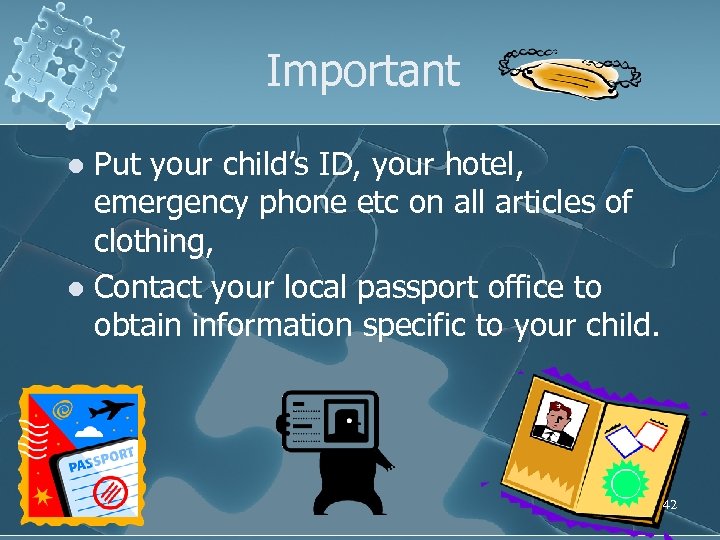
Important Put your child’s ID, your hotel, emergency phone etc on all articles of clothing, l Contact your local passport office to obtain information specific to your child. l 42
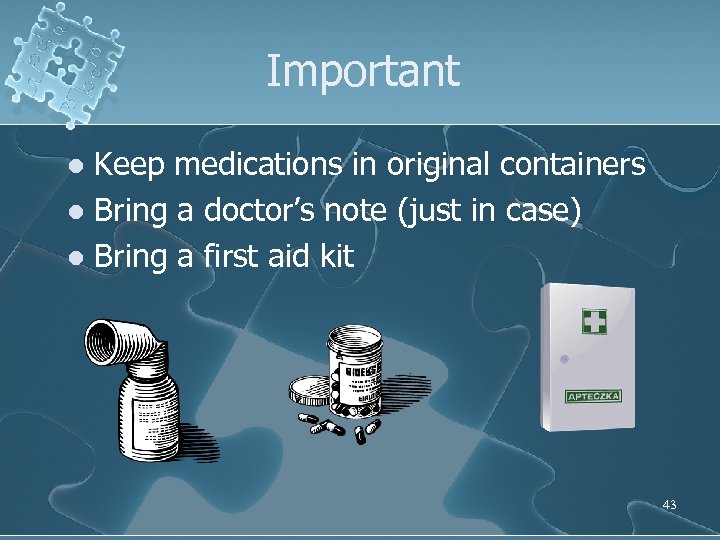
Important Keep medications in original containers l Bring a doctor’s note (just in case) l Bring a first aid kit l 43
Important If your child is a picky eater, enquire at the passport office as to what foods you can bring on the plane and in your luggage. 44
Important If you are staying at a resort or visiting one, ask for a list of restaurants to email and see if they have the ‘correct’ foods 45
Each time you will learn something that you think “why didn’t we think of that before” and you can use that to make the trip the next time even better. It is definitely a work in progress Have a great trip and let us know what tips you learn on your trip for us to share with others. 46
References & Resources l l l Autism Sourcebook by Karen Siff Exkorn Autism Matters (an Autism Ontario publication) www. autismontario. com Children Diagnosed with Autism; What to Expect, Where to get Help (an Autism Ontario publication) www. autismontario. com BBB Autism Support Network www. bbbautism. com BBB Autism At Home Support liz@deaknet. com 47
Bonne Voyage!!! 48
Скачать презентацию 2007 Liz Cohen and BBB Autism Support
8d8dad39c3d81bf86548a5a255b9624f.ppt