 Скачать презентацию 2007 Farm Bill Proposals U S Department of
df965a39f782a6bca86f47fc4fce6395.ppt
- Количество слайдов: 41



2007 Farm Bill Proposals U. S. Department of Agriculture “We need farm policy that recognizes the tremendous potential of American agriculture. These proposals do just that. We listened to the people and now deliver our proposals for America’s farm bill. ” - Mike Johanns, Secretary of Agriculture
Purpose of Farm Bill Legislation n The farm bill authorizes USDA’s: Commodity program support n Conservation and Forestry n Renewable Energy n Research n Trade n Food stamps and other nutrition assistance n Rural Development n 2 2
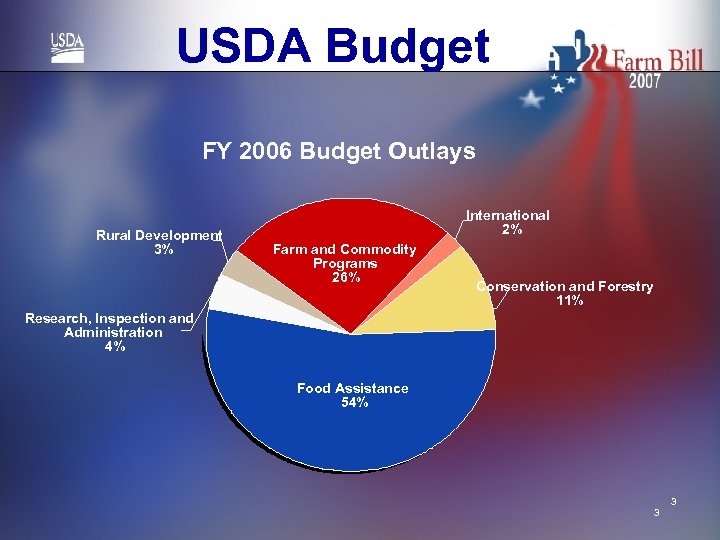
USDA Budget FY 2006 Budget Outlays Rural Development 3% International 2% Farm and Commodity Programs 26% Conservation and Forestry 11% Research, Inspection and Administration 4% Food Assistance 54% 3 3
Title 1: Commodity Programs All funding reflects 10 -year totals unless otherwise noted 4 4
Title I: Commodity n Revise Marketing Loan Rates: n Set loan rates based upon average market price of last five years (excluding high and low years) n Cap loan rates at levels established by Houseapproved 2002 farm bill n Change from daily posted county price to monthly n Increase direct payments by $5. 5 billion n n More predictable payment creates a strong safety net Not tied to price or production n Create revenue-based counter-cyclical program n n Provide greater support in significant loss situations Targets support to be a true safety net 5 5
Title I: Commodity n Tighten payment limits; eliminate three-entity rule and lower the Adjusted Gross Income (AGI) cap from $2. 5 million to $200, 000 n n n AGI = gross income minus farm expenses and other deductions Targets support to be a true safety net Only 2. 3% of Americans have AGI above $200, 000 n Provide conservation enhanced payment option n Option to replace commodity support payments with enhanced direct payments for conservation commitments n Proposed increased direct payment plus 10 percent n Less market distortion and more environmental benefits 6
Title I: Commodity n Eliminate commodity program payments on land acquired through a 1031 tax exchange n Addresses artificially high land values n Revise the Milk Income Loss Contract Program to make it consistent with other counter-cyclical programs n Continue price support program for milk n Continue sugar program at no net cost to taxpayers n Balance supply and demand through domestic marketing allotments 7 7
Title I: Commodity n Allow planting flexibility of fruits, vegetables and wild rice on program crop base acres n Complies with WTO ruling n Require base acreage retirement when all or a portion of cropland is sold for non-agriculture use n Expand conservation compliance n Eliminate USDA program payment eligibility on grasslands converted into crop production 8 8
Title II: Conservation Programs All funding reflects 10 -year totals unless otherwise noted 9
Title II: Conservation n Increase conservation funding by $7. 8 billion n Consolidate existing cost-share programs into a newly designed Environmental Quality Incentives Program (EQIP) n n Increase total funding by $4. 2 billion Includes $1. 7 billion for a Regional Water Program n Streamline working lands easement programs into one Private Lands Protection Program n n Increase funding by $900 million Eliminate redundancies 10 10
Title II: Conservation n Increase Wetlands Reserve Program funding by $2. 1 billion n Increase enrollment cap from 2. 3 to 3. 5 million acres n Increase funding for the Conservation Security Program by $500 million n Provide incentives for increased conservation 11 11
Title II: Conservation n Reauthorize the Conservation Reserve Program with added focus on the most environmentally sensitive lands n Give priority within whole field enrollments to lands utilized for biomass production n Authorize Federal agencies to accelerate the development of private markets for the trading of ecosystem benefits associated with conservation 12
Title II: Conservation n Consolidate two emergency response programs into a new Emergency Landscape Restoration Program n Provide a one-stop source when emergency conservation assistance is needed n Set aside 10 percent of all farm bill conservation program spending for beginning and socially disadvantaged farmers 13 13
Title III: Trade Programs All funding reflects 10 -year totals unless otherwise noted 14
Title III: Trade n Increase funding by $68 million for specialty crop technical assistance grants n Increase allowable project award to $500, 000 n Increase funding for the Market Access Program by $250 million n Target non-program commodities n Establish a new grant program to address emerging sanitary and phytosanitary issues 15
Title III: Trade n Enhance U. S. presence within international standard setting bodies n Increase analytical support and other technical assistance to assist limited resource U. S. agriculture groups in trade disputes n Expand trade capacity, food safety and agriculture extension programs in fragile regions around the world 16
Title III: Trade n Reform the Commodity Credit Corporation’s export credit guarantee programs to better withstand challenge n Repeal the Global Marketing Strategy and Export Enhancement Program, which are redundant or inactive, allowing USDA to focus resources on priority issues 17
Title IV: Nutrition Programs All funding reflects 10 -year totals unless otherwise noted 18
Title IV: Nutrition n Simplify and modernize the Food Stamp Program, while maintaining its integrity n n n Improve access for the working poor and elderly Better reflect the needs of recipients and States Rename program “Food and Nutrition Program” n Streamline other food assistance programs to improve administration and efficiency n n n The Emergency Food Assistance Program Food Distribution on Indian Reservations Senior Farmers’ Market Nutrition Program 19 19
Title IV: Nutrition n Provide $2. 75 billion in additional fruit and vegetable purchases for distribution in food assistance programs n Increase funding by $500 million to purchase fruits and vegetables for school meals n Provide $100 million for competitive grants to States to develop and test solutions to the rising problem of obesity in low-income areas 20
Title V: Credit Programs All funding reflects 10 -year totals unless otherwise noted 21
Title V: Credit n Increase the limits for direct ownership loans and direct operating loans to a combined maximum of $500, 000 n Double the percentage of direct operating loans targeted to beginning and socially disadvantaged producers to 70% n Target 100% of direct farm ownership loans toward beginning and socially disadvantaged farmers and ranchers 22 22
Title V: Credit n Provide greater down payment loan access and flexibility for beginning farmers and ranchers n Cut the loan interest rate in half n Defer the first payment for one year n Decrease the minimum contribution toward the property purchase price from ten to five percent n Eliminate the $250, 000 cap on the value of property that may be purchased 23
Title VI: Rural Development Programs All funding reflects 10 -year totals unless otherwise noted 24
Title VI: Rural Development n Consolidate rural development programs to increase flexibility and efficiency n Provide $1. 6 billion in loans to complete the rehabilitation of all 1, 283 certified Rural Critical Access Hospitals 25 25
Title VI: Rural Development n Provide an additional $500 million to reduce the backlog of rural infrastructure projects Water and waste disposal loans and grants n Emergency water assistance grants n Community Facilities loan and grant programs n Distance learning and telemedicine grants n 26
Title VII: Research Programs All funding reflects 10 -year totals unless otherwise noted 27
Title VII: Research n Provide $1 billion for specialty crops research n Advance plant breeding genetics and genomics n Provide $500 million to create the Agricultural Bio -energy and Bio-based Products Research Initiative n Enhance the production and conversion of biomass to renewable fuels and related products n Reorganize and revitalize USDA’s research, education and economics mission n Better coordinate internal USDA research with external 28 university research funded by USDA 28
Title VIII: Forestry Programs All funding reflects 10 -year totals unless otherwise noted 29
Title VIII: Forestry n Initiate a new $150 million Wood to Energy Program n Accelerate development of new technologies to use low-value woody biomass to produce energy n Create a grant program to develop innovative solutions to local forest management issues 30 30
Title IX: Energy Programs All funding reflects 10 -year totals unless otherwise noted 31
Title IX: Energy n Provide $500 million to create a Bio-energy and Bio-products Research Program n Increase cost-effectiveness through cooperation between university and Federal scientists n Provide $500 million for rural alternative energy and energy efficiency grants n Directly assists farmers, ranchers, and rural small businesses 32
Title IX: Energy n Provide $2. 1 billion in loan guarantees to support cellulose ethanol projects in rural areas n Provide $150 million for biomass research competitive grants, focusing on cellulose ethanol 33
Title X: Miscellaneous Programs All funding reflects 10 -year totals unless otherwise noted 34
Title X: Miscellaneous n Improve risk management tools for farmers by creating a supplemental insurance program n Increase the efficiency and effectiveness of the crop insurance program n Revise dairy assessment requirements to create a more fair system n Increase funding for research, data collection and certification for organic agriculture 35 35
Areas of Special Focus All funding reflects 10 -year totals unless otherwise noted 36
Disaster Relief n Revenue-based counter-cyclical program n Gap coverage in crop insurance n Link crop insurance participation to farm program participation n New emergency landscape restoration program 37
Beginning and Socially Disadvantaged Producers n Provide $250 million to increase direct payments by 20% for five years for beginning farmers and ranchers n Revise the Beginning Farmer and Rancher Down payment Loan Program n n Provide more flexibility and access to loans at a lower interest rate Add socially disadvantaged producers as eligible applicants n Reserve 10 percent of conservation financial assistance for beginning and socially disadvantaged producers 38 38
Support for Specialty Crops n Provide $2. 75 billion in Section 32 funds to purchase fruits and vegetables for food assistance programs n Provide $500 million to increase the purchase of fruits and vegetables in school meals n Provide a $250 million increase for the Market Access Program – targeted for non-program commodities 39 39
Support for Specialty Crops n Provide $20 million to address international sanitary and phytosanitary (SPS) issues n Increase Technical Assistance for Specialty Crops n Make specialty crop waste eligible under energy programs 40
2007 Farm Bill Proposals U. S. Department of Agriculture “We need farm policy that recognizes the tremendous potential of American agriculture. These proposals do just that. We listened to the people and now deliver our proposals for America’s farm bill. ” - Mike Johanns, Secretary of Agriculture 41
Скачать презентацию 2007 Farm Bill Proposals U S Department of
df965a39f782a6bca86f47fc4fce6395.ppt