 Скачать презентацию 2007 Alabama EPSCo R Meeting February 13 2007
5ef881a626f267f102ed576bef3de4bb.ppt
- Количество слайдов: 20



2007 Alabama EPSCo. R Meeting February 13, 2007 University of Alabama in Huntsville USDA EPSCo. R Mc. Arthur Floyd, Ph. D. – State Director Charles Prince, Ph. D. - Co-Director
USDA EPSCo. R A co-funding initiative n In Alabama, all proposals submitted to any USDA National Research Initiative program are considered for EPSCo. R co-funding n All proposals must be submitted in response to a Request for Proposals (RFA) – unsolicited applications are NOT accepted n submissions accepted once per year – deadlines are program specific n
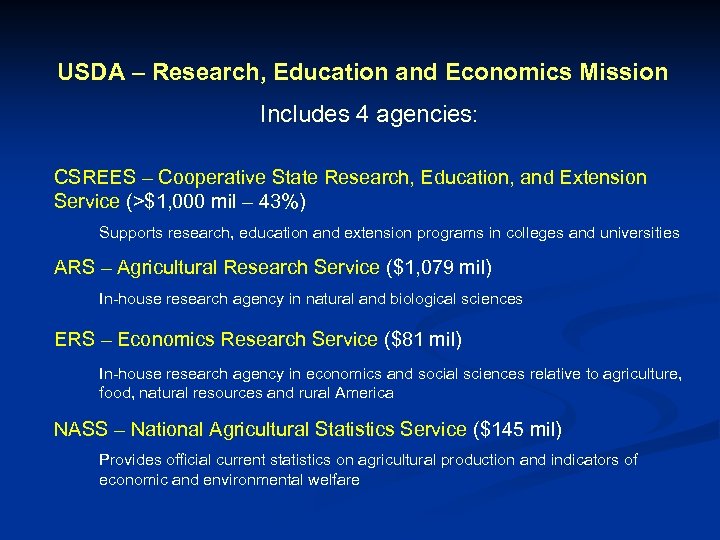
USDA – Research, Education and Economics Mission Includes 4 agencies: CSREES – Cooperative State Research, Education, and Extension Service (>$1, 000 mil – 43%) Supports research, education and extension programs in colleges and universities ARS – Agricultural Research Service ($1, 079 mil) In-house research agency in natural and biological sciences ERS – Economics Research Service ($81 mil) In-house research agency in economics and social sciences relative to agriculture, food, natural resources and rural America NASS – National Agricultural Statistics Service ($145 mil) Provides official current statistics on agricultural production and indicators of economic and environmental welfare
USDA – Research, Education and Economics Mission CSREES – Cooperative State Research, Education, and Extension Service Federal Assistance provided via 3 mechanisms Formula funds Congressionally directed funds Competitive funds
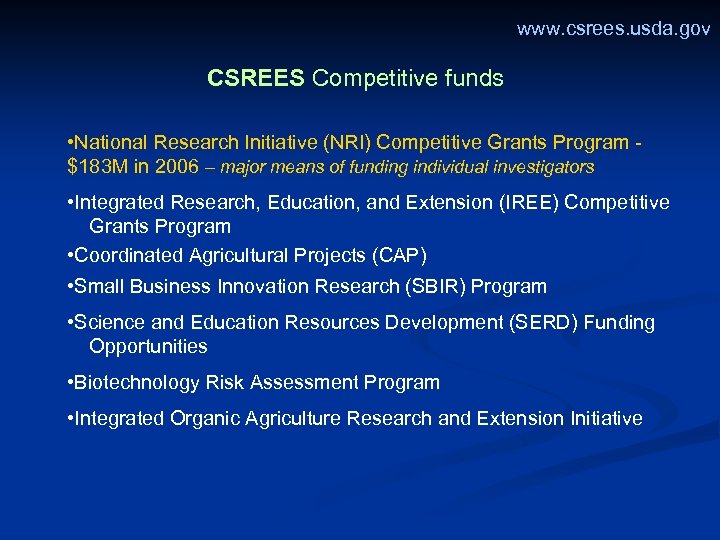
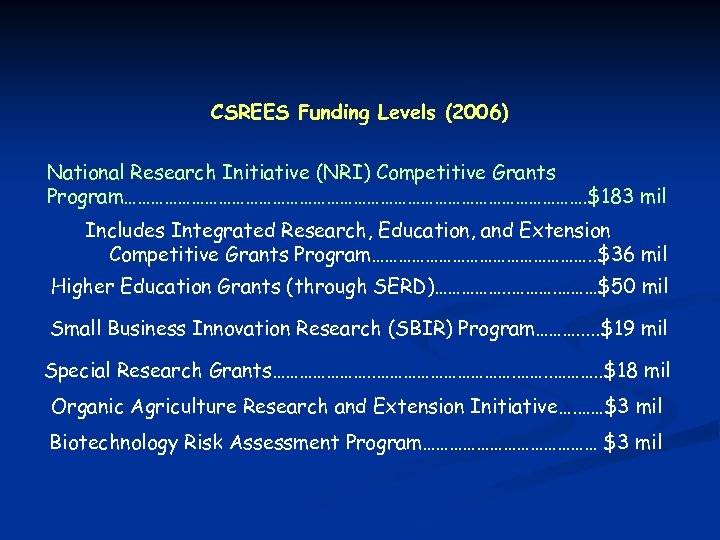
www. csrees. usda. gov CSREES Competitive funds • National Research Initiative (NRI) Competitive Grants Program $183 M in 2006 – major means of funding individual investigators • Integrated Research, Education, and Extension (IREE) Competitive Grants Program • Coordinated Agricultural Projects (CAP) • Small Business Innovation Research (SBIR) Program • Science and Education Resources Development (SERD) Funding Opportunities • Biotechnology Risk Assessment Program • Integrated Organic Agriculture Research and Extension Initiative
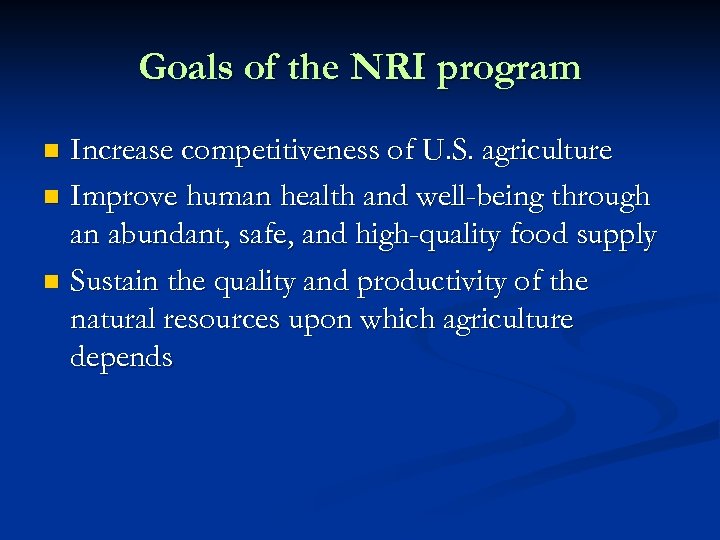
Goals of the NRI program Increase competitiveness of U. S. agriculture n Improve human health and well-being through an abundant, safe, and high-quality food supply n Sustain the quality and productivity of the natural resources upon which agriculture depends n
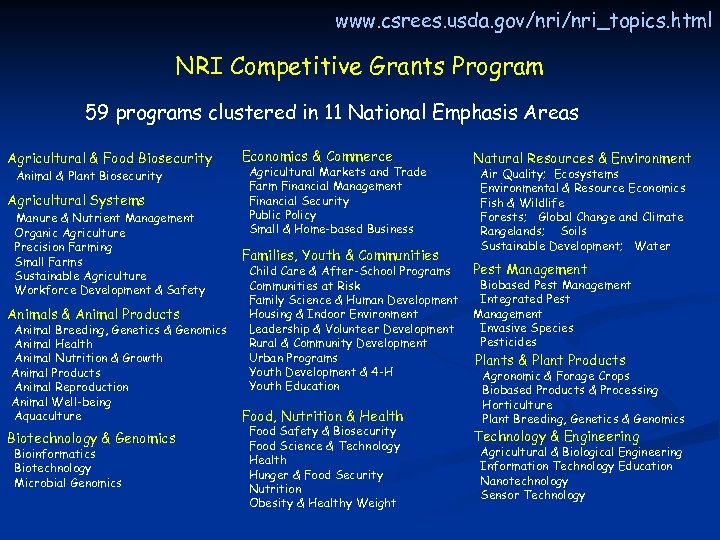
www. csrees. usda. gov/nri_topics. html NRI Competitive Grants Program 59 programs clustered in 11 National Emphasis Areas Agricultural & Food Biosecurity Animal & Plant Biosecurity Agricultural Systems Manure & Nutrient Management Organic Agriculture Precision Farming Small Farms Sustainable Agriculture Workforce Development & Safety Animals & Animal Products Animal Breeding, Genetics & Genomics Animal Health Animal Nutrition & Growth Animal Products Animal Reproduction Animal Well-being Aquaculture Biotechnology & Genomics Bioinformatics Biotechnology Microbial Genomics Economics & Commerce Agricultural Markets and Trade Farm Financial Management Financial Security Public Policy Small & Home-based Business Families, Youth & Communities Child Care & After-School Programs Communities at Risk Family Science & Human Development Housing & Indoor Environment Leadership & Volunteer Development Rural & Community Development Urban Programs Youth Development & 4 -H Youth Education Food, Nutrition & Health Food Safety & Biosecurity Food Science & Technology Health Hunger & Food Security Nutrition Obesity & Healthy Weight Natural Resources & Environment Air Quality; Ecosystems Environmental & Resource Economics Fish & Wildlife Forests; Global Change and Climate Rangelands; Soils Sustainable Development; Water Pest Management Biobased Pest Management Integrated Pest Management Invasive Species Pesticides Plants & Plant Products Agronomic & Forage Crops Biobased Products & Processing Horticulture Plant Breeding, Genetics & Genomics Technology & Engineering Agricultural & Biological Engineering Information Technology Education Nanotechnology Sensor Technology
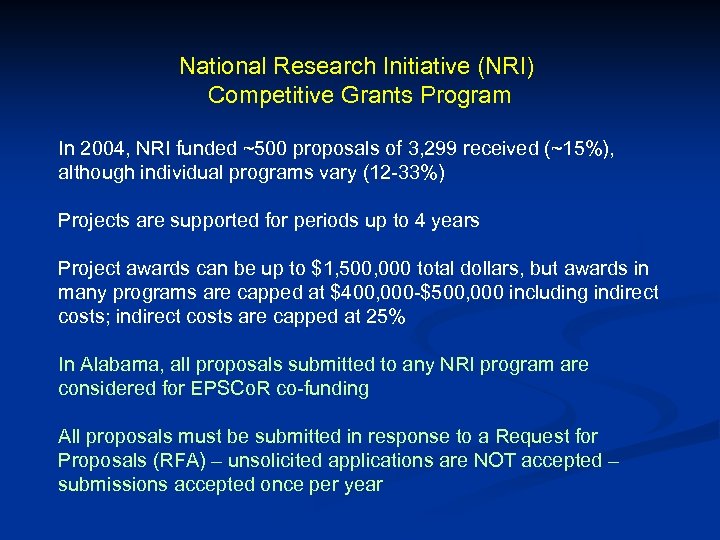
National Research Initiative (NRI) Competitive Grants Program In 2004, NRI funded ~500 proposals of 3, 299 received (~15%), although individual programs vary (12 -33%) Projects are supported for periods up to 4 years Project awards can be up to $1, 500, 000 total dollars, but awards in many programs are capped at $400, 000 -$500, 000 including indirect costs; indirect costs are capped at 25% In Alabama, all proposals submitted to any NRI program are considered for EPSCo. R co-funding All proposals must be submitted in response to a Request for Proposals (RFA) – unsolicited applications are NOT accepted – submissions accepted once per year
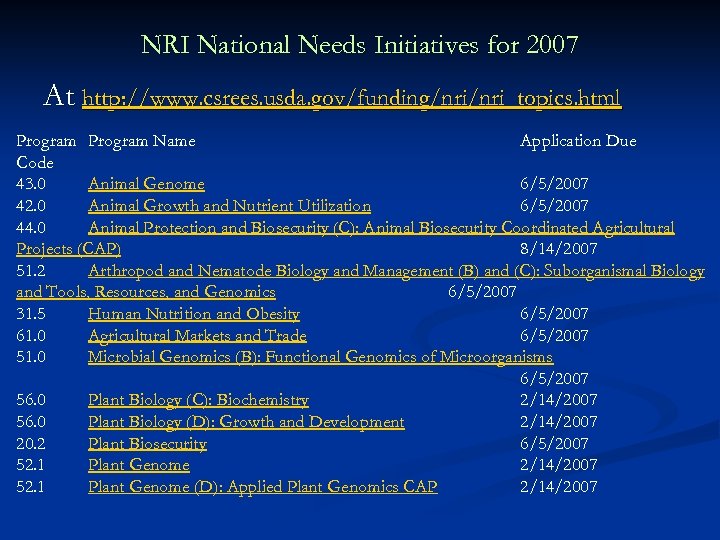
NRI National Needs Initiatives for 2007 At http: //www. csrees. usda. gov/funding/nri_topics. html Program Name Application Due Code 43. 0 Animal Genome 6/5/2007 42. 0 Animal Growth and Nutrient Utilization 6/5/2007 44. 0 Animal Protection and Biosecurity (C): Animal Biosecurity Coordinated Agricultural Projects (CAP) 8/14/2007 51. 2 Arthropod and Nematode Biology and Management (B) and (C): Suborganismal Biology and Tools, Resources, and Genomics 6/5/2007 31. 5 Human Nutrition and Obesity 6/5/2007 61. 0 Agricultural Markets and Trade 6/5/2007 51. 0 Microbial Genomics (B): Functional Genomics of Microorganisms 6/5/2007 56. 0 Plant Biology (C): Biochemistry 2/14/2007 56. 0 Plant Biology (D): Growth and Development 2/14/2007 20. 2 Plant Biosecurity 6/5/2007 52. 1 Plant Genome 2/14/2007 52. 1 Plant Genome (D): Applied Plant Genomics CAP 2/14/2007
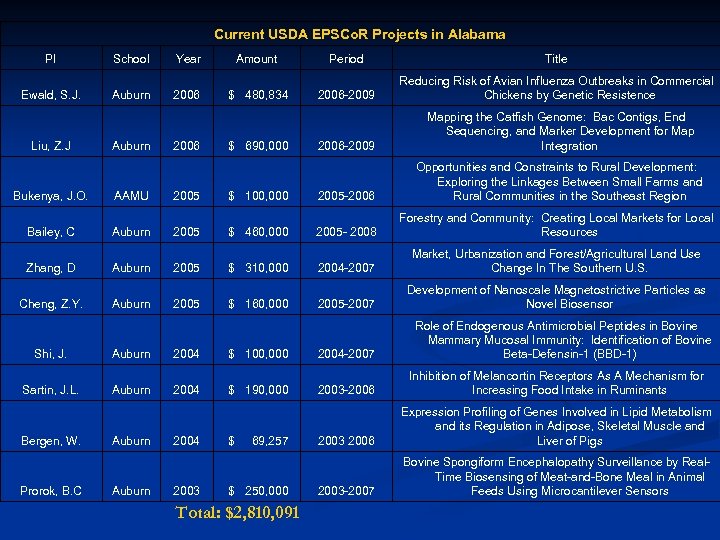
Current USDA EPSCo. R Projects in Alabama PI School Year Amount Period Title Ewald, S. J. Auburn 2006 $ 480, 834 2006 -2009 Reducing Risk of Avian Influenza Outbreaks in Commercial Chickens by Genetic Resistence Liu, Z. J Bukenya, J. O. Bailey, C Zhang, D Cheng, Z. Y. Auburn AAMU Auburn 2006 2005 $ 690, 000 $ 100, 000 $ 460, 000 $ 310, 000 $ 160, 000 2006 -2009 Mapping the Catfish Genome: Bac Contigs, End Sequencing, and Marker Development for Map Integration 2005 -2006 Opportunities and Constraints to Rural Development: Exploring the Linkages Between Small Farms and Rural Communities in the Southeast Region 2005 - 2008 Forestry and Community: Creating Local Markets for Local Resources 2004 -2007 Market, Urbanization and Forest/Agricultural Land Use Change In The Southern U. S. 2005 -2007 Development of Nanoscale Magnetostrictive Particles as Novel Biosensor Role of Endogenous Antimicrobial Peptides in Bovine Mammary Mucosal Immunity: Identification of Bovine Beta-Defensin-1 (BBD-1) Shi, J. Auburn 2004 $ 100, 000 2004 -2007 Sartin, J. L. Auburn 2004 $ 190, 000 2003 -2006 Inhibition of Melancortin Receptors As A Mechanism for Increasing Food Intake in Ruminants 2003 2006 Expression Profiling of Genes Involved in Lipid Metabolism and its Regulation in Adipose, Skeletal Muscle and Liver of Pigs 2003 -2007 Bovine Spongiform Encephalopathy Surveillance by Real. Time Biosensing of Meat-and-Bone Meal in Animal Feeds Using Microcantilever Sensors Bergen, W. Prorok, B. C Auburn 2004 2003 $ 69, 257 $ 250, 000 Total: $2, 810, 091
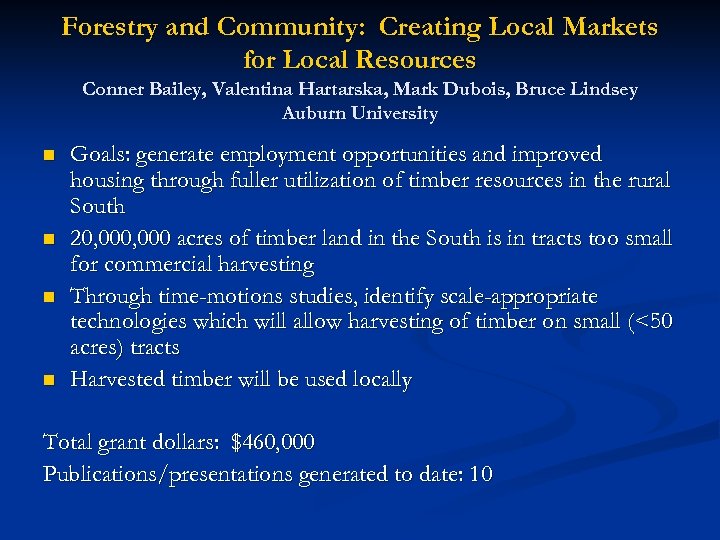
Forestry and Community: Creating Local Markets for Local Resources Conner Bailey, Valentina Hartarska, Mark Dubois, Bruce Lindsey Auburn University n n Goals: generate employment opportunities and improved housing through fuller utilization of timber resources in the rural South 20, 000 acres of timber land in the South is in tracts too small for commercial harvesting Through time-motions studies, identify scale-appropriate technologies which will allow harvesting of timber on small (<50 acres) tracts Harvested timber will be used locally Total grant dollars: $460, 000 Publications/presentations generated to date: 10
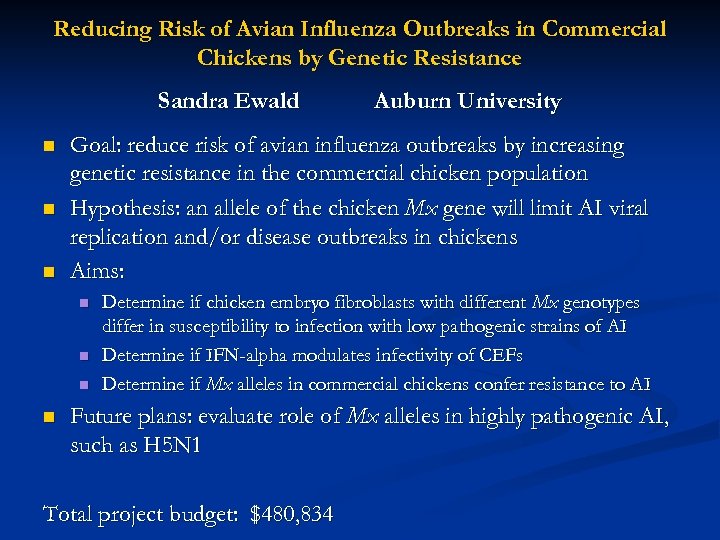
Reducing Risk of Avian Influenza Outbreaks in Commercial Chickens by Genetic Resistance Sandra Ewald n n n Goal: reduce risk of avian influenza outbreaks by increasing genetic resistance in the commercial chicken population Hypothesis: an allele of the chicken Mx gene will limit AI viral replication and/or disease outbreaks in chickens Aims: n n Auburn University Determine if chicken embryo fibroblasts with different Mx genotypes differ in susceptibility to infection with low pathogenic strains of AI Determine if IFN-alpha modulates infectivity of CEFs Determine if Mx alleles in commercial chickens confer resistance to AI Future plans: evaluate role of Mx alleles in highly pathogenic AI, such as H 5 N 1 Total project budget: $480, 834
Opportunities and Constraints to Rural Development: Exploring the Linkages between Small Farms and Rural Communities in the Southeast Region James Bukenya Alabama A&M University n n n Goal: develop tools that will enable policy makers to assign realistic values to the non-market contributions of small farms to a region’s economy and community development Methods: acquire analytical data from USDA Census of Agricultural Statistics, retail statistics from State Tax Commissions, employment data from State Employment Offices and data from relevant literature Next: develop relevant data to model 20 policy scenarios and how communities may be impacted economically Total amount of award: $100, 000
Thank you. Charles W. Prince, Ph. D. Professor of Nutrition Sciences and Biomedical Enginering Assistant Vice-President for Research University of Alabama at Birmingham 205 -934 -7757 princecw@uab. edu
CSREES Funding Levels (2006) National Research Initiative (NRI) Competitive Grants Program……………………………………………. $183 mil Includes Integrated Research, Education, and Extension Competitive Grants Program……………………. . $36 mil Higher Education Grants (through SERD)……………. . ………$50 mil Small Business Innovation Research (SBIR) Program………. . . $19 mil Special Research Grants…………………. ……. . ………. . $18 mil Organic Agriculture Research and Extension Initiative…. ……$3 mil Biotechnology Risk Assessment Program………………… $3 mil
www. csrees. usda. gov CSREES Federal Assistance Formula funds Support base programs of the state experiment stations, the Cooperative Extension System, and Cooperative Forestry Programs Not available on a competitive basis to individual researchers
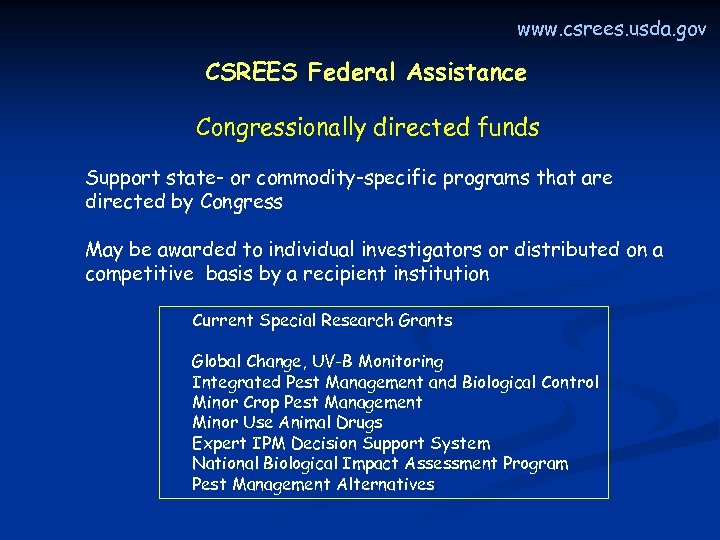
www. csrees. usda. gov CSREES Federal Assistance Congressionally directed funds Support state- or commodity-specific programs that are directed by Congress May be awarded to individual investigators or distributed on a competitive basis by a recipient institution Current Special Research Grants Global Change, UV-B Monitoring Integrated Pest Management and Biological Control Minor Crop Pest Management Minor Use Animal Drugs Expert IPM Decision Support System National Biological Impact Assessment Program Pest Management Alternatives
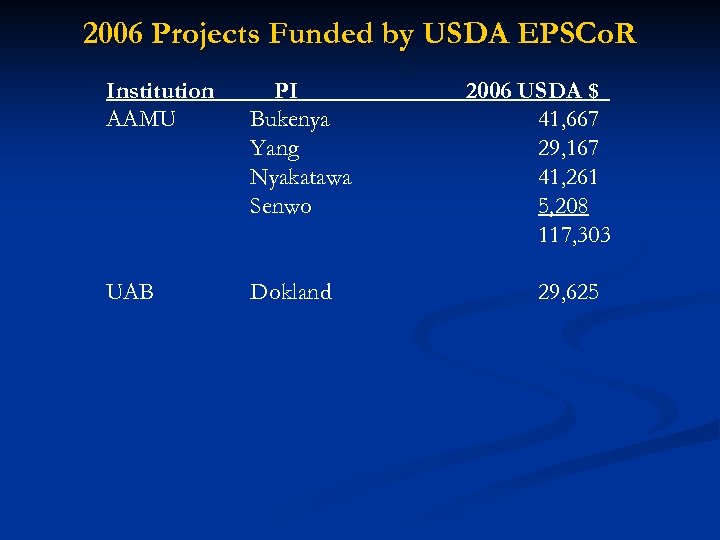
2006 Projects Funded by USDA EPSCo. R Institution AAMU PI Bukenya Yang Nyakatawa Senwo UAB Dokland 2006 USDA $ 41, 667 29, 167 41, 261 5, 208 117, 303 29, 625
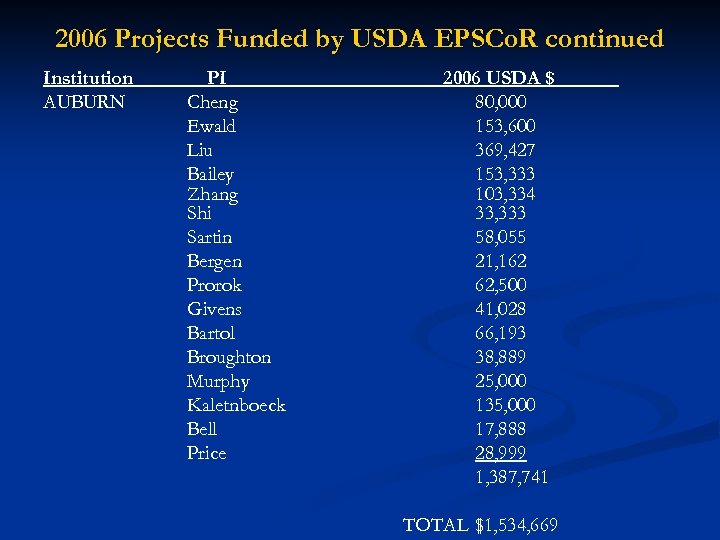
2006 Projects Funded by USDA EPSCo. R continued Institution AUBURN PI Cheng Ewald Liu Bailey Zhang Shi Sartin Bergen Prorok Givens Bartol Broughton Murphy Kaletnboeck Bell Price 2006 USDA $ 80, 000 153, 600 369, 427 153, 333 103, 334 33, 333 58, 055 21, 162 62, 500 41, 028 66, 193 38, 889 25, 000 135, 000 17, 888 28, 999 1, 387, 741 TOTAL $1, 534, 669
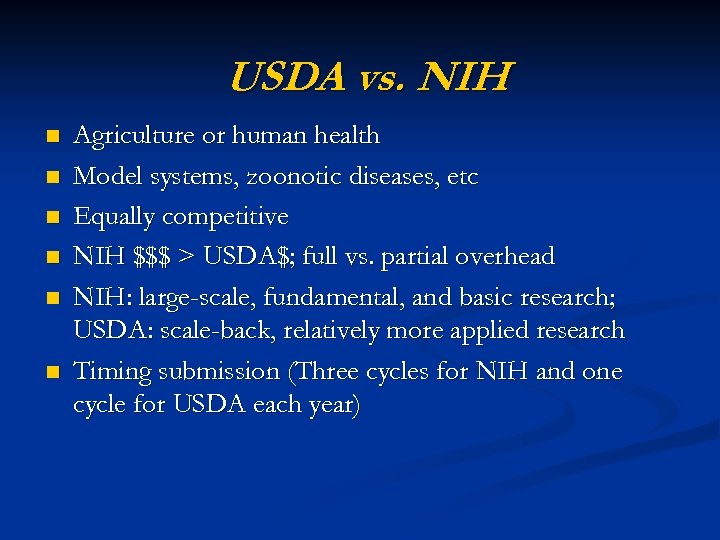
USDA vs. NIH n n n Agriculture or human health Model systems, zoonotic diseases, etc Equally competitive NIH $$$ > USDA$; full vs. partial overhead NIH: large-scale, fundamental, and basic research; USDA: scale-back, relatively more applied research Timing submission (Three cycles for NIH and one cycle for USDA each year)
Скачать презентацию 2007 Alabama EPSCo R Meeting February 13 2007
5ef881a626f267f102ed576bef3de4bb.ppt