


 Скачать презентацию 2005 National Health Care Leadership Conference Saint John
f6119e7d5499c28e214941878e340fb1.ppt
- Количество слайдов: 56
 2005 National Health Care Leadership Conference Saint John, New Brunswick June 6 & 7, 2005 Presented by:
 Health Care in Canada Partners è è è è Association of Canadian Academic Healthcare Organizations Canadian Association for Community Care Canadian College of Health Service Executives Canadian Healthcare Association Canadian Homecare Association Canadian Medical Association Canadian Nursing Association Canadian Pharmacists Association Canadian Public Health Association Health Charities Coalition of Canada Merck Frosst Canada Ltd. POLLARA Research Rogers Media 2
 Table of Contents Page è Methodology 4 è Overview of the Health Care System è Views on the September 2004 Federal. Provincial Health Care Deal 13 è Improving Access è Promoting and Protecting Health 25 è Supporting Innovation è Increasing Accountability è Conclusions 42 16 27 37 5
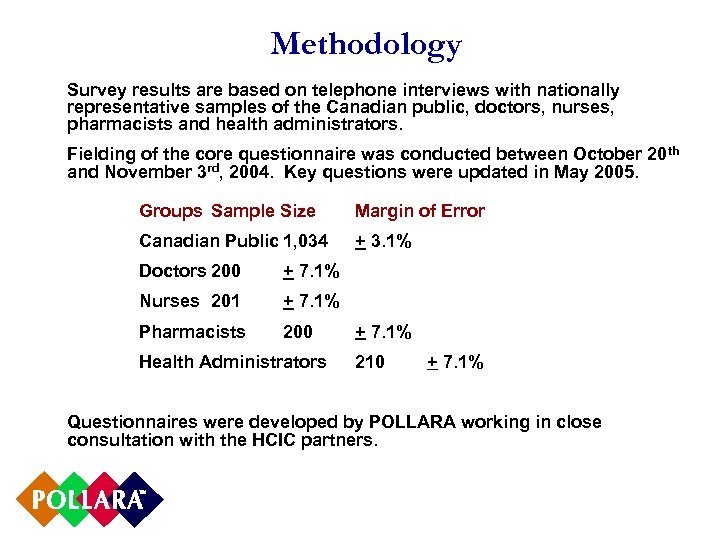 Methodology Survey results are based on telephone interviews with nationally representative samples of the Canadian public, doctors, nurses, pharmacists and health administrators. Fielding of the core questionnaire was conducted between October 20 th and November 3 rd, 2004. Key questions were updated in May 2005. Groups Sample Size Margin of Error Canadian Public 1, 034 + 3. 1% Doctors 200 + 7. 1% Nurses 201 + 7. 1% Pharmacists 200 Health Administrators + 7. 1% 210 + 7. 1% Questionnaires were developed by POLLARA working in close consultation with the HCIC partners.
 Overview of the Health Care System 5
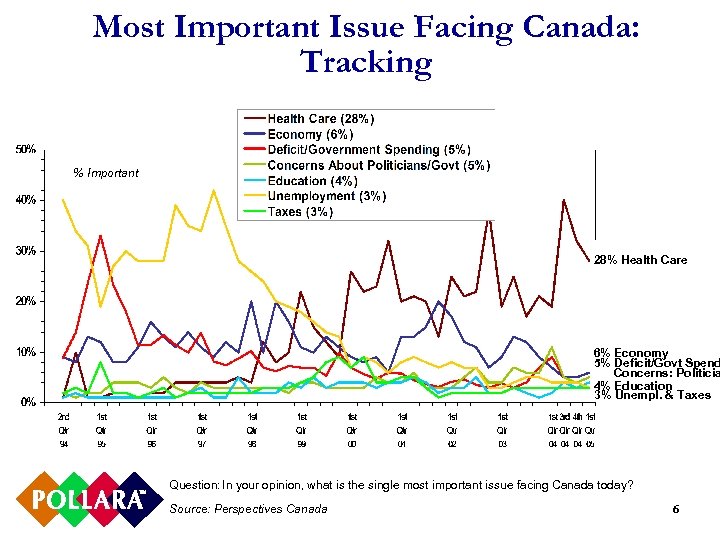 Most Important Issue Facing Canada: Tracking % Important 28% Health Care 6% Economy 5% Deficit/Govt Spend Concerns: Politicia 4% Education 3% Unempl. & Taxes Question: In your opinion, what is the single most important issue facing Canada today? Source: Perspectives Canada 6
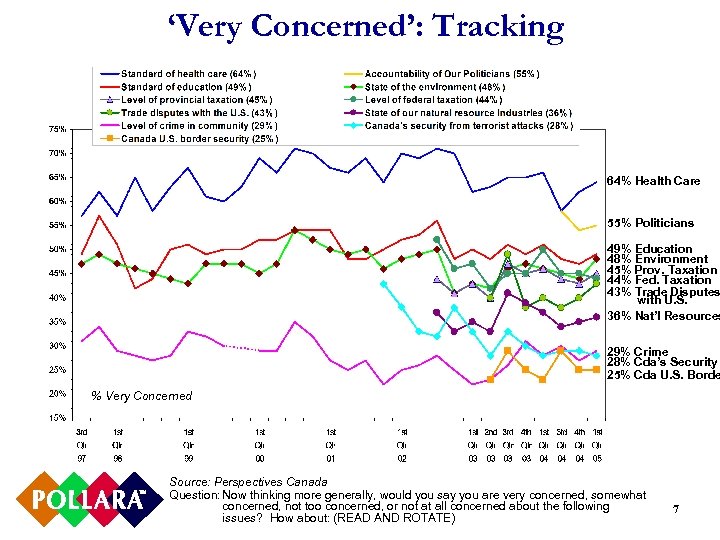 ‘Very Concerned’: Tracking 64% Health Care 55% Politicians 49% Education 48% Environment 45% Prov. Taxation 44% Fed. Taxation 43% Trade Disputes with U. S. 36% Nat’l Resources 29% Crime 28% Cda’s Security 25% Cda U. S. Borde % Very Concerned Source: Perspectives Canada Question: Now thinking more generally, would you say you are very concerned, somewhat concerned, not too concerned, or not at all concerned about the following issues? How about: (READ AND ROTATE) 7
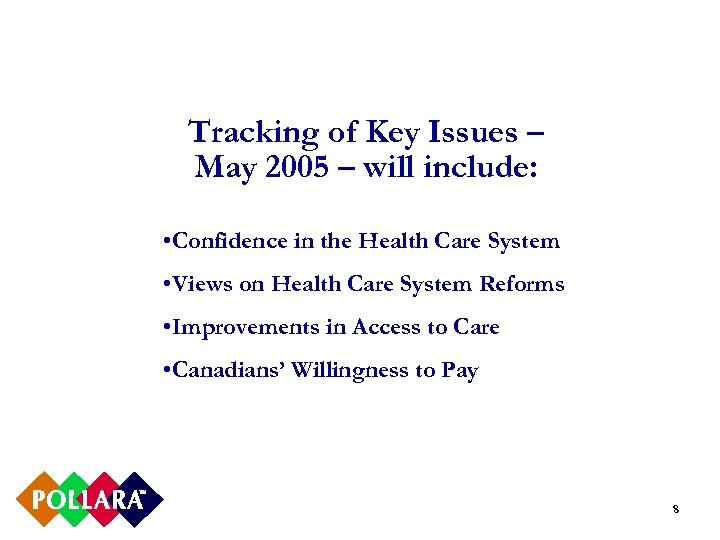 Tracking of Key Issues – May 2005 – will include: • Confidence in the Health Care System • Views on Health Care System Reforms • Improvements in Access to Care • Canadians’ Willingness to Pay 8
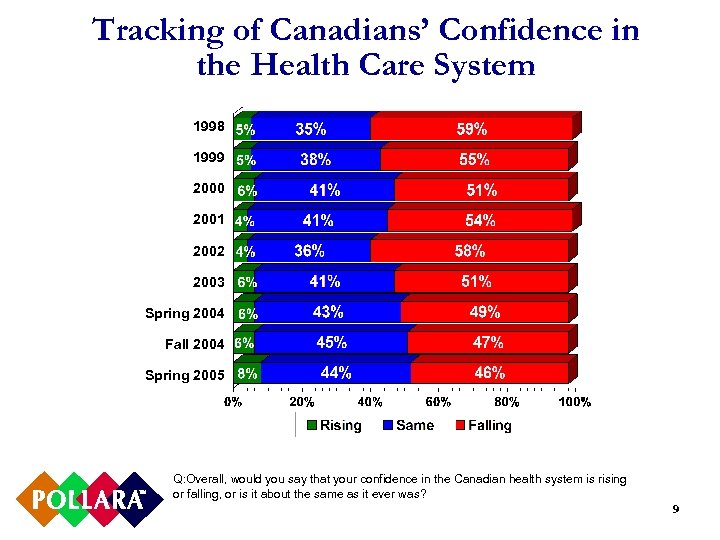 Tracking of Canadians’ Confidence in the Health Care System 1998 1999 2000 2001 2002 2003 Spring 2004 Fall 2004 Spring 2005 Q: Overall, would you say that your confidence in the Canadian health system is rising or falling, or is it about the same as it ever was? 9
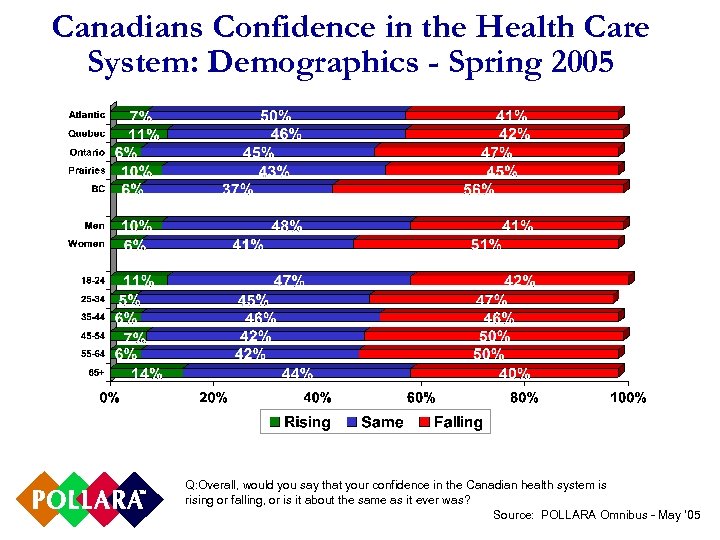 Canadians Confidence in the Health Care System: Demographics - Spring 2005 Q: Overall, would you say that your confidence in the Canadian health system is rising or falling, or is it about the same as it ever was? Source: POLLARA Omnibus - May ‘ 05
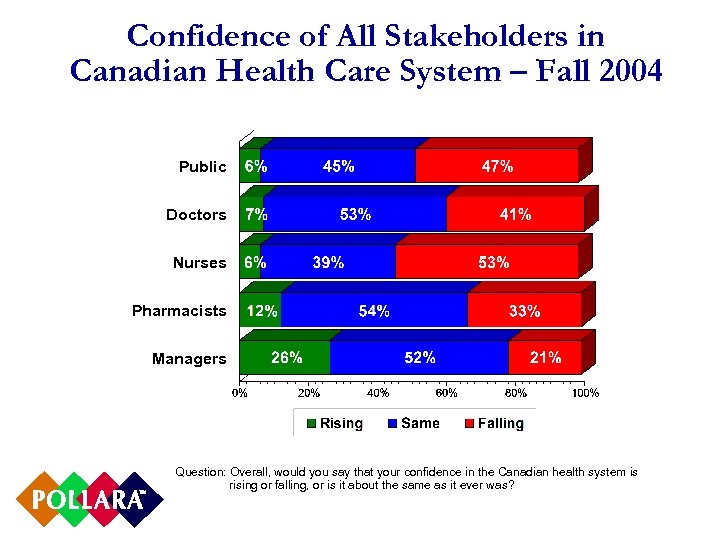 Confidence of All Stakeholders in Canadian Health Care System – Fall 2004 Public Doctors Nurses Pharmacists Managers Question: Overall, would you say that your confidence in the Canadian health system is rising or falling, or is it about the same as it ever was?
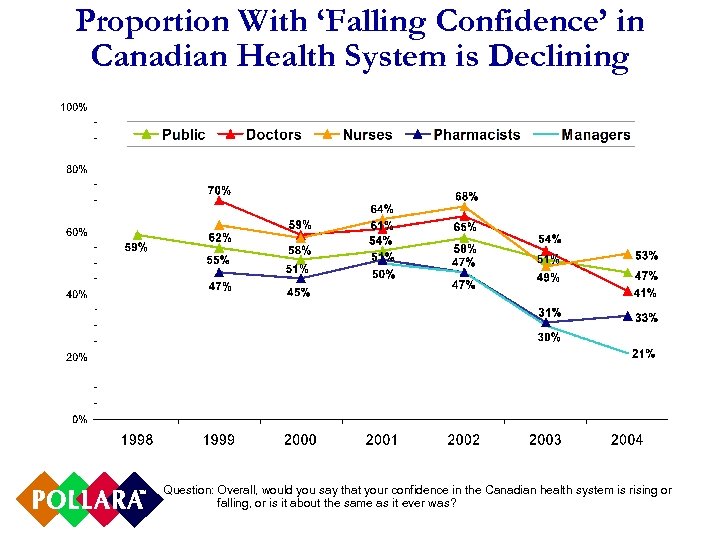 Proportion With ‘Falling Confidence’ in Canadian Health System is Declining Question: Overall, would you say that your confidence in the Canadian health system is rising or falling, or is it about the same as it ever was?
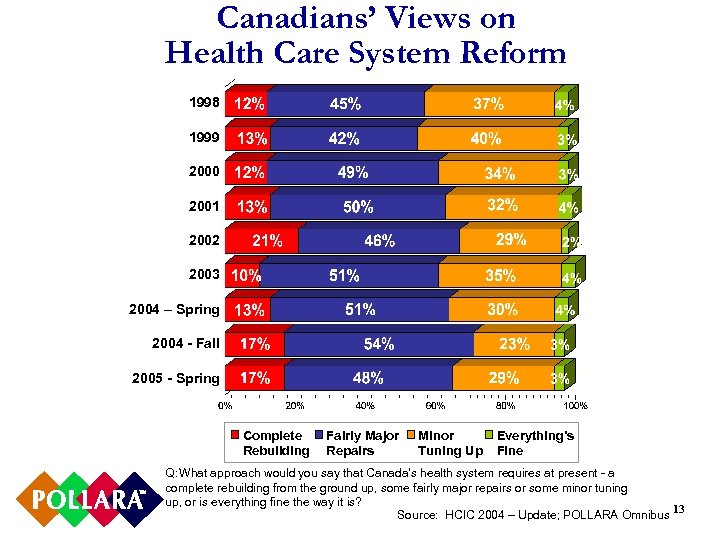 Canadians’ Views on Health Care System Reform 1998 1999 2000 2001 2002 2003 2004 – Spring 2004 - Fall 2005 - Spring Complete Rebuilding Fairly Major Repairs Minor Tuning Up Everything's Fine Q: What approach would you say that Canada’s health system requires at present - a complete rebuilding from the ground up, some fairly major repairs or some minor tuning up, or is everything fine the way it is? 13 Source: HCIC 2004 – Update; POLLARA Omnibus
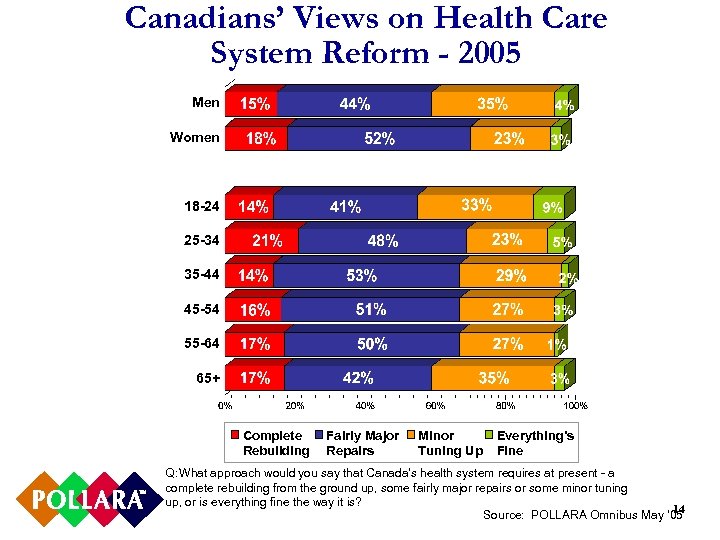 Canadians’ Views on Health Care System Reform - 2005 Men Women 18 -24 25 -34 35 -44 45 -54 55 -64 65+ Complete Rebuilding Fairly Major Repairs Minor Tuning Up Everything's Fine Q: What approach would you say that Canada’s health system requires at present - a complete rebuilding from the ground up, some fairly major repairs or some minor tuning up, or is everything fine the way it is? 14 Source: POLLARA Omnibus May ‘ 05
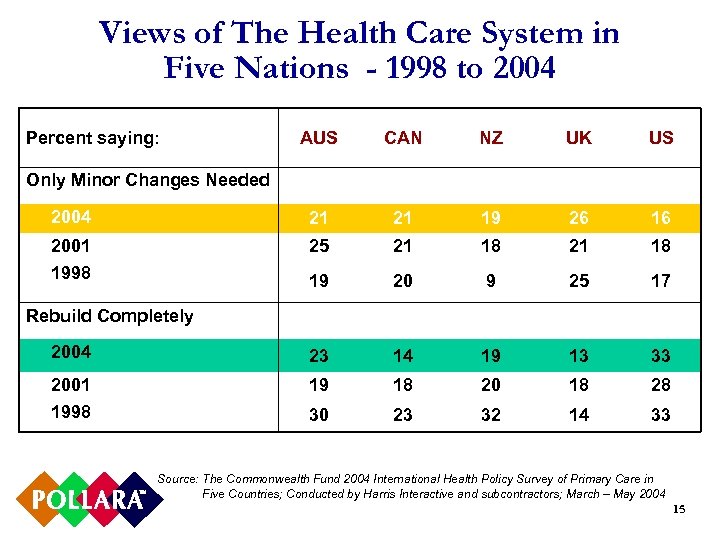 Views of The Health Care System in Five Nations - 1998 to 2004 Percent saying: AUS CAN NZ UK US 2004 21 21 19 26 16 2001 1998 25 21 18 19 20 9 25 17 2004 23 14 19 13 33 2001 1998 19 18 20 18 28 30 23 32 14 33 Only Minor Changes Needed Rebuild Completely Source: The Commonwealth Fund 2004 International Health Policy Survey of Primary Care in Five Countries; Conducted by Harris Interactive and subcontractors; March – May 2004 15
 Views on the September 2004 Federal-Provincial Health Care Deal 16
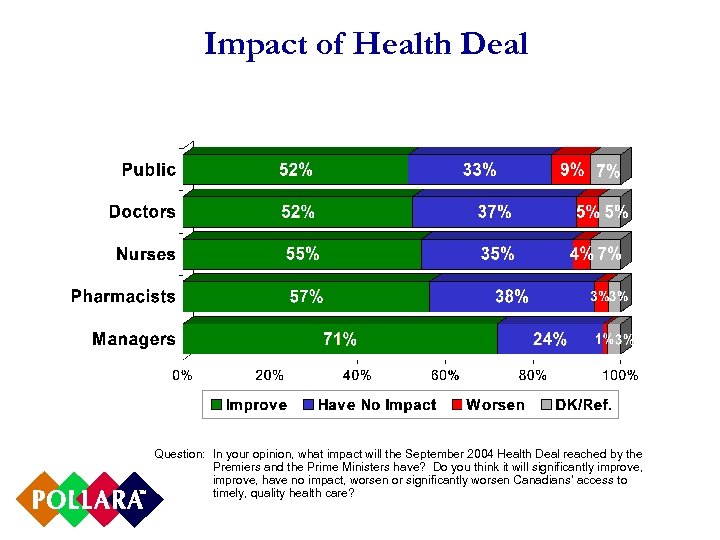 Impact of Health Deal Question: In your opinion, what impact will the September 2004 Health Deal reached by the Premiers and the Prime Ministers have? Do you think it will significantly improve, have no impact, worsen or significantly worsen Canadians’ access to timely, quality health care?
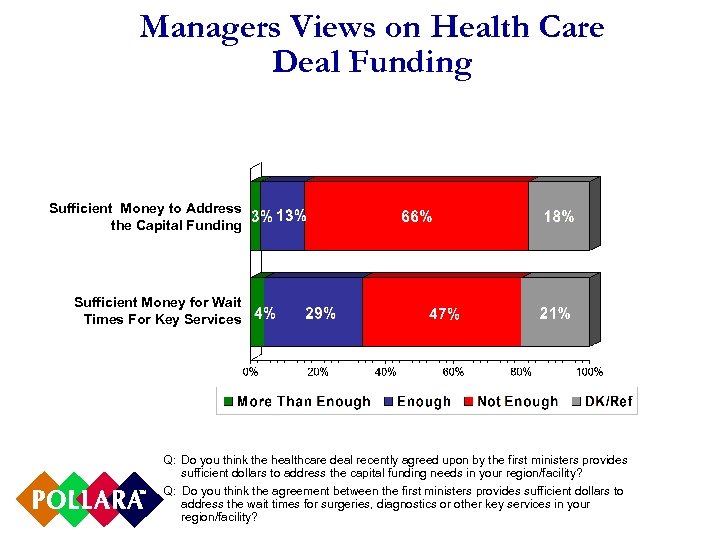 Managers Views on Health Care Deal Funding Sufficient Money to Address the Capital Funding Sufficient Money for Wait Times For Key Services Q: Do you think the healthcare deal recently agreed upon by the first ministers provides sufficient dollars to address the capital funding needs in your region/facility? Q: Do you think the agreement between the first ministers provides sufficient dollars to address the wait times for surgeries, diagnostics or other key services in your region/facility?
 Improving Access 19
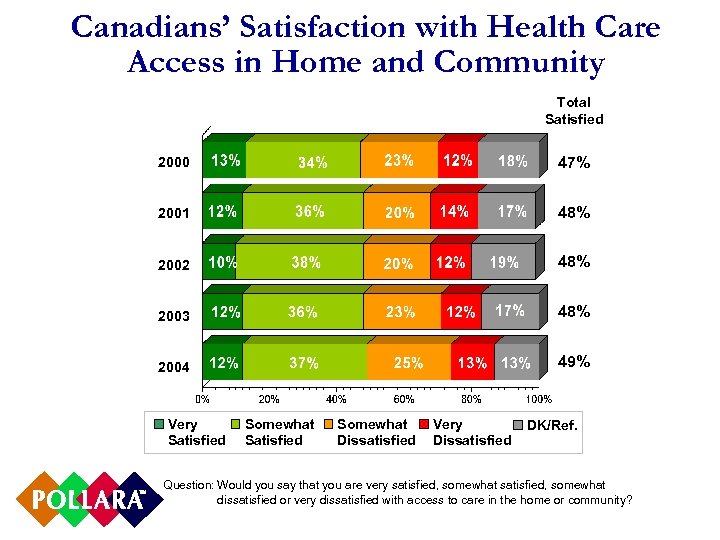 Canadians’ Satisfaction with Health Care Access in Home and Community Total Satisfied 2000 47% 2001 48% 2002 48% 2003 48% 2004 49% Very Satisfied Somewhat Dissatisfied Very Dissatisfied DK/Ref. Question: Would you say that you are very satisfied, somewhat dissatisfied or very dissatisfied with access to care in the home or community?
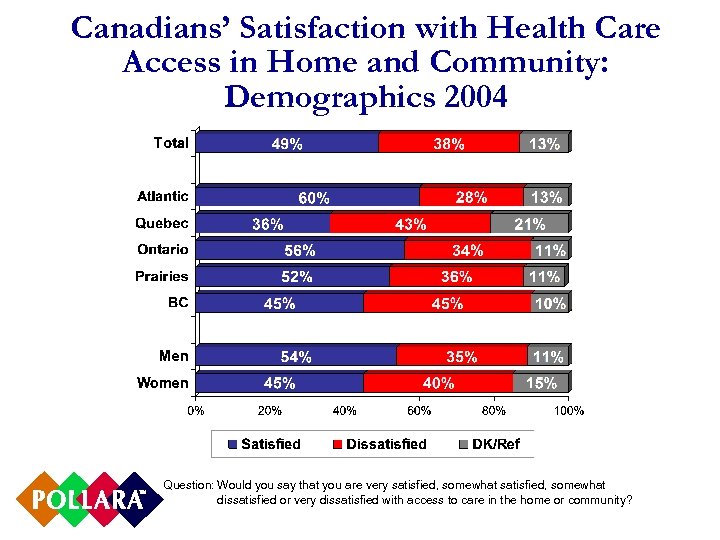 Canadians’ Satisfaction with Health Care Access in Home and Community: Demographics 2004 Question: Would you say that you are very satisfied, somewhat dissatisfied or very dissatisfied with access to care in the home or community?
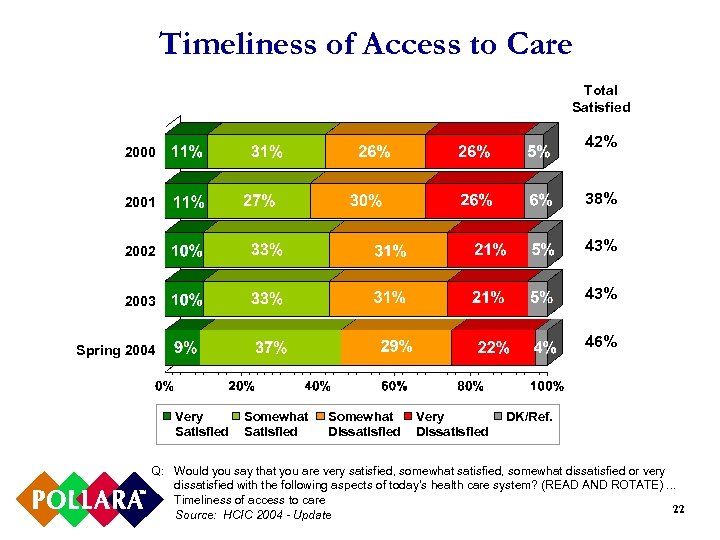 Timeliness of Access to Care Total Satisfied 42% 2000 2001 38% 2002 43% 2003 43% 46% Spring 2004 Very Satisfied Somewhat Dissatisfied Very Dissatisfied DK/Ref. Q: Would you say that you are very satisfied, somewhat dissatisfied or very dissatisfied with the following aspects of today’s health care system? (READ AND ROTATE). . . Timeliness of access to care 22 Source: HCIC 2004 - Update
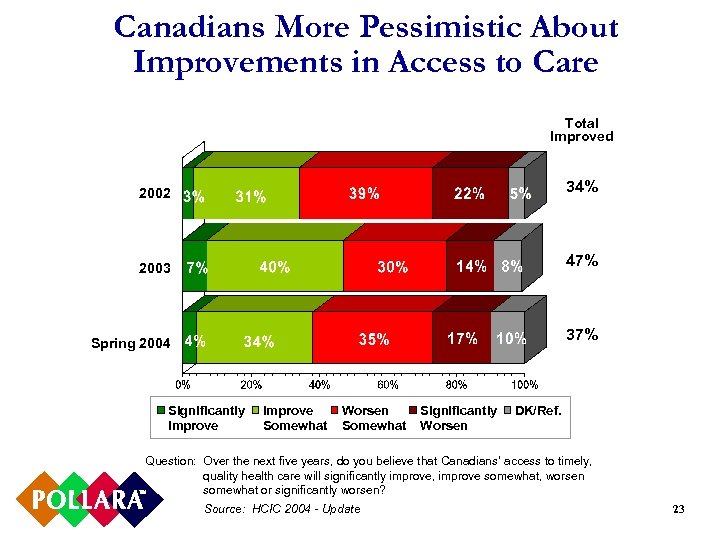 Canadians More Pessimistic About Improvements in Access to Care Total Improved 2002 34% 2003 47% 37% Spring 2004 Significantly Improve Somewhat Worsen Somewhat Significantly Worsen DK/Ref. Question: Over the next five years, do you believe that Canadians’ access to timely, quality health care will significantly improve, improve somewhat, worsen somewhat or significantly worsen? Source: HCIC 2004 - Update 23
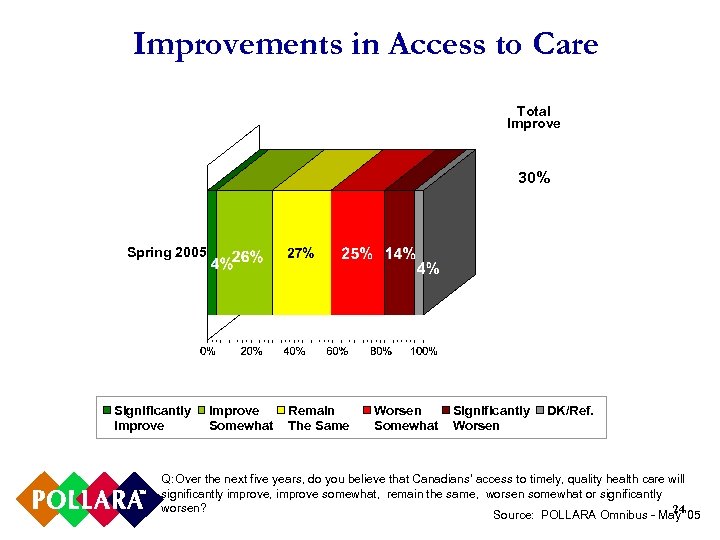 Improvements in Access to Care Total Improve 30% Spring 2005 Significantly Improve Somewhat Remain The Same Worsen Somewhat Significantly Worsen DK/Ref. Q: Over the next five years, do you believe that Canadians’ access to timely, quality health care will significantly improve, improve somewhat, remain the same, worsen somewhat or significantly worsen? 24 Source: POLLARA Omnibus - May ‘ 05
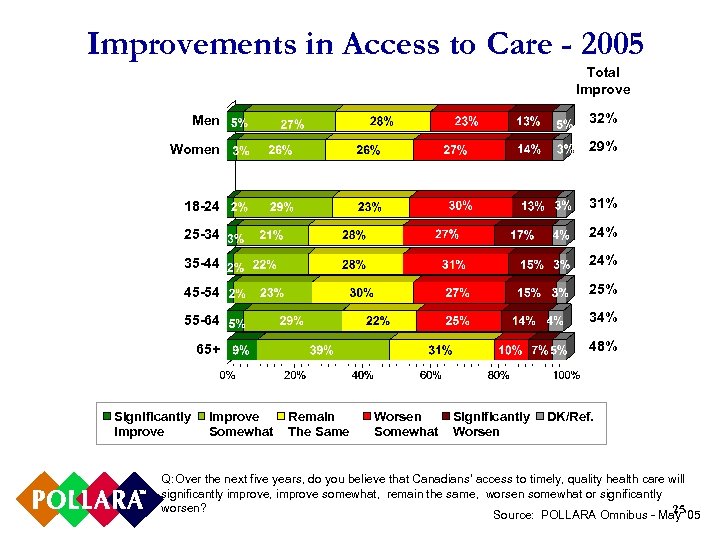 Improvements in Access to Care - 2005 Total Improve Men 32% Women 29% 18 -24 31% 25 -34 24% 35 -44 24% 45 -54 25% 55 -64 34% 65+ 48% Significantly Improve Somewhat Remain The Same Worsen Somewhat Significantly Worsen DK/Ref. Q: Over the next five years, do you believe that Canadians’ access to timely, quality health care will significantly improve, improve somewhat, remain the same, worsen somewhat or significantly worsen? 25 Source: POLLARA Omnibus - May ‘ 05
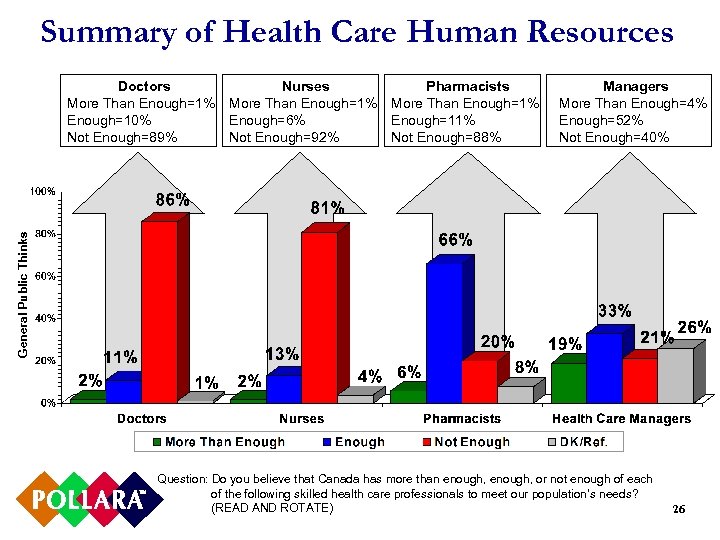 Summary of Health Care Human Resources Managers More Than Enough=4% Enough=52% Not Enough=40% General Public Thinks Doctors Nurses Pharmacists More Than Enough=1% Enough=10% Enough=6% Enough=11% Not Enough=89% Not Enough=92% Not Enough=88% Question: Do you believe that Canada has more than enough, or not enough of each of the following skilled health care professionals to meet our population’s needs? (READ AND ROTATE) 26
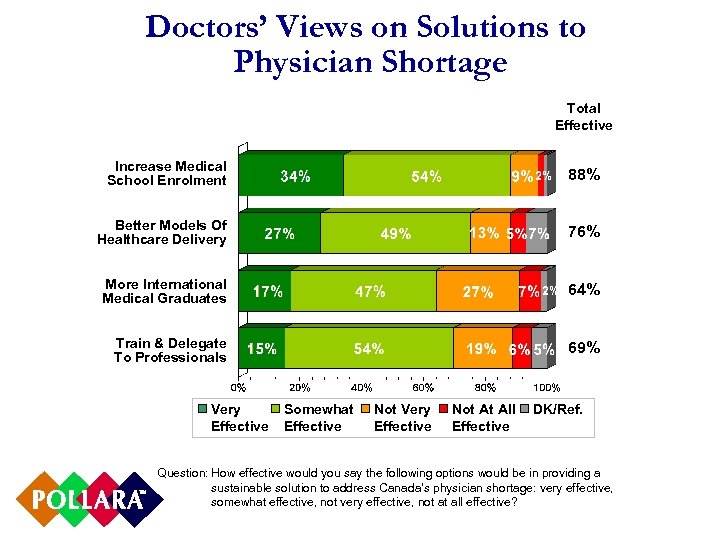 Doctors’ Views on Solutions to Physician Shortage Total Effective Increase Medical School Enrolment 88% Better Models Of Healthcare Delivery 76% More International Medical Graduates 64% Train & Delegate To Professionals 69% Very Effective Somewhat Effective Not Very Effective Not At All Effective DK/Ref. Question: How effective would you say the following options would be in providing a sustainable solution to address Canada’s physician shortage: very effective, somewhat effective, not very effective, not at all effective?
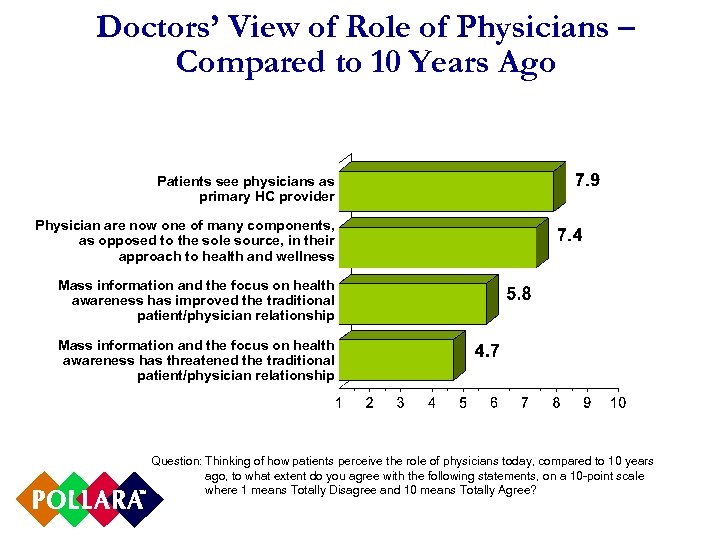 Doctors’ View of Role of Physicians – Compared to 10 Years Ago Patients see physicians as primary HC provider Physician are now one of many components, as opposed to the sole source, in their approach to health and wellness Mass information and the focus on health awareness has improved the traditional patient/physician relationship Mass information and the focus on health awareness has threatened the traditional patient/physician relationship Question: Thinking of how patients perceive the role of physicians today, compared to 10 years ago, to what extent do you agree with the following statements, on a 10 -point scale where 1 means Totally Disagree and 10 means Totally Agree?
 Pharmacists’ View on Role of Pharmacists should play an integral part in providing medication services to patients receiving care at home Pharmacists should have greater role in choosing the appropriate prescription medications for patients Question: To what extent do you agree with the following statements, on a 10 -point scale where 1 means Totally Disagree and 10 means Totally Agree:
 Promoting and Protecting Health 30
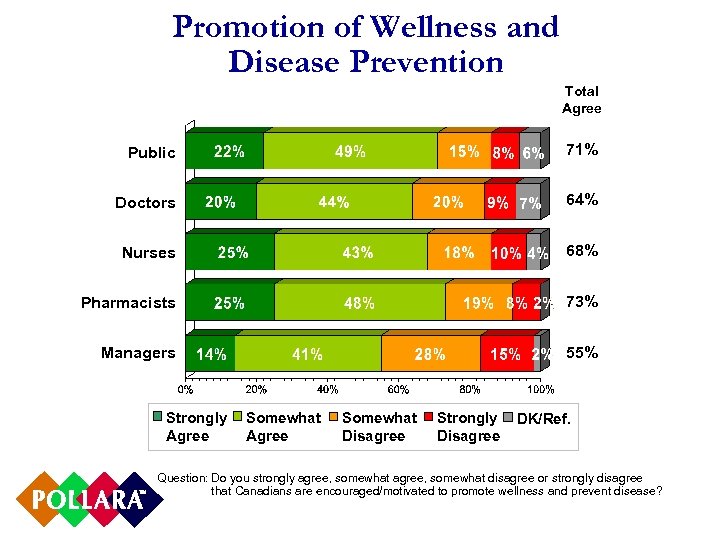 Promotion of Wellness and Disease Prevention Total Agree Public 71% Doctors 64% Nurses 68% Pharmacists 73% Managers 55% Strongly Agree Somewhat Disagree Strongly Disagree DK/Ref. Question: Do you strongly agree, somewhat disagree or strongly disagree that Canadians are encouraged/motivated to promote wellness and prevent disease?
 Supporting Innovation 32
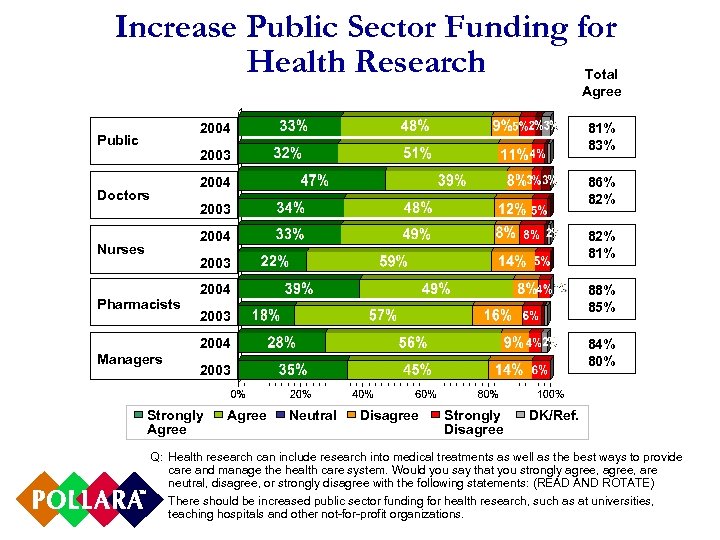 Increase Public Sector Funding for Health Research Total Agree 81% 83% 2004 Public 2003 2004 Doctors 86% 82% 2003 2004 Nurses 82% 81% 2003 Pharmacists Managers 2004 88% 85% 2003 2004 84% 80% 2003 Strongly Agree Neutral Disagree Strongly Disagree DK/Ref. Q: Health research can include research into medical treatments as well as the best ways to provide care and manage the health care system. Would you say that you strongly agree, are neutral, disagree, or strongly disagree with the following statements: (READ AND ROTATE) There should be increased public sector funding for health research, such as at universities, teaching hospitals and other not-for-profit organizations.
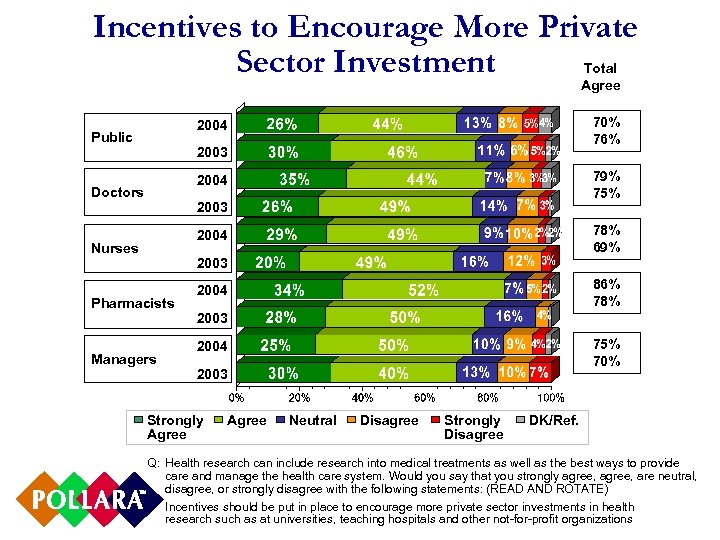 Incentives to Encourage More Private Sector Investment Total Agree 70% 76% 2004 Public 2003 79% 75% 2004 Doctors 2003 78% 69% 2004 Nurses 2003 Pharmacists Managers 86% 78% 2004 2003 75% 70% 2004 2003 Strongly Agree Neutral Disagree Strongly Disagree DK/Ref. Q: Health research can include research into medical treatments as well as the best ways to provide care and manage the health care system. Would you say that you strongly agree, are neutral, disagree, or strongly disagree with the following statements: (READ AND ROTATE) Incentives should be put in place to encourage more private sector investments in health research such as at universities, teaching hospitals and other not-for-profit organizations
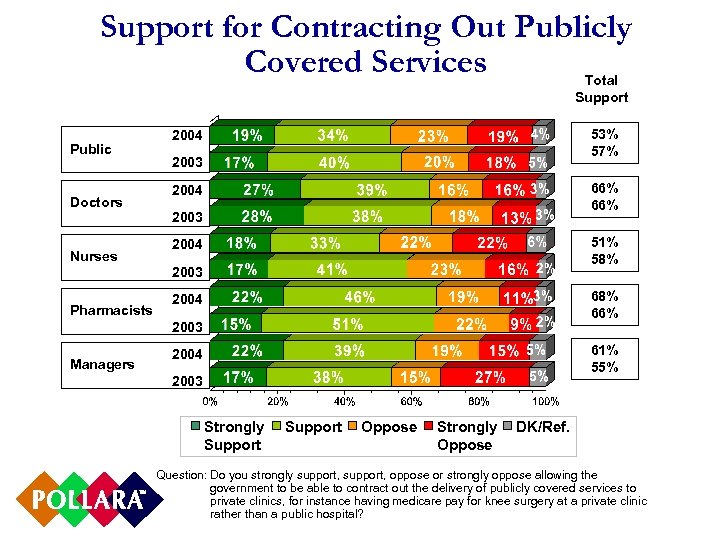 Support for Contracting Out Publicly Covered Services Total Support Public Doctors Nurses Pharmacists 53% 57% 2004 2003 66% 2004 2003 51% 58% 2004 2003 68% 66% 2004 2003 Managers 61% 55% 2004 2003 Strongly Support Oppose Strongly Oppose DK/Ref. Question: Do you strongly support, oppose or strongly oppose allowing the government to be able to contract out the delivery of publicly covered services to private clinics, for instance having medicare pay for knee surgery at a private clinic rather than a public hospital?
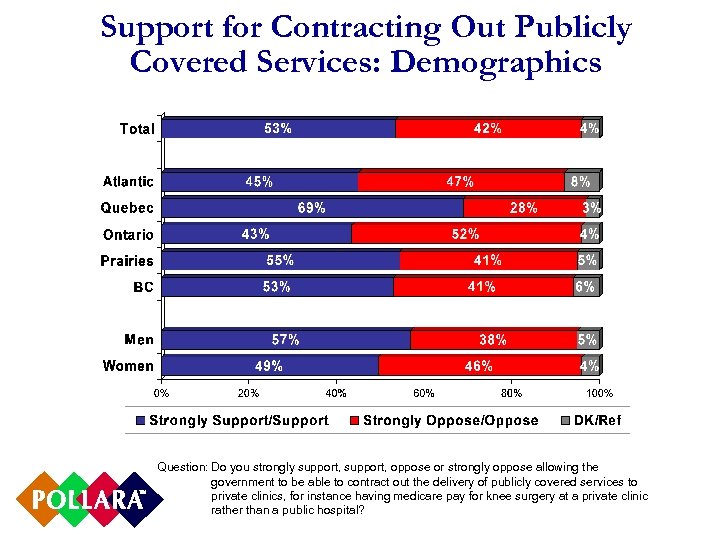 Support for Contracting Out Publicly Covered Services: Demographics Question: Do you strongly support, oppose or strongly oppose allowing the government to be able to contract out the delivery of publicly covered services to private clinics, for instance having medicare pay for knee surgery at a private clinic rather than a public hospital?
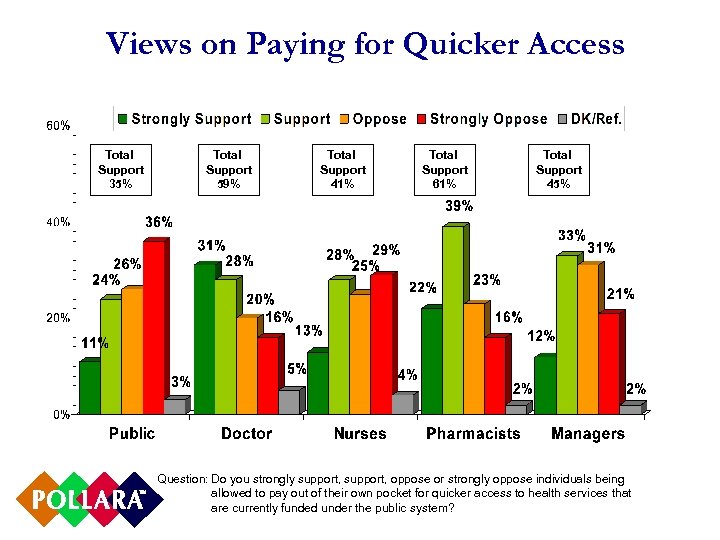 Views on Paying for Quicker Access Total Support 35% Total Support 59% Total Support 41% Total Support 61% Total Support 45% Question: Do you strongly support, oppose or strongly oppose individuals being allowed to pay out of their own pocket for quicker access to health services that are currently funded under the public system?
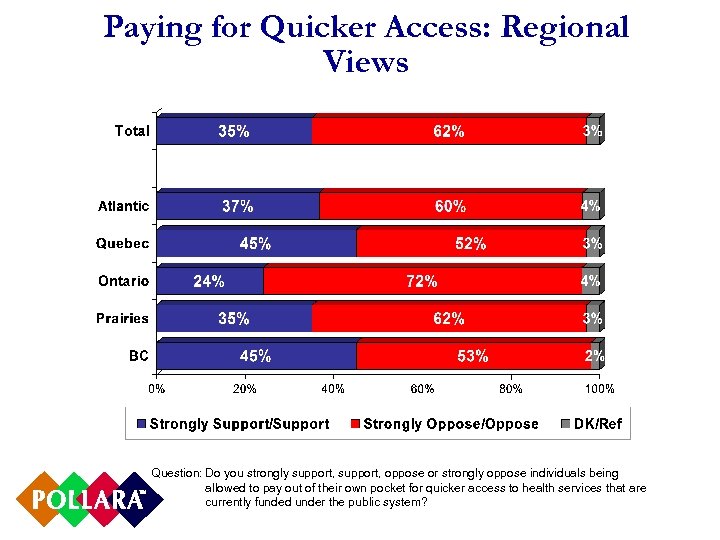 Paying for Quicker Access: Regional Views Question: Do you strongly support, oppose or strongly oppose individuals being allowed to pay out of their own pocket for quicker access to health services that are currently funded under the public system?
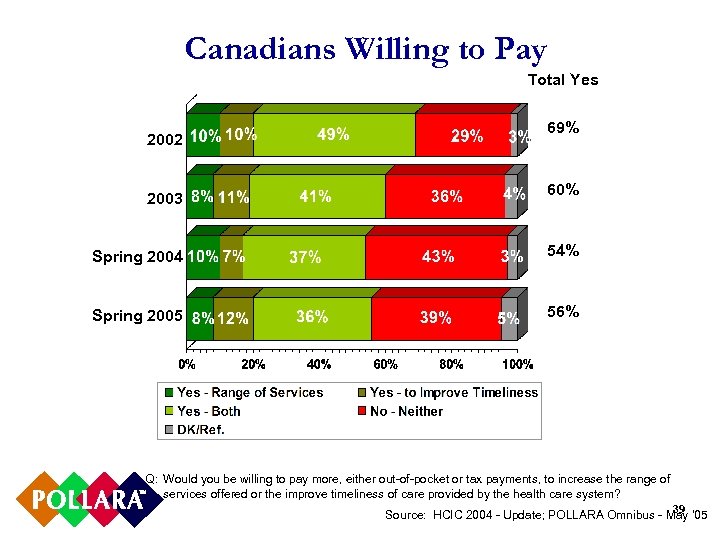 Canadians Willing to Pay Total Yes 2002 2003 69% 60% Spring 2004 54% Spring 2005 56% Q: Would you be willing to pay more, either out-of-pocket or tax payments, to increase the range of services offered or the improve timeliness of care provided by the health care system? 39 Source: HCIC 2004 - Update; POLLARA Omnibus - May ‘ 05
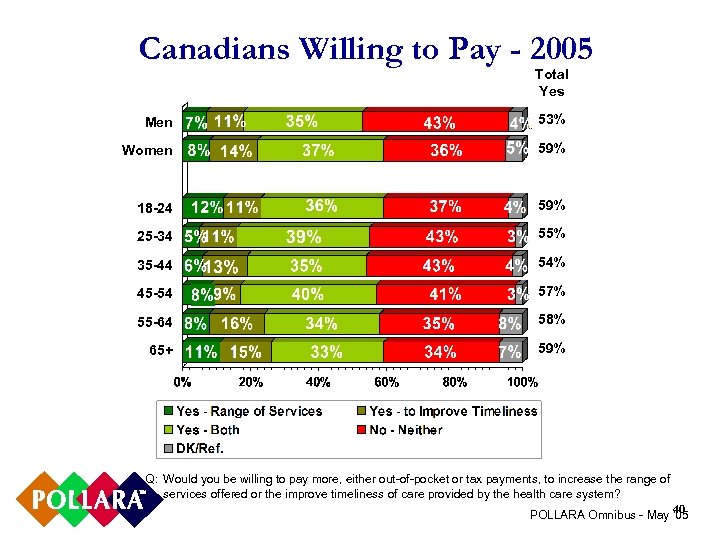 Canadians Willing to Pay - 2005 Total Yes Men 53% Women 59% 18 -24 59% 25 -34 55% 35 -44 54% 45 -54 57% 55 -64 58% 65+ 59% Q: Would you be willing to pay more, either out-of-pocket or tax payments, to increase the range of services offered or the improve timeliness of care provided by the health care system? 40 POLLARA Omnibus - May ‘ 05
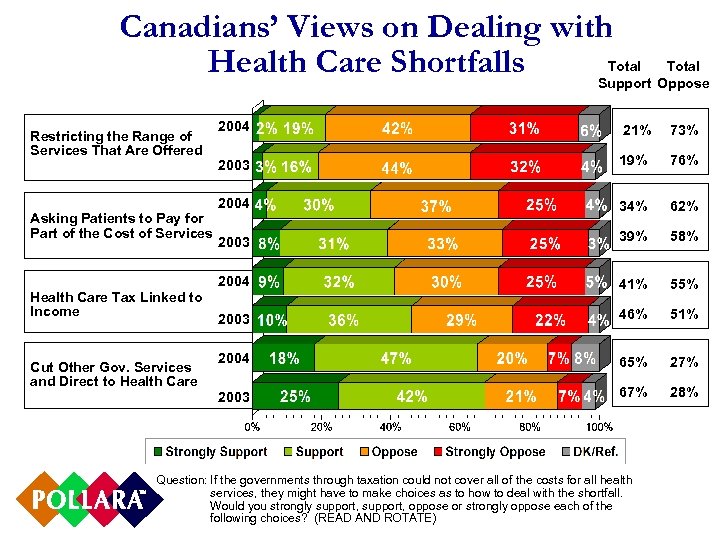 Canadians’ Views on Dealing with Total Health Care Shortfalls Support Oppose Asking Patients to Pay for Part of the Cost of Services Health Care Tax Linked to Income Cut Other Gov. Services and Direct to Health Care 2004 21% 73% 2003 19% 76% 2004 34% 62% 2003 39% 58% 2004 Restricting the Range of Services That Are Offered 41% 55% 2003 46% 51% 2004 65% 27% 2003 67% 28% Question: If the governments through taxation could not cover all of the costs for all health services, they might have to make choices as to how to deal with the shortfall. Would you strongly support, oppose or strongly oppose each of the following choices? (READ AND ROTATE)
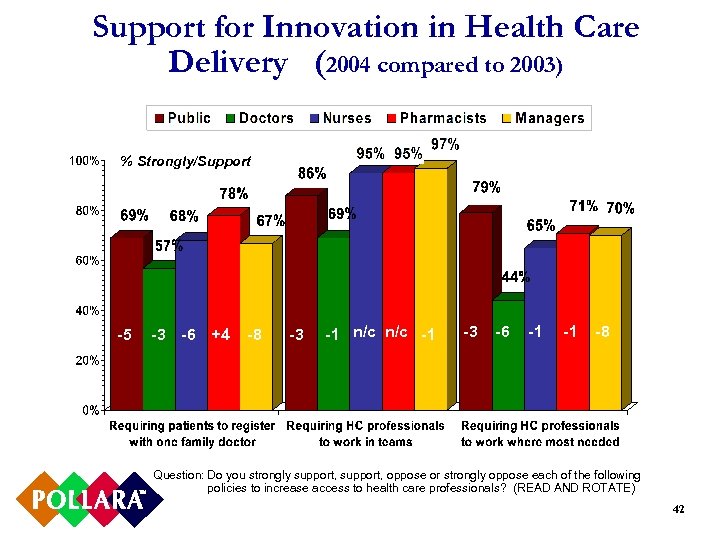 Support for Innovation in Health Care Delivery (2004 compared to 2003) % Strongly/Support -5 -3 -6 +4 -8 -3 -1 n/c -1 -3 -6 -1 -1 -8 Question: Do you strongly support, oppose or strongly oppose each of the following policies to increase access to health care professionals? (READ AND ROTATE) 42
 Increasing Accountability 43
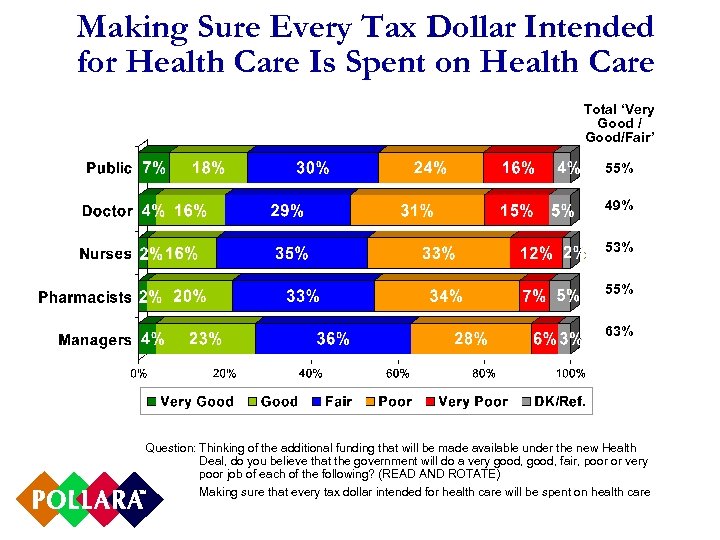 Making Sure Every Tax Dollar Intended for Health Care Is Spent on Health Care Total ‘Very Good / Good/Fair’ 55% 49% 53% 55% 63% Question: Thinking of the additional funding that will be made available under the new Health Deal, do you believe that the government will do a very good, fair, poor or very poor job of each of the following? (READ AND ROTATE) Making sure that every tax dollar intended for health care will be spent on health care
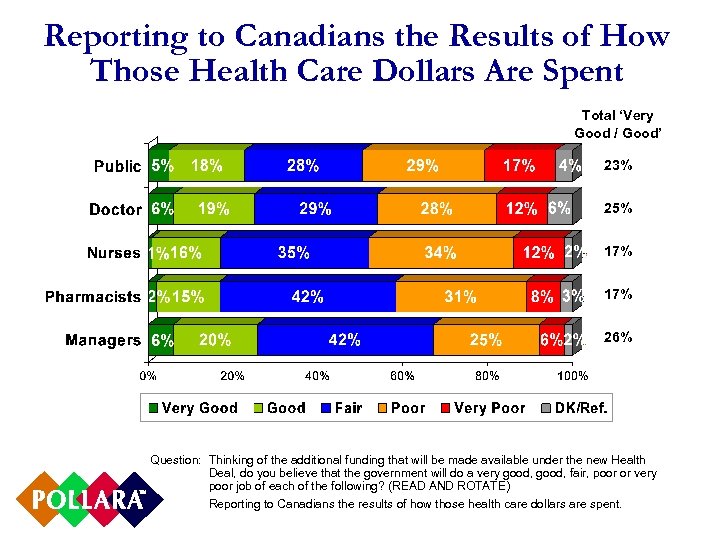 Reporting to Canadians the Results of How Those Health Care Dollars Are Spent Total ‘Very Good / Good’ 23% 25% 17% 26% Question: Thinking of the additional funding that will be made available under the new Health Deal, do you believe that the government will do a very good, fair, poor or very poor job of each of the following? (READ AND ROTATE) Reporting to Canadians the results of how those health care dollars are spent.
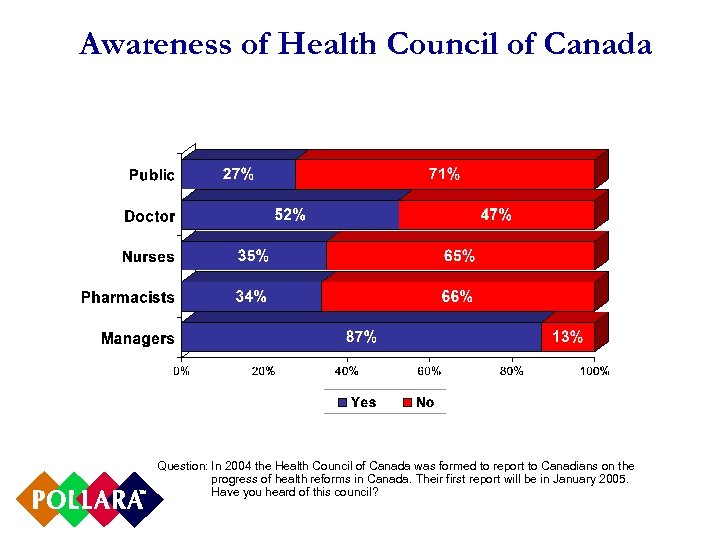 Awareness of Health Council of Canada Question: In 2004 the Health Council of Canada was formed to report to Canadians on the progress of health reforms in Canada. Their first report will be in January 2005. Have you heard of this council?
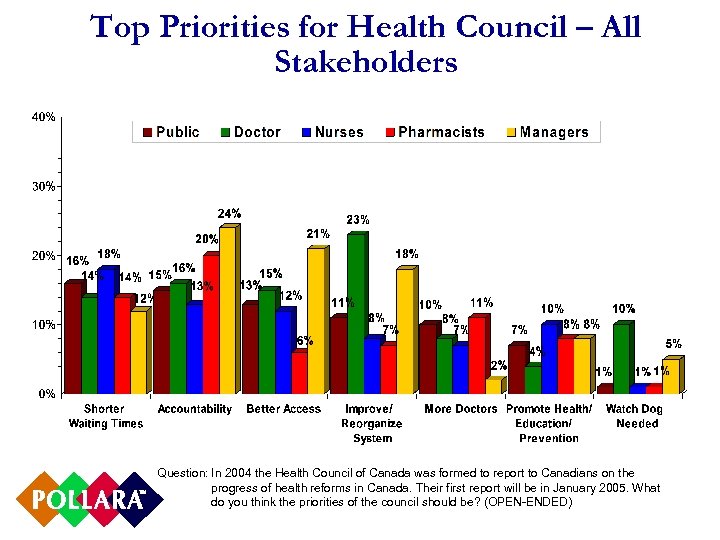 Top Priorities for Health Council – All Stakeholders Question: In 2004 the Health Council of Canada was formed to report to Canadians on the progress of health reforms in Canada. Their first report will be in January 2005. What do you think the priorities of the council should be? (OPEN-ENDED)
 Conclusions 48
 Conclusions è Health care remains a top issue of concern for Canadians. è Confidence in the health care system is falling for a large proportion of the public. è Most of the professional stakeholders are not as pessimistic as the Canadian public overall (except nurses). In fact onequarter of health care managers report raising confidence in the system. è The Federal-Provincial health care deal is viewed as an improvement to system, with managers the most positive. è Access remains a concern, with less than half of Canadians indicating they are satisfied with health care access at home and in community. This remains unchanged over the last number of years. è The majority of Canadians feel that access to timely quality health care will remain the same or worsen over the next five years.
 Conclusions è More than half of Canadians continue to say that the health care system requires either complete rebuilding or fairly major repairs. è The public and all stakeholder groups say there is a shortage of both doctors and nurses in the system. è Canadians (especially doctors and pharmacists) appear willing to accept alternative ways to deliver health care services, such as contracting out certain publicly funded services. They are, however, unwilling to accept cuts to services or having to pay more, either directly out of pocket or indirectly through a health care tax, to fund these alternative delivery methods. è More than half of Canadians are willing to pay more to “increase timeliness of care” or “increase the range of services”.
 Conclusions è Meanwhile, while Canadians may accept increased private involvement in the delivery of services, a majority do not support being able to pay to jump the queue to receive quicker service. è Canadians and all providers groups support increasing public funding and incentives for private funding of health research. Support for incentives for private funding has risen for all provider groups. è Canadians are looking for innovative solutions in how we deliver care before we seek additional personal contribution from them or restrict services we offer. è Canadians feel skeptical about how government will in ensuring money assigned for health care will be spent on health care, as well as in reporting to Canadians how health care dollars are spent.
 Conclusions è Awareness of Health Council is highest among health care managers and doctors, and lowest among general public. è Assessing public and provider priorities for the Health Council will likely require more deliberative approaches combined with public polling. è Canadians are open to reforms and have expectations that the new Health Deal will improve things.
 Plans for 2005 and beyond è We hope that the survey results, roundtables, and other forums can act as a catalyst for engaging the public in discussion on health policy issues. è August - September: We will survey the public, physicians, nurses, pharmacists, health care managers. è Accessibility and Innovation Roundtable: (televised on CPAC) – October/November. è Exploring ways to look at increasing use of the Health Care in Canada website: http: //www. hcic-sssc. ca
 Some things we are looking at: è We will continue to look at the following 4 key themes: n Improving Access n Promoting and Protecting Health n Supporting Innovation n Increasing Accountability
 The partners are looking to: è Engage the public more and use as a platform to champion some success stories è Explore demographic differences and across public/providers. è Some possible areas of interest: n n Certainty, Safety and Risk in the Health System n Access: Exploring Key Sectors n è Defining the Patient of the Future: (client, customer? ) Chronic Care: What New Approaches Are Needed? Ask the tough questions on reforms for the future: n Private/public mix in provision and in payment? n Myth and Reality checks.
 2005 National Health Care Leadership Conference Saint John, New Brunswick June 6 & 7, 2005 Presented by: