 Скачать презентацию 2005 IPv 6 技術巡迴研討會 IPv 6 Addressing
e1417d423f88d59e595eba7aba49154e.ppt
- Количество слайдов: 66




2005 IPv 6 技術巡迴研討會 IPv 6 Addressing
I P v 6 網 際 網 路 協 定 技 術 巡 迴 研 討 會 2 Introduction to IP version 6 Agenda l Introduction l IPv 6 Addressing l IPv 6 Header l Address Autoconfiguration l Addressing Allocation Policy l ICMPv 6 l Neighbor Discovery
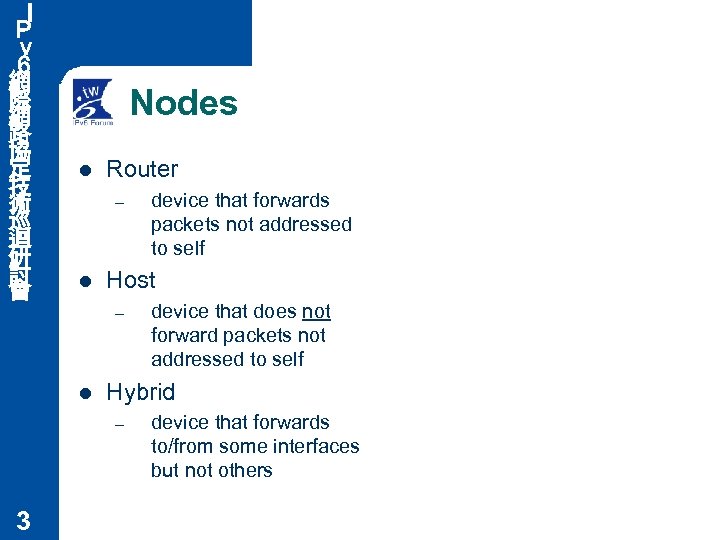
I P v 6 網 際 網 路 協 定 技 術 巡 迴 研 討 會 Nodes l Router – l Host – l device that does not forward packets not addressed to self Hybrid – 3 device that forwards packets not addressed to self device that forwards to/from some interfaces but not others
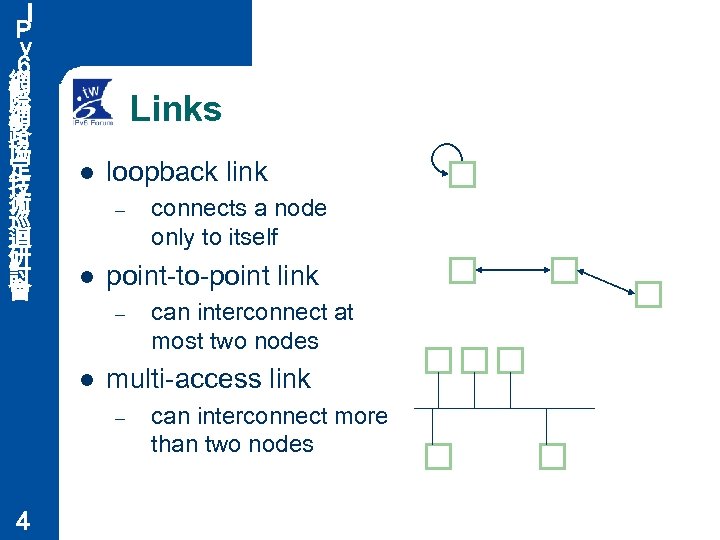
I P v 6 網 際 網 路 協 定 技 術 巡 迴 研 討 會 Links l loopback link – l point-to-point link – l can interconnect at most two nodes multi-access link – 4 connects a node only to itself can interconnect more than two nodes
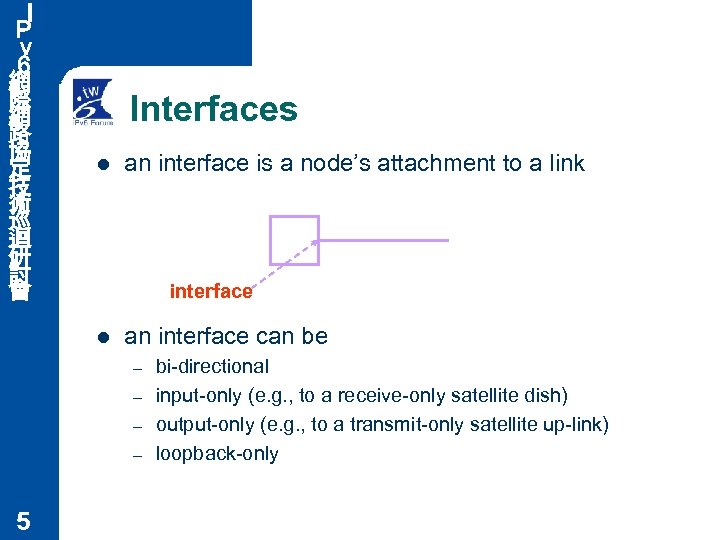
I P v 6 網 際 網 路 協 定 技 術 巡 迴 研 討 會 Interfaces l an interface is a node’s attachment to a link interface l an interface can be – – 5 bi-directional input-only (e. g. , to a receive-only satellite dish) output-only (e. g. , to a transmit-only satellite up-link) loopback-only
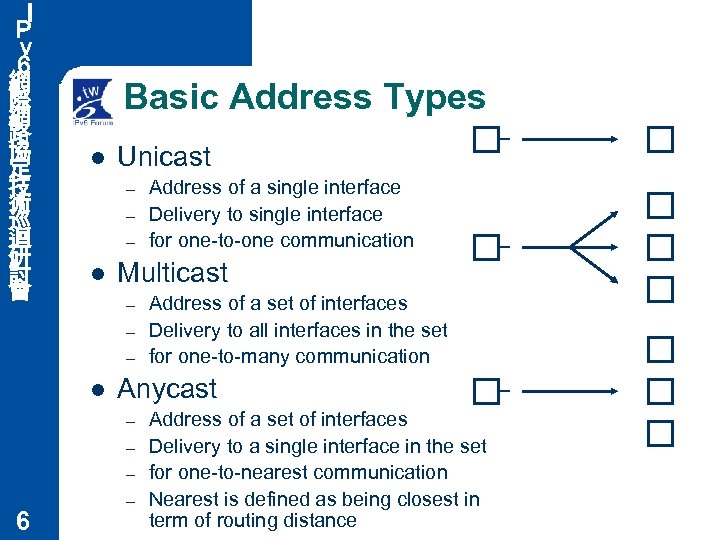
I P v 6 網 際 網 路 協 定 技 術 巡 迴 研 討 會 Basic Address Types l Unicast – – – l Multicast – – – l Address of a set of interfaces Delivery to all interfaces in the set for one-to-many communication Anycast – – – 6 Address of a single interface Delivery to single interface for one-to-one communication – Address of a set of interfaces Delivery to a single interface in the set for one-to-nearest communication Nearest is defined as being closest in term of routing distance
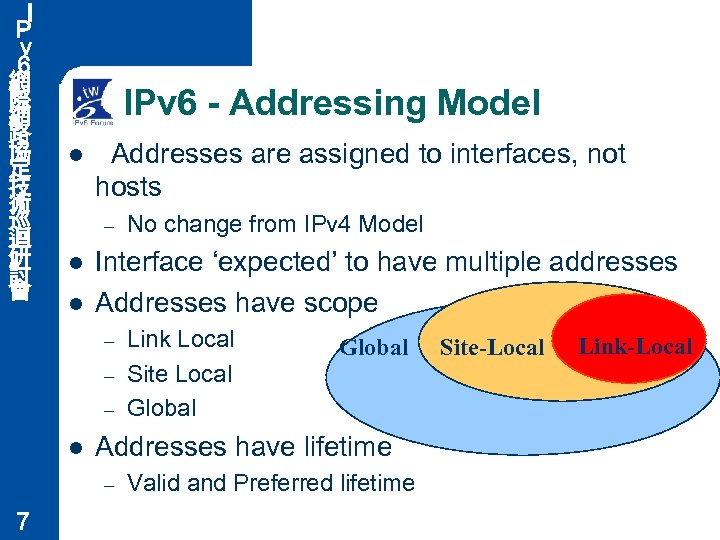
I P v 6 網 際 網 路 協 定 技 術 巡 迴 研 討 會 IPv 6 - Addressing Model l Addresses are assigned to interfaces, not hosts – l l Interface ‘expected’ to have multiple addresses Addresses have scope – – – l Link Local Site Local Global Addresses have lifetime – 7 No change from IPv 4 Model Valid and Preferred lifetime Site-Local Link-Local
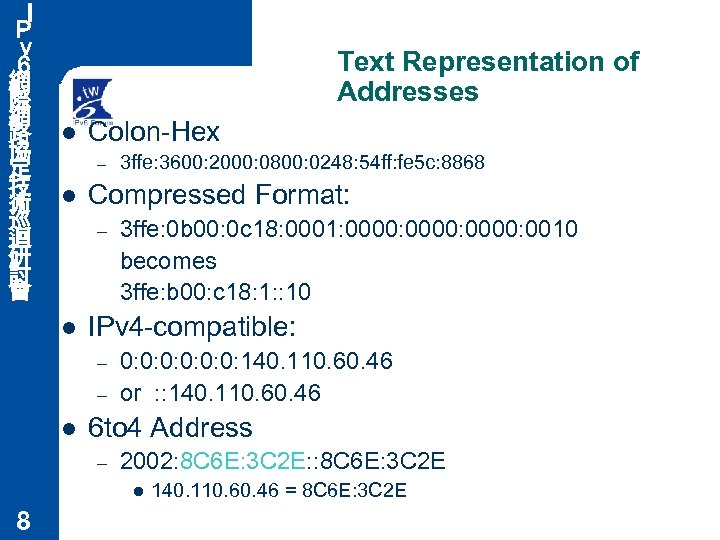
I P v Text Representation of 6 網 Addresses 際 網 路 l Colon-Hex 協 – 3 ffe: 3600: 2000: 0800: 0248: 54 ff: fe 5 c: 8868 定 技 l Compressed Format: 術 巡 – 3 ffe: 0 b 00: 0 c 18: 0001: 0000: 0010 迴 研 becomes 討 會 3 ffe: b 00: c 18: 1: : 10 l IPv 4 -compatible: – – l 0: 0: 0: 140. 110. 60. 46 or : : 140. 110. 60. 46 6 to 4 Address – 2002: 8 C 6 E: 3 C 2 E: : 8 C 6 E: 3 C 2 E l 8 140. 110. 60. 46 = 8 C 6 E: 3 C 2 E
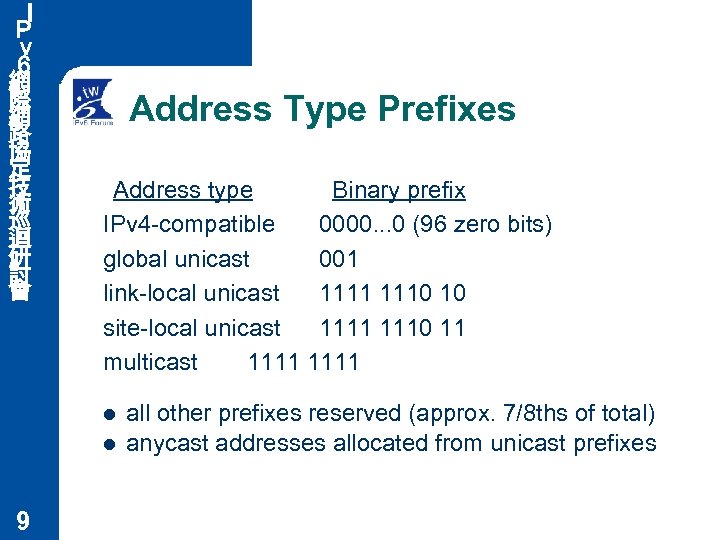
I P v 6 網 際 網 路 協 定 技 術 巡 迴 研 討 會 Address Type Prefixes Address type Binary prefix IPv 4 -compatible 0000. . . 0 (96 zero bits) global unicast 001 link-local unicast 1111 1110 10 site-local unicast 1111 1110 11 multicast 1111 l l 9 all other prefixes reserved (approx. 7/8 ths of total) anycast addresses allocated from unicast prefixes
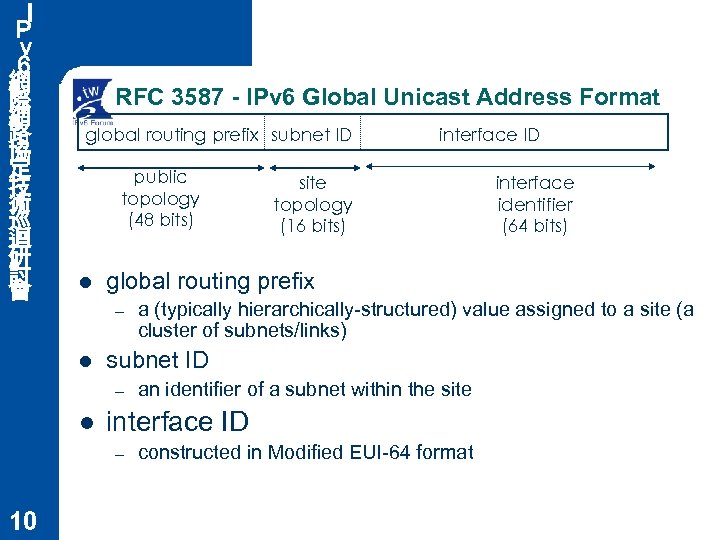
I P v 6 網 際 網 路 協 定 技 術 巡 迴 研 討 會 RFC 3587 - IPv 6 Global Unicast Address Format global routing prefix subnet ID public topology (48 bits) l an identifier of a subnet within the site interface ID – 10 interface identifier (64 bits) a (typically hierarchically-structured) value assigned to a site (a cluster of subnets/links) subnet ID – l site topology (16 bits) global routing prefix – l interface ID constructed in Modified EUI-64 format
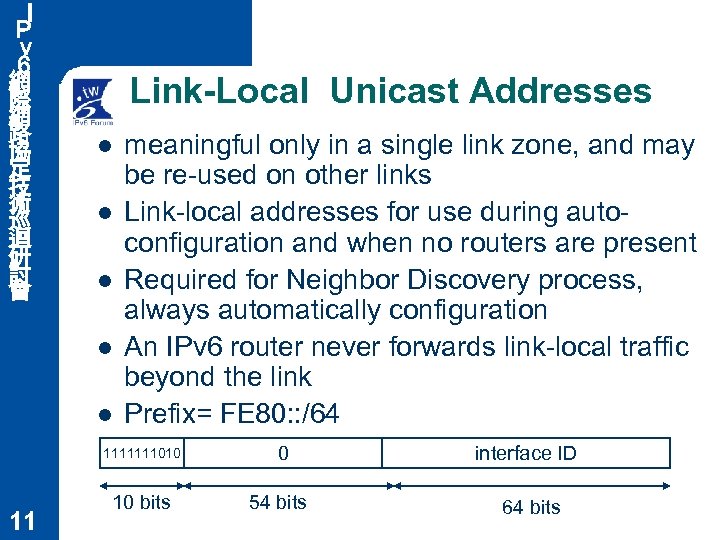
I P v 6 網 際 網 路 協 定 技 術 巡 迴 研 討 會 Link-Local Unicast Addresses l l l meaningful only in a single link zone, and may be re-used on other links Link-local addresses for use during autoconfiguration and when no routers are present Required for Neighbor Discovery process, always automatically configuration An IPv 6 router never forwards link-local traffic beyond the link Prefix= FE 80: : /64 1111111010 11 10 bits 0 interface ID 54 bits 64 bits
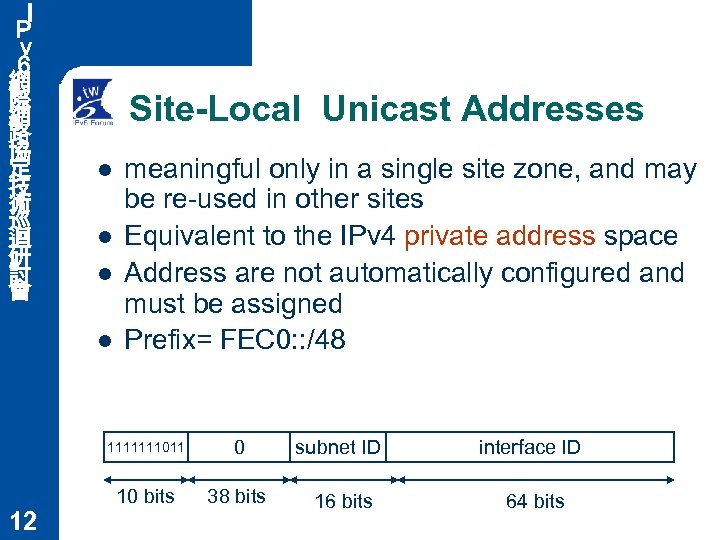
I P v 6 網 際 網 路 協 定 技 術 巡 迴 研 討 會 Site-Local Unicast Addresses l l meaningful only in a single site zone, and may be re-used in other sites Equivalent to the IPv 4 private address space Address are not automatically configured and must be assigned Prefix= FEC 0: : /48 1111111011 12 0 subnet ID interface ID 10 bits 38 bits 16 bits 64 bits
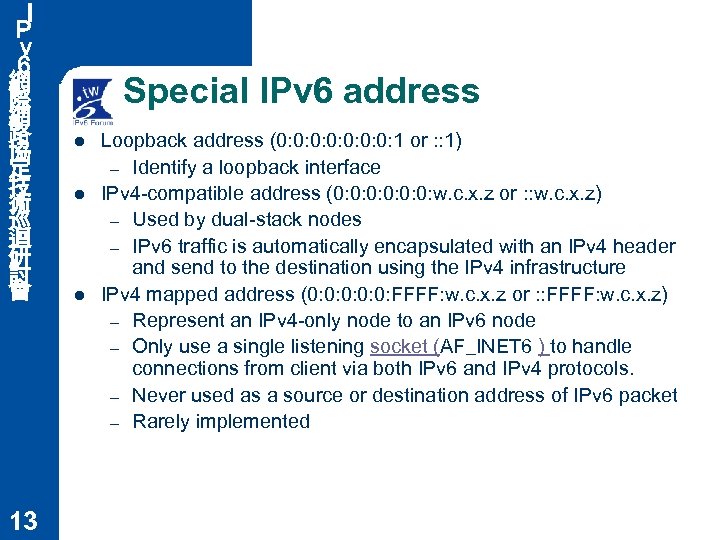
I P v 6 網 際 網 路 協 定 技 術 巡 迴 研 討 會 13 Special IPv 6 address l l l Loopback address (0: 0: 1 or : : 1) – Identify a loopback interface IPv 4 -compatible address (0: 0: 0: w. c. x. z or : : w. c. x. z) – Used by dual-stack nodes – IPv 6 traffic is automatically encapsulated with an IPv 4 header and send to the destination using the IPv 4 infrastructure IPv 4 mapped address (0: 0: 0: FFFF: w. c. x. z or : : FFFF: w. c. x. z) – Represent an IPv 4 -only node to an IPv 6 node – Only use a single listening socket (AF_INET 6 ) to handle connections from client via both IPv 6 and IPv 4 protocols. – Never used as a source or destination address of IPv 6 packet – Rarely implemented
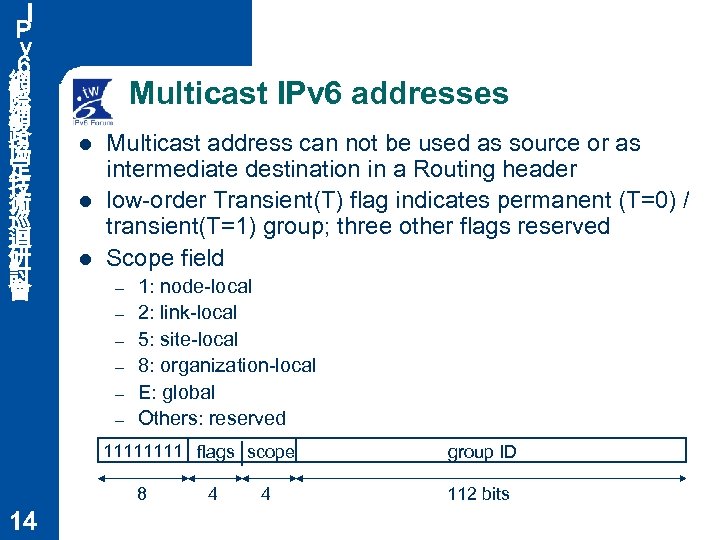
I P v 6 網 際 網 路 協 定 技 術 巡 迴 研 討 會 Multicast IPv 6 addresses l l l Multicast address can not be used as source or as intermediate destination in a Routing header low-order Transient(T) flag indicates permanent (T=0) / transient(T=1) group; three other flags reserved Scope field – – – 1: node-local 2: link-local 5: site-local 8: organization-local E: global Others: reserved 1111 flags scope 8 14 4 4 group ID 112 bits
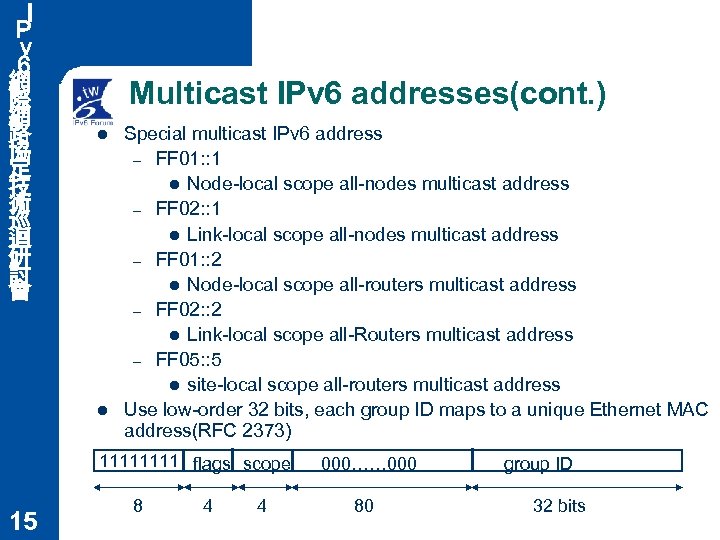
I P v 6 網 際 網 路 協 定 技 術 巡 迴 研 討 會 Multicast IPv 6 addresses(cont. ) l l Special multicast IPv 6 address – FF 01: : 1 l Node-local scope all-nodes multicast address – FF 02: : 1 l Link-local scope all-nodes multicast address – FF 01: : 2 l Node-local scope all-routers multicast address – FF 02: : 2 l Link-local scope all-Routers multicast address – FF 05: : 5 l site-local scope all-routers multicast address Use low-order 32 bits, each group ID maps to a unique Ethernet MAC address(RFC 2373) 1111 flags scope 15 8 4 4 000…… 000 80 group ID 32 bits
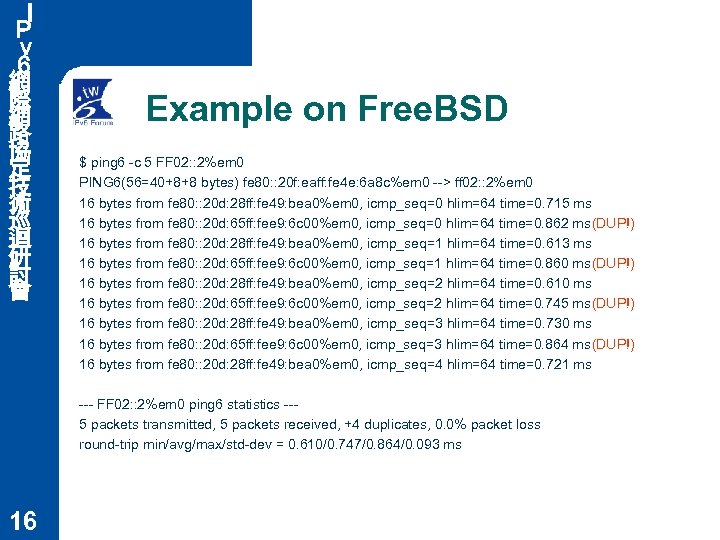
I P v 6 網 際 網 路 協 定 技 術 巡 迴 研 討 會 Example on Free. BSD $ ping 6 -c 5 FF 02: : 2%em 0 PING 6(56=40+8+8 bytes) fe 80: : 20 f: eaff: fe 4 e: 6 a 8 c%em 0 --> ff 02: : 2%em 0 16 bytes from fe 80: : 20 d: 28 ff: fe 49: bea 0%em 0, icmp_seq=0 hlim=64 time=0. 715 ms 16 bytes from fe 80: : 20 d: 65 ff: fee 9: 6 c 00%em 0, icmp_seq=0 hlim=64 time=0. 862 ms(DUP!) 16 bytes from fe 80: : 20 d: 28 ff: fe 49: bea 0%em 0, icmp_seq=1 hlim=64 time=0. 613 ms 16 bytes from fe 80: : 20 d: 65 ff: fee 9: 6 c 00%em 0, icmp_seq=1 hlim=64 time=0. 860 ms(DUP!) 16 bytes from fe 80: : 20 d: 28 ff: fe 49: bea 0%em 0, icmp_seq=2 hlim=64 time=0. 610 ms 16 bytes from fe 80: : 20 d: 65 ff: fee 9: 6 c 00%em 0, icmp_seq=2 hlim=64 time=0. 745 ms(DUP!) 16 bytes from fe 80: : 20 d: 28 ff: fe 49: bea 0%em 0, icmp_seq=3 hlim=64 time=0. 730 ms 16 bytes from fe 80: : 20 d: 65 ff: fee 9: 6 c 00%em 0, icmp_seq=3 hlim=64 time=0. 864 ms(DUP!) 16 bytes from fe 80: : 20 d: 28 ff: fe 49: bea 0%em 0, icmp_seq=4 hlim=64 time=0. 721 ms --- FF 02: : 2%em 0 ping 6 statistics --5 packets transmitted, 5 packets received, +4 duplicates, 0. 0% packet loss round-trip min/avg/max/std-dev = 0. 610/0. 747/0. 864/0. 093 ms 16
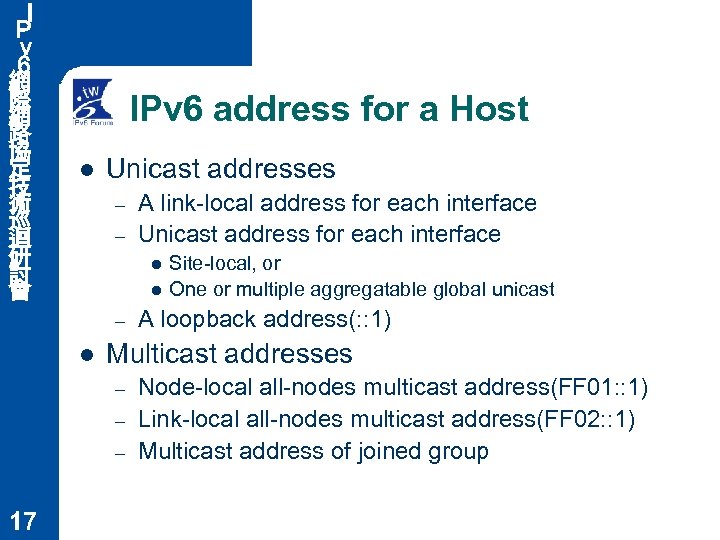
I P v 6 網 際 網 路 協 定 技 術 巡 迴 研 討 會 IPv 6 address for a Host l Unicast addresses – – l l – l Site-local, or One or multiple aggregatable global unicast A loopback address(: : 1) Multicast addresses – – – 17 A link-local address for each interface Unicast address for each interface Node-local all-nodes multicast address(FF 01: : 1) Link-local all-nodes multicast address(FF 02: : 1) Multicast address of joined group
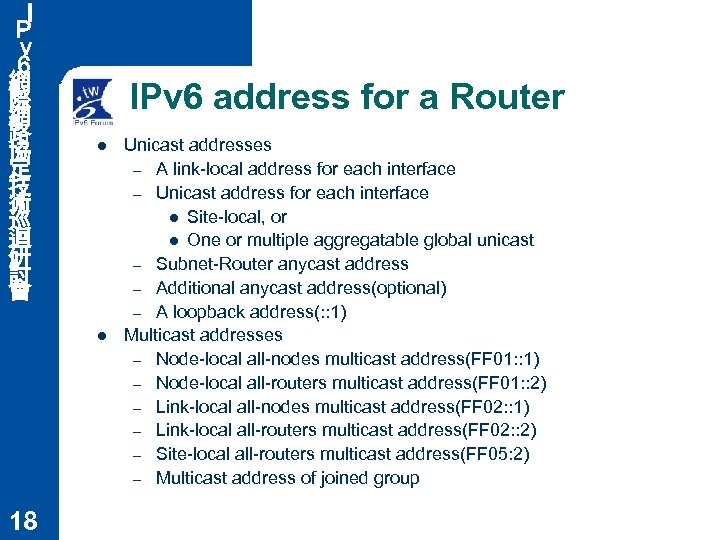
I P v 6 網 際 網 路 協 定 技 術 巡 迴 研 討 會 IPv 6 address for a Router l l 18 Unicast addresses – A link-local address for each interface – Unicast address for each interface l Site-local, or l One or multiple aggregatable global unicast – Subnet-Router anycast address – Additional anycast address(optional) – A loopback address(: : 1) Multicast addresses – Node-local all-nodes multicast address(FF 01: : 1) – Node-local all-routers multicast address(FF 01: : 2) – Link-local all-nodes multicast address(FF 02: : 1) – Link-local all-routers multicast address(FF 02: : 2) – Site-local all-routers multicast address(FF 05: 2) – Multicast address of joined group
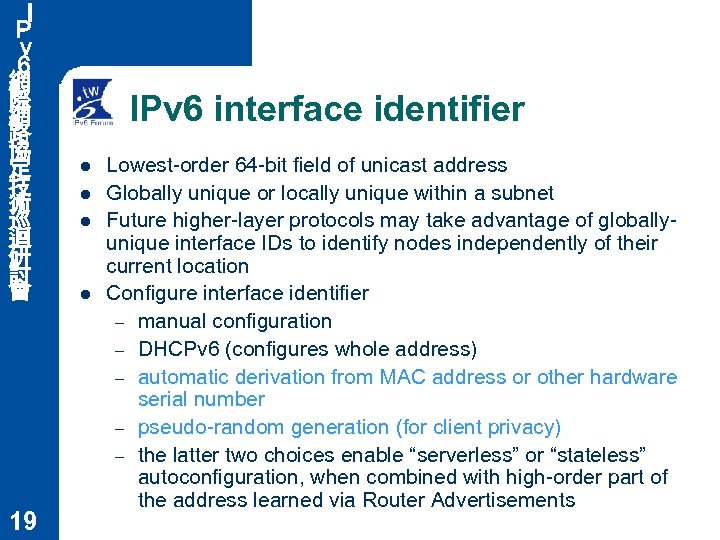
I P v 6 網 際 網 路 協 定 技 術 巡 迴 研 討 會 19 IPv 6 interface identifier l l Lowest-order 64 -bit field of unicast address Globally unique or locally unique within a subnet Future higher-layer protocols may take advantage of globallyunique interface IDs to identify nodes independently of their current location Configure interface identifier – manual configuration – DHCPv 6 (configures whole address) – automatic derivation from MAC address or other hardware serial number – pseudo-random generation (for client privacy) – the latter two choices enable “serverless” or “stateless” autoconfiguration, when combined with high-order part of the address learned via Router Advertisements
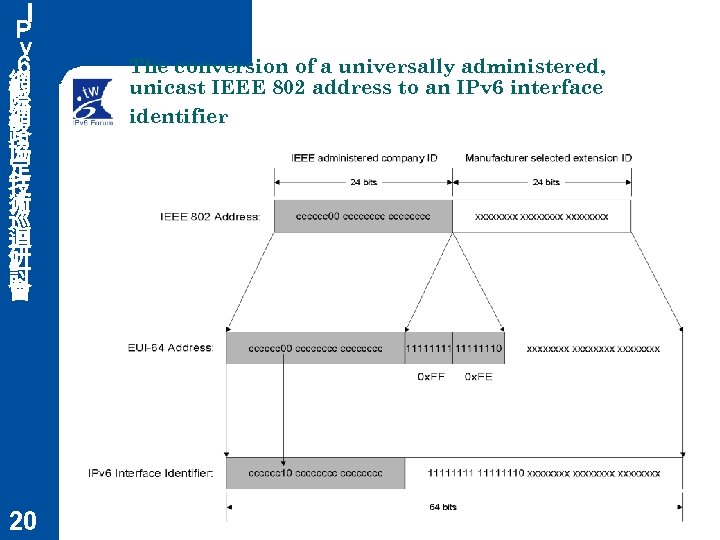
I P v 6 網 際 網 路 協 定 技 術 巡 迴 研 討 會 20 The conversion of a universally administered, unicast IEEE 802 address to an IPv 6 interface identifier
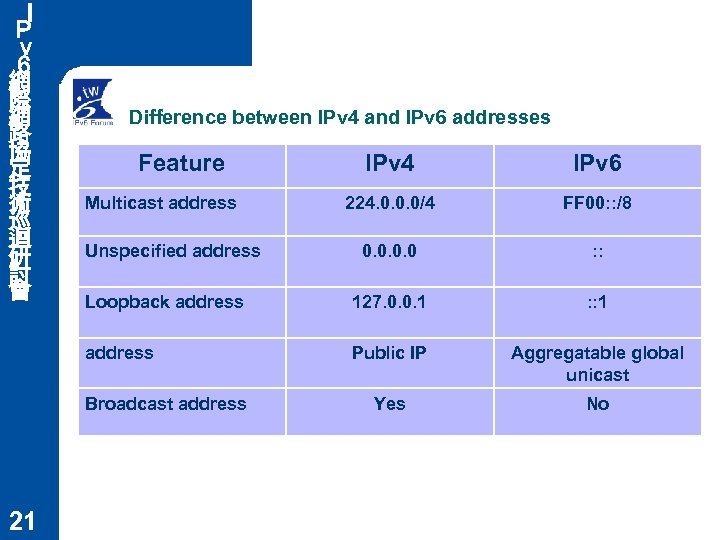
I P v 6 網 際 網 路 協 定 技 術 巡 迴 研 討 會 Difference between IPv 4 and IPv 6 addresses Feature IPv 4 IPv 6 224. 0. 0. 0/4 FF 00: : /8 0. 0 : : Loopback address 127. 0. 0. 1 : : 1 address Public IP Aggregatable global unicast Yes No Multicast address Unspecified address Broadcast address 21
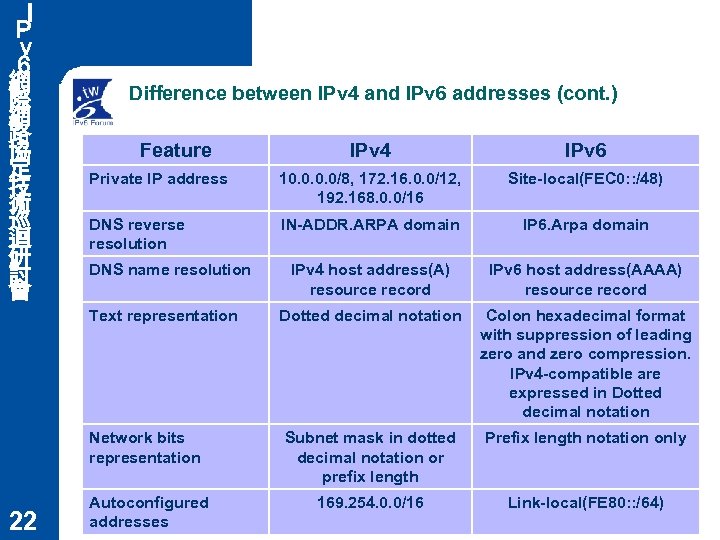
I P v 6 網 際 網 路 協 定 技 術 巡 迴 研 討 會 Difference between IPv 4 and IPv 6 addresses (cont. ) Feature IPv 4 IPv 6 Private IP address 10. 0/8, 172. 16. 0. 0/12, 192. 168. 0. 0/16 Site-local(FEC 0: : /48) DNS reverse resolution IN-ADDR. ARPA domain IP 6. Arpa domain IPv 4 host address(A) resource record IPv 6 host address(AAAA) resource record Dotted decimal notation Colon hexadecimal format with suppression of leading zero and zero compression. IPv 4 -compatible are expressed in Dotted decimal notation Network bits representation Subnet mask in dotted decimal notation or prefix length Prefix length notation only Autoconfigured addresses 169. 254. 0. 0/16 Link-local(FE 80: : /64) DNS name resolution Text representation 22
I P v 6 網 際 網 路 協 定 技 術 巡 迴 研 討 會 Introduction to IP version 6 l l l 23 l Agenda Introduction IPv 6 Addressing IPv 6 Header Address Autoconfiguration Addressing Allocation Policy ICMPv 6 Neighbor Discovery
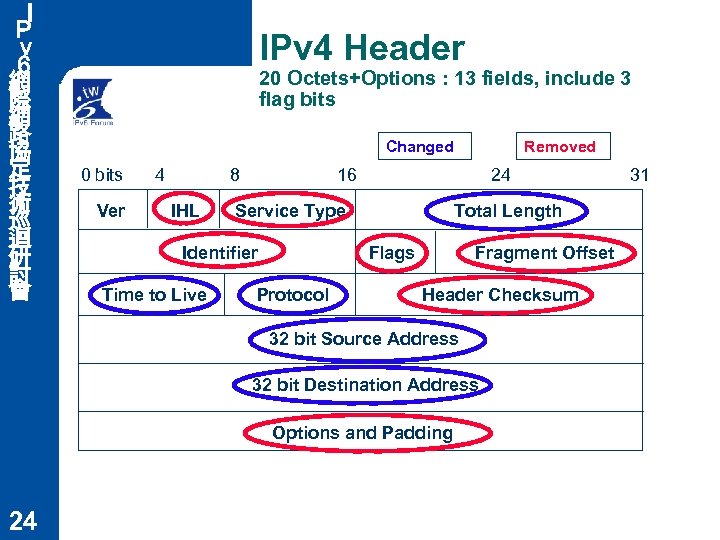
I P v 6 網 際 網 路 協 定 技 術 巡 迴 研 討 會 IPv 4 Header 20 Octets+Options : 13 fields, include 3 flag bits Changed 0 bits Ver 4 8 IHL 16 24 Service Type Identifier Time to Live Removed Total Length Flags Protocol Fragment Offset Header Checksum 32 bit Source Address 32 bit Destination Address Options and Padding 24 31
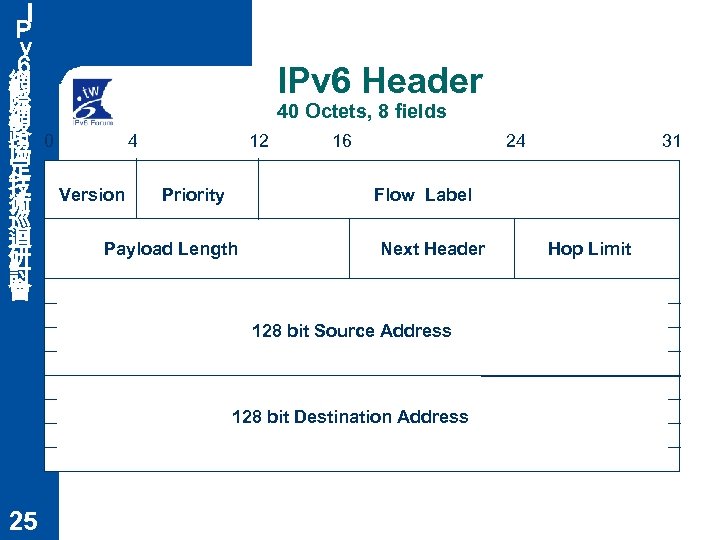
I P v 6 網 際 網 路 0 4 協 定 技 Version Priority 術 巡 迴 Payload Length 研 討 會 IPv 6 Header 40 Octets, 8 fields 12 16 24 Flow Label Next Header 128 bit Source Address 128 bit Destination Address 25 31 Hop Limit
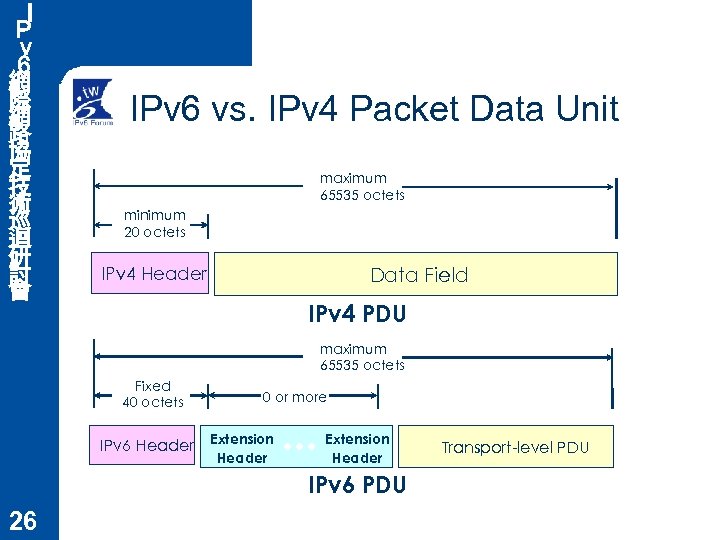
I P v 6 網 際 網 路 協 定 技 術 巡 迴 研 討 會 IPv 6 vs. IPv 4 Packet Data Unit maximum 65535 octets minimum 20 octets IPv 4 Header Data Field IPv 4 PDU maximum 65535 octets Fixed 40 octets IPv 6 Header 0 or more Extension Header IPv 6 PDU 26 Transport-level PDU
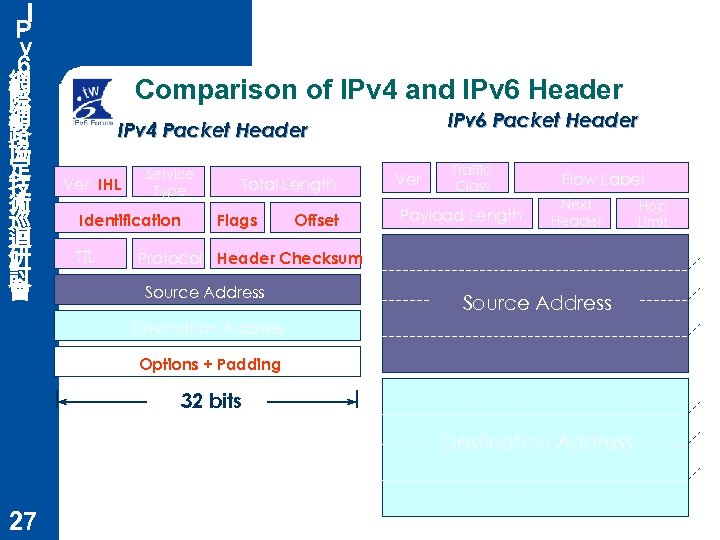
I P v 6 網 際 網 路 協 定 技 術 巡 迴 研 討 會 Comparison of IPv 4 and IPv 6 Header IPv 6 Packet Header IPv 4 Packet Header Ver IHL Service Type Identification TTL Total Length Flags Offset Ver Traffic Class Payload Length Flow Label Next Header Protocol Header Checksum Source Address Destination Address Options + Padding 32 bits Destination Address 27 Hop Limit
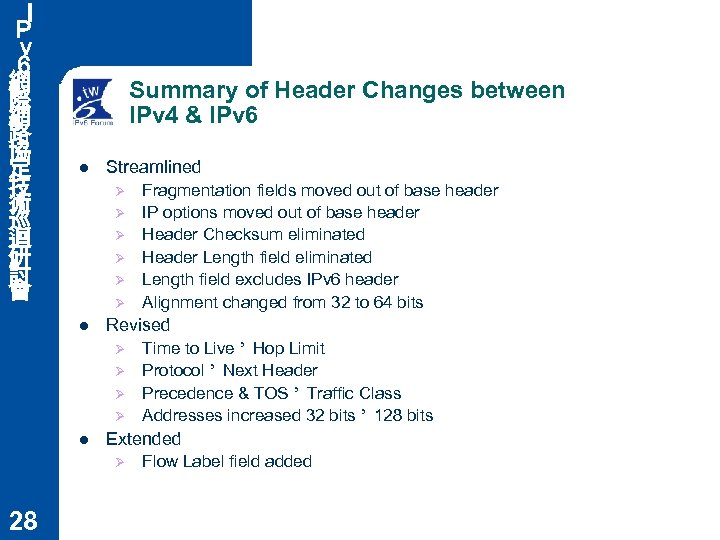
I P v 6 網 際 網 路 協 定 技 術 巡 迴 研 討 會 Summary of Header Changes between IPv 4 & IPv 6 l Streamlined Ø Ø Ø l Revised Ø Ø l Time to Live ’ Hop Limit Protocol ’ Next Header Precedence & TOS ’ Traffic Class Addresses increased 32 bits ’ 128 bits Extended Ø 28 Fragmentation fields moved out of base header IP options moved out of base header Header Checksum eliminated Header Length field eliminated Length field excludes IPv 6 header Alignment changed from 32 to 64 bits Flow Label field added
I P v 6 網 際 網 路 協 定 技 術 巡 迴 研 討 會 Introduction to IP version 6 l l l l 29 Agenda Introduction IPv 6 Addressing IPv 6 Header Address Autoconfiguration Addressing Allocation Policy ICMPv 6 Neighbor Discovery
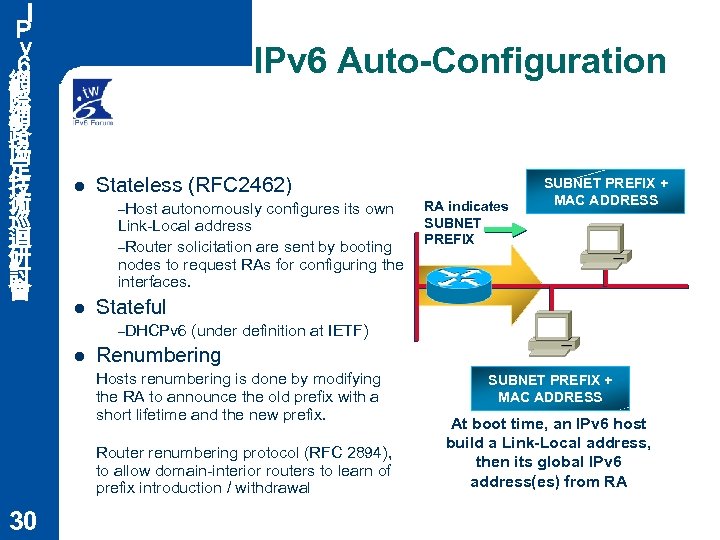
I P v 6 網 際 網 路 協 定 技 術 巡 迴 研 討 會 IPv 6 Auto-Configuration l Stateless (RFC 2462) –Host autonomously configures its own Link-Local address –Router solicitation are sent by booting nodes to request RAs for configuring the interfaces. l Stateful –DHCPv 6 l (under definition at IETF) Renumbering Hosts renumbering is done by modifying the RA to announce the old prefix with a short lifetime and the new prefix. Router renumbering protocol (RFC 2894), to allow domain-interior routers to learn of prefix introduction / withdrawal 30 RA indicates SUBNET PREFIX + MAC ADDRESS At boot time, an IPv 6 host build a Link-Local address, then its global IPv 6 address(es) from RA
I P v 6 網 際 網 路 協 定 技 術 巡 迴 研 討 會 Serverless Autoconfiguration (“Plug-n-Play”) l 1. 2. l l 31 Hosts can construct their own addresses: – subnet prefix(es) learned from periodic multicast advertisements from neighboring router(s) – interface IDs generated locally l MAC addresses pseudo-random temporary Other IP-layer parameters also learned from router adverts (e. g. , router addresses, recommended hop limit, etc. ) Higher-layer info (e. g. , DNS server and NTP server addresses) discovered by multicast / anycast-based service-location protocol [details being worked out] DHCP also available for those who want more control
I P v 6 網 際 網 路 協 定 技 術 巡 迴 研 討 會 Auto-Reconfiguration (“Renumbering”) l l l 32 New address prefixes can be introduced, and old ones withdrawn – we assume some overlap period between old and new, i. e. , no “Flag Day” – hosts learn prefix lifetimes and preference order from router advertisements – old TCP connections can survive until end of overlap; new TCP connections can survive beyond overlap Router renumbering protocol, to allow domain-interior routers to learn of prefix introduction / withdrawal New DNS structure to facilitate prefix changes
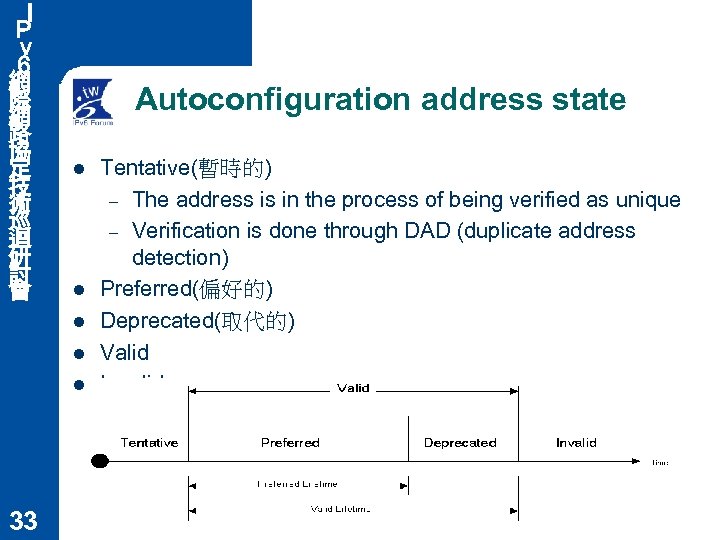
I P v 6 網 際 網 路 協 定 技 術 巡 迴 研 討 會 Autoconfiguration address state l l l 33 Tentative(暫時的) – The address is in the process of being verified as unique – Verification is done through DAD (duplicate address detection) Preferred(偏好的) Deprecated(取代的) Valid Invalid
I P v 6 網 際 網 路 協 定 技 術 巡 迴 研 討 會 34 Introduction to IP version 6 Agenda l Introduction l IPv 6 Addressing l IPv 6 Header l Address Autoconfiguration l Addressing Allocation Policy l ICMPv 6 l Neighbor Discovery
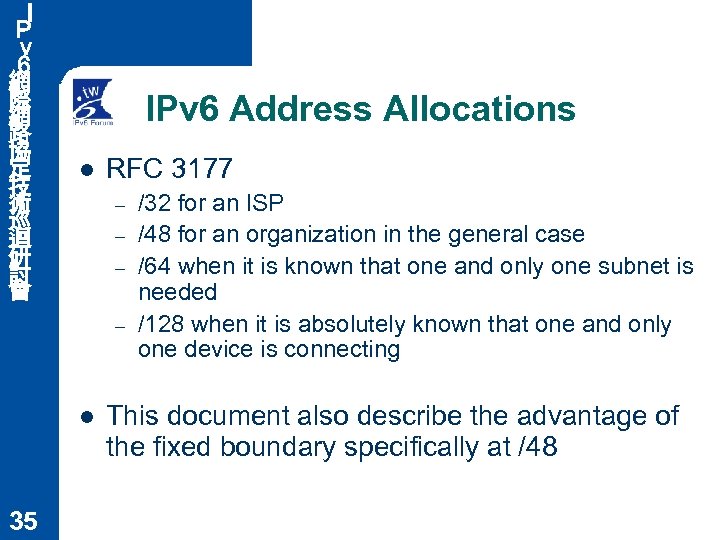
I P v 6 網 際 網 路 協 定 技 術 巡 迴 研 討 會 IPv 6 Address Allocations l RFC 3177 – – l 35 /32 for an ISP /48 for an organization in the general case /64 when it is known that one and only one subnet is needed /128 when it is absolutely known that one and only one device is connecting This document also describe the advantage of the fixed boundary specifically at /48
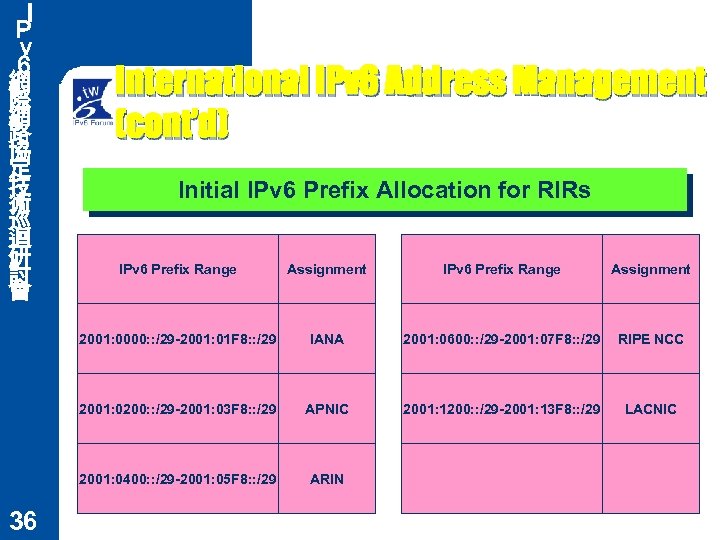
I P v 6 網 際 網 路 協 定 技 術 巡 迴 研 討 會 International IPv 6 Address Management (cont’d) Initial IPv 6 Prefix Allocation for RIRs Assignment IPv 6 Prefix Range Assignment 2001: 0000: : /29 -2001: 01 F 8: : /29 IANA 2001: 0600: : /29 -2001: 07 F 8: : /29 RIPE NCC 2001: 0200: : /29 -2001: 03 F 8: : /29 APNIC 2001: 1200: : /29 -2001: 13 F 8: : /29 LACNIC 2001: 0400: : /29 -2001: 05 F 8: : /29 36 IPv 6 Prefix Range ARIN
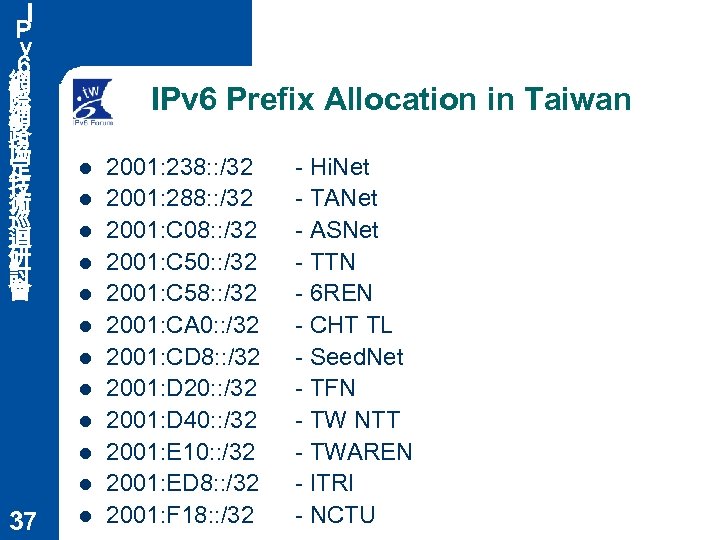
I P v 6 網 際 網 路 協 定 技 術 巡 迴 研 討 會 IPv 6 Prefix Allocation in Taiwan l l l 37 l 2001: 238: : /32 2001: 288: : /32 2001: C 08: : /32 2001: C 50: : /32 2001: C 58: : /32 2001: CA 0: : /32 2001: CD 8: : /32 2001: D 20: : /32 2001: D 40: : /32 2001: E 10: : /32 2001: ED 8: : /32 2001: F 18: : /32 - Hi. Net - TANet - ASNet - TTN - 6 REN - CHT TL - Seed. Net - TFN - TW NTT - TWAREN - ITRI - NCTU
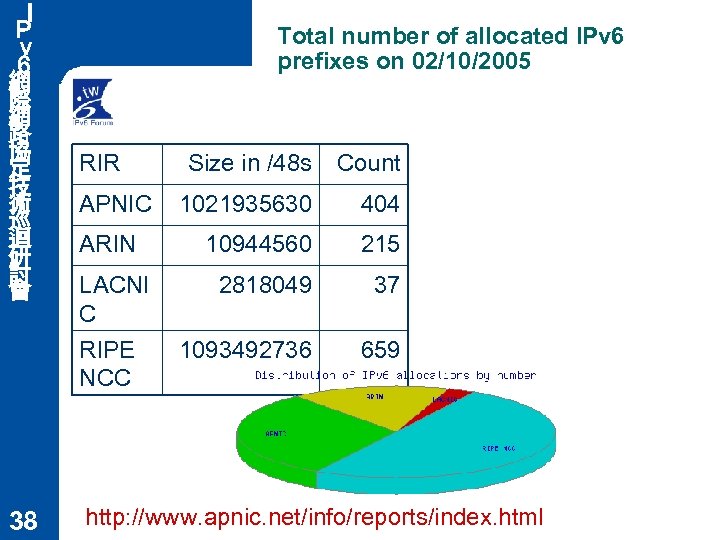
I P v 6 網 際 網 路 協 定 技 術 巡 迴 研 討 會 Total number of allocated IPv 6 prefixes on 02/10/2005 RIR Size in /48 s Count 1021935630 404 ARIN 10944560 215 LACNI C 2818049 37 1093492736 659 APNIC RIPE NCC 38 http: //www. apnic. net/info/reports/index. html
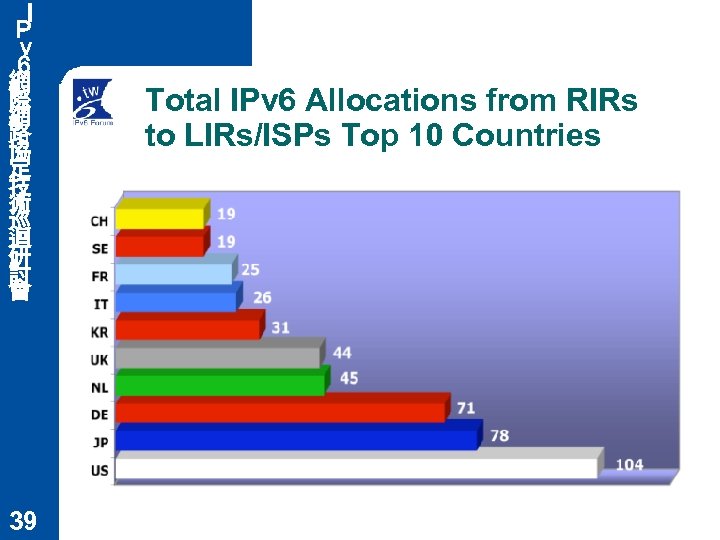
I P v 6 網 際 網 路 協 定 技 術 巡 迴 研 討 會 39 Total IPv 6 Allocations from RIRs to LIRs/ISPs Top 10 Countries
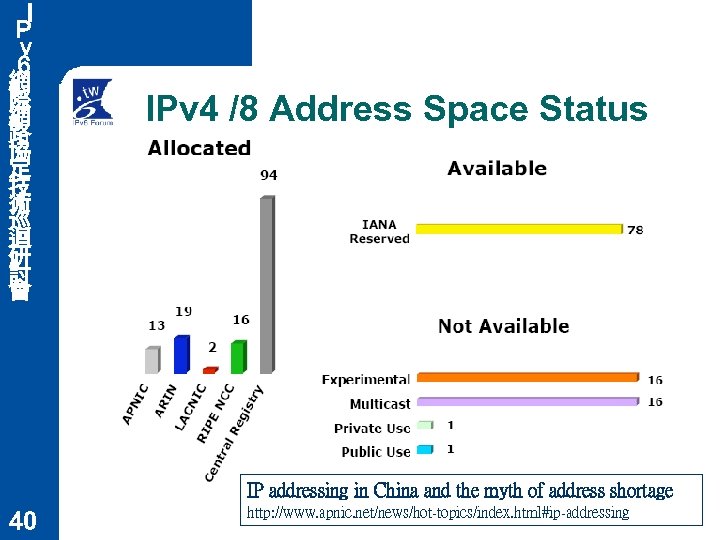
I P v 6 網 際 網 路 協 定 技 術 巡 迴 研 討 會 IPv 4 /8 Address Space Status IP addressing in China and the myth of address shortage 40 http: //www. apnic. net/news/hot-topics/index. html#ip-addressing
I P v 6 網 際 網 路 協 定 技 術 巡 迴 研 討 會 41 Introduction to IP version 6 Agenda l Introduction l IPv 6 Addressing l IPv 6 Header l Address Autoconfiguration l Addressing Allocation Policy l ICMPv 6 l Neighbor Discovery
I P v 6 網 際 網 路 協 定 技 術 巡 迴 研 討 會 Features of ICMPv 6 l l l 42 An integral part of IPv 6 and MUST be fully implement by every IPv 6 node (RFC 2463) Next Header value= 58 Report delivery or forwarding errors Provide simple echo service for troubleshooting Multicast Listener discovery(MLD) – 3 ICMP messages Neighbor Discovery(ND) – 5 ICMP messages
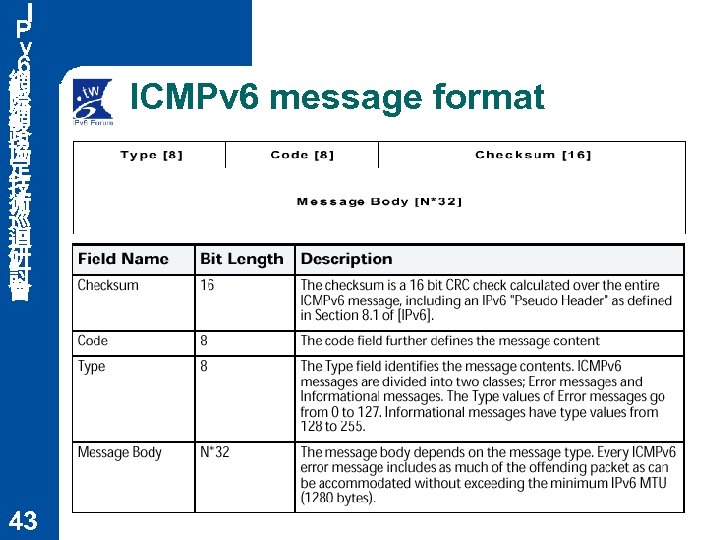
I P v 6 網 際 網 路 協 定 技 術 巡 迴 研 討 會 43 ICMPv 6 message format
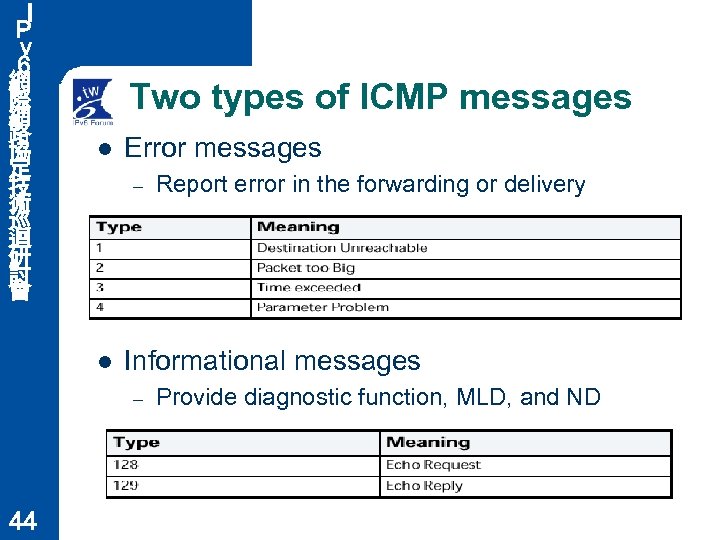
I P v 6 網 際 網 路 協 定 技 術 巡 迴 研 討 會 Two types of ICMP messages l Error messages – l Informational messages – 44 Report error in the forwarding or delivery Provide diagnostic function, MLD, and ND
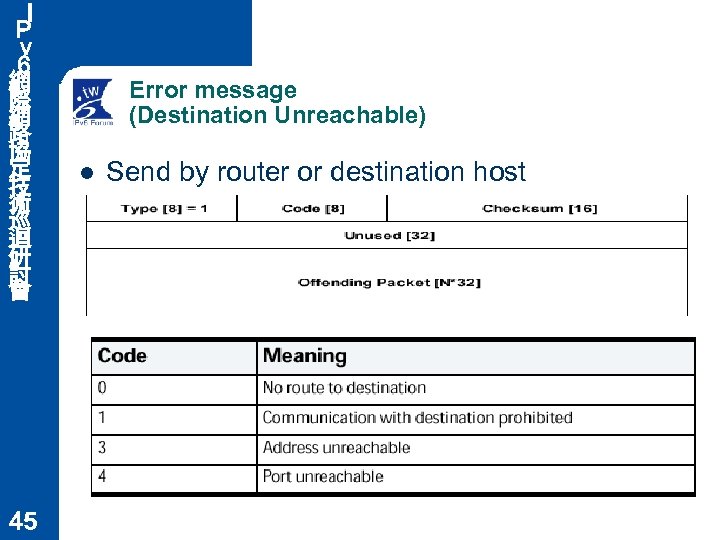
I P v 6 網 際 網 路 協 定 技 術 巡 迴 研 討 會 45 Error message (Destination Unreachable) l Send by router or destination host
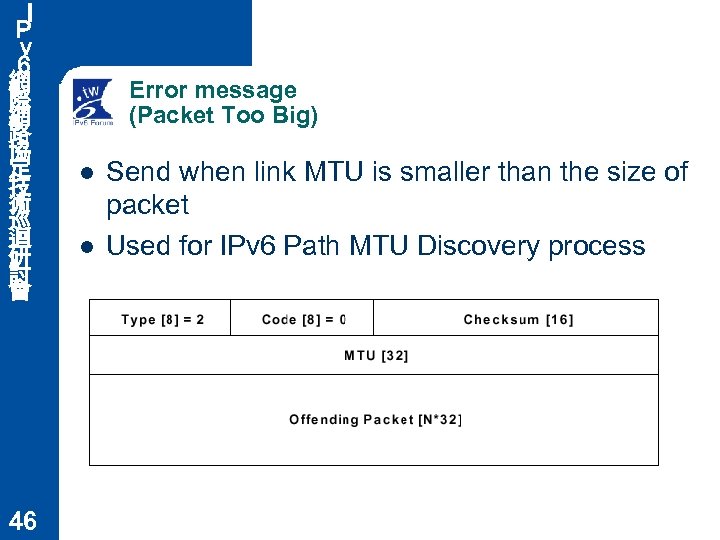
I P v 6 網 際 網 路 協 定 技 術 巡 迴 研 討 會 46 Error message (Packet Too Big) l l Send when link MTU is smaller than the size of packet Used for IPv 6 Path MTU Discovery process
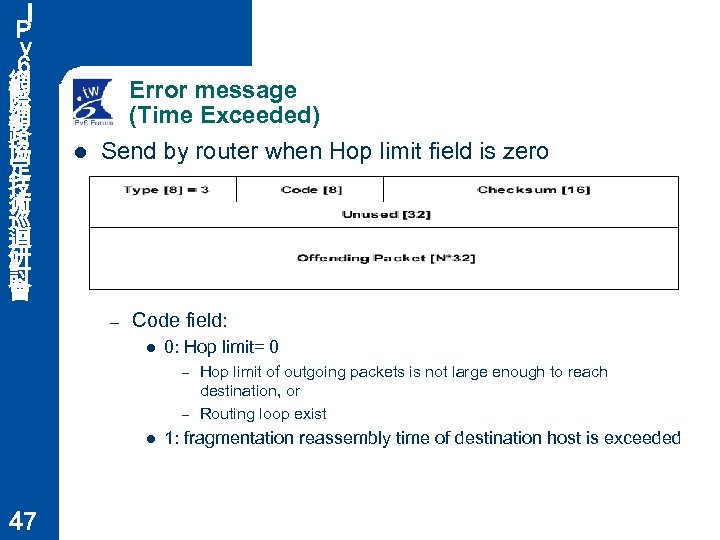
I P v 6 網 際 網 路 協 定 技 術 巡 迴 研 討 會 l Error message (Time Exceeded) Send by router when Hop limit field is zero – Code field: l 0: Hop limit= 0 Hop limit of outgoing packets is not large enough to reach destination, or – Routing loop exist – l 47 1: fragmentation reassembly time of destination host is exceeded
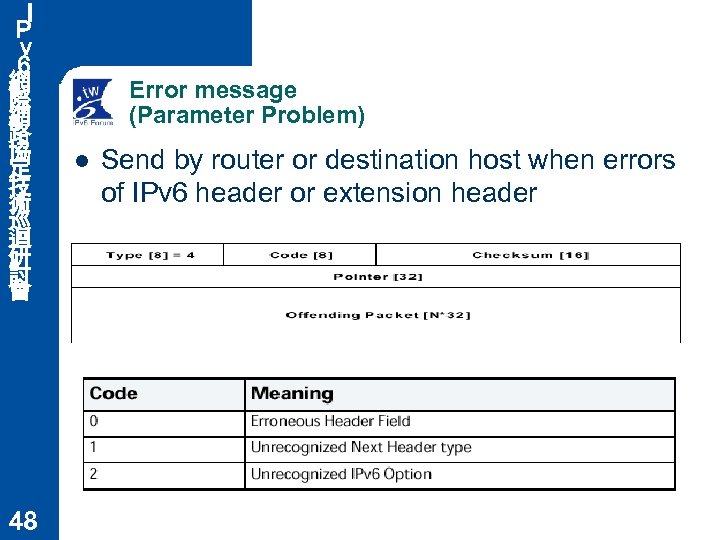
I P v 6 網 際 網 路 協 定 技 術 巡 迴 研 討 會 48 Error message (Parameter Problem) l Send by router or destination host when errors of IPv 6 header or extension header
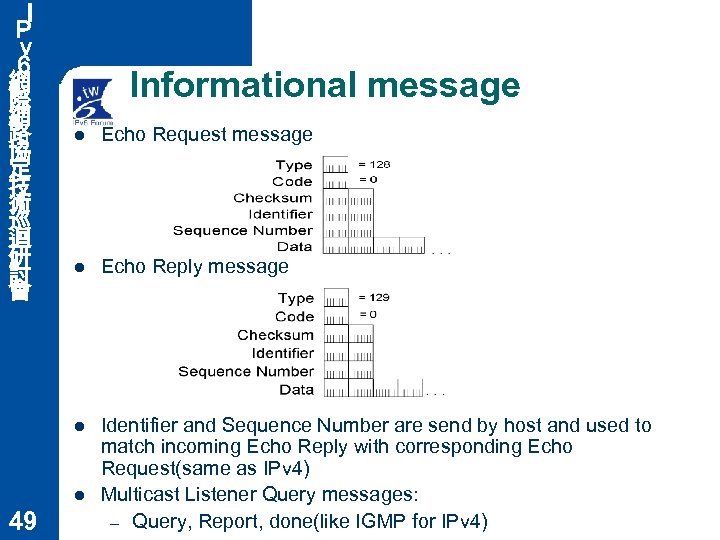
I P v 6 網 際 網 路 協 定 技 術 巡 迴 研 討 會 Informational message l Echo Request message l Echo Reply message l Identifier and Sequence Number are send by host and used to match incoming Echo Reply with corresponding Echo Request(same as IPv 4) Multicast Listener Query messages: – Query, Report, done(like IGMP for IPv 4) l 49
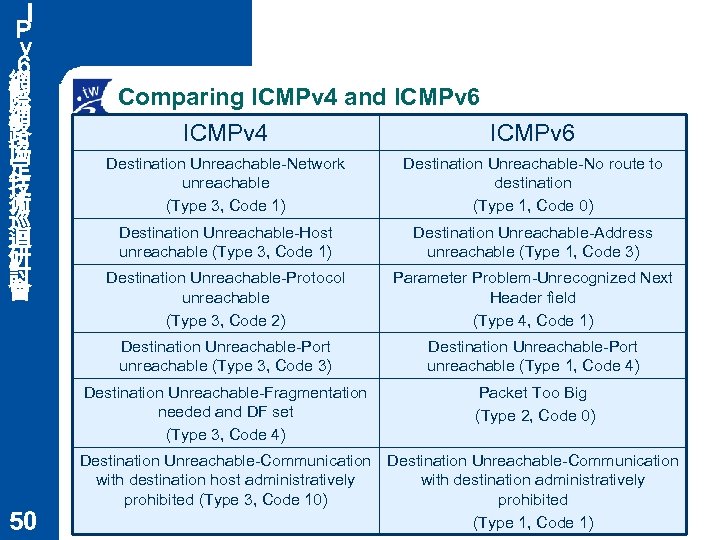
I P v 6 網 際 網 路 協 定 技 術 巡 迴 研 討 會 Comparing ICMPv 4 and ICMPv 6 ICMPv 4 ICMPv 6 Destination Unreachable-No route to destination (Type 1, Code 0) Destination Unreachable-Host unreachable (Type 3, Code 1) Destination Unreachable-Address unreachable (Type 1, Code 3) Destination Unreachable-Protocol unreachable (Type 3, Code 2) Parameter Problem-Unrecognized Next Header field (Type 4, Code 1) Destination Unreachable-Port unreachable (Type 3, Code 3) Destination Unreachable-Port unreachable (Type 1, Code 4) Destination Unreachable-Fragmentation needed and DF set (Type 3, Code 4) 50 Destination Unreachable-Network unreachable (Type 3, Code 1) Packet Too Big (Type 2, Code 0) Destination Unreachable-Communication with destination host administratively with destination administratively prohibited (Type 3, Code 10) prohibited (Type 1, Code 1)
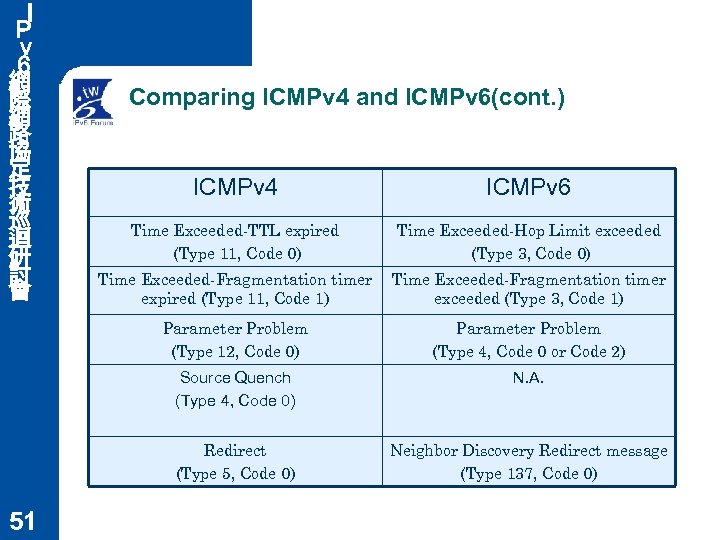
I P v 6 網 際 網 路 協 定 技 術 巡 迴 研 討 會 Comparing ICMPv 4 and ICMPv 6(cont. ) ICMPv 6 Time Exceeded-TTL expired (Type 11, Code 0) Time Exceeded-Hop Limit exceeded (Type 3, Code 0) Time Exceeded-Fragmentation timer expired (Type 11, Code 1) Time Exceeded-Fragmentation timer exceeded (Type 3, Code 1) Parameter Problem (Type 12, Code 0) Parameter Problem (Type 4, Code 0 or Code 2) Source Quench (Type 4, Code 0) N. A. Redirect (Type 5, Code 0) 51 ICMPv 4 Neighbor Discovery Redirect message (Type 137, Code 0)
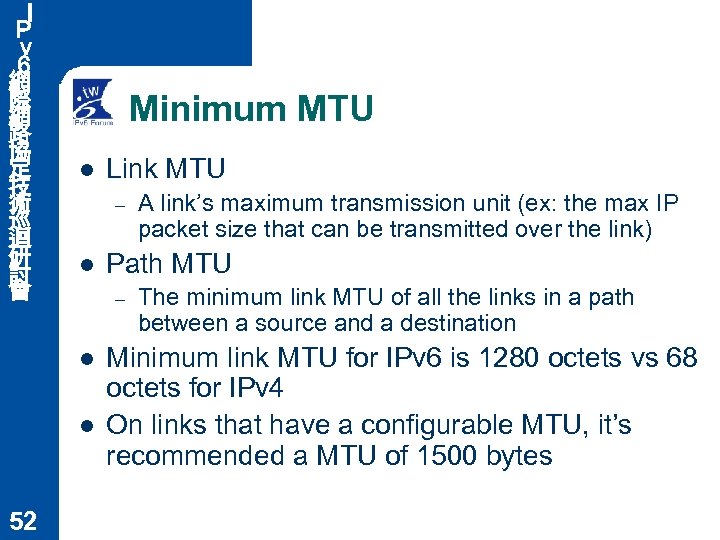
I P v 6 網 際 網 路 協 定 技 術 巡 迴 研 討 會 Minimum MTU l – l l A link’s maximum transmission unit (ex: the max IP packet size that can be transmitted over the link) Path MTU – l 52 Link MTU The minimum link MTU of all the links in a path between a source and a destination Minimum link MTU for IPv 6 is 1280 octets vs 68 octets for IPv 4 On links that have a configurable MTU, it’s recommended a MTU of 1500 bytes
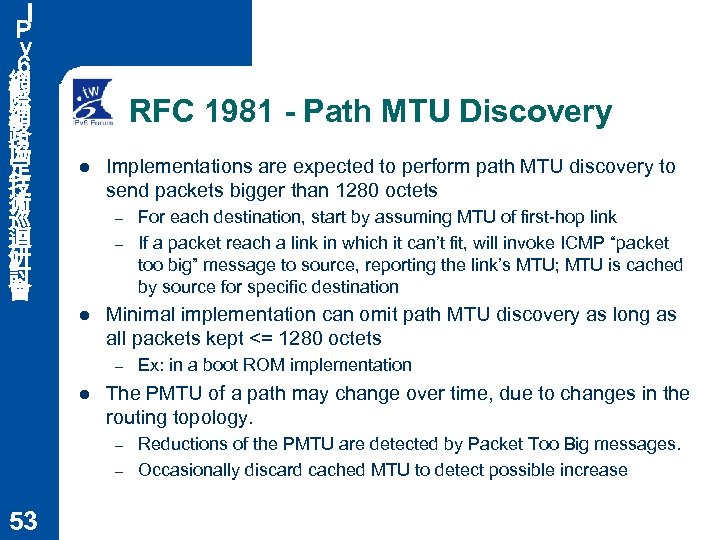
I P v 6 網 際 網 路 協 定 技 術 巡 迴 研 討 會 RFC 1981 - Path MTU Discovery l Implementations are expected to perform path MTU discovery to send packets bigger than 1280 octets – – l Minimal implementation can omit path MTU discovery as long as all packets kept <= 1280 octets – l Ex: in a boot ROM implementation The PMTU of a path may change over time, due to changes in the routing topology. – – 53 For each destination, start by assuming MTU of first-hop link If a packet reach a link in which it can’t fit, will invoke ICMP “packet too big” message to source, reporting the link’s MTU; MTU is cached by source for specific destination Reductions of the PMTU are detected by Packet Too Big messages. Occasionally discard cached MTU to detect possible increase
I P v 6 網 際 網 路 協 定 技 術 巡 迴 研 討 會 Introduction to IP version 6 l l l 54 l Agenda Introduction IPv 6 Addressing IPv 6 Header Address Autoconfiguration Addressing Allocation Policy ICMPv 6 Neighbor Discovery
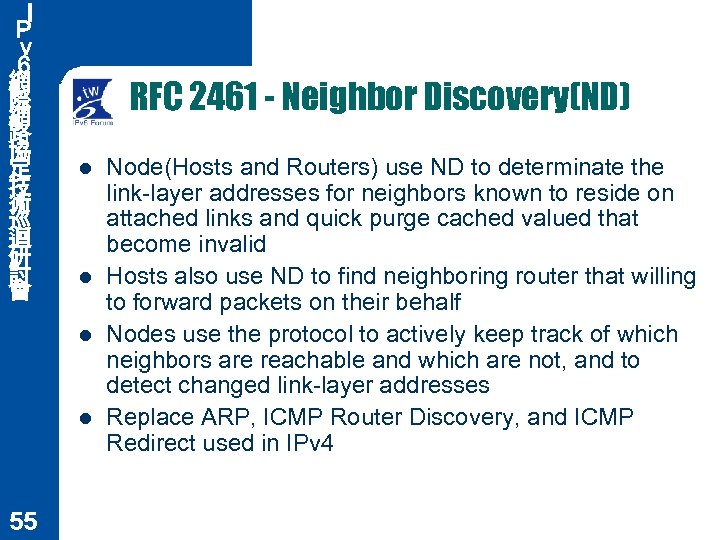
I P v 6 網 際 網 路 協 定 技 術 巡 迴 研 討 會 RFC 2461 - Neighbor Discovery(ND) l l 55 Node(Hosts and Routers) use ND to determinate the link-layer addresses for neighbors known to reside on attached links and quick purge cached valued that become invalid Hosts also use ND to find neighboring router that willing to forward packets on their behalf Nodes use the protocol to actively keep track of which neighbors are reachable and which are not, and to detect changed link-layer addresses Replace ARP, ICMP Router Discovery, and ICMP Redirect used in IPv 4
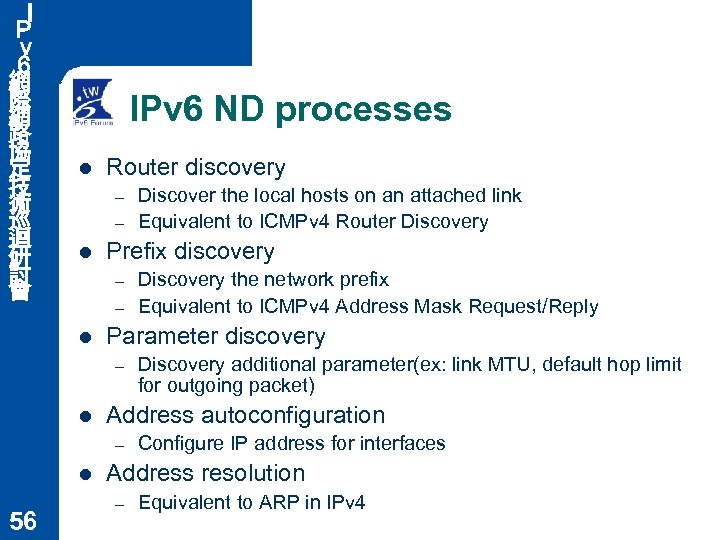
I P v 6 網 際 網 路 協 定 技 術 巡 迴 研 討 會 IPv 6 ND processes l Router discovery – – l Prefix discovery – – l 56 Discovery additional parameter(ex: link MTU, default hop limit for outgoing packet) Address autoconfiguration – l Discovery the network prefix Equivalent to ICMPv 4 Address Mask Request/Reply Parameter discovery – l Discover the local hosts on an attached link Equivalent to ICMPv 4 Router Discovery Configure IP address for interfaces Address resolution – Equivalent to ARP in IPv 4
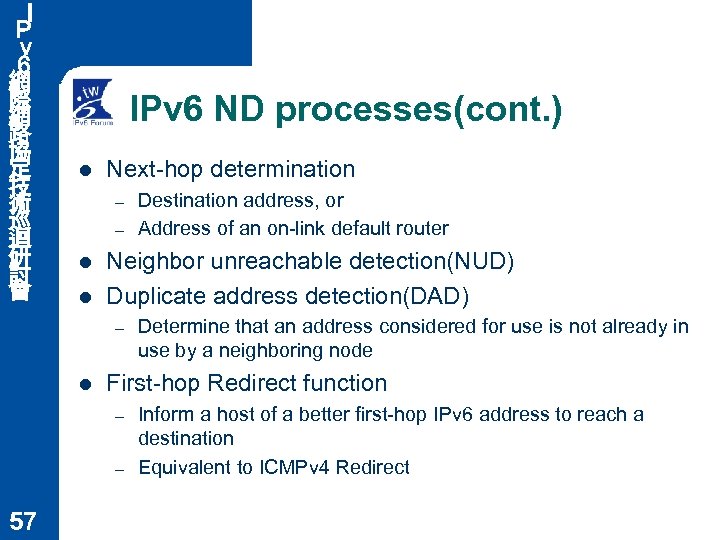
I P v 6 網 際 網 路 協 定 技 術 巡 迴 研 討 會 IPv 6 ND processes(cont. ) l Next-hop determination – – l l Neighbor unreachable detection(NUD) Duplicate address detection(DAD) – l Determine that an address considered for use is not already in use by a neighboring node First-hop Redirect function – – 57 Destination address, or Address of an on-link default router Inform a host of a better first-hop IPv 6 address to reach a destination Equivalent to ICMPv 4 Redirect
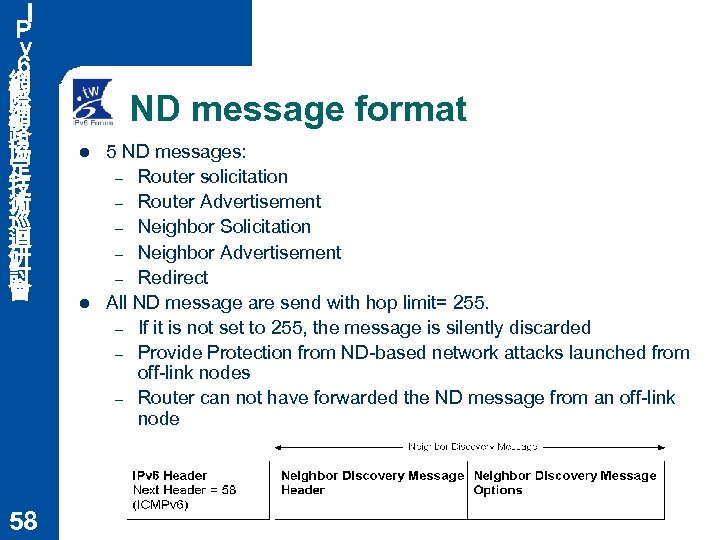
I P v 6 網 際 網 路 協 定 技 術 巡 迴 研 討 會 58 ND message format l l 5 ND messages: – Router solicitation – Router Advertisement – Neighbor Solicitation – Neighbor Advertisement – Redirect All ND message are send with hop limit= 255. – If it is not set to 255, the message is silently discarded – Provide Protection from ND-based network attacks launched from off-link nodes – Router can not have forwarded the ND message from an off-link node
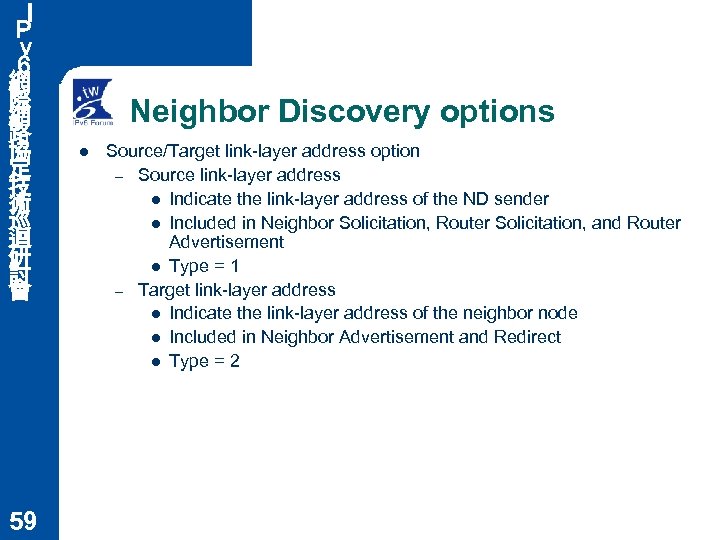
I P v 6 網 際 網 路 協 定 技 術 巡 迴 研 討 會 59 Neighbor Discovery options l Source/Target link-layer address option – Source link-layer address l Indicate the link-layer address of the ND sender l Included in Neighbor Solicitation, Router Solicitation, and Router Advertisement l Type = 1 – Target link-layer address l Indicate the link-layer address of the neighbor node l Included in Neighbor Advertisement and Redirect l Type = 2
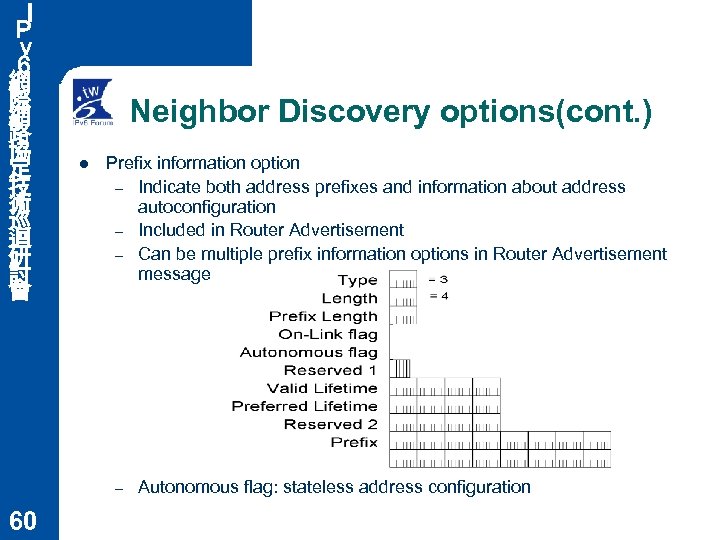
I P v 6 網 際 網 路 協 定 技 術 巡 迴 研 討 會 Neighbor Discovery options(cont. ) l Prefix information option – Indicate both address prefixes and information about address autoconfiguration – Included in Router Advertisement – Can be multiple prefix information options in Router Advertisement message – 60 Autonomous flag: stateless address configuration
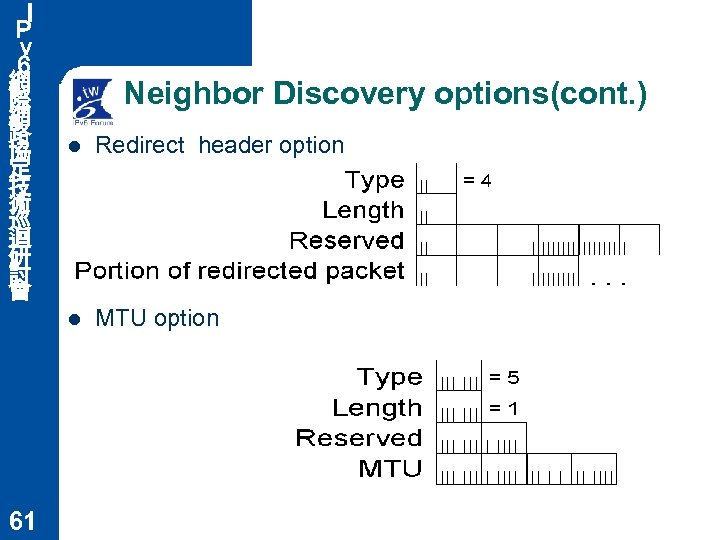
I P v 6 網 際 網 路 協 定 技 術 巡 迴 研 討 會 Neighbor Discovery options(cont. ) Redirect header option l 61 l MTU option
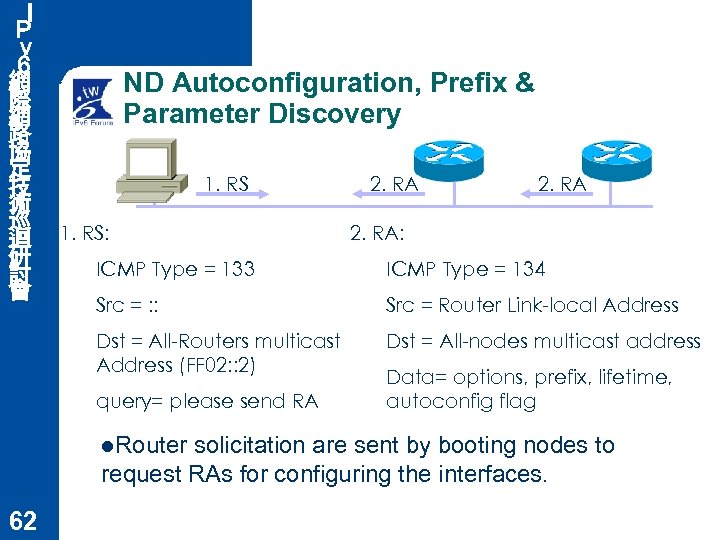
I P v 6 網 ND Autoconfiguration, Prefix & 際 Parameter Discovery 網 路 協 定 1. RS 2. RA 技 術 巡 1. RS: 2. RA: 迴 研 ICMP Type = 134 ICMP Type = 133 討 會 Src = : : Src = Router Link-local Address Dst = All-Routers multicast Address (FF 02: : 2) Dst = All-nodes multicast address query= please send RA l. Router Data= options, prefix, lifetime, autoconfig flag solicitation are sent by booting nodes to request RAs for configuring the interfaces. 62
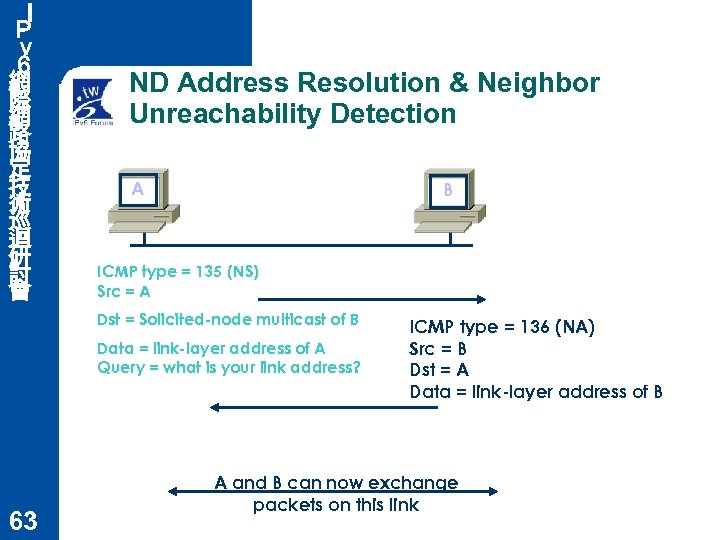
I P v 6 網 際 網 路 協 定 技 術 巡 迴 研 討 會 ND Address Resolution & Neighbor Unreachability Detection A B ICMP type = 135 (NS) Src = A Dst = Solicited-node multicast of B Data = link-layer address of A Query = what is your link address? 63 ICMP type = 136 (NA) Src = B Dst = A Data = link-layer address of B A and B can now exchange packets on this link
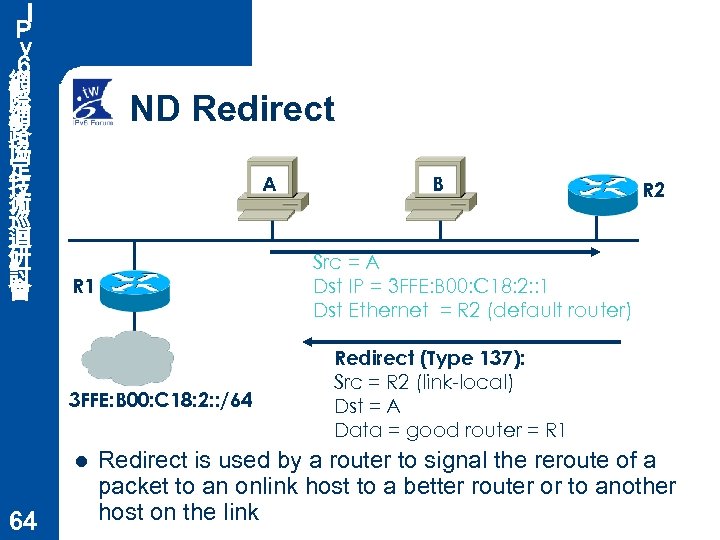
I P v 6 網 際 網 路 協 定 技 術 巡 迴 研 討 會 ND Redirect A 3 FFE: B 00: C 18: 2: : /64 64 R 2 Src = A Dst IP = 3 FFE: B 00: C 18: 2: : 1 Dst Ethernet = R 2 (default router) R 1 l B Redirect (Type 137): Src = R 2 (link-local) Dst = A Data = good router = R 1 Redirect is used by a router to signal the reroute of a packet to an onlink host to a better router or to another host on the link
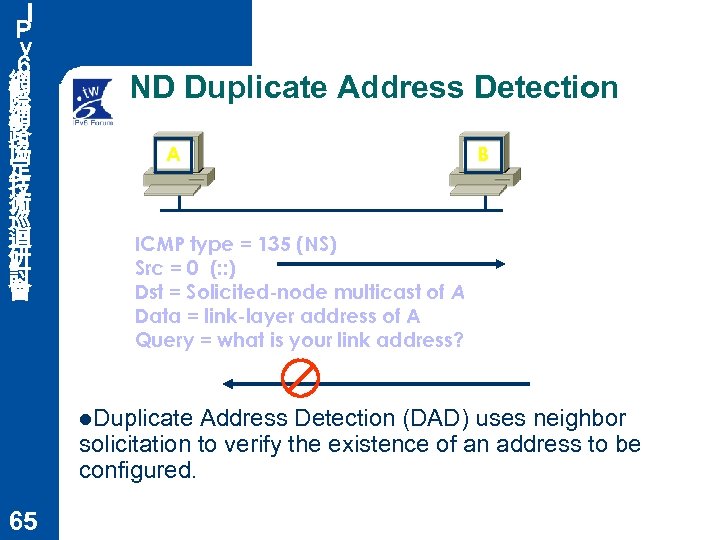
I P v 6 網 際 網 路 協 定 技 術 巡 迴 研 討 會 ND Duplicate Address Detection A B ICMP type = 135 (NS) Src = 0 (: : ) Dst = Solicited-node multicast of A Data = link-layer address of A Query = what is your link address? l. Duplicate Address Detection (DAD) uses neighbor solicitation to verify the existence of an address to be configured. 65
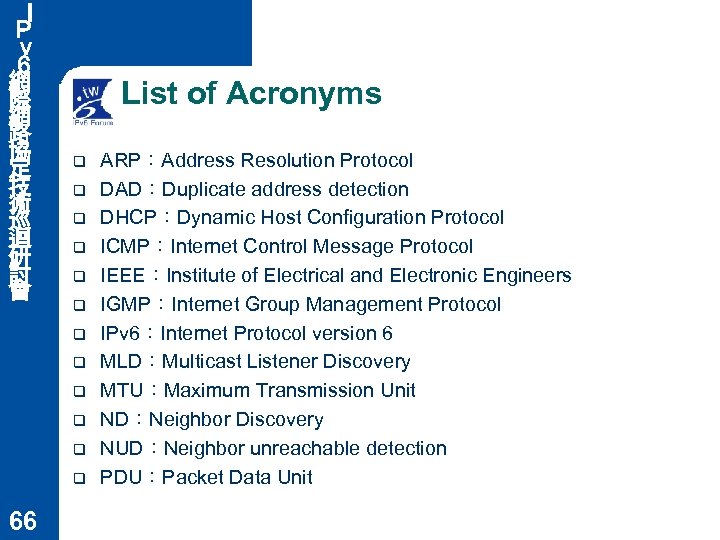
I P v 6 網 際 網 路 協 定 技 術 巡 迴 研 討 會 List of Acronyms q q q 66 ARP:Address Resolution Protocol DAD:Duplicate address detection DHCP:Dynamic Host Configuration Protocol ICMP:Internet Control Message Protocol IEEE:Institute of Electrical and Electronic Engineers IGMP:Internet Group Management Protocol IPv 6:Internet Protocol version 6 MLD:Multicast Listener Discovery MTU:Maximum Transmission Unit ND:Neighbor Discovery NUD:Neighbor unreachable detection PDU:Packet Data Unit
Скачать презентацию 2005 IPv 6 技術巡迴研討會 IPv 6 Addressing
e1417d423f88d59e595eba7aba49154e.ppt