


 Скачать презентацию 2004 MAPLD The Negative Impact of Lead-free Products
571acb7963d4cfcd78b669b024aeec95.ppt
- Количество слайдов: 37
 2004 MAPLD The Negative Impact of Lead-free Products on Aerospace & Military Electronics Reliability Andy Kostic, Ph. D. Charlie Minter Fellow Northrop Grumman Electronic Systems Product Integrity Engineering Baltimore, MD Andrew. Kostic@ngc. com Technical Risk Manager Best Manufacturing Practices Center of Excellence College Park, MD Charlie@bmpcoe. org Kostic
 2004 MAPLD Some Facts About Lead Poisoning • Harmful effects of lead (Pb) on the human body are well documented – – – • • Acts as a neurotoxin Inhibits hemoglobin production Affects brain development Lead ingress to human body known to occur through inhalation and ingestion Dramatic reduction in human blood lead levels since 1972, the beginning of transition to lead-free gasoline – 78% reduction documented in 1991 by EPA Kostic 2 2
 2004 MAPLD Lead-Free Movement Background • In 1985, the Swedish government enacted the Chemical Products Act based on the “Precautionary Principle” – Precautionary Principle: “When an activity raises threats of harm to human health or the environment, precautionary measures should be taken even if some cause-and-effect relationships are not fully established scientifically. ” • There is no evidence linking the lead used in electronics manufacturing and products to any harm to humans or the environment – Electronics industry uses less than 0. 5% of world lead consumption – No mechanism established for transfer of lead to blood through direct contact or proximity to lead in electronics – No evidence of elevated lead in blood of soldering personnel There a host of issues associated with lead-free, but danger from landfill contamination is not one of them Kostic 3 3
 2004 MAPLD EU Legislation • Fears over perceived harm from lead precipitated legislative action in Europe – European Union (EU) drafted legislation related to recycling (Waste Electrical and Electronic Equipment – WEEE) and prevention (Restriction Of certain Hazardous Substances – ROHS) scheduled to take effect in July 2006 • Pb (among other substances) used in electronic soldering to be banned by pending EU legislation Kostic 4 4
 2004 MAPLD Japanese Initiatives • Japan’s lead-free movement cites landfill space crisis and potential for lead leaching into water supplies • Japan running out of landfill space; Government and industry looking for ways to reduce amount of waste – – – Emphasis on costly and burdensome recycling Some manufacturers looking to eliminate lead from products to avoid recycling requirement Ban on lead from electronic solder and component finishes will not solve landfill problems Kostic 5 5
 2004 MAPLD Status of Legislation in the U. S. • U. S. EPA considers both lead and silver toxic metals – • Neither may exceed a maximum level of 5. 0 mg/l in a landfill water sample test Currently no Federal lead elimination legislation enacted / pending in U. S. – – Probable that some law will be enacted restricting lead use January 2001, EPA published a rule that classified lead and lead compounds as persistent, bioaccumulative, and toxic (PBT) chemicals • Tightened previous weight reporting thresholds requirements on manufacturers by factor of ~ 250 X Kostic 6 6
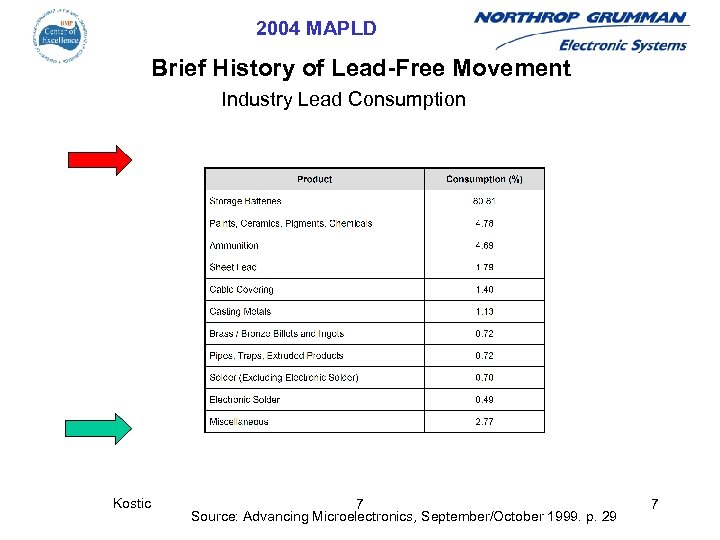 2004 MAPLD Brief History of Lead-Free Movement Industry Lead Consumption Kostic 7 Source: Advancing Microelectronics, September/October 1999. p. 29 7
 2004 MAPLD Facts to Consider • The mere presence of lead does not constitute hazard to humans – – • Miners working in Colorado lead mines and living on soil with 20, 000 ppm contamination (EPA accepted levels for most soil is 500 ppm) had lead blood levels approximately 10 times lower than national standard set by centers for disease control People in downtown Cincinnati have lead blood levels about 5 times higher than lead miners in Colorado Major contributors to landfill pollution – – Lead-acid batteries (48. 1%) TV picture tubes and computer CRTS (35. 8%) • Both are exempt from current draft legislation or proposed industry regulations Kostic 8 8
 2004 MAPLD Replacements More Toxic • Proposed replacements for current tin-lead (Sn. Pb) soldering compound – – – Tin-silver-copper (Sn. Ag. Cu) Tin-silver-bismuth (Sn. Ag. Bi) Both significantly more toxic than Sn. Pb • Silver has been cited as 70 to 90 times more toxic to humans and dangerous to aquatic life than lead Environmental justification for lead-free electronics is unfounded Kostic 9 9
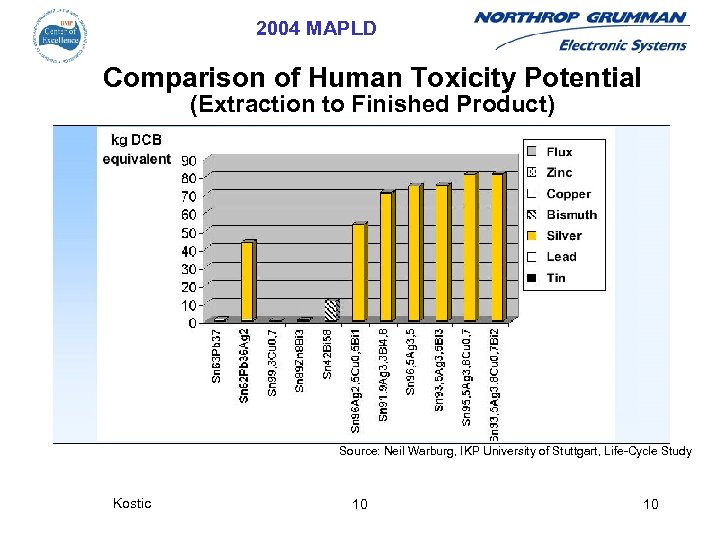 2004 MAPLD Comparison of Human Toxicity Potential (Extraction to Finished Product) Source: Neil Warburg, IKP University of Stuttgart, Life-Cycle Study Kostic 10 10
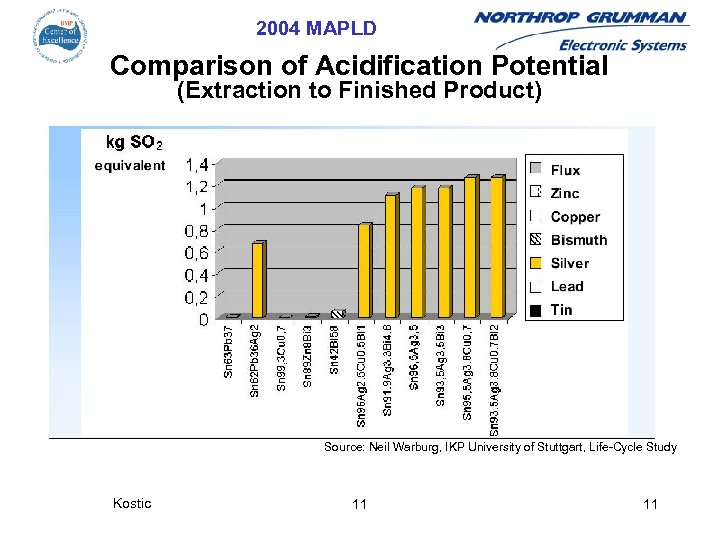 2004 MAPLD Comparison of Acidification Potential (Extraction to Finished Product) Source: Neil Warburg, IKP University of Stuttgart, Life-Cycle Study Kostic 11 11
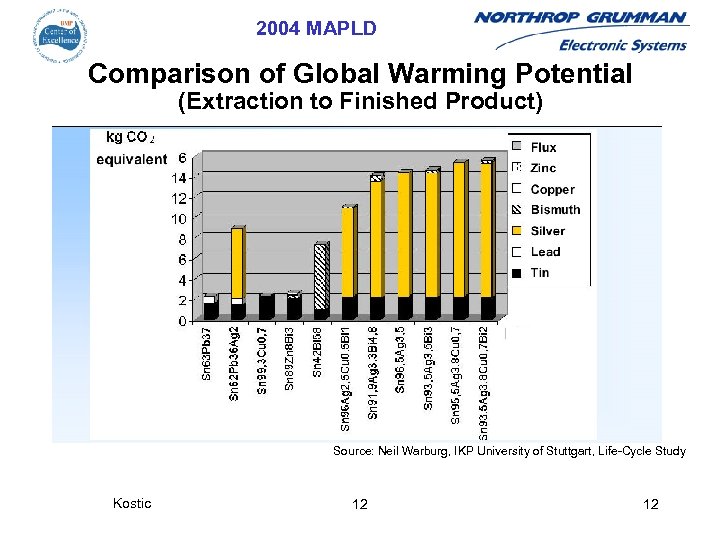 2004 MAPLD Comparison of Global Warming Potential (Extraction to Finished Product) Source: Neil Warburg, IKP University of Stuttgart, Life-Cycle Study Kostic 12 12
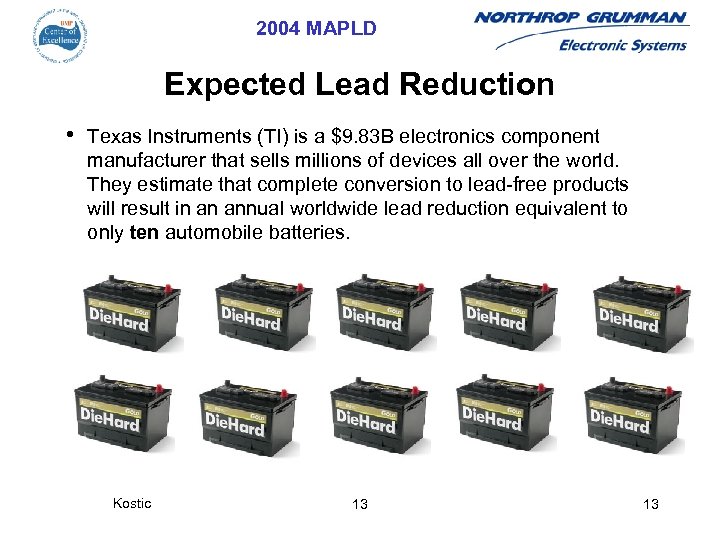 2004 MAPLD Expected Lead Reduction • Texas Instruments (TI) is a $9. 83 B electronics component manufacturer that sells millions of devices all over the world. They estimate that complete conversion to lead-free products will result in an annual worldwide lead reduction equivalent to only ten automobile batteries. Kostic 13 13
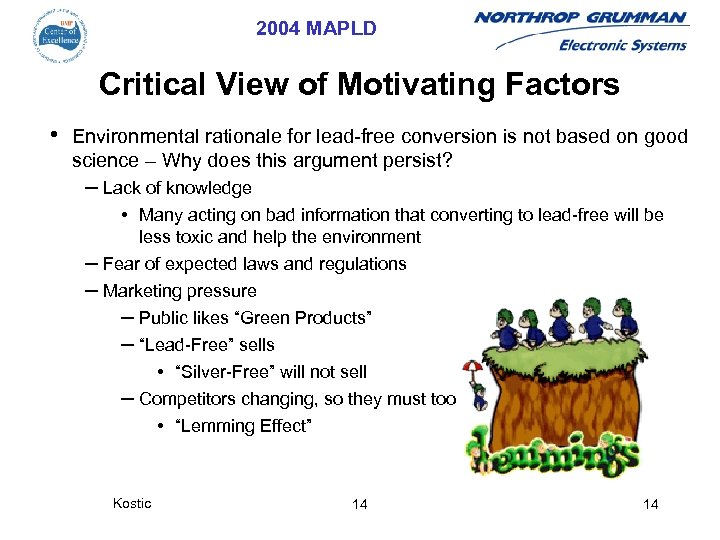 2004 MAPLD Critical View of Motivating Factors • Environmental rationale for lead-free conversion is not based on good science – Why does this argument persist? – Lack of knowledge • Many acting on bad information that converting to lead-free will be less toxic and help the environment – Fear of expected laws and regulations – Marketing pressure – Public likes “Green Products” – “Lead-Free” sells • “Silver-Free” will not sell – Competitors changing, so they must too • “Lemming Effect” Kostic 14 14
 2004 MAPLD Critical View of Motivating Factors • Many are compromising principles for profit – Lead-free products sell better – Replacement materials are usually slightly cheaper • Reliability of critical military / commercial aerospace systems will be adversely impacted by lead-free conversion – Increasingly dependent on commercial parts – Exemption from EU legislation provides no benefit if reliable parts cannot be obtained Kostic 15 15
 2004 MAPLD Potential Risks Associated with Lead-Free • Entire manufacturing process must be revised to properly apply the replacement materials – – – • • Higher Reflow Soldering Temperatures Circuit Board Glass Transition Temperatures Changes in Part Moisture Sensitivity Levels (MSLs) Unknown / untested life cycle reliability Solderability Use of lead-free solder may result in brittle solder joints New solder fluxes needed Kostic 16 16
 2004 MAPLD Potential Risks Associated with Lead-Free • • • Mixing technologies during assembly, repair, or upgrade Difficulty in tracking parts with differing finishes Inability of contractors to know what type parts they are getting; plating may be performed by a third or fourth tier supplier Occurrence of tin whiskers – reemergence of an insidious failure mechanism Tin “pest” causing lead-free solder failures in low temperature applications No standards or guidelines yet developed to mitigate risks Kostic 17 17
 2004 MAPLD Tin Pest in Lead-free Solders • High tin lead free solders have been shown to be subject to a phenomena known as “tin pest” • Tin pest is the change of state from metallic tin to semiconductor tin at temperatures below 13 C • • • Maximum rate of conversion at – 40 C Semiconductor tin is • Brittle • • • Forms within hours of exposure Metal powder 26% greater volume than metallic tin Serious risk for any application with long term cold exposure Kostic 18 18
 2004 MAPLD Tin Whiskers – One Critical Risk Issue • Industry trend – commercial electronics moving to lead-free components and solder • • Lead-free components vulnerable to tin whisker formation • Nationally important issue – impacts national security and human safety Military and aerospace industry, highly dependent on commercial components, will be at higher risk Kostic 19 19
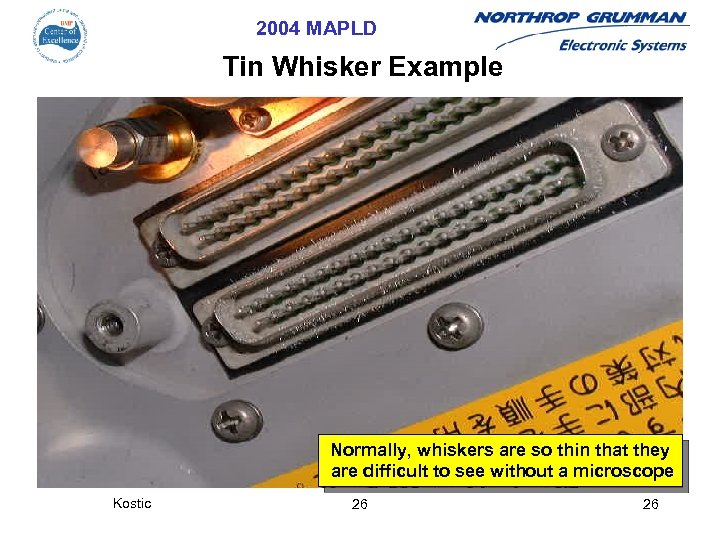
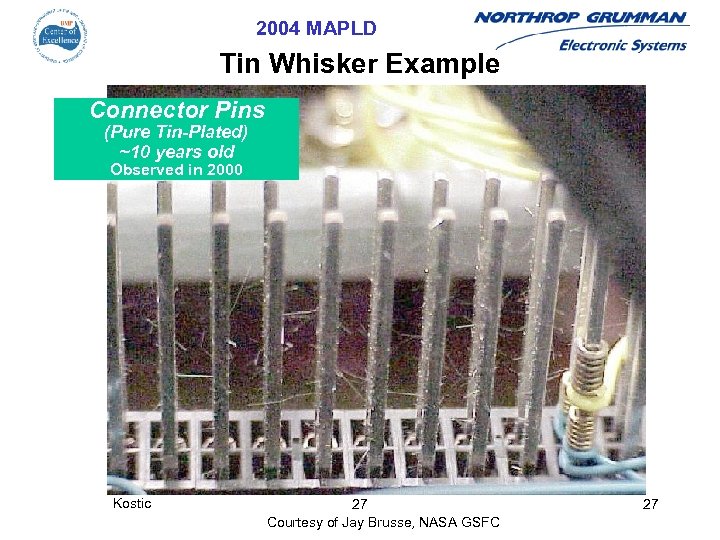
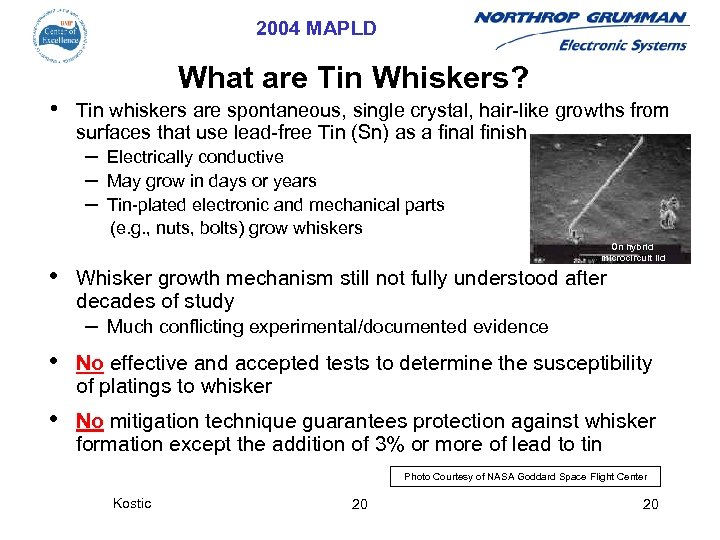 2004 MAPLD • What are Tin Whiskers? Tin whiskers are spontaneous, single crystal, hair-like growths from surfaces that use lead-free Tin (Sn) as a final finish – – – Electrically conductive May grow in days or years Tin-plated electronic and mechanical parts (e. g. , nuts, bolts) grow whiskers • On hybrid microcircuit lid Whisker growth mechanism still not fully understood after decades of study – Much conflicting experimental/documented evidence • No effective and accepted tests to determine the susceptibility of platings to whisker • No mitigation technique guarantees protection against whisker formation except the addition of 3% or more of lead to tin Photo Courtesy of NASA Goddard Space Flight Center Kostic 20 20
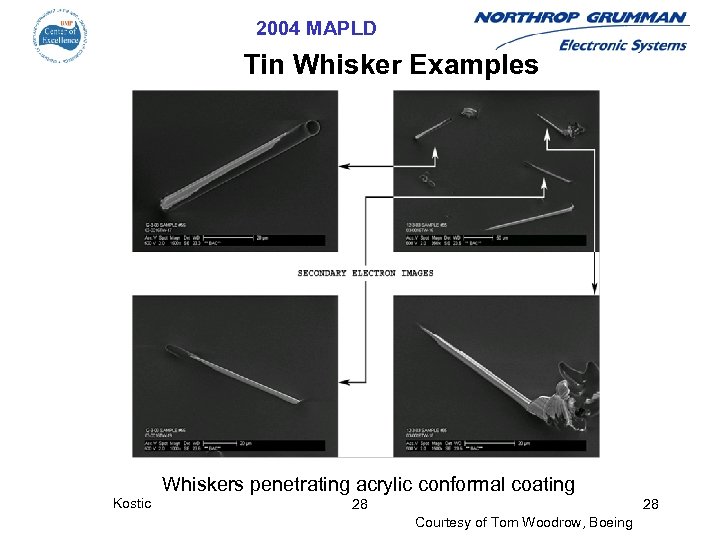
 2004 MAPLD Tin Whiskers Background • • Phenomenon observed since 1940 s Growth varies widely – – – Within hours After years of dormancy Anytime in between • Whisker shapes and forms vary from few microns to several millimeters • • • Up to 200 whiskers per square millimeter have been observed Whiskers can grow through thin conformal coating Major ad hoc government-industry group has formed to address tin whisker problem – CALCE Tin Whiskers Group http: //www. calce. umd. edu/lead-free/ http: //nepp. nasa. gov/whisker/ Kostic 21 21
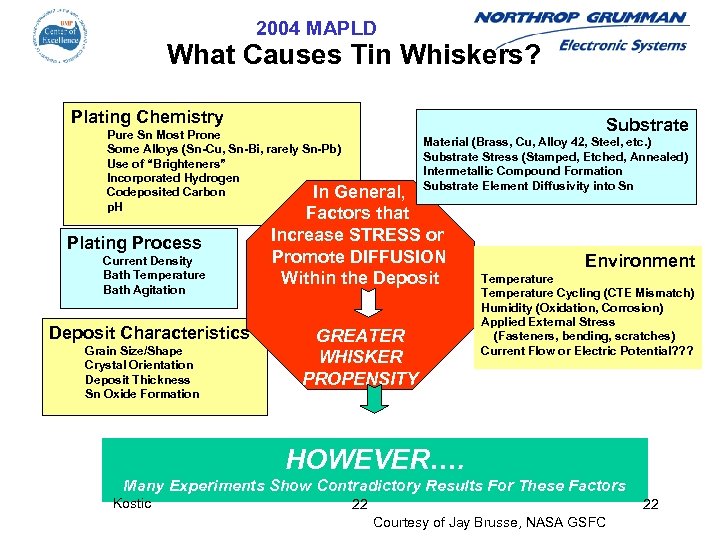 2004 MAPLD What Causes Tin Whiskers? Plating Chemistry Pure Sn Most Prone Some Alloys (Sn-Cu, Sn-Bi, rarely Sn-Pb) Use of “Brighteners” Incorporated Hydrogen Codeposited Carbon In General, p. H Plating Process Current Density Bath Temperature Bath Agitation Deposit Characteristics Grain Size/Shape Crystal Orientation Deposit Thickness Sn Oxide Formation Substrate Material (Brass, Cu, Alloy 42, Steel, etc. ) Substrate Stress (Stamped, Etched, Annealed) Intermetallic Compound Formation Substrate Element Diffusivity into Sn Factors that Increase STRESS or Promote DIFFUSION Within the Deposit GREATER WHISKER PROPENSITY Environment Temperature Cycling (CTE Mismatch) Humidity (Oxidation, Corrosion) Applied External Stress (Fasteners, bending, scratches) Current Flow or Electric Potential? ? ? HOWEVER…. Many Experiments Show Contradictory Results For These Factors Kostic 22 22 Courtesy of Jay Brusse, NASA GSFC
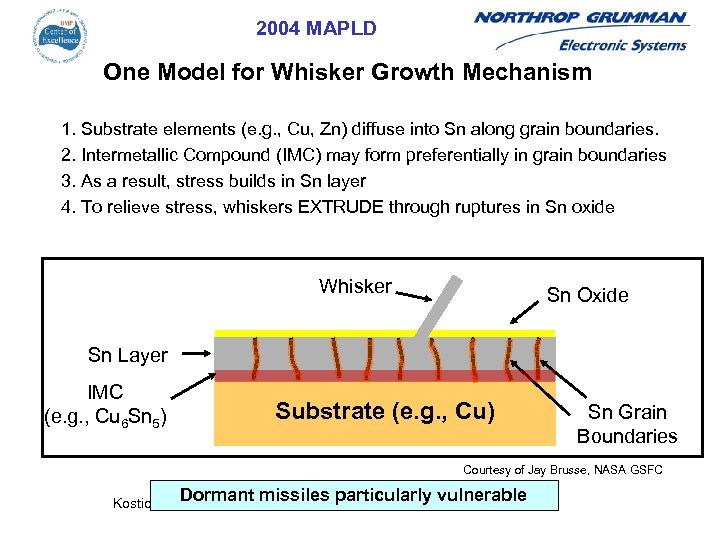 2004 MAPLD One Model for Whisker Growth Mechanism 1. Substrate elements (e. g. , Cu, Zn) diffuse into Sn along grain boundaries. 2. Intermetallic Compound (IMC) may form preferentially in grain boundaries 3. As a result, stress builds in Sn layer 4. To relieve stress, whiskers EXTRUDE through ruptures in Sn oxide Whisker Sn Oxide Sn Layer IMC (e. g. , Cu 6 Sn 5) Substrate (e. g. , Cu) Sn Grain Boundaries Courtesy of Jay Brusse, NASA GSFC Kostic Dormant missiles particularly vulnerable
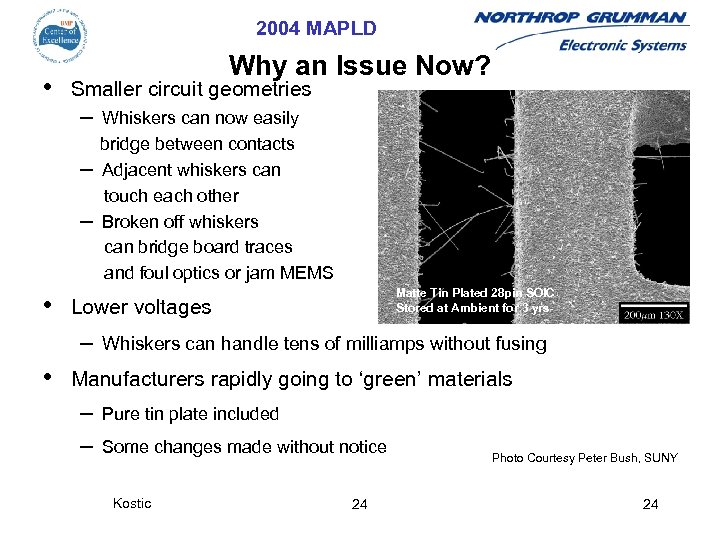 2004 MAPLD • Why an Issue Now? Smaller circuit geometries – Whiskers can now easily bridge between contacts – Adjacent whiskers can touch each other – Broken off whiskers can bridge board traces and foul optics or jam MEMS • Lower voltages – • Matte Tin Plated 28 pin SOIC Stored at Ambient for 3 yrs Whiskers can handle tens of milliamps without fusing Manufacturers rapidly going to ‘green’ materials – – Pure tin plate included Some changes made without notice Kostic 24 Photo Courtesy Peter Bush, SUNY 24
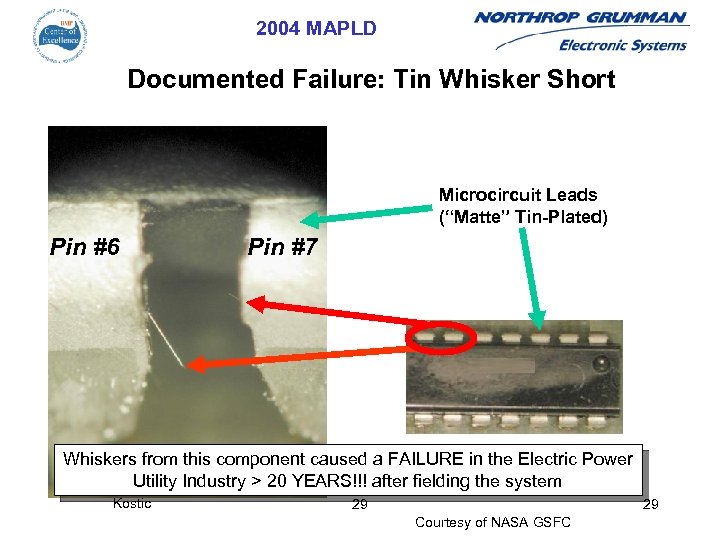
 2004 MAPLD Tin Whisker Failure Mechanisms • Stable short circuit in low voltage, high impedance circuits where current insufficient to fuse whisker open • Transient short circuit until whisker fuses open • Plasma arcing in vacuum potentially most destructive - whisker can fuse open but the vaporized tin may initiate a plasma that can conduct over 200 amps! Atmospheric conditions with additional voltage/current may also experience whisker induced arcs • Debris/Contamination: Whiskers or parts of whiskers may break loose and bridge isolated conductors or interfere with optical surfaces or microelectromechanical systems (MEMS) Kostic 25 25
 2004 MAPLD Tin Whisker Example Normally, whiskers are so thin that they are difficult to see without a microscope Kostic 26 26
 2004 MAPLD Tin Whisker Example Connector Pins (Pure Tin-Plated) ~10 years old Observed in 2000 Kostic 27 Courtesy of Jay Brusse, NASA GSFC 27
 2004 MAPLD Tin Whisker Examples Whiskers penetrating acrylic conformal coating Kostic 28 28 Courtesy of Tom Woodrow, Boeing
 2004 MAPLD Documented Failure: Tin Whisker Short Microcircuit Leads (“Matte” Tin-Plated) Pin #6 Pin #7 Whiskers from this component caused a FAILURE in the Electric Power Utility Industry > 20 YEARS!!! after fielding the system Kostic 29 29 Courtesy of NASA GSFC
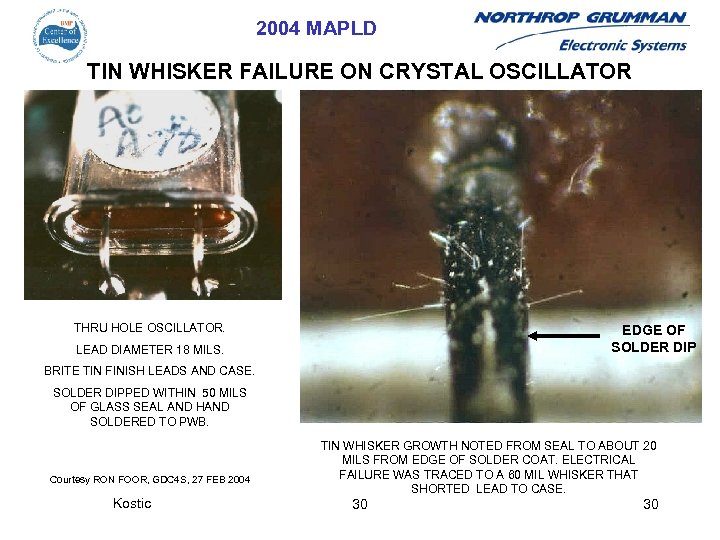 2004 MAPLD TIN WHISKER FAILURE ON CRYSTAL OSCILLATOR THRU HOLE OSCILLATOR. EDGE OF SOLDER DIP LEAD DIAMETER 18 MILS. BRITE TIN FINISH LEADS AND CASE. SOLDER DIPPED WITHIN 50 MILS OF GLASS SEAL AND HAND SOLDERED TO PWB. Courtesy RON FOOR, GDC 4 S, 27 FEB 2004 Kostic TIN WHISKER GROWTH NOTED FROM SEAL TO ABOUT 20 MILS FROM EDGE OF SOLDER COAT. ELECTRICAL FAILURE WAS TRACED TO A 60 MIL WHISKER THAT SHORTED LEAD TO CASE. 30 30
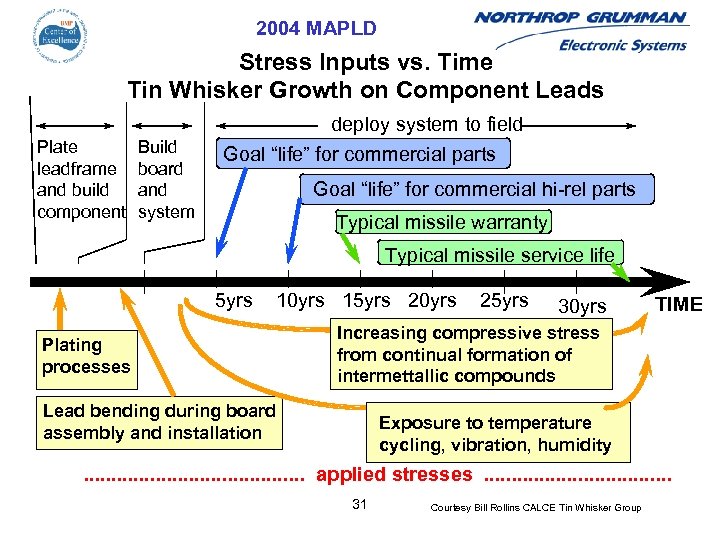 2004 MAPLD Stress Inputs vs. Time Tin Whisker Growth on Component Leads deploy system to field Plate leadframe and build component Build board and system Goal “life” for commercial parts Goal “life” for commercial hi-rel parts Typical missile warranty Typical missile service life 5 yrs Plating processes 10 yrs 15 yrs 20 yrs 25 yrs 30 yrs TIME Increasing compressive stress from continual formation of intermettallic compounds Lead bending during board assembly and installation Exposure to temperature cycling, vibration, humidity . . applied stresses. . . . 31 Courtesy Bill Rollins CALCE Tin Whisker Group
 2004 MAPLD Documented Tin Whisker Failure Experience • Weapon systems that were built between 1985 and 1992 have had documented tin whisker failures – – • • Failure rates varied from 1% to 10% Manufacturers of microcircuits/semiconductors BEGAN shifting to pure tin in 1996 -97 6 Satellites: partial or complete loss (Galaxy – 3, Solidaridad 1, Direct TV 3, and HS 601) 1998 -2002 Airborne radar systems Kostic 32 32
 2004 MAPLD Kostic 33 33
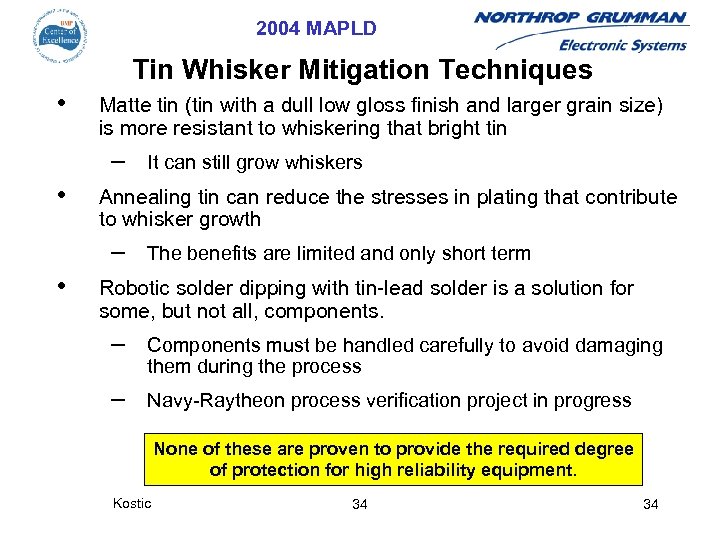 2004 MAPLD Tin Whisker Mitigation Techniques • Matte tin (tin with a dull low gloss finish and larger grain size) is more resistant to whiskering that bright tin – • Annealing tin can reduce the stresses in plating that contribute to whisker growth – • It can still grow whiskers The benefits are limited and only short term Robotic solder dipping with tin-lead solder is a solution for some, but not all, components. – Components must be handled carefully to avoid damaging them during the process – Navy-Raytheon process verification project in progress None of these are proven to provide the required degree of protection for high reliability equipment. Kostic 34 34
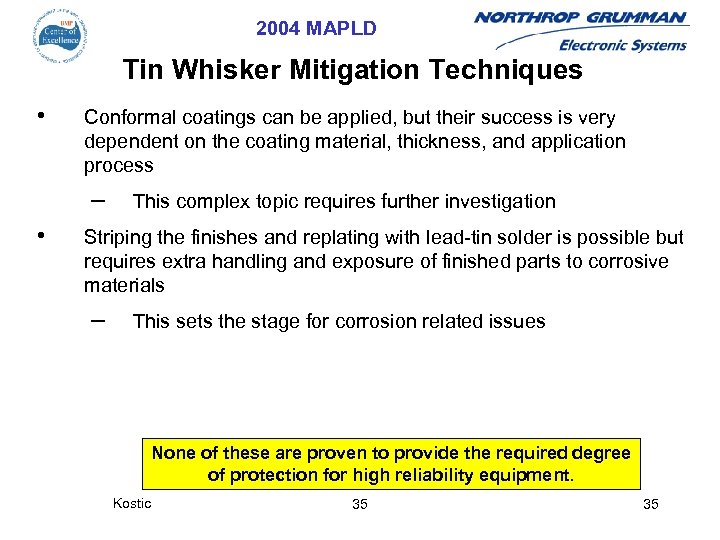 2004 MAPLD Tin Whisker Mitigation Techniques • Conformal coatings can be applied, but their success is very dependent on the coating material, thickness, and application process – • This complex topic requires further investigation Striping the finishes and replating with lead-tin solder is possible but requires extra handling and exposure of finished parts to corrosive materials – This sets the stage for corrosion related issues None of these are proven to provide the required degree of protection for high reliability equipment. Kostic 35 35
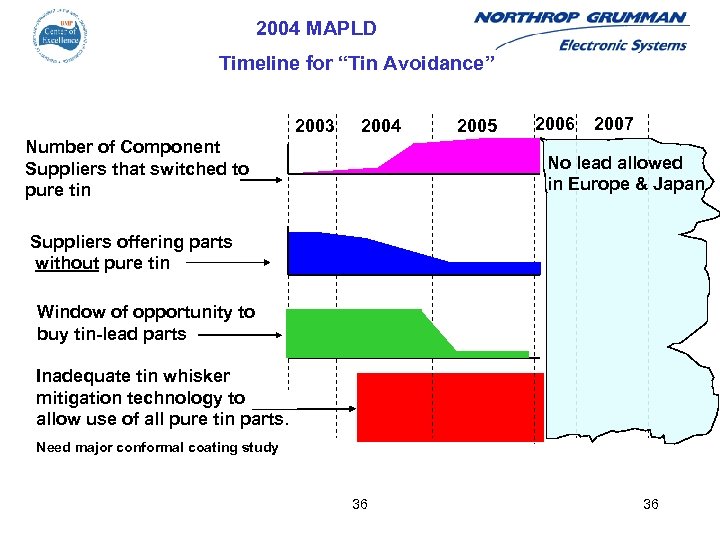 2004 MAPLD Timeline for “Tin Avoidance” 2003 2004 Number of Component Suppliers that switched to pure tin 2005 2006 2007 No lead allowed in Europe & Japan Suppliers offering parts without pure tin Window of opportunity to buy tin-lead parts Inadequate tin whisker mitigation technology to allow use of all pure tin parts. Need major conformal coating study 36 36
 2004 MAPLD Summary Transition to Lead-Free Electronic Components Poses Serious Risk to National Defense • • • Environmental justification for conversion to lead-free is invalid Current replacements for lead-based solder compounds appear to be more toxic and harmful to the environment Reliability of products manufactured with lead-free solder and components has yet to be proven in service Dependence of military / aerospace industry applications on lower reliability lead-free components will result in higher risk Tremendous costs for conversion to lead-free products Kostic 37 37