


 Скачать презентацию 2003 European Control Conference Flight Control Law Design
cd6c94a9ace76eed13138242d56ccdb1.ppt
- Количество слайдов: 71
 2003 European Control Conference Flight Control Law Design: An Industry Perspective Gary J. Balas balas@aem. umn. edu Aerospace Engineering and Mechanics University of Minnesota Minneapolis, MN 55105 USA September 4, 2003
 Presentation Overview Survey of the control techniques being used by industry in Brazil, Europe, Russia and the United States of America to design flight control laws for fixed-wing aircraft. 2
 Outline • 100 years of Controlled Flight • Introduction • Background • Countries • Brazil • Israel • Europe • Russia • France • United States of America • Germany • Boeing • Italy • Honeywell • Sweden • Lockheed Martin • United Kingdom • Summary 3
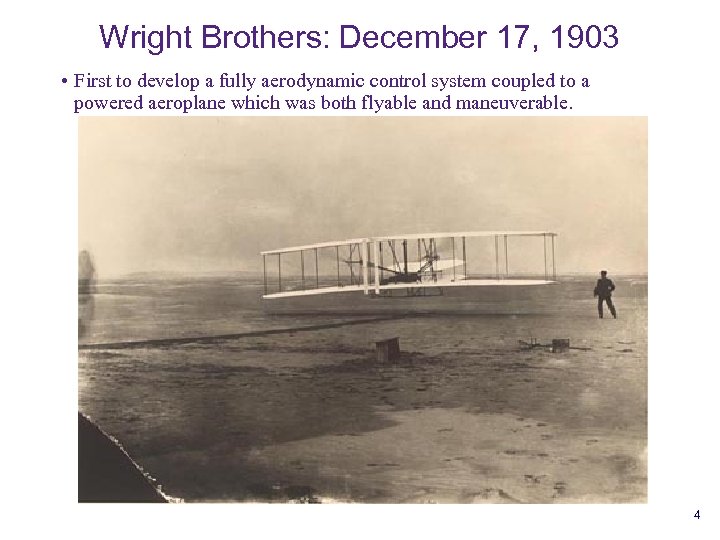 Wright Brothers: December 17, 1903 • First to develop a fully aerodynamic control system coupled to a powered aeroplane which was both flyable and maneuverable. 4
 United Kingdom Most Influential Predecessor of the Wright’s • Sir George Cayley in 1799 at Brompton, near Scarborough in Yorkshire sketched a “conventional” configuration of an aeroplane. Indeed, in 1909 Wilbur Wright himself paid Cayley the following tribute: "About 100 years ago, an Englishman, Sir George Cayley, carried the science of flight to a point which it had never reached before and which it scarcely reached again during the last century. “ “The History of Flight from Around the World, ” United Kingdom, Eur. Ing. Dr. J. A. D. Ackroyd 5
 Cambridge University, England Lord Kelvin, President, Royal Society, undergraduate at Cambridge University, Senior Wrangler 6
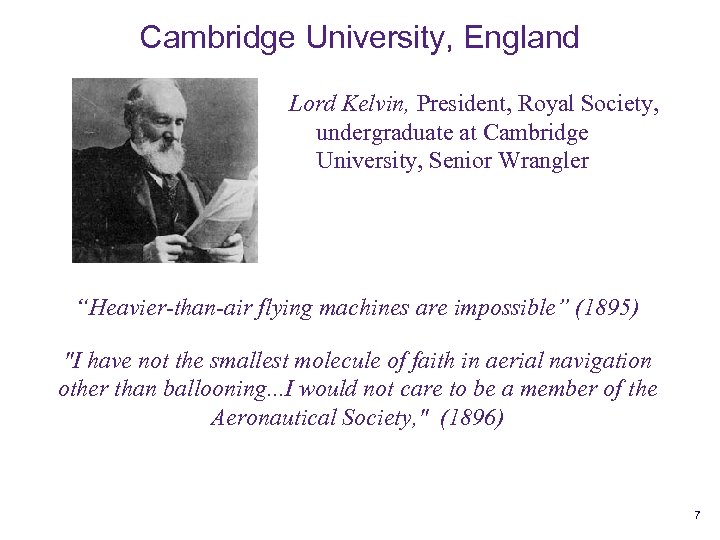 Cambridge University, England Lord Kelvin, President, Royal Society, undergraduate at Cambridge University, Senior Wrangler “Heavier-than-air flying machines are impossible” (1895) "I have not the smallest molecule of faith in aerial navigation other than ballooning. . . I would not care to be a member of the Aeronautical Society, " (1896) 7
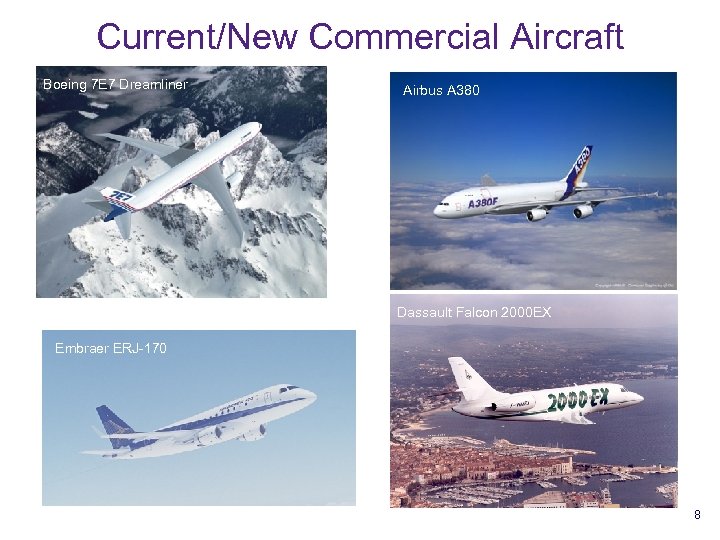 Current/New Commercial Aircraft Boeing 7 E 7 Dreamliner Airbus A 380 Dassault Falcon 2000 EX Embraer ERJ-170 8
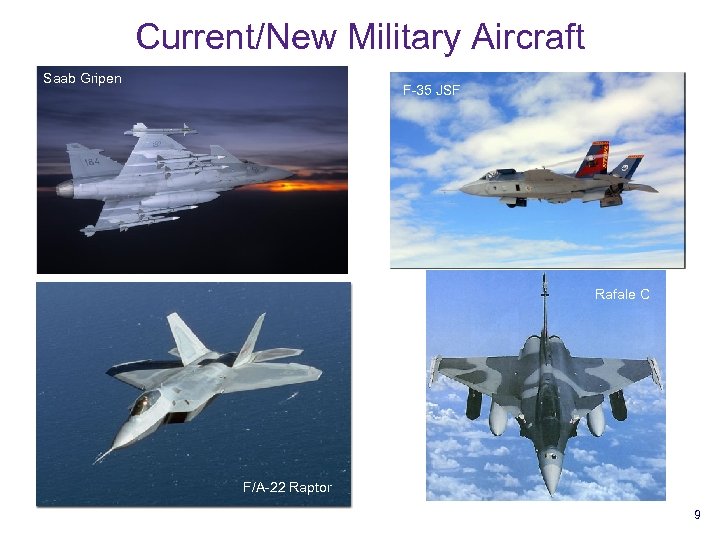 Current/New Military Aircraft Saab Gripen F-35 JSF Rafale C F/A-22 Raptor 9
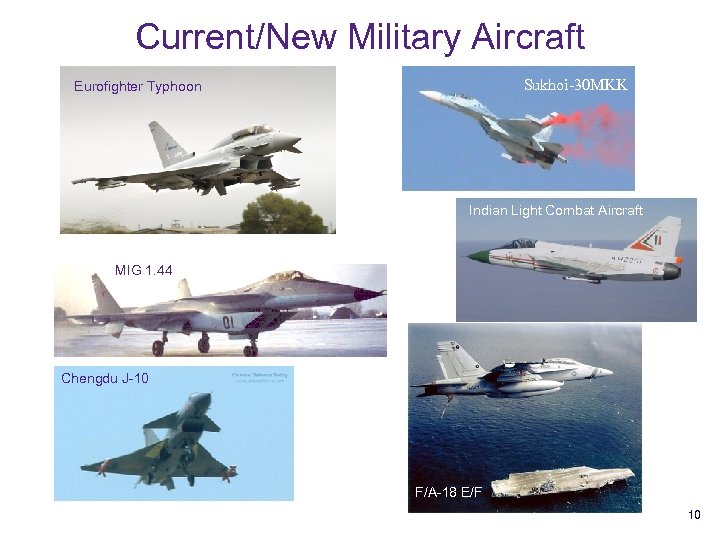 Current/New Military Aircraft Sukhoi-30 MKK Eurofighter Typhoon Indian Light Combat Aircraft MIG 1. 44 Chengdu J-10 Sukhoi SU-37 F/A-18 E/F 10
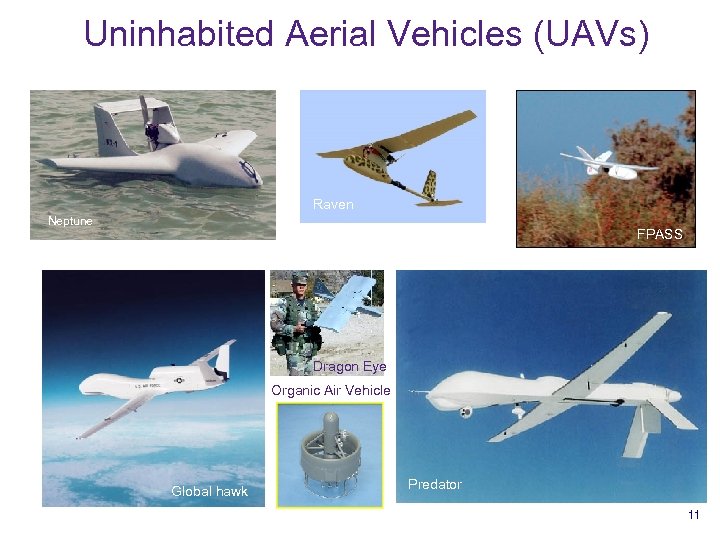 Uninhabited Aerial Vehicles (UAVs) Raven Neptune FPASS Dragon Eye Organic Air Vehicle Global hawk Predator 11
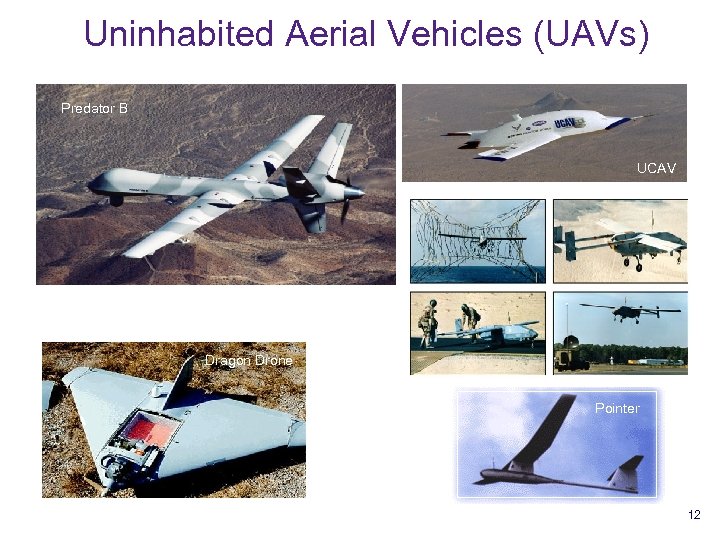 Uninhabited Aerial Vehicles (UAVs) Predator B UCAV Pioneer Dragon Drone FPASS Dragon Drone Pointer 12
 Uninhabited Aerial Vehicles (UAVs) • US Department of Defense (Do. D) has 20 UAVs in service or under conceptual development: • Do. D will have invested over $10 Billion in UAVs by 2007*. • Do. D UAV systems will grow to 300 by the year 2010*. • 32 Nations are developing more than 250 models of UAVs*. • Over 60 small and Micro UAV programs are under way through out the world. * Do. D Unmanned Aerial Vehicle Roadmap: 2002 -2027 13
 Background Flight control design research is a very active area: • In 2002 alone, 490 flight control design related papers were published. • Majority new theory or applying theory to aircraft simulations. • Basis from which the aircraft industry draws its “new” ideas. Working Group 23 of Advisory Group for Aerospace Research and development (AGARD now RTO) noted in 1996: • Skill required to design an advanced flight control system is not easily transferred and very little material exists in the open literature to be used as a reference handbook by designers. • RTO recommended better documentation of existing flight control system development process, lessons learned and best practices. 14
 Background Survey of the current practices and control design approaches used by the aircraft industry. • Brazil , Europe (France, Germany, Italy, Sweden, United Kingdom), Israel, Russia, United States of America Caveats: • • Limited information on techniques used in industry. Some companies consider the control architecture, algorithms etc. to be IP. Companies that publish more are better represented in this talk. Almost all the references cited were published in English. 15
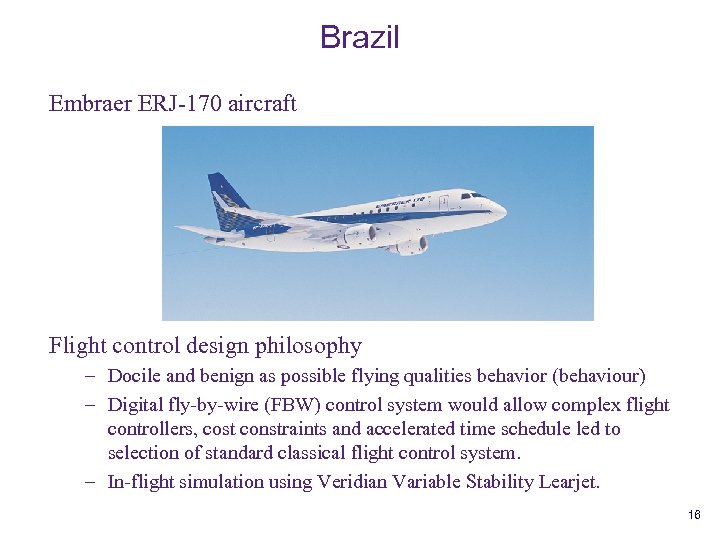 Brazil Embraer ERJ-170 aircraft Flight control design philosophy – Docile and benign as possible flying qualities behavior (behaviour) – Digital fly-by-wire (FBW) control system would allow complex flight controllers, cost constraints and accelerated time schedule led to selection of standard classical flight control system. – In-flight simulation using Veridian Variable Stability Learjet. 16
 Europe 17
 Europe Long tradition of aeronautical research. • Close links between universities and industry • To increase cooperation, the Association of European Research Establishments in Aeronautics (EREA) found in 1994. – CIRA (Italy), DERA (Great Britain), DLR (Germany), FFA (Sweden), INTA (Spain), NLR (Dutch) and ONERA (France, 1999). – Group for Aeronautical Research and Technology in Europe (GARTEUR) • GARTEUR Flight Mechanics Action Group 08 (1994 -1997) – Robust control design methods • GARTEUR Flight Mechanics Action Group 11 (1999 -2002) – New Analysis Techniques for Clearance of Flight Control Laws • Many European aircraft industries are multi-national and parts of the same aircraft flight control laws are designed in more than one country. 18
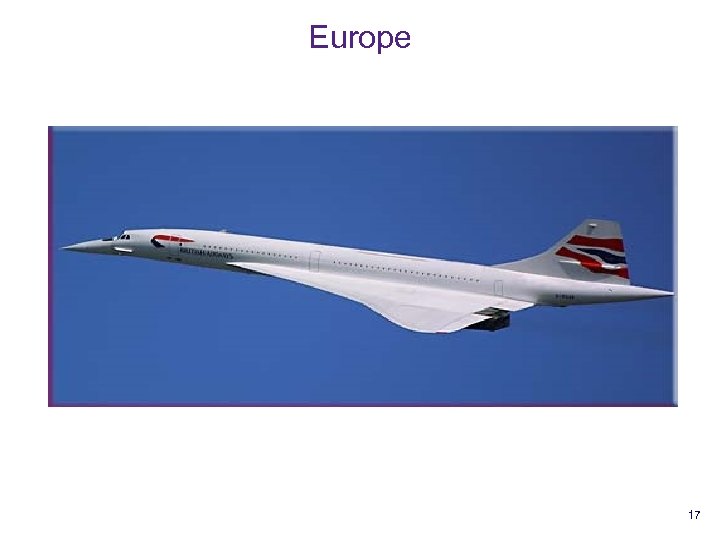
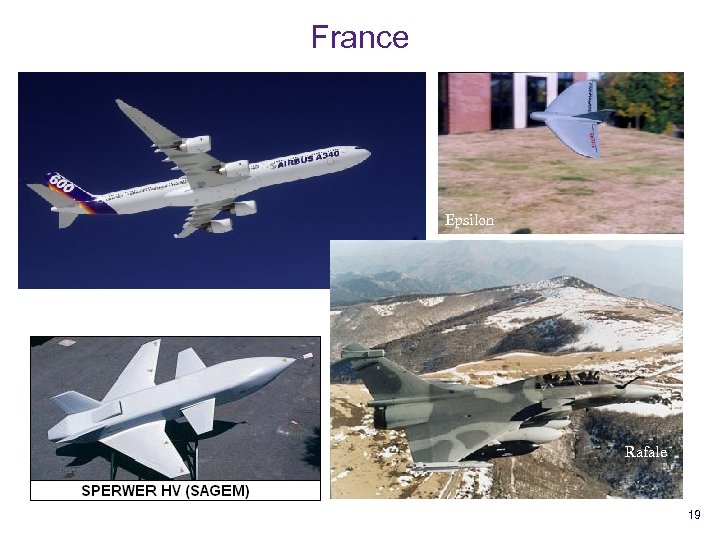 France Concorde Epsilon Rafale 19
 France • Mirage 2000, Rafale C • Airbus – Major partner in European consortium of French, German, Spain and U. K. companies – A 300/A 310, A 320, A 330/A 340, A 380 under design. – Developer of commercial fly-by-wire (FBW) system. • A 320 was first commercial aircraft to enter service with a FBW flight control system (1988). • A 340 2 nd generation FBW certified in 1992. • All Airbus flight control surfaces are electronically controlled and hydraulically activated. • UAVs 20
 France – Airbus A 320 Flight Control Laws • Improve the natural flying qualities, particularly the stability, control and flight envelope protection. Longitudinal Control • Load factor demands • Classical proportional plus integral control Lateral-directional Control • Roll rate, sideslip and bank angle commands • Classical proportional plus integral control with a gain matrix for stability and roll rate/sideslip decoupling. 21
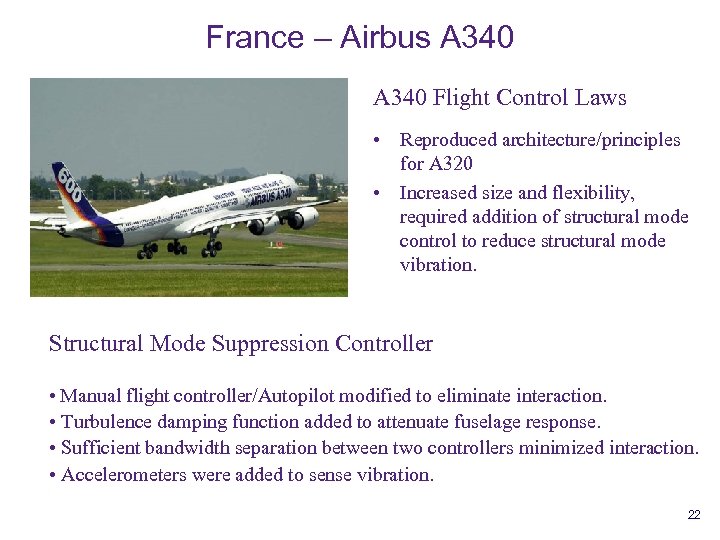 France – Airbus A 340 Flight Control Laws • Reproduced architecture/principles for A 320 • Increased size and flexibility, required addition of structural mode control to reduce structural mode vibration. Structural Mode Suppression Controller • Manual flight controller/Autopilot modified to eliminate interaction. • Turbulence damping function added to attenuate fuselage response. • Sufficient bandwidth separation between two controllers minimized interaction. • Accelerometers were added to sense vibration. 22
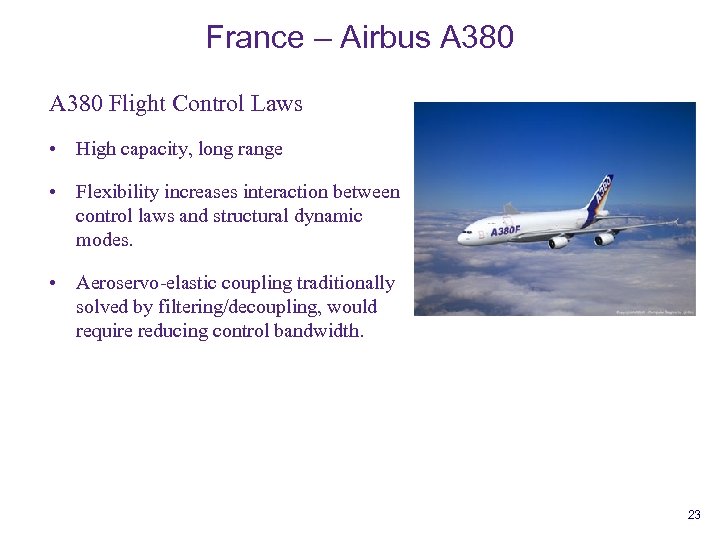 France – Airbus A 380 Flight Control Laws • High capacity, long range • Flexibility increases interaction between control laws and structural dynamic modes. • Aeroservo-elastic coupling traditionally solved by filtering/decoupling, would require reducing control bandwidth. 23
 France – Airbus A 380 Approach • Airframe flexibility taken directly into account when designing the flight control laws. • Integrated flight control laws to achieve desired handling qualities and flexible mode damping requirements leading to extended control bandwidth. • Flight tested on A 340 using A 380 models • Robust to fuel, payload, etc. variations • Same concept applied to autopilot and manual control laws. 24
 Germany Commercial Aviation • Airbus • DLR experimental aircraft (ATTAS) Advanced Technologies Testing Aircraft System. Military Aviation • Eurofighter • X-31 (US/Germany program) 25
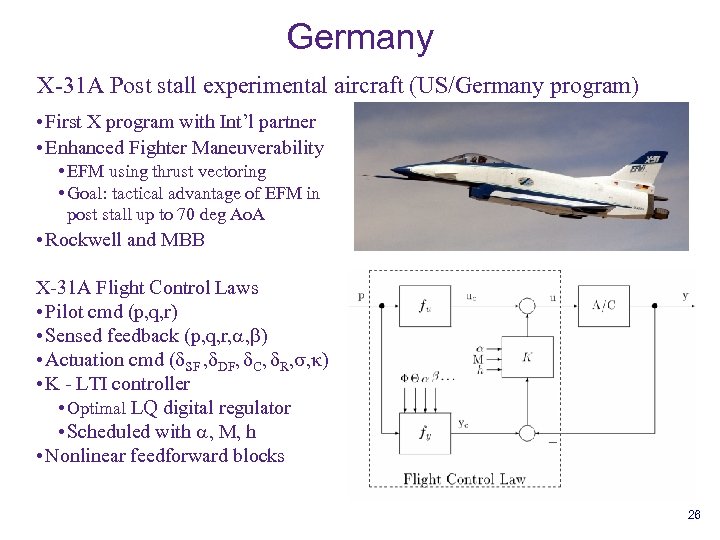 Germany X-31 A Post stall experimental aircraft (US/Germany program) • First X program with Int’l partner • Enhanced Fighter Maneuverability • EFM using thrust vectoring • Goal: tactical advantage of EFM in post stall up to 70 deg Ao. A • Rockwell and MBB X-31 A Flight Control Laws • Pilot cmd (p, q, r) • Sensed feedback (p, q, r, , ) • Actuation cmd ( SF , DF, C, R, , ) • K - LTI controller • Optimal LQ digital regulator • Scheduled with , M, h • Nonlinear feedforward blocks 26
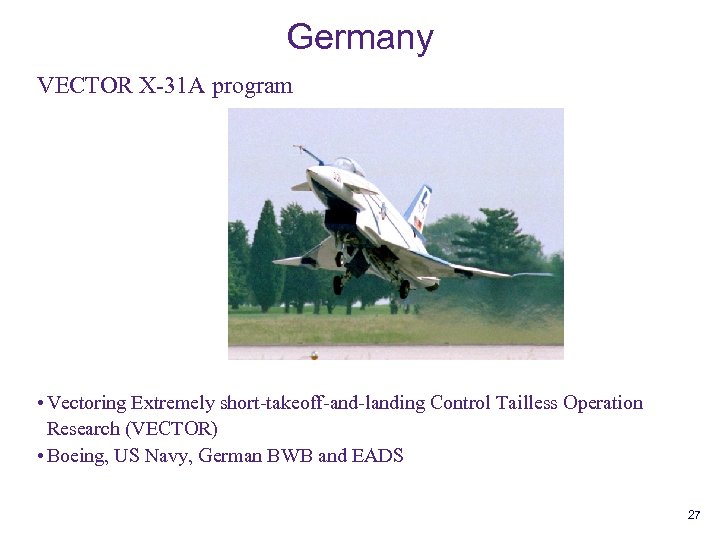 Germany VECTOR X-31 A program • Vectoring Extremely short-takeoff-and-landing Control Tailless Operation Research (VECTOR) • Boeing, US Navy, German BWB and EADS 27
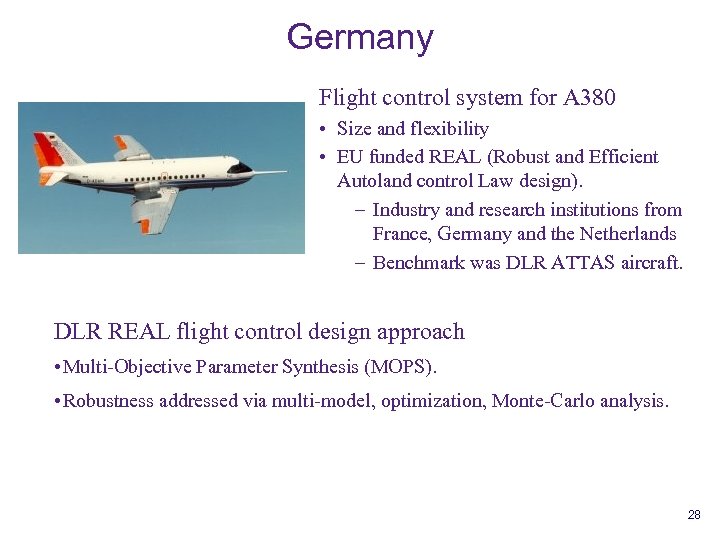 Germany Flight control system for A 380 • Size and flexibility • EU funded REAL (Robust and Efficient Autoland control Law design). – Industry and research institutions from France, Germany and the Netherlands – Benchmark was DLR ATTAS aircraft. DLR REAL flight control design approach • Multi-Objective Parameter Synthesis (MOPS). • Robustness addressed via multi-model, optimization, Monte-Carlo analysis. 28
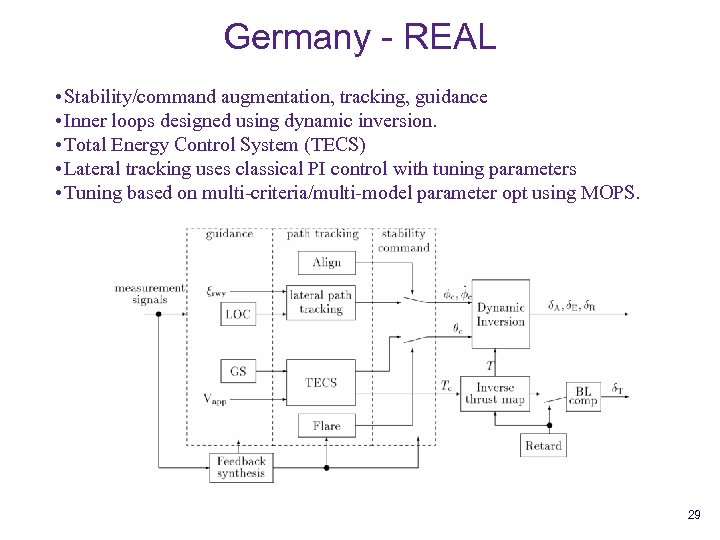 Germany - REAL • Stability/command augmentation, tracking, guidance • Inner loops designed using dynamic inversion. • Total Energy Control System (TECS) • Lateral tracking uses classical PI control with tuning parameters • Tuning based on multi-criteria/multi-model parameter opt using MOPS. 29
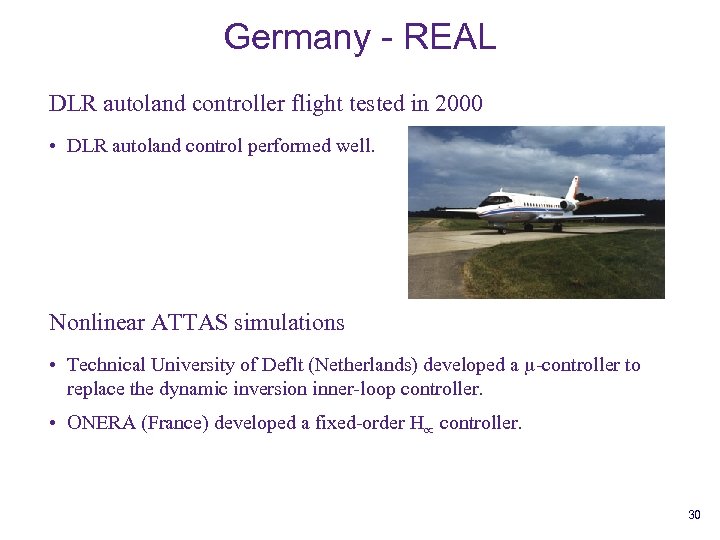 Germany - REAL DLR autoland controller flight tested in 2000 • DLR autoland control performed well. Nonlinear ATTAS simulations • Technical University of Deflt (Netherlands) developed a -controller to replace the dynamic inversion inner-loop controller. • ONERA (France) developed a fixed-order H controller. 30
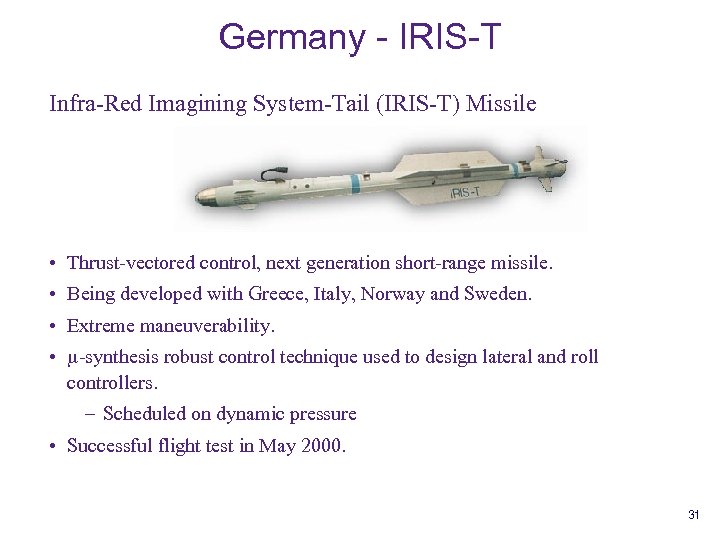 Germany - IRIS-T Infra-Red Imagining System-Tail (IRIS-T) Missile • Thrust-vectored control, next generation short-range missile. • Being developed with Greece, Italy, Norway and Sweden. • Extreme maneuverability. • -synthesis robust control technique used to design lateral and roll controllers. – Scheduled on dynamic pressure • Successful flight test in May 2000. 31
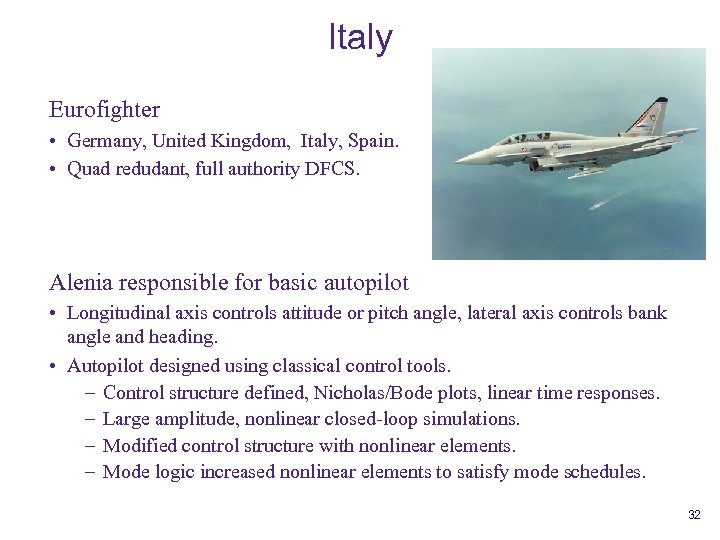 Italy Eurofighter • Germany, United Kingdom, Italy, Spain. • Quad redudant, full authority DFCS. Alenia responsible for basic autopilot • Longitudinal axis controls attitude or pitch angle, lateral axis controls bank angle and heading. • Autopilot designed using classical control tools. – Control structure defined, Nicholas/Bode plots, linear time responses. – Large amplitude, nonlinear closed-loop simulations. – Modified control structure with nonlinear elements. – Mode logic increased nonlinear elements to satisfy mode schedules. 32
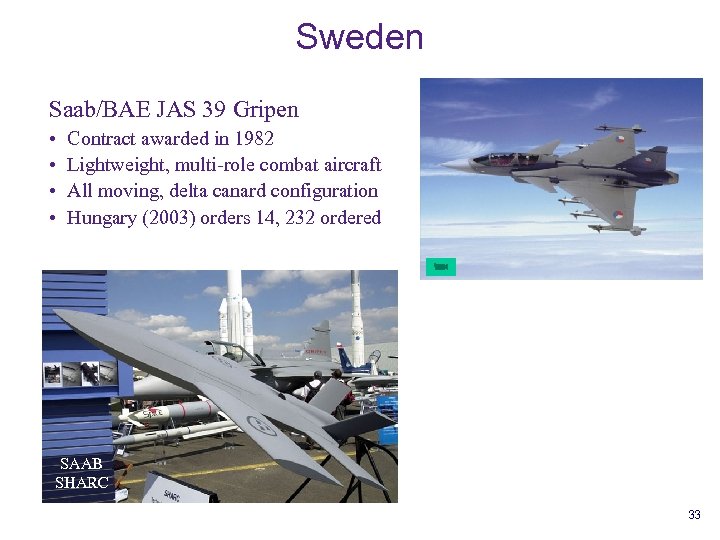 Sweden Saab/BAE JAS 39 Gripen • • Contract awarded in 1982 Lightweight, multi-role combat aircraft All moving, delta canard configuration Hungary (2003) orders 14, 232 ordered SAAB SHARC 33
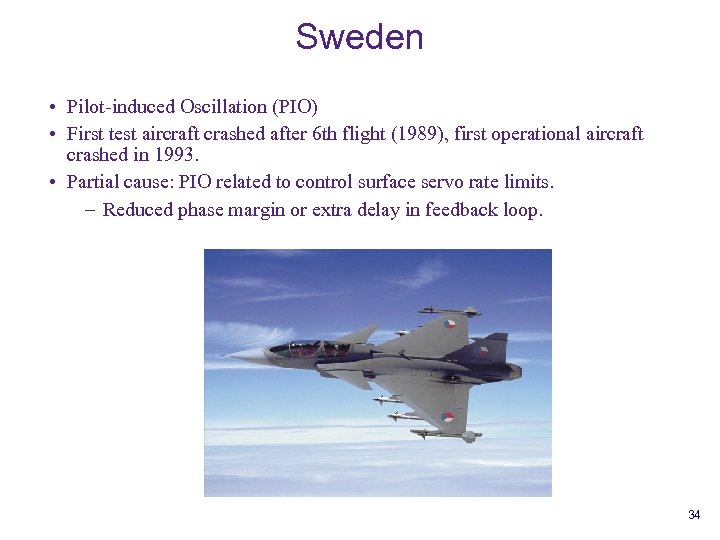 Sweden • Pilot-induced Oscillation (PIO) • First test aircraft crashed after 6 th flight (1989), first operational aircraft crashed in 1993. • Partial cause: PIO related to control surface servo rate limits. – Reduced phase margin or extra delay in feedback loop. 34
 Sweden Controller modification based on PIOs • • • Feedback phase compensation based on anti-windup methods. Increased or advanced phase around nonlinearity. Low pass filters used to eliminate biases and high frequency roll off issues Flight tested and verified. Phase compensation technique used in place of rate limiters in Gripen production flight control system. 35
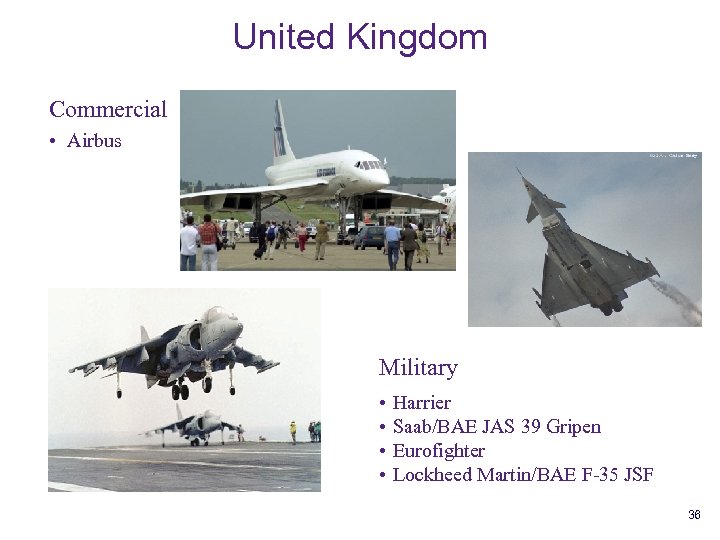 United Kingdom Commercial • Airbus Military • • Harrier Saab/BAE JAS 39 Gripen Eurofighter Lockheed Martin/BAE F-35 JSF 36
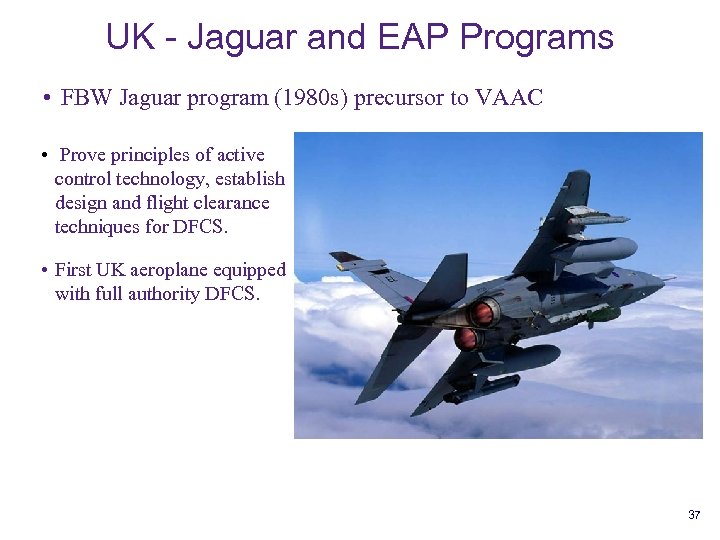 UK - Jaguar and EAP Programs • FBW Jaguar program (1980 s) precursor to VAAC • Prove principles of active control technology, establish design and flight clearance techniques for DFCS. • First UK aeroplane equipped with full authority DFCS. 37
 UK - Jaguar and EAP Programs • Experimental Aircraft Programme (EAP, 1983 -1995) – Follow on from Jaguar programme. – Control design process: • Linear low frequency: PI scheduled as function control • Nonlinear: trim distribution, nonlinear control power, nonlinear variations of stability • Linear high frequency: avoid structural coupling – Lessons learned: separate regulator and command path designs. • FBW Jaguar and EAP shaped Eurofighter flight controller 38
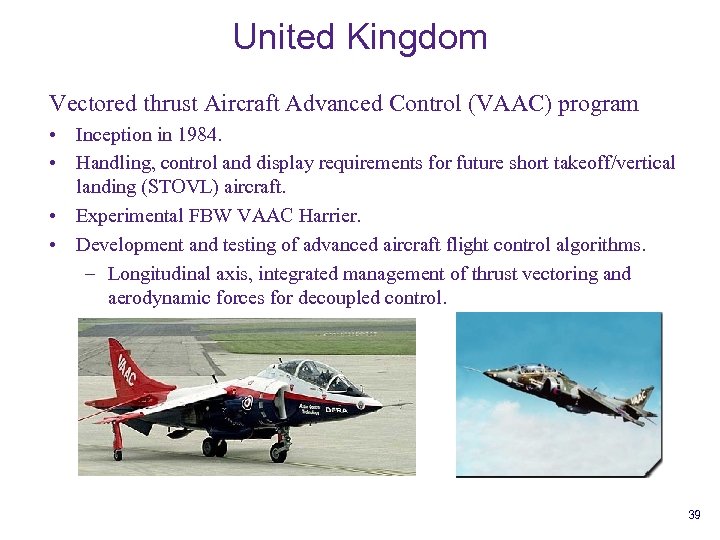 United Kingdom Vectored thrust Aircraft Advanced Control (VAAC) program • Inception in 1984. • Handling, control and display requirements for future short takeoff/vertical landing (STOVL) aircraft. • Experimental FBW VAAC Harrier. • Development and testing of advanced aircraft flight control algorithms. – Longitudinal axis, integrated management of thrust vectoring and aerodynamic forces for decoupled control. 39
 UK - VAAC Control Strategies • Classical control, loop-at-a-time – Frequency shaping, gain-scheduling, significant nonlinearities linearized with inverse functions, iterative design. – Anti-windup scheme and control allocation. • Nonlinear static inverse – Nonlinear inverse of the aircraft to determine control effectors to trim. aircraft at a given maneuvering state. – Constrainted design process used to define unique solution to nonlinear inverse problem (trim map). – Nonlinear inverse feed-forward combined with low gain, classical feedback design for stability. 40
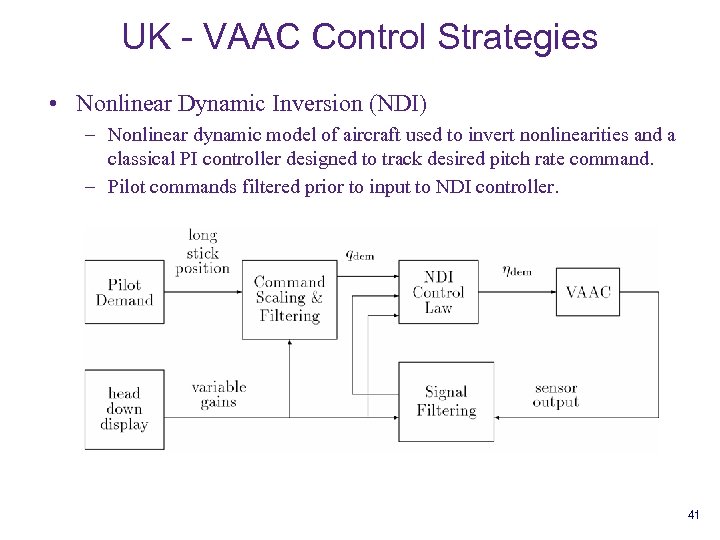 UK - VAAC Control Strategies • Nonlinear Dynamic Inversion (NDI) – Nonlinear dynamic model of aircraft used to invert nonlinearities and a classical PI controller designed to track desired pitch rate command. – Pilot commands filtered prior to input to NDI controller. 41
 UK - VAAC Control Strategies • H loop shaping – Multivariable linear controllers at 4 points: hover-to-forward flight. – Inner-loop pitch rate feedback used to reduce effect of pitch moment due to thrust changes. – Outer-loop 3 -input/3 -output, H loop shaping to control normal and forward acceleration and incidence. – Weight selection similar to classical loop-shaping. – Four linear point designs gain-scheduled throughout flight envelope. • Controller implemented in observer form. • Interpolated controller gains and interpolated controller outputs. – H loop shaping techniques also used to synthesize an integrated longitudinal/lateral flight and propulsions control system for VAAC. 42
 UK - VAAC Control Strategies • Linear, parameter-varying (LPV) controller –System dynamics written as LTI models whose state-space coefficients are a function of scheduling variable(s). –LPV H loop shaping uses LPV model of nonlinear aircraft dynamics to directly synthesize a scheduled LPV controller. –Successfully implemented at tested between 1995 and 1998. 43
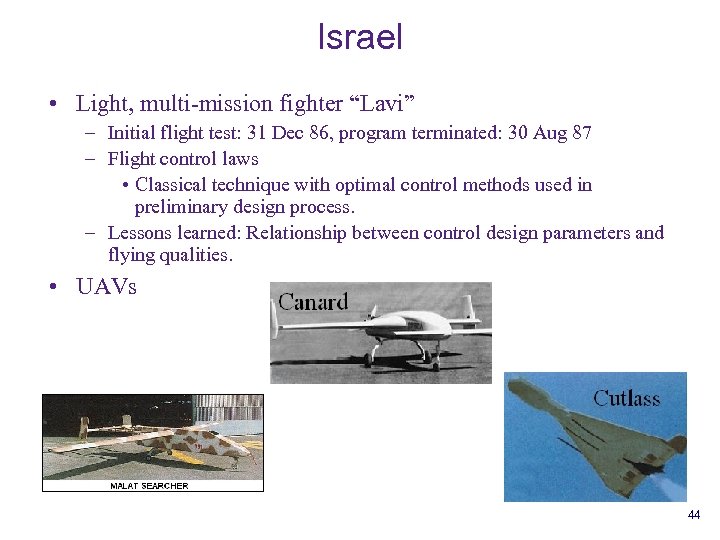 Israel • Light, multi-mission fighter “Lavi” – Initial flight test: 31 Dec 86, program terminated: 30 Aug 87 – Flight control laws • Classical technique with optimal control methods used in preliminary design process. – Lessons learned: Relationship between control design parameters and flying qualities. • UAVs 44
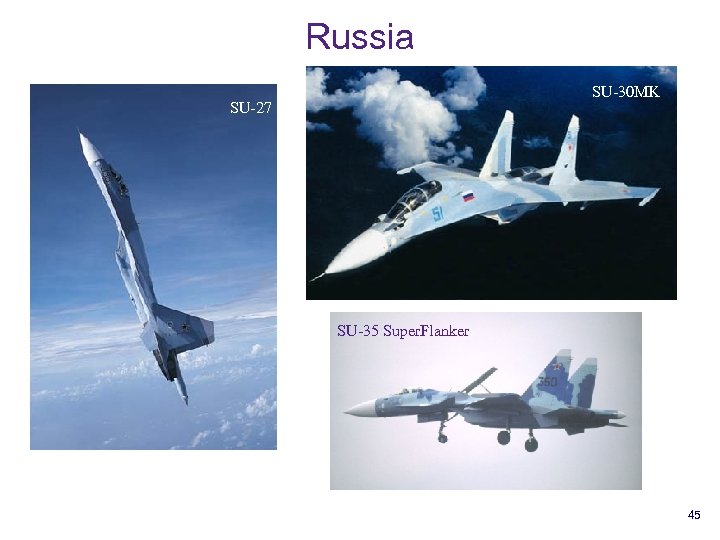 Russia SU-30 MK SU-27 SU-35 Super. Flanker 45
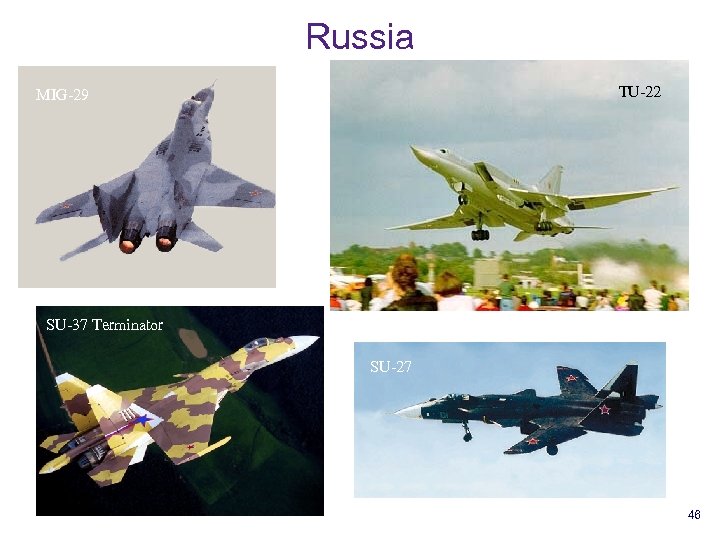 Russia TU-22 MIG-29 SU-37 Terminator SU-27 46
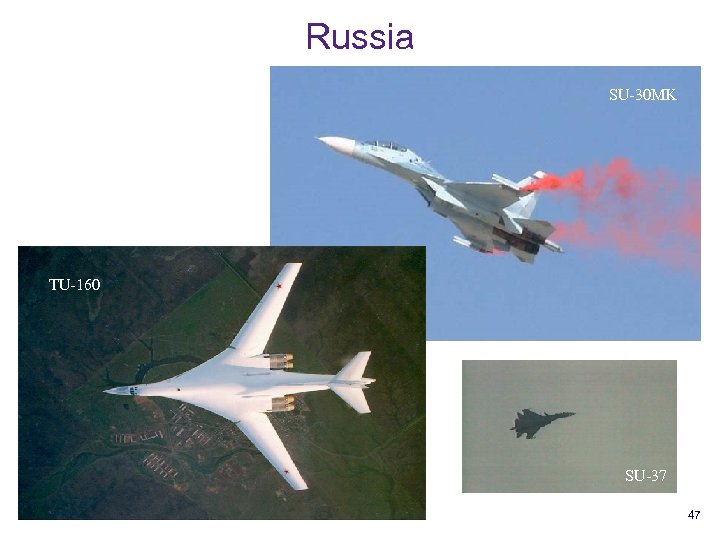 Russia SU-30 MK TU-160 SU-37 47
 Russia Extensive history of military/commercial aircraft development. • English language literature on Russian industry flight control design techniques is limited. Sukhoi 37 FBW flight controller • Quad redundant DFCS • Design requirements – Good handling qualities. – Optimal trimming. – Reconfigurable under flight control system failures to maximize control moments and trim configuration. • Adaptive controller designed to eliminate small amplitude self-induced oscillations due to actuator nonlinearities. 48
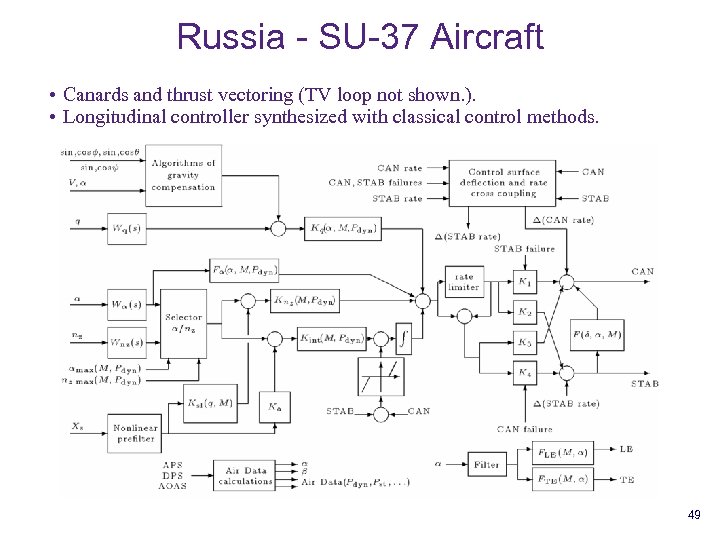 Russia - SU-37 Aircraft • Canards and thrust vectoring (TV loop not shown. ). • Longitudinal controller synthesized with classical control methods. 49
 United States of America (USA) Commerical • Boeing (Mc. Donnell Douglas) – B-717, B-737, B-747, B-757, B-767, B-777 • Honeywell Military • Lockheed Martin (General Dynamics) – F-16, F-22, F-35 (JSF) • Northrup Grumann – F-14, F-20, B-2 • Boeing (Mc. Donnell Douglas, North American Rockwell) – B-52, B-1 B, C-17 C-40 A, F/A-18, KC-10 • Honeywell 50
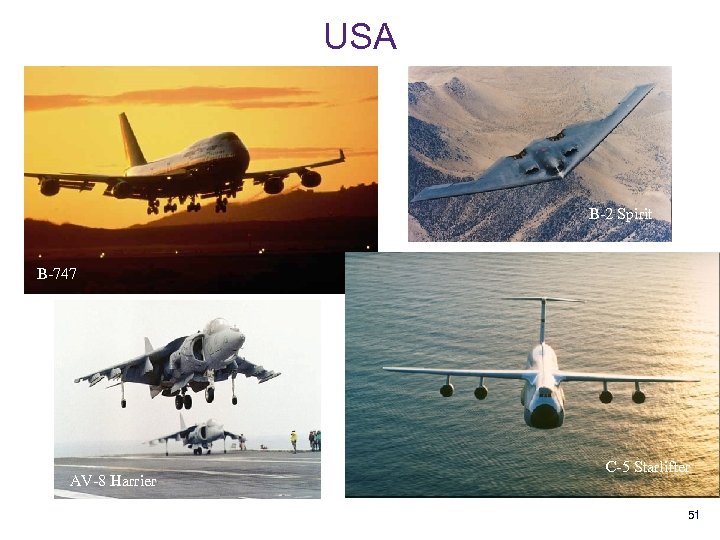 USA B-2 Spirit B-747 AV-8 Harrier C-5 Starlifter 51
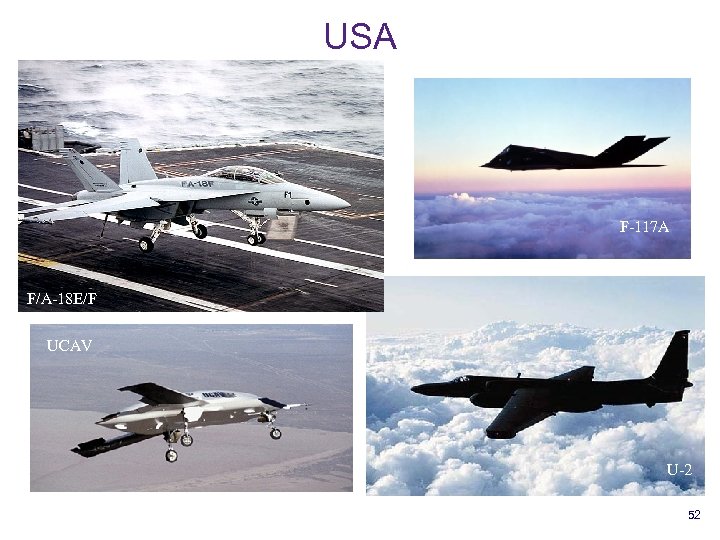 USA F-117 A F/A-18 E/F UCAV B-747 U-2 52
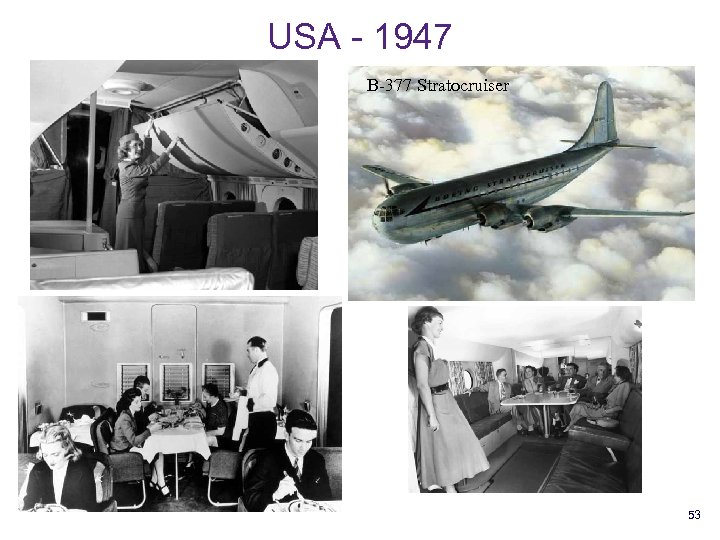 USA - 1947 B-377 Stratocruiser B-747 53
 USA Flight Control Specifications Multivariable Control • Multiple sensors, disturbances, objectives, surfaces (TV) with coupling. • Military specifications focus on SISO, loop-at-a-time analysis Multivariable Control Design Guidelines (1996) • • Honeywell Research Labs, Lockheed Ft. Worth, Lockheed Skunk Works Eigenstructure assignment, dynamic inversion, -synthesis F-177, YF-22 and MCT/F-16 Report provides a reference point for the US Air Force to evaluate the design of future flight control systems. 54
 Boeing The Boeing Company • Largest manufacturer of aircraft in the world. • Merger of Boeing, Rockwell International and Mc. Donnell Douglas – Variety of approaches to flight control design Multivariable Flight Control • First application in 1978 as part of a NASA research program. • Since 1980 s, multivariable control as been applied to a number of aircraft – Multivariable control with classical frequency-domain interpretations. – Guidelines to transform design requirements into math – Training of control engineers – User-friendly control software programs. 55
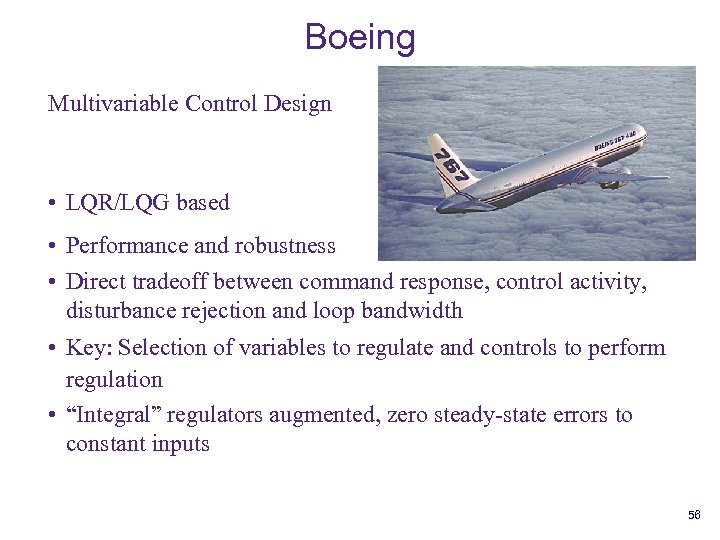 Boeing Multivariable Control Design • LQR/LQG based • Performance and robustness • Direct tradeoff between command response, control activity, disturbance rejection and loop bandwidth • Key: Selection of variables to regulate and controls to perform regulation • “Integral” regulators augmented, zero steady-state errors to constant inputs 56
 Boeing Integral LQR/LQG design procedure: • Select controls and regulated outputs: # controls = # regulated variables. – Check singular values and transmission zeros. • Attach integrators and set target zeros. • Select Q and R matrices for LQR problem. – Q and R selected based on command loop crossover frequencies. • Q ( R ) diagonal, qi (ri) adjusts bandwidth of command loop for yi (ui). – Check loop at input to integrator and actuator. – Note that the control loop crossover frequency is limited by the actuator capabilities and structural mode coupling. – Verify that the phase margins at higher frequencies are sufficient. • Feed-forward gains adjusted for flying qualities. 57
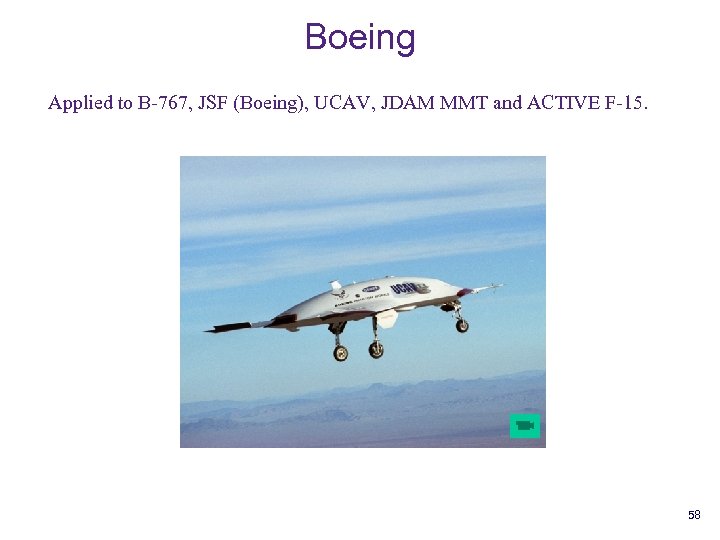 Boeing Applied to B-767, JSF (Boeing), UCAV, JDAM MMT and ACTIVE F-15. 58
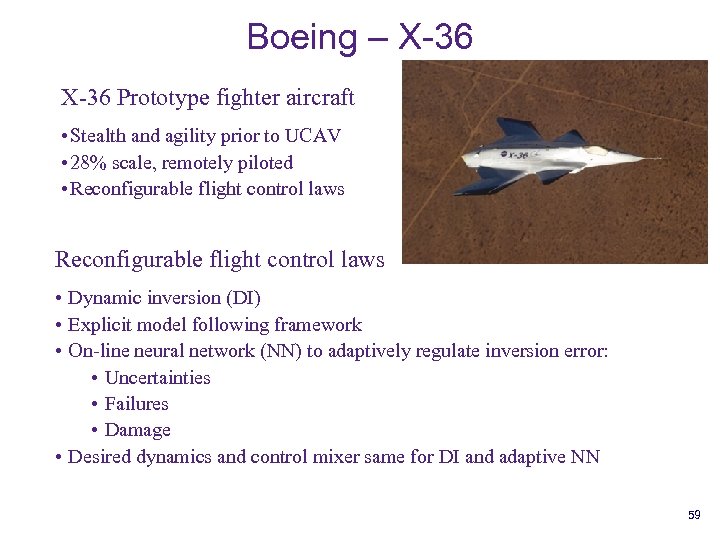 Boeing – X-36 Prototype fighter aircraft • Stealth and agility prior to UCAV • 28% scale, remotely piloted • Reconfigurable flight control laws • Dynamic inversion (DI) • Explicit model following framework • On-line neural network (NN) to adaptively regulate inversion error: • Uncertainties • Failures • Damage B-747 • Desired dynamics and control mixer same for DI and adaptive NN 59
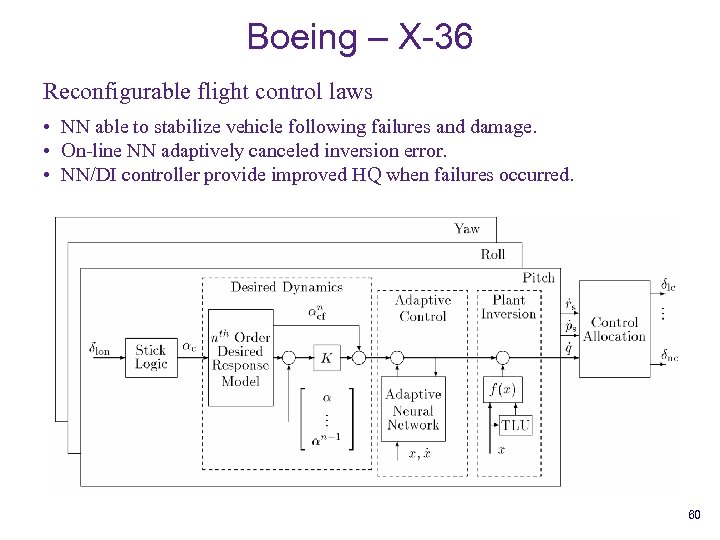 Boeing – X-36 Reconfigurable flight control laws • NN able to stabilize vehicle following failures and damage. • On-line NN adaptively canceled inversion error. • NN/DI controller provide improved HQ when failures occurred. B-747 60
 Honeywell Research Center (Honeywell Labs) • Significant contribution to areas of robust control and dynamic inversion. • Approach to NDI is MACH (Multi-Application Control). • MACH is a modular, nonlinear multivariable design approach. – Blends classical control design with inversion. • Outer-loop controllers: Proportional or PI. • Inner-loop controllers: Dynamic Inversion. 61
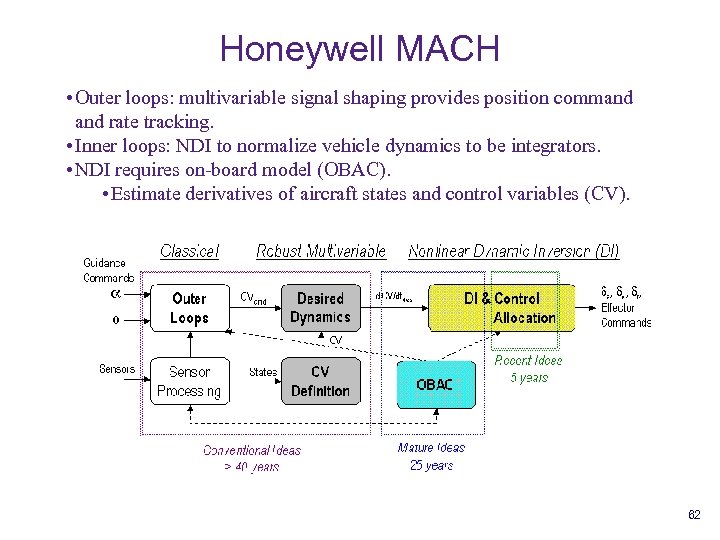 Honeywell MACH • Outer loops: multivariable signal shaping provides position command rate tracking. • Inner loops: NDI to normalize vehicle dynamics to be integrators. • NDI requires on-board model (OBAC). • Estimate derivatives of aircraft states and control variables (CV). B-747 62
 Honeywell MACH Five components of MACH: 1. Select controlled variables (CV) for performance/robustness. 2. Outer-loops convert pilot/guidance commands into CV commands. • Nonlinear elements such as limiters. 3. Desired dynamics define dynamic behaviour the CVs should follow while tracking their commands. 4. NDI attempts to solve the equations of motion for actuator commands to satisfy CV desired rate of change. • Control allocation logic may be necessary. 5. OBAC computes nonlinear vehicle dynamics for inversion. • Least-squares used to approximate aerodynamic B-747 data. 63
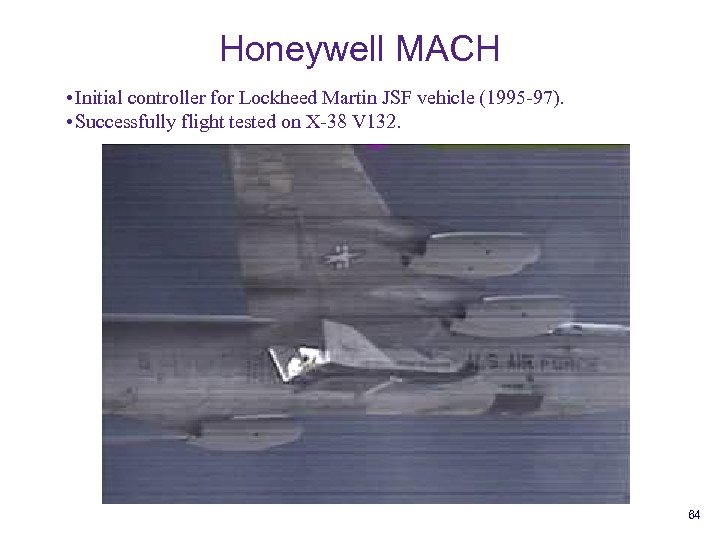 Honeywell MACH • Initial controller for Lockheed Martin JSF vehicle (1995 -97). • Successfully flight tested on X-38 V 132. B-747 64
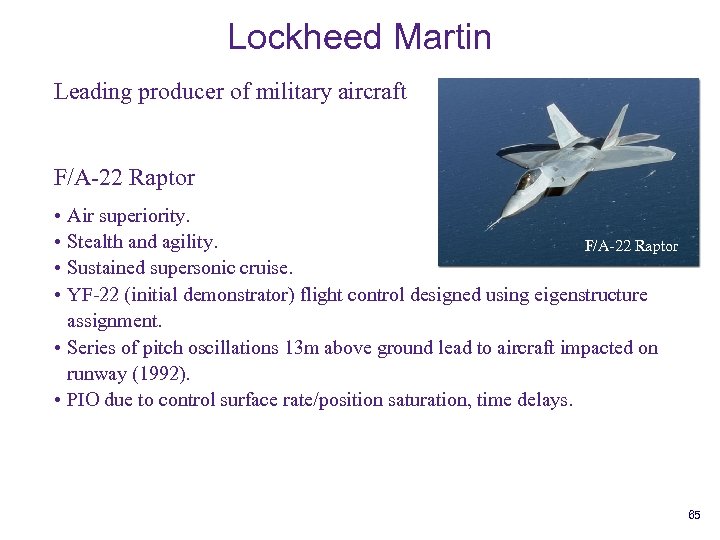 Lockheed Martin • Leading producer JSF F-35 of military aircraft F/A-22 Raptor • Air superiority. • Stealth and agility. F/A-22 Raptor • Sustained supersonic cruise. • YF-22 (initial demonstrator) flight control designed using eigenstructure assignment. • Series of pitch oscillations 13 m above ground lead to aircraft impacted on runway (1992). • PIO due to control surface rate/position saturation, time delays. 65
 Lockheed Martin - F/A-22 • F/A-22 flight JSF F-35 control law redesign • Excellent flying qualities and lessons learned. • Classical control combined with eigenstructure assignment. • Removal of pitch integrator key to redesign. • Addition of first order pitch stick command pre-filter needed to recover flying qualities requirements. • Classical tradeoff between pitch attitude and flight path angle bandwidth. • Redesigned flight control law successfully achieved Level I handling qualities for all closed-loop tracking tasks. 66
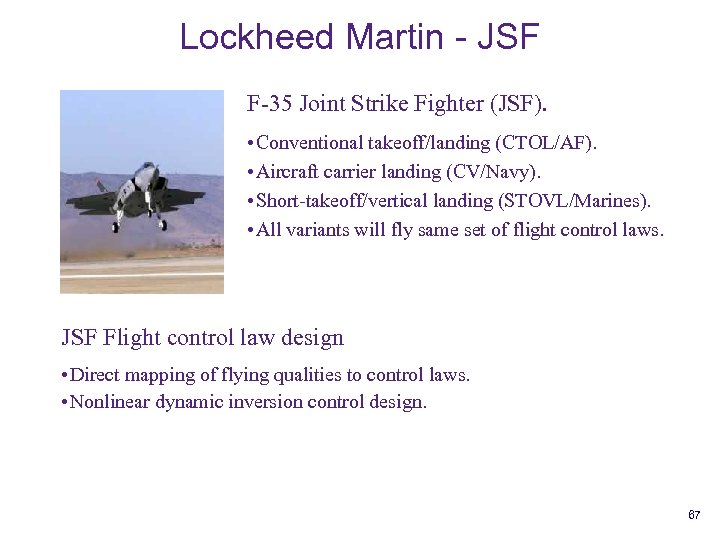 Lockheed Martin - JSF • JSF F-35 Joint Strike Fighter (JSF). • Conventional takeoff/landing (CTOL/AF). • Aircraft carrier landing (CV/Navy). • Short-takeoff/vertical landing (STOVL/Marines). • All variants will fly same set of flight control laws. JSF Flight control law design • Direct mapping of flying qualities to control laws. • Nonlinear dynamic inversion control design. 67
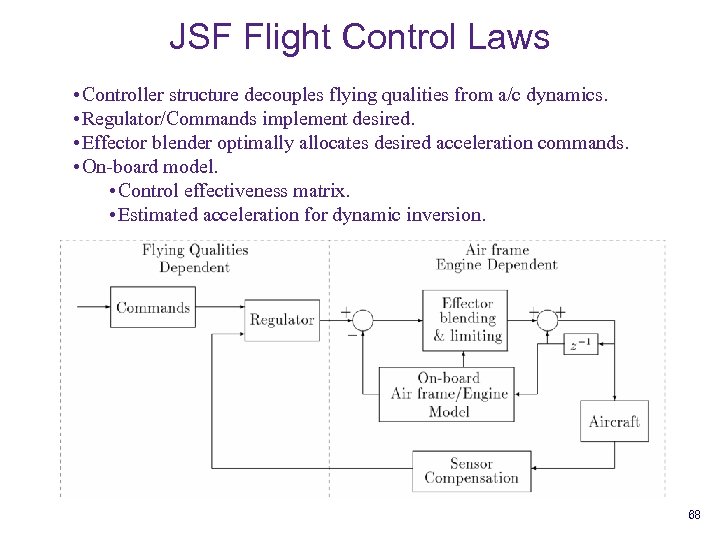 JSF Flight Control Laws • Controller structure decouples flying qualities from a/c dynamics. • Regulator/Commands implement desired. • Effector blender optimally allocates desired acceleration commands. • On-board model. • Control effectiveness matrix. • Estimated acceleration for dynamic inversion. B-747 68
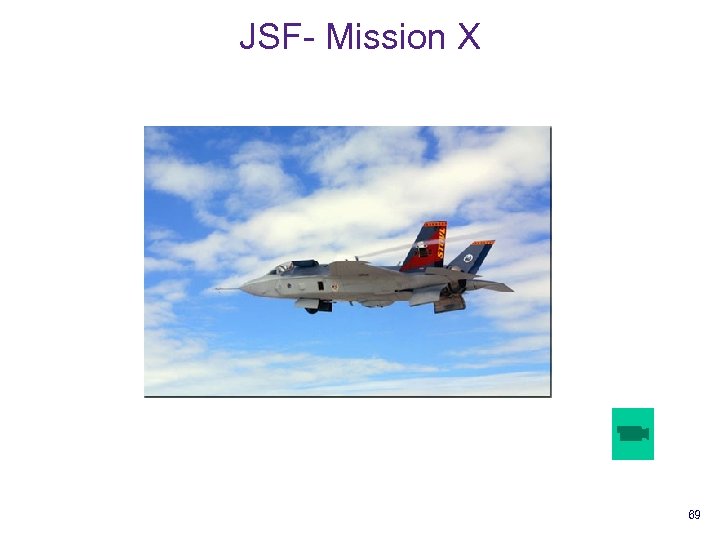 JSF- Mission X 69
 Summary • Use of multivariable control techniques to design the flight control laws for new aircraft is standard. • Dynamic inversion is the most widely applied multivariable control design technique in the aircraft industry. • Dramatic change from 15 years ago when almost all flight control laws for aircraft were designed using classical control techniques. 70
 Acknowledgments Rick Hyde Kevin Wise Dale Enns Chris Fielding Dagfin Gangass George Papageorgiou Krister Fersan Prof. Fred Culick Martin Hanel Ralph Paul Dominique Briére Frank Thielecke Greg Walker Prof. Alexander Efremov David Bodden This work was funded in part by the NASA Langley Cooperative Agreement # NCC-1 -337, Dr. Celeste Belcastro Program Manager, Dr. Christine Belcastro, Technical Monitor. 71