 Скачать презентацию 2001 University of Tokyo CUBESAT Project University of
14c96f9eb32362df265c5284f796a4e5.ppt
- Количество слайдов: 128



2001 University of Tokyo CUBESAT Project University of Tokyo Cube. Sat Project CRITICAL DESIGN REVIEW April, 6, 2001 Intelligent Space Systems Laboratory University of Tokyo
2001 University of Tokyo CUBESAT Project ■Contents • Project Overview –Cube. Sat program, Organization, Management, Schedule • Mission Overview –Design Assumption, Mission Objective, Mission Profile, Success Level • System Design –Design Strategy & Concepts • Subsystem Details –Electronics, Power, Communication, Structure, Environment, Ground Segment • Concerns
2001 University of Tokyo CUBESAT Project Overview
2001 University of Tokyo CUBESAT Project ■Cube. Sat Program ・Proposed in University Space Systems Symposium. (Nov. 1998, Hawaii) ・International educational program to improve students’ skill of space engineering and project management. ・Quick and low cost development policy. ・ 10 cm cubic satellite weighing less than 1 kg.
2001 University of Tokyo CUBESAT Project ■Project Constraints ・ 10 cm cubic shape, weight less than 1 kg. ・Installed in the carrier called “P-POD”, developed by Cal. Poly. ・P-POD is to be installed in MPA (Multiple Payload Adopter), developed by One Stop Satellite Solutions Inc. ・Launched by Russian rocket “Dnepr” from Baikonur in November, 2001. ・Orbit 600 -800 km circular, 60 degree inclination ・HAM band operation
2001 University of Tokyo CUBESAT Project ■Cube. Sat Developers ・California Polytechnic State U ・Dartmouth College ・Florida Space Institute ・Leland High School ・Montana State University ・Stanford University ・Stellar Innovations ・Taylor University ・Tokyo Institute of Technology ・University of Arizona ・University of Tokyo ・Wilcox High School
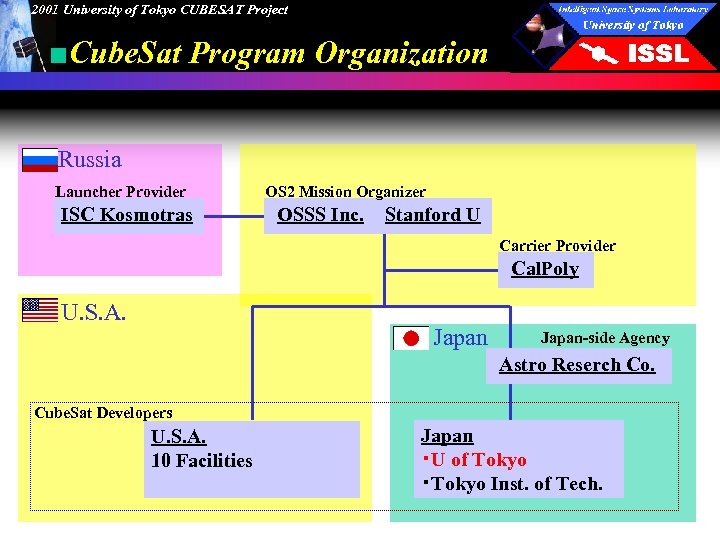
2001 University of Tokyo CUBESAT Project ■Cube. Sat Program Organization Russia Launcher Provider ISC Kosmotras OS 2 Mission Organizer OSSS Inc. Stanford U Carrier Provider Cal. Poly U. S. A. Japan-side Agency Astro Reserch Co. Cube. Sat Developers U. S. A. 10 Facilities Japan ・U of Tokyo ・Tokyo Inst. of Tech.
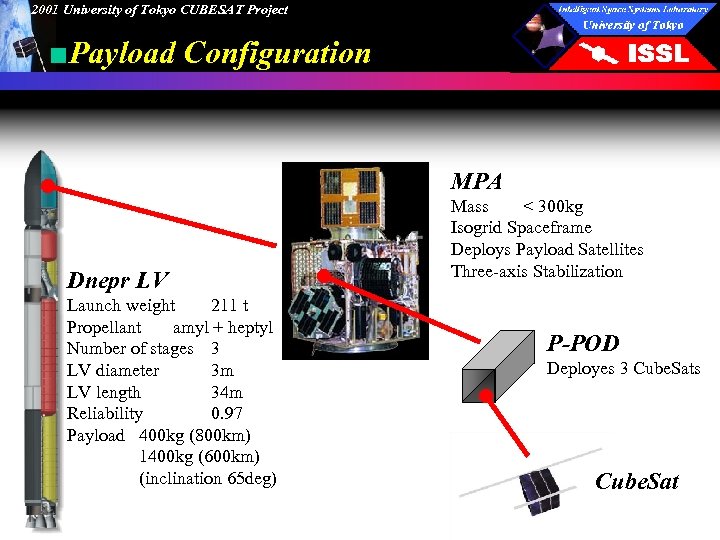
2001 University of Tokyo CUBESAT Project ■Payload Configuration MPA Dnepr LV Launch weight 211 t Propellant amyl + heptyl Number of stages 3 LV diameter 3 m LV length 34 m Reliability 0. 97 Payload 400 kg (800 km) 1400 kg (600 km) (inclination 65 deg) Mass < 300 kg Isogrid Spaceframe Deploys Payload Satellites Three-axis Stabilization P-POD Deployes 3 Cube. Sats Cube. Sat
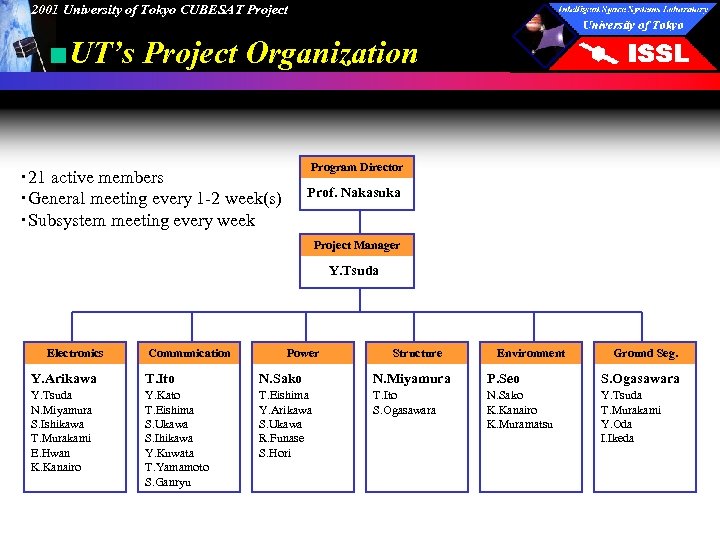
2001 University of Tokyo CUBESAT Project ■UT’s Project Organization Program Director ・ 21 active members ・General meeting every 1 -2 week(s) ・Subsystem meeting every week Prof. Nakasuka Project Manager Y. Tsuda Electronics Communication Power Structure Environment Ground Seg. Y. Arikawa T. Ito N. Sako N. Miyamura P. Seo S. Ogasawara Y. Tsuda N. Miyamura S. Ishikawa T. Murakami E. Hwan K. Kanairo Y. Kato T. Eishima S. Ukawa S. Ihikawa Y. Kuwata T. Yamamoto S. Ganryu T. Eishima Y. Arikawa S. Ukawa R. Funase S. Hori T. Ito S. Ogasawara N. Sako K. Kanairo K. Muramatsu Y. Tsuda T. Murakami Y. Oda I. Ikeda
![2001 University of Tokyo CUBESAT Project ■Development Milestone Development code : XI [sai] (X-factor](https://present5.com/presentation/14c96f9eb32362df265c5284f796a4e5/image-10.jpg "2001 University of Tokyo CUBESAT Project ■Development Milestone Development code : XI [sai] (X-factor")
2001 University of Tokyo CUBESAT Project ■Development Milestone Development code : XI [sai] (X-factor Investigator) XI-II ・Basic functional check ・Technological demonstration for USSS conference ・Bread board model ・Validation of all technology to be used Communication test model, Mass model, CDR XI-III ・Engineering model ・Served to the integration & environmental testing ・Flight model & back up model XI-IV, V ・One for flight, the other for operation practice etc.
2001 University of Tokyo CUBESAT Project Mission Overview
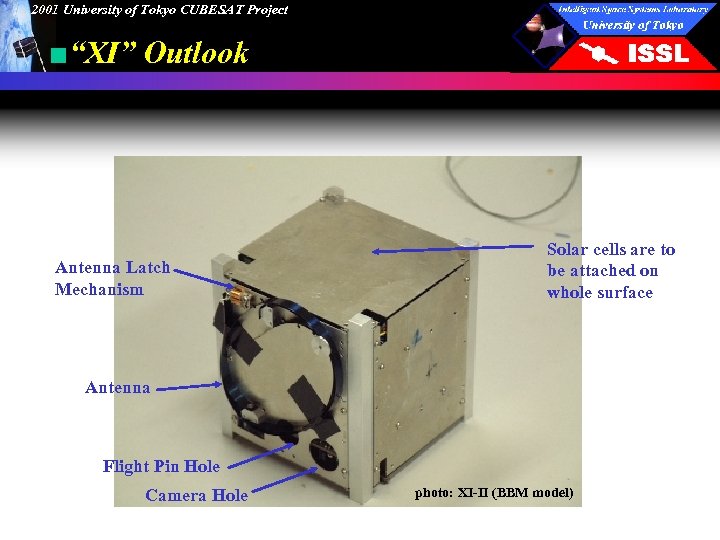
2001 University of Tokyo CUBESAT Project ■“XI” Outlook Antenna Latch Mechanism Solar cells are to be attached on whole surface Antenna Flight Pin Hole Camera Hole photo: XI-II (BBM model)
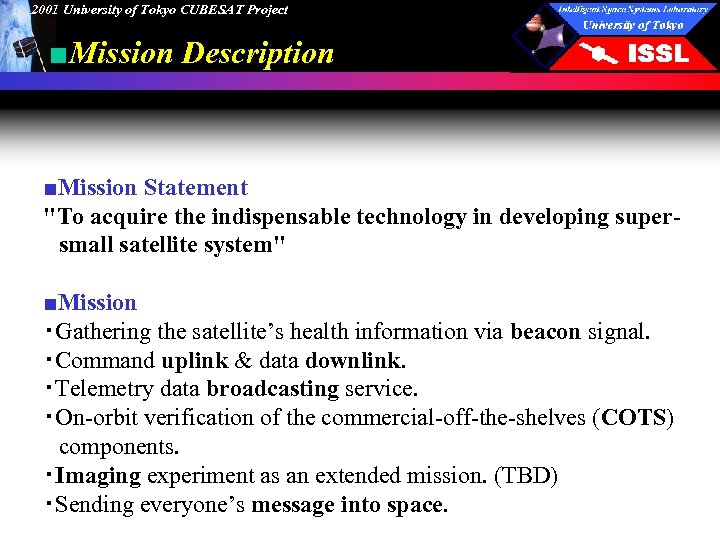
2001 University of Tokyo CUBESAT Project ■Mission Description ■Mission Statement "To acquire the indispensable technology in developing supersmall satellite system" ■Mission ・Gathering the satellite’s health information via beacon signal. ・Command uplink & data downlink. ・Telemetry data broadcasting service. ・On-orbit verification of the commercial-off-the-shelves (COTS) components. ・Imaging experiment as an extended mission. (TBD) ・Sending everyone’s message into space.
2001 University of Tokyo CUBESAT Project ■Success Level (1) ■Project’s Minimum Success --- Acquiring the important technology and knowledge through designing and fabricating the spacecraft. ・Establishing overall work flow of the satellite development project. ・Establishing a methodology of spacecraft design. ・Raising the fabrication technique. ・Conducting several kind of testing and feeding back its results to the design. ・Keeping the project progressing smoothly so as to bring it to be the launchable condition. ■Mission Success --- Receiving signals from the spacecraft. ・Surviving in the actual launch environment. ・Successfully verifying the function of the communication system. ・Gathering house keeping data.
2001 University of Tokyo CUBESAT Project ■Success Level (2) ■Full Success --- Succeeding in uplink & downlink. ・Successfully commanding the spacecraft by uplink. ・Getting downlink data as a reaction to the command uplink. ■Advanced Success --- Successfully verifying the function of the advanced mission components. ・Verifying that sensors planned to be equipped as advanced mission components should work normally.
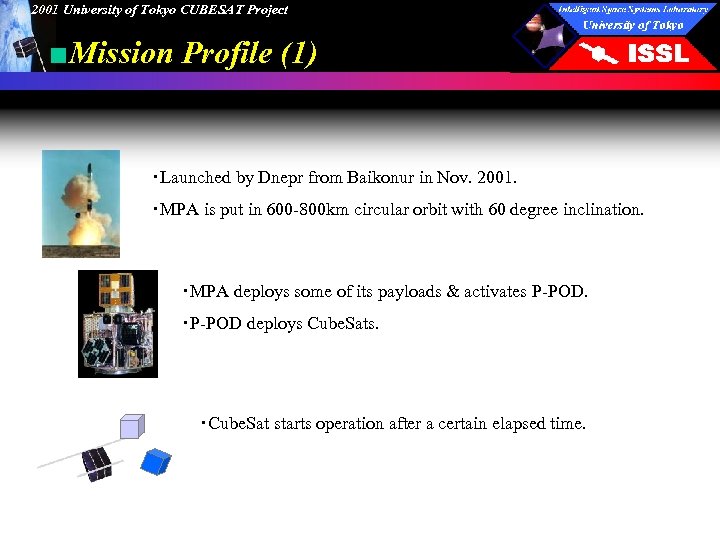
2001 University of Tokyo CUBESAT Project ■Mission Profile (1) ・Launched by Dnepr from Baikonur in Nov. 2001. ・MPA is put in 600 -800 km circular orbit with 60 degree inclination. ・MPA deploys some of its payloads & activates P-POD. ・P-POD deploys Cube. Sats. ・Cube. Sat starts operation after a certain elapsed time.
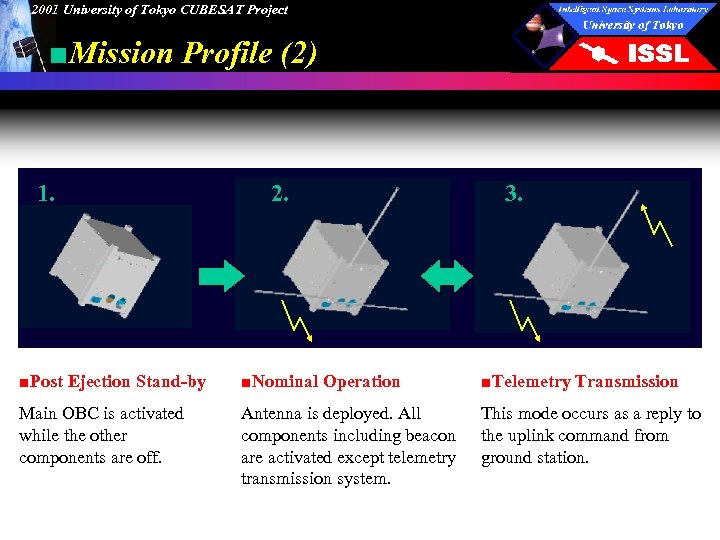
2001 University of Tokyo CUBESAT Project ■Mission Profile (2) 1. 2. 3. ■Post Ejection Stand-by ■Nominal Operation ■Telemetry Transmission Main OBC is activated while the other components are off. Antenna is deployed. All components including beacon are activated except telemetry transmission system. This mode occurs as a reply to the uplink command from ground station.
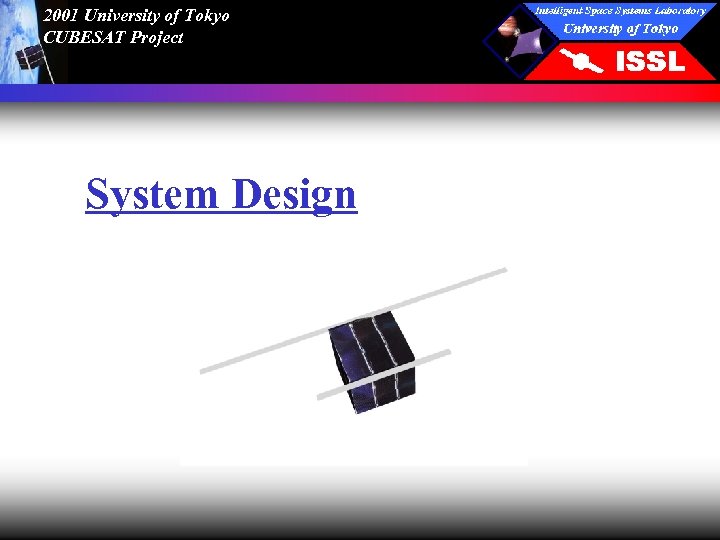
2001 University of Tokyo CUBESAT Project System Design
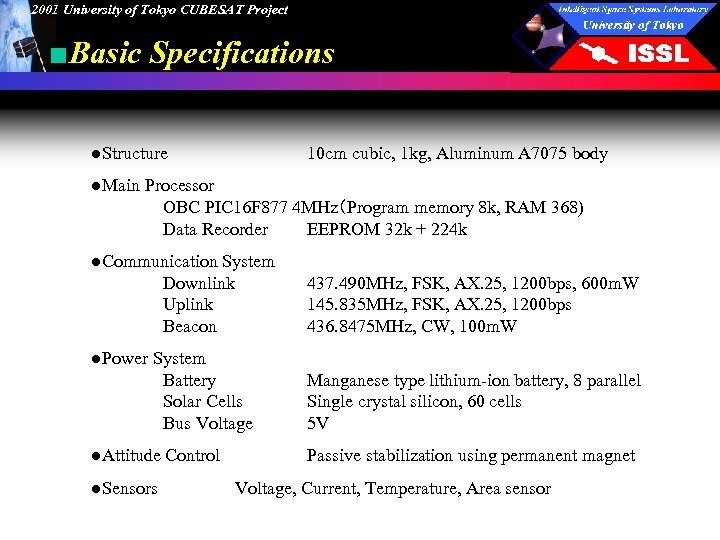
2001 University of Tokyo CUBESAT Project ■Basic Specifications ●Structure 10 cm cubic, 1 kg, Aluminum A 7075 body ●Main Processor OBC PIC 16 F 877 4 MHz(Program memory 8 k, RAM 368) Data Recorder EEPROM 32 k + 224 k ●Communication System Downlink Uplink Beacon 437. 490 MHz, FSK, AX. 25, 1200 bps, 600 m. W 145. 835 MHz, FSK, AX. 25, 1200 bps 436. 8475 MHz, CW, 100 m. W ●Power System Battery Solar Cells Bus Voltage Manganese type lithium-ion battery, 8 parallel Single crystal silicon, 60 cells 5 V ●Attitude Control Passive stabilization using permanent magnet ●Sensors Voltage, Current, Temperature, Area sensor
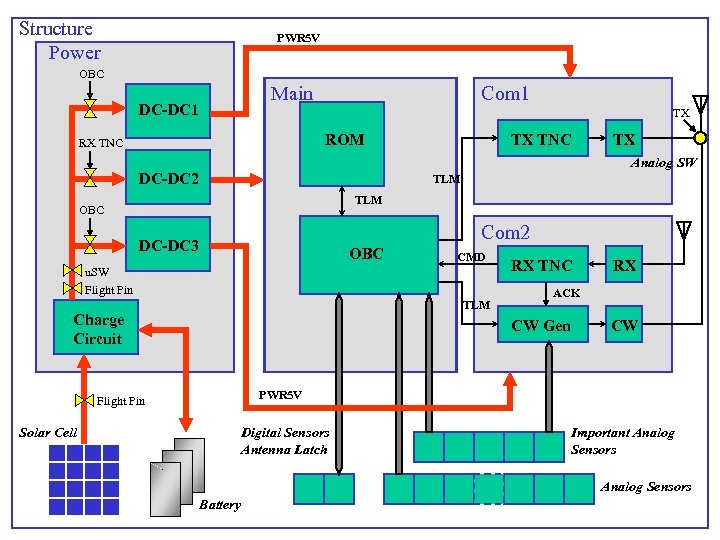
Structure Power PWR 5 V OBC Main DC-DC 1 Com 1 TX ROM RX TNC TX Analog SW DC-DC 2 TLM OBC Com 2 DC-DC 3 OBC CMD u. SW Flight Pin TLM Charge Circuit RX TNC RX ACK CW Gen CW PWR 5 V Flight Pin Solar Cell Digital Sensors Antenna Latch Important Analog Sensors Battery
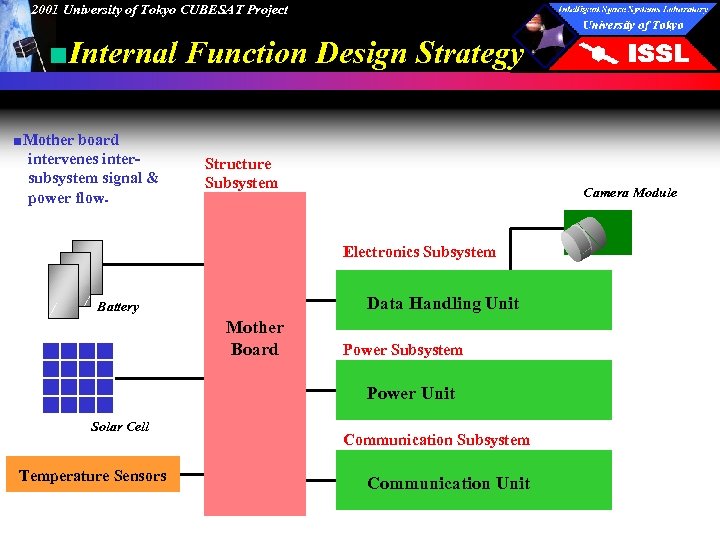
2001 University of Tokyo CUBESAT Project ■Internal Function Design Strategy ■Mother board intervenes intersubsystem signal & power flow. Structure Subsystem Camera Module Electronics Subsystem Data Handling Unit Battery Mother Board Power Subsystem Power Unit Solar Cell Temperature Sensors Communication Subsystem Communication Unit
2001 University of Tokyo CUBESAT Project Structure Subsystem
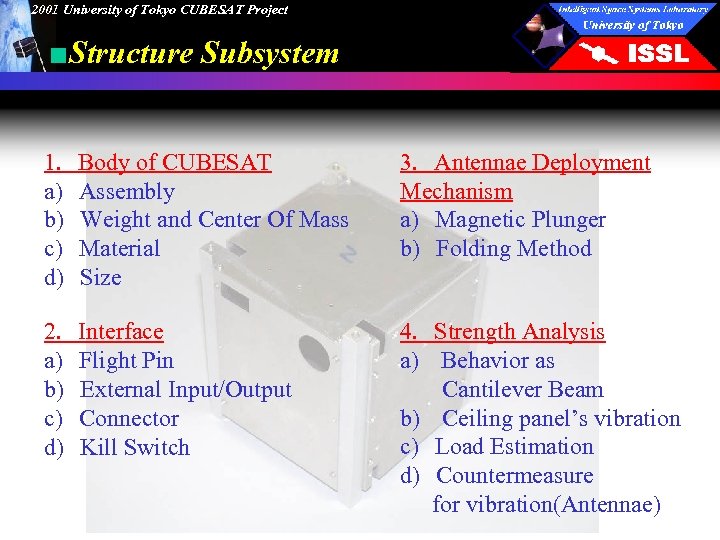
2001 University of Tokyo CUBESAT Project ■Structure Subsystem 1. Body of CUBESAT a) Assembly b) Weight and Center Of Mass c) Material d) Size 3. Antennae Deployment Mechanism a) Magnetic Plunger b) Folding Method 2. Interface a) Flight Pin b) External Input/Output c) Connector d) Kill Switch 4. Strength Analysis a) Behavior as Cantilever Beam b) Ceiling panel’s vibration c) Load Estimation d) Countermeasure for vibration(Antennae)
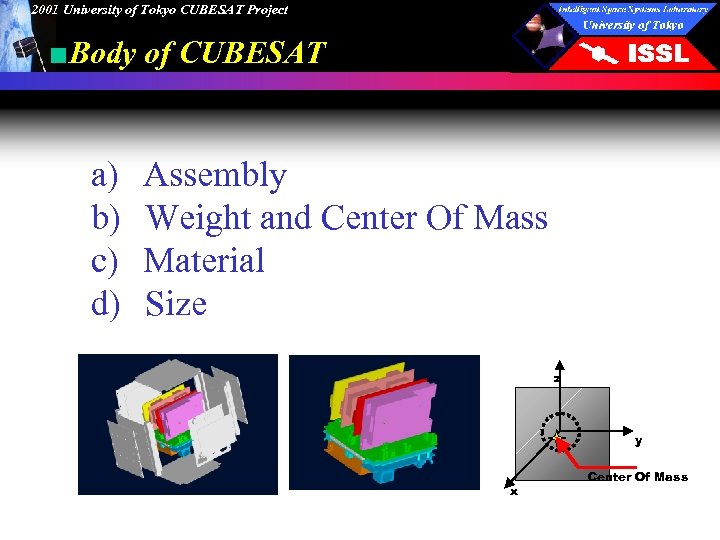
2001 University of Tokyo CUBESAT Project ■Body of CUBESAT a) Assembly b) Weight and Center Of Mass c) Material d) Size z y x Center Of Mass
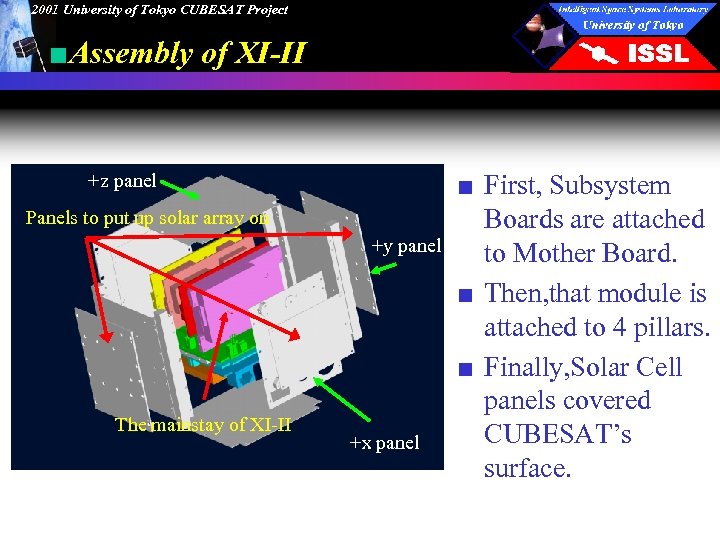
2001 University of Tokyo CUBESAT Project ■Assembly of XI-II +z panel Panels to put up solar array on +y panel The mainstay of XI-II +x panel ■ First, Subsystem Boards are attached to Mother Board. ■ Then, that module is attached to 4 pillars. ■ Finally, Solar Cell panels covered CUBESAT’s surface.
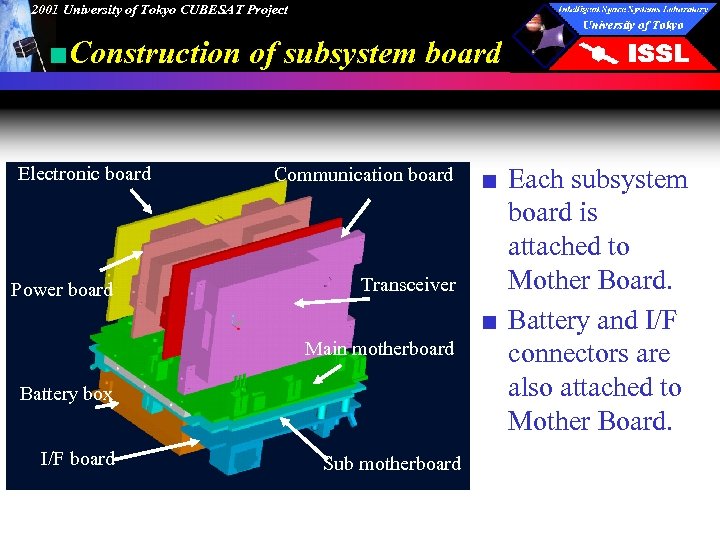
2001 University of Tokyo CUBESAT Project ■Construction of subsystem board Electronic board Power board Communication board Transceiver Main motherboard Battery box I/F board Sub motherboard ■ Each subsystem board is attached to Mother Board. ■ Battery and I/F connectors are also attached to Mother Board.
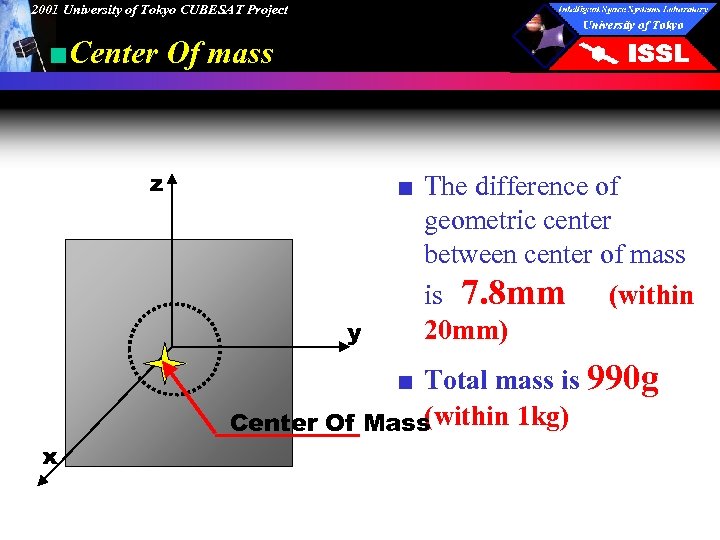
2001 University of Tokyo CUBESAT Project ■Center Of mass z y x ■ The difference of geometric center between center of mass is 7. 8 mm (within 20 mm) ■ Total mass is 990 g (within 1 kg) Center Of Mass
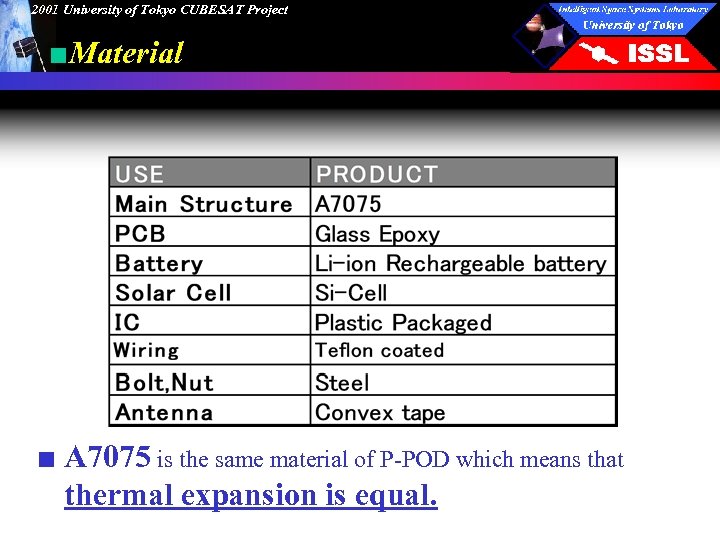
2001 University of Tokyo CUBESAT Project ■Material ■ A 7075 is the same material of P-POD which means that thermal expansion is equal.
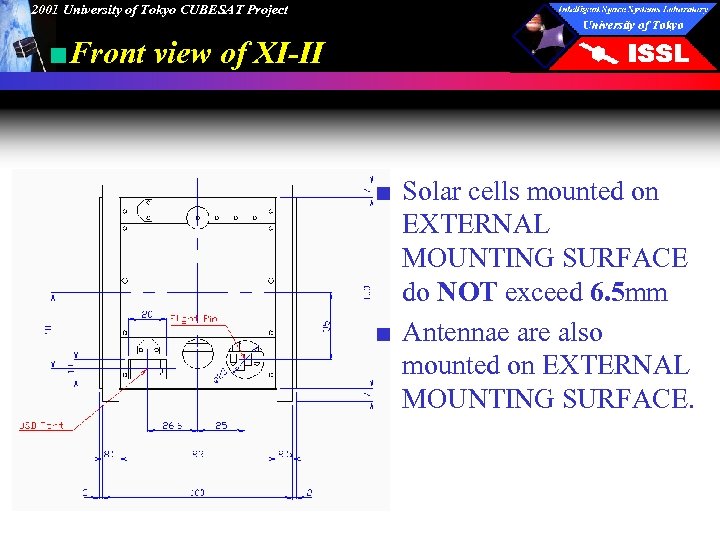
2001 University of Tokyo CUBESAT Project ■Front view of XI-II ■ Solar cells mounted on EXTERNAL MOUNTING SURFACE do NOT exceed 6. 5 mm ■ Antennae are also mounted on EXTERNAL MOUNTING SURFACE.
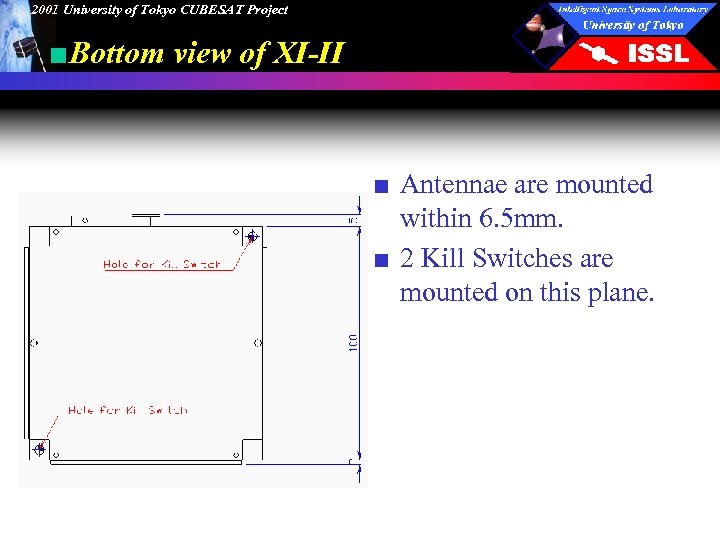
2001 University of Tokyo CUBESAT Project ■Bottom view of XI-II ■ Antennae are mounted within 6. 5 mm. ■ 2 Kill Switches are mounted on this plane.
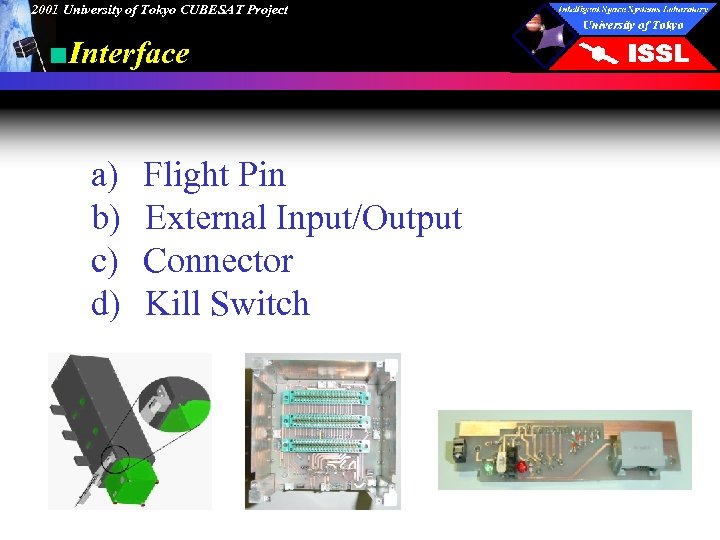
2001 University of Tokyo CUBESAT Project ■Interface a) Flight Pin b) External Input/Output c) Connector d) Kill Switch
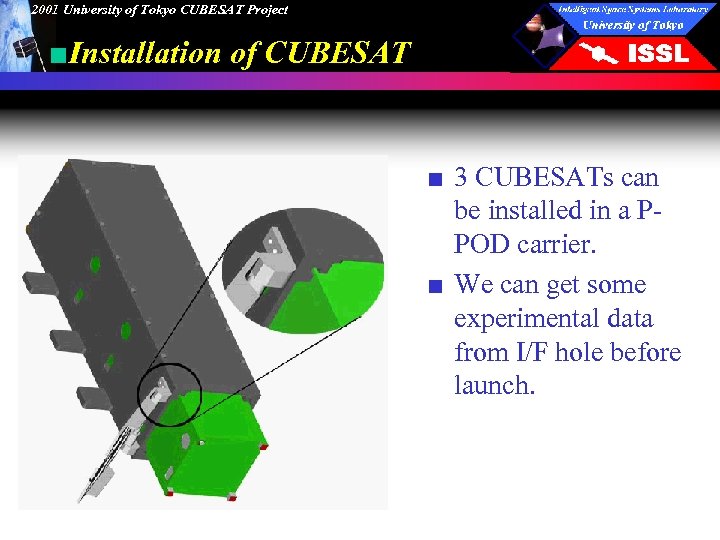
2001 University of Tokyo CUBESAT Project ■Installation of CUBESAT ■ 3 CUBESATs can be installed in a PPOD carrier. ■ We can get some experimental data from I/F hole before launch.
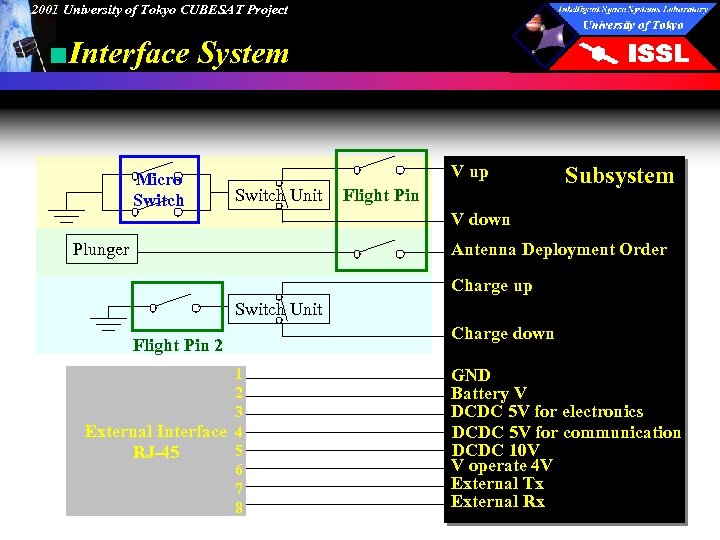
2001 University of Tokyo CUBESAT Project ■Interface System Micro Switch V up Switch Unit Flight Pin Subsystem V down Plunger Antenna Deployment Order Charge up Switch Unit Flight Pin 2 1 2 3 External Interface 4 5 RJ-45 6 7 8 Charge down GND Battery V DCDC 5 V for electronics DCDC 5 V for communication DCDC 10 V V operate 4 V External Tx External Rx
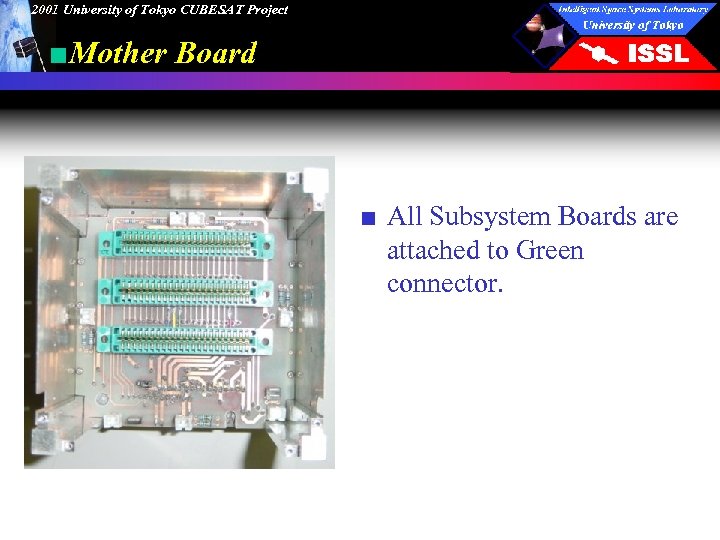
2001 University of Tokyo CUBESAT Project ■Mother Board ■ All Subsystem Boards are attached to Green connector.
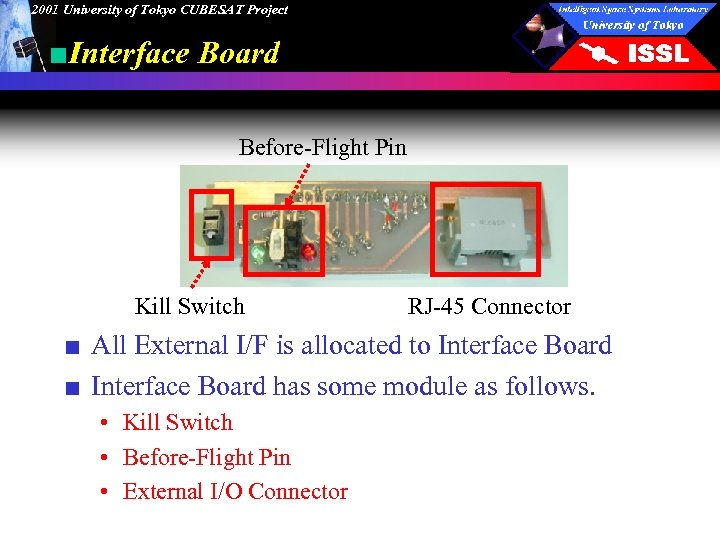
2001 University of Tokyo CUBESAT Project ■Interface Board Before-Flight Pin Kill Switch RJ-45 Connector ■ All External I/F is allocated to Interface Board ■ Interface Board has some module as follows. • Kill Switch • Before-Flight Pin • External I/O Connector
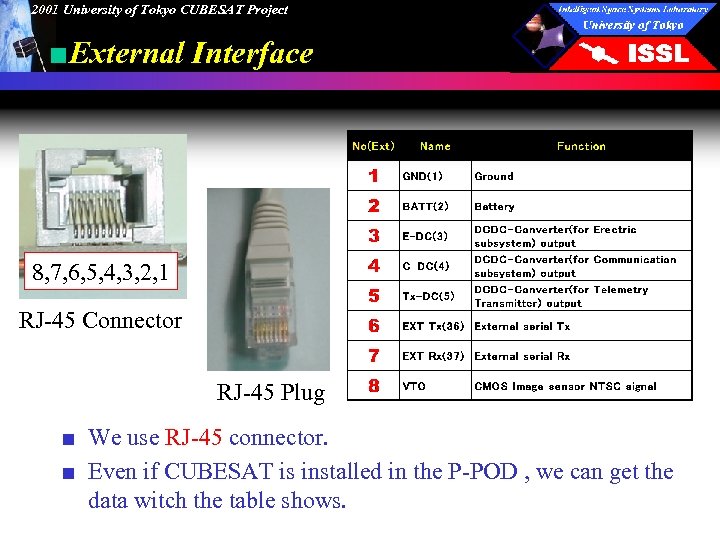
2001 University of Tokyo CUBESAT Project ■External Interface 8, 7, 6, 5, 4, 3, 2, 1 RJ-45 Connector RJ-45 Plug ■ We use RJ-45 connector. ■ Even if CUBESAT is installed in the P-POD , we can get the data witch the table shows.
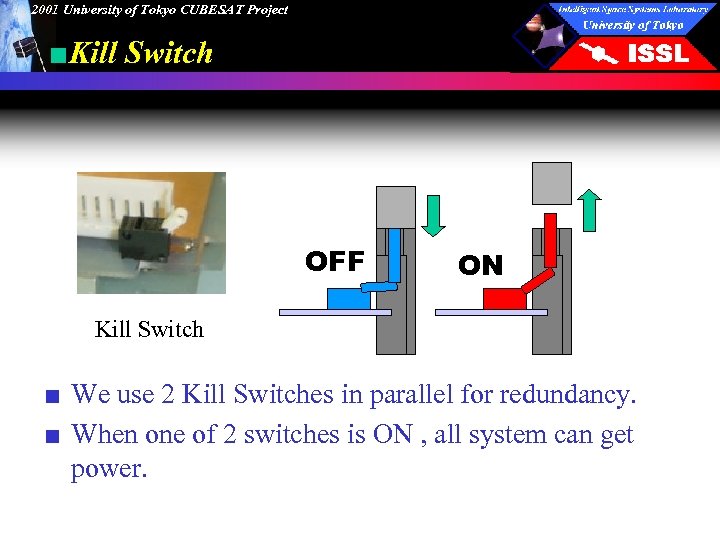
2001 University of Tokyo CUBESAT Project ■Kill Switch OFF ON Kill Switch ■ We use 2 Kill Switches in parallel for redundancy. ■ When one of 2 switches is ON , all system can get power.
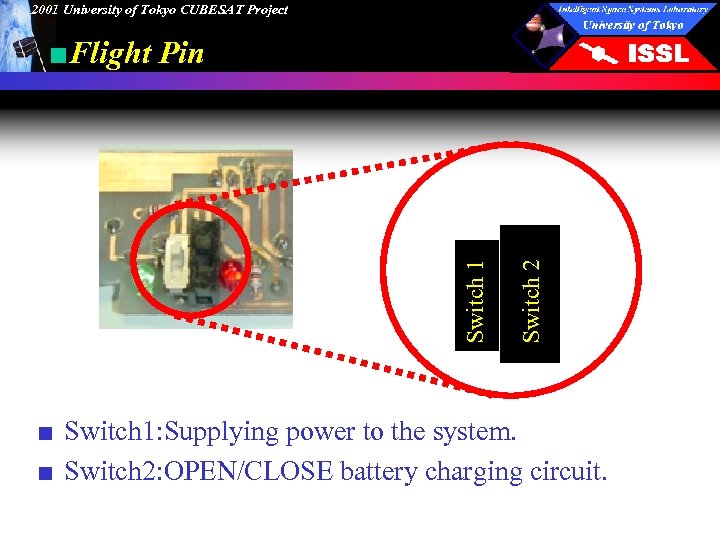
2001 University of Tokyo CUBESAT Project Switch 2 Switch 1 ■Flight Pin ■ Switch 1: Supplying power to the system. ■ Switch 2: OPEN/CLOSE battery charging circuit.
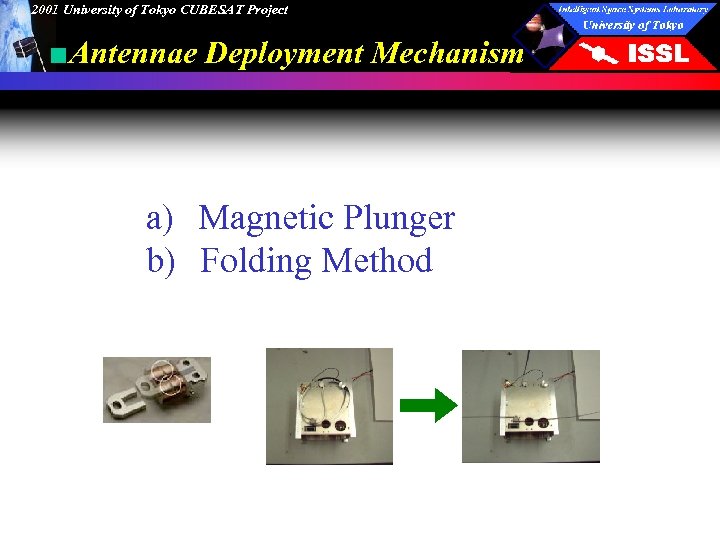
2001 University of Tokyo CUBESAT Project ■Antennae Deployment Mechanism a) Magnetic Plunger b) Folding Method
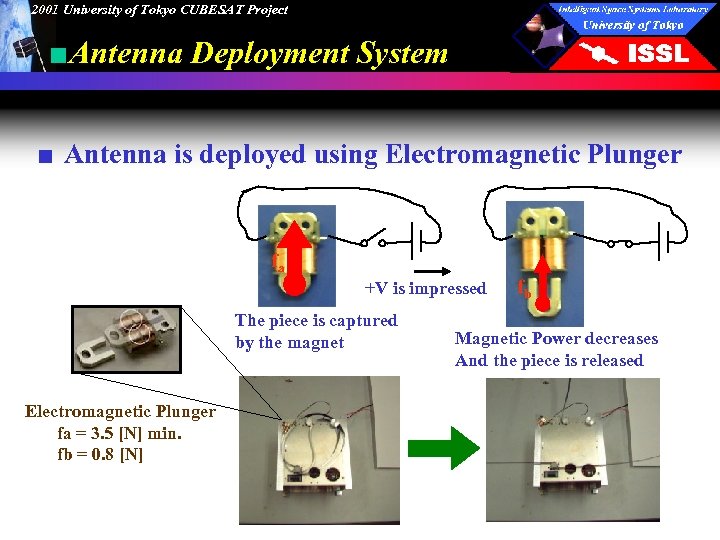
2001 University of Tokyo CUBESAT Project ■Antenna Deployment System ■ Antenna is deployed using Electromagnetic Plunger fa +V is impressed The piece is captured by the magnet Electromagnetic Plunger fa = 3. 5 [N] min. fb = 0. 8 [N] fb Magnetic Power decreases And the piece is released
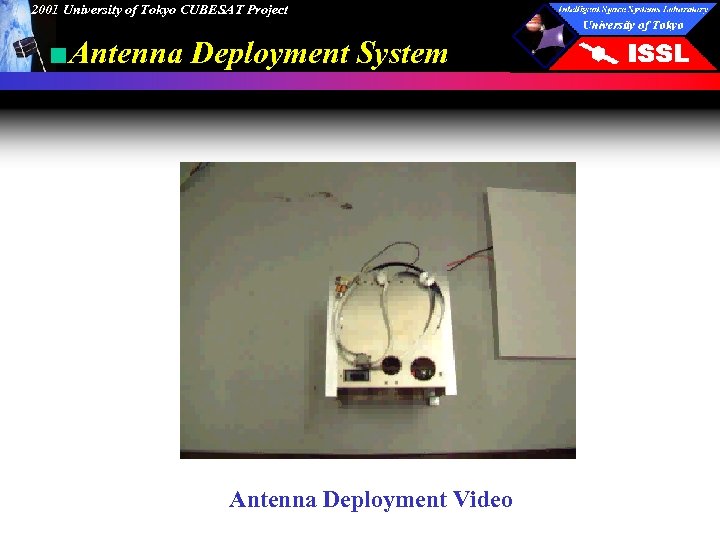
2001 University of Tokyo CUBESAT Project ■Antenna Deployment System Antenna Deployment Video
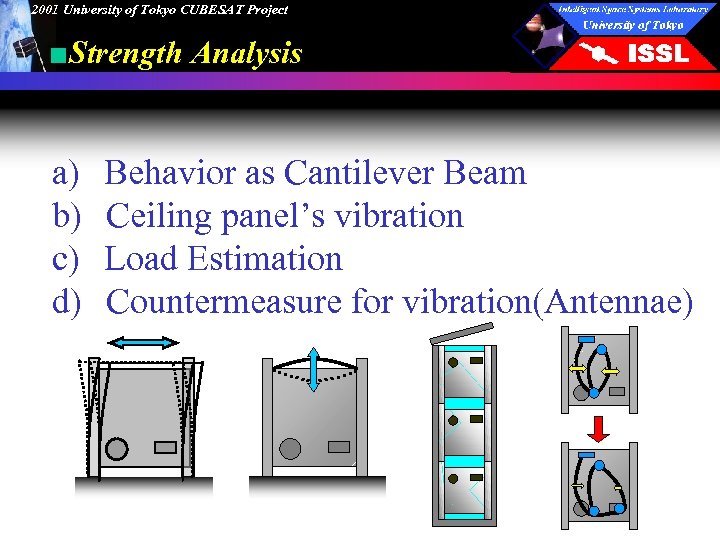
2001 University of Tokyo CUBESAT Project ■Strength Analysis a) Behavior as Cantilever Beam b) Ceiling panel’s vibration c) Load Estimation d) Countermeasure for vibration(Antennae)
![2001 University of Tokyo CUBESAT Project ■Behavior as Cantilever Beam[1] ■ If CUBESAT experiences](https://present5.com/presentation/14c96f9eb32362df265c5284f796a4e5/image-43.jpg "2001 University of Tokyo CUBESAT Project ■Behavior as Cantilever Beam[1] ■ If CUBESAT experiences")
2001 University of Tokyo CUBESAT Project ■Behavior as Cantilever Beam[1] ■ If CUBESAT experiences very strong vibration, it may behave as a cantilever beam. ■ In this case , the Harmonic Frequency is around 20[k. Hz] (witch is enough high, comparing to the launch vehicle’s frequency)
![2001 University of Tokyo CUBESAT Project ■Ceiling panel’s vibration[1] ■ Harmonic Frequency is around](https://present5.com/presentation/14c96f9eb32362df265c5284f796a4e5/image-44.jpg "2001 University of Tokyo CUBESAT Project ■Ceiling panel’s vibration[1] ■ Harmonic Frequency is around")
2001 University of Tokyo CUBESAT Project ■Ceiling panel’s vibration[1] ■ Harmonic Frequency is around 1 - 2 [k. Hz] ■ The Harmonic Frequency largely depends on the thickness of the panel. ■ The thicker the panel is designed , the higher the Harmonic Frequency becomes.
![2001 University of Tokyo CUBESAT Project ■Ceiling panel’s vibration[2] ■ To avoid ceiling panel’s](https://present5.com/presentation/14c96f9eb32362df265c5284f796a4e5/image-45.jpg "2001 University of Tokyo CUBESAT Project ■Ceiling panel’s vibration[2] ■ To avoid ceiling panel’s")
2001 University of Tokyo CUBESAT Project ■Ceiling panel’s vibration[2] ■ To avoid ceiling panel’s vibration we have to design it as possible as thick. ■ For this design , Total Mass is large problem ■ Eventually, we have to choose around 1. 0 -1. 5 mm
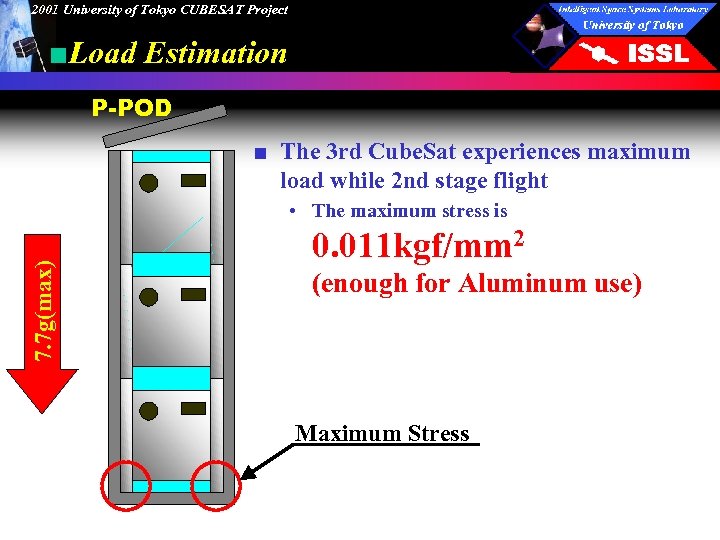
2001 University of Tokyo CUBESAT Project ■Load Estimation P-POD ■ The 3 rd Cube. Sat experiences maximum load while 2 nd stage flight 7. 7 g(max) • The maximum stress is 0. 011 kgf/mm 2 (enough for Aluminum use) Maximum Stress
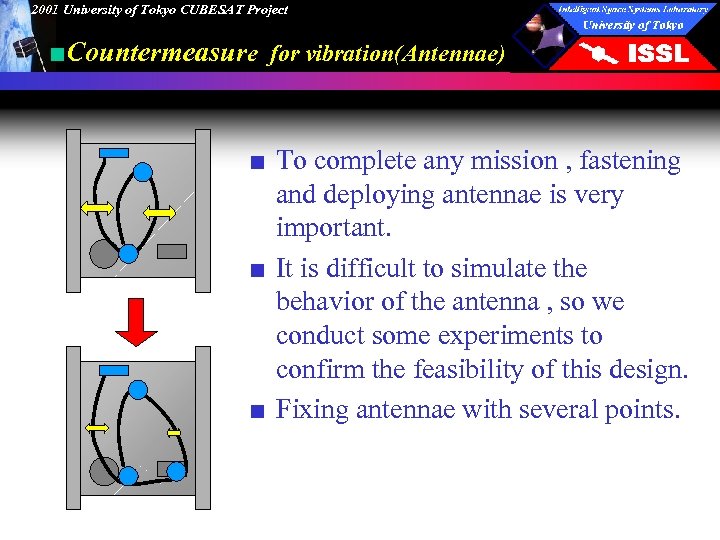
2001 University of Tokyo CUBESAT Project ■Countermeasure for vibration(Antennae) ■ To complete any mission , fastening and deploying antennae is very important. ■ It is difficult to simulate the behavior of the antenna , so we conduct some experiments to confirm the feasibility of this design. ■ Fixing antennae with several points.
2001 University of Tokyo CUBESAT Project Electronics Subsystem
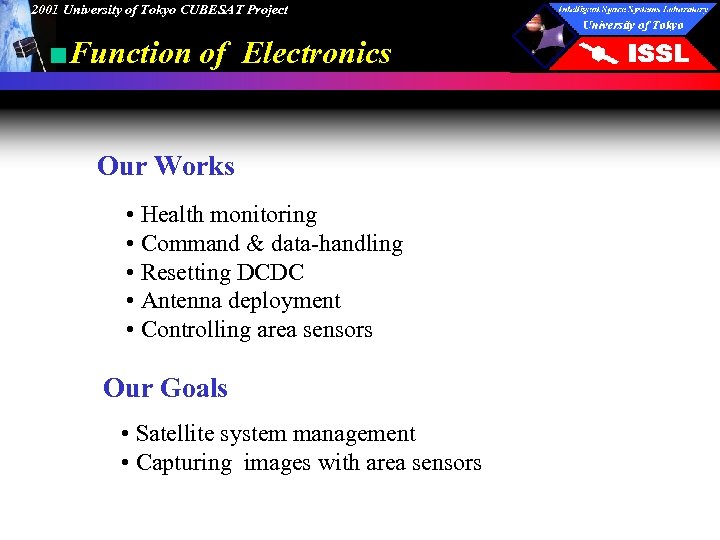
2001 University of Tokyo CUBESAT Project ■Function of Electronics Our Works • Health monitoring • Command & data-handling • Resetting DCDC • Antenna deployment • Controlling area sensors Our Goals • Satellite system management • Capturing images with area sensors
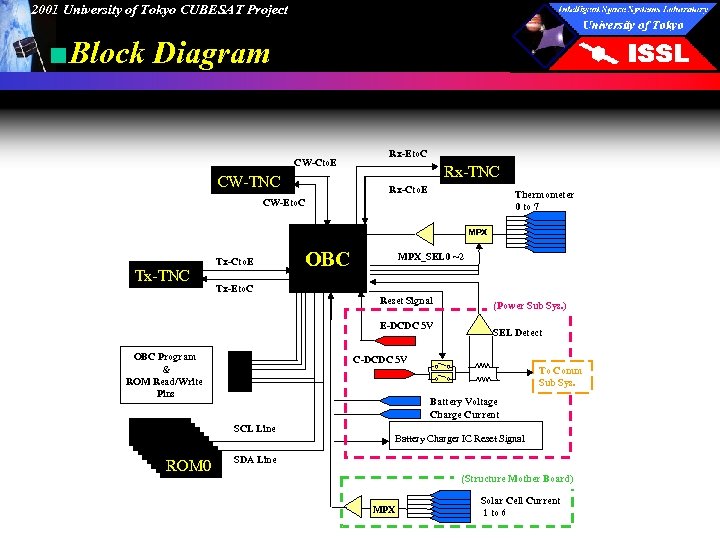
2001 University of Tokyo CUBESAT Project ■Block Diagram CW-Cto. E CW-TNC Rx-Eto. C Rx-TNC Rx-Cto. E Thermometer 0 to 7 CW-Eto. C MPX Tx-TNC Tx-Cto. E OBC MPX_SEL 0 ~2 Tx-Eto. C Reset Signal E-DCDC 5 V OBC Program & ROM Read/Write Pins ROM 0 ROM 0 (Power Sub Sys. ) SEL Detect C-DCDC 5 V To Comm Sub Sys. Battery Voltage Charge Current SCL Line Battery Charger IC Reset Signal SDA Line (Structure Mother Board) MPX Solar Cell Current 1 to 6
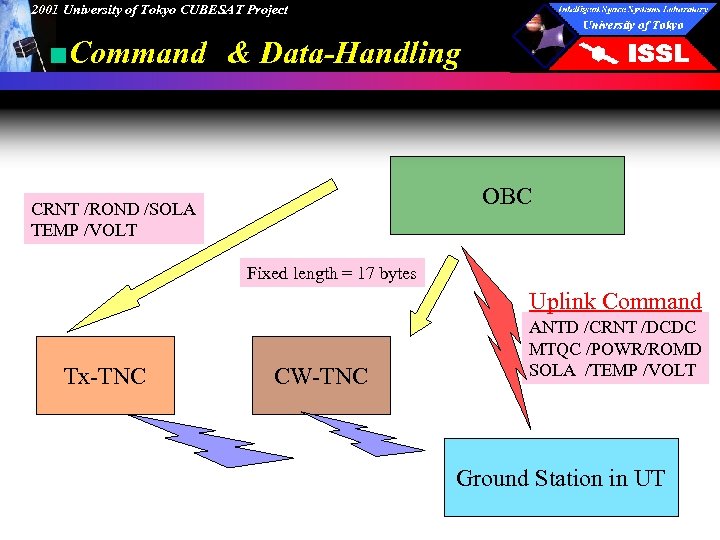
2001 University of Tokyo CUBESAT Project ■Command & Data-Handling OBC CRNT /ROND /SOLA TEMP /VOLT Fixed length = 17 bytes Uplink Command Tx-TNC CW-TNC ANTD /CRNT /DCDC MTQC /POWR/ROMD SOLA /TEMP /VOLT Ground Station in UT
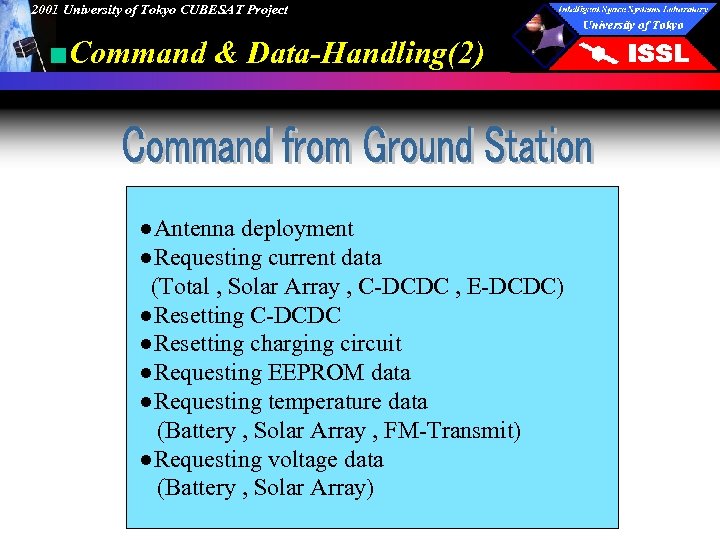
2001 University of Tokyo CUBESAT Project ■Command & Data-Handling(2) ●Antenna deployment ●Requesting current data (Total , Solar Array , C-DCDC , E-DCDC) ●Resetting C-DCDC ●Resetting charging circuit ●Requesting EEPROM data ●Requesting temperature data (Battery , Solar Array , FM-Transmit) ●Requesting voltage data (Battery , Solar Array)
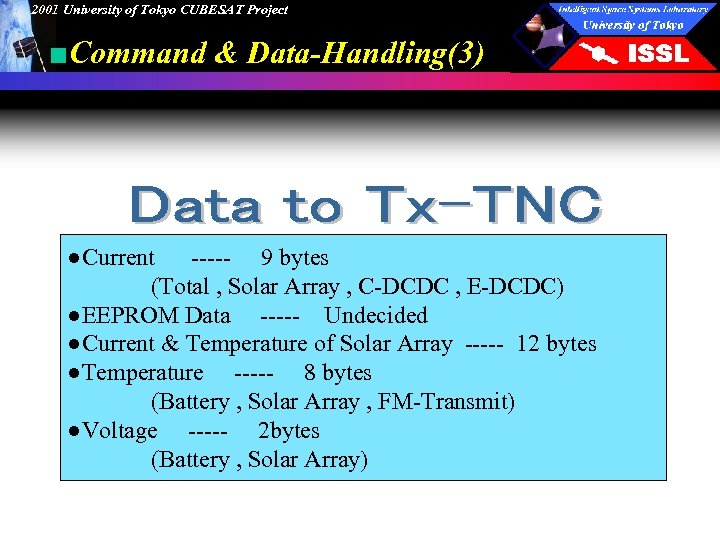
2001 University of Tokyo CUBESAT Project ■Command & Data-Handling(3) ●Current ----- 9 bytes (Total , Solar Array , C-DCDC , E-DCDC) ●EEPROM Data ----- Undecided ●Current & Temperature of Solar Array ----- 12 bytes ●Temperature ----- 8 bytes (Battery , Solar Array , FM-Transmit) ●Voltage ----- 2 bytes (Battery , Solar Array)
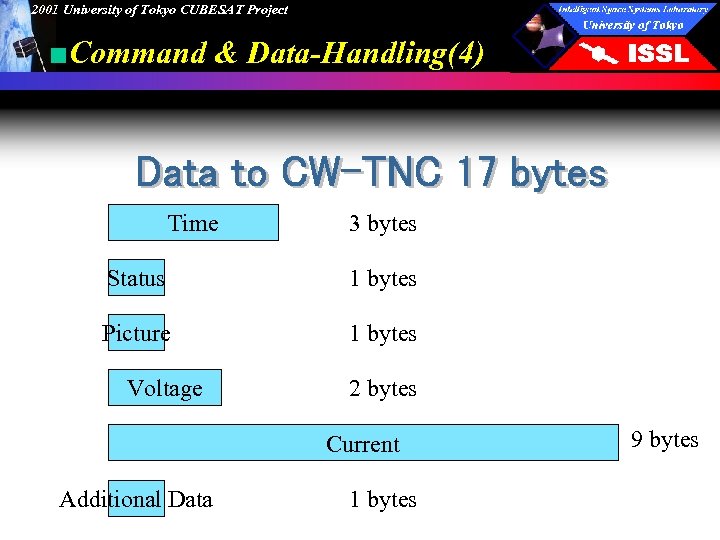
2001 University of Tokyo CUBESAT Project ■Command & Data-Handling(4) Time 3 bytes Status 1 bytes Picture 1 bytes Voltage 2 bytes Current Additional Data 1 bytes 9 bytes
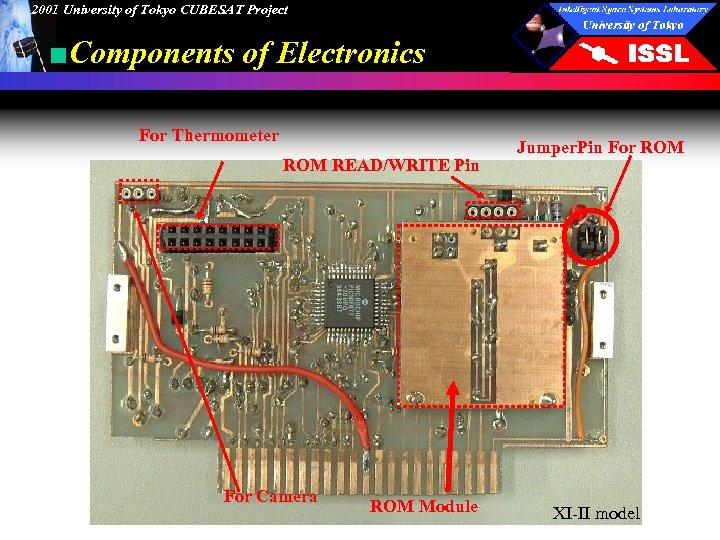
2001 University of Tokyo CUBESAT Project ■Components of Electronics For Thermometer ROM READ/WRITE Pin For Camera ROM Module Jumper. Pin For ROM XI-II model
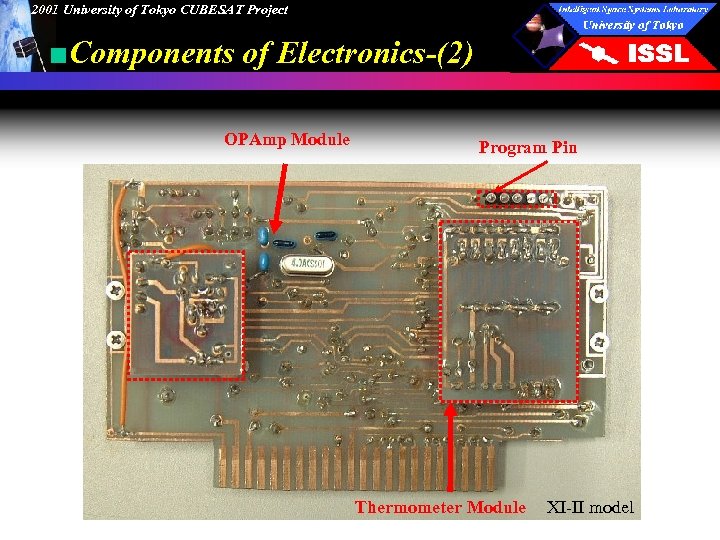
2001 University of Tokyo CUBESAT Project ■Components of Electronics-(2) OPAmp Module Program Pin Thermometer Module XI-II model
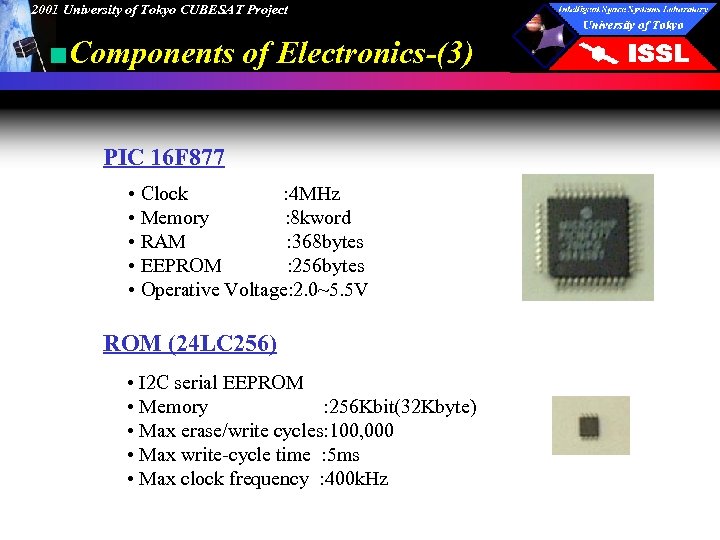
2001 University of Tokyo CUBESAT Project ■Components of Electronics-(3) PIC 16 F 877 • Clock : 4 MHz • Memory : 8 kword • RAM : 368 bytes • EEPROM : 256 bytes • Operative Voltage: 2. 0~5. 5 V ROM (24 LC 256) • I 2 C serial EEPROM • Memory : 256 Kbit(32 Kbyte) • Max erase/write cycles: 100, 000 • Max write-cycle time : 5 ms • Max clock frequency : 400 k. Hz
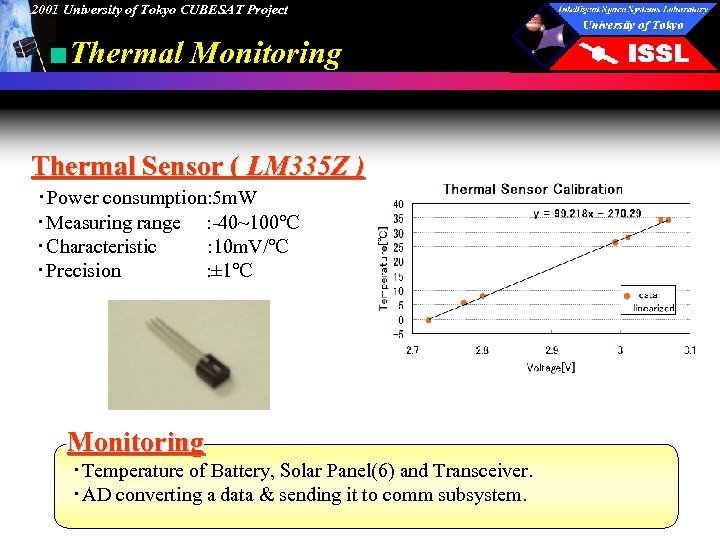
2001 University of Tokyo CUBESAT Project ■Thermal Monitoring Thermal Sensor ( LM 335 Z ) ・Power consumption: 5 m. W ・Measuring range : -40~100℃ ・Characteristic : 10 m. V/℃ ・Precision : ± 1℃ Monitoring ・Temperature of Battery, Solar Panel(6) and Transceiver. ・AD converting a data & sending it to comm subsystem.
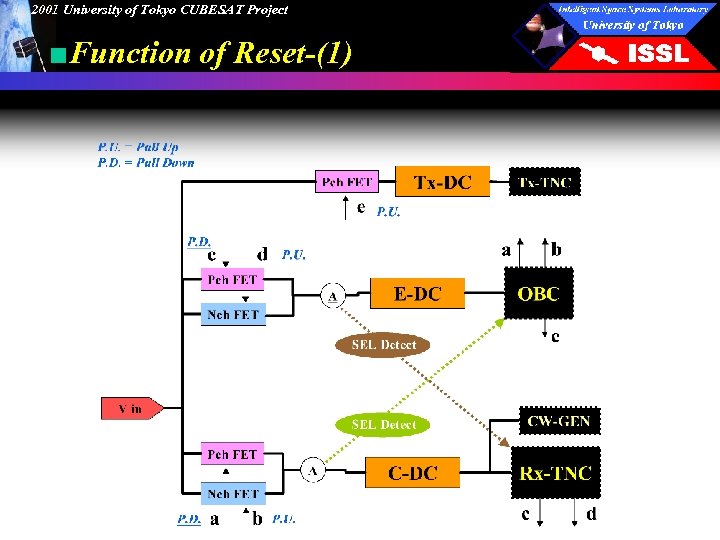
2001 University of Tokyo CUBESAT Project ■Function of Reset-(1)
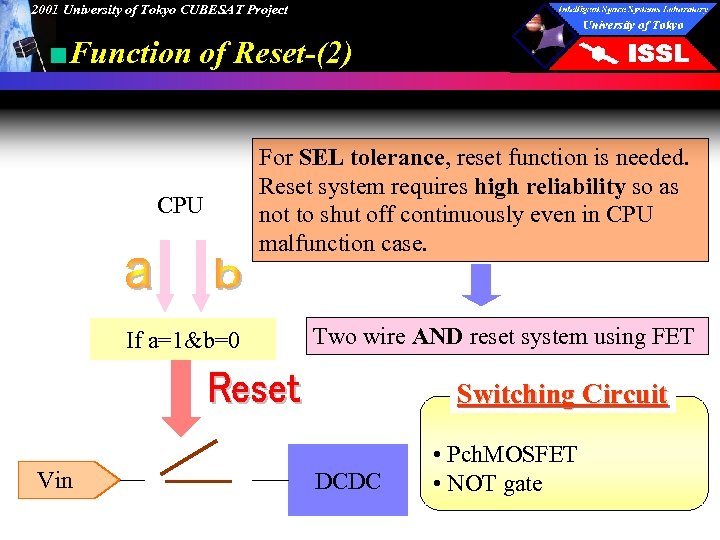
2001 University of Tokyo CUBESAT Project ■Function of Reset-(2) CPU If a=1&b=0 For SEL tolerance, reset function is needed. Reset system requires high reliability so as not to shut off continuously even in CPU malfunction case. Two wire AND reset system using FET Switching Circuit Vin DCDC • Pch. MOSFET • NOT gate
2001 University of Tokyo CUBESAT Project Communication Subsystem
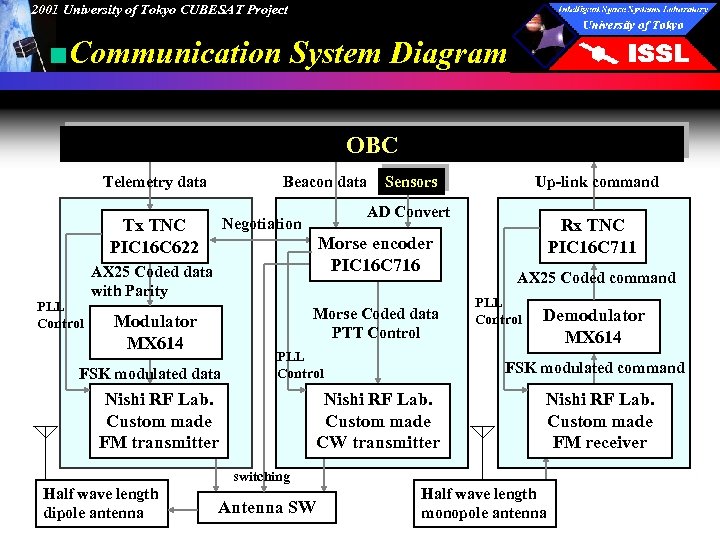
2001 University of Tokyo CUBESAT Project ■Communication System Diagram OBC Telemetry data Beacon data PLL Control Morse encoder PIC 16 C 716 AX 25 Coded data with Parity Morse Coded data PTT Control Modulator MX 614 FSK modulated data Up-link command AD Convert Negotiation Tx TNC PIC 16 C 622 Sensors PLL Control Nishi RF Lab. Custom made FM transmitter Rx TNC PIC 16 C 711 AX 25 Coded command PLL Control Demodulator MX 614 FSK modulated command Nishi RF Lab. Custom made CW transmitter Nishi RF Lab. Custom made FM receiver switching Half wave length dipole antenna Antenna SW Half wave length monopole antenna
2001 University of Tokyo CUBESAT Project Telemetry Transmission System
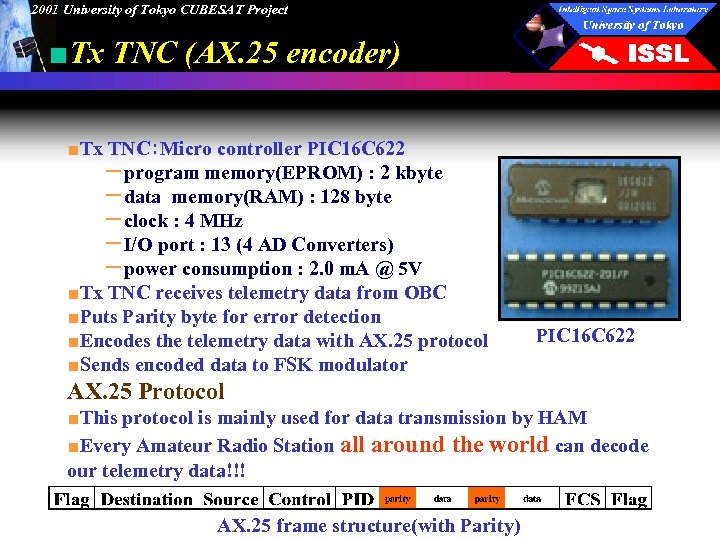
2001 University of Tokyo CUBESAT Project ■Tx TNC (AX. 25 encoder) ■Tx TNC:Micro controller PIC 16 C 622 -program memory(EPROM) : 2 kbyte -data memory(RAM) : 128 byte -clock : 4 MHz -I/O port : 13 (4 AD Converters) -power consumption : 2. 0 m. A @ 5 V ■Tx TNC receives telemetry data from OBC ■Puts Parity byte for error detection ■Encodes the telemetry data with AX. 25 protocol ■Sends encoded data to FSK modulator PIC 16 C 622 AX. 25 Protocol ■This protocol is mainly used for data transmission by HAM ■Every Amateur Radio Station all around the world can decode our telemetry data!!! AX. 25 frame structure(with Parity)
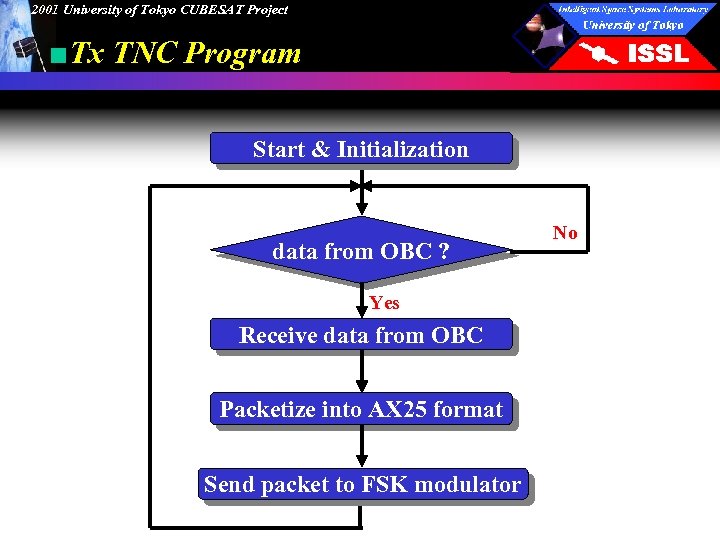
2001 University of Tokyo CUBESAT Project ■Tx TNC Program Start & Initialization data from OBC ? Yes Receive data from OBC Packetize into AX 25 format Send packet to FSK modulator No
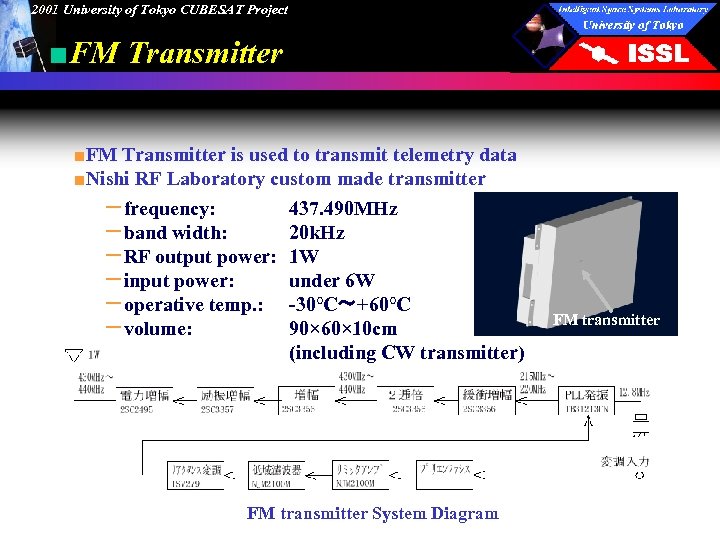
2001 University of Tokyo CUBESAT Project ■FM Transmitter is used to transmit telemetry data ■Nishi RF Laboratory custom made transmitter -frequency: 437. 490 MHz -band width: 20 k. Hz -RF output power: 1 W -input power: under 6 W -operative temp. : -30℃~+60℃ -volume: 90× 60× 10 cm (including CW transmitter) FM transmitter System Diagram FM transmitter
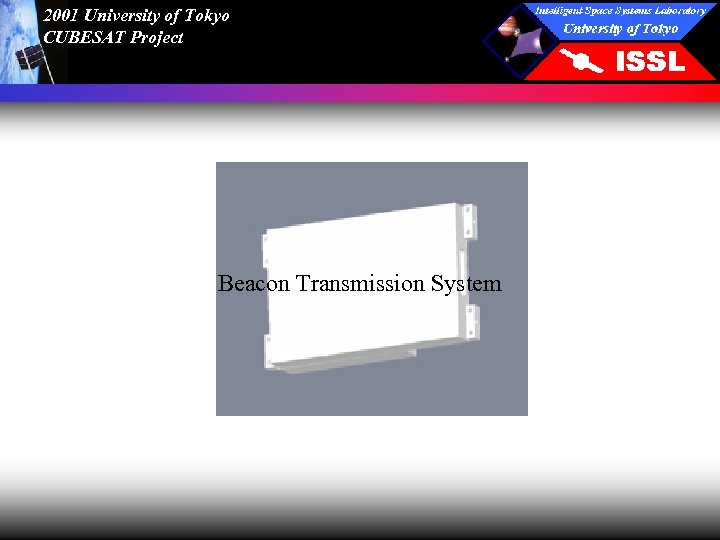
2001 University of Tokyo CUBESAT Project Beacon Transmission System
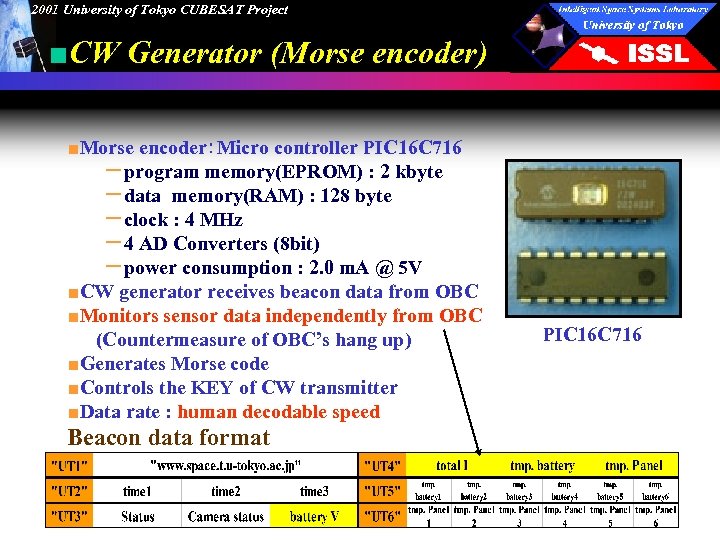
2001 University of Tokyo CUBESAT Project ■CW Generator (Morse encoder) ■Morse encoder:Micro controller PIC 16 C 716 -program memory(EPROM) : 2 kbyte -data memory(RAM) : 128 byte -clock : 4 MHz -4 AD Converters (8 bit) -power consumption : 2. 0 m. A @ 5 V ■CW generator receives beacon data from OBC ■Monitors sensor data independently from OBC (Countermeasure of OBC’s hang up) ■Generates Morse code ■Controls the KEY of CW transmitter ■Data rate : human decodable speed Beacon data format PIC 16 C 716
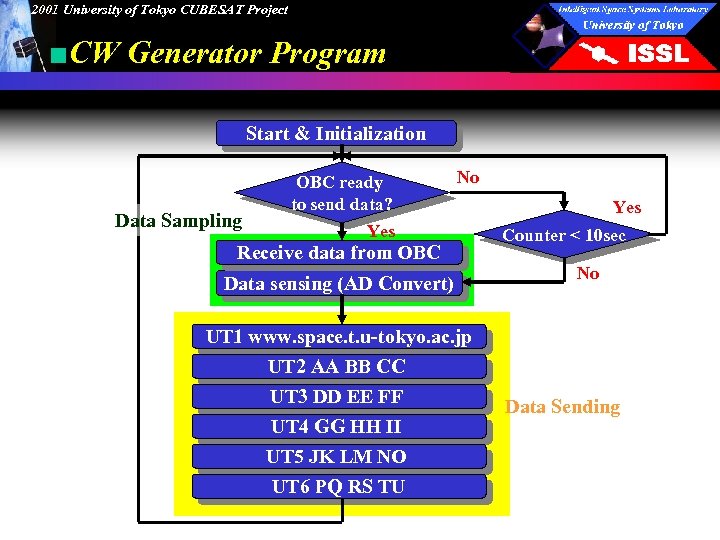
2001 University of Tokyo CUBESAT Project ■CW Generator Program Start & Initialization Data Sampling OBC ready to send data? No Yes Receive data from OBC Data sensing (AD Convert) UT 1 www. space. t. u-tokyo. ac. jp UT 2 AA BB CC UT 3 DD EE FF UT 4 GG HH II UT 5 JK LM NO UT 6 PQ RS TU Yes Counter < 10 sec No Data Sending
2001 University of Tokyo CUBESAT Project Command Receiving System
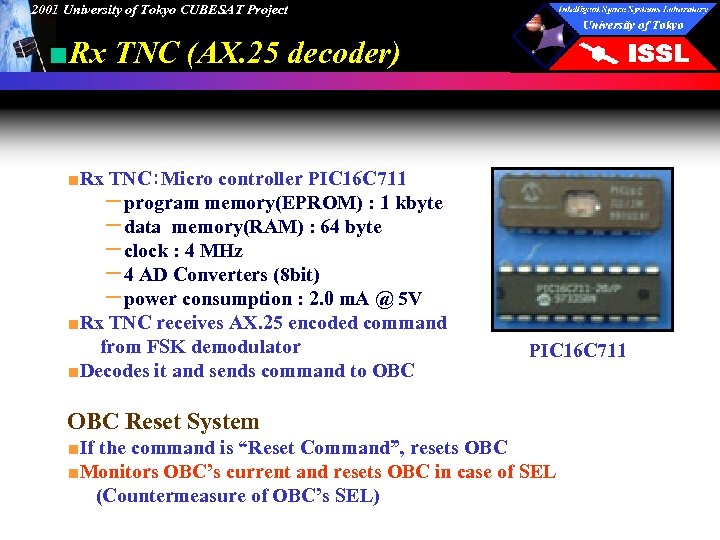
2001 University of Tokyo CUBESAT Project ■Rx TNC (AX. 25 decoder) ■Rx TNC:Micro controller PIC 16 C 711 -program memory(EPROM) : 1 kbyte -data memory(RAM) : 64 byte -clock : 4 MHz -4 AD Converters (8 bit) -power consumption : 2. 0 m. A @ 5 V ■Rx TNC receives AX. 25 encoded command from FSK demodulator ■Decodes it and sends command to OBC PIC 16 C 711 OBC Reset System ■If the command is “Reset Command”, resets OBC ■Monitors OBC’s current and resets OBC in case of SEL (Countermeasure of OBC’s SEL)
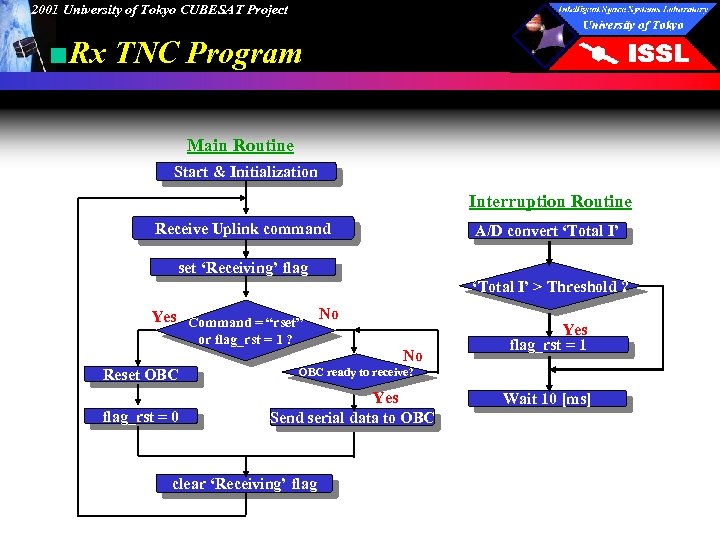
2001 University of Tokyo CUBESAT Project ■Rx TNC Program Main Routine Start & Initialization Interruption Routine Receive Uplink command A/D convert ‘Total I’ set ‘Receiving’ flag ‘Total I’ > Threshold ? Yes Command = “rset” or flag_rst = 1 ? Reset OBC flag_rst = 0 No No Yes flag_rst = 1 OBC ready to receive? Yes Send serial data to OBC clear ‘Receiving’ flag Wait 10 [ms]
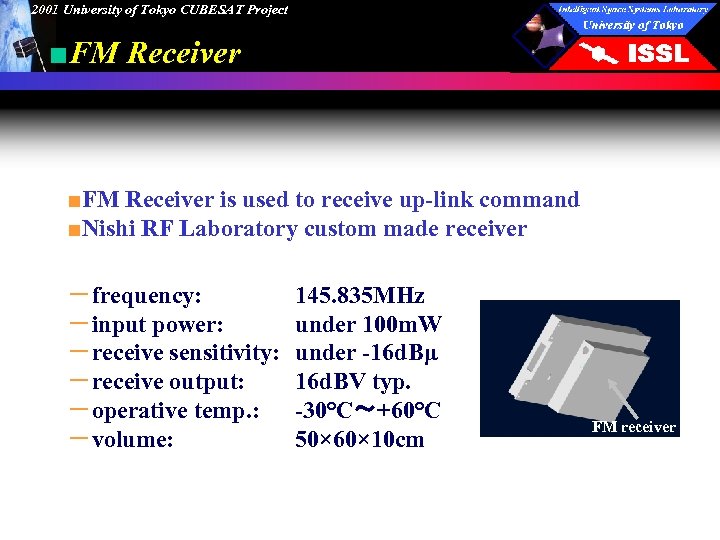
2001 University of Tokyo CUBESAT Project ■FM Receiver is used to receive up-link command ■Nishi RF Laboratory custom made receiver -frequency: -input power: -receive sensitivity: -receive output: -operative temp. : -volume: 145. 835 MHz under 100 m. W under -16 d. Bμ 16 d. BV typ. -30℃~+60℃ 50× 60× 10 cm FM receiver
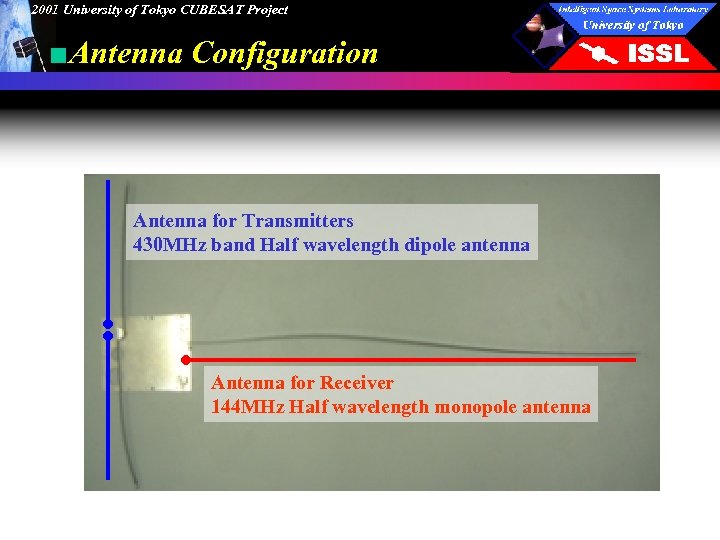
2001 University of Tokyo CUBESAT Project ■Antenna Configuration Antenna for Transmitters 430 MHz band Half wavelength dipole antenna Antenna for Receiver 144 MHz Half wavelength monopole antenna
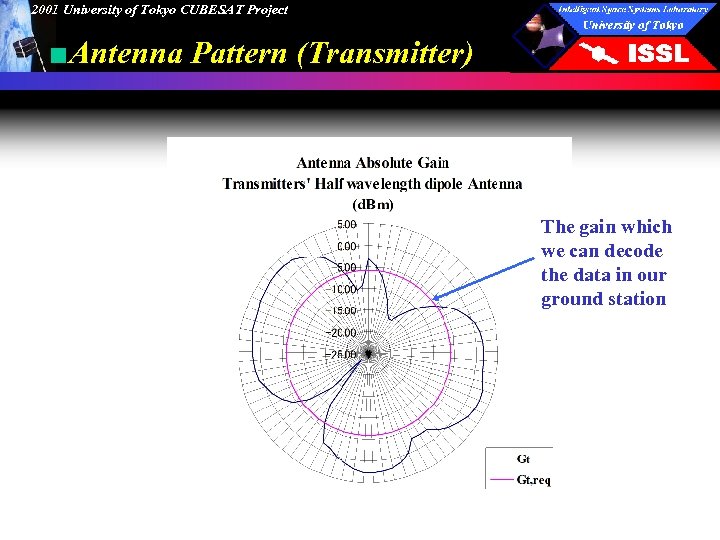
2001 University of Tokyo CUBESAT Project ■Antenna Pattern (Transmitter) The gain which we can decode the data in our ground station
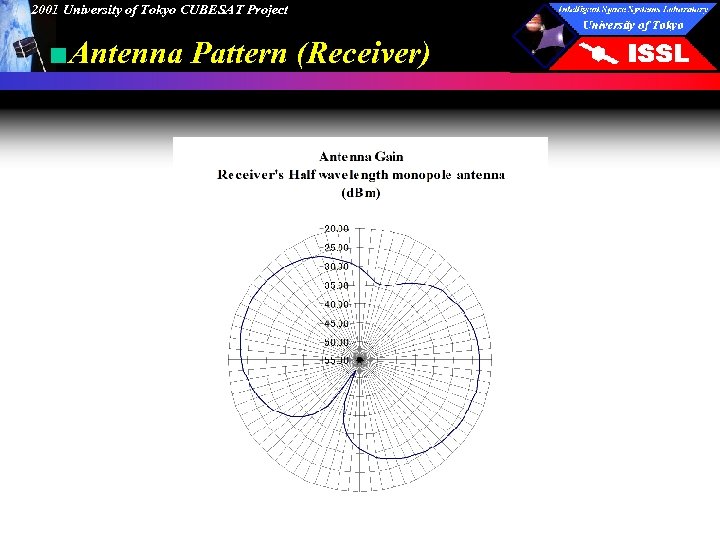
2001 University of Tokyo CUBESAT Project ■Antenna Pattern (Receiver)
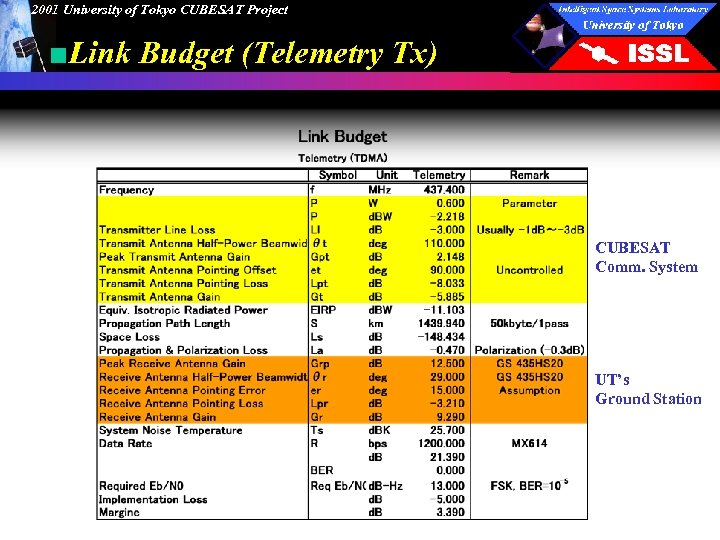
2001 University of Tokyo CUBESAT Project ■Link Budget (Telemetry Tx) CUBESAT Comm. System UT’s Ground Station
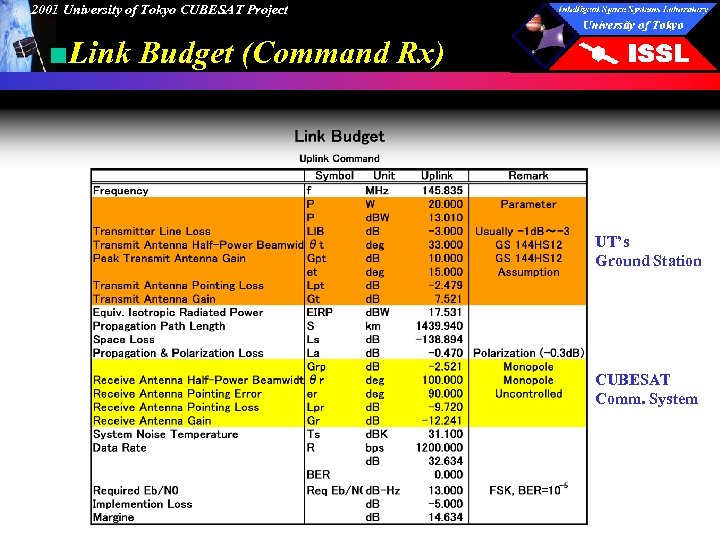
2001 University of Tokyo CUBESAT Project ■Link Budget (Command Rx) UT’s Ground Station CUBESAT Comm. System
2001 University of Tokyo CUBESAT Project Power Subsystem
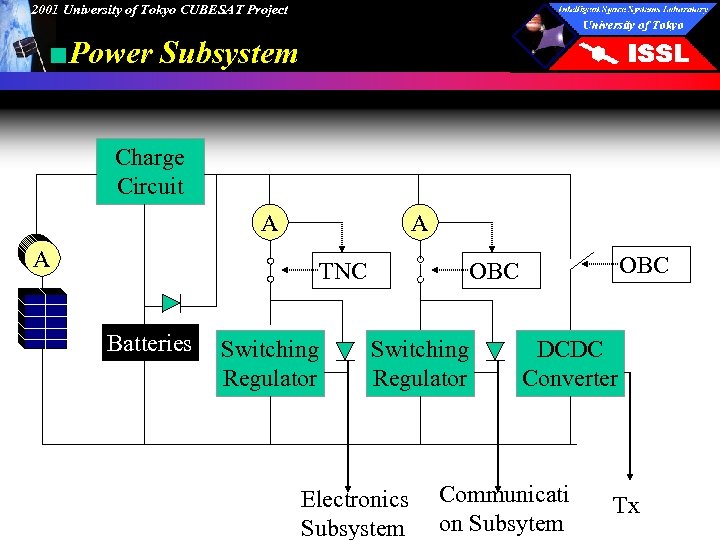
2001 University of Tokyo CUBESAT Project ■Power Subsystem Charge Circuit A A A TNC Batteries Switching Regulator OBC Switching Regulator Electronics Subsystem DCDC Converter Communicati on Subsytem Tx
2001 University of Tokyo CUBESAT Project ■Power Subsystem(CONT’D) ■ Supply a continuous source of electrical power to loads. • Power source is solar panels. • Batteries are used for storage • Regulated DC power and unregulated power is supplied for loads. • Power consumption is monitored for SEL.
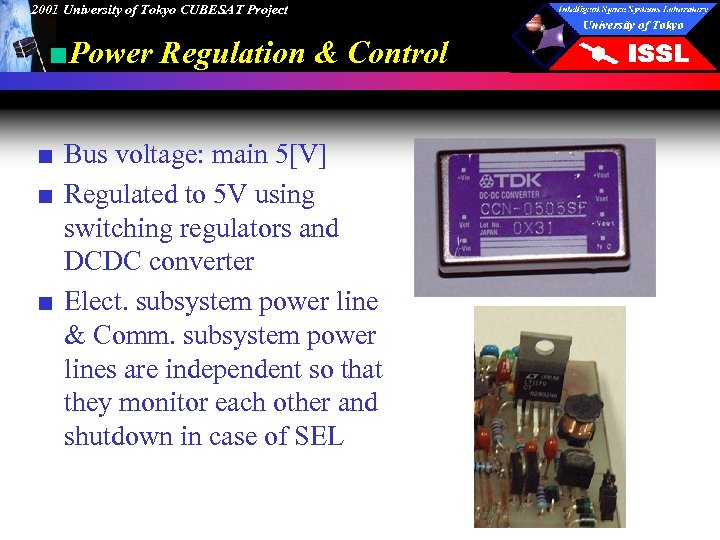
2001 University of Tokyo CUBESAT Project ■Power Regulation & Control ■ Bus voltage: main 5[V] ■ Regulated to 5 V using switching regulators and DCDC converter ■ Elect. subsystem power line & Comm. subsystem power lines are independent so that they monitor each other and shutdown in case of SEL
2001 University of Tokyo CUBESAT Project ■Source ■ Power is supplied by body mounted solar cells. ■ Cells are arranged on all 6 Cube. Sat surfaces. ■ Average power 1228 [m. W] (typ @ 80℃)
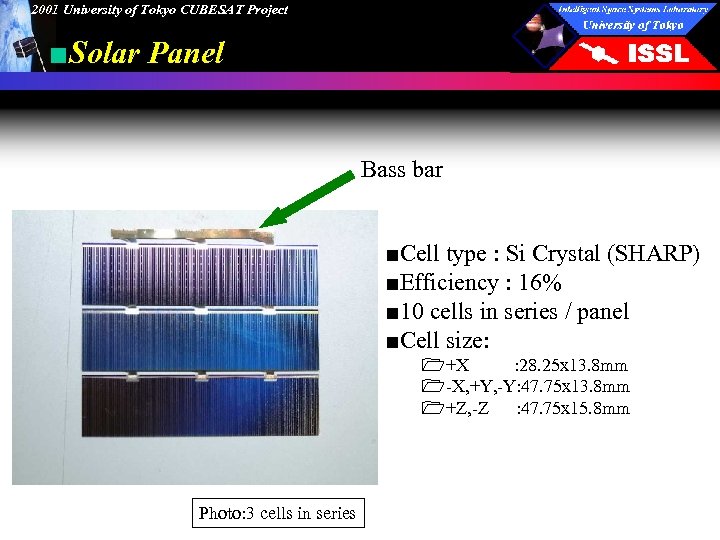
2001 University of Tokyo CUBESAT Project ■Solar Panel Bass bar ■Cell type : Si Crystal (SHARP) ■Efficiency : 16% ■ 10 cells in series / panel ■Cell size: 1+X : 28. 25 x 13. 8 mm 1 -X, +Y, -Y: 47. 75 x 13. 8 mm 1+Z, -Z : 47. 75 x 15. 8 mm Photo: 3 cells in series
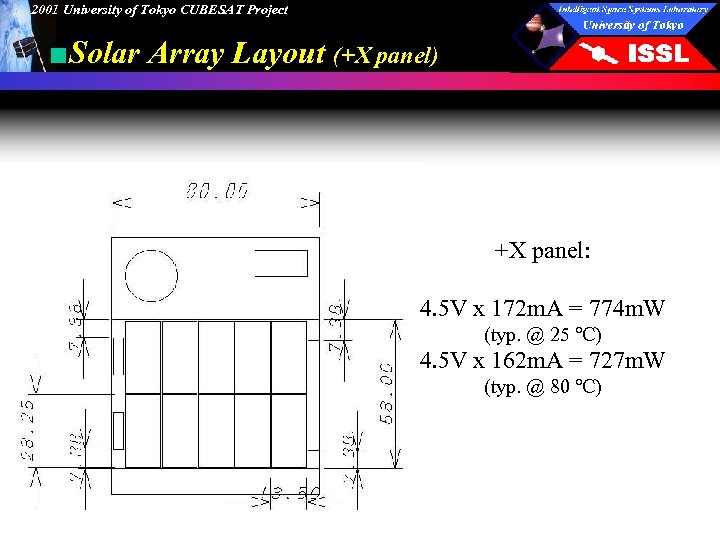
2001 University of Tokyo CUBESAT Project ■Solar Array Layout (+X panel) +X panel: 4. 5 V x 172 m. A = 774 m. W (typ. @ 25 ℃) 4. 5 V x 162 m. A = 727 m. W (typ. @ 80 ℃)
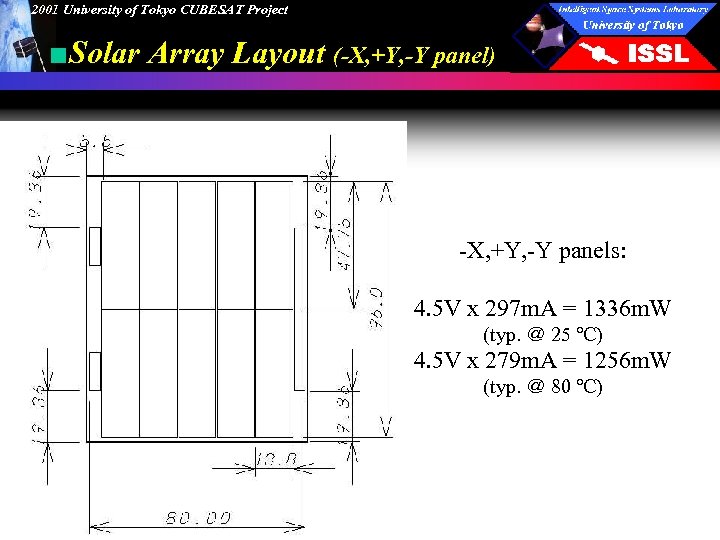
2001 University of Tokyo CUBESAT Project ■Solar Array Layout (-X, +Y, -Y panel) -X, +Y, -Y panels: 4. 5 V x 297 m. A = 1336 m. W (typ. @ 25 ℃) 4. 5 V x 279 m. A = 1256 m. W (typ. @ 80 ℃)
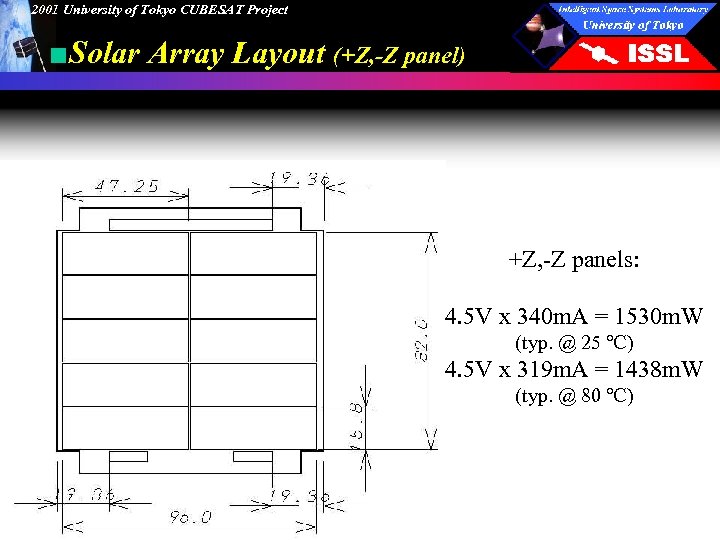
2001 University of Tokyo CUBESAT Project ■Solar Array Layout (+Z, -Z panel) +Z, -Z panels: 4. 5 V x 340 m. A = 1530 m. W (typ. @ 25 ℃) 4. 5 V x 319 m. A = 1438 m. W (typ. @ 80 ℃)
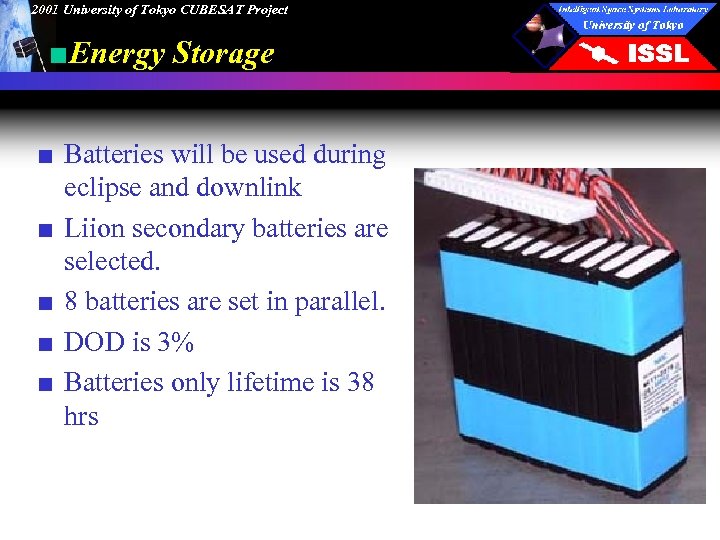
2001 University of Tokyo CUBESAT Project ■Energy Storage ■ Batteries will be used during eclipse and downlink ■ Liion secondary batteries are selected. ■ 8 batteries are set in parallel. ■ DOD is 3% ■ Batteries only lifetime is 38 hrs
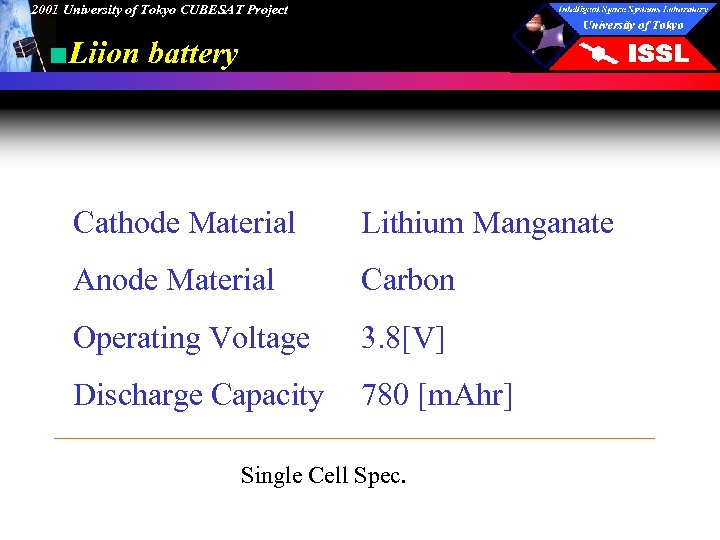
2001 University of Tokyo CUBESAT Project ■Liion battery Cathode Material Lithium Manganate Anode Material Carbon Operating Voltage 3. 8[V] Discharge Capacity 780 [m. Ahr] Single Cell Spec.
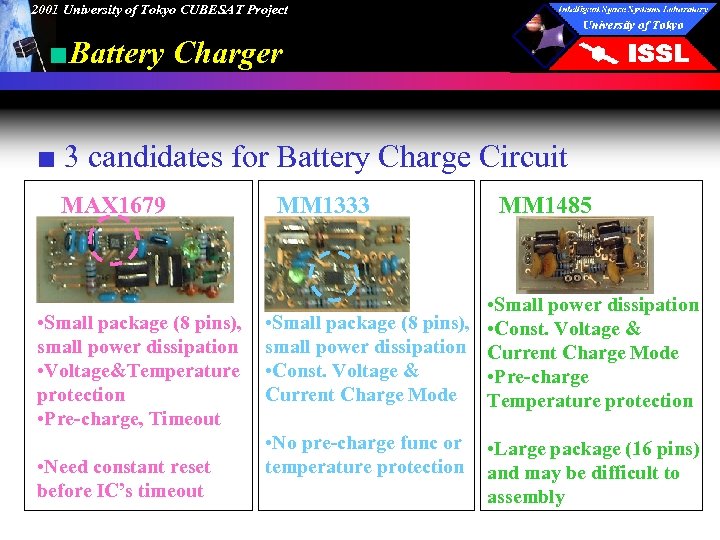
2001 University of Tokyo CUBESAT Project ■Battery Charger ■ 3 candidates for Battery Charge Circuit MAX 1679 • Small package (8 pins), small power dissipation • Voltage&Temperature protection • Pre-charge, Timeout • Need constant reset before IC’s timeout MM 1333 MM 1485 • Small power dissipation • Small package (8 pins), • Const. Voltage & small power dissipation Current Charge Mode • Const. Voltage & • Pre-charge Current Charge Mode Temperature protection • No pre-charge func or temperature protection • Large package (16 pins) and may be difficult to assembly
![2001 University of Tokyo CUBESAT Project ■Energy Consumption Components Power[m. W] Frequency in use](https://present5.com/presentation/14c96f9eb32362df265c5284f796a4e5/image-91.jpg "2001 University of Tokyo CUBESAT Project ■Energy Consumption Components Power[m. W] Frequency in use")
2001 University of Tokyo CUBESAT Project ■Energy Consumption Components Power[m. W] Frequency in use OBC sensors Tx TNC Tx CW CW TNC Rx Rx TNC Camera Magnetic Plg. All times During downlink All times (ON / OFF) All times Sometimes Antennae deployment 20 20 20 6000 300/125 20 150 800
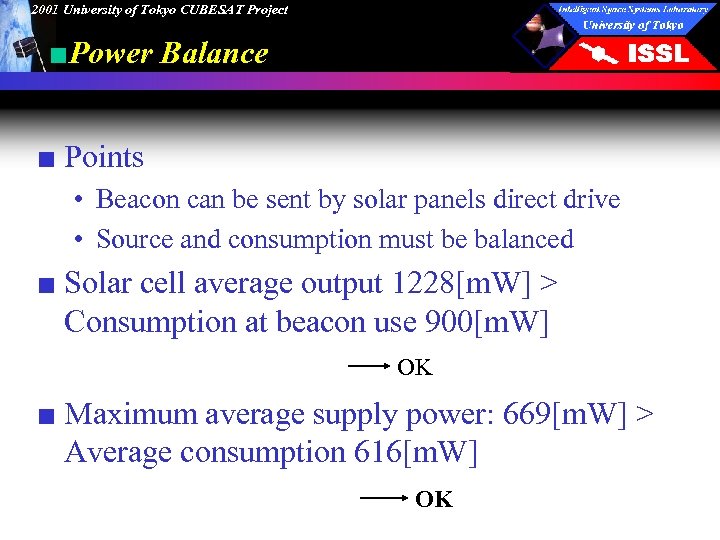
2001 University of Tokyo CUBESAT Project ■Power Balance ■ Points • Beacon can be sent by solar panels direct drive • Source and consumption must be balanced ■ Solar cell average output 1228[m. W] > Consumption at beacon use 900[m. W] OK ■ Maximum average supply power: 669[m. W] > Average consumption 616[m. W] OK
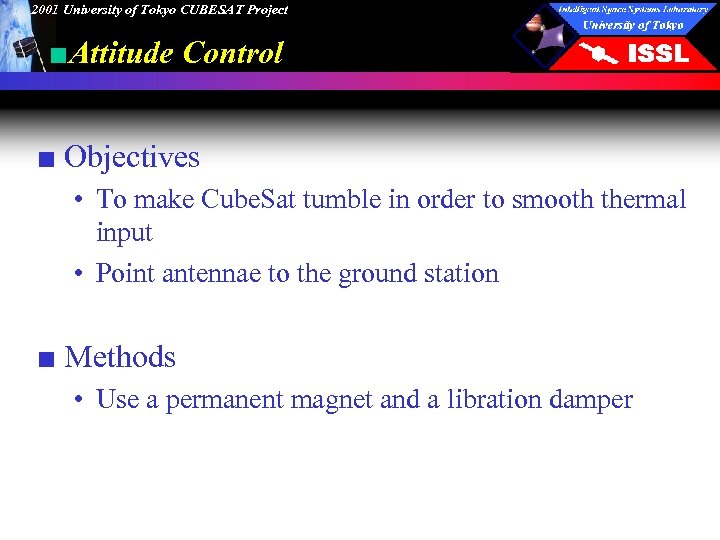
2001 University of Tokyo CUBESAT Project ■Attitude Control ■ Objectives • To make Cube. Sat tumble in order to smooth thermal input • Point antennae to the ground station ■ Methods • Use a permanent magnet and a libration damper
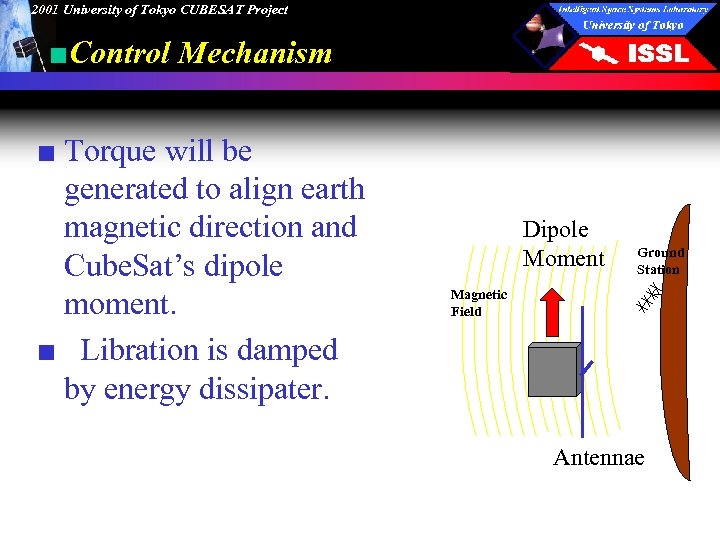
2001 University of Tokyo CUBESAT Project ■Control Mechanism ■ Torque will be generated to align earth magnetic direction and Cube. Sat’s dipole moment. ■ Libration is damped by energy dissipater. Dipole Moment Ground Station Magnetic Field Antennae
![2001 University of Tokyo CUBESAT Project ■Torquer Sizing Disturbance Air. Drag Solar Pressure Torque[Nm]](https://present5.com/presentation/14c96f9eb32362df265c5284f796a4e5/image-95.jpg "2001 University of Tokyo CUBESAT Project ■Torquer Sizing Disturbance Air. Drag Solar Pressure Torque[Nm]")
2001 University of Tokyo CUBESAT Project ■Torquer Sizing Disturbance Air. Drag Solar Pressure Torque[Nm] 2. 26 E-10 1. 38 E-9 Gravity Gradient To follow the change of magnetic field Required Torque 1. 0 E-6 [Nm] 1. 25 E-8 1. 0 E-6 At 800 km magnetic field Required Magnetic Dipole Moment 0. 046 [Am^2]
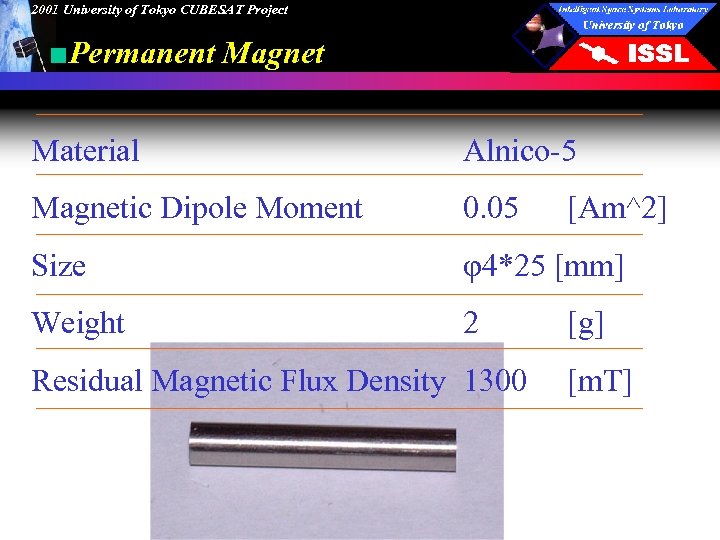
2001 University of Tokyo CUBESAT Project ■Permanent Magnet Material Alnico-5 Magnetic Dipole Moment 0. 05 Size φ4*25 [mm] Weight 2 Residual Magnetic Flux Density 1300 [Am^2] [g] [m. T]
2001 University of Tokyo CUBESAT Project ■Libration Damper ■ Libration damper dissipates energy to stable attitude change. • Dissipation caused by hysteresis loss and eddy current loss • High permeability iron is used for the damper • 3 days are expected (8 days for worst case) to damp oscillation
2001 University of Tokyo CUBESAT Project Environment Subsystem
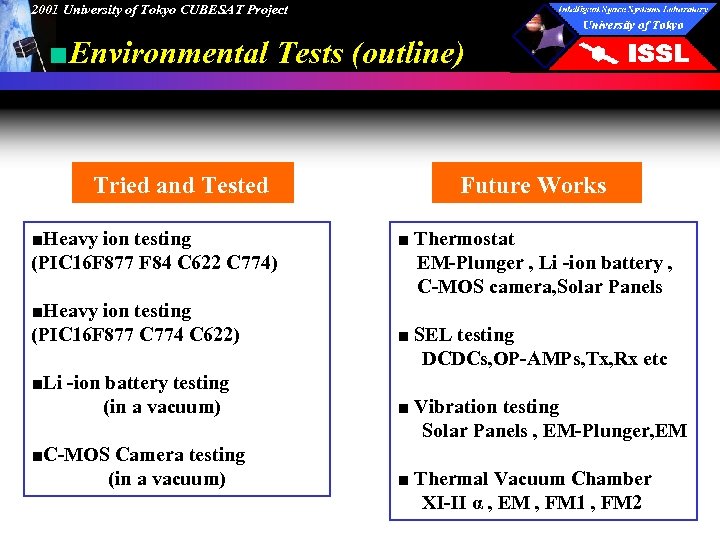
2001 University of Tokyo CUBESAT Project ■Environmental Tests (outline) Tried and Tested ■Heavy ion testing (PIC 16 F 877 F 84 C 622 C 774) ■Heavy ion testing (PIC 16 F 877 C 774 C 622) ■Li -ion battery testing (in a vacuum) ■C-MOS Camera testing (in a vacuum) Future Works ■ Thermostat EM-Plunger , Li -ion battery , C-MOS camera, Solar Panels ■ SEL testing DCDCs, OP-AMPs, Tx, Rx etc ■ Vibration testing Solar Panels , EM-Plunger, EM ■ Thermal Vacuum Chamber XI-II α , EM , FM 1 , FM 2
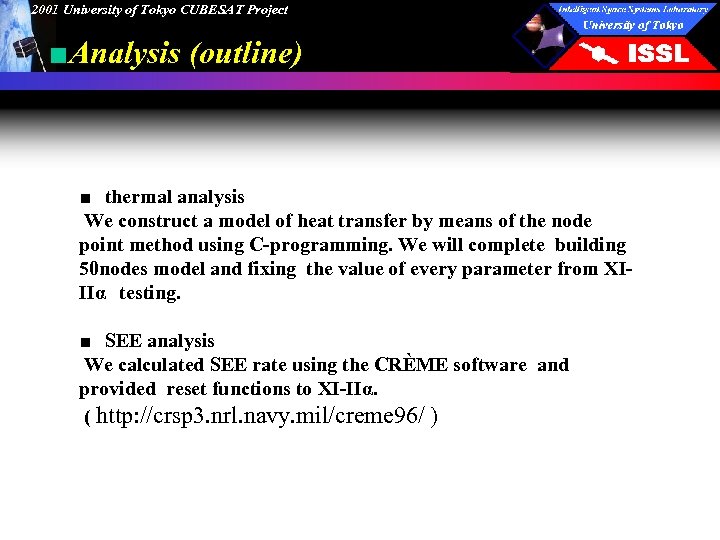
2001 University of Tokyo CUBESAT Project ■Analysis (outline) ■ thermal analysis We construct a model of heat transfer by means of the node point method using C-programming. We will complete building 50 nodes model and fixing the value of every parameter from XIIIα testing. ■ SEE analysis We calculated SEE rate using the CRÈME software and provided reset functions to XI-IIα. ( http: //crsp 3. nrl. navy. mil/creme 96/ )
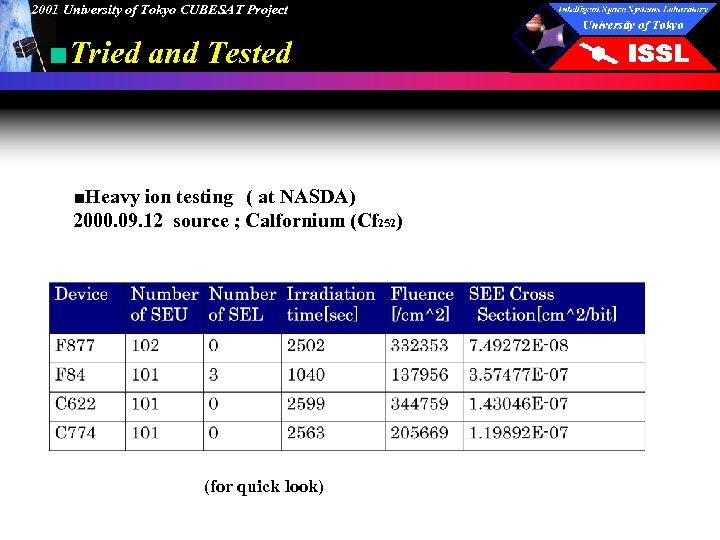
2001 University of Tokyo CUBESAT Project ■Tried and Tested ■Heavy ion testing ( at NASDA) 2000. 09. 12 source ; Calfornium (Cf 252) (for quick look)
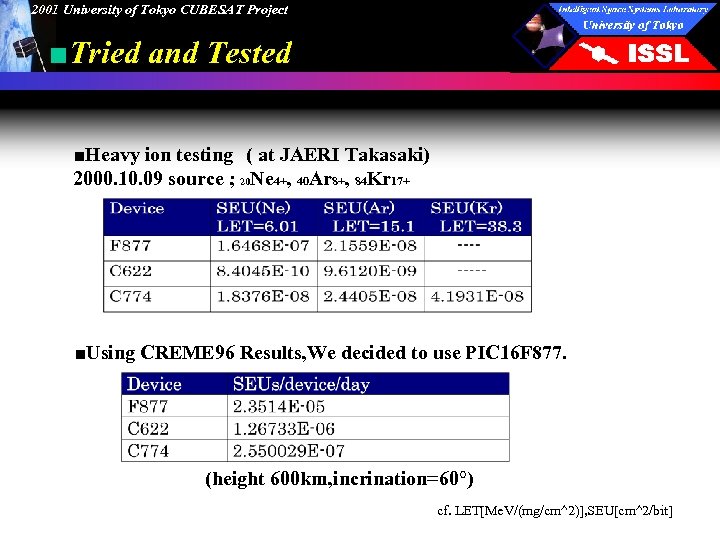
2001 University of Tokyo CUBESAT Project ■Tried and Tested ■Heavy ion testing ( at JAERI Takasaki) 2000. 10. 09 source ; 20 Ne 4+, 40 Ar 8+, 84 Kr 17+ ■Using CREME 96 Results, We decided to use PIC 16 F 877. (height 600 km, incrination=60°) cf. LET[Me. V/(mg/cm^2)], SEU[cm^2/bit]
2001 University of Tokyo CUBESAT Project ■Tried and Tested ■ Vacuum chamber testing - Li ion battery test (2001. 21 - 23 at UT-Arakawa Lab. ) No deterioration observed in 10^-5 Torr evacuated chamber.
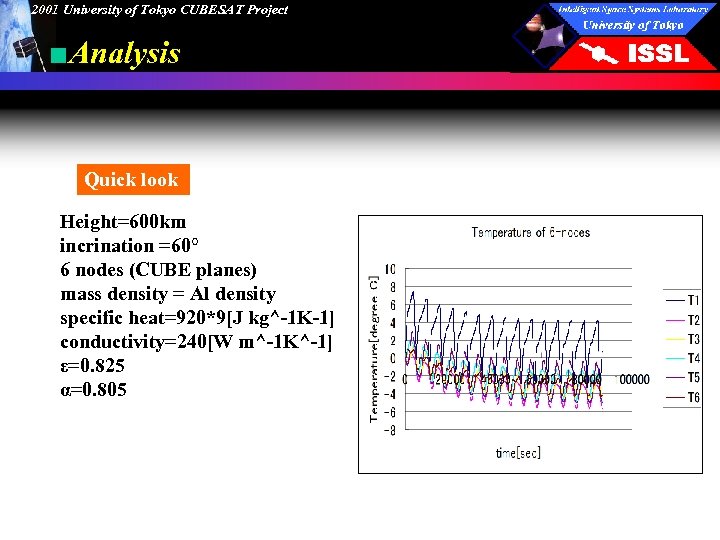
2001 University of Tokyo CUBESAT Project ■Analysis Quick look Height=600 km incrination =60° 6 nodes (CUBE planes) mass density = Al density specific heat=920*9[J kg^-1 K-1] conductivity=240[W m^-1 K^-1] ε=0. 825 α=0. 805
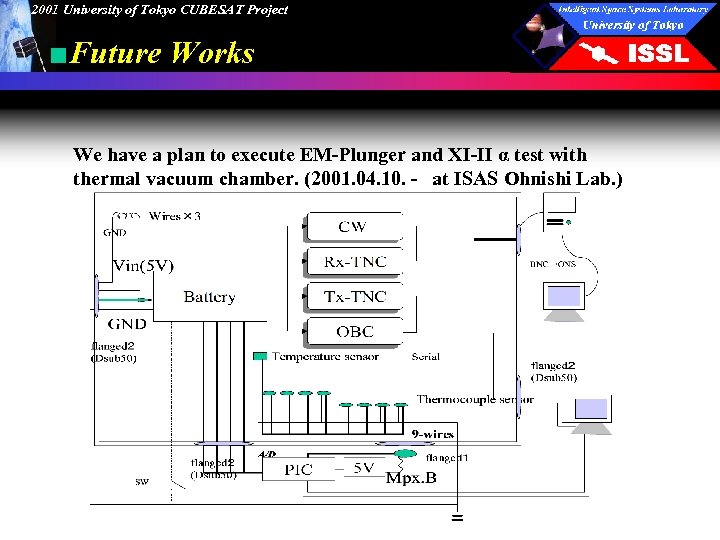
2001 University of Tokyo CUBESAT Project ■Future Works We have a plan to execute EM-Plunger and XI-II α test with thermal vacuum chamber. (2001. 04. 10. - at ISAS Ohnishi Lab. )
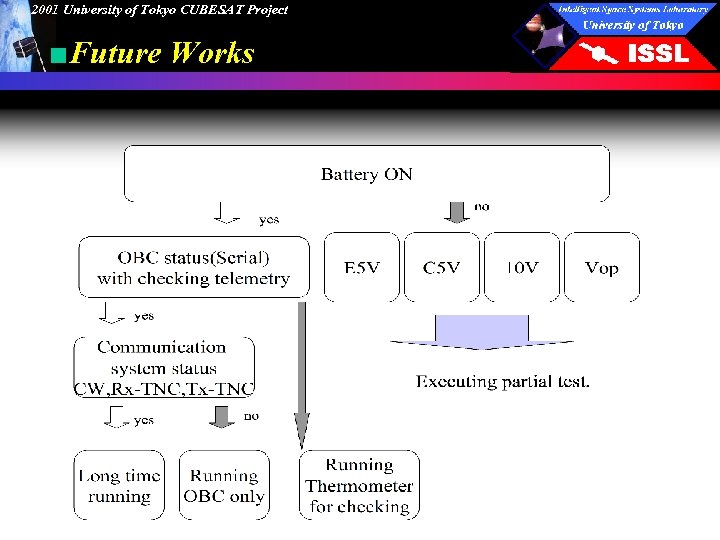
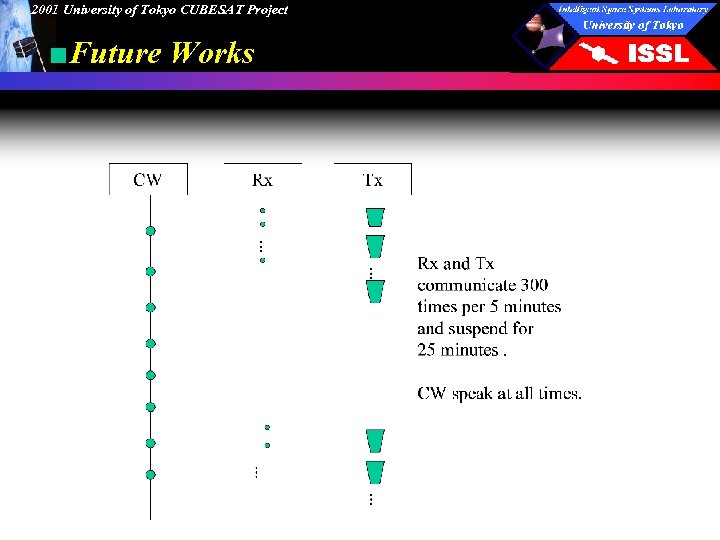
2001 University of Tokyo CUBESAT Project ■Future Works
2001 University of Tokyo CUBESAT Project ■Future Works
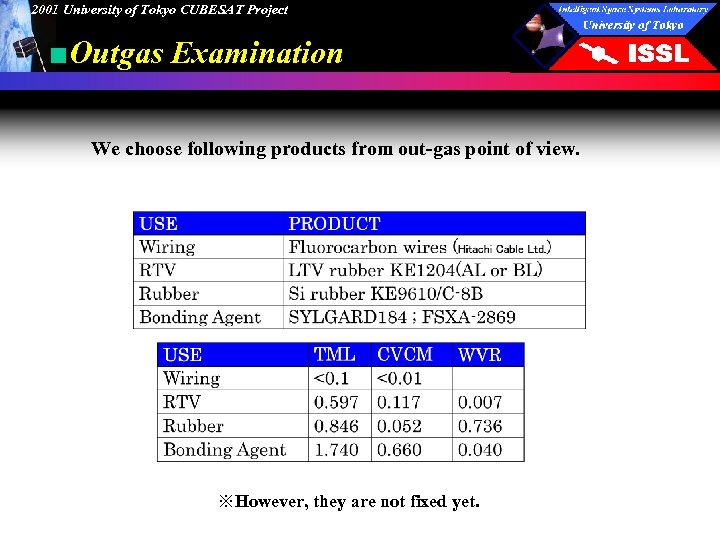
2001 University of Tokyo CUBESAT Project ■Outgas Examination We choose following products from out-gas point of view. ※However, they are not fixed yet.
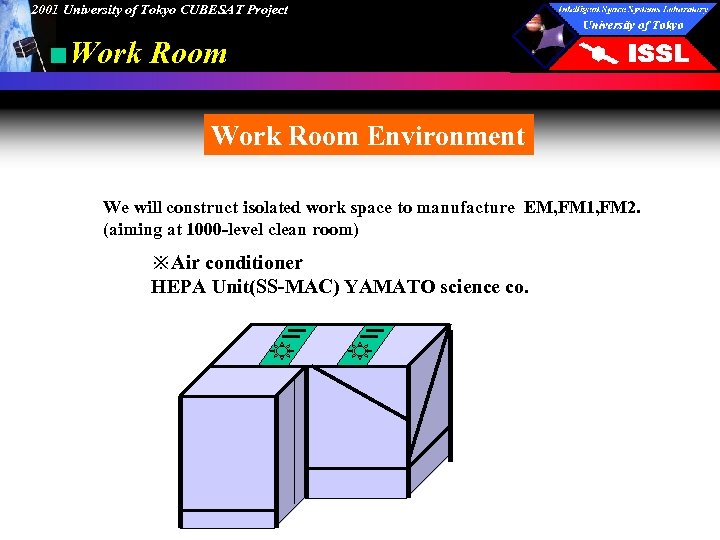
2001 University of Tokyo CUBESAT Project ■Work Room Environment We will construct isolated work space to manufacture EM, FM 1, FM 2. (aiming at 1000 -level clean room) ※Air conditioner HEPA Unit(SS-MAC) YAMATO science co.
2001 University of Tokyo CUBESAT Project Ground Segment
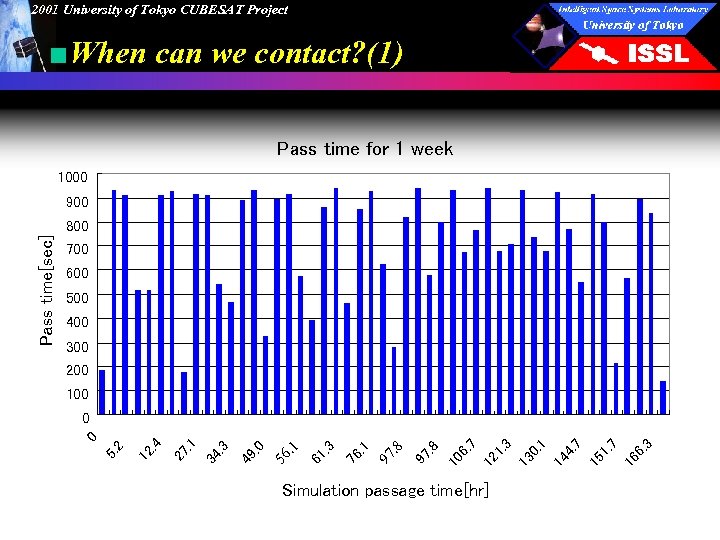
2001 University of Tokyo CUBESAT Project ■When can we contact? (1) Pass time for 1 week 1000 900 700 600 500 400 300 200 100 0 Simulation passage time[hr] 6. 3 16 1. 7 15 4. 7 14 0. 1 13 1. 3 12 6. 7 10 97. 8 76. 1 61. 3 56. 1 49. 0 34. 3 27. 1 12. 4 5. 2 0 Pass time[sec] 800
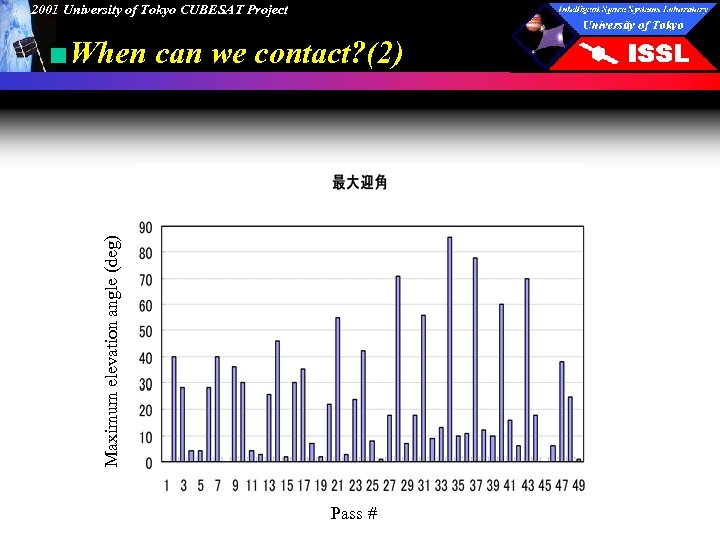
2001 University of Tokyo CUBESAT Project Maximum elevation angle (deg) ■When can we contact? (2) Pass #
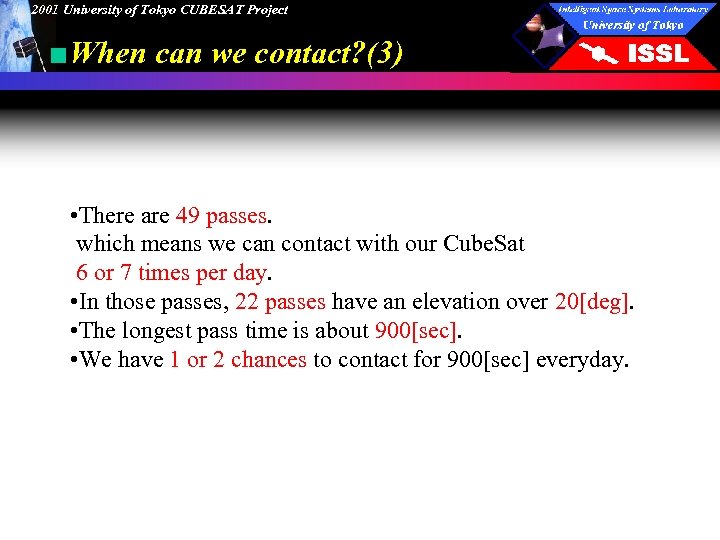
2001 University of Tokyo CUBESAT Project ■When can we contact? (3) • There are 49 passes. which means we can contact with our Cube. Sat 6 or 7 times per day. • In those passes, 22 passes have an elevation over 20[deg]. • The longest pass time is about 900[sec]. • We have 1 or 2 chances to contact for 900[sec] everyday.
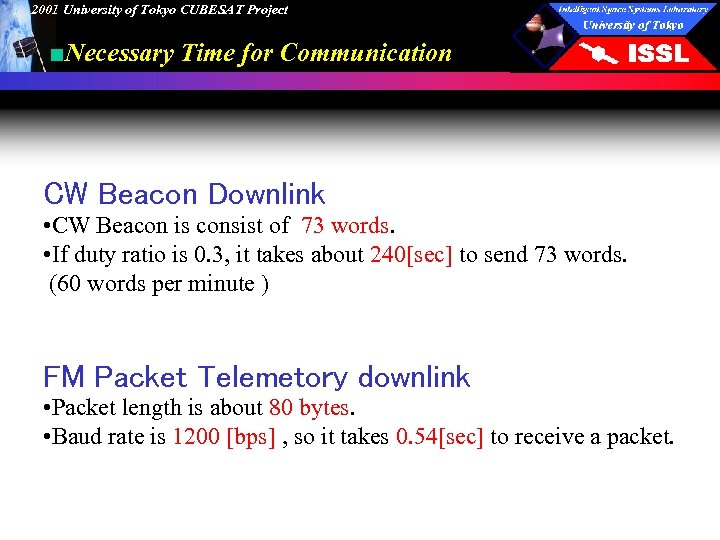
2001 University of Tokyo CUBESAT Project ■Necessary Time for Communication CW Beacon Downlink • CW Beacon is consist of 73 words. • If duty ratio is 0. 3, it takes about 240[sec] to send 73 words. (60 words per minute ) FM Packet Telemetory downlink • Packet length is about 80 bytes. • Baud rate is 1200 [bps] , so it takes 0. 54[sec] to receive a packet.
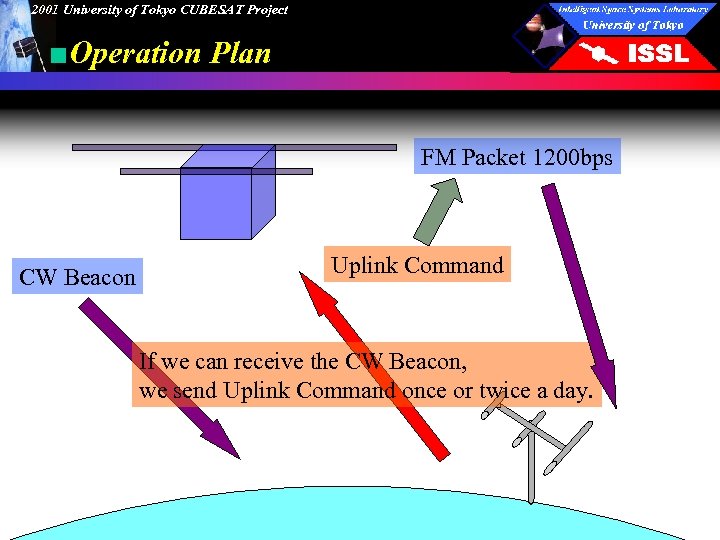
2001 University of Tokyo CUBESAT Project ■Operation Plan FM Packet 1200 bps CW Beacon Uplink Command If we can receive the CW Beacon, we send Uplink Command once or twice a day.
2001 University of Tokyo CUBESAT Project ■How to handle Downlink Data We expect it may be difficult for us to receive and decode downlink data perfectly, so we prepare backup system to get something of traces of downlink data. • Recording CW Beacon & Telemetry Packet to Mini Disk. • Original TNC skipping CRC (check sum).
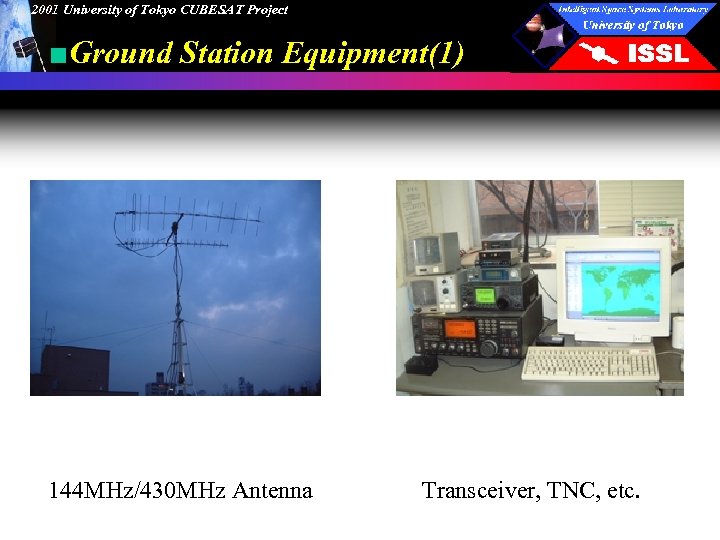
2001 University of Tokyo CUBESAT Project ■Ground Station Equipment(1) 144 MHz/430 MHz Antenna Transceiver, TNC, etc.
2001 University of Tokyo CUBESAT Project ■Ground Station Equipment(2) • 144 MHz/430 MHz cross Yagi antenna [WHS 32 N, MASPRO] • 430 MHz cross Yagi antenna (TBD) • Antenna rotator & controller for azimuth [750 FX, EMOTATOR] • Antenna rotator & controller for elevation [EV 800, EMOTATOR] • VHF/UHF multi band all mode transceiver [IC-970 J, ICOM] • VHF/UHF multi band all mode transceiver (Equipped for 9600 bps packets) [IC-910 D, ICOM]
![2001 University of Tokyo CUBESAT Project ■Ground Station Equipment(3) • TNC [TNC 505, TASCO]](https://present5.com/presentation/14c96f9eb32362df265c5284f796a4e5/image-119.jpg "2001 University of Tokyo CUBESAT Project ■Ground Station Equipment(3) • TNC [TNC 505, TASCO]")
2001 University of Tokyo CUBESAT Project ■Ground Station Equipment(3) • TNC [TNC 505, TASCO] • TNC (With function to co-decode CW signal) [TNC 555, TASCO] • TNC (Skipping CRC) [handmade] • Signal converter [I/F between PC and rotators] • Level converter [CT 17, ICOM (I/F between PC and Tranceivers] • PC (OS: Window 98) • MDLP mode MD recorder (TBD) [MDS-S 50, SONY]× 2
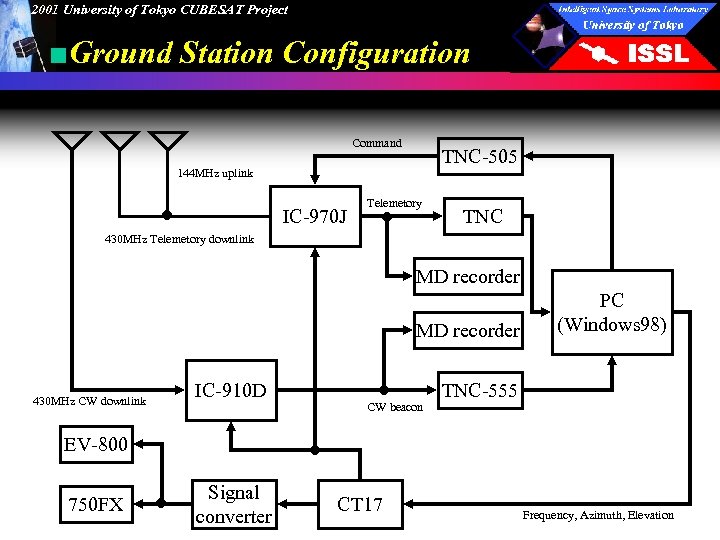
2001 University of Tokyo CUBESAT Project ■Ground Station Configuration Command TNC-505 144 MHz uplink IC-970 J Telemetory TNC 430 MHz Telemetory downlink MD recorder 430 MHz CW downlink IC-910 D CW beacon PC (Windows 98) TNC-555 EV-800 750 FX Signal converter CT 17 Frequency, Azimuth, Elevation
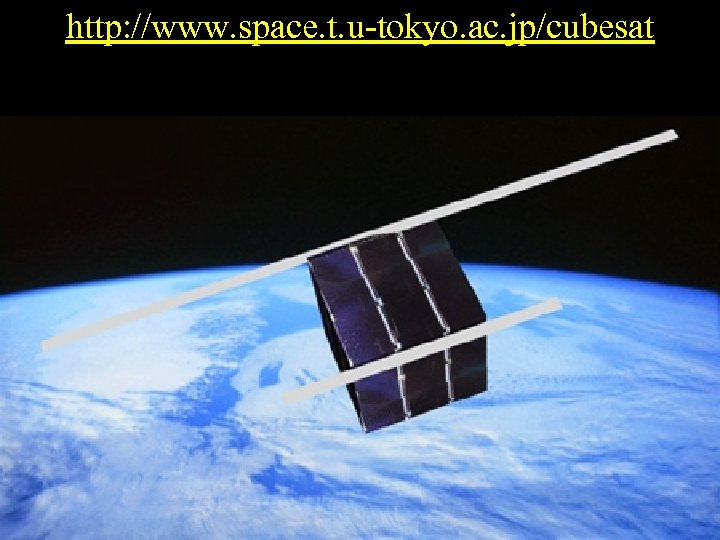
http: //www. space. t. u-tokyo. ac. jp/cubesat
2001 University of Tokyo CUBESAT Project ■Message Mission ■ Message from all over the world will be microfilmed and packed in Cube. Sat ■ Themes are • Dreams for space • Cube. Sat mission proposal etc. ■ Messages are accepted by postal cards. ■ Details are uploaded to Web. Pages
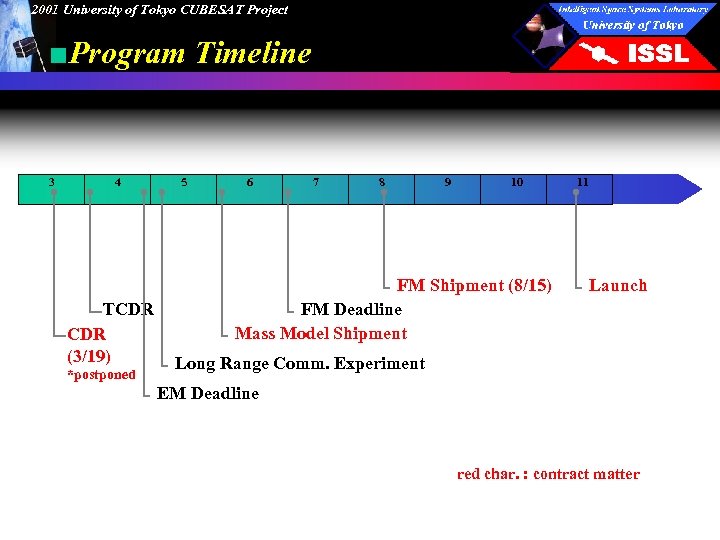
2001 University of Tokyo CUBESAT Project ■Program Timeline 3 4 TCDR (3/19) *postponed 5 6 7 8 9 10 FM Shipment (8/15) FM Deadline Mass Model Shipment 11 Launch Long Range Comm. Experiment EM Deadline red char. : contract matter
2001 University of Tokyo CUBESAT Project ■Concerns (Electronics) ■ We made a reset system for countermeasure against SEL, but still do not decide the SEL threshold current. How do we decide it and how much should we have a margin for it? ■ For countermeasure against SEU, we will set only Watch Dog Timer. Is it enough? How can we detect SEU?
2001 University of Tokyo CUBESAT Project ■Concerns (Communication) ■ When and by whom will our Cube. Sat’s call sign be distributed? ■ Only one frequency band is allocated for up-link command. If some developers uses the same protocol (ex. AX. 25), how each Cubesat distinguishes its GS’s command from other GS’s command? Are there any regulations? ■ Does our Cubesat require an impedance matching circuit between transceiver and antenna? ■ Is it necessary to conduct a radiation environment test to FSK modulator-demodulator? ■ Must our Cubesat equip space rated coaxial cable? Now, we are planning to use normal one (1. 5 D 2 V).
2001 University of Tokyo CUBESAT Project ■Concerns (Environment) ■ thermal vacuum testing regulation for Flight Model ■ TML, CVCM limits ■ the Vibration testing on Flight Model.
2001 University of Tokyo CUBESAT Project ■Concerns (Power) ■ Is the use of a permanent magnet permitted? ■ When can we charge batteries last?
2001 University of Tokyo CUBESAT Project ■Concerns (Ground) ■ How can we get the orbital information of our Cube. Sat?
Скачать презентацию 2001 University of Tokyo CUBESAT Project University of
14c96f9eb32362df265c5284f796a4e5.ppt