 Скачать презентацию 20 1 The Basics of Futures Contracts
de55c371e0baf320eda5fc3fafb0aa48.ppt
- Количество слайдов: 9



20. 1 The Basics of Futures Contracts • Futures (versus forwards) • Allow individuals and firms to buy and sell specific amounts of foreign currency at an agreed-upon price determined on a given future day • Traded on an exchange (e. g. , CME Group, NYSE Euronex’s LIFFE CONNECT, and Tokyo Financial Exchange) • Standardized, smaller amounts (e. g. , ¥ 12. 5 M, € 125, 000, C$100, 000) • Fixed maturities (e. g. , 30, 60, 90, 180, 360 days) • Credit risk • Futures brokerage firms register with the Commodity futures trading commission (CFTC) as a futures commission merchant (FCM) • Clearing member/clearinghouse 20 -1 © 2012 Pearson Education, Inc. All rights reserved.
20. 1 The Basics of Futures Contracts • Margins • Credit risk is handled by setting up an account called a margin account, wherein they deposit an asset to act as collateral • The first asset is called the initial margin • Asset can be cash, U. S. govt obligations, securities listed on NYSE and American Stock Exchange, gold warehouse receipts or letters of credit • Depend on size of contract and variability of currency involved) • Marking to market – deposit of daily losses/profits • Maintenance margins – minimum amount that must be kept in the account to guard against severe fluctuations in the futures prices (for CME, about $1, 500 for USD/GBP and $4, 500 for JPY/USD) 20 -2 © 2012 Pearson Education, Inc. All rights reserved.
20. 1 The Basics of Futures Contracts • Margin call – when the value of the margin account reaches the maintenance margin • the account must be brought back up to its initial value 20 -3 © 2012 Pearson Education, Inc. All rights reserved.
20. 2 Hedging Transaction Risk with Futures • Potential problems with a futures hedge – What if you need to hedge an odd amount? – What if the contract delivery date doesn’t match your receivable/payable date? – Basis risk – if the price of the futures contract does not move one-for-one with the spot exchange rate • Basis=Spot price – Futures price = S(t) – f(t, T) 20 -4 © 2012 Pearson Education, Inc. All rights reserved.

20. 3 Basics of Foreign Currency Option Contracts • Gives the buyer the right, but not the obligation to buy (call) or sell (put) a specific amount of foreign currency for domestic currency at a specific forex rate • Price is called the premium • Traded by money center banks and exchanges (e. g. , NASDAQ OMX PHLX) • European vs. American options: European options can only be exercised on maturity date; Americans can be exercised anytime (i. e. , “early exercise” is permitted) • Strike/exercise price (“K”) – forex rate in the contract • Intrinsic value – revenue from exercising an option • In the money/out of the money/at-the-money • • 20 -5 Call option: max[S-K, 0] Put option: max[K-S, 0] © 2012 Pearson Education, Inc. All rights reserved.
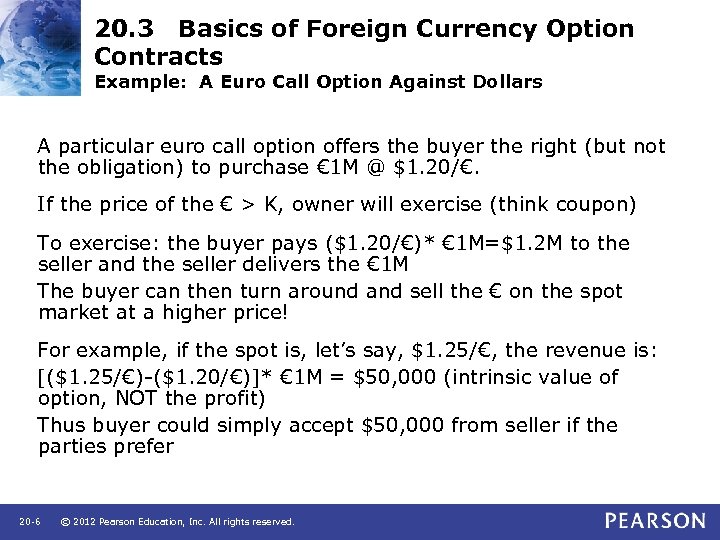
20. 3 Basics of Foreign Currency Option Contracts Example: A Euro Call Option Against Dollars A particular euro call option offers the buyer the right (but not the obligation) to purchase € 1 M @ $1. 20/€. If the price of the € > K, owner will exercise (think coupon) To exercise: the buyer pays ($1. 20/€)* € 1 M=$1. 2 M to the seller and the seller delivers the € 1 M The buyer can then turn around and sell the € on the spot market at a higher price! For example, if the spot is, let’s say, $1. 25/€, the revenue is: [($1. 25/€)-($1. 20/€)]* € 1 M = $50, 000 (intrinsic value of option, NOT the profit) Thus buyer could simply accept $50, 000 from seller if the parties prefer 20 -6 © 2012 Pearson Education, Inc. All rights reserved.
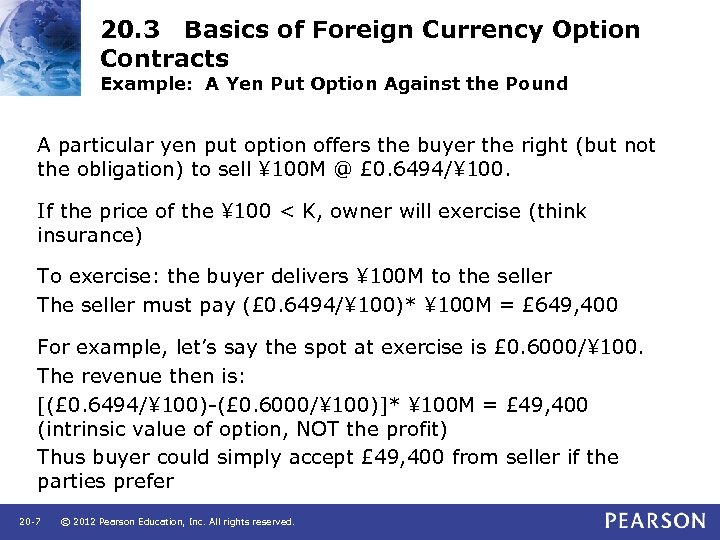
20. 3 Basics of Foreign Currency Option Contracts Example: A Yen Put Option Against the Pound A particular yen put option offers the buyer the right (but not the obligation) to sell ¥ 100 M @ £ 0. 6494/¥ 100. If the price of the ¥ 100 < K, owner will exercise (think insurance) To exercise: the buyer delivers ¥ 100 M to the seller The seller must pay (£ 0. 6494/¥ 100)* ¥ 100 M = £ 649, 400 For example, let’s say the spot at exercise is £ 0. 6000/¥ 100. The revenue then is: [(£ 0. 6494/¥ 100)-(£ 0. 6000/¥ 100)]* ¥ 100 M = £ 49, 400 (intrinsic value of option, NOT the profit) Thus buyer could simply accept £ 49, 400 from seller if the parties prefer 20 -7 © 2012 Pearson Education, Inc. All rights reserved.
20. 4 The Use of Options in Risk Management • A bidding situation at Bagwell Construction – U. S. company wants to bid on a building in Tokyo (in yen) • Transaction risk since bid is in yen • Can’t use forward hedge because if they don’t win, it would be a liability regardless! • Option allows flexibility in case they don’t win! • Using options to hedge transaction risk • Forward/futures contracts don’t allow you to benefit from the “up” side • Allows a hedge but maintains the upside potential from favorable exchange rate changes 20 -8 © 2012 Pearson Education, Inc. All rights reserved.
20. 4 The Use of Options in Risk Management • Hedging with options as buying insurance • Hedging foreign currency risk with forwards and options • Options as insurance contracts • As amount of coverage increases so does the cost (premium) to insure • Changing the quality of the insurance policy – make ceiling on our cost of the foreign currency as low as possible 20 -9 © 2012 Pearson Education, Inc. All rights reserved.
Скачать презентацию 20 1 The Basics of Futures Contracts
de55c371e0baf320eda5fc3fafb0aa48.ppt