 Скачать презентацию 2 The Global Environment and Operations Strategy Power
39ab2cd2164aee2cbe3abbb30a74f6f3.ppt
- Количество слайдов: 50



2 The Global Environment and Operations Strategy Power. Point presentation to accompany Heizer and Render Operations Management, 10 e, Global Edition Principles of Operations Management, 8 e, Global Edition Power. Point slides by Jeff Heyl © 2011 Pearson Education 2 -1
Global Strategies u Boeing – sales and production are worldwide u Sony – purchases components from suppliers in Thailand, Malaysia, and around the world © 2011 Pearson Education 2 -2
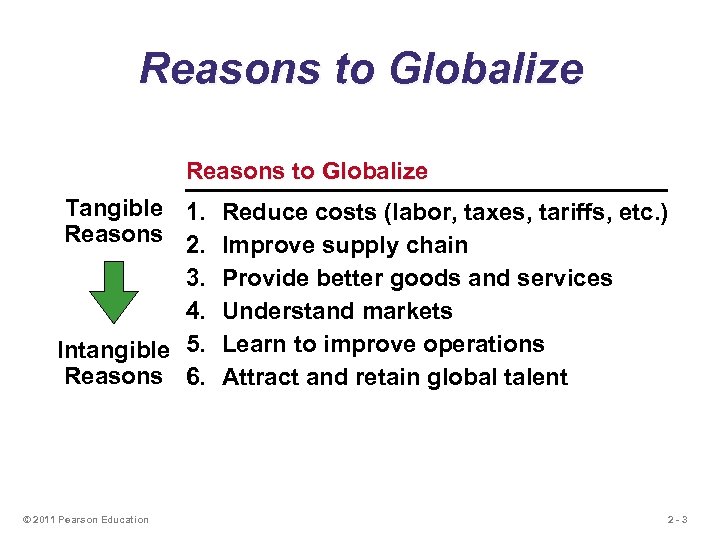
Reasons to Globalize Tangible 1. Reduce costs (labor, taxes, tariffs, etc. ) Reasons 2. Improve supply chain 3. Provide better goods and services 4. Understand markets Intangible 5. Learn to improve operations Reasons 6. Attract and retain global talent © 2011 Pearson Education 2 -3
Reduce Costs u Foreign locations with lower wage rates can lower direct and indirect costs u World Trade Organization (WTO) u North American Free Trade Agreement (NAFTA) u APEC, SEATO, CAFTA u European Union (EU) © 2011 Pearson Education 2 -4
Improve the Supply Chain u Locating facilities closer to unique resources u Auto design to California u Athletic shoe production to China u Perfume manufacturing in France © 2011 Pearson Education 2 -5
Provide Better Goods and Services u Objective and subjective characteristics of goods and services u On-time deliveries u Cultural variables u Improved customer service © 2011 Pearson Education 2 -6
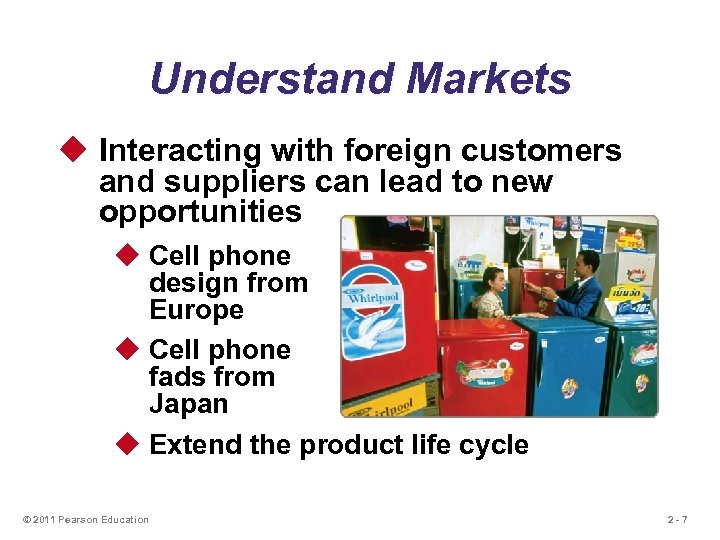
Understand Markets u Interacting with foreign customers and suppliers can lead to new opportunities u Cell phone design from Europe u Cell phone fads from Japan u Extend the product life cycle © 2011 Pearson Education 2 -7
Learn to Improve Operations u Remain open to the free flow of ideas u General Motors partnered with a Japanese auto manufacturer to learn new approaches to production and inventory control u Equipment and layout have been improved using Scandinavian ergonomic competence © 2011 Pearson Education 2 -8
Attract and Retain Global Talent u Offer better employment opportunities u Better growth opportunities and insulation against unemployment u Relocate unneeded personnel to more prosperous locations © 2011 Pearson Education 2 -9
Cultural and Ethical Issues u Cultures can be quite different u Attitudes can be quite different towards u Punctuality u Thievery u Lunch breaks u Bribery u Environment u Child labor u Intellectual property © 2011 Pearson Education 2 - 10
Companies Want To Consider u National literacy rate u Work ethic u Rate of innovation u Tax rates u Rate of technology change u Inflation u Number of skilled workers u Political stability u Product liability laws u Availability of raw materials u Interest rates u Population u Export restrictions u Number of miles of highway u Variations in language u Phone system © 2011 Pearson Education 2 - 11
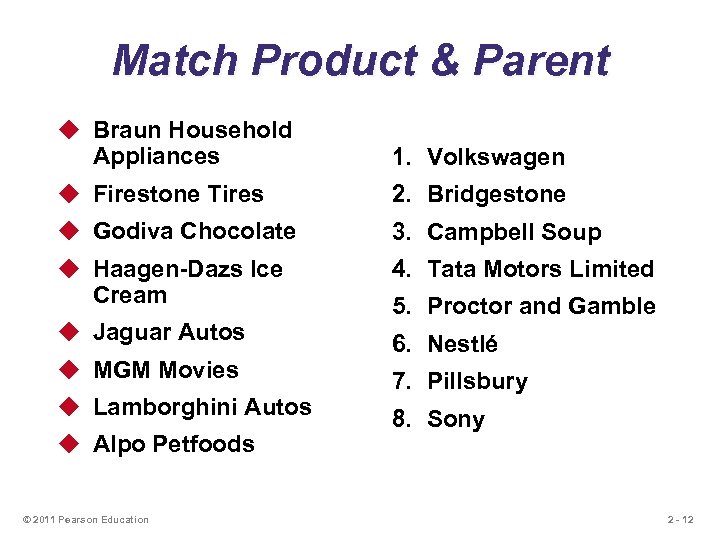
Match Product & Parent u Braun Household Appliances 1. Volkswagen u Firestone Tires 2. Bridgestone u Godiva Chocolate 3. Campbell Soup u Haagen-Dazs Ice Cream 4. Tata Motors Limited u Jaguar Autos 6. Nestlé u MGM Movies u Lamborghini Autos u Alpo Petfoods © 2011 Pearson Education 5. Proctor and Gamble 7. Pillsbury 8. Sony 2 - 12
Developing Missions and Strategies Mission statements tell an organization where it is going The Strategy tells the organization how to get there © 2011 Pearson Education 2 - 13
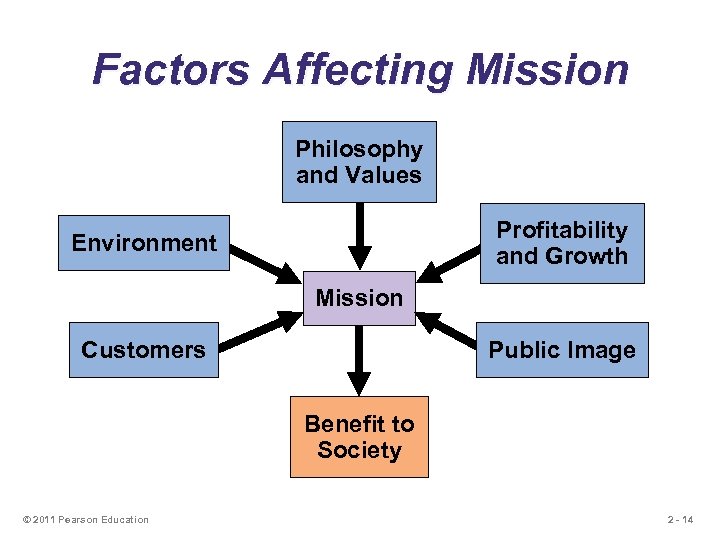
Factors Affecting Mission Philosophy and Values Profitability and Growth Environment Mission Customers Public Image Benefit to Society © 2011 Pearson Education 2 - 14
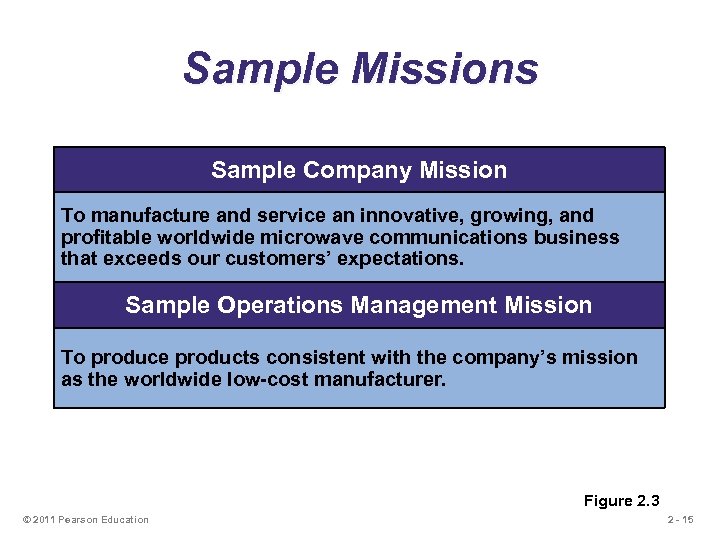
Sample Missions Sample Company Mission To manufacture and service an innovative, growing, and profitable worldwide microwave communications business that exceeds our customers’ expectations. Sample Operations Management Mission To produce products consistent with the company’s mission as the worldwide low-cost manufacturer. Figure 2. 3 © 2011 Pearson Education 2 - 15
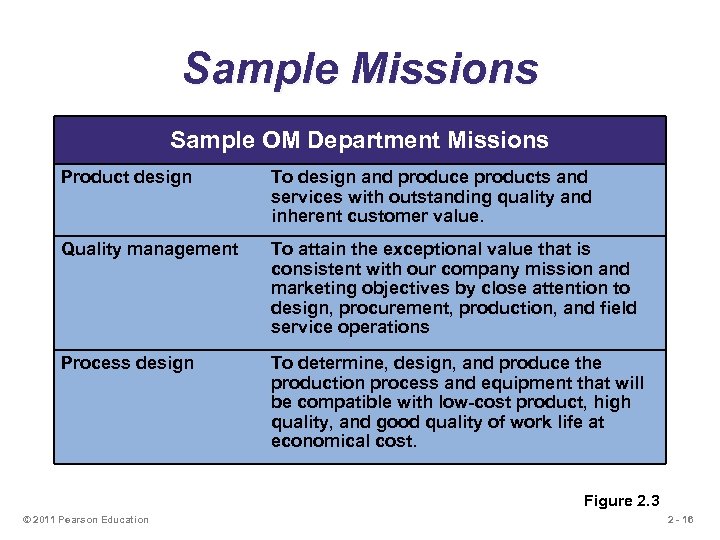
Sample Missions Sample OM Department Missions Product design To design and produce products and services with outstanding quality and inherent customer value. Quality management To attain the exceptional value that is consistent with our company mission and marketing objectives by close attention to design, procurement, production, and field service operations Process design To determine, design, and produce the production process and equipment that will be compatible with low-cost product, high quality, and good quality of work life at economical cost. Figure 2. 3 © 2011 Pearson Education 2 - 16
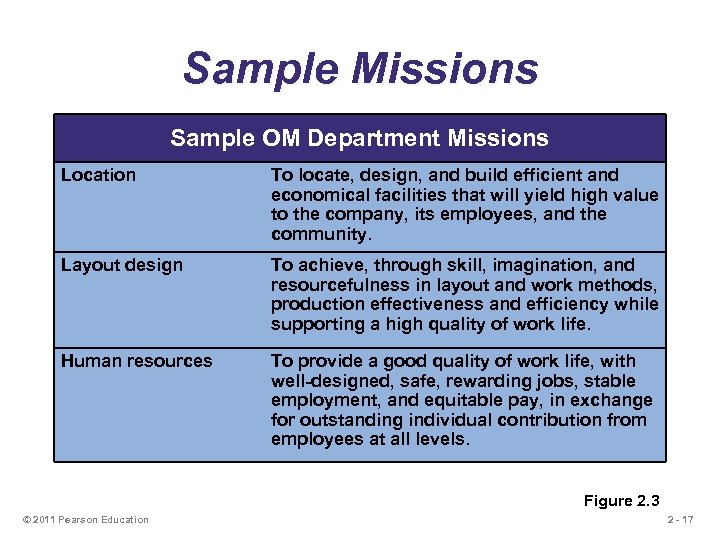
Sample Missions Sample OM Department Missions Location To locate, design, and build efficient and economical facilities that will yield high value to the company, its employees, and the community. Layout design To achieve, through skill, imagination, and resourcefulness in layout and work methods, production effectiveness and efficiency while supporting a high quality of work life. Human resources To provide a good quality of work life, with well-designed, safe, rewarding jobs, stable employment, and equitable pay, in exchange for outstanding individual contribution from employees at all levels. Figure 2. 3 © 2011 Pearson Education 2 - 17
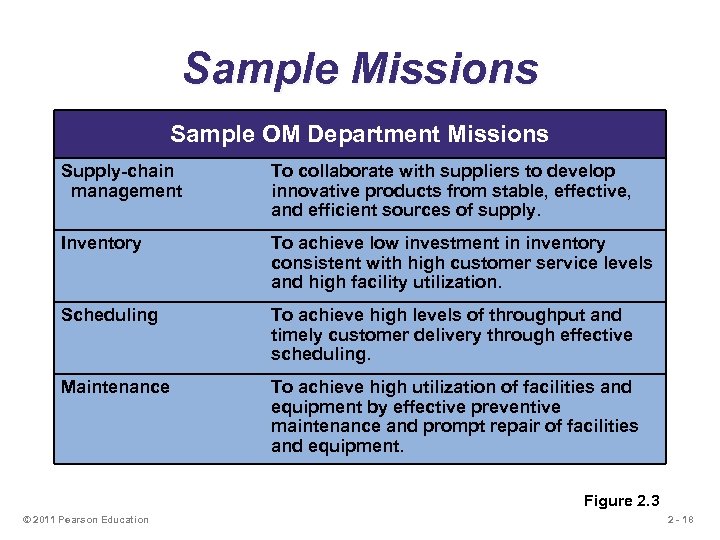
Sample Missions Sample OM Department Missions Supply-chain management To collaborate with suppliers to develop innovative products from stable, effective, and efficient sources of supply. Inventory To achieve low investment in inventory consistent with high customer service levels and high facility utilization. Scheduling To achieve high levels of throughput and timely customer delivery through effective scheduling. Maintenance To achieve high utilization of facilities and equipment by effective preventive maintenance and prompt repair of facilities and equipment. Figure 2. 3 © 2011 Pearson Education 2 - 18
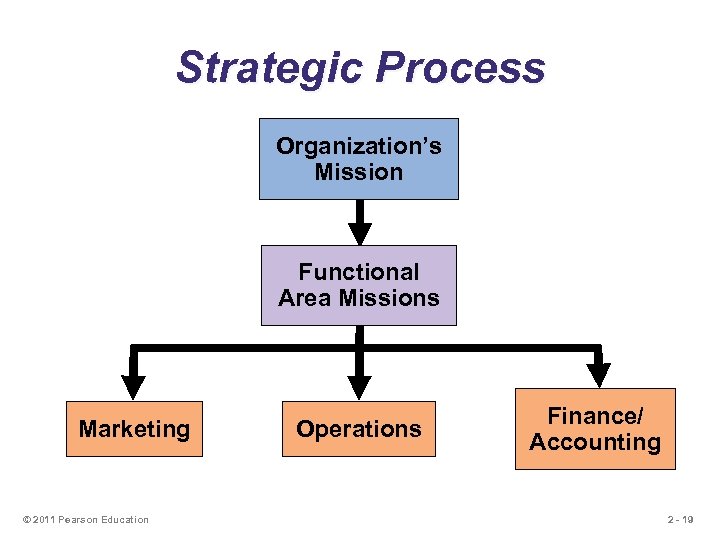
Strategic Process Organization’s Mission Functional Area Missions Marketing © 2011 Pearson Education Operations Finance/ Accounting 2 - 19
Strategy u Action plan to achieve mission u Functional areas have strategies u Strategies exploit opportunities and strengths, neutralize threats, and avoid weaknesses © 2011 Pearson Education 2 - 20
Strategies for Competitive Advantage u Differentiation – better, or at least different u Cost leadership – cheaper u Response – rapid response © 2011 Pearson Education 2 - 21
Competing on Differentiation Uniqueness can go beyond both the physical characteristics and service attributes to encompass everything that impacts customer’s perception of value u Safeskin gloves – leading edge products u Walt Disney Magic Kingdom – experience differentiation u Hard Rock Cafe – dining experience © 2011 Pearson Education 2 - 22
Competing on Cost Provide the maximum value as perceived by customer. Does not imply low quality. u Southwest Airlines – secondary airports, no frills service, efficient utilization of equipment u Wal-Mart – small overhead, shrinkage, distribution costs u Franz Colruyt – no bags, low light, no music, doors on freezers © 2011 Pearson Education 2 - 23
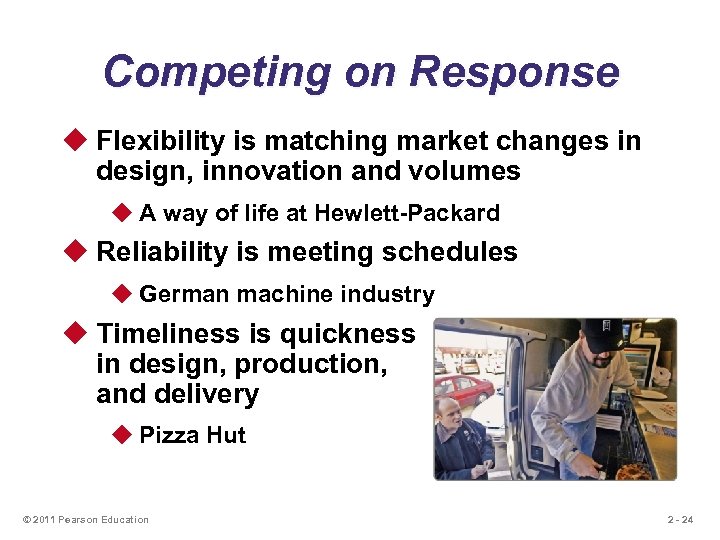
Competing on Response u Flexibility is matching market changes in design, innovation and volumes u A way of life at Hewlett-Packard u Reliability is meeting schedules u German machine industry u Timeliness is quickness in design, production, and delivery u Pizza Hut © 2011 Pearson Education 2 - 24
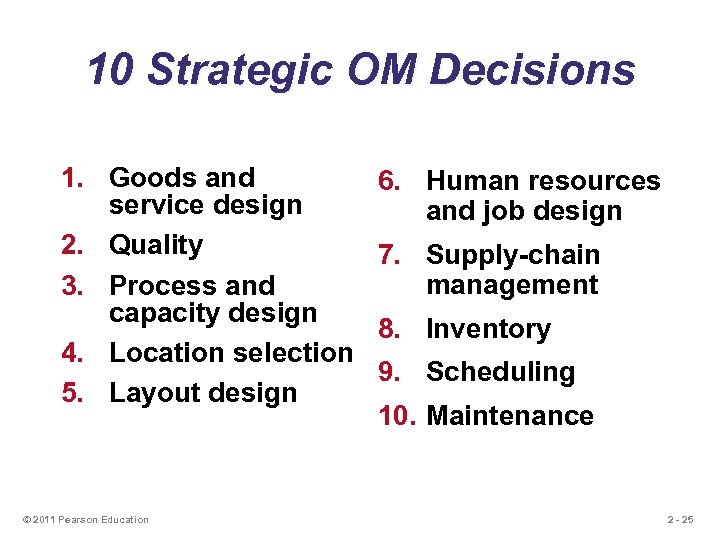
10 Strategic OM Decisions 1. Goods and service design 2. Quality 3. Process and capacity design 4. Location selection 5. Layout design © 2011 Pearson Education 6. Human resources and job design 7. Supply-chain management 8. Inventory 9. Scheduling 10. Maintenance 2 - 25
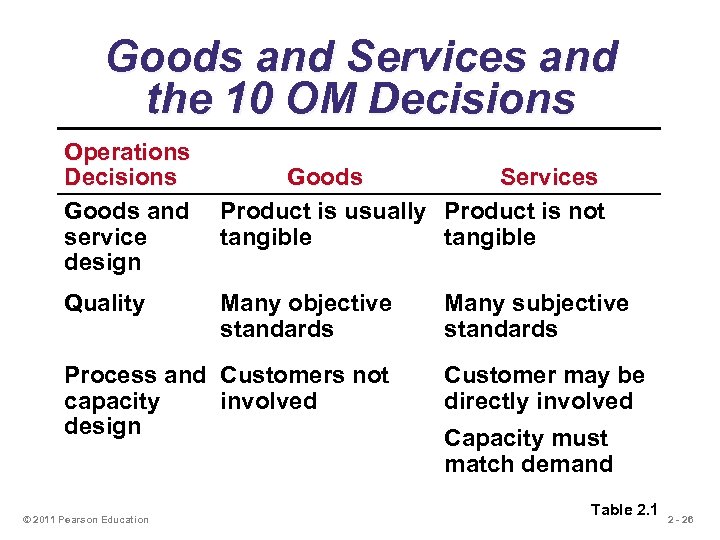
Goods and Services and the 10 OM Decisions Operations Decisions Goods and service design Quality Goods Services Product is usually Product is not tangible Many objective standards Process and Customers not capacity involved design © 2011 Pearson Education Many subjective standards Customer may be directly involved Capacity must match demand Table 2. 1 2 - 26
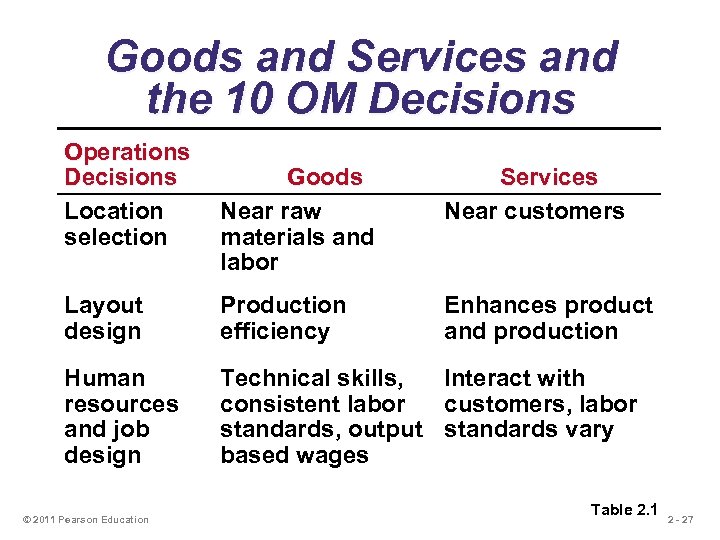
Goods and Services and the 10 OM Decisions Operations Decisions Location selection Goods Near raw materials and labor Services Near customers Layout design Production efficiency Enhances product and production Human resources and job design Technical skills, Interact with consistent labor customers, labor standards, output standards vary based wages © 2011 Pearson Education Table 2. 1 2 - 27
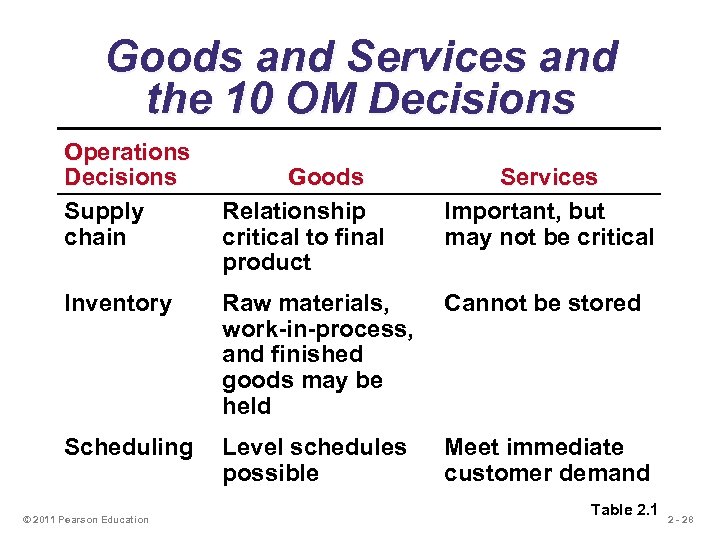
Goods and Services and the 10 OM Decisions Operations Decisions Supply chain Goods Relationship critical to final product Services Important, but may not be critical Inventory Raw materials, work-in-process, and finished goods may be held Cannot be stored Scheduling Level schedules possible Meet immediate customer demand © 2011 Pearson Education Table 2. 1 2 - 28
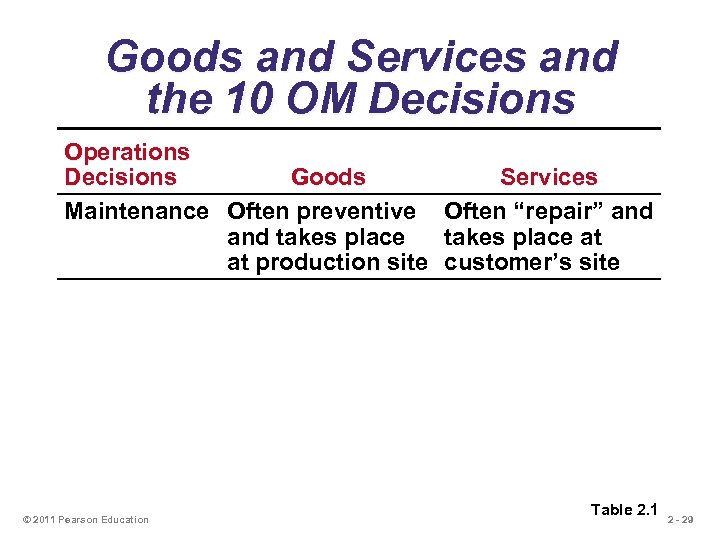
Goods and Services and the 10 OM Decisions Operations Decisions Goods Services Maintenance Often preventive Often “repair” and takes place at at production site customer’s site © 2011 Pearson Education Table 2. 1 2 - 29
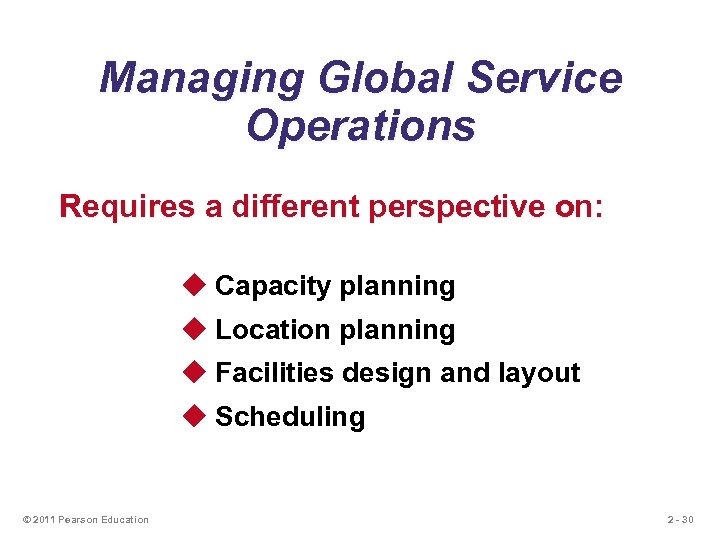
Managing Global Service Operations Requires a different perspective on: u Capacity planning u Location planning u Facilities design and layout u Scheduling © 2011 Pearson Education 2 - 30
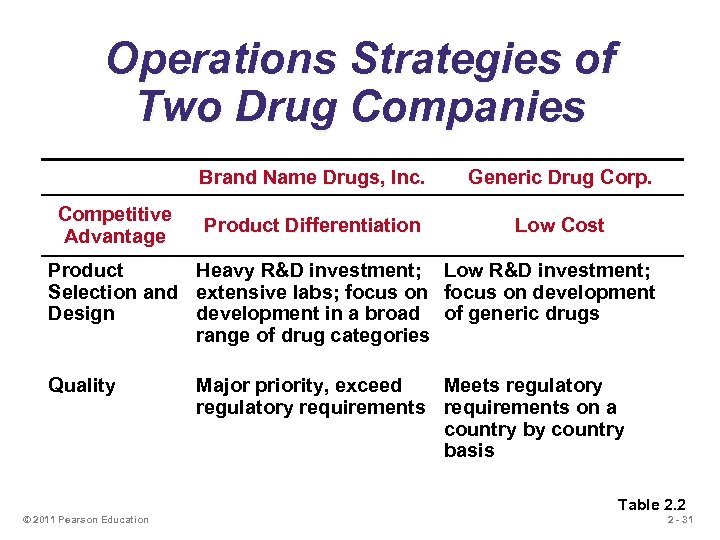
Operations Strategies of Two Drug Companies Brand Name Drugs, Inc. Competitive Advantage Generic Drug Corp. Product Differentiation Low Cost Product Heavy R&D investment; Low R&D investment; Selection and extensive labs; focus on development Design development in a broad of generic drugs range of drug categories Quality Major priority, exceed Meets regulatory requirements on a country by country basis Table 2. 2 © 2011 Pearson Education 2 - 31
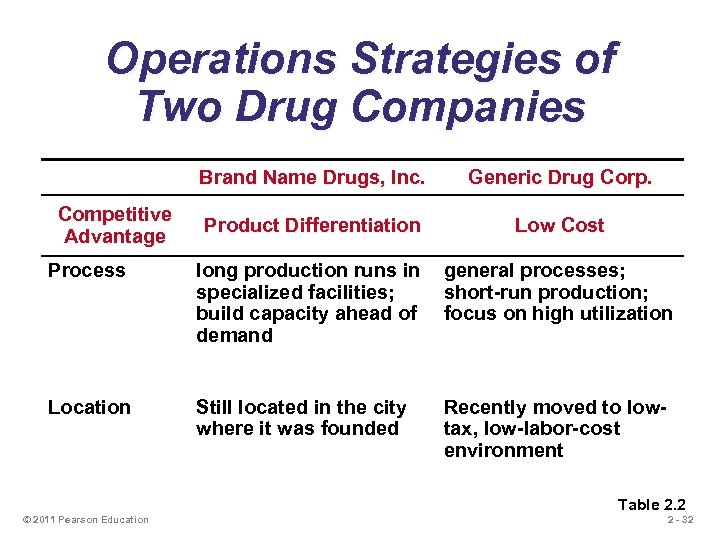
Operations Strategies of Two Drug Companies Brand Name Drugs, Inc. Generic Drug Corp. Product Differentiation Low Cost Process long production runs in specialized facilities; build capacity ahead of demand general processes; short-run production; focus on high utilization Location Still located in the city where it was founded Recently moved to lowtax, low-labor-cost environment Competitive Advantage Table 2. 2 © 2011 Pearson Education 2 - 32
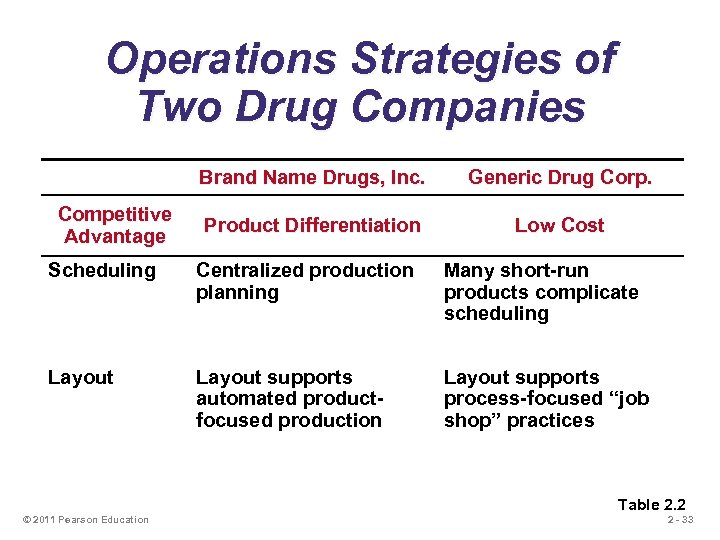
Operations Strategies of Two Drug Companies Brand Name Drugs, Inc. Competitive Advantage Generic Drug Corp. Product Differentiation Low Cost Scheduling Centralized production planning Many short-run products complicate scheduling Layout supports automated productfocused production Layout supports process-focused “job shop” practices Table 2. 2 © 2011 Pearson Education 2 - 33
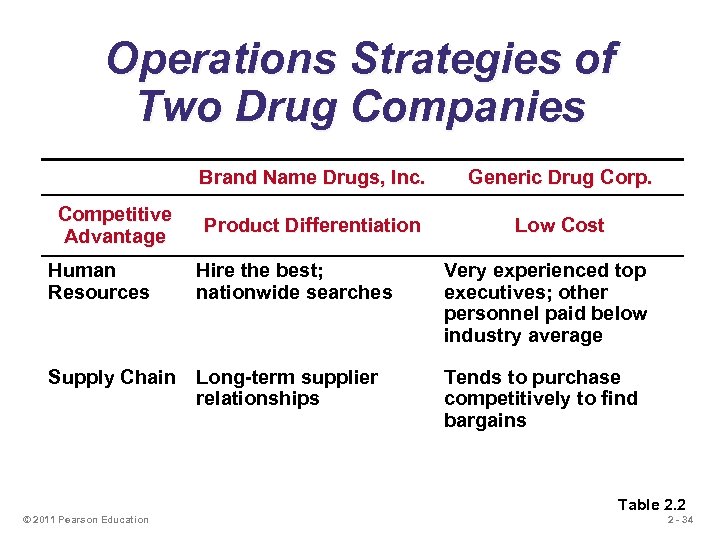
Operations Strategies of Two Drug Companies Brand Name Drugs, Inc. Competitive Advantage Generic Drug Corp. Product Differentiation Low Cost Human Resources Hire the best; nationwide searches Very experienced top executives; other personnel paid below industry average Supply Chain Long-term supplier relationships Tends to purchase competitively to find bargains Table 2. 2 © 2011 Pearson Education 2 - 34
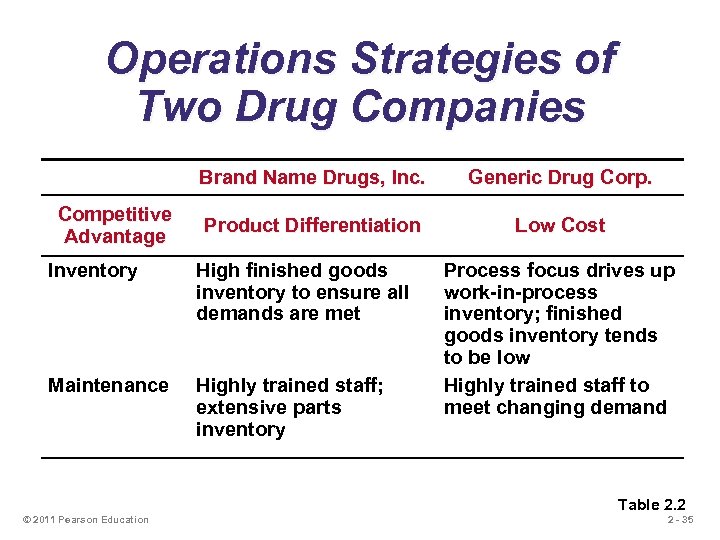
Operations Strategies of Two Drug Companies Brand Name Drugs, Inc. Competitive Advantage Generic Drug Corp. Product Differentiation Low Cost Inventory High finished goods inventory to ensure all demands are met Maintenance Highly trained staff; extensive parts inventory Process focus drives up work-in-process inventory; finished goods inventory tends to be low Highly trained staff to meet changing demand Table 2. 2 © 2011 Pearson Education 2 - 35
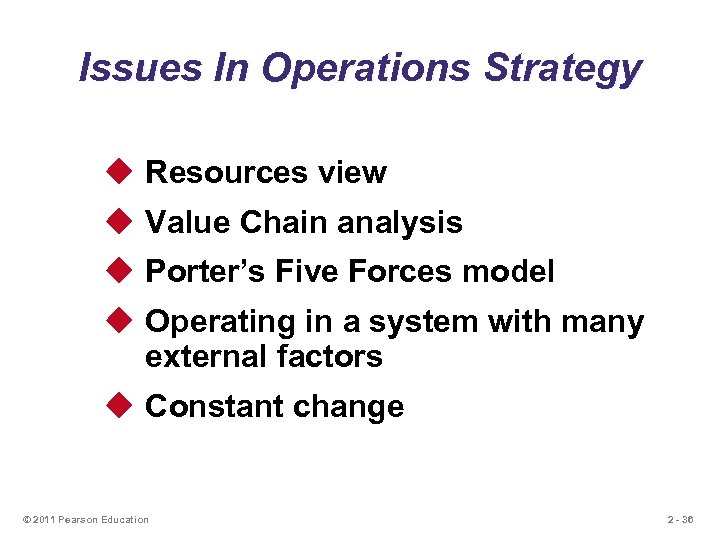
Issues In Operations Strategy u Resources view u Value Chain analysis u Porter’s Five Forces model u Operating in a system with many external factors u Constant change © 2011 Pearson Education 2 - 36
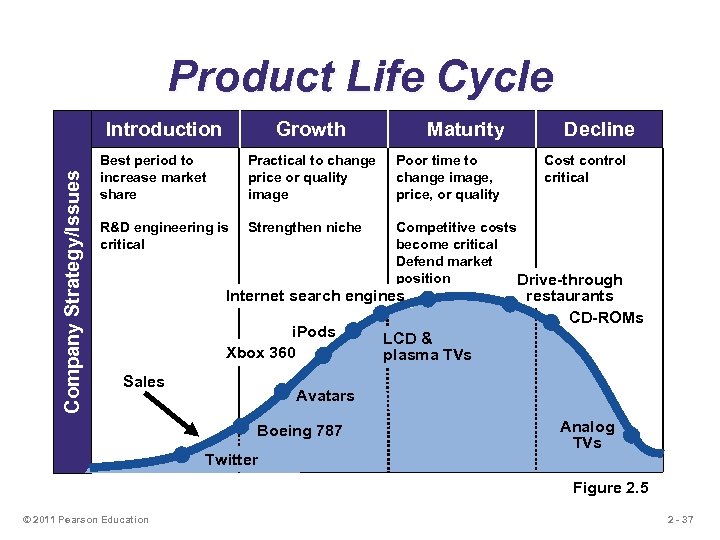
Product Life Cycle Company Strategy/Issues Introduction Growth Maturity Decline Best period to increase market share Practical to change price or quality image Poor time to change image, price, or quality R&D engineering is critical Strengthen niche Competitive costs become critical Defend market position Drive-through Internet search engines i. Pods Xbox 360 Sales Cost control critical restaurants CD-ROMs LCD & plasma TVs Avatars Boeing 787 Twitter Analog TVs Figure 2. 5 © 2011 Pearson Education 2 - 37
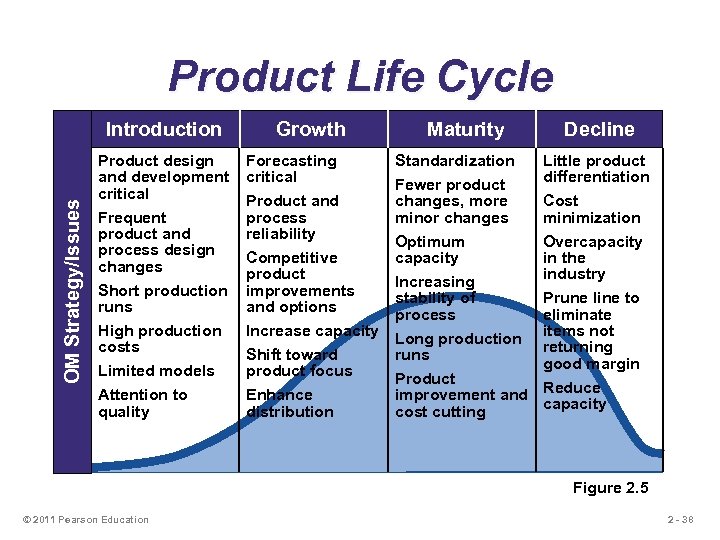
Product Life Cycle OM Strategy/Issues Introduction Product design and development critical Frequent product and process design changes Short production runs High production costs Limited models Attention to quality Growth Forecasting critical Maturity Standardization Fewer product Product and changes, more process minor changes reliability Optimum Competitive capacity product Increasing improvements stability of and options process Increase capacity Long production runs Shift toward product focus Product improvement and Enhance cost cutting distribution Decline Little product differentiation Cost minimization Overcapacity in the industry Prune line to eliminate items not returning good margin Reduce capacity Figure 2. 5 © 2011 Pearson Education 2 - 38
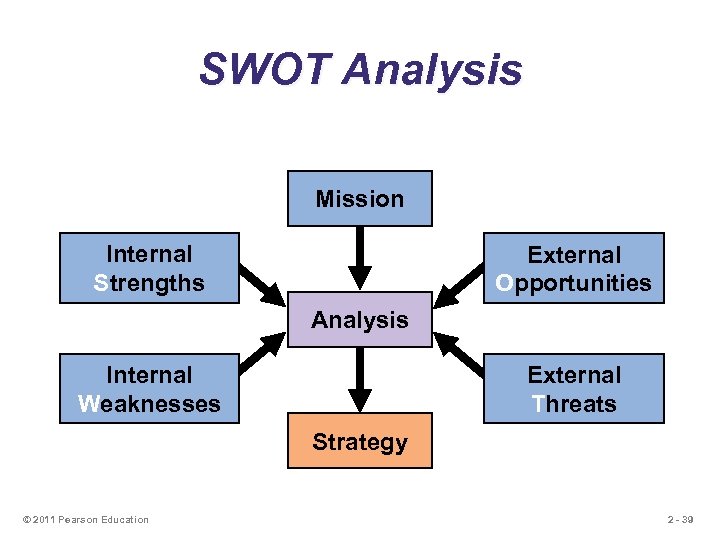
SWOT Analysis Mission Internal Strengths External Opportunities Analysis Internal Weaknesses External Threats Strategy © 2011 Pearson Education 2 - 39
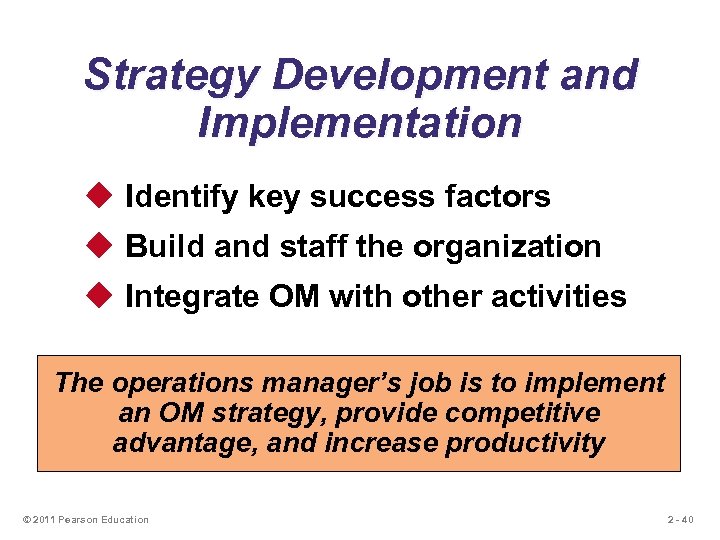
Strategy Development and Implementation u Identify key success factors u Build and staff the organization u Integrate OM with other activities The operations manager’s job is to implement an OM strategy, provide competitive advantage, and increase productivity © 2011 Pearson Education 2 - 40
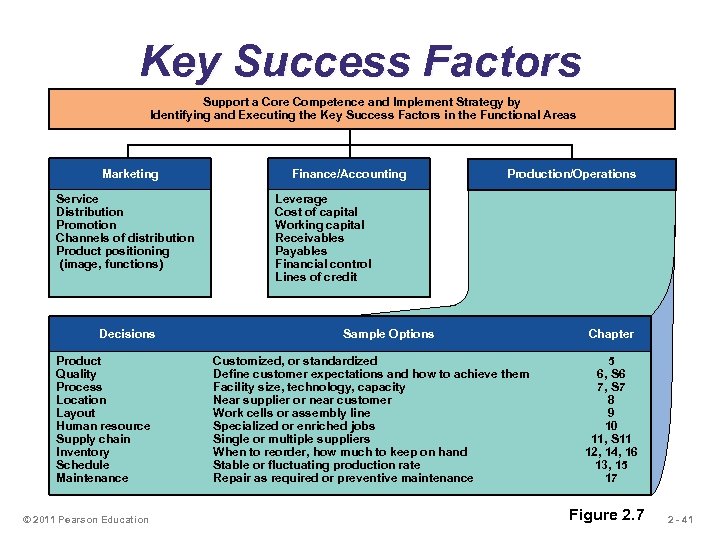
Key Success Factors Support a Core Competence and Implement Strategy by Identifying and Executing the Key Success Factors in the Functional Areas Marketing Service Distribution Promotion Channels of distribution Product positioning (image, functions) Decisions Product Quality Process Location Layout Human resource Supply chain Inventory Schedule Maintenance © 2011 Pearson Education Finance/Accounting Production/Operations Leverage Cost of capital Working capital Receivables Payables Financial control Lines of credit Sample Options Customized, or standardized Define customer expectations and how to achieve them Facility size, technology, capacity Near supplier or near customer Work cells or assembly line Specialized or enriched jobs Single or multiple suppliers When to reorder, how much to keep on hand Stable or fluctuating production rate Repair as required or preventive maintenance Chapter 5 6, S 6 7, S 7 8 9 10 11, S 11 12, 14, 16 13, 15 17 Figure 2. 7 2 - 41
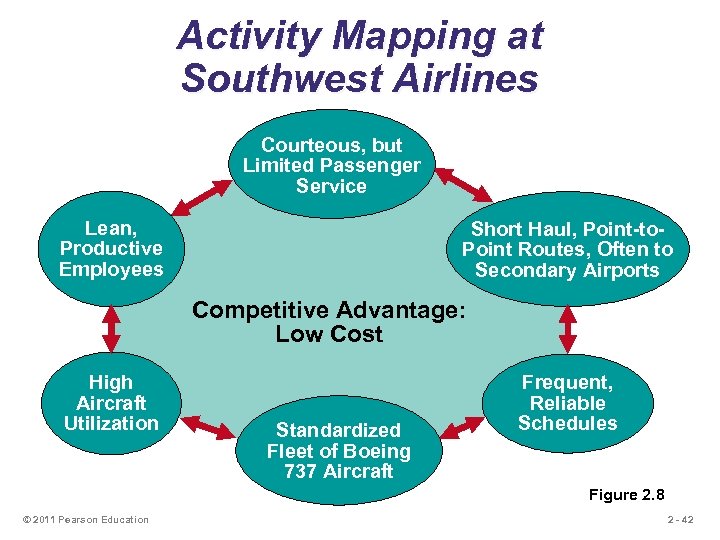
Activity Mapping at Southwest Airlines Courteous, but Limited Passenger Service Lean, Productive Employees Short Haul, Point-to. Point Routes, Often to Secondary Airports Competitive Advantage: Low Cost High Aircraft Utilization Standardized Fleet of Boeing 737 Aircraft Frequent, Reliable Schedules Figure 2. 8 © 2011 Pearson Education 2 - 42
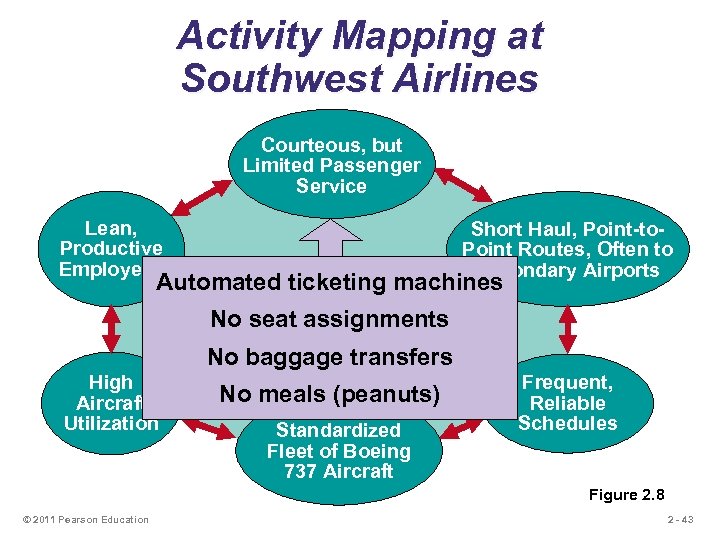
Activity Mapping at Southwest Airlines Courteous, but Limited Passenger Service Lean, Productive Employees Short Haul, Point-to. Point Routes, Often to Secondary Airports Automated ticketing machines Competitive Advantage: No seat assignments Low Cost No baggage transfers High Aircraft Utilization No meals (peanuts) Standardized Fleet of Boeing 737 Aircraft Frequent, Reliable Schedules Figure 2. 8 © 2011 Pearson Education 2 - 43
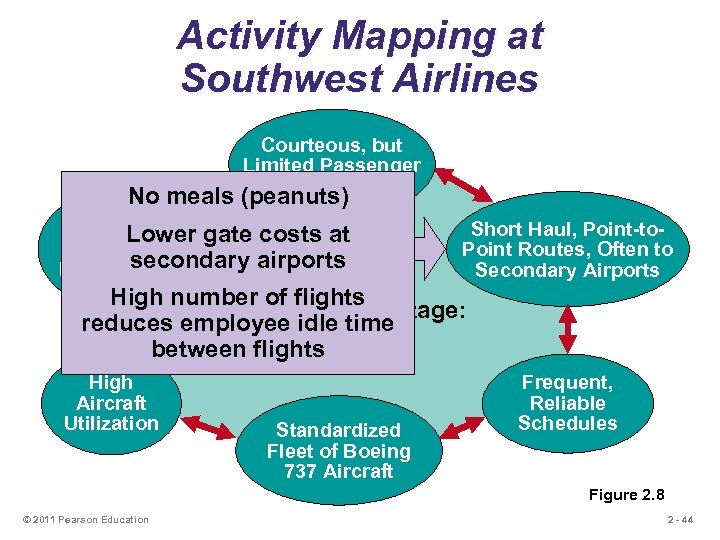
Activity Mapping at Southwest Airlines Courteous, but Limited Passenger Service No meals (peanuts) Lean, Lower gate costs at Productive secondary airports Employees Short Haul, Point-to. Point Routes, Often to Secondary Airports High number of flights Competitive Advantage: reduces employee idle time Low Cost between flights High Aircraft Utilization Standardized Fleet of Boeing 737 Aircraft Frequent, Reliable Schedules Figure 2. 8 © 2011 Pearson Education 2 - 44
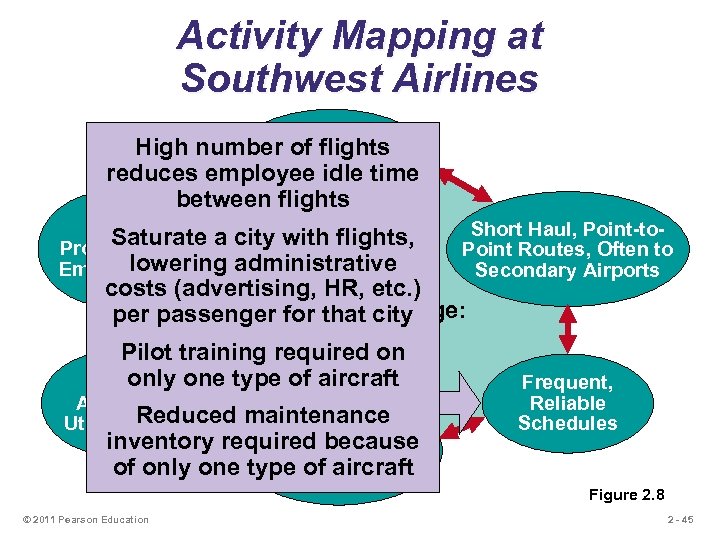
Activity Mapping at Southwest Airlines Courteous, but High number of flights Limited idle time reduces employee Passenger Service between flights Lean, Saturate a Productive lowering Employees Short Haul, Point-tocity with flights, Point Routes, Often to administrative Secondary Airports costs (advertising, HR, etc. ) Competitive Advantage: per passenger for that city Low Cost Pilot training required on only one type of aircraft High Frequent, Aircraft Reduced Utilization maintenance Standardized inventory required of Boeing Fleet because of only one type of. Aircraft 737 aircraft Reliable Schedules Figure 2. 8 © 2011 Pearson Education 2 - 45
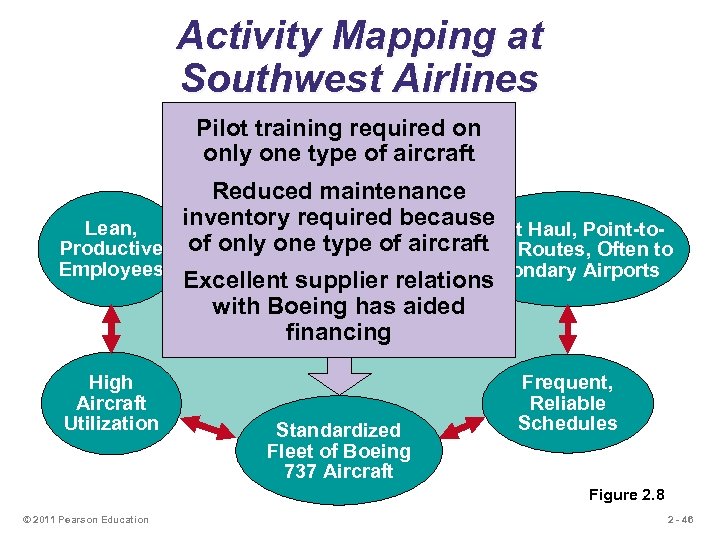
Activity Mapping at Southwest Airlines Pilot training required on Courteous, but only one type of aircraft Limited Passenger Service Reduced maintenance inventory required because Haul, Point-to. Lean, Short of only one type of aircraft Routes, Often to Productive Point Employees Secondary Airports Excellent supplier relations with Boeing has aided Competitive Advantage: financing Low Cost High Aircraft Utilization Standardized Fleet of Boeing 737 Aircraft Frequent, Reliable Schedules Figure 2. 8 © 2011 Pearson Education 2 - 46
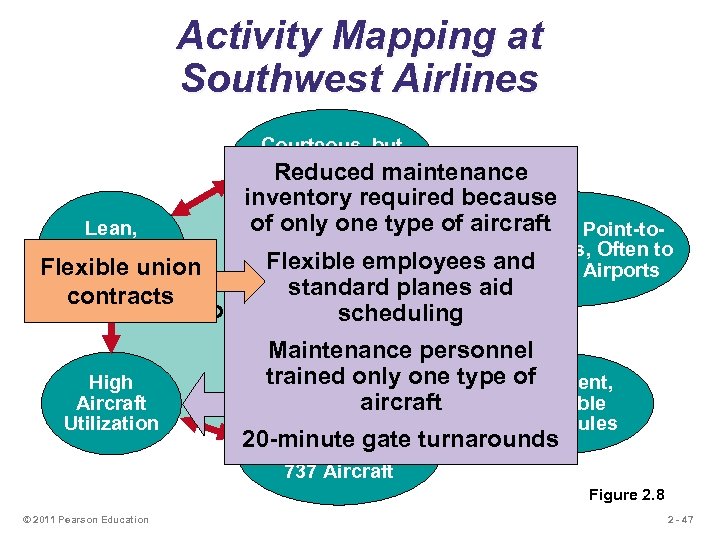
Activity Mapping at Southwest Airlines Courteous, but Limited Passenger Reduced maintenance Service Lean, Productive Flexible union Employees inventory required because of only one type of aircraft Point-to. Short Haul, Point Routes, Often to Flexible employees and Secondary Airports standard planes aid contracts Competitive Advantage: scheduling Low Cost Maintenance personnel trained only one type of High Frequent, Aircraft Reliable aircraft Utilization Standardized 20 -minute gate Fleet of Boeing 737 Aircraft Schedules turnarounds Figure 2. 8 © 2011 Pearson Education 2 - 47
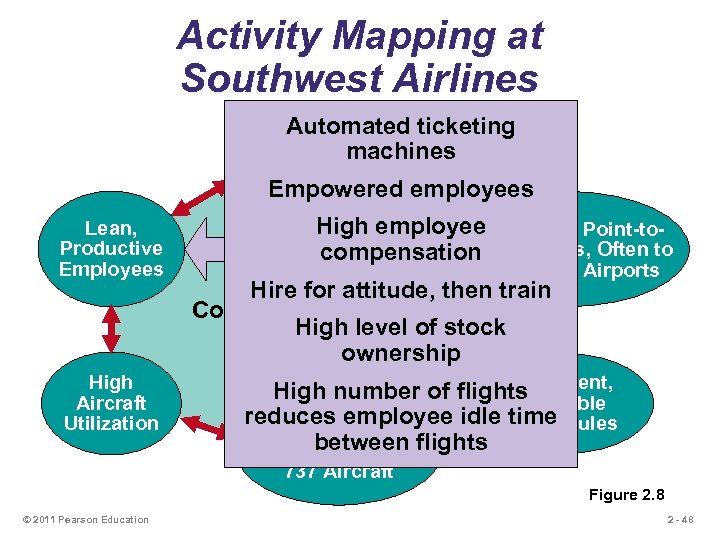
Activity Mapping at Southwest Airlines Automated ticketing Courteous, but machines Limited Passenger Service Empowered employees Lean, Productive Employees High Aircraft Utilization High employee Short Haul, Point-to. Point compensation Routes, Often to Secondary Airports Hire for attitude, then train Competitive Advantage: High level Low Cost of stock ownership Frequent, High number of flights Reliable reduces employee idle time Schedules Standardized Fleetbetween flights of Boeing 737 Aircraft Figure 2. 8 © 2011 Pearson Education 2 - 48
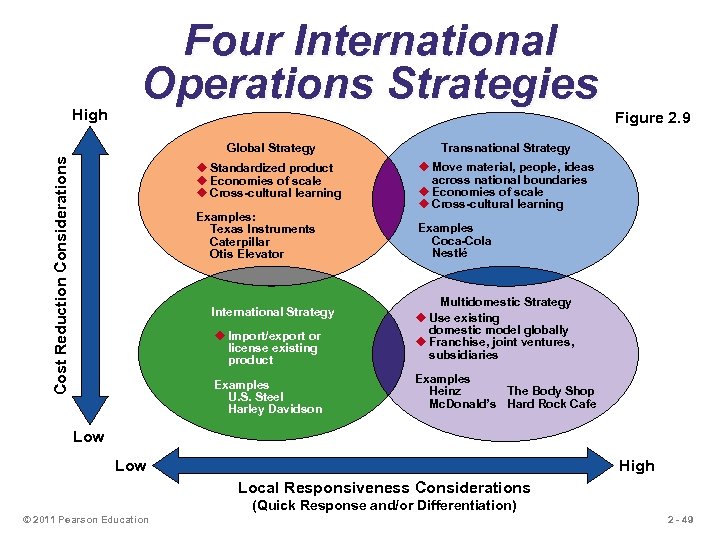
High Four International Operations Strategies Transnational Strategy u Standardized product u Economies of scale u Cross-cultural learning Cost Reduction Considerations Global Strategy Figure 2. 9 u Move material, people, ideas across national boundaries u Economies of scale u Cross-cultural learning Examples: Texas Instruments Caterpillar Otis Elevator Examples Coca-Cola Nestlé u Import/export or license existing product Multidomestic Strategy u Use existing domestic model globally u Franchise, joint ventures, subsidiaries Examples U. S. Steel Harley Davidson Examples Heinz The Body Shop Mc. Donald’s Hard Rock Cafe International Strategy Low High Local Responsiveness Considerations (Quick Response and/or Differentiation) © 2011 Pearson Education 2 - 49
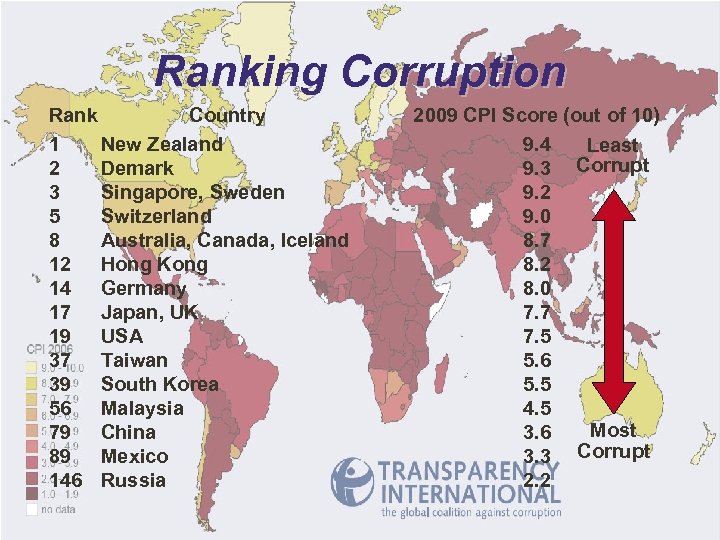
Ranking Corruption Rank Country 1 New Zealand 2 Demark 3 Singapore, Sweden 5 Switzerland 8 Australia, Canada, Iceland 12 Hong Kong 14 Germany 17 Japan, UK 19 USA 37 Taiwan 39 South Korea 56 Malaysia 79 China 89 Mexico 146 Russia © 2011 Pearson Education 2009 CPI Score (out of 10) 9. 4 Least 9. 3 Corrupt 9. 2 9. 0 8. 7 8. 2 8. 0 7. 7 7. 5 5. 6 5. 5 4. 5 Most 3. 6 3. 3 Corrupt 2. 2 2 - 50
Скачать презентацию 2 The Global Environment and Operations Strategy Power
39ab2cd2164aee2cbe3abbb30a74f6f3.ppt