 Скачать презентацию 2 nd International Conference on Universal Digital Library
57072619c25732b7afb6544d6f428bd5.ppt
- Количество слайдов: 32



2 nd International Conference on Universal Digital Library ICUDL 2006 Towards Establishing an ETD for Egyptian Universities By M. F. Tolba, T. M. Nazmy, Y. M. Abd El-Latif, E. Abdelwahab Faculty of computer and information sciences, Ain Shams University, Cairo, Egypt 1
Agenda • • Introduction, The main Components to start an ETD project, The ETD Project for The Egyptian Universities, The project objectives, • • • ASUNET reserving system, General Problems in developing an ETD, The main features of the ETD project, The ETD Consortium Conclusions. 2
Introduction • The electronic thesis and dissertation (ETD) or Networked Digital Library of Theses and Dissertations, movement is truly becoming a global phenomenon, • According to the UNESCO guide for creating Electronic Theses and Dissertations (ETDs) joining and participating in the Networked Digital Library of Theses and Dissertations, (NDLTD) is one of the best ways to understand the concepts regarding digital libraries. 3
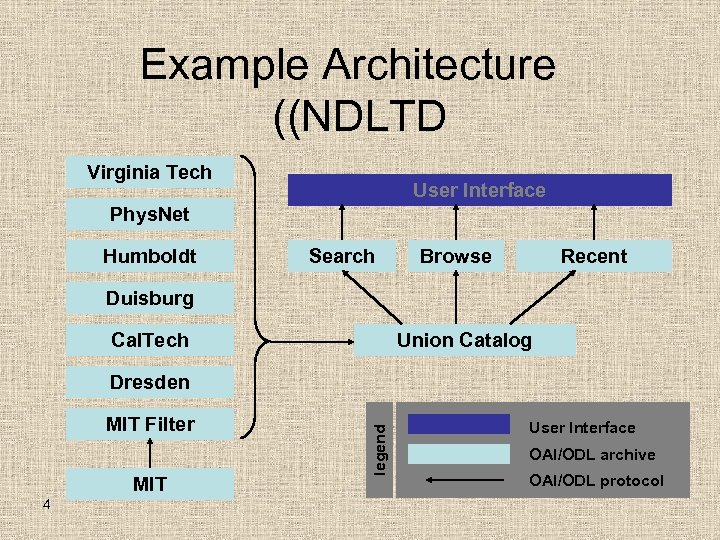
Example Architecture ((NDLTD Virginia Tech User Interface Phys. Net Humboldt Search Browse Recent Duisburg Cal. Tech Union Catalog MIT Filter MIT 4 legend Dresden User Interface OAI/ODL archive OAI/ODL protocol
General Problems in developing an ETD • Readiness: “How ready is the institution to embrace ETDs such that electronic submission should be a requirement of the process? ” • Publication Potential: Several publishers have declared flatly that ETDs are considered previous publications and will not be accepted. 5
General Problems in developing an ETD • Intellectual Property: As with any electronic publication, ETDs present property rights issues, by the student and sponsorship by the university. • Orientation and Training: Institutions running ETD programs, whether in pilot or routine mode, have discovered that orientation and training need a great deal of attention and may represent significant additional cost. 6
General Problems in developing an ETD • Standards: Choice of formats can be troublesome, especially when students are creating their work in everything from state-of-the-art. • Costs: Some feel that ETDs, though a tremendous improvement in service, will not result in appreciable overall cost-savings; others feel that considerable savings will result. 7
General Problems in developing an ETD • Archiving, Preservation: Some institutions are moving forward, trusting that technological solutions will be found, while others remain cautious and are not committing to archiving. • Many others are committed to running parallel paper/microform systems or to relying on UMI as an archival holding. 8
Background • It is well known that UMI has been performing collection, cataloging for access and conversion of dissertations to microform for over twenty years. • Our center, ASUNET, for deposing the Egyptian universities Dissertations starts at 1992, using microfilm as reserving media. 9
The main Components to establish an ETD project 1. 2. 3. 4. 5. 6. 7. 8. Digital objects, Funding, Infrastructure, Policy for submission, publishing, accessibility, following ETD standards, Management Creating and joining ETD communities, Powerful archiving system, Software that includes: • 10 • • • metadata, to be submitted to a union catalogue, using standard format such as Marc format. , harvesting, of metadata using OAI indexing, searching, browsing, security, and powerful interfaces.
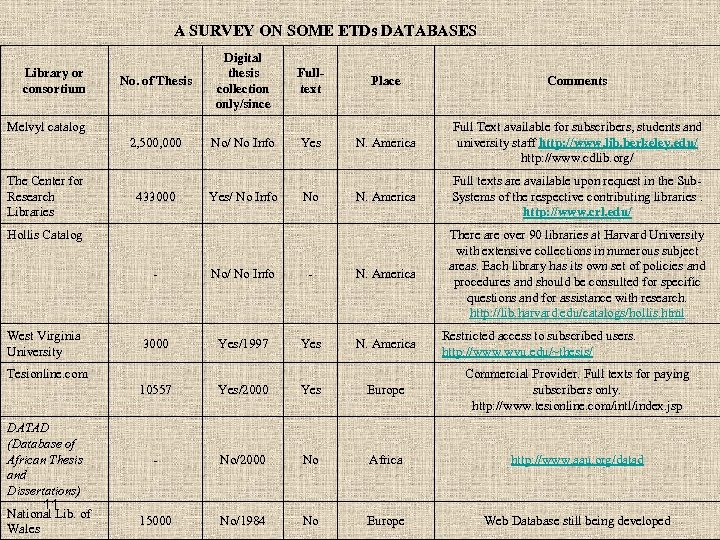
A SURVEY ON SOME ETDs DATABASES Library or consortium No. of Thesis Digital thesis collection only/since Fulltext Place Comments N. America Full Text available for subscribers, students and university staff http: //www. lib. berkeley. edu/ http: //www. cdlib. org/ N. America Full texts are available upon request in the Sub. Systems of the respective contributing libraries. http: //www. crl. edu/ There are over 90 libraries at Harvard University with extensive collections in numerous subject areas. Each library has its own set of policies and procedures and should be consulted for specific questions and for assistance with research. http: //lib. harvard. edu/catalogs/hollis. html Melvyl catalog 2, 500, 000 The Center for Research Libraries 433000 No/ No Info Yes No Hollis Catalog - West Virginia University No/ No Info - N. America 3000 Yes/1997 Yes N. America Tesionline. com Restricted access to subscribed users. http: //www. wvu. edu/~thesis/ 10557 DATAD (Database of African Thesis and Dissertations) Yes/2000 Yes Europe Commercial Provider. Full texts for paying subscribers only. http: //www. tesionline. com/intl/index. jsp - No/2000 No Africa http: //www. aau. org/datad 15000 No/1984 No Europe Web Database still being developed 11 National Lib. of Wales
The ETD Project for The Egyptian Universities § It is Funding from Ministry of higher education (Egypt), ASUNET is in charge of implementing this project. § The National Thesis Library was created to be part of the Ain Shams University Information Network (ASUNET). The intention was to store all theses submitted at Egyptian universities to obtain Masters and Doctoral scientific grades. § the ASUNET is considered as the repository of theses from all the Egyptian universities, more than 150 faculty in 15 uni. 12
The project objectives • The main goals of the proposed project are: 1. Converting ca. 11, 000 Microfilm containing more than 150, 000 scientific theses into an electronic readable form. 2. Indexing the thus created electronic archive. 3. Building a modern electronic search functionality which enables retrieving information from abstracts as well as full-text documents. 4. Offering both online and offline search functionalities 5. Integrating the created archive with similar databases worldwide 6. Providing accessibility to this repository to a vast audience throughout in the Arab region and throughout the world 13
ASUNET reserving system • ASUNET maintains and preserves their dissertation collection on microfilm and microfiche. On-demand duplication and distribution in paper and microform. Since 2000, reformatting into TIFF images wrapped in PDF. 14
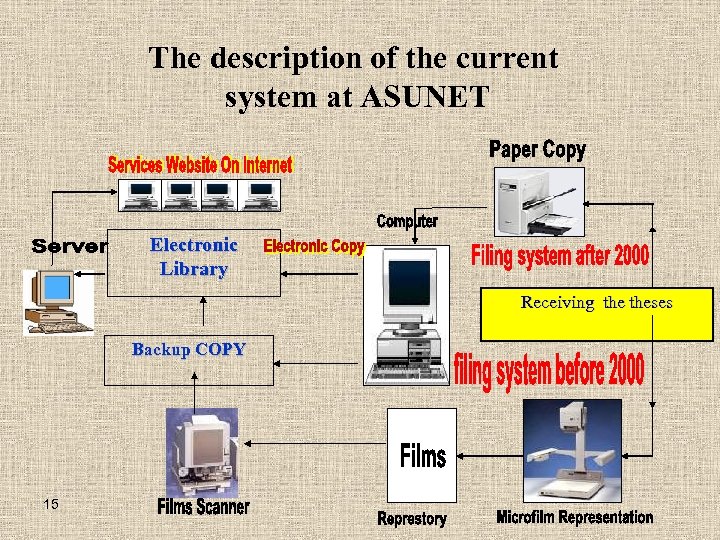
The description of the current system at ASUNET Electronic Library Receiving theses Backup COPY 15
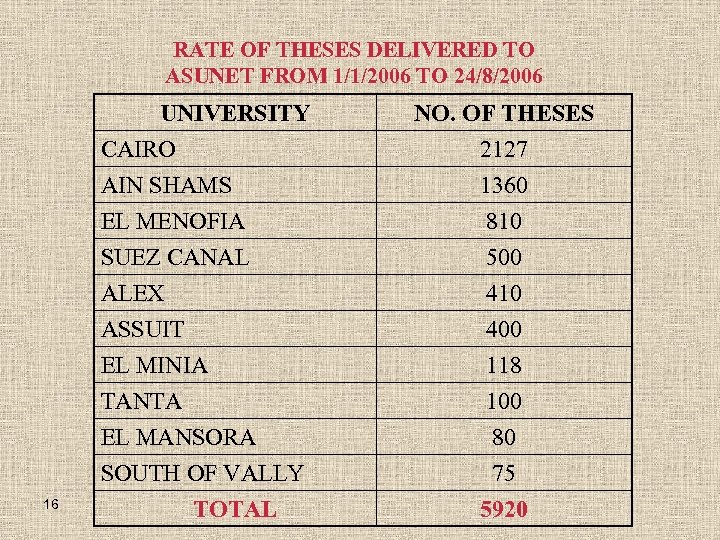
RATE OF THESES DELIVERED TO ASUNET FROM 1/1/2006 TO 24/8/2006 UNIVERSITY CAIRO AIN SHAMS EL MENOFIA 16 NO. OF THESES 2127 1360 810 SUEZ CANAL ALEX ASSUIT EL MINIA TANTA EL MANSORA SOUTH OF VALLY TOTAL 500 410 400 118 100 80 75 5920
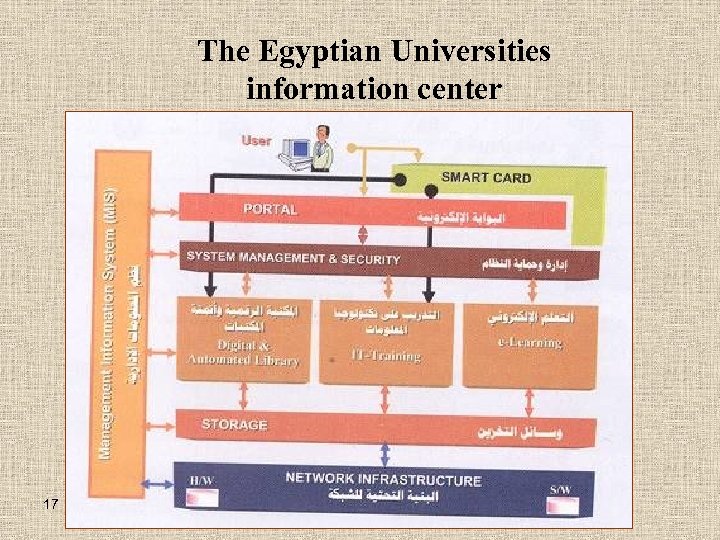
The Egyptian Universities information center 17
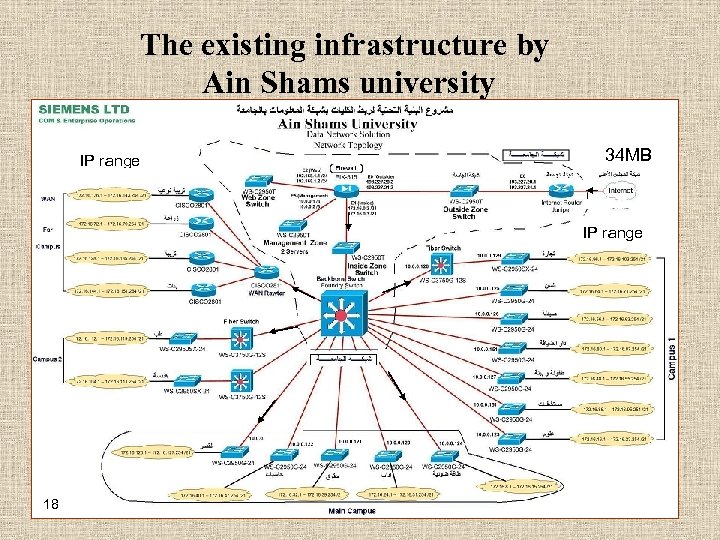
The existing infrastructure by Ain Shams university IP range 34 MB IP range 18
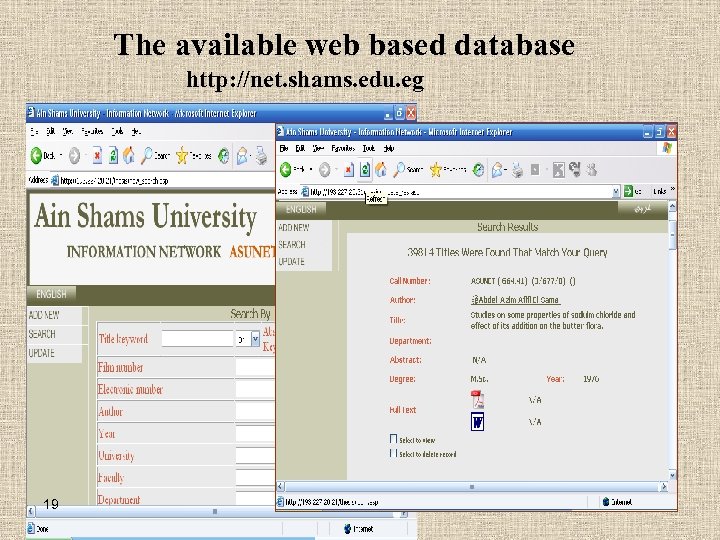
The available web based database http: //net. shams. edu. eg 19
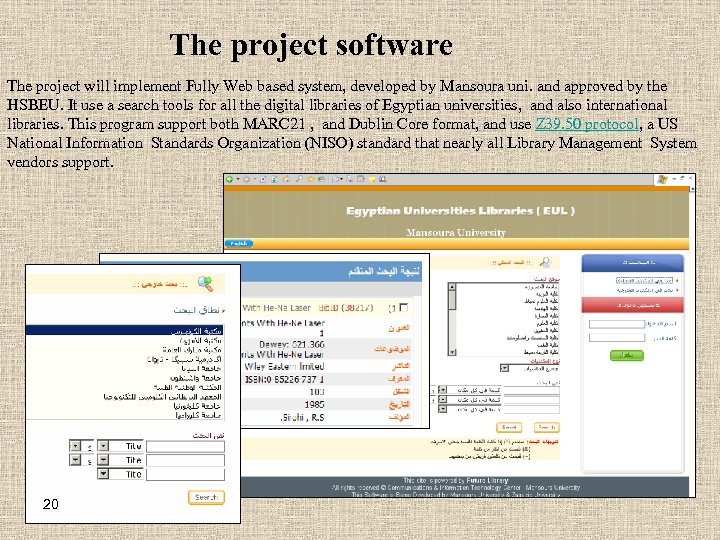
The project software The project will implement Fully Web based system, developed by Mansoura uni. and approved by the HSBEU. It use a search tools for all the digital libraries of Egyptian universities, and also international libraries. This program support both MARC 21 , and Dublin Core format, and use Z 39. 50 protocol, a US National Information Standards Organization (NISO) standard that nearly all Library Management System vendors support. 20
The main features of the ETD project Metadata • Metadata is usually produced through a process called "cataloging "that is often carried out by trained librarians. Collections of such information are commonly stored in "catalogs. "In computerized environments, • metadata may be automatically or semi-automatically extracted or derived from the original content, or the "full-text "may simply be indexed and searched without involving metadata )as happens on the WWW when search engines are employed. ( • The Open Archives Initiative (OAI) Protocol is used for Metadata Harvesting • 21
Types of metadata • Descriptive metadata is information that describes the item, such as title, author, publisher, subject, physical dimensions, et cetera. • Administrative metadata may include information about acquisition, access restrictions, provenance, preservation, and treatment decisions. • Structural metadata is information about how the item is put together or arranged such as the table of contents page, individual page numbers, illustration and plates pages, et cetera. 22
The document format • Document type definition (DTD): A DTD provides a standard way to define the SGML or XML tags used within a document. • Both SGML and XML are "meta" languages because they are used for defining markup languages. • Today XML is a W 3 C Recommendation. This means that XML has been reviewed and approved by the members of the W 3 C. • XML is therefore deemed "stable" and ready for widespread deployment. • XML is a system for designing custom-made markup languages, XML allows users to define a markup language for themselves. 23
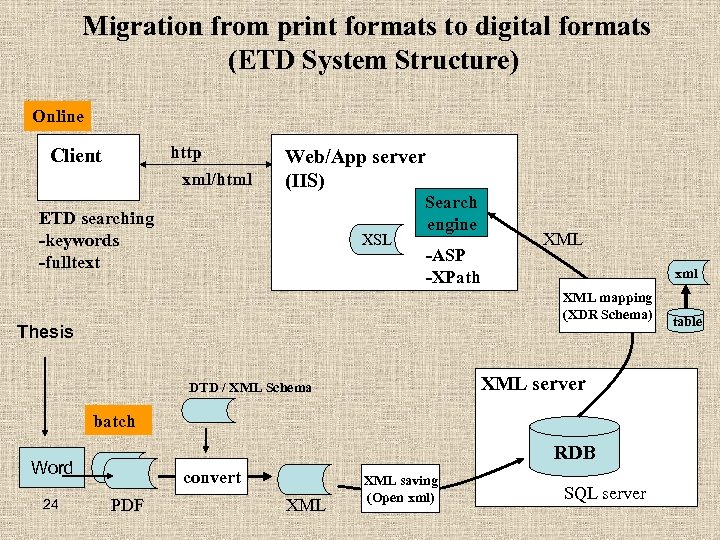
Migration from print formats to digital formats (ETD System Structure) Online http xml/html Client Web/App server (IIS) ETD searching -keywords -fulltext XSL Search engine -ASP -XPath XML xml XML mapping (XDR Schema) Thesis XML server DTD / XML Schema batch RDB Word 24 convert PDF XML saving (Open xml) SQL server table
Ontology Design and Deployment • An ontology is an engineering artifact: – It is constituted by a specific vocabulary used to describe a certain reality Given key role of ontologies in the Semantic Web, Design and maintain high quality ontologies, e. g. : • Meaningful — all named classes can have instances • Correct — captured intuitions of domain experts • Minimally redundant — no unintended synonyms • • • 25 RDF stands for Resource Description Framework It is a W 3 C candidate recommendation (http: //www. w 3. org/RDF) RDFS is recognisable as an ontology language
The ETD Consortium Our project of an ETD will establish a consortium from all the Egyptian universities, libraries, and cooperate with international ETD communities, to create a collaborative environment to promote interoperability and increase the availability of ETDs in networked digital libraries (Internet). 26
The objectives of the ETD Consortium : î Help each other to build and maintain ETD projects î Share experiences and SW solutions î Find new ways to enhance ETD project. î Create union catalogs of metadata records 27
Also help the universities to: î Create and operate a digital library î Be ready for e-publishing of T&Ds î Discuss authors’ rights and define policies to access scholarly information î Model new workflows to process ETDs î Discuss paper & ETDs x ETDs only 28
î Discuss and define policies for digital preservation î Decide participation in the consortia î Define a local metadata model î Train staff on digital libraries and ETDs îPrepare a program to help students on writing ETDs 29
Conclusions • Our conclusions can be viewed as a set of recommendations to apply in the course of physical implementation of the ETD project at ASUNET, such as: – 30 Creating a professional business plan for the creation of the said ETD including financial, technical and managerial milestones to be met in a realistic time-frame.
Conclusions – Initiating an inter-disciplinary group concerned with the issues of E-Copyrights with the aim to solve them to be able to provide accessibility to FULL-Text documents in a legal, organized way. • Adopting the above described ETDMS standard for metadata-specification and the OAI-PMH Protocol. • Constructing intelligent search engines and ontologies on top of their usual search algorithms. 31
32
Скачать презентацию 2 nd International Conference on Universal Digital Library
57072619c25732b7afb6544d6f428bd5.ppt