


 Скачать презентацию 2 nd INTERNATIONAL CONFERENCE EXCELLENCE IN SCHOOL EDUCATION
04089e2c5c83d2528dcdc3ee02dbf16d.ppt
- Количество слайдов: 27
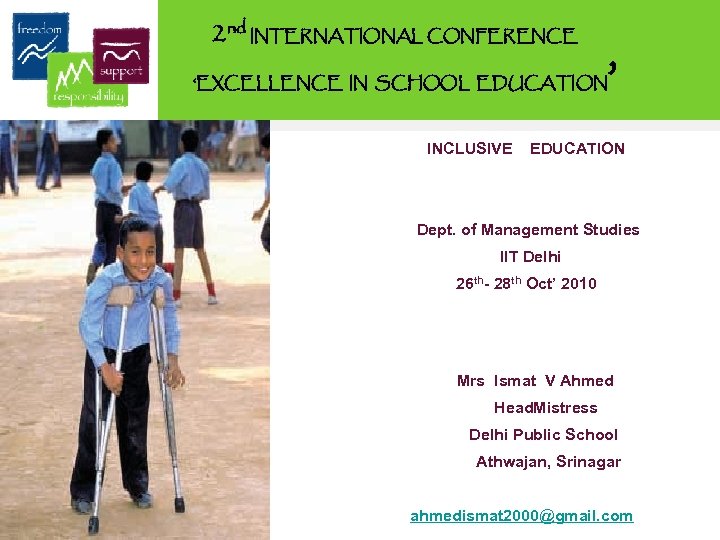 2 nd INTERNATIONAL CONFERENCE ‘EXCELLENCE IN SCHOOL EDUCATION ’ INCLUSIVE EDUCATION Dept. of Management Studies IIT Delhi 26 th- 28 th Oct’ 2010 Mrs Ismat V Ahmed Head. Mistress Delhi Public School Athwajan, Srinagar ahmedismat 2000@gmail. com
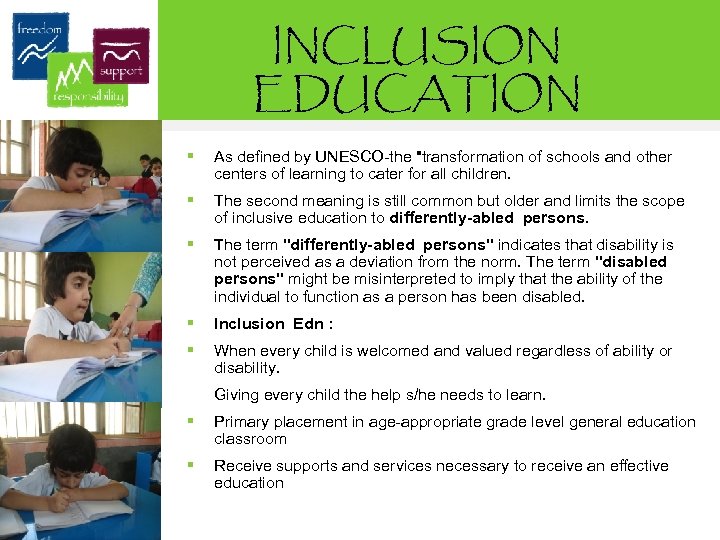 INCLUSION EDUCATION § As defined by UNESCO-the "transformation of schools and other centers of learning to cater for all children. § The second meaning is still common but older and limits the scope of inclusive education to differently-abled persons. § The term "differently-abled persons" indicates that disability is not perceived as a deviation from the norm. The term "disabled persons" might be misinterpreted to imply that the ability of the individual to function as a person has been disabled. § Inclusion Edn : § When every child is welcomed and valued regardless of ability or disability. Giving every child the help s/he needs to learn. § Primary placement in age-appropriate grade level general education classroom § Receive supports and services necessary to receive an effective education
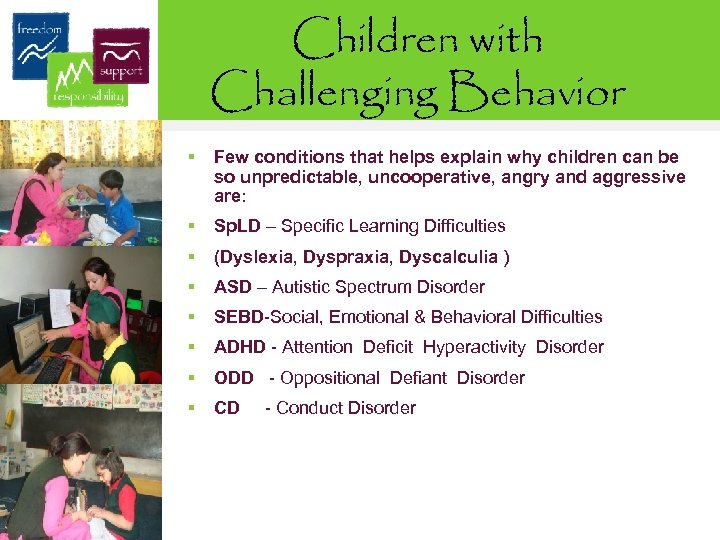 Children with Challenging Behavior § Few conditions that helps explain why children can be so unpredictable, uncooperative, angry and aggressive are: § Sp. LD – Specific Learning Difficulties § (Dyslexia, Dyspraxia, Dyscalculia ) § ASD – Autistic Spectrum Disorder § SEBD-Social, Emotional & Behavioral Difficulties § ADHD - Attention Deficit Hyperactivity Disorder § ODD - Oppositional Defiant Disorder § CD - Conduct Disorder
 The Top Four reasons for Special Needs: 1) Make life more enjoyable and manageable 2) Find the best help so you can get a break 3) Include your child in many community activities 4) Advocate more effectively for your child
 ANXIETIES : • Transform education systems: must provide a flexible curriculum responsive to differences among learners • develop a support system to provide continuous and competent guidance to stake holders- teachers, learners and parents. • Education should cater to diverse learners. • a challenge and enrichment, rather than a problem. • Strengthen capacity of existing services rather than invent new ones. • Improve co-ordination - encourage partnerships. • Need flexibility - different models in different settings.
 Hurdles & Barriers § Readiness § Safety § Special care § Lack of programs § Lack of knowledge § Lack of commitment
 Policies and Inclusion: RESOURCES ESSENTIAL § To avoid harm to the academic education of students with disabilities, a full panoply of services and resources is required, including: § Adequate supports and services for the student § Well-designed individualized education programs(IEP) § Professional development for teachers involved. § Teachers to plan, meet, create, and evaluate the students together § Reduced class size based on the severity of the student needs § Professional skill development in the areas of cooperative learning, peer tutoring, adaptive curriculum. § Collaboration between parents, teachers and administrators § Sufficient funding so that schools will be able to develop programs based on student’s need.
 Classroom Strategies To Support Inclusive Education: § Multi-level instruction § Cooperative learning § Individualized learning modules § Activity-based learning § Peer tutoring
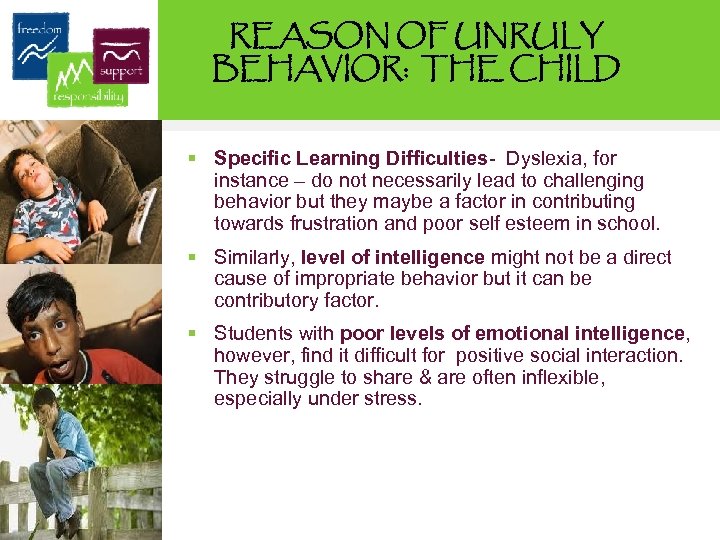 REASON OF UNRULY BEHAVIOR: THE CHILD § Specific Learning Difficulties- Dyslexia, for instance – do not necessarily lead to challenging behavior but they maybe a factor in contributing towards frustration and poor self esteem in school. § Similarly, level of intelligence might not be a direct cause of impropriate behavior but it can be contributory factor. § Students with poor levels of emotional intelligence, however, find it difficult for positive social interaction. They struggle to share & are often inflexible, especially under stress.
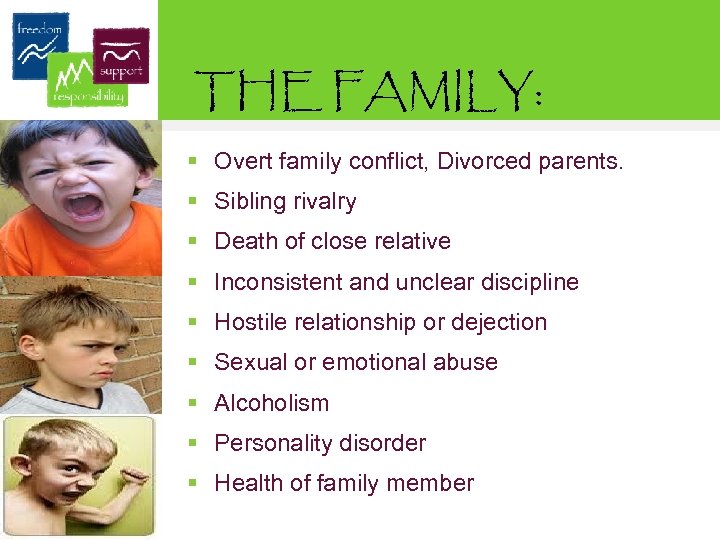 THE FAMILY: § Overt family conflict, Divorced parents. § Sibling rivalry § Death of close relative § Inconsistent and unclear discipline § Hostile relationship or dejection § Sexual or emotional abuse § Alcoholism § Personality disorder § Health of family member
 THE COMMUNITY § Socio –Economic disadvantage § Constant changes of circumstances § Disaster § Discrimination § Homelessness § Other significant life events
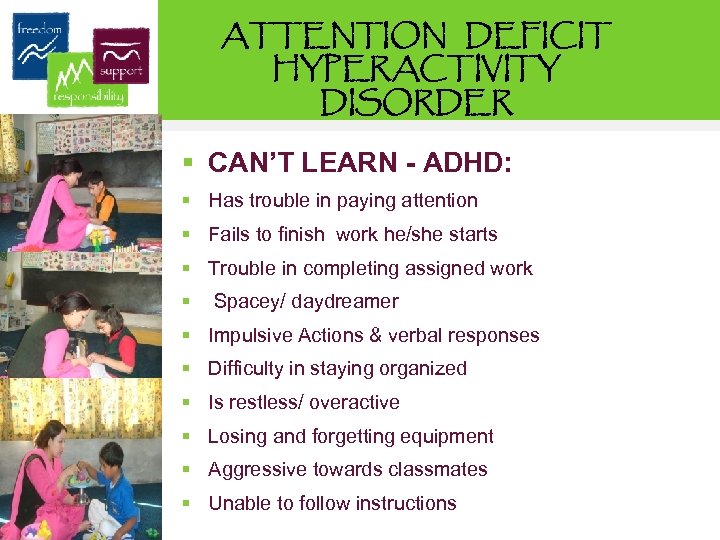 ATTENTION DEFICIT HYPERACTIVITY DISORDER § CAN’T LEARN - ADHD: § Has trouble in paying attention § Fails to finish work he/she starts § Trouble in completing assigned work § Spacey/ daydreamer § Impulsive Actions & verbal responses § Difficulty in staying organized § Is restless/ overactive § Losing and forgetting equipment § Aggressive towards classmates § Unable to follow instructions
 OPPOSITIONAL DEFIANT DISORDER § WON’T LEARN- ODD : § Argue with Adults § Refuse and Defy § Are Angry and Defensive § Are Spiteful and vindictive
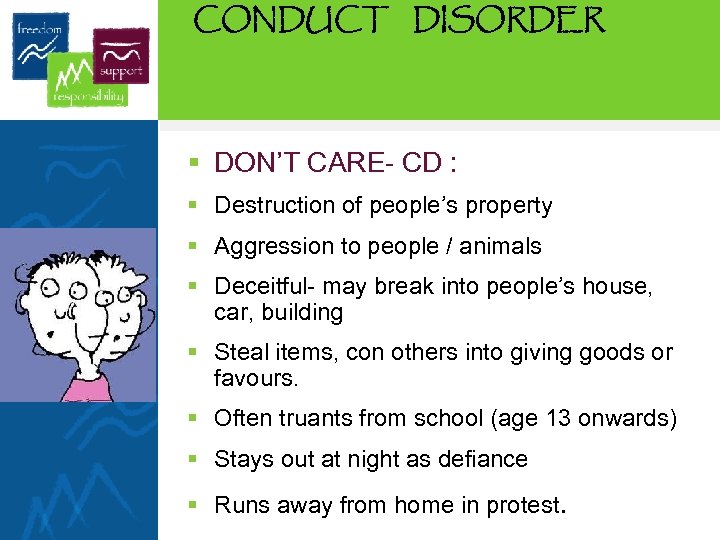 CONDUCT DISORDER § DON’T CARE- CD : § Destruction of people’s property § Aggression to people / animals § Deceitful- may break into people’s house, car, building § Steal items, con others into giving goods or favours. § Often truants from school (age 13 onwards) § Stays out at night as defiance § Runs away from home in protest.
 Special Education IS. . . …individualized supports that give kids with disabilities the : § extra help they need to learn from general curriculum. § Physical therapy § Language therapy § Behavior plan § Environmental accommodations § Speech therapy § Curriculum adaptations § Communication board
 Each student has an IEP § learning goals and objectives for the coming year § the services and supports the student will receive § accommodations for the student (different ways of learning or responding) § if and to what extent the general curriculum will be modified for the student § if and why the student will be out of the general education classroom and away from non-disabled students.
 Blend of Curriculum • There must be a connection between the general curriculum objectives and this student’s IEP goals and objectives. • What the student will learn about each subject the class is studying. • Which and how many general curriculum objectives are to be taught. • Must make general curriculum objectives functional and meaningful for this student.
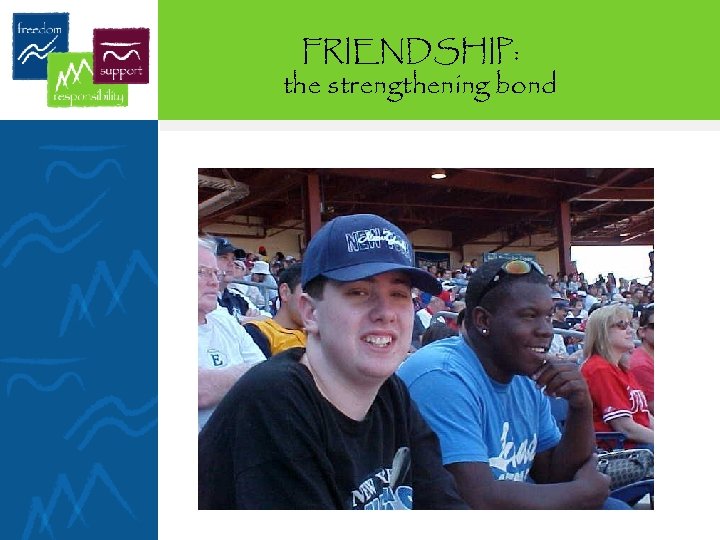 FRIENDSHIP: the strengthening bond
 Inclusion – Making it work § It’s not readiness § It’s not finding the right program § It’s not providing services § It’s about support ‘Special children are generally sensitive. They feel and understand that they are different’
 Factors that determine the success of inclusive classrooms: § Family-school partnerships § Collaboration between general and special educators § Well-constructed plans that identify specific accommodations, modifications, and goals for each student § Coordinated planning and communication between "general" and "special needs" staff § Integrated service delivery § Ongoing training and staff development
 1. Same as all students, with accommodations § Listen to story and then respond to opinion questions using communication device § Create art project using adapted materials § Conduct science experiment using peer assistance
 2. Lower level objectives, same curriculum unit § During a lesson on responsibilities of the president • § During a lesson on telling time to the 1/4 hour • § Use a digital clock to tell time to the hour During a lesson on budgeting • § Identify the president’s picture and tell his name Match coins (rupee, coin) to a sample During history lesson on Stone Age people • Match key concepts to visuals to show understanding of the shelters, food, and activities of Stone Age People During math activity worksheet to practice multiple digit addition • § During science activity on whale identification • § Use manipulatives to group items together and then count the sum Sort pictures of whales from other animals During science activity on rock formation • Sort rocks by color
 3. Alternate skills § During a science activity • Interact appropriately with others, use mobility skills, and use one-to-one correspondence (count out materials) § During an Indian history discussion • Maintain an upright position and answer questions using a communication device § During classroom reading • Use adapted book to match and place pictures on the page § During science class on recycling • Pick up and place recycled item in appropriate bin § During social studies group activity to develop presentation on racism • Walk to front of class using walker, operate computer to change slides using switch.
 Reading § Simplify texts § Peer partner reads § Add representational objects § § Use photos or visuals Use interactive strategies to support participation – place visual, turn pages, record response. § Use technology for access (slant boards, page turners, digital books) § § Taped reading materials § Embed preferences Provide objects connected to content material to support the reading experience – read with your hands. § Offer choices § § Use technology- computer program Mount symbols, pictures or tactile objects that represent concepts being § Adapt response expectations taught through a textbook.
 Writing § Alternatives to a pencil • Stamps • Stickers • Magnetic letters • Markers • Tape recorder for dictation • Keyboard • On-screen keyboard • Touch screen selection • Arrange pictures, cards § § § Use objects or manipulatives connected to content material to § describe an event, give information, use non-slip matting to keep them in place. § Use objects or manipulatives to “write” words or numbers – place the objects in order to “tell” the story, or give information about the concept being taught. Collect the items in a bag or basket to represent a collection of information. Take a digital picture. Pair the objects with words, symbols, or numbers. Have a peer scribe to record the event. Provide a choice of two objects to give a “written” answer to a question – accept direct selection, gesture, eye gaze or other mode of student communication. Mark answer, select answer from cards, point to answer, select using AAC or digital display
 Let’s Talk § Sharing concerns, experiences, hopes, fears, and dreams § Working together to change the opportunities for achieving inclusion ‘The child is not a pail to be filled but a fire to be lit. ’
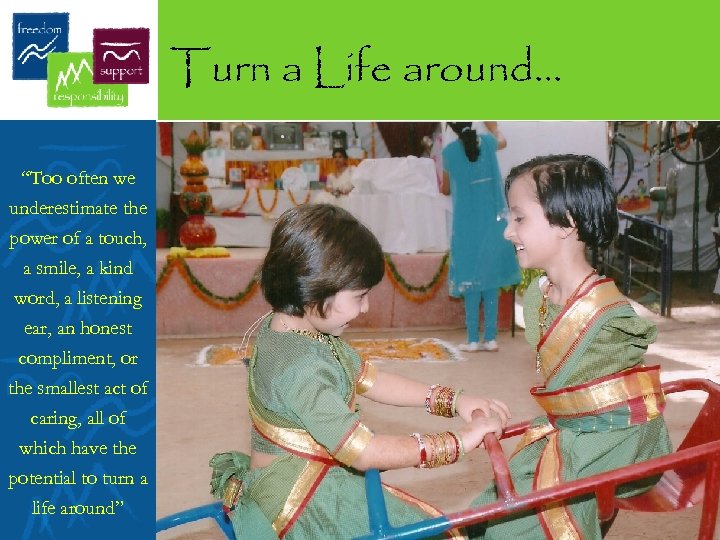 Turn a Life around… “Too often we underestimate the power of a touch, a smile, a kind word, a listening ear, an honest compliment, or the smallest act of caring, all of which have the potential to turn a life around”