


 Скачать презентацию 2 nd Annual Pileus Project General Stakeholder Advisory
b190cd6f1cc885e0f1a475ab8f45e1b9.ppt
- Количество слайдов: 38
 2 nd Annual Pileus Project General Stakeholder Advisory Group Meeting March 9, 2004 – 4: 00 -6: 00 PM
 WELCOME! & Introductions – Lori Martin
 News & Comments from the EPA – Jeanne Bisanz
 Review of the Agriculture & Climate Team’s Progress To Date – Dr. Julie Winkler
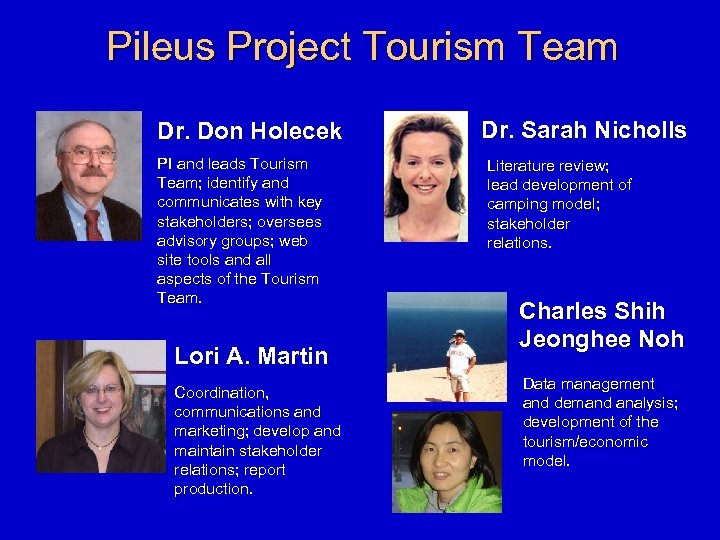 Pileus Project Tourism Team Dr. Don Holecek PI and leads Tourism Team; identify and communicates with key stakeholders; oversees advisory groups; web site tools and all aspects of the Tourism Team. Lori A. Martin Coordination, communications and marketing; develop and maintain stakeholder relations; report production. Dr. Sarah Nicholls Literature review; lead development of camping model; stakeholder relations. Charles Shih Jeonghee Noh Data management and demand analysis; development of the tourism/economic model.
 Primary Objective To develop tools that tourism and outdoor recreation businesses in Michigan can use to incorporate climate variability and change into their planning activities
 Rationale for Current Study There is a need for studies that … • • • Are more location (site) specific Focus on the shorter term Focus on the bottom-line
 Why Research Tourism? • Assessment revealed that data needs to be in more useable form for stakeholders to use – short term time frame • Tourism businesses operate with relatively narrow profit margins • Weather dependent • Profitability is often very reliant on seasonality
 Tourism & Outdoor Recreation in Michigan • • • Are vital to Michigan’s economy & society Are extremely weather-dependent Are very sensitive to climate variability & change • Yet, are also subject to a multitude of other influences
 Other Influences on Tourism • • Leisure time Demographics Socioeconomics Economic factors – Consumer confidence, interest rates, gas prices – Prices: entrance fees, equipment, etc. • Competition (from local to international) • Technological innovations
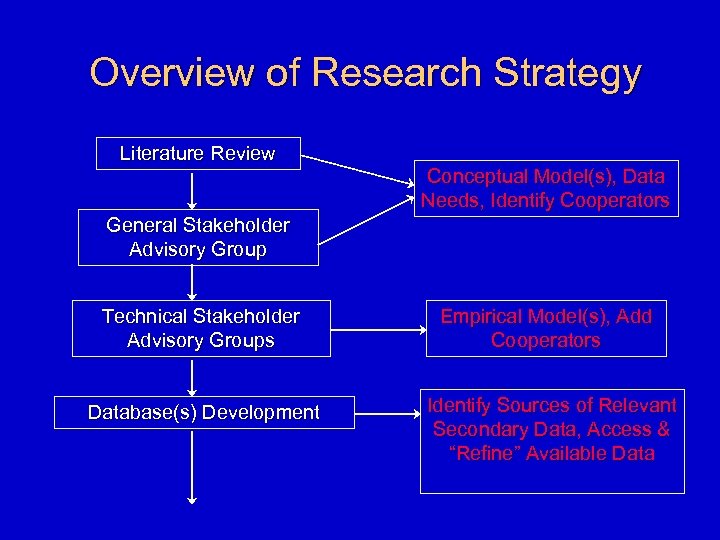 Overview of Research Strategy Literature Review Conceptual Model(s), Data Needs, Identify Cooperators General Stakeholder Advisory Group Technical Stakeholder Advisory Groups Empirical Model(s), Add Cooperators Database(s) Development Identify Sources of Relevant Secondary Data, Access & “Refine” Available Data
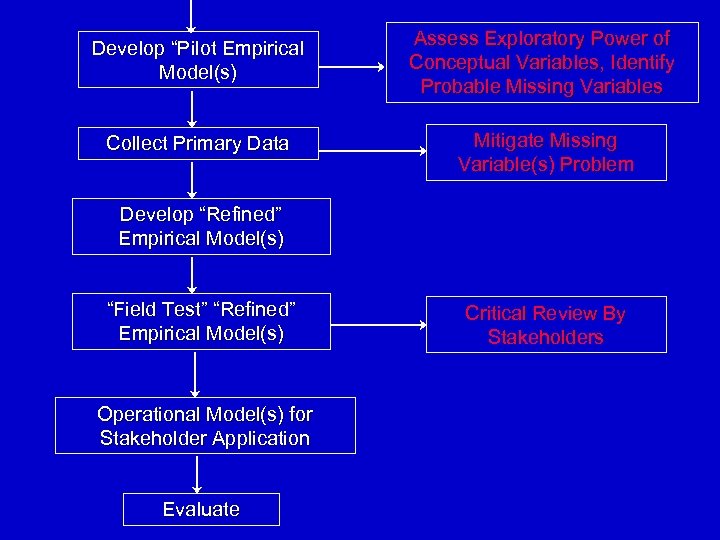 Develop “Pilot Empirical Model(s) Assess Exploratory Power of Conceptual Variables, Identify Probable Missing Variables Collect Primary Data Mitigate Missing Variable(s) Problem Develop “Refined” Empirical Model(s) “Field Test” “Refined” Empirical Model(s) Operational Model(s) for Stakeholder Application Evaluate Critical Review By Stakeholders
 Literature Review • The likely impacts of climate variability & change on outdoor recreation & tourism have been “seriously understudied” (Morehouse, 2001) • Studies to date have … – Been scattered (in area & activity) – Been broad (in areas & time frames) – Been conducted mostly by physical geographers & climatologists – Paid little attention to economic issues
 Key Research Groups & Contacts • Climatic Research Unit, University of East Anglia, UK (Viner, Agnew) • Adaptation & Impacts Research Group of Environment Canada/Faculty of Environmental Studies, University of Waterloo, Canada (Scott, Wall, Mc. Boyle, Mills)
 Stakeholder Involvement & Introduction of Project • 1 st General Stakeholder Advisory Group Meeting, March 2003 • Michigan Tourism Outlook Conference, March 2003 - Presentation, Andresen • Midwest Ski Area Association Conference, August 2003 - Attended, Martin
 • TTRA Cen. States Conference, Sept 2003 - Presentation, Martin • Tourism Industry Coalition of Michigan, October & December 2003 - Presentations, Martin, Holecek & Andresen • Michigan Association of Convention & Visitor Bureaus, December 2003 - Presentation, Martin & Holecek • 2 nd General Tourism Stakeholder Advisory Group Meeting, March 2004
 Related Activities • First International Conference on Climate Change & Tourism, April 2003 - Attended, conference report in Annals of Tourism Research, Nicholls • European Science Foundation Exploratory Workshop on Climate Change, Environment & Tourism, June 2003 - Attended, Nicholls
 Outreach to Date • East Lakes-West Lakes Meeting of Association of American Geographers, October 2003 - Presentation, Nicholls & Shih • NATO Advanced Research Workshop, NATO Science Series - Chapter, Nicholls • Preparation of articles for, e. g. , Journal of Leisure Research
 Future Outreach • Annual Meeting of AAG, March 2004 - Presentation, Nicholls • Second International Workshop on Climate, Tourism & Recreation, June 2004 - Presentation, Nicholls • Annual Michigan Tourism Conference, October 2004 - Presentation and/or exhibit, Holecek & Martin
 Three Tourism & Outdoor Recreation Models • “Comprehensive” – based on traffic counts • Downhill Skiing & Snowboarding • Camping
 # 1 Comprehensive Model
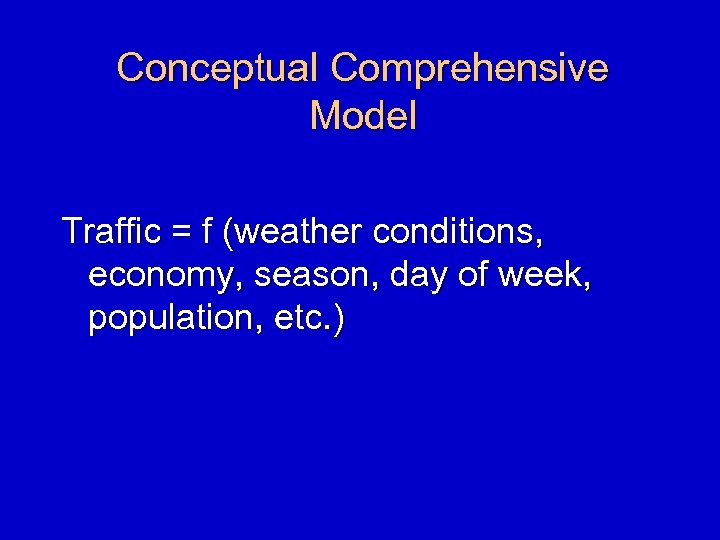 Conceptual Comprehensive Model Traffic = f (weather conditions, economy, season, day of week, population, etc. )
 Traffic Trends 1991 -2000 (US 127 Clare)
 Traffic Trends 1991 -2000 (US 127 Clare)
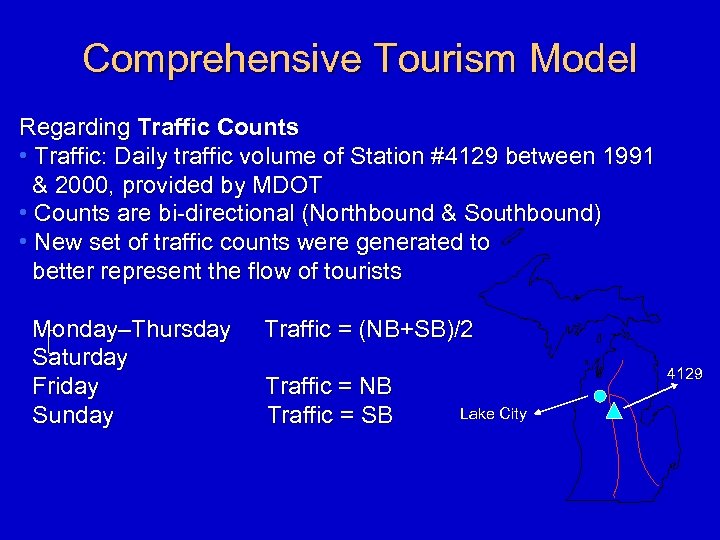 Comprehensive Tourism Model Regarding Traffic Counts • Traffic: Daily traffic volume of Station #4129 between 1991 & 2000, provided by MDOT • Counts are bi-directional (Northbound & Southbound) • New set of traffic counts were generated to better represent the flow of tourists Monday–Thursday Traffic = (NB+SB)/2 Saturday Friday Traffic = NB Lake City Sunday Traffic = SB 4129
 Comprehensive Tourism Model Variable Definition and Data Sources • Daily high temperatures and precipitation: Daily observations from the Lake City weather station provided by the Climate Team • CCI: Consumer Confidence Index for the East North Central Region (MI, OH, WI, IN, IL) (Conference Board) • Seasons: Spring (March, April, May), Summer (June, July, August), Fall (September, October, November), and Winter (December, January, February) • Days of the week: Friday and Sunday, Saturday and Weekdays (Monday through Thursday) • Holiday: New Year’s Day, Memorial Day, Independence Day, Labor Day, Thanksgiving, and Christmas
 Comprehensive Tourism Model: Regression Analysis *Dependent variable is the logarithm of traffic volume *Overall R-Square=0. 820 *Winter dummy variable & gas prices were not significant & dropped from the model
 Comprehensive Tourism Model: Regression Analysis Durbin-Watson Stat = 1. 192
 Comprehensive Model – Forecasting Example • # of Vehicles = Constant+B 1*Temp+B 2*Precip+B 3*CCI+B 4* Summer+B 5*Fall+B 6*Fri. Sun+B 7*Sat+B 8*Holiday +B 9*Year • Scenario: Friday of July, 2005 (non-holiday) • Temperature: Average (mean), warmer (1 std deviation above mean), cooler (1 std deviation below mean) • # of Vehicles: Average – 13, 552 Warmer – 14, 296 Cooler – 12, 845 1, 500
 # 2 Downhill Skiing & Snowboarding Model
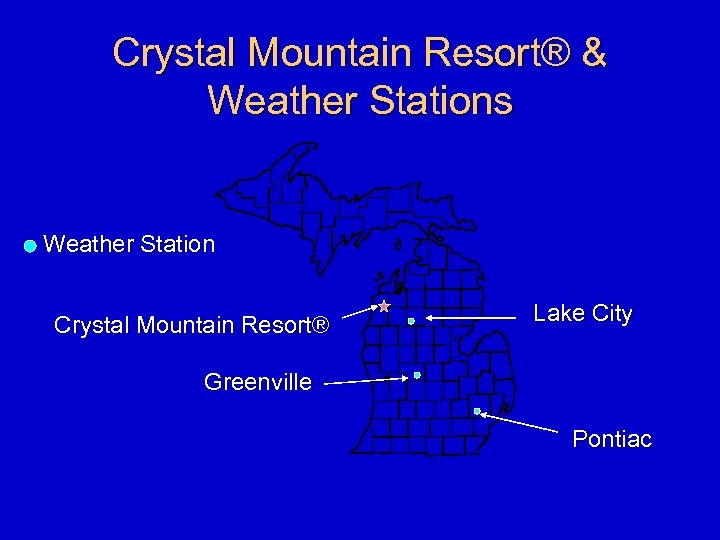 Crystal Mountain Resort® & Weather Stations Weather Station Crystal Mountain Resort® Lake City Greenville Pontiac
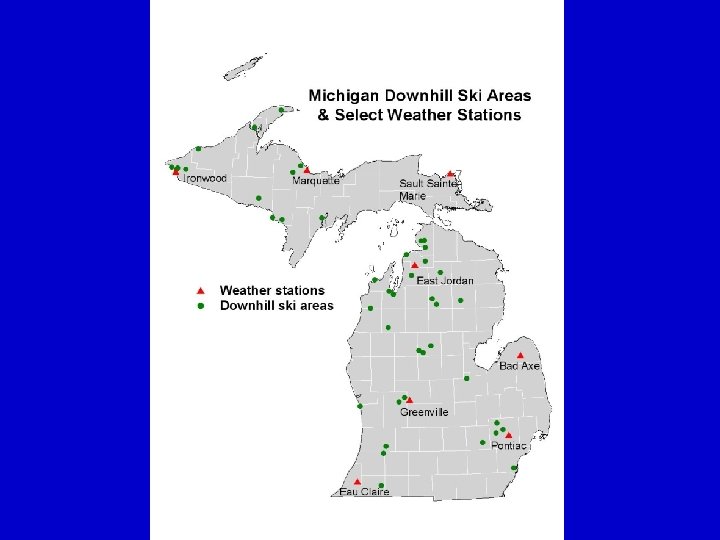
 Downhill Skiing & Snowboarding Model Variable Definition & Data Sources • Skier: number of daily tickets sold at Crystal Mountain Ski Resort between 1996 & 2002 • Weather: daily minimum temperatures & daily snow depth for the “Lake City” station provided by the Climate Team Snow depths of two other stations: Greenville & Pontiac also included • Regional CCI • Weekend: Friday, Saturday, Sunday • Holiday: Christmas break through New Year’s day, excluding weekends • Peakseason: December, January, & February
 Downhill Skiing & Snowboarding Model Regression Analysis of Crystal Mt. Skiers (1996 -2002) *R-square = 0. 543 *Gas prices & snow fall were dropped due to insignificance *Durbin-Watson Stat = 1. 318
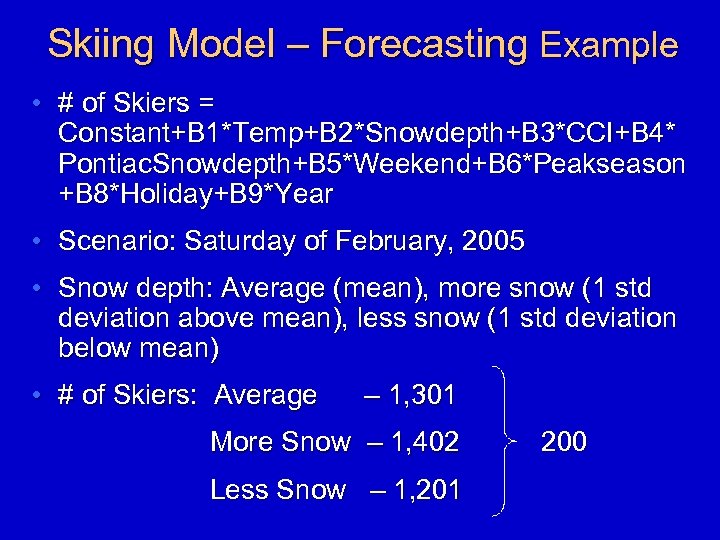 Skiing Model – Forecasting Example • # of Skiers = Constant+B 1*Temp+B 2*Snowdepth+B 3*CCI+B 4* Pontiac. Snowdepth+B 5*Weekend+B 6*Peakseason +B 8*Holiday+B 9*Year • Scenario: Saturday of February, 2005 • Snow depth: Average (mean), more snow (1 std deviation above mean), less snow (1 std deviation below mean) • # of Skiers: Average – 1, 301 More Snow – 1, 402 Less Snow – 1, 201 200
 # 3 Camping Model
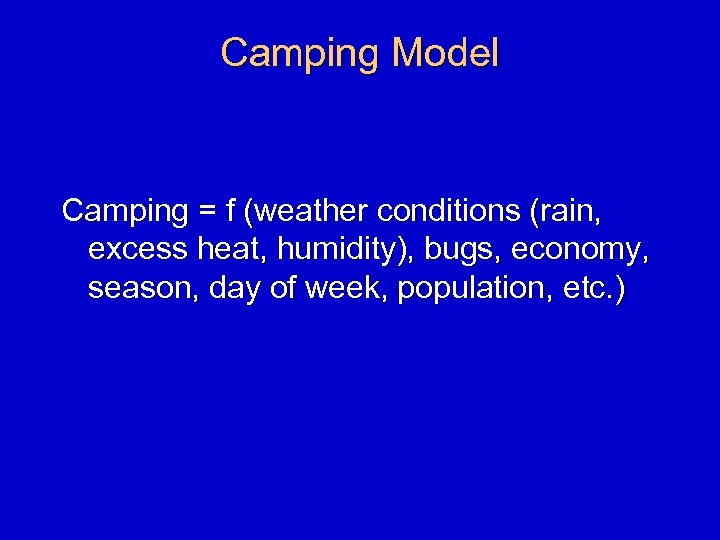 Camping Model Camping = f (weather conditions (rain, excess heat, humidity), bugs, economy, season, day of week, population, etc. )
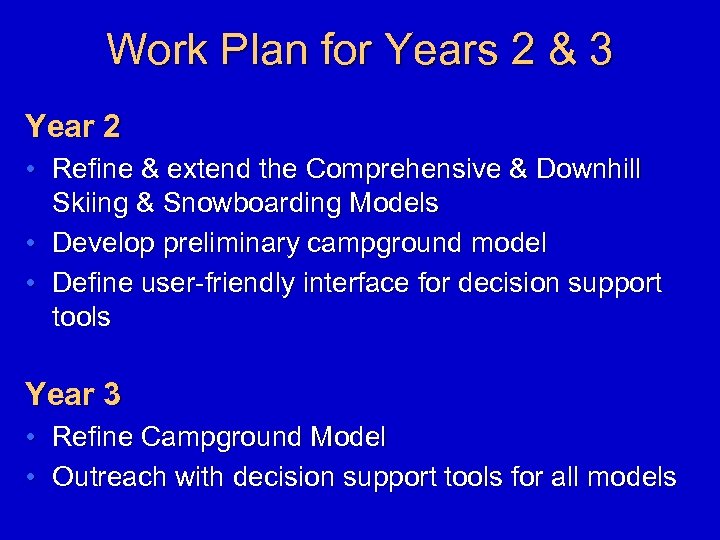 Work Plan for Years 2 & 3 Year 2 • Refine & extend the Comprehensive & Downhill Skiing & Snowboarding Models • Develop preliminary campground model • Define user-friendly interface for decision support tools Year 3 • Refine Campground Model • Outreach with decision support tools for all models