 Скачать презентацию 1920 s good times and bad Era of
108a4b0845dab0a448e208c6f12ae7af.ppt
- Количество слайдов: 19




1920’s good times (and bad)
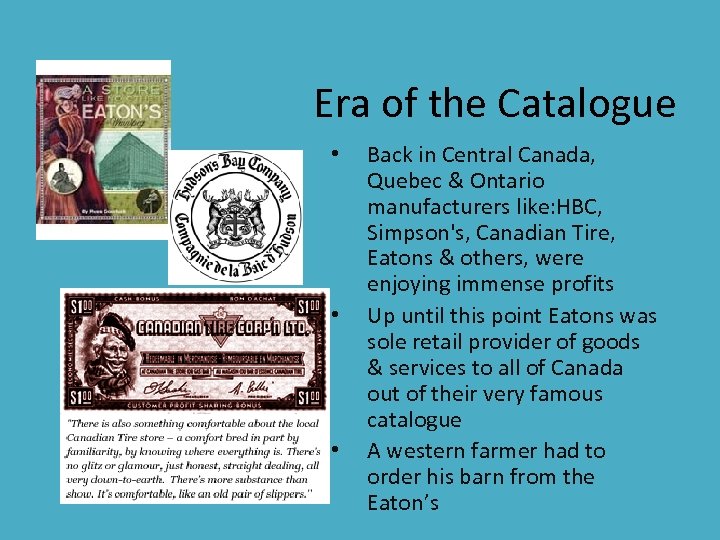
Era of the Catalogue • • • Back in Central Canada, Quebec & Ontario manufacturers like: HBC, Simpson's, Canadian Tire, Eatons & others, were enjoying immense profits Up until this point Eatons was sole retail provider of goods & services to all of Canada out of their very famous catalogue A western farmer had to order his barn from the Eaton’s
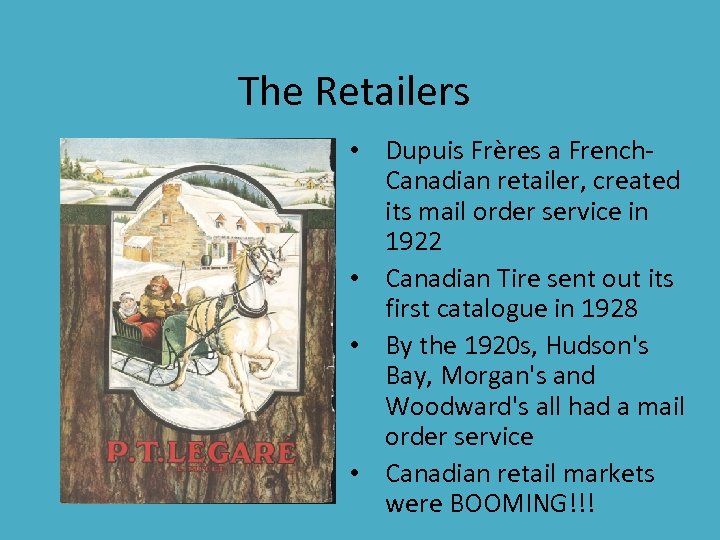
The Retailers • Dupuis Frères a French. Canadian retailer, created its mail order service in 1922 • Canadian Tire sent out its first catalogue in 1928 • By the 1920 s, Hudson's Bay, Morgan's and Woodward's all had a mail order service • Canadian retail markets were BOOMING!!!
Enter Advertising • • The advertising industry exploded during the 1920 s: magazine advertising revenues tripled between 1918 and 1929 = $200 million business Women made most of the purchasing decisions = advertisers began to direct their campaigns to them.
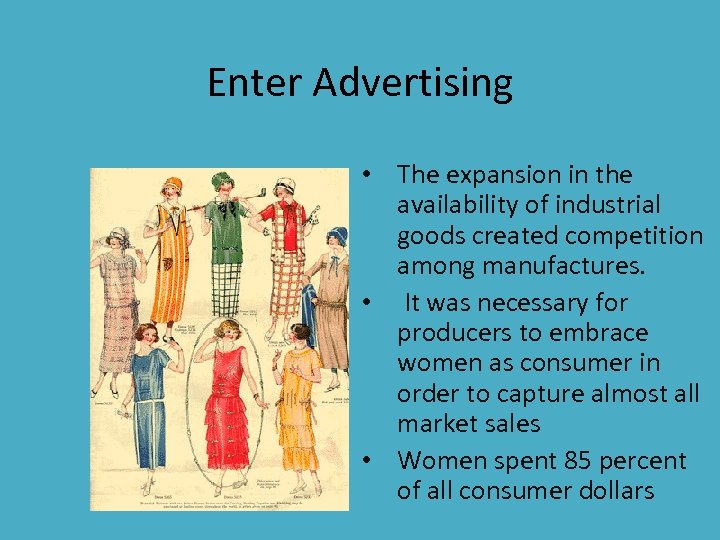
Enter Advertising • The expansion in the availability of industrial goods created competition among manufactures. • It was necessary for producers to embrace women as consumer in order to capture almost all market sales • Women spent 85 percent of all consumer dollars

Tricks of the Trade • Establish your target market e. g women ages 25 -54 • Establish your brand-essence: what it stands for e. g. Pepsi stands for youth • Establish the tactic you will use to advertise your product

Tactics • Comparative Advertising: Compare your product to someone else’s & make yours seem superior • Testimonial: Have an “expert” or “customer” promote your product by singing it’s praises • Fear: Strike fear into the hearts of your consumer that something bad will happen unless they use/buy your product • Emotional Appeal: Playing on consumers heart strings in order to get them to buy their product

Ad Analysis: Jell-O Who is the target market? What is the essence of the Jell-O according to this ad? What tactic is the advertiser using?
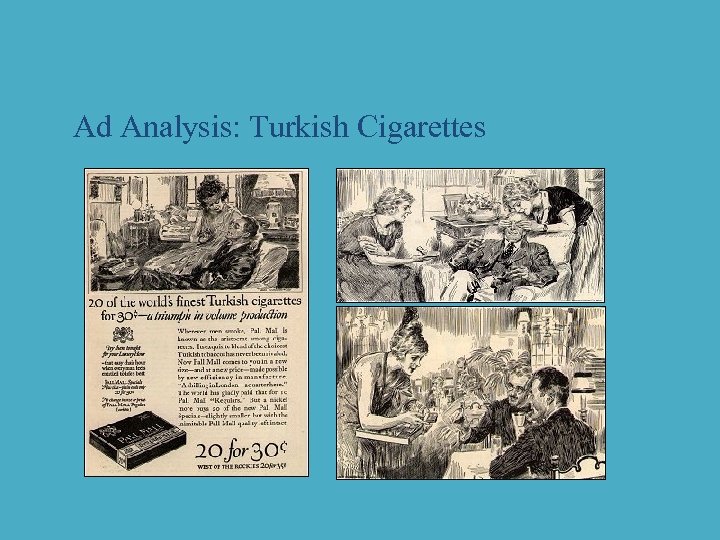
Ad Analysis: Turkish Cigarettes

ON THE OUTSIDE OF THE GOOD TIMES
• The prosperity of the 1920 s wasnot shared equally across Canada. It was also not shared equally among all people; birthplace, skin colour, gender, social class, and age all determined whether or not Canadians enjoyed the Roaring Twenties.
Women • Even though they had won political rights, they are still under-represented in government • Still not considered ‘persons’ under the law • Many attitudes remained the same: – Girls not expected to stay in school as long as boys – Much of their education aimed at preparing them for marriage and motherhood – Some girls learned skills such as typing and shorthand; this would lead them to low-paying clerical jobs
• More women were going to university – In 1891, 11. 6 % of undergraduates were women – In 1930 it was 23. 5% – These women had wider employment opportunities, but were still paid less than men by as much as 60% -unskilled women worked as household domestics or in low-paying jobs in offices, stores, and factories. - Women still seen as temporary employees, working only until they are married; then they would be fired
Children • Some laws regulating child labour had been passed in the late 19 th and early 20 th centuries in Canada • Many children left school before the age of 16 to join the workforce • The “home children” were British orphans or members of poor families who were sent to Canada to start a new life
• They were often exploited • Little supervision once they had been placed in Canadian homes • Had to stay with host family for up to 7 years before they were allowed to move on • Some were treated as family members; others were overworked, neglected, and sometimes abused • By the 1920 s, reformers were speaking out against the scheme and it ended in 1930 with the beginning of the Great Depression

Intolerance • As immigration from non-English-speaking countries increased, so did instances of intolerance • These new immigrants found their new neighbours to be unfriendly or scornful of their customs and beliefs • For visible as minority immigrants, intolerance could be even more severe • Belief in superiority of race (especially in north America and northern Europe) (Ethnocentric)

• Certain practices that would not be tolerated today – ex. Restaurants refusing to serve Blacks • Some people tried to ‘improve’ the “inferior races” through education or missionary work • The Ku Klux Klan, the American White supremacist movement, was active in Canada in the 1920 s and 1930 s – Saskatchewan – as many as 15, 000 Klan members by 1930; they had political influence, especially on the conservative party
Native Canadians • Native ceremonies such as the Potlach andthe Sun Dance were banned • Native children were taken away from their homes to be educated in residential schools by governments or religious organizations • Wanted to assimilate the young generation into mainstream Canadian life • If Natives lived on reserves, they were not allowed to vote

• In 1920, the government amended the Indian Act, banning traditional forms of Native government • Independence movements were resisted by the Canadian government – In the early 1920 s a Six Nation chief took his case for self-government to the British government and the League of Nations, but Ottawa refused to give in and they imposed an elective council on the Six Nations
Скачать презентацию 1920 s good times and bad Era of
108a4b0845dab0a448e208c6f12ae7af.ppt