


 Скачать презентацию 19 03 2018 1 Environmental law update Spring 2016
8038ac52a732255fd761899c62cea2c9.ppt
- Количество слайдов: 53
 19/03/2018 1
 Environmental law update Spring 2016 John Mitchell, partner, Regulatory Risk & Compliance
 Rationalisation of carbon taxes • September 2015 – consultation by Treasury (yet to report) • November 2015 IEMA publishes its submission to the consultation calling for “greater ambition” in carbon reduction • November 2015 – government publishes a tender for research into the cumulative administrative burden of carbon reduction policies 19/03/2018 3
 ESOS • October 2015 – EA announces period of grace for late submission • December 2015 – final surge of submissions took expected compliance to 70% • February 2016 – compliance by the end of January did reach the anticipated 70% • Not clear how many of the remaining 30% are actually obligated • January 2016 - DECC publishes guide to making best use of ESOS reports 19/03/2018 4
 Fines • Thames Water – fined £ 1 m for polluting a canal in Hertfordshire • Yorkshire Water – fined £ 600, 000 for polluting a lake in Wakefield • Hanson Concrete – fined £ 110, 000 for breach of environmental permit 19/03/2018 5
 Enforcement undertakings • Since April 2015 the EA has been able to accept enforcement undertakings for environmental permit breaches – This includes water pollution cases – However, none has been processed or accepted – EA admitted in February that it is due to the complexity of the issues • Record enforcement undertaking accepted 19/03/2018 6
 Economic impact duties for regulators • Government consultation on how regulators are to comply with their economic growth obligations • Enterprise Bill will: – Require regulators to report on this annually – Bring them within the scope of the regulatory impact target for business 19/03/2018 7
 Water market • April 2017 – competition starts in non-household water retail market • October 2016 – businesses must be ready for the market opening • Government aim is that this will promote water efficiency through innovative tariffs • Don’t assume that by staying with your current provider you will be better off 19/03/2018 8
 19/03/2018 9
 Welcome to ISO 14001: 2015 updates Presented by; Ray White C. ENV. CQP Aspen Business Consultants Ltd.
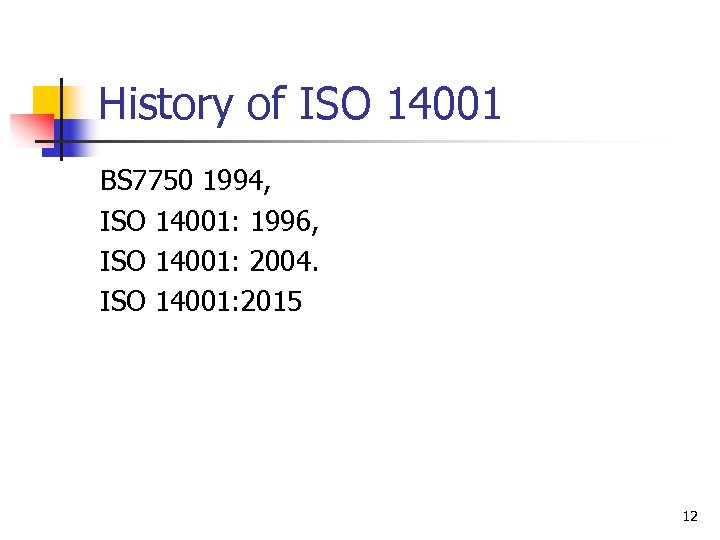 History of ISO 14001 BS 7750 1994, ISO 14001: 1996, ISO 14001: 2004. ISO 14001: 2015 12
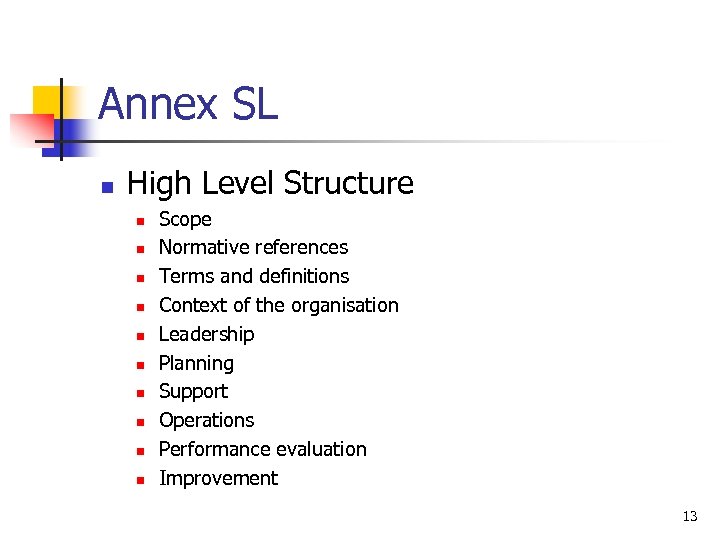 Annex SL n High Level Structure n n n n n Scope Normative references Terms and definitions Context of the organisation Leadership Planning Support Operations Performance evaluation Improvement 13
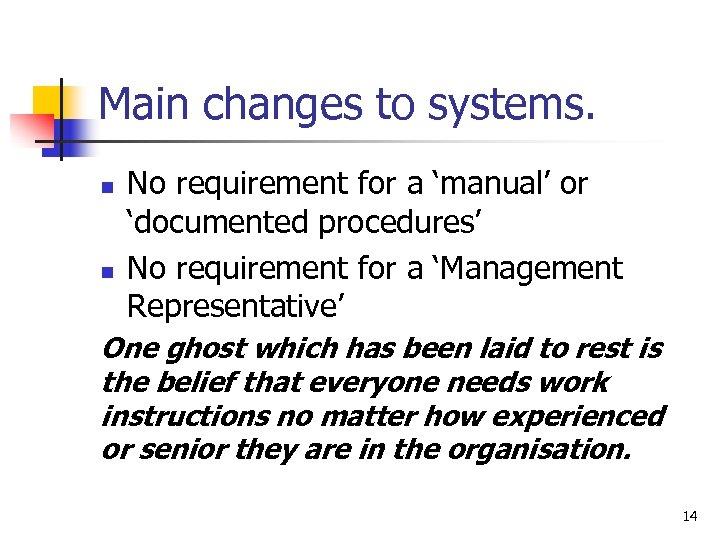 Main changes to systems. n n No requirement for a ‘manual’ or ‘documented procedures’ No requirement for a ‘Management Representative’ One ghost which has been laid to rest is the belief that everyone needs work instructions no matter how experienced or senior they are in the organisation. 14
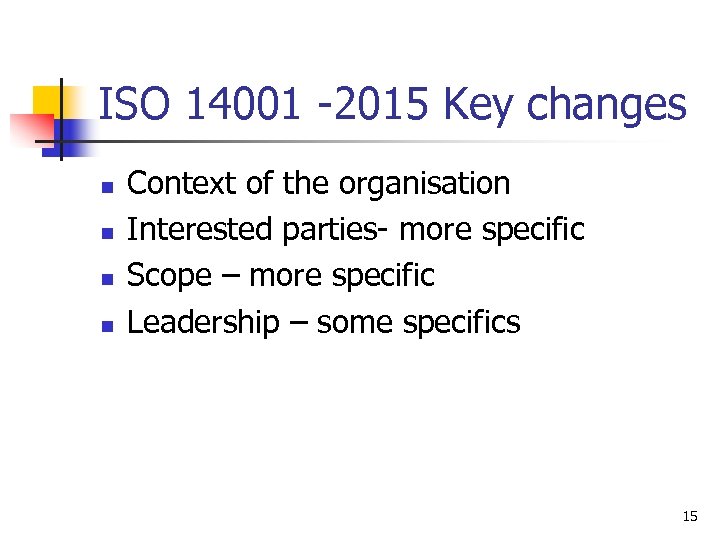 ISO 14001 -2015 Key changes n n Context of the organisation Interested parties- more specific Scope – more specific Leadership – some specifics 15
 4. 0 Context of the organisation n n Scope – fully define? Interested parties – who? What? Threats and Opportunities What? Compliance obligations What? 16
 Threats and Opportunities n n n SWOT analysis PEST analysis Listing and dealing with the outcomes 17
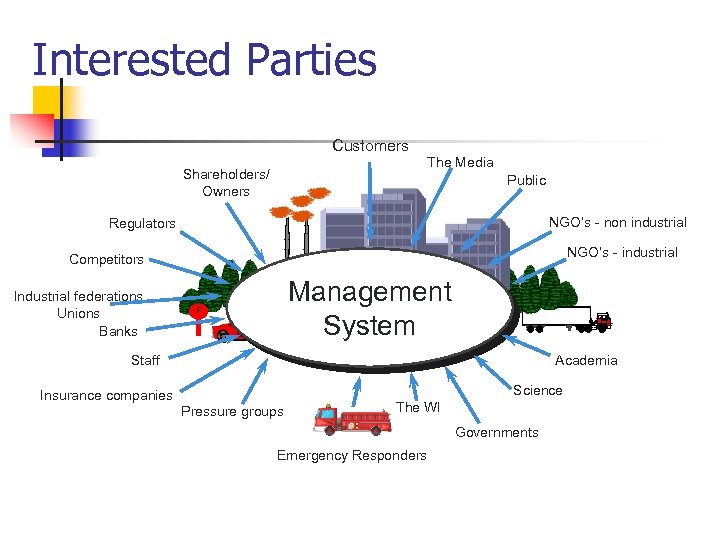 Interested Parties Customers The Media Shareholders/ Owners Public NGO’s - non industrial Regulators NGO’s - industrial Competitors Industrial federations Unions Banks Management System P Academia Staff Science Insurance companies Pressure groups The WI Governments Emergency Responders
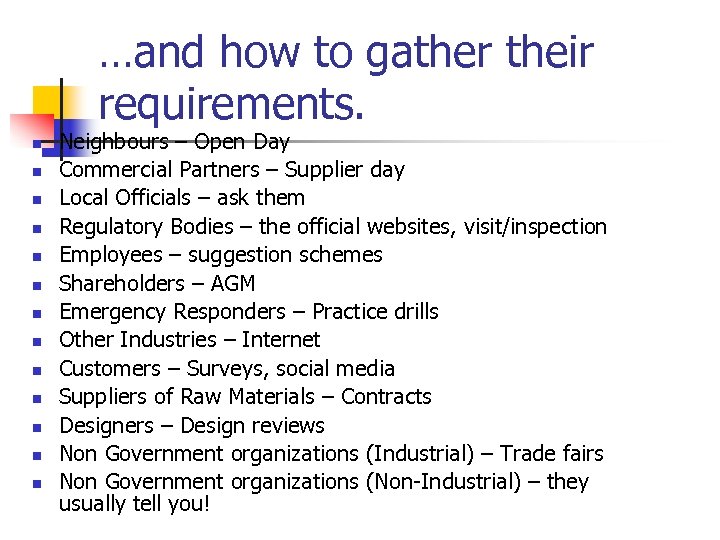 …and how to gather their requirements. n n n n Neighbours – Open Day Commercial Partners – Supplier day Local Officials – ask them Regulatory Bodies – the official websites, visit/inspection Employees – suggestion schemes Shareholders – AGM Emergency Responders – Practice drills Other Industries – Internet Customers – Surveys, social media Suppliers of Raw Materials – Contracts Designers – Design reviews Non Government organizations (Industrial) – Trade fairs Non Government organizations (Non-Industrial) – they usually tell you!
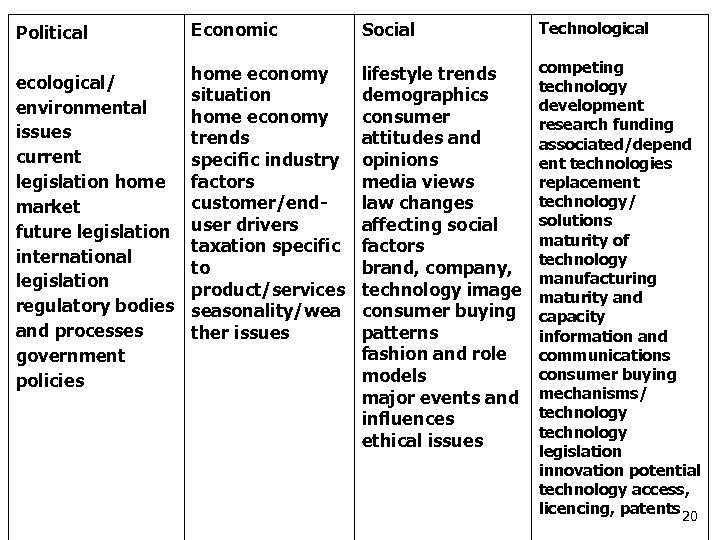 Political Economic home economy ecological/ situation environmental home economy issues trends current specific industry legislation home factors customer/endmarket future legislation user drivers taxation specific international to legislation product/services regulatory bodies seasonality/wea and processes ther issues government policies Social Technological lifestyle trends demographics consumer attitudes and opinions media views law changes affecting social factors brand, company, technology image consumer buying patterns fashion and role models major events and influences ethical issues competing technology development research funding associated/depend ent technologies replacement technology/ solutions maturity of technology manufacturing maturity and capacity information and communications consumer buying mechanisms/ technology legislation innovation potential technology access, licencing, patents 20
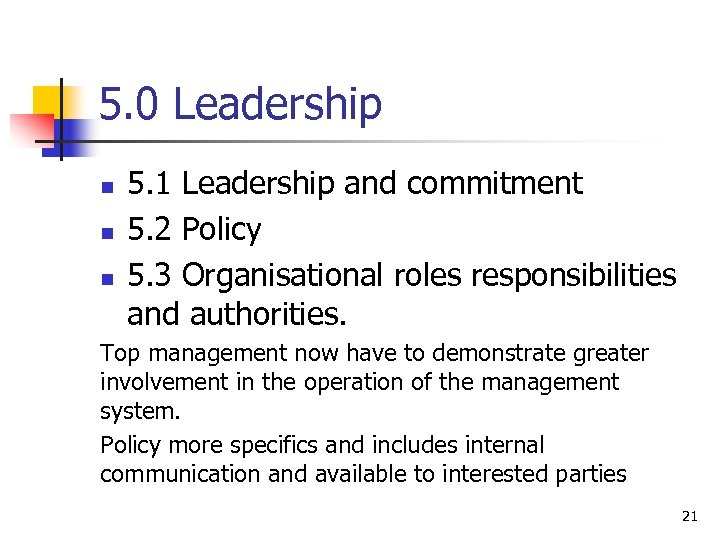 5. 0 Leadership n n n 5. 1 Leadership and commitment 5. 2 Policy 5. 3 Organisational roles responsibilities and authorities. Top management now have to demonstrate greater involvement in the operation of the management system. Policy more specifics and includes internal communication and available to interested parties 21
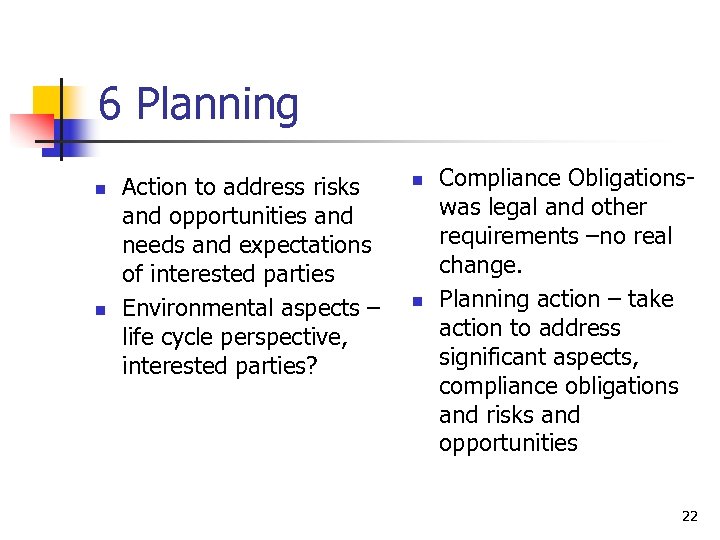 6 Planning n n Action to address risks and opportunities and needs and expectations of interested parties Environmental aspects – life cycle perspective, interested parties? n n Compliance Obligationswas legal and other requirements –no real change. Planning action – take action to address significant aspects, compliance obligations and risks and opportunities 22
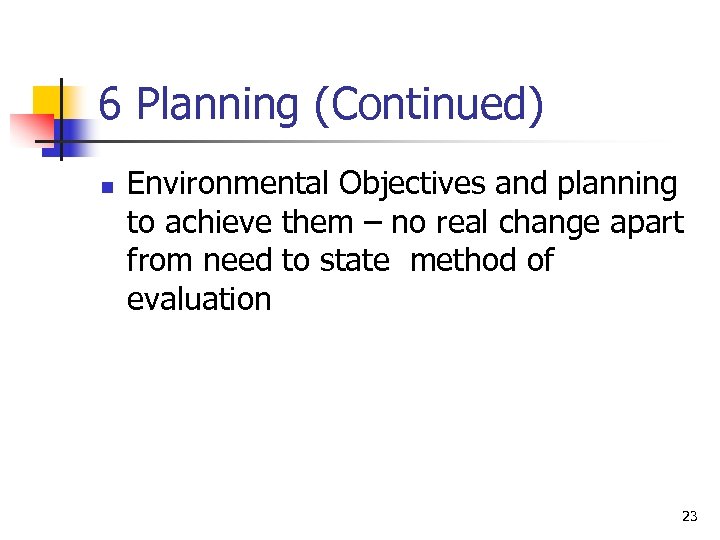 6 Planning (Continued) n Environmental Objectives and planning to achieve them – no real change apart from need to state method of evaluation 23
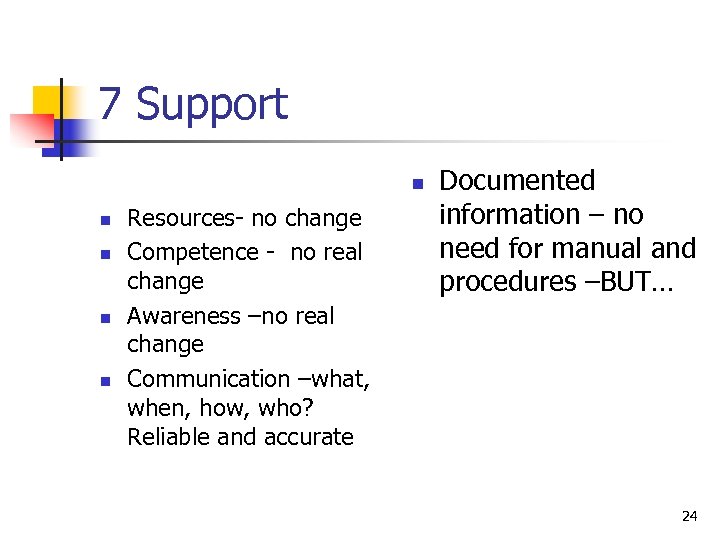 7 Support n n n Resources- no change Competence - no real change Awareness –no real change Communication –what, when, how, who? Reliable and accurate Documented information – no need for manual and procedures –BUT… 24
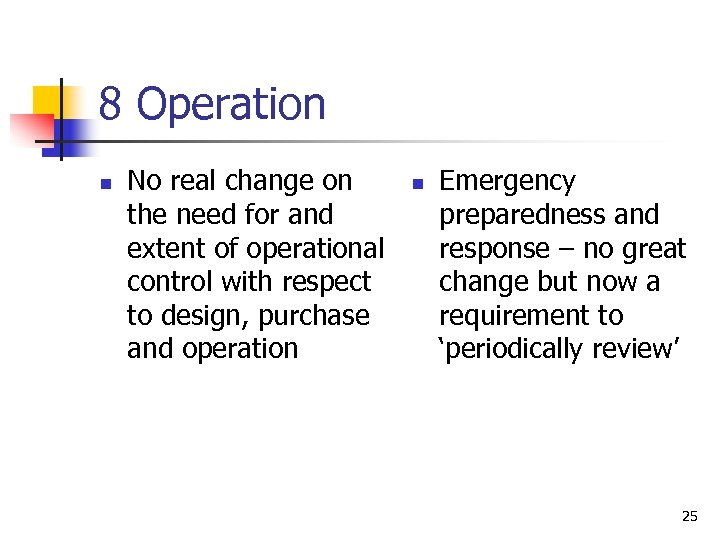 8 Operation n No real change on the need for and extent of operational control with respect to design, purchase and operation n Emergency preparedness and response – no great change but now a requirement to ‘periodically review’ 25
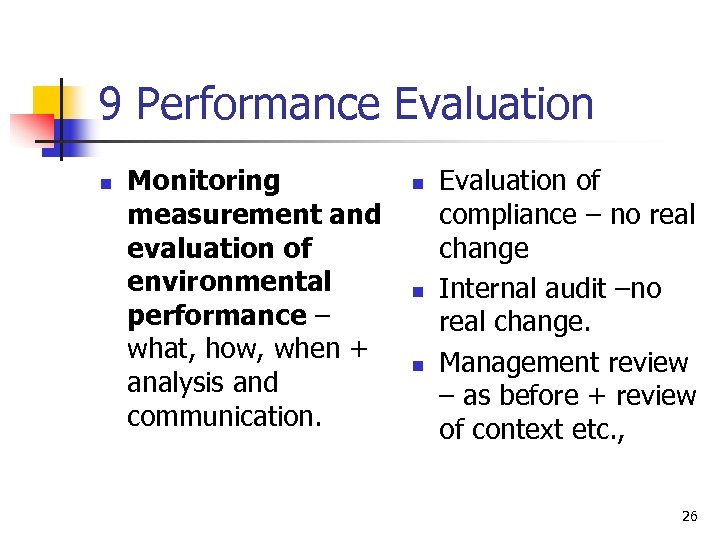 9 Performance Evaluation n Monitoring measurement and evaluation of environmental performance – what, how, when + analysis and communication. n n n Evaluation of compliance – no real change Internal audit –no real change. Management review – as before + review of context etc. , 26
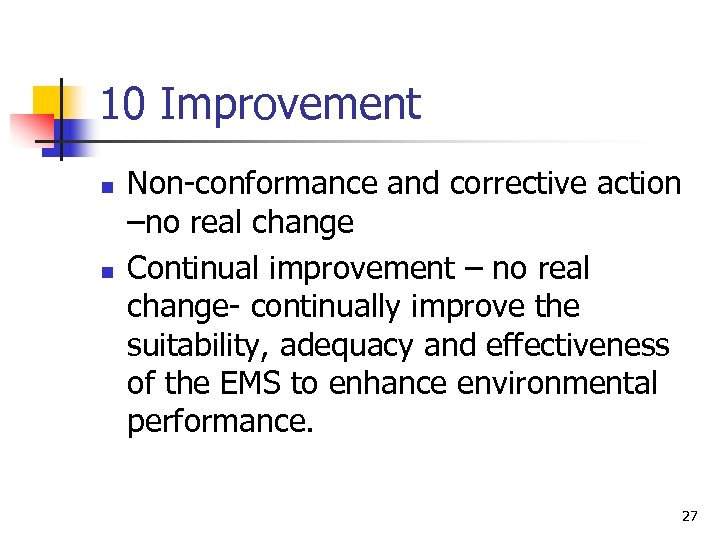 10 Improvement n n Non-conformance and corrective action –no real change Continual improvement – no real change- continually improve the suitability, adequacy and effectiveness of the EMS to enhance environmental performance. 27
 THE END n Any further questions? 28
 Environmental Management ISO 14001 Environmental Management A view from the Bridge
 Environmental Management ISO 14001 Environmental Management A view from the Bridge Dougy Hill BIFM ILM MCIM Agenda • EMS & Why ? • Business drivers for an EMS at Sparsholt College • An FM’s perspective • Benefits of having an EMS • Benefits already seen & projects going forward
 Environmental Management Why? • An Environmental Management System is a mechanism that enables an organisation to identify and manage & reduce their environmental impacts NOT JUST A BADGE • Requires total commitment of organisation – to prevent pollution and comply with legal & other applicable requirements • Drives continual improvement • Ultimately the aim of an EMS is to reduce the No two EMS’s are the same. Every organisation is different with a unique set of positive and negative organisation’s impact on the environmental impacts
 Environmental Management Business drivers for an EMS • Reduced costs: energy, waste, water • Management: improved data = better decisions • Marketing: attract students, staff funding from investors support from industry • Legal compliance & risk control • Improve / protect brand reputation • Market reassurance • Enhanced student experience • Improves communication between departments
 Environmental Management EMS from the inside – an FM’s perspective First thought - College is just “badging” Second thought - I don’t have the time or resources to do this Then realisation that 75% of systems / processes already in place Realisation of benefits to the organisation Committed to achieving ISO 14001, but not just for the “badge”
 Environmental Management Benefits already realised * attract students who care about the environment and would like to attend a College that also cares - generates income * allow the College to continue to improve its environmental performance (sustainability is one of our key values) * allow the effective targeting of the most significant environmental impacts (College has limited resources) * give the College confidence that it is conforming with legal and other requirements * attract the very best members of personal to apply to work at the College * encourage staff to stay at the College --> reduced cost though advertising, enrolling and staff training as a result of a high turn around of staff
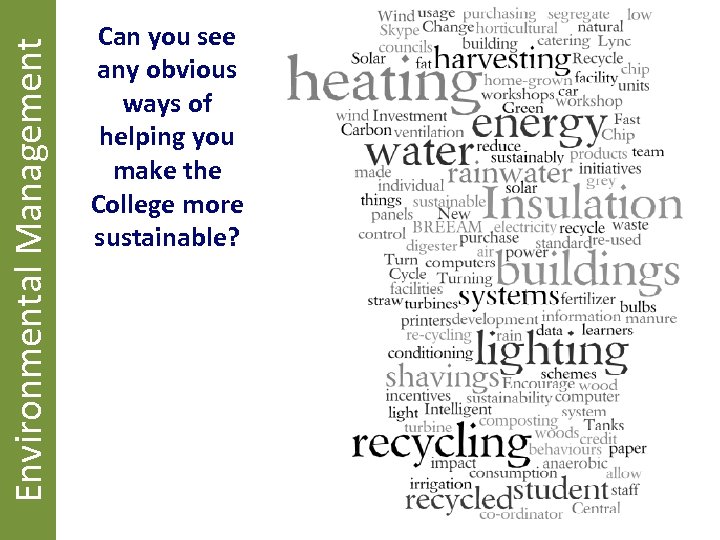 Environmental Management Can you see any obvious ways of helping you make the College more sustainable?
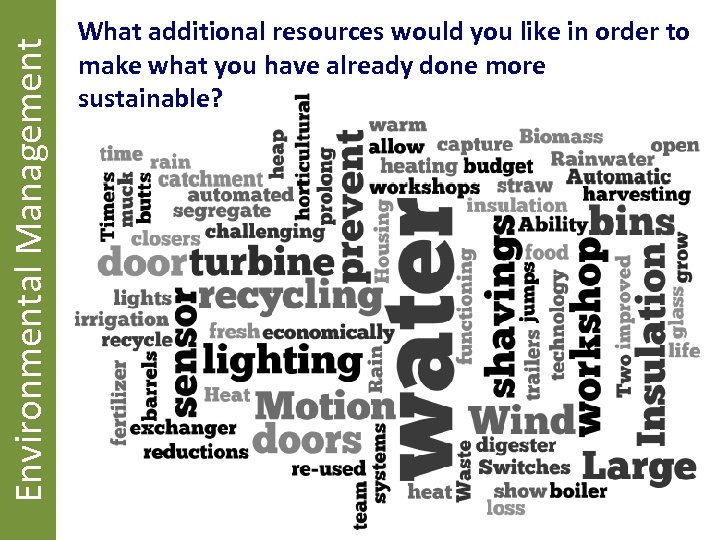 Environmental Management What additional resources would you like in order to make what you have already done more sustainable?
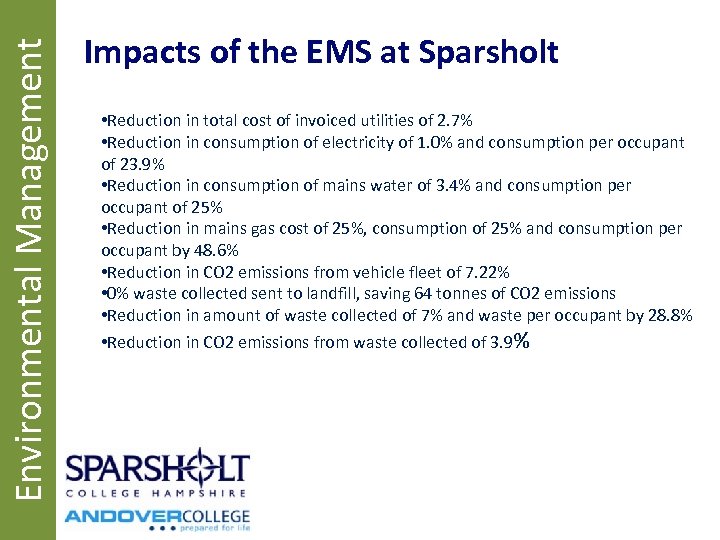 Environmental Management Impacts of the EMS at Sparsholt • Reduction in total cost of invoiced utilities of 2. 7% • Reduction in consumption of electricity of 1. 0% and consumption per occupant of 23. 9% • Reduction in consumption of mains water of 3. 4% and consumption per occupant of 25% • Reduction in mains gas cost of 25%, consumption of 25% and consumption per occupant by 48. 6% • Reduction in CO 2 emissions from vehicle fleet of 7. 22% • 0% waste collected sent to landfill, saving 64 tonnes of CO 2 emissions • Reduction in amount of waste collected of 7% and waste per occupant by 28. 8% • Reduction in CO 2 emissions from waste collected of 3. 9%
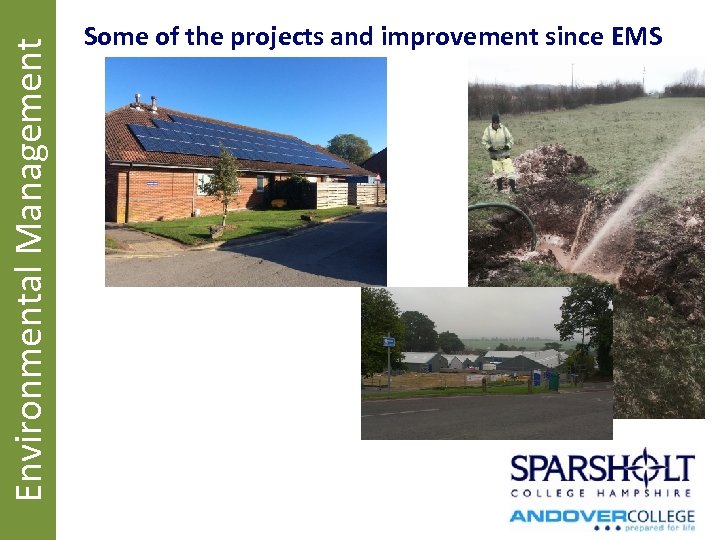 Environmental Management Some of the projects and improvement since EMS
 Environmental Management
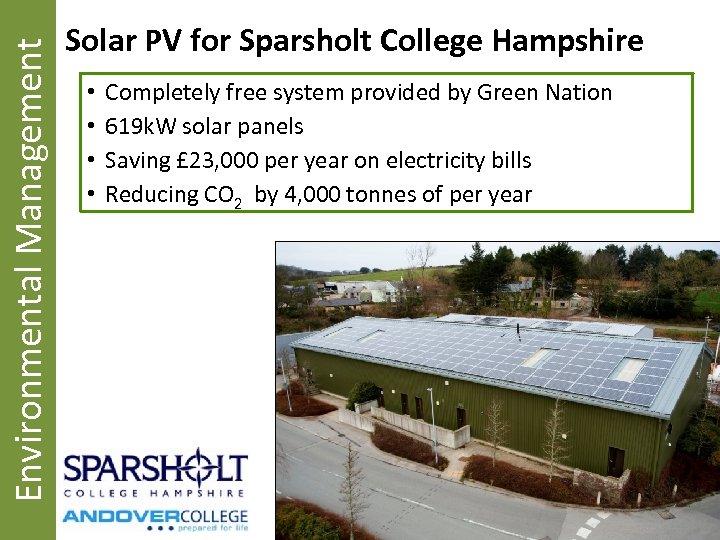 Environmental Management Solar PV for Sparsholt College Hampshire • • Completely free system provided by Green Nation 619 k. W solar panels Saving £ 23, 000 per year on electricity bills Reducing CO 2 by 4, 000 tonnes of per year
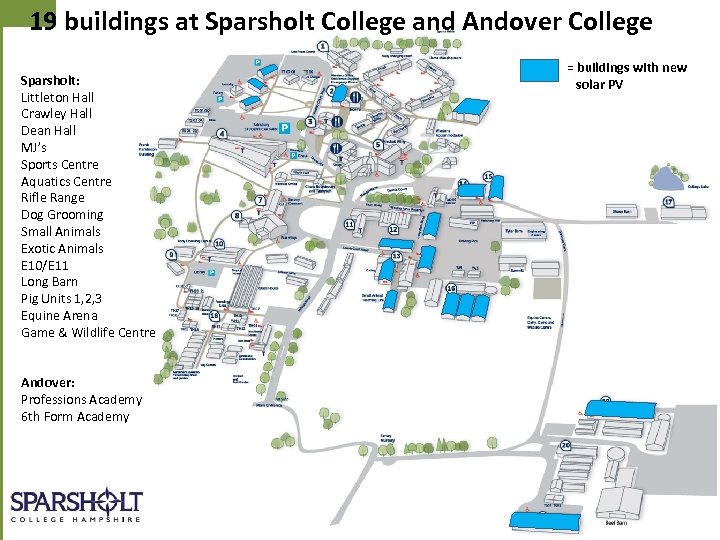 Environmental Management 19 buildings at Sparsholt College and Andover College Sparsholt: Littleton Hall Crawley Hall Dean Hall MJ’s Sports Centre Aquatics Centre Rifle Range Dog Grooming Small Animals Exotic Animals E 10/E 11 Long Barn Pig Units 1, 2, 3 Equine Arena Game & Wildlife Centre Andover: Professions Academy 6 th Form Academy = buildings with new solar PV
 Environmental Management Next steps Continual improvement • Target the new 2015 standard • Need to get more staff & students to realise benefits of monitoring energy, waste, etc, but also implementing change • Drive our new targets & Objectives • Be proud of what we have achieved in such a short period Any Questions
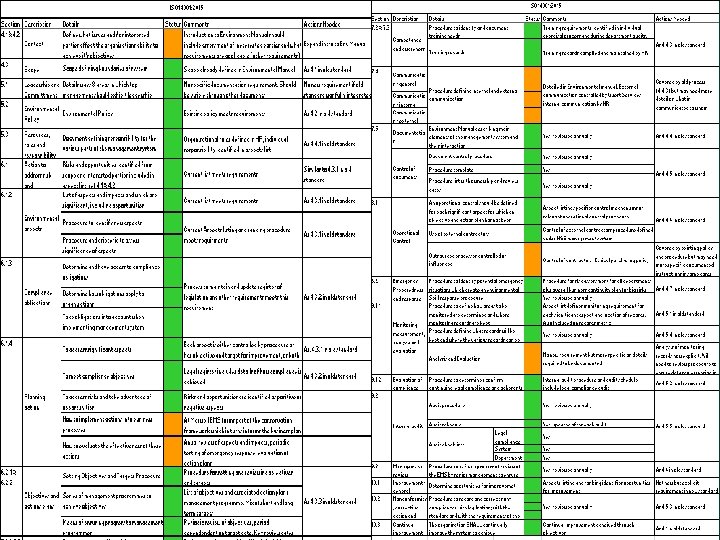
 ISO 14001: 2015 GAP ANALYSIS Duncan East
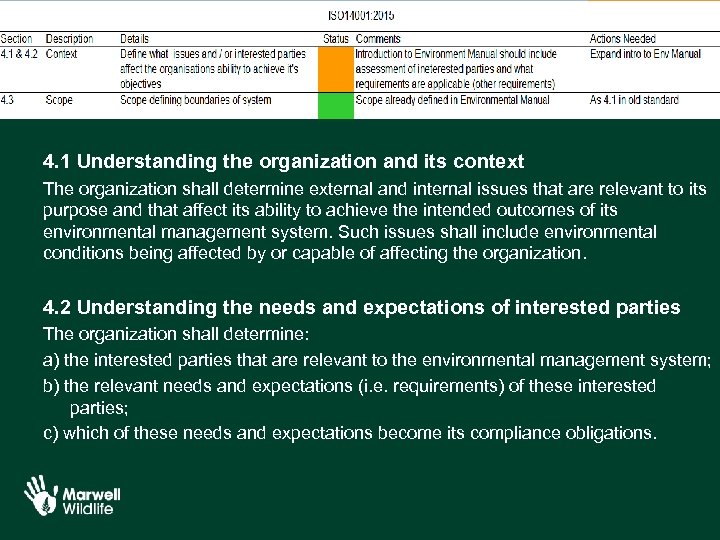 4. 1 Understanding the organization and its context The organization shall determine external and internal issues that are relevant to its purpose and that affect its ability to achieve the intended outcomes of its environmental management system. Such issues shall include environmental conditions being affected by or capable of affecting the organization. 4. 2 Understanding the needs and expectations of interested parties The organization shall determine: a) the interested parties that are relevant to the environmental management system; b) the relevant needs and expectations (i. e. requirements) of these interested parties; c) which of these needs and expectations become its compliance obligations.
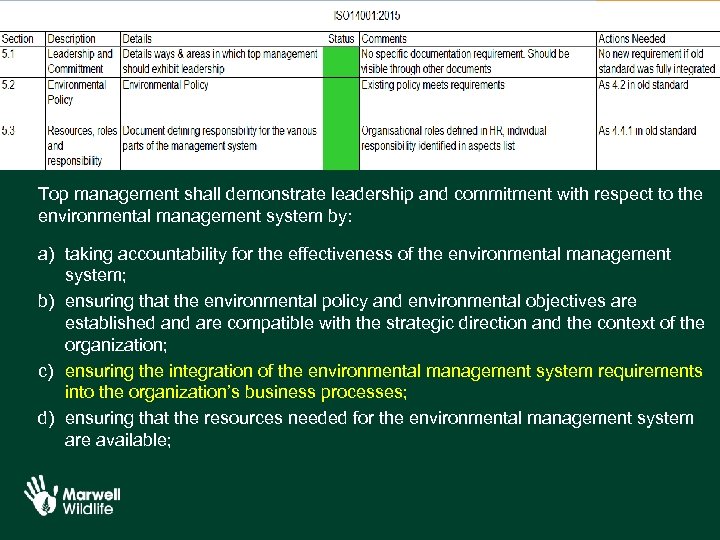 Top management shall demonstrate leadership and commitment with respect to the environmental management system by: a) taking accountability for the effectiveness of the environmental management system; b) ensuring that the environmental policy and environmental objectives are established and are compatible with the strategic direction and the context of the organization; c) ensuring the integration of the environmental management system requirements into the organization’s business processes; d) ensuring that the resources needed for the environmental management system are available;
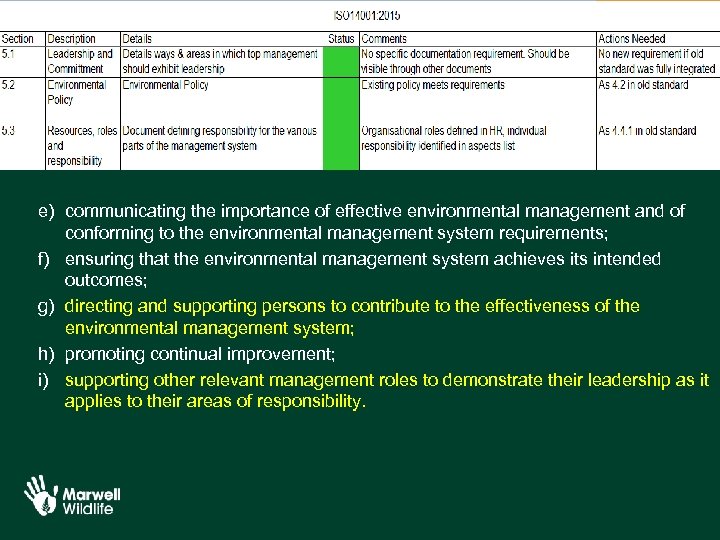 e) communicating the importance of effective environmental management and of conforming to the environmental management system requirements; f) ensuring that the environmental management system achieves its intended outcomes; g) directing and supporting persons to contribute to the effectiveness of the environmental management system; h) promoting continual improvement; i) supporting other relevant management roles to demonstrate their leadership as it applies to their areas of responsibility.
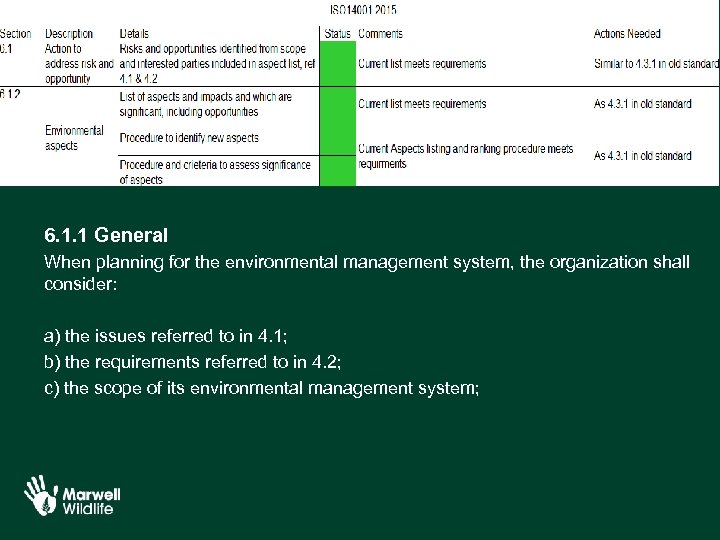 6. 1. 1 General When planning for the environmental management system, the organization shall consider: a) the issues referred to in 4. 1; b) the requirements referred to in 4. 2; c) the scope of its environmental management system;
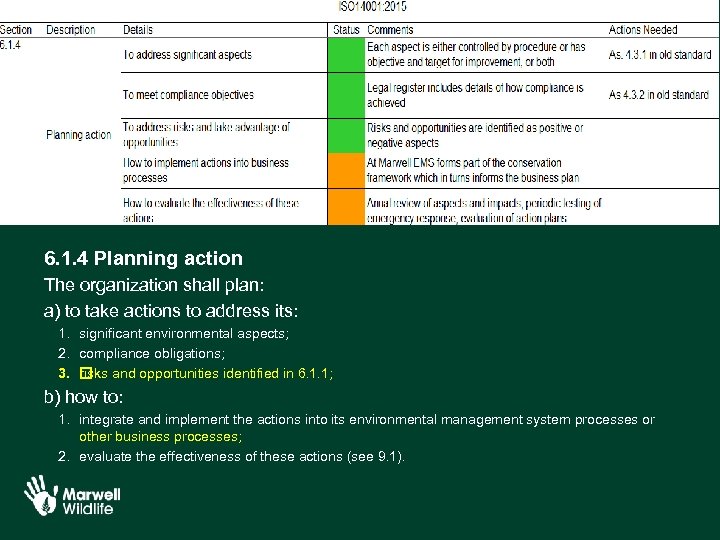 6. 1. 4 Planning action The organization shall plan: a) to take actions to address its: 1. significant environmental aspects; 2. compliance obligations; 3. and opportunities identified in 6. 1. 1; risks b) how to: 1. integrate and implement the actions into its environmental management system processes or other business processes; 2. evaluate the effectiveness of these actions (see 9. 1).
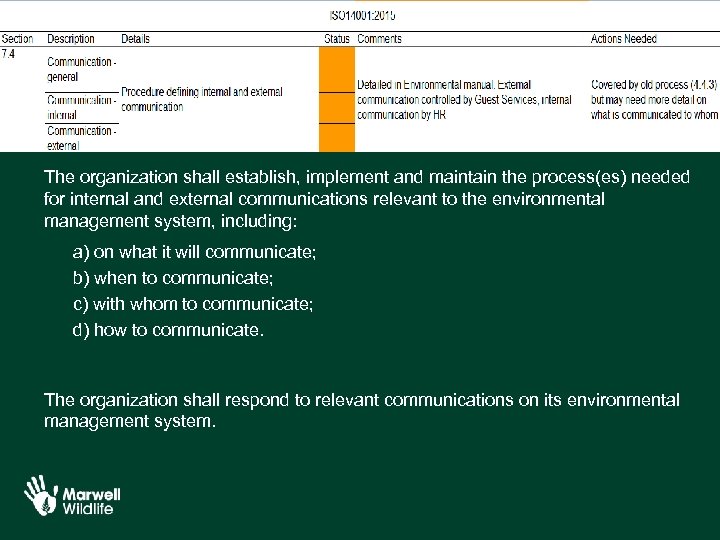 The organization shall establish, implement and maintain the process(es) needed for internal and external communications relevant to the environmental management system, including: a) on what it will communicate; b) when to communicate; c) with whom to communicate; d) how to communicate. The organization shall respond to relevant communications on its environmental management system.
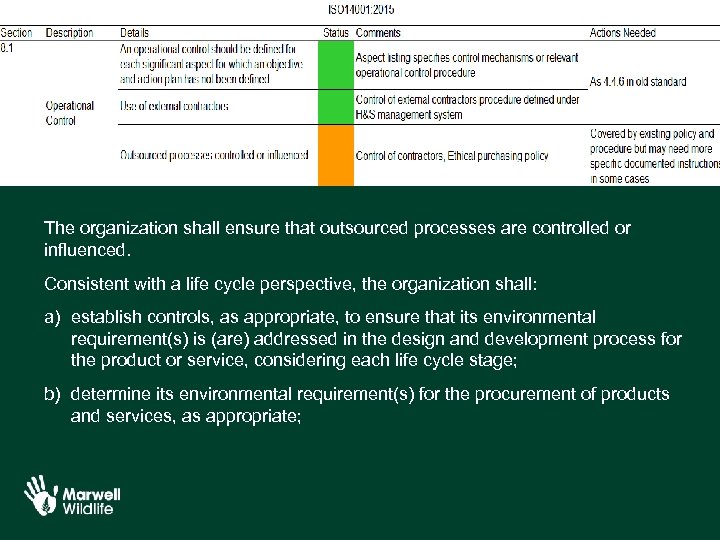 The organization shall ensure that outsourced processes are controlled or influenced. Consistent with a life cycle perspective, the organization shall: a) establish controls, as appropriate, to ensure that its environmental requirement(s) is (are) addressed in the design and development process for the product or service, considering each life cycle stage; b) determine its environmental requirement(s) for the procurement of products and services, as appropriate;
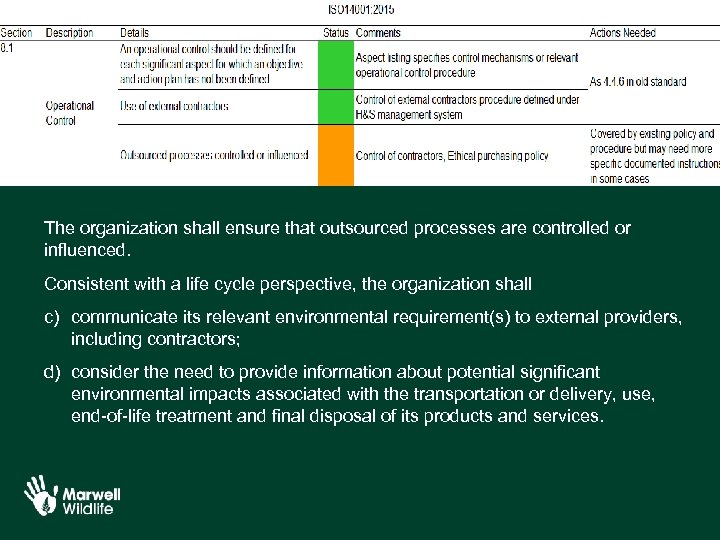 The organization shall ensure that outsourced processes are controlled or influenced. Consistent with a life cycle perspective, the organization shall c) communicate its relevant environmental requirement(s) to external providers, including contractors; d) consider the need to provide information about potential significant environmental impacts associated with the transportation or delivery, use, end-of-life treatment and final disposal of its products and services.
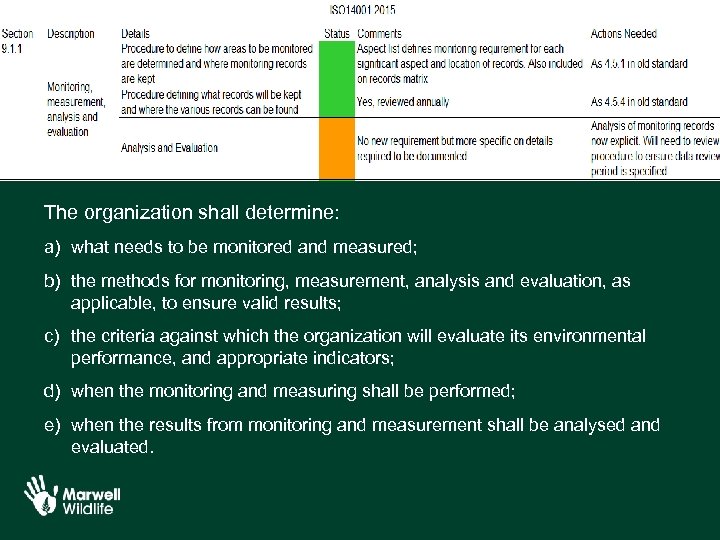 The organization shall determine: a) what needs to be monitored and measured; b) the methods for monitoring, measurement, analysis and evaluation, as applicable, to ensure valid results; c) the criteria against which the organization will evaluate its environmental performance, and appropriate indicators; d) when the monitoring and measuring shall be performed; e) when the results from monitoring and measurement shall be analysed and evaluated.
 Thank you Any Questions?