 Скачать презентацию 18 -1 Mc Graw-Hill Irwin Copyright 2011 by
d19d53c5e00a36684770a7738bb1fa73.ppt
- Количество слайдов: 43



18 -1 Mc. Graw-Hill/Irwin Copyright © 2011 by the Mc. Graw-Hill Companies, Inc. All rights reserved.
Key Concepts and Skills Understand – How exchange rates are quoted and what they mean – The difference between spot and forward rates – Purchasing power parity and interest rate parity and the implications for changes in exchange rates – The types of exchange rate risk and how it can be managed – The impact of political risk on international business investing 18 -2
Chapter Outline 18. 1 18. 2 18. 3 18. 4 18. 5 18. 6 Terminology Foreign Exchange Markets and Exchange Rates Purchasing Power Parity Exchange Rates and Interest Rates Exchange Rate Risk Political Risk 18 -3
International Finance Terminology • American Depositary Receipt (ADR) – Security issued in the U. S. representing shares of a foreign stock – Can be traded in the U. S. • Cross-rate – Implicit exchange rate between two currencies when both are quoted in a third (usually dollars) currency. • Eurobond – Bond issued in multiple countries but denominated in the issuer’s home currency 18 -4
International Finance Terminology • Eurocurrency (Eurodollars) – Money deposited in a financial center outside the country of the currency involved – “Eurodollars” = dollar-denominated deposits in banks outside the U. S. banking system • Foreign bonds – Sold by foreign borrower – Denominated in currency of the country of issue • Gilts – British and Irish government securities 18 -5
International Finance Terminology • London Interbank Offer Rate (LIBOR) – Rate international banks charge each other for loans of Eurodollars overnight in the London market – Frequently used as a benchmark rate for money market instruments • Swaps – Interest rate swap = two parties exchange a floatingrate payment for a fixed-rate payment – Currency swap = agreement to deliver one currency in exchange for another 18 -6
Global Capital Markets • Number of exchanges in foreign countries continues to increase, as does the liquidity on those exchanges • Exchanges facilitate the flow of capital – Extremely important to developing countries – Differences: • Market Structure • Regulation • Trading rules • United States = most developed capital markets in the world, but: – Foreign markets becoming more competitive – Often more willing to innovate 18 -7
Example: Work the Web • Thinking about going to Mexico for spring break or Japan for your summer vacation? • How many pesos or yen can you get in exchange for $1, 000? • Click on the Web surfer to find out 18 -8
FOREX Trading • Foreign Exchange – Largest market in the world – $1. 9 trillion per day on average – Trading = 24/7 over-the-counter – Most trading in USD, £, ¥, and € • FOREX quotations: – Direct = USD per foreign currency – Indirect = Units of foreign currency per USD 18 -9
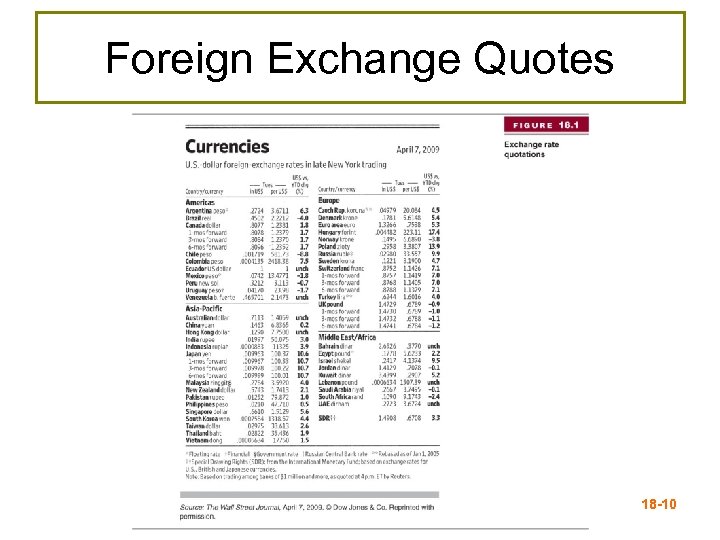
Foreign Exchange Quotes 18 -10
Exchange Rates • The price of one country’s currency in terms of another – Most currency quoted in terms of dollars • Direct Quotation = price of foreign currency expressed in U. S. dollars. (dollars per currency); Figure 18. 1 “in US$” • Indirect quotation = the amount of a foreign currency required to buy one U. S. dollar (currency per dollar); Figure 18. 1 “per US$” Return to Quick Quiz 18 -11
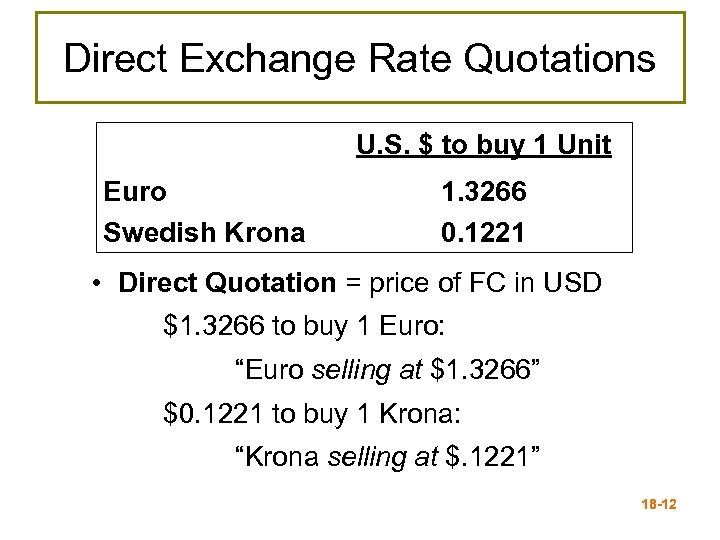
Direct Exchange Rate Quotations U. S. $ to buy 1 Unit Euro Swedish Krona 1. 3266 0. 1221 • Direct Quotation = price of FC in USD $1. 3266 to buy 1 Euro: “Euro selling at $1. 3266” $0. 1221 to buy 1 Krona: “Krona selling at $. 1221” 18 -12
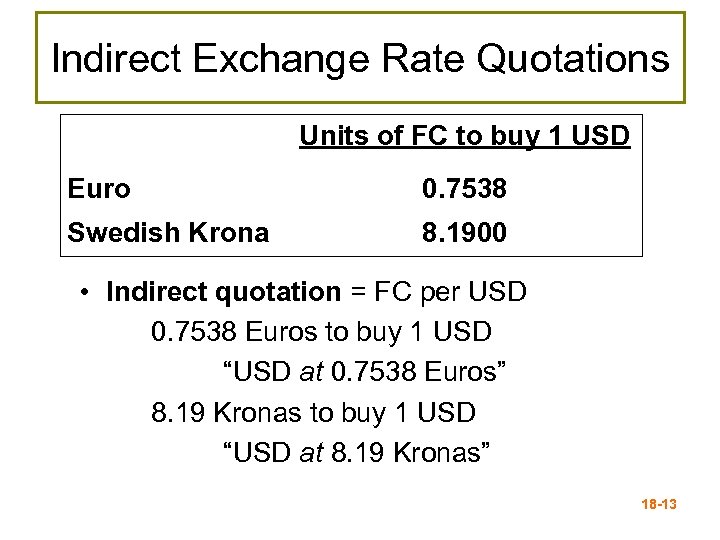
Indirect Exchange Rate Quotations Units of FC to buy 1 USD Euro 0. 7538 Swedish Krona 8. 1900 • Indirect quotation = FC per USD 0. 7538 Euros to buy 1 USD “USD at 0. 7538 Euros” 8. 19 Kronas to buy 1 USD “USD at 8. 19 Kronas” 18 -13
Direct & Indirect Exchange Rate Quotations • An indirect quotation is the reciprocal of a direct quotation – Direct Quotation = 1/Indirect Quotation • Euros and British pounds normally quoted as direct quotations – “The pound is selling at 1. 4729 USD” • All other currencies quoted as indirect 18 -14
Example: Exchange Rates • Suppose you have $10, 000. Based on the rates in Figure 18. 1, how many Norwegian Krona can you buy? – Exchange rate = 8. 1900 Krona per U. S. dollar – Buy 10, 000(8. 1900) = 81, 900 Krona • Suppose you are visiting London and you want to buy a souvenir that costs 1, 000 British pounds. How much does it cost in U. S. dollars? – Exchange rate = $1. 4279 dollars per pound – Cost = 1, 000 X 1. 4279 = $1, 427. 90 18 -15
Cross Rates • The exchange rate between any two currencies not involving U. S. dollars • Usually calculated from direct or indirect rates • Based on U. S. dollar exchange rates 18 -16
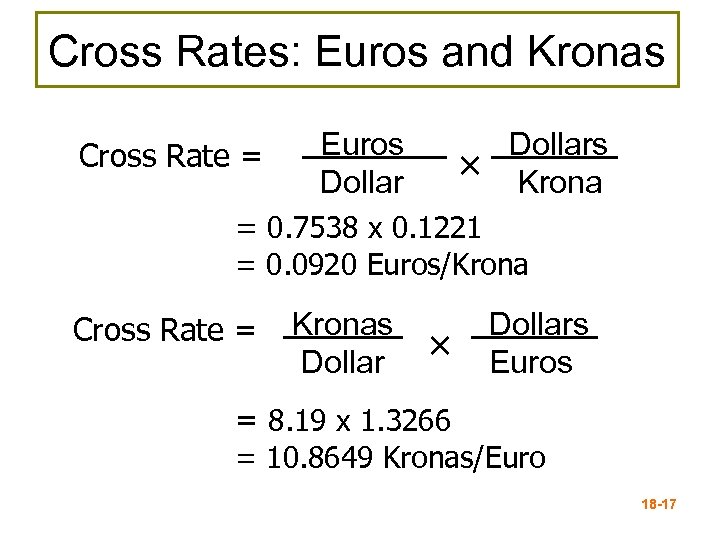
Cross Rates: Euros and Kronas Cross Rate = Euros Dollars × Krona = 0. 7538 x 0. 1221 = 0. 0920 Euros/Krona Cross Rate = Kronas Dollar × Dollars Euros = 8. 19 x 1. 3266 = 10. 8649 Kronas/Euro 18 -17
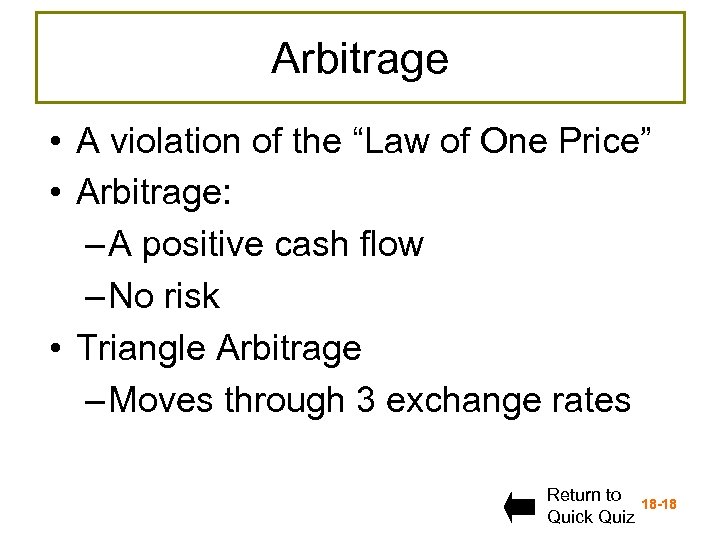
Arbitrage • A violation of the “Law of One Price” • Arbitrage: – A positive cash flow – No risk • Triangle Arbitrage – Moves through 3 exchange rates Return to Quick Quiz 18 -18
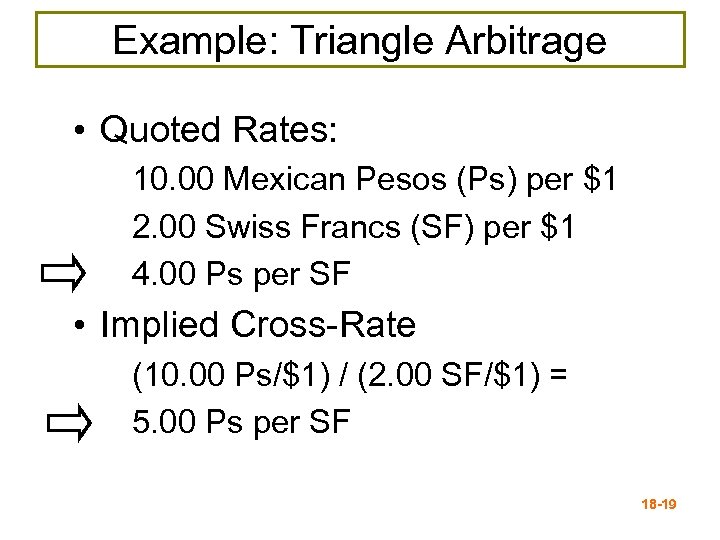
Example: Triangle Arbitrage • Quoted Rates: 10. 00 Mexican Pesos (Ps) per $1 2. 00 Swiss Francs (SF) per $1 4. 00 Ps per SF • Implied Cross-Rate (10. 00 Ps/$1) / (2. 00 SF/$1) = 5. 00 Ps per SF 18 -19
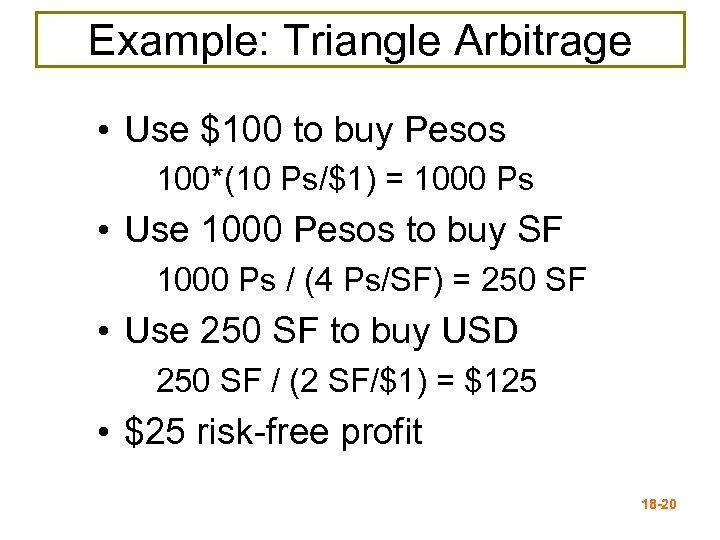
Example: Triangle Arbitrage • Use $100 to buy Pesos 100*(10 Ps/$1) = 1000 Ps • Use 1000 Pesos to buy SF 1000 Ps / (4 Ps/SF) = 250 SF • Use 250 SF to buy USD 250 SF / (2 SF/$1) = $125 • $25 risk-free profit 18 -20
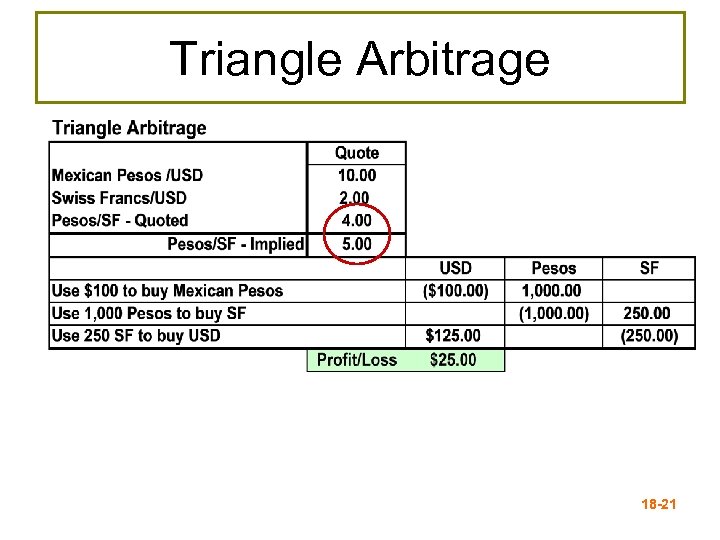
Triangle Arbitrage 18 -21
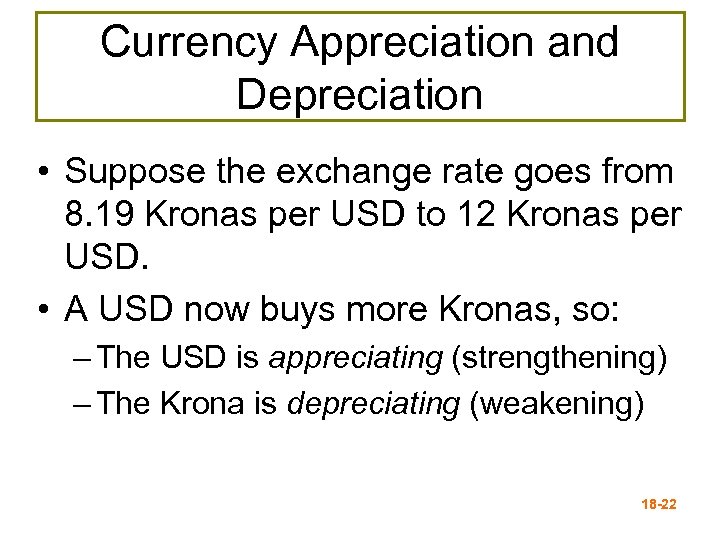
Currency Appreciation and Depreciation • Suppose the exchange rate goes from 8. 19 Kronas per USD to 12 Kronas per USD. • A USD now buys more Kronas, so: – The USD is appreciating (strengthening) – The Krona is depreciating (weakening) 18 -22
Transaction Terminology • Spot rate (S) – The exchange rate for an immediate trade • Forward rate (F) – The exchange rate specified today in a forward contract to exchange currency at some future date – Normally reported as indirect quotations 18 -23
The Forward Rate at a Premium to the Spot Rate • F > S Foreign currency selling at a premium • Example: Spot rate = 0. 7 £/$ Forward rate = 0. 6 £/$ – The pound is expected to appreciate – £ will buy more dollars in the future Forward rate for the pound is at a premium 18 -24
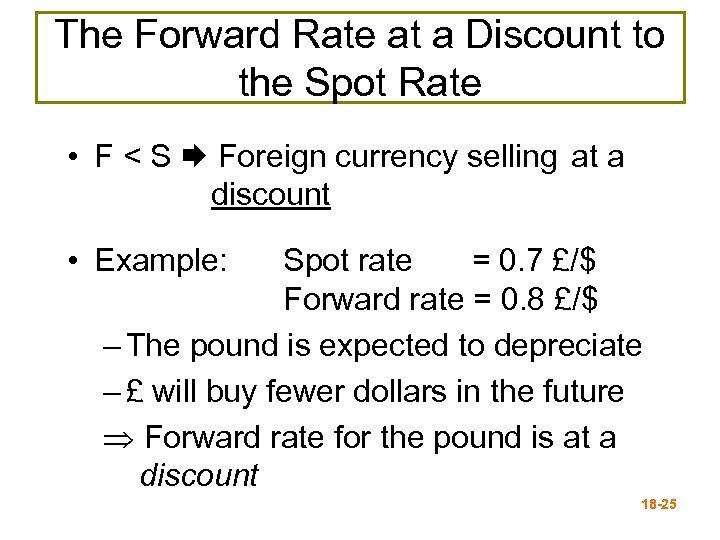
The Forward Rate at a Discount to the Spot Rate • F < S Foreign currency selling at a discount • Example: Spot rate = 0. 7 £/$ Forward rate = 0. 8 £/$ – The pound is expected to depreciate – £ will buy fewer dollars in the future Forward rate for the pound is at a discount 18 -25
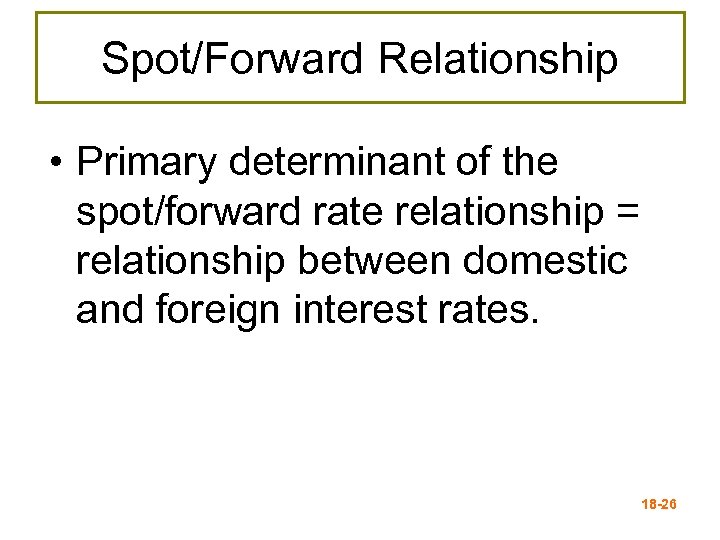
Spot/Forward Relationship • Primary determinant of the spot/forward rate relationship = relationship between domestic and foreign interest rates. 18 -26
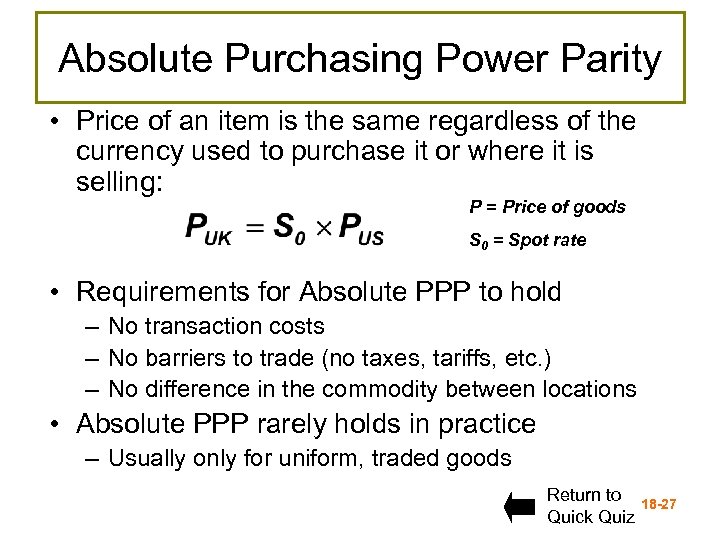
Absolute Purchasing Power Parity • Price of an item is the same regardless of the currency used to purchase it or where it is selling: P = Price of goods S 0 = Spot rate • Requirements for Absolute PPP to hold – No transaction costs – No barriers to trade (no taxes, tariffs, etc. ) – No difference in the commodity between locations • Absolute PPP rarely holds in practice – Usually only for uniform, traded goods Return to Quick Quiz 18 -27
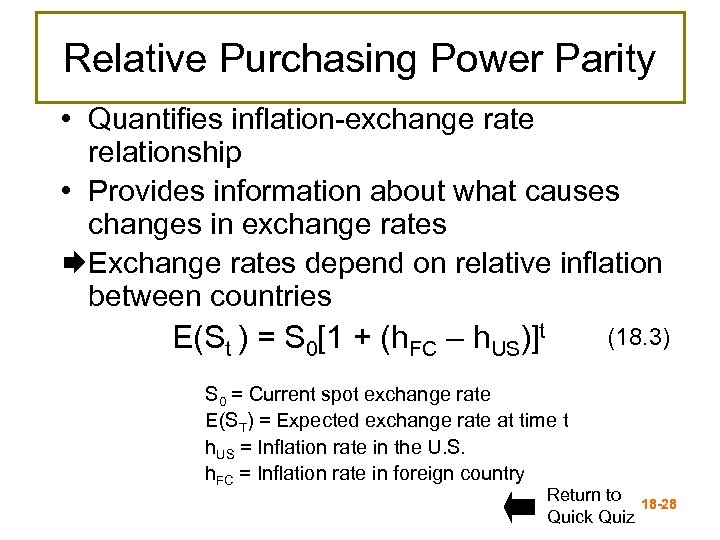
Relative Purchasing Power Parity • Quantifies inflation-exchange rate relationship • Provides information about what causes changes in exchange rates Exchange rates depend on relative inflation between countries (18. 3) E(St ) = S 0[1 + (h. FC – h. US)]t S 0 = Current spot exchange rate E(ST) = Expected exchange rate at time t h. US = Inflation rate in the U. S. h. FC = Inflation rate in foreign country Return to Quick Quiz 18 -28
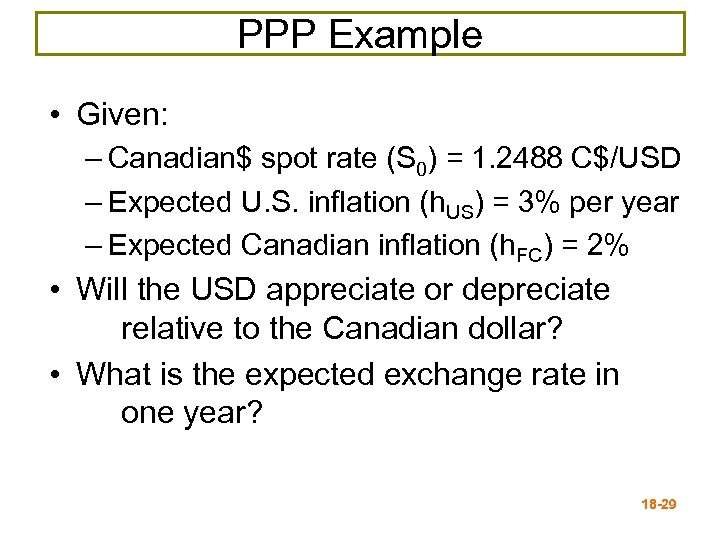
PPP Example • Given: – Canadian$ spot rate (S 0) = 1. 2488 C$/USD – Expected U. S. inflation (h. US) = 3% per year – Expected Canadian inflation (h. FC) = 2% • Will the USD appreciate or depreciate relative to the Canadian dollar? • What is the expected exchange rate in one year? 18 -29
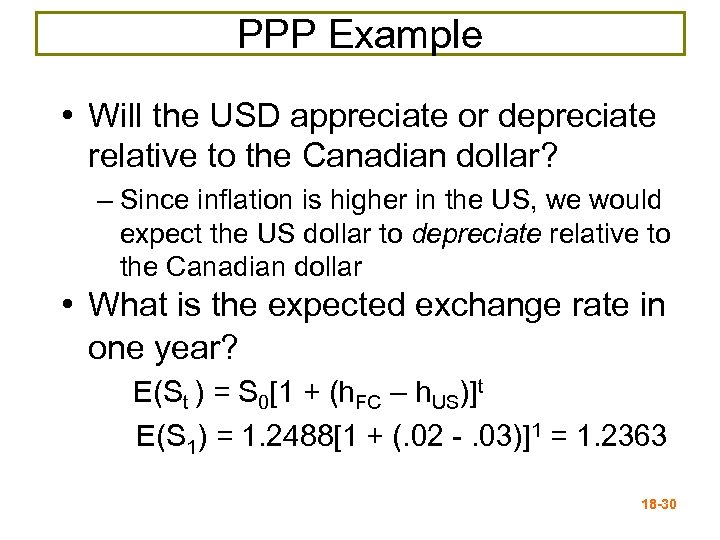
PPP Example • Will the USD appreciate or depreciate relative to the Canadian dollar? – Since inflation is higher in the US, we would expect the US dollar to depreciate relative to the Canadian dollar • What is the expected exchange rate in one year? E(St ) = S 0[1 + (h. FC – h. US)]t E(S 1) = 1. 2488[1 + (. 02 -. 03)]1 = 1. 2363 18 -30
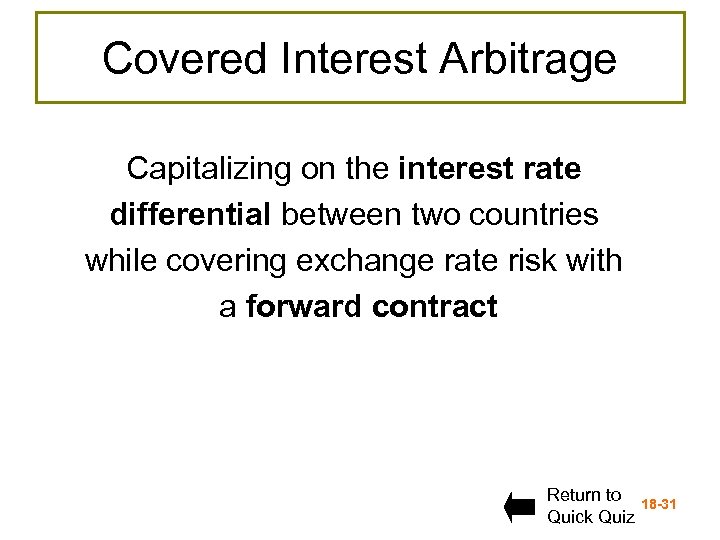
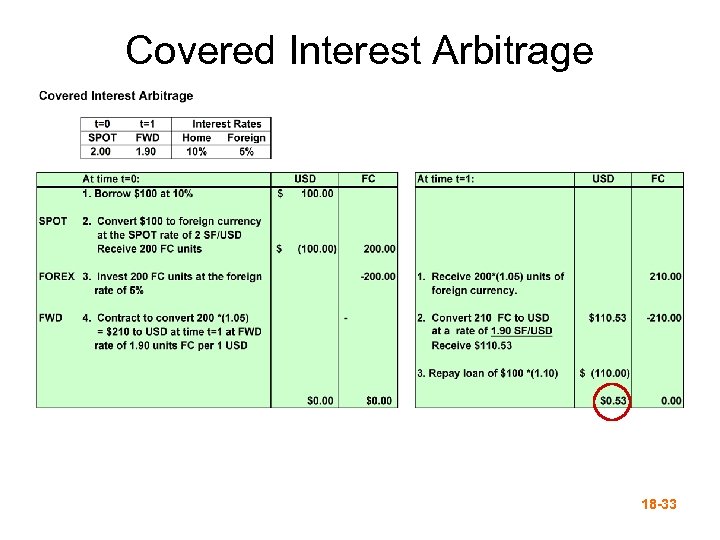
Covered Interest Arbitrage Capitalizing on the interest rate differential between two countries while covering exchange rate risk with a forward contract Return to Quick Quiz 18 -31
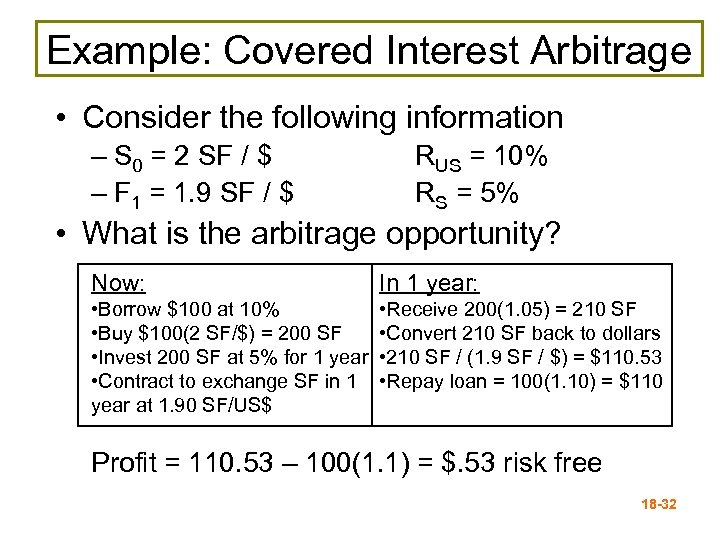
Example: Covered Interest Arbitrage • Consider the following information – S 0 = 2 SF / $ – F 1 = 1. 9 SF / $ RUS = 10% RS = 5% • What is the arbitrage opportunity? Now: In 1 year: • Borrow $100 at 10% • Buy $100(2 SF/$) = 200 SF • Invest 200 SF at 5% for 1 year • Contract to exchange SF in 1 year at 1. 90 SF/US$ • Receive 200(1. 05) = 210 SF • Convert 210 SF back to dollars • 210 SF / (1. 9 SF / $) = $110. 53 • Repay loan = 100(1. 10) = $110 Profit = 110. 53 – 100(1. 1) = $. 53 risk free 18 -32
Covered Interest Arbitrage 18 -33
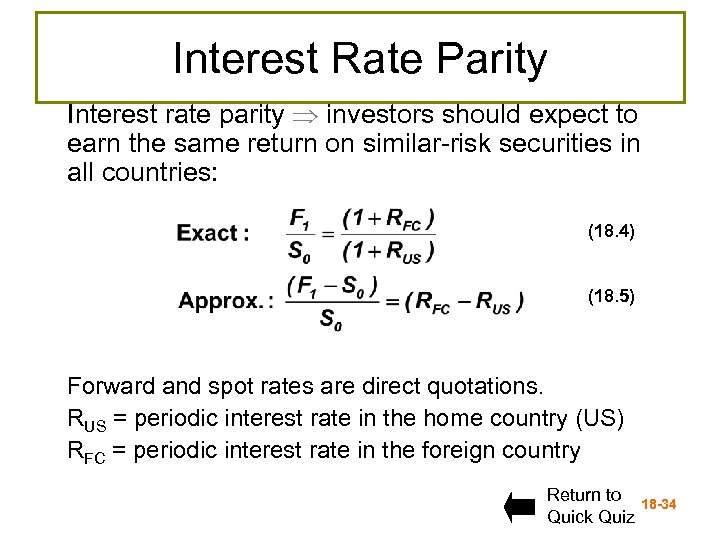
Interest Rate Parity Interest rate parity investors should expect to earn the same return on similar-risk securities in all countries: (18. 4) (18. 5) Forward and spot rates are direct quotations. RUS = periodic interest rate in the home country (US) RFC = periodic interest rate in the foreign country Return to Quick Quiz 18 -34
Exchange Rate Risk • The risk that the value of a cash flow in one currency translated from another currency will decline due to a change in exchange rates. • A natural consequence of international operations in a world where relative currency values move up and down. 18 -35
Short-Run Exposure • Risk from day-to-day fluctuations in exchange rates and the fact that companies have contracts to buy and sell goods in the shortrun at fixed prices • Managing risk – Enter into a forward agreement to guarantee the exchange rate – Use foreign currency options to lock in exchange rates if they move against you, but benefit from rates if they move in your favor Return to Quick Quiz 18 -36
Long-Run Exposure • Long-run fluctuations from unanticipated changes in relative economic conditions • Managing risk – More difficult to hedge – Try to match long-run inflows and outflows in the currency – Borrowing in the foreign country may mitigate some of the problems Return to Quick Quiz 18 -37
Translation Exposure • Income from foreign operations translated back to U. S. dollars for accounting, even if foreign currency not actually converted: – If gains/losses flowed through directly to the income statement significant EPS volatility – Accounting regulations require: • All cash flows be converted at the prevailing exchange rates • Currency gains and losses accumulated in a special account within shareholders’ equity 18 -38
Managing Exchange Rate Risk • Large multinational firms may need to manage the exchange rate risk associated with several different currencies • The firm needs to consider its net exposure to currency risk instead of just looking at each currency separately • Hedging individual currencies could be expensive and may actually increase exposure 18 -39
Political Risk • Changes in value due to political actions in the foreign country • Investment in countries that have unstable governments should require higher returns • Extent of political risk depends on the nature of the business: – The more dependent the business is on other operations within the firm, the less valuable it is to others – Natural resource development can be very valuable to others, especially if much of the ground work has already been done • Local financing can often reduce political risk Return to Quick Quiz 18 -40
Quick Quiz • What does an exchange rate tell us? (Slide 18. 11) • What is triangle arbitrage? (Slide 18. 18) • What is absolute purchasing power parity? (Slide 18. 27) • What is relative purchasing power parity? (Slide 18. 28) • What is covered interest arbitrage? (Slide 18. 31) 18 -41
Quick Quiz • What is interest rate parity? (Slide 18. 34) • What is the difference between short-run interest rate exposure and long-run interest rate exposure and how can you hedge each type? (Slide 18. 36) (Slide 18. 37) • What is political risk and what types of business face the greatest risk? (Slide 18. 40) 18 -42
Chapter 18 END
Скачать презентацию 18 -1 Mc Graw-Hill Irwin Copyright 2011 by
d19d53c5e00a36684770a7738bb1fa73.ppt