


 Скачать презентацию 18 05 2001 Autotuning Why to Use
Учебное пособие по функции автонастройки F7.ppt
- Количество слайдов: 8
 18/05/2001 Autotuning
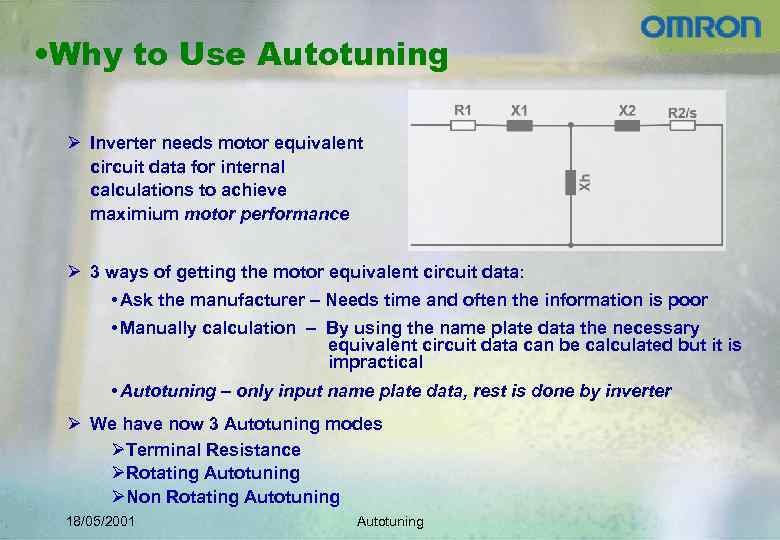 • Why to Use Autotuning Ø Inverter needs motor equivalent circuit data for internal calculations to achieve maximium motor performance Ø 3 ways of getting the motor equivalent circuit data: • Ask the manufacturer – Needs time and often the information is poor • Manually calculation – By using the name plate data the necessary equivalent circuit data can be calculated but it is impractical • Autotuning – only input name plate data, rest is done by inverter Ø We have now 3 Autotuning modes ØTerminal Resistance ØRotating Autotuning ØNon Rotating Autotuning 18/05/2001 Autotuning
 • Terminal Resistance Tuning Mode Ø NEW tuning mode Ø Available in all control modes (V/f, V/f w. PG, Vector) Ø Inverter detects Terminal Resistance • The Inverter applies a DC voltage to the motor and detects the resulting current. • Terminal Resistance can be calculated easily. • Motor does not rotate while terminal resistance tuning mode. Ø Result: • By knowing the resistance the motor internal voltage drop and motor temperature influence can be compensated. • When using long motor cables, the voltage drop at the cable resistance can be compensated by the inverter. 18/05/2001 Autotuning
 • Rotating Autotuning Ø Available in Open Loop Vector mode Ø Inverter determines • • • Terminal Resistance, Leakage Inductance No Load Current Core Saturation Coefficient Rated Slip Frequency Ø Result: • By knowing the exact motor equivalent data the inverter can calculate the Id and Iq values very accurate. • Maximum speed and tourque accuracy can be achieved. Ø ONE BIG DISADVANTAGE: • The motor is rotating while Autotuning Not usable at applications, where load and motor can´t get disconnected 18/05/2001 Autotuning !
 • Non Rotating Autotuning Ø Ø NEW tuning mode Available in Open Loop Vector mode 2 Parts: Non Rotating Part and Test Mode Non Rotating Part • Terminal Resistance, • Leakage Inductance • The values for No Load Current and Motor Rated Slip are taken from an inverter internal motor data table (based on Yaskawa standard motors). Ø Test Mode • First run of the motor with min. 30% of rated speed. Speed agree must be detected. • Real values of No Load Current and Rated Slip are detected during test mode. Ø Result: • By knowing motor equivalent data Id and Iq can be calculated very accurate. Ø ADVANTAGE: Motor does not has to rotate while Autotuning 18/05/2001 Autotuning now is performable in almost every case, even if motor and load are coupled Autotuning !
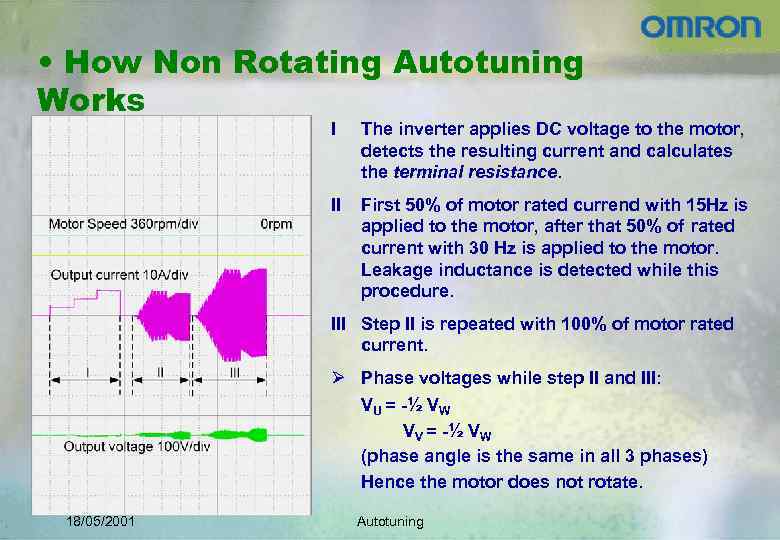 • How Non Rotating Autotuning Works I The inverter applies DC voltage to the motor, detects the resulting current and calculates the terminal resistance. II First 50% of motor rated currend with 15 Hz is applied to the motor, after that 50% of rated current with 30 Hz is applied to the motor. Leakage inductance is detected while this procedure. III Step II is repeated with 100% of motor rated current. Ø Phase voltages while step II and III: VU = -½ VW VV = -½ VW (phase angle is the same in all 3 phases) Hence the motor does not rotate. 18/05/2001 Autotuning
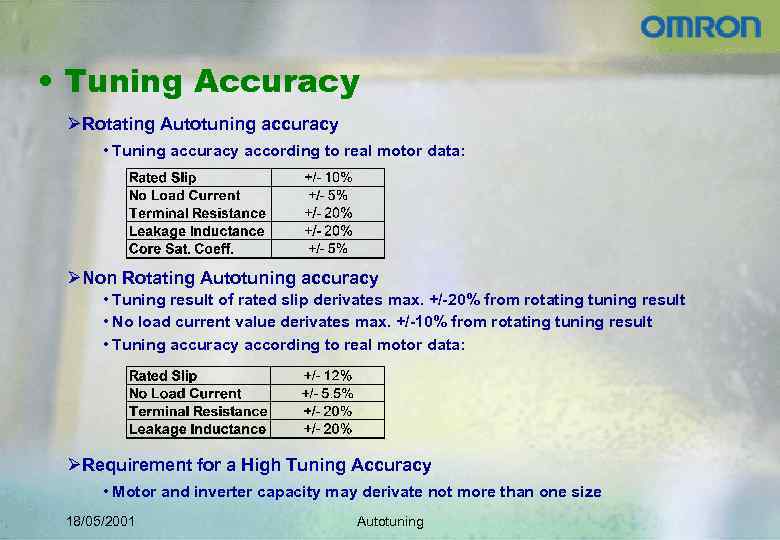 • Tuning Accuracy ØRotating Autotuning accuracy • Tuning accuracy according to real motor data: ØNon Rotating Autotuning accuracy • Tuning result of rated slip derivates max. +/-20% from rotating tuning result • No load current value derivates max. +/-10% from rotating tuning result • Tuning accuracy according to real motor data: ØRequirement for a High Tuning Accuracy • Motor and inverter capacity may derivate not more than one size 18/05/2001 Autotuning
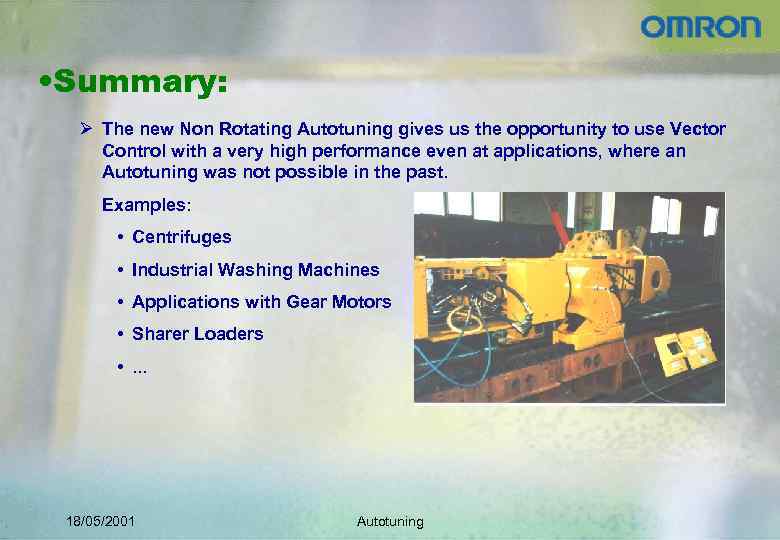 • Summary: Ø The new Non Rotating Autotuning gives us the opportunity to use Vector Control with a very high performance even at applications, where an Autotuning was not possible in the past. Examples: • Centrifuges • Industrial Washing Machines • Applications with Gear Motors • Sharer Loaders • . . . 18/05/2001 Autotuning