


 Скачать презентацию 18 03 2018 P 3 Forces for Transport OCR Gateway
50a078aee96e43d740338efb94fb23d3.ppt
- Количество слайдов: 69
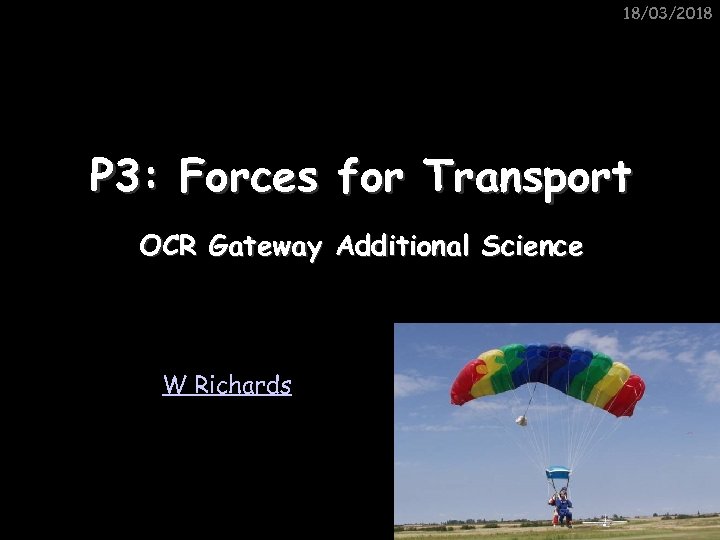 18/03/2018 P 3: Forces for Transport OCR Gateway Additional Science W Richards
 P 3 a Speed 18/03/2018
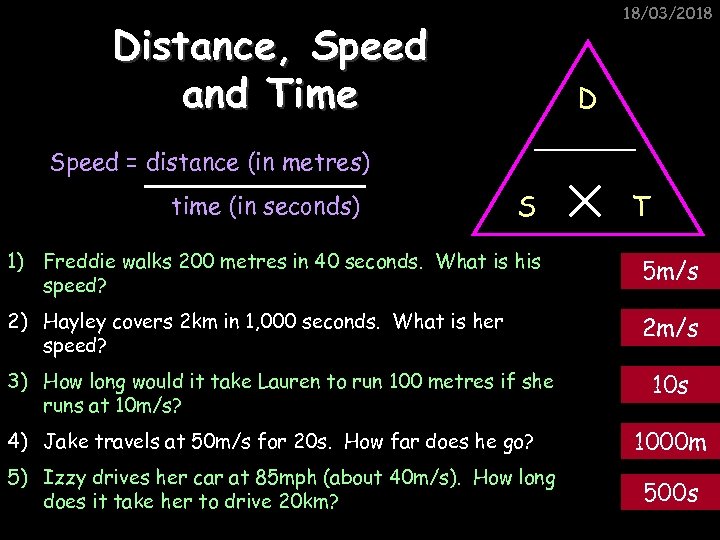 18/03/2018 Distance, Speed and Time D Speed = distance (in metres) time (in seconds) S T 1) Freddie walks 200 metres in 40 seconds. What is his speed? 5 m/s 2) Hayley covers 2 km in 1, 000 seconds. What is her speed? 2 m/s 3) How long would it take Lauren to run 100 metres if she runs at 10 m/s? 4) Jake travels at 50 m/s for 20 s. How far does he go? 5) Izzy drives her car at 85 mph (about 40 m/s). How long does it take her to drive 20 km? 10 s 1000 m 500 s
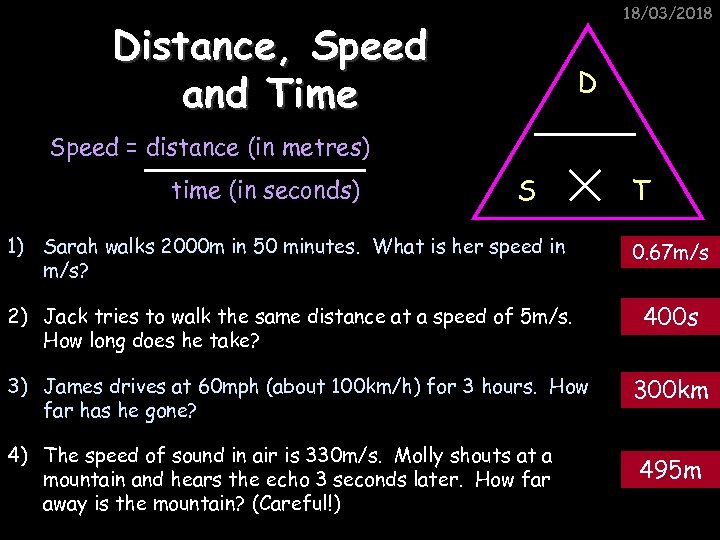 18/03/2018 Distance, Speed and Time D Speed = distance (in metres) time (in seconds) S T 1) Sarah walks 2000 m in 50 minutes. What is her speed in m/s? 0. 67 m/s 2) Jack tries to walk the same distance at a speed of 5 m/s. How long does he take? 400 s 3) James drives at 60 mph (about 100 km/h) for 3 hours. How far has he gone? 4) The speed of sound in air is 330 m/s. Molly shouts at a mountain and hears the echo 3 seconds later. How far away is the mountain? (Careful!) 300 km 495 m
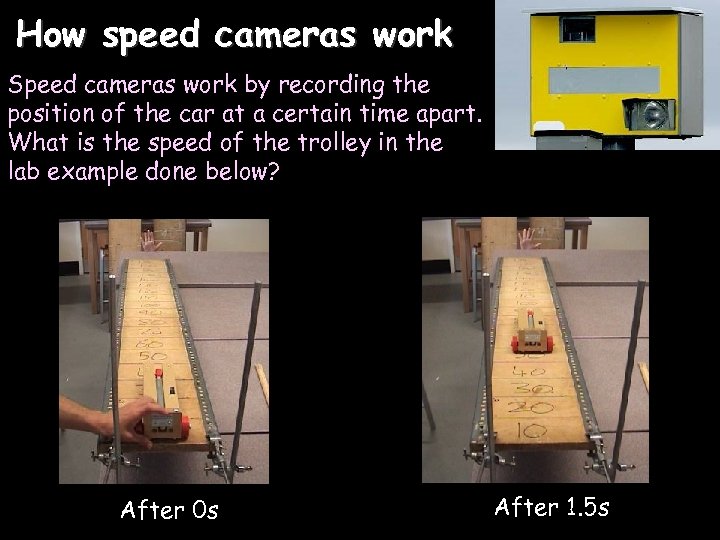 18/03/2018 How speed cameras work Speed cameras work by recording the position of the car at a certain time apart. What is the speed of the trolley in the lab example done below? After 0 s After 1. 5 s
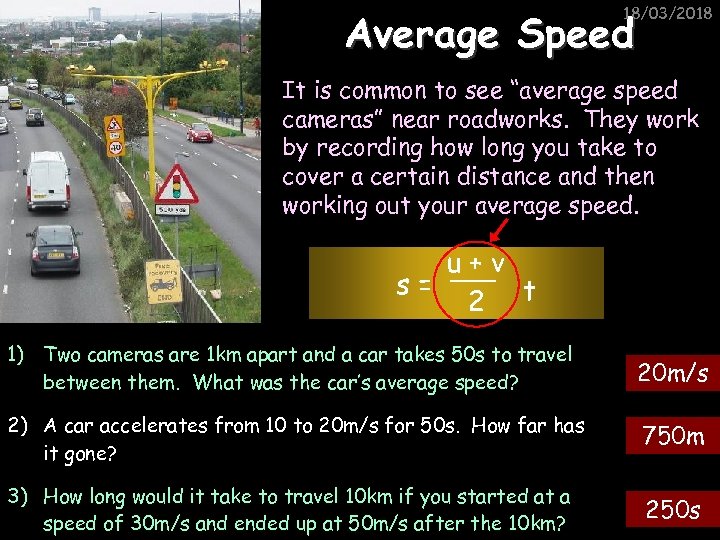 18/03/2018 Average Speed It is common to see “average speed cameras” near roadworks. They work by recording how long you take to cover a certain distance and then working out your average speed. u+v s= 2 t 1) Two cameras are 1 km apart and a car takes 50 s to travel between them. What was the car’s average speed? 20 m/s 2) A car accelerates from 10 to 20 m/s for 50 s. How far has it gone? 750 m 3) How long would it take to travel 10 km if you started at a speed of 30 m/s and ended up at 50 m/s after the 10 km? 250 s
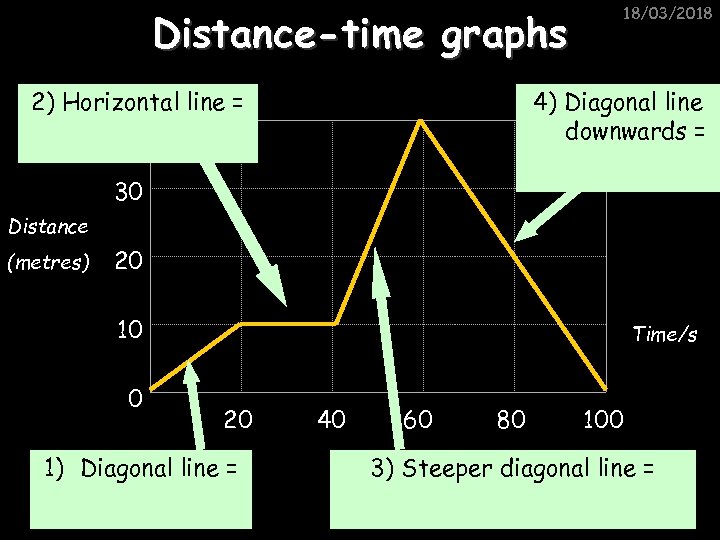 18/03/2018 Distance-time graphs 2) Horizontal line = 40 4) Diagonal line downwards = 30 Distance (metres) 20 10 0 Time/s 20 1) Diagonal line = 40 60 80 100 3) Steeper diagonal line =
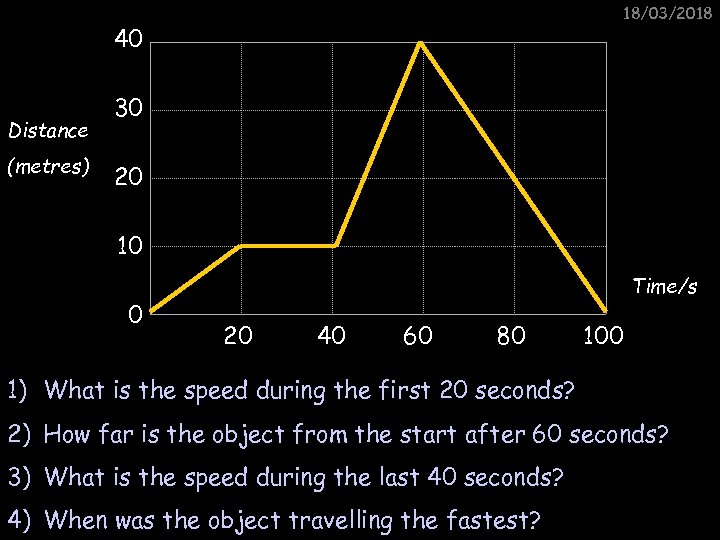 18/03/2018 40 Distance (metres) 30 20 10 0 Time/s 20 40 60 80 100 1) What is the speed during the first 20 seconds? 2) How far is the object from the start after 60 seconds? 3) What is the speed during the last 40 seconds? 4) When was the object travelling the fastest?
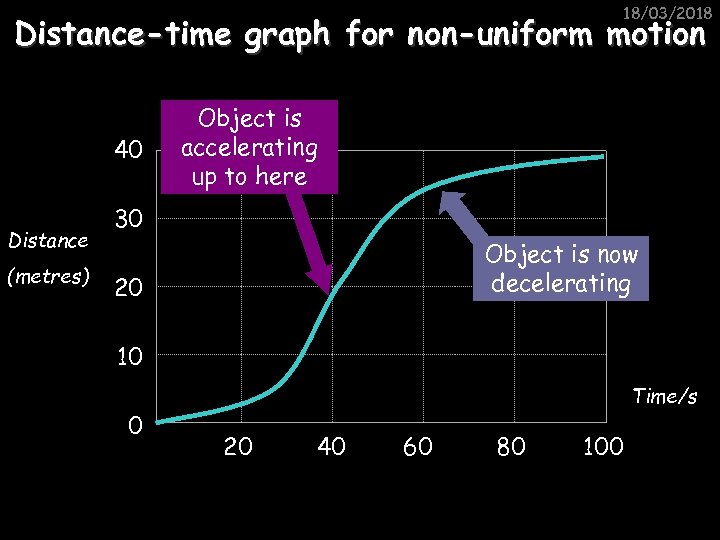 18/03/2018 Distance-time graph for non-uniform motion 40 Distance (metres) Object is accelerating up to here 30 Object is now decelerating 20 10 0 Time/s 20 40 60 80 100
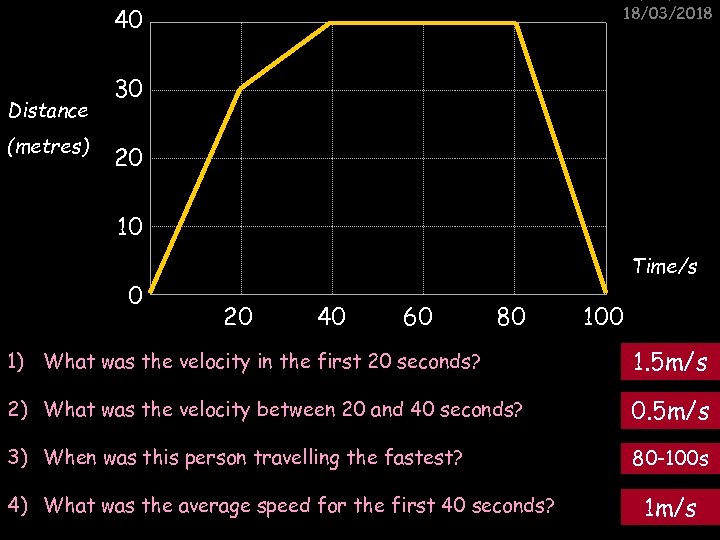 18/03/2018 40 Distance (metres) 30 20 10 0 Time/s 20 40 60 80 100 1) What was the velocity in the first 20 seconds? 1. 5 m/s 2) What was the velocity between 20 and 40 seconds? 0. 5 m/s 3) When was this person travelling the fastest? 80 -100 s 4) What was the average speed for the first 40 seconds? 1 m/s
 P 3 b Changing Speed 18/03/2018
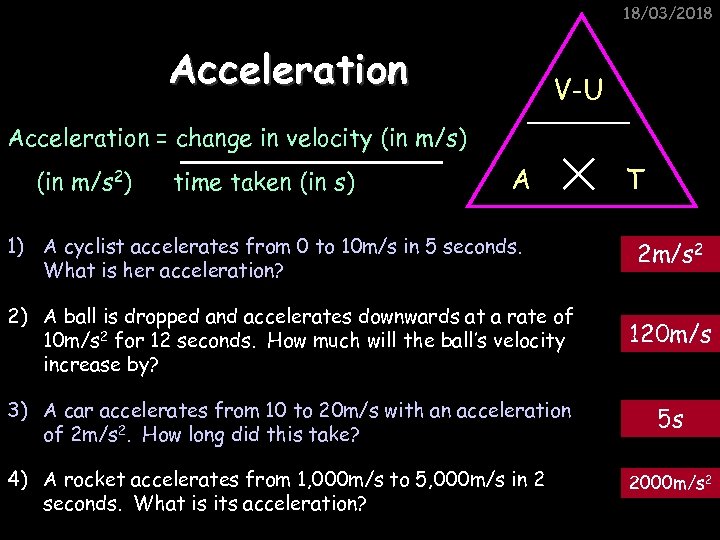 18/03/2018 Acceleration V-U Acceleration = change in velocity (in m/s) (in m/s 2) time taken (in s) A 1) A cyclist accelerates from 0 to 10 m/s in 5 seconds. What is her acceleration? T 2 m/s 2 2) A ball is dropped and accelerates downwards at a rate of 10 m/s 2 for 12 seconds. How much will the ball’s velocity increase by? 120 m/s 3) A car accelerates from 10 to 20 m/s with an acceleration of 2 m/s 2. How long did this take? 5 s 4) A rocket accelerates from 1, 000 m/s to 5, 000 m/s in 2 seconds. What is its acceleration? 2000 m/s 2
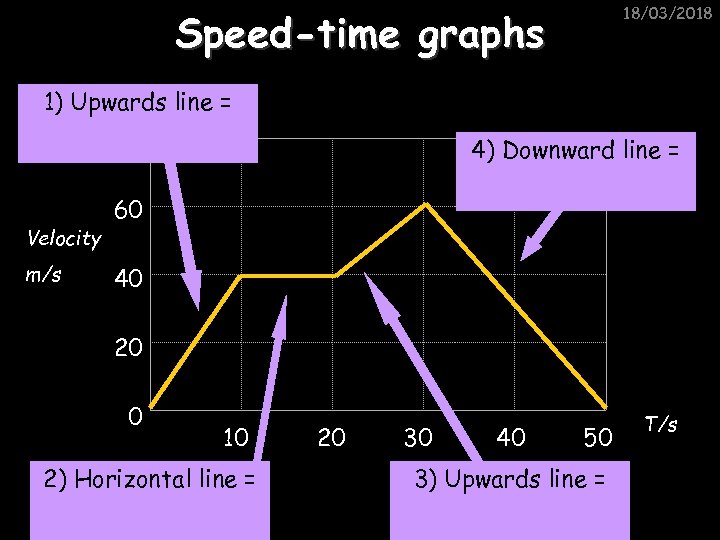 18/03/2018 Speed-time graphs 1) Upwards line = 80 Velocity m/s 4) Downward line = 60 40 20 0 10 2) Horizontal line = 20 30 40 50 3) Upwards line = T/s
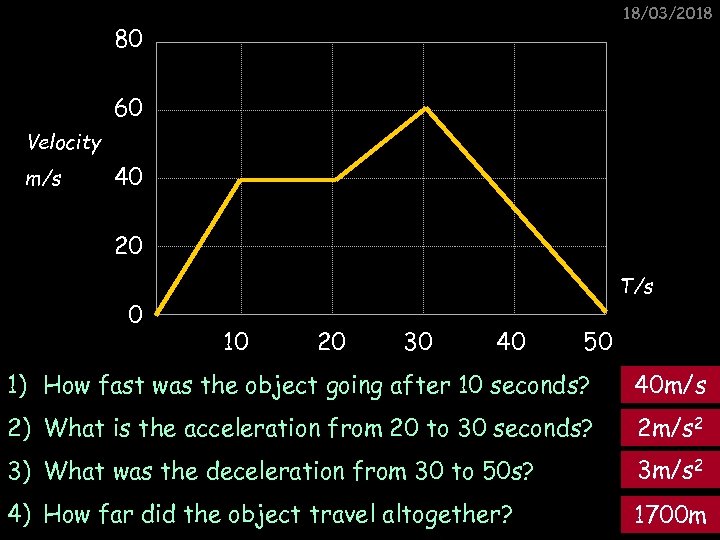 18/03/2018 80 60 Velocity m/s 40 20 0 T/s 10 20 30 40 50 1) How fast was the object going after 10 seconds? 40 m/s 2) What is the acceleration from 20 to 30 seconds? 2 m/s 2 3) What was the deceleration from 30 to 50 s? 3 m/s 2 4) How far did the object travel altogether? 1700 m
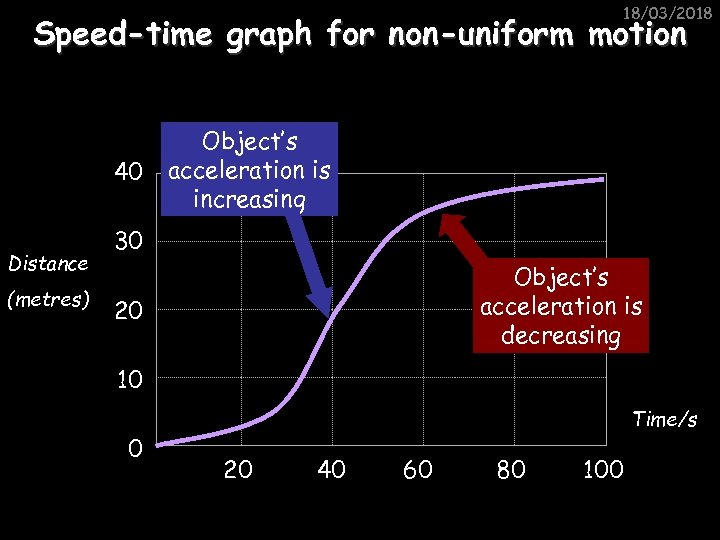 18/03/2018 Speed-time graph for non-uniform motion 40 Distance (metres) Object’s acceleration is increasing 30 Object’s acceleration is decreasing 20 10 0 Time/s 20 40 60 80 100
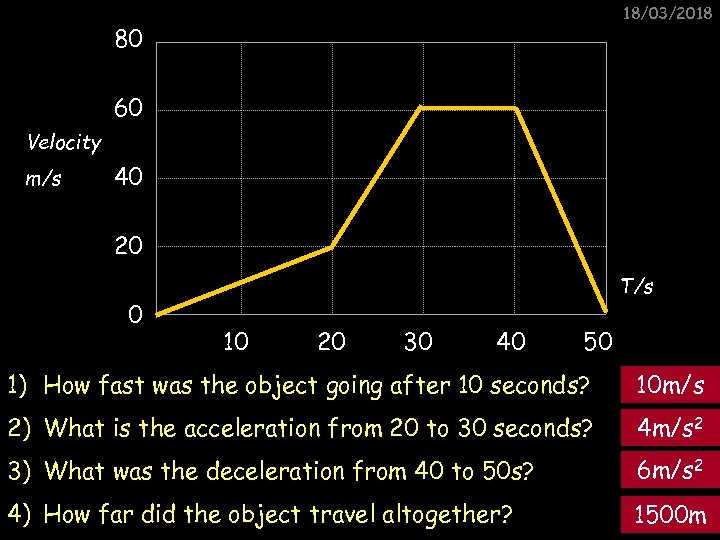 18/03/2018 80 60 Velocity m/s 40 20 0 T/s 10 20 30 40 50 1) How fast was the object going after 10 seconds? 10 m/s 2) What is the acceleration from 20 to 30 seconds? 4 m/s 2 3) What was the deceleration from 40 to 50 s? 6 m/s 2 4) How far did the object travel altogether? 1500 m
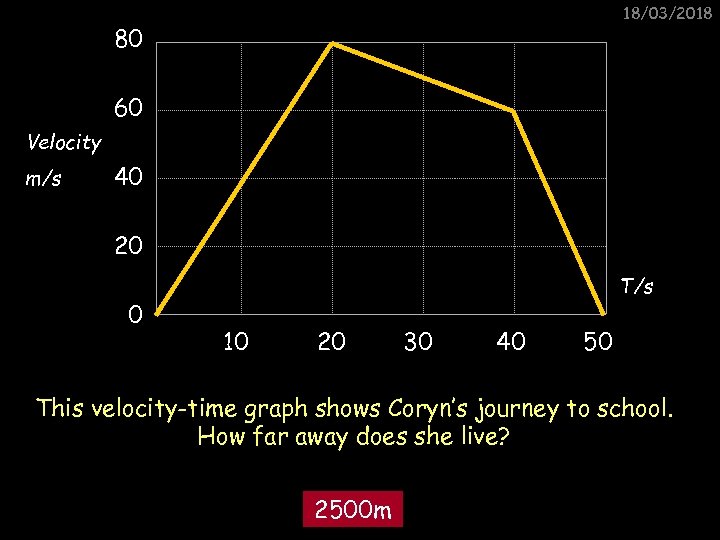 18/03/2018 80 60 Velocity m/s 40 20 0 T/s 10 20 30 40 50 This velocity-time graph shows Coryn’s journey to school. How far away does she live? 2500 m
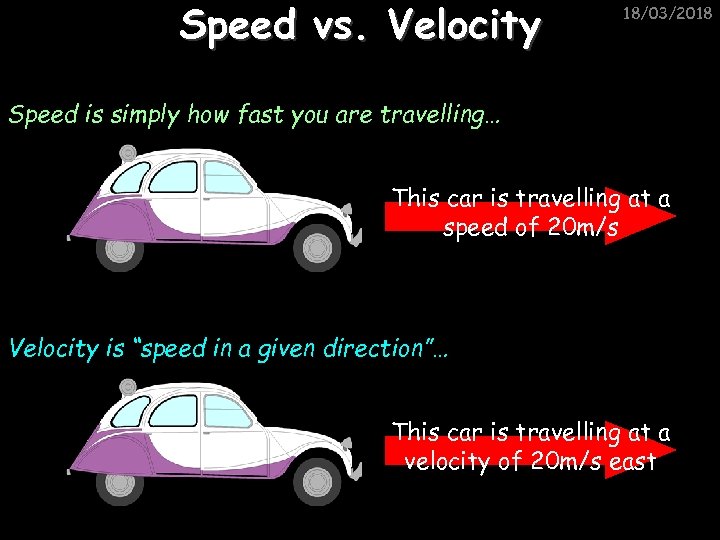 Speed vs. Velocity 18/03/2018 Speed is simply how fast you are travelling… This car is travelling at a speed of 20 m/s Velocity is “speed in a given direction”… This car is travelling at a velocity of 20 m/s east
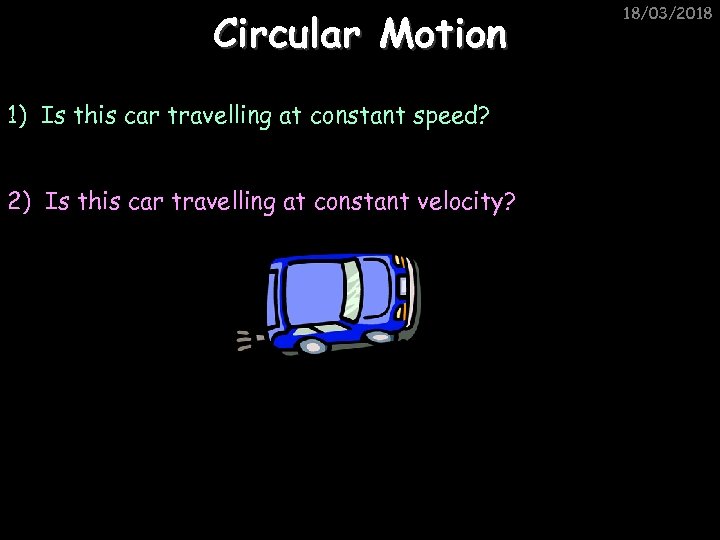 Circular Motion 1) Is this car travelling at constant speed? 2) Is this car travelling at constant velocity? 18/03/2018
 P 3 c Forces and Motion 18/03/2018
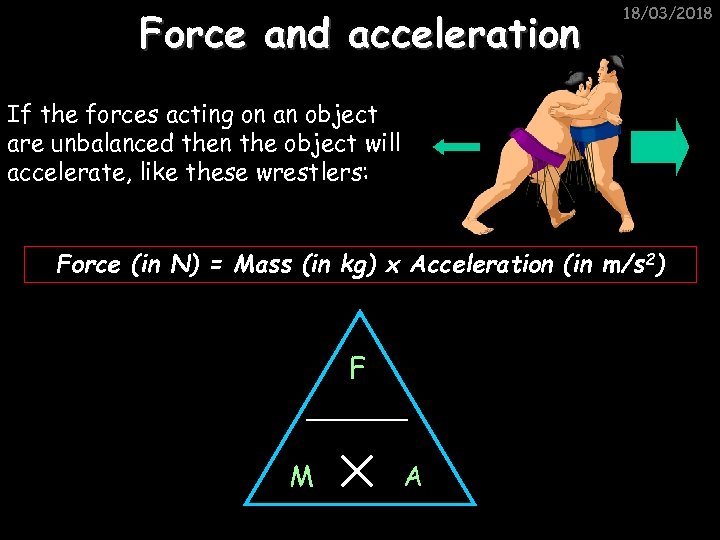 Force and acceleration 18/03/2018 If the forces acting on an object are unbalanced then the object will accelerate, like these wrestlers: Force (in N) = Mass (in kg) x Acceleration (in m/s 2) F M A
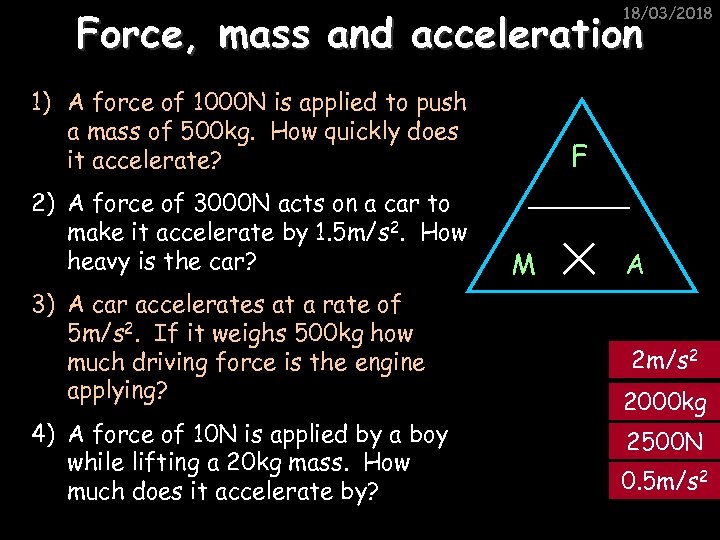 18/03/2018 Force, mass and acceleration 1) A force of 1000 N is applied to push a mass of 500 kg. How quickly does it accelerate? 2) A force of 3000 N acts on a car to make it accelerate by 1. 5 m/s 2. How heavy is the car? 3) A car accelerates at a rate of 5 m/s 2. If it weighs 500 kg how much driving force is the engine applying? 4) A force of 10 N is applied by a boy while lifting a 20 kg mass. How much does it accelerate by? F M A 2 m/s 2 2000 kg 2500 N 0. 5 m/s 2
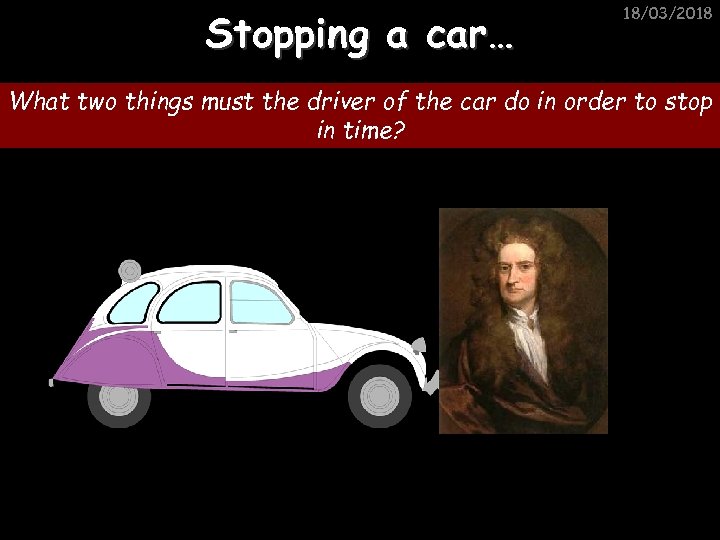 Stopping a car… 18/03/2018 What two things must the driver of the car do in order to stop in time?
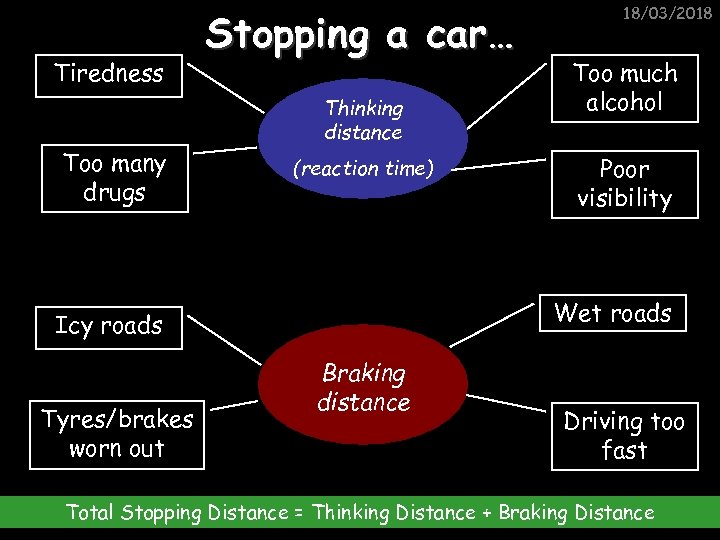 Tiredness Too many drugs Stopping a car… Thinking distance (reaction time) Too much alcohol Poor visibility Wet roads Icy roads Tyres/brakes worn out 18/03/2018 Braking distance Driving too fast Total Stopping Distance = Thinking Distance + Braking Distance
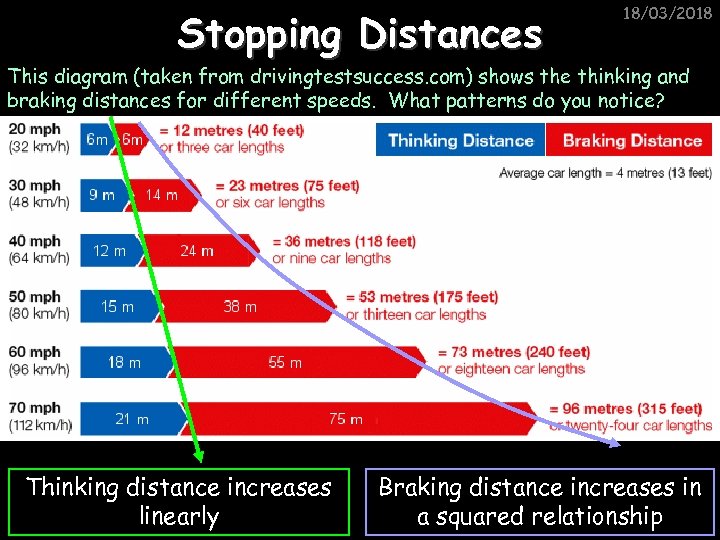 Stopping Distances 18/03/2018 This diagram (taken from drivingtestsuccess. com) shows the thinking and braking distances for different speeds. What patterns do you notice? Thinking distance increases linearly Braking distance increases in a squared relationship
 P 3 d Work and Power 18/03/2018
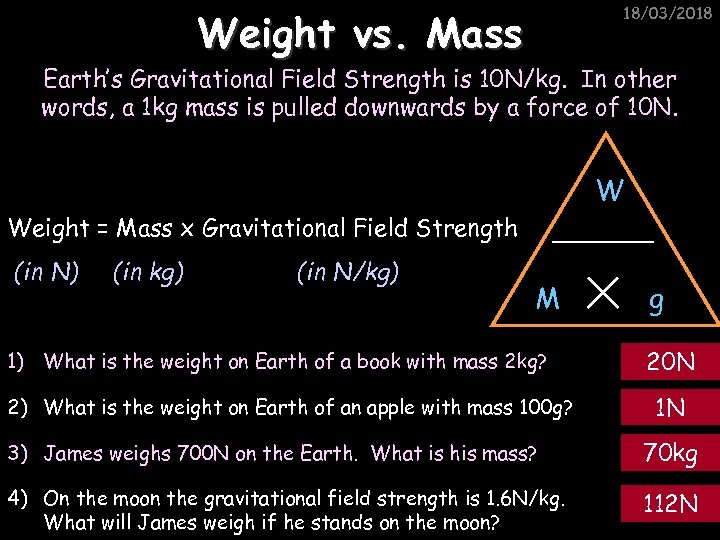 18/03/2018 Weight vs. Mass Earth’s Gravitational Field Strength is 10 N/kg. In other words, a 1 kg mass is pulled downwards by a force of 10 N. W Weight = Mass x Gravitational Field Strength (in N) (in kg) (in N/kg) M 1) What is the weight on Earth of a book with mass 2 kg? 2) What is the weight on Earth of an apple with mass 100 g? g 20 N 1 N 3) James weighs 700 N on the Earth. What is his mass? 70 kg 4) On the moon the gravitational field strength is 1. 6 N/kg. What will James weigh if he stands on the moon? 112 N
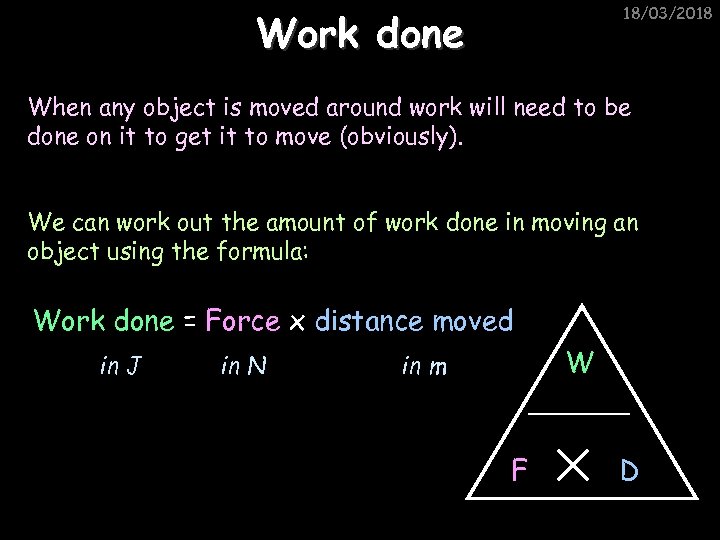 18/03/2018 Work done When any object is moved around work will need to be done on it to get it to move (obviously). We can work out the amount of work done in moving an object using the formula: Work done = Force x distance moved in J in N W in m F D
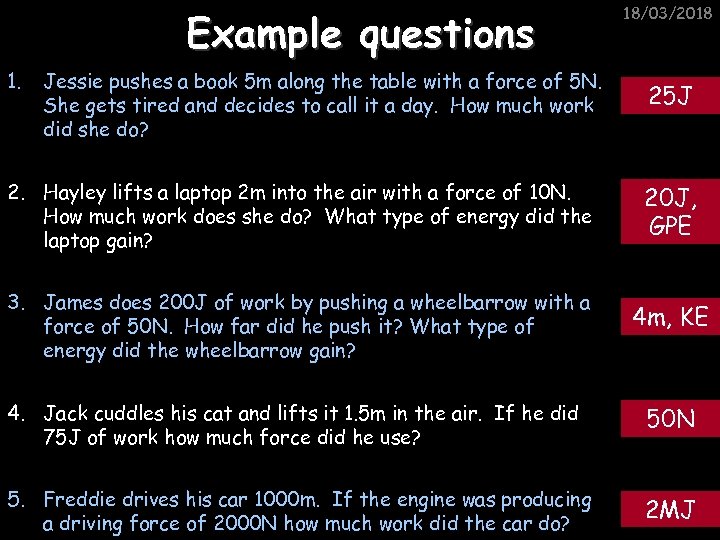 Example questions 1. Jessie pushes a book 5 m along the table with a force of 5 N. She gets tired and decides to call it a day. How much work did she do? 18/03/2018 25 J 2. Hayley lifts a laptop 2 m into the air with a force of 10 N. How much work does she do? What type of energy did the laptop gain? 20 J, GPE 3. James does 200 J of work by pushing a wheelbarrow with a force of 50 N. How far did he push it? What type of energy did the wheelbarrow gain? 4 m, KE 4. Jack cuddles his cat and lifts it 1. 5 m in the air. If he did 75 J of work how much force did he use? 50 N 5. Freddie drives his car 1000 m. If the engine was producing a driving force of 2000 N how much work did the car do? 2 MJ
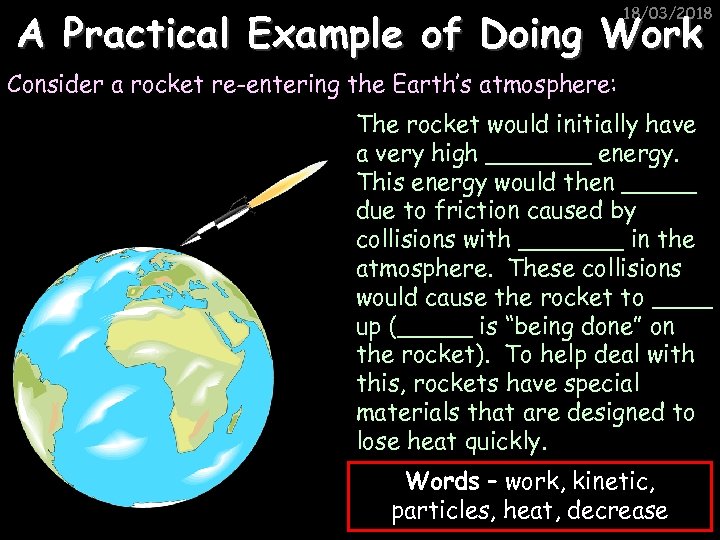 18/03/2018 A Practical Example of Doing Work Consider a rocket re-entering the Earth’s atmosphere: The rocket would initially have a very high _______ energy. This energy would then _____ due to friction caused by collisions with _______ in the atmosphere. These collisions would cause the rocket to ____ up (_____ is “being done” on the rocket). To help deal with this, rockets have special materials that are designed to lose heat quickly. Words – work, kinetic, particles, heat, decrease
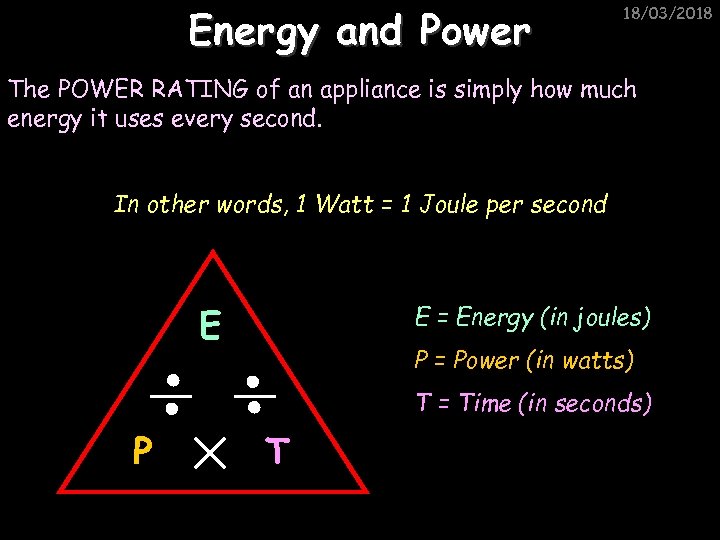 Energy and Power 18/03/2018 The POWER RATING of an appliance is simply how much energy it uses every second. In other words, 1 Watt = 1 Joule per second E E = Energy (in joules) P = Power (in watts) T = Time (in seconds) P T
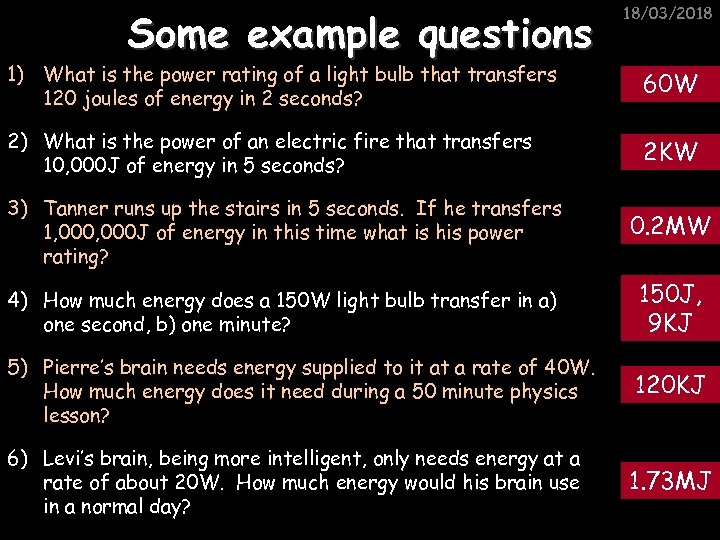 Some example questions 18/03/2018 1) What is the power rating of a light bulb that transfers 120 joules of energy in 2 seconds? 60 W 2) What is the power of an electric fire that transfers 10, 000 J of energy in 5 seconds? 2 KW 3) Tanner runs up the stairs in 5 seconds. If he transfers 1, 000 J of energy in this time what is his power rating? 0. 2 MW 4) How much energy does a 150 W light bulb transfer in a) one second, b) one minute? 150 J, 9 KJ 5) Pierre’s brain needs energy supplied to it at a rate of 40 W. How much energy does it need during a 50 minute physics lesson? 120 KJ 6) Levi’s brain, being more intelligent, only needs energy at a rate of about 20 W. How much energy would his brain use in a normal day? 1. 73 MJ
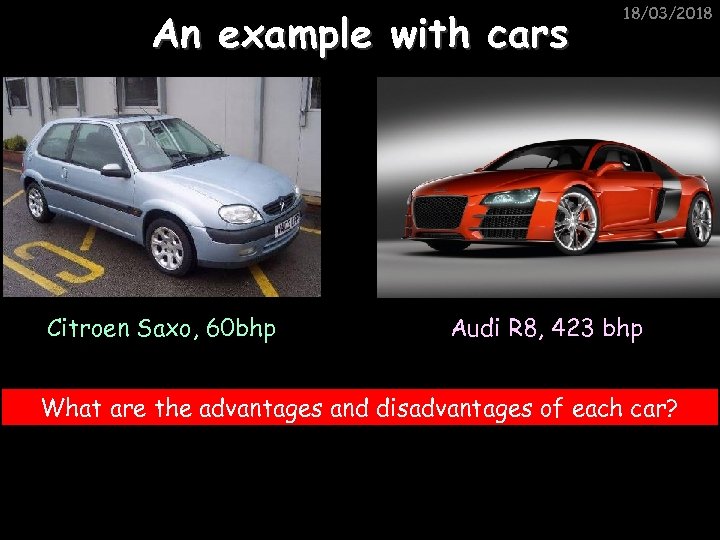 An example with cars Citroen Saxo, 60 bhp 18/03/2018 Audi R 8, 423 bhp What are the advantages and disadvantages of each car?
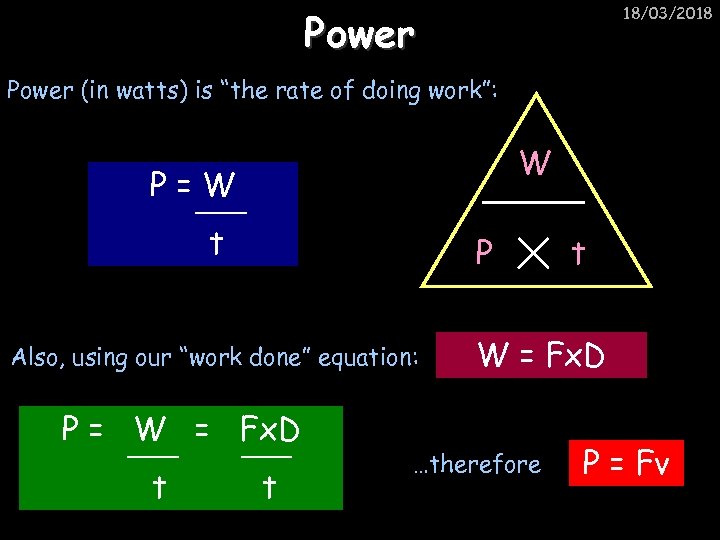 18/03/2018 Power (in watts) is “the rate of doing work”: W P=W t P Also, using our “work done” equation: P = W = Fx. D t t t W = Fx. D …therefore P = Fv
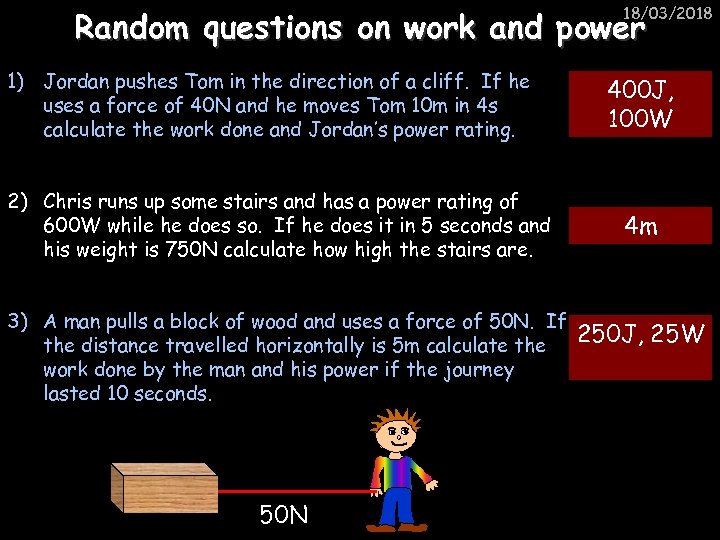 18/03/2018 Random questions on work and power 1) Jordan pushes Tom in the direction of a cliff. If he uses a force of 40 N and he moves Tom 10 m in 4 s calculate the work done and Jordan’s power rating. 2) Chris runs up some stairs and has a power rating of 600 W while he does so. If he does it in 5 seconds and his weight is 750 N calculate how high the stairs are. 400 J, 100 W 4 m 3) A man pulls a block of wood and uses a force of 50 N. If 250 J, 25 W the distance travelled horizontally is 5 m calculate the work done by the man and his power if the journey lasted 10 seconds. 50 N
 P 3 e Energy on the Move 18/03/2018
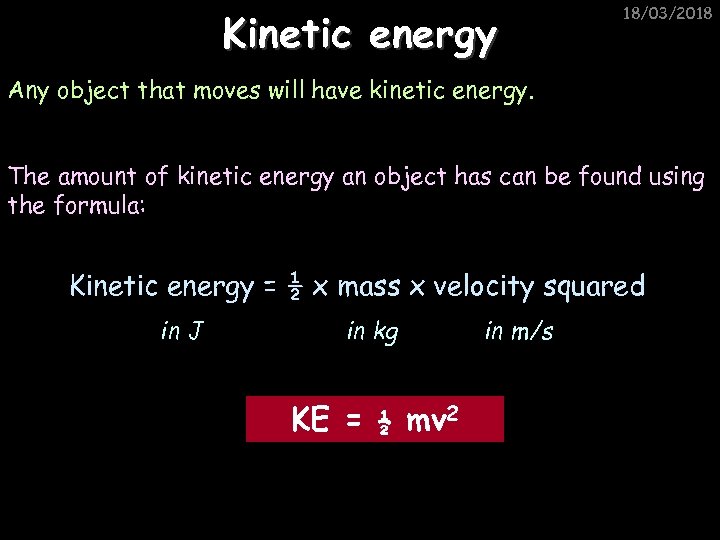 Kinetic energy 18/03/2018 Any object that moves will have kinetic energy. The amount of kinetic energy an object has can be found using the formula: Kinetic energy = ½ x mass x velocity squared in J in kg KE = ½ in m/s mv 2
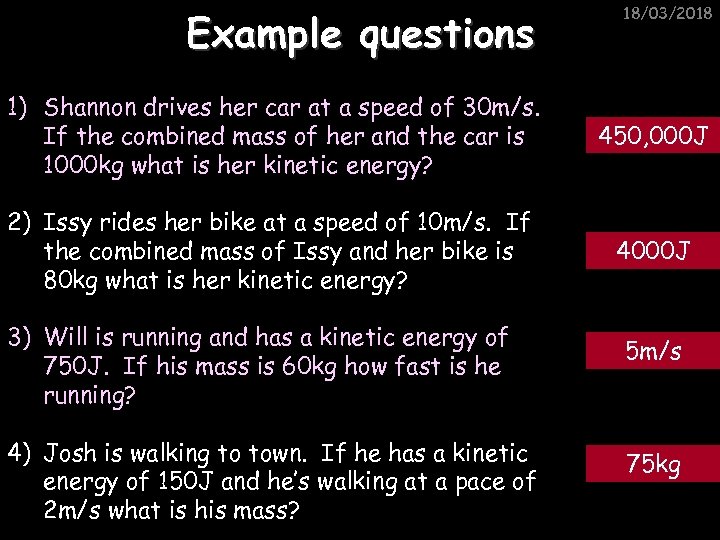 Example questions 18/03/2018 1) Shannon drives her car at a speed of 30 m/s. If the combined mass of her and the car is 1000 kg what is her kinetic energy? 450, 000 J 2) Issy rides her bike at a speed of 10 m/s. If the combined mass of Issy and her bike is 80 kg what is her kinetic energy? 4000 J 3) Will is running and has a kinetic energy of 750 J. If his mass is 60 kg how fast is he running? 4) Josh is walking to town. If he has a kinetic energy of 150 J and he’s walking at a pace of 2 m/s what is his mass? 5 m/s 75 kg
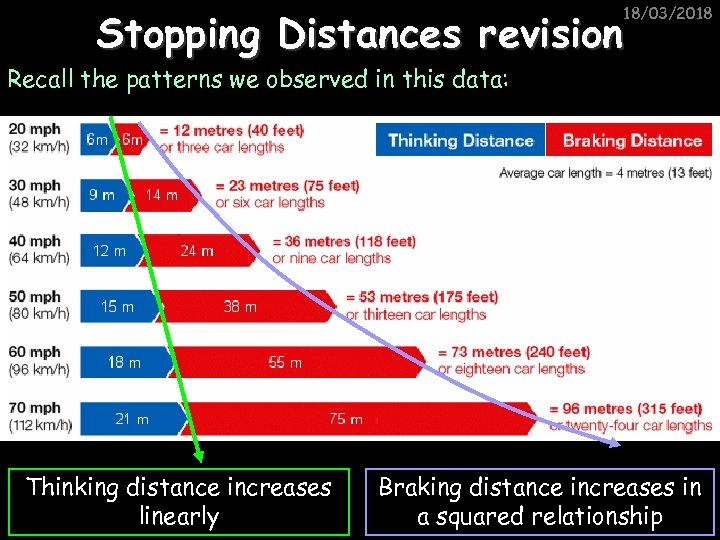 18/03/2018 Stopping Distances revision Recall the patterns we observed in this data: Thinking distance increases linearly Braking distance increases in a squared relationship
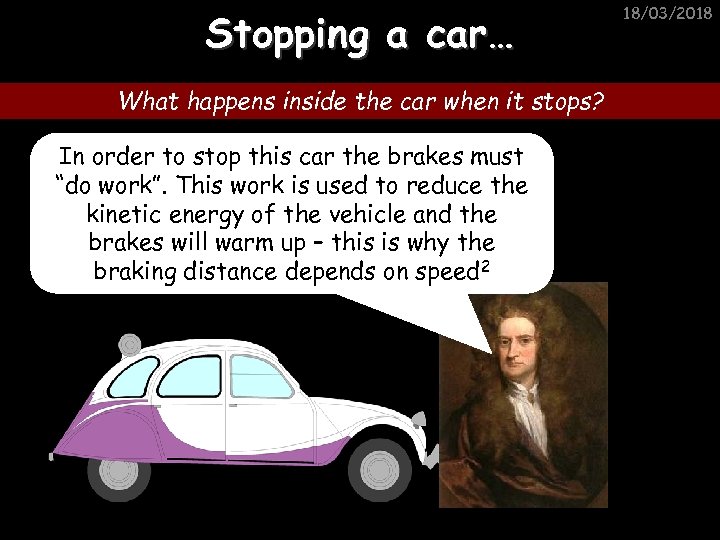 Stopping a car… What happens inside the car when it stops? In order to stop this car the brakes must “do work”. This work is used to reduce the kinetic energy of the vehicle and the brakes will warm up – this is why the braking distance depends on speed 2 18/03/2018
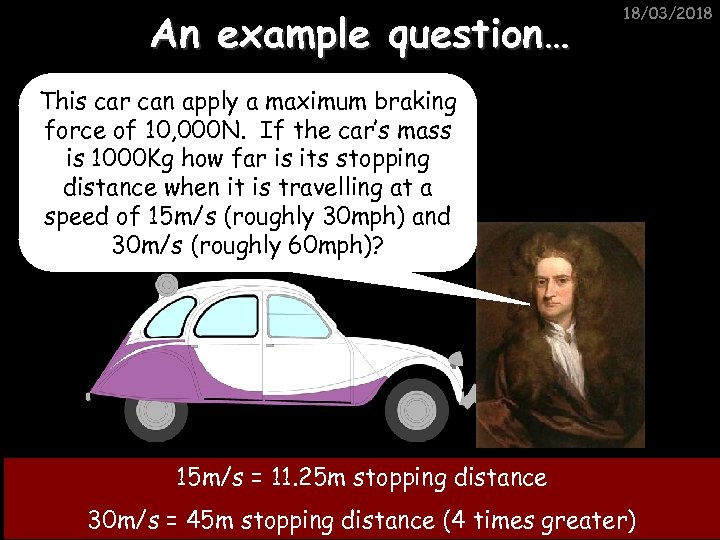 An example question… 18/03/2018 This car can apply a maximum braking force of 10, 000 N. If the car’s mass is 1000 Kg how far is its stopping distance when it is travelling at a speed of 15 m/s (roughly 30 mph) and 30 m/s (roughly 60 mph)? 15 m/s = 11. 25 m stopping distance 30 m/s = 45 m stopping distance (4 times greater)
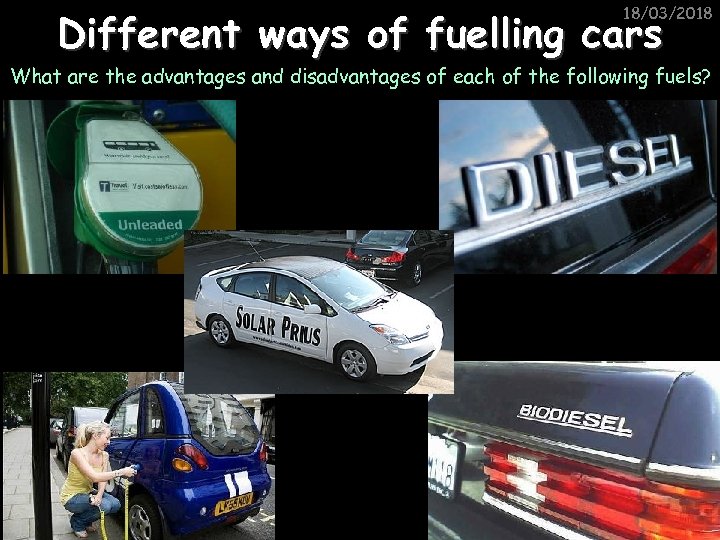 18/03/2018 Different ways of fuelling cars What are the advantages and disadvantages of each of the following fuels?
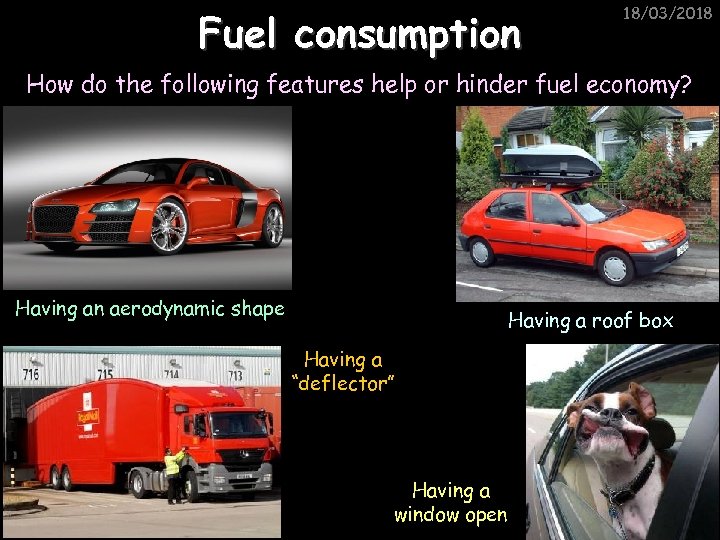 Fuel consumption 18/03/2018 How do the following features help or hinder fuel economy? Having an aerodynamic shape Having a roof box Having a “deflector” Having a window open
 P 3 f Crumple Zones 18/03/2018
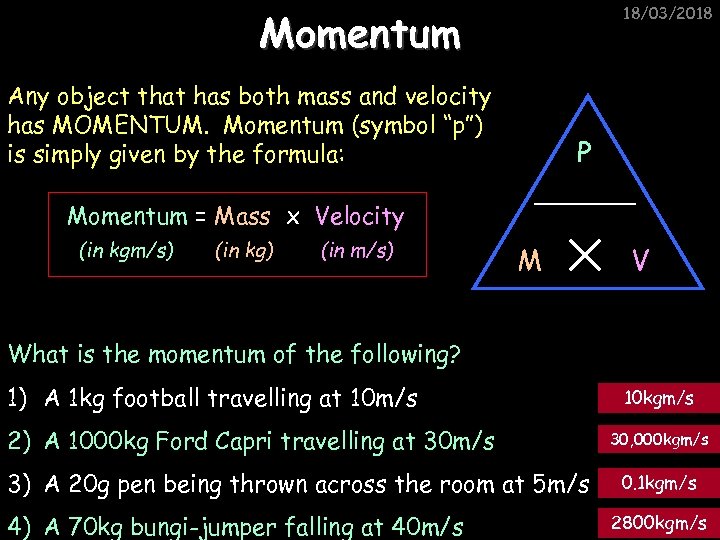 18/03/2018 Momentum Any object that has both mass and velocity has MOMENTUM. Momentum (symbol “p”) is simply given by the formula: P Momentum = Mass x Velocity (in kgm/s) (in kg) (in m/s) M V What is the momentum of the following? 1) A 1 kg football travelling at 10 m/s 2) A 1000 kg Ford Capri travelling at 30 m/s 3) A 20 g pen being thrown across the room at 5 m/s 4) A 70 kg bungi-jumper falling at 40 m/s 10 kgm/s 30, 000 kgm/s 0. 1 kgm/s 2800 kgm/s
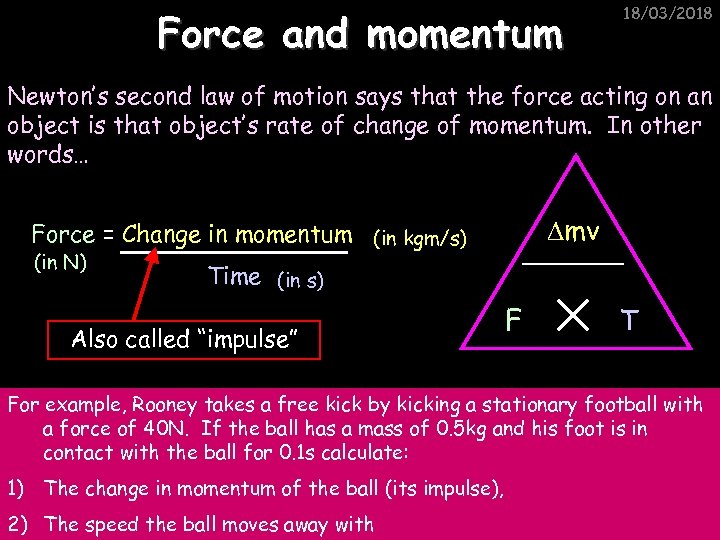 Force and momentum 18/03/2018 Newton’s second law of motion says that the force acting on an object is that object’s rate of change of momentum. In other words… mv Force = Change in momentum (in kgm/s) (in N) Time (in s) Also called “impulse” F T For example, Rooney takes a free kick by kicking a stationary football with a force of 40 N. If the ball has a mass of 0. 5 kg and his foot is in contact with the ball for 0. 1 s calculate: 1) The change in momentum of the ball (its impulse), 2) The speed the ball moves away with
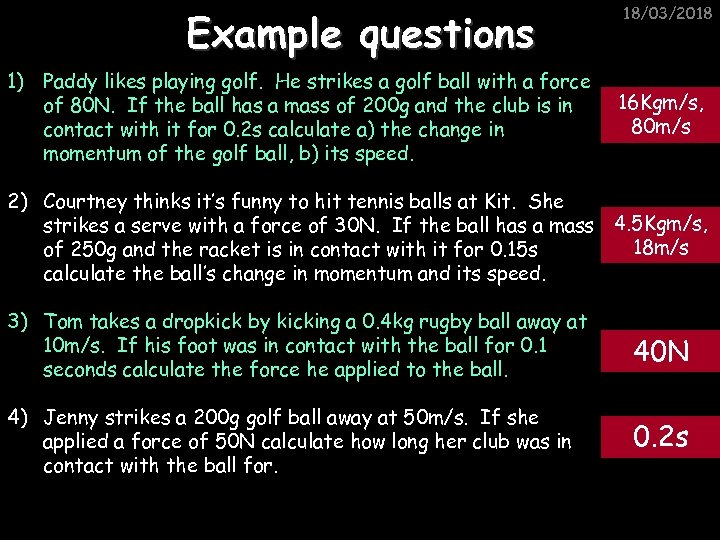 Example questions 1) Paddy likes playing golf. He strikes a golf ball with a force of 80 N. If the ball has a mass of 200 g and the club is in contact with it for 0. 2 s calculate a) the change in momentum of the golf ball, b) its speed. 18/03/2018 16 Kgm/s, 80 m/s 2) Courtney thinks it’s funny to hit tennis balls at Kit. She strikes a serve with a force of 30 N. If the ball has a mass 4. 5 Kgm/s, 18 m/s of 250 g and the racket is in contact with it for 0. 15 s calculate the ball’s change in momentum and its speed. 3) Tom takes a dropkick by kicking a 0. 4 kg rugby ball away at 10 m/s. If his foot was in contact with the ball for 0. 1 seconds calculate the force he applied to the ball. 40 N 4) Jenny strikes a 200 g golf ball away at 50 m/s. If she applied a force of 50 N calculate how long her club was in contact with the ball for. 0. 2 s
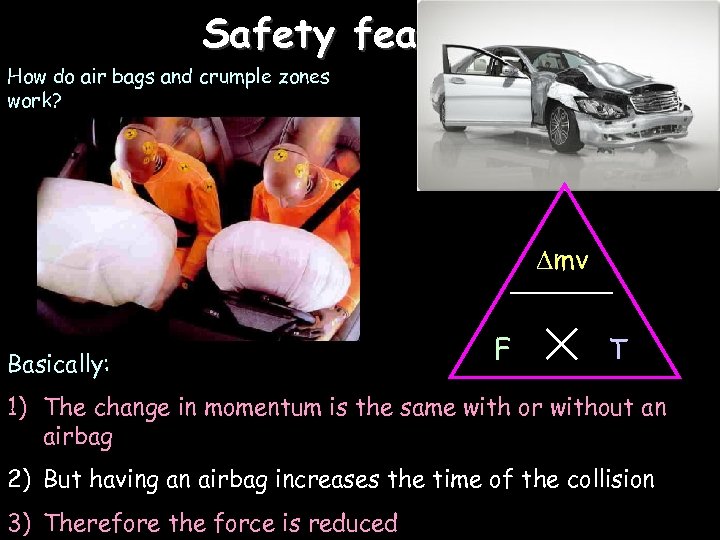 18/03/2018 Safety features How do air bags and crumple zones work? mv Basically: F T 1) The change in momentum is the same with or without an airbag 2) But having an airbag increases the time of the collision 3) Therefore the force is reduced
 Car Safety Features 18/03/2018 These objects all help reduce injury by basically absorbing energy. Cars also have ABS brakes which prevent them from skidding by automatically pumping off and on to avoid the brakes locking.
 P 3 g Falling Safely 18/03/2018
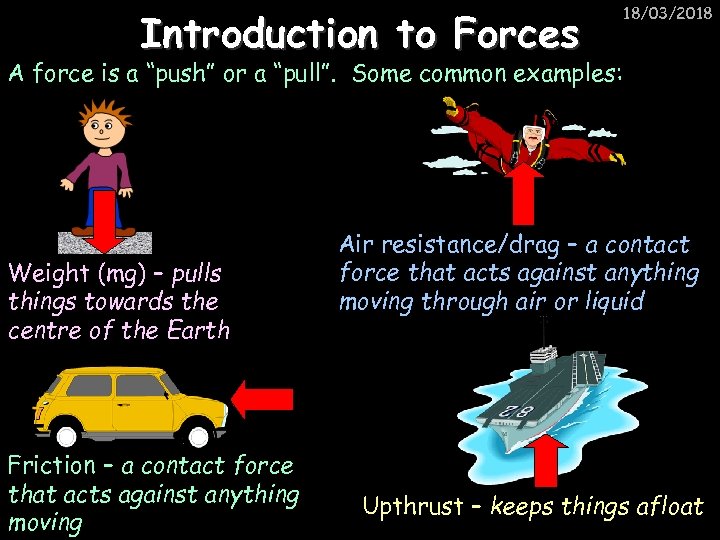 Introduction to Forces 18/03/2018 A force is a “push” or a “pull”. Some common examples: Weight (mg) – pulls things towards the centre of the Earth Friction – a contact force that acts against anything moving Air resistance/drag – a contact force that acts against anything moving through air or liquid Upthrust – keeps things afloat
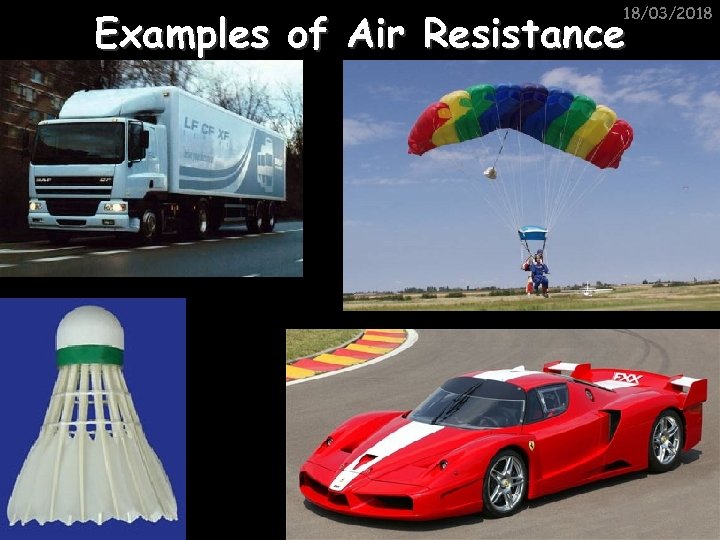 18/03/2018 Examples of Air Resistance
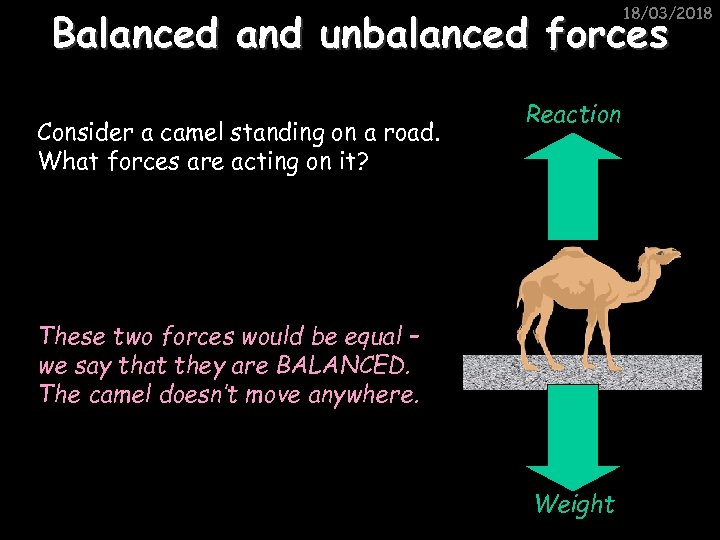 18/03/2018 Balanced and unbalanced forces Consider a camel standing on a road. What forces are acting on it? Reaction These two forces would be equal – we say that they are BALANCED. The camel doesn’t move anywhere. Weight
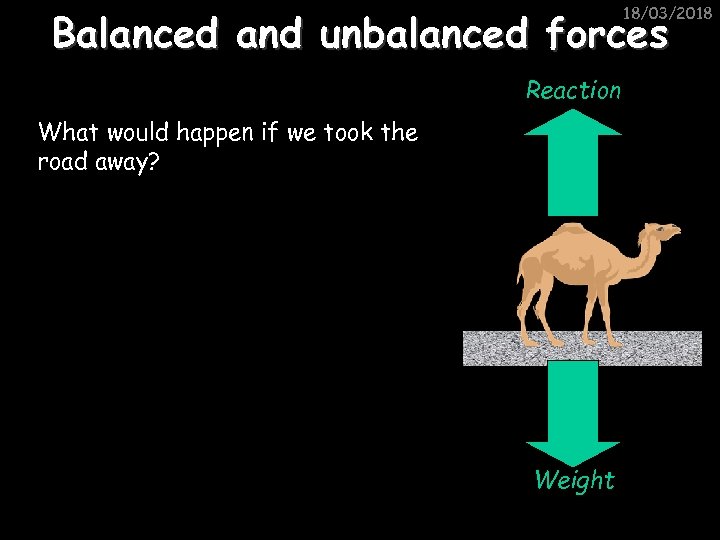 18/03/2018 Balanced and unbalanced forces Reaction What would happen if we took the road away? Weight
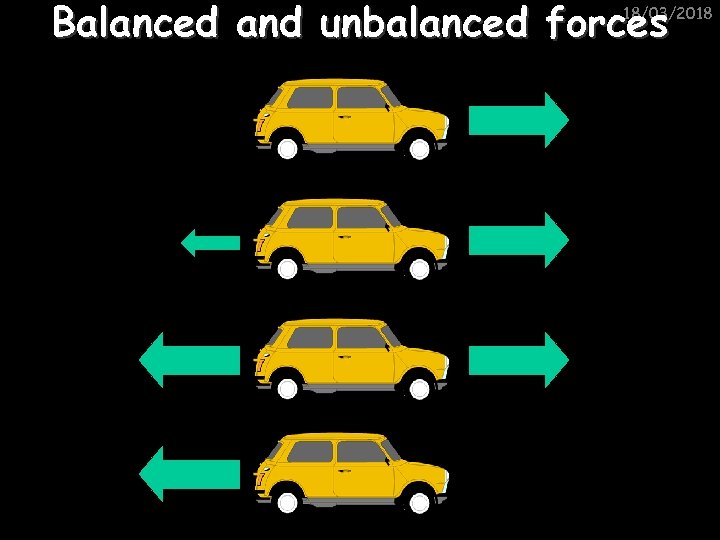 Balanced and unbalanced forces 18/03/2018
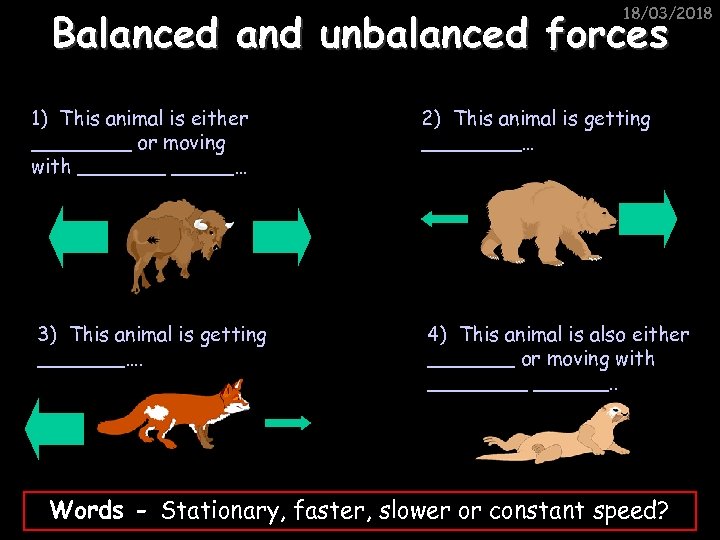 18/03/2018 Balanced and unbalanced forces 1) This animal is either ____ or moving with _______… 3) This animal is getting _______…. 2) This animal is getting ____… 4) This animal is also either _______ or moving with ______. . Words - Stationary, faster, slower or constant speed?
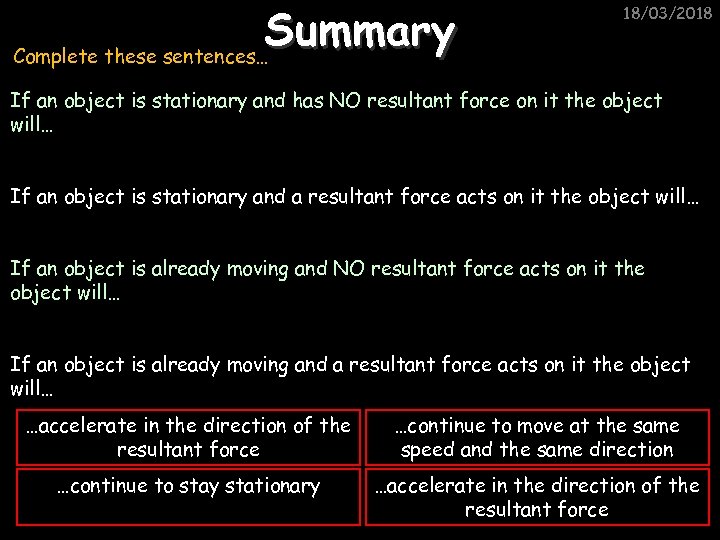 Summary Complete these sentences… 18/03/2018 If an object is stationary and has NO resultant force on it the object will… If an object is stationary and a resultant force acts on it the object will… If an object is already moving and NO resultant force acts on it the object will… If an object is already moving and a resultant force acts on it the object will… …accelerate in the direction of the resultant force …continue to move at the same speed and the same direction …continue to stay stationary …accelerate in the direction of the resultant force
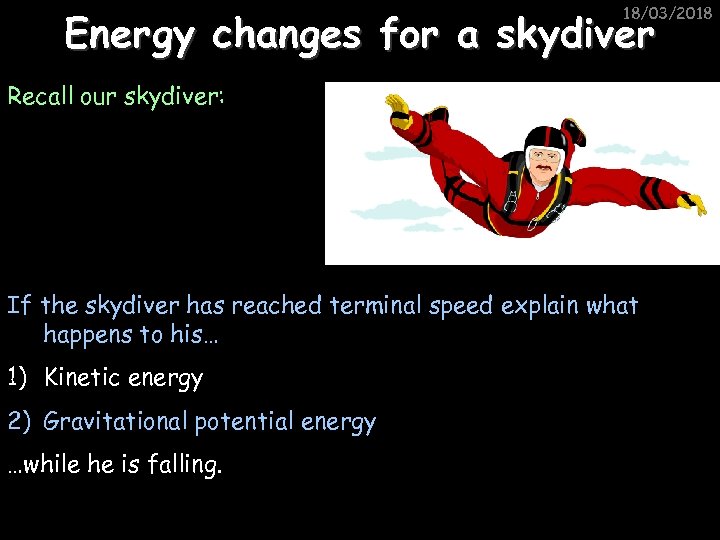
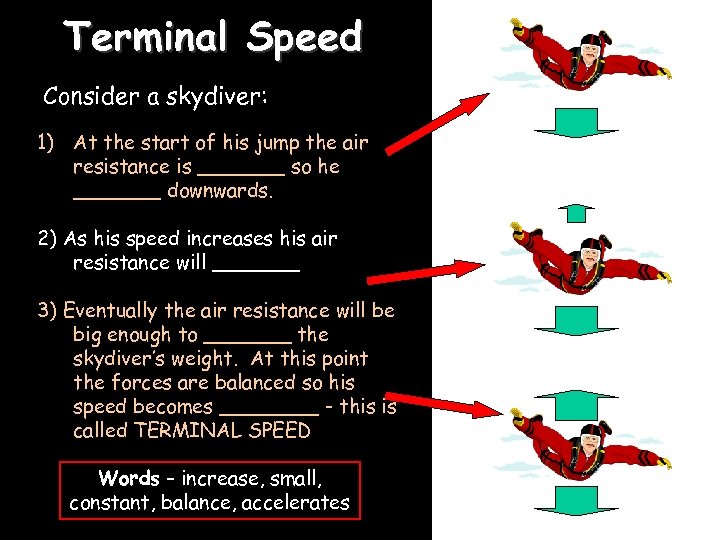 Terminal Speed Consider a skydiver: 1) At the start of his jump the air resistance is _______ so he _______ downwards. 2) As his speed increases his air resistance will _______ 3) Eventually the air resistance will be big enough to _______ the skydiver’s weight. At this point the forces are balanced so his speed becomes ____ - this is called TERMINAL SPEED Words – increase, small, constant, balance, accelerates 18/03/2018
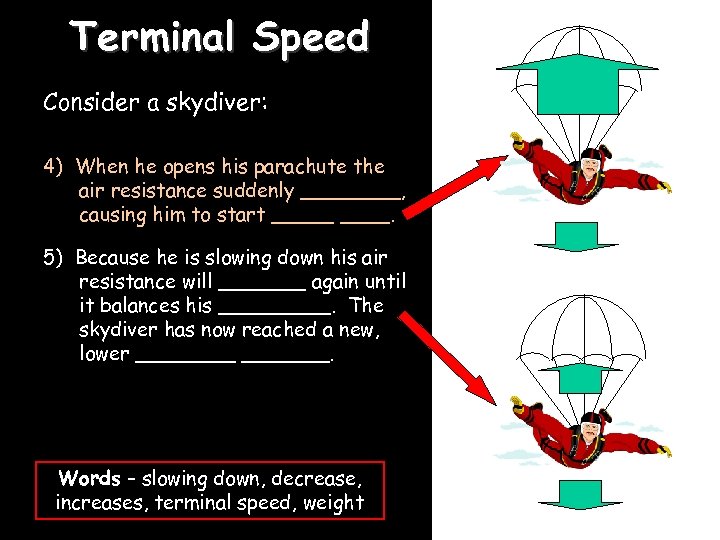 Terminal Speed Consider a skydiver: 4) When he opens his parachute the air resistance suddenly ____, causing him to start _____. 5) Because he is slowing down his air resistance will _______ again until it balances his _____. The skydiver has now reached a new, lower _______. Words – slowing down, decrease, increases, terminal speed, weight 18/03/2018
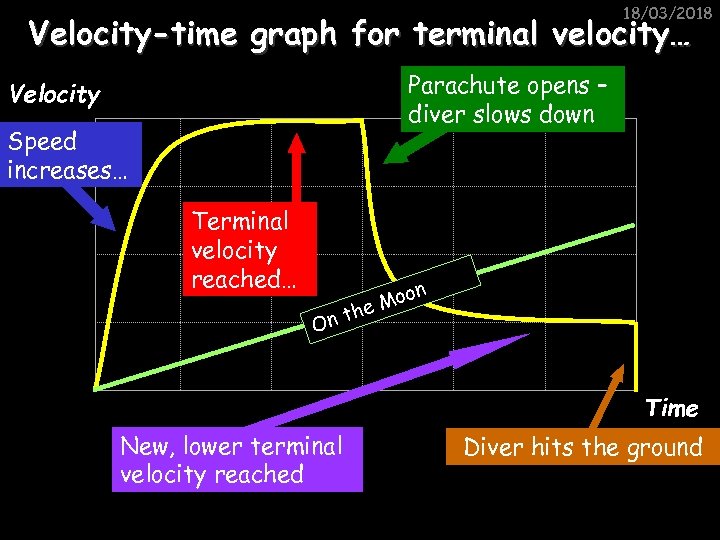 18/03/2018 Velocity-time graph for terminal velocity… Parachute opens – diver slows down Velocity Speed increases… Terminal velocity reached… On n Moo he t Time New, lower terminal velocity reached Diver hits the ground
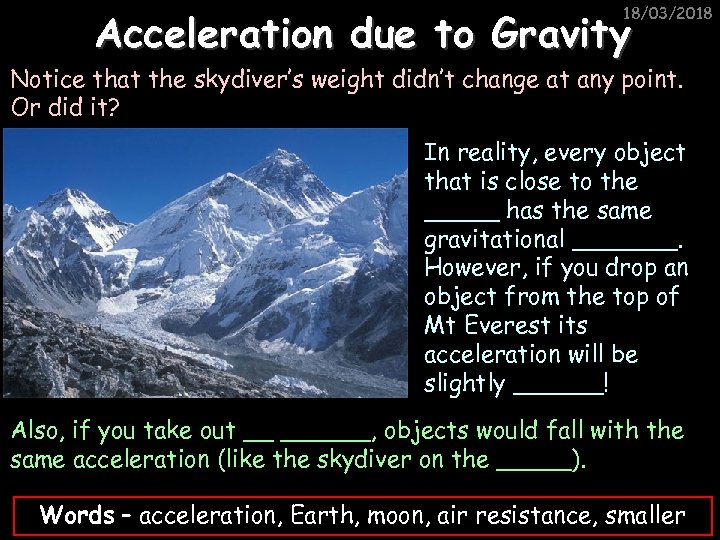 18/03/2018 Acceleration due to Gravity Notice that the skydiver’s weight didn’t change at any point. Or did it? In reality, every object that is close to the _____ has the same gravitational _______. However, if you drop an object from the top of Mt Everest its acceleration will be slightly ______! Also, if you take out __ ______, objects would fall with the same acceleration (like the skydiver on the _____). Words – acceleration, Earth, moon, air resistance, smaller
 18/03/2018 P 3 h The Energy of Games and Theme rides
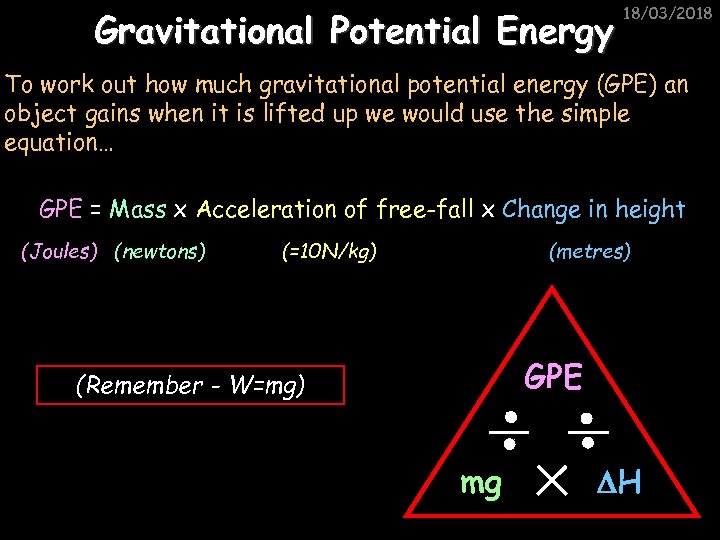 Gravitational Potential Energy 18/03/2018 To work out how much gravitational potential energy (GPE) an object gains when it is lifted up we would use the simple equation… GPE = Mass x Acceleration of free-fall x Change in height (Joules) (newtons) (=10 N/kg) (metres) GPE (Remember - W=mg) mg H
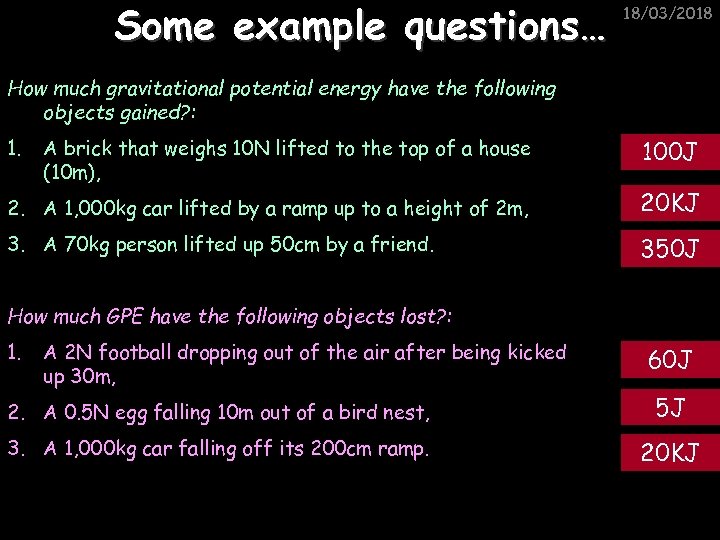 Some example questions… 18/03/2018 How much gravitational potential energy have the following objects gained? : 1. A brick that weighs 10 N lifted to the top of a house (10 m), 100 J 2. A 1, 000 kg car lifted by a ramp up to a height of 2 m, 20 KJ 3. A 70 kg person lifted up 50 cm by a friend. 350 J How much GPE have the following objects lost? : 1. A 2 N football dropping out of the air after being kicked up 30 m, 60 J 2. A 0. 5 N egg falling 10 m out of a bird nest, 5 J 3. A 1, 000 kg car falling off its 200 cm ramp. 20 KJ
 18/03/2018 Energy changes for a skydiver Recall our skydiver: If the skydiver has reached terminal speed explain what happens to his… 1) Kinetic energy 2) Gravitational potential energy …while he is falling.
 18/03/2018 Understanding Kinetic Energy KE = If the mass of the object is doubled what effect would this have on the object’s kinetic energy? ½ mv 2 If the speed of the object is doubled what effect would this have on the object’s kinetic energy?
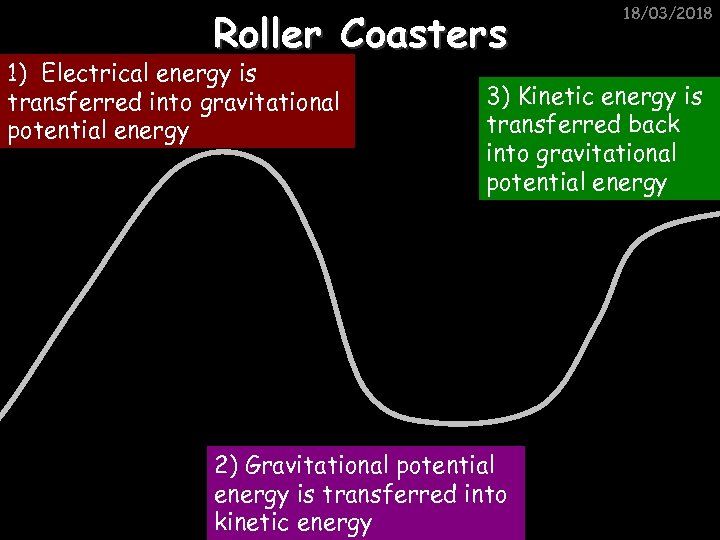 Roller Coasters 1) Electrical energy is transferred into gravitational potential energy 18/03/2018 3) Kinetic energy is transferred back into gravitational potential energy 2) Gravitational potential energy is transferred into kinetic energy
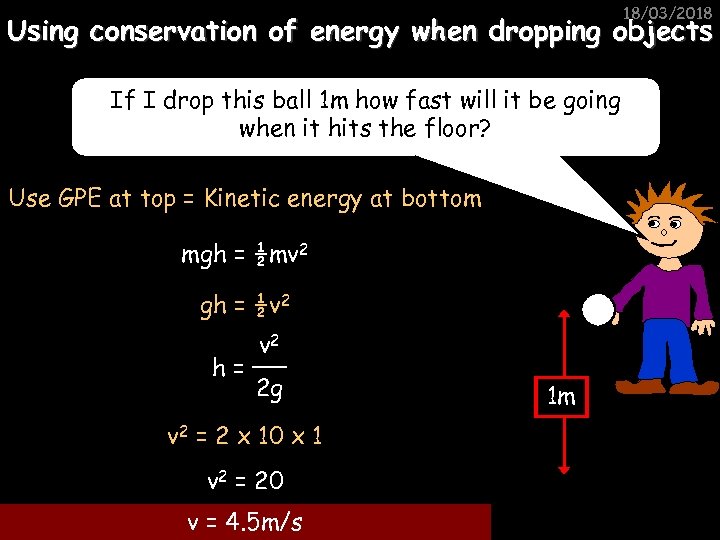 18/03/2018 Using conservation of energy when dropping objects If I drop this ball 1 m how fast will it be going when it hits the floor? Use GPE at top = Kinetic energy at bottom mgh = ½mv 2 gh = ½v 2 h= v 2 2 g v 2 = 2 x 10 x 1 v 2 = 20 v = 4. 5 m/s 1 m
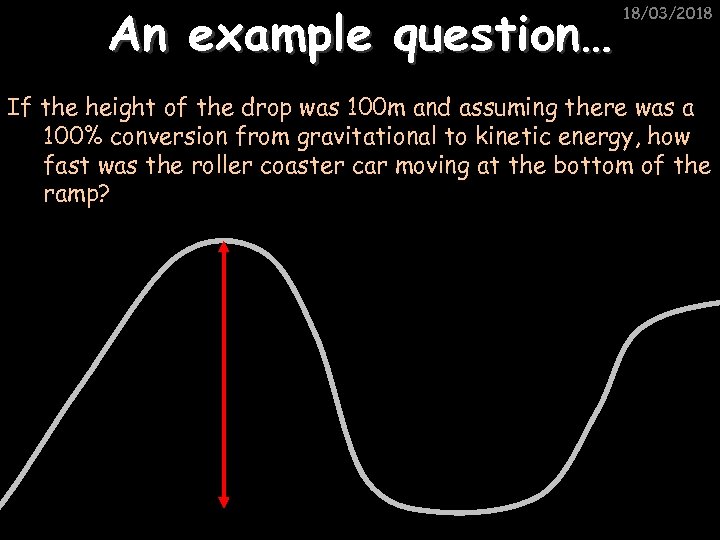 An example question… 18/03/2018 If the height of the drop was 100 m and assuming there was a 100% conversion from gravitational to kinetic energy, how fast was the roller coaster car moving at the bottom of the ramp?