


 Скачать презентацию 17 Financial Leverage and Capital Structure Policy Mc
d6b98284b5742fe5590d7765019497cd.ppt
- Количество слайдов: 45
 17 Financial Leverage and Capital Structure Policy Mc. Graw-Hill/Irwin Copyright © 2008 by The Mc. Graw-Hill Companies, Inc. All rights reserved.
 Key Concepts and Skills § Understand the effect of financial leverage on cash flows and the cost of equity § Understand the impact of taxes and bankruptcy on capital structure choice § Understand the basic components of the bankruptcy process 17 -1
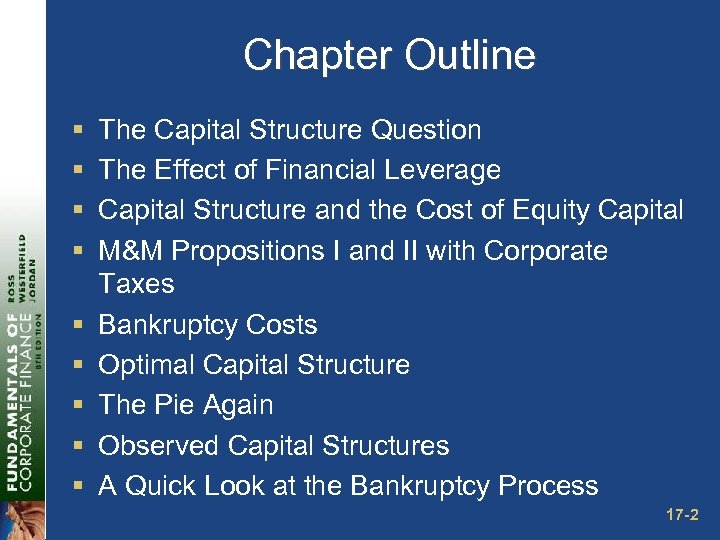 Chapter Outline § § § § § The Capital Structure Question The Effect of Financial Leverage Capital Structure and the Cost of Equity Capital M&M Propositions I and II with Corporate Taxes Bankruptcy Costs Optimal Capital Structure The Pie Again Observed Capital Structures A Quick Look at the Bankruptcy Process 17 -2
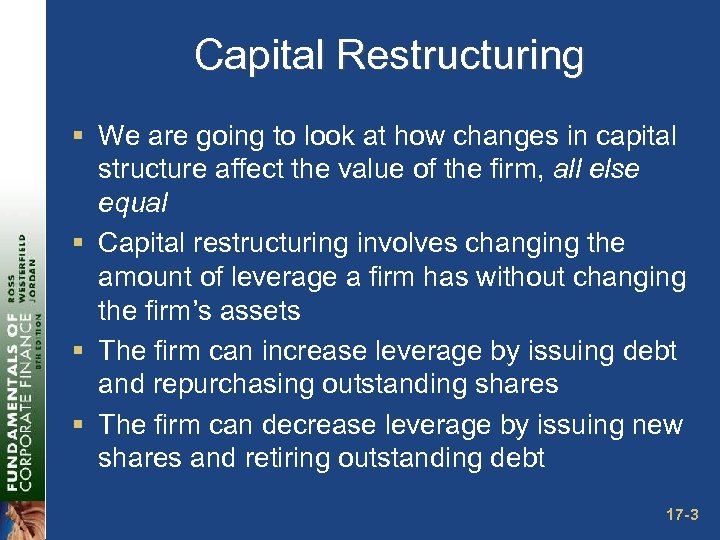 Capital Restructuring § We are going to look at how changes in capital structure affect the value of the firm, all else equal § Capital restructuring involves changing the amount of leverage a firm has without changing the firm’s assets § The firm can increase leverage by issuing debt and repurchasing outstanding shares § The firm can decrease leverage by issuing new shares and retiring outstanding debt 17 -3
 Choosing a Capital Structure § What is the primary goal of financial managers? § Maximize stockholder wealth § We want to choose the capital structure that will maximize stockholder wealth § We can maximize stockholder wealth by maximizing the value of the firm or minimizing the WACC 17 -4
 The Effect of Leverage § How does leverage affect the EPS and ROE of a firm? § When we increase the amount of debt financing, we increase the fixed interest expense § If we have a really good year, then we pay our fixed cost and we have more left over for our stockholders § If we have a really bad year, we still have to pay our fixed costs and we have less left over for our stockholders § Leverage amplifies the variation in both EPS and ROE 17 -5
 Example: Financial Leverage, EPS and ROE – Part I § We will ignore the effect of taxes at this stage § What happens to EPS and ROE when we issue debt and buy back shares of stock? 17 -6
 Example: Financial Leverage, EPS and ROE – Part II § Variability in ROE § Current: ROE ranges from 6% to 20% § Proposed: ROE ranges from 2% to 30% § Variability in EPS § Current: EPS ranges from $0. 60 to $2. 00 § Proposed: EPS ranges from $0. 20 to $3. 00 § The variability in both ROE and EPS increases when financial leverage is increased 17 -7
 Break-Even EBIT § Find EBIT where EPS is the same under both the current and proposed capital structures § If we expect EBIT to be greater than the break-even point, then leverage is beneficial to our stockholders § If we expect EBIT to be less than the break-even point, then leverage is detrimental to our stockholders 17 -8
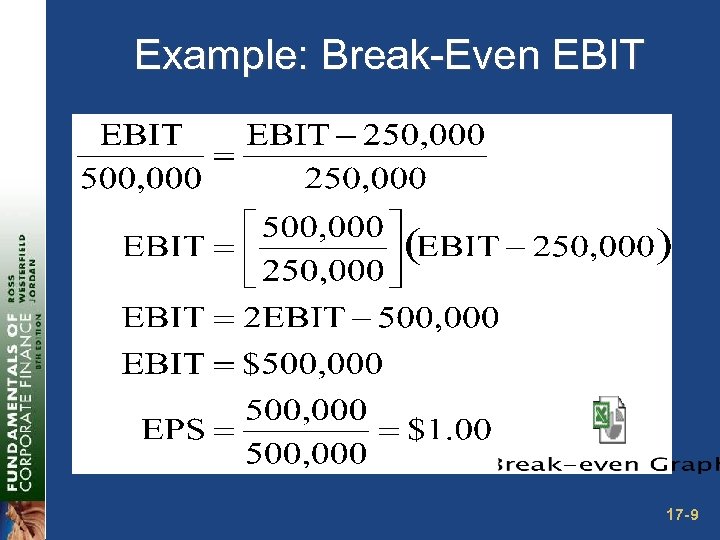 Example: Break-Even EBIT 17 -9
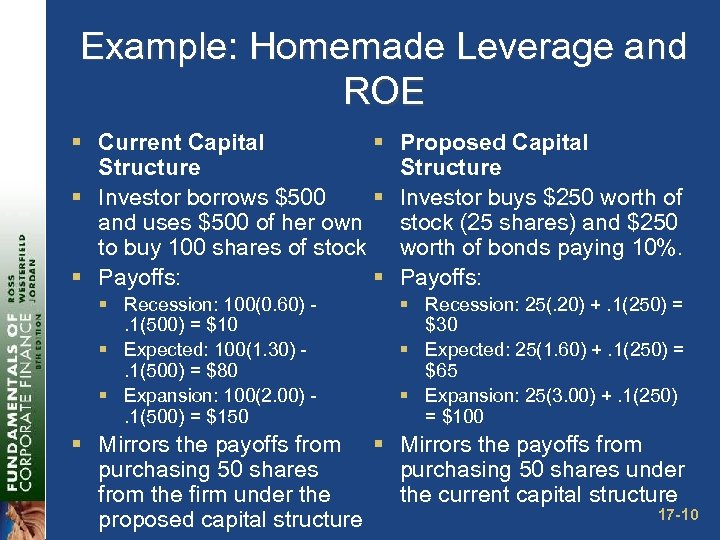 Example: Homemade Leverage and ROE § Current Capital § Structure § Investor borrows $500 § and uses $500 of her own to buy 100 shares of stock § Payoffs: § § Recession: 100(0. 60). 1(500) = $10 § Expected: 100(1. 30). 1(500) = $80 § Expansion: 100(2. 00). 1(500) = $150 Proposed Capital Structure Investor buys $250 worth of stock (25 shares) and $250 worth of bonds paying 10%. Payoffs: § Recession: 25(. 20) +. 1(250) = $30 § Expected: 25(1. 60) +. 1(250) = $65 § Expansion: 25(3. 00) +. 1(250) = $100 § Mirrors the payoffs from purchasing 50 shares under from the firm under the current capital structure 17 -10 proposed capital structure
 Capital Structure Theory § Modigliani and Miller Theory of Capital Structure § Proposition I – firm value § Proposition II – WACC § The value of the firm is determined by the cash flows to the firm and the risk of the assets § Changing firm value § Change the risk of the cash flows § Change the cash flows 17 -11
 Capital Structure Theory Under Three Special Cases § Case I – Assumptions § No corporate or personal taxes § No bankruptcy costs § Case II – Assumptions § Corporate taxes, but no personal taxes § No bankruptcy costs § Case III – Assumptions § Corporate taxes, but no personal taxes § Bankruptcy costs 17 -12
 Case I – Propositions I and II § Proposition I § The value of the firm is NOT affected by changes in the capital structure § The cash flows of the firm do not change; therefore, value doesn’t change § Proposition II § The WACC of the firm is NOT affected by capital structure 17 -13
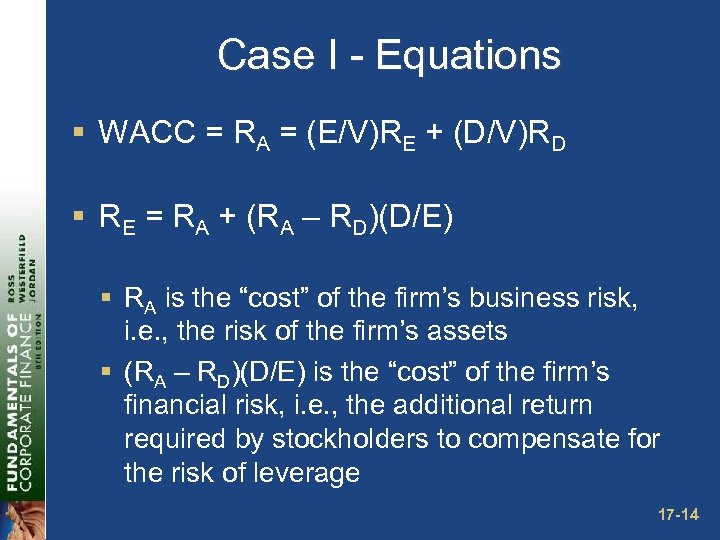 Case I - Equations § WACC = RA = (E/V)RE + (D/V)RD § RE = RA + (RA – RD)(D/E) § RA is the “cost” of the firm’s business risk, i. e. , the risk of the firm’s assets § (RA – RD)(D/E) is the “cost” of the firm’s financial risk, i. e. , the additional return required by stockholders to compensate for the risk of leverage 17 -14
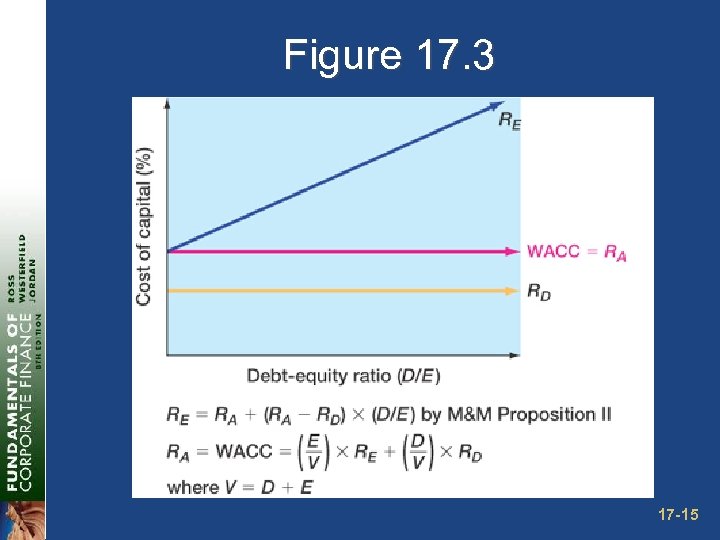 Figure 17. 3 17 -15
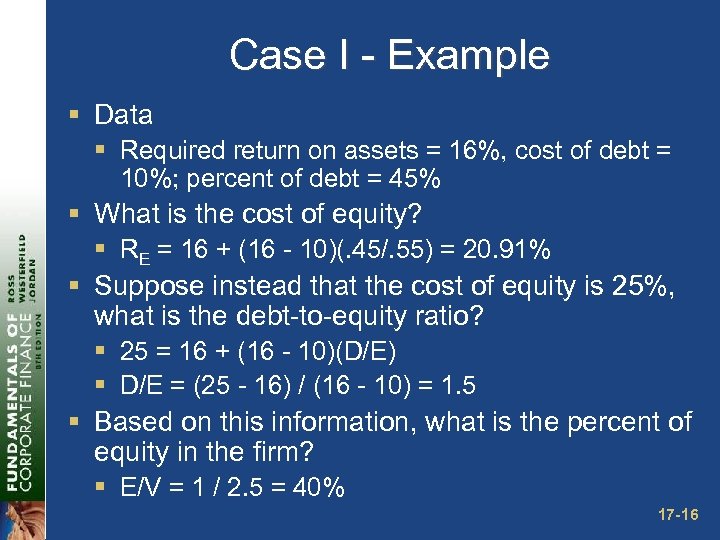 Case I - Example § Data § Required return on assets = 16%, cost of debt = 10%; percent of debt = 45% § What is the cost of equity? § RE = 16 + (16 - 10)(. 45/. 55) = 20. 91% § Suppose instead that the cost of equity is 25%, what is the debt-to-equity ratio? § 25 = 16 + (16 - 10)(D/E) § D/E = (25 - 16) / (16 - 10) = 1. 5 § Based on this information, what is the percent of equity in the firm? § E/V = 1 / 2. 5 = 40% 17 -16
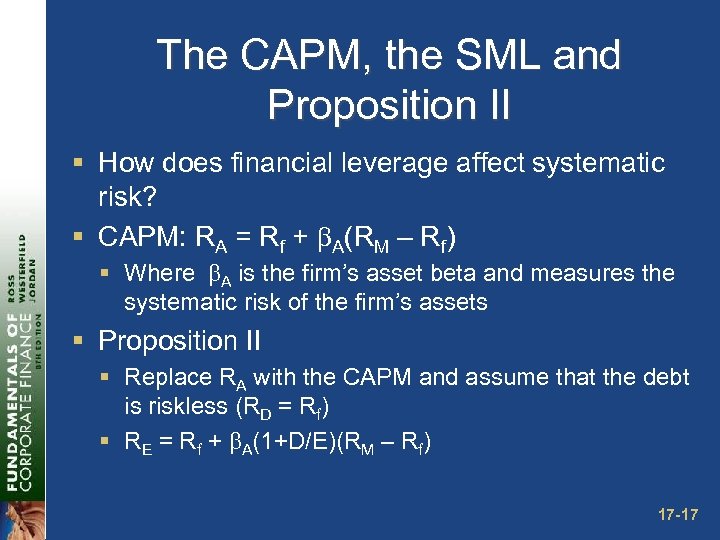 The CAPM, the SML and Proposition II § How does financial leverage affect systematic risk? § CAPM: RA = Rf + A(RM – Rf) § Where A is the firm’s asset beta and measures the systematic risk of the firm’s assets § Proposition II § Replace RA with the CAPM and assume that the debt is riskless (RD = Rf) § RE = Rf + A(1+D/E)(RM – Rf) 17 -17
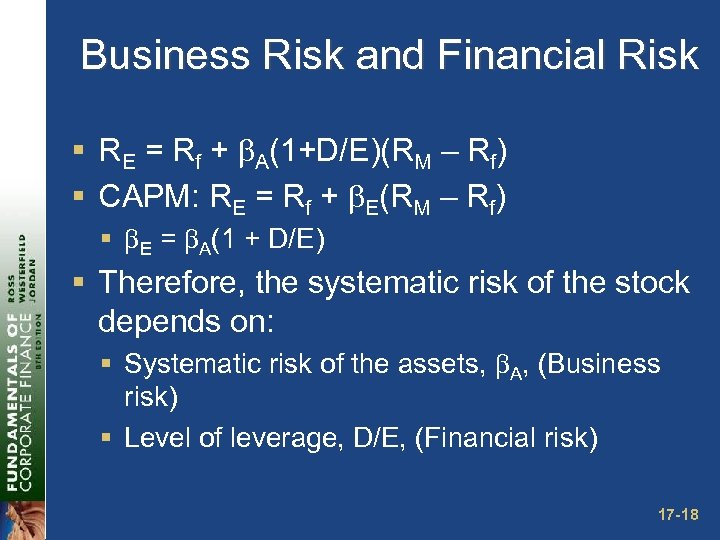 Business Risk and Financial Risk § RE = Rf + A(1+D/E)(RM – Rf) § CAPM: RE = Rf + E(RM – Rf) § E = A(1 + D/E) § Therefore, the systematic risk of the stock depends on: § Systematic risk of the assets, A, (Business risk) § Level of leverage, D/E, (Financial risk) 17 -18
 Case II – Cash Flow § Interest is tax deductible § Therefore, when a firm adds debt, it reduces taxes, all else equal § The reduction in taxes increases the cash flow of the firm § How should an increase in cash flows affect the value of the firm? 17 -19
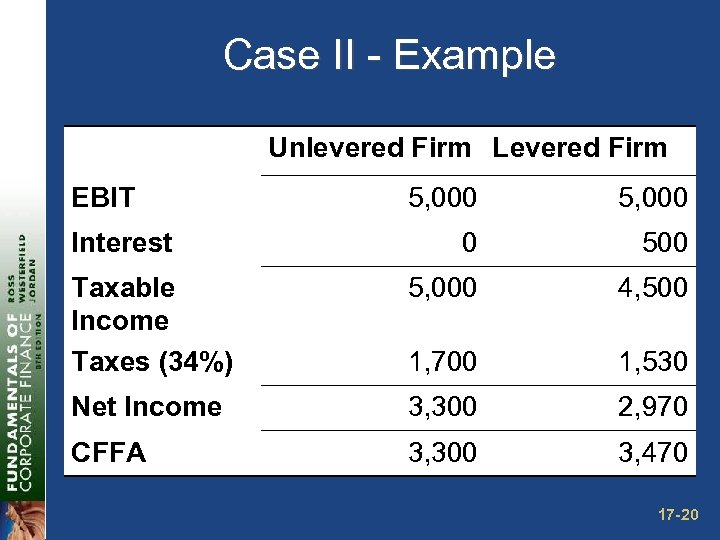 Case II - Example Unlevered Firm Levered Firm EBIT 5, 000 0 500 Taxable Income Taxes (34%) 5, 000 4, 500 1, 700 1, 530 Net Income 3, 300 2, 970 CFFA 3, 300 3, 470 Interest 17 -20
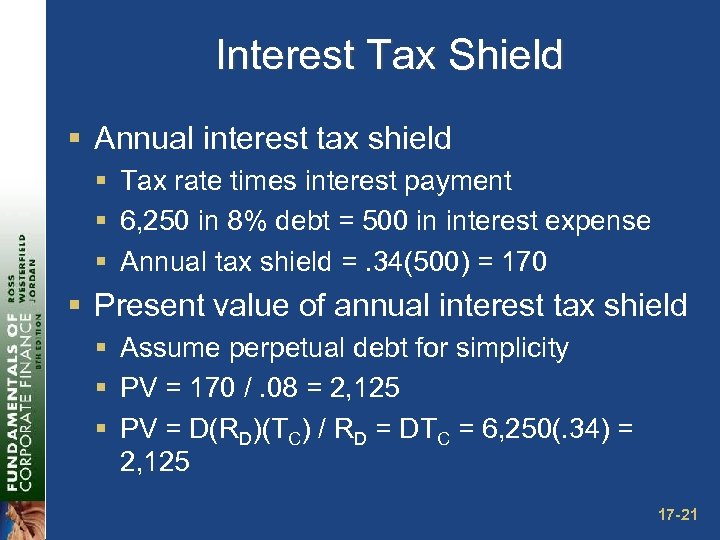 Interest Tax Shield § Annual interest tax shield § Tax rate times interest payment § 6, 250 in 8% debt = 500 in interest expense § Annual tax shield =. 34(500) = 170 § Present value of annual interest tax shield § Assume perpetual debt for simplicity § PV = 170 /. 08 = 2, 125 § PV = D(RD)(TC) / RD = DTC = 6, 250(. 34) = 2, 125 17 -21
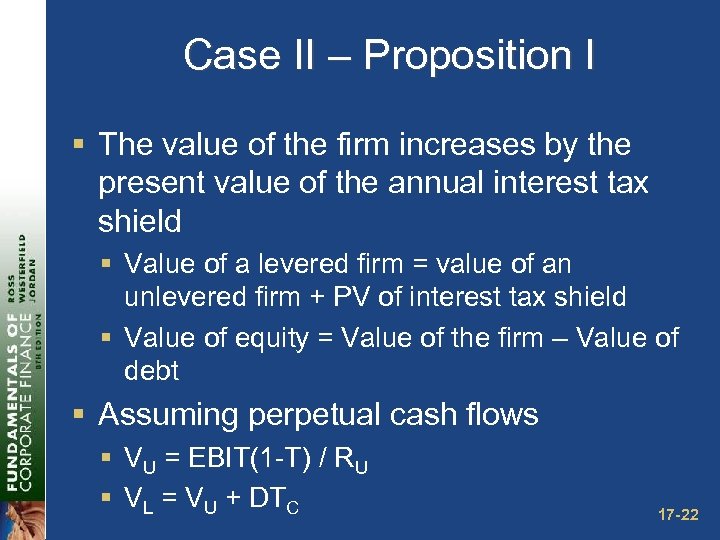 Case II – Proposition I § The value of the firm increases by the present value of the annual interest tax shield § Value of a levered firm = value of an unlevered firm + PV of interest tax shield § Value of equity = Value of the firm – Value of debt § Assuming perpetual cash flows § VU = EBIT(1 -T) / RU § VL = VU + DTC 17 -22
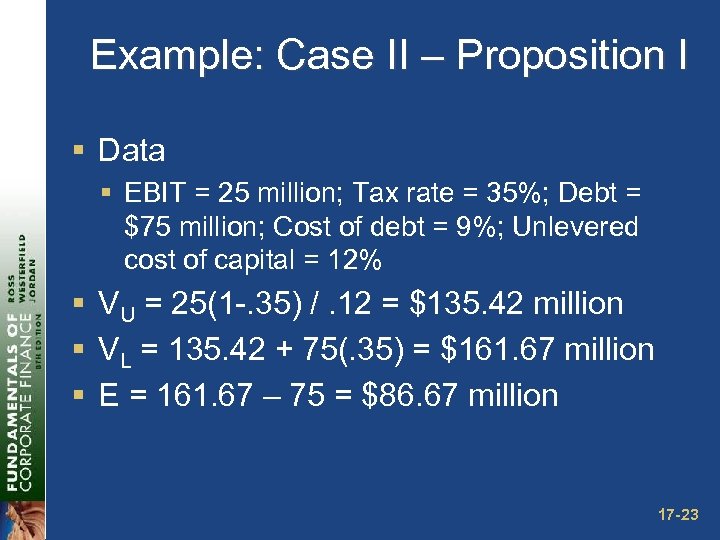 Example: Case II – Proposition I § Data § EBIT = 25 million; Tax rate = 35%; Debt = $75 million; Cost of debt = 9%; Unlevered cost of capital = 12% § VU = 25(1 -. 35) /. 12 = $135. 42 million § VL = 135. 42 + 75(. 35) = $161. 67 million § E = 161. 67 – 75 = $86. 67 million 17 -23
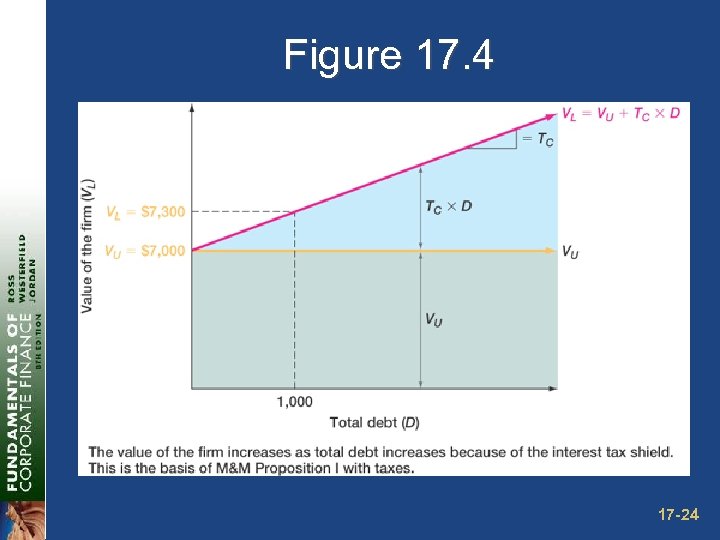 Figure 17. 4 17 -24
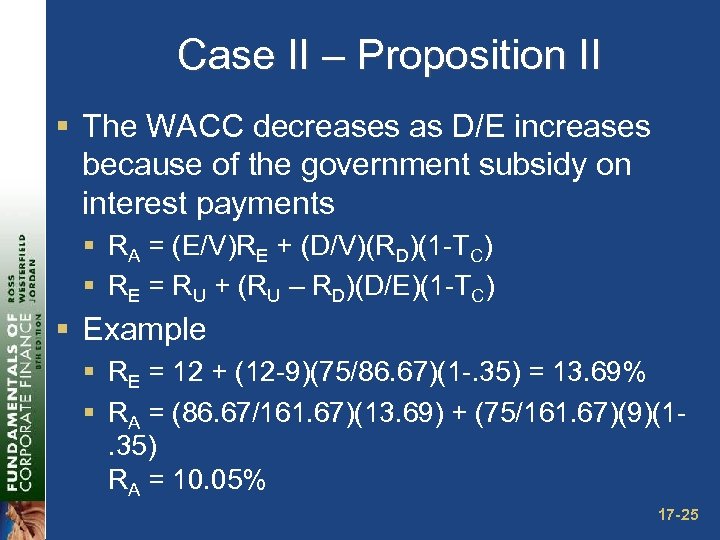 Case II – Proposition II § The WACC decreases as D/E increases because of the government subsidy on interest payments § RA = (E/V)RE + (D/V)(RD)(1 -TC) § RE = RU + (RU – RD)(D/E)(1 -TC) § Example § RE = 12 + (12 -9)(75/86. 67)(1 -. 35) = 13. 69% § RA = (86. 67/161. 67)(13. 69) + (75/161. 67)(9)(1. 35) RA = 10. 05% 17 -25
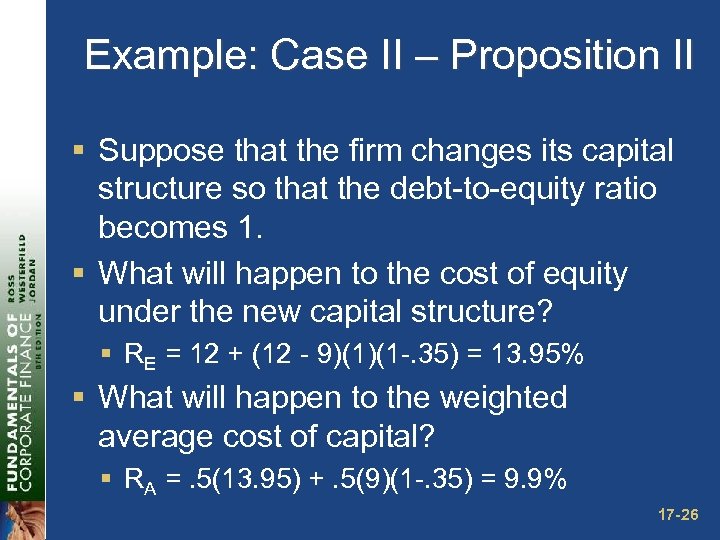 Example: Case II – Proposition II § Suppose that the firm changes its capital structure so that the debt-to-equity ratio becomes 1. § What will happen to the cost of equity under the new capital structure? § RE = 12 + (12 - 9)(1)(1 -. 35) = 13. 95% § What will happen to the weighted average cost of capital? § RA =. 5(13. 95) +. 5(9)(1 -. 35) = 9. 9% 17 -26
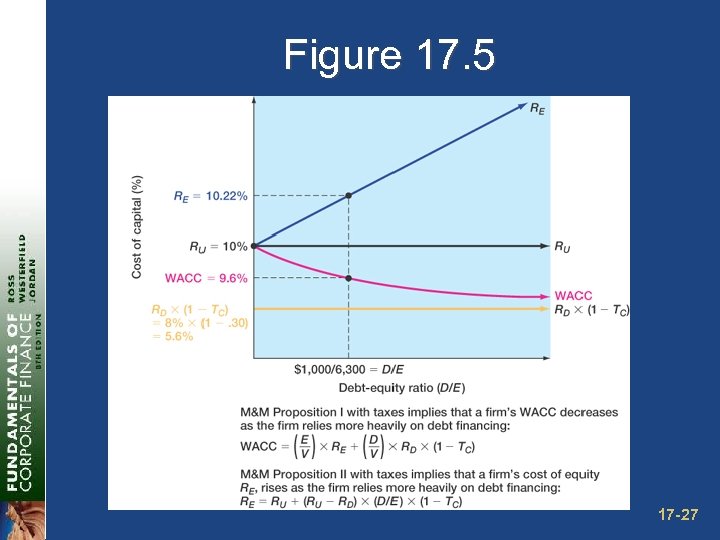 Figure 17. 5 17 -27
 Case III § Now we add bankruptcy costs § As the D/E ratio increases, the probability of bankruptcy increases § This increased probability will increase the expected bankruptcy costs § At some point, the additional value of the interest tax shield will be offset by the increase in expected bankruptcy cost § At this point, the value of the firm will start to decrease and the WACC will start to increase as more debt is added 17 -28
 Bankruptcy Costs § Direct costs § Legal and administrative costs § Ultimately cause bondholders to incur additional losses § Disincentive to debt financing § Financial distress § Significant problems in meeting debt obligations § Most firms that experience financial distress do not ultimately file for bankruptcy 17 -29
 More Bankruptcy Costs § Indirect bankruptcy costs § Larger than direct costs, but more difficult to measure and estimate § Stockholders want to avoid a formal bankruptcy filing § Bondholders want to keep existing assets intact so they can at least receive that money § Assets lose value as management spends time worrying about avoiding bankruptcy instead of running the business § The firm may also lose sales, experience interrupted operations and lose valuable employees 17 -30
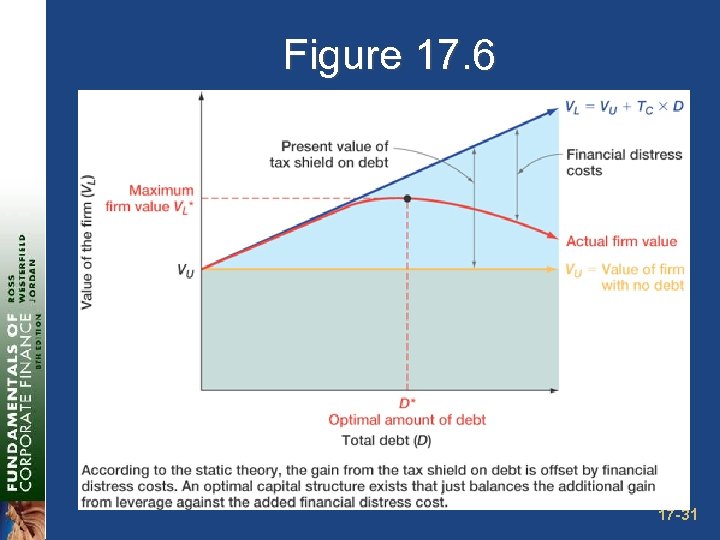 Figure 17. 6 17 -31
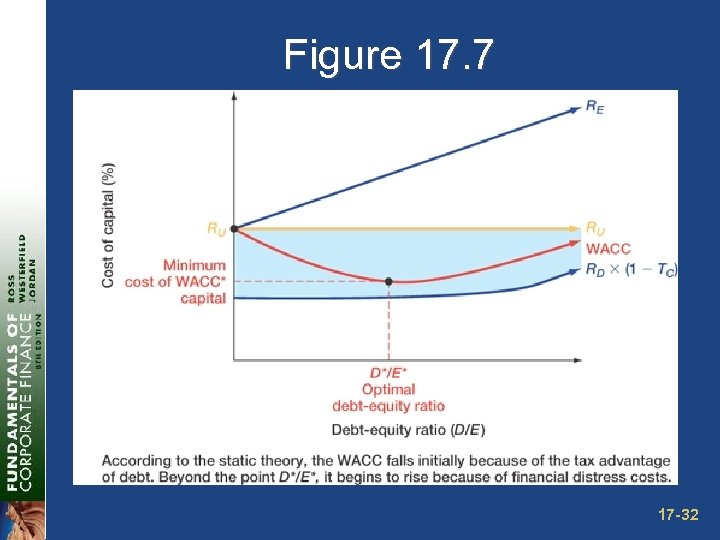 Figure 17. 7 17 -32
 Conclusions § Case I – no taxes or bankruptcy costs § No optimal capital structure § Case II – corporate taxes but no bankruptcy costs § Optimal capital structure is almost 100% debt § Each additional dollar of debt increases the cash flow of the firm § Case III – corporate taxes and bankruptcy costs § Optimal capital structure is part debt and part equity § Occurs where the benefit from an additional dollar of debt is just offset by the increase in expected bankruptcy costs 17 -33
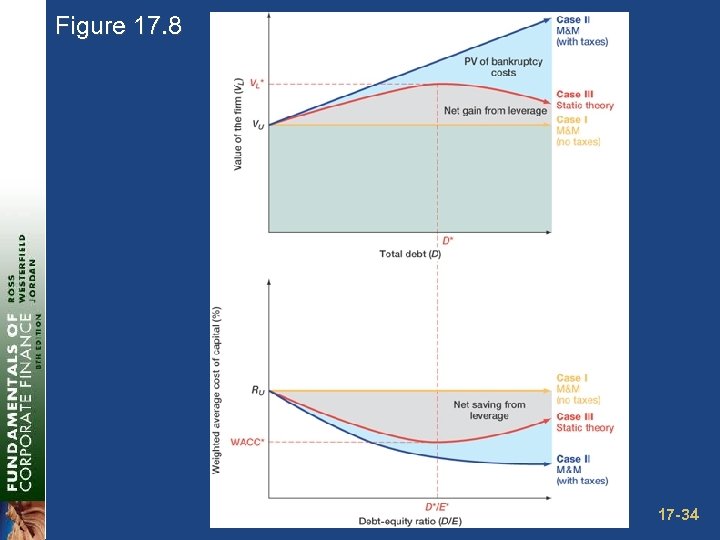 Figure 17. 8 17 -34
 Managerial Recommendations § The tax benefit is only important if the firm has a large tax liability § Risk of financial distress § The greater the risk of financial distress, the less debt will be optimal for the firm § The cost of financial distress varies across firms and industries and as a manager you need to understand the cost for your industry 17 -35
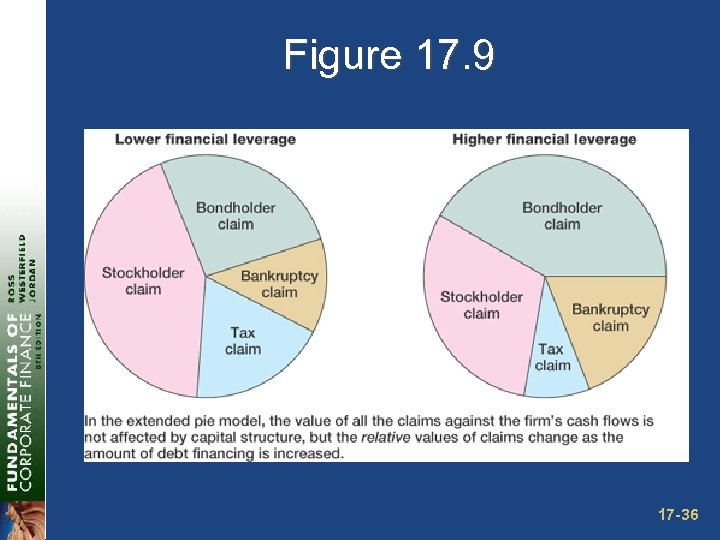 Figure 17. 9 17 -36
 The Value of the Firm § Value of the firm = marketed claims + nonmarketed claims § Marketed claims are the claims of stockholders and bondholders § Nonmarketed claims are the claims of the government and other potential stakeholders § The overall value of the firm is unaffected by changes in capital structure § The division of value between marketed claims and nonmarketed claims may be impacted by capital structure decisions 17 -37
 Observed Capital Structure § Capital structure does differ by industries § Differences according to Cost of Capital 2004 Yearbook by Ibbotson Associates, Inc. § Lowest levels of debt § Drugs with 6. 38% debt § Paper and computers with 10. 24 – 10. 68% debt § Highest levels of debt § Airlines with 64. 22% debt § Electric utilities with 49. 03% debt 17 -38
 Work the Web Example § You can find information about a company’s capital structure relative to its industry, sector and the S&P 500 at Reuters at Yahoo § Click on the web surfer to go to the site § Choose a company and get a quote § Choose ratio comparisons 17 -39
 Bankruptcy Process – Part I § Business failure – business has terminated with a loss to creditors § Legal bankruptcy – petition federal court for bankruptcy § Technical insolvency – firm is unable to meet debt obligations § Accounting insolvency – book value of equity is negative 17 -40
 Bankruptcy Process – Part II § Liquidation § Chapter 7 of the Federal Bankruptcy Reform Act of 1978 § Trustee takes over assets, sells them and distributes the proceeds according to the absolute priority rule § Reorganization § Chapter 11 of the Federal Bankruptcy Reform Act of 1978 § Restructure the corporation with a provision to repay creditors 17 -41
 Quick Quiz § Explain the effect of leverage on EPS and ROE § What is the break-even EBIT and how do we compute it? § How do we determine the optimal capital structure? § What is the optimal capital structure in the three cases that were discussed in this chapter? § What is the difference between liquidation and reorganization? 17 -42
 17 End of Chapter Mc. Graw-Hill/Irwin Copyright © 2008 by The Mc. Graw-Hill Companies, Inc. All rights reserved.
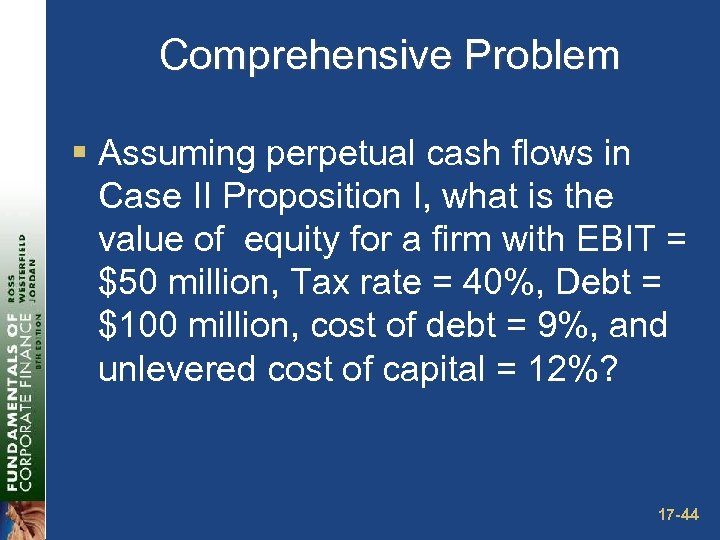 Comprehensive Problem § Assuming perpetual cash flows in Case II Proposition I, what is the value of equity for a firm with EBIT = $50 million, Tax rate = 40%, Debt = $100 million, cost of debt = 9%, and unlevered cost of capital = 12%? 17 -44