


 Скачать презентацию 16 th Annual HISA Health Informatics Conference The
4ce7bb3becc5bf0e3b89ce92414e5bad.ppt
- Количество слайдов: 39
 16 th Annual HISA Health Informatics Conference: The Person in the Centre The I-CAN: Using e-Health to get People the Support they Need www. i-can. org. au Samuel Arnold Vivienne Riches Trevor Parmenter Roger Stancliffe
 I-CAN v 4. 2 www. i-can. org. au I CAN DO IT! Samuel Arnold Vivienne Riches Trevor Parmenter Roger Stancliffe
 Acknowledgements Aussies: Vivienne Riches, Trevor Parmenter, Samuel Arnold, Roger Stancliffe, Gwynnyth Llewellyn, Keith Mc. Villy, Jeffrey Chan, Gabrielle Hindmarsh, Julie Pryor, Tony Harman (and many others) POMs: Helen Sanderson, Edwin Jones, David Felce, Sandy Toogood, Jim Mansell and colleagues Yanks: Michael Smull, John O’Brien, Marc Gold, AAIDD WHO ICF
 What is the I-CAN? The Instrument for the Classification and Assessment of Support Needs (I-CAN) “a support needs assessment designed to assess and guide support delivery for people with a disability including mental illness. It provides a user, client, staff and family friendly holistic assessment, conceptually based upon the internationally recognized WHO ICF framework. ” www. i-can. org. au
 Support Needs Assessment What’s so different about assessing support needs instead of assessing functioning, health or adaptive behavior? The questions we used to ask were: • Can you count change? Can you climb a ladder? Now we are asking: • How much support do you need to go to the shops? If you wanted to climb a ladder, how much support would you need?
 A Bit of History Project in the Australian Capital Territory (ACT) (started in 1998) to develop a resource allocation tool for assessing and classifying support needs of people with an intellectual disability prior to determining funding needs SCAN Supports Classification and Assessment of Needs
 Our History • ARC linkage funding over 3 years to develop an instrument to assess & classify support needs • administered by the University of Sydney with CDS and Royal Rehabilitation Centre Sydney as industry partners • Over 5000 participants in trials of first three versions, = 1012 assessments completed. • Ongoing revisions based upon: • Factor Analysis • Validity and reliability studies • Feedback (what’s missing? ) • Ongoing review of the WHO ICF framework (WHO, 2001) n
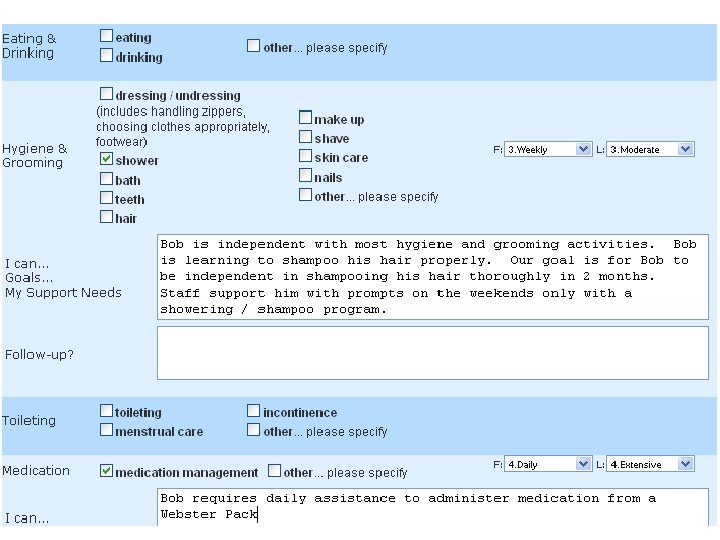
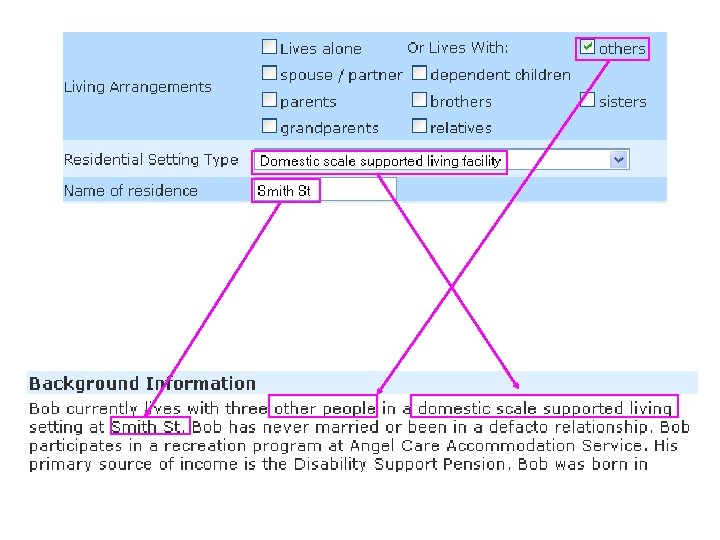
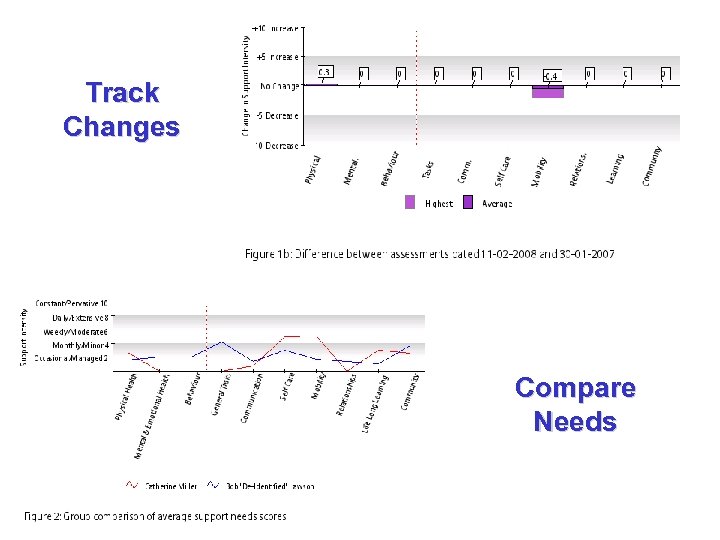
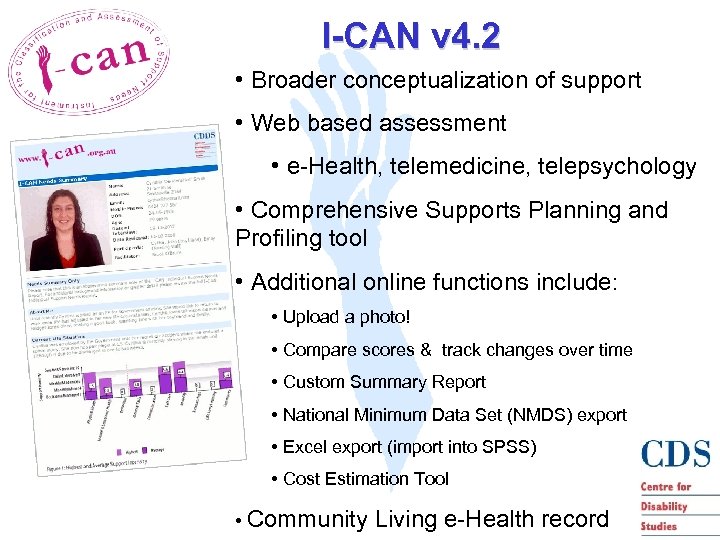 I-CAN v 4. 2 • Broader conceptualization of support • Web based assessment • e-Health, telemedicine, telepsychology • Comprehensive Supports Planning and Profiling tool • Additional online functions include: • Upload a photo! • Compare scores & track changes over time • Custom Summary Report • National Minimum Data Set (NMDS) export • Excel export (import into SPSS) • Cost Estimation Tool • Community Living e-Health record
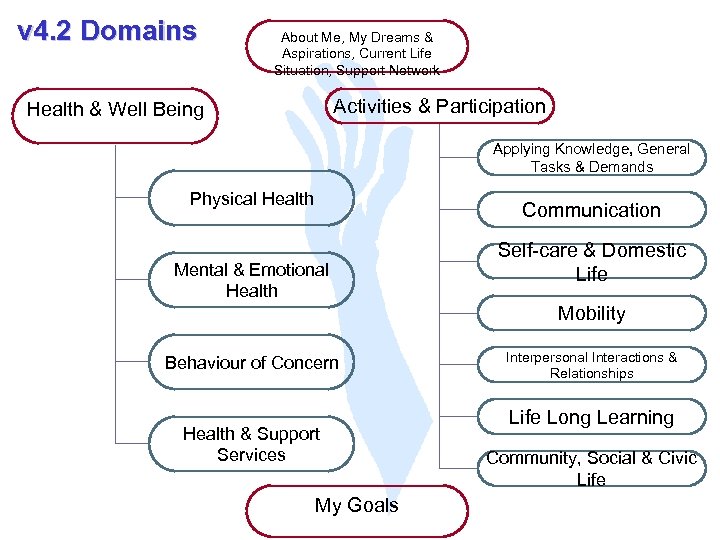 v 4. 2 Domains About Me, My Dreams & Aspirations, Current Life Situation, Support Network Activities & Participation Health & Well Being Applying Knowledge, General Tasks & Demands Physical Health Communication Mental & Emotional Health Self-care & Domestic Life Mobility Behaviour of Concern Health & Support Services My Goals Interpersonal Interactions & Relationships Life Long Learning Community, Social & Civic Life
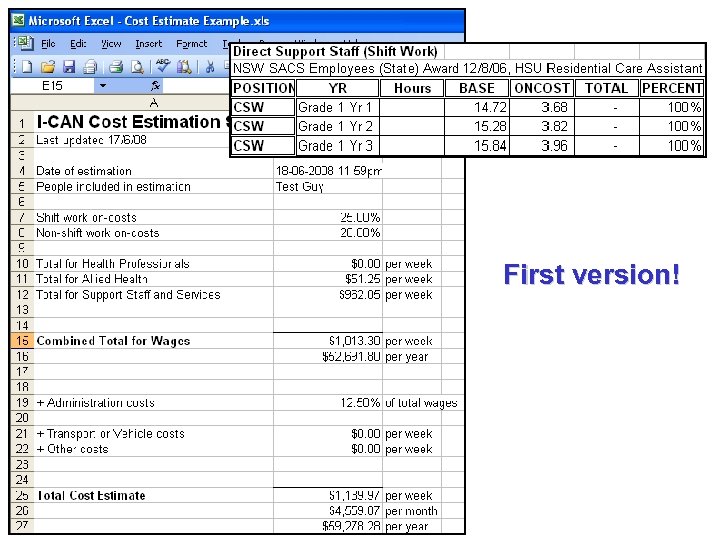 First version!
 Track Changes Compare Needs
 I-CAN Theoretical Models Or how to describe humans with boxes and arrows.
 • World Health Organisation’s (WHO) International Classification of Functioning, Disability & Health (ICF) • Integration of medical and social models -> Bio-psycho-social • Person-environment interaction • Search me online – though my webserver seems to keep falling over!
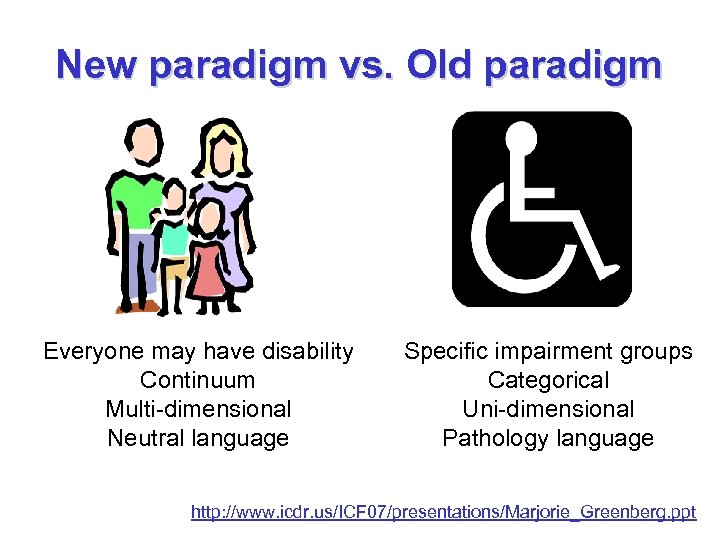 New paradigm vs. Old paradigm Everyone may have disability Continuum Multi-dimensional Neutral language Specific impairment groups Categorical Uni-dimensional Pathology language http: //www. icdr. us/ICF 07/presentations/Marjorie_Greenberg. ppt
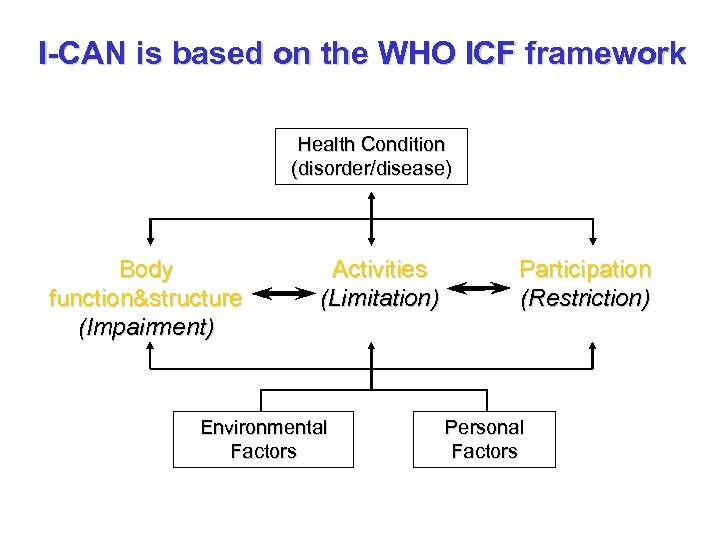 I-CAN is based on the WHO ICF framework Health Condition (disorder/disease) Body function&structure (Impairment) Activities (Limitation) Environmental Factors Participation (Restriction) Personal Factors
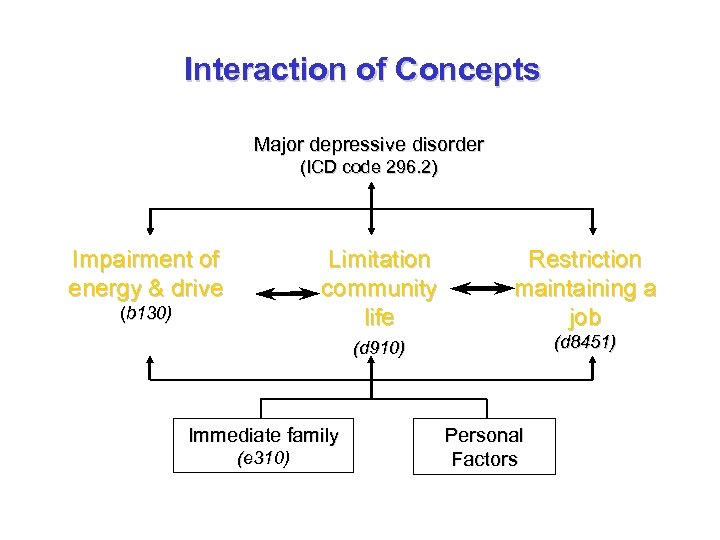 Interaction of Concepts Major depressive disorder (ICD code 296. 2) Impairment of energy & drive Limitation community life (d 910) (b 130) Restriction maintaining a job (d 8451) Immediate family (e 310) Personal Factors
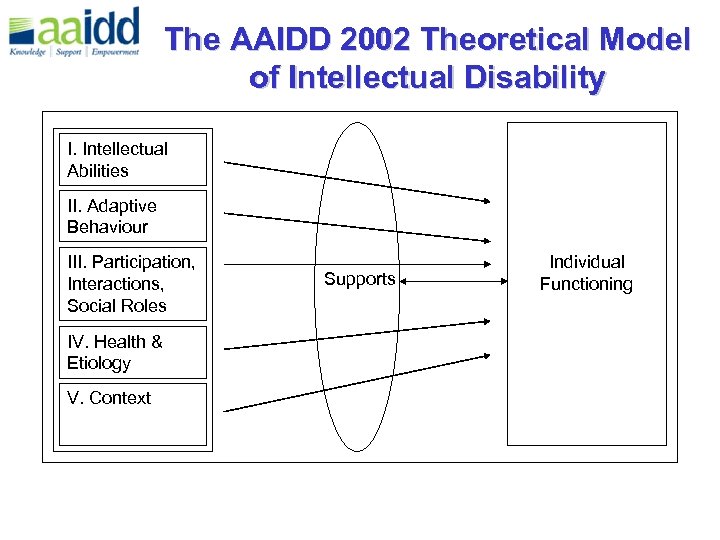 The AAIDD 2002 Theoretical Model of Intellectual Disability I. Intellectual Abilities II. Adaptive Behaviour III. Participation, Interactions, Social Roles IV. Health & Etiology V. Context Supports Individual Functioning
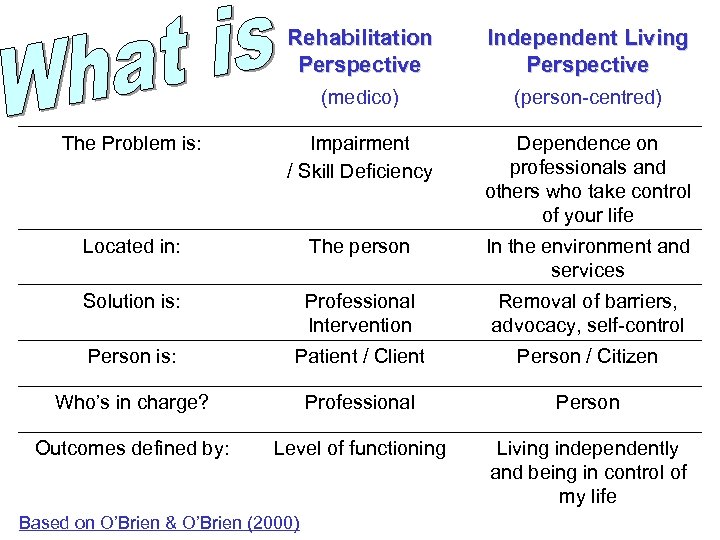 Rehabilitation Perspective Independent Living Perspective (medico) (person-centred) The Problem is: Impairment / Skill Deficiency Dependence on professionals and others who take control of your life Located in: The person In the environment and services Solution is: Professional Intervention Removal of barriers, advocacy, self-control Person is: Patient / Client Person / Citizen Who’s in charge? Professional Person Outcomes defined by: Level of functioning Living independently and being in control of my life Based on O’Brien & O’Brien (2000)
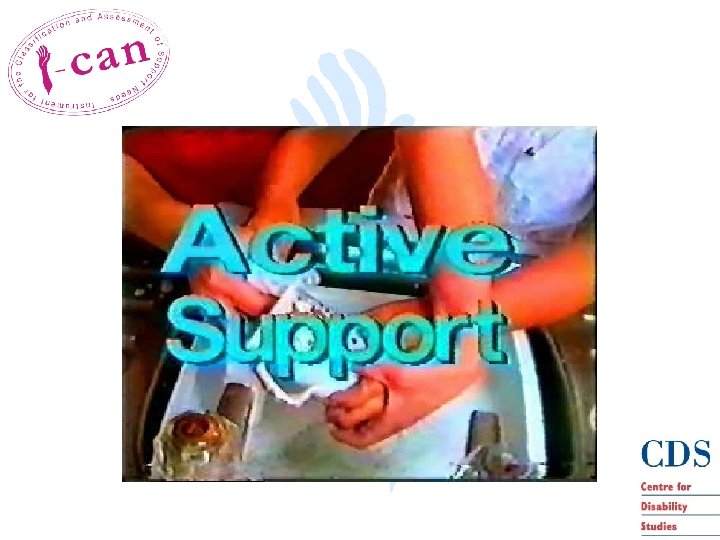
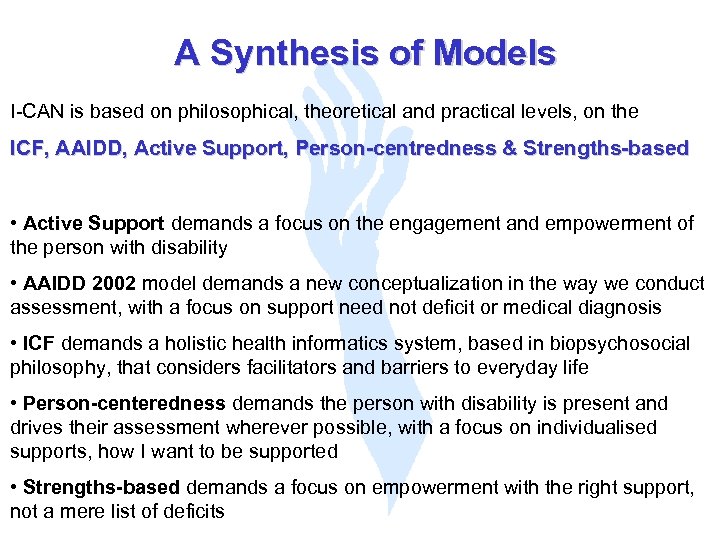 A Synthesis of Models I-CAN is based on philosophical, theoretical and practical levels, on the ICF, AAIDD, Active Support, Person-centredness & Strengths-based • Active Support demands a focus on the engagement and empowerment of the person with disability • AAIDD 2002 model demands a new conceptualization in the way we conduct assessment, with a focus on support need not deficit or medical diagnosis • ICF demands a holistic health informatics system, based in biopsychosocial philosophy, that considers facilitators and barriers to everyday life • Person-centeredness demands the person with disability is present and drives their assessment wherever possible, with a focus on individualised supports, how I want to be supported • Strengths-based demands a focus on empowerment with the right support, not a mere list of deficits
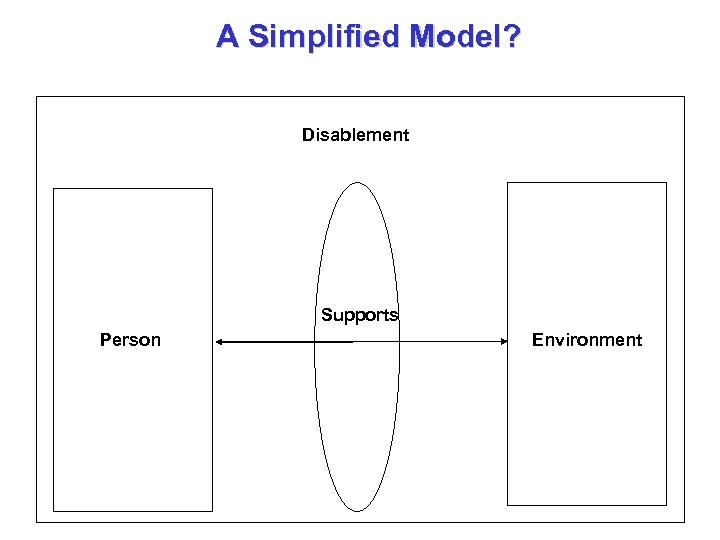 A Simplified Model? Disablement Supports Person Environment
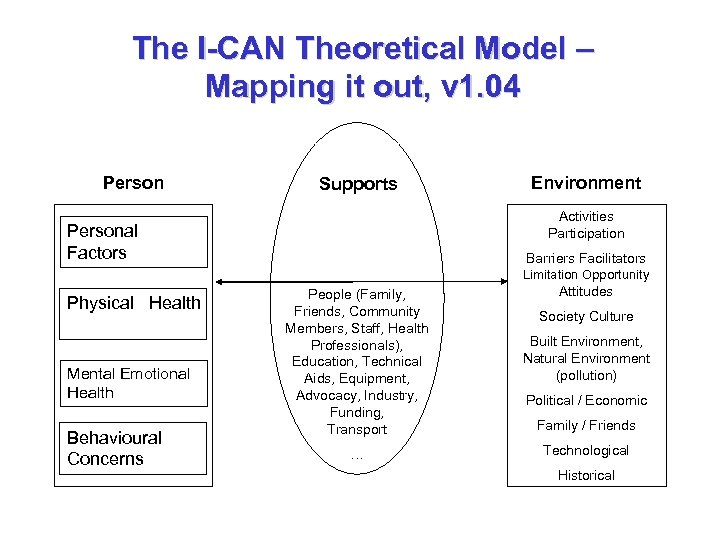 The I-CAN Theoretical Model – Mapping it out, v 1. 04 Person Supports Environment Activities Participation Personal Factors Barriers Facilitators Limitation Opportunity Physical Health Mental Emotional Health Behavioural Concerns Attitudes People (Family, Friends, Community Members, Staff, Health Professionals), Education, Technical Aids, Equipment, Advocacy, Industry, Funding, Transport Built Environment, Natural Environment (pollution) … Technological Society Culture Political / Economic Family / Friends Historical
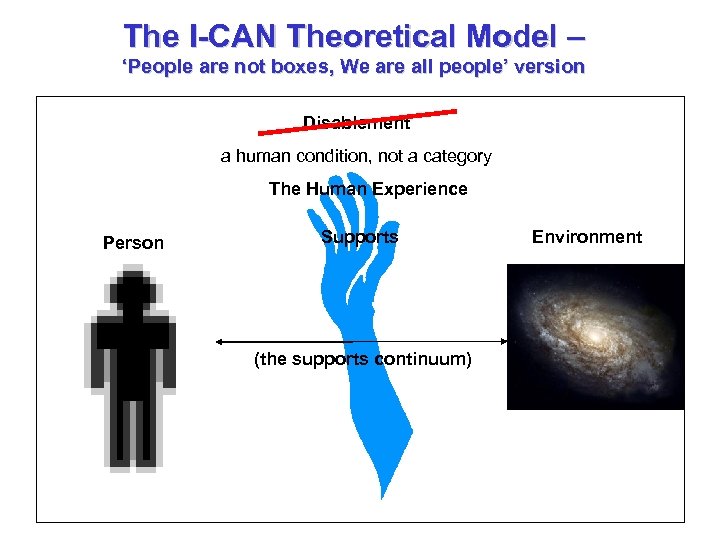 The I-CAN Theoretical Model – ‘People are not boxes, We are all people’ version Disablement a human condition, not a category The Human Experience Person Supports (the supports continuum) Environment
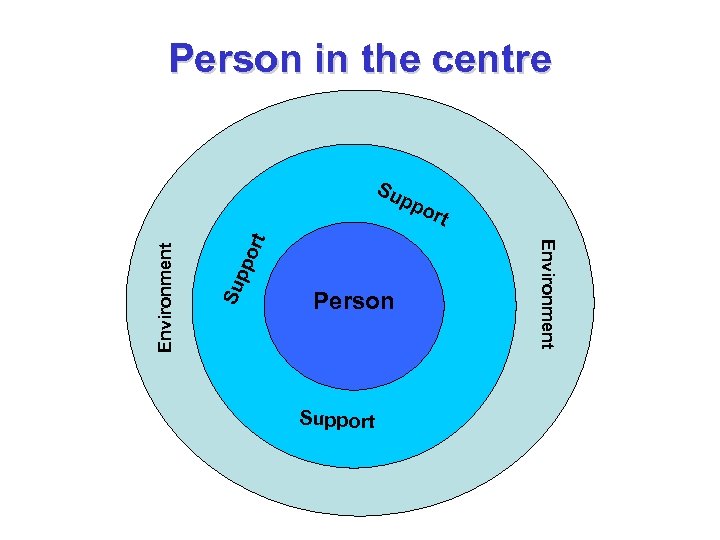 Person in the centre Su pp rt ppo Su Person Support Environment ort
 Hmmm a simplified model needs a new name… “All you need is love” - no no, not technical enough, already copyrighted! “All you need is support” - no no, not catchy
 International Classification of Functioning, Disability and Health OR International Classification of People, the Support they Need, and the Environment
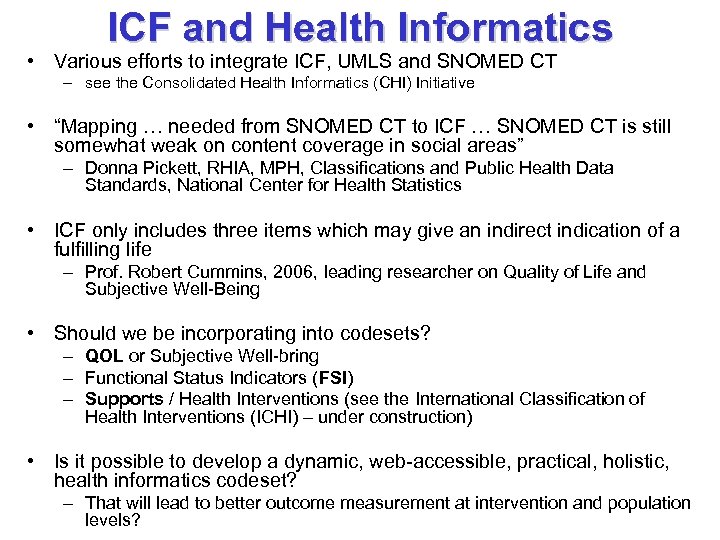 ICF and Health Informatics • Various efforts to integrate ICF, UMLS and SNOMED CT – see the Consolidated Health Informatics (CHI) Initiative • “Mapping … needed from SNOMED CT to ICF … SNOMED CT is still somewhat weak on content coverage in social areas” – Donna Pickett, RHIA, MPH, Classifications and Public Health Data Standards, National Center for Health Statistics • ICF only includes three items which may give an indirect indication of a fulfilling life – Prof. Robert Cummins, 2006, leading researcher on Quality of Life and Subjective Well-Being • Should we be incorporating into codesets? – QOL or Subjective Well-bring – Functional Status Indicators (FSI) – Supports / Health Interventions (see the International Classification of Health Interventions (ICHI) – under construction) • Is it possible to develop a dynamic, web-accessible, practical, holistic, health informatics codeset? – That will lead to better outcome measurement at intervention and population levels?
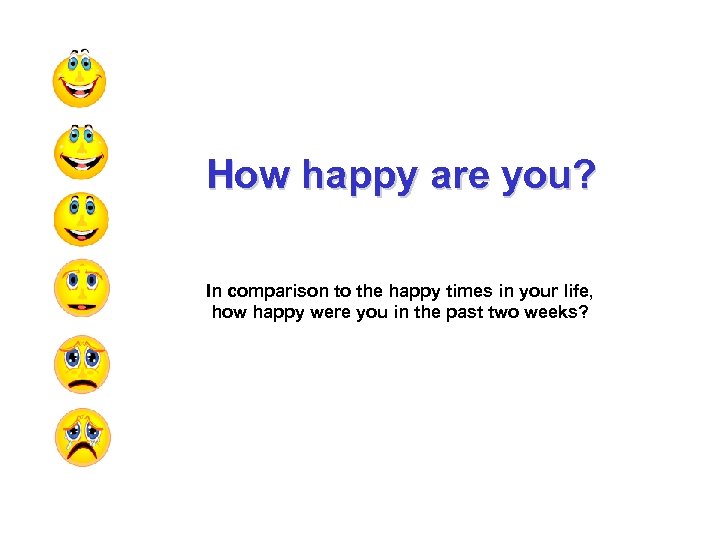 How happy are you? In comparison to the happy times in your life, how happy were you in the past two weeks?
 Research • On-going development & trial of instrument & process • Data collected in NSW, ACT, Vic & Qld • Residential settings, mental health settings, rehabilitation settings, and some day program settings • Facilitators require training – version 4 allows for auditing of facilitators skills • Process engaging 5071 participants versions 1 -3 • n=1012 complete data sets versions 1 -3 • n=170 to date 4 th versions • Studies of reliability, concurrent and predictive validity, practical utility
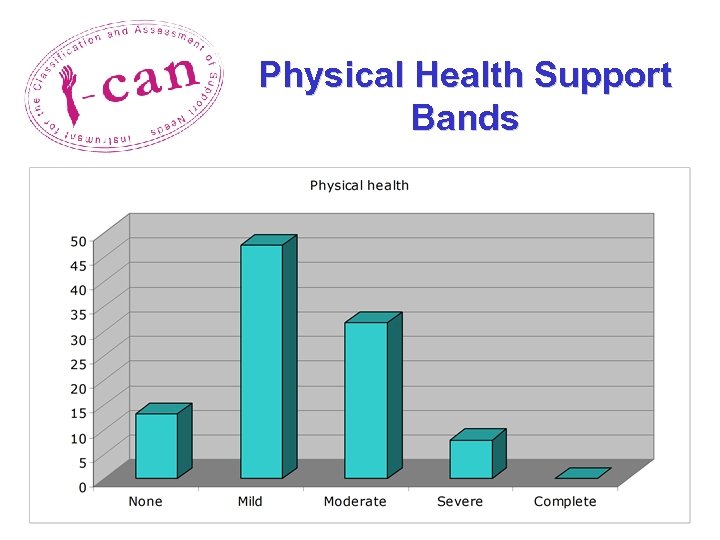 Physical Health Support Bands
 Reliability Studies • Internal consistency alpha 0. 70 to 0. 98 v 1 -3 • Internal consistency alpha 0. 83 to 0. 93 v 4 except 0. 68 for Health & Support Services Domain, due to redesign to allow for specific costs estimation (n=100) • Inter-rater reliability r = 0. 96 to 1. 00 v 1 -3 • Overall agreements r = 0. 99 v 1 -3 • Test-retest reliability r = 0. 21 to 0. 94 v 1 -3 1 year r = 0. 21 Physical Health Scale r = 0. 93 for Mobility Scale 2 years r =-0. 22 Mental Emotional Health r = 0. 94 Mobility Scale
 Participant Evaluations Positive feedback from: • People with disabilities • Trained facilitators • Family members and advocates Continued positive feedback with v 4
 Validity Studies • I-CAN and Inventory for Client and Agency Planning (ICAP) (Bruininks, Hill, Weatherman & Woodcock, 1986) • Moderate and significant correlations with service level score coefficients ( -. 39 Communication to -. 62 Behaviour) • I-CAN & Quality of Life Questionnaire (QOL-Q) (Schalock & Keith, 1993) • Significant correlation between Community Integration/Social Belonging and I-CAN scales of Mental Emotional Health, Communication and Interpersonal Interactions and Relationships • Otherwise generally low to moderate correlations • I-CAN v 4 and Service Need Assessment Profile (SNAP) (Gould, 1998) • Several strong correlations between, though primarily Health & Well-Being domains, suggests I-CAN more holistic than SNAP
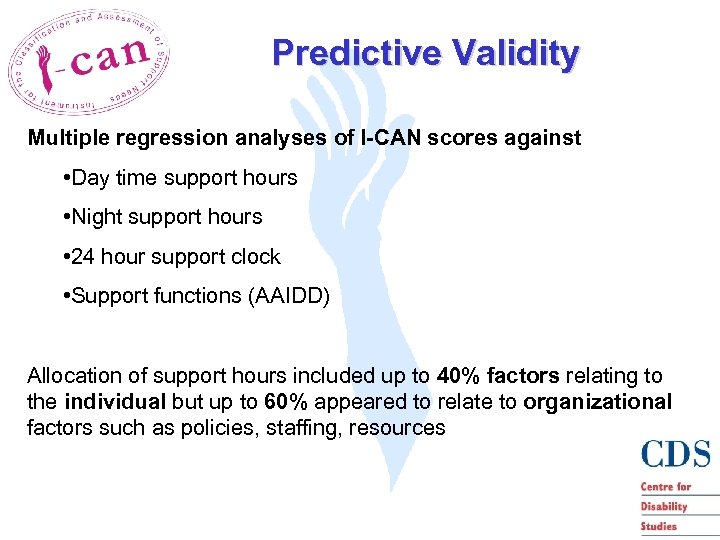 Predictive Validity Multiple regression analyses of I-CAN scores against • Day time support hours • Night support hours • 24 hour support clock • Support functions (AAIDD) Allocation of support hours included up to 40% factors relating to the individual but up to 60% appeared to relate to organizational factors such as policies, staffing, resources
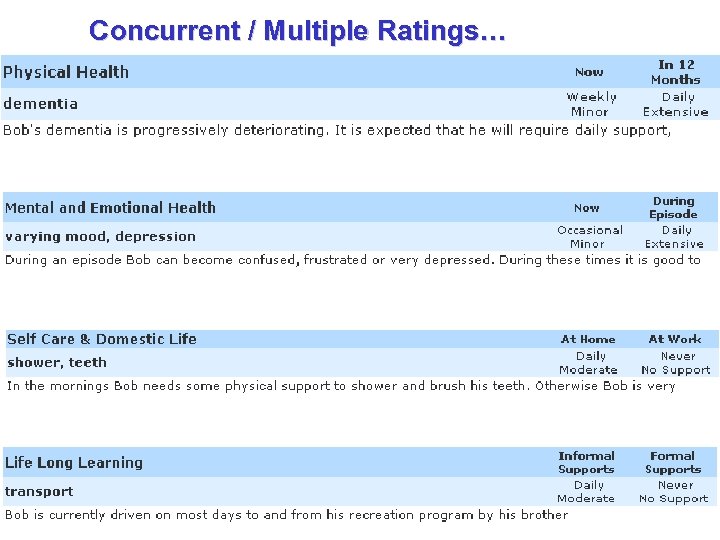 Concurrent / Multiple Ratings…
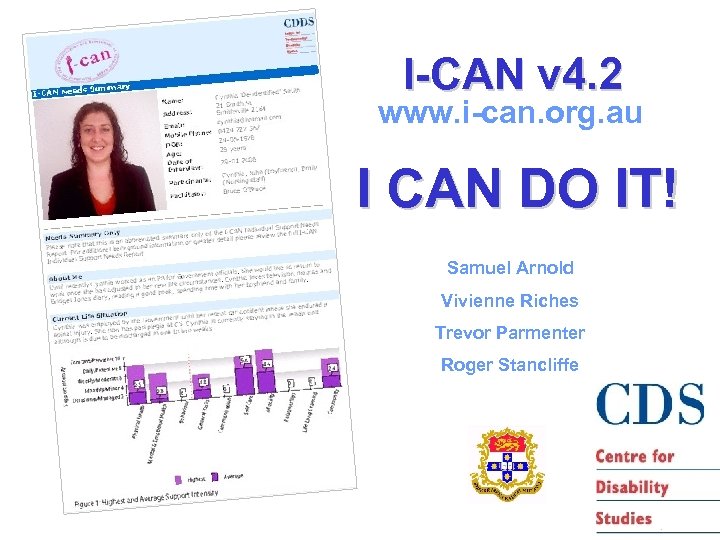 I-CAN v 4. 2 www. i-can. org. au I CAN DO IT! Samuel Arnold Vivienne Riches Trevor Parmenter Roger Stancliffe