 Скачать презентацию 15 Sea Grass Beds Kelp Forests Rocky Reefs
f708b7011ea41387a3540d56875be4c4.ppt
- Количество слайдов: 74



15 Sea Grass Beds, Kelp Forests, Rocky Reefs, and Coral Reefs Notes for Marine Biology: Function, Biodiversity, Ecology By Jeffrey S. Levinton
Sea Grasses • Sea grasses are marine angiosperms, or flowering plants, that are confined to very shallow water • Extend mainly by subsurface rhizome systems within soft sediment • Found throughout tropical and temperate oceans • Grow best in very shallow water, high light and modest current flow
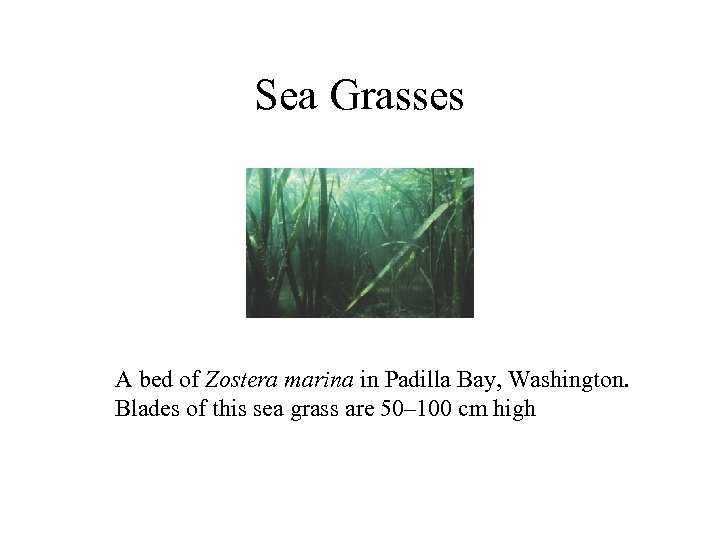
Sea Grasses A bed of Zostera marina in Padilla Bay, Washington. Blades of this sea grass are 50– 100 cm high
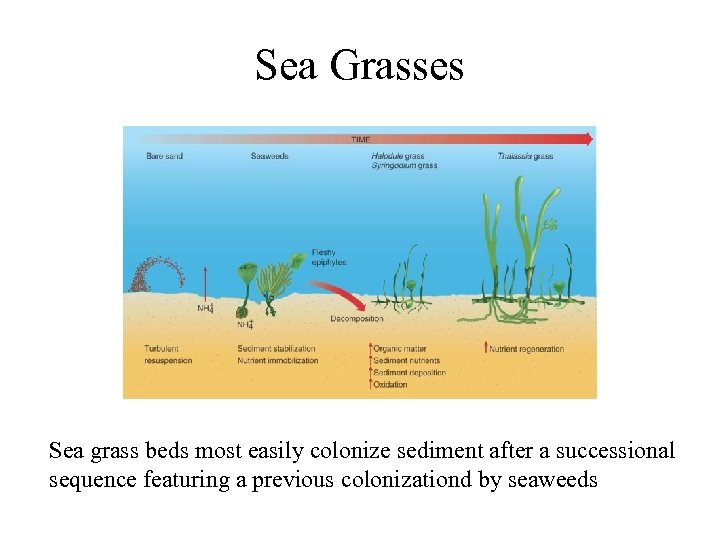
Sea Grasses Sea grass beds most easily colonize sediment after a successional sequence featuring a previous colonizationd by seaweeds
Sea Grasses - Production, Ecology • High primary production, support a diverse group of animal species • Sea grass beds reduce current flow • deter the entry of crab and fish predators from side • May enhance growth and abundance of infaunal suspension feeders near edge, although phytoplankton may not penetrate far into bed
Sea Grasses - Grazing, Community Structure • Grazing on sea grasses variable: in temperate zone, grazing on Zostera marina (eel grass) is minimal • In tropics, sea grass beds comprised of several species that are grazed differentially because of different toughness, cellulose content • Green turtles nip leaf tips, which encourages growth of more soft and digestible new grass • Even tough grasses grazed by turtles, urchins, dugongs. Green turtles have extended hindguts with intestinal microflora, digesting cellulose
Sea Grasses - Grazing, Community Structure • Tropical sea grass beds diverse, often as many as 10 species, mixed with seaweed species • Seaweeds and grasses grazed by a variety of invertebrates, who also seek shelter among the grass and seaweed • Predators such as fishes, crabs, consume invertebrates but no strong top-down effects by predators
Sea Grasses - Decline • Sea grasses very vulnerable to eutrophication phytoplankton shade sea grasses, strong reductions of eel grass beds in North America • Possible that overfishing results in reduced grazing and overgrowth of epiphytes, which smothers sea grasses • Dredging, boat traffic, also causes decline of sea grasses • Disease important, fungus caused eelgrass epidemic in 1930 s, recovery, but other fungi are now cause of sporadic diseases in tropical sea grasses
Rocky Reefs - Kelp Forests • Kelp forest - rocky reef complex found in cooler coastal waters with high nutrients • Kelp forest–rocky reefs are often dominated in shallow waters by kelps and seaweeds and by epifaunal animals in deeper waters animaldominated rocky reefs • Switch from cover dominance by rapidly growing seaweeds in shallow water to epifaunal animal dominance in deeper water
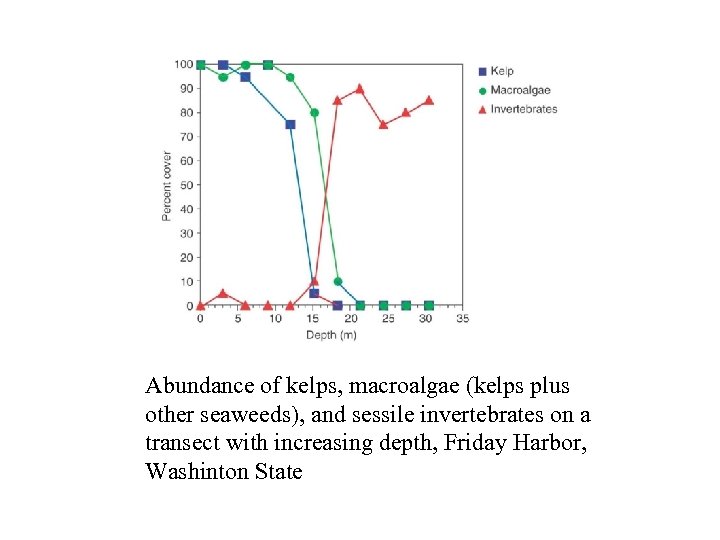
Abundance of kelps, macroalgae (kelps plus other seaweeds), and sessile invertebrates on a transect with increasing depth, Friday Harbor, Washinton State
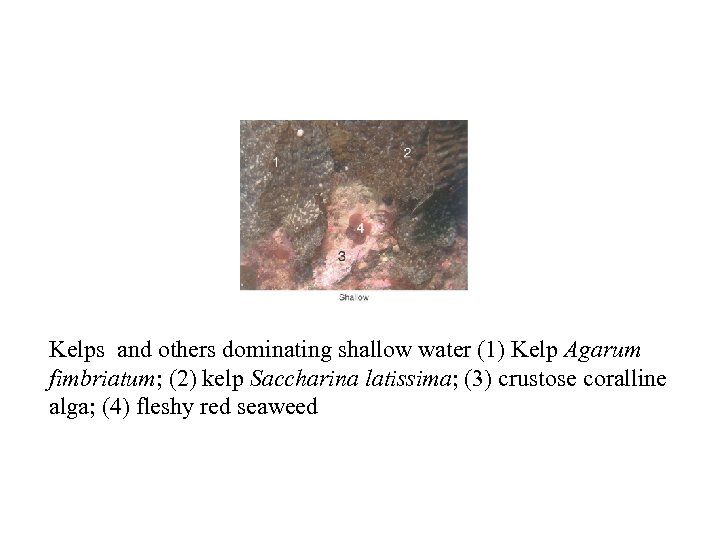
Kelps and others dominating shallow water (1) Kelp Agarum fimbriatum; (2) kelp Saccharina latissima; (3) crustose coralline alga; (4) fleshy red seaweed
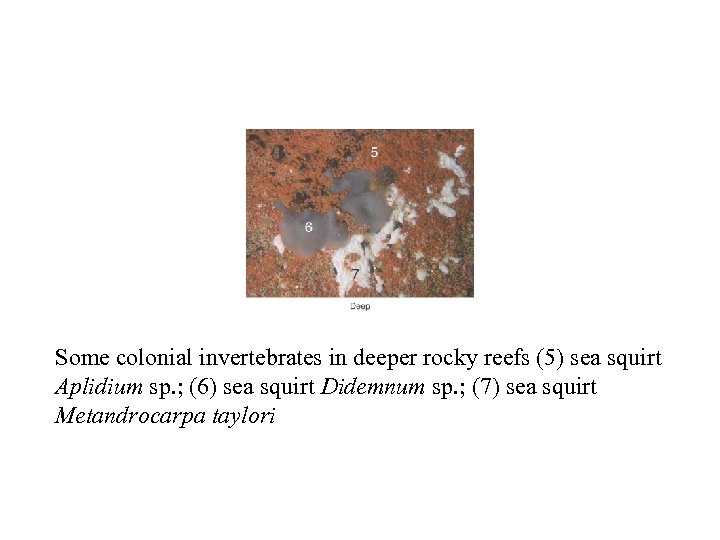
Some colonial invertebrates in deeper rocky reefs (5) sea squirt Aplidium sp. ; (6) sea squirt Didemnum sp. ; (7) sea squirt Metandrocarpa taylori
Rocky Reefs • Abundant communities ofalgae and invertebrates, often dominated by colonial invertebrates. • Often are very patchy, with alternations of rocks dominated by rich invertebrate assemblages and turf-forming calcareous red algae • Subtidal rock wall patches of animals often are short on space, suggesting the importance of competition
Rocky Reefs • Many invertebrates have lecithotrophic larvae, which reduces dispersal distance, increases patchiness • Rocky reefs are grazed more intensely, mainly by sea urchins, on horizontal benches
Kelp Forests • Dominated by brown seaweeds in the Laminariales • Found in clear, shallow water, nutrient rich and usually < 20°C, exposed to open sea • Generally laminarian seaweeds have high growth rates, often of the order of centimeters/day • “Forests” can be 10 -20 m high or only a meter in height
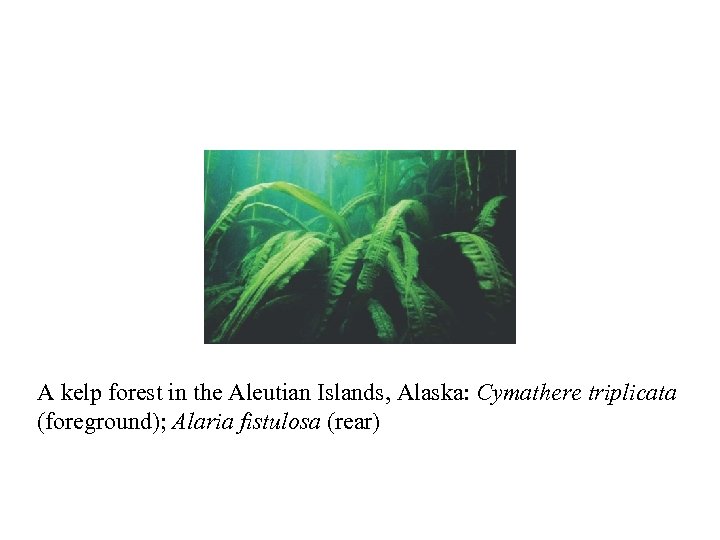
A kelp forest in the Aleutian Islands, Alaska: Cymathere triplicata (foreground); Alaria fistulosa (rear)
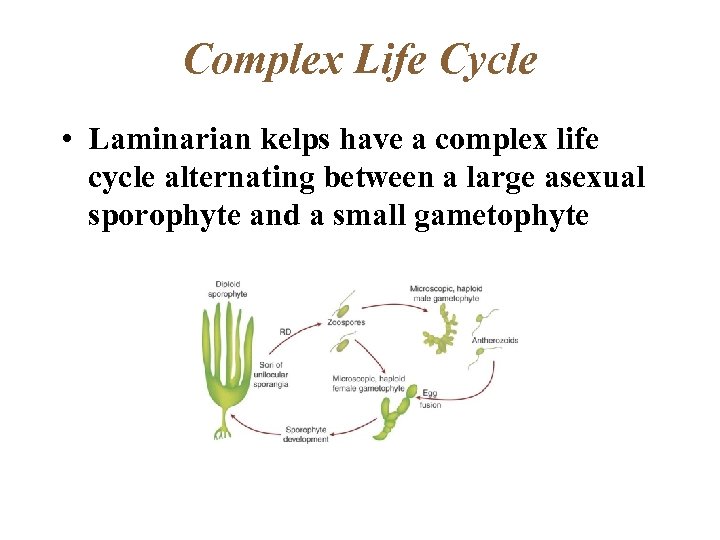
Complex Life Cycle • Laminarian kelps have a complex life cycle alternating between a large asexual sporophyte and a small gametophyte
Kelp Forests Are Diverse • Kelp forests have many species of seaweeds, even if sometimes dominated by one species • Many invertebrate species present, especially sessile benthic species living on hard substrata - suspension feeders common
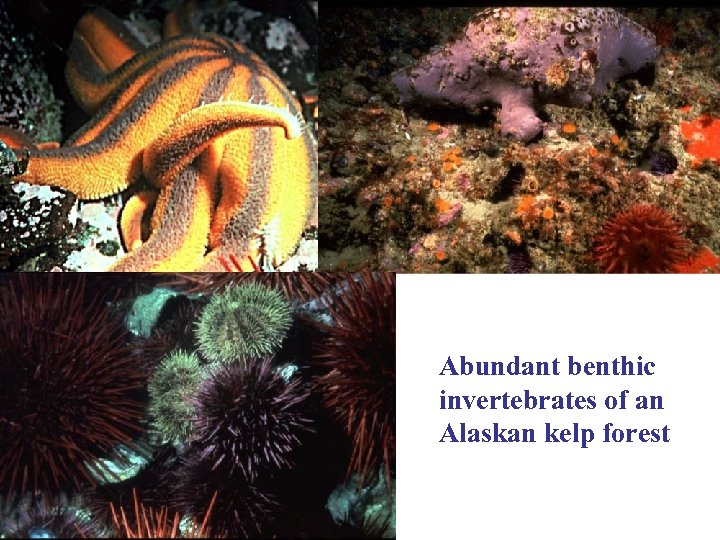
Abundant benthic invertebrates of an Alaskan kelp forest
Kelp Forest Community Structure • Herbivory - herbivorous sea urchins • Carnivory - sea otter Enhydra lutris can regulate urchin populations • Result: trophic cascade; add otters, have reduction of urchins and increase of kelp abundance; reduce otters: kelp grazed down by abundant urchins • Recent history: otters hunted to near extinction, their recovery has strong impacts on urchin/kelp balance • In lower-latitude California kelp forests, a larger diversity of predators beyond sea otters exerts top-down effects
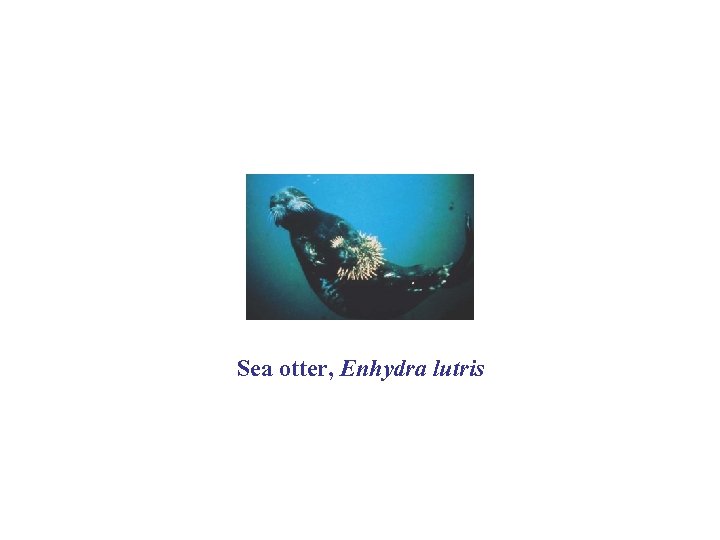
Sea otter, Enhydra lutris
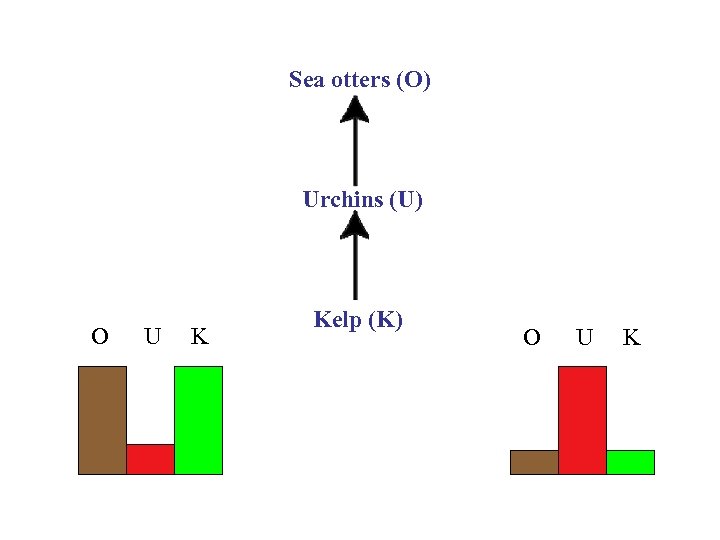
Sea otters (O) Urchins (U) O U K Kelp (K) O U K
Evolutionary Consequences of Herbivory • North Pacific - otters reduce urchins - low herbivory (0 -2%/day) - relatively few defenses evolved by kelps against herbivory • Australasia - less predation on urchins results in higher urchin herbivory (57%/day) - phlorotannin concentrations in kelps were on average 5 -6 x of North Pacific Steinberg, Estes, Winter, 1995, Proc. Nat. Acad. Sci. 92: 8145 -8
Kelp Forest Community Structure • Effect of storms: remove kelp • El nino: storms + warm water -> kelp mortality • California kelp forests*: storms remove kelp, urchins roam, and inhibit kelp colonization and growth: barrens • California kelp forests: if kelp growth is rich, urchins stay in crevices and capture drift algae • This leads to two alternating states: barrens and kelp forest *Harrold and Reed 1985 Ecology
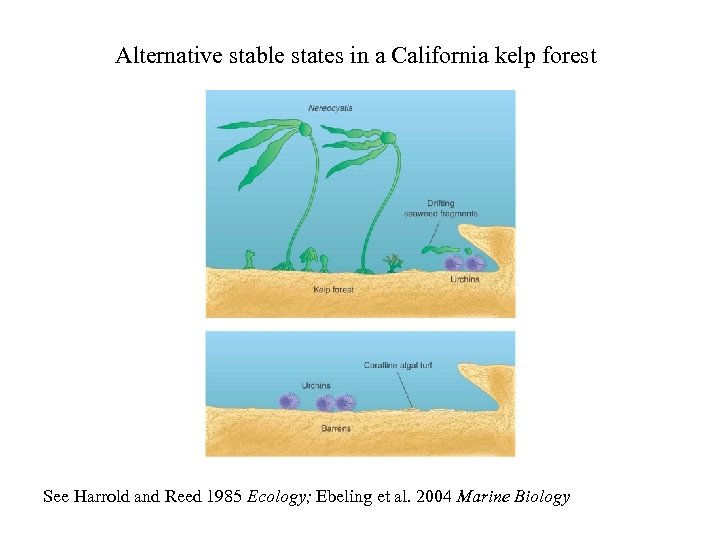
Alternative stable states in a California kelp forest See Harrold and Reed 1985 Ecology; Ebeling et al. 2004 Marine Biology
Kelp Forest Community Structure Succession: • Nereocystis - winner in succession in Pacific NWAlaska? ? • Urchins die -> kelp recruitment - several species cooccur • Although Nereocystis is often an upper canopy species, with fronds at the surface, it is often an annual and dies back each year • Laminaria gradually shades out other seaweeds wins if no dense urchin populations
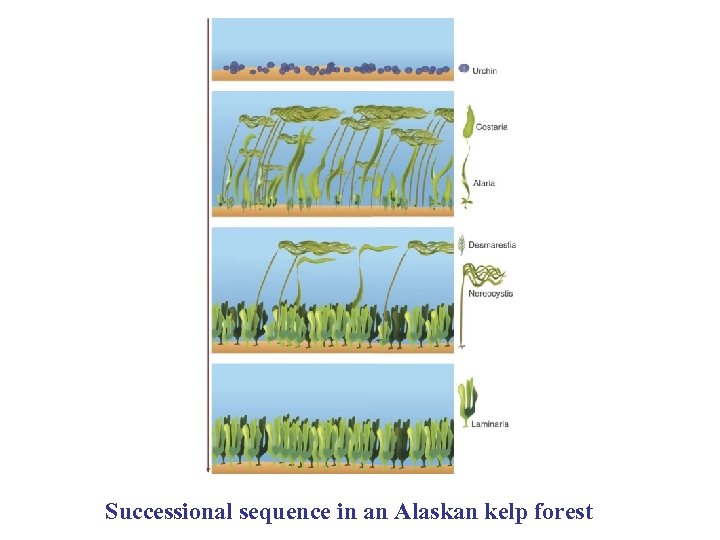
Successional sequence in an Alaskan kelp forest
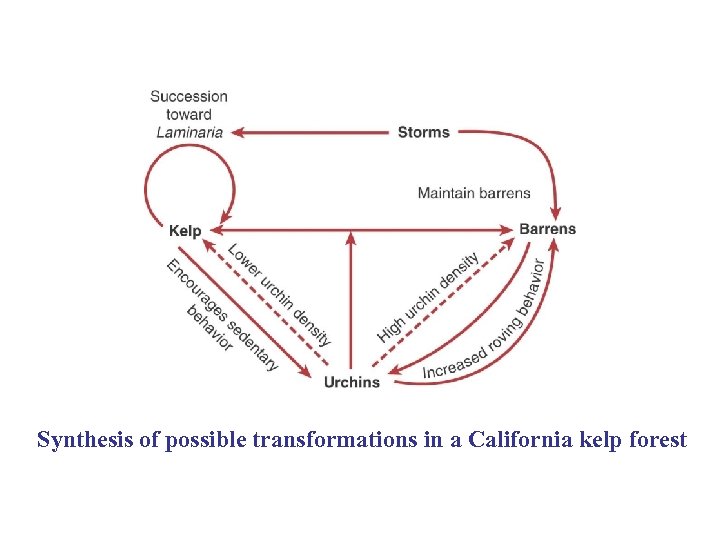
Synthesis of possible transformations in a California kelp forest
Kelp Forest Recap • Clear, nutrient-rich, cool < 20 ºC • Trophic cascade: otters, urchins, kelp (plus Orca at top of chain in Alaska) • Barrens versus rich kelp forest - stable states, owing to urchin behavior • Succession in Alaska - light competition leading to dominance by Laminaria
Coral Reefs • Geological importance: often massive physical structures • Biological importance: biological structure, High diversity, • Economic importance: shoreline protection, harbors, fishing, tourism
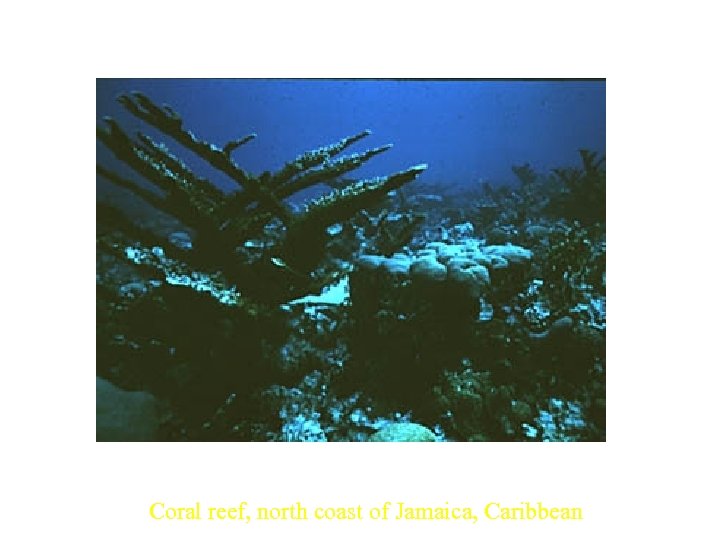
Coral reef, north coast of Jamaica, Caribbean
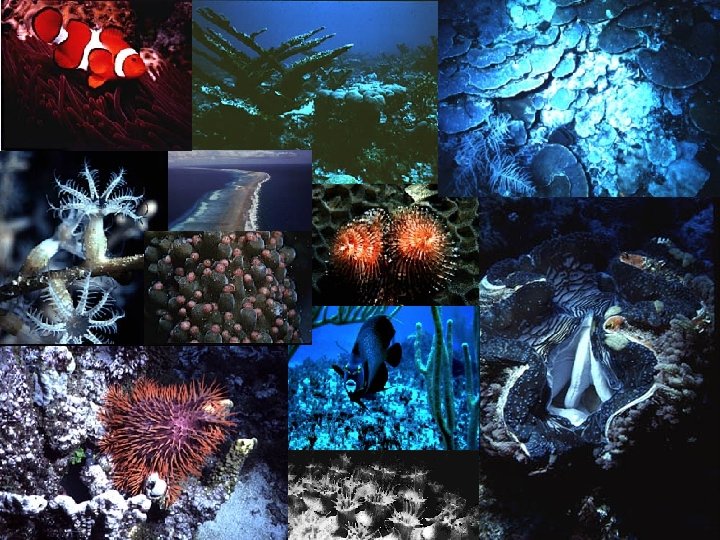
Coral Reefs • Compacted and cemented assemblages of skeletons and sediment of sedentary organisms • Constructional, wave-resistant features • Built up principally by corals, coralline algae, sponges, and other organisms, but also cemented together • Reef-building corals belong to the Scleractinia, have endosymbiotic algae known as zooxanthellae; high calcification rate • Topographically complex
Coral Reefs - Limiting Factors • Warm sea temperature (current problem of global sea surface temperature rise) • High light (symbiosis with algae) • Open marine salinities usually • Low turbidity - coral reefs do poorly in near-continent areas with suspended sediment
Coral Reefs - Limiting Factors 2 • Strong sea water currents, wave action • Reef growth a balance between growth and bioerosion • Reef growth must respond to rises and falls of sea level • p. H? Increasing ocean acidity a problem?
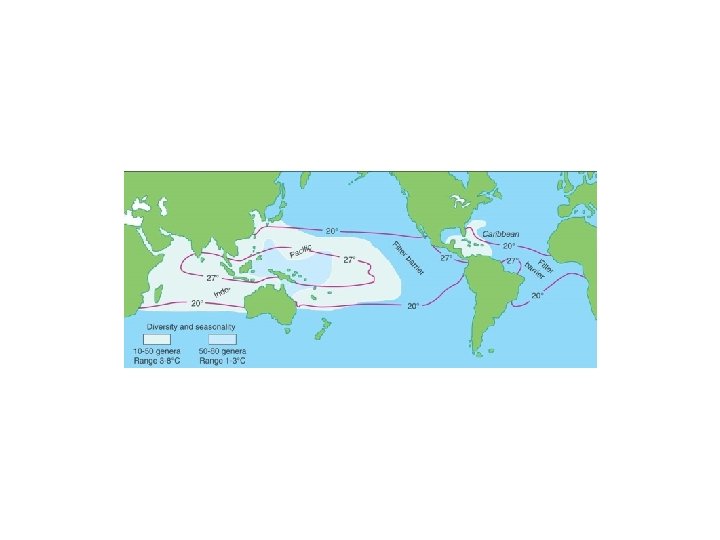
Coral Reef Biogeography • Current division between Pacific and Atlantic provinces • Strong Pacific diversity gradient: (1) diversity drops with increasing longitude, away from center of diversity near Phillipines and Indonesia; (2) also a latitudinal diversity gradient, with diversity dropping with increasing latitude, north and south from near equator • Historically, Pacific and Atlantic provinces were once united by connection across Tethyan Sea, which disappeared in Miocene, ca. 10 million years ago.
Reef Types • Coastal reefs - wide variety of reefs from massive structures ( Great Barrier Reef), to small patches such (Eilat, Israel) • Atolls - horseshoe or ring-shaped island chain of islands atop a sea mount
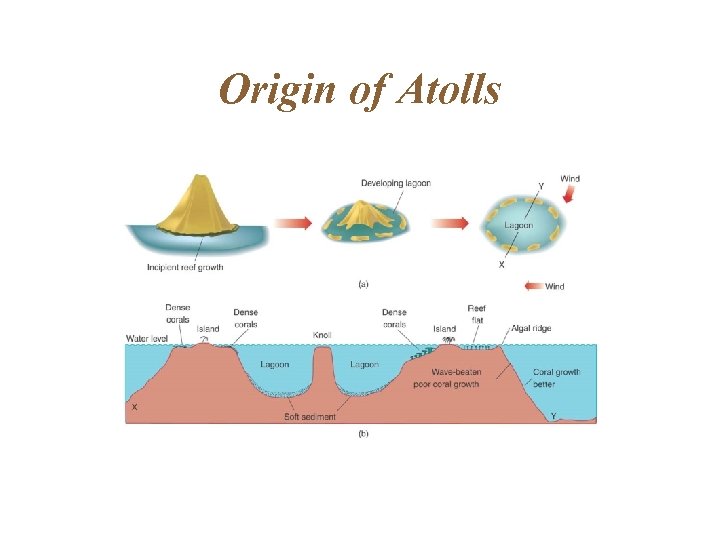
Origin of Atolls
Reef-Building (Hermatypic) Corals • Belong to the phylum Cnidaria, Class Anthozoa, Order Scleractinia • Secrete skeletons of calcium carbonate • Are colonies of many similar polyps • Can be divided into branching and massive forms • Have abundant endosymbiotic zooxanthellae
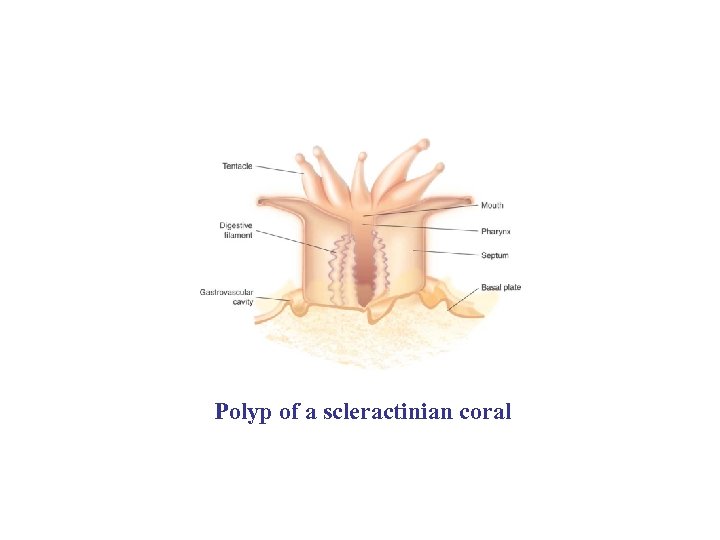
Polyp of a scleractinian coral
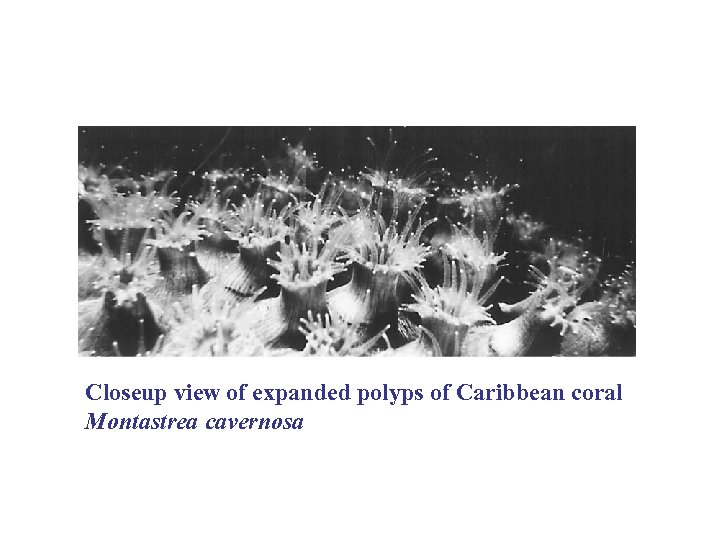
Closeup view of expanded polyps of Caribbean coral Montastrea cavernosa
Hermatypic vs. Ahermatypic Corals • Hermatypic: Reef framework building, have many zooxanthellae, hi calcification • Ahermatypic: not framework builders, low calcification
Growth Forms • Branching: grow in linear dimension fairly rapidly 10 cm per year • Massive: Produce lots of calcium carbonate but grow more slowly in linear dimensions, about 1 cm per year
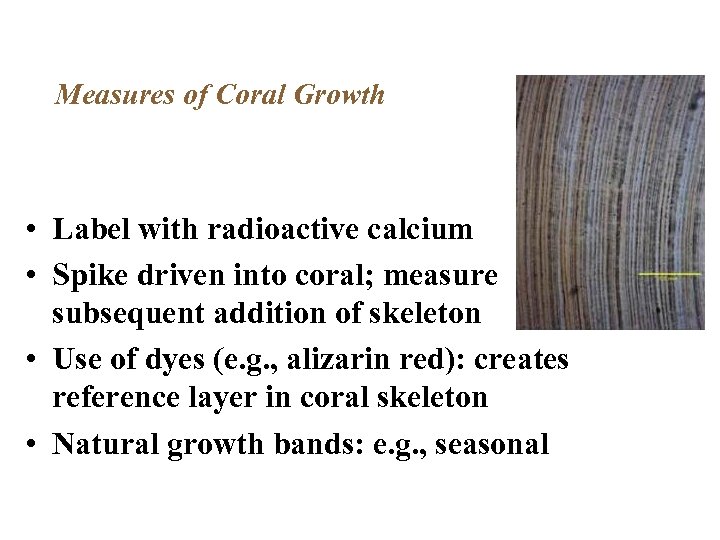
Measures of Coral Growth • Label with radioactive calcium • Spike driven into coral; measure subsequent addition of skeleton • Use of dyes (e. g. , alizarin red): creates reference layer in coral skeleton • Natural growth bands: e. g. , seasonal
Corals - Biodiversity and Form Diversity • Coral species usually first identified on basis of morphology • Problem: coral species have a large degree of morphological plasticity - variable growth response to variation in water energy, light, competitive interactions with other species • Problem: nearly morphologically identical species • Species now identified more with DNA sequencing
Zooxanthellae • Found in species of anemones, hermatypic corals, octocorals, bivalve Tridacna, ciliophora (Euplotes) • Once considered as one species: Symbiodinium microadriaticum but they are at least 10 distinct taxa, not much correlation between coral and zx, large genetic distance among species; see Rowan and Powers 1992 PNAS • Is a dinoflagellate: found in tissues without dinoflagellate pair of flagellae, but can be put in culture where flagellae are developed • Found in corals within tissues (endodermal), concentrated in tentacles
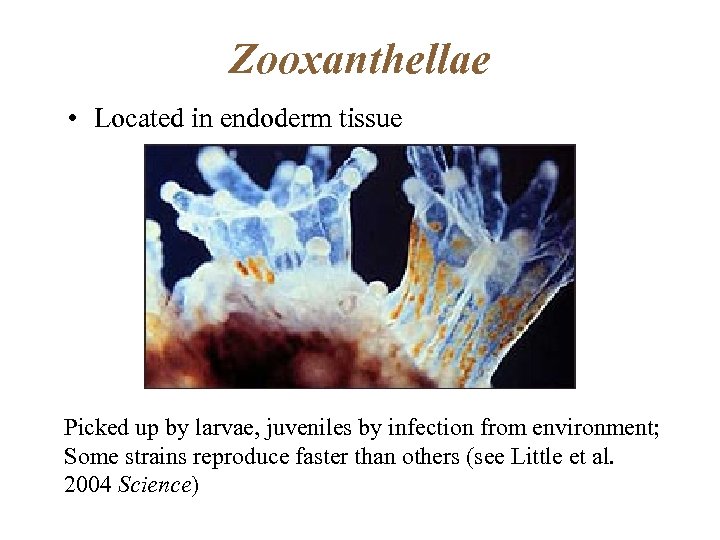
Zooxanthellae • Located in endoderm tissue Picked up by larvae, juveniles by infection from environment; Some strains reproduce faster than others (see Little et al. 2004 Science)
Zooxanthellae - Benefits? • Nutrition - radiocarbon-labeled carbon taken up by zooxanthellae and transported to coral tissues (note corals usually also feed on microzooplankton) • Source of oxygen for coral respiration - maybe not a major benefit, because corals are in oxygenated water • Facilitate release of excretion products - again, not likely to be a major benefit, because corals are in well-circulated water • Facilitate calcification - uptake of carbon dioxide by zooxanthellae enhances calcium carbonate deposition: inhibit photosynthesis and calcification rate decreases
Zooxanthellae - Bleaching? • Bleaching - expulsion of zooxanthellae • Causes - stress (temperature, disease) • Mechanisms - poorly understood - zooxanthellae cells appear to die and are expelled • Test among mechanisms with fluorochromes; support for cell death under temperature stress (Strychar et al. 2004 J. Exp. Mar. Biol. Ecol. )
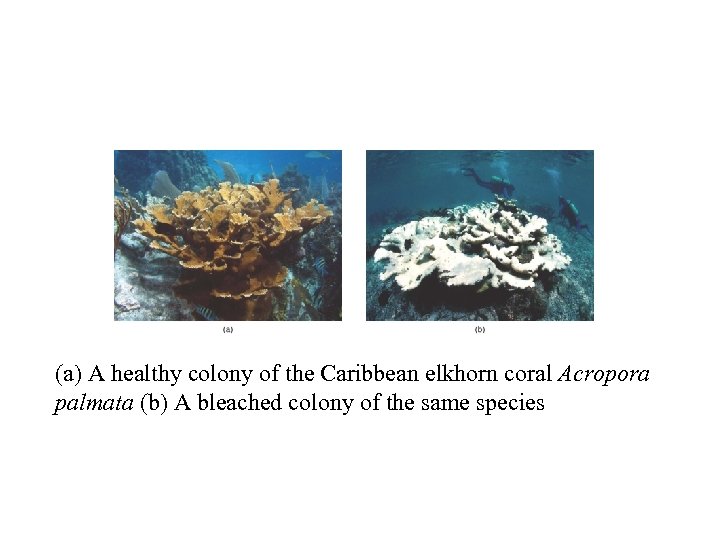
(a) A healthy colony of the Caribbean elkhorn coral Acropora palmata (b) A bleached colony of the same species
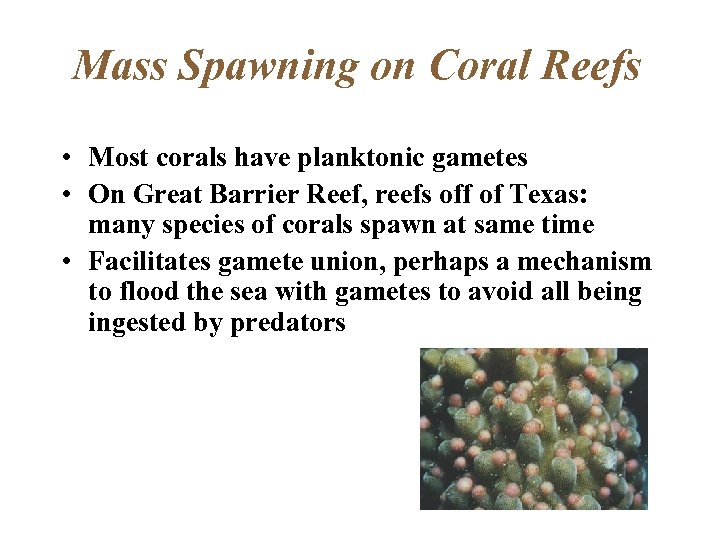
Mass Spawning on Coral Reefs • Most corals have planktonic gametes • On Great Barrier Reef, reefs off of Texas: many species of corals spawn at same time • Facilitates gamete union, perhaps a mechanism to flood the sea with gametes to avoid all being ingested by predators
Depth Zonation on Reefs • Reefs dominated by different coral species at different depths • May be controlled by factors similar to rocky shores, but not so well known, also possible relationship to changing light conditions
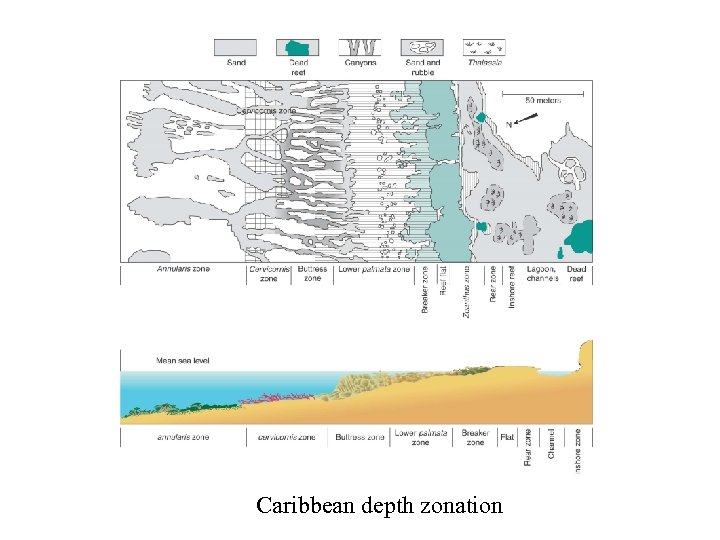
Caribbean depth zonation
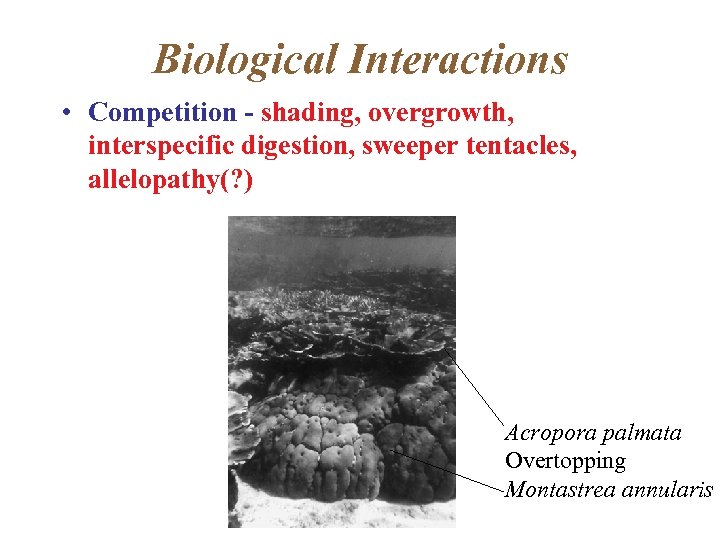
Biological Interactions • Competition - shading, overgrowth, interspecific digestion, sweeper tentacles, allelopathy(? ) Acropora palmata Overtopping Montastrea annularis
Biological Interactions • Competition - shading, overgrowth, interspecific digestion, sweeper tentacles, allelopathy(? ) • Predation and grazing - some common coral predators (e. g. , crown-of-thorns starfish), grazers (e. g. , surgeon fish, parrotfish, urchins) • Disturbance - e. g. , storms, hurricanes, cyclones • Larval recruitment - mass spawning, question of currents and recruitment of larvae • Disease - spread by currents, can cause mass mortality of some species (e. g. , common black sea urchin Diadema antillarum in 1980 s)
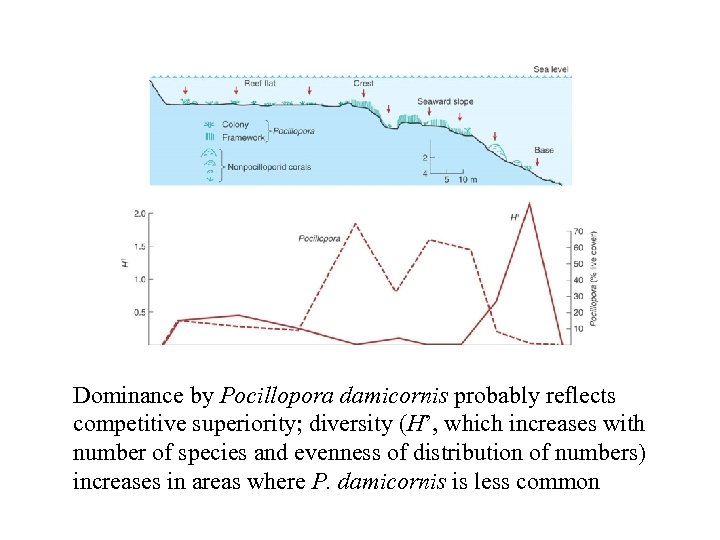
Dominance by Pocillopora damicornis probably reflects competitive superiority; diversity (H’, which increases with number of species and evenness of distribution of numbers) increases in areas where P. damicornis is less common
Interspecific Competition 1 • Goreau Paradox – calcification rate not proportional to percent cover (e. g. , buttress zone - massive coral Montastrea annularis)
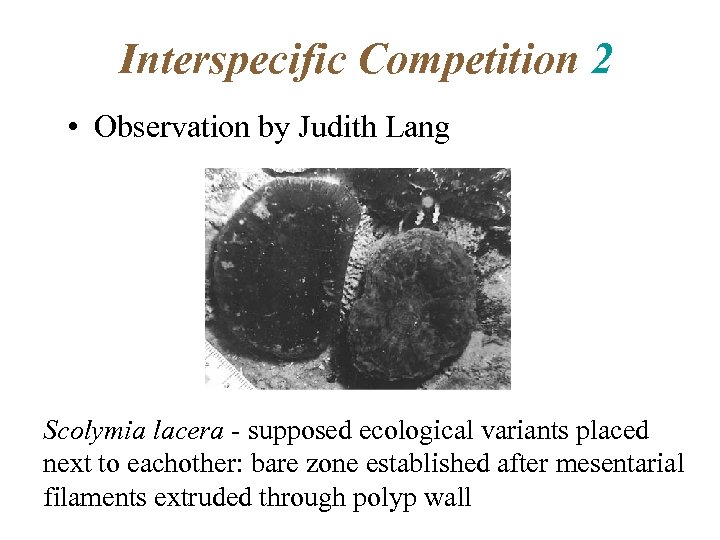
Interspecific Competition 2 • Observation by Judith Lang Scolymia lacera - supposed ecological variants placed next to eachother: bare zone established after mesentarial filaments extruded through polyp wall
Interspecific Competition 3 Conclusion: Interaction is due to interspecific competition by digestion (variants are different species) • Corals compete by rapid growth, shading, interspecific digestion, sweeper tentacles. • Slower growing forms have interspecific digestion, sweeper tentacle defenses, which allows them to hold place on the reef against faster-growing competitors
Predation and Grazing 1 • Role of predation on reefs poorly known, reefs lacking top carnivores might exert strong effects but data is spotty • Caribbean: Urchin Diadema antillarum feeds both on sea grasses surrounding patch reefs and on algae on reefs; experimental removal results in strong seaweed growth; disease in 1980 s eliminated most urchins and this resulted in strong growth of seaweeds, inhibits coral recruitment • Fish grazing usually very important (parrot fish, surgeon fish), affects seaweed growth
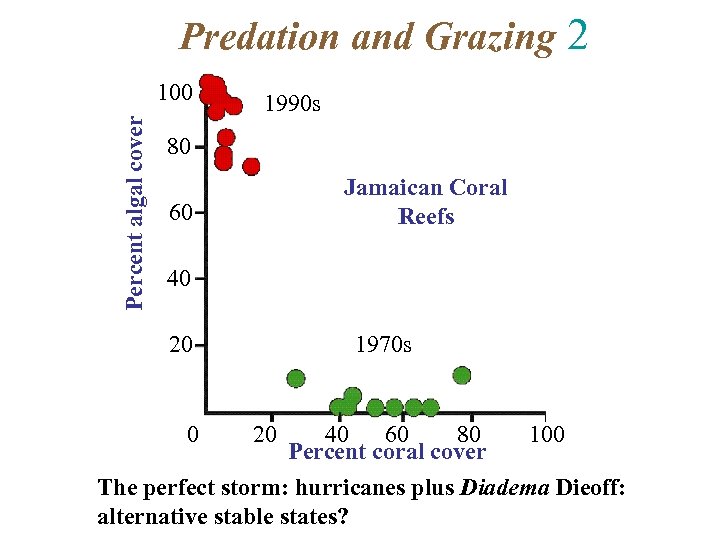
Predation and Grazing 2 Percent algal cover 100 1990 s 80 Jamaican Coral Reefs 60 40 20 0 1970 s 20 40 60 80 100 Percent coral cover The perfect storm: hurricanes plus Diadema Dieoff: alternative stable states?
Predation and Grazing 3 • Pacific Ocean: Crown-of-thorns starfish Acanthaster planci feeds on corals • Outbreaks all over Indo-Pacific starting in 1960 s • Formerly rare, they changed behavior: herding instead of dispersed, changed from nocturnal to diurnal in feeding See Sapp, J. 1999, What is Natural? Oxford University Press, NY.
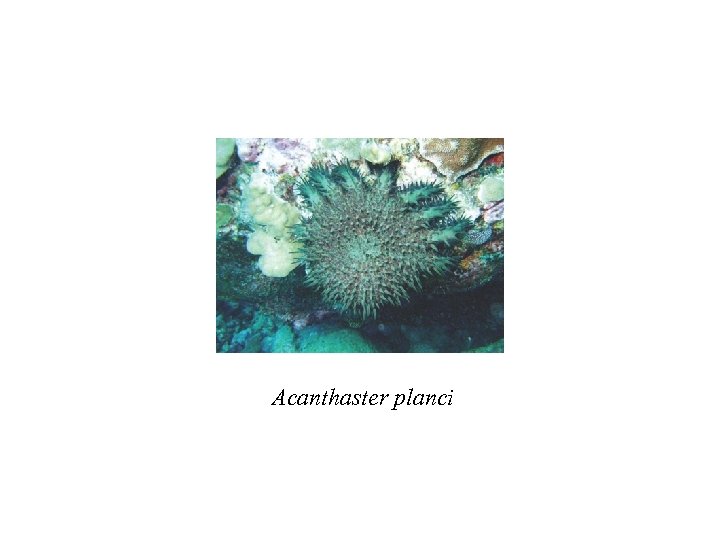
Acanthaster planci
Predation and Grazing 4 • Explanations for Crown-of-thorns seastar outbreaks? 1. Blasting of harbors in WWII--> enhanced 2. larval settlement 3. 2. Overfishing and overcollection of starfish’s main predator, giant triton Charonia tritonus, overfished islands Have more crown-of-thorns seastars* 3. Storms-->nutrient washout-->phytoplankton--> starfish larval survival *N. K. Dulvy et al. Ecology Letters 2004 7, 410 -416
Climate Change and Coral Reefs • Sea surface temperature warming: Warming has increased over past century and heating correlated with increased bleaching events, e. g. , summer of 2005 in Caribbean
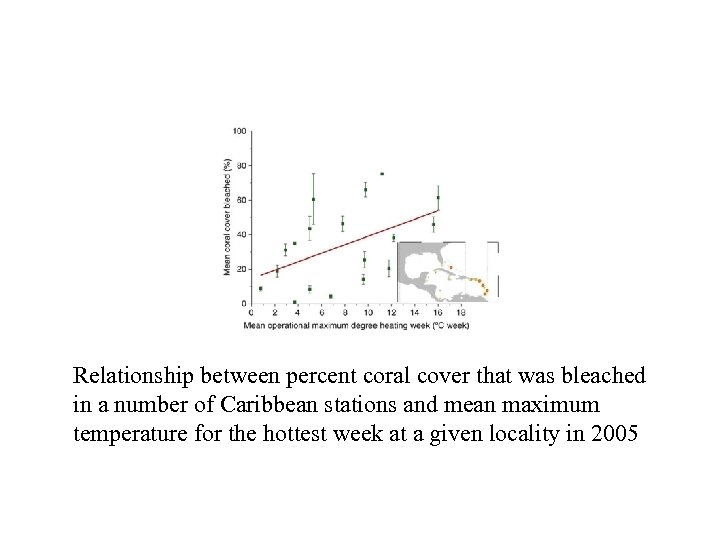
Relationship between percent coral cover that was bleached in a number of Caribbean stations and mean maximum temperature for the hottest week at a given locality in 2005
Climate Change and Coral Reefs • Acidification: carbon dioxide addition to atmosphere results in reduction of seawater p. H • Corals secrete aragonite, a relatively unstable form of calcium carbonate; aragonite is hard to secrete at much higher activities of Ca and carbonate relative to other form, calcite • Already evidence of lower skeletal density in one Australian coral over time
Coral Bleaching and Disease • Bleaching - expulsion of zooxanthellae discussed already • Disease widely ascribed to decline of corals • Disease very poorly characterized (Koch criterion of disease) • The bacteria must be present in every case of the disease. • The bacteria must be isolated from the host with the disease and grown in pure culture. • The specific disease must be reproduced when a pure culture of the bacteria is inoculated into a healthy susceptible host. • The bacteria must be recoverable from the experimentally infected host
Coral Bleaching and Disease • White Band disease - affects acroporid corals, perhaps gram negative bacterium, not isolated yet (reorganization of Caribbean communities? ) • White Plague - rapid degradation of corals, gram negative bacterium, cultured in lab and infects corals • Black Band disease - affects, non-acroporid corals, consortium of microorganisms, leads to sulfide accumulation and toxicity to corals Richardson, L. 1998 TREE 13: 438 -443
Bleaching Impacts on Coral Fish • Coral fish communities very diverse, dependent often on crevices in coral colonies and patches • Most evidence shows little effect of bleaching events on coral-associated fish (Booth and Beretta 2002 Marine Ecology Progress Series) • Perhaps because most coral-associated fish are long lived, so impacts are underestimated (see Bellwood et al. 2006 Global Change Biology)
Future of Coral Reefs? • Organic pollution • Habitat alteration (turbidity caused by humans) • Over fishing • Global warming --> bleaching, acidification • Intense storms appear to have a contributory role in degradation of corals
Future of Coral Reefs? 2 • Decrease of coral cover worldwide • Loss of specific groups, such as acroporids in Caribbean, relative to other corals • Increase of bleaching worldwide • Increase of disease • Increase of crown-of-thorns starfish outbreaks See Bellwood et al. 2004 Nature; Pandolfi, J. M. et al. 2005, Science 307: 1725 -6

The End
Скачать презентацию 15 Sea Grass Beds Kelp Forests Rocky Reefs
f708b7011ea41387a3540d56875be4c4.ppt