


 Скачать презентацию 15 Road to Civil War Chapter 1820 -1861
3207c40d915d8f144aa3cc437d9ba9d2.ppt
- Количество слайдов: 46
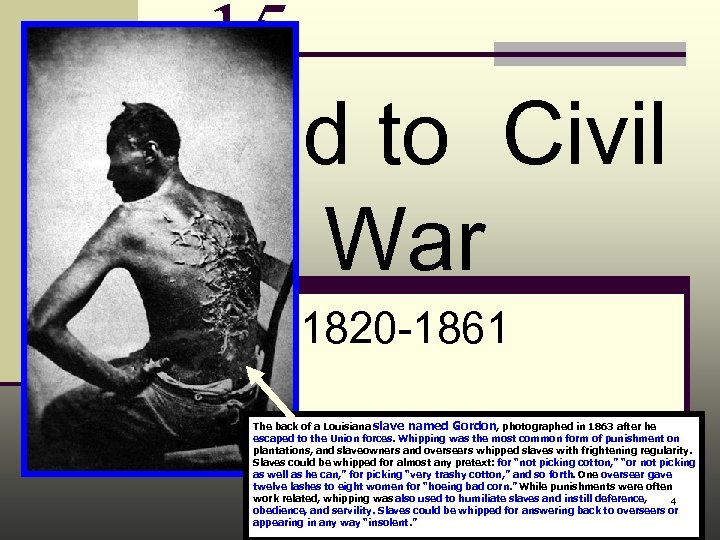 15 Road to Civil War Chapter 1820 -1861 The back of a Louisiana slave named Gordon, photographed in 1863 after he escaped to the Union forces. Whipping was the most common form of punishment on plantations, and slaveowners and overseers whipped slaves with frightening regularity. Slaves could be whipped for almost any pretext: for “not picking cotton, ” “or not picking as well as he can, ” for picking “very trashy cotton, ” and so forth. One overseer gave twelve lashes to eight women for “hoeing bad corn. ” While punishments were often work related, whipping was also used to humiliate slaves and instill deference, 4 obedience, and servility. Slaves could be whipped for answering back to overseers or appearing in any way “insolent. ”
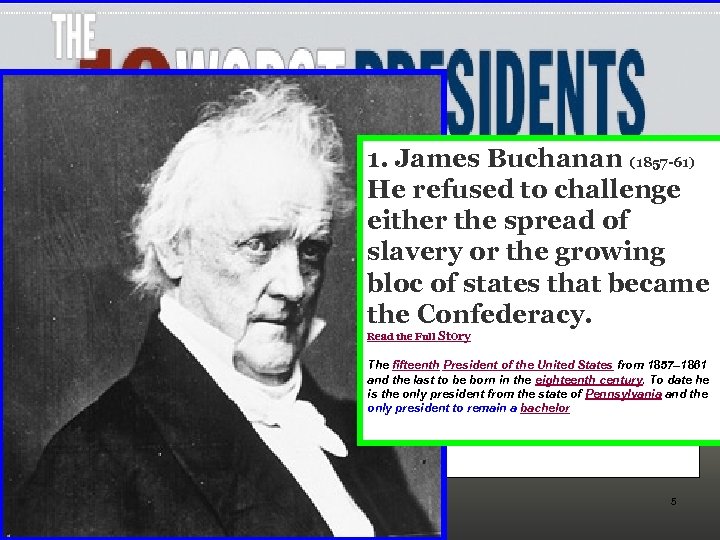 It’s not a coincidence that six of the seven presidents who served from 1841 -61 made the list of the… (as defined by a poll conducted by Newsweek 3 -2 -09) 9. (tie) Herbert Hoover. Buchanan(1841) (tie) S. Pierce(1869 -77) 6. 1. James (1929 -33) John. Richard Nixon (1969 -74) 7. 3. Millard Fillmore (1850 -53) Ulysses. Tyler (1841 -45) (1857 -61) 4. Franklin Johnson (1865 -69 (1853 -57) 5. 9. 8. William Harrison Andrew Grantgifted, he will He was known as a poor communicatorof 30 Though politically He right after n He was a stalwart Andrew of 10. Zachary Taylorchallenge president for the Serving was for expandingallwho His. He refused todefender fervor the Compromise He backed associated with the of fueled n. Hedays afterimpeachmentparty' tradesurvivedexacerbatedof forever and wars the A political novice, the war hero is slavery bethecontracting eitherdelayed adding spread. Southern Johnson, who abandoned hisan hescandal andover presided his borders—thereby the 1850 opposing after Depression. that once he was president. Watergate entirely forgettable as president. platform graft and corruption, pneumonia during his slavery outbreak of or the growing to 2. Reconstruction initiatives Warren several. Story. G. Harding 1921 -23 Read the Full slave states—helped resignation. secession by allowing slavery interminable inaugural. bloc but the stage intentions. Hethe hadanofthe 14 th Civil War. was set. Full Story ineffectual spread. good for the and including states that became Read the Full Story Read the Confederacy. indecisive leader who played amendment. Read the Full Story Read the poker. Full Story his friends while The fifteenth President of the United States from 1857– 1861 plundered the U. S. treasury. and the last to be born in the eighteenth century. To date he Read the Full Story is the only president from the state of Pennsylvania and the only president to remain a bachelor 5
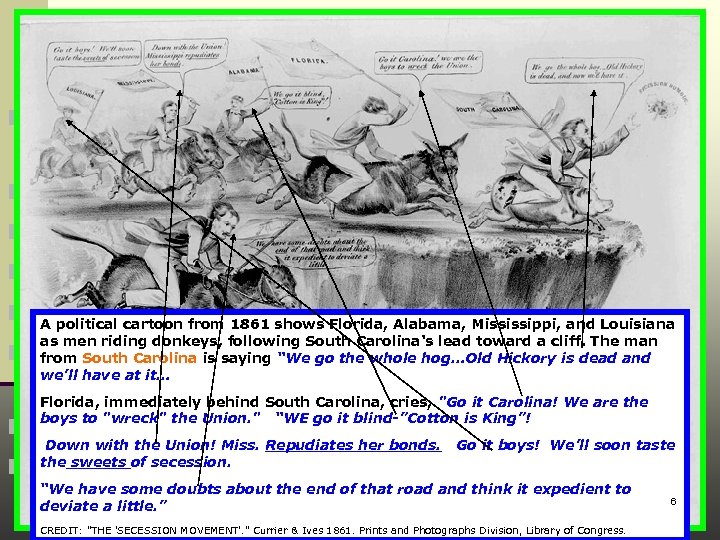 (Underlying Causes: Slavery, state’s rights diff. societies and economic systems) The Downhill Slide to War (Immediate Causes) n 1. Compromise of 1850 and Fugitive Slave Act of 1850 n 2. Uncle Tom’s Cabin 1852 n 3. Kansas Nebraska Act 1854 n 4. Formation of Republican Party 1856 n 5. Dred Scott Decision 1857 A political cartoon from 1861 shows Florida, Alabama, Mississippi, and Louisiana as men riding donkeys, following South Carolina's lead toward a cliff. The man n 6. John Brown’s Raid of Harper’s Ferry Oct. 16, from South Carolina is saying “We go the whole hog…Old Hickory is dead and we’ll have at it… 1859. immediately behind South Carolina, cries, "Go it Carolina! We are the Florida, boys to "wreck" the Union. " “WE go it blind-”Cotton is King”! n 7. Election of Abraham Lincoln 1860 Down with the Union! Miss. Repudiates her bonds. Go it boys! We’ll soon taste the sweets of secession. n 8. Attack on Fort Sumter April 12, 1861. “We have some doubts about the end of that road and think it expedient to deviate a little. ” CREDIT: "THE 'SECESSION MOVEMENT'. " Currier & Ives 1861. Prints and Photographs Division, Library of Congress. 6
 Did You Know? Every so often the Vice-President becomes important. n Throughout its history the United States Senate has sometimes been evenly divided between the political parties. When that happens, it is the vice president who breaks any tie votes. This happened more than 230 times. Since the 1870 s, however, no vice president has cast more than 10 tiebreaking votes. 7
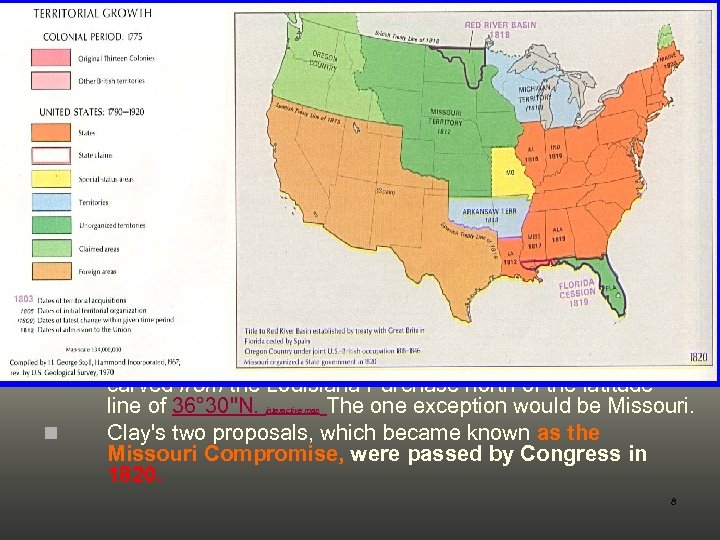 The Missouri Compromise (Pages 436 -437) n n Missouri applied for statehood in 1819. At the time the Senate was balanced, with 11 free states and 11 slave states. The North and the South, with very different economic systems, were also competing for new lands in the West. . Representative Henry Clay, Speaker of the House, proposed a solution to the Missouri problem. Maine, which had been a part of Massachusetts, had also applied for admission to the Union as a new state. Clay suggested admitting Missouri as a slave state and admitting Maine as a free state at the same time. Clay proposed prohibiting slavery in all territories and states carved from the Louisiana Purchase north of the latitude line of 36° 30"N. The one exception would be Missouri. Clay's two proposals, which became known as the Missouri Compromise, were passed by Congress in 1820. interactive map n 8
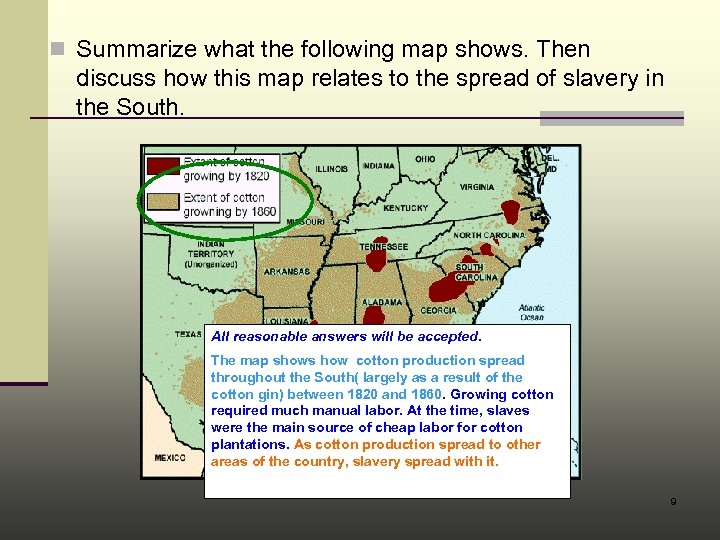 n Summarize what the following map shows. Then discuss how this map relates to the spread of slavery in the South. All reasonable answers will be accepted. The map shows how cotton production spread throughout the South( largely as a result of the cotton gin) between 1820 and 1860. Growing cotton required much manual labor. At the time, slaves were the main source of cheap labor for cotton plantations. As cotton production spread to other areas of the country, slavery spread with it. 9
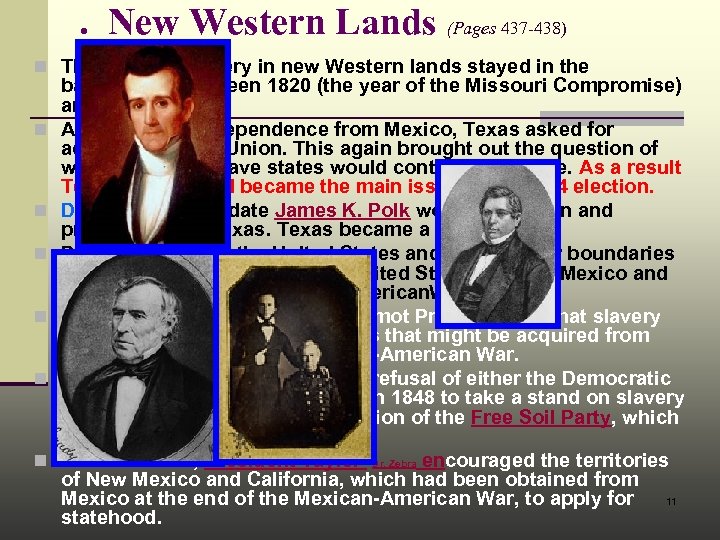 . New Western Lands (Pages 437 -438) n The issue of slavery in new Western lands stayed in the n n n background between 1820 (the year of the Missouri Compromise) and the 1840 s. After winning independence from Mexico, Texas asked for admission to the Union. This again brought out the question of whether free or slave states would control the Senate. As a result Texas's statehood became the main issue in the 1844 election. Democratic candidate James K. Polk won the election and pressed to add Texas became a state in 1845. Disputes between the United States and Mexico over boundaries in Texas and the desire of the United States for New Mexico and California led to the Mexican American War. Wilmot's proposal, called the Wilmot Provisio, said that slavery should be prohibited in any lands that might be acquired from Mexico at the end of the Mexican American War. The debate over slavery and the refusal of either the Democratic or Whig candidate for president in 1848 to take a stand on slavery in the territories led to the formation of the Free Soil Party, which supported the Wilmot Proviso. Once in office, President Taylor Dr. Zebra encouraged the territories of New Mexico and California, which had been obtained from Mexico at the end of the Mexican American War, to apply for 11 statehood.
![Further Complicating Things: The “Know-Nothings” [The American Party] ß Nativists. ß Anti-Catholics. ß Antiimmigrants.](https://present5.com/presentation/3207c40d915d8f144aa3cc437d9ba9d2/image-8.jpg "Further Complicating Things: The “Know-Nothings” [The American Party] ß Nativists. ß Anti-Catholics. ß Antiimmigrants.") Further Complicating Things: The “Know-Nothings” [The American Party] ß Nativists. ß Anti-Catholics. ß Antiimmigrants. 1849 Secret Order of the Star-Spangled Banner, created in NYC and spreads becoming a national party-American Party-in 1855 12
Further Complicating Things: The “Know-Nothings” [The American Party] ß Nativists. ß Anti-Catholics. ß Antiimmigrants. 1849 Secret Order of the Star-Spangled Banner, created in NYC and spreads becoming a national party-American Party-in 1855 12
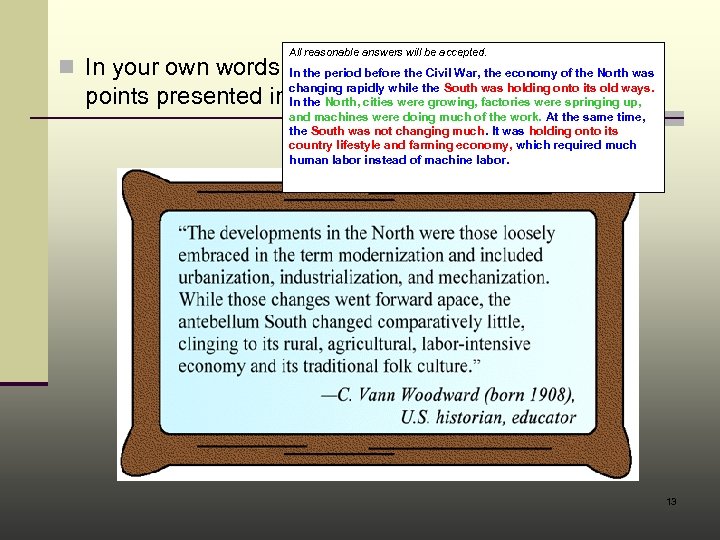 All reasonable answers will be accepted. n In your own words, In the period before the Civil War, the economy of the North was summarize the main idea and key points presented in changing rapidly while the South was holding onto its old ways. the following passage. In the North, cities were growing, factories were springing up, and machines were doing much of the work. At the same time, the South was not changing much. It was holding onto its country lifestyle and farming economy, which required much human labor instead of machine labor. 13
 Wilmot’s proposal would have prohibited slavery in many new Western territories, which would not have been acceptable to the South; Calhoun’s proposal would have allowed slavery in all new Western lands, which the North would have opposed. Why would the proposals by David Wilmot and John C. Calhoun regarding slavery in the Western lands have been received differently in the North and South? 14
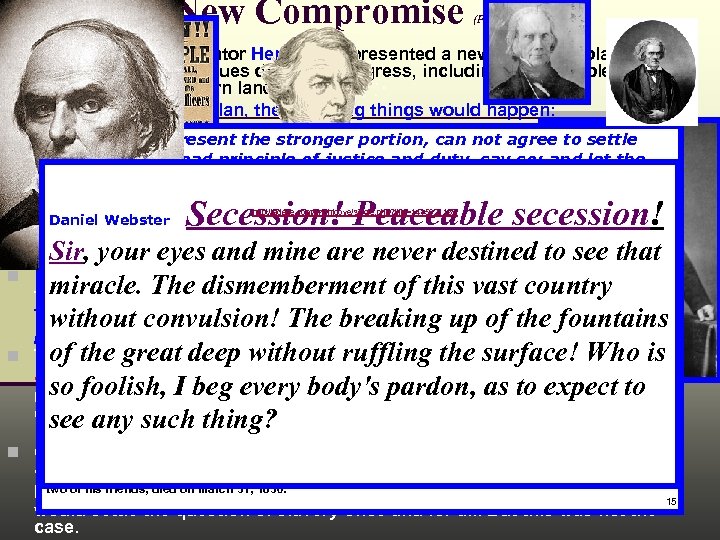 III. A New Compromise (Pages 438 -439) n In January 1850 Senator Henry Clay presented a new multi part plan to n n n n n settle a number of issues dividing Congress, including the possible spread of slavery into Western lands. According to Clay's plan, the following things would happen: 1. California would be admitted as a free state. can not agree to settle If you who represent the stronger portion, 2. The New Mexico Territory would have no slavery restrictions. let them on the broad principle of justice and duty, say so; and 3. A New Mexico Texas border dispute would be decided in favor of New States we both represent agree to separate and part in peace. Mexico. If you are unwilling wehttp: //adage. com/brightcove/single. php? title=1415621128 tell us so; and we shall should part in peace, 4. The slave trade though not slavery would be abolished in Washington, Daniel Webster know what to do when you reduce the question to submission or D. C. resistance. If you remain silent, you will compel us to infer by your Sir, your eyes and mine are never destined to see that 5. There would be a stronger fugitive slave law. acts what you intend. In that case California will become the test A bitter debate in Congress over the provisions of Clay's proposal raged question. If. Theadmit her under all the difficulties that oppose her miracle. you dismemberment of this vast country for seven months. Clay's plan could not pass as a package, and President admission, you compel us to infer that you intend to exclude us from Taylor opposed it. Then in July 1820, Taylor suddenly died-Fillmore without convulsion! The breaking up of the fountains the whole of the acquired Territories, with the intention of destroying pres. irretrievably the equilibrium between the two sections. We should be of the great deep without that your the surface! Who The new president, Millard Fillmore, proposed a compromise. Senator is blind not to perceive in that case ruffling real objects are power Stephen Douglas split Clay's proposal into five different bills to allow and aggrandizement, and infatuated, not to act accordingly. March so foolish, I beg every body's pardon, as to expect to members of Congress to vote on them separately. That way, members 4 th 1850 could vote for measures they agreed with and vote against parts they did see any such thing? not support without rejecting the whole plan. Congress passed the series of five separate bills in August and September John C. Calhoun Too ill to deliver it himself, so it was read by another senator with Calhoun present in the Senate Chamber. Calhoun, so ill he had to be helped out of the Chamber after the speech by 1850. Together they became known as the Compromise of 1850. two of his friends, died on March 31, 1850. Many Americans, including President Fillmore, thought this compromise 15 would settle the question of slavery once and for all. But this was not the case. Secession! Peaceable secession!
 California would be admitted to the Union as a free state, and the slave trade would be abolished in Washington, D. C. , which satisfied the North. The New Mexico Territory would be open to slavery, and there would be a stronger fugitive slave law, which pleased the South. How did the Compromise of 1850 satisfy both free states and slave states? 16
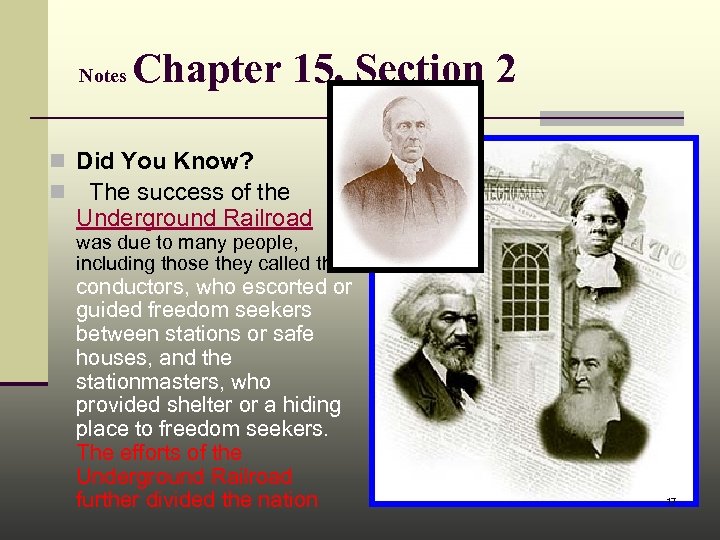 Notes Chapter 15, Section 2 n Did You Know? n The success of the Underground Railroad was due to many people, including those they called the conductors, who escorted or guided freedom seekers between stations or safe houses, and the stationmasters, who provided shelter or a hiding place to freedom seekers. The efforts of the Underground Railroad further divided the nation 17
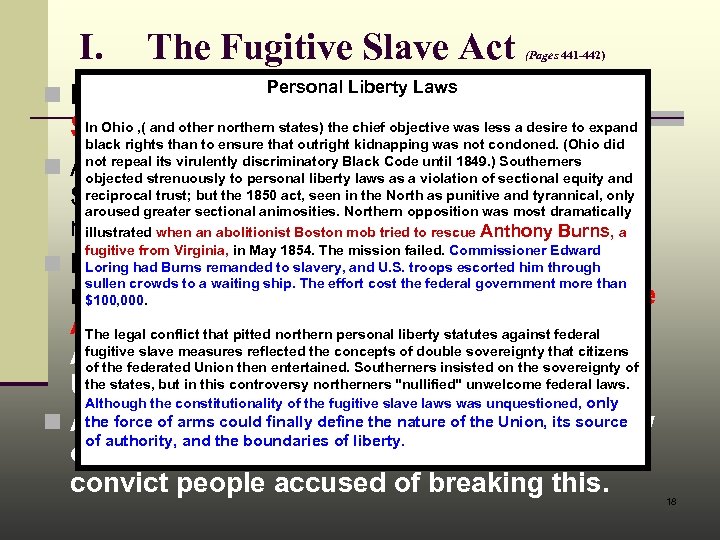 I. The Fugitive Slave Act (Pages 441 -442) Personal Liberty Laws 1850 Congress passed the Fugitive In Ohio , ( and other northern states) the chief objective was less a desire to expand Slave Act. black rights than to ensure that outright kidnapping was not condoned. (Ohio did n In not repeal its virulently discriminatory Black Code until 1849. ) Southerners n After passage of the Fugitive Slave Act, objected strenuously to personal liberty laws as a violation of sectional equity and reciprocal trust; but the 1850 act, seen in the North as punitive and tyrannical, only Southerners stepped up efforts to catch aroused greater sectional animosities. Northern opposition was most dramatically runaways. illustrated when an abolitionist Boston mob tried to rescue Anthony Burns, a fugitive from Virginia, in May 1854. The mission failed. Commissioner Edward Loring had Burns remanded to slavery, and U. S. troops escorted him through n Many Northerners who opposed slavery sullen crowds to a waiting ship. The effort cost the federal government more than refused to cooperate with the Fugitive Slave $100, 000. Act and continued to aid runaway enslaved The legal conflict that pitted northern personal liberty statutes against federal fugitive slave measures reflected the concepts of double sovereignty that citizens African Americans. They created the of the federated Union then entertained. Southerners insisted on the sovereignty of the states, but in this controversy northerners "nullified" unwelcome federal laws. Underground Railroad to help runaways. Although the constitutionality of the fugitive slave laws was unquestioned, only the force of arms could finally define the nature of the Union, its source n Although the Fugitive Slave Act was the law of authority, and the boundaries of liberty. of the land, Northern juries often refused to convict people accused of breaking this. 18
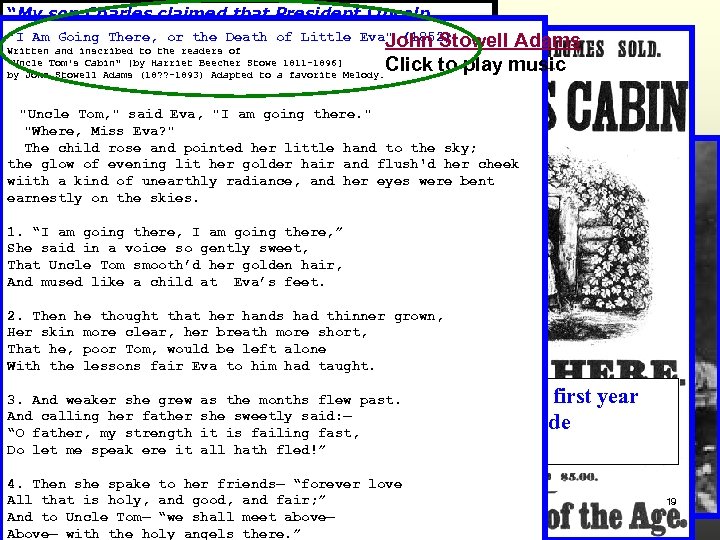 “My son Charles claimed that President Lincoln looked down at me with Death of Little Eva" (1852) "I Am Going There, or the his coal nugget eyes and John Stowell Adams Written "so this is the lady of said, and inscribed tothe readers who started the great war!". "Uncle Tom's Cabin" [by Harriet Beecher Stowe 1811 -1896] Click to play music I don't recall the incident, but a. Charles was with me by John Stowell Adams (18? ? -1893) Adapted to favorite Melody. the day I met Mr. Lincoln. If it was said, it is a terrible Tom, " said Eva, put am going there. " "Uncle accusation to "I on anyone. True, my book, "Uncle Tom's Cabin", did stir up the hornet's nest, "Where, Miss Eva? " The child rose unrest were planted and to the sky; but the seeds ofand pointed her little hand a divided the glow of been the harvest before it had been nation had evening lit her golder hair and flush'd her cheek wiith a kind of unearthly radiance, written. ” Harriet Beecher Stowe and her eyes were bent Harriet Beecher Stow 1811 -1898 earnestly on the skies. 1. “I am going there, ” She said in a voice so gently sweet, That Uncle Tom smooth’d her golden hair, And mused like a child at Eva’s feet. 2. Then he thought that her hands had thinner grown, Her skin more clear, her breath more short, That he, poor Tom, would be left alone With the lessons fair Eva to him had taught. 3. And weaker she grew And calling her father “O father, my strength Do let me speak ere it as the months. Sold 300, 000 copies in the first flew past. she sweetly said: — Sold two million in a decade it is failing fast, all hath fled!” 4. Then she spake to her friends— “forever love All that is holy, and good, and fair; ” And to Uncle Tom— “we shall meet above— Above— with the holy angels there. ” year 19
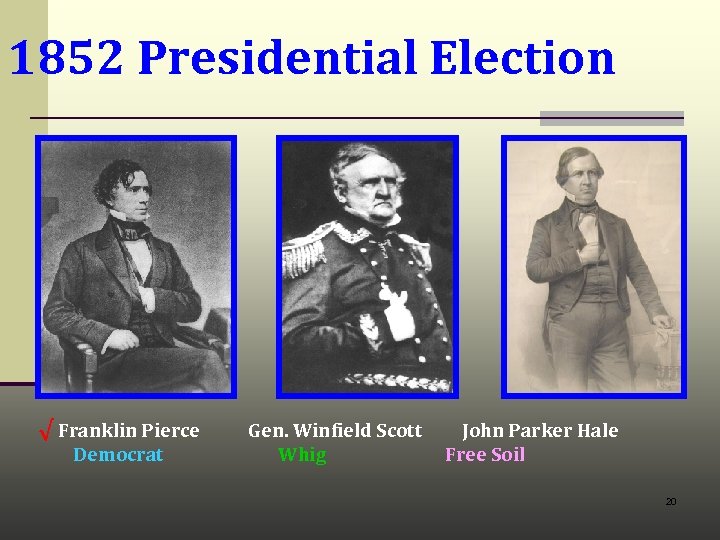 1852 Presidential Election √ Franklin Pierce Democrat Gen. Winfield Scott Whig John Parker Hale Free Soil 20
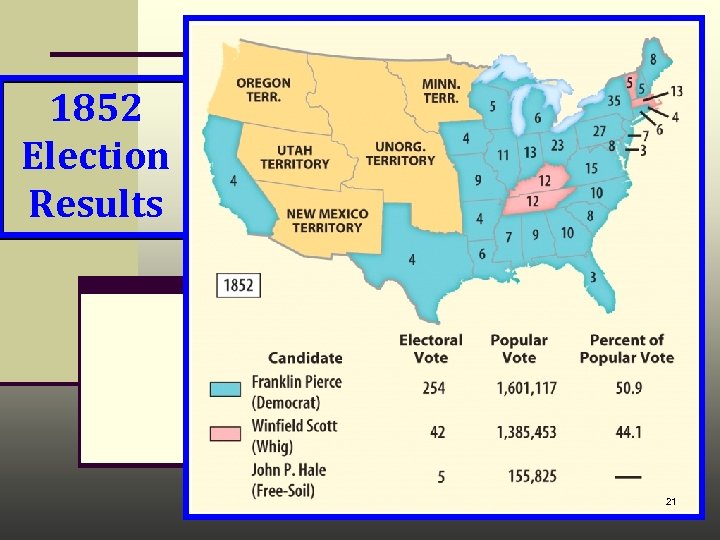 1852 Election Results 21
 Those who did not support slavery felt they were being forced to do something morally wrong and could not go against their consciences. Can you think of any current public policies or laws that people might object to on moral grounds? Why do you think many people refused to obey the Fugitive Slave Act? 22
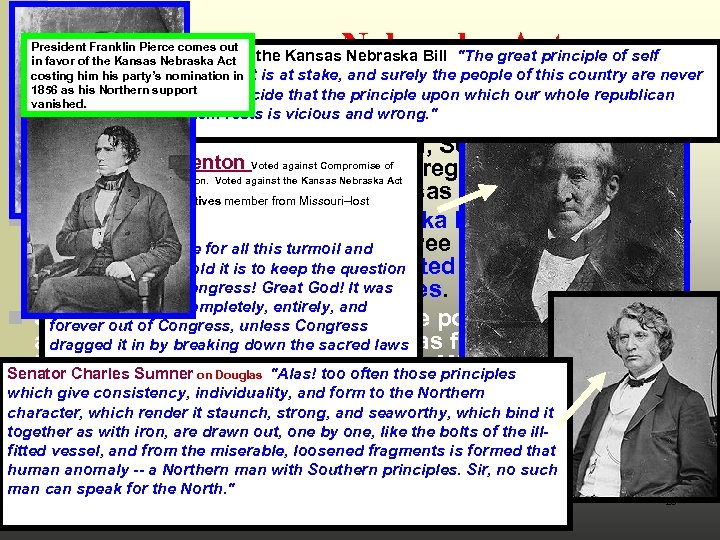 II. The Kansas-Nebraska Act President Franklin Pierce comes out (Pages 442 -443) Douglas on the Kansas Nebraska Bill "The great principle of self in favor of the Kansas Nebraska Act costing him his party’s nomination in government is at stake, and surely the people of this country are never 1856 as his Northern support going to decide that the principle upon which our whole republican vanished. system rests is vicious and wrong. " n Hoping to encourage settlement of the West and open the way for a transcontinental railroad, Senator Stephen Thomas Hart Benton Voted against Compromise of Douglas proposed organizing the region west of Missouri 1850 as a senator. Lost reelection. Voted against the Kansas Nebraska Act and Iowa as the territories of Kansas and Nebraska as a House of Representatives member from Missouri–lost reelection again as a result. n Because both Kansas and Nebraska lay north of 36° 30"N the area that was established as free of slavery in the "What is the excuse for all this turmoil and mischief? We are told it is to keep the question Compromise of 1820 it was expected that Kansas and of slavery out of Congress! Great God! It was Nebraska would become free states. out of Congress, completely, entirely, and n Southerners were disturbed by the possibility of Kansas forever out of Congress, unless Congress and Nebraska entering the Union as free states, so Senator dragged it in by breaking down the sacred laws which settled it!“ (Compromise of 1820) Douglas proposed abandoning the Missouri Compromise Senator Charles Sumner on Douglas "Alas! too often those principles and letting settlers in each territory decide whether to allow which give consistency, individuality, and form to the Northern character, which render it staunch, strong, and seaworthy, which bind it slavery. This was called "popular sovereignty. " together as with iron, are drawn out, one by one, like the bolts of the illn There was bitter debate over the issue in Congress. In 1854 fitted vessel, and from the miserable, loosened fragments is formed that Congress passed the Kansas Nebraska Act. human anomaly -- a Northern man with Southern principles. Sir, no such man can speak for the North. " 23
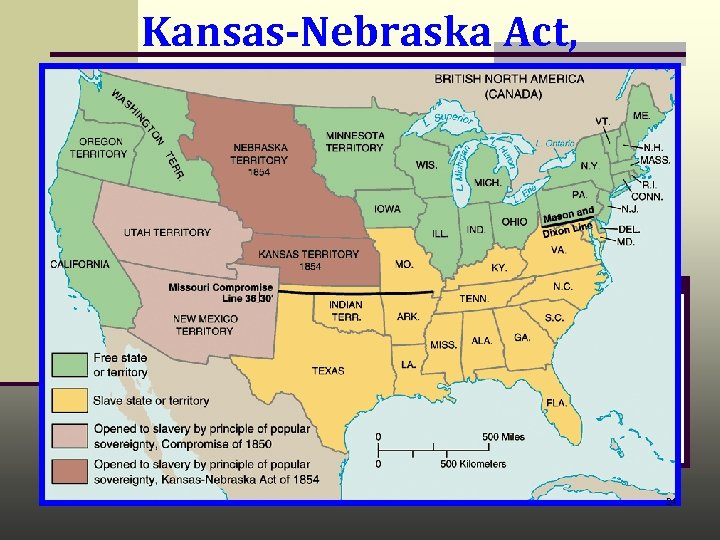 Kansas-Nebraska Act, 1854 24
![Run Time: [05: 21] The Compromise of 1850 did not solve North/South disputes over](https://present5.com/presentation/3207c40d915d8f144aa3cc437d9ba9d2/image-21.jpg "Run Time: [05: 21] The Compromise of 1850 did not solve North/South disputes over") Run Time: [05: 21] The Compromise of 1850 did not solve North/South disputes over new states and the location of the Transcontinental Railroad. Trace the consequences of the Kansas-Nebraska Bill. Uncover events in what came to be called Bleeding Kansas 25
Run Time: [05: 21] The Compromise of 1850 did not solve North/South disputes over new states and the location of the Transcontinental Railroad. Trace the consequences of the Kansas-Nebraska Bill. Uncover events in what came to be called Bleeding Kansas 25
 The Kansas Nebraska Act Opened the door to slavery in the Kansas and Nebraska territories. It overturned a previous agreement, the Compromise of 1820, which said that areas north of 36, 30”N, which included Kansas and Nebraska, would be free of slavery. Why could the North have considered the Kansas Nebraska Act a betrayal? 26
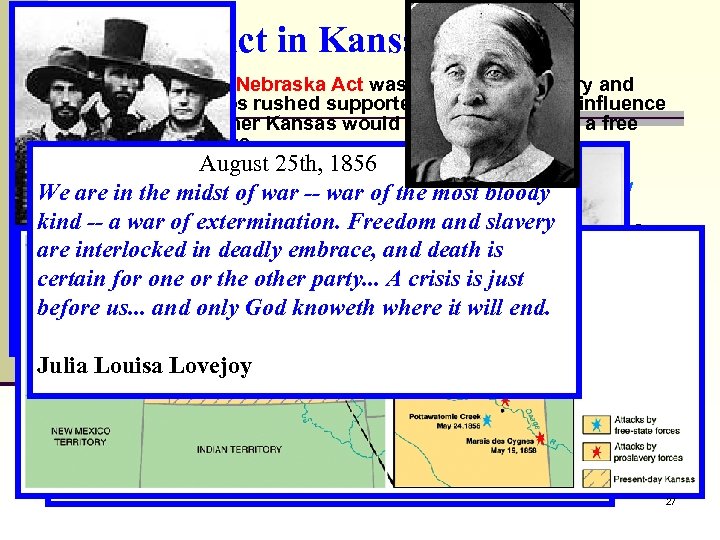 III. Conflict in Kansas (Pages 443 -444) n After the Kansas Nebraska Act was passed, proslavery and antislavery groups rushed supporters into Kansas to influence voting over whether Kansas would enter the Union as a free state or slave state. August 25 th, 1856 n In the spring of 1855, in an election thought by antislavery We supporters to be unfair, Kansas voters elected a proslavery are in the midst of war -- war of the most bloody legislature. kind -- a war of extermination. Freedom and slavery n Soon after the election, the new Kansas legislature passed a are series of laws supporting slavery, such as the requirement that interlocked in deadly embrace, and death is candidates for political office be proslavery. Antislavery forces, certain for one or the other party. . . A crisis is just refusing to accept these laws, armed themselves, held their own elections, and adopted a constitution prohibiting slavery. before us. . . and only God knoweth where it will end. n By January 1856, rival governments one proslavery and one antislavery existed in Kansas. Both of them applied for “Imagine a man standing in a pair of long boots. . . the handle of a large bowie-knife Julia Louisa Lovejoy statehood on behalf of Kansas and asked Congress for projecting from one or both boot-tops; a leather belt buckled around his waist, on each side of which is fastened a large revolver. . . Imagine such a picture of recognition. nhumanity, who can swear any given number of oaths in any specified time, drink The opposing forces, both armed, clashed in Kansas. . any quantity of bad whiskey without getting drunk, and boast of having stolen a Newspapers began to refer to the area as "Bleeding half dozen horses and killed one or more abolitionists -- and you will have a pretty fair conception of a Border Ruffian, as he appears in Missouri and in Kansas. ” Kansas. “ Becomes the first territory to shed blood in a civil war over slavery John H. Gihon 27
![Run Time: [08: 05] The Compromise of 1850 put off the question about slavery](https://present5.com/presentation/3207c40d915d8f144aa3cc437d9ba9d2/image-24.jpg "Run Time: [08: 05] The Compromise of 1850 put off the question about slavery") Run Time: [08: 05] The Compromise of 1850 put off the question about slavery in territories for a few years, but the lure of the west was irresistible. 28
Run Time: [08: 05] The Compromise of 1850 put off the question about slavery in territories for a few years, but the lure of the west was irresistible. 28
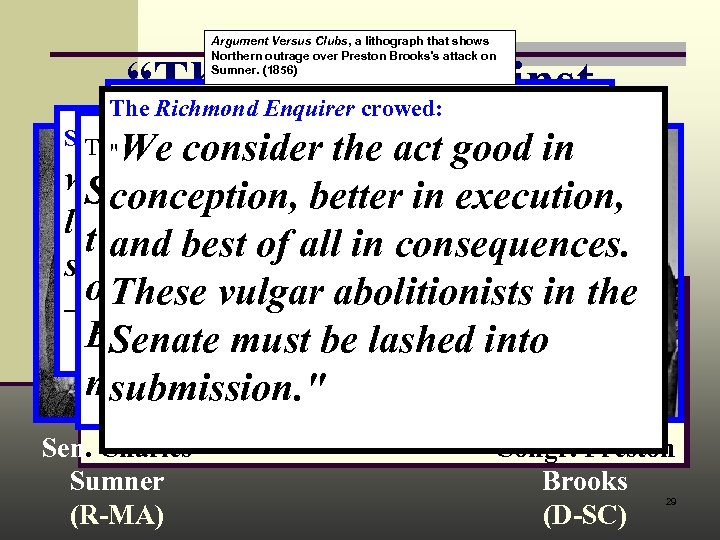 Argument Versus Clubs, a lithograph that shows Northern outrage over Preston Brooks's attack on Sumner. (1856) “The Douglas: crowed: noisome, Crime…a Against The Richmond Enquirer “ Sumner on Butler: … Brooks to Sumner: “Mr. mistress Two days consider the taken a 1856 "squat, and nameless 19 -20 We later Preston “has act good in Kansas” May who, though ugly to others, is always Sumner, I haveproperyour speech animal…not a read execution, conception, better inmodel for lovely to him; Though polluted in the an best carefully. It twice. American senator. ” is a libel and over of all in consequences. sight of the world, is chaste in his sight on South Carolina, and Mr. in the These vulgar abolitionists —I mean, the harlot, Slavery. ” Butler, who is berelative into Senate must a lashed of mine!” submission. " Sen. Charles Sumner (R-MA) Congr. Preston Brooks (D-SC) 29
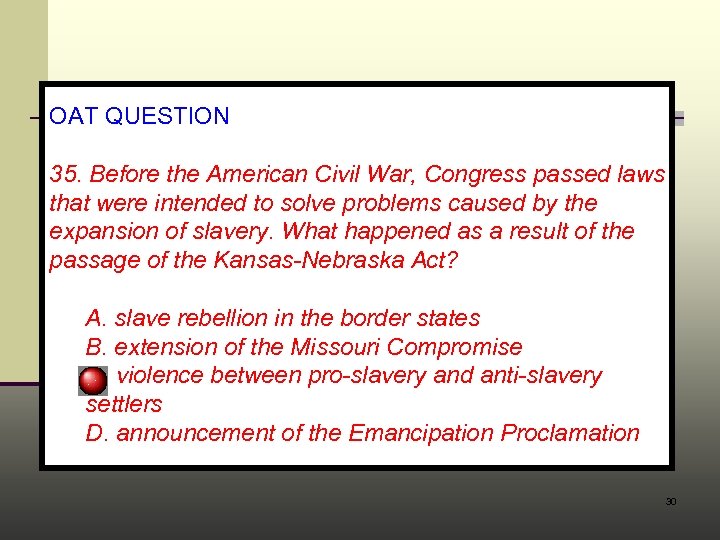 OAT QUESTION 35. Before the American Civil War, Congress passed laws that were intended to solve problems caused by the expansion of slavery. What happened as a result of the passage of the Kansas-Nebraska Act? A. slave rebellion in the border states B. extension of the Missouri Compromise C. violence between pro-slavery and anti-slavery settlers D. announcement of the Emancipation Proclamation 30
 Why did people who opposed slavery mistrust the results of the 1855 election for the Kansas legislature? In an election that chose a proslavery legislature, there were more votes cast than there were voters in Kansas. (1, 500 actual voters but there were more than 6, 000 votes counted) 31
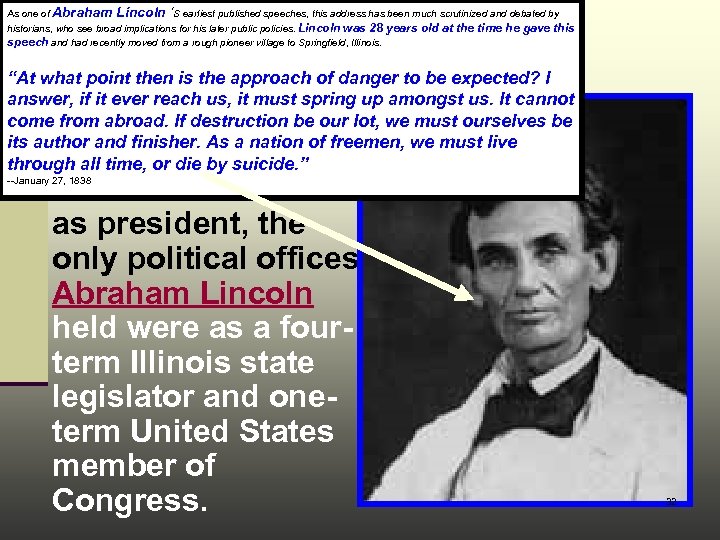 As one of Abraham Lincoln ‘s earliest published speeches, this address has been much scrutinized and debated by historians, who see broad implications for his later public policies. Lincoln was 28 years old at the time he gave this speech and had recently moved from a rough pioneer village to Springfield, Illinois. Notes Chapter 15, Section 3 “At what point then is the approach of danger to be expected? I answer, if it ever reach us, it must spring up amongst us. It cannot come from abroad. If destruction be our lot, we must ourselves be its author and finisher. As a nation of freemen, we must live through all time, or die by suicide. ” n Did You Know? n Before his election --January 27, 1838 as president, the only political offices Abraham Lincoln held were as a four term Illinois state legislator and one term United States member of Congress. 32
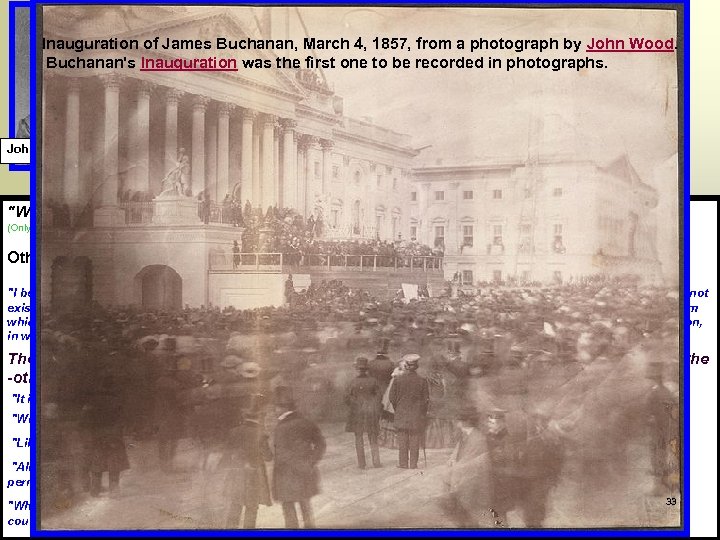 I. A New Political Party Inauguration of James Buchanan, March 4, 1857, from a photograph by John Wood. (Pages 445 -446) Buchanan's Inauguration was the first one to be recorded in photographs. n In 1854 antislavery Whigs and Millard Fillmore—American John C. Freemont Republican Party/Know Nothing Party Nativist. antislavery Democrats joined with Free "What is right and what is practicable are two different things. " Soilers to create the Republican Party. Other great moments in the fence sitting, tight rope walking, life of James Buchanan n Republican candidates began to challenge proslavery Whigs and Democrats in state and congressional The Buchanan treasury of quotations, such as it is, is marked by an on-the-one-hand, on-the elections of 1854. -other-hand evenhandedness that left him with sores from straddling the fence: n Democrat James Buchanan won the presidential election of 1856, with the strong support of Southerners. (Only President from Pennsylvania)—James Buchanan "I believe [slavery] to be a great political and great moral evil. I thank God, my lot has been cast in a State where it does not exist. But, while I entertain these opinions, I know it is an evil at present without a remedy. . . one of those moral evils, from which it is impossible for us to escape, without the introduction of evils infinitely greater. There are portions of this Union, in which, if you emancipate our slaves, they will become masters. There can be no middle course. " "It is better to bear the ills we have than to fly to others we know not of. " "What is right and what is practicable are two different things. " "Liberty must be allowed to work out its natural results; and these will, ere long, astonish the world. " "All that is necessary to [abolish slavery], and all for which the slave States have ever contended, is to be let alone and permitted to manage their domestic institutions in their own way. " "Whatever the result may be, " he said, "I shall carry to my grave the consciousness that I at least meant well for my 33 country. "
![Run Time: [26: 41] The election of Abraham Lincoln in 1860 spawned the secession](https://present5.com/presentation/3207c40d915d8f144aa3cc437d9ba9d2/image-30.jpg "Run Time: [26: 41] The election of Abraham Lincoln in 1860 spawned the secession") Run Time: [26: 41] The election of Abraham Lincoln in 1860 spawned the secession of seven southern states. Trace the early events and issues of the Civil War, including the attack on Fort Sumter, the mobilization of troops, and the influence of border states. 34
Run Time: [26: 41] The election of Abraham Lincoln in 1860 spawned the secession of seven southern states. Trace the early events and issues of the Civil War, including the attack on Fort Sumter, the mobilization of troops, and the influence of border states. 34
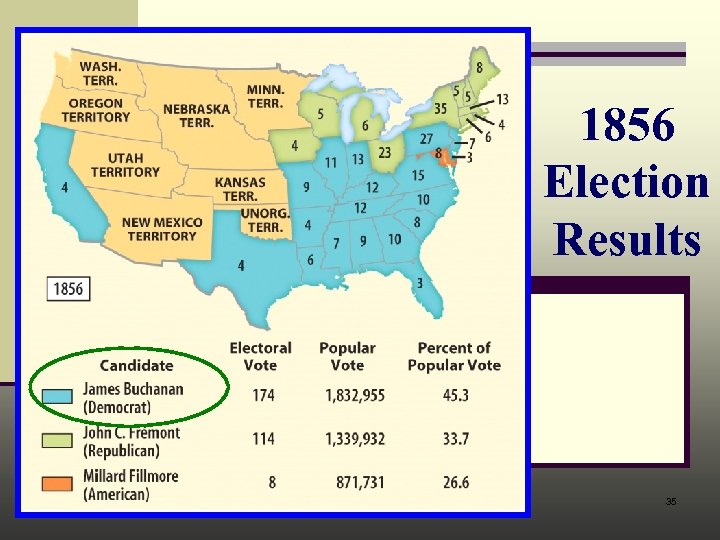 1856 Election Results 35
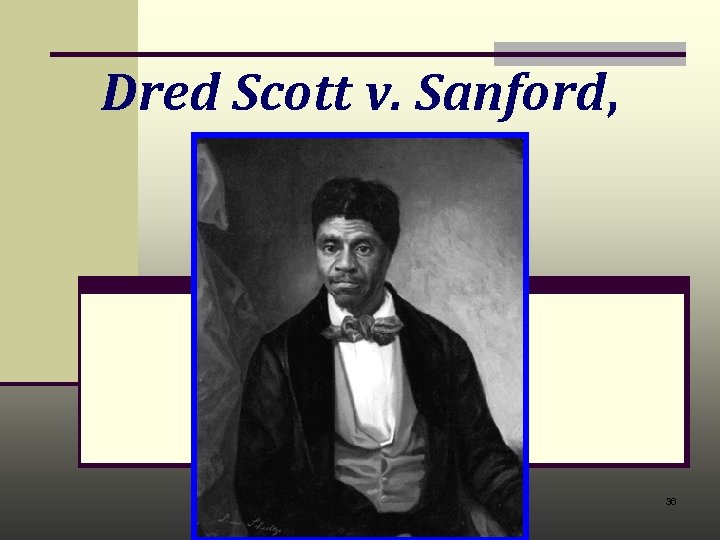 Dred Scott v. Sanford, 1857 36
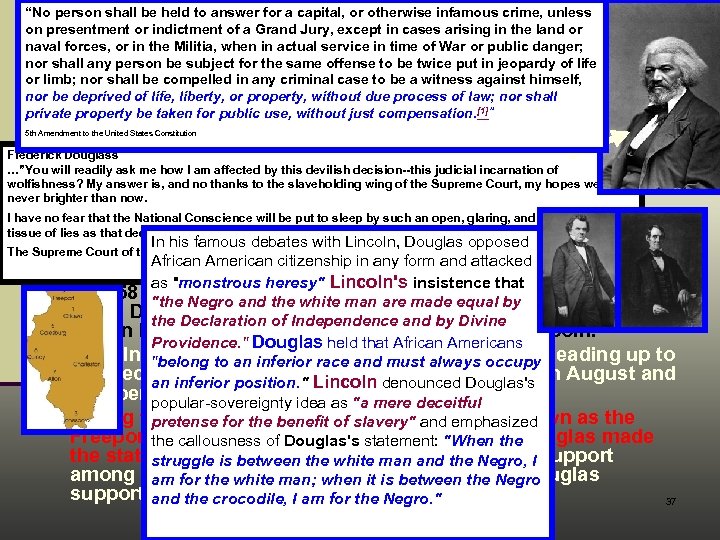 II. The Dred Scott Decision “No person shall be held to answer for a capital, or otherwise infamous crime, unless (Pages 446 -448) on presentment or indictment of a Grand Jury, except in cases arising in the land or naval forces, or in the Militia, when in actual service in time of War or public danger; nor shall any person be subject for the same offense to be twice put in jeopardy of life n Two days after President Buchanan took office, the Supreme or limb; nor shall be compelled in any criminal case to be a witness against himself, Court announced the Dred Scott decision. nor be deprived of life, liberty, or property, without due process of law; nor shall n In the Dred Scott decision, Chief Justice Taney said that Scott private property be taken for public use, without just compensation. [1]” was a slave, not a citizen, and therefore had no right to bring a lawsuit. He added that Scott's residence on free soil did not Frederick Douglass …”You will readily ask me how I am affected by this devilish decision this judicial incarnation of make him free, because he was property. As property, he could wolfishness? My answer is, and no thanks to the slaveholding wing of the Supreme Court, my hopes were not be taken away from his owner without "due process of law. " never brighter than now. (5 th Amendment) Chief Justice Roger B. Taney I have no fear that the National Conscience will be put to sleep by such an open, glaring, and scandalous n The Dred Scott decision outraged antislavery advocates in the tissue of lies as that decision is, and has been, over and over, shown to be. In his famous debates with Lincoln, Douglas opposed North, but pleased Southerners, dividing the country more than The Supreme Court of the United States is not the only power in this world…” African American citizenship in any form and attacked ever. as "monstrous heresy" Lincoln's insistence that n In 1858 the Senate race in Illinois attracted national attention. It "the Negro and the white man are made equal by pitted Democratic Senator Stephen Douglas against a little the Declaration of Independence and by Divine known Republican challenger named Abraham Lincoln. Providence. " Douglas held that African Americans n Lincoln challenged Douglas to a series of debates leading up to "belong to an inferior race and must always occupy the election. The seven debates took place between August and an inferior position. " Lincoln denounced Douglas's October 1858. Slavery was the main topic. popular-sovereignty idea as "a mere deceitful n During the debates Douglas put forth his idea known as the pretense for the benefit of slavery" and emphasized Freeport Doctrine, after the Illinois town where Douglas made the callousness of Douglas's statement: "When the statement. This point of view gained Douglas support struggle is between the white man and the Negro, I among those that were against slavery but lost Douglas am for the white man; when it is between the Negro support among the proslavery population. and the crocodile, I am for the Negro. " 37 5 th Amendment to the United States Constitution
![Run Time: [05: 46] In 1857, the Supreme Court was a decidedly partisan institution.](https://present5.com/presentation/3207c40d915d8f144aa3cc437d9ba9d2/image-34.jpg "Run Time: [05: 46] In 1857, the Supreme Court was a decidedly partisan institution.") Run Time: [05: 46] In 1857, the Supreme Court was a decidedly partisan institution. Their desire to secure the rights of slave holders would cause them to make the most infamous judicial decision in American History. The man who started it all was Dred Scott. 38
Run Time: [05: 46] In 1857, the Supreme Court was a decidedly partisan institution. Their desire to secure the rights of slave holders would cause them to make the most infamous judicial decision in American History. The man who started it all was Dred Scott. 38
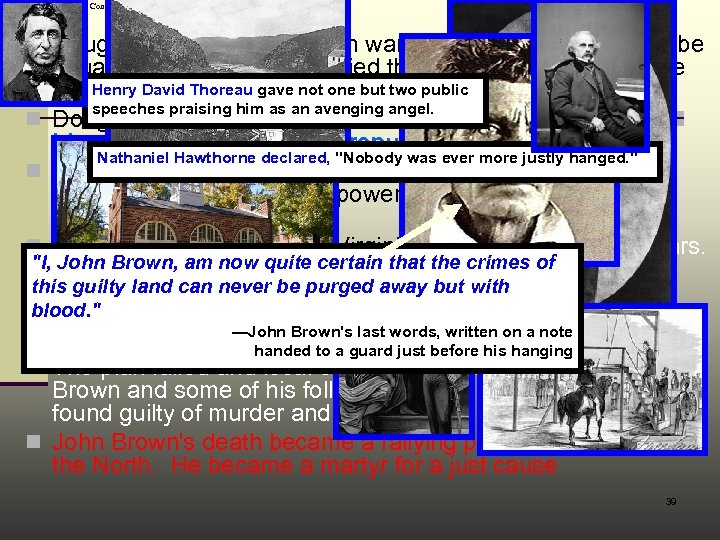 II. Continued n Douglas claimed that Lincoln wanted African Americans to be equal to whites. Lincoln denied this. He said that he and the Henry David Thoreau gave not one but two public Republican Party merely felt that slavery was wrong. speeches praising him as an avenging angel. n Douglas narrowly won the election, but during the debates, Lincoln earned a national reputation. Nathaniel Hawthorne declared, "Nobody was ever more justly hanged. " n After the election of 1858, Southerners felt increasingly threatened by the growing power of the antislavery Republican Party. n A raid on Harpers Ferry, Virginia, further fed Southern fears. "I, John Brown, am now quite certain that the crimes of On October 16, 1859, abolitionist John Brown led a small this guilty land can never be purged away but with in a raid on an group of whites and free African Americans blood. " arsenal at Harpers Ferry. The aim was to arm enslaved —John Brown's last words, written on a note African Americans and spark a slave uprising. handed to a guard just before his hanging n The plan failed and local citizens and federal troops captured Brown and some of his followers. John Brown was tried, found guilty of murder and treason, and hanged. n John Brown's death became a rallying point for abolitionists in the North. He became a martyr for a just cause 39
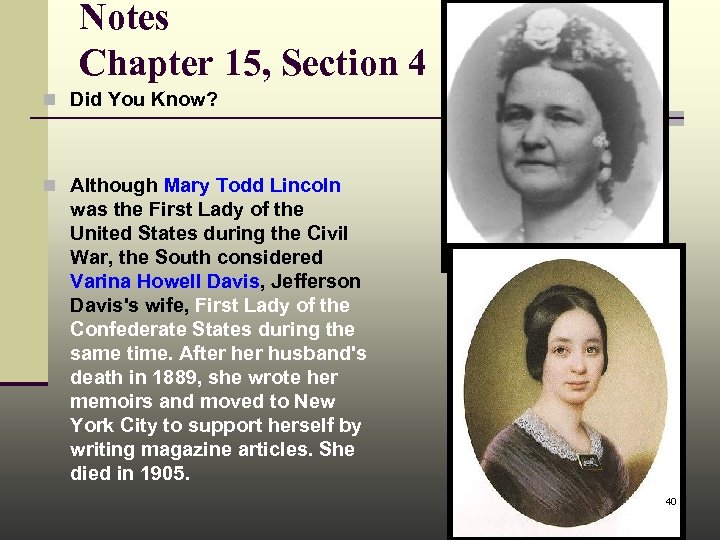 Notes Chapter 15, Section 4 n Did You Know? n Although Mary Todd Lincoln was the First Lady of the United States during the Civil War, the South considered Varina Howell Davis, Jefferson Davis's wife, First Lady of the Confederate States during the same time. After husband's death in 1889, she wrote her memoirs and moved to New York City to support herself by writing magazine articles. She died in 1905. 40
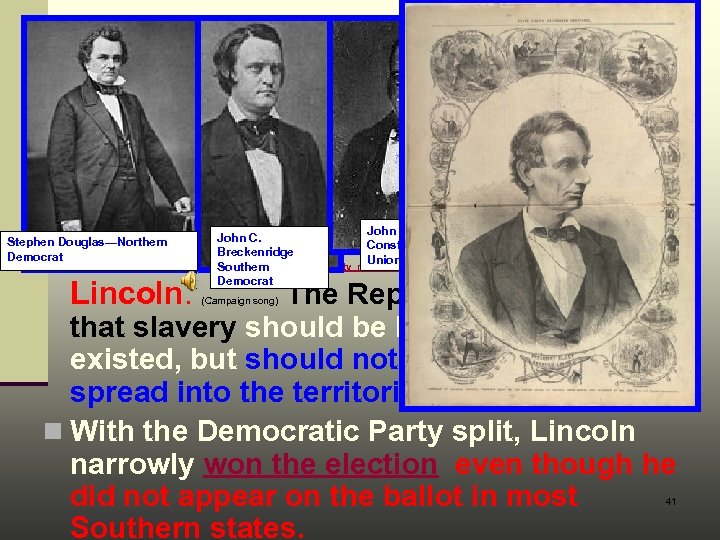 I. The Election of 1860 (Pages 449 -450) n In the months leading up to the election of 1860, the issue of slavery split the Democratic Party along sectional lines. n The Republican Party nominated Abraham n Lincoln. The Republican Party said that slavery should be left alone where it existed, but should not be allowed to spread into the territories. n With the Democratic Party split, Lincoln narrowly won the election even though he did not appear on the ballot in most Southern states. John Bell John C. Constitutional Breckenridge Union Party http: //www. youtube. com/watch? v=wx. Ww. Dg. Oj 0 o. E&safety_mode=true&persist_safety_mode=1&safe=active Southern Democrat Stephen Douglas—Northern Democrat (Campaign song) 41
![Republican Party Platform in 1860 ß Non-extension of slavery [for the Free-Soilers. ] ß](https://present5.com/presentation/3207c40d915d8f144aa3cc437d9ba9d2/image-38.jpg "Republican Party Platform in 1860 ß Non-extension of slavery [for the Free-Soilers. ] ß") Republican Party Platform in 1860 ß Non-extension of slavery [for the Free-Soilers. ] ß Protective tariff [for the No. Industrialists]. ß No abridgment of rights for immigrants [a disappointment for the “Know-Nothings”]. ß Government aid to build a Pacific RR [for the Northwest]. ß Internal improvements [for the West] at federal expense. ß Free homesteads for the public domain [for farmers]. 42
Republican Party Platform in 1860 ß Non-extension of slavery [for the Free-Soilers. ] ß Protective tariff [for the No. Industrialists]. ß No abridgment of rights for immigrants [a disappointment for the “Know-Nothings”]. ß Government aid to build a Pacific RR [for the Northwest]. ß Internal improvements [for the West] at federal expense. ß Free homesteads for the public domain [for farmers]. 42
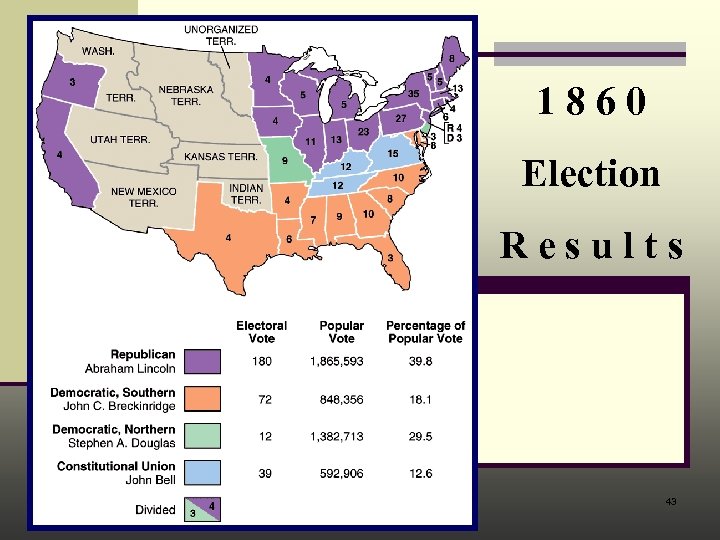 1860 Election Results 43
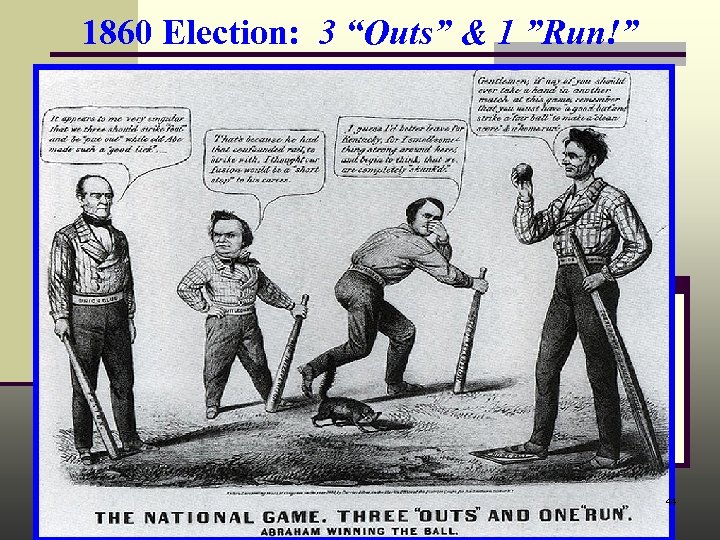 1860 Election: 3 “Outs” & 1 ”Run!” 44
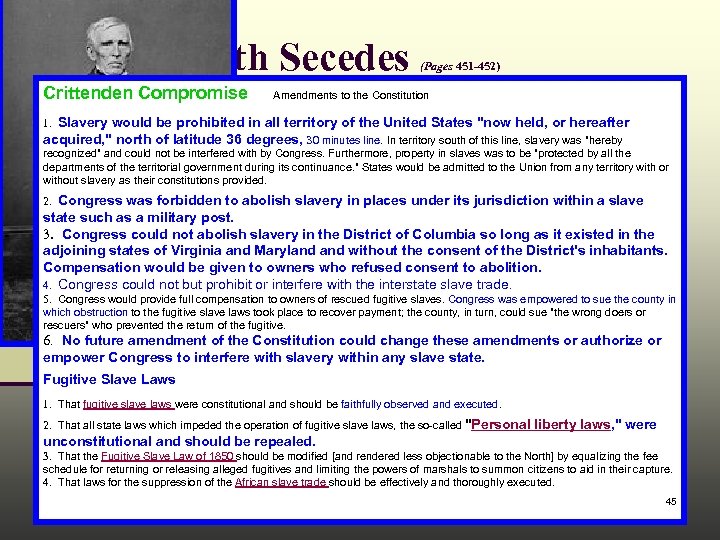 II. The South Secedes Crittenden Compromise (Pages 451 -452) Amendments to the Constitution n. Slavery would be prohibited in all territory of the United States "now held, or hereafter Although Lincoln had promised to leave slavery 1. alone where it existed, Southerners did not trust the Republican Party to protect their rights. On 2. Congress was forbidden to abolish slavery in places under its jurisdiction within a slave November 20, 1860, South Carolina held a special state such as a military post. convention and voted to secede from the Union. 3. Congress could not abolish slavery in the District of Columbia so long as it existed in the adjoining states of Virginia and Maryland without the consent of the District's inhabitants. n Even after South Carolina's secession, leaders in Compensation would be given to owners who refused consent to abolition. 4. Congress could not but prohibit or interfere with the interstate slave trade. Washington worked to find a compromise that would 5. Congress would provide full compensation to owners of rescued fugitive slaves. Congress was empowered to sue the county in which obstruction to the fugitive slave laws took place to recover payment; the county, in turn, could sue "the wrong doers or preserve the Union. rescuers" who prevented the return of the fugitive. 6. No future amendment of the Constitution could change these amendments or authorize or n C. Senator John Crittendon of Kentucky proposed a empower Congress to interfere with slavery within any slave state. Fugitive Slave Laws plan to protect slavery in all present and future 1. That fugitive slave laws were constitutional and should be faithfully observed and executed. territories south of the 36° 30 line set by the Missouri 2. That all state laws which impeded the operation of fugitive slave laws, the so-called "Personal liberty laws, " were unconstitutional and should be repealed. Compromise. This was unacceptable to both 3. That the Fugitive Slave Law of 1850 should be modified [and rendered less objectionable to the North] by equalizing the fee schedule for returning or releasing alleged fugitives and limiting the powers of marshals to summon citizens to aid in their capture. Republicans and Southern leaders. 4. That laws for the suppression of the African slave trade should be effectively and thoroughly executed. acquired, " north of latitude 36 degrees, 30 minutes line. In territory south of this line, slavery was "hereby recognized" and could not be interfered with by Congress. Furthermore, property in slaves was to be "protected by all the departments of the territorial government during its continuance. " States would be admitted to the Union from any territory with or without slavery as their constitutions provided. 45
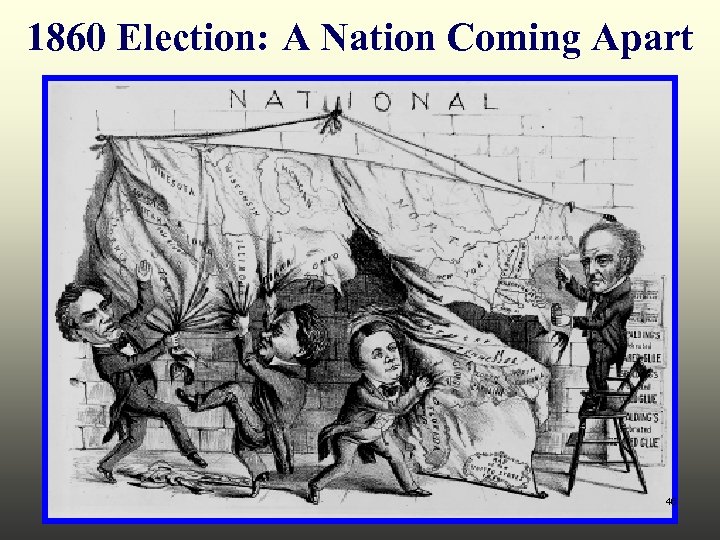 1860 Election: A Nation Coming Apart 46
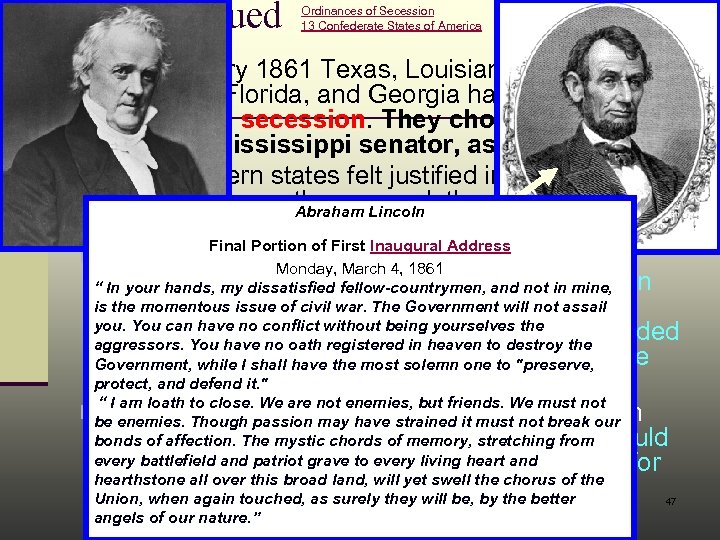 II. Continued Ordinances of Secession 13 Confederate States of America n By February 1861 Texas, Louisiana, Mississippi, Alabama, Florida, and Georgia had joined South Carolina in secession. They chose Jefferson Davis, a Mississippi senator, as their president. n The Southern states felt justified in leaving the Union because, they argued, they had voluntarily Abraham Lincoln entered the Union. . Final Portion of First Inaugural Address n F. While the Southern states were seceding, Monday, March 4, 1861 James Buchanan was still president. Buchanan “ In your hands, my dissatisfied fellow-countrymen, and not in mine, is the momentous issue of civil war. The Government will not assail sent a message to Congress stating that the you. You can have no conflict without being yourselves the Southern states had no right to secede. He added aggressors. You have no oath registered in heaven to destroy the that the United States government did not have Government, while I shall have the most solemn one to "preserve, protect, and defend it. " the power to stop them. “ I am loath to close. We are not enemies, but friends. We must not nbe enemies. Though passion may have strained it must not break our In his inaugural speech in March 1861, Lincoln took on a calming tone. He said secession bonds of affection. The mystic chords of memory, stretching from would every battlefield and patriot grave to every living heart and South for not be permitted, but pleaded with the hearthstone all over this broad land, will yet swell the chorus of the reconciliation. Union, when again touched, as surely they will be, by the better 47 angels of our nature. ”
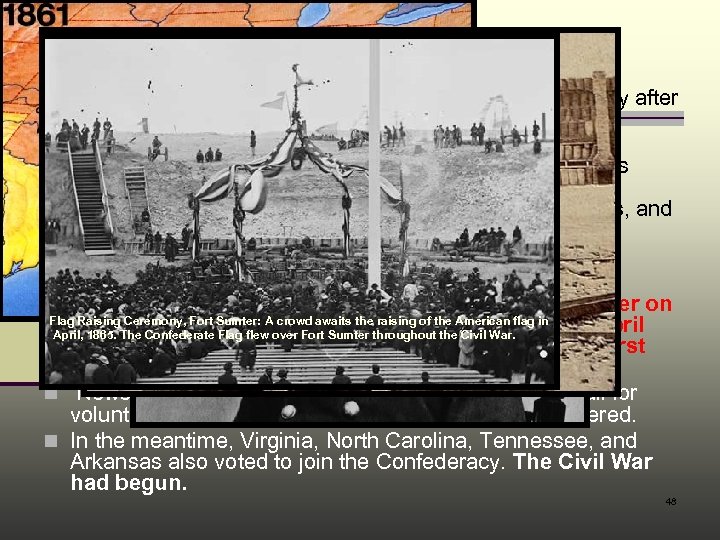 III. Fort Sumter (Page 453) n Confederate forces had taken over some federal property after secession. n On the day after his inauguration, Lincoln received a message from the commander of Fort Sumter, which was located on an island at the entrance of the harbor in Charleston, South Carolina. The fort was low on supplies, and the Confederates were demanding its surrender. n Lincoln informed the governor of South Carolina that the Union would send supplies to the fort. n The Confederates responded by attacking Fort Sumter on Flag Raising Ceremony, Fort Sumter: A crowd awaits the raising of the American flag in the fort on April 12, 1861. The fort surrendered on April, 1865. The Confederate Flag flew over Fort Sumter throughout the Civil War. 14, with no loss of life on either side. This was the first attack of the Civil War n News of the attack got the North fired up. Lincoln's call for volunteers to fight the Confederacy was quickly answered. n In the meantime, Virginia, North Carolina, Tennessee, and Arkansas also voted to join the Confederacy. The Civil War had begun. 48
 Why do you think the Confederacy decided to fire on Fort Sumter rather than accept Lincoln’s request to peacefully resupply the soldiers there? The Confederacy wanted to drive home the point that it did not want reconciliation with the Union and intended to fight to maintain itself as a separate nation. 49
 Pick one of the following questions to answer on tomorrow’s test n. How did sectionalism lead to Civil War? n. Why was the Dred Scott decision important? 50