


 Скачать презентацию 15 Investment Analysis and Portfolio Management First Canadian
2f9045725e03ae8c5c4b9bd8a4d0f011.ppt
- Количество слайдов: 31
 15 Investment Analysis and Portfolio Management First Canadian Edition By Reilly, Brown, Hedges, Chang
 Chapter 15 Equity Portfolio Management Strategies • • • An Overview Passive Equity Portfolio Management Strategies Active Equity Portfolio Management Strategies Investment Styles Asset Allocation Strategies Copyright © 2010 by Nelson Education Ltd. 15 -2
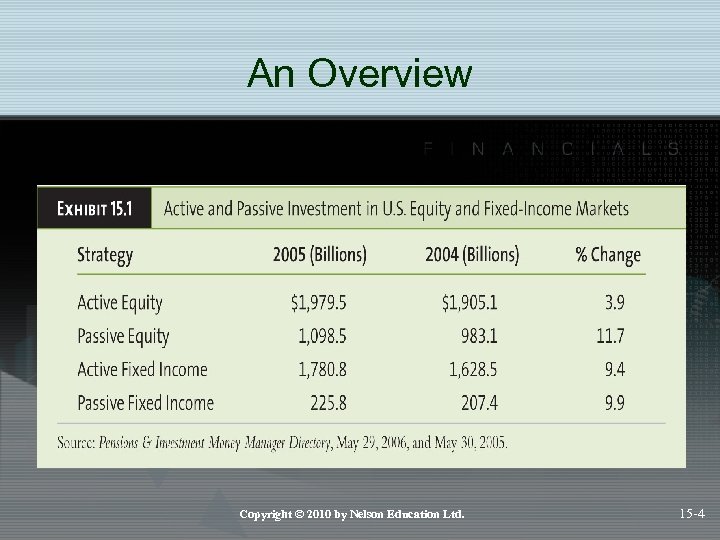
 An Overview • Passive Investment Management • • Long-term buy-and-hold strategy Usually tracks an index over time Designed to match market performance Manager is judged on how well they track the target index • Active equity portfolio management • Attempts to outperform a passive benchmark portfolio on a risk-adjusted basis by seeking the “alpha” value Copyright © 2010 by Nelson Education Ltd. 15 -3
 An Overview Copyright © 2010 by Nelson Education Ltd. 15 -4
 Passive Equity Portfolio Management Strategies • Attempt to replicate the performance of an index • May slightly underperform the target index due to fees and commissions • Strong rationale for this approach • Costs of active management (1 to 2%) are hard to overcome in risk-adjusted performance • Many different market indexes are used for tracking portfolios Copyright © 2010 by Nelson Education Ltd. 15 -5
 Index Portfolio Construction Techniques • Full Replication • All securities in the index are purchased in proportion to weights in the index • This helps ensure close tracking • Increases transaction costs, particularly with dividend reinvestment Copyright © 2010 by Nelson Education Ltd. 15 -6
 Index Portfolio Construction Techniques • Sampling • Buys a representative sample of stocks in the benchmark index according to their weights in the index • Fewer stocks means lower commissions • Reinvestment of dividends is less difficult • Will not track the index as closely, so there will be some tracking error Copyright © 2010 by Nelson Education Ltd. 15 -7
 Index Portfolio Construction Techniques • Quadratic Optimization (or programming techniques) • Historical information on price changes and correlations between securities are input into a computer program that determines the composition of a portfolio that will minimize tracking error with the benchmark • Relies on historical correlations, which may change over time, leading to failure to track the index Copyright © 2010 by Nelson Education Ltd. 15 -8
 Tracking Error and Index Portfolio Construction • The goal of the passive manager should be to minimize the portfolio’s return volatility relative to the index, i. e. , to minimize tracking error • Tracking Error Measure • Return differential in time period t Δt =Rpt – Rbt where Rpt= return to the managed portfolio in Period t Rbt= return to the benchmark portfolio in Period t • Tracking error is measured as the standard deviation of Δt, normally annualized (TE) Copyright © 2010 by Nelson Education Ltd. 15 -9
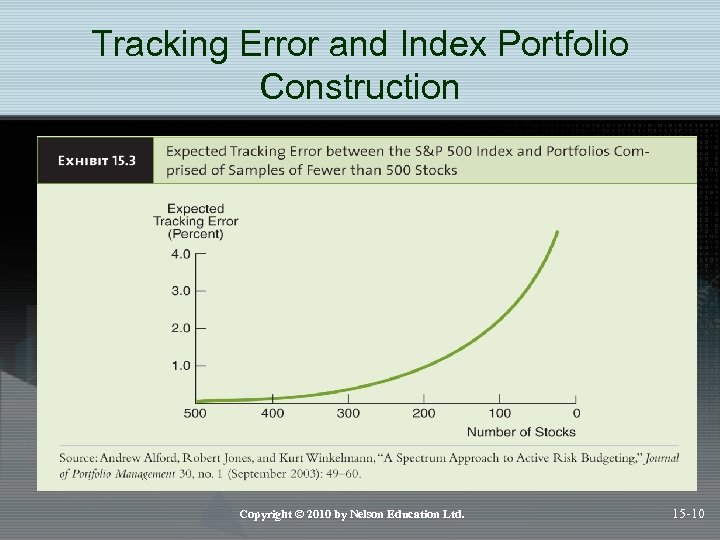 Tracking Error and Index Portfolio Construction Copyright © 2010 by Nelson Education Ltd. 15 -10
 Methods of Index Portfolio Investing • Index Funds • In an indexed portfolio, the fund manager will typically attempt to replicate the composition of the particular index exactly • The fund manager will buy the exact securities comprising the index in their exact weights • Change those positions anytime the composition of the index itself is changed • Low trading and management expense ratios • Advantage: provide an inexpensive way for investors to acquire a diversified portfolio Copyright © 2010 by Nelson Education Ltd. 15 -11
 Methods of Index Portfolio Investing • ETFs • Depository receipts that give investors a pro rata claim on the capital gains and cash flows of the securities that are held in deposit by a financial institution that issued the certificates • Advantage of ETFs over index mutual funds is that they can be bought and sold (and short sold) like common stock • The notable example of ETFs • Standard & Poor’s 500 Depository Receipts (SPDRs) • Regional or country ETFs • Sector ETFs Copyright © 2010 by Nelson Education Ltd. 15 -12
 Active Equity Portfolio Management Strategies • Goal is to earn a portfolio return that exceeds the return of a passive benchmark portfolio, net of transaction costs, on a riskadjusted basis • Need to select an appropriate benchmark • Practical difficulties of active manager • Transactions costs must be offset by superior performance vis-à-vis the benchmark • Higher risk-taking can also increase needed performance to beat the benchmark Copyright © 2010 by Nelson Education Ltd. 15 -13
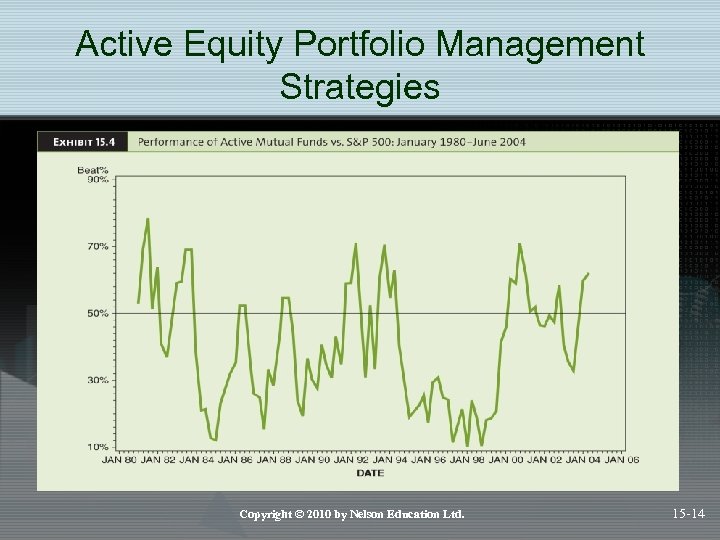 Active Equity Portfolio Management Strategies Copyright © 2010 by Nelson Education Ltd. 15 -14
 Fundamental Strategies • Top-Down versus Bottom-Up Approaches • Top-Down • Broad country and asset class allocations • Sector allocation decisions • Individual securities selection • Bottom-Up • Emphasizes the selection of securities without any initial market or sector analysis • Form a portfolio of equities that can be purchased at a substantial discount to what his or her valuation model indicates they are worth Copyright © 2010 by Nelson Education Ltd. 15 -15
 Fundamental Strategies • Three Generic Themes • Time the equity market by shifting funds into and out of stocks, bonds, and T-bills depending on broad market forecasts • Shift funds among different equity sectors and industries (e. g. , financial stocks, technology stocks) or among investment styles (e. g. , value, growth large capitalization, small capitalization). This is basically the sector rotation strategy • Do stock picking and look at individual issues in an attempt to find undervalued stocks Copyright © 2010 by Nelson Education Ltd. 15 -16
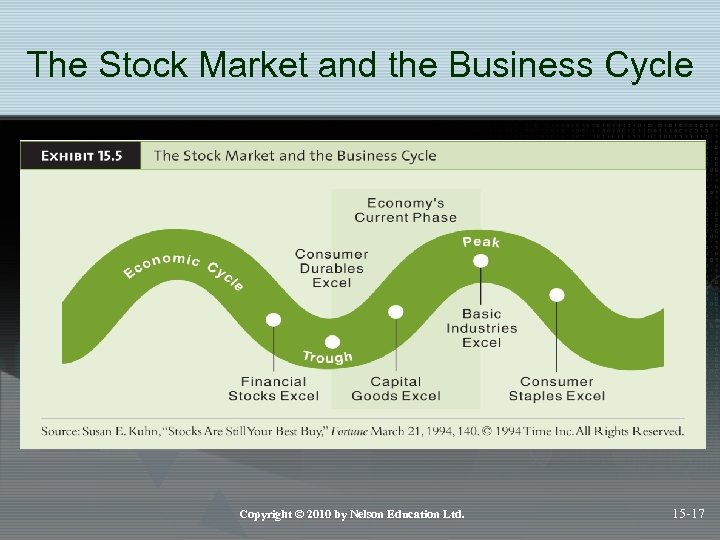 The Stock Market and the Business Cycle Copyright © 2010 by Nelson Education Ltd. 15 -17
 Fundamental Strategies: • The 130/30 Strategy • Long positions up to 130% of the portfolio’s original capital and short positions up to 30% • Use of the short positions creates the leverage needed, increasing both risk and expected returns compared to the fund’s benchmark • Enable managers to make full use of their fundamental research to buy stocks they identify as undervalued as well as short those that are overvalued Copyright © 2010 by Nelson Education Ltd. 15 -18
 Technical Strategies • Contrarian Investment Strategy • The belief that the best time to buy (sell) a stock is when the majority of other investors are the most bearish (bullish) about it • The concept of mean reverting • The overreaction hypothesis • Price Momentum Strategy • Focus on the trend of past prices alone and makes purchase and sale decisions accordingly • Assume that recent trends in past prices will continue Copyright © 2010 by Nelson Education Ltd. 15 -19
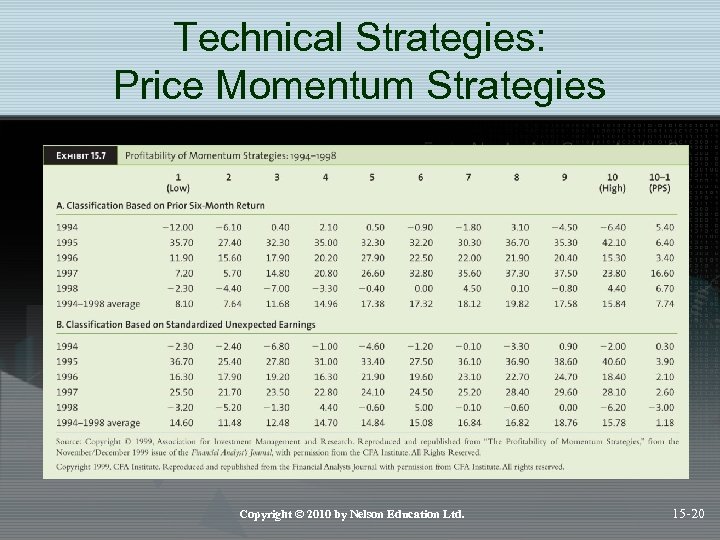 Technical Strategies: Price Momentum Strategies Copyright © 2010 by Nelson Education Ltd. 15 -20
 Anomalies and Attributes • Earnings Momentum Strategy • Momentum is measured by the difference of actual EPS to the expected EPS • Purchases stocks that have accelerating earnings and sells (or short sells) stocks with disappointing earnings • Calendar-Related Anomalies • The Weekend Effect • The January Effect • Firm-Specific Attributes • Firm Size • P/E and P/BV ratios by Nelson Education Ltd. Copyright © 2010 15 -21
 Investment Styles • Value Versus Growth • A growth investor focuses on the current and future economic “story” of a company, with less regard to share valuation • Focus on EPS and its economic determinants • Look for companies expected to have rapid EPS growth Copyright © 2010 by Nelson Education Ltd. 15 -22
 Investment Styles • Value Versus Growth • Value investor focuses on share price in anticipation of a market correction and improving company fundamentals • Value stocks generally have offered somewhat higher returns than growth stocks, but this does not occur with much consistency from one investment period to another • Focus on the price component • Not care much about current earnings • Assume the P/E ratio is below its natural level Copyright © 2010 by Nelson Education Ltd. 15 -23
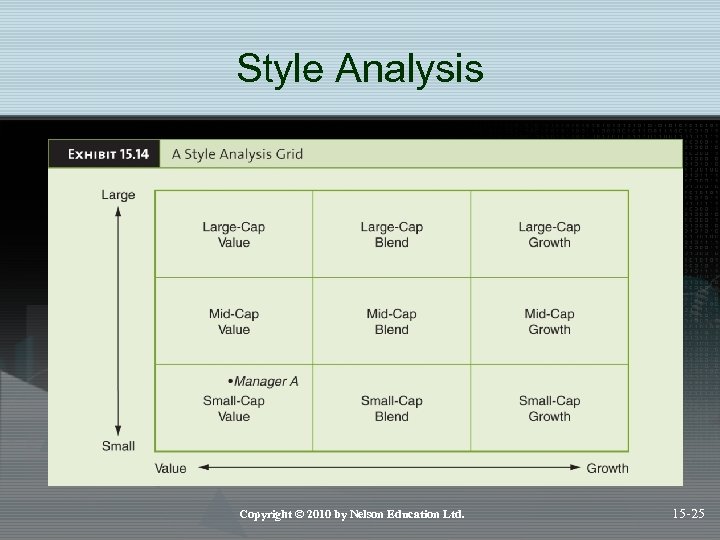
 Style Analysis • Construct a portfolio to capture one or more of the characteristics of equity securities • Small-cap stocks, low-P/E stocks, etc… • Value stocks (those that appear to be underpriced according to various measures) • Low Price/Book value or Price/Earnings ratios • Growth stocks (above-average earnings per share increases) • High P/E, possibly a price momentum strategy Copyright © 2010 by Nelson Education Ltd. 15 -24
 Style Analysis Copyright © 2010 by Nelson Education Ltd. 15 -25
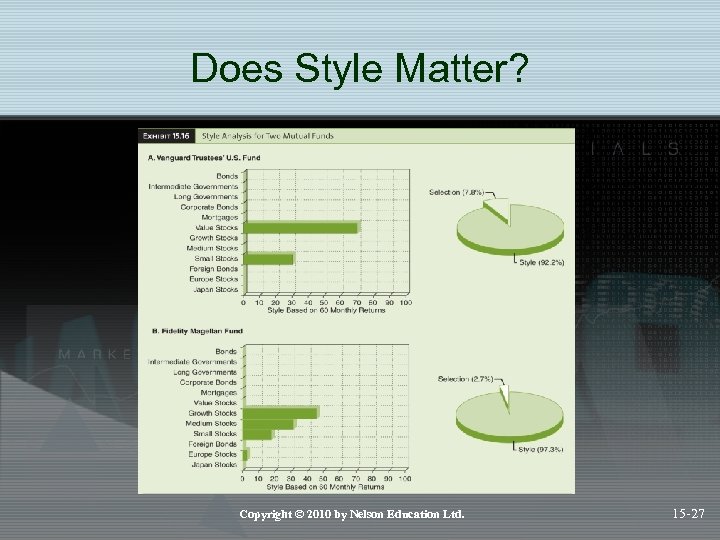
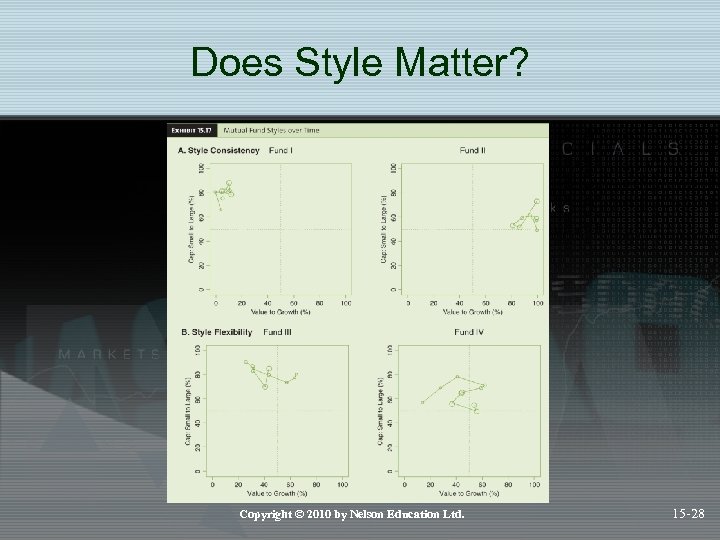
 Does Style Matter? • Choice to align with investment style communicates information to clients • Determining style is useful in measuring performance relative to a benchmark • Style identification allows an investor to diversify by portfolio • Style investing allows control of the total portfolio to be shared between the investment managers and a sponsor • Intentional and unintentional style drift Copyright © 2010 by Nelson Education Ltd. 15 -26
 Does Style Matter? Copyright © 2010 by Nelson Education Ltd. 15 -27
 Does Style Matter? Copyright © 2010 by Nelson Education Ltd. 15 -28
 Asset Allocation Strategies • Integrated asset allocation • Capital market conditions • Investor’s objectives and constraints • Strategic asset allocation • Constant-mix Copyright © 2010 by Nelson Education Ltd. 15 -29
 Asset Allocation Strategies • Tactical asset allocation • Mean reversion • Inherently contrarian • Insured asset allocation • Constant proportion Copyright © 2010 by Nelson Education Ltd. 15 -30
 Asset Allocation Strategies • Selecting an Active Allocation Method • Perceptions of variability in the client’s objectives and constraints • Perceived relationship between the past and future capital market conditions • The investor’s needs and capital market conditions are can be considered constant and can be considered variable Copyright © 2010 by Nelson Education Ltd. 15 -31