


 Скачать презентацию 15 Intellectual Development from Six Chapter 15 Intellectual
ae9622c1accdf3772fafd51d5ce6a329.ppt
- Количество слайдов: 30
 15 Intellectual Development from Six Chapter 15 Intellectual Development from Four to Six Chapter Contents § Section 15. 1 Brain Development from Four to Six § Section 15. 2 Learning from Four to Six Glencoe The Developing Child Chapter 15 Intellectual Development from Four to Six 1
 Chapter 15 Intellectual Development from Four to Six Section 15. 1 Brain Development from Four to Six • There are eight basic types of intelligence. • Piaget, Vygotsky, and Montessori developed three of the many theories about intelligence and how people learn. Glencoe The Developing Child Chapter 15 Intellectual Development from Four to Six 2
 Chapter 15 Intellectual Development from Four to Six Content Vocabulary Academic Vocabulary intelligence quotient (IQ) regulate cultural bias oriented multiple intelligences Glencoe The Developing Child Chapter 15 Intellectual Development from Four to Six 3
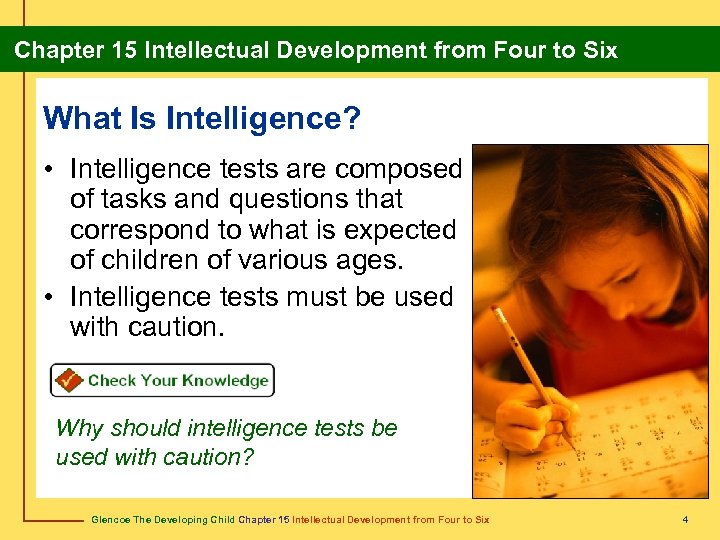 Chapter 15 Intellectual Development from Four to Six What Is Intelligence? • Intelligence tests are composed of tasks and questions that correspond to what is expected of children of various ages. • Intelligence tests must be used with caution. Why should intelligence tests be used with caution? Glencoe The Developing Child Chapter 15 Intellectual Development from Four to Six 4
 Chapter 15 Intellectual Development from Four to Six What Is Intelligence? • Gardner identified eight multiple intelligences: • linguistic • logical-mathematical • spatial • musical multiple intelligences Abilities in problem solving • bodily-kinesthetic or creating materials that have value. • interpersonal • intrapersonal • naturalist Glencoe The Developing Child Chapter 15 Intellectual Development from Four to Six 5
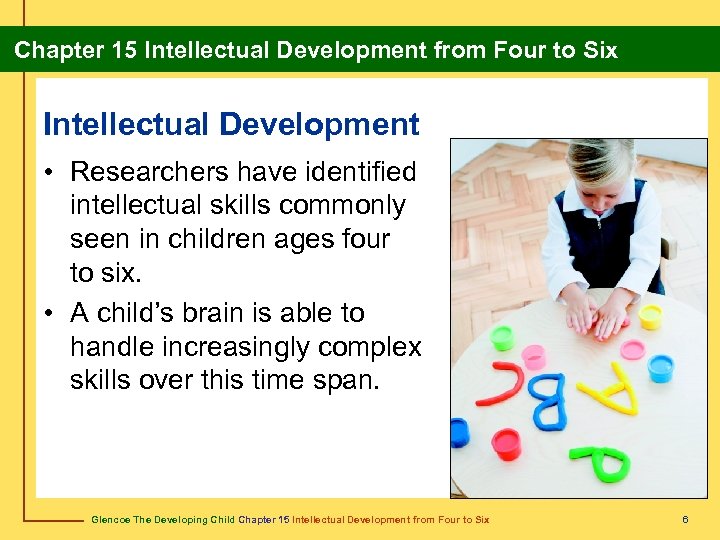 Chapter 15 Intellectual Development from Four to Six Intellectual Development • Researchers have identified intellectual skills commonly seen in children ages four to six. • A child’s brain is able to handle increasingly complex skills over this time span. Glencoe The Developing Child Chapter 15 Intellectual Development from Four to Six 6
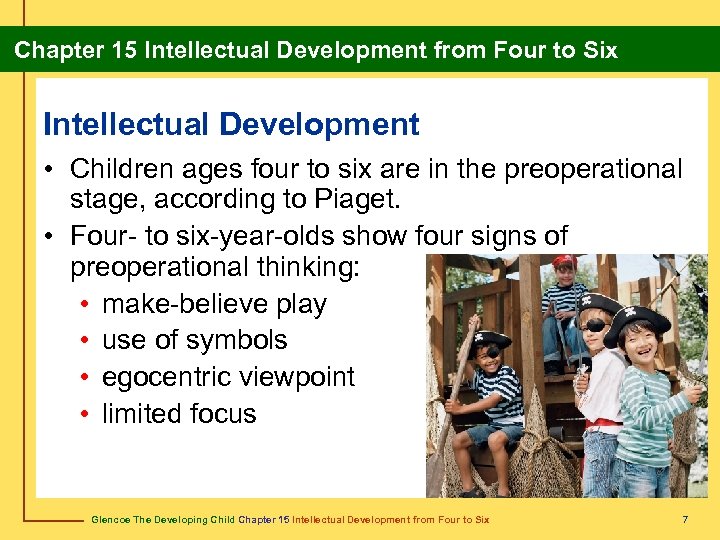 Chapter 15 Intellectual Development from Four to Six Intellectual Development • Children ages four to six are in the preoperational stage, according to Piaget. • Four- to six-year-olds show four signs of preoperational thinking: • make-believe play • use of symbols • egocentric viewpoint • limited focus Glencoe The Developing Child Chapter 15 Intellectual Development from Four to Six 7
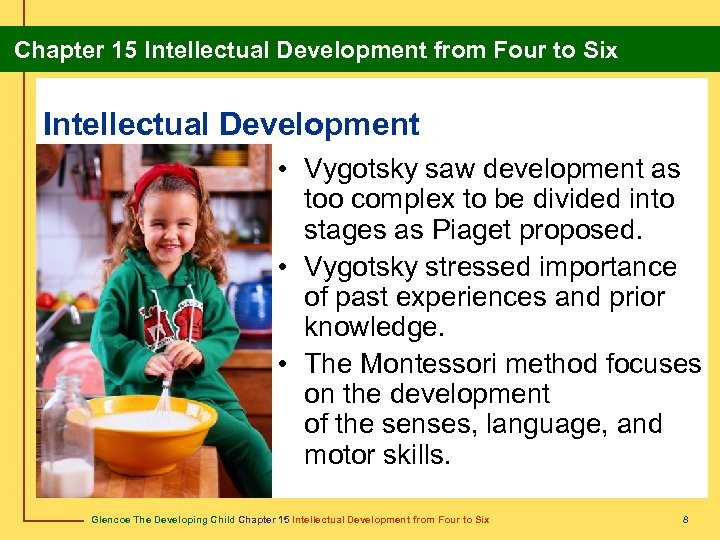 Chapter 15 Intellectual Development from Four to Six Intellectual Development • Vygotsky saw development as too complex to be divided into stages as Piaget proposed. • Vygotsky stressed importance of past experiences and prior knowledge. • The Montessori method focuses on the development of the senses, language, and motor skills. Glencoe The Developing Child Chapter 15 Intellectual Development from Four to Six 8
 Chapter 15 Intellectual Development from Four to Six Section 15. 2 Learning from Four to Six • Parents and caregivers find ways to assist their children in learning, to promote interest in the arts, and to help them with speech development. • Parents also prepare children for the transition to school. Glencoe The Developing Child Chapter 15 Intellectual Development from Four to Six 9
 Chapter 15 Intellectual Development from Four to Six Content Vocabulary Academic Vocabulary phoneme foster alliteration articulation bilingual finger play Glencoe The Developing Child Chapter 15 Intellectual Development from Four to Six 10
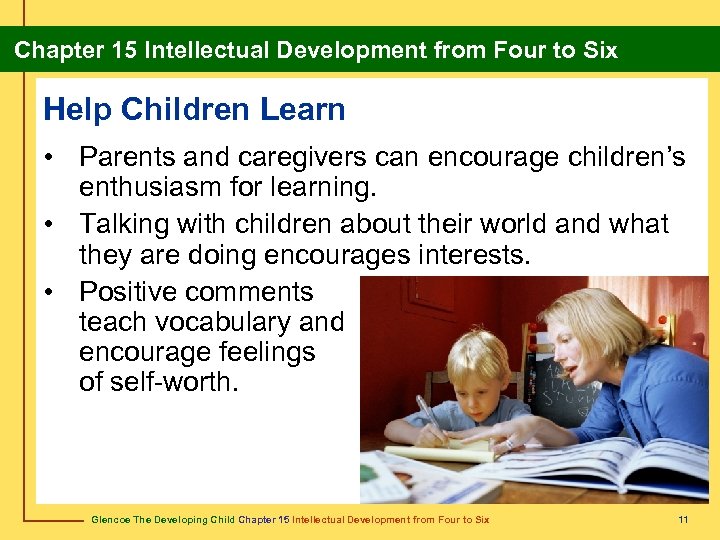 Chapter 15 Intellectual Development from Four to Six Help Children Learn • Parents and caregivers can encourage children’s enthusiasm for learning. • Talking with children about their world and what they are doing encourages interests. • Positive comments teach vocabulary and encourage feelings of self-worth. Glencoe The Developing Child Chapter 15 Intellectual Development from Four to Six 11
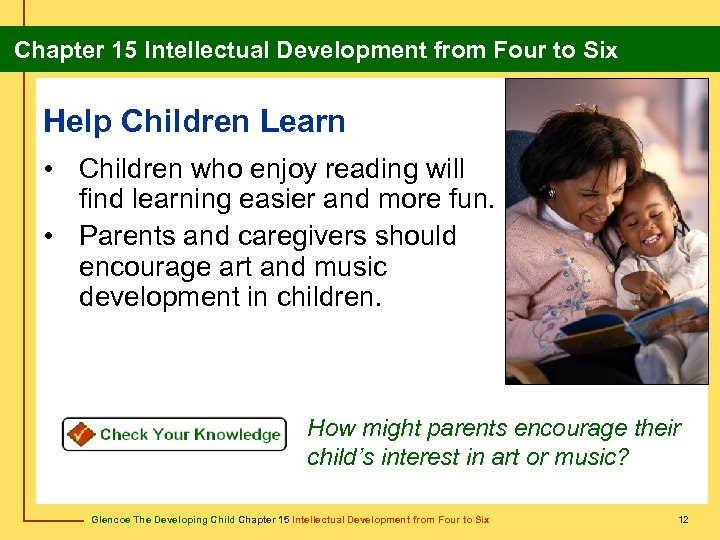 Chapter 15 Intellectual Development from Four to Six Help Children Learn • Children who enjoy reading will find learning easier and more fun. • Parents and caregivers should encourage art and music development in children. How might parents encourage their child’s interest in art or music? Glencoe The Developing Child Chapter 15 Intellectual Development from Four to Six 12
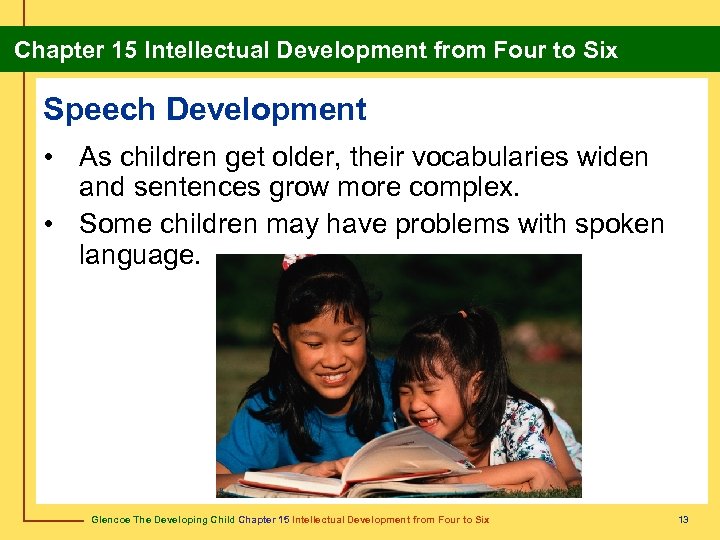 Chapter 15 Intellectual Development from Four to Six Speech Development • As children get older, their vocabularies widen and sentences grow more complex. • Some children may have problems with spoken language. Glencoe The Developing Child Chapter 15 Intellectual Development from Four to Six 13
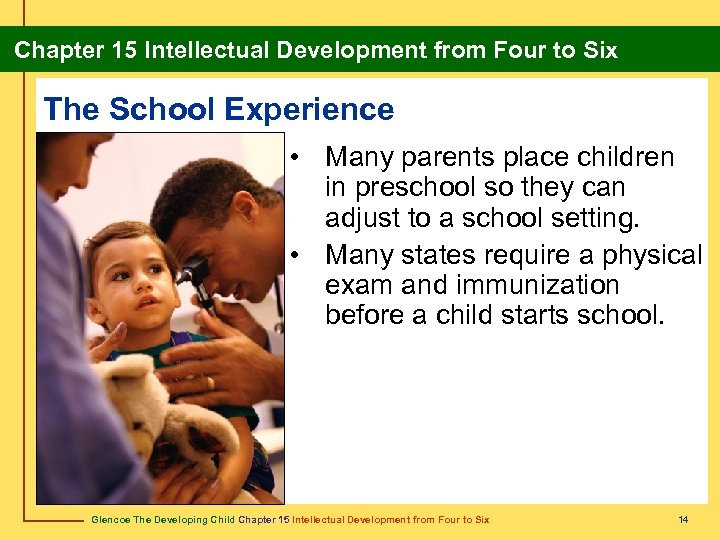 Chapter 15 Intellectual Development from Four to Six The School Experience • Many parents place children in preschool so they can adjust to a school setting. • Many states require a physical exam and immunization before a child starts school. Glencoe The Developing Child Chapter 15 Intellectual Development from Four to Six 14
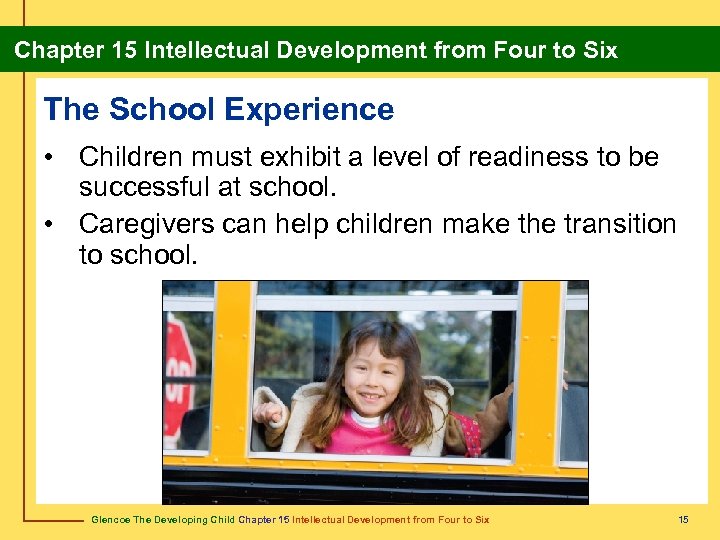 Chapter 15 Intellectual Development from Four to Six The School Experience • Children must exhibit a level of readiness to be successful at school. • Caregivers can help children make the transition to school. Glencoe The Developing Child Chapter 15 Intellectual Development from Four to Six 15
 Chapter 15 Intellectual Development from Four to Six Chapter Summary Section 15. 1 Brain Development from Four to Six • Intelligence tests vary for children of different ages. • Gardner identified eight types of intelligence. • Piaget’s theory says children ages two to seven are in the preoperational period of thinking. • Vygotsky and Montessori introduced influential theories of learning. Glencoe The Developing Child Chapter 15 Intellectual Development from Four to Six 16
 Chapter 15 Intellectual Development from Four to Six Chapter Summary Section 15. 2 Learning from Four to Six • Making reading a regular part of children’s lives will encourage them to enjoy books in the future and promote learning. • Between ages four and six, children’s language skills usually improve rapidly, but some children need help. • Children starting school can be helped to prepare for new situations. Glencoe The Developing Child Chapter 15 Intellectual Development from Four to Six 17
 Chapter 15 Intellectual Development from Four to Six Review Do you remember the vocabulary terms from this chapter? Use the following slides to check your knowledge of the definitions. The slides in this section include both English and Spanish terms and definitions. Start Glencoe The Developing Child Chapter 15 Intellectual Development from Four to Six 18
 Chapter 15 Intellectual Development from Four to Six intelligence quotient (IQ) coeficiente intelectual (CI) A number obtained by comparing a child’s test results to those of other children the same age. Número obtenido al comparar los resultados que obtiene un niño en un examen con los de otros niños de su misma edad. Show Definition Glencoe The Developing Child Chapter 15 Intellectual Development from Four to Six 19
 Chapter 15 Intellectual Development from Four to Six cultural bias predisposición cultural An advantage to people from one culture over other cultures. Ventaja de algunas personas sobre otras para pertenecer a una cultura específica. Show Definition Glencoe The Developing Child Chapter 15 Intellectual Development from Four to Six 20
 Chapter 15 Intellectual Development from Four to Six multiple intelligences inteligencia múltiple Abilities in problem solving or creating materials that have value. La habilidad de resolver problemas o crear materiales de alto valor. Show Definition Glencoe The Developing Child Chapter 15 Intellectual Development from Four to Six 21
 Chapter 15 Intellectual Development from Four to Six phoneme fonema The smallest individual Es el mínimo sonido sound in a word, such as individual en una the ou in house. palabra, como por ejemplo la c en casa. Show Definition Glencoe The Developing Child Chapter 15 Intellectual Development from Four to Six 22
 Chapter 15 Intellectual Development from Four to Six alliteration aliteración The repetition of beginning sounds. Repetición de sonidos al comienzo de palabras. Show Definition Glencoe The Developing Child Chapter 15 Intellectual Development from Four to Six 23
 Chapter 15 Intellectual Development from Four to Six bilingual bilingüe Able to speak two languages. Con la habilidad de hablar dos idiomas. Show Definition Glencoe The Developing Child Chapter 15 Intellectual Development from Four to Six 24
 Chapter 15 Intellectual Development from Four to Six finger play juego de dedos A song or chant with accompanying hand motions. Una canción o canto acompañado con movimientos de las manos. Show Definition Glencoe The Developing Child Chapter 15 Intellectual Development from Four to Six 25
 Chapter 15 Intellectual Development from Four to Six regulate regular To control and bring to a desired level. Controlar y poner en un nivel deseado. Show Definition Glencoe The Developing Child Chapter 15 Intellectual Development from Four to Six 26
 Chapter 15 Intellectual Development from Four to Six oriented orientado Directed or positioned in a particular way. Dirigido o posicionado en una forma particular. Show Definition Glencoe The Developing Child Chapter 15 Intellectual Development from Four to Six 27
 Chapter 15 Intellectual Development from Four to Six foster fomentar To encourage the development of something. Promover el desarrollo de algo. Show Definition Glencoe The Developing Child Chapter 15 Intellectual Development from Four to Six 28
 Chapter 15 Intellectual Development from Four to Six articulation articulación The ability to use clear, distinct speech. Habilidad para hablar de manera clara. Show Definition Glencoe The Developing Child Chapter 15 Intellectual Development from Four to Six 29
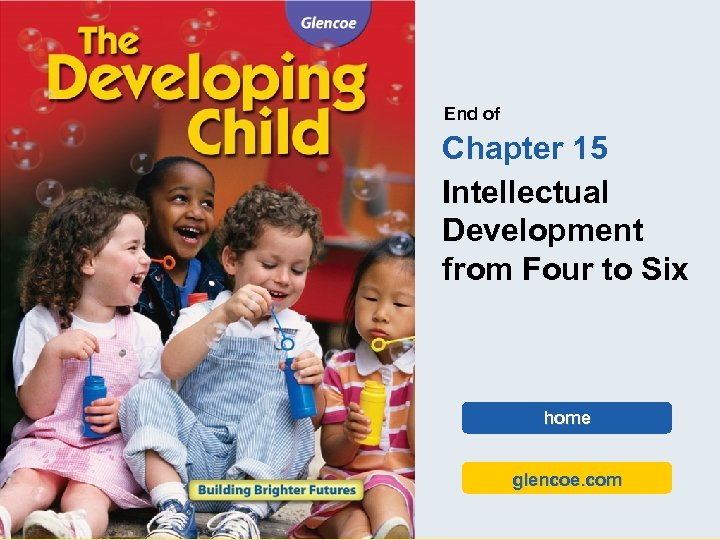 Chapter 15 Intellectual Development from Four to Six End of Chapter 15 Intellectual Development from Four to Six home glencoe. com Glencoe The Developing Child Chapter 15 Intellectual Development from Four to Six 30