


 Скачать презентацию 15 -744 Computer Networking L-18 Naming Today s
8c02dbf51fc8c75bb29184716f77036b.ppt
- Количество слайдов: 48
 15 -744: Computer Networking L-18 Naming
 Today’s Lecture • Naming and CDNs • Required readings • Middleboxes No Longer Considered Harmful • Internet Indirection Infrastructure • Optional readings • Democratizing content publication with Coral 2
 Overview • Akamai • I 3 • DOA 3
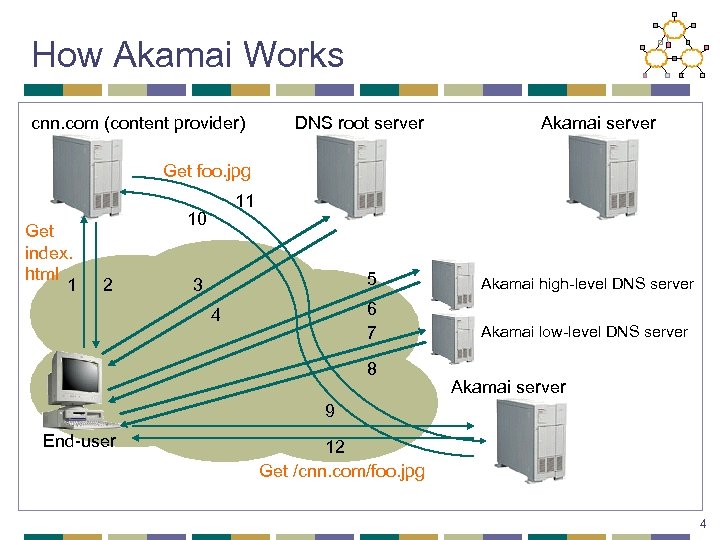 How Akamai Works cnn. com (content provider) DNS root server Akamai server Get foo. jpg Get index. html 1 11 10 2 5 4 Akamai high-level DNS server 6 7 3 Akamai low-level DNS server 8 Akamai server 9 End-user 12 Get /cnn. com/foo. jpg 4
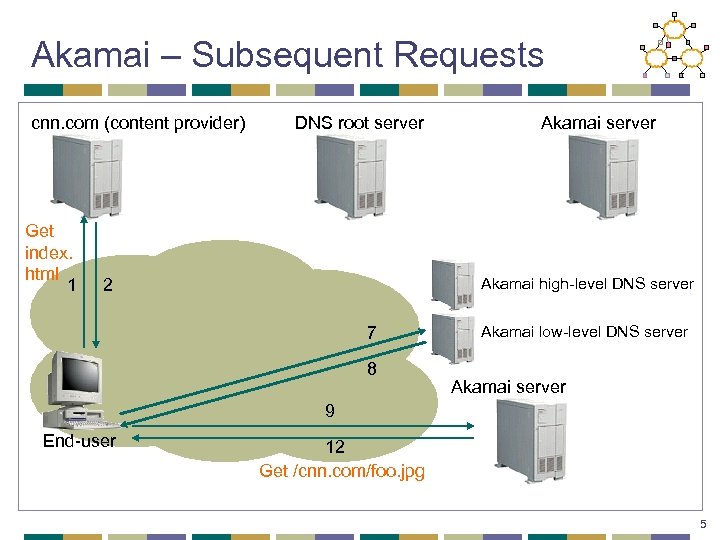 Akamai – Subsequent Requests cnn. com (content provider) Get index. html 1 DNS root server Akamai high-level DNS server 2 7 8 Akamai low-level DNS server Akamai server 9 End-user 12 Get /cnn. com/foo. jpg 5
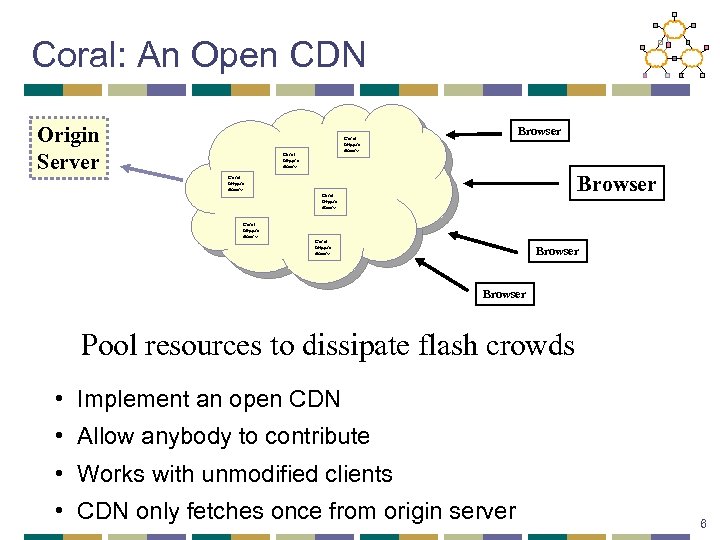 Coral: An Open CDN Origin Server Browser Coral httpprx dnssrv Coral httpprx dnssrv Browser Pool resources to dissipate flash crowds • Implement an open CDN • Allow anybody to contribute • Works with unmodified clients • CDN only fetches once from origin server 6
 Using Coral. CDN • Rewrite URLs into “Coralized” URLs • www. x. com → www. x. com. nyud. net: 8090 • Directs clients to Coral, which absorbs load • Who might “Coralize” URLs? • Web server operators Coralize URLs • Coralized URLs posted to portals, mailing lists • Users explicitly Coralize URLs 7
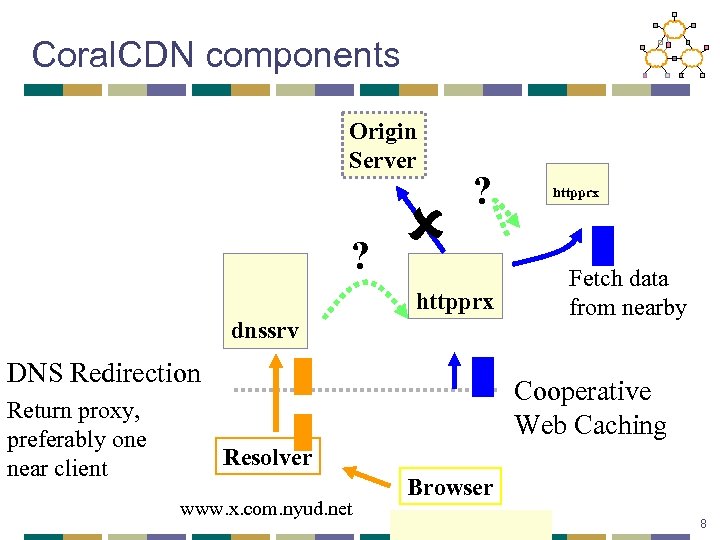 Coral. CDN components Origin Server ? ? httpprx Fetch data from nearby httpprx dnssrv DNS Redirection Return proxy, preferably one near client Cooperative Web Caching Resolver www. x. com. nyud. net Browser 216. 165. 108. 10 8
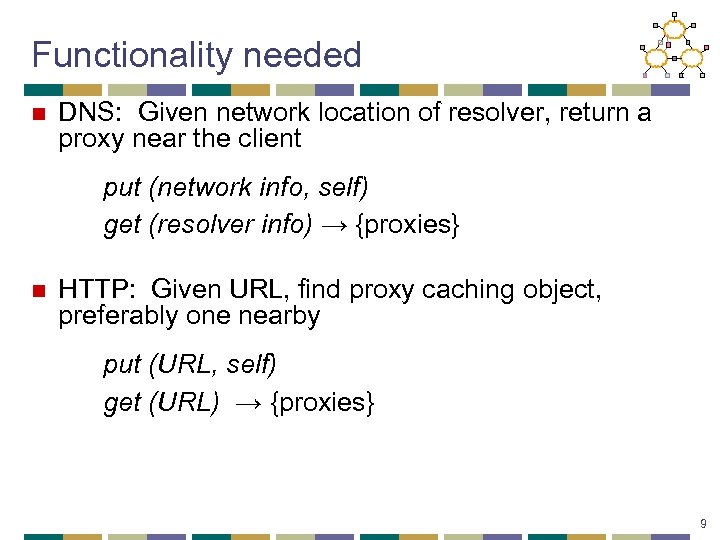 Functionality needed n DNS: Given network location of resolver, return a proxy near the client put (network info, self) get (resolver info) → {proxies} n HTTP: Given URL, find proxy caching object, preferably one nearby put (URL, self) get (URL) → {proxies} 9
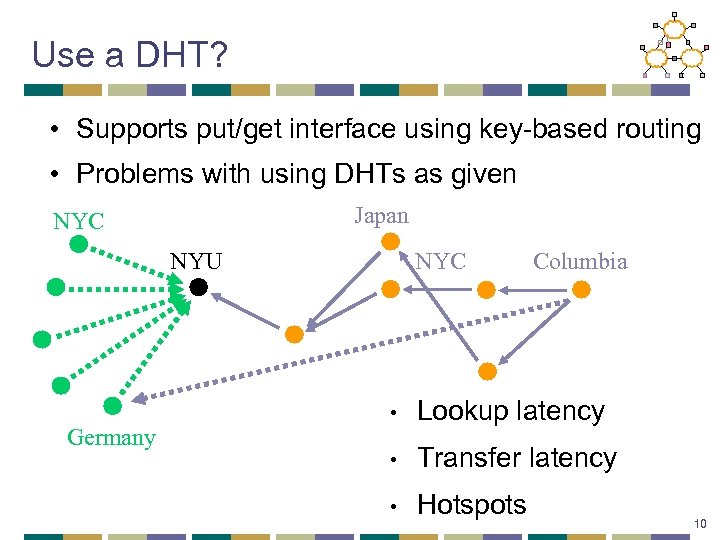 Use a DHT? • Supports put/get interface using key-based routing • Problems with using DHTs as given Japan NYC NYU Germany NYC Columbia • Lookup latency • Transfer latency • Hotspots 10
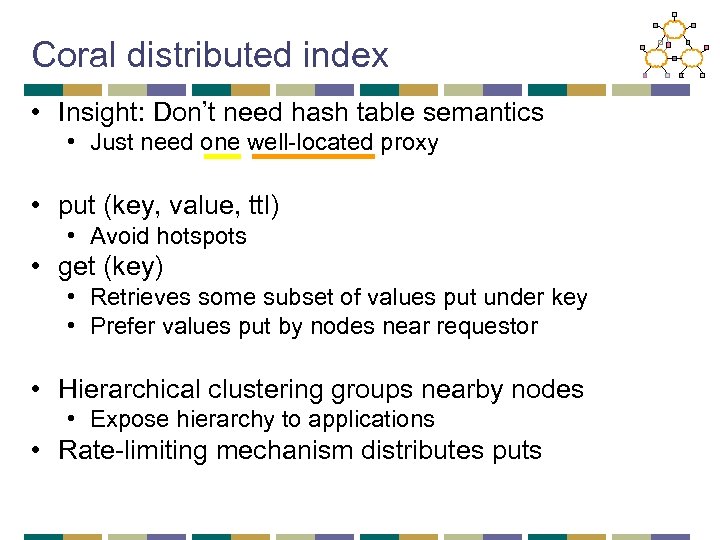 Coral distributed index • Insight: Don’t need hash table semantics • Just need one well-located proxy • put (key, value, ttl) • Avoid hotspots • get (key) • Retrieves some subset of values put under key • Prefer values put by nodes near requestor • Hierarchical clustering groups nearby nodes • Expose hierarchy to applications • Rate-limiting mechanism distributes puts
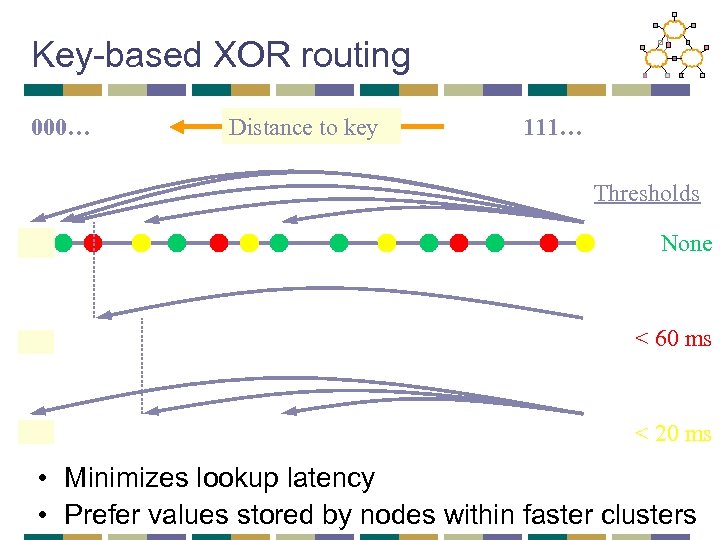 Key-based XOR routing 000… Distance to key 111… Thresholds None < 60 ms < 20 ms • Minimizes lookup latency • Prefer values stored by nodes within faster clusters
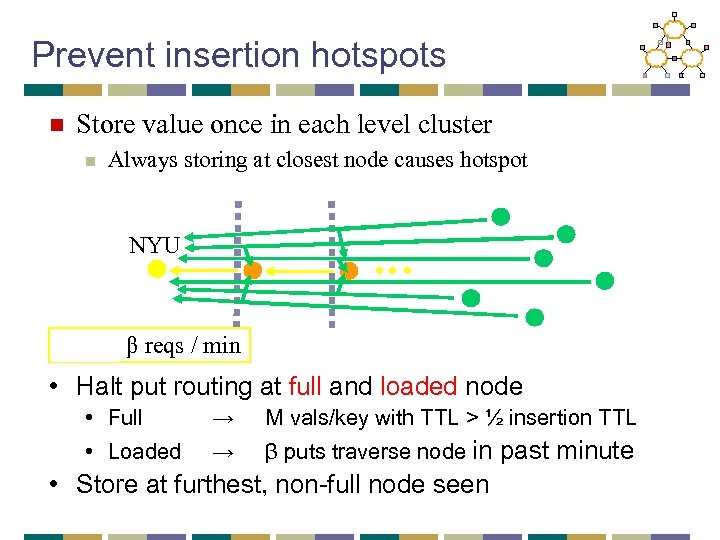 Prevent insertion hotspots n Store value once in each level cluster n Always storing at closest node causes hotspot NYU … (log n) β reqs / min • Halt put routing at full and loaded node • Full • Loaded → M vals/key with TTL > ½ insertion TTL → β puts traverse node in past minute • Store at furthest, non-full node seen
 Coral Contributions • Self-organizing clusters of nodes • NYU and Columbia prefer one another to Germany • Rate-limiting mechanism • Everybody caching and fetching same URL does not overload any node in system • Decentralized DNS Redirection • Works with unmodified clients No centralized management or a priori knowledge of proxies’ locations or network configurations 14
 Overview • Akamai • I 3 • DOA 15
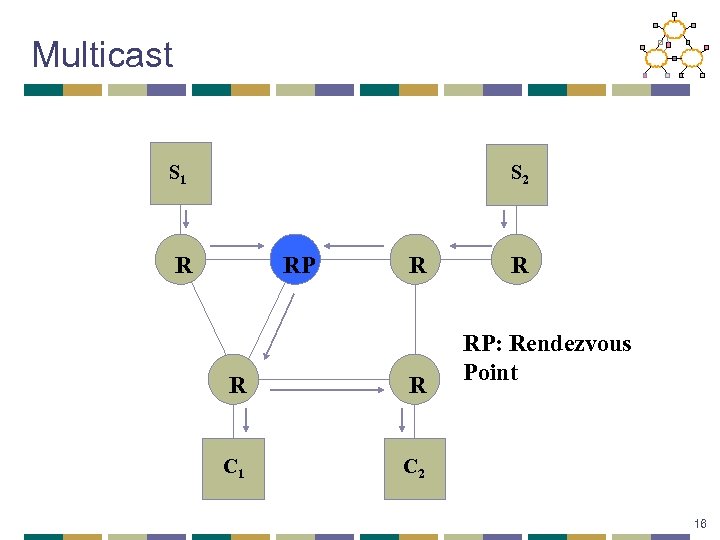 Multicast S 1 S 2 R RP R R R C 1 R RP: Rendezvous Point C 2 16
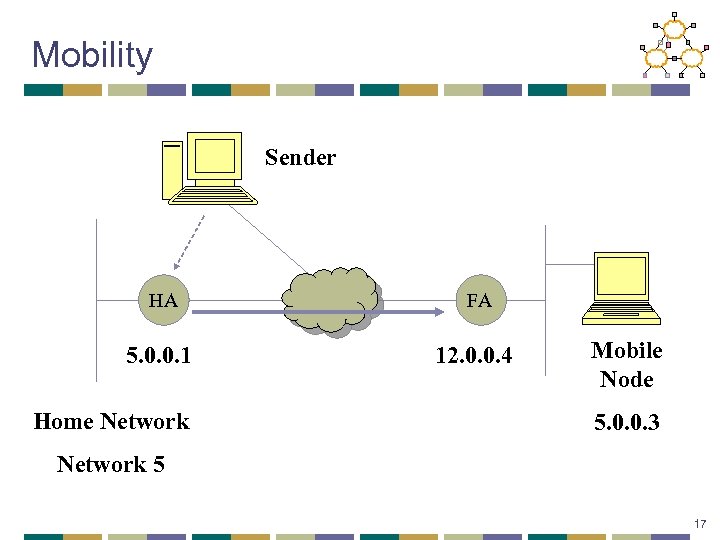 Mobility Sender HA FA 5. 0. 0. 1 12. 0. 0. 4 Home Network Mobile Node 5. 0. 0. 3 Network 5 17
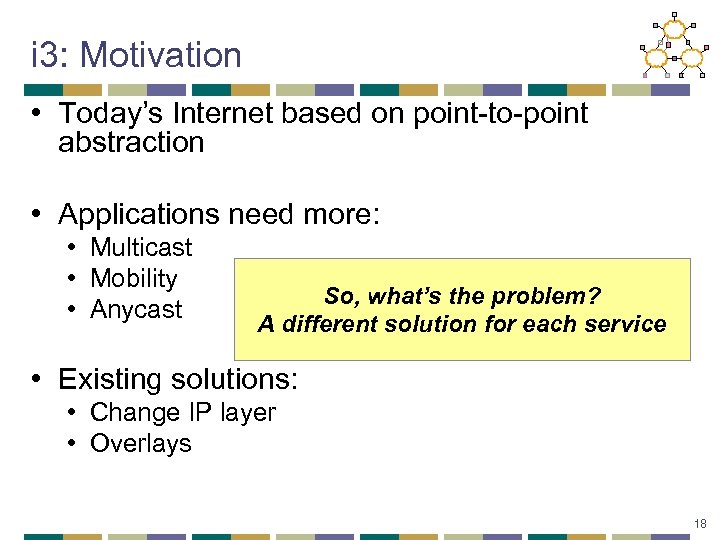 i 3: Motivation • Today’s Internet based on point-to-point abstraction • Applications need more: • Multicast • Mobility • Anycast So, what’s the problem? A different solution for each service • Existing solutions: • Change IP layer • Overlays 18
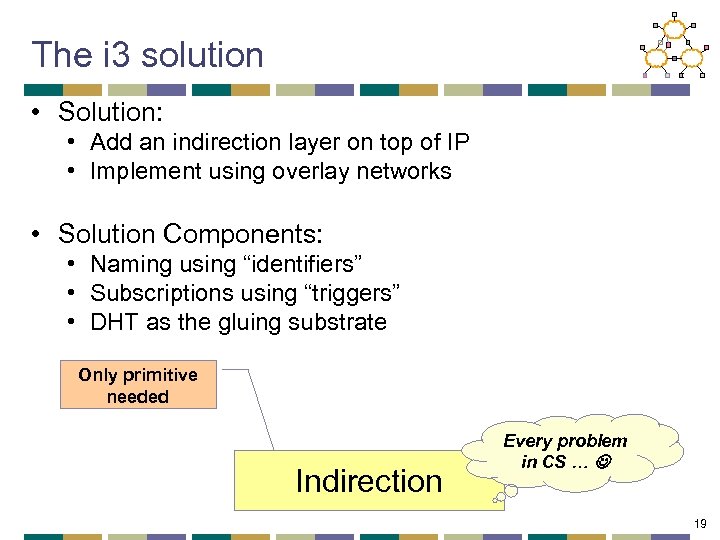 The i 3 solution • Solution: • Add an indirection layer on top of IP • Implement using overlay networks • Solution Components: • Naming using “identifiers” • Subscriptions using “triggers” • DHT as the gluing substrate Only primitive needed Indirection Every problem in CS … 19
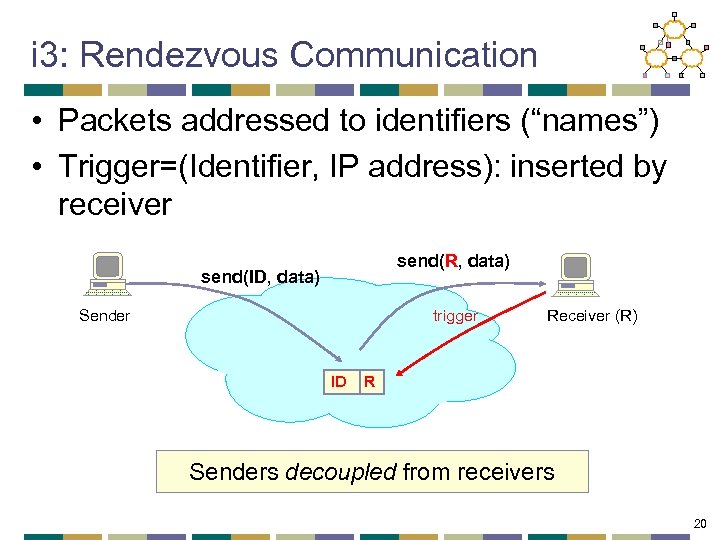 i 3: Rendezvous Communication • Packets addressed to identifiers (“names”) • Trigger=(Identifier, IP address): inserted by receiver send(R, data) send(ID, data) Sender trigger ID Receiver (R) R Senders decoupled from receivers 20
 i 3: Service Model • API • send. Packet(id, p); • insert. Trigger(id, addr); • remove. Trigger(id, addr); // optional • Best-effort service model (like IP) • Triggers periodically refreshed by end-hosts • Reliability, congestion control, and flowcontrol implemented at end-hosts 21
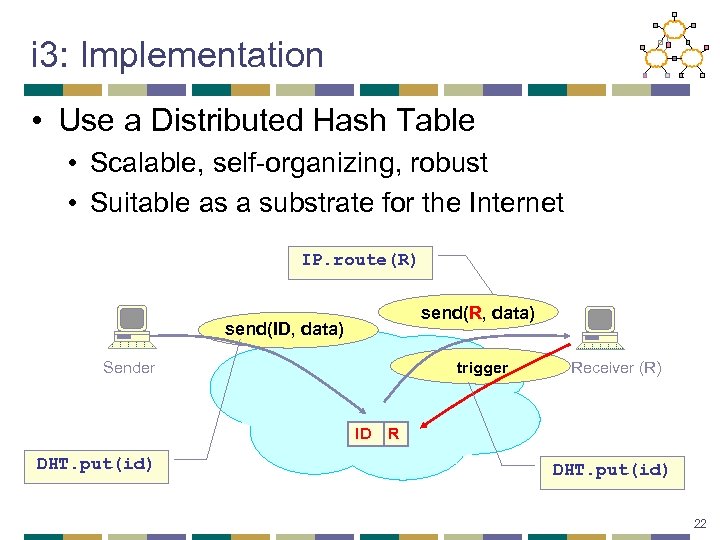 i 3: Implementation • Use a Distributed Hash Table • Scalable, self-organizing, robust • Suitable as a substrate for the Internet IP. route(R) send(R, data) send(ID, data) Sender trigger ID DHT. put(id) Receiver (R) R DHT. put(id) 22
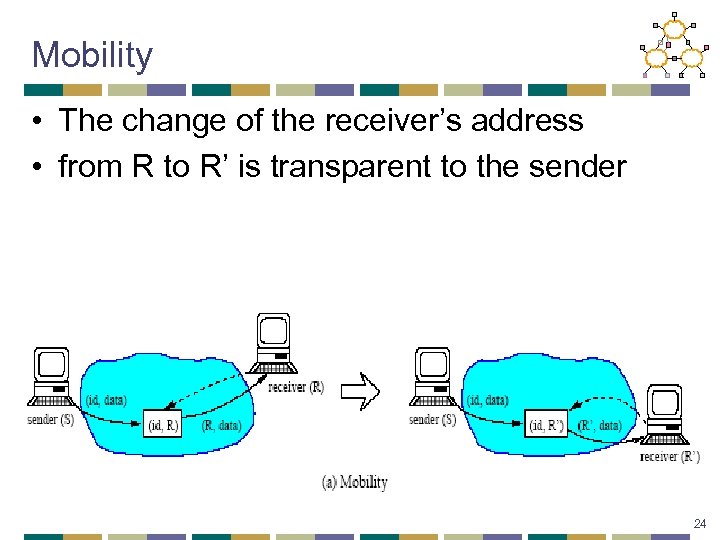 Mobility • The change of the receiver’s address • from R to R’ is transparent to the sender 24
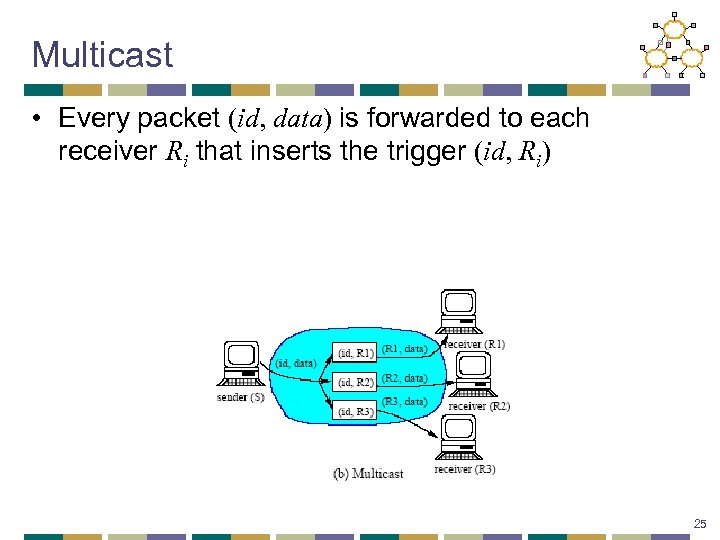 Multicast • Every packet (id, data) is forwarded to each receiver Ri that inserts the trigger (id, Ri) 25
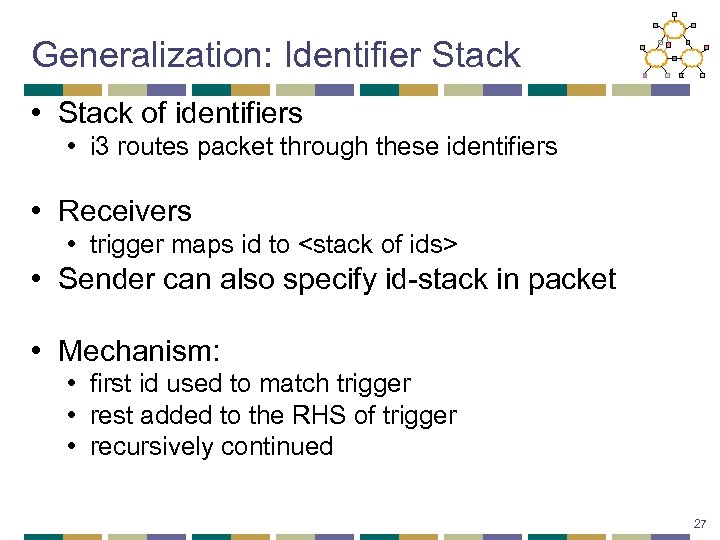 Generalization: Identifier Stack • Stack of identifiers • i 3 routes packet through these identifiers • Receivers • trigger maps id to
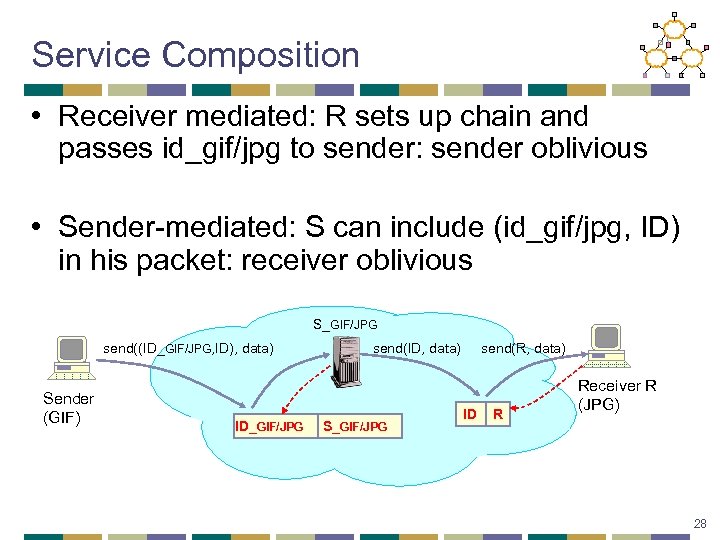 Service Composition • Receiver mediated: R sets up chain and passes id_gif/jpg to sender: sender oblivious • Sender-mediated: S can include (id_gif/jpg, ID) in his packet: receiver oblivious S_GIF/JPG send((ID_GIF/JPG, ID), data) Sender (GIF) ID_GIF/JPG send(R, data) send(ID, data) S_GIF/JPG ID R Receiver R (JPG) 28
 Overview • Akamai • I 3 • DOA 31
 Architectural Brittleness • Hosts are tied to IP addresses • Mobility and multi-homing pose problems • Services are tied to hosts • A service is more than just one host: replication, migration, composition • Packets might require processing at intermediaries before reaching destination • “Middleboxes” (NATs, firewalls, …) 32
 Reactions to the Problem • Purist: can’t live with middleboxes • Pragmatist: can’t live without middleboxes • Pluralist (us): purist, pragmatist both right • DOA goal: Architectural extension in which: • Middleboxes first-class Internet citizens • Harmful effects reduced, good effects kept • New functions arise 33
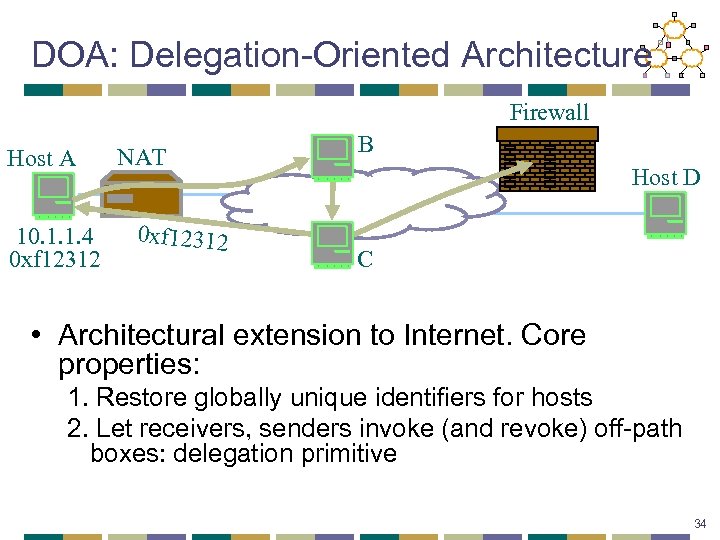 DOA: Delegation-Oriented Architecture Firewall Host A 10. 1. 1. 4 0 xf 12312 NAT 0 xf 12312 B Host D C • Architectural extension to Internet. Core properties: 1. Restore globally unique identifiers for hosts 2. Let receivers, senders invoke (and revoke) off-path boxes: delegation primitive 34
 Naming Can Help • Thesis: proper naming can cure some ills • Layered naming provides layers of indirection and shielding • Many proposals advocate large-scale, overarching architectural change • Routers, end-hosts, services • Proposal: • Changes “only” hosts and name resolution • Synthesis of much previous work 35
 Internet Naming is Host-Centric • Two global namespaces: DNS and IP addresses • These namespaces are host-centric • • IP addresses: network location of host DNS names: domain of host Both closely tied to an underlying structure Motivated by host-centric application • Such names constrain movement/replication 36
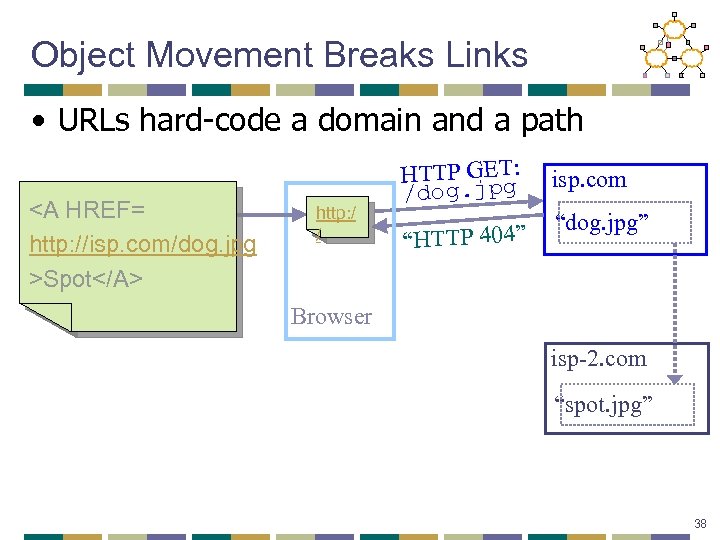 Object Movement Breaks Links • URLs hard-code a domain and a path Spot http: / / HTTP GET: /dog. jpg “HTTP 404” isp. com “dog. jpg” Browser isp-2. com “spot. jpg” 38
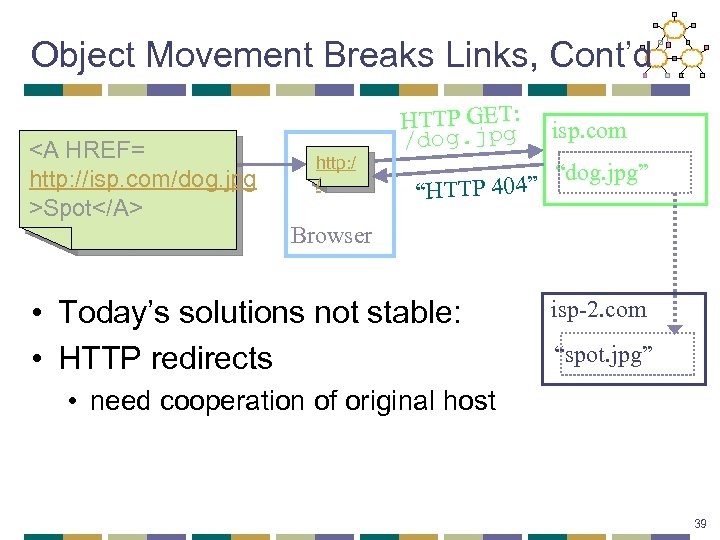 Object Movement Breaks Links, Cont’d Spot http: / / HTTP GET: /dog. jpg “HTTP 404” isp. com “dog. jpg” Browser • Today’s solutions not stable: • HTTP redirects isp-2. com “spot. jpg” • need cooperation of original host 39
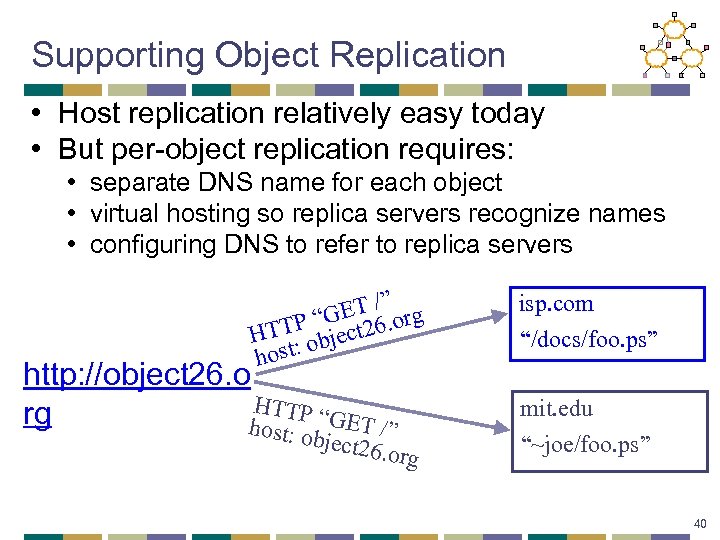 Supporting Object Replication • Host replication relatively easy today • But per-object replication requires: • separate DNS name for each object • virtual hosting so replica servers recognize names • configuring DNS to refer to replica servers /” GET 6. org “ TTP bject 2 H : o host http: //object 26. o HTTP rg “GET hos /” t: objec t 26. org isp. com “/docs/foo. ps” mit. edu “~joe/foo. ps” 40
 Key Architectural Questions • Which entities should be named? • What should names look like? • What should names resolve to? 41
 Delegation • Names usually resolve to “location” of entity • Packets might require processing at intermediaries before reaching destination • Such processing today violates layering • Only element identified by packet’s IP destination should inspect higher layers Delegation principle: A network entity should be able to direct resolutions of its name not only to its own location, but also to chosen delegates 42
 Name Services and Hosts Separately • Service identifiers (SIDs) are hostindependent data names • End-point identifiers (EIDs) are locationindependent host names • Protocols bind to names, and resolve them • Apps should use SIDs as data handles • Transport connections should bind to EIDs Binding principle: Names should bind protocols only to relevant aspects of underlying structure 43
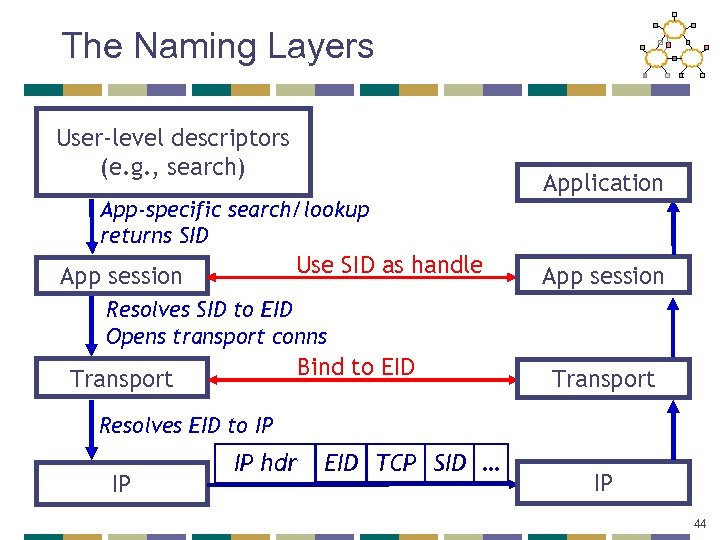 The Naming Layers User-level descriptors (e. g. , search) App-specific search/lookup returns SID Use SID as handle App session Application App session Resolves SID to EID Opens transport conns Bind to EID Transport Resolves EID to IP IP IP hdr EID TCP SID … IP 44
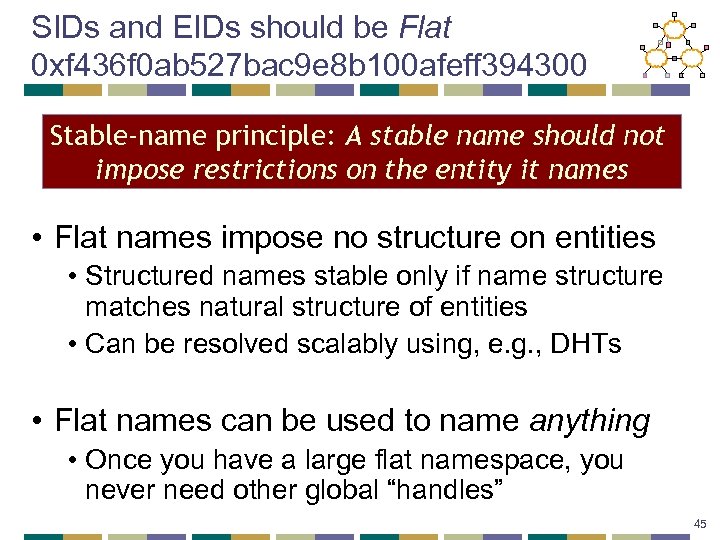 SIDs and EIDs should be Flat 0 xf 436 f 0 ab 527 bac 9 e 8 b 100 afeff 394300 Stable-name principle: A stable name should not impose restrictions on the entity it names • Flat names impose no structure on entities • Structured names stable only if name structure matches natural structure of entities • Can be resolved scalably using, e. g. , DHTs • Flat names can be used to name anything • Once you have a large flat namespace, you never need other global “handles” 45
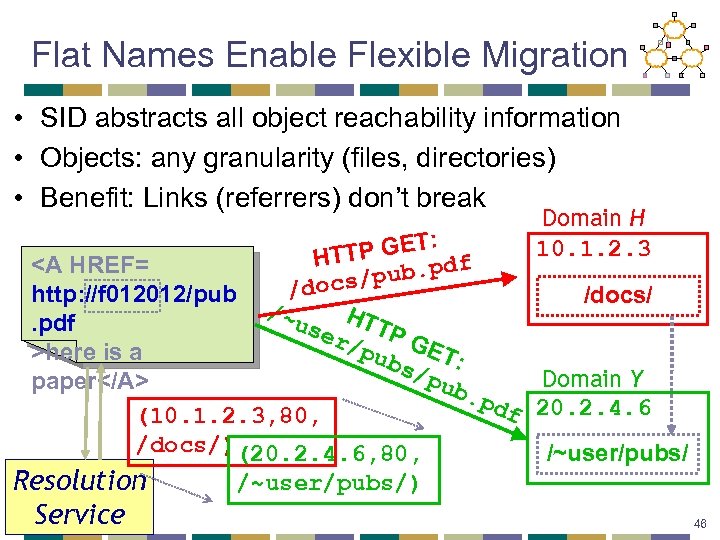 Flat Names Enable Flexible Migration • SID abstracts all object reachability information • Objects: any granularity (files, directories) • Benefit: Links (referrers) don’t break Domain H 10. 1. 2. 3 : TP GET df HT here is a bs/ : pub Domain Y paper. pd f 20. 2. 4. 6 (10. 1. 2. 3, 80, /docs/)(20. 2. 4. 6, 80, /~user/pubs/) Resolution Service 46
 Flat Names are a Two-Edged Sword • Global resolution infrastructure needed • Perhaps as “managed DHT” infrastructure • Lack of local name control • Lack of locality • Not user-friendly • User-level descriptors are human-friendly 47
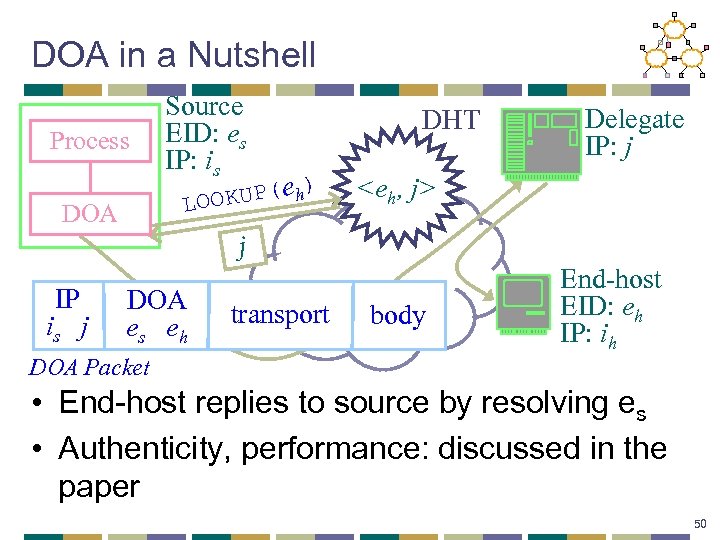
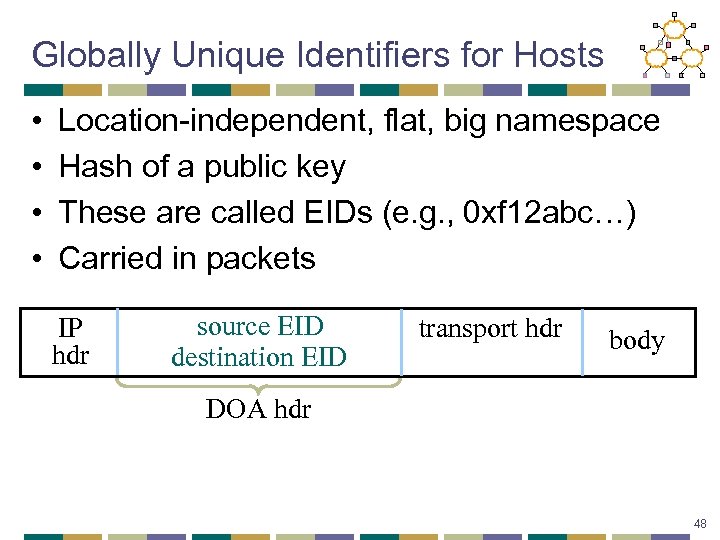 Globally Unique Identifiers for Hosts • • Location-independent, flat, big namespace Hash of a public key These are called EIDs (e. g. , 0 xf 12 abc…) Carried in packets IP hdr source EID destination EID transport hdr body DOA hdr 48
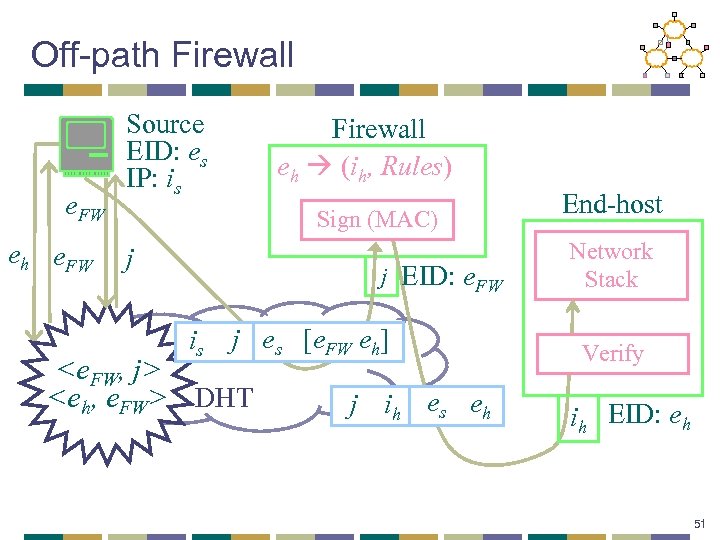
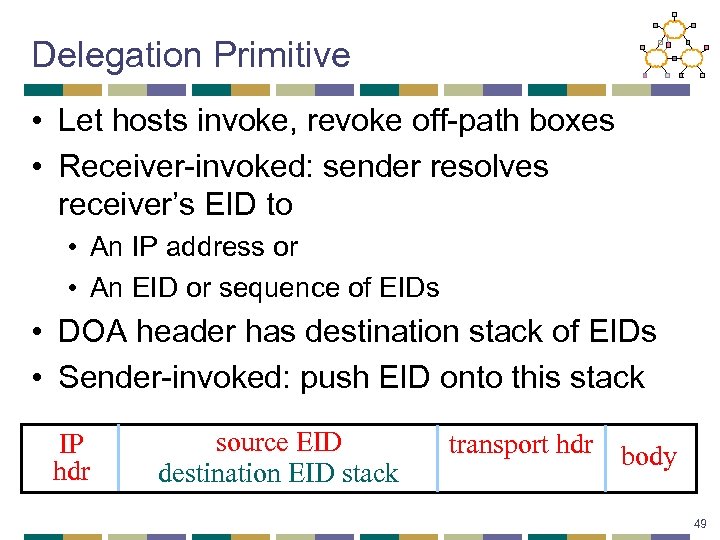 Delegation Primitive • Let hosts invoke, revoke off-path boxes • Receiver-invoked: sender resolves receiver’s EID to • An IP address or • An EID or sequence of EIDs • DOA header has destination stack of EIDs • Sender-invoked: push EID onto this stack IP hdr source EID destination EID stack transport hdr body 49
 DOA in a Nutshell Process Source EID: es IP: is ) OKUP(e h LO DOA DHT Delegate IP: j
 Off-path Firewall e. FW eh e. FW Source EID: es IP: is Firewall eh (ih, Rules) Sign (MAC) j j EID: e. FW is j es [e. FW eh]
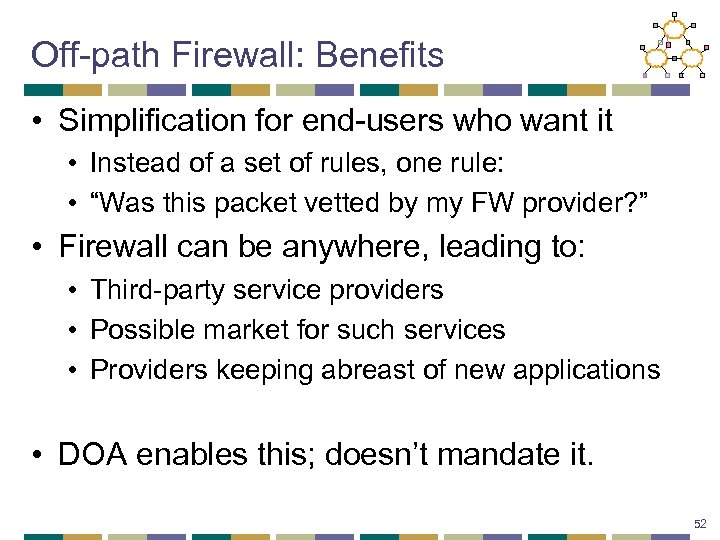 Off-path Firewall: Benefits • Simplification for end-users who want it • Instead of a set of rules, one rule: • “Was this packet vetted by my FW provider? ” • Firewall can be anywhere, leading to: • Third-party service providers • Possible market for such services • Providers keeping abreast of new applications • DOA enables this; doesn’t mandate it. 52
 Next Lecture • Data-oriented networking and DTNs • Required reading: • Networking Named Content • A Delay-Tolerant Network Architecture for Challenged Internets • Optional reading: • An Architecture for Internet Data Transfer • A Data-Oriented (and Beyond) Network Architecture 53