


 Скачать презентацию 15 -251 Some Great Theoretical Ideas in Computer
dfd793fe6ebd03e9d9d216259bd46853.ppt
- Количество слайдов: 54
 15 -251 Some Great Theoretical Ideas in Computer Science for
 This Course…
 Probability Refresher What’s a Random Variable? A Random Variable is a real-valued function on a sample space S E[X+Y] = E[X] + E[Y]
![Probability Refresher What does this mean: E[X | A]? Is this true: Pr[ A](https://present5.com/presentation/dfd793fe6ebd03e9d9d216259bd46853/image-4.jpg "Probability Refresher What does this mean: E[X | A]? Is this true: Pr[ A") Probability Refresher What does this mean: E[X | A]? Is this true: Pr[ A ] = Pr[ A | B ] Pr[ B ] + Pr[ A | B ] Pr[ B ] Yes! Similarly: E[ X ] = E[ X | A ] Pr[ A ] + E[ X | A ] Pr[ A ]
Probability Refresher What does this mean: E[X | A]? Is this true: Pr[ A ] = Pr[ A | B ] Pr[ B ] + Pr[ A | B ] Pr[ B ] Yes! Similarly: E[ X ] = E[ X | A ] Pr[ A ] + E[ X | A ] Pr[ A ]
 Air Marshal Problem Every passenger has an assigned seat There are n-1 passengers and n seats Before the passengers board, an air marshal sits on a random seat When a passenger enters the plane, if their assigned seat is taken, they pick a seat at random What is the probability that the last passenger to enter the plane sits in their assigned seat?
 Several years ago Berkeley faced a law suit … 1. % of male applicants admitted to graduate school was 10% 2. % of female applicants admitted to graduate school was 5% Grounds for discrimination? SUIT
 Berkeley did a survey of its departments to find out which ones were at fault
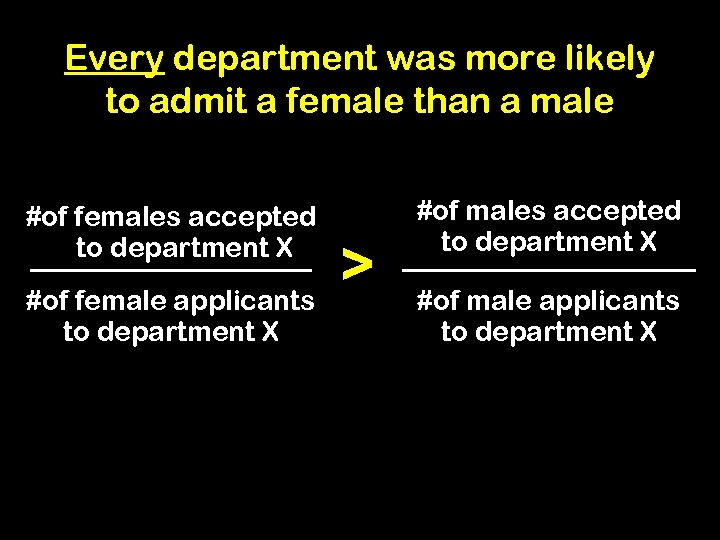 Every department was more likely to admit a female than a male #of females accepted to department X #of female applicants to department X > #of males accepted to department X #of male applicants to department X
 How can this be ?
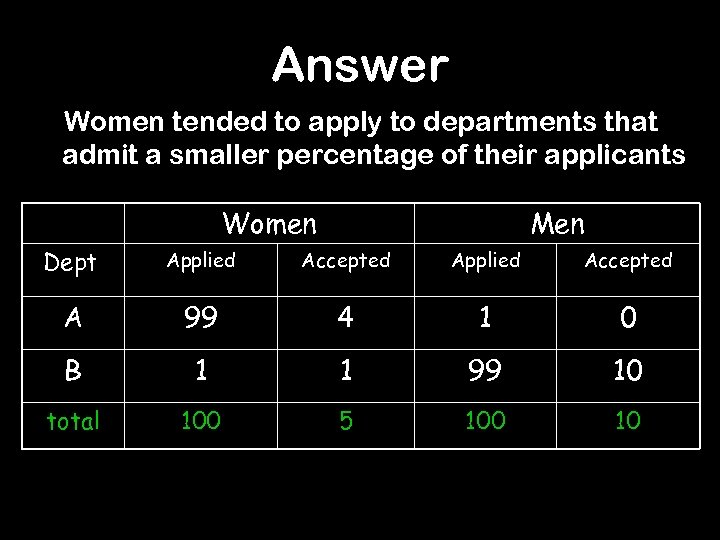 Answer Women tended to apply to departments that admit a smaller percentage of their applicants Women Men Dept Applied Accepted A 99 4 1 0 B 1 1 99 10 total 100 5 100 10
 A single summary statistic (such as an average, or a median) may not summarize the data well !
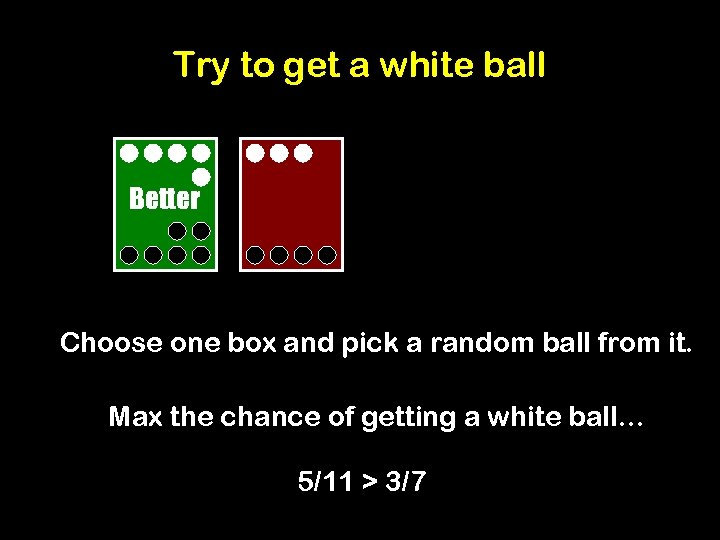 Try to get a white ball Better Choose one box and pick a random ball from it. Max the chance of getting a white ball… 5/11 > 3/7
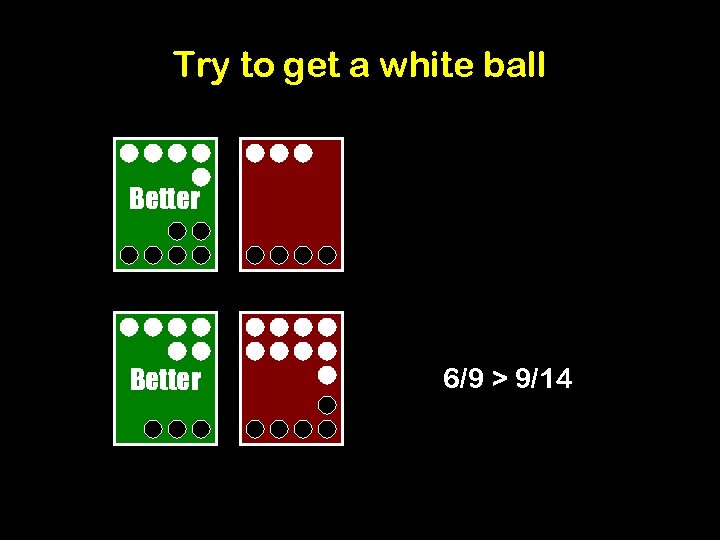 Try to get a white ball Better 6/9 > 9/14
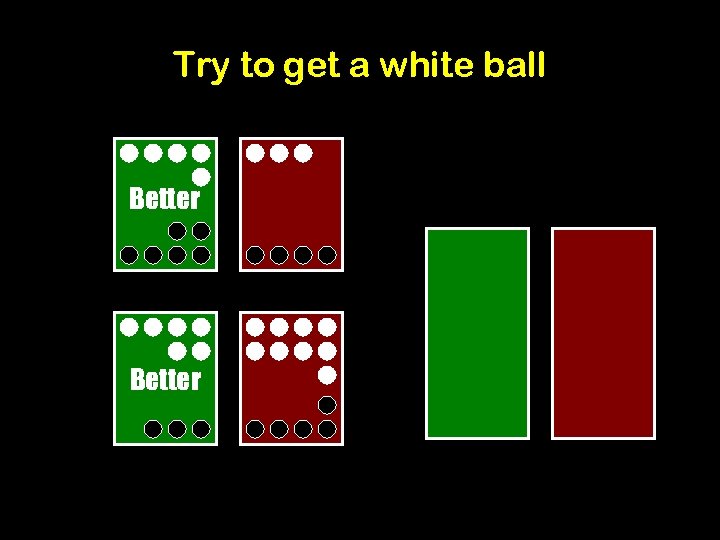 Try to get a white ball Better
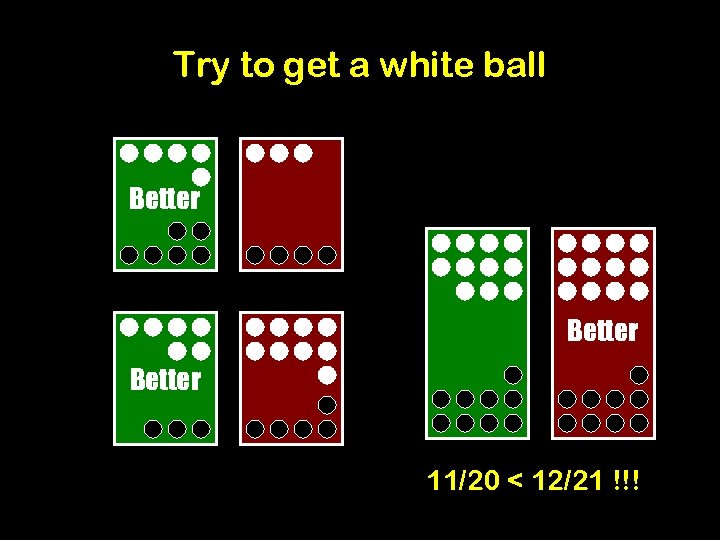 Try to get a white ball Better 11/20 < 12/21 !!!
 Simpson’s Paradox Arises all the time… Be careful when you interpret numbers
 Department of Transportation requires that each month all airlines report their “on-time record” # of on-time flights landing at nation’s 30 busiest airports # of total flights into those airports http: //www. bts. gov/programs/oai/
 Different airlines serve different airports with different frequency An airline sending most of its planes into fair weather airports will crush an airline flying mostly into foggy airports It can even happen that an airline has a better record at each airport, but gets a worse overall rating by this method.
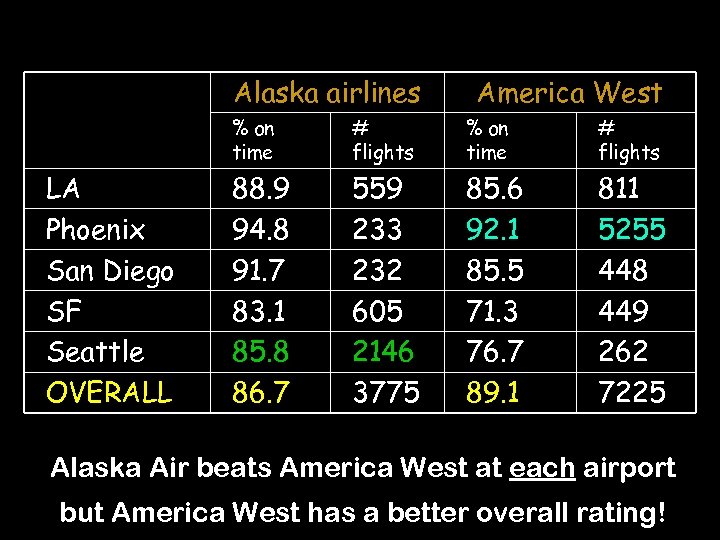 Alaska airlines America West % on time LA Phoenix San Diego SF Seattle OVERALL # flights % on time # flights 88. 9 94. 8 91. 7 83. 1 85. 8 86. 7 559 233 232 605 2146 3775 85. 6 92. 1 85. 5 71. 3 76. 7 89. 1 811 5255 448 449 262 7225 Alaska Air beats America West at each airport but America West has a better overall rating!
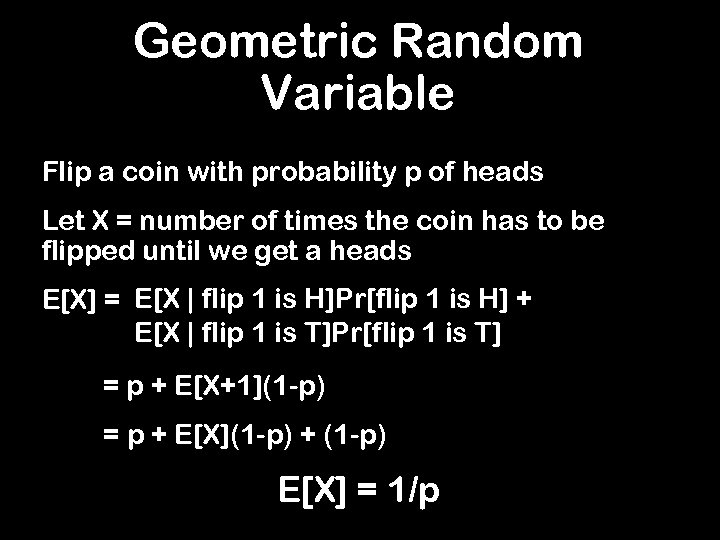 Geometric Random Variable Flip a coin with probability p of heads Let X = number of times the coin has to be flipped until we get a heads E[X] = E[X | flip 1 is H]Pr[flip 1 is H] + E[X | flip 1 is T]Pr[flip 1 is T] = p + E[X+1](1 -p) = p + E[X](1 -p) + (1 -p) E[X] = 1/p
 CMULand All CMU SCS students fly off to space and colonize the moon Faced with the problem that there are more men than women, the authorities impose a new rule: When having kids, stop after you have a girl Will the number of new girls be higher than the number of new boys? What if the rule is: stop after having two girls?
 Coupon Collector’s Problem There are n types of coupons in cereal boxes Want to collect them all On average, how many cereal boxes do I have to buy to get them all?
 Random Walks Lecture 12 (February 19, 2009)
 How to walk home drunk
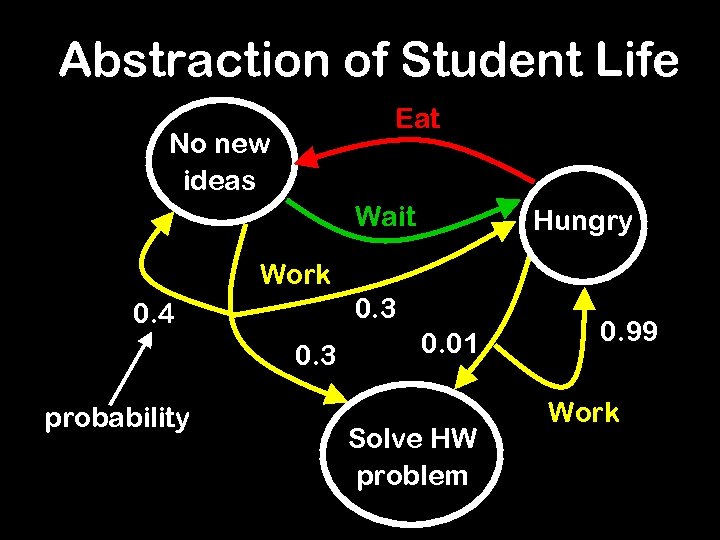 Abstraction of Student Life Eat No new ideas Wait Hungry Work 0. 3 0. 4 0. 3 probability 0. 01 Solve HW problem 0. 99 Work
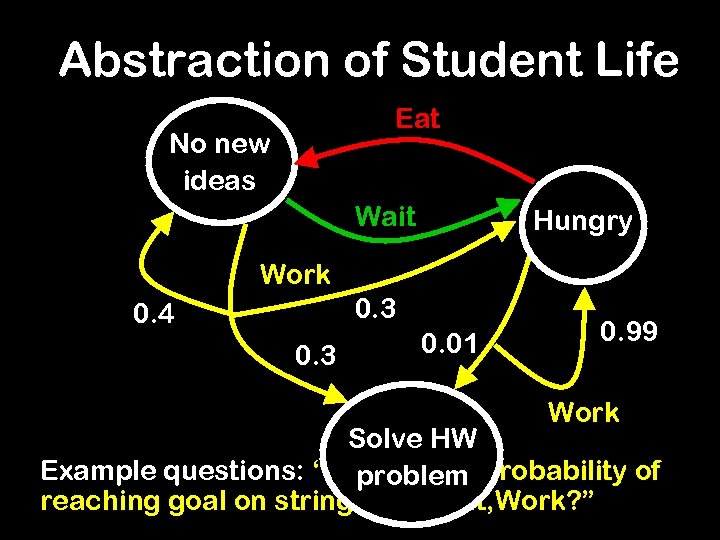 Abstraction of Student Life Eat No new ideas Wait Hungry Work 0. 3 0. 4 0. 3 0. 01 0. 99 Work Solve HW Example questions: “What is the probability of problem reaching goal on string Work, Eat, Work? ”
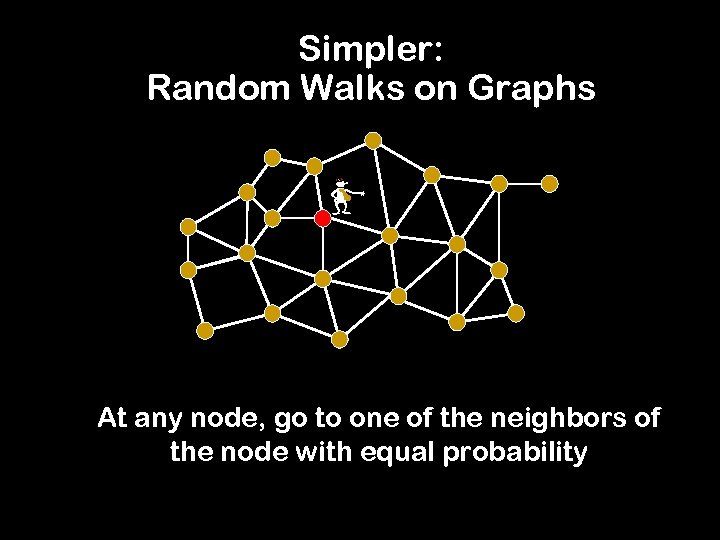 Simpler: Random Walks on Graphs - At any node, go to one of the neighbors of the node with equal probability
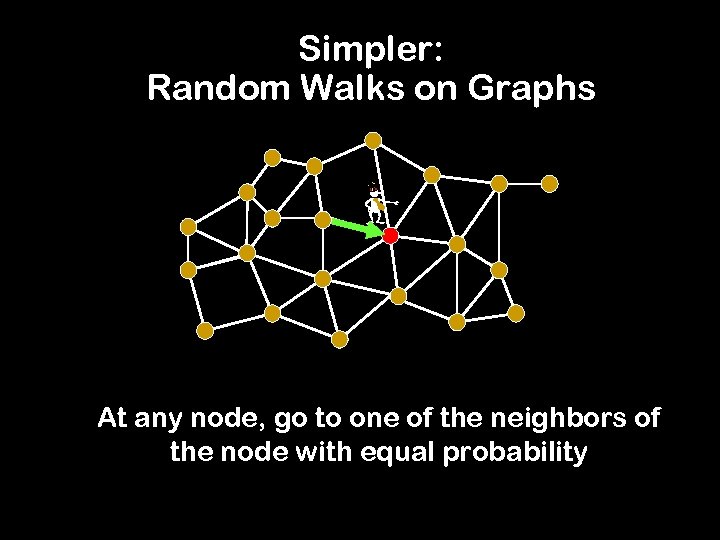 Simpler: Random Walks on Graphs - At any node, go to one of the neighbors of the node with equal probability
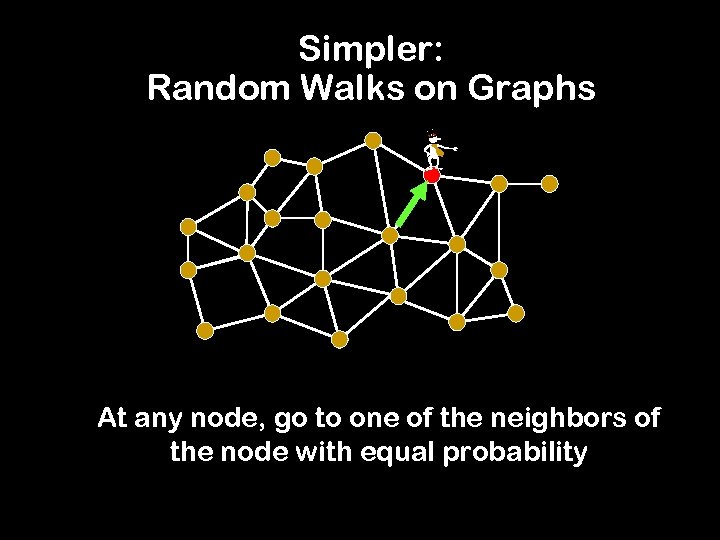 Simpler: Random Walks on Graphs - At any node, go to one of the neighbors of the node with equal probability
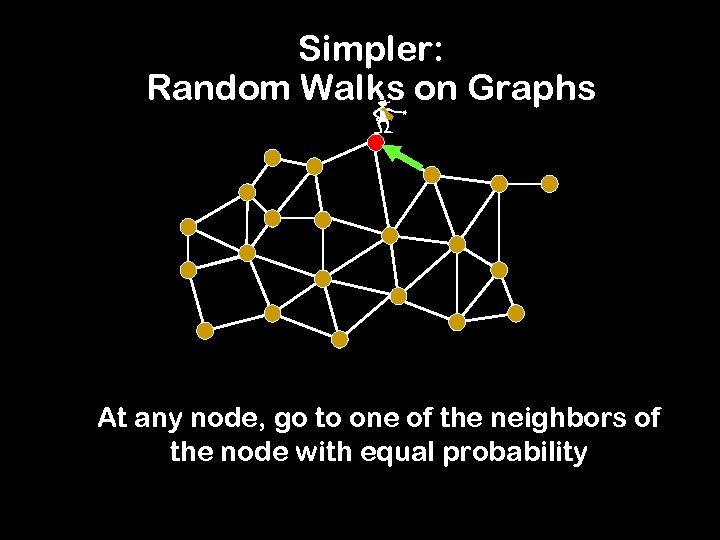 Simpler: Random Walks on Graphs - At any node, go to one of the neighbors of the node with equal probability
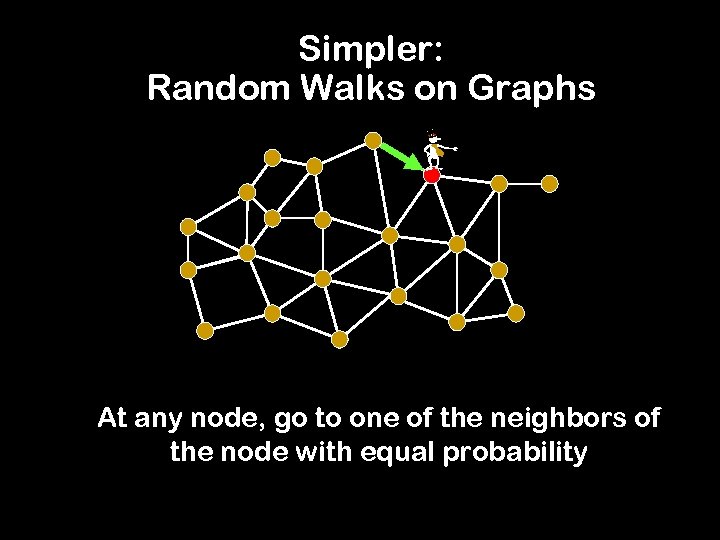 Simpler: Random Walks on Graphs - At any node, go to one of the neighbors of the node with equal probability
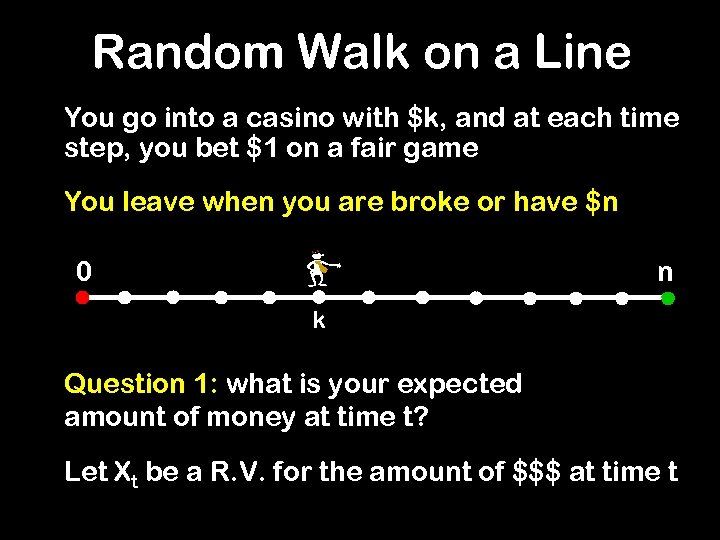 Random Walk on a Line You go into a casino with $k, and at each time step, you bet $1 on a fair game You leave when you are broke or have $n 0 n k Question 1: what is your expected amount of money at time t? Let Xt be a R. V. for the amount of $$$ at time t
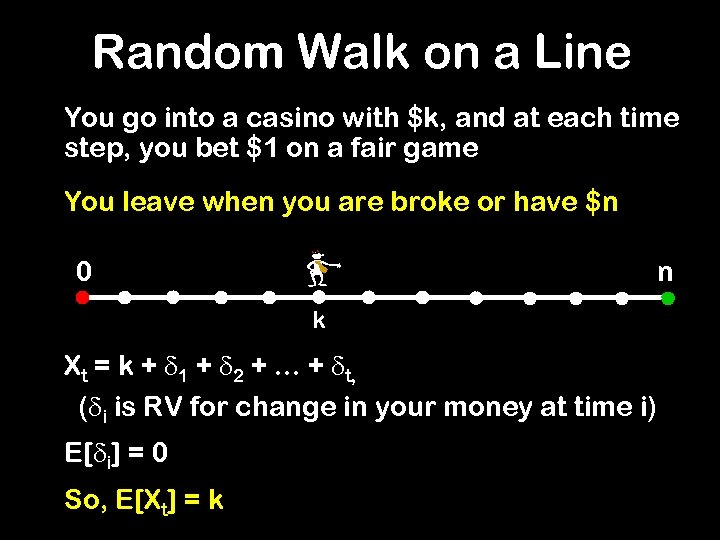 Random Walk on a Line You go into a casino with $k, and at each time step, you bet $1 on a fair game You leave when you are broke or have $n 0 n k Xt = k + d 1 + d 2 +. . . + dt, (di is RV for change in your money at time i) E[di] = 0 So, E[Xt] = k
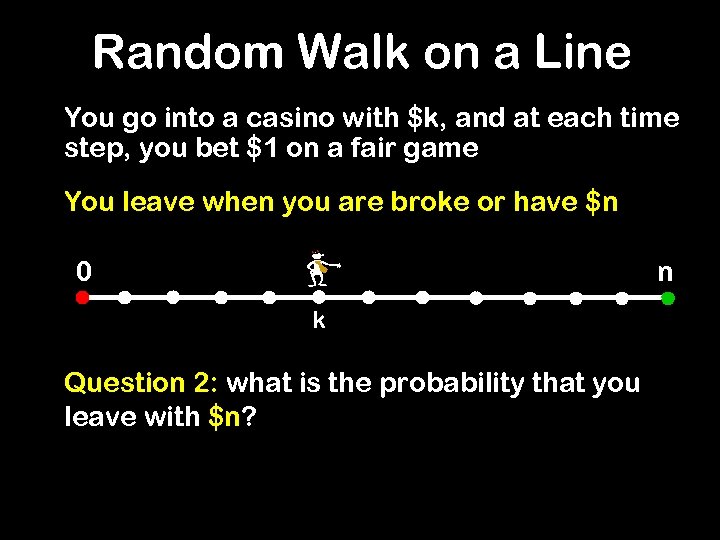 Random Walk on a Line You go into a casino with $k, and at each time step, you bet $1 on a fair game You leave when you are broke or have $n 0 n k Question 2: what is the probability that you leave with $n?
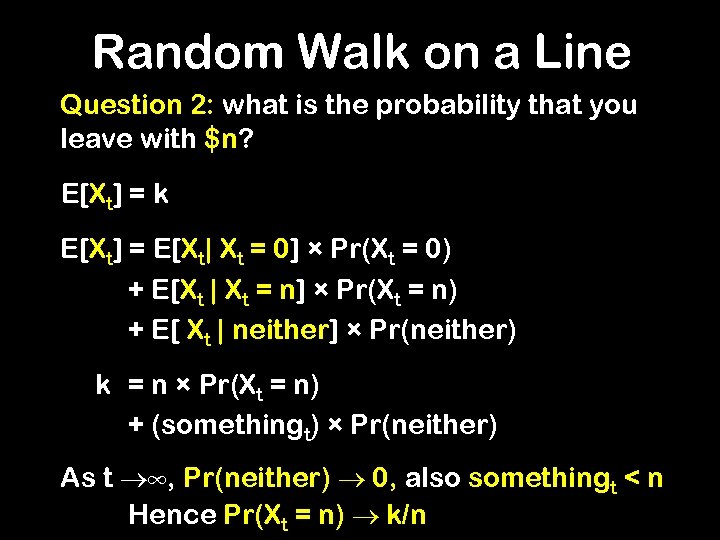 Random Walk on a Line Question 2: what is the probability that you leave with $n? E[Xt] = k E[Xt] = E[Xt| Xt = 0] × Pr(Xt = 0) + E[Xt | Xt = n] × Pr(Xt = n) + E[ Xt | neither] × Pr(neither) k = n × Pr(Xt = n) + (somethingt) × Pr(neither) As t ∞, Pr(neither) 0, also somethingt < n Hence Pr(Xt = n) k/n
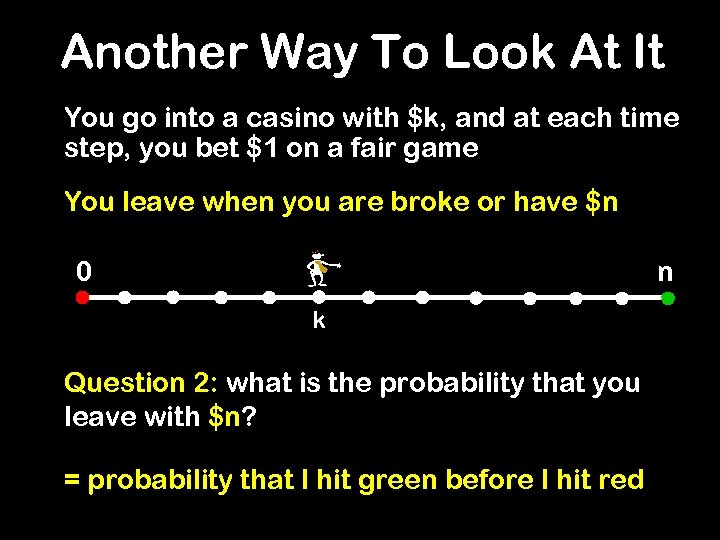 Another Way To Look At It You go into a casino with $k, and at each time step, you bet $1 on a fair game You leave when you are broke or have $n 0 n k Question 2: what is the probability that you leave with $n? = probability that I hit green before I hit red
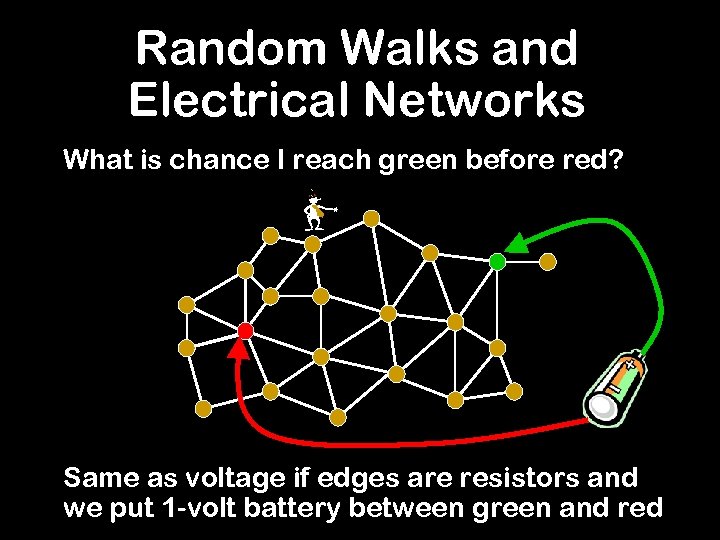 Random Walks and Electrical Networks What is chance I reach green before red? - Same as voltage if edges are resistors and we put 1 -volt battery between green and red
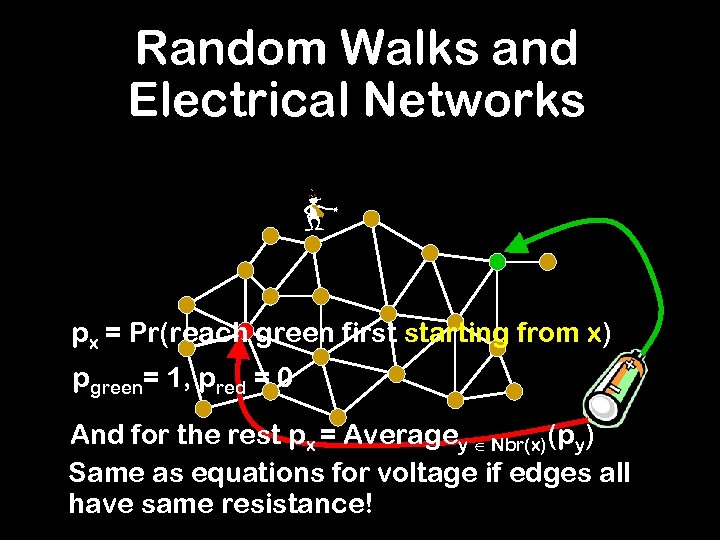 Random Walks and Electrical Networks px = Pr(reach green first starting from x) pgreen= 1, pred = 0 And for the rest px = Averagey Nbr(x)(py) Same as equations for voltage if edges all have same resistance!
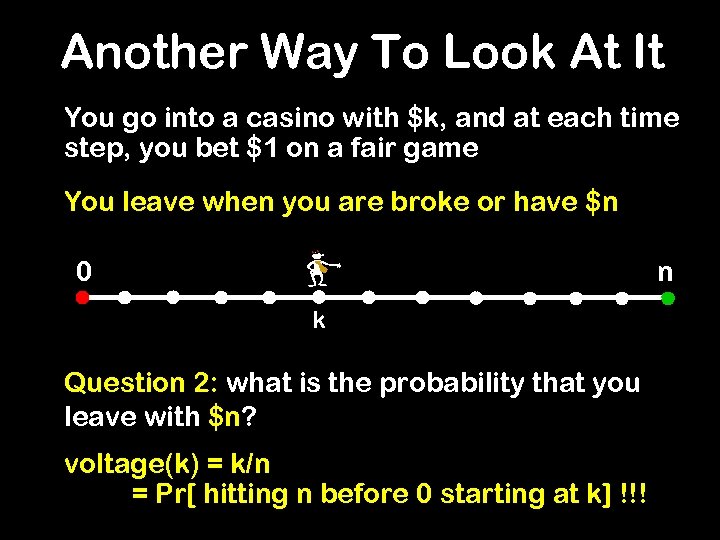 Another Way To Look At It You go into a casino with $k, and at each time step, you bet $1 on a fair game You leave when you are broke or have $n 0 n k Question 2: what is the probability that you leave with $n? voltage(k) = k/n = Pr[ hitting n before 0 starting at k] !!!
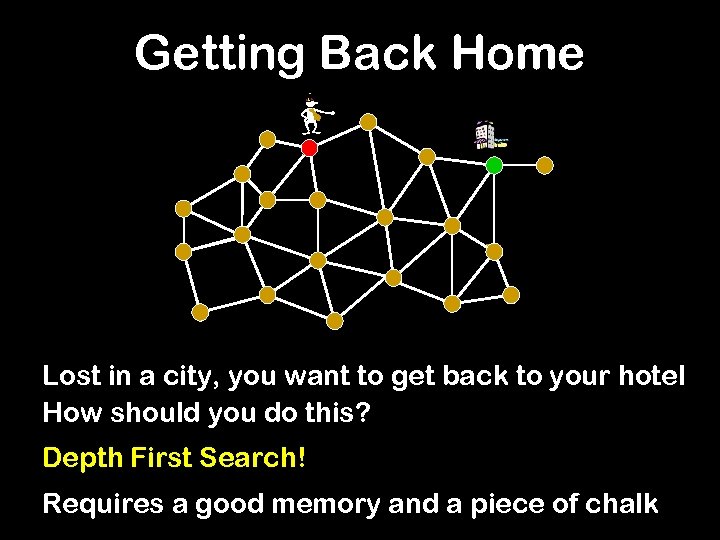 Getting Back Home - Lost in a city, you want to get back to your hotel How should you do this? Depth First Search! Requires a good memory and a piece of chalk
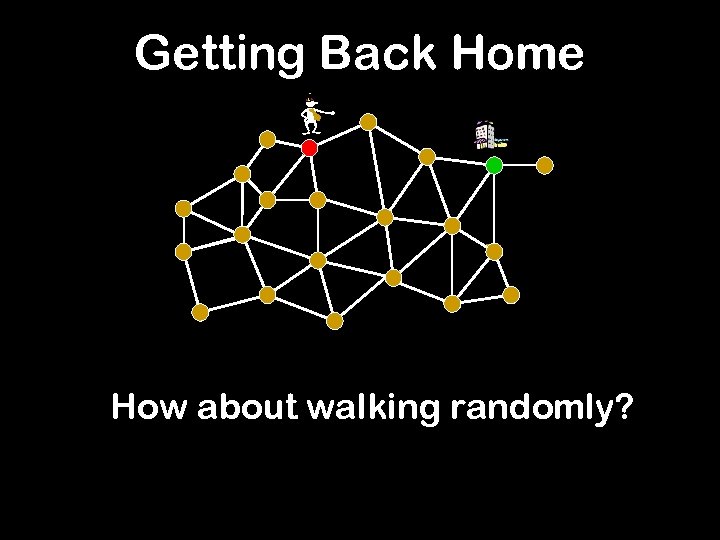 Getting Back Home - How about walking randomly?
![Will this work? Is Pr[ reach home ] = 1? When will I get](https://present5.com/presentation/dfd793fe6ebd03e9d9d216259bd46853/image-42.jpg "Will this work? Is Pr[ reach home ] = 1? When will I get") Will this work? Is Pr[ reach home ] = 1? When will I get home? What is E[ time to reach home ]?
Will this work? Is Pr[ reach home ] = 1? When will I get home? What is E[ time to reach home ]?
![Pr[ will reach home ] = 1](https://present5.com/presentation/dfd793fe6ebd03e9d9d216259bd46853/image-43.jpg "Pr[ will reach home ] = 1") Pr[ will reach home ] = 1
Pr[ will reach home ] = 1
 We Will Eventually Get Home Look at the first n steps There is a non-zero chance p 1 that we get home Also, p 1 ≥ (1/n)n Suppose we fail Then, wherever we are, there is a chance p 2 ≥ (1/n)n that we hit home in the next n steps from there Probability of failing to reach home by time kn = (1 – p 1)(1 – p 2) … (1 – pk) 0 as k ∞
 Furthermore: If the graph has n nodes and m edges, then E[ time to visit all nodes ] ≤ 2 m × (n-1) E[ time to reach home ] is at most this
 Actually, we get home pretty fast… Chance that we don’t hit home by (2 k)2 m(n-1) steps is (½)k
 A Simple Calculation True of False: If the average income of people is $100 then more than 50% of the people can be earning more than $200 each False! else the average would be higher!!!
![Markov’s Inequality If X is a non-negative r. v. with mean E[X], then Pr[](https://present5.com/presentation/dfd793fe6ebd03e9d9d216259bd46853/image-48.jpg "Markov’s Inequality If X is a non-negative r. v. with mean E[X], then Pr[") Markov’s Inequality If X is a non-negative r. v. with mean E[X], then Pr[ X > 2 E[X] ] ≤ ½ Pr[ X > k E[X] ] ≤ 1/k Andrei A. Markov
Markov’s Inequality If X is a non-negative r. v. with mean E[X], then Pr[ X > 2 E[X] ] ≤ ½ Pr[ X > k E[X] ] ≤ 1/k Andrei A. Markov
![Markov’s Inequality Non-neg random variable X has expectation A = E[X] = E[X |](https://present5.com/presentation/dfd793fe6ebd03e9d9d216259bd46853/image-49.jpg "Markov’s Inequality Non-neg random variable X has expectation A = E[X] = E[X |") Markov’s Inequality Non-neg random variable X has expectation A = E[X] = E[X | X > 2 A ] Pr[X > 2 A] + E[X | X ≤ 2 A ] Pr[X ≤ 2 A] ≥ E[X | X > 2 A ] Pr[X > 2 A] (since X is non-neg) Also, E[X | X > 2 A] > 2 A A ≥ 2 A × Pr[X > 2 A] ½ ≥ Pr[X > 2 A] Pr[ X > k × expectation ] ≤ 1/k
Markov’s Inequality Non-neg random variable X has expectation A = E[X] = E[X | X > 2 A ] Pr[X > 2 A] + E[X | X ≤ 2 A ] Pr[X ≤ 2 A] ≥ E[X | X > 2 A ] Pr[X > 2 A] (since X is non-neg) Also, E[X | X > 2 A] > 2 A A ≥ 2 A × Pr[X > 2 A] ½ ≥ Pr[X > 2 A] Pr[ X > k × expectation ] ≤ 1/k
 Actually, we get home pretty fast… Chance that we don’t hit home by (2 k)2 m(n-1) steps is (½)k
 An Averaging Argument Suppose I start at u E[ time to hit all vertices | start at u ] ≤ C(G) Hence, by Markov’s Inequality: Pr[ time to hit all vertices > 2 C(G) | start at u ] ≤ ½
 So Let’s Walk Some Mo! Pr [ time to hit all vertices > 2 C(G) | start at u ] ≤ ½ Suppose at time 2 C(G), I’m at some node with more nodes still to visit Pr [ haven’t hit all vertices in 2 C(G) more time | start at v ] ≤ ½ Chance that you failed both times ≤ ¼ = (½)2 Hence, Pr[ havent hit everyone in time k × 2 C(G) ] ≤ (½)k
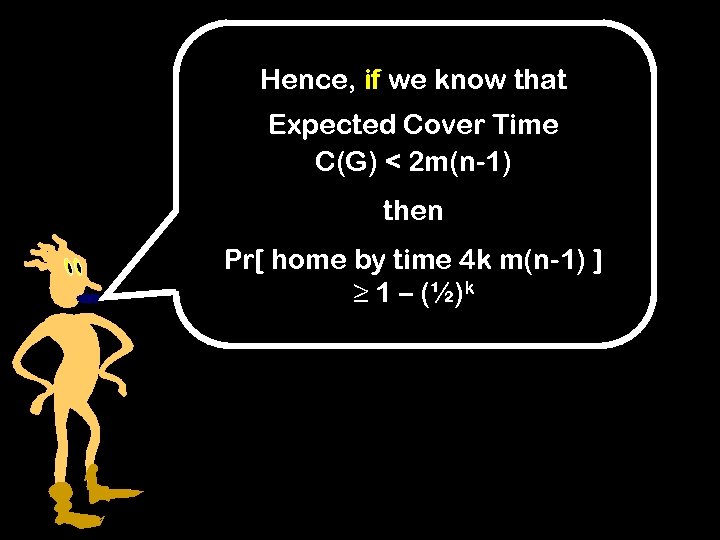 Hence, if we know that Expected Cover Time C(G) < 2 m(n-1) then Pr[ home by time 4 k m(n-1) ] ≥ 1 – (½)k
 Random Walk in a Line Cover Time of a Graph Markov’s Inequality Here’s What You Need to Know…