


 Скачать презентацию 15 -251 Great Theoretical Ideas in Computer Science
f939a65dc96ffd368079b239cd6f6851.ppt
- Количество слайдов: 61
 15 -251 Great Theoretical Ideas in Computer Science
 Algebraic Structures: Group Theory Lecture 15 (October 12, 2010)
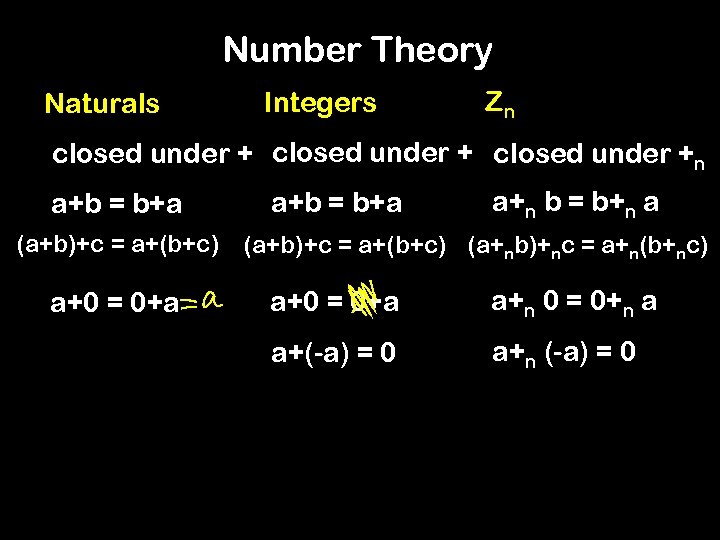 Number Theory Naturals Integers Zn closed under +n a+b = b+a (a+b)+c = a+(b+c) a+0 = 0+a a+b = b+a a+n b = b+n a (a+b)+c = a+(b+c) (a+nb)+nc = a+n(b+nc) a+0 = 0+a a+n 0 = 0+n a a+(-a) = 0 a+n (-a) = 0
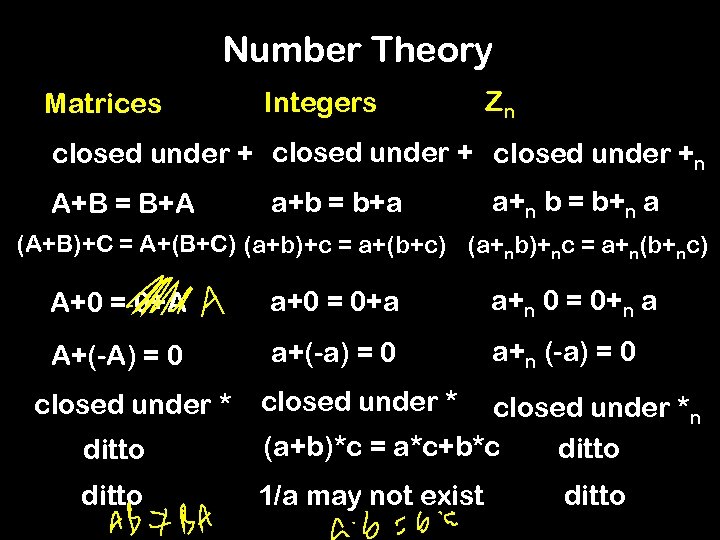 Number Theory Matrices Integers Zn closed under +n A+B = B+A a+b = b+a a+n b = b+n a (A+B)+C = A+(B+C) (a+b)+c = a+(b+c) (a+nb)+nc = a+n(b+nc) A+0 = 0+A a+0 = 0+a a+n 0 = 0+n a A+(-A) = 0 a+(-a) = 0 a+n (-a) = 0 closed under * ditto closed under *n (a+b)*c = a*c+b*c ditto 1/a may not exist ditto
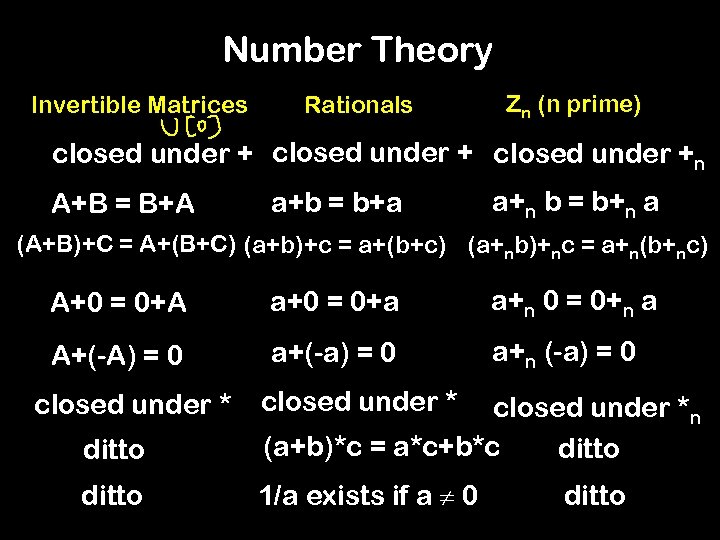 Number Theory Invertible Matrices Rationals Zn (n prime) closed under +n A+B = B+A a+b = b+a a+n b = b+n a (A+B)+C = A+(B+C) (a+b)+c = a+(b+c) (a+nb)+nc = a+n(b+nc) A+0 = 0+A a+0 = 0+a a+n 0 = 0+n a A+(-A) = 0 a+(-a) = 0 a+n (-a) = 0 closed under * ditto closed under *n (a+b)*c = a*c+b*c ditto 1/a exists if a 0 ditto
 Abstraction: Abstract away the inessential features of a problem =
 Today we are going to study the abstract properties of binary operations
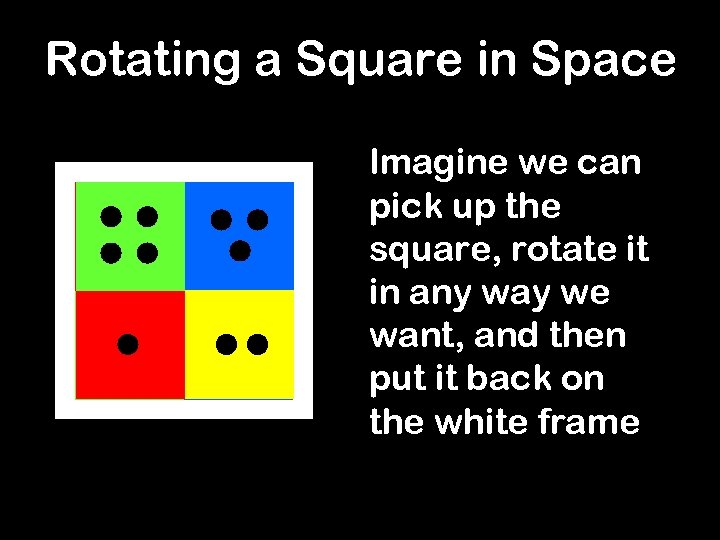 Rotating a Square in Space Imagine we can pick up the square, rotate it in any way we want, and then put it back on the white frame
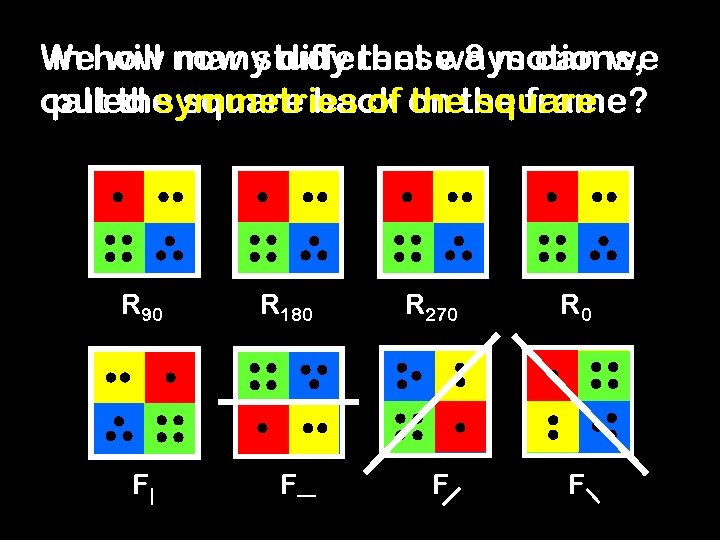 Wehow now study these 8 motions, In will many different ways can we called symmetries of on the frame? put the square back the square R 90 F| R 180 F— R 270 F R 0 F
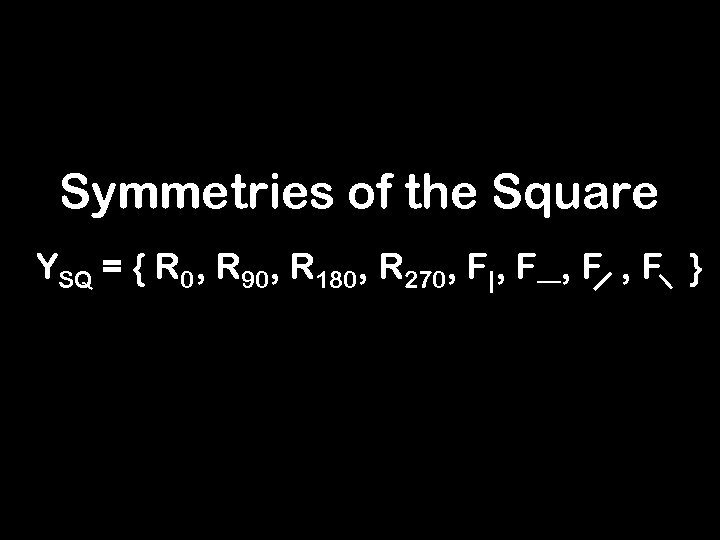 Symmetries of the Square YSQ = { R 0, R 90, R 180, R 270, F|, F—, F }
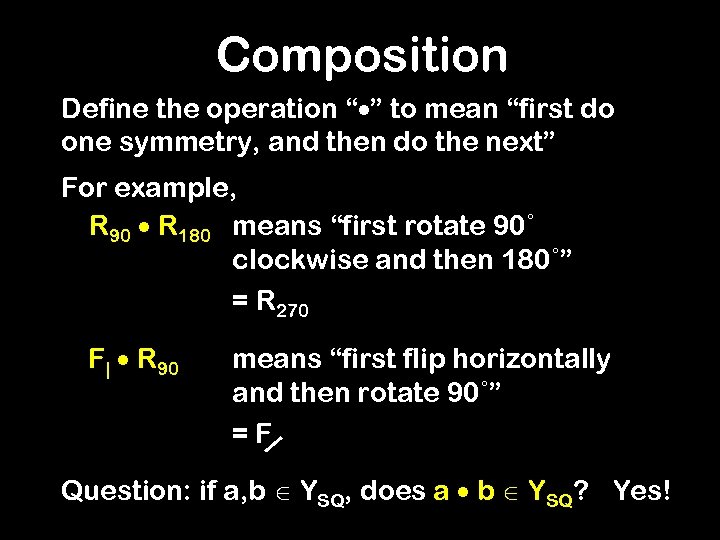 Composition Define the operation “ ” to mean “first do one symmetry, and then do the next” For example, R 90 R 180 means “first rotate 90˚ clockwise and then 180˚” = R 270 F| R 90 means “first flip horizontally and then rotate 90˚” =F Question: if a, b YSQ, does a b YSQ? Yes!
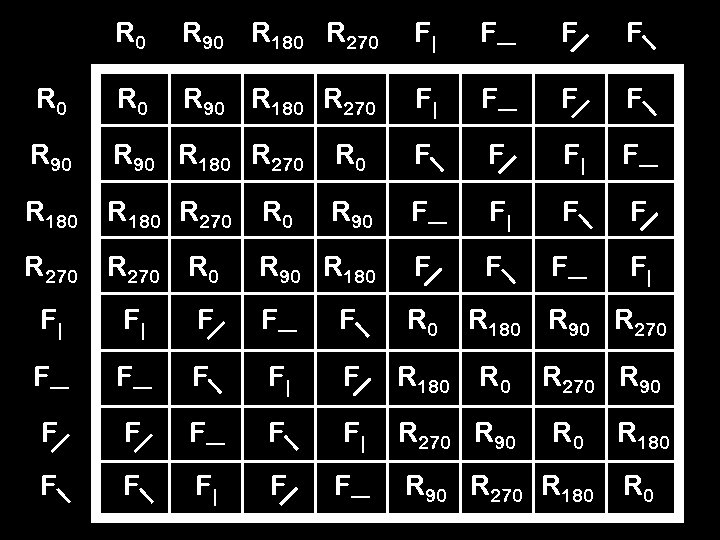 R 0 R 90 R 180 R 270 F| F— F F R 90 R 180 R 270 R 0 F F F| F— R 180 R 270 R 90 F— F| F F R 270 R 0 R 90 R 180 F F F— F| F| F| F F— F R 0 R 180 R 90 R 270 F— F— F F| F R 180 F F F— F F| R 270 R 90 F F F| F F— R 0 R 270 R 90 R 270 R 180 R 0
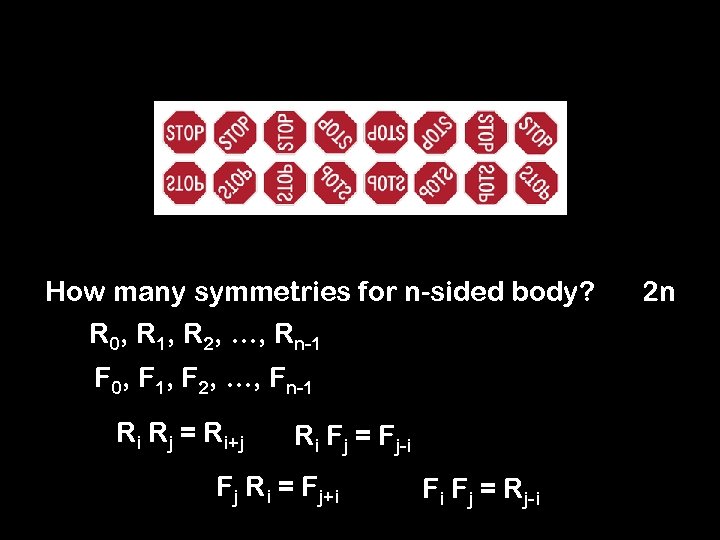 How many symmetries for n-sided body? R 0, R 1, R 2, …, Rn-1 F 0, F 1, F 2, …, Fn-1 Ri Rj = Ri+j Ri Fj = Fj-i Fj Ri = Fj+i Fi Fj = Rj-i 2 n
 Some Formalism If S is a set, S S is: the set of all (ordered) pairs of elements of S S S = { (a, b) | a S and b S } If S has n elements, how many elements does S S have? n 2 Formally, is a function from YSQ to YSQ : YSQ → YSQ As shorthand, we write (a, b) as “a b”
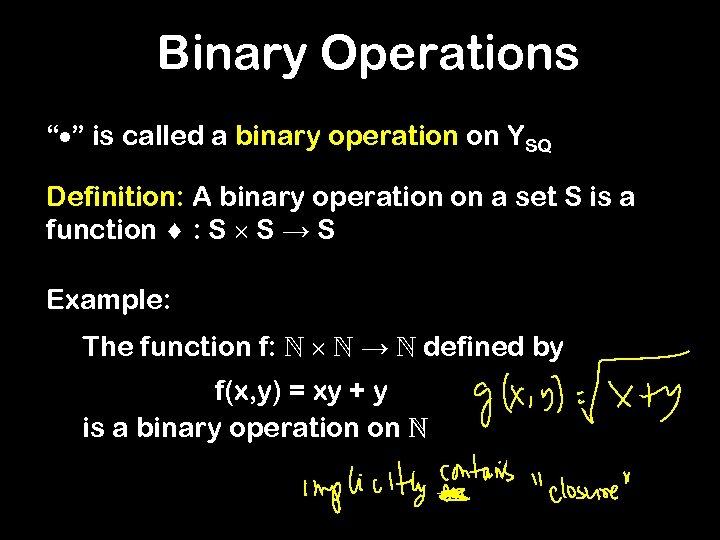 Binary Operations “ ” is called a binary operation on YSQ Definition: A binary operation on a set S is a function : S S → S Example: The function f: → defined by f(x, y) = xy + y is a binary operation on
 Associativity A binary operation on a set S is associative if: for all a, b, c S, (a b) c = a (b c) Examples: Is f: → defined by f(x, y) = xy + y associative? (ab + b)c + c = a(bc + c) + (bc + c)? NO! Is the operation on the set of symmetries of the square associative? YES!
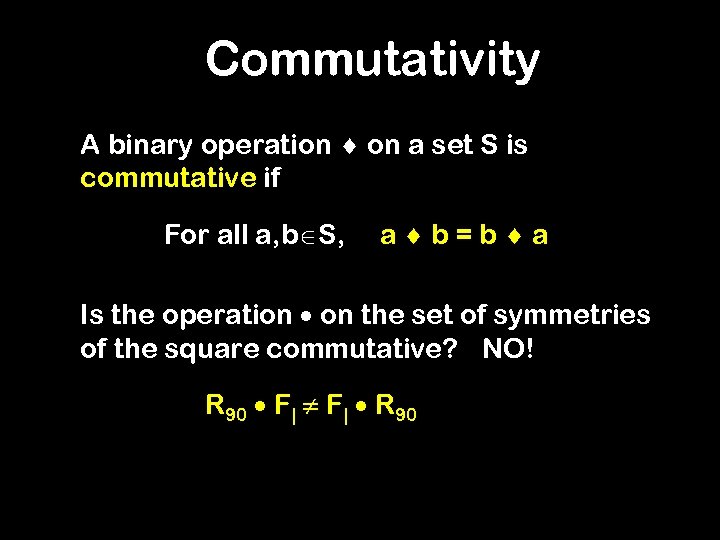 Commutativity A binary operation on a set S is commutative if For all a, b S, a b=b a Is the operation on the set of symmetries of the square commutative? NO! R 90 F| ≠ F| R 90
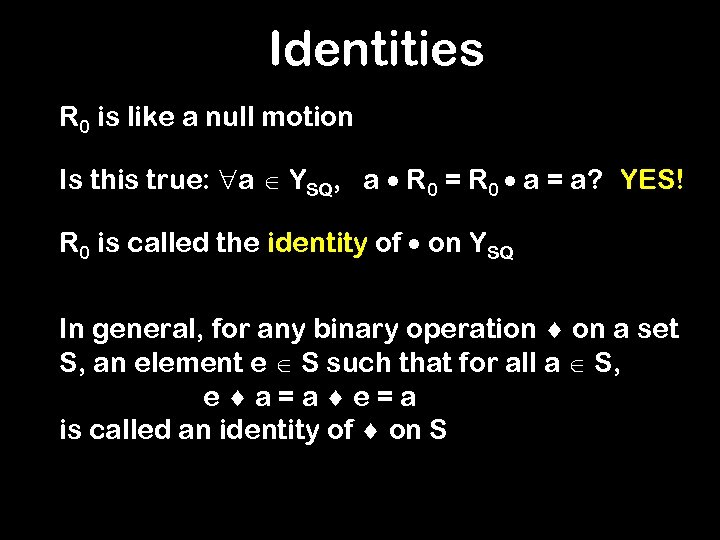 Identities R 0 is like a null motion Is this true: a YSQ, a R 0 = R 0 a = a? YES! R 0 is called the identity of on YSQ In general, for any binary operation on a set S, an element e S such that for all a S, e a=a e=a is called an identity of on S
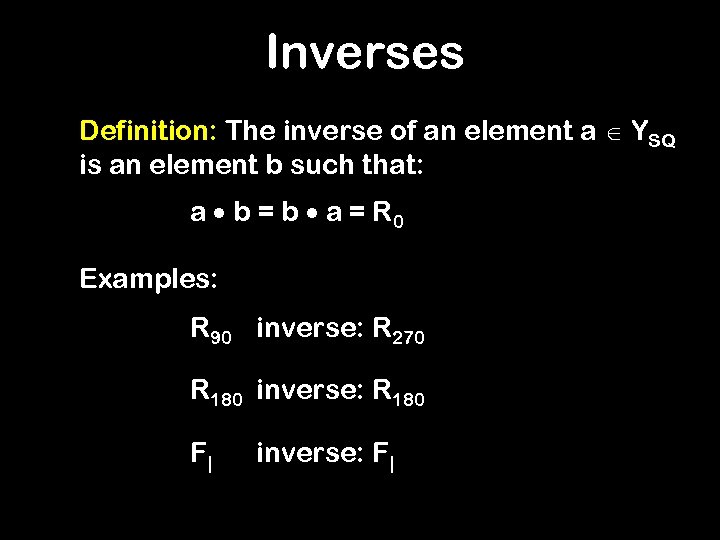 Inverses Definition: The inverse of an element a YSQ is an element b such that: a b = b a = R 0 Examples: R 90 inverse: R 270 R 180 inverse: R 180 F| inverse: F|
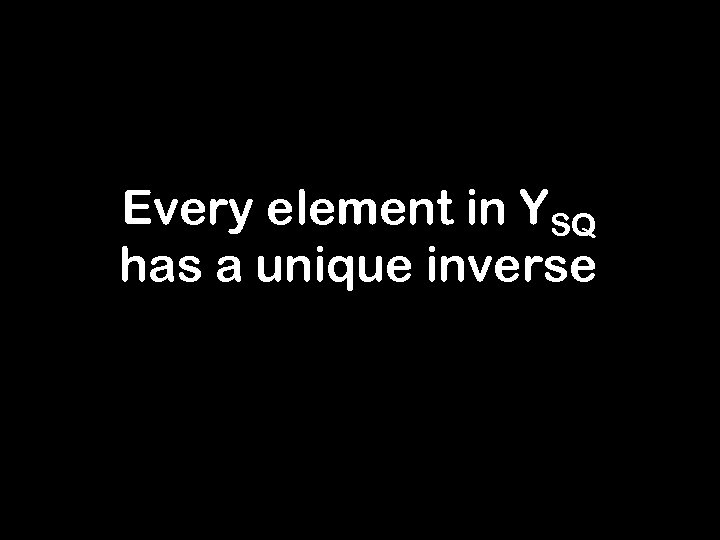 Every element in YSQ has a unique inverse
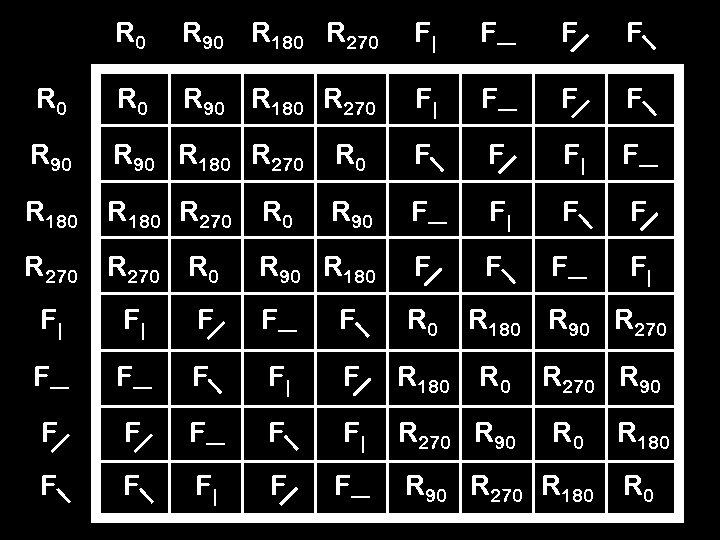 R 0 R 90 R 180 R 270 F| F— F F R 90 R 180 R 270 R 0 F F F| F— R 180 R 270 R 90 F— F| F F R 270 R 0 R 90 R 180 F F F— F| F| F| F F— F R 0 R 180 R 90 R 270 F— F— F F| F R 180 F F F— F F| R 270 R 90 F F F| F F— R 0 R 270 R 90 R 270 R 180 R 0
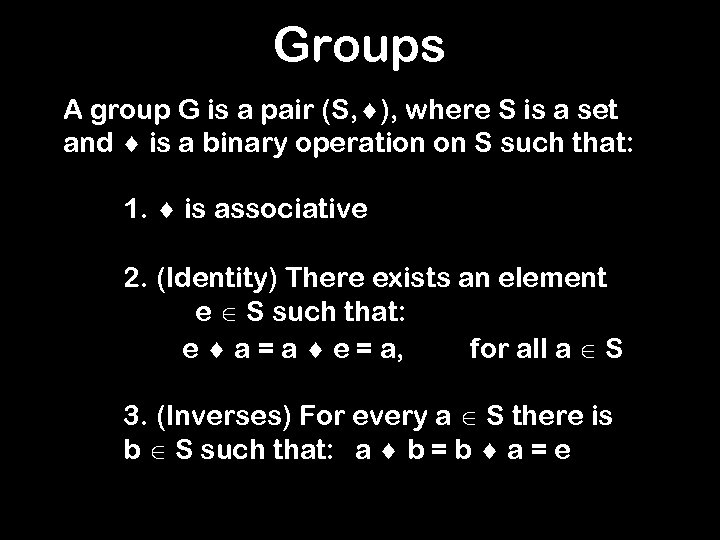
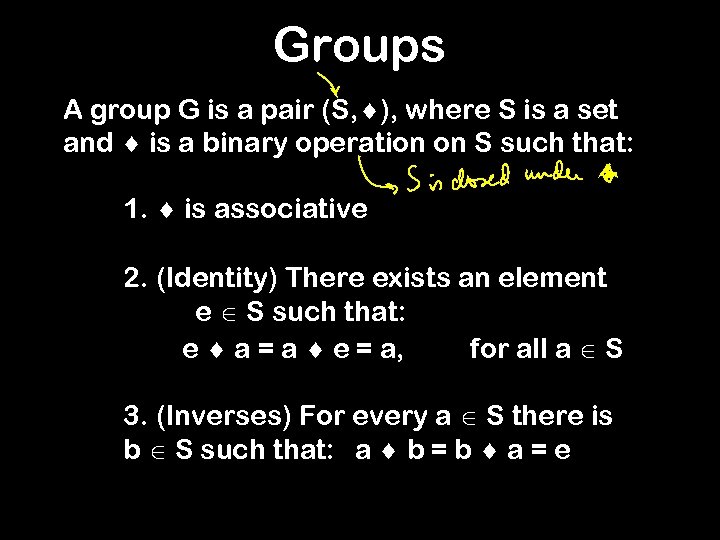 Groups A group G is a pair (S, ), where S is a set and is a binary operation on S such that: 1. is associative 2. (Identity) There exists an element e S such that: e a = a e = a, for all a S 3. (Inverses) For every a S there is b S such that: a b = b a = e
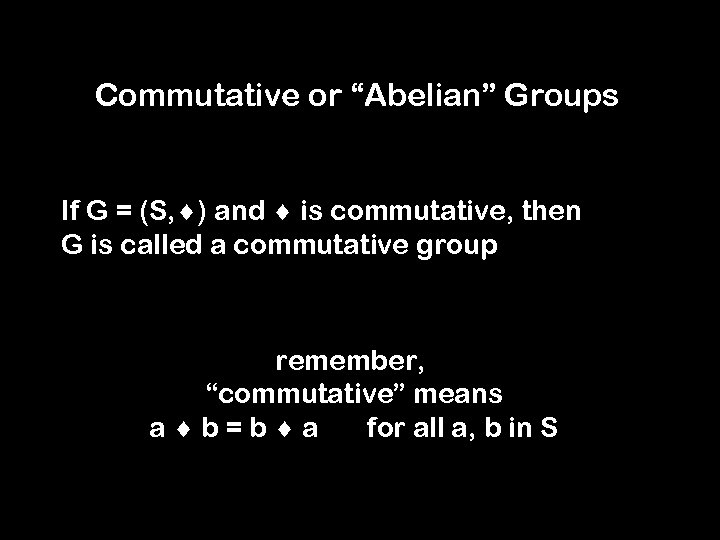 Commutative or “Abelian” Groups If G = (S, ) and is commutative, then G is called a commutative group remember, “commutative” means a b=b a for all a, b in S
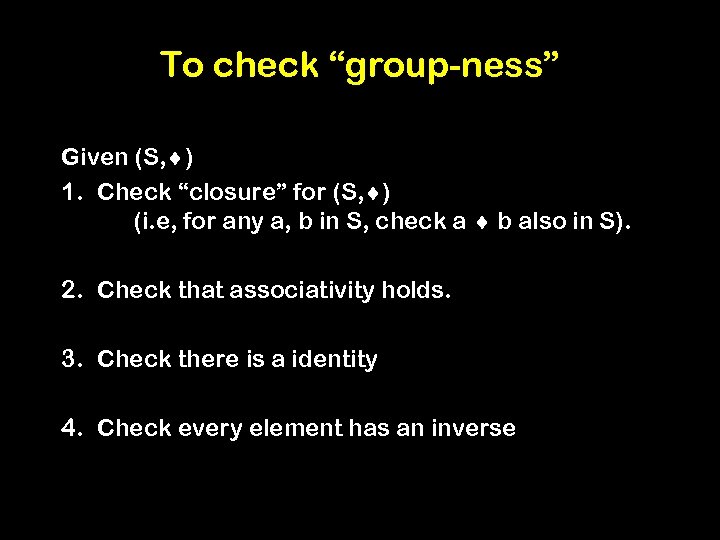 To check “group-ness” Given (S, ) 1. Check “closure” for (S, ) (i. e, for any a, b in S, check a b also in S). 2. Check that associativity holds. 3. Check there is a identity 4. Check every element has an inverse
 Some examples…
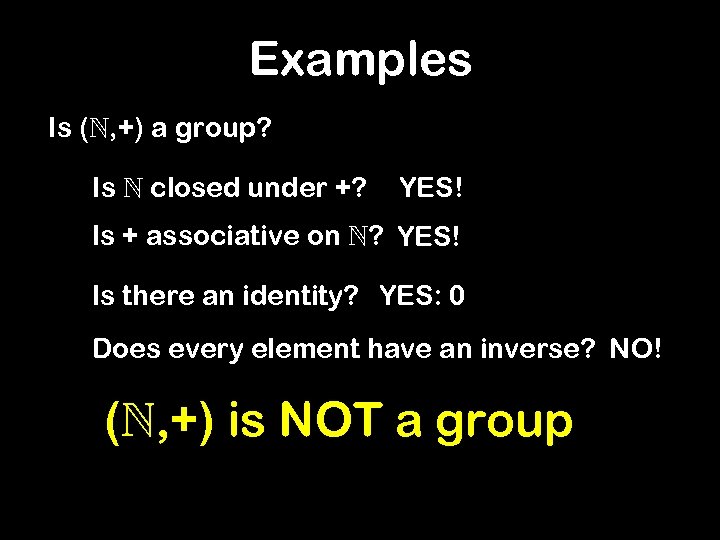 Examples Is ( , +) a group? Is closed under +? YES! Is + associative on ? YES! Is there an identity? YES: 0 Does every element have an inverse? NO! ( , +) is NOT a group
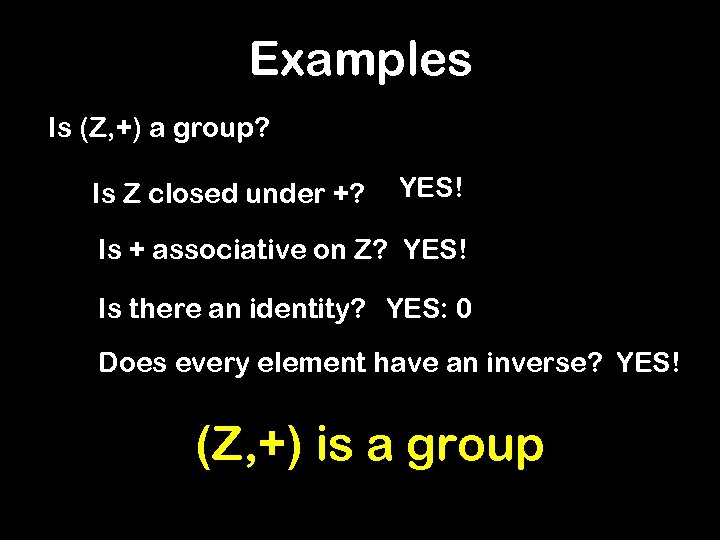 Examples Is (Z, +) a group? Is Z closed under +? YES! Is + associative on Z? YES! Is there an identity? YES: 0 Does every element have an inverse? YES! (Z, +) is a group
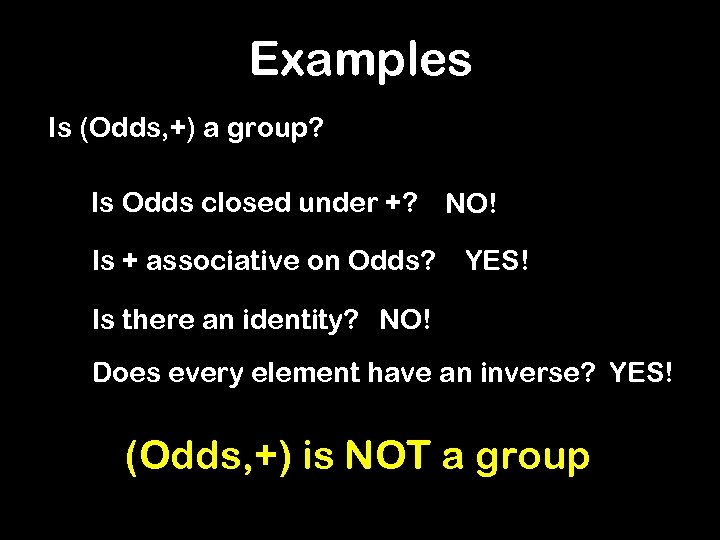 Examples Is (Odds, +) a group? Is Odds closed under +? NO! Is + associative on Odds? YES! Is there an identity? NO! Does every element have an inverse? YES! (Odds, +) is NOT a group
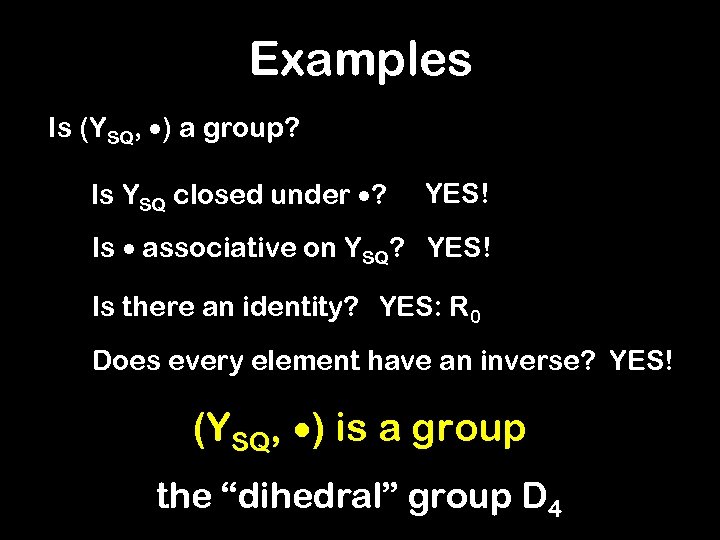 Examples Is (YSQ, ) a group? Is YSQ closed under ? YES! Is associative on YSQ? YES! Is there an identity? YES: R 0 Does every element have an inverse? YES! (YSQ, ) is a group the “dihedral” group D 4
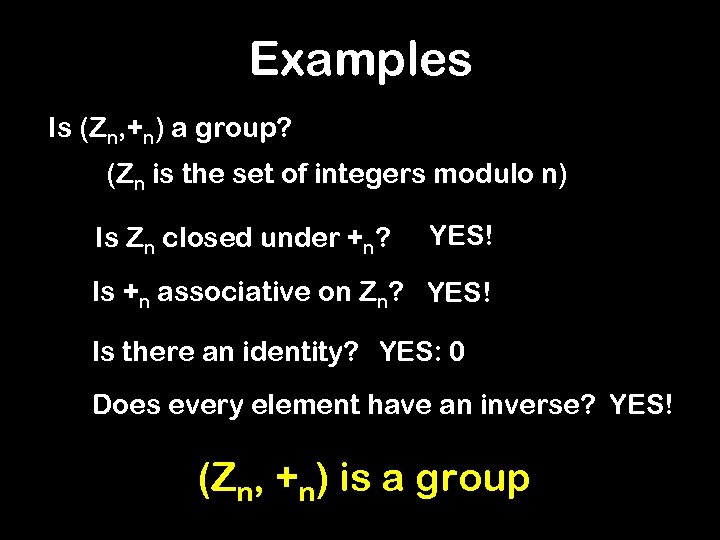 Examples Is (Zn, +n) a group? (Zn is the set of integers modulo n) Is Zn closed under +n? YES! Is +n associative on Zn? YES! Is there an identity? YES: 0 Does every element have an inverse? YES! (Zn, +n) is a group
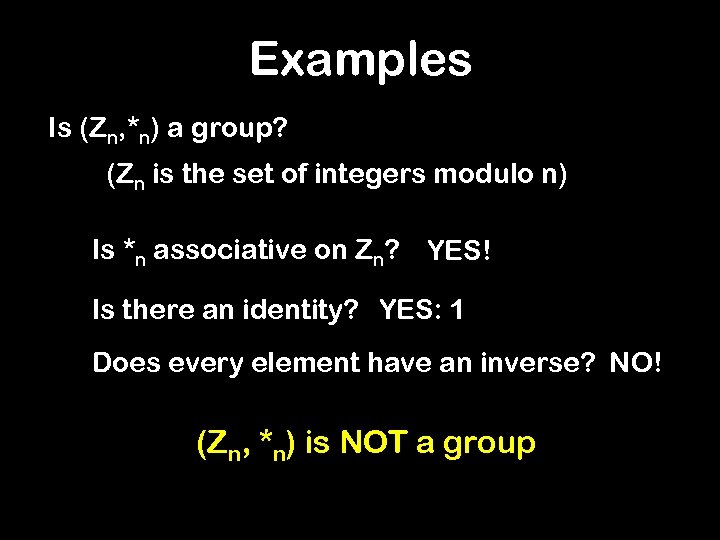 Examples Is (Zn, *n) a group? (Zn is the set of integers modulo n) Is *n associative on Zn? YES! Is there an identity? YES: 1 Does every element have an inverse? NO! (Zn, *n) is NOT a group
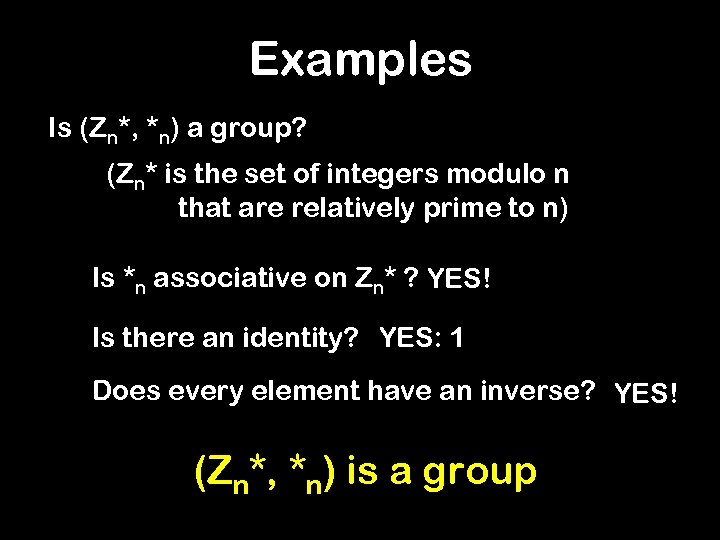 Examples Is (Zn*, *n) a group? (Zn* is the set of integers modulo n that are relatively prime to n) Is *n associative on Zn* ? YES! Is there an identity? YES: 1 Does every element have an inverse? YES! (Zn*, *n) is a group
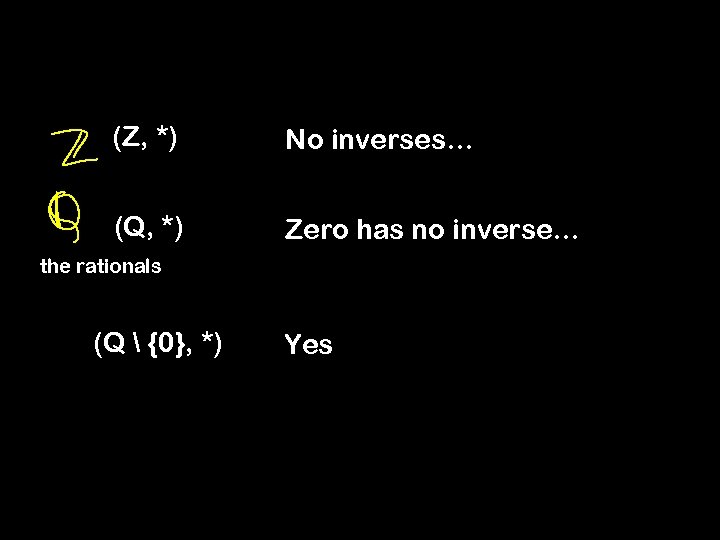 (Z, *) No inverses… (Q, *) Zero has no inverse… the rationals (Q {0}, *) Yes
 Groups A group G is a pair (S, ), where S is a set and is a binary operation on S such that: 1. is associative 2. (Identity) There exists an element e S such that: e a = a e = a, for all a S 3. (Inverses) For every a S there is b S such that: a b = b a = e
 Some properties of groups…
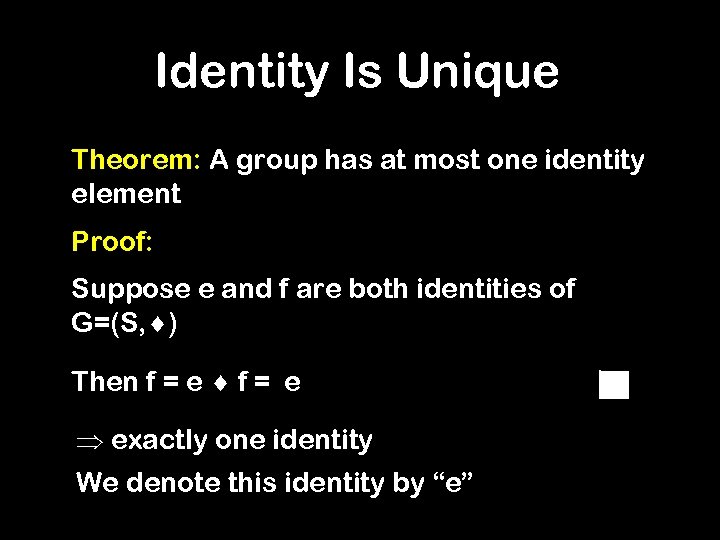 Identity Is Unique Theorem: A group has at most one identity element Proof: Suppose e and f are both identities of G=(S, ) Then f = e exactly one identity We denote this identity by “e”
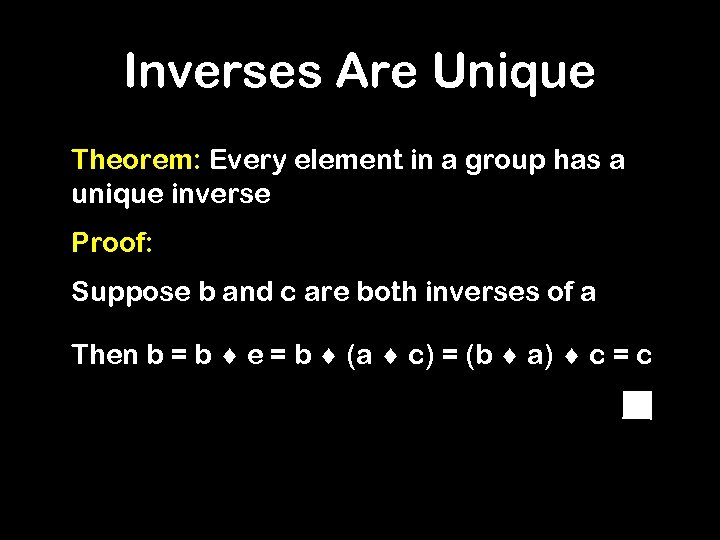 Inverses Are Unique Theorem: Every element in a group has a unique inverse Proof: Suppose b and c are both inverses of a Then b = b e = b (a c) = (b a) c = c
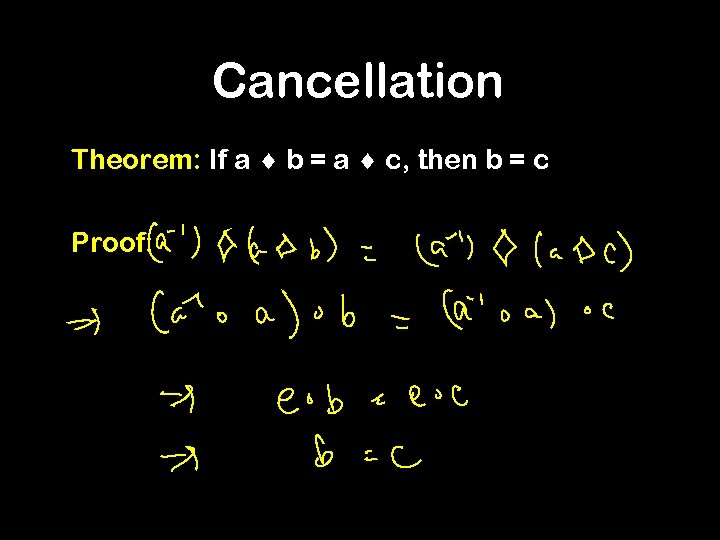 Cancellation Theorem: If a b = a c, then b = c Proof:
 Orders and generators
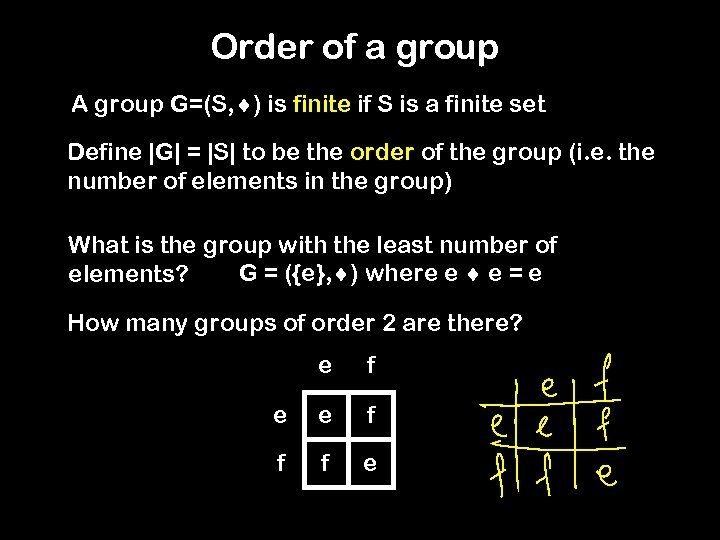 Order of a group A group G=(S, ) is finite if S is a finite set Define |G| = |S| to be the order of the group (i. e. the number of elements in the group) What is the group with the least number of G = ({e}, ) where e e = e elements? How many groups of order 2 are there? e f e e f f f e
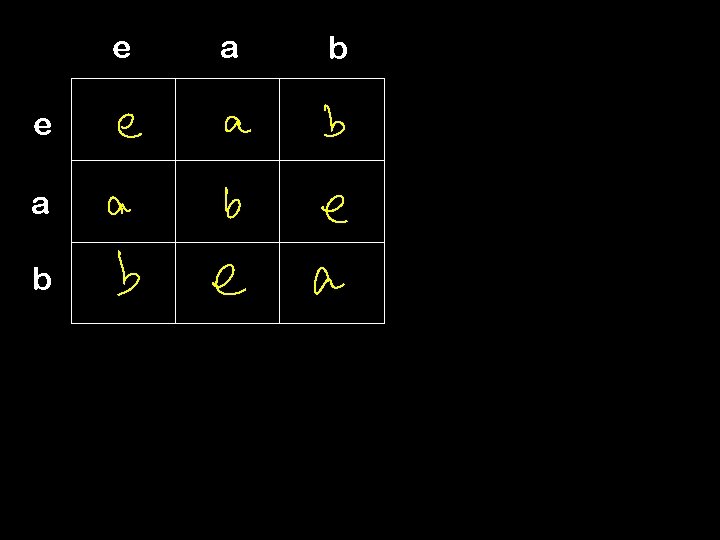 e e a b
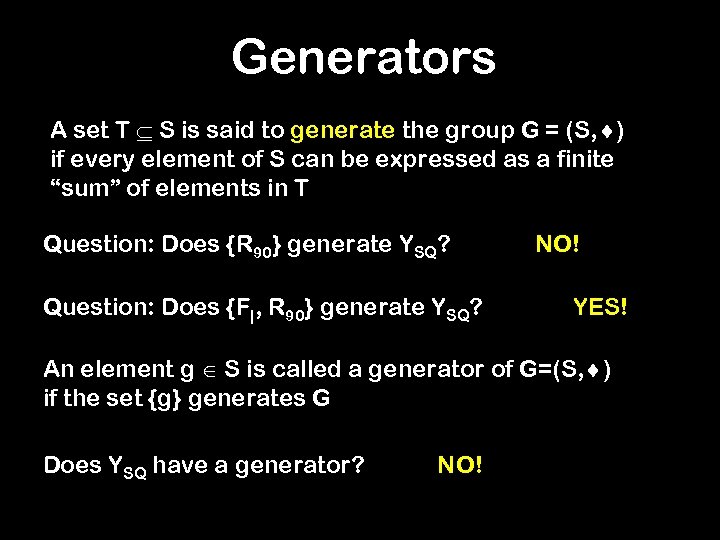 Generators A set T S is said to generate the group G = (S, ) if every element of S can be expressed as a finite “sum” of elements in T Question: Does {R 90} generate YSQ? Question: Does {F|, R 90} generate YSQ? NO! YES! An element g S is called a generator of G=(S, ) if the set {g} generates G Does YSQ have a generator? NO!
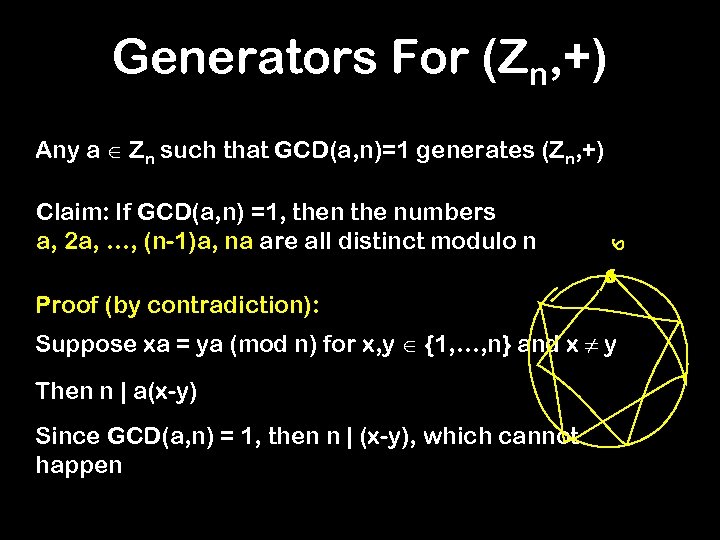 Generators For (Zn, +) Any a Zn such that GCD(a, n)=1 generates (Zn, +) Claim: If GCD(a, n) =1, then the numbers a, 2 a, …, (n-1)a, na are all distinct modulo n Proof (by contradiction): Suppose xa = ya (mod n) for x, y {1, …, n} and x ≠ y Then n | a(x-y) Since GCD(a, n) = 1, then n | (x-y), which cannot happen
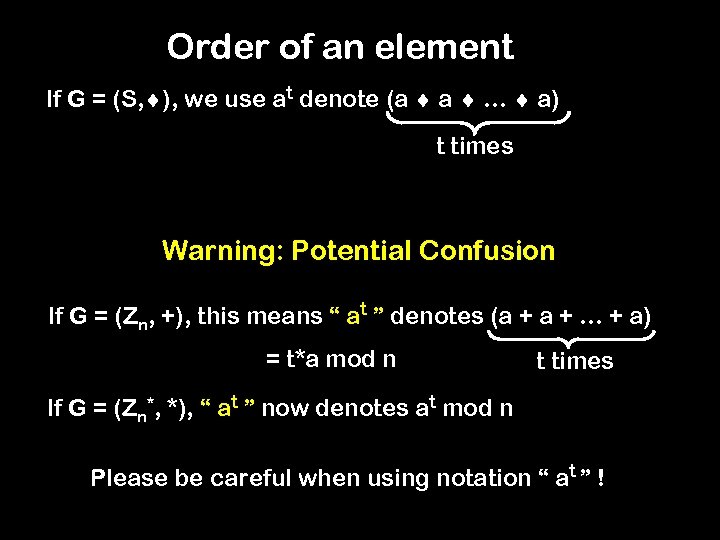 Order of an element If G = (S, ), we use at denote (a a … a) t times Warning: Potential Confusion If G = (Zn, +), this means “ at ” denotes (a + … + a) = t*a mod n t times If G = (Zn*, *), “ at ” now denotes at mod n Please be careful when using notation “ at ” !
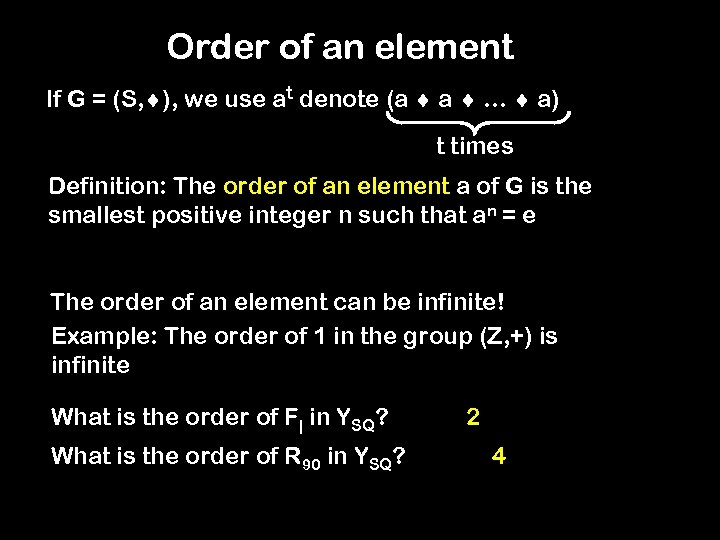 Order of an element If G = (S, ), we use at denote (a a … a) t times Definition: The order of an element a of G is the smallest positive integer n such that an = e The order of an element can be infinite! Example: The order of 1 in the group (Z, +) is infinite What is the order of F| in YSQ? What is the order of R 90 in YSQ? 2 4
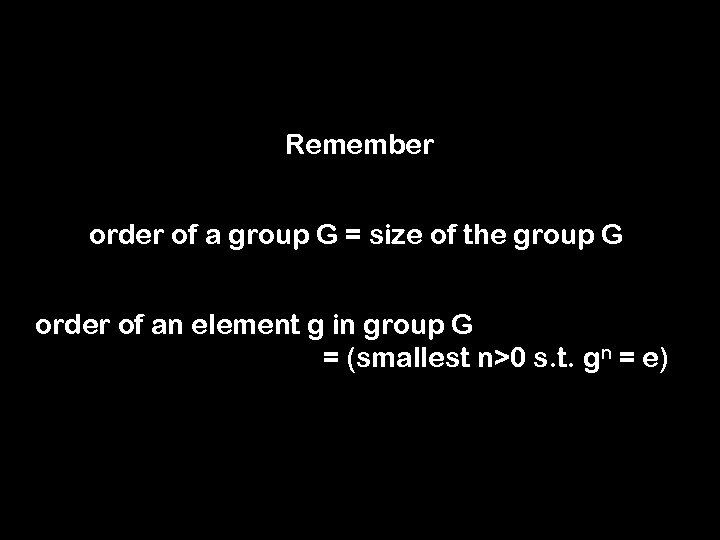 Remember order of a group G = size of the group G order of an element g in group G = (smallest n>0 s. t. gn = e)
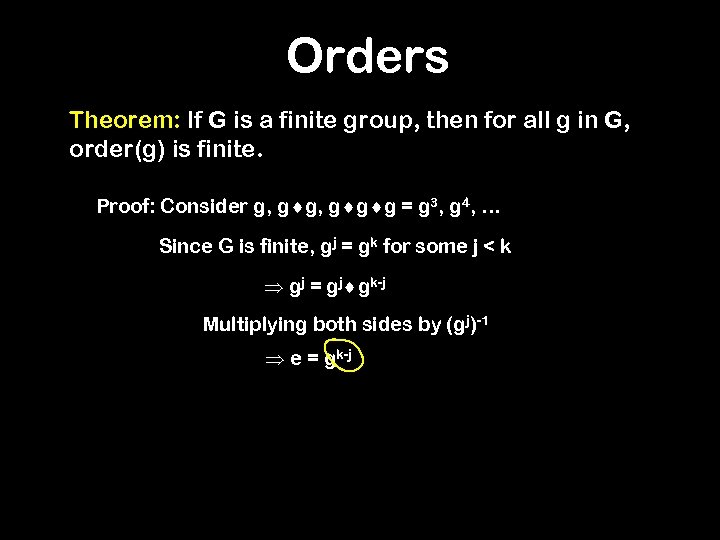 Orders Theorem: If G is a finite group, then for all g in G, order(g) is finite. Proof: Consider g, g g g = g 3, g 4, … Since G is finite, gj = gk for some j < k gj = gj gk-j Multiplying both sides by (gj)-1 e = gk-j
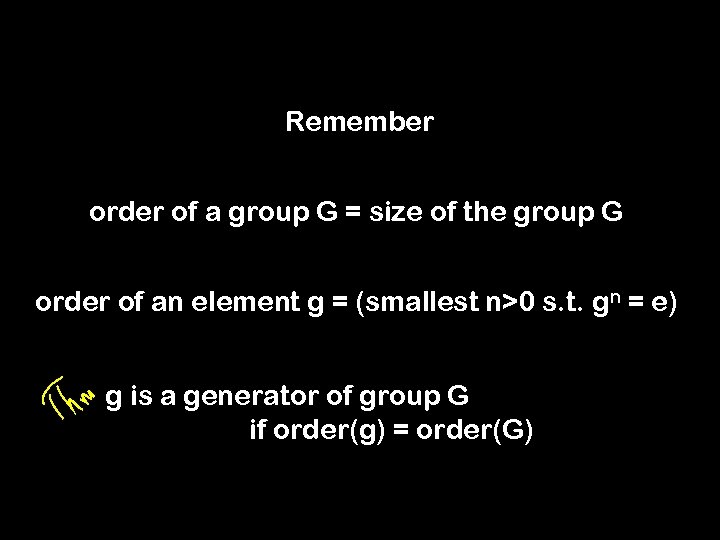 Remember order of a group G = size of the group G order of an element g = (smallest n>0 s. t. gn = e) g is a generator of group G if order(g) = order(G)
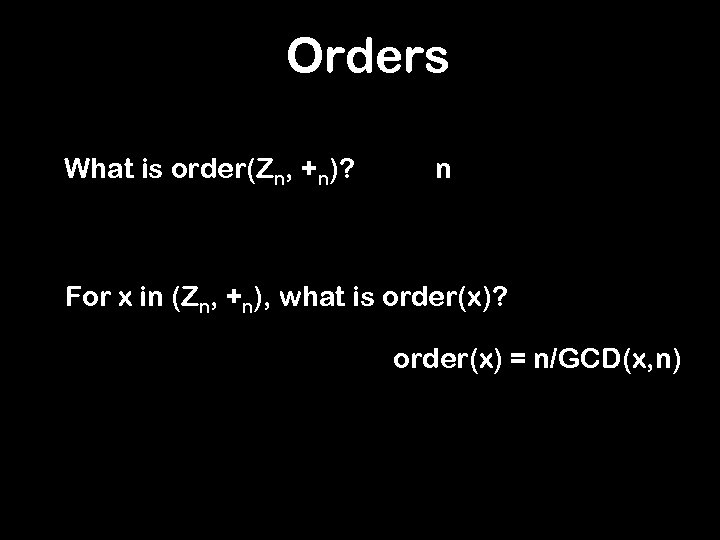 Orders What is order(Zn, +n)? n For x in (Zn, +n), what is order(x)? order(x) = n/GCD(x, n)
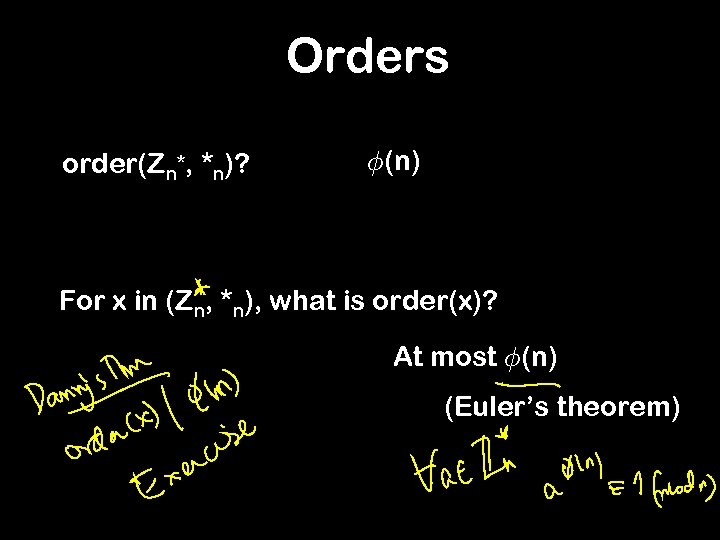 Orders order(Zn*, *n)? Á(n) For x in (Zn, *n), what is order(x)? At most Á(n) (Euler’s theorem)
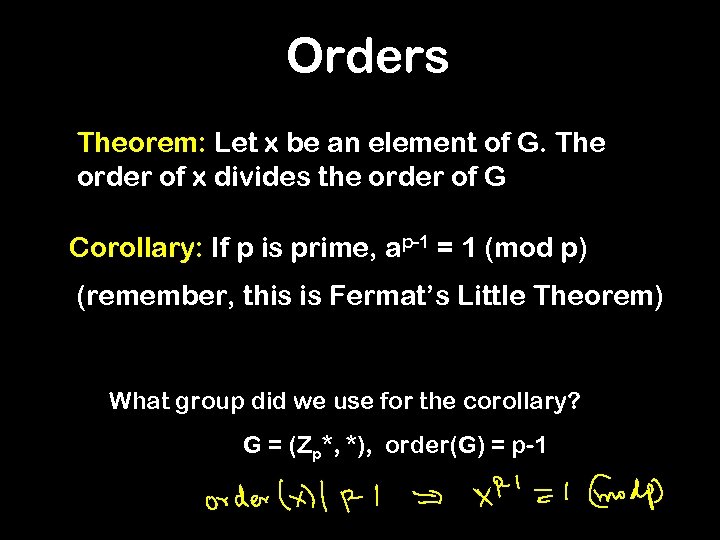 Orders Theorem: Let x be an element of G. The order of x divides the order of G Corollary: If p is prime, ap-1 = 1 (mod p) (remember, this is Fermat’s Little Theorem) What group did we use for the corollary? G = (Zp*, *), order(G) = p-1
 Groups and Subgroups
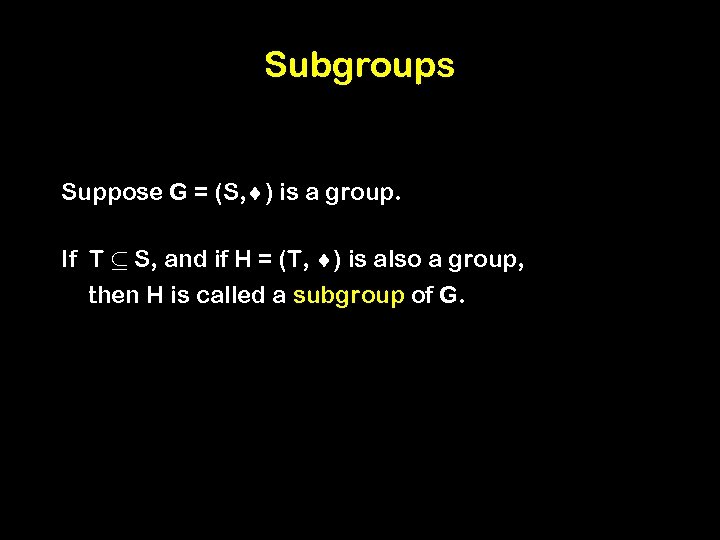 Subgroups Suppose G = (S, ) is a group. If T µ S, and if H = (T, ) is also a group, then H is called a subgroup of G.
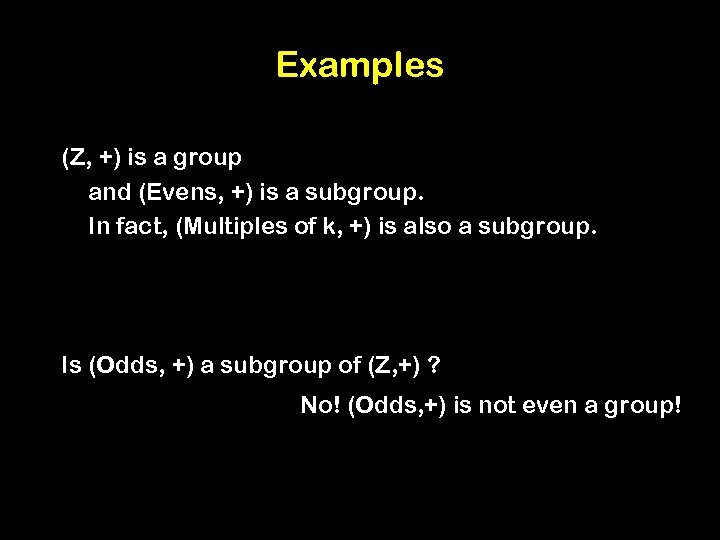 Examples (Z, +) is a group and (Evens, +) is a subgroup. In fact, (Multiples of k, +) is also a subgroup. Is (Odds, +) a subgroup of (Z, +) ? No! (Odds, +) is not even a group!
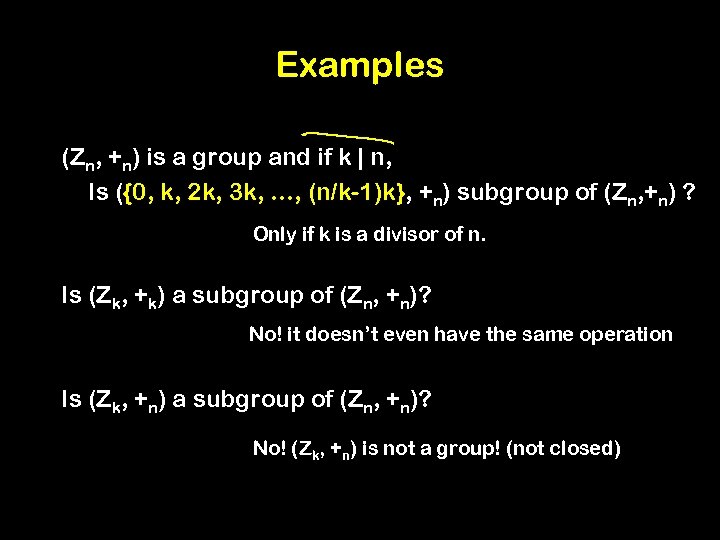 Examples (Zn, +n) is a group and if k | n, Is ({0, k, 2 k, 3 k, …, (n/k-1)k}, +n) subgroup of (Zn, +n) ? Only if k is a divisor of n. Is (Zk, +k) a subgroup of (Zn, +n)? No! it doesn’t even have the same operation Is (Zk, +n) a subgroup of (Zn, +n)? No! (Zk, +n) is not a group! (not closed)
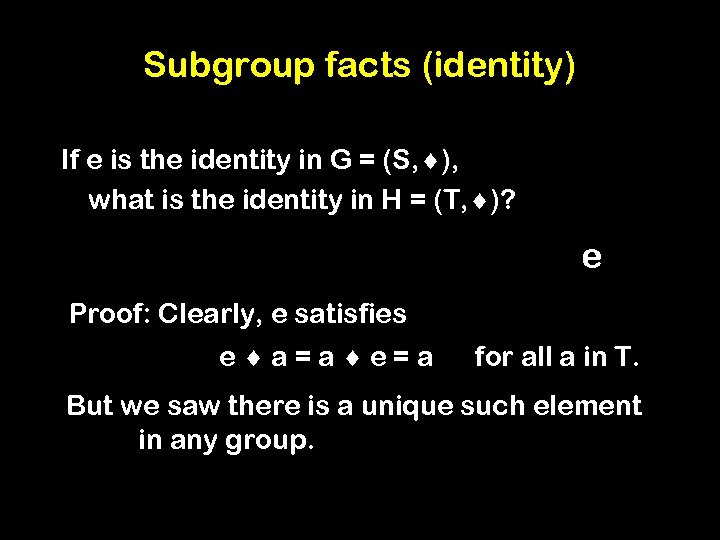 Subgroup facts (identity) If e is the identity in G = (S, ), what is the identity in H = (T, )? e Proof: Clearly, e satisfies e a=a e=a for all a in T. But we saw there is a unique such element in any group.
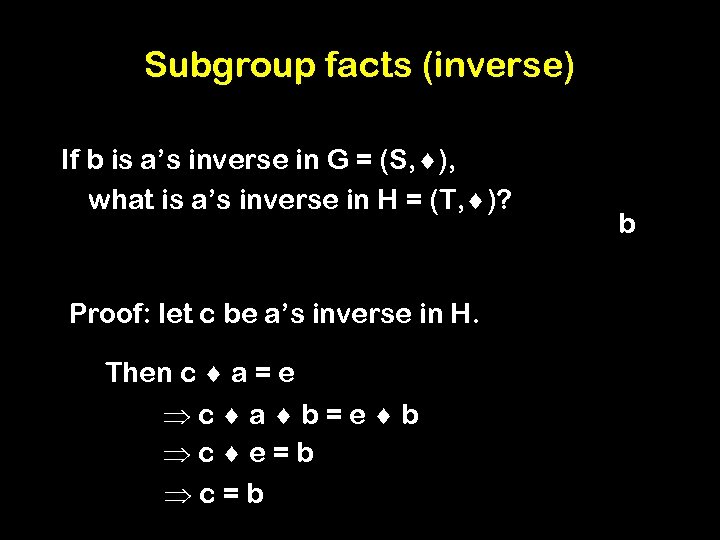 Subgroup facts (inverse) If b is a’s inverse in G = (S, ), what is a’s inverse in H = (T, )? Proof: let c be a’s inverse in H. Then c a = e c a b=e b c e=b c=b b
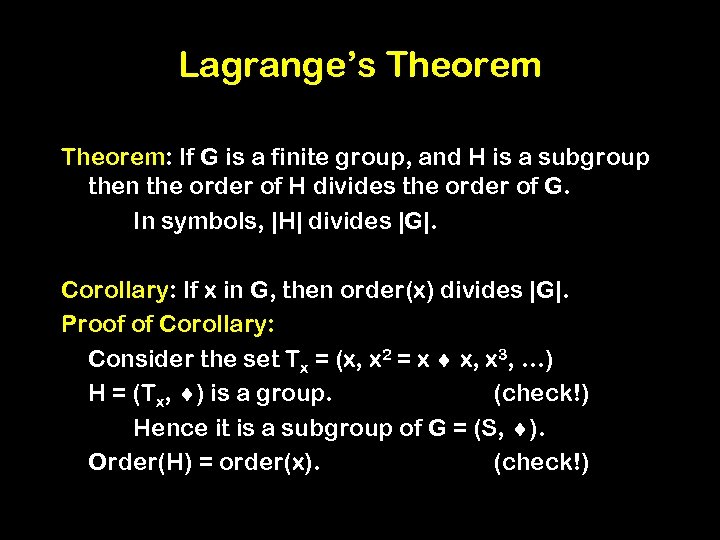 Lagrange’s Theorem: If G is a finite group, and H is a subgroup then the order of H divides the order of G. In symbols, |H| divides |G|. Corollary: If x in G, then order(x) divides |G|. Proof of Corollary: Consider the set Tx = (x, x 2 = x x, x 3, …) H = (Tx, ) is a group. (check!) Hence it is a subgroup of G = (S, ). Order(H) = order(x). (check!)
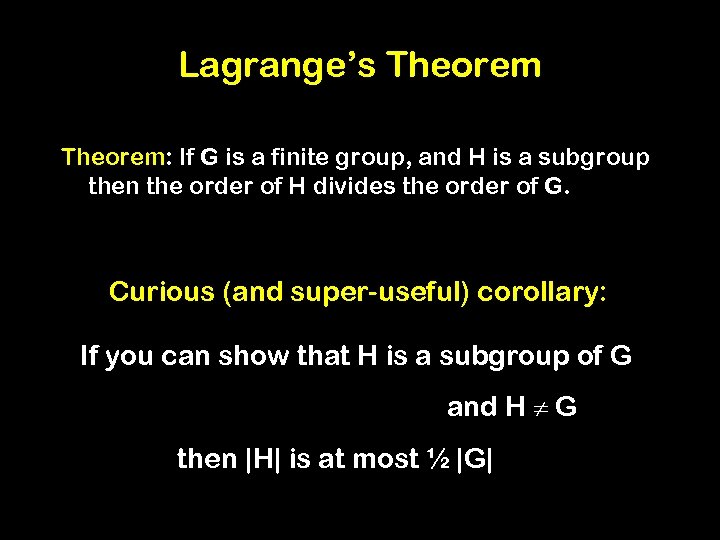 Lagrange’s Theorem: If G is a finite group, and H is a subgroup then the order of H divides the order of G. Curious (and super-useful) corollary: If you can show that H is a subgroup of G and H G then |H| is at most ½ |G|
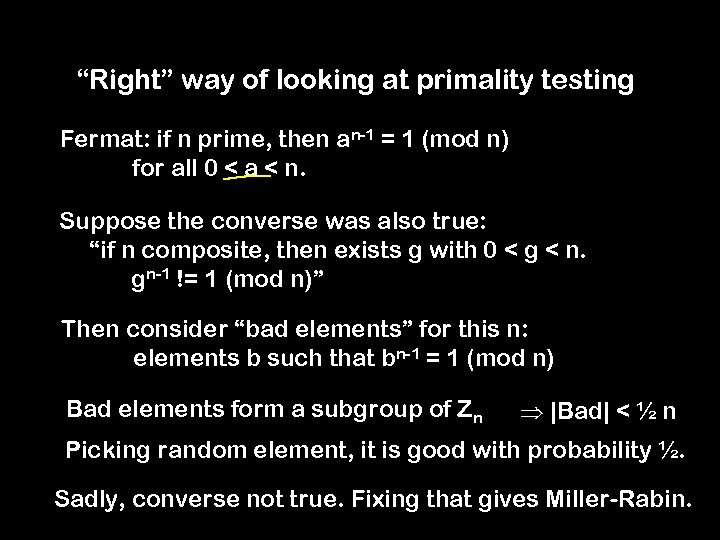 “Right” way of looking at primality testing Fermat: if n prime, then an-1 = 1 (mod n) for all 0 < a < n. Suppose the converse was also true: “if n composite, then exists g with 0 < g < n. gn-1 != 1 (mod n)” Then consider “bad elements” for this n: elements b such that bn-1 = 1 (mod n) Bad elements form a subgroup of Zn |Bad| < ½ n Picking random element, it is good with probability ½. Sadly, converse not true. Fixing that gives Miller-Rabin.
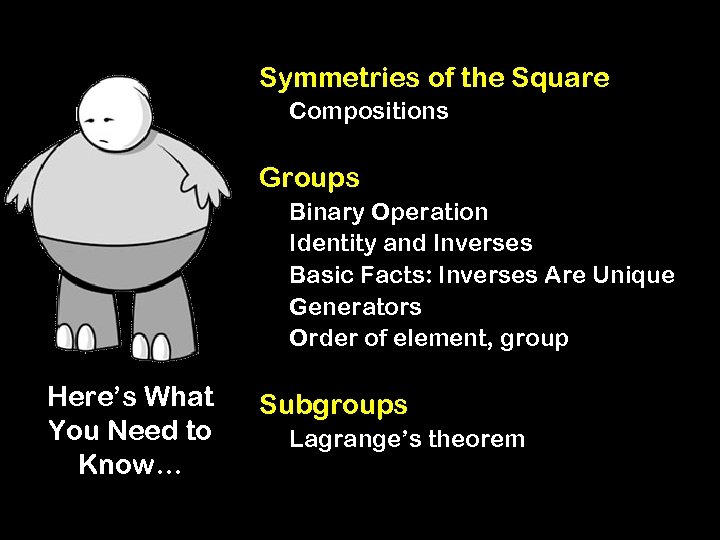 Symmetries of the Square Compositions Groups Binary Operation Identity and Inverses Basic Facts: Inverses Are Unique Generators Order of element, group Here’s What You Need to Know… Subgroups Lagrange’s theorem