 Скачать презентацию 14 th ICDRA Singapore — 2 December 2010
9149b7cd5c3a74d473e9d90c902d0357.ppt
- Количество слайдов: 27




14 th ICDRA Singapore - 2 December 2010 Establishing a mechanism to avoid "shopping around" for ethical approval Fimbo, A. M Tanzania Food and Drugs Authority 1 www. tfda. or.
Outline ►EC/IRB shopping ►Mechanisms to avoid shopping ►Registration of clinical trials ►Establishing networks for sharing information: ►About AVAREF ►PACTA Project ►Tanzania experience 2 www. tfda. or.
EC/IRB shopping ►Is an act of applying for ethical or regulatory approvals from different ECs/IRBs/NRAs. ►Researchers who are not satisfied with one EC/IRB/NRA’s approvals/reviews switch over to another Authority which was not aware of the other's prior decision. ►Researchers would like to find the EC/NRA that's more likely to respond favourably to one's research proposal and circumvent those that might not or have more stringent requirements. 3 www. tfda. or.
EC/IRB shopping ►This can most often occur in countries with weak regulatory mechanism including minimal oversight of clinical trials. ►The review procedures may also be different in different settings. ►Trials banned in one country for safety and/or ethical reasons may be conducted in another country with weaker systems for overseeing trials. ►How to solve this 4 www. tfda. or.
Registration of trials (1) ►One way of solving the problem is to ensure that all trials are registered in a publicly accessible registry. ►A registry can help to identify publication bias such as when a trial is conducted but not published, often because there adverse outcomes or results are ‘negative’. ►Ensures that objectives cannot be changed throughout the course of the trial. ►Can help to identify outcome bias if only a selection of the outcomes (usually those with positive results) are reported. 5 www. tfda. or.
Registration of trials (2) ►Registration also: ►Improves transparency and accountability of researchers. ►Ensures that key information is made available to the public and ►Enhance public trust in the conduct of clinical research. 6 www. tfda. or.
Registration of trials (3) ►Not reporting the results of trials is now increasingly seen as scientific and ethical misconduct. ►The pressure to register trials to reduce biased under-reporting is growing. ►Legislation in some countries now requires registration of trials, while some funding agencies and official bodies recommend it. 7 www. tfda. or.
Registration of trials (4) ► The 2004 Ministerial Summit on Health Research called on the WHO to establish “a network of international clinical trial registers to ensure a single point of access and the unambiguous identification of trials” ► The 58 th WHA endorsed the above call in 2005 ► This was also supported by the International Committee of Medical Journal Editors (ICMJE) ► In 2007 the ICMJE updated their statement - that they would only publish the results of trials registered prospectively and that members of the WHO Network of Primary Registries meet their requirements. 8 www. tfda. or.
Registration of trials (5) ►Trial registration is therefore mandatory for publication in medical journals according to ICMJE. ►Without a registration number from a WHOendorsed primary registry, results of the trial will not even be considered for publication in member journals. ►The Declaration of Helsinki also requires clinical trials to be registered in a publicly accessible database before recruitment of the first subject (Declaration of Helsinki, WMA 2008). 9 www. tfda. or.
Registration of trials (6) ► The International Clinical Trials Registry Platform (ICTRP) (http: //www. who. int/ictrp/en/) is a global initiative that was established by WHO in 2006 in response to demand from countries through the WHA. ► The aim of ICTRP is: ► To make information about all clinical trials involving human beings publicly available. ► To provide a forum for registers to exchange information and work together to establish best practice for clinical trial registration. ► To link clinical trials registers in order to ensure a single point of access and the unambiguous identification of trials with a view of enhancing access to information by patients, families, patient groups and others (WHA 2005). 10 www. tfda. or.
Registration of trials (7) ► Primary Registries in the WHO Registry Network include: ► Pan African Clinical Trial Registry (PACTR) ► Australian New Zealand Clinical Trials Registry (ANZCTR) ► Clinical Trials Registry - India (CTRI) ► German Clinical Trials Register (DRKS) ► The Netherlands National Trial Register (NTR) ► Sri Lanka Clinical Trials Registry (SLCTR) ► www. ISRCTN. org ► Chinese Clinical Trial Registry (Chi. CTR) ► Clinical Research Information Service (CRi. S), Republic of Korea ► Iranian Registry of Clinical Trials (IRCT) ► Japan Primary Registries Network (JPRN) (http: //www. who. int/ictrp/network/primary/en/index. html): 11 www. tfda. or.
Registration of trials (8) ► Despite all the efforts, there are still some challenges on achieving universal trial registration. ► It is believed that many trials are still conducted/have been conducted without being registered (particularly in poor countries where resources are limited in scrutinizing and confirming whether trials have been registered or not). ► This can also be explained by the fact that trial registration is not a legal requirement and lacks enough power of enforcement. ► Having legislation in place can help to ensure that all researchers register their trials. ► What has been done in Africa? 12 www. tfda. or.
AVAREF (1) ► Taking into account the challenges facing Africa in overseeing clinical trials including issues related to registration of trials and recognizing the strength of networking amongst ECs & NRAs, the African Vaccine Regulatory Forum (AVAREF) was established during the NRA workshop organized by WHO in Accra – Ghana in Sept 2006. ► AVAREF has ever since been an informal network approach to regulation of clinical trials in Africa. ► The Forum is made up of 19 countries at the moment: Botswana, Burkina Faso, Cameroon, Ethiopia, Kenya, Gambia, Ghana, Gabon, Uganda, Tanzania, Mali, Malawi, Nigeria, South Africa, Senegal, Rwanda, Mozambique, Zambia and Zimbabwe ► More countries are invited to join the Forum at any time. 13 www. tfda. or.
AVAREF (2) ►Has been an effective initiative to stimulate progress towards regulatory harmonization of clinical trials ►It serves as an "ad-hoc" scientific and regulatory advisory body for ECs/NRAs to make informed decisions regarding evaluation of registration dossiers, authorization of clinical trials of vaccines in the region. 14 www. tfda. or.
AVAREF (3) ►The Forum meets every year: ►AVAREF 1 – Accra, Ghana – 2006 (inception) ►AVAREF 2 – Ouagadougou, B/Faso - 2007 ►AVAREF 3 – Zanzibar, Tanzania - 2008 ►AVAREF 4 – Abuja, Nigeria - 2009 ►AVAREF 5 – Nairobi, Kenya - 2010 ►AVAREF 6 – Planned for either Mozambique, Zimbabwe, Malawi or Senegal - 2011 15 www. tfda. or.
Objectives of AVAREF ► To provide information to countries targeted for clinical trials of vaccines, on vaccine candidates and timelines. ► To promote communication and collaboration between NRAs in countries where vaccines are developed and ECs and NRAs in countries targeted for clinical trials. ► To provide expertise to African NRAs, especially, on development of procedures for authorization and monitoring of clinical trials as well as the evaluation of data. ► To promote vaccine development and access, in line with the Global Immunization and Strategy and Vision (GIVS), as well as the goals of the IVB/HQ and IVD/AFRO programmes. 16 www. tfda. or.
Major achievements ►Joint reviews and joint inspections conducted (Conjugate meningitis A and Malaria vaccines) ►Development of African Common Clinical Trial Guidelines (ACCTG) ►Integration of ethical review, regulation and registration of clinical trials 17 www. tfda. or.
Major achievements ►Model regulatory procedures developed and adopted by many countries ►Regulatory oversight has improved significantly in region ►Channels of communication among African regulators and with regulators from developed countries have created confidence, strength and willingness to harmonize processes 18 www. tfda. or.
PACTA Project (1) ►As part of AVAREF initiative a working group of Pan African Clinical Trials Alliance (PACTA) has been established. ►The working group consists of 6 countries (Tanzania, Uganda, Nigeria, South Africa, B/Faso and Ghana). ►The aims of the working group is to push forward some of the agenda items agreed during AVAREF meetings to include: 19 www. tfda. or.
PACTA Project (2) ►Establishing a more effective coordination between NRAs and ECs ►Processes/Models for authorization of clinical trials ►Registration of clinical trials ►The working group held its first meeting at WHO HQ in Geneva 9 – 10 th Nov, 2010 ►The issues above were agreed to be piloted in the countries participated and results will be reported during the forthcoming AVAREF meeting. ►A timeline of 3 & 6 months have been agreed for countries to provide feedback on progress. 20 www. tfda. or.
Tanzania experience (1) ►The TFDA has been active in setting up a system for regulation of clinical trials since 2003. ►Standards - documents, processes and procedures related to oversight of clinical trials have been developed ►The Authority assesses and approves applications to conduct clinical trials in TZ ►Ensures that investigational products meets appropriate standards of quality, safety and efficacy with due regard to the phase of the trial 21 www. tfda. or.
Tanzania experience (2) ►Ensures that clinical trials are appropriately designed to meet stated objectives according to national laws and regulations ►Ensures that clinical trials are conducted in accordance with existing national laws/regulations or internationally accepted standards e. g. WHO, ICH-GCP etc. ►Conducts inspections at investigator sites and/or sponsor/CRO facilities 22 www. tfda. or.
Tanzania experience (3) ►Regulations (The Tanzania Food, Drugs and Cosmetics (Clinical Trials Control) Regulations, 2009) which provides for registration of clinical trials are in final stages of approval. ►A National Registry is in final stages of development. 23 www. tfda. or.
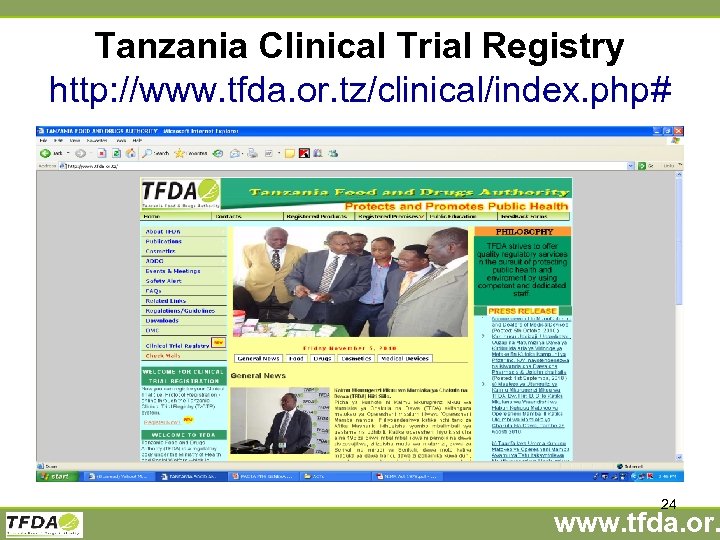
Tanzania Clinical Trial Registry http: //www. tfda. or. tz/clinical/index. php# 24 www. tfda. or.
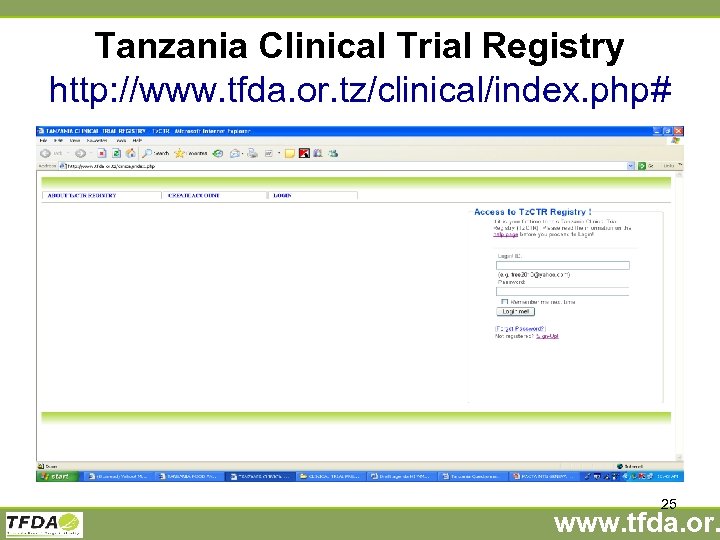
Tanzania Clinical Trial Registry http: //www. tfda. or. tz/clinical/index. php# 25 www. tfda. or.
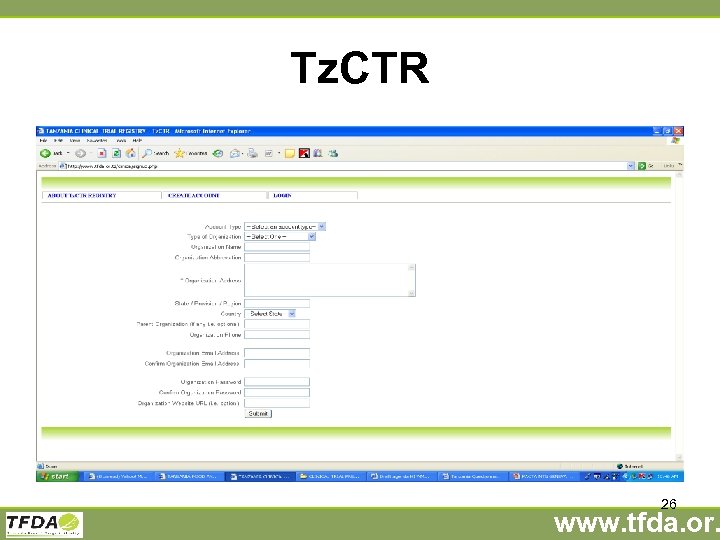
Tz. CTR 26 www. tfda. or.
Conclusion ► Registration of clinical trials allows for researchers and the public to know what studies are being conducted, by whom and where ► Ensures research participants are not exposed to unnecessary risks ► Permits human research to be done with public scrutiny ► Reduces shopping around for EC/NRA approvals ► AVAREF has been a good platform towards harmonization, capacity building and sharing of information to include trials being carried out in Africa. 27 www. tfda. or.
Скачать презентацию 14 th ICDRA Singapore — 2 December 2010
9149b7cd5c3a74d473e9d90c902d0357.ppt