


 Скачать презентацию 13 th Symposium on Development and Social Transformation
6a1a7d43640b6d7e0d9968539ac01d9c.ppt
- Количество слайдов: 48
 13 th Symposium on Development and Social Transformation Panel 2: Problems In Post-Socialist Transition: The Case of Romania Wednesday, April 19 th (10: 15 -11: 30 am)
 13 th Symposium on Development and Social Transformation Panel 2: Problems In Post-Socialist Transition: The Case of Romania Privatization Of Industrial Property In Romania: Political & Economical Explanations Of Relative Failure Oana Adriana Zabava
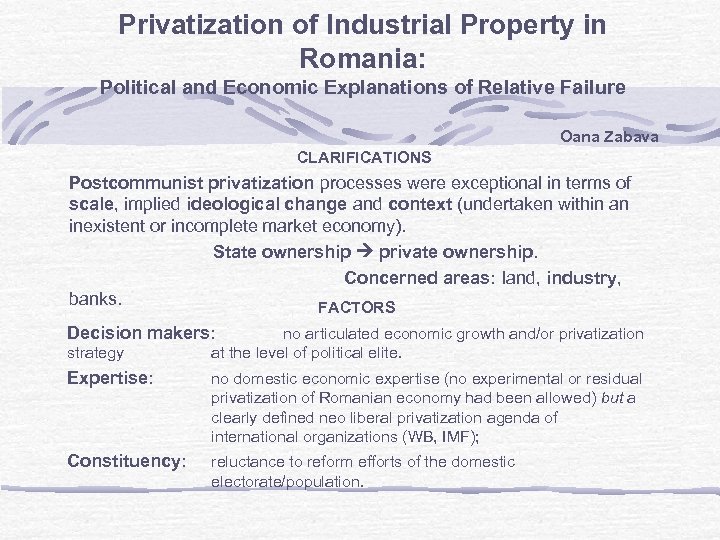 Privatization of Industrial Property in Romania: Political and Economic Explanations of Relative Failure Oana Zabava CLARIFICATIONS Postcommunist privatization processes were exceptional in terms of scale, implied ideological change and context (undertaken within an inexistent or incomplete market economy). State ownership private ownership. Concerned areas: land, industry, banks. FACTORS Decision makers: strategy no articulated economic growth and/or privatization at the level of political elite. Expertise: no domestic economic expertise (no experimental or residual privatization of Romanian economy had been allowed) but a clearly defined neo liberal privatization agenda of international organizations (WB, IMF); Constituency: reluctance to reform efforts of the domestic electorate/population.
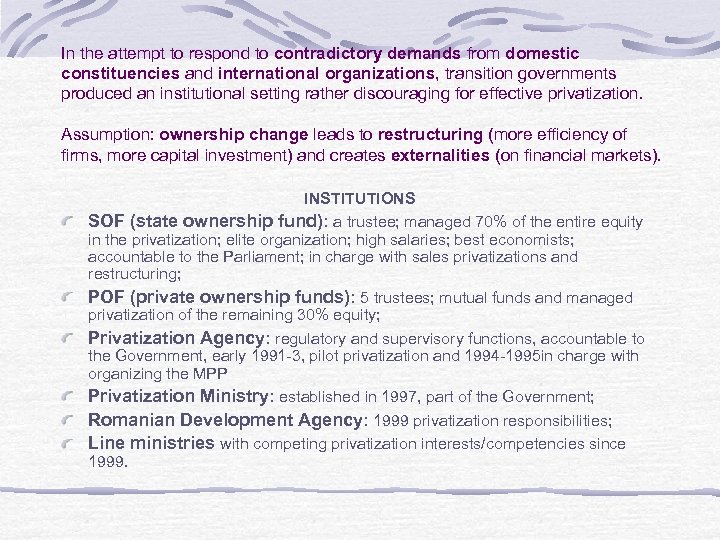 In the attempt to respond to contradictory demands from domestic constituencies and international organizations, transition governments produced an institutional setting rather discouraging for effective privatization. Assumption: ownership change leads to restructuring (more efficiency of firms, more capital investment) and creates externalities (on financial markets). INSTITUTIONS SOF (state ownership fund): a trustee; managed 70% of the entire equity in the privatization; elite organization; high salaries; best economists; accountable to the Parliament; in charge with sales privatizations and restructuring; POF (private ownership funds): 5 trustees; mutual funds and managed privatization of the remaining 30% equity; Privatization Agency: regulatory and supervisory functions, accountable to the Government, early 1991 -3, pilot privatization and 1994 -1995 in charge with organizing the MPP Privatization Ministry: established in 1997, part of the Government; Romanian Development Agency: 1999 privatization responsibilities; Line ministries with competing privatization interests/competencies since 1999.
 PRIVATIZATION METHODS Pilot/Spontaneous (1990 -1994) PRIVATIZATION OUTCOMES Management-Employee-Buy-Out (MEBO) (19901994) Mass Privatization Program (MPP) (19951996) Sales to Outside Investors ü Increase in privatized firms’ performance; ü Irreversible private ownership & shrinking state in economy (1996 - present) LIMITATIONS Scope: ‘regii autonome’ were exempt until 1997; Extent: MPP program privatized enterprises only partially (40 up to 60% of shares); as a result ‘residual’ shares were difficult to privatize; Incentives for restructuring: Insider control insufficient management expertise, insufficient capital investment Dispersed ownership weak corporate governance Multiple criteria for sales Lack of transparency Social criteria for sales advantage to buyers committed to secure current level of employment Subsidies for restructuring
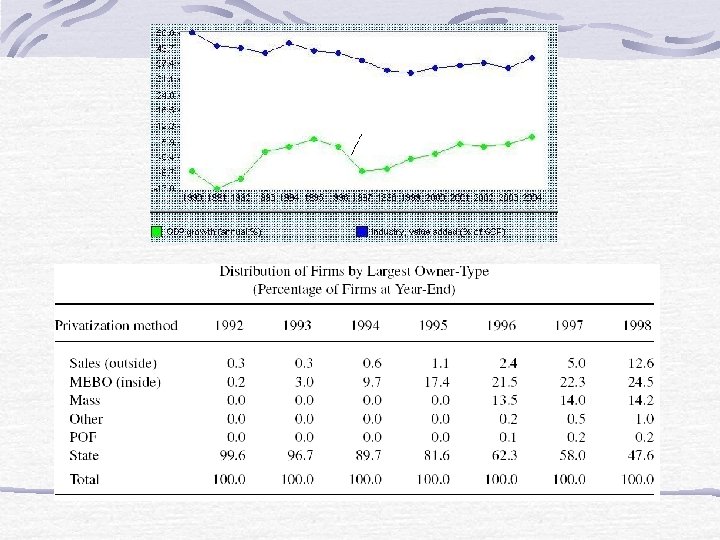
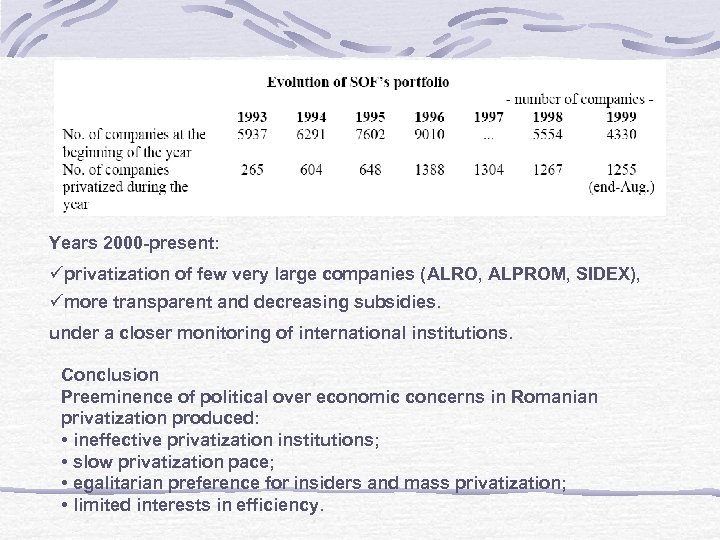 Years 2000 -present: üprivatization of few very large companies (ALRO, ALPROM, SIDEX), ümore transparent and decreasing subsidies. under a closer monitoring of international institutions. Conclusion Preeminence of political over economic concerns in Romanian privatization produced: • ineffective privatization institutions; • slow privatization pace; • egalitarian preference for insiders and mass privatization; • limited interests in efficiency.
 13 th Symposium on Development and Social Transformation Panel 2: Problems In Post-Socialist Transition: The Case of Romania Challenges Of Judicial Power And Independence: A Case Study Of Romania Angela Fitzpatrick
 The Challenge of Judicial Activism in Post-Communist Democracies: Lessons from Romania’s 2005 Constitutional Court Crisis ANGELA FITZPATRICK Ph. D. Student, Political Science The Maxwell School, Syracuse University
 • • • Introduction and Case Background The “Active” Constitutional Courts of Central and Eastern Europe The Challenge of Judicial Activism in Transitioning Democracies Lessons from/for Romania’s July 2005 Constitutional Court Crisis Conclusions
 I. Introduction and Case Background • In July 2005, Romania’s Constitutional Court declared a set of EU-accession related reforms passed by the new coalition unconstitutional. – The problem? Because the Constitutional Court was made up of members appointed by the previous governing regime, the Social Democrat Party (PSD), some felt that this was a political move to impede the agenda of the current power holders and PSD’s rivals, the Justice and Truth Alliance (DA PNL-PD). • This accusation highlights a broader question about judicial power: should an unelected, politically-appointed Court be allowed to subvert policy decisions made by those who were elected by the people?
 II. The “Active” Constitutional Courts of Central and Eastern Europe • The “active” constitutional courts of the region share three institutional features: – fewer barriers to an audience with them; – their members have fixed appointments that are more in line with electoral cycles; – they work under constitutions that offer more explicit details regarding court power. • In other words, the post-Communist constitutional courts were all designed with “structural differences that make them better suited to play [a] democratic role” (Scheppele 2003 b: 235).
 III. The Challenge of Judicial Activism in Transitioning Democracies • For some scholars, a court that has the power to act against the governing coalition is a liability, especially in transitioning regimes (Shapiro 1999, Hirschl 2000, Hirschl 2002, Sadurski 2002, Hirschl 2004). – citizens should be able to elect officials based on their policy agendas and remove them when they fail to achieve them. • For others that advocate an active judiciary, the court has proven to be the most stable, and therefore trusted, actor during the transitional period. – it remains relatively protected from the disorder of democratic politics, while still subject to some degree of accountability.
 IV. Lessons from/for Romania’s July 2005 Constitutional Court Crisis • During the 1990’s, Romania’s Court was widely considered to be a political actor whose “decisions are considered politically motivated” (Weber 2002: 284). – Until 2004, when the DA PNL-PD alliance came to power, the members of Romania’s Constitutional Court enjoyed the support of a friendly governing coalition under PSD. • In claiming that the Constitutional Court’s actions were driven by the political agenda of the opposition party, the governing coalition called into question the undemocratic nature of judicial activism in the very area in which it has been heralded as beneficial for transition in the region (Scheppele 2003 a, 2003 b, 2003 c).
 V. Conclusions • Even if one accepts the widely argued view that the Court was purely driven by its affiliation with PSD, the potential political implications of institutional design that encourages judicial activism should be addressed. – All forms of judicial review allow justices who are put in place by the previous regime to block legislation passed by the current governing coalition, which can ultimately result in crises of the sort seen in Romania in the summer of 2005. • As long as judicial activism is encouraged, it is unlikely that judicial independence can be institutionally strengthened – doing so would threaten the power of elected officials, those able to pursue – and therefore unlikely – the constitutional reforms necessary to do so.
 13 th Symposium on Development and Social Transformation Panel 2: Problems In Post-Socialist Transition: The Case of Romania Social Transition In Romania Gabriella Pakucs
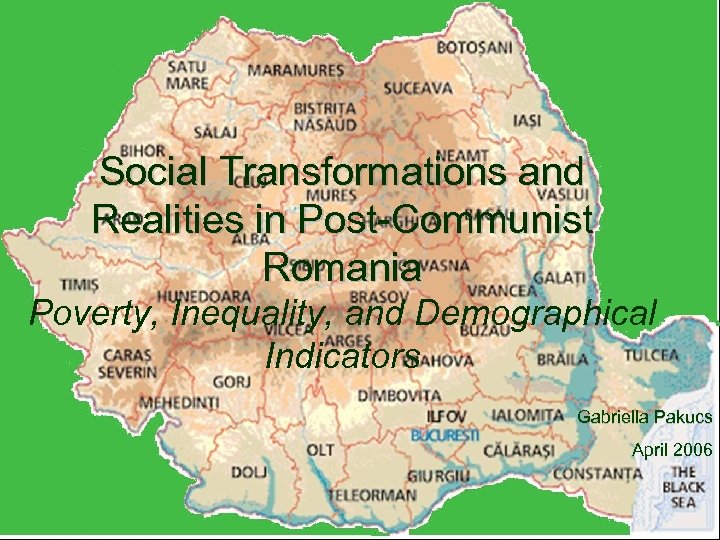 Social Transformations and Realities in Post-Communist Romania Poverty, Inequality, and Demographical Indicators Gabriella Pakucs April 2006
 Social indicators Deep transformations in all the spheres of the society: economic, politic, social On the social level the current situation is due to: the communist past the transition period new behavioral patterns
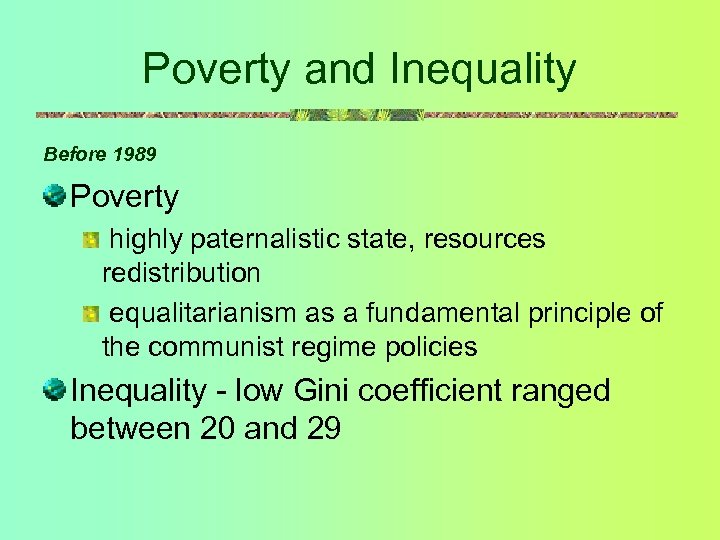 Poverty and Inequality Before 1989 Poverty highly paternalistic state, resources redistribution equalitarianism as a fundamental principle of the communist regime policies Inequality - low Gini coefficient ranged between 20 and 29
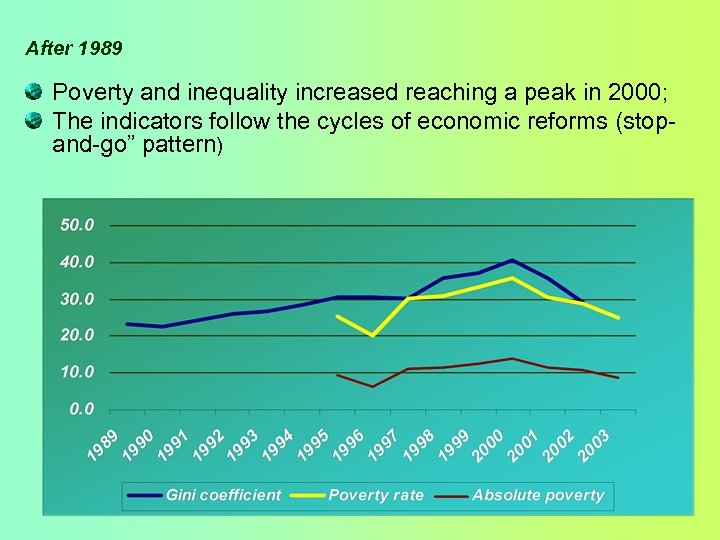 After 1989 Poverty and inequality increased reaching a peak in 2000; The indicators follow the cycles of economic reforms (stopand-go” pattern)
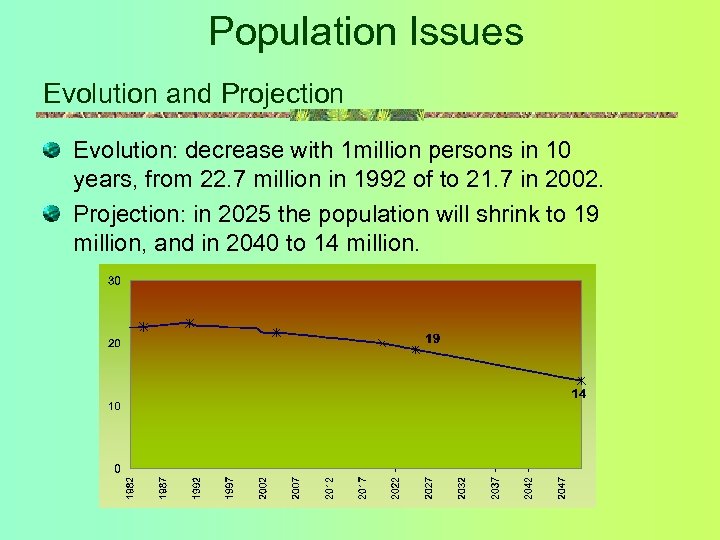 Population Issues Evolution and Projection Evolution: decrease with 1 million persons in 10 years, from 22. 7 million in 1992 of to 21. 7 in 2002. Projection: in 2025 the population will shrink to 19 million, and in 2040 to 14 million.
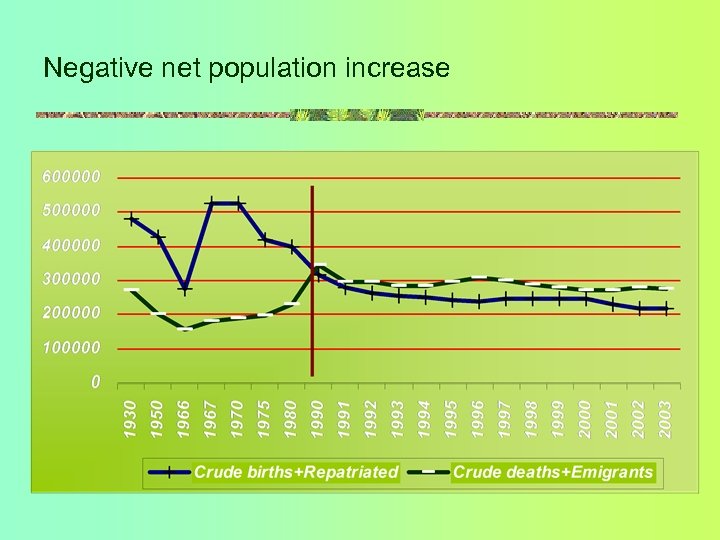 Negative net population increase
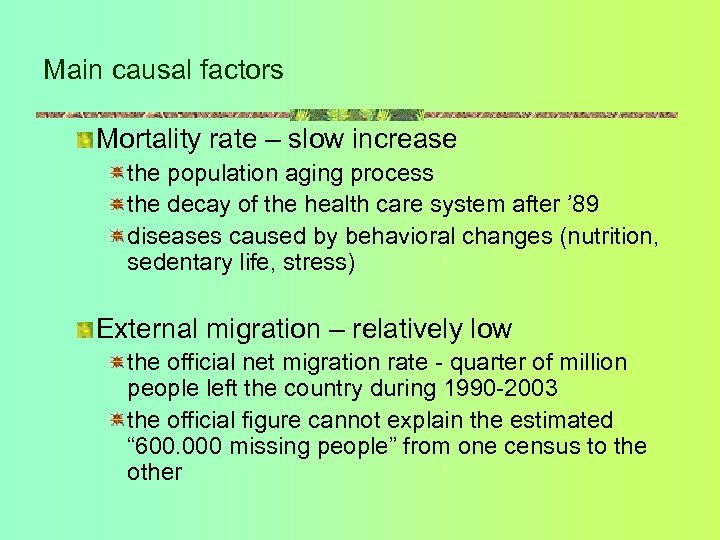 Main causal factors Mortality rate – slow increase the population aging process the decay of the health care system after ’ 89 diseases caused by behavioral changes (nutrition, sedentary life, stress) External migration – relatively low the official net migration rate - quarter of million people left the country during 1990 -2003 the official figure cannot explain the estimated “ 600. 000 missing people” from one census to the other
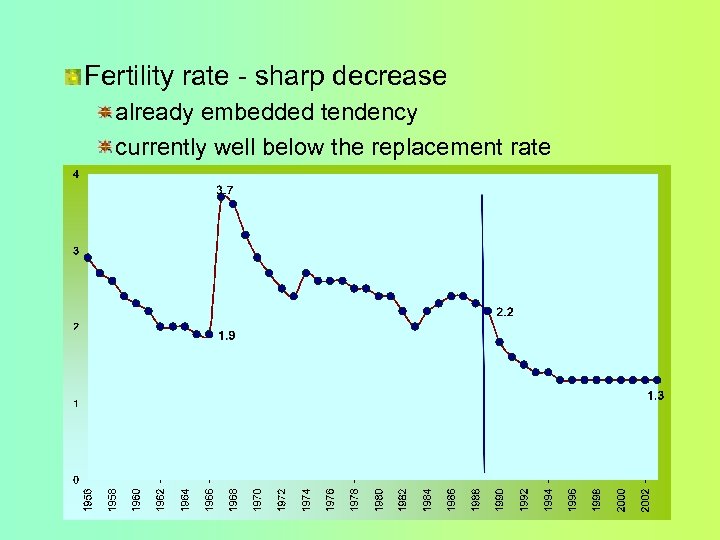 Fertility rate - sharp decrease already embedded tendency currently well below the replacement rate
 13 th Symposium on Development and Social Transformation Panel 2: Problems In Post-Socialist Transition: The Case of Romania ROMANIA Mihaela Carstei
 Impacts of Capital Account Liberalization Evidence for Romania Mihaela Carstei April 17, 2006
 Growth Theory • Most theories of growth, from Ricardo to Solow and Romer, emphasize domestic savings as a key determinant of long term growth. • The international capital mobility breaks this link between savings and investment • • It makes investment demand a far more important determinant of economic growth than domestic savings supply Allows for poor countries to supplement their investment needs and grow more rapidly than would otherwise be possible. • Leads to large shifts in international location of production • It can stimulate or substitute for trade • International capital flows can also supplement or even replace aid
 Capital Account Liberalization • Last step in the sequencing of reforms • Is the process of removing restrictions from international transactions related to the movement of capital. • It can involve the removal of controls on both domestic residents’ international financial transactions and on investments in the home country by foreigners. • Liberalization can apply to both inflows and outflows of capital.
 Capital Account Liberalization • Capital account restrictions can take various forms including: • • limiting domestic banks’ foreign borrowing; controlling foreign capital coming into the economy; limiting the sectors of industry in which foreigners can invest, and restricting the ability of foreign investors to repatriate money earned from investments in the domestic economy.
 The evidence for Romania • 1998: liberalization of current account operations (Art. VIII of IMF Articles of Agreement) • 1999: liberalization of medium- and longterm capital inflows • 2001: schedule of capital account liberalization
 The evidence for Romania • 2001 -2002: liberalization of capital flows with low impact on the balance of payments 1. 2. 3. 4. 5. direct and real-estate investment by residents abroad admission to quotation of national securities on foreign capital markets collateral granted by foreigners to residents personal capital movements medium- and long-term loans related to commercial transactions or services granted by residents to nonresidents
 The evidence for Romania • 2003 – 2004: liberalization of capital movements consisting of transfers in performance of insurance contracts and other capital flows with significant impact on the real sector 1. 2. 3. 4. 5. residents’ transactions in foreign securities financial borrowings and loans with maturity less than 1 year granted by foreigners to residents financial borrowings and loans granted by residents to foreigners collateral granted by residents to foreigners admission to quotation of foreign securities on domestic capital markets
 The evidence for Romania • At latest upon accession to EU: liberalization of capital flows with significant impact on the balance of payments 1. 2. 3. operations in RON-denominated deposit accounts opened by foreigners with resident financial institutions operations in securities and other open market instruments operations in current and deposit accounts opened by residents abroad
 Effects of capital flows • The growth-related benefits of capital account liberalization for developing countries have not been established • It is more accurate to say that these results have not been observed and may not exist at all. • This goes against the conventional wisdom behind the approach of the Bretton Woods Institutions: • The benefits of liberalization will accrue to those countries who follow the right policies, and who have the right institutional and supervisory standards in place.
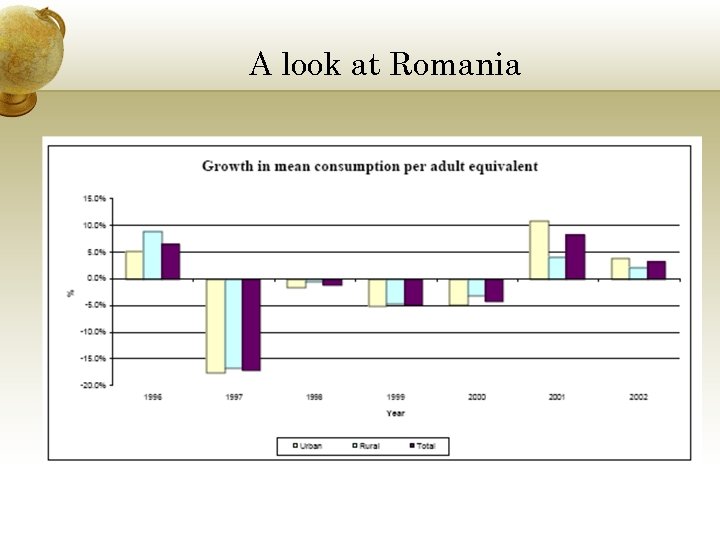
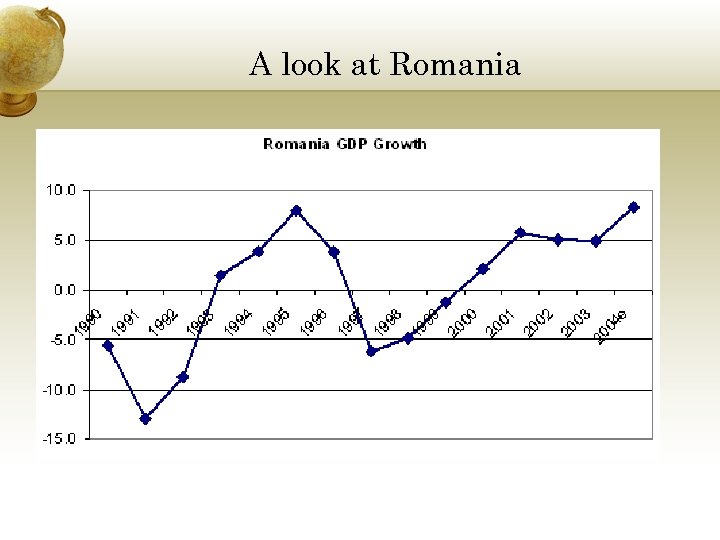
 A look at Romania • Poverty changes in Romania tend to mirror closely both GDP and consumption growth. • In 1997 -1999, output decline in Romania was accompanied by a widening of poverty, • While robust GDP expansion in 1996 and the recent rebound that started in 2000 were accompanied by reductions in poverty.
 A look at Romania • According to the World Bank’s recommended benchmarks to measure absolute poverty in Europe • • in 1989 5. 4% of Romania’s population lived on US$ 4. 30 per day or less. in 1994 the rate jumped to 80. 0%. by 2000, it had dropped to 67. 5%. in 2002, 14% of the population reported to be living on US$ 2. 15 or less per day
 A look at Romania
 A look at Romania
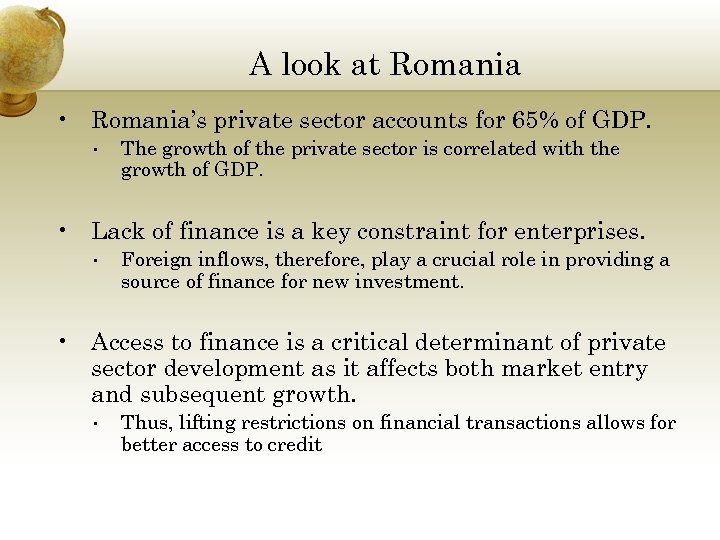 A look at Romania • Romania’s private sector accounts for 65% of GDP. • The growth of the private sector is correlated with the growth of GDP. • Lack of finance is a key constraint for enterprises. • Foreign inflows, therefore, play a crucial role in providing a source of finance for new investment. • Access to finance is a critical determinant of private sector development as it affects both market entry and subsequent growth. • Thus, lifting restrictions on financial transactions allows for better access to credit
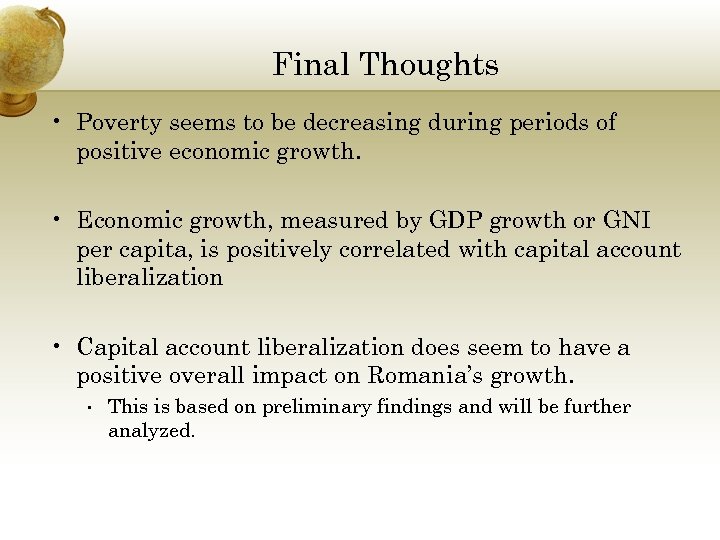 Final Thoughts • Poverty seems to be decreasing during periods of positive economic growth. • Economic growth, measured by GDP growth or GNI per capita, is positively correlated with capital account liberalization • Capital account liberalization does seem to have a positive overall impact on Romania’s growth. • This is based on preliminary findings and will be further analyzed.
 13 th Symposium on Development and Social Transformation Panel 2: Problems In Post-Socialist Transition: The Case of Romania Trends In Romanian Rural Development Oana Adriana Zabava
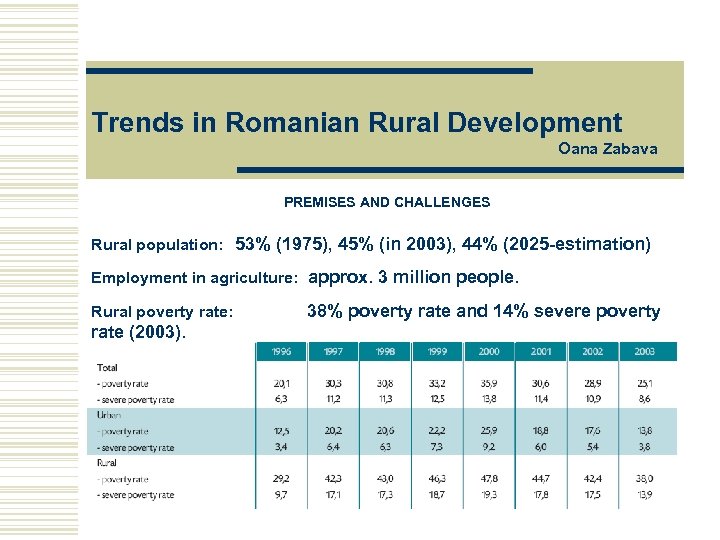 Trends in Romanian Rural Development Oana Zabava PREMISES AND CHALLENGES Rural population: 53% (1975), 45% (in 2003), 44% (2025 -estimation) Employment in agriculture: approx. 3 million people. Rural poverty rate: rate (2003). 38% poverty rate and 14% severe poverty
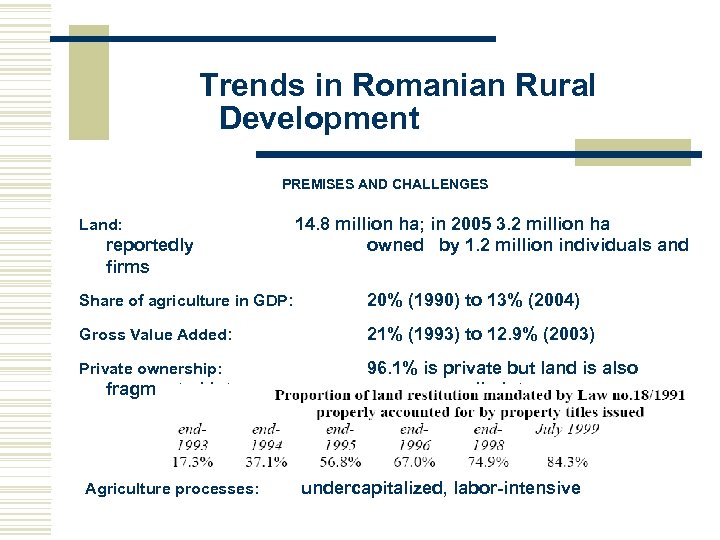 Trends in Romanian Rural Development PREMISES AND CHALLENGES Land: reportedly firms 14. 8 million ha; in 2005 3. 2 million ha owned by 1. 2 million individuals and Share of agriculture in GDP: 20% (1990) to 13% (2004) Gross Value Added: 21% (1993) to 12. 9% (2003) Private ownership: 96. 1% is private but land is also small plots fragmented into Agriculture processes: undercapitalized, labor-intensive
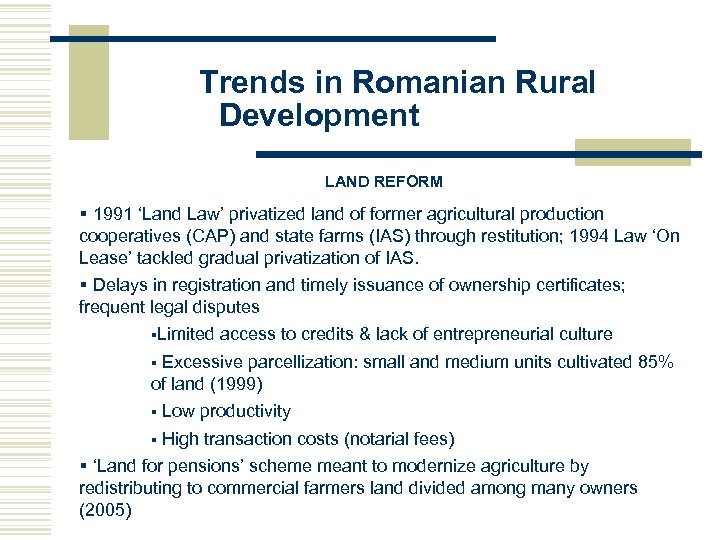 Trends in Romanian Rural Development LAND REFORM § 1991 ‘Land Law’ privatized land of former agricultural production cooperatives (CAP) and state farms (IAS) through restitution; 1994 Law ‘On Lease’ tackled gradual privatization of IAS. § Delays in registration and timely issuance of ownership certificates; frequent legal disputes §Limited access to credits & lack of entrepreneurial culture § Excessive parcellization: small and medium units cultivated 85% of land (1999) § Low productivity § High transaction costs (notarial fees) § ‘Land for pensions’ scheme meant to modernize agriculture by redistributing to commercial farmers land divided among many owners (2005)
 Trends in Romanian Rural Development RURAL DEVELOPMENT POLICY w Main obstacles: n n Farm segment: market infrastructure (high transaction costs), clear user and property rights Non farm segment: physical infrastructure, finance, state governance (corruption) w Aid and preparation for EU accession: n n n ISPA, SAPARD – programs of technical and financial assistance; Responses of the Romanian Government: Rural Development Strategy (1998), National Plan for Agriculture and Rural Development (2000) Direct EU farm subsidies phased in until 2016 to create incentives for restructuring agriculture
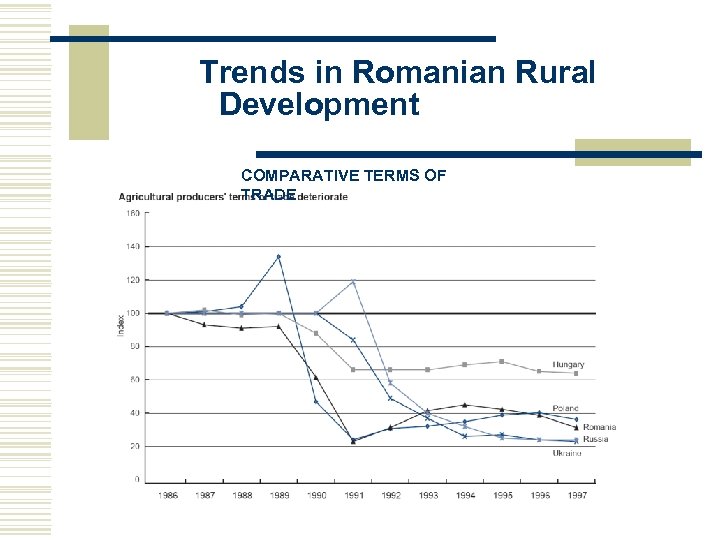 Trends in Romanian Rural Development COMPARATIVE TERMS OF TRADE
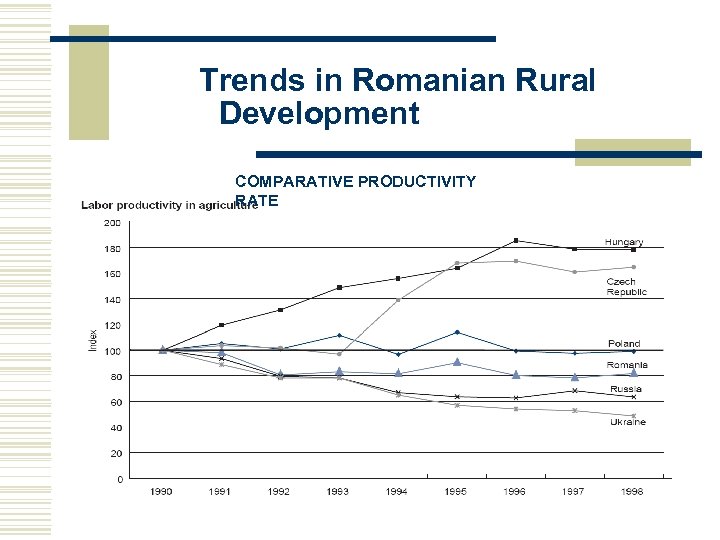 Trends in Romanian Rural Development COMPARATIVE PRODUCTIVITY RATE
 13 th Symposium on Development and Social Transformation Panel 2: Problems In Post-Socialist Transition: The Case of Romania Wednesday, April 19 th (10: 15 -11: 30 am) Oana Adriana Zabava Angela Fitzpatrick Gabriella Pakucs Mihaela Carstei Oana Adriana Zabava Privatization Of Industrial Property In Romania: Political & Economical Explanations of Relative Failure Challenges of Judicial Power & Independence: A Case Study of Romania Social Transition in Romania Trends in Romanian Rural Development