


 Скачать презентацию 13 th Annual International C 2 Research
f9ff060557470e7c8145fcfe9212c42d.ppt
- Количество слайдов: 26
 13 th Annual International C 2 Research & Technology Symposium Modeling Impacts of Operational Changes on Joint Campaign Effects Mr. John Arsenault, Tri-Cor Industries Mr. Larry Stephens, Dynamics Research Corporation HQ Air Mobility Command Directorate of Air, Space and Information Operations Resources and Requirements Division June 2008
 Modeling Impacts of Operational Changes on Joint Campaign Effects n Purpose n Air Mobility Command – Background n Implications for Strategic Responsiveness n Traditional Analysis n Current Modeling Methodology n Proposed Process n Results & Examples n Conclusions 2
 Purpose n Develop analytical approach to calculating value of air mobility to COCOM n Provide analysis of impact of changes in air mobility capabilities on Joint Warfighting n Better articulate value of air mobility investments at AF and OSD based on achieving Joint effects Link air mobility capabilities to achievement of Joint effects 3
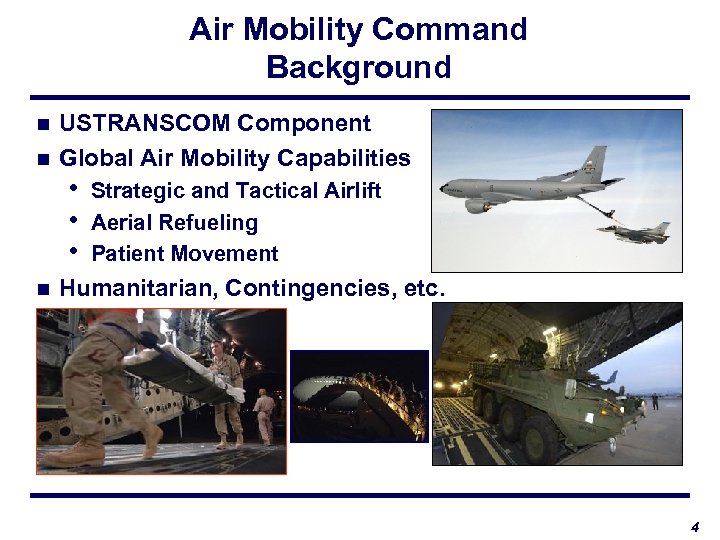 Air Mobility Command Background USTRANSCOM Component n Global Air Mobility Capabilities n • • • n Strategic and Tactical Airlift Aerial Refueling Patient Movement Humanitarian, Contingencies, etc. 4
 Implications for Strategic Responsiveness n Global reach and strategic responsiveness are becoming more important, not less so n Future OE will demand more frequent and more timely action by the US and international community to counter aggression and prevent conflict n US must be able to project power rapidly to any point in the globe to conduct effective military operations in any environment, in any terrain, and against any threat, in the face of determined opposition to intervention 5
 Traditional Analysis n AMC Focused on Narrow Definition of Air Mobility Performance n Joint Analyses Produced Airlift “Capability Windows” Based on Deployment of Forces n Resulting conclusions define upper and lower risk limits and “acceptance” of lower capability levels • Example: DOD Mobility Capabilities Study 2006 (MCS 06) Assessed Air Mobility Capabilities “Adequate” 6
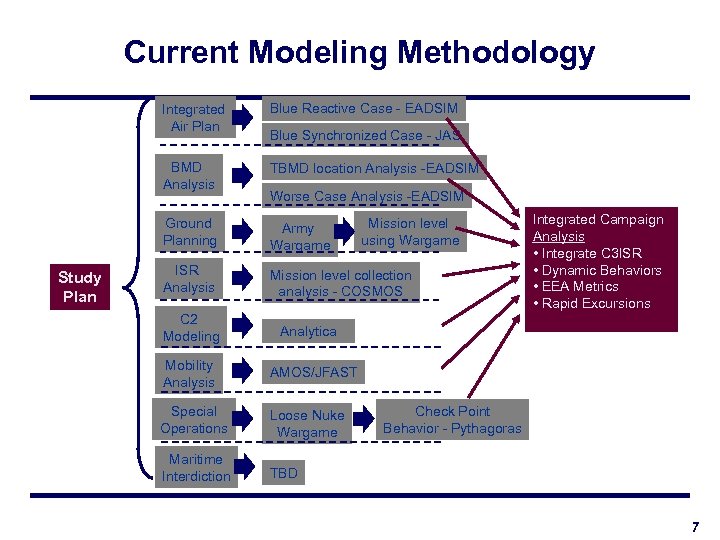 Current Modeling Methodology Integrated Air Plan BMD Analysis Blue Reactive Case - EADSIM Blue Synchronized Case - JAS TBMD location Analysis -EADSIM Worse Case Analysis -EADSIM Ground Planning Study Plan Army Wargame ISR Analysis Mission level collection analysis - COSMOS C 2 Modeling Mission level using Wargame Integrated Campaign Analysis • Integrate C 3 ISR • Dynamic Behaviors • EEA Metrics • Rapid Excursions Analytica Mobility Analysis AMOS/JFAST Special Operations Loose Nuke Wargame Maritime Interdiction TBD Check Point Behavior - Pythagoras 7
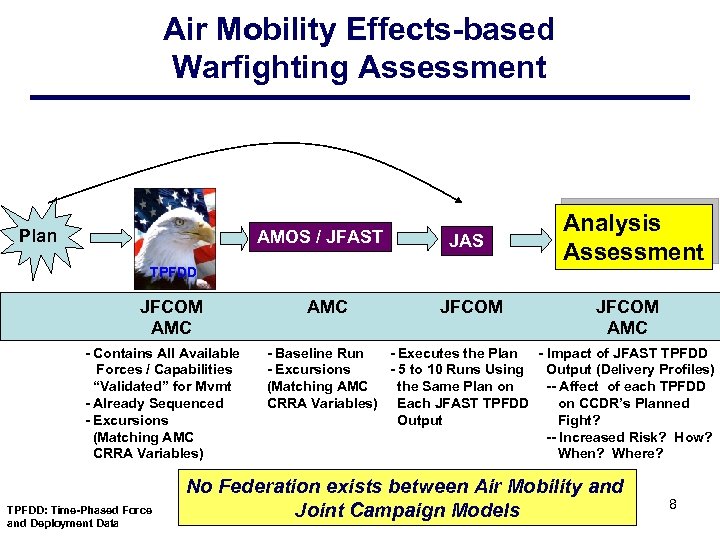 Air Mobility Effects-based Warfighting Assessment Plan AMOS / JFAST JAS TPFDD JFCOM AMC - Contains All Available Forces / Capabilities “Validated” for Mvmt - Already Sequenced - Excursions (Matching AMC CRRA Variables) TPFDD: Time-Phased Force and Deployment Data AMC JFCOM Analysis Assessment JFCOM AMC - Baseline Run - Executes the Plan - Impact of JFAST TPFDD - Excursions - 5 to 10 Runs Using Output (Delivery Profiles) (Matching AMC the Same Plan on -- Affect of each TPFDD CRRA Variables) Each JFAST TPFDD on CCDR’s Planned Output Fight? -- Increased Risk? How? When? Where? No Federation exists between Air Mobility and Joint Campaign Models 8
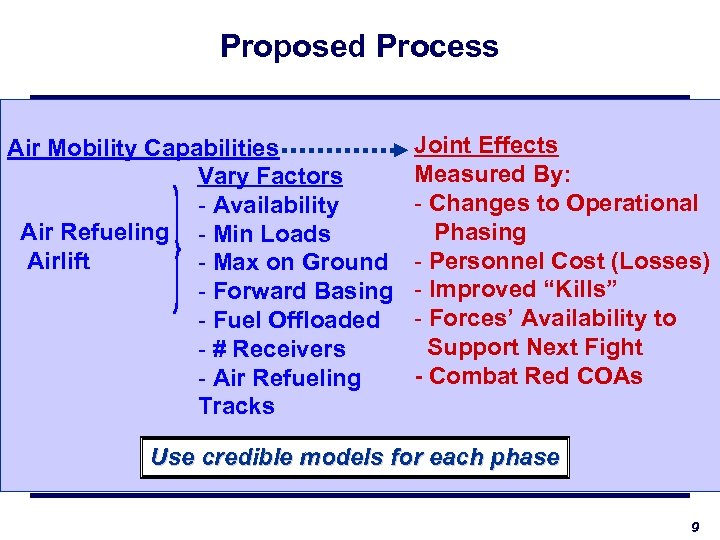 Proposed Process Air Mobility Capabilities Vary Factors - Availability Air Refueling - Min Loads Airlift - Max on Ground - Forward Basing - Fuel Offloaded - # Receivers - Air Refueling Tracks Joint Effects Measured By: - Changes to Operational Phasing - Personnel Cost (Losses) - Improved “Kills” - Forces’ Availability to Support Next Fight - Combat Red COAs Use credible models for each phase 9
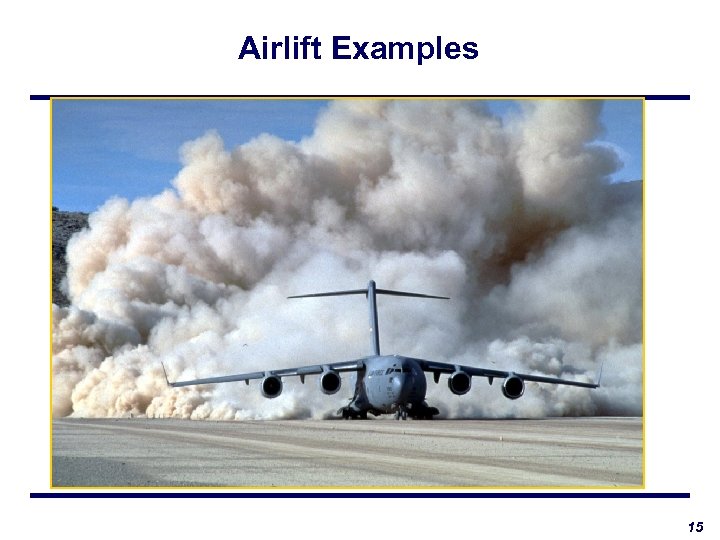
 Results and Examples n Air Refueling n Airlift 10
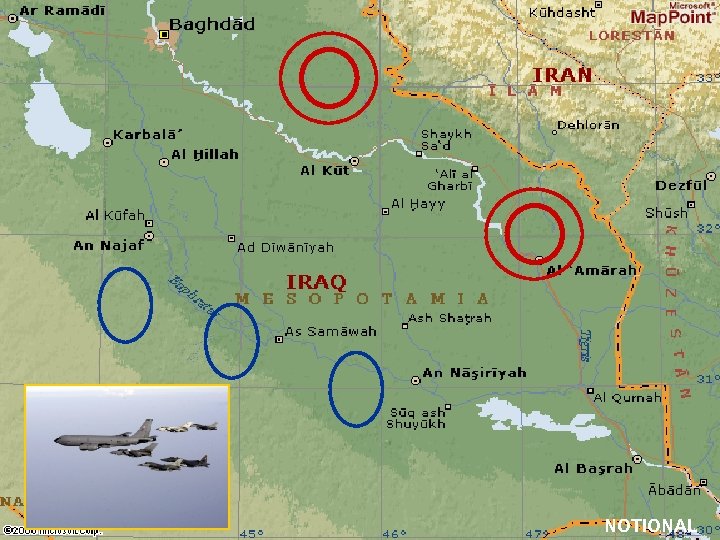
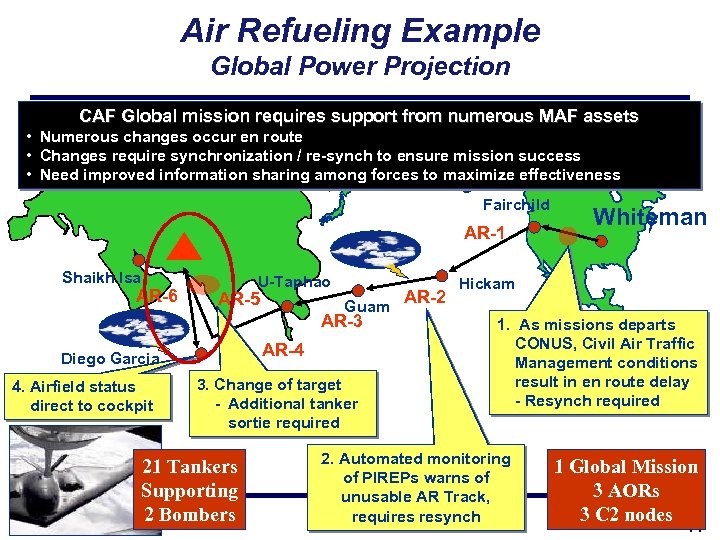
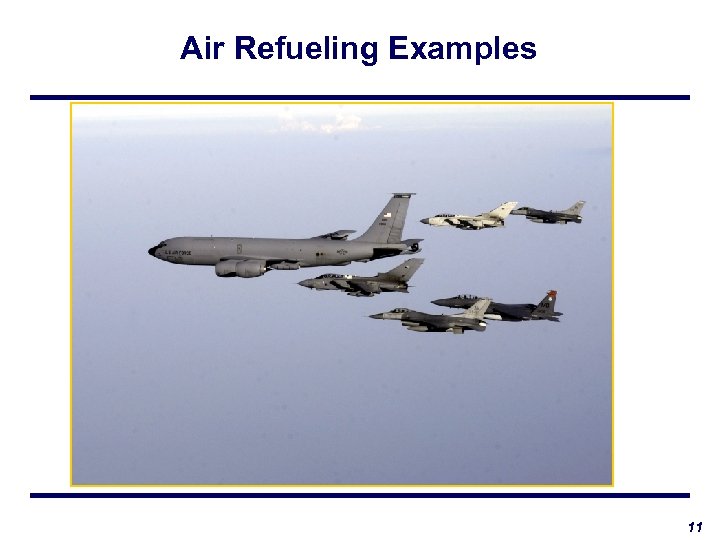 Air Refueling Examples 11
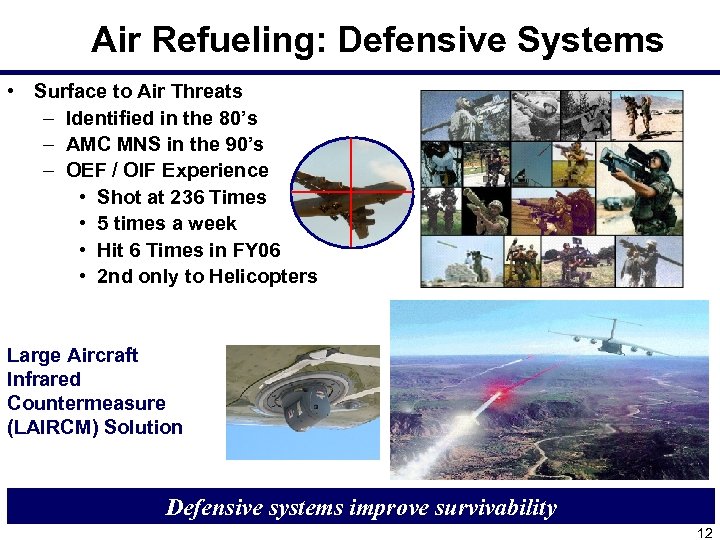 Air Refueling: Defensive Systems • Surface to Air Threats – Identified in the 80’s – AMC MNS in the 90’s – OEF / OIF Experience • Shot at 236 Times • 5 times a week • Hit 6 Times in FY 06 • 2 nd only to Helicopters Large Aircraft Infrared Countermeasure (LAIRCM) Solution Defensive systems improve survivability 12
 13 NOTIONAL
 Air Refueling Example Global Power Projection CAF Global mission requires support from numerous MAF assets • Numerous changes occur en route • Changes require synchronization / re-synch to ensure mission success • Need improved information sharing among forces to maximize effectiveness Fairchild AR-1 Shaikh Isa AR-6 U-Taphao AR-5 Guam AR-3 AR-4 Diego Garcia 4. Airfield status direct to cockpit 3. Change of target - Additional tanker sortie required 21 Tankers Supporting 2 Bombers AR-2 Whiteman Hickam 1. As missions departs CONUS, Civil Air Traffic Management conditions result in en route delay - Resynch required 2. Automated monitoring of PIREPs warns of unusable AR Track, requires resynch 1 Global Mission 3 AORs 3 C 2 nodes 14
 Airlift Examples 15
 UNCLASSIFIED Airlift Example Phase 1 d Secure Key Gov’t, Civil Sites Campaign Execution Timeline S FDO 2 C (+ADVON) S FDO 1 (Trans to Phase 1) S C S Phase 1 c Degrade C 2 S Phase 1 a Seize KPODs C 25% Phase 2 (Early Option) Consolidate, Extend 95% Operation Commence Execution T O D A Y D+0 D+1 D+2 D+3 D+4 D+5 D+6 D+7 Consolidate, Extend Example: CCDR wargaming indicates shows Early Phase 2 execution compresses overall campaign by 10 -days & reduces risk in friendly losses, destruction of local infrastructure, etc. Phase 1 b DELAYED START Secure PODs, Key Mil Sites Operation Completed Phase 2 D+8 D+9 D+10 D+11 D+12 D+13 N-2 N-1 C+0 C+1 C+2 C+3 C+4 C+5 C+6 C+7 C+8 C+9 C+10 C+11 C+12 C+13 C+14 C+15 C+16 T O D A Y 100% SOF PKG 1 100% =/> 50 % of 25 ID aviation capability must be in-place and operationally available to enable Phase 2 early execution. 1 BCT(S) SOF PKG 2 99% 82 ABN (2 BCT / RDY BDE, 18 ABNCP C 2 E) =/>25% Closed at APOD =/>50% Closed at APOD 432 MPBN(+) =/>80% Closed at APOD (OPERATIONALLY AVAILABLE) Final Closure at APOD C Day: Deployment begins D Day: Operations begin 25 ID(AVN)(Med)(-) 50% 99% Strategic Deployment Timeline (Air) 3 ACR(-) 16 UNCLASSIFIED
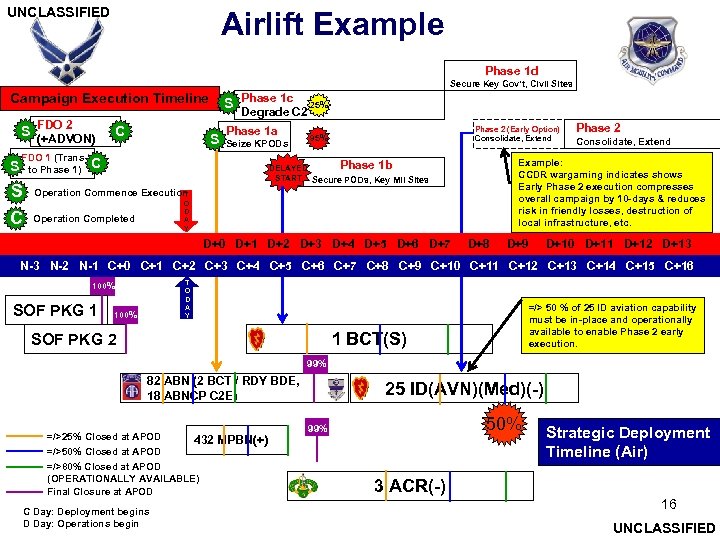
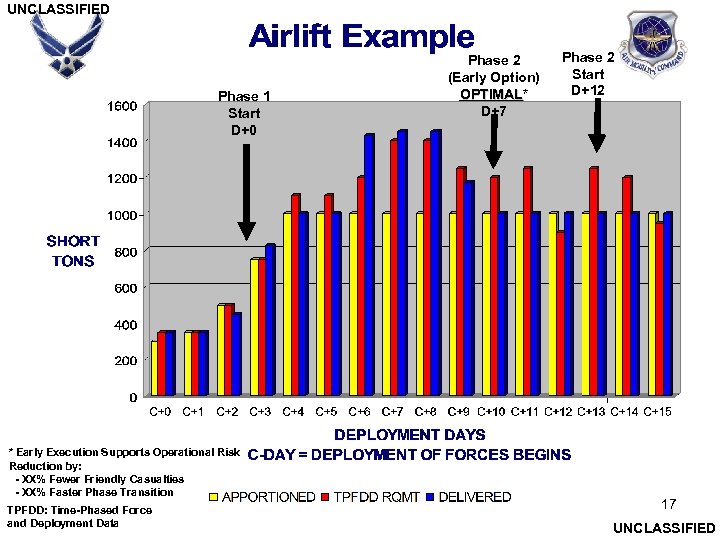 UNCLASSIFIED Phase 1 Start D+0 * Early Execution Supports Operational Risk Reduction by: - XX% Fewer Friendly Casualties - XX% Faster Phase Transition TPFDD: Time-Phased Force and Deployment Data Phase 2 (Early Option) OPTIMAL* OPTIMAL D+7 Phase 2 Start D+12 17 UNCLASSIFIED
 Conclusions § § § No Single Integrated Joint Campaign Model Major Limitations To Modeling Airlift & Air Refueling No federation capability Training To Run Models / Do Analyses Funding Requirements However, Capability Exists Now To Assess Joint Effects By Linking Air Mobility Variables To Campaign Variables In Joint Models Leverage Existing Capabilities Today 18
 Questions? “Modeling Impacts of Operational Changes on Joint Campaign Effects” 19
 Back-ups 20
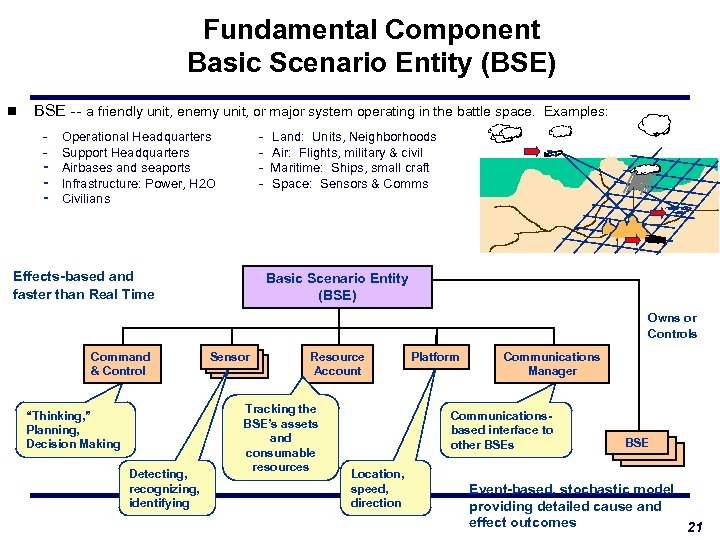 Fundamental Component Basic Scenario Entity (BSE) n BSE -- a friendly unit, enemy unit, or major system operating in the battle space. Examples: - - Operational Headquarters Support Headquarters Airbases and seaports Infrastructure: Power, H 2 O Civilians - Effects-based and faster than Real Time Land: Units, Neighborhoods Air: Flights, military & civil Maritime: Ships, small craft Space: Sensors & Comms Basic Scenario Entity (BSE) Owns or Controls Command & Control “Thinking, ” Planning, Decision Making Detecting, recognizing, identifying Sensor Resource Account Tracking the BSE’s assets and consumable resources Platform Communications Manager Communicationsbased interface to other BSEs Location, speed, direction BSE Event-based, stochastic model providing detailed cause and effect outcomes 21
 JAS § § § Joint Analysis System Formerly Known as JWARS (Joint Warfare System) Admittedly Weak On Mobility – Less Weak In Other Areas Used By USAF A 5 XS; Defense Threat Reduction Agency; JFCOM J 8; JFCOM J 2; Coast Guard Used For UE 06; Noble Resolve 07 -2 Current Status Listed In OSD PA&E’s M&S Tool Registry As A Non. Analytical Baseline Core Analysis Tool § No Immediate Plans To Improve Mobility § § Future – “Hot Potato” 22
 THUNDER USAF’s Campaign-Level Analytical Simulation § Used By JS/J 8; OSD PA&E; USAF/A 3; USAF/A 9; ACC; AFSPC; Navy; USFK; PACOM; CENTCOM § Used For MCS and Numerous Other Studies § Current Status § Listed In OSD PA&E’s M&S Tool Registry As An Analytical Baseline Core Analysis Tool § Mature, Legacy Model § Runs On Sun And SGI Unix And Linux Workstations § § Future – Will Be Succeeded By STORM 23
 STORM § § § Synthetic Theater Operations Research Model USAF’s New Campaign-Level Simulation Succeeds THUNDER Used By HAF/A 9; ACC/A 9; UK; JS/J 8; OSD PA&E Used For Unified Engagement Series of Wargames Current Status Listed In OSD PA&E’s M&S Tool Registry As A Non. Analytical Baseline Core Analysis Tool § Wrapping Up AF Development – Adding a Navy Piece § Runs Under Windows XP, SPARC Solaris, & PC Linux § § Future – Some Kind Of A “Federation” With AMOS 24
 JICM Joint Integrated Contingency Model § Used by JS; Services; COCOMs; OSD; Australia; ROK § Used For § Assessment Of Ability Of Programmed Forces To Execute Defense Strategy (Joint Staff and OSD) § Development Of Force Structure And Munitions Requirements (Army) § § Current Status Listed In OSD PA&E’s M&S Tool Registry As An Analytical Baseline Core Analysis Tool § Mature, Legacy Model § Runs On Sun Workstations Under Solaris Operating System § § Future – Federation With AMP/MIDAS 25
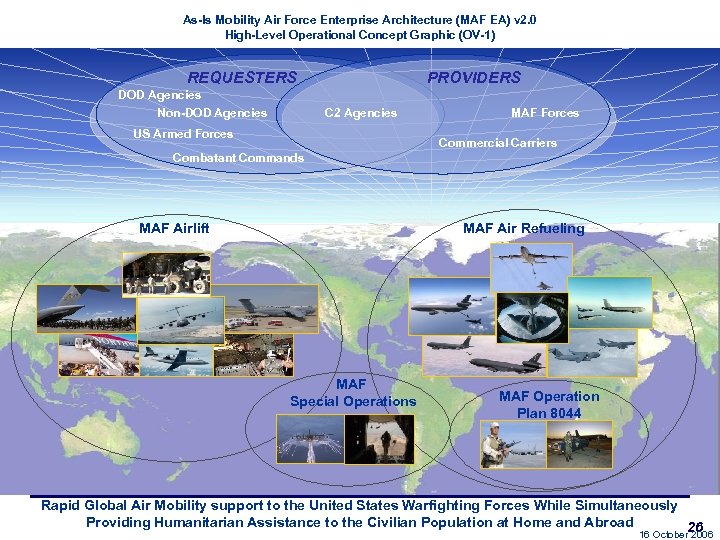 As-Is Mobility Air Force Enterprise Architecture (MAF EA) v 2. 0 High-Level Operational Concept Graphic (OV-1) REQUESTERS DOD Agencies Non-DOD Agencies PROVIDERS C 2 Agencies US Armed Forces MAF Forces Commercial Carriers Combatant Commands MAF Airlift MAF Air Refueling MAF Special Operations MAF Operation Plan 8044 Rapid Global Air Mobility support to the United States Warfighting Forces While Simultaneously Providing Humanitarian Assistance to the Civilian Population at Home and Abroad 26 16 October 2006