


 Скачать презентацию 13 January 2009 European Structured Finance 2008 -09
633a4874943a73fa66ecfd519f7c55c2.ppt
- Количество слайдов: 103
 13 January 2009 European Structured Finance 2008 -09 Alexander Batchvarov, CFA +44 20 7995 8649 alexander_batchvarov@ml. com Ludwig Clement +44 20 7995 0432 ludwig_clement@ml. com Caspar Cook, CFA +44 131 473 1055 caspar_cook@ml. com Altynay Davletova, CFA +44 20 7995 3968 altynay_davletova@ml. com James Martin +44 20 7995 0110 james_martin@ml. com Furquan Kidwai +44 20 7996 2536 furquan_kidwai@ml. com Sabine Winkler +44 20 7995 4756 sabine_winkler@ml. com What Drives European Credit Spreads - 2009 Product ID 1
 13 January 2009 2008 -09: In search of a strong footing
 13 January 2009 2008 - an exceptional year in every respect Rated new issuance exceded Eur 700 bn, much higher than in previous years Public placement - maybe less than 2. 5% of new issuance Main primary market investor- the central banks Secondary market - main focus of remaining investors Spreads - wide across stack, asset classes and geographies CDS on ABS - a viable investment instrument for the cash strapped investor; volatile basis Spread volatility - not a surprise, but how much is driven by fundamentals and how much by technicals US and European ABS - mutually re-enhanced relationship in secondary spreads 3
 13 January 2009 2008 - an exceptional year in every respect Performance of European structured finance bonds deteriorating, but the majority of the European structured finance transactions perform according to initial expectations Rating agencies changes in methodology and/or assumptions adding to market instability - an event risk rather than credit risk Deteriorating credit performance - is the actual deterioration within expectations or beyond expectations? Mt. M sensitivity - unnecessary for structured, illiquid and difficult to value positions - drove traditional investors away from the market and converted buyers into forced sellers Reputational issues - media frenzy and financial institutions reputation - better lose one’s shirt in equity than a shirt’s button in structured finance! Wider markets’ lack of understanding of the structured finance world Events that were never meant to happen - demise of the monolines, hitting a MT NAT test (who gave that advise? !), collapse of the commercial paper market, rise and fall of the systemic bank risk, decline of covered bonds liquidity and collapse of related market-making mechanism, multinotch downgrades due to radical changes in rating methodology - a squadron of blcak swans! 4
 13 January 2009 The demise of the parallel banking system Banks and finance companies actively originate loans in the expectation that they can off-load them to long-term investors Securitisation is the transformation mechanism by which pools of loans are converted into bonds with different risk profile Securitisation bonds are sold to investors with different risk appetite - investors of the senior part of 70 -90% of each transaction play a key part in the placement Investors base for the senior and bulkiest part of the securtisation bonds comprise banks, SIVs, ABCP conduits and hedge funds - all rely on short-term funding and/or leverage The parallel banking system replicated the traditional gap (short-term funding / long-term investing) of traditional banking system without the benefit of CB aid A run on the parallel banking system occurred when the short-term markets shut down, bringing the main players of the parallel banking system to their knees The parallel banking system provided credit to the tune of USD 1. 5 -1. 8 trl p. a. globally in the preceding five years (Western Europe E 350 -500 bn p. a. from securitisation plus E 150 -200 bn p. a. from covered bonds) The elimination of credit flows from the parallel banking system without a replacement provider of that credit in the near team is having a devastating effect on the markets and the economies of many countries around the world 5
 Government actions 13 January 2009 Actions associated with providing liquidity to the markets Repo facilities and repo eligibility (categories II, IV, V) Actions meant to stimulate new lending Guarantee for financing of new lending (the UK) Actions to support borrowers facing debt service difficulties Spain and Italy, so far Actions to prop up the banks and stimulate new debt issuance Government guarantees for bank debt (many countries for 3 or 5 years), covered bonds (Sweden, Ireland, UK), RMBS (UK) Creating a multiple-tier bond market: government guaranteed (GG) bank debt, GG covered bonds, GG MBS, regular (non-GG) bank debt, legacy covered bonds, legacy ABS and MBS Loan modifications - self-interest or moral suasion Additional actions required - social housing, first time buyers, new investors 6
 13 January 2009 From one to two markets for structured finance Government related markets for structured finance bonds Repo facilities - new issuance price to repo, not priced to market Potential implementation of government guarantees to RMBS and covered bonds (UK) Government-guaranteed covered bonds vs. covered bonds from government supported banks Legacy markets for structured finance products Secondary markets for ABS and MBS Secondary markets for covered bonds Wide spreads for liquidity or credit reasons, or both Interaction among the different primary markets in the presence of government guarantee GG bank debt - most attractive pricing but limited maturity (3 or 5 yrs) and size per government support packages (on balance sheet debt) Covered bonds - attractive pricing for the guaranteed covered bonds but admin cost not justifiable, hence covered bonds attractive for maturities beyond 3/5 years (on balance sheet debt with encumbrance, investor acceptance in light of product disparity) Securitisation - attractive due to clear asset/liability matching and maturity/ cash flow profile(regulatory issues about retention and capital treatment, structures and asset investor acceptance) Short-term and long-term distortions and their cure 7
 13 January 2009 In Search of New Investors and New Asset Allocation Remaining traditional investors Banks - the Mt. M issue, overload, reinvesting amortisation, tight liquidity, delevering Insurance companies - 2012 and capital requirement rules Pension funds - different degree of past involvement Government guaranteed paper - the SSA investor Distressed investors Fixed income funds, alternative credit funds Timing the entry, sizing the return ‘Price Distressed’ bonds vs ‘Credit Distressed’ bonds Challenges in sizing the distressed debt market in Europe Cross-over investors Natural fit - private equity investors and CLOs; property investors and CMBS Tenuous fit - bank equity investors and RMBS/ ABS Developments and returns on the traditional market of a given investor in comparison with availability and return of structured finance instruments - dividend yield&capital return vs. coupon&principal return 8
 13 January 2009 The Asset Allocation Questions Preferred part of the distressed universe - price vs credit distressed Fit into the existing allocation guidelines or need to modify guidelines Availability of the necessary skill set in the organisation Allocation to fixed income / alternatives / distressed in traditional equity portfolios Realistic assumptions about equity returns Ability to use derivatives to hedge or take exposure Ability to hold investments to maturity 9
 13 January 2009 The future of Structured Finance Pros The need for credit and the inability of banks to provide it from wholesale and deposits Demographics demand fixed income instruments Investors preference for secured investment instruments Availability of skilled structured finance professionals displaced by the upheaval in investment banking Securitisation as a truly match-funded funding mechanism Attractive relative value of securitisation and covered bonds post dislocation Cons Regulatory zeal/ hyperactivity - BIS 2. 2 and the X% rule Insufficient investor base Ambiguity of rating agencies role Negative publicity surrounding structured finance Crowding out effect of government guaranteed debt and ‘nationalisation’ of the banks 10
 13 January 2009 Expectations for 2009 De-leveraging and re-capitalisation of banks Stabilisation or at least sizing the trough of the residential and commercial real estate markets Sizing the depth of the economic turn in Europe Reduction of systemic risk in the banking system Clarity as to the range of measures the governments are prepared to take to support the economies, consumer and corporate sectors, market liquidity and funding availability Accepting a scenario-based risk-reward approach to investing Differentiating between price distressed and credit distressed bonds, new and legacy bonds 11
 13 January 2009 Islamic finance
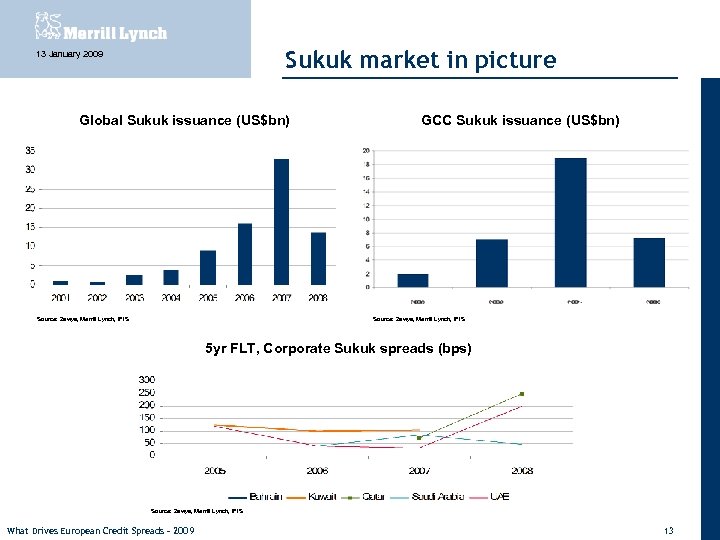 Sukuk market in picture 13 January 2009 Global Sukuk issuance (US$bn) Source: Zawya, Merrill Lynch, IFIS GCC Sukuk issuance (US$bn) Source: Zawya, Merrill Lynch, IFIS 5 yr FLT, Corporate Sukuk spreads (bps) Source: Zawya, Merrill Lynch, IFIS What Drives European Credit Spreads - 2009 13
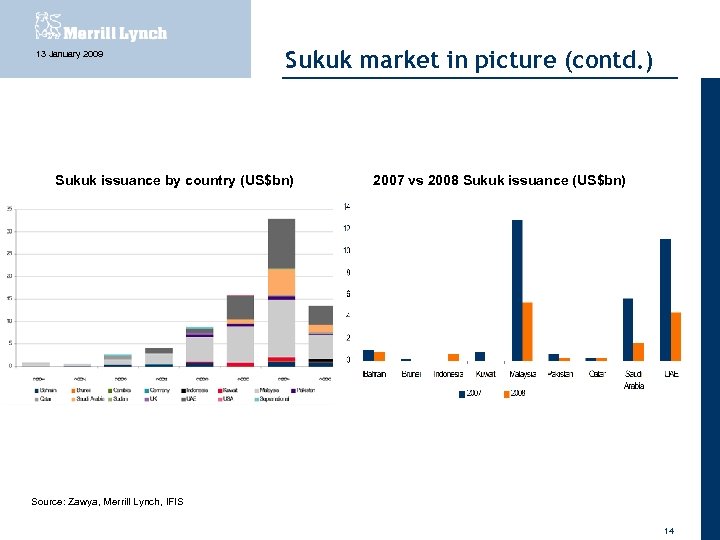 13 January 2009 Sukuk market in picture (contd. ) Sukuk issuance by country (US$bn) 2007 vs 2008 Sukuk issuance (US$bn) Source: Zawya, Merrill Lynch, IFIS 14
 13 January 2009 Sukuk spreads widened and issuance declined Sukuk spreads widened 2 -3 times; Corporate sukuk priced in the range of 115 – 275 bps; Saudi spread declined on GSE issuance Widening attributed to shariah ruling on asset buy-back in sukuks, contagion from the global economic slow down and uncertainty regarding the peg issue Issuance declined 58% y-o-y; only Bahraini market kept up with last year’s numbers – local money market instruments in demand Malaysian local currency sukuk dominated the market with US$5. 3 bn issuance Indonesia a new market entrant: US$677 mn vs US$44 mn (in 2007); fixed rate Issuance predominantly in local currency Shariah-compliant syndicated lending continues as an alternate debt supplier 15
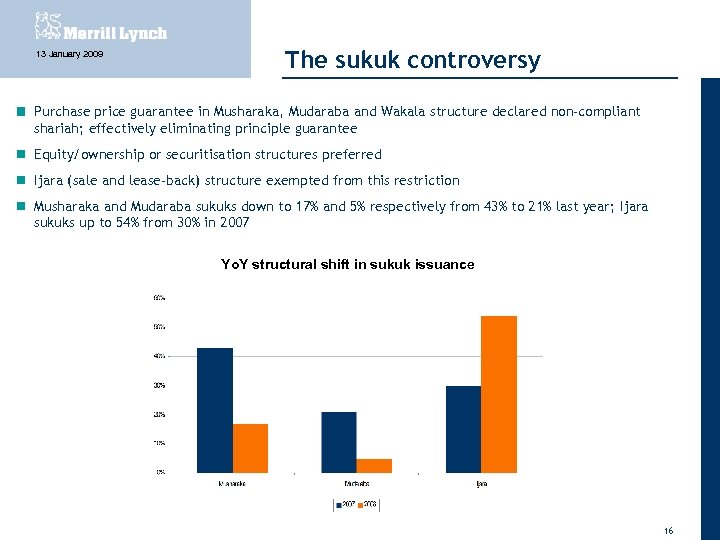 13 January 2009 The sukuk controversy Purchase price guarantee in Musharaka, Mudaraba and Wakala structure declared non-compliant shariah; effectively eliminating principle guarantee Equity/ownership or securitisation structures preferred Ijara (sale and lease-back) structure exempted from this restriction Musharaka and Mudaraba sukuks down to 17% and 5% respectively from 43% to 21% last year; Ijara sukuks up to 54% from 30% in 2007 Yo. Y structural shift in sukuk issuance 16
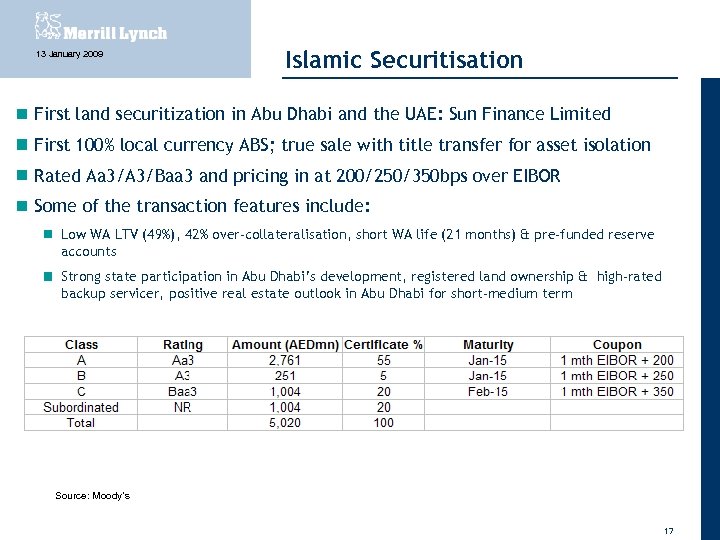 13 January 2009 Islamic Securitisation First land securitization in Abu Dhabi and the UAE: Sun Finance Limited First 100% local currency ABS; true sale with title transfer for asset isolation Rated Aa 3/A 3/Baa 3 and pricing in at 200/250/350 bps over EIBOR Some of the transaction features include: Low WA LTV (49%), 42% over-collateralisation, short WA life (21 months) & pre-funded reserve accounts Strong state participation in Abu Dhabi’s development, registered land ownership & high-rated backup servicer, positive real estate outlook in Abu Dhabi for short-medium term Source: Moody’s 17
 13 January 2009 GCC Securitisation: any chance? Fundamentals: weakening economy and real estate markets; Saudi relatively better Credit growth: credit growing rapidly, banks’ loan to deposit growth (100% in Qatar, 65% KSA), over -exposure to the real estate sector – need to offload in the capital market Collateral performance: low non-performing loan ratio supported by strong economic growth; consumer loans exposed to local stock markets (esp. KSA) and real estate; deterioration of assets likely especially the UAE Demand: local investors and banks; shariah-compliant securitisation to attract Islamic banks; however real estate exposure to be taken with a pinch of salt Legal issues: untested and evolving legal system; two-tier SPV used so far; free-zones more reliable, replicate English law Expectations: GCC securitisation to continue; UAE the most developed markets in the GCC; Qatar and Saudi picking up; post-downturn origination to slow down 18
 13 January 2009 Consumer & mortgage lending Total loans (% of GDP): UAE (103%), Qatar (69%), Bahrain (64%), KSA (42%), Egypt (48%) Consumer Deposits (% of GDP): UAE (103%) and Bahrain (96%) leading, position boosted by offshore financial centres Retails loans: Highest retail loans in Qatar and Bahrain, UAE lagging (6% of GDP) Private consumption rising; credit card market growing – UAE accounts for 50% Mortgage penetration low across the board; UAE (8%) and Kuwait (10%) top the list Increasing housing costs to support mortgage growth Legal infrastructure needs clarity 19
 13 January 2009 Covered bonds 2008 -09
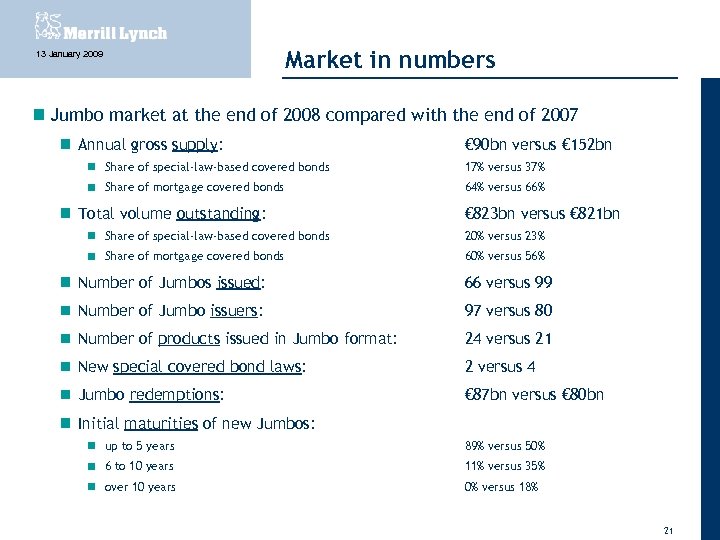 Market in numbers 13 January 2009 Jumbo market at the end of 2008 compared with the end of 2007 Annual gross supply: € 90 bn versus € 152 bn Share of special-law-based covered bonds 17% versus 37% Share of mortgage covered bonds 64% versus 66% Total volume outstanding: € 823 bn versus € 821 bn Share of special-law-based covered bonds 20% versus 23% Share of mortgage covered bonds 60% versus 56% Number of Jumbos issued: 66 versus 99 Number of Jumbo issuers: 97 versus 80 Number of products issued in Jumbo format: 24 versus 21 New special covered bond laws: 2 versus 4 Jumbo redemptions: € 87 bn versus € 80 bn Initial maturities of new Jumbos: up to 5 years 89% versus 50% 6 to 10 years 11% versus 35% over 10 years 0% versus 18% 21
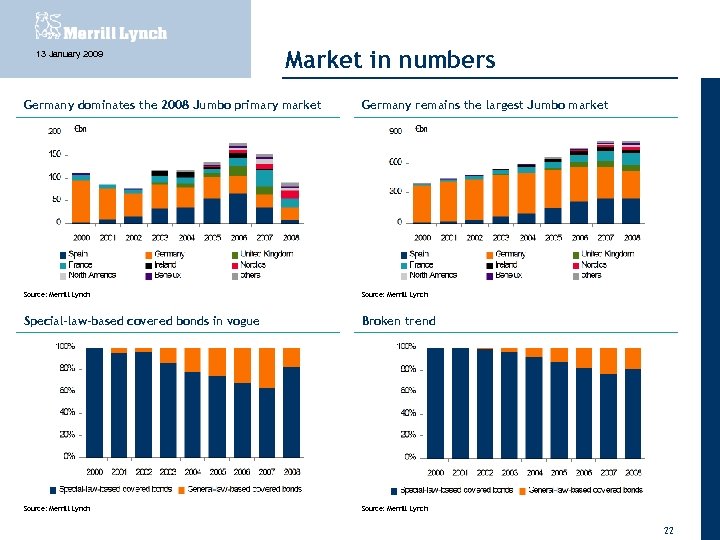 13 January 2009 Market in numbers Germany dominates the 2008 Jumbo primary market Germany remains the largest Jumbo market Source: Merrill Lynch Special-law-based covered bonds in vogue Broken trend Source: Merrill Lynch 22
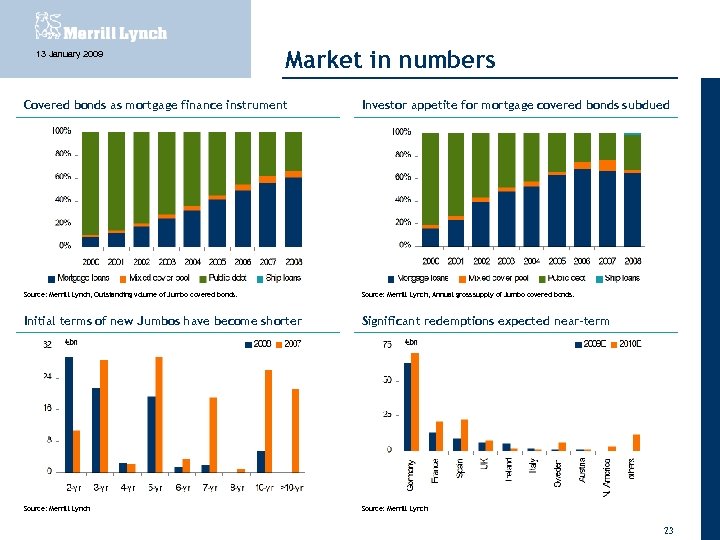 13 January 2009 Market in numbers Covered bonds as mortgage finance instrument Investor appetite for mortgage covered bonds subdued Source: Merrill Lynch, Outstanding volume of Jumbo covered bonds. Source: Merrill Lynch, Annual gross supply of Jumbo covered bonds. Initial terms of new Jumbos have become shorter Significant redemptions expected near-term Source: Merrill Lynch 23
 13 January 2009 Challenges What place do covered bonds have in a bank’s overall funding mix? Banks adjust their balance sheets and refinancing strategies Originate-to-retain and originate-to-repo process is in vogue Secured funding implies structural subordination Term funding has to gain importance over time How will the investor base develop and grow? The development of a domestic investor base becomes crucial The risk assessment of covered bonds has become more complex How will the pricing of covered bonds develop? From a ‘rates plus’ product to a ‘credit minus’ product to an in-between product Exceptional competition from government-guaranteed bank debt 24
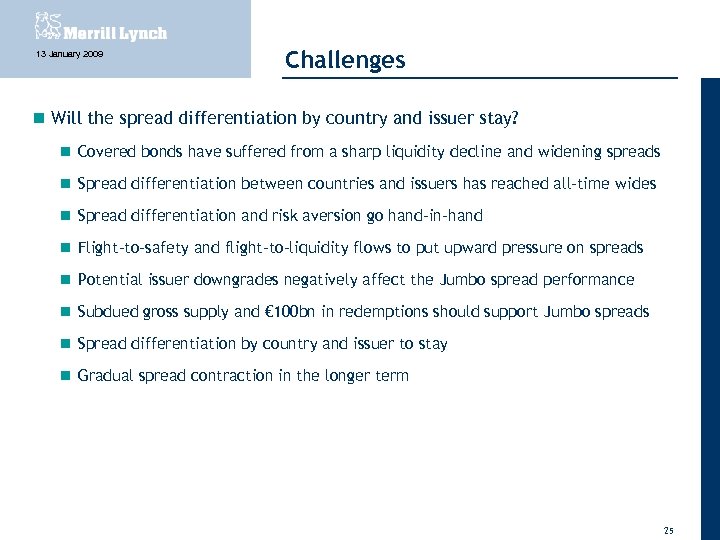 13 January 2009 Challenges Will the spread differentiation by country and issuer stay? Covered bonds have suffered from a sharp liquidity decline and widening spreads Spread differentiation between countries and issuers has reached all-time wides Spread differentiation and risk aversion go hand-in-hand Flight-to-safety and flight-to-liquidity flows to put upward pressure on spreads Potential issuer downgrades negatively affect the Jumbo spread performance Subdued gross supply and € 100 bn in redemptions should support Jumbo spreads Spread differentiation by country and issuer to stay Gradual spread contraction in the longer term 25
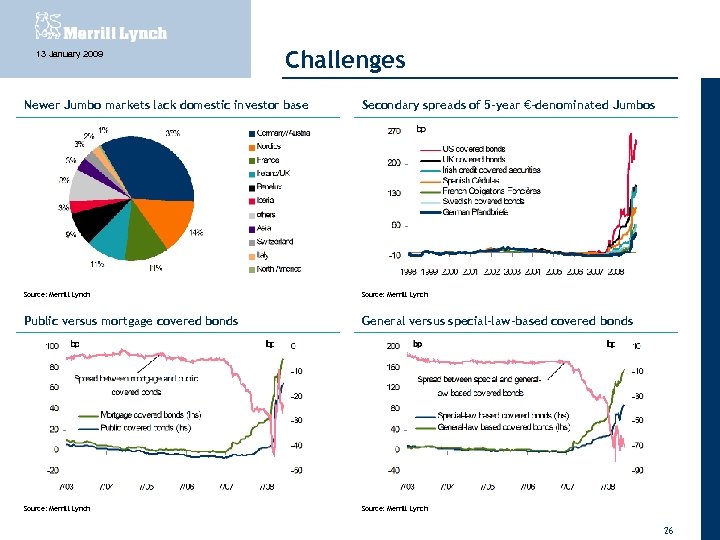 13 January 2009 Challenges Newer Jumbo markets lack domestic investor base Secondary spreads of 5 -year €-denominated Jumbos Source: Merrill Lynch Public versus mortgage covered bonds General versus special-law-based covered bonds Source: Merrill Lynch 26
 13 January 2009 Comeback The 2009 comeback of covered bonds Exceptional market conditions have stemmed the flow of new Jumbo issuance Financing markets have to stabilise and investor risk aversion needs to ease Banks need a variety of funding instruments and matched refinancing Banks have to wean themselves off current exceptional government support The covered bond market dynamics are not fully divorced from the credit market The reception of a covered bond depends on an issuer’s reputation with investors An overhaul of the market-making system to restore investor confidence Combined efforts from the different covered bond market stakeholders 27
 13 January 2009 UK RMBS
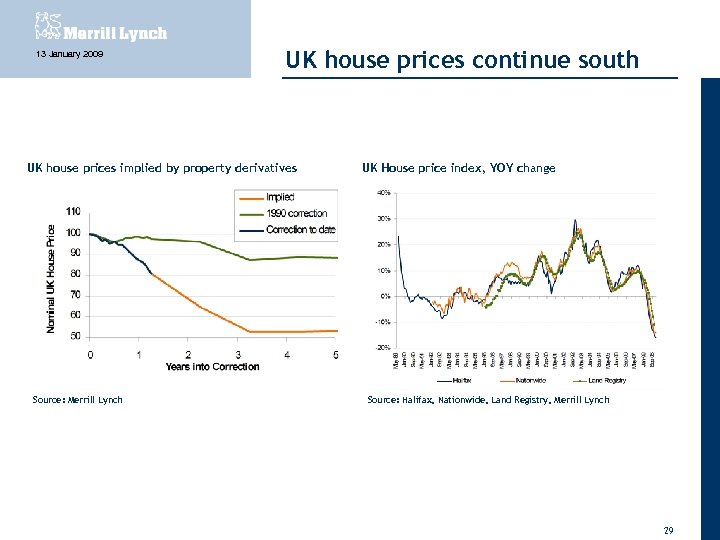 13 January 2009 UK house prices continue south UK house prices implied by property derivatives Source: Merrill Lynch UK House price index, YOY change Source: Halifax, Nationwide, Land Registry, Merrill Lynch 29
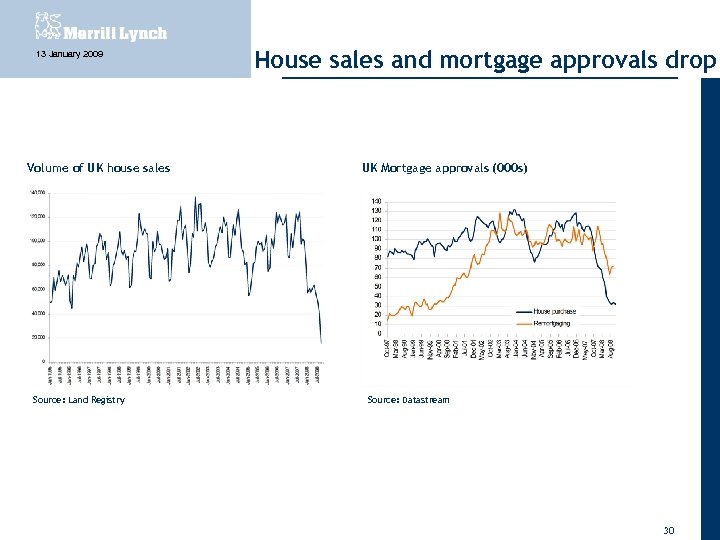 13 January 2009 Volume of UK house sales Source: Land Registry House sales and mortgage approvals drop UK Mortgage approvals (000 s) Source: Datastream 30
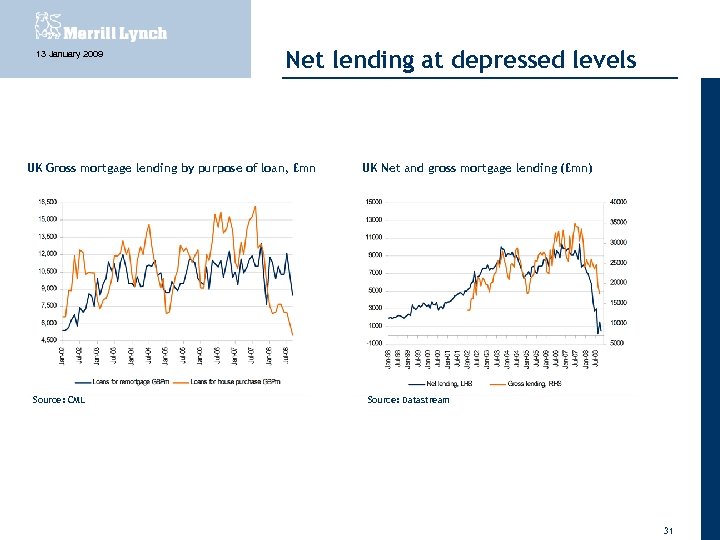 13 January 2009 Net lending at depressed levels UK Gross mortgage lending by purpose of loan, £mn Source: CML UK Net and gross mortgage lending (£mn) Source: Datastream 31
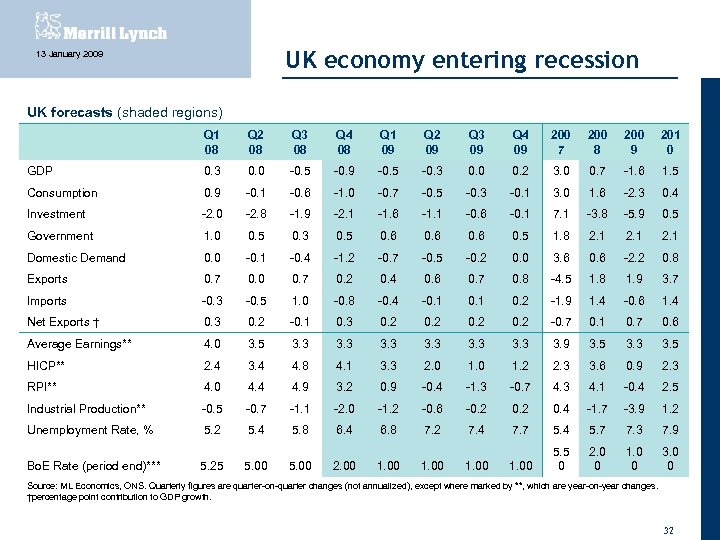 UK economy entering recession 13 January 2009 UK forecasts (shaded regions) Q 1 08 Q 2 08 Q 3 08 Q 4 08 Q 1 09 Q 2 09 Q 3 09 Q 4 09 200 7 200 8 200 9 201 0 GDP 0. 3 0. 0 -0. 5 -0. 9 -0. 5 -0. 3 0. 0 0. 2 3. 0 0. 7 -1. 6 1. 5 Consumption 0. 9 -0. 1 -0. 6 -1. 0 -0. 7 -0. 5 -0. 3 -0. 1 3. 0 1. 6 -2. 3 0. 4 Investment -2. 0 -2. 8 -1. 9 -2. 1 -1. 6 -1. 1 -0. 6 -0. 1 7. 1 -3. 8 -5. 9 0. 5 Government 1. 0 0. 5 0. 3 0. 5 0. 6 0. 5 1. 8 2. 1 Domestic Demand 0. 0 -0. 1 -0. 4 -1. 2 -0. 7 -0. 5 -0. 2 0. 0 3. 6 0. 6 -2. 2 0. 8 Exports 0. 7 0. 0 0. 7 0. 2 0. 4 0. 6 0. 7 0. 8 -4. 5 1. 8 1. 9 3. 7 Imports -0. 3 -0. 5 1. 0 -0. 8 -0. 4 -0. 1 0. 2 -1. 9 1. 4 -0. 6 1. 4 Net Exports † 0. 3 0. 2 -0. 1 0. 3 0. 2 -0. 7 0. 1 0. 7 0. 6 Average Earnings** 4. 0 3. 5 3. 3 3. 9 3. 5 3. 3 3. 5 HICP** 2. 4 3. 4 4. 8 4. 1 3. 3 2. 0 1. 2 2. 3 3. 6 0. 9 2. 3 RPI** 4. 0 4. 4 4. 9 3. 2 0. 9 -0. 4 -1. 3 -0. 7 4. 3 4. 1 -0. 4 2. 5 Industrial Production** -0. 5 -0. 7 -1. 1 -2. 0 -1. 2 -0. 6 -0. 2 0. 4 -1. 7 -3. 9 1. 2 Unemployment Rate, % 5. 2 5. 4 5. 8 6. 4 6. 8 7. 2 7. 4 7. 7 5. 4 5. 7 7. 3 7. 9 1. 00 5. 5 0 2. 0 0 1. 0 0 3. 0 0 Bo. E Rate (period end)*** 5. 25 5. 00 2. 00 1. 00 Source: ML Economics, ONS. Quarterly figures are quarter-on-quarter changes (not annualized), except where marked by **, which are year-on-year changes. †percentage point contribution to GDP growth. 32
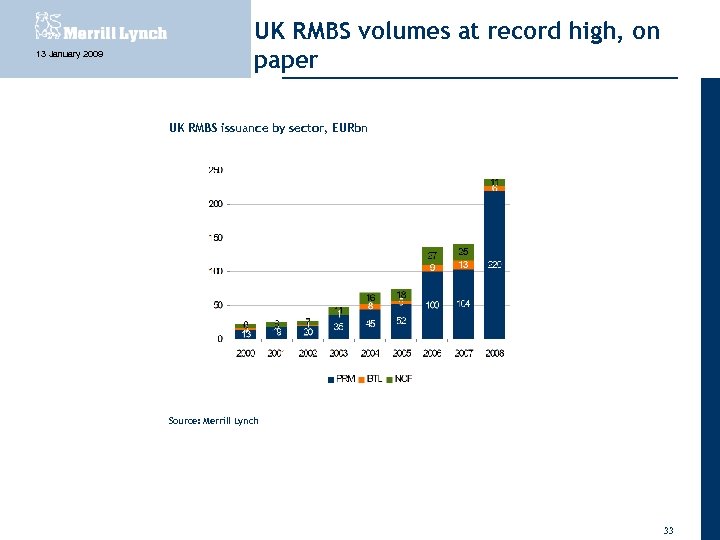 13 January 2009 UK RMBS volumes at record high, on paper UK RMBS issuance by sector, EURbn Source: Merrill Lynch 33
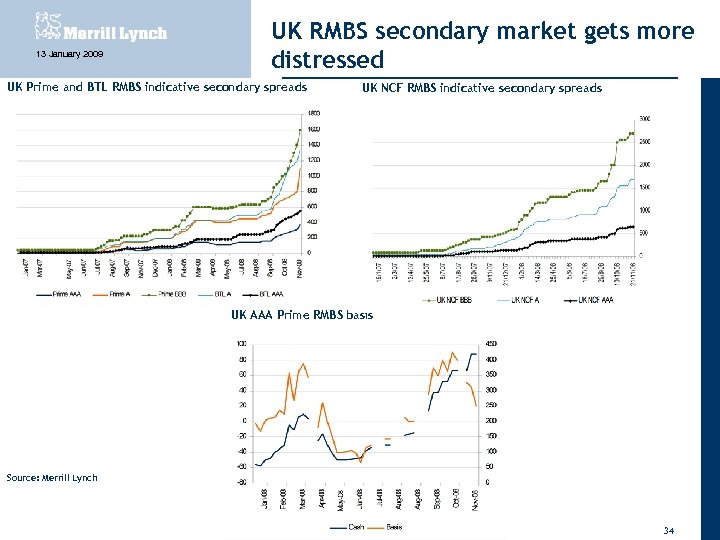 13 January 2009 UK RMBS secondary market gets more distressed UK Prime and BTL RMBS indicative secondary spreads UK NCF RMBS indicative secondary spreads UK AAA Prime RMBS basis Source: Merrill Lynch 34
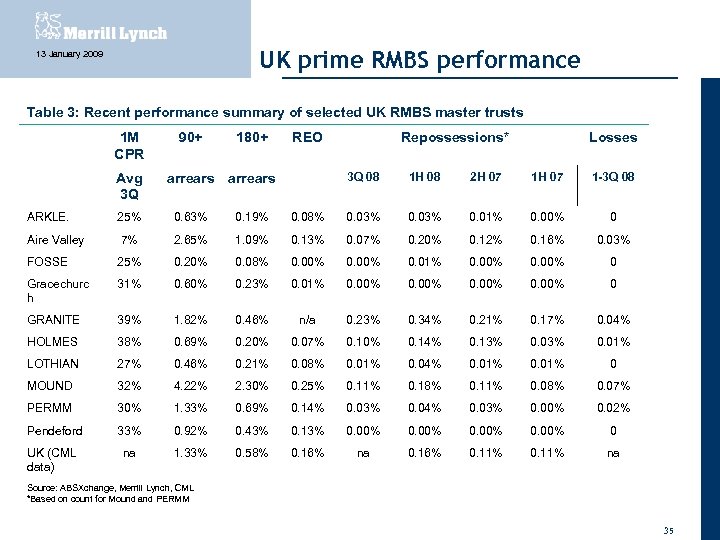 UK prime RMBS performance 13 January 2009 Table 3: Recent performance summary of selected UK RMBS master trusts 1 M CPR Avg 3 Q 90+ 180+ REO Repossessions* Losses 3 Q 08 arrears 1 H 08 2 H 07 1 -3 Q 08 ARKLE. 25% 0. 63% 0. 19% 0. 08% 0. 03% 0. 01% 0. 00% 0 Aire Valley 7% 2. 65% 1. 09% 0. 13% 0. 07% 0. 20% 0. 12% 0. 16% 0. 03% FOSSE 25% 0. 20% 0. 08% 0. 00% 0. 01% 0. 00% 0 Gracechurc h 31% 0. 60% 0. 23% 0. 01% 0. 00% 0 GRANITE 39% 1. 82% 0. 46% n/a 0. 23% 0. 34% 0. 21% 0. 17% 0. 04% HOLMES 38% 0. 69% 0. 20% 0. 07% 0. 10% 0. 14% 0. 13% 0. 01% LOTHIAN 27% 0. 46% 0. 21% 0. 08% 0. 01% 0. 04% 0. 01% 0 MOUND 32% 4. 22% 2. 30% 0. 25% 0. 11% 0. 18% 0. 11% 0. 08% 0. 07% PERMM 30% 1. 33% 0. 69% 0. 14% 0. 03% 0. 00% 0. 02% Pendeford 33% 0. 92% 0. 43% 0. 13% 0. 00% 0 UK (CML data) na 1. 33% 0. 58% 0. 16% na 0. 16% 0. 11% na Source: ABSXchange, Merrill Lynch, CML *Based on count for Mound and PERMM 35
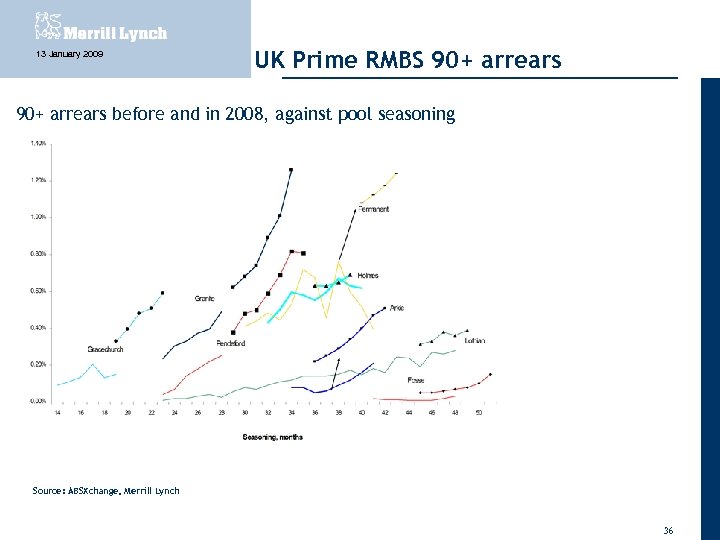 13 January 2009 UK Prime RMBS 90+ arrears before and in 2008, against pool seasoning Source: ABSXchange, Merrill Lynch 36
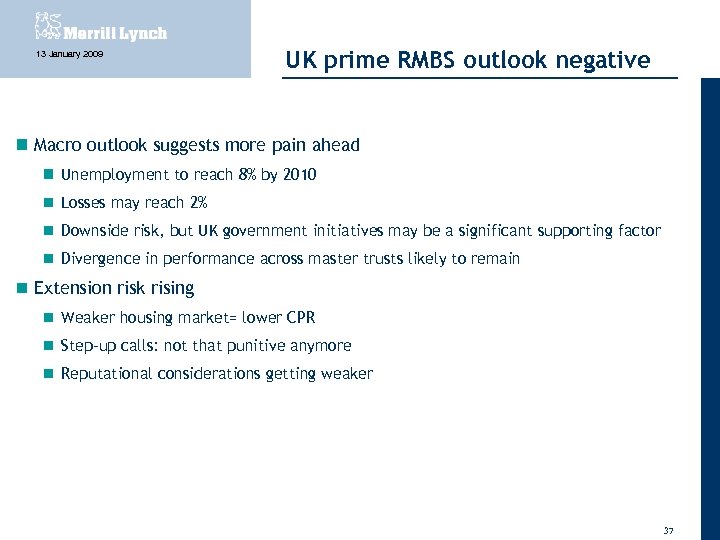 13 January 2009 UK prime RMBS outlook negative Macro outlook suggests more pain ahead Unemployment to reach 8% by 2010 Losses may reach 2% Downside risk, but UK government initiatives may be a significant supporting factor Divergence in performance across master trusts likely to remain Extension risk rising Weaker housing market= lower CPR Step-up calls: not that punitive anymore Reputational considerations getting weaker 37
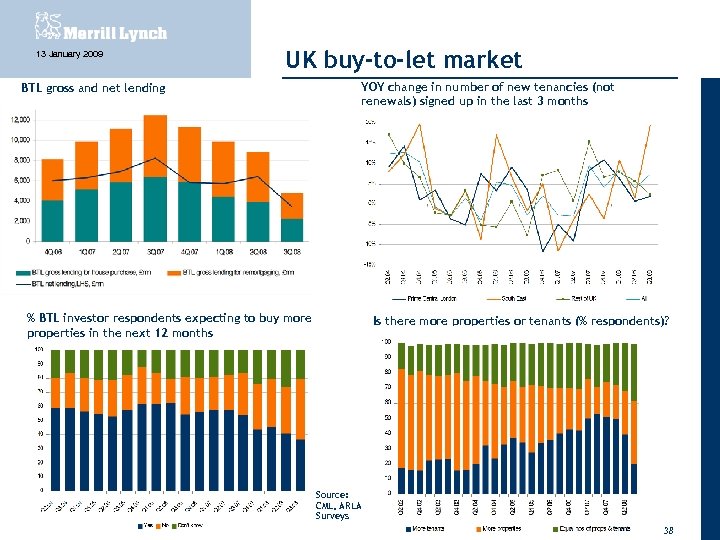 13 January 2009 UK buy-to-let market BTL gross and net lending YOY change in number of new tenancies (not renewals) signed up in the last 3 months % BTL investor respondents expecting to buy more properties in the next 12 months Is there more properties or tenants (% respondents)? Source: CML, ARLA Surveys 38
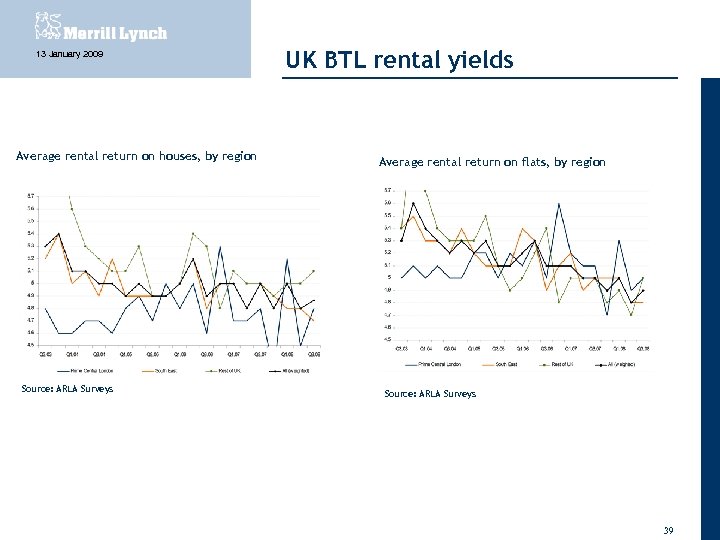 13 January 2009 Average rental return on houses, by region Source: ARLA Surveys UK BTL rental yields Average rental return on flats, by region Source: ARLA Surveys 39
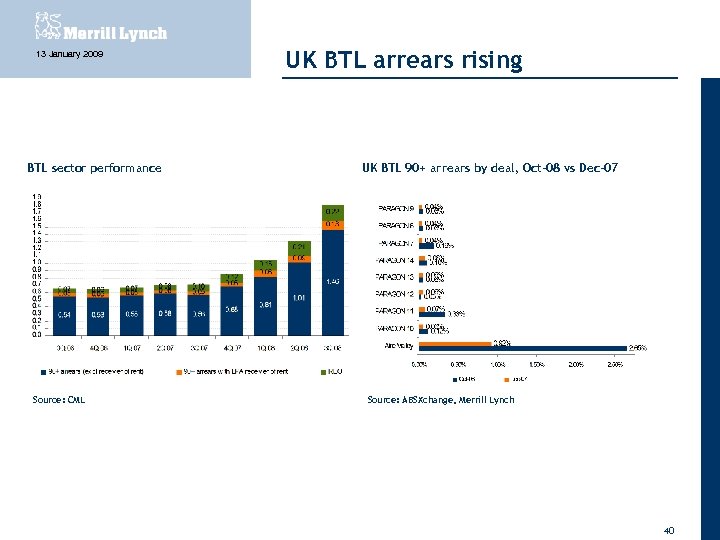 13 January 2009 BTL sector performance Source: CML UK BTL arrears rising UK BTL 90+ arrears by deal, Oct-08 vs Dec-07 Source: ABSXchange, Merrill Lynch 40
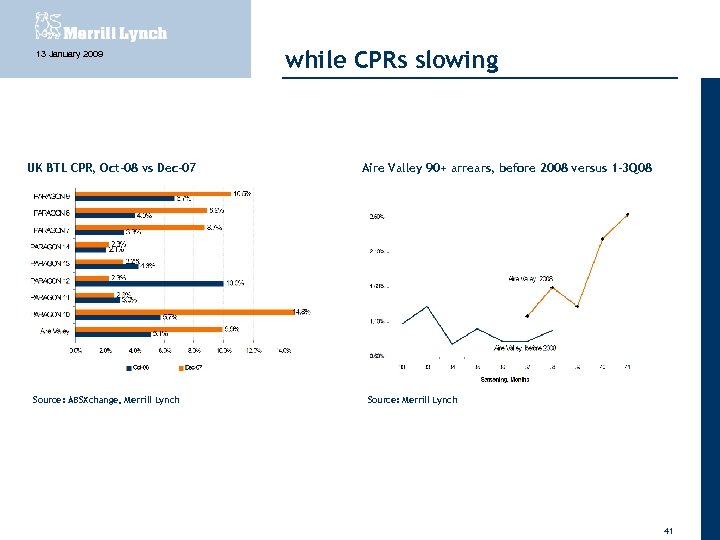 13 January 2009 UK BTL CPR, Oct-08 vs Dec-07 Source: ABSXchange, Merrill Lynch while CPRs slowing Aire Valley 90+ arrears, before 2008 versus 1 -3 Q 08 Source: Merrill Lynch 41
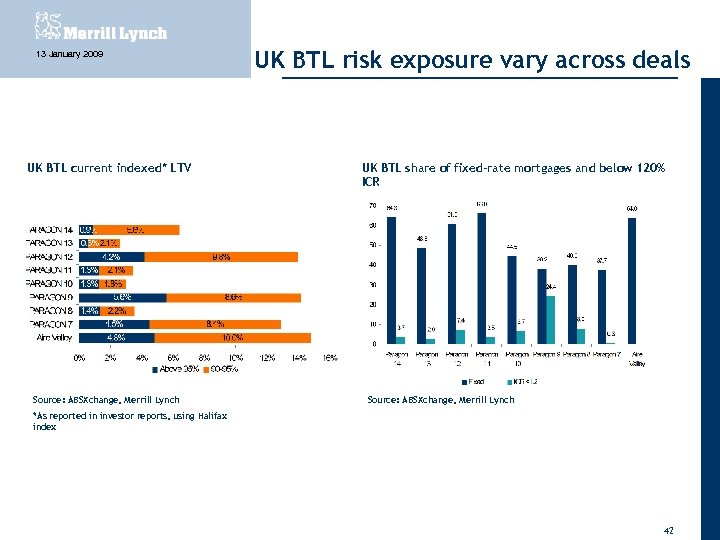 13 January 2009 UK BTL current indexed* LTV Source: ABSXchange, Merrill Lynch UK BTL risk exposure vary across deals UK BTL share of fixed-rate mortgages and below 120% ICR Source: ABSXchange, Merrill Lynch *As reported in investor reports, using Halifax index 42
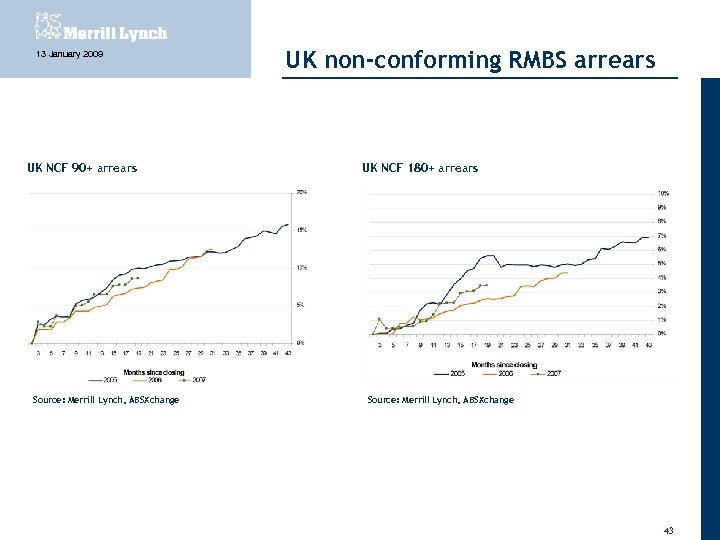 13 January 2009 UK NCF 90+ arrears Source: Merrill Lynch, ABSXchange UK non-conforming RMBS arrears UK NCF 180+ arrears Source: Merrill Lynch, ABSXchange 43
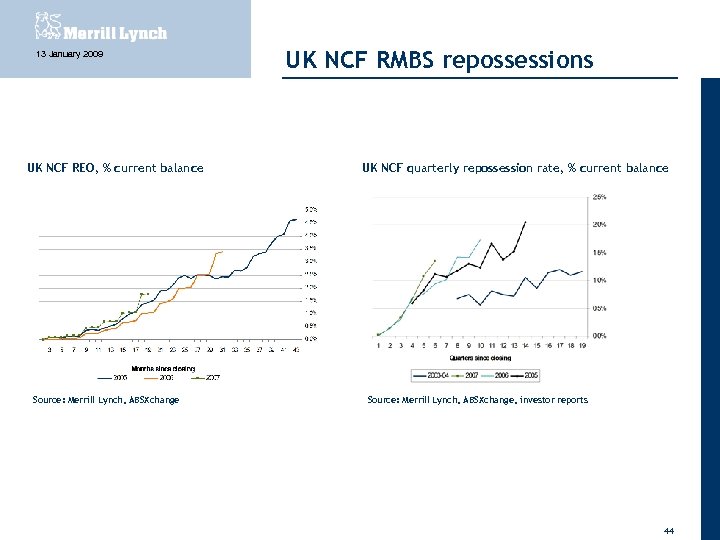 13 January 2009 UK NCF REO, % current balance Source: Merrill Lynch, ABSXchange UK NCF RMBS repossessions UK NCF quarterly repossession rate, % current balance Source: Merrill Lynch, ABSXchange, investor reports 44
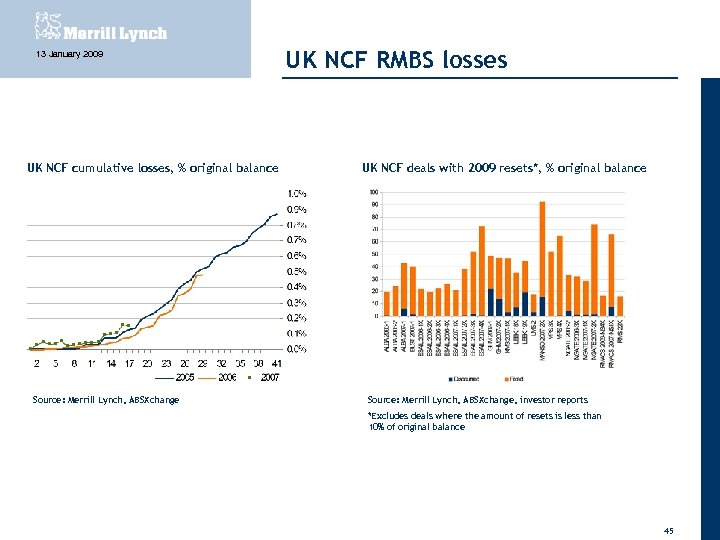 13 January 2009 UK NCF cumulative losses, % original balance Source: Merrill Lynch, ABSXchange UK NCF RMBS losses UK NCF deals with 2009 resets*, % original balance Source: Merrill Lynch, ABSXchange, investor reports *Excludes deals where the amount of resets is less than 10% of original balance 45
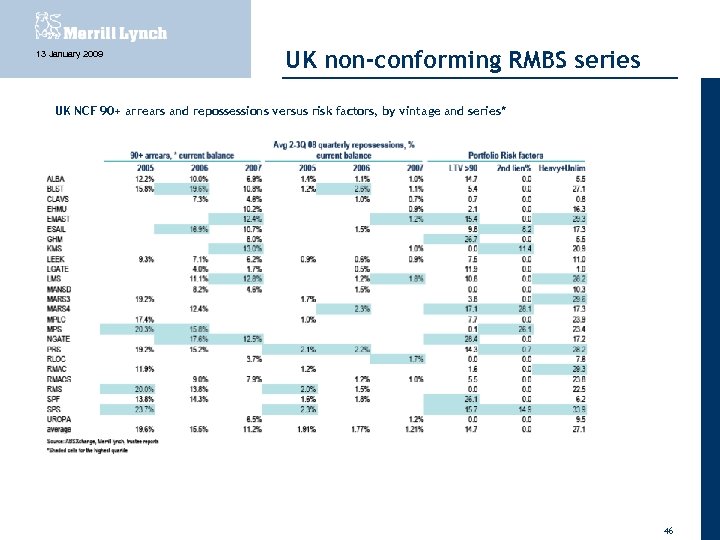 13 January 2009 UK non-conforming RMBS series UK NCF 90+ arrears and repossessions versus risk factors, by vintage and series* 46
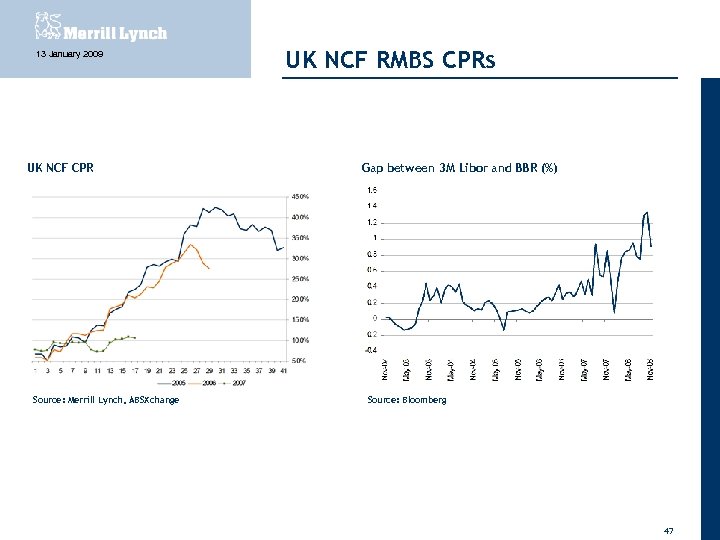 13 January 2009 UK NCF CPR Source: Merrill Lynch, ABSXchange UK NCF RMBS CPRs Gap between 3 M Libor and BBR (%) Source: Bloomberg 47
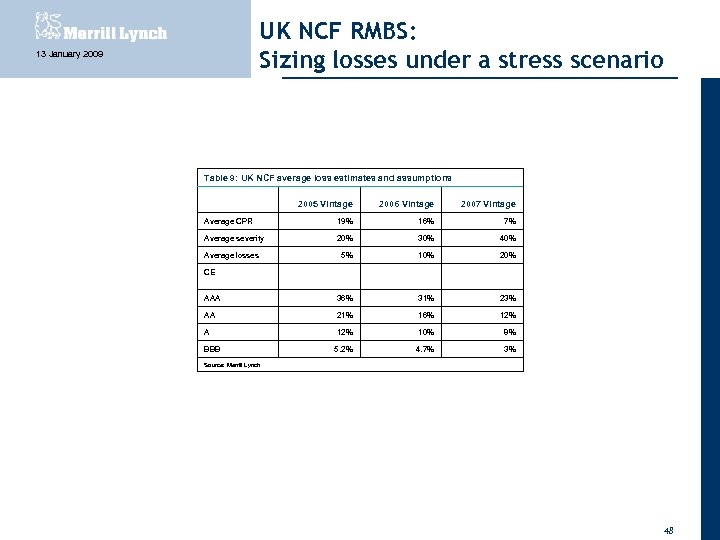 UK NCF RMBS: Sizing losses under a stress scenario 13 January 2009 Table 9: UK NCF average loss estimates and assumptions 2005 Vintage 2006 Vintage 2007 Vintage Average CPR 19% 16% 7% Average severity 20% 30% 40% 5% 10% 20% AAA 36% 31% 23% AA 21% 16% 12% A 12% 10% 8% BBB 5. 2% 4. 7% 3% Average losses CE Source: Merrill Lynch 48
 13 January 2009 European RMBS
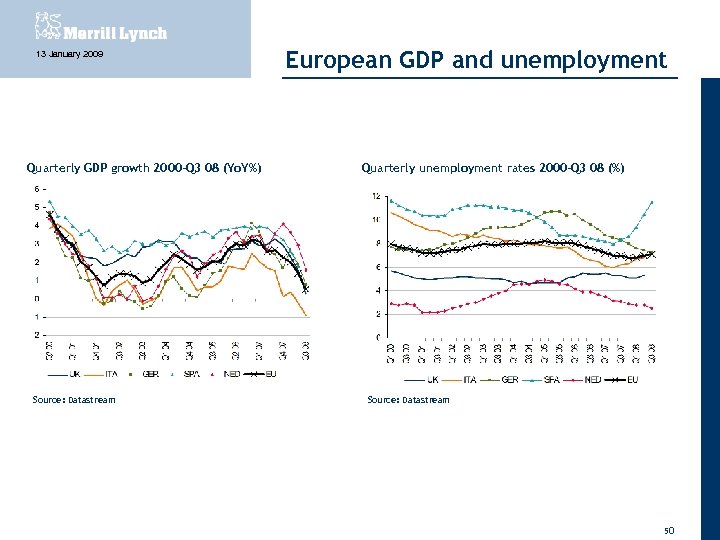 13 January 2009 Quarterly GDP growth 2000 -Q 3 08 (Yo. Y%) Source: Datastream European GDP and unemployment Quarterly unemployment rates 2000 -Q 3 08 (%) Source: Datastream 50
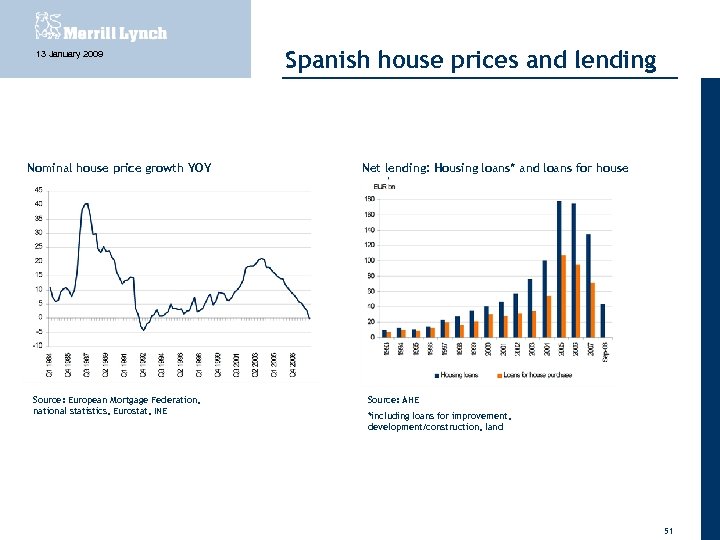 13 January 2009 Nominal house price growth YOY Source: European Mortgage Federation, national statistics, Eurostat, INE Spanish house prices and lending Net lending: Housing loans* and loans for house purchases Source: AHE *including loans for improvement, development/construction, land 51
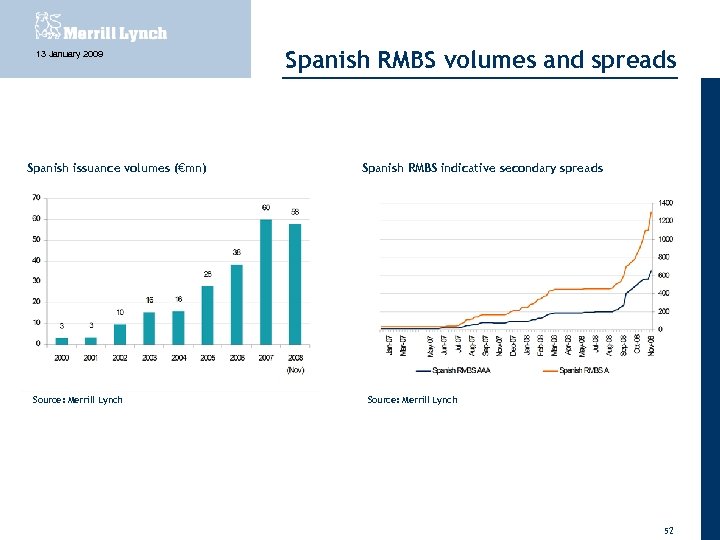 13 January 2009 Spanish issuance volumes (€mn) Source: Merrill Lynch Spanish RMBS volumes and spreads Spanish RMBS indicative secondary spreads Source: Merrill Lynch 52
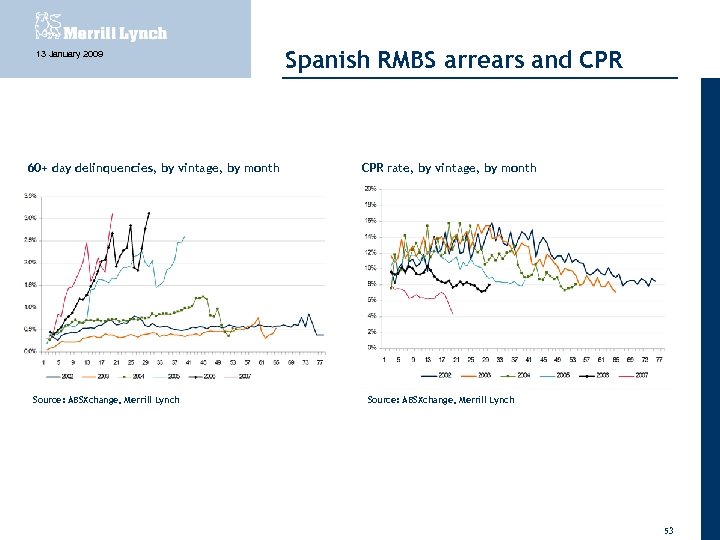 13 January 2009 60+ day delinquencies, by vintage, by month Source: ABSXchange, Merrill Lynch Spanish RMBS arrears and CPR rate, by vintage, by month Source: ABSXchange, Merrill Lynch 53
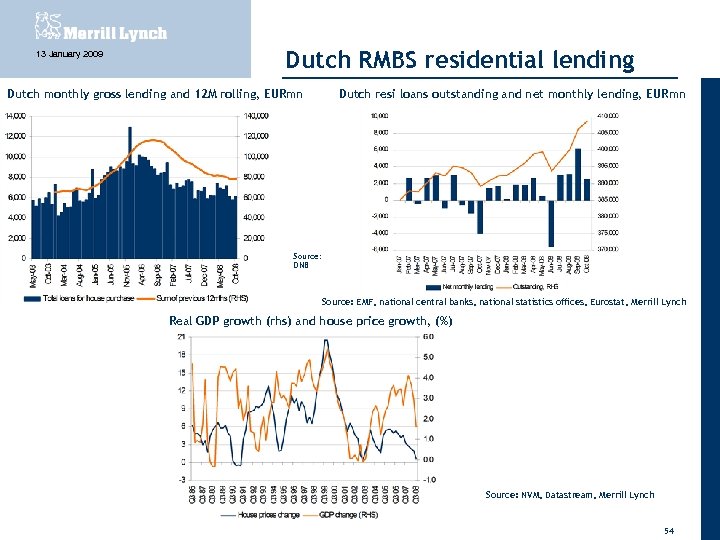 13 January 2009 Dutch RMBS residential lending Dutch monthly gross lending and 12 M rolling, EURmn Dutch resi loans outstanding and net monthly lending, EURmn Source: DNB Source: EMF, national central banks, national statistics offices, Eurostat, Merrill Lynch Real GDP growth (rhs) and house price growth, (%) Source: NVM, Datastream, Merrill Lynch 54
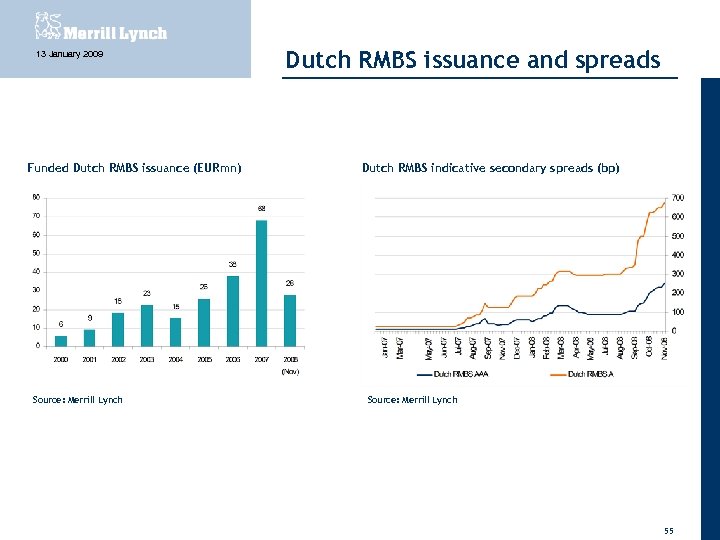 13 January 2009 Funded Dutch RMBS issuance (EURmn) Source: Merrill Lynch Dutch RMBS issuance and spreads Dutch RMBS indicative secondary spreads (bp) Source: Merrill Lynch 55
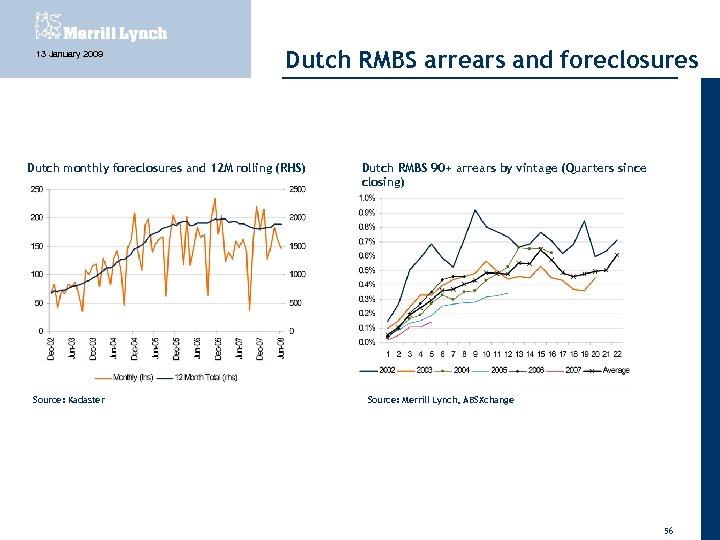 13 January 2009 Dutch RMBS arrears and foreclosures Dutch monthly foreclosures and 12 M rolling (RHS) Source: Kadaster Dutch RMBS 90+ arrears by vintage (Quarters since closing) Source: Merrill Lynch, ABSXchange 56
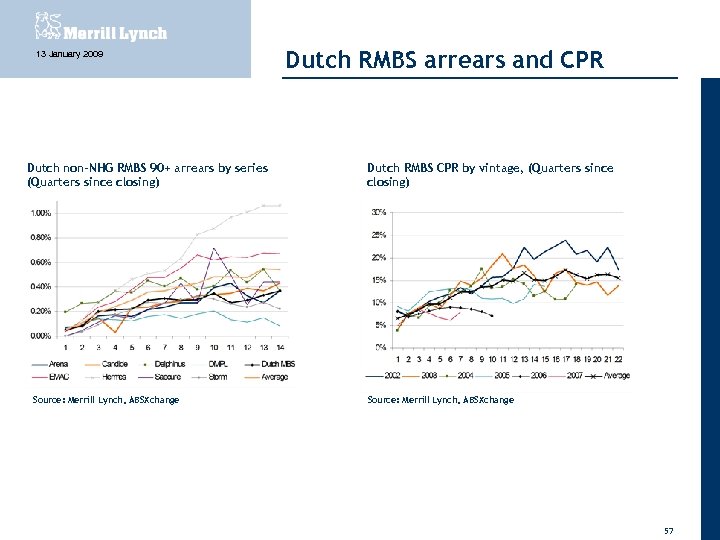 13 January 2009 Dutch non-NHG RMBS 90+ arrears by series (Quarters since closing) Source: Merrill Lynch, ABSXchange Dutch RMBS arrears and CPR Dutch RMBS CPR by vintage, (Quarters since closing) Source: Merrill Lynch, ABSXchange 57
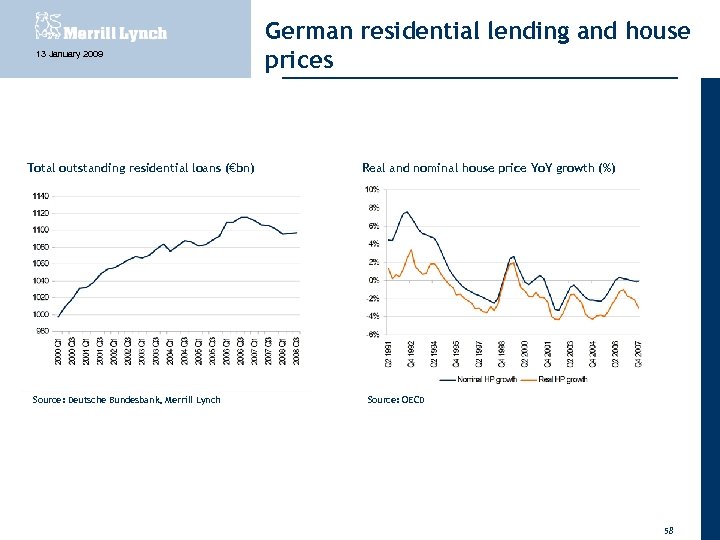 13 January 2009 Total outstanding residential loans (€bn) Source: Deutsche Bundesbank, Merrill Lynch German residential lending and house prices Real and nominal house price Yo. Y growth (%) Source: OECD 58
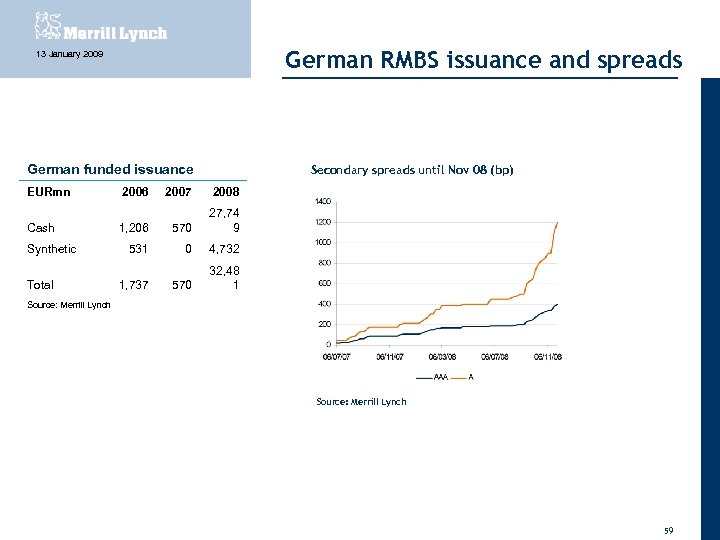 German RMBS issuance and spreads 13 January 2009 German funded issuance Secondary spreads until Nov 08 (bp) EURmn 2006 2007 2008 Cash 1, 206 570 27, 74 9 531 0 4, 732 570 32, 48 1 Synthetic Total 1, 737 Source: Merrill Lynch 59
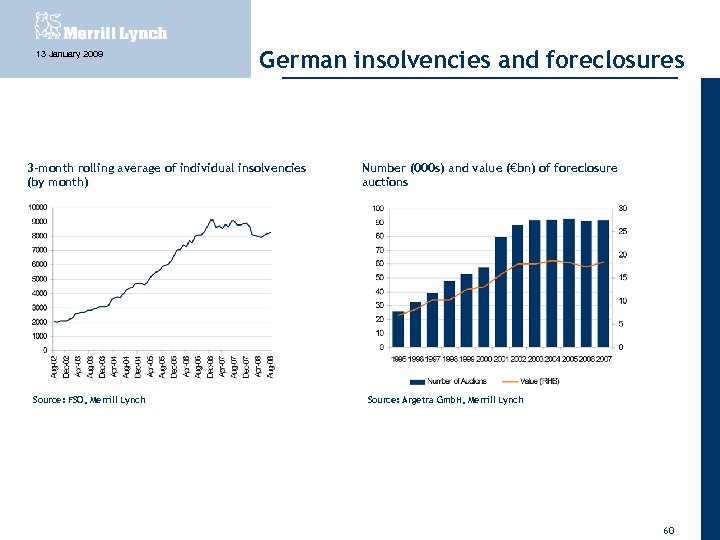 13 January 2009 German insolvencies and foreclosures 3 -month rolling average of individual insolvencies (by month) Source: FSO, Merrill Lynch Number (000 s) and value (€bn) of foreclosure auctions Source: Argetra Gmb. H, Merrill Lynch 60
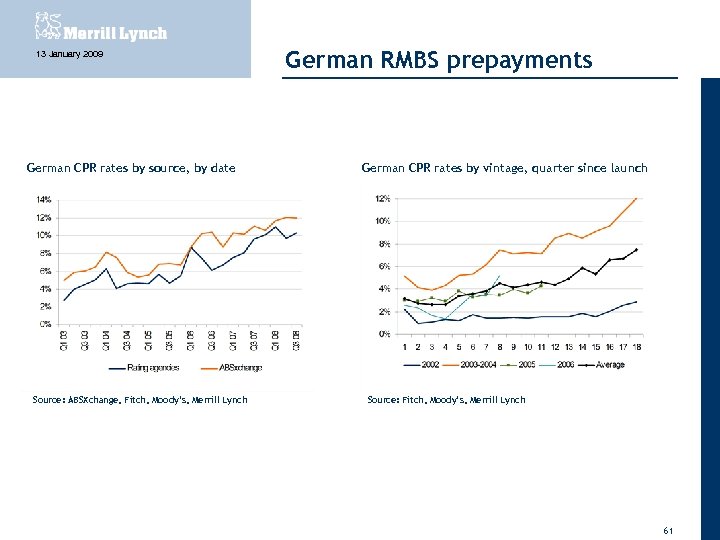 13 January 2009 German CPR rates by source, by date Source: ABSXchange, Fitch, Moody’s, Merrill Lynch German RMBS prepayments German CPR rates by vintage, quarter since launch Source: Fitch, Moody’s, Merrill Lynch 61
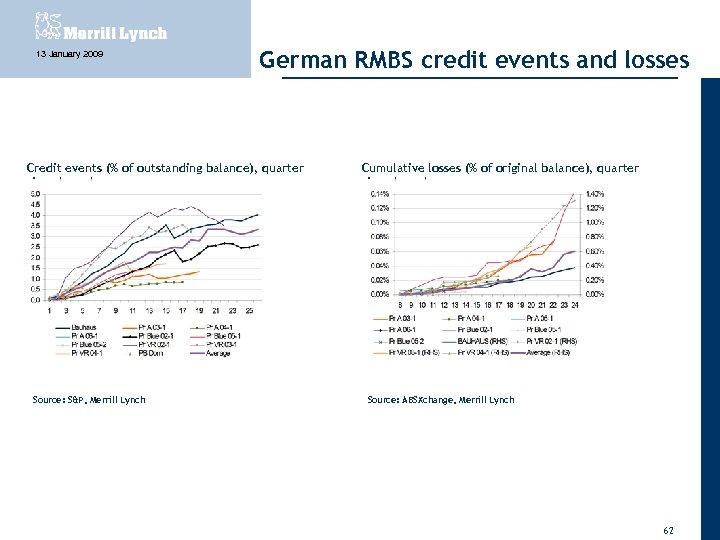 13 January 2009 German RMBS credit events and losses Credit events (% of outstanding balance), quarter since launch Source: S&P, Merrill Lynch Cumulative losses (% of original balance), quarter since launch Source: ABSXchange, Merrill Lynch 62
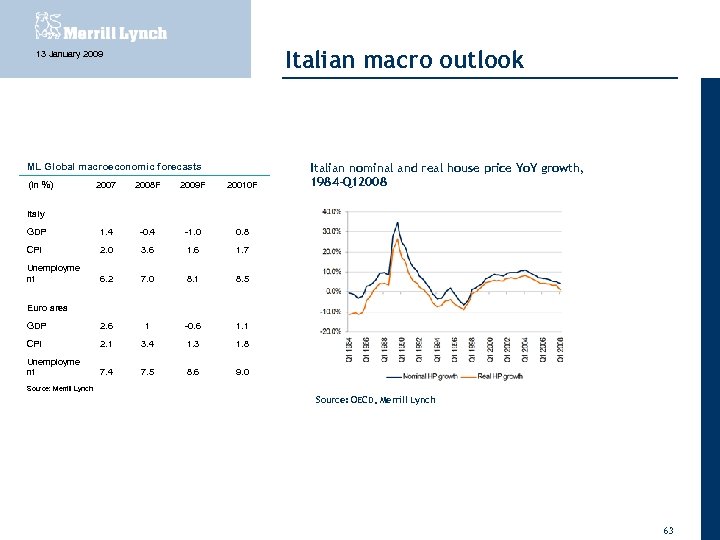 Italian macro outlook 13 January 2009 ML Global macroeconomic forecasts (in %) 2007 2008 F 2009 F 20010 F GDP 1. 4 -0. 4 -1. 0 0. 8 CPI 2. 0 3. 6 1. 7 Unemployme nt 6. 2 7. 0 8. 1 8. 5 GDP 2. 6 1 -0. 6 1. 1 CPI 2. 1 3. 4 1. 3 1. 8 Unemployme nt 7. 4 7. 5 8. 6 Italian nominal and real house price Yo. Y growth, 1984 -Q 12008 9. 0 Italy Euro area Source: Merrill Lynch Source: OECD, Merrill Lynch 63
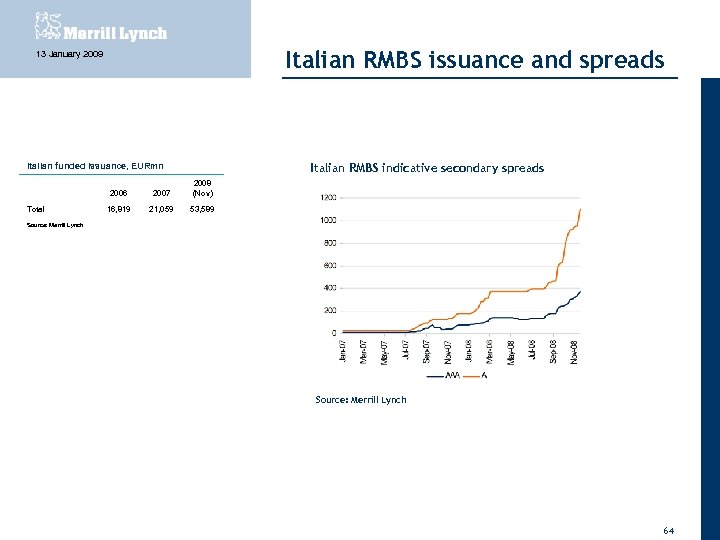 Italian RMBS issuance and spreads 13 January 2009 Italian RMBS indicative secondary spreads Italian funded issuance, EURmn 2006 Total 2007 2008 (Nov) 16, 819 21, 059 53, 589 Source: Merrill Lynch 64
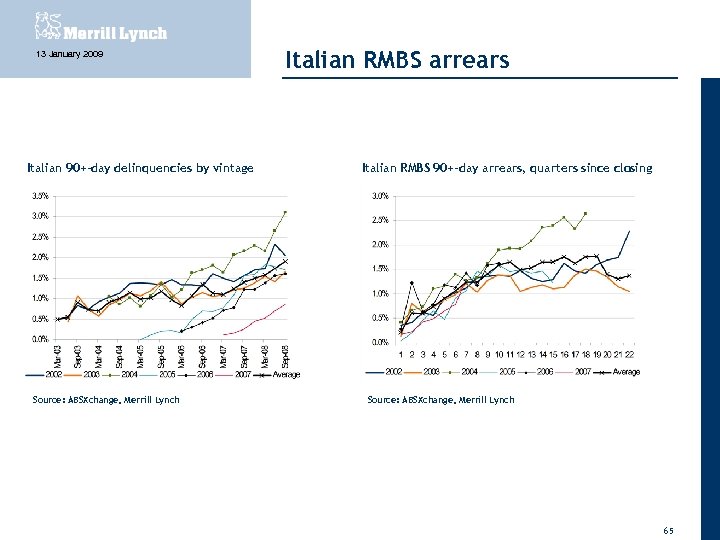 13 January 2009 Italian 90+-day delinquencies by vintage Source: ABSXchange, Merrill Lynch Italian RMBS arrears Italian RMBS 90+-day arrears, quarters since closing Source: ABSXchange, Merrill Lynch 65
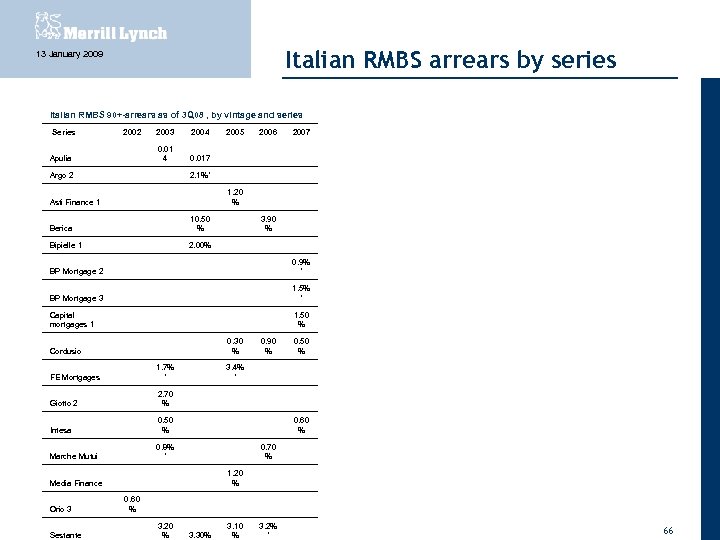 Italian RMBS arrears by series 13 January 2009 Italian RMBS 90+-arrears as of 3 Q 08 , by vintage and series Series 2002 2003 2004 2005 2006 2007 Apulia 0. 01 4 0. 017 Argo 2 2. 1%* Asti Finance 1 1. 20 % Berica 10. 50 % 3. 90 % Bipielle 1 2. 00% BP Mortgage 2 0. 9% * BP Mortgage 3 1. 5% * Capital mortgages 1 1. 50 % Cordusio 0. 30 % 0. 90 % 0. 50 % FE Mortgages 1. 7% * 3. 4% * Giotto 2 2. 70 % Intesa 0. 50 % 0. 60 % Marche Mutui 0. 8% * 0. 70 % Media Finance 1. 20 % 0. 60 % 3. 20 % 3. 30% 3. 10 % 3. 2% * Orio 3 Sestante 66
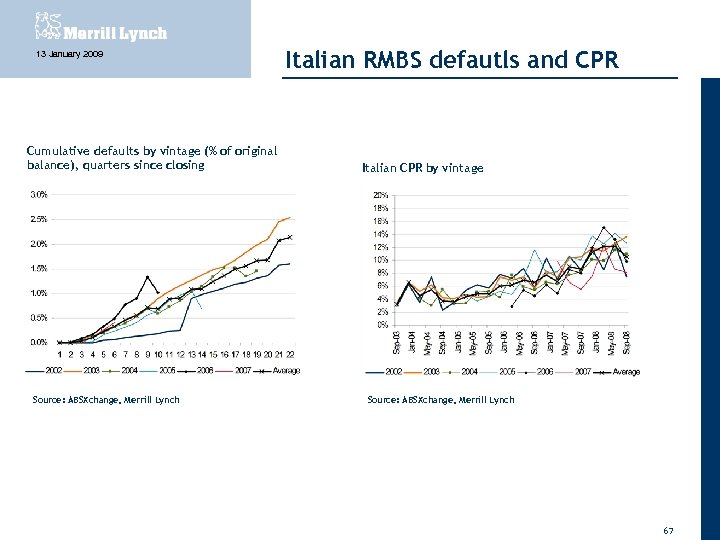 13 January 2009 Cumulative defaults by vintage (% of original balance), quarters since closing Source: ABSXchange, Merrill Lynch Italian RMBS defautls and CPR Italian CPR by vintage Source: ABSXchange, Merrill Lynch 67
 13 January 2009 European CMBS & property derivatives – stressed or distressed?
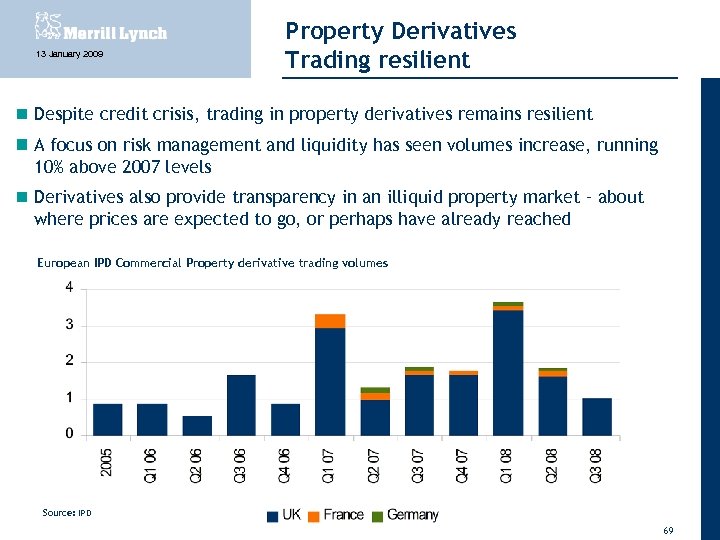 13 January 2009 Property Derivatives Trading resilient Despite credit crisis, trading in property derivatives remains resilient A focus on risk management and liquidity has seen volumes increase, running 10% above 2007 levels Derivatives also provide transparency in an illiquid property market – about where prices are expected to go, or perhaps have already reached European IPD Commercial Property derivative trading volumes Source: IPD 69
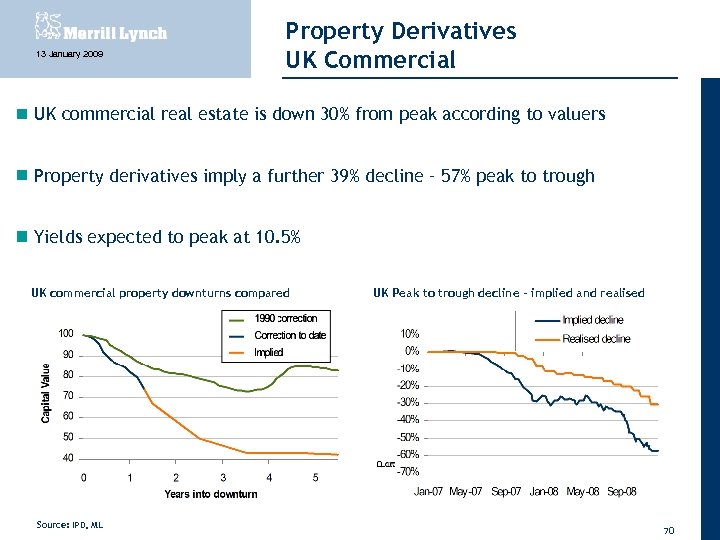 13 January 2009 Property Derivatives UK Commercial UK commercial real estate is down 30% from peak according to valuers Property derivatives imply a further 39% decline – 57% peak to trough Yields expected to peak at 10. 5% UK commercial property downturns compared Source: IPD, ML UK Peak to trough decline - implied and realised 70
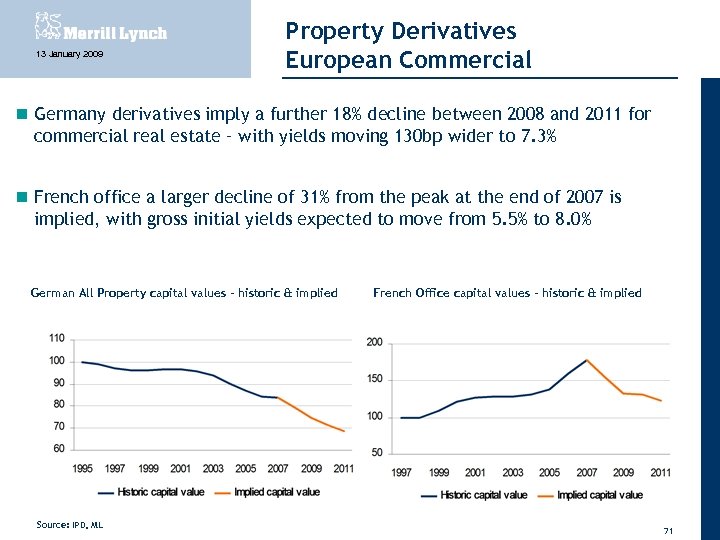 13 January 2009 Property Derivatives European Commercial Germany derivatives imply a further 18% decline between 2008 and 2011 for commercial real estate – with yields moving 130 bp wider to 7. 3% French office a larger decline of 31% from the peak at the end of 2007 is implied, with gross initial yields expected to move from 5. 5% to 8. 0% German All Property capital values - historic & implied Source: IPD, ML French Office capital values - historic & implied 71
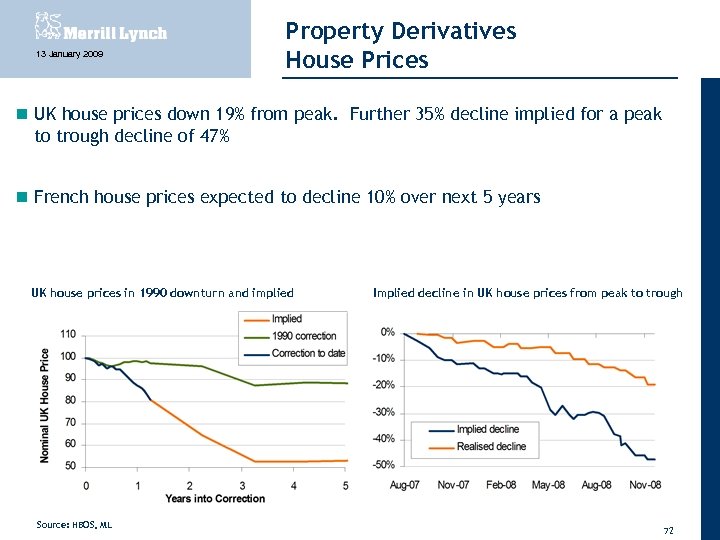 13 January 2009 Property Derivatives House Prices UK house prices down 19% from peak. Further 35% decline implied for a peak to trough decline of 47% French house prices expected to decline 10% over next 5 years UK house prices in 1990 downturn and implied Source: HBOS, ML Implied decline in UK house prices from peak to trough 72
 13 January 2009 Property Derivatives 2009 Developments Property derivatives to be used more strategically Shorted dated investment strategy has outperformed by a large margin Interest growing in structured products Portfolio management in direct portfolios and alpha generation Managing liquidity, particularly for open-ended funds CMBS hedging or arbitrage becoming easier Increasing links between valuations and transactions Forward index prices represent current sale prices Valuers increasing aware of property derivative prices Increasing links between REITs and property derivatives Listing of property derivatives on Eurex to go live in Q 1 73
 13 January 2009 CMBS in distress Servicer to behave like a trustee in not exercising discretion, this will slow the recovery or workout process significantly. Vacant possession value falls of 80%+ are likely to be repeated for some secondary assets. Secondary spreads could gap out further if forced asset sales become the norm and banks offload CRE loans into ‘bad’ bank structures What Drives European Credit Spreads - 2009 74
 13 January 2009 Who is the marginal buyer for CRE? REIT buyer. . . high single digit yields for prime assets, lower leverage does not affect post tax returns, rights issues/partial asset sales Sovereign wealth funds…still provide a source of capital for super prime assets but are not going to be as dominant given declining oil prices Private equity buyer and hedge fund buyer aiming for returns of 20%+…CMBS potentially provides their route…falling libor/euribor with constant absolute return expectations from this buyer base points to declining CMBS prices Corporate buyer…reversing the trend of sale and leasebacks, the corporate buyer could provide a bid for some of the secondary property in CMBS but they are likely to look for a short payback period What Drives European Credit Spreads - 2009 75
 13 January 2009 Special Servicer is going to minimise litigation risk Enforcement is going to be difficult due to the need to get noteholders to indemnify the servicer. Maximising recovery is likely to result from working loans out rather than enforcement on non trophy or prime assets. Without indemnification the servicer will minimise litigation by trying to behave as a prudent lender. This could be done by following the action that bank lenders and other servicers are taking. At the moment the newsflow points to prudent lenders opting to workout. 76
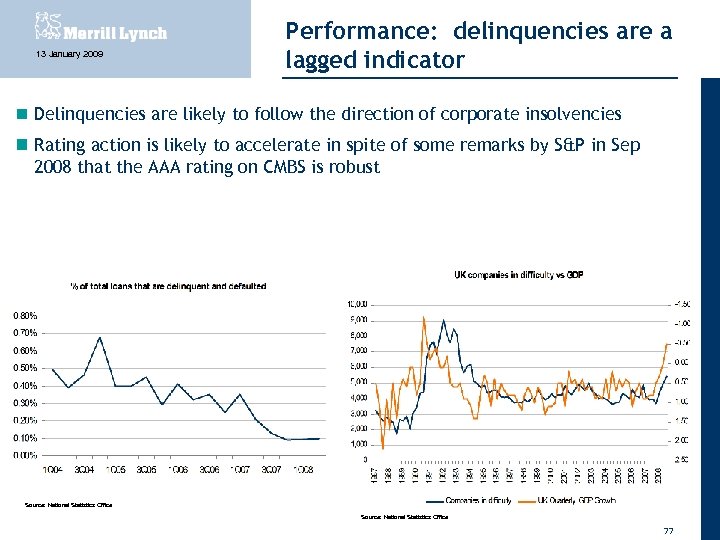 13 January 2009 Performance: delinquencies are a lagged indicator Delinquencies are likely to follow the direction of corporate insolvencies Rating action is likely to accelerate in spite of some remarks by S&P in Sep 2008 that the AAA rating on CMBS is robust Source: National Statistics Office 77
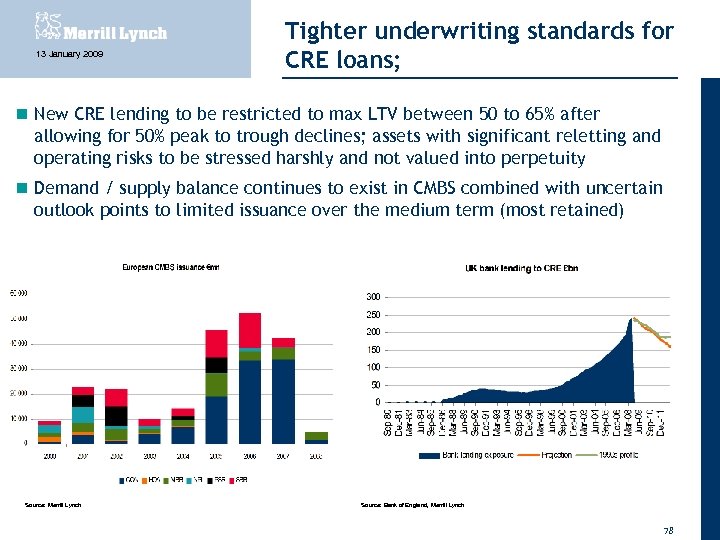 13 January 2009 Tighter underwriting standards for CRE loans; New CRE lending to be restricted to max LTV between 50 to 65% after allowing for 50% peak to trough declines; assets with significant reletting and operating risks to be stressed harshly and not valued into perpetuity Demand / supply balance continues to exist in CMBS combined with uncertain outlook points to limited issuance over the medium term (most retained) Source: Merrill Lynch Source: Bank of England, Merrill Lynch 78
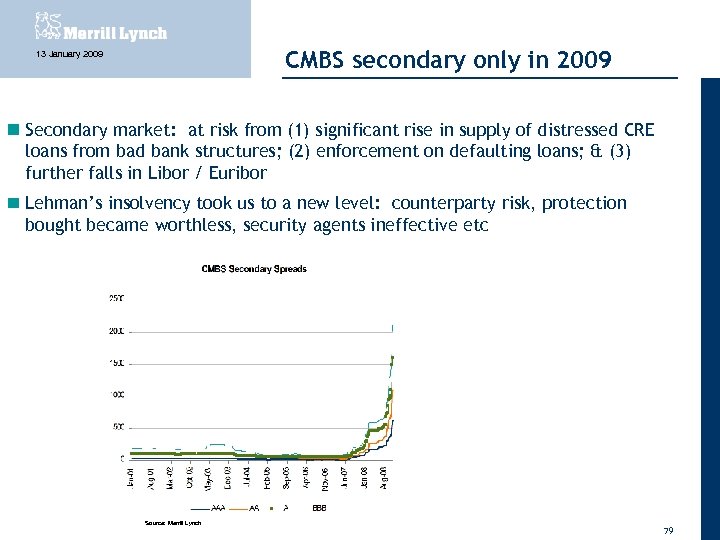 CMBS secondary only in 2009 13 January 2009 Secondary market: at risk from (1) significant rise in supply of distressed CRE loans from bad bank structures; (2) enforcement on defaulting loans; & (3) further falls in Libor / Euribor Lehman’s insolvency took us to a new level: counterparty risk, protection bought became worthless, security agents ineffective etc Source: Merrill Lynch 79
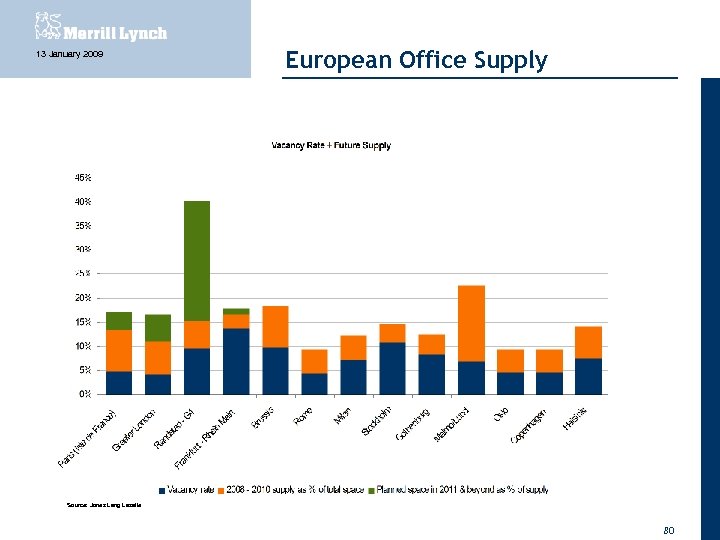 13 January 2009 European Office Supply Source: Jones Lang Lasalle 80
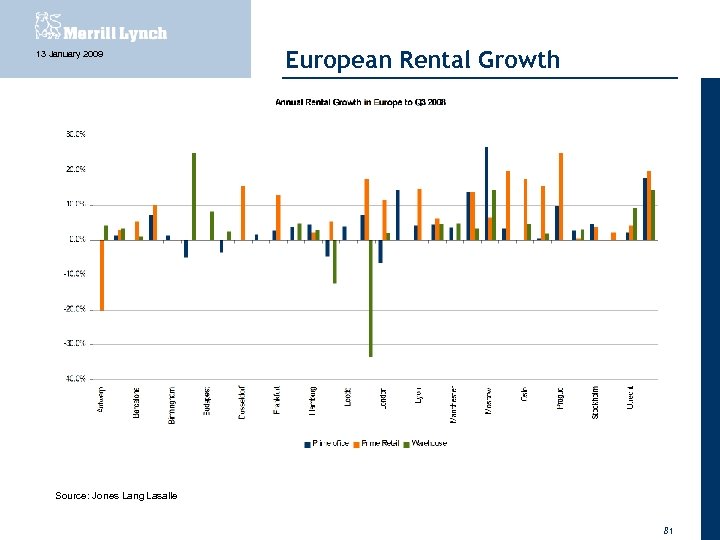 13 January 2009 European Rental Growth Source: Jones Lang Lasalle 81
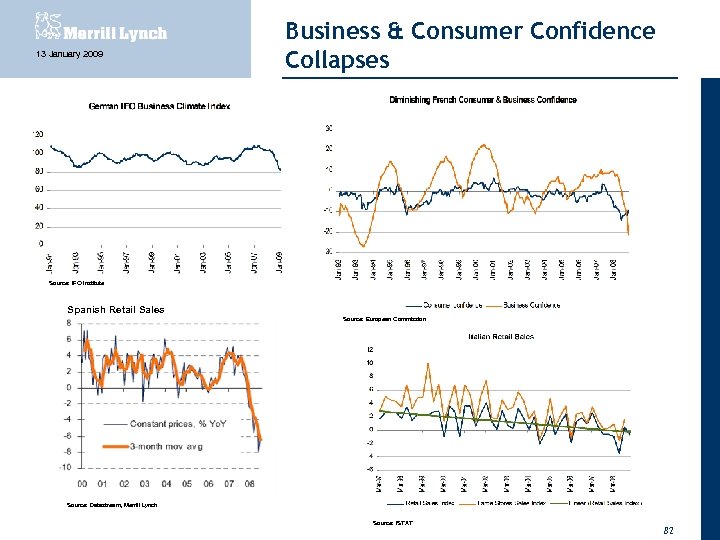 13 January 2009 Business & Consumer Confidence Collapses Source: IFO Institute Spanish Retail Sales Source: European Commission Source: Datastream, Merrill Lynch Source: ISTAT 82
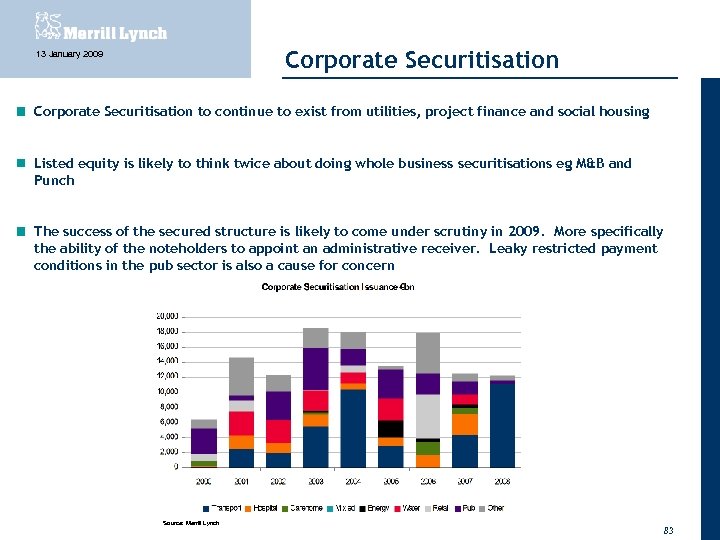 Corporate Securitisation 13 January 2009 Corporate Securitisation to continue to exist from utilities, project finance and social housing Listed equity is likely to think twice about doing whole business securitisations eg M&B and Punch The success of the secured structure is likely to come under scrutiny in 2009. More specifically the ability of the noteholders to appoint an administrative receiver. Leaky restricted payment conditions in the pub sector is also a cause for concern Source: Merrill Lynch 83
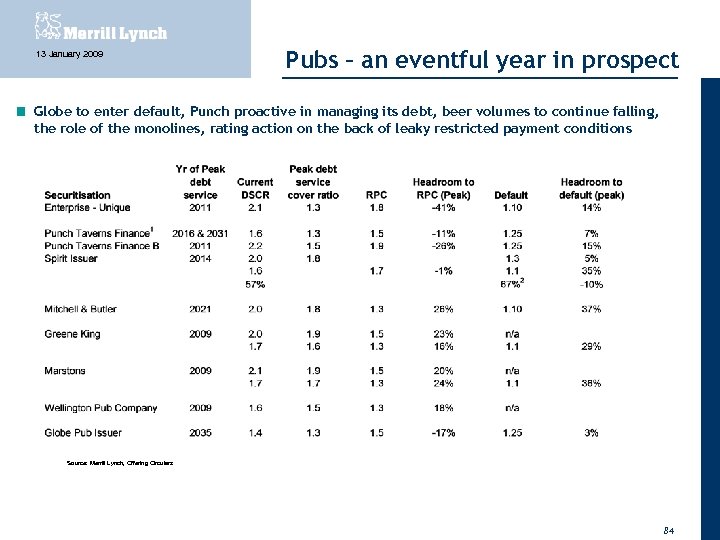 13 January 2009 Pubs – an eventful year in prospect Globe to enter default, Punch proactive in managing its debt, beer volumes to continue falling, the role of the monolines, rating action on the back of leaky restricted payment conditions Source: Merrill Lynch, Offering Circulars 84
 13 January 2009 Infrastructure Deflation: most project finance deals have 100% index linked debt, water deals 50%, gas 25% and BAA 10%. With deflation principal due may actually fall. Water regulatory review likely to put pressure on Post Maintenance Interest Cover Ratios…overall though expect a pragmatic approach from the regulator BAA to continue to suffer from the large overhang of debt, hefty capital spend, retail risk and the forced sale process No change on THPA: poor outlook due to concentration of revenues in steel and oil, construction of post panamax facility, amortisation picks up in 2011 resulting in an RPC breach, car revenue to come under pressure. Carehomes are under pressure from local authority fees and contraction in private payer wealth. Over-levered carehome securitisations may prompt local authorities to prefer less levered competitors. 85
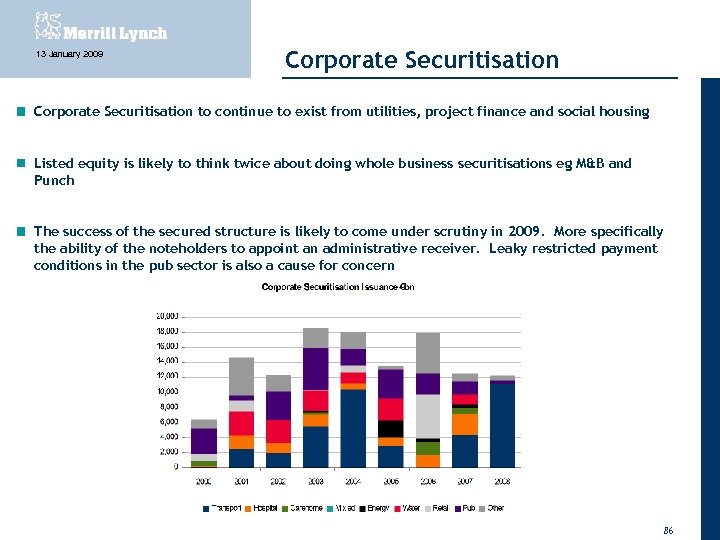 13 January 2009 Corporate Securitisation to continue to exist from utilities, project finance and social housing Listed equity is likely to think twice about doing whole business securitisations eg M&B and Punch The success of the secured structure is likely to come under scrutiny in 2009. More specifically the ability of the noteholders to appoint an administrative receiver. Leaky restricted payment conditions in the pub sector is also a cause for concern 86
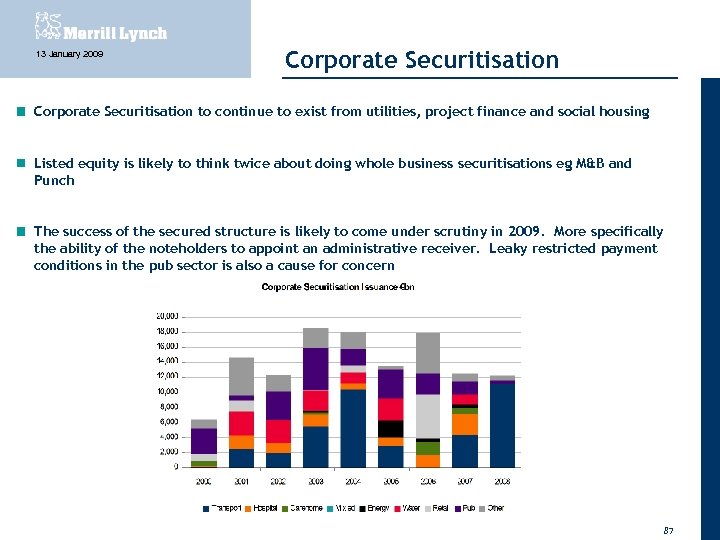 13 January 2009 Corporate Securitisation to continue to exist from utilities, project finance and social housing Listed equity is likely to think twice about doing whole business securitisations eg M&B and Punch The success of the secured structure is likely to come under scrutiny in 2009. More specifically the ability of the noteholders to appoint an administrative receiver. Leaky restricted payment conditions in the pub sector is also a cause for concern 87
 13 January 2009 European CDOs
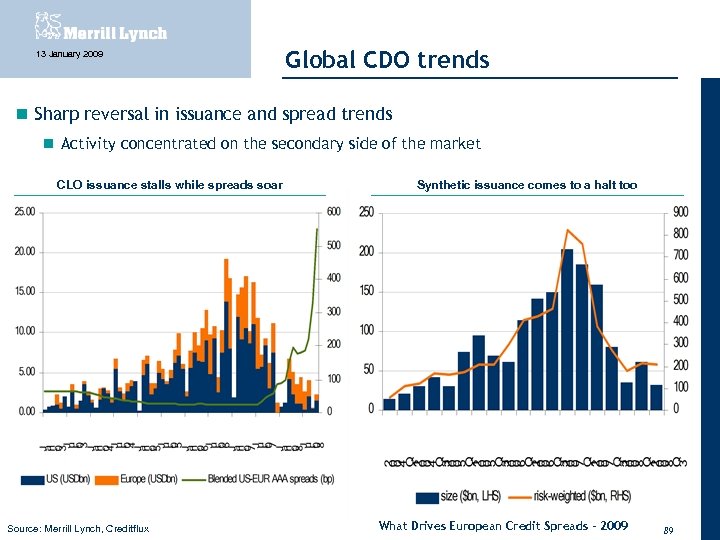 13 January 2009 Global CDO trends Sharp reversal in issuance and spread trends Activity concentrated on the secondary side of the market CLO issuance stalls while spreads soar Source: Merrill Lynch, Creditflux Synthetic issuance comes to a halt too What Drives European Credit Spreads - 2009 89
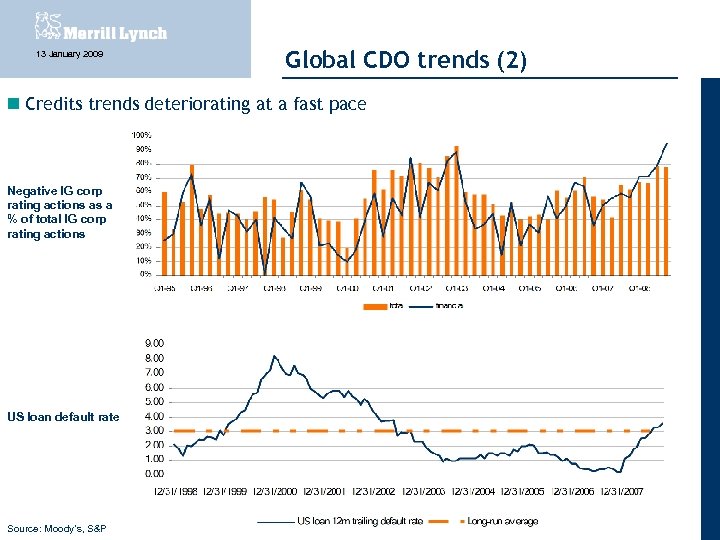 13 January 2009 Global CDO trends (2) Credits trends deteriorating at a fast pace Negative IG corp rating actions as a % of total IG corp rating actions US loan default rate Source: Moody’s, S&P 90
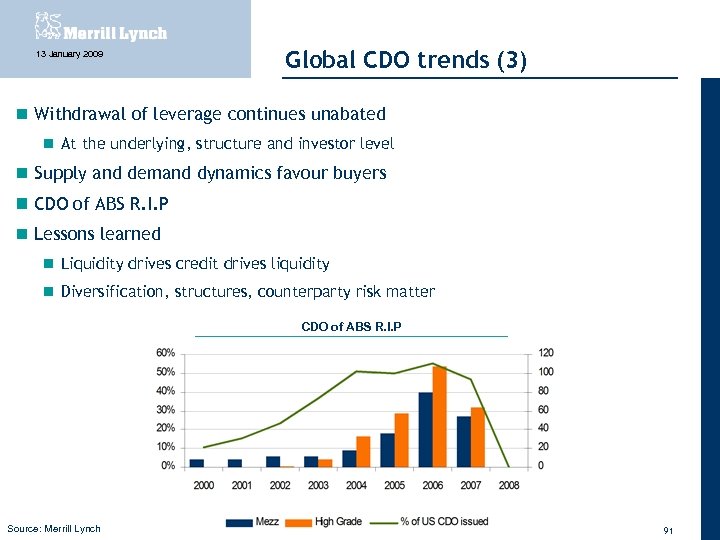 13 January 2009 Global CDO trends (3) Withdrawal of leverage continues unabated At the underlying, structure and investor level Supply and demand dynamics favour buyers CDO of ABS R. I. P Lessons learned Liquidity drives credit drives liquidity Diversification, structures, counterparty risk matter CDO of ABS R. I. P Source: Merrill Lynch 91
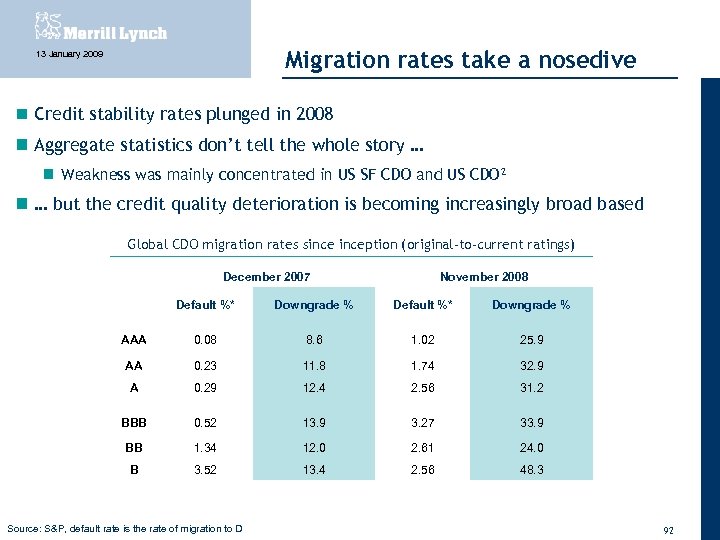 Migration rates take a nosedive 13 January 2009 Credit stability rates plunged in 2008 Aggregate statistics don’t tell the whole story … Weakness was mainly concentrated in US SF CDO and US CDO² … but the credit quality deterioration is becoming increasingly broad based Global CDO migration rates sinception (original-to-current ratings) December 2007 November 2008 Default %* Downgrade % AAA 0. 08 8. 6 1. 02 25. 9 AA 0. 23 11. 8 1. 74 32. 9 A 0. 29 12. 4 2. 56 31. 2 BBB 0. 52 13. 9 3. 27 33. 9 BB 1. 34 12. 0 2. 61 24. 0 B 3. 52 13. 4 2. 56 48. 3 Source: S&P, default rate is the rate of migration to D 92
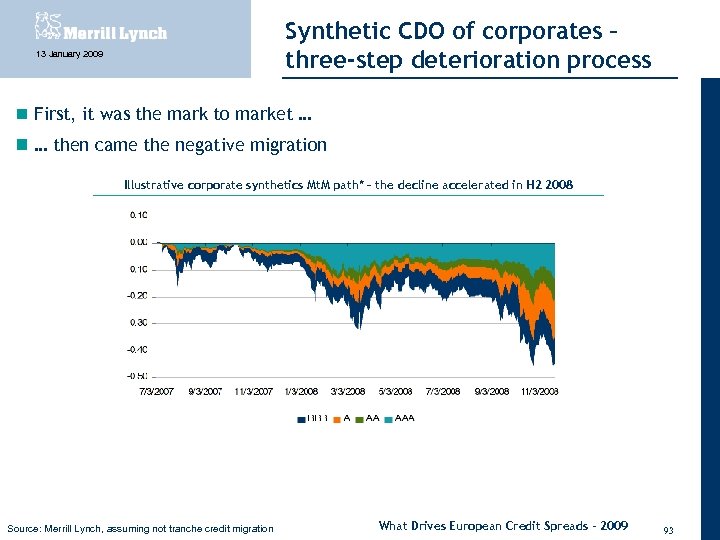 Synthetic CDO of corporates – three-step deterioration process 13 January 2009 First, it was the mark to market … … then came the negative migration Illustrative corporate synthetics Mt. M path* – the decline accelerated in H 2 2008 Source: Merrill Lynch, assuming not tranche credit migration What Drives European Credit Spreads - 2009 93
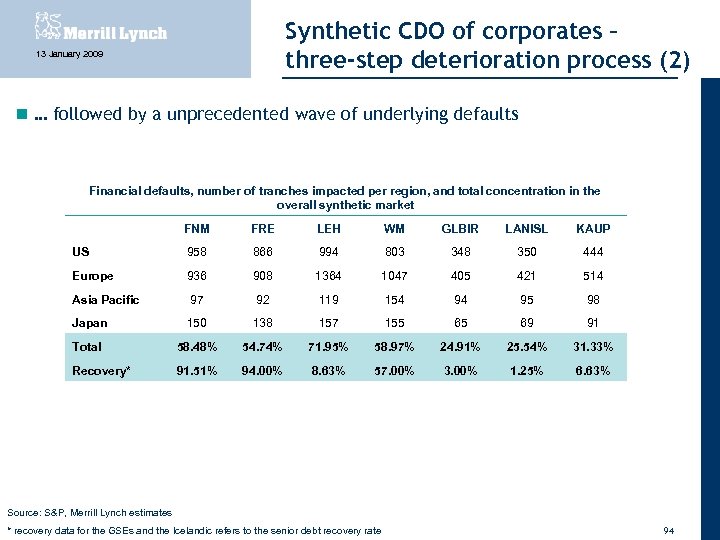 Synthetic CDO of corporates – three-step deterioration process (2) 13 January 2009 … followed by a unprecedented wave of underlying defaults Financial defaults, number of tranches impacted per region, and total concentration in the overall synthetic market FNM FRE LEH WM GLBIR LANISL KAUP US 958 866 994 803 348 350 444 Europe 936 908 1364 1047 405 421 514 Asia Pacific 97 92 119 154 94 95 98 Japan 150 138 157 155 65 69 91 Total 58. 48% 54. 74% 71. 95% 58. 97% 24. 91% 25. 54% 31. 33% Recovery* 91. 51% 94. 00% 8. 63% 57. 00% 3. 00% 1. 25% 6. 63% Source: S&P, Merrill Lynch estimates * recovery data for the GSEs and the Icelandic refers to the senior debt recovery rate 94
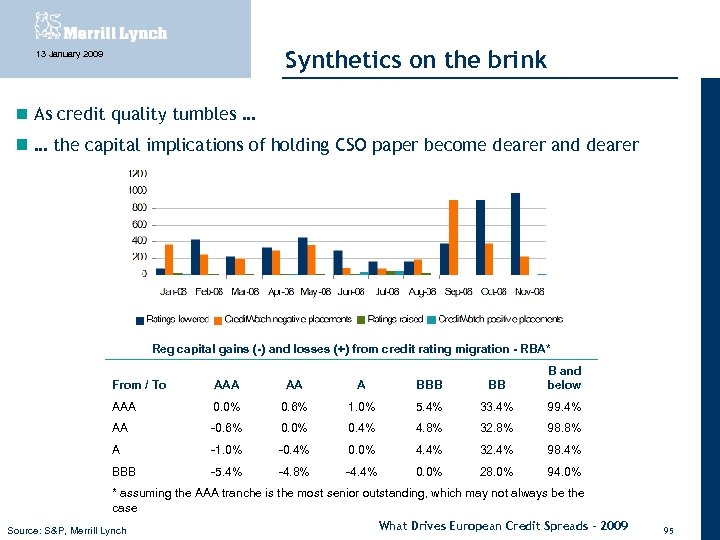 Synthetics on the brink 13 January 2009 As credit quality tumbles … … the capital implications of holding CSO paper become dearer and dearer Reg capital gains (-) and losses (+) from credit rating migration - RBA* From / To AAA AA A BBB BB B and below AAA 0. 0% 0. 6% 1. 0% 5. 4% 33. 4% 99. 4% AA -0. 6% 0. 0% 0. 4% 4. 8% 32. 8% 98. 8% A -1. 0% -0. 4% 0. 0% 4. 4% 32. 4% 98. 4% BBB -5. 4% -4. 8% -4. 4% 0. 0% 28. 0% 94. 0% * assuming the AAA tranche is the most senior outstanding, which may not always be the case Source: S&P, Merrill Lynch What Drives European Credit Spreads - 2009 95
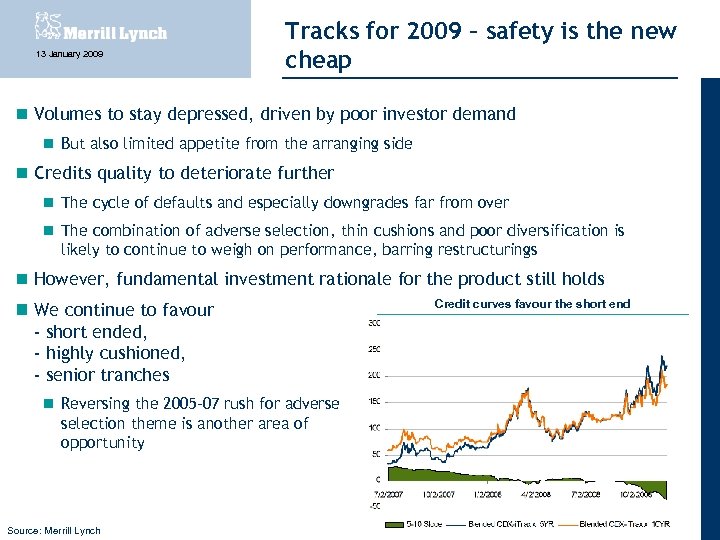 13 January 2009 Tracks for 2009 – safety is the new cheap Volumes to stay depressed, driven by poor investor demand But also limited appetite from the arranging side Credits quality to deteriorate further The cycle of defaults and especially downgrades far from over The combination of adverse selection, thin cushions and poor diversification is likely to continue to weigh on performance, barring restructurings However, fundamental investment rationale for the product still holds We continue to favour - short ended, - highly cushioned, - senior tranches Credit curves favour the short end Reversing the 2005 -07 rush for adverse selection theme is another area of opportunity Source: Merrill Lynch What Drives European Credit Spreads - 2009 96
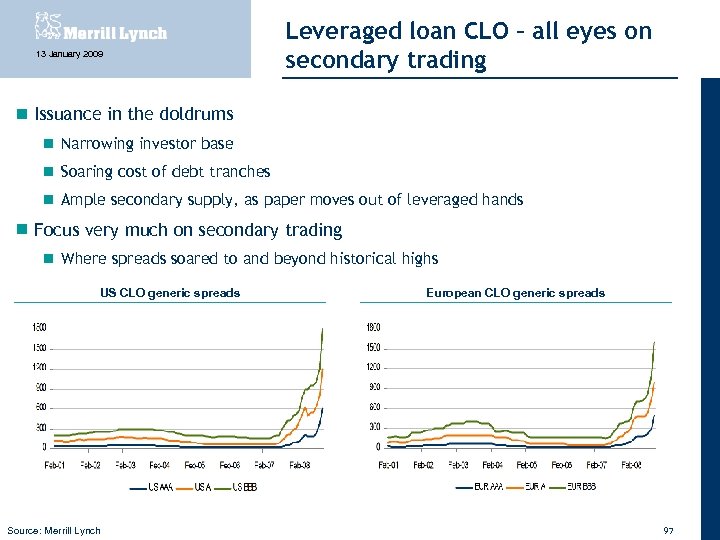 13 January 2009 Leveraged loan CLO – all eyes on secondary trading Issuance in the doldrums Narrowing investor base Soaring cost of debt tranches Ample secondary supply, as paper moves out of leveraged hands Focus very much on secondary trading Where spreads soared to and beyond historical highs US CLO generic spreads Source: Merrill Lynch European CLO generic spreads 97
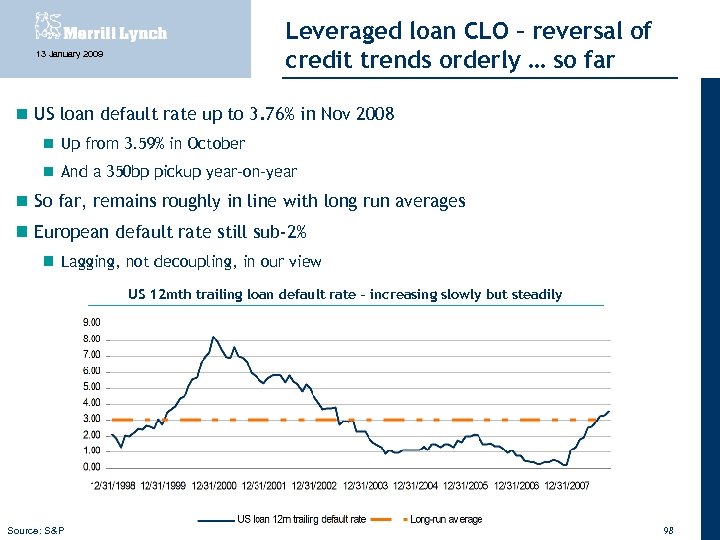 Leveraged loan CLO – reversal of credit trends orderly … so far 13 January 2009 US loan default rate up to 3. 76% in Nov 2008 Up from 3. 59% in October And a 350 bp pickup year-on-year So far, remains roughly in line with long run averages European default rate still sub-2% Lagging, not decoupling, in our view US 12 mth trailing loan default rate – increasing slowly but steadily Source: S&P 98
 13 January 2009 CLO – credit deterioration to pick up significantly in 2009 Defaults The combination of ever strengthening lending standards, very poor refinancing outlook, and collapsing economic data across the board will bring default rates above those of the previous cycle We expect double digit default rate in 2009 Recoveries Weak covenants, large institutional market share, and a proliferation of loan-only issuers likely to drive recoveries much lower Dispersion to be very pronounced, especially across loan sub types. Look for 2 nd lien / mezzanine to behave like sub debt upon default Repayments Near-zero repayments to persist for a while … … preventing reinvestments in newer vintage, stronger collateral 99
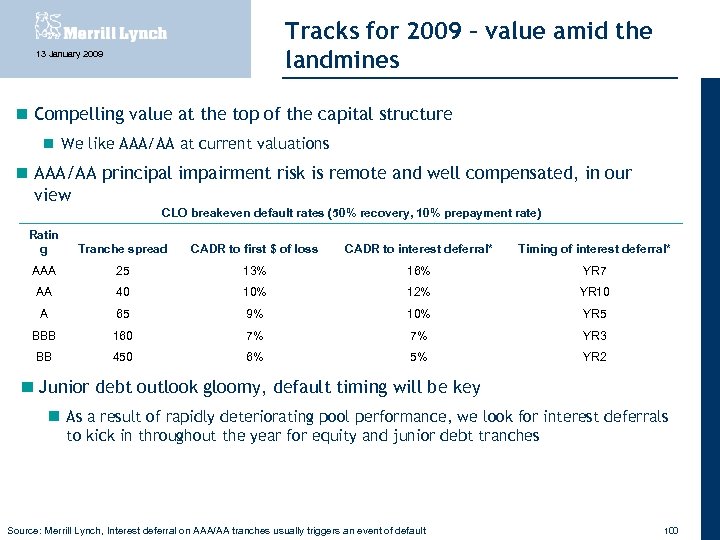 Tracks for 2009 – value amid the landmines 13 January 2009 Compelling value at the top of the capital structure We like AAA/AA at current valuations AAA/AA principal impairment risk is remote and well compensated, in our view CLO breakeven default rates (50% recovery, 10% prepayment rate) Ratin g Tranche spread CADR to first $ of loss CADR to interest deferral* Timing of interest deferral* AAA 25 13% 16% YR 7 AA 40 10% 12% YR 10 A 65 9% 10% YR 5 BBB 160 7% 7% YR 3 BB 450 6% 5% YR 2 Junior debt outlook gloomy, default timing will be key As a result of rapidly deteriorating pool performance, we look for interest deferrals to kick in throughout the year for equity and junior debt tranches Source: Merrill Lynch, Interest deferral on AAA/AA tranches usually triggers an event of default 100
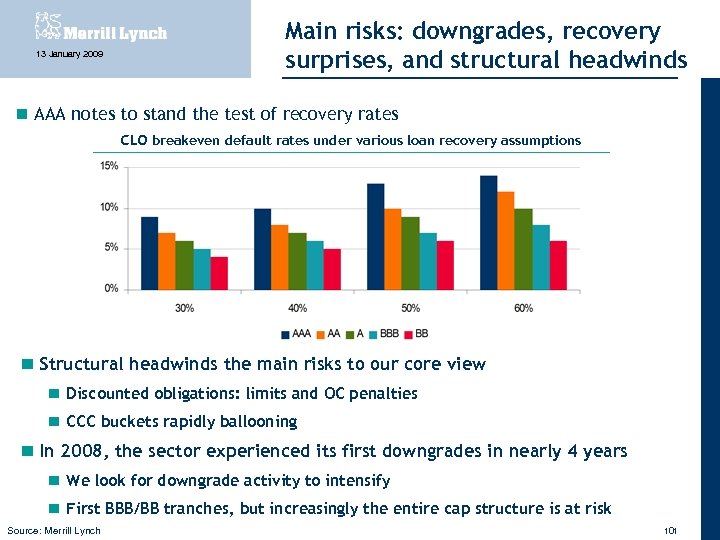 13 January 2009 Main risks: downgrades, recovery surprises, and structural headwinds AAA notes to stand the test of recovery rates CLO breakeven default rates under various loan recovery assumptions Structural headwinds the main risks to our core view Discounted obligations: limits and OC penalties CCC buckets rapidly ballooning In 2008, the sector experienced its first downgrades in nearly 4 years We look for downgrade activity to intensify First BBB/BB tranches, but increasingly the entire cap structure is at risk Source: Merrill Lynch 101
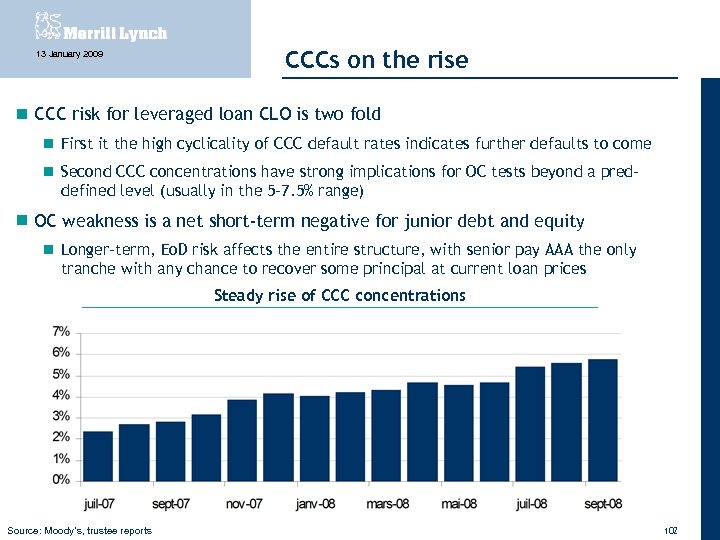 13 January 2009 CCCs on the rise CCC risk for leveraged loan CLO is two fold First it the high cyclicality of CCC default rates indicates further defaults to come Second CCC concentrations have strong implications for OC tests beyond a preddefined level (usually in the 5 -7. 5% range) OC weakness is a net short-term negative for junior debt and equity Longer-term, Eo. D risk affects the entire structure, with senior pay AAA the only tranche with any chance to recover some principal at current loan prices Steady rise of CCC concentrations Source: Moody’s, trustee reports 102
 13 January 2009 Year ahead: the road to reform This is not 2002 -2003 CDO problems – and structured credit in general – are much more widespread than the HY CBO issues of 2002 -03. We expect reforms will need to be much deeper, and the time to recovery much longer, before any sustainable comeback is possible Focus on portfolio composition Positive portfolio selection, as well as a greater focus on structures, technical factors and liquidity, should prevail. Differentiation eventually gets to take centre stage. Withdrawal of leverage – in its many forms Borrower leverage Structural leverage Investor leverage 2009 Outlook Demand: the quest for a renewed AAA investor base Supply: secondary to continue outweigh primary Credit: challenges to intensify Spreads: bottom not reached, but downside to most-senior tranches is reducing 103