


 Скачать презентацию 13 — 1 CHAPTER 13 Capital Structure and
0be5ae80f67e26170427ce5b5b3796e3.ppt
- Количество слайдов: 45
 13 - 1 CHAPTER 13 Capital Structure and the Cost of Capital Now that you have a better understanding of the types of capital used by healthcare organizations, it’s time to consider two related questions: Is there an optimal mix of debt and equity for any given business? What is the cost associated with a business’s capital? Copyright © 2012 by the Foundation of the American College of Healthcare Executives 11/10/11 Version
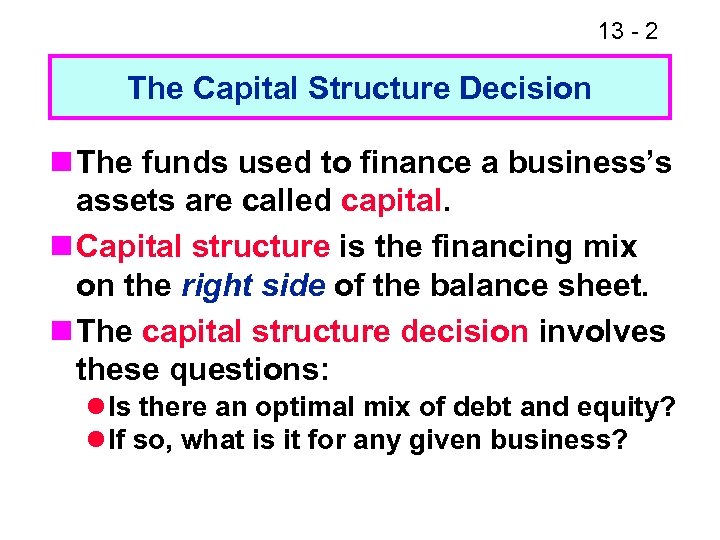 13 - 2 The Capital Structure Decision n The funds used to finance a business’s assets are called capital. n Capital structure is the financing mix on the right side of the balance sheet. n The capital structure decision involves these questions: l Is there an optimal mix of debt and equity? l If so, what is it for any given business?
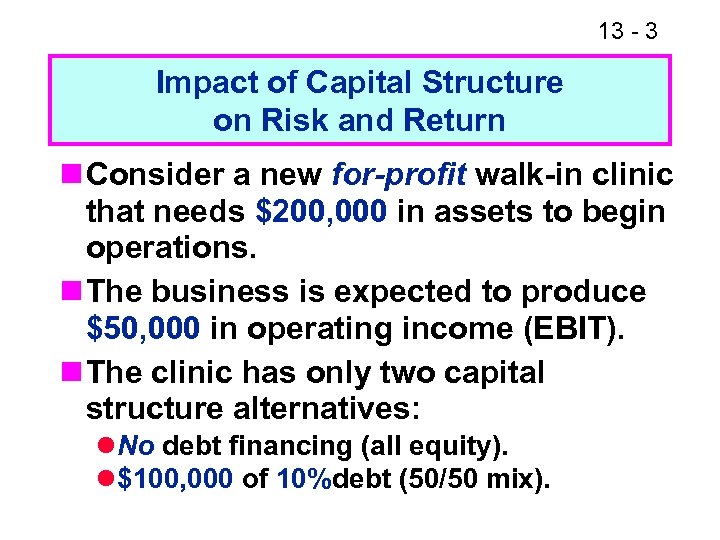 13 - 3 Impact of Capital Structure on Risk and Return n Consider a new for-profit walk-in clinic that needs $200, 000 in assets to begin operations. n The business is expected to produce $50, 000 in operating income (EBIT). n The clinic has only two capital structure alternatives: l No debt financing (all equity). l $100, 000 of 10%debt (50/50 mix).
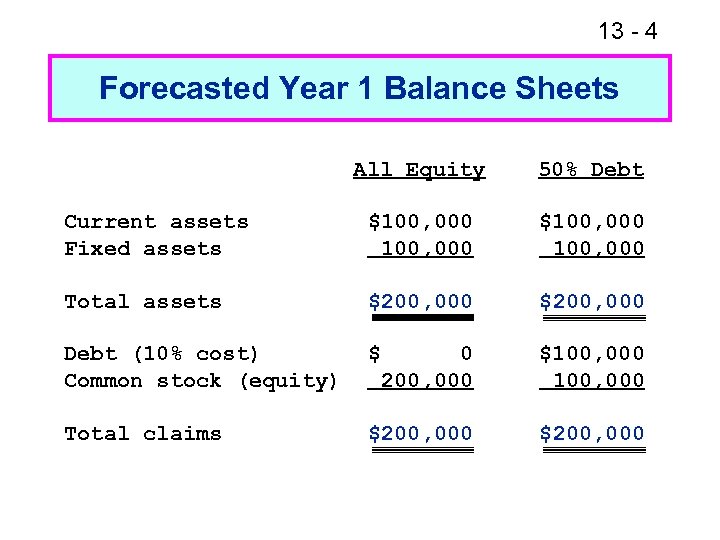 13 - 4 Forecasted Year 1 Balance Sheets All Equity 50% Debt Current assets Fixed assets $100, 000 Total assets $200, 000 Debt (10% cost) Common stock (equity) $ 0 200, 000 $100, 000 Total claims $200, 000
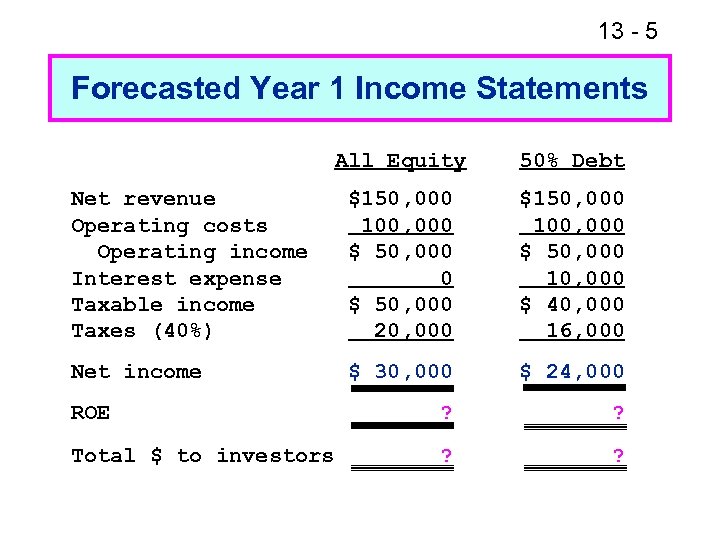 13 - 5 Forecasted Year 1 Income Statements All Equity 50% Debt Net revenue Operating costs Operating income Interest expense Taxable income Taxes (40%) $150, 000 100, 000 $ 50, 000 20, 000 $150, 000 100, 000 $ 50, 000 10, 000 $ 40, 000 16, 000 Net income $ 30, 000 $ 24, 000 ROE ? ? Total $ to investors ? ?
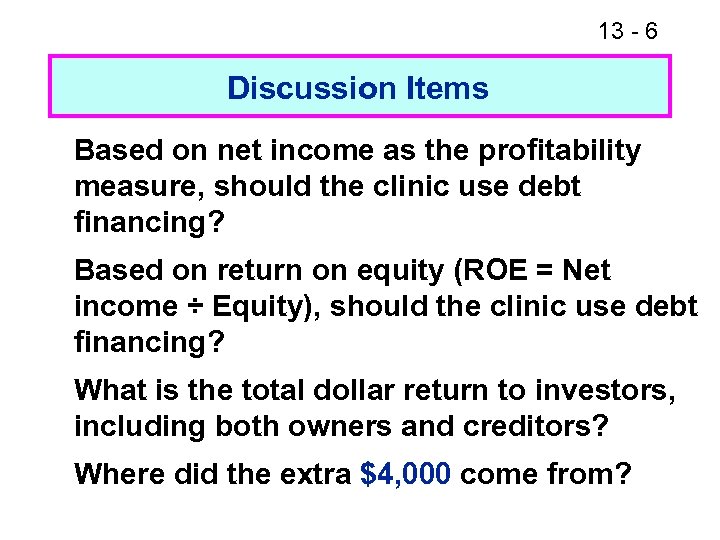 13 - 6 Discussion Items Based on net income as the profitability measure, should the clinic use debt financing? Based on return on equity (ROE = Net income ÷ Equity), should the clinic use debt financing? What is the total dollar return to investors, including both owners and creditors? Where did the extra $4, 000 come from?
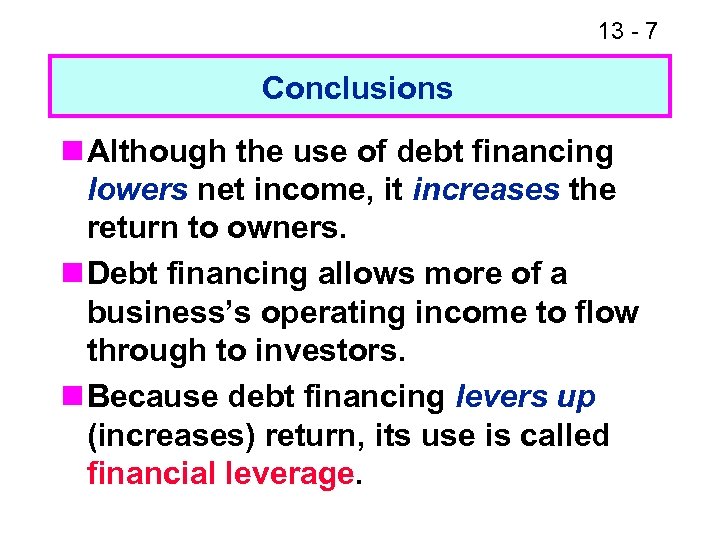 13 - 7 Conclusions n Although the use of debt financing lowers net income, it increases the return to owners. n Debt financing allows more of a business’s operating income to flow through to investors. n Because debt financing levers up (increases) return, its use is called financial leverage.
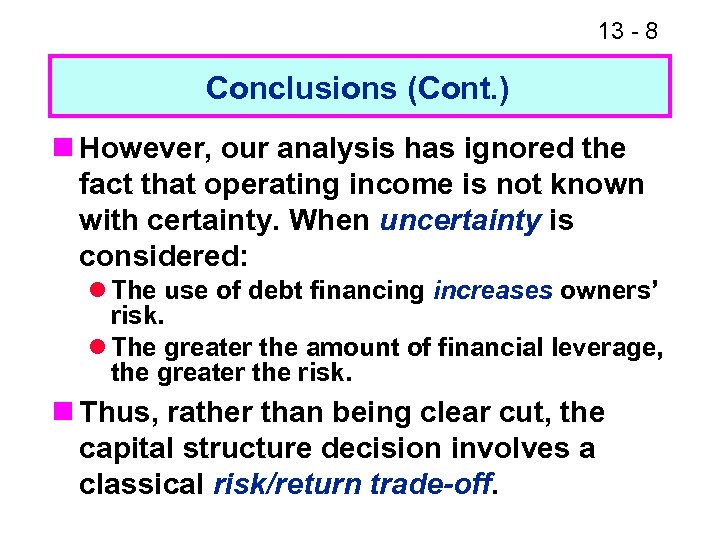 13 - 8 Conclusions (Cont. ) n However, our analysis has ignored the fact that operating income is not known with certainty. When uncertainty is considered: l The use of debt financing increases owners’ risk. l The greater the amount of financial leverage, the greater the risk. n Thus, rather than being clear cut, the capital structure decision involves a classical risk/return trade-off.
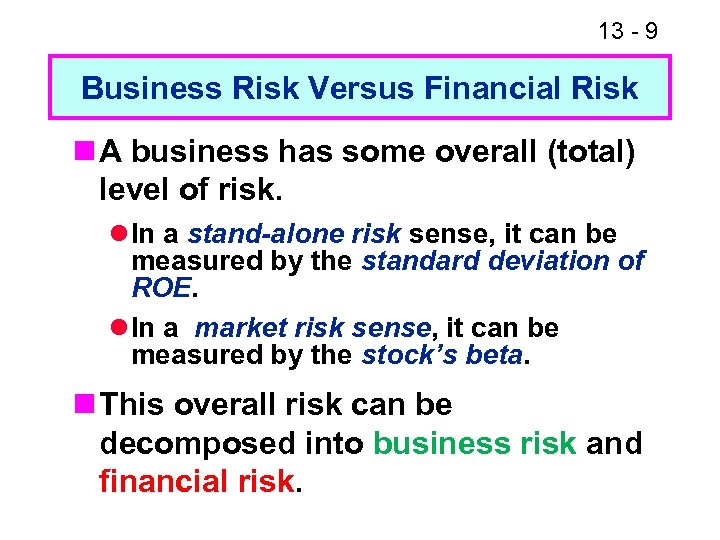 13 - 9 Business Risk Versus Financial Risk n A business has some overall (total) level of risk. l In a stand-alone risk sense, it can be measured by the standard deviation of ROE. l In a market risk sense, it can be measured by the stock’s beta. n This overall risk can be decomposed into business risk and financial risk.
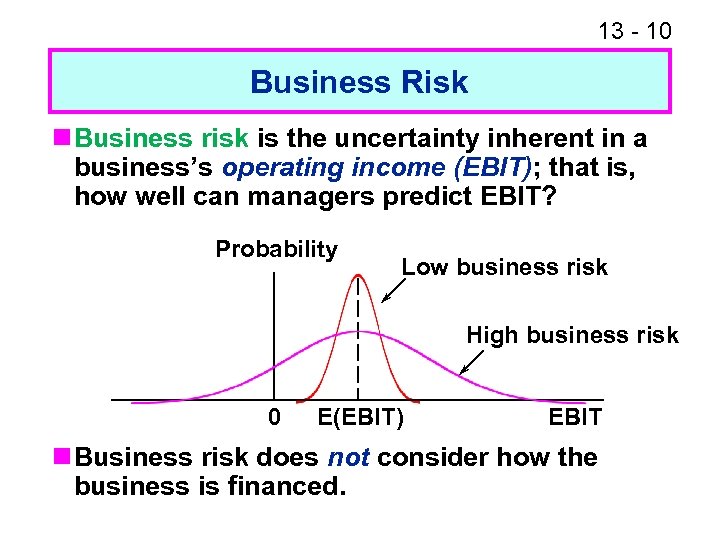 13 - 10 Business Risk n Business risk is the uncertainty inherent in a business’s operating income (EBIT); that is, how well can managers predict EBIT? Probability Low business risk High business risk 0 E(EBIT) EBIT n Business risk does not consider how the business is financed.
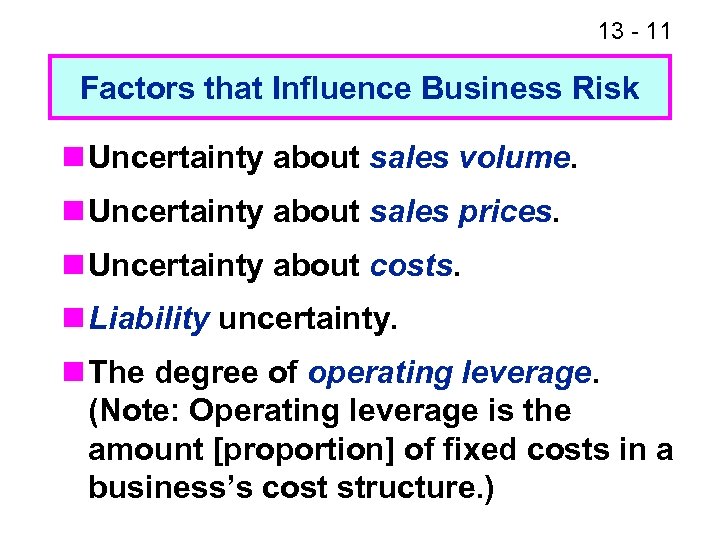 13 - 11 Factors that Influence Business Risk n Uncertainty about sales volume. n Uncertainty about sales prices. n Uncertainty about costs. n Liability uncertainty. n The degree of operating leverage. (Note: Operating leverage is the amount [proportion] of fixed costs in a business’s cost structure. )
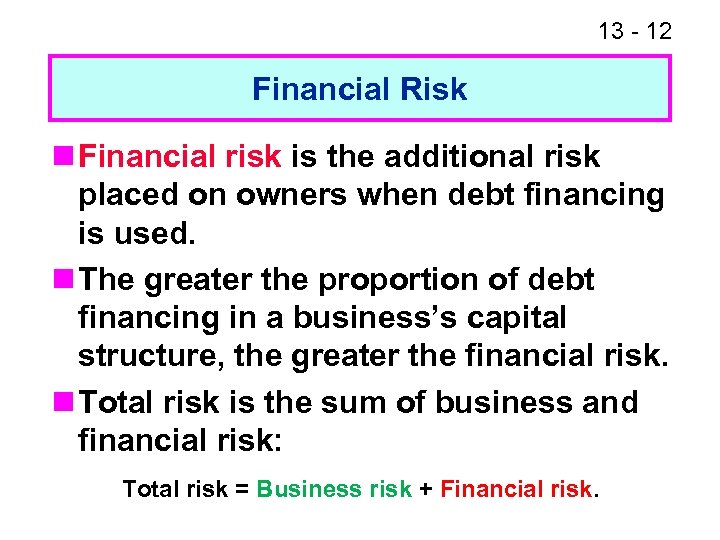 13 - 12 Financial Risk n Financial risk is the additional risk placed on owners when debt financing is used. n The greater the proportion of debt financing in a business’s capital structure, the greater the financial risk. n Total risk is the sum of business and financial risk: Total risk = Business risk + Financial risk.
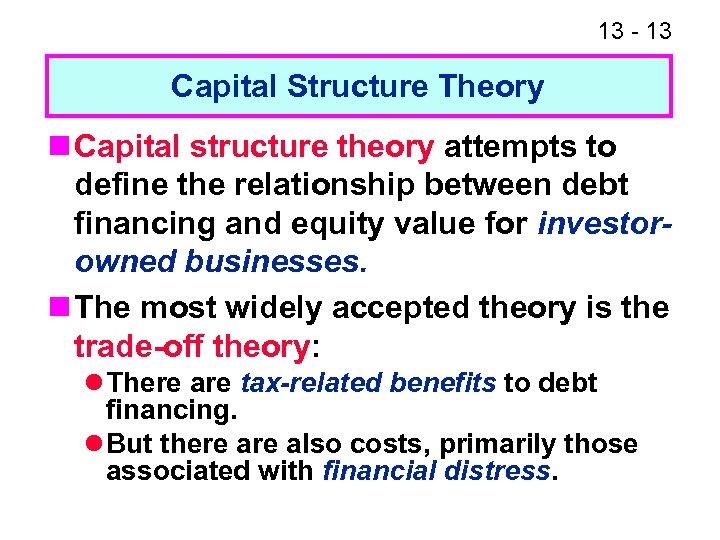 13 - 13 Capital Structure Theory n Capital structure theory attempts to define the relationship between debt financing and equity value for investorowned businesses. n The most widely accepted theory is the trade-off theory: l There are tax-related benefits to debt financing. l But there also costs, primarily those associated with financial distress.
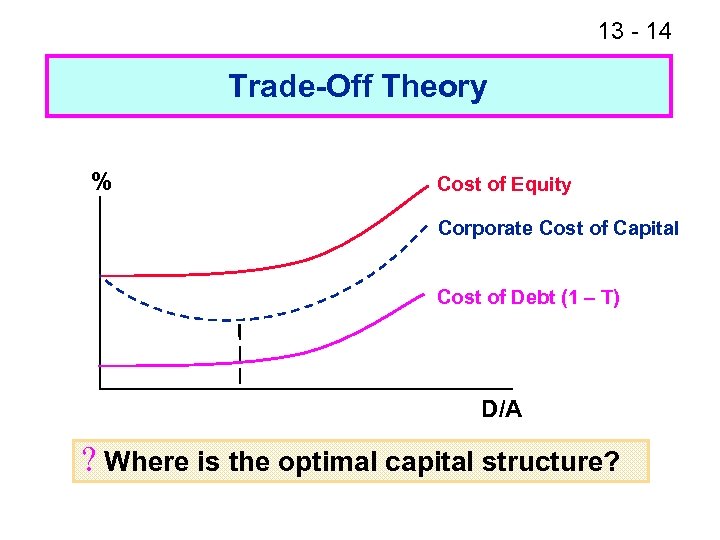 13 - 14 Trade-Off Theory % Cost of Equity Corporate Cost of Capital Cost of Debt (1 – T) D/A ? Where is the optimal capital structure?
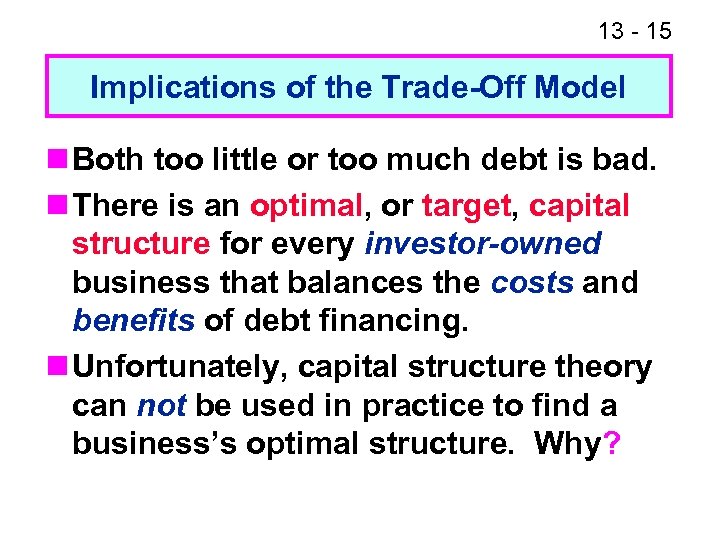 13 - 15 Implications of the Trade-Off Model n Both too little or too much debt is bad. n There is an optimal, or target, capital structure for every investor-owned business that balances the costs and benefits of debt financing. n Unfortunately, capital structure theory can not be used in practice to find a business’s optimal structure. Why?
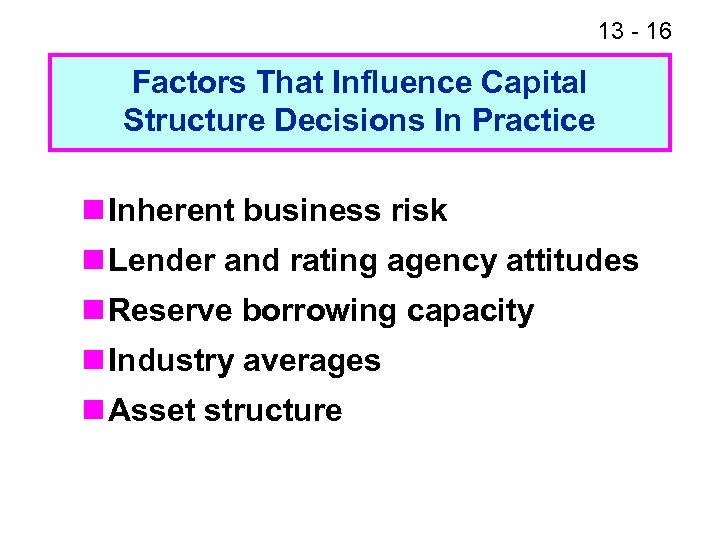 13 - 16 Factors That Influence Capital Structure Decisions In Practice n Inherent business risk n Lender and rating agency attitudes n Reserve borrowing capacity n Industry averages n Asset structure
 13 - 17 Not-For-Profit Businesses n So far, the discussion has focused on investor-owned businesses. n The same general concepts apply to not-for-profit businesses: l There is a benefit to debt financing. l There also are costs. n However, not-for-profit firms do not have the same financial flexibility as do investor-owned businesses.
 13 - 18 Cost of Capital Basics n The corporate cost of capital is a blend (weighted average) of the costs of a business’s permanent financing sources. n It is used as a benchmark rate of return in the evaluation of proposed projects. n Key considerations: l Capital components to include l Handling of tax benefits (for FP businesses) l Historical versus marginal costs
 13 - 19 Estimating the Component Cost of Debt n Discuss debt costs with banker: l Investment banker if bonds are used l Commercial banker if loan is used n Look at YTM on outstanding bond issues if they are actively traded. n Look to the debt markets for guidance. l Find the interest rate on debt recently issued by similar companies. l Use out the prime rate for guidance
 13 - 20 Component Cost of Debt (Cont. ) n For a not-for-profit organization, the cost of debt is the unadjusted interest rate. n However, investor-owned organizations must consider the tax benefits of debt: l Assume that Major Hospital Chain (MHC) has a 40% tax rate. According to its bankers, a new bond issue would require an interest rate of 10%. l Its component (or effective) cost of debt is: 10% x (1 - T) = 10% x 0. 6 = 6. 0%. l This adjustment is built into the corporate cost of capital formula.
 13 - 21 Component Cost of Debt (Cont. ) n Issuance costs are typically small and hence can be ignored in the debt cost estimate. n Also, the difference between the stated rate and EAR is typically small, so the stated rate generally is used. ? Does ownership (FP versus NFP) have a significant effect on the effective cost of debt?
 13 - 22 Component Cost of Equity n The component cost of debt is the return required by debt suppliers, and the component cost of equity is defined similarly. n For now, we will consider large investor-owned businesses. The primary sources of equity are: l Retained earnings l New equity (common stock) sales
 13 - 23 Component Cost of Equity (Cont. ) n The cost of new common stock is the return that investors require on that stock. n There is an opportunity cost associated with retained earnings: l If earnings are retained rather than returned to owners, the owners bear an opportunity loss. l These funds could be reinvested in alternative investments of similar risk.
 13 - 24 Component Cost of Equity (Cont. ) n Thus, retained earnings have roughly the same cost as does capital raised through new stock sales. n There are three methods that can be used to estimate the cost of equity in a large, publicly-traded business: l Capital Asset Pricing Model (CAPM) l Discounted cash flow (DCF) model l Debt cost plus risk premium
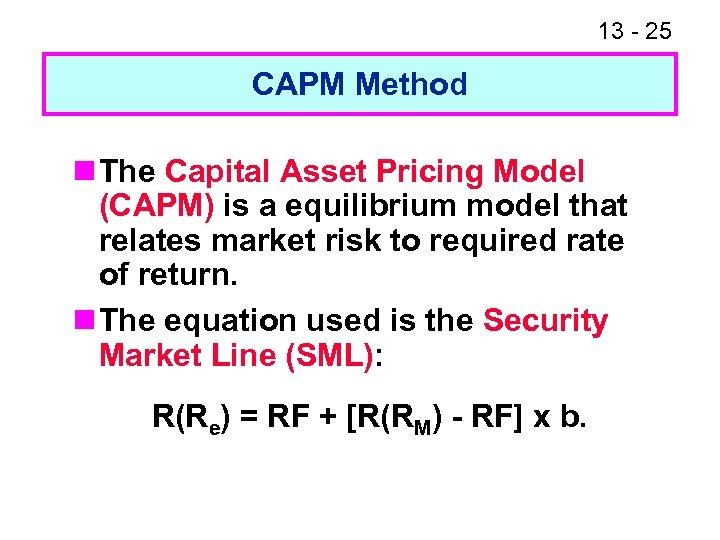 13 - 25 CAPM Method n The Capital Asset Pricing Model (CAPM) is a equilibrium model that relates market risk to required rate of return. n The equation used is the Security Market Line (SML): R(Re) = RF + [R(RM) - RF] x b.
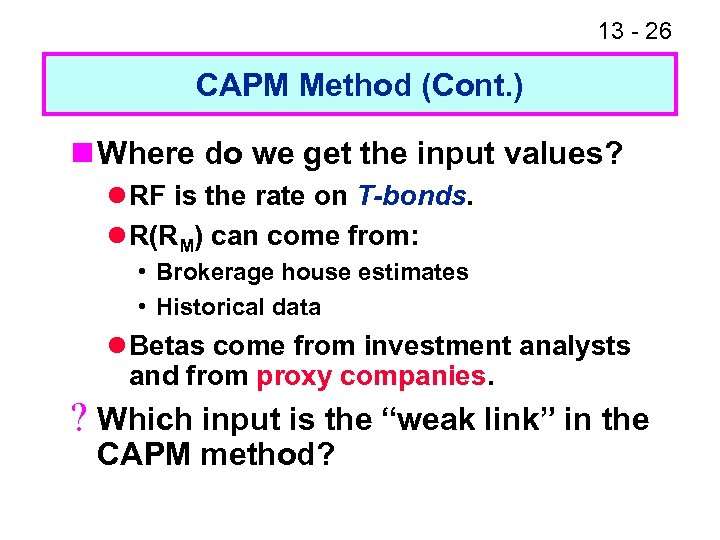 13 - 26 CAPM Method (Cont. ) n Where do we get the input values? l RF is the rate on T-bonds. l R(RM) can come from: • Brokerage house estimates • Historical data l Betas come from investment analysts and from proxy companies. ? Which input is the “weak link” in the CAPM method?
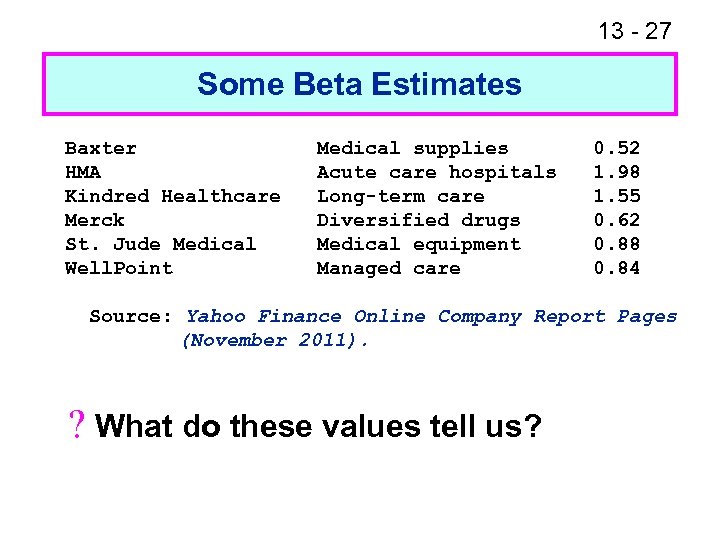 13 - 27 Some Beta Estimates Baxter HMA Kindred Healthcare Merck St. Jude Medical Well. Point Medical supplies Acute care hospitals Long-term care Diversified drugs Medical equipment Managed care 0. 52 1. 98 1. 55 0. 62 0. 88 0. 84 Source: Yahoo Finance Online Company Report Pages (November 2011). ? What do these values tell us?
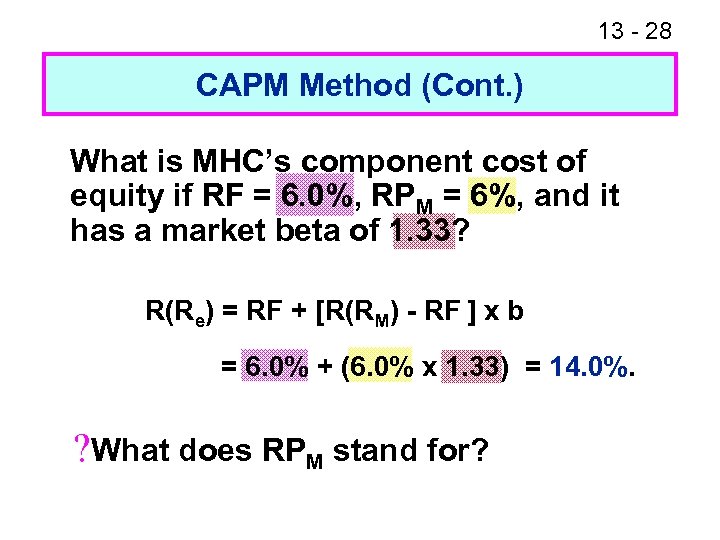 13 - 28 CAPM Method (Cont. ) What is MHC’s component cost of equity if RF = 6. 0%, RPM = 6%, and it has a market beta of 1. 33? R(Re) = RF + [R(RM) - RF ] x b = 6. 0% + (6. 0% x 1. 33) = 14. 0%. ? What does RPM stand for?
 13 - 29 DCF Method n The discounted cash flow (DCF) model applied to dividend paying firms, assumes that a business’s stock price is the present value of the expected dividend stream. n The DCF method can be used both with constant and nonconstant growth, but the calculations are more complicated when growth is nonconstant.
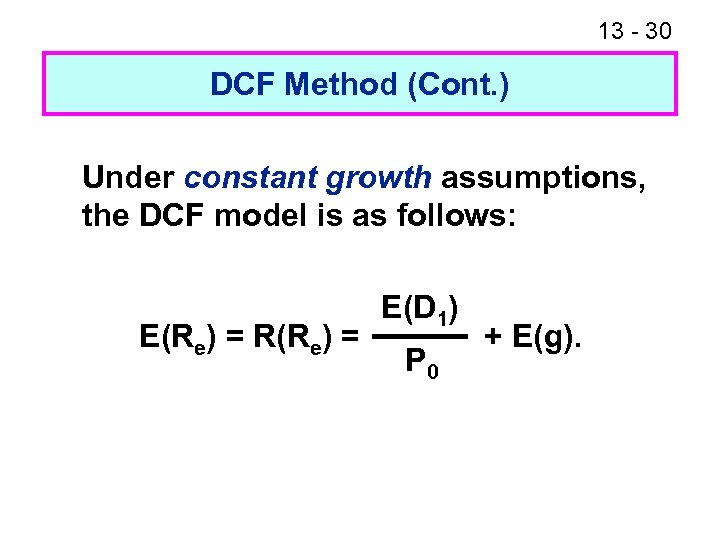 13 - 30 DCF Method (Cont. ) Under constant growth assumptions, the DCF model is as follows: E(Re) = R(Re) = E(D 1) P 0 + E(g).
 13 - 31 DCF Method (Cont. ) n Where do we get the input values? l P 0 comes from the Wall Street Journal (or many other sources). l E(D 1) can come from: • Analyst’s estimates • Historical D 0 multiplied by [1 +E(g)] l E(g) from stock analyst’s forecasts. ? Which input is the “weak link” in the DCF method?
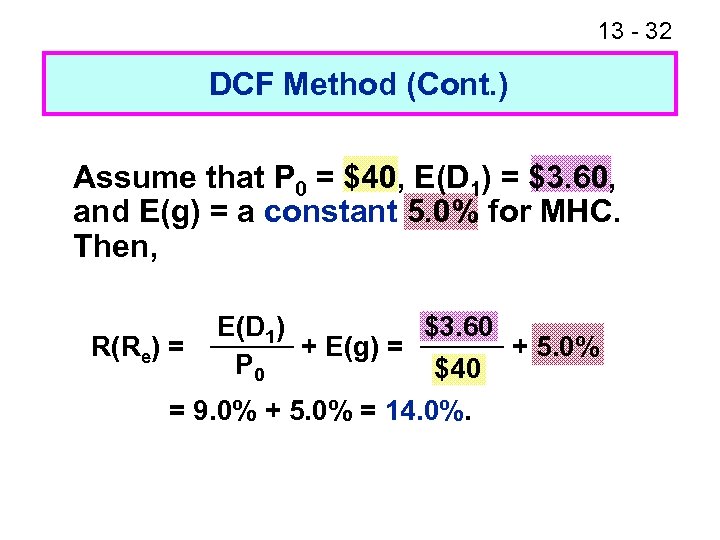 13 - 32 DCF Method (Cont. ) Assume that P 0 = $40, E(D 1) = $3. 60, and E(g) = a constant 5. 0% for MHC. Then, E(D 1) $3. 60 R(Re) = + E(g) = + 5. 0% P 0 $40 = 9. 0% + 5. 0% = 14. 0%.
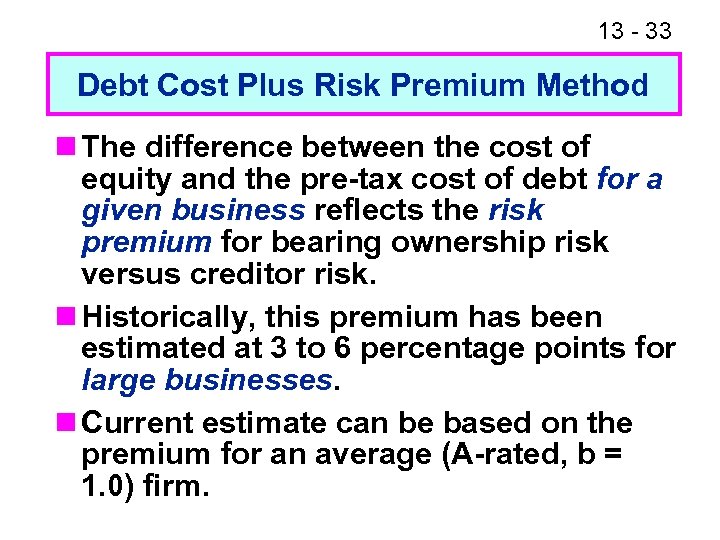 13 - 33 Debt Cost Plus Risk Premium Method n The difference between the cost of equity and the pre-tax cost of debt for a given business reflects the risk premium for bearing ownership risk versus creditor risk. n Historically, this premium has been estimated at 3 to 6 percentage points for large businesses. n Current estimate can be based on the premium for an average (A-rated, b = 1. 0) firm.
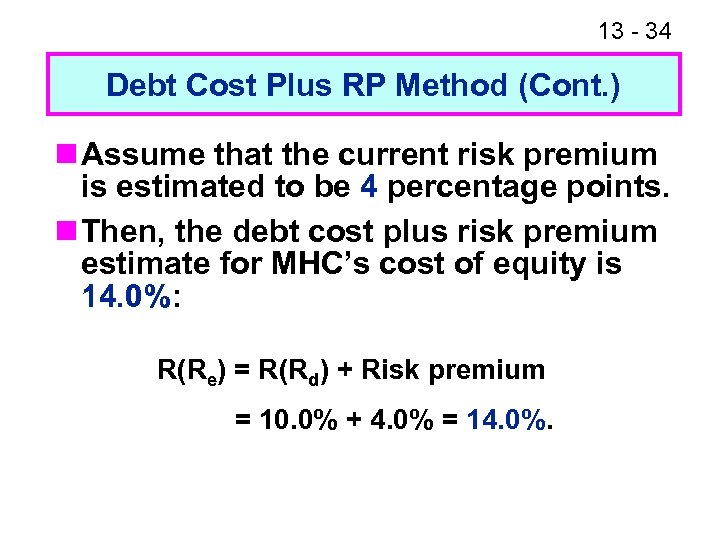 13 - 34 Debt Cost Plus RP Method (Cont. ) n Assume that the current risk premium is estimated to be 4 percentage points. n Then, the debt cost plus risk premium estimate for MHC’s cost of equity is 14. 0%: R(Re) = R(Rd) + Risk premium = 10. 0% + 4. 0% = 14. 0%.
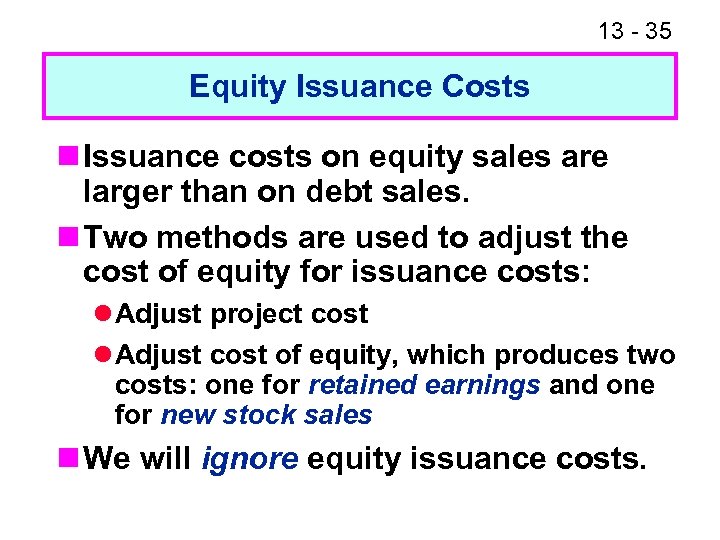 13 - 35 Equity Issuance Costs n Issuance costs on equity sales are larger than on debt sales. n Two methods are used to adjust the cost of equity for issuance costs: l Adjust project cost l Adjust cost of equity, which produces two costs: one for retained earnings and one for new stock sales n We will ignore equity issuance costs.
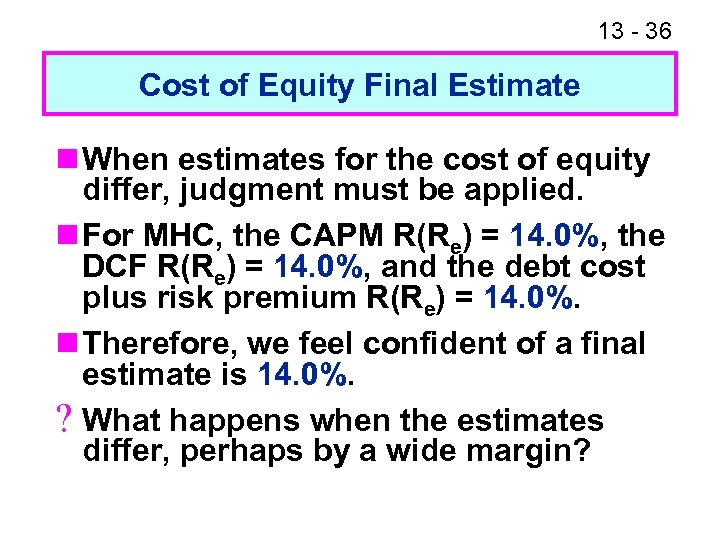 13 - 36 Cost of Equity Final Estimate n When estimates for the cost of equity differ, judgment must be applied. n For MHC, the CAPM R(Re) = 14. 0%, the DCF R(Re) = 14. 0%, and the debt cost plus risk premium R(Re) = 14. 0%. n Therefore, we feel confident of a final estimate is 14. 0%. ? What happens when the estimates differ, perhaps by a wide margin?
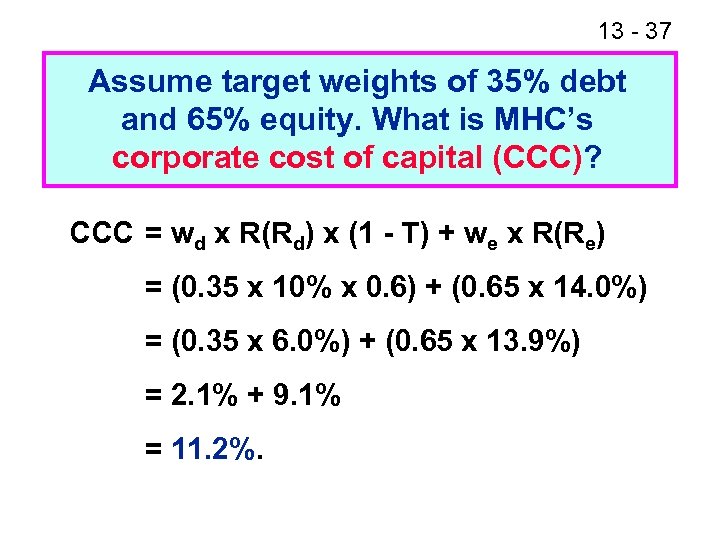 13 - 37 Assume target weights of 35% debt and 65% equity. What is MHC’s corporate cost of capital (CCC)? CCC = wd x R(Rd) x (1 - T) + we x R(Re) = (0. 35 x 10% x 0. 6) + (0. 65 x 14. 0%) = (0. 35 x 6. 0%) + (0. 65 x 13. 9%) = 2. 1% + 9. 1% = 11. 2%.
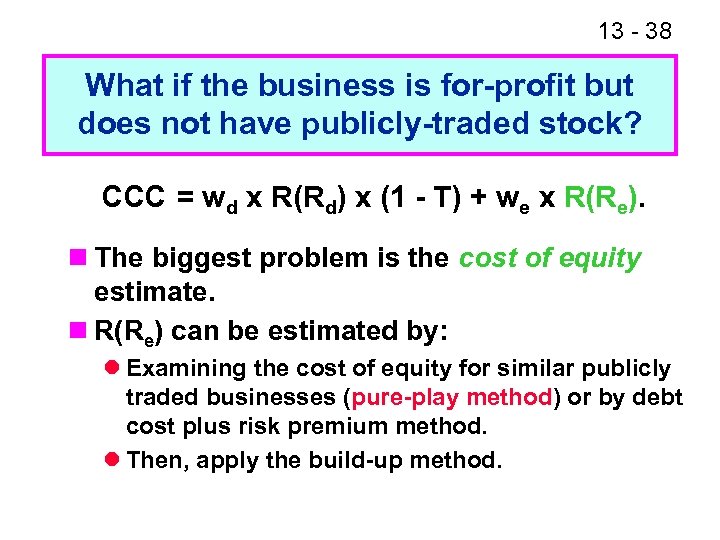 13 - 38 What if the business is for-profit but does not have publicly-traded stock? CCC = wd x R(Rd) x (1 - T) + we x R(Re). n The biggest problem is the cost of equity estimate. n R(Re) can be estimated by: l Examining the cost of equity for similar publicly traded businesses (pure-play method) or by debt cost plus risk premium method. l Then, apply the build-up method.
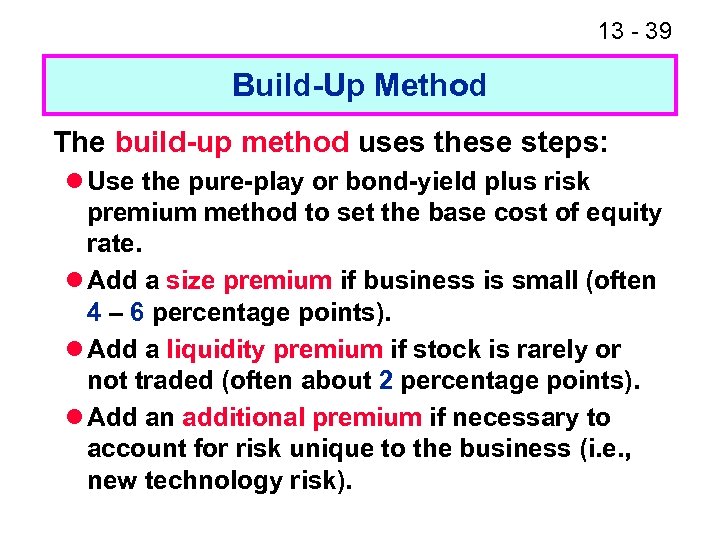 13 - 39 Build-Up Method The build-up method uses these steps: l Use the pure-play or bond-yield plus risk premium method to set the base cost of equity rate. l Add a size premium if business is small (often 4 – 6 percentage points). l Add a liquidity premium if stock is rarely or not traded (often about 2 percentage points). l Add an additional premium if necessary to account for risk unique to the business (i. e. , new technology risk).
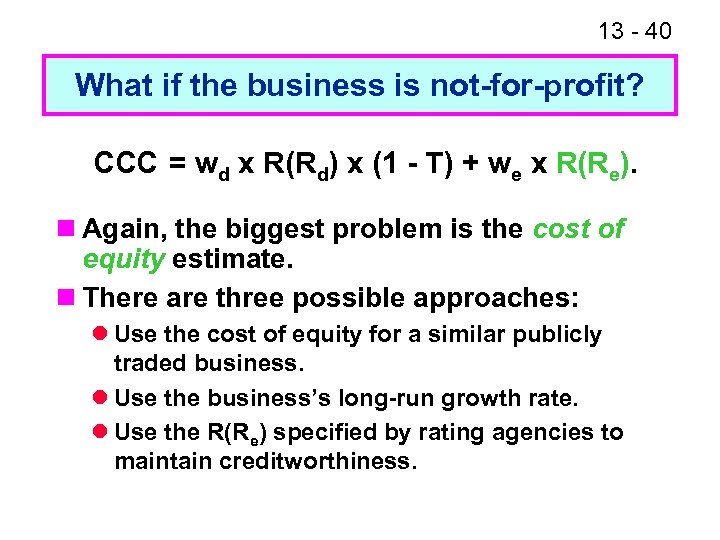 13 - 40 What if the business is not-for-profit? CCC = wd x R(Rd) x (1 - T) + we x R(Re). n Again, the biggest problem is the cost of equity estimate. n There are three possible approaches: l Use the cost of equity for a similar publicly traded business. l Use the business’s long-run growth rate. l Use the R(Re) specified by rating agencies to maintain creditworthiness.
 13 - 41 What factors influence a business’s corporate cost of capital? n Market conditions l Level of interest rates l Overall level of investor risk aversion n The firm’s risk: l Business risk, as reflected by the inherent risk in the business line and the firm’s use of operating leverage. l Financial risk, as reflected by the amount of financial leverage (debt financing) used.
 13 - 42 The corporate cost of capital will be used as the “hurdle rate” for evaluating capital projects. Would the same rate be applied to all projects? n No. The corporate cost of capital reflects the risk of the a business’s average project. It can be used only for projects with average risk. n The corporate cost of capital must be adjusted when the project being evaluated has non-average risk.
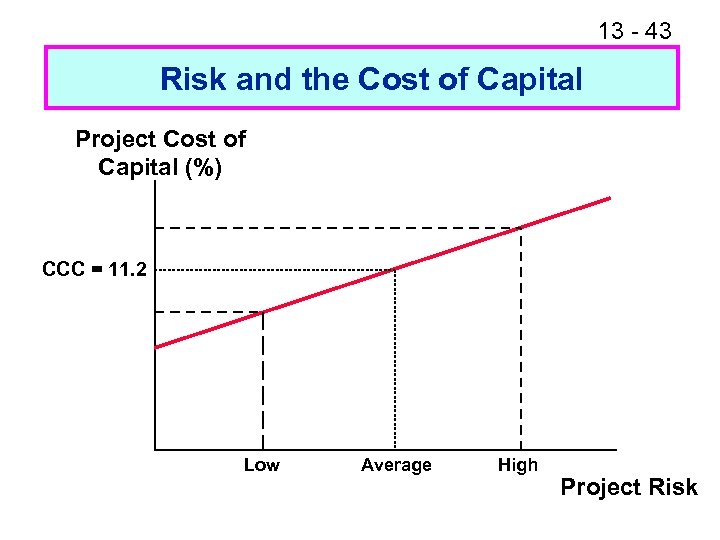 13 - 43 Risk and the Cost of Capital Project Cost of Capital (%) CCC = 11. 2 Low Average High Project Risk
 13 - 44 Divisional Costs of Capital (DCC) n Often, large organizations have subsidiaries that operate in different business lines. n In this situation, it is best to estimate divisional costs of capital that reflect the unique risk (and possibly unique capital structure) of each division. n Then, differential project risk is measured on a divisional basis.
 13 - 45 Conclusion n This concludes our discussion of Chapter 13 (Capital Structure and the Cost of Capital). n Although not all concepts were discussed in class, you are responsible for all of the material in the text. ? Do you have any questions?