


 Скачать презентацию 12 th Symposium on Development and Social Transformation
aed8fe7aa5bf122dfe91d19e15626793.ppt
- Количество слайдов: 63
 12 th Symposium on Development and Social Transformation Panel 6: Policy Initiatives in China Thursday November 17 (9: 00 -10: 00)
 12 th Symposium on Development and Social Transformation Panel 6: Policy Initiatives in China Towards Fulfillment of Universal Service Obligation in Telecommunications: Case Study of China Anindita Sen Gupta
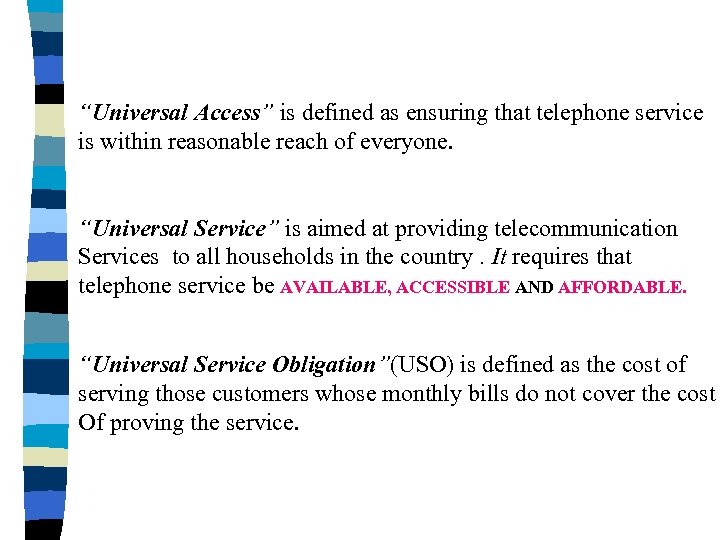 “Universal Access” is defined as ensuring that telephone service is within reasonable reach of everyone. “Universal Service” is aimed at providing telecommunication Services to all households in the country. It requires that telephone service be AVAILABLE, ACCESSIBLE AND AFFORDABLE. “Universal Service Obligation”(USO) is defined as the cost of serving those customers whose monthly bills do not cover the cost Of proving the service.
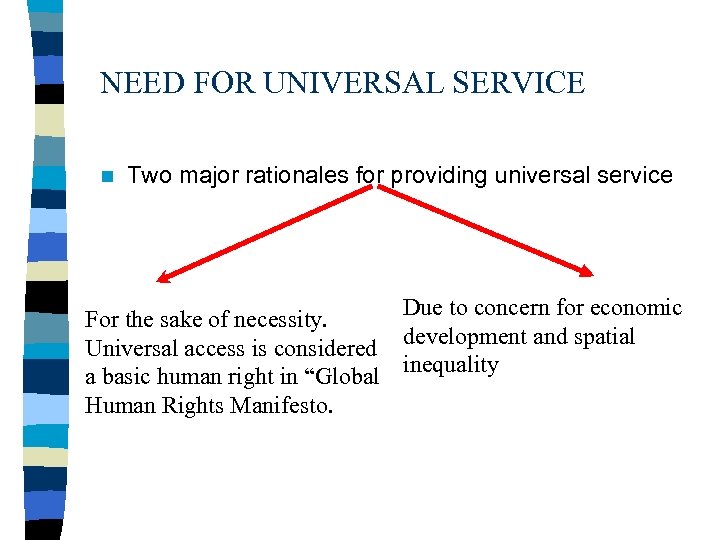 NEED FOR UNIVERSAL SERVICE n Two major rationales for providing universal service Due to concern for economic For the sake of necessity. Universal access is considered development and spatial a basic human right in “Global inequality Human Rights Manifesto.
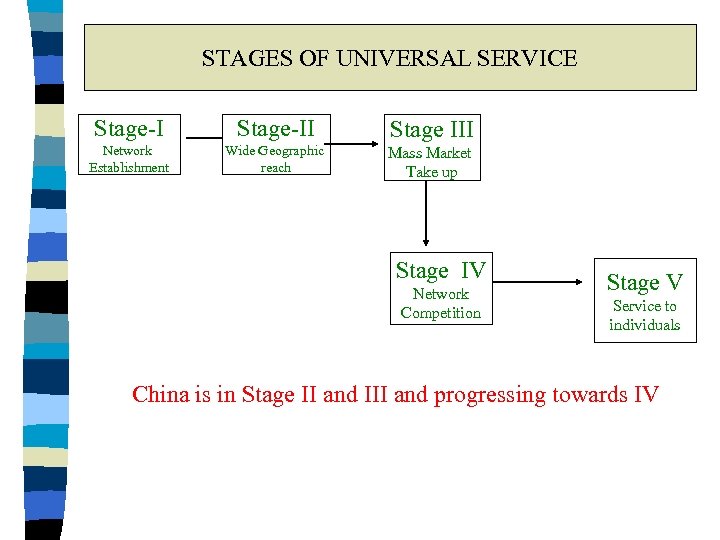 STAGES OF UNIVERSAL SERVICE Stage-II Stage III Network Establishment Wide Geographic reach Mass Market Take up Stage IV Network Competition Stage V Service to individuals China is in Stage II and III and progressing towards IV
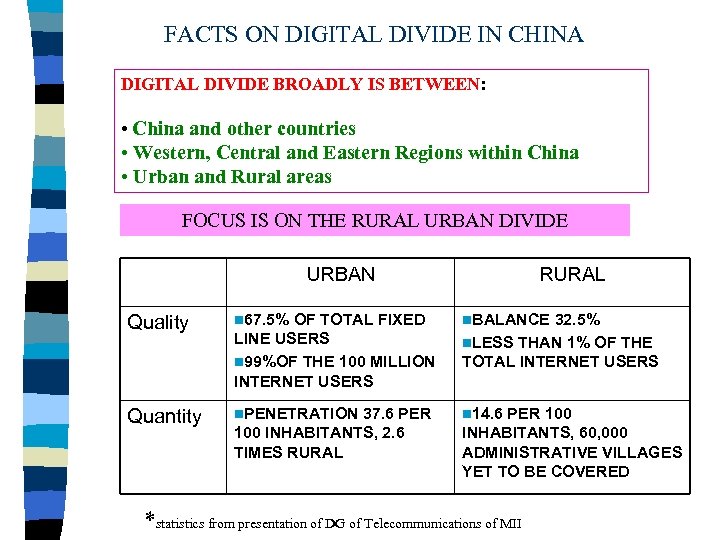 FACTS ON DIGITAL DIVIDE IN CHINA DIGITAL DIVIDE BROADLY IS BETWEEN: • China and other countries • Western, Central and Eastern Regions within China • Urban and Rural areas FOCUS IS ON THE RURAL URBAN DIVIDE URBAN RURAL Quality n 67. 5% OF TOTAL FIXED LINE USERS n 99%OF THE 100 MILLION INTERNET USERS n. BALANCE Quantity n. PENETRATION n 14. 6 37. 6 PER 100 INHABITANTS, 2. 6 TIMES RURAL 32. 5% n. LESS THAN 1% OF THE TOTAL INTERNET USERS PER 100 INHABITANTS, 60, 000 ADMINISTRATIVE VILLAGES YET TO BE COVERED *statistics from presentation of DG of Telecommunications of MII
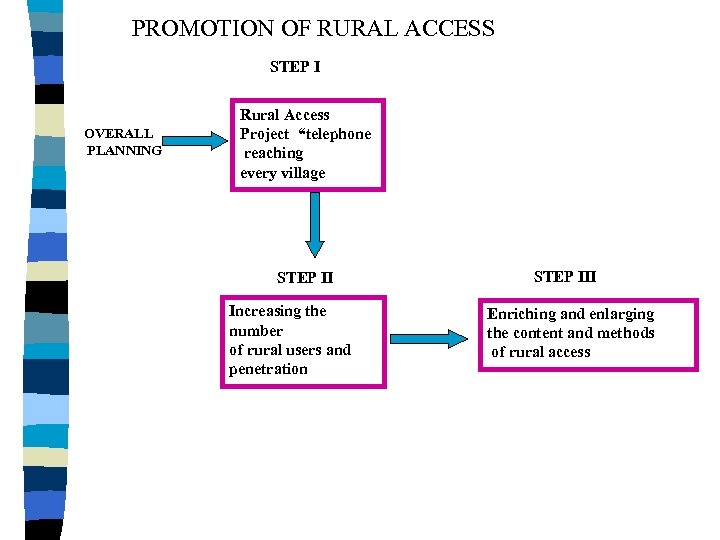 PROMOTION OF RURAL ACCESS STEP I OVERALL PLANNING Rural Access Project “telephone reaching every village STEP II Increasing the number of rural users and penetration STEP III Enriching and enlarging the content and methods of rural access
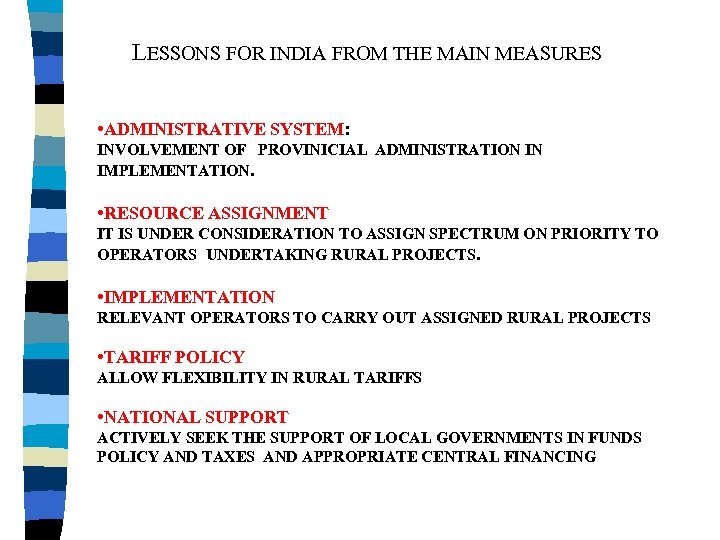 LESSONS FOR INDIA FROM THE MAIN MEASURES • ADMINISTRATIVE SYSTEM: INVOLVEMENT OF PROVINICIAL ADMINISTRATION IN IMPLEMENTATION. • RESOURCE ASSIGNMENT IT IS UNDER CONSIDERATION TO ASSIGN SPECTRUM ON PRIORITY TO OPERATORS UNDERTAKING RURAL PROJECTS. • IMPLEMENTATION RELEVANT OPERATORS TO CARRY OUT ASSIGNED RURAL PROJECTS • TARIFF POLICY ALLOW FLEXIBILITY IN RURAL TARIFFS • NATIONAL SUPPORT ACTIVELY SEEK THE SUPPORT OF LOCAL GOVERNMENTS IN FUNDS POLICY AND TAXES AND APPROPRIATE CENTRAL FINANCING
 12 th Symposium on Development and Social Transformation Panel 6: Policy Initiatives in China Population Policy in China Sunil Kumar Gulati
 POPULATION POLICY. …China, lessons for India 1999 th Meeting on Effective, People friendly Population Policy Formulation What meeting? Here we are! Presented by Kumar Sunil Gulati IAS
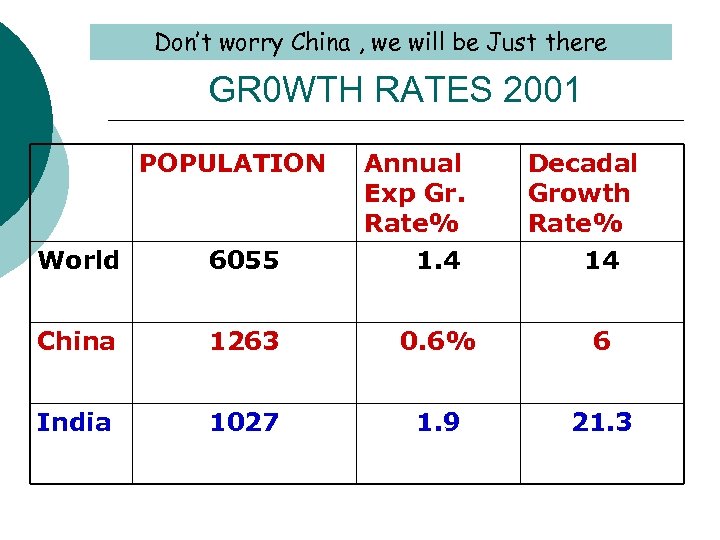 Don’t worry China , we will be Just there GR 0 WTH RATES 2001 POPULATION World 6055 Annual Exp Gr. Rate% 1. 4 Decadal Growth Rate% 14 China 1263 0. 6% 6 India 1027 1. 9 21. 3
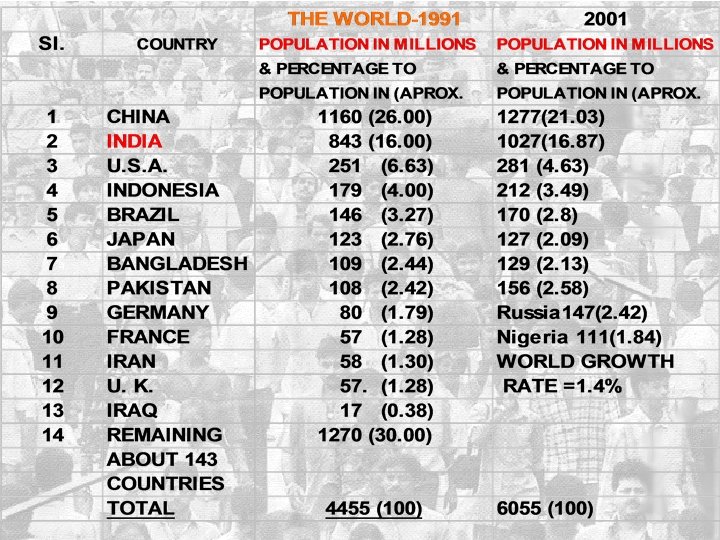
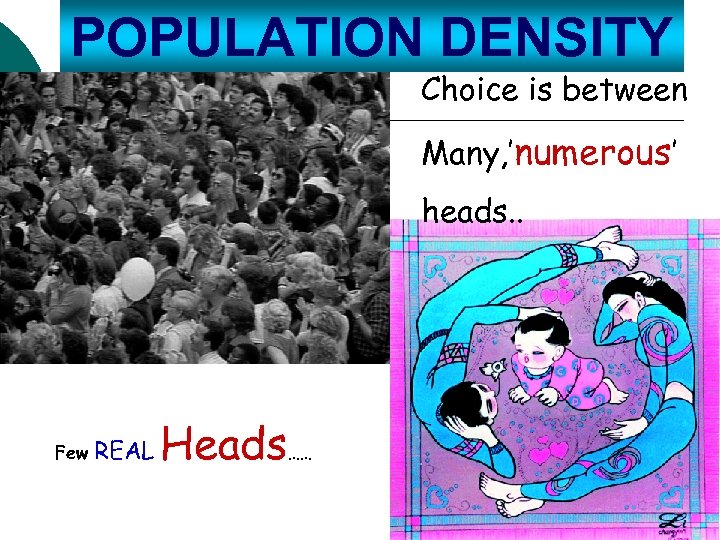 POPULATION DENSITY Choice is between Many, ’numerous’ heads. . Few REAL Heads……
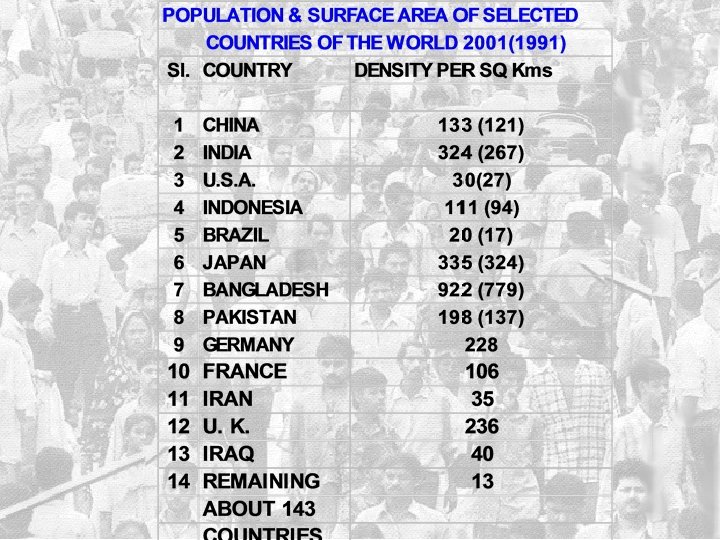
 Do You Know ? ¡ Population of USA at 27. 8 Cr is third in the world next to India. ¡ India=Three USAs + Two Canadas and still with a Bangladesh to spare. ¡ Density of Population in India is only 324 compared to 30 in USA and 3 in Canada !
 Population Policy ¡ Ancient times War, Floods, droughts ¡ Kings Ming Dynasty (1368 -98) Used li-chia (ten headmen) to get ten Families (chia) to give labour and Taxes per fang(110 HHs)Pop 60. 5 m , 5. 7 per HH ¡ Then it became ting, working Males per HH
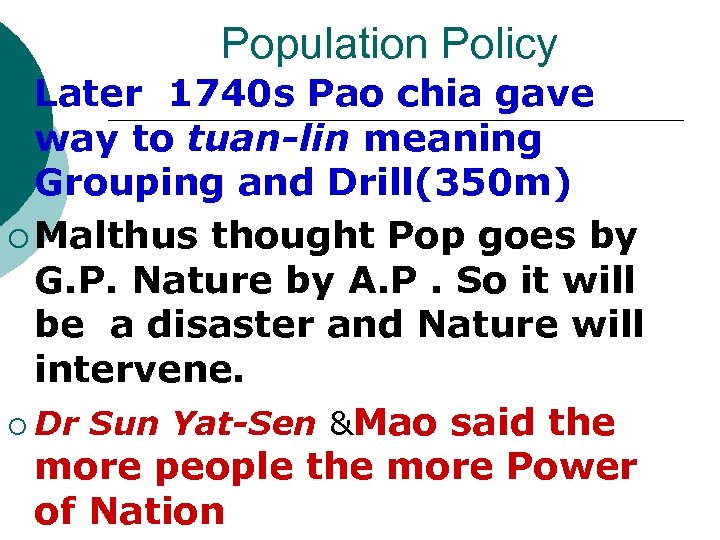 Population Policy ¡ Later 1740 s Pao chia gave way to tuan-lin meaning Grouping and Drill(350 m) ¡ Malthus thought Pop goes by G. P. Nature by A. P. So it will be a disaster and Nature will intervene. ¡ Dr Sun Yat-Sen &Mao said the more people the more Power of Nation
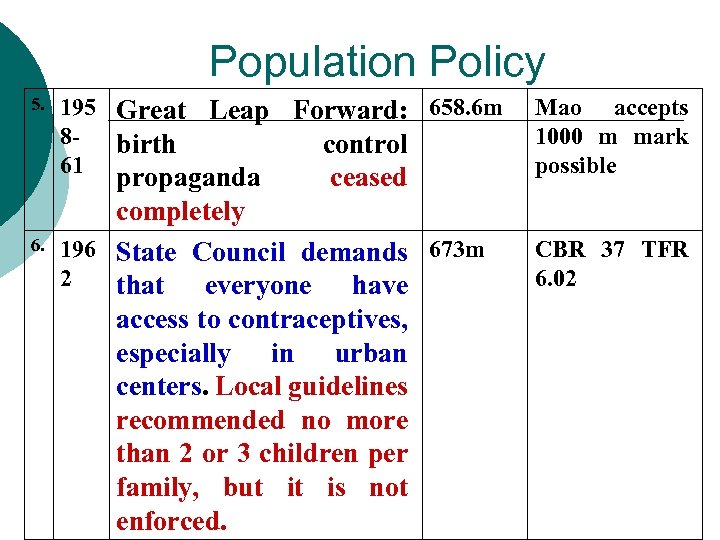 Population Policy 5. 6. 195 Great Leap Forward: 658. 6 m 8 birth control 61 propaganda ceased completely 196 State Council demands 673 m 2 that everyone have access to contraceptives, especially in urban centers. Local guidelines recommended no more than 2 or 3 children per family, but it is not enforced. Mao accepts 1000 m mark possible CBR 37 TFR 6. 02
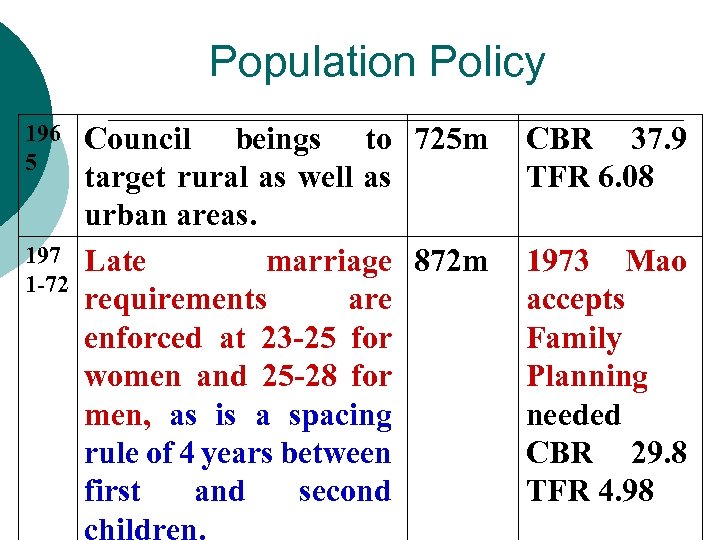 Population Policy 196 5 197 1 -72 Council beings to 725 m target rural as well as urban areas. Late marriage 872 m requirements are enforced at 23 -25 for women and 25 -28 for men, as is a spacing rule of 4 years between first and second children. CBR 37. 9 TFR 6. 08 1973 Mao accepts Family Planning needed CBR 29. 8 TFR 4. 98
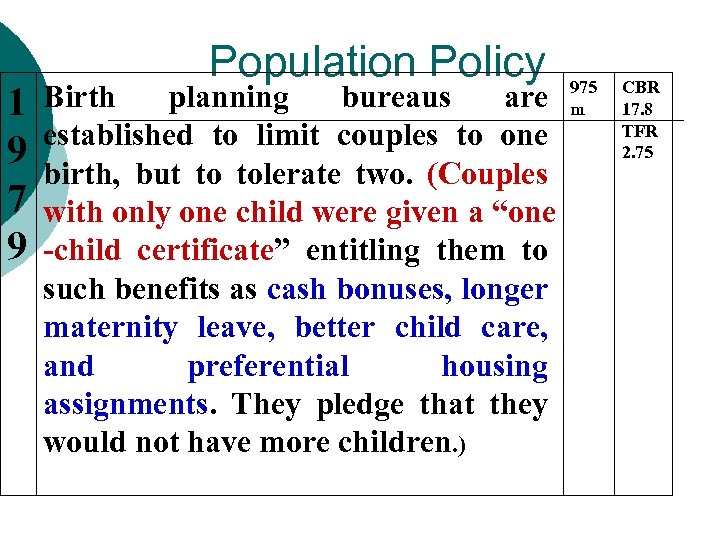 1 9 7 9 Population Policy Birth planning bureaus are established to limit couples to one birth, but to tolerate two. (Couples with only one child were given a “one -child certificate” entitling them to such benefits as cash bonuses, longer maternity leave, better child care, and preferential housing assignments. They pledge that they would not have more children. ) 975 m CBR 17. 8 TFR 2. 75
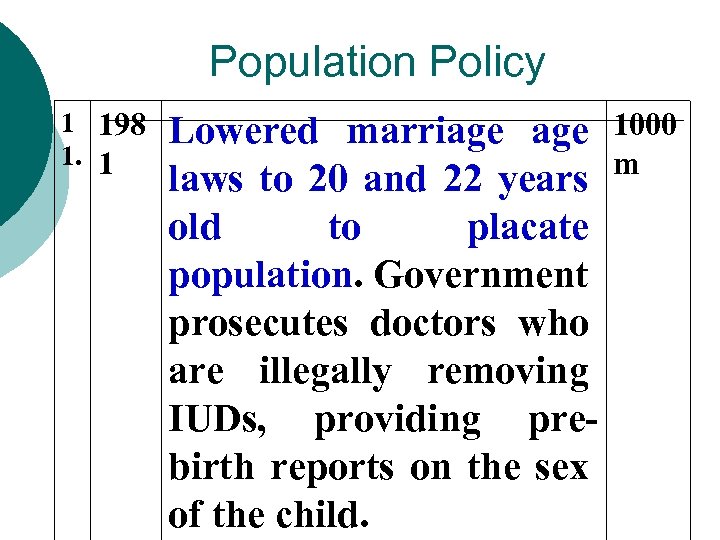 Population Policy 1 198 1. 1 Lowered marriage laws to 20 and 22 years old to placate population. Government prosecutes doctors who are illegally removing IUDs, providing prebirth reports on the sex of the child. 1000 m
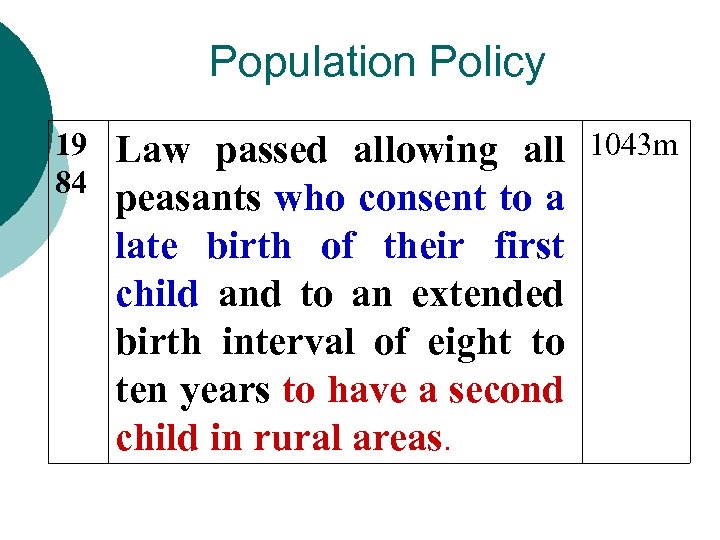 Population Policy 19 84 Law passed allowing all peasants who consent to a late birth of their first child and to an extended birth interval of eight to ten years to have a second child in rural areas. 1043 m
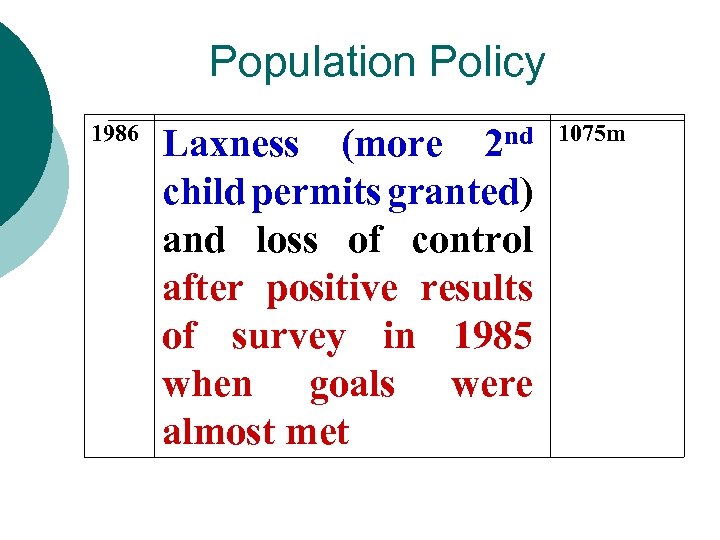 Population Policy 1986 nd 1075 m 2 Laxness (more child permits granted) and loss of control after positive results of survey in 1985 when goals were almost met
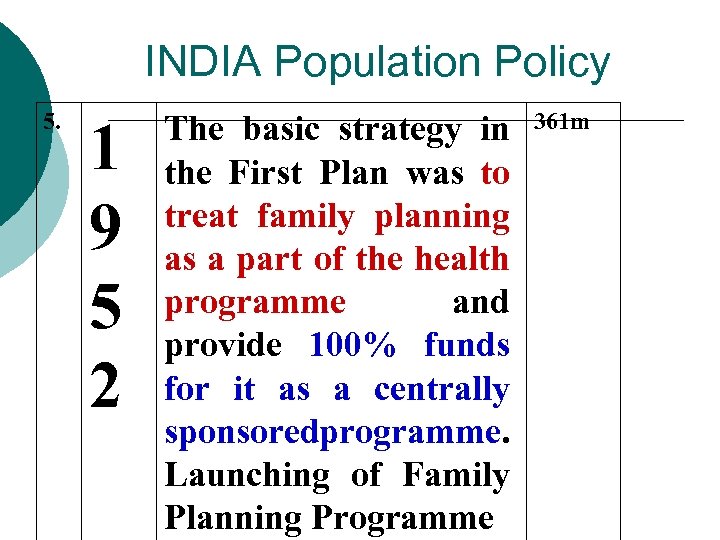 INDIA Population Policy 5. 1 9 5 2 The basic strategy in the First Plan was to treat family planning as a part of the health programme and provide 100% funds for it as a centrally sponsoredprogramme. Launching of Family Planning Programme 361 m
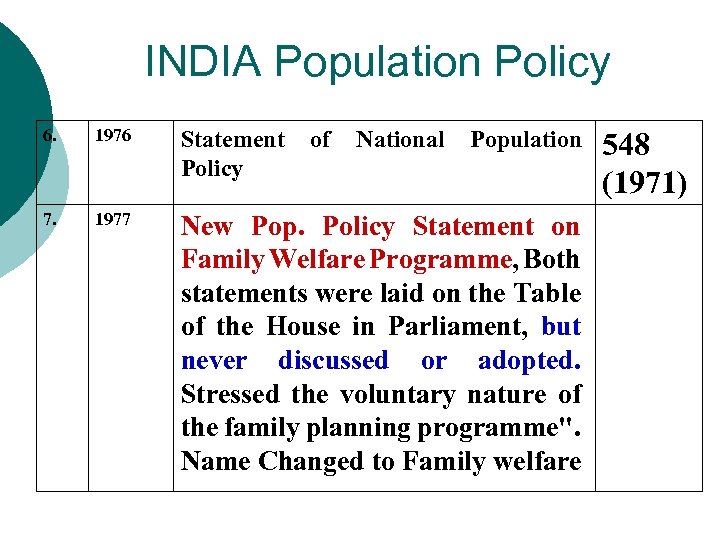 INDIA Population Policy 6. 1976 Statement Policy 7. 1977 New Pop. Policy Statement on Family Welfare Programme, Both statements were laid on the Table of the House in Parliament, but never discussed or adopted. Stressed the voluntary nature of the family planning programme". Name Changed to Family welfare of National Population 548 (1971)
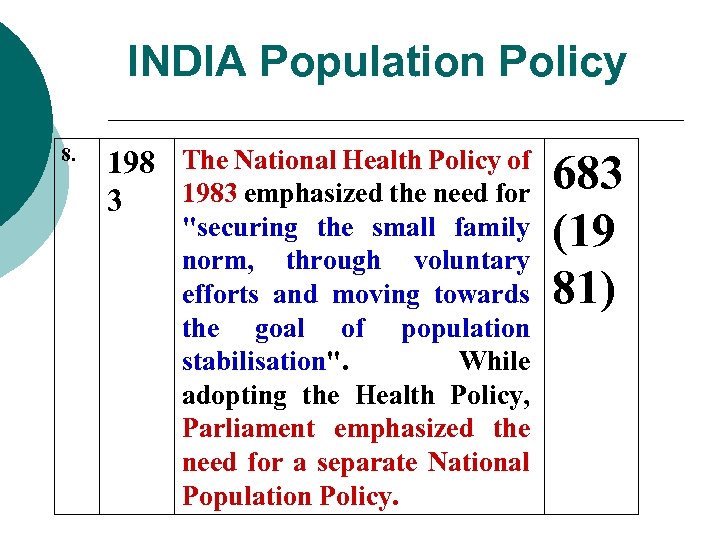 INDIA Population Policy 8. 198 The National Health Policy of 1983 emphasized the need for 3 "securing the small family norm, through voluntary efforts and moving towards the goal of population stabilisation". While adopting the Health Policy, Parliament emphasized the need for a separate National Population Policy. 683 (19 81)
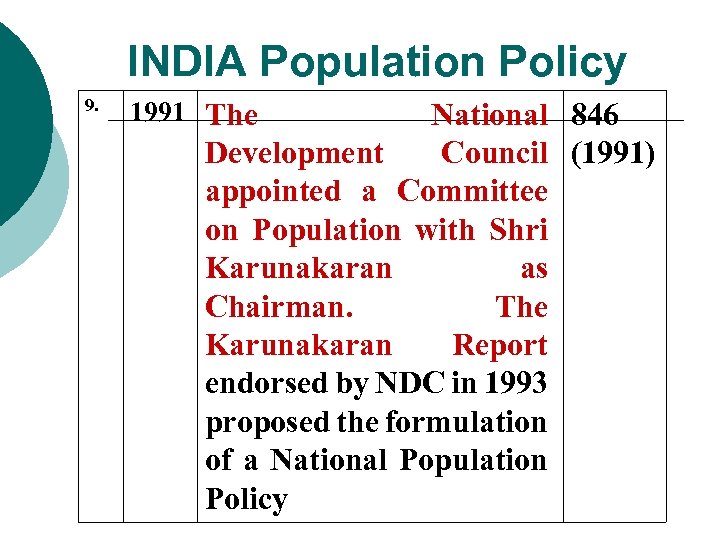 INDIA Population Policy 9. 1991 The National 846 Development Council (1991) appointed a Committee on Population with Shri Karunakaran as Chairman. The Karunakaran Report endorsed by NDC in 1993 proposed the formulation of a National Population Policy
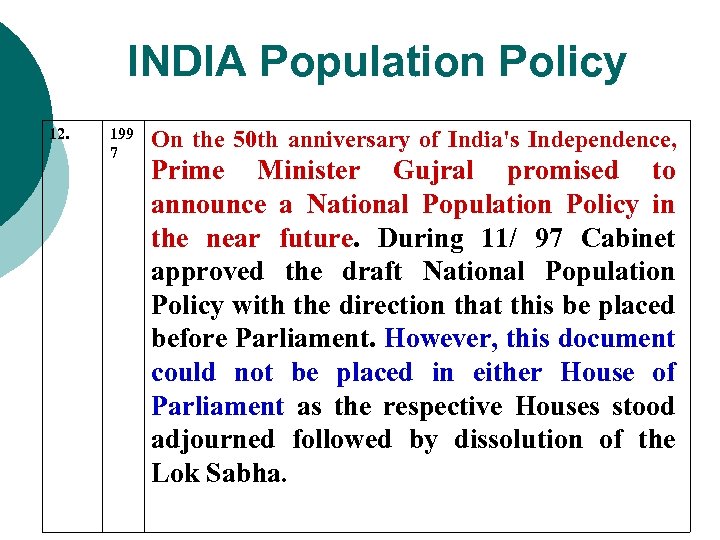 INDIA Population Policy 12. 199 7 On the 50 th anniversary of India's Independence, Prime Minister Gujral promised to announce a National Population Policy in the near future. During 11/ 97 Cabinet approved the draft National Population Policy with the direction that this be placed before Parliament. However, this document could not be placed in either House of Parliament as the respective Houses stood adjourned followed by dissolution of the Lok Sabha.
 INDIA Population Policy 14. 2000 National Population Policy Formulated
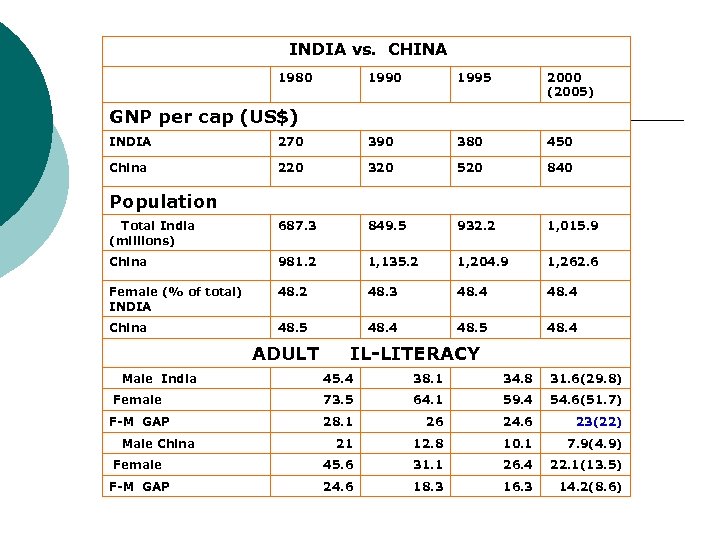 INDIA vs. CHINA 1980 1995 2000 (2005) GNP per cap (US$) INDIA 270 390 380 450 China 220 320 520 840 Total India (millions) 687. 3 849. 5 932. 2 1, 015. 9 China 981. 2 1, 135. 2 1, 204. 9 1, 262. 6 Female (% of total) INDIA 48. 2 48. 3 48. 4 China 48. 5 48. 4 Population ADULT IL-LITERACY Male India 45. 4 38. 1 34. 8 31. 6(29. 8) Female 73. 5 64. 1 59. 4 54. 6(51. 7) F-M GAP 28. 1 26 24. 6 23(22) 21 12. 8 10. 1 7. 9(4. 9) Female 45. 6 31. 1 26. 4 22. 1(13. 5) F-M GAP 24. 6 18. 3 16. 3 14. 2(8. 6) Male China
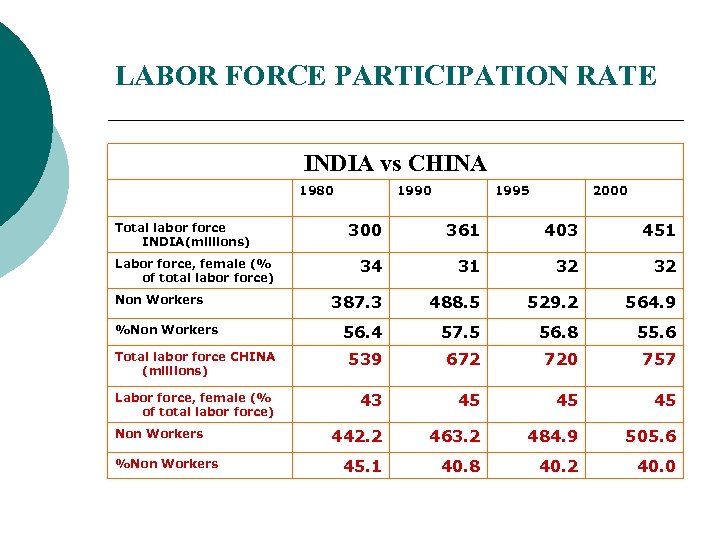 LABOR FORCE PARTICIPATION RATE INDIA vs CHINA 1980 1995 2000 361 403 451 34 31 32 32 387. 3 488. 5 529. 2 564. 9 56. 4 57. 5 56. 8 55. 6 Total labor force CHINA (millions) 539 672 720 757 Labor force, female (% of total labor force) 43 45 45 45 442. 2 463. 2 484. 9 505. 6 45. 1 40. 8 40. 2 40. 0 Total labor force INDIA(millions) Labor force, female (% of total labor force) Non Workers %Non Workers
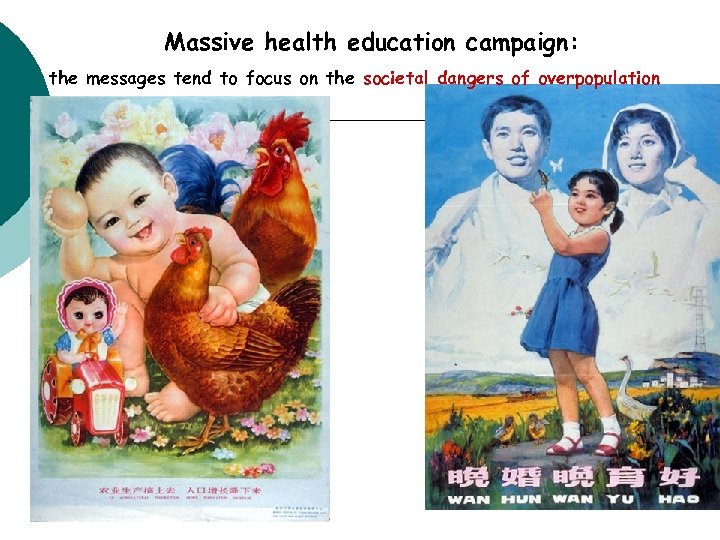 Massive health education campaign: the messages tend to focus on the societal dangers of overpopulation
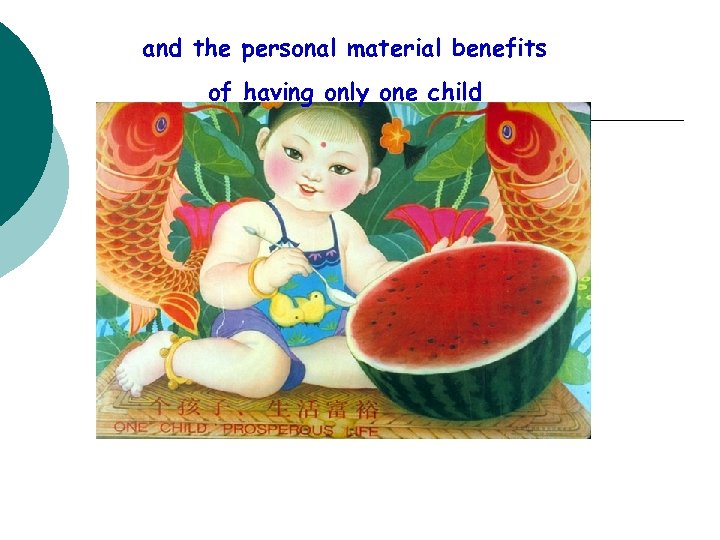 and the personal material benefits of having only one child
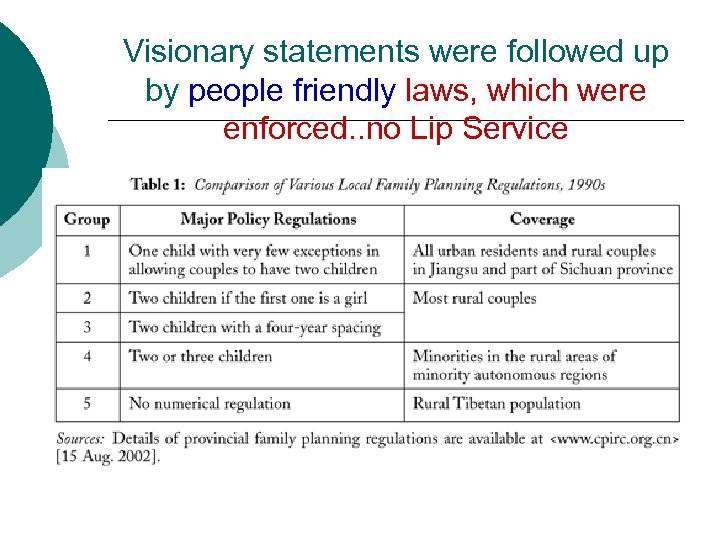 Visionary statements were followed up by people friendly laws, which were enforced. . no Lip Service
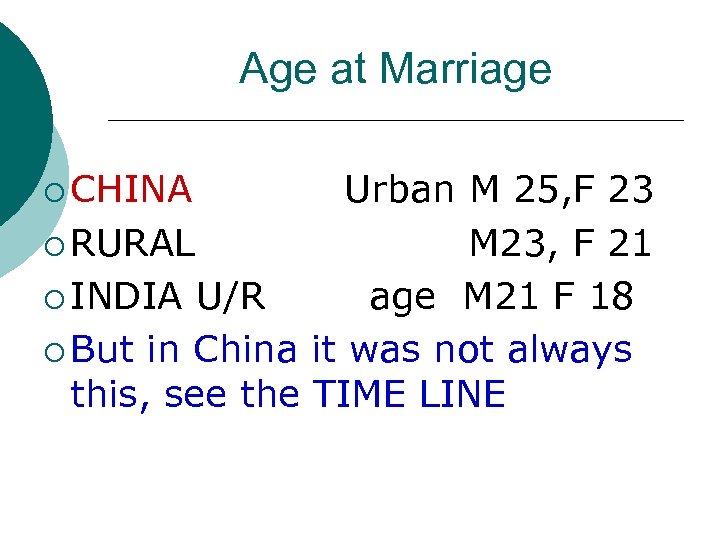 Age at Marriage ¡ CHINA Urban M 25, F 23 ¡ RURAL M 23, F 21 ¡ INDIA U/R age M 21 F 18 ¡ But in China it was not always this, see the TIME LINE
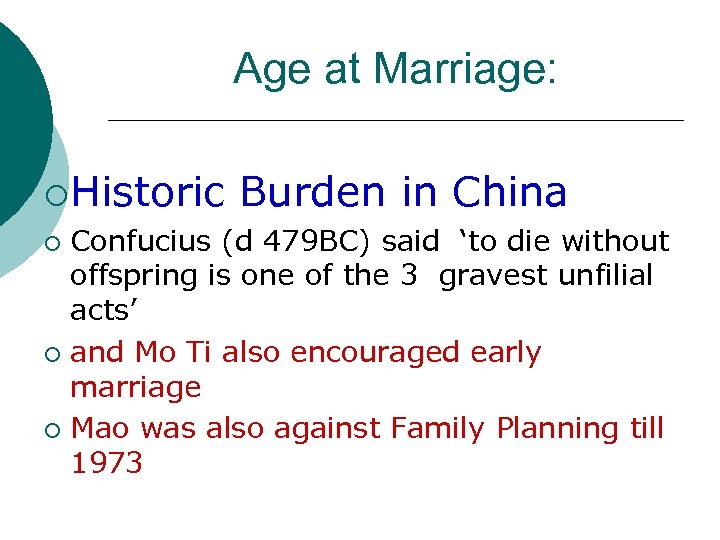 Age at Marriage: ¡ Historic Burden in China Confucius (d 479 BC) said ‘to die without offspring is one of the 3 gravest unfilial acts’ ¡ and Mo Ti also encouraged early marriage ¡ Mao was also against Family Planning till 1973 ¡
 TIME LINE Age at Marriage ¡ ¡ The marriage law of 1950 raised the age from 18 to 20 for males and 16 to 18 for females CHINA(1973) Late marriage requirements are enforced M 25 -28 yrs F 23 -25 Spacing rule of 4 years between first and second children. ¡ 1981: Lowered marriage laws to 20 and 22 years old to placate population. ¡
 Notice the FLEXIBILTY ¡ 1984: Law passed allowing all peasants who consent to a late birth of their first child and to an extended birth interval of eight to ten years to have a second child in rural areas. ¡ 1986 Laxness (more 2 nd child permits granted) and loss of control after positive results of survey in 1985 when goals were almost met
 TIME LINE Age at Marriage INDIA ¡ Historically Child Marriages ¡ 1956 : Child Marriage Prohibition Act fixed Urban/Rural age at Males 21 Females 18 ¡ Since then Please all policy the same goes on…………We don’t care…
 Goals for 2010: INDIA National Pop. Policy ¡ Promote delayed marriage for girls, not earlier than age 18 and preferably after 20 years of age ¡ Address the unmet needs for basic reproductive and child health services, supply and infrastructure
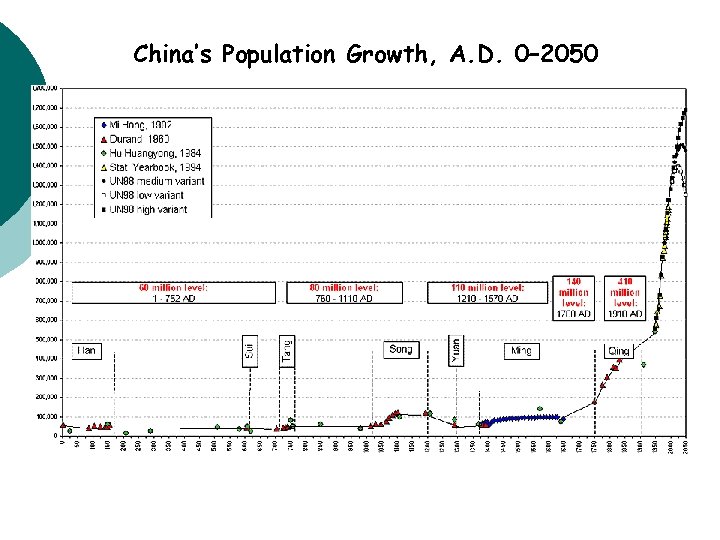 China’s Population Growth, A. D. 0– 2050
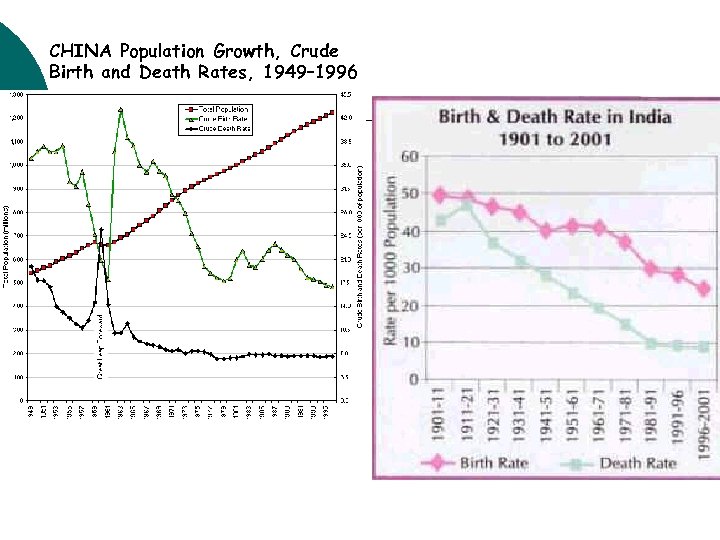 CHINA Population Growth, Crude Birth and Death Rates, 1949– 1996
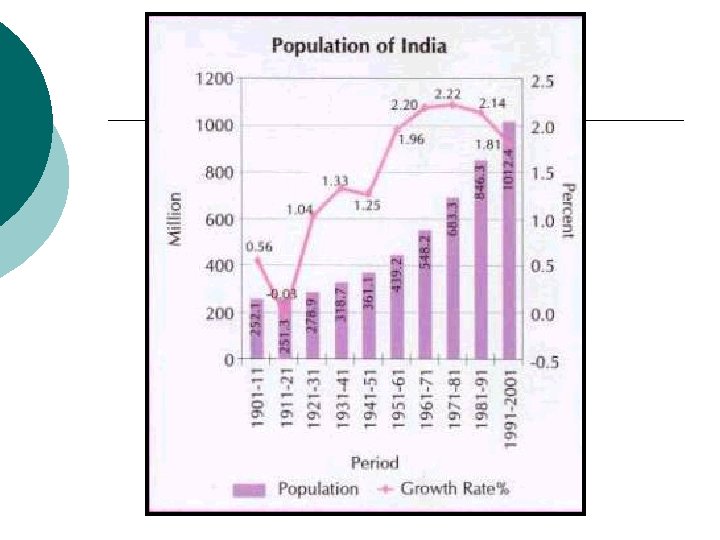
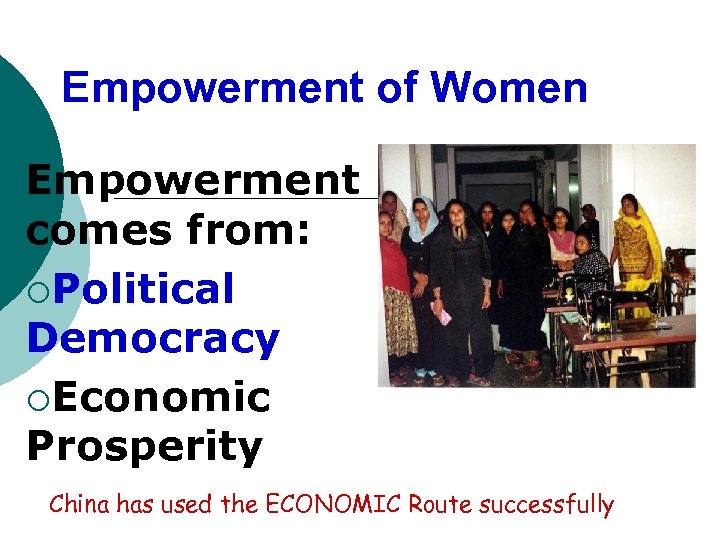 Empowerment of Women Empowerment comes from: ¡Political Democracy ¡Economic Prosperity China has used the ECONOMIC Route successfully
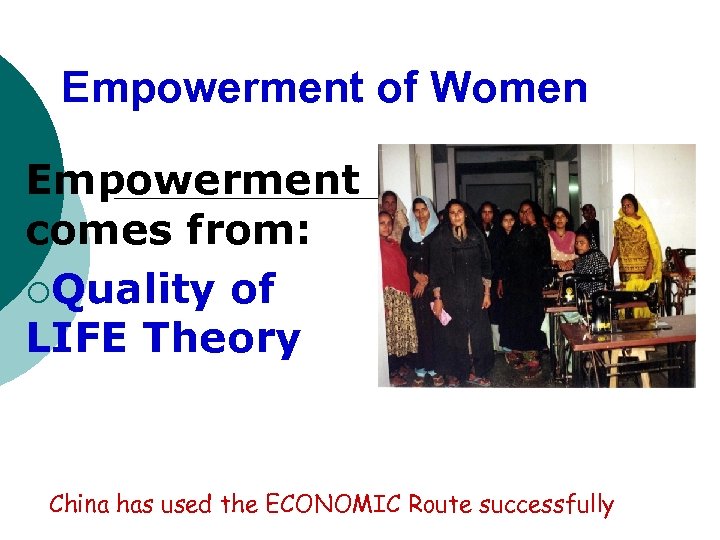 Empowerment of Women Empowerment comes from: ¡Quality of LIFE Theory China has used the ECONOMIC Route successfully
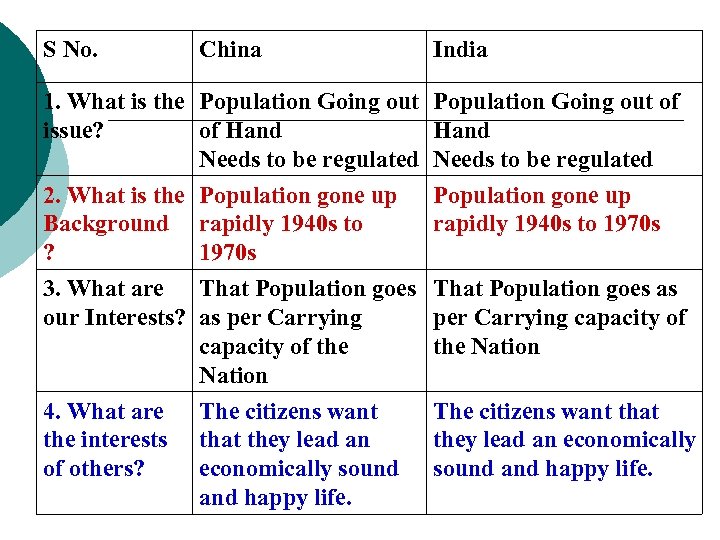 S No. China India 1. What is the Population Going out of issue? of Hand Needs to be regulated 2. What is the Background ? 3. What are our Interests? Population gone up rapidly 1940 s to 1970 s That Population goes as per Carrying capacity of the Nation Population gone up rapidly 1940 s to 1970 s 4. What are the interests of others? The citizens want that they lead an economically sound and happy life. That Population goes as per Carrying capacity of the Nation
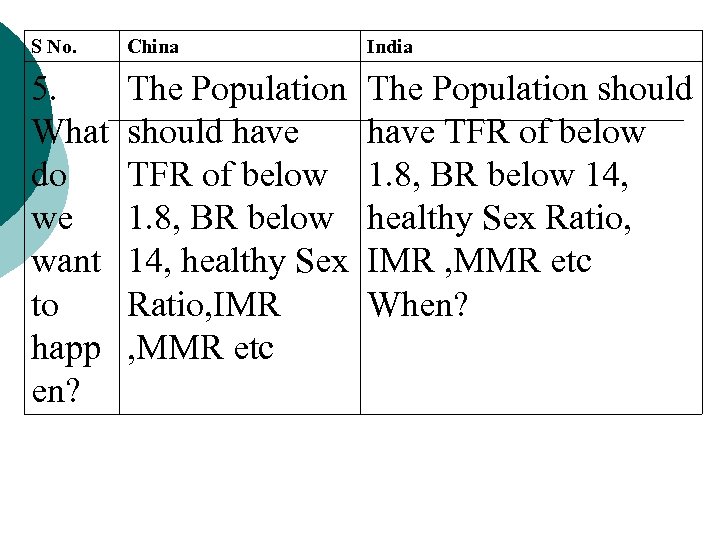 S No. China India 5. What do we want to happ en? The Population should have TFR of below 1. 8, BR below 14, healthy Sex Ratio, IMR , MMR etc When?
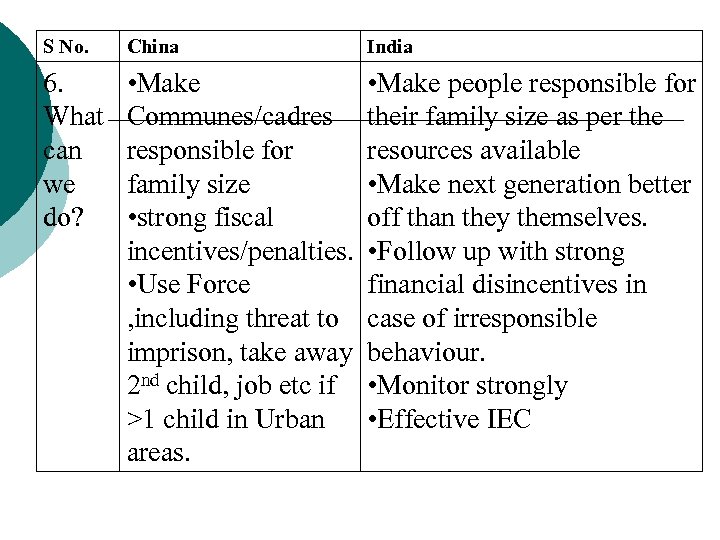 S No. China India 6. What can we do? • Make Communes/cadres responsible for family size • strong fiscal incentives/penalties. • Use Force , including threat to imprison, take away 2 nd child, job etc if >1 child in Urban areas. • Make people responsible for their family size as per the resources available • Make next generation better off than they themselves. • Follow up with strong financial disincentives in case of irresponsible behaviour. • Monitor strongly • Effective IEC
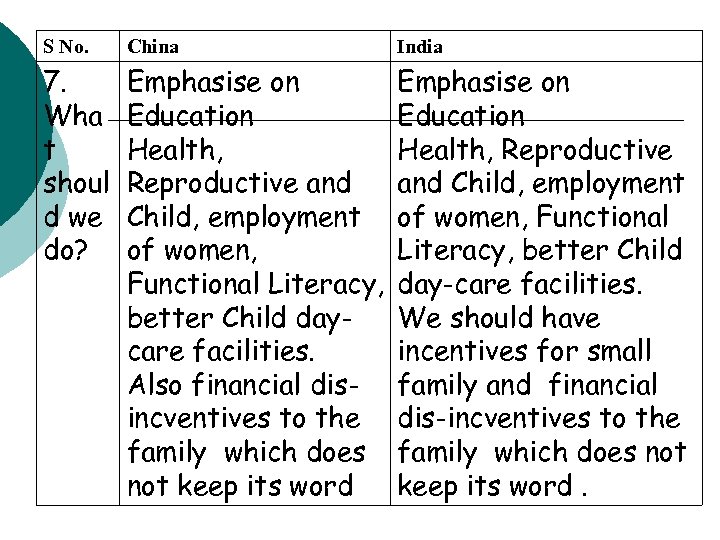 S No. China India 7. Wha t shoul d we do? Emphasise on Education Health, Reproductive and Child, employment of women, Functional Literacy, better Child daycare facilities. Also financial disincventives to the family which does not keep its word Emphasise on Education Health, Reproductive and Child, employment of women, Functional Literacy, better Child day-care facilities. We should have incentives for small family and financial dis-incventives to the family which does not keep its word.
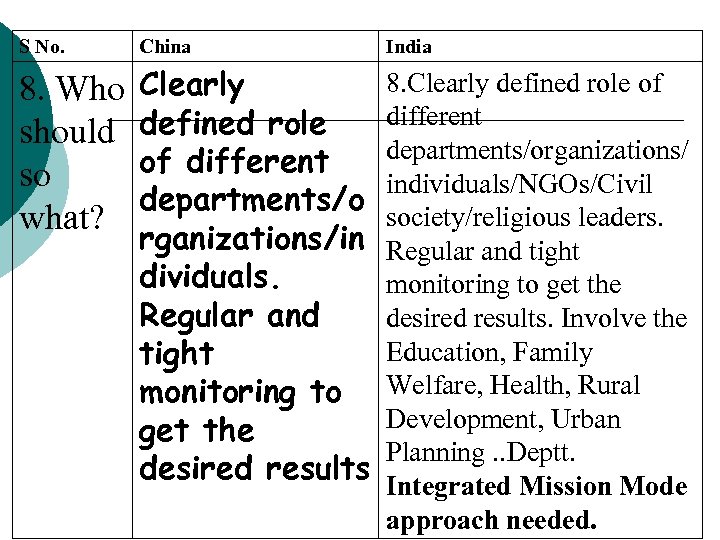 S No. China India 8. Who should so what? Clearly defined role of different departments/o rganizations/in dividuals. Regular and tight monitoring to get the desired results 8. Clearly defined role of different departments/organizations/ individuals/NGOs/Civil society/religious leaders. Regular and tight monitoring to get the desired results. Involve the Education, Family Welfare, Health, Rural Development, Urban Planning. . Deptt. Integrated Mission Mode approach needed.
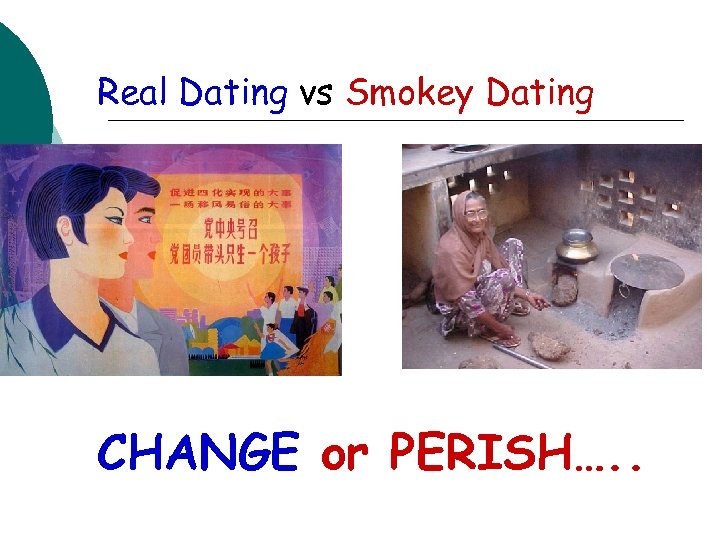 Real Dating vs Smokey Dating CHANGE or PERISH…. .
 12 th Symposium on Development and Social Transformation Panel 6: Policy Initiatives in China Mobile Number Portability in Hong Kong P. Sudhakara Rao
 What is MNP? n n Mobile Number portability allows the Mobile Subscribers to retain their existing number when they change the subscription from one service provider to another. It removes the major obstacle of freedom of choice of the customer and promotes the fair and efficient competition in the cellular industry.
 Benefits of MNP n n n Type 1 benefits: - Benefits accrue to subscribers who retain their telephone numbers Type 2 benefits: - Benefits that arise out of competition between the operators Type 3 benefits: - Cost savings to callers to porting users
 Study of Mobile Number Portability n n Feasibility Study and cost-benefit analysis of MNP for Mobile services in Hong Kong by consultant. Results of cost-benefit analysis. Introduction of MNP would promote fair competition and create net benefits of HK $ 461 million in net present value over 10 years.
 Implementation of MNP in Hong Kong n n Based on Consultant’s findings and cost-benefit analysis Through extensive consultation/discussion with Industry Direct Implementation of Distributed Database solution with FNO providing look up service on 1 st March 1999 Set up of Implementation Task Force (ITF) of MNP to work on detailed technical specifications and Implementation schedule
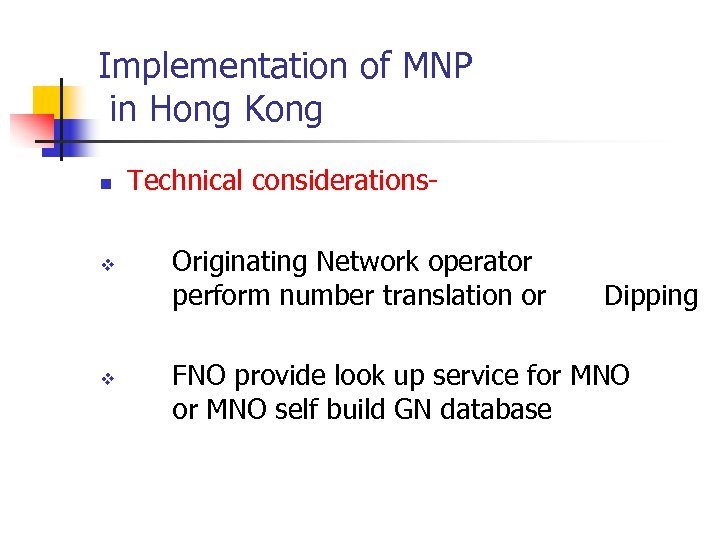 Implementation of MNP in Hong Kong n v v Technical considerations. Originating Network operator perform number translation or Dipping FNO provide look up service for MNO self build GN database
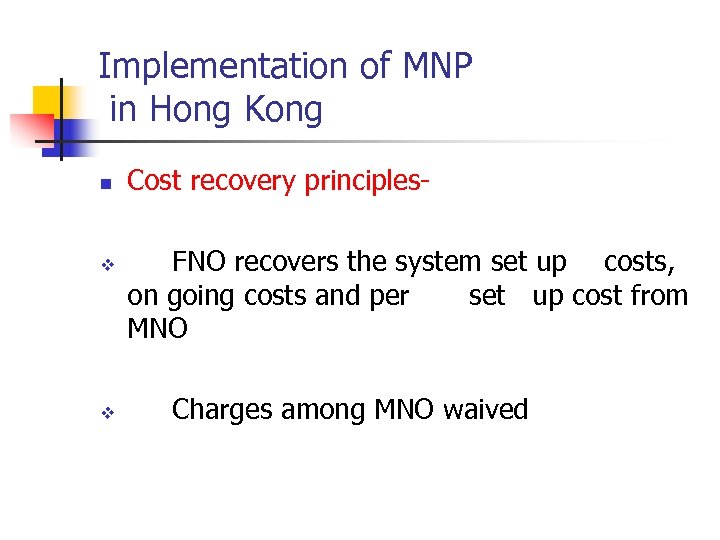 Implementation of MNP in Hong Kong n v v Cost recovery principles. FNO recovers the system set up costs, on going costs and per set up cost from MNO Charges among MNO waived
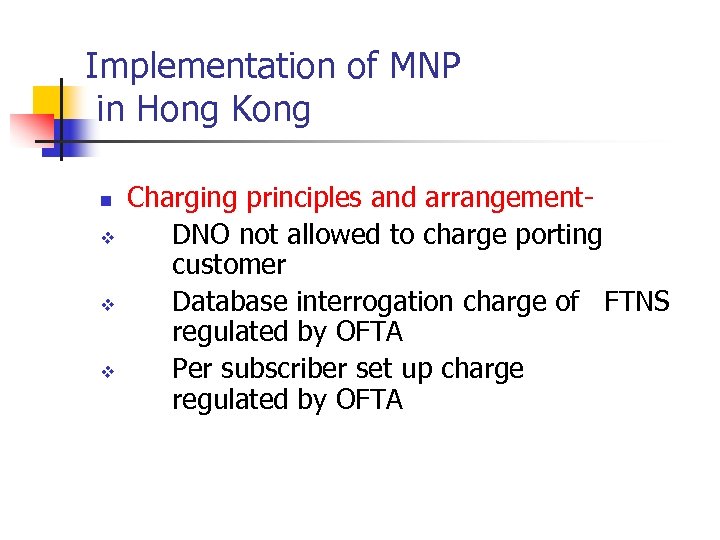 Implementation of MNP in Hong Kong n v v v Charging principles and arrangement. DNO not allowed to charge porting customer Database interrogation charge of FTNS regulated by OFTA Per subscriber set up charge regulated by OFTA
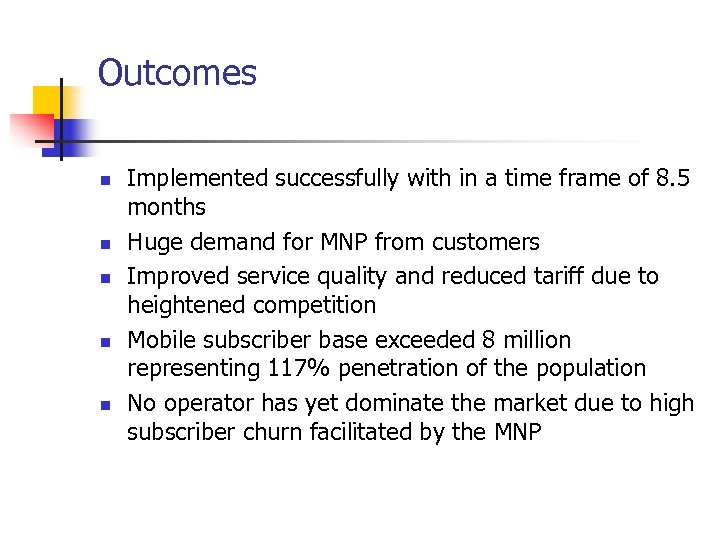 Outcomes n n n Implemented successfully with in a time frame of 8. 5 months Huge demand for MNP from customers Improved service quality and reduced tariff due to heightened competition Mobile subscriber base exceeded 8 million representing 117% penetration of the population No operator has yet dominate the market due to high subscriber churn facilitated by the MNP
 Key Learning for India n n n Experience of Hong Kong is very much useful Conducting feasibility study and cost- benefit analysis Involving Industry in finalizing the technical and functional standards Set up of Implementation Task Force Go for long term solution with out going for migration through short term solution
 Key Learning for India EXCEPTIONS § No prior experience of Number portability in Fixed Telecom services § Instead of Distributed Database model, centralized database service is ideal for Indian context
 12 th Symposium on Development and Social Transformation Panel 6: Policy Initiatives in China Thursday, November 17 (9: 00 - 10: 00) Anindita Sen Gupta Sunil Kumar Gulati Universal Service Obligation: China Population Policy in China P. Sudhakara Rao Mobile Number Portability in Hong Kong