


 Скачать презентацию 12 Managing Capacity and Demand Chapter — 12
719ee214fa258f4c0c58ed33ef58a66d.ppt
- Количество слайдов: 13
 12 Managing Capacity and Demand Chapter - 12
 12 -2 Learning Objectives ¨ Describe the strategies for matching capacity and demand for services. ¨ Recommend an overbooking strategy. ¨ Use Linear Programming to prepare a weekly workshift schedule. ¨ Prepare ¨ Use a work schedule for part-time employees. yield management.
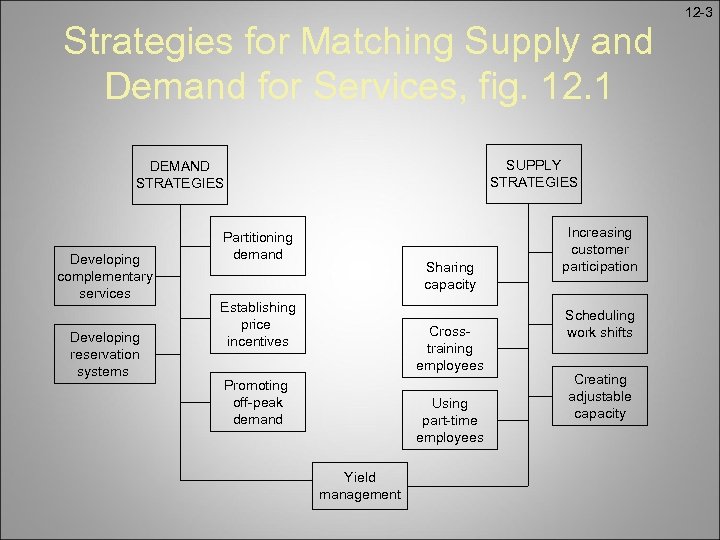 Strategies for Matching Supply and Demand for Services, fig. 12. 1 SUPPLY STRATEGIES DEMAND STRATEGIES Developing complementary services Developing reservation systems Partitioning demand Sharing capacity Establishing price incentives Crosstraining employees Promoting off-peak demand Using part-time employees Yield management Increasing customer participation Scheduling work shifts Creating adjustable capacity 12 -3
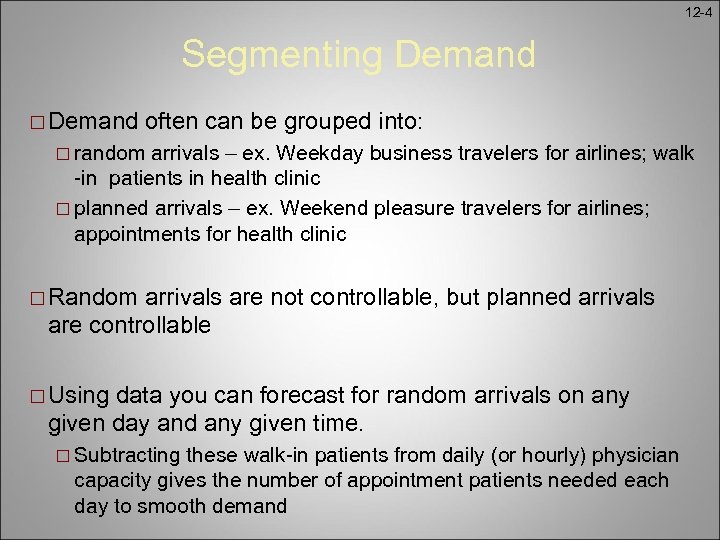 12 -4 Segmenting Demand ¨ Demand often can be grouped into: ¨ random arrivals – ex. Weekday business travelers for airlines; walk -in patients in health clinic ¨ planned arrivals – ex. Weekend pleasure travelers for airlines; appointments for health clinic ¨ Random arrivals are not controllable, but planned arrivals are controllable ¨ Using data you can forecast for random arrivals on any given day and any given time. ¨ Subtracting these walk-in patients from daily (or hourly) physician capacity gives the number of appointment patients needed each day to smooth demand
 12 -5 Offering Price Incentives ¨ The price incentives pushes the casual demand helps in smoothening the demand. For example: ¨ Weekend and night rates for cell-phone plans ¨ Off-season ¨ Peak-load hotel rates at resort locations pricing by utility companies
 12 -6 Promoting off-peak demand ¨ Do specials to attract demand during off-peak ¨ Use of resort hotels to do off-season specials, like free breakfast or tickets
 Reservation System and Overbooking 12 -7 ¨ Taking reservations pre-sells the potential service – allowing better planning. ¨ Reservation allows you to deflect additional demand to other time slots at the same facility or other facility within the same organization – example, Hotel chains ¨ Customer benefits from reservation that they do not have to wait in lines and are guaranteed service availability ¨ What if customer decides not to honor their reservation? ¨ Potential problem for the service provider ¨ Service providers have started overbooking (that is, book more than capacity) to overcome the problem of no-shows. ¨ What if all customers show-up? ¨ Train your frontline workers to handle overbooking problem graciously.
 12 -8 Strategies for Managing Capacity ¨ Daily work-shift scheduling ¨ By scheduling work-shifts appropriately, the service capacity can be made available to meet demand ¨ We forecast demand for every hour, which is used to create hourly service staffing requirements ¨ Decide the service level you want to provide – for example, what percentage of calls should be picked within 4 rings will decide the number of operators to schedule.
 12 -9 Increasing Customer participation ¨ Design service in such a way that you can involve customers in service delivery – example fast food places ¨ This allows the capacity to vary along with the demand, that is, customers not only increase demand but also increase capacity ¨ Incentive should be built in for customers to participate as a co-producer– example price break, faster check-out ¨ Problems ¨ what if the customers gets hurt ¨ No control on service quality provided by the customer, example table may not be cleaned properly after eating ¨ Contamination and spillage – in bulk stores the customer can use dirty hands or can spill
 12 -10 Creating Adjustable Capacity ¨ By design the capacity can be made variable ¨ In Benihana restaurant, they can change the number of tables depending on the number of chefs; because a chef is assigned to a table ¨ Capacity at peak periods can be increased and at off-peak time the workers are used effectively to perform supportive tasks and have higher level of preparedness ¨ Requires ¨ no cross trained employees union problems in job classifications
 12 -11 Other Strategies ¨ Sharing capacity ¨ Airlines cooperate in sharing same gates, ramps, baggagehandling equipment, and ground personnel ¨ Cross-trained employees ¨ Creates flexible capacity and also increases capacity, example Hy. Vee where the workers stock at off-peak time unless called by the manager to operate a register. ¨ Using part-time employees ¨ They can supplement regular employees
 12 -12 Yield Management ¨ Yield management model attempts to allocate the fixed capacity of seats on an aircraft to match the potential demand in various market segments in the most profitable manner.
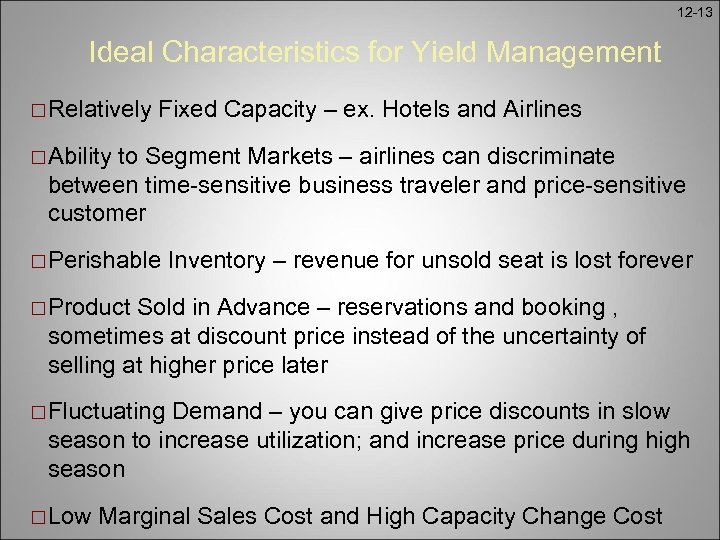 12 -13 Ideal Characteristics for Yield Management ¨ Relatively Fixed Capacity – ex. Hotels and Airlines ¨ Ability to Segment Markets – airlines can discriminate between time-sensitive business traveler and price-sensitive customer ¨ Perishable Inventory – revenue for unsold seat is lost forever ¨ Product Sold in Advance – reservations and booking , sometimes at discount price instead of the uncertainty of selling at higher price later ¨ Fluctuating Demand – you can give price discounts in slow season to increase utilization; and increase price during high season ¨ Low Marginal Sales Cost and High Capacity Change Cost