


 Скачать презентацию 12 -1 Copyright 2015 Pearson Education Inc
808fb4b07d5f8cf2b8e4c6fd96574bdb.ppt
- Количество слайдов: 48
 12 -1 Copyright © 2015 Pearson Education, Inc.
 Chapter 12: Leadership 12 -2 Copyright © 2015 Pearson Education, Inc.
 Learning Objectives After studying this chapter, you should be able to: ØContrast leadership and management. ØSummarize the conclusions of trait theories of leadership. ØIdentify the central tenets and main limitations of behavioral theories. ØAssess contingency theories of leadership by their level of support. ØContrast charismatic and transformational leadership. ØDefine authentic leadership. ØDemonstrate the role mentoring plays in our understanding of leadership. ØAddress challenges to the effectiveness of leadership. 12 -3 Copyright © 2015 Pearson Education, Inc.
 LO 1 Contrast Leadership and Management ØLeadership is the ability to influence a group toward the achievement of a vision or set of goals. Ø Not all leaders are managers, nor are all managers leaders. ØNonsanctioned leadership is often as important or more important than formal influence. 12 -4 Copyright © 2015 Pearson Education, Inc.
 LO 1 Contrast Leadership and Management ØStrong leadership and strong management are needed for optimal effectiveness. ØLeaders: Ø Challenge the status quo. Ø Create visions of the future. Ø Inspire organizational members to want to achieve the visions. ØManagers: Ø Formulate detailed plans. Ø Create efficient organizational structures. Ø Oversee day-to-day operations. Copyright © 2015 Pearson Education, Inc. 12 -5
 LO 2 Summarize the Conclusions of Trait Theories of Leadership ØTrait theories of leadership focus on personal qualities and characteristics. Ø The search for personality, social, physical, or intellectual attributes that differentiate leaders from non-leaders goes back to the earliest stages of leadership research. 12 -6 Copyright © 2015 Pearson Education, Inc.
 LO 2 Summarize the Conclusions of Trait Theories of Leadership ØA breakthrough came when researchers began organizing traits around the Big Five personality framework. ØMost of the dozens of traits in various leadership reviews fit under one of the Big Five, giving strong support to traits as predictors of leadership. 12 -7 Copyright © 2015 Pearson Education, Inc.
 LO 2 Summarize the Conclusions of Trait Theories of Leadership ØThe trait approach does have something to offer. ØGood leaders: Ø Like being around people. Ø Are able to assert themselves (extraverted). Ø Are disciplined and able to keep commitments they make (conscientious). Ø Are creative and flexible (open). 12 -8 Copyright © 2015 Pearson Education, Inc.
 LO 2 Summarize the Conclusions of Trait Theories of Leadership ØAnother trait that may indicate effective leadership is emotional intelligence (EI). ØAdvocates of EI argue that without it, a person can have outstanding training, a highly analytical mind, a compelling vision, and an endless supply of terrific ideas, but still not make a great leader. ØA core component of EI is empathy. 12 -9 Copyright © 2015 Pearson Education, Inc.
 LO 2 Summarize the Conclusions of Trait Theories of Leadership ØConclusions based on the latest findings: Ø Contrary to what we believed 20 years ago, and thanks to the Big Five, we can say that traits can predict leadership. Ø Traits do a better job predicting the emergence of leaders and the appearance of leadership than actually distinguishing between effective and ineffective leaders. 12 -10 Copyright © 2015 Pearson Education, Inc.
 Identify the Central Tenets and Main Limitations of Behavioral Theories LO 3 ØBehavioral theories of leadership imply we can train people to be leaders. ØOhio State Studies found two behaviors that accounted for most leadership behavior: Ø Initiating structure – the extent to which a leader is likely to define and structure his role and those of employees in the search for goal attainment. Ø Consideration – the extent to which a person’s job relationships are characterized by mutual trust, respect for employees’ ideas, and regard for their feelings. Copyright © 2015 Pearson Education, Inc. 12 -11
 Identify the Central Tenets and Main Limitations of Behavioral Theories LO 3 ØUniversity of Michigan’s objectives also identified two behavioral types: Ø The employee-oriented leader emphasized interpersonal relationships by taking a personal interest in the needs of employees and accepting individual differences among them. Ø The production-oriented leader emphasized the technical or task aspects of the job, focusing on accomplishing the group’s tasks. Copyright © 2015 Pearson Education, Inc. 12 -12
 Identify the Central Tenets and Main Limitations of Behavioral Theories LO 3 ØThe GLOBE study suggests there are international differences in preference for initiating structure and consideration. Ø Based on the values of Brazilian employees, a U. S. manager leading a team in Brazil would need to be team oriented, participative, and humane. Leaders high in consideration would succeed best in this culture. 12 -13 Copyright © 2015 Pearson Education, Inc.
 Identify the Central Tenets and Main Limitations of Behavioral Theories LO 3 ØSummary of Trait Theories and Behavioral Theories Ø Leaders who have certain traits and who display consideration and structuring behaviors do appear to be more effective. Ø Traits and behaviors do not guarantee success. ØContext matters, too. 12 -14 Copyright © 2015 Pearson Education, Inc.
 Assess Contingency Theories of Leadership By Their Level of Support LO 4 ØThe Fiedler contingency model Ø A key factor in leadership success is the individual’s leadership style. ØLeast preferred co-worker (LPC) questionnaire. ØTask or relationship oriented. ØAssumes leadership style is fixed. 12 -15 Copyright © 2015 Pearson Education, Inc.
 Assess Contingency Theories of Leadership By Their Level of Support LO 4 ØDefining the Situation Ø Contingency dimensions: 1. Leader-member relations 2. Task structure 3. Position power 12 -16 Copyright © 2015 Pearson Education, Inc.
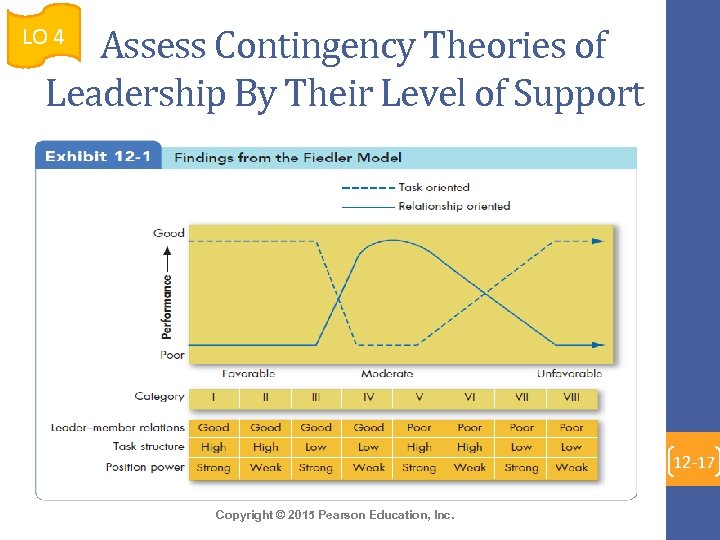 Assess Contingency Theories of Leadership By Their Level of Support LO 4 12 -17 Copyright © 2015 Pearson Education, Inc.
 Assess Contingency Theories of Leadership By Their Level of Support LO 4 ØEvaluation of the Fiedler model Ø Considerable evidence to support at least substantial parts of the model. Ø Problems with the practical use of the model. ØLogic underlying the LPC is not well understood. ØLPC scores are not stable. ØContingency variables are complex and difficult for practitioners to assess. 12 -18 Copyright © 2015 Pearson Education, Inc.
 Assess Contingency Theories of Leadership By Their Level of Support LO 4 ØOther Contingency Theories Ø Situational leadership theory (SLT) is a contingency theory that focuses on the followers. ØSuccessful leadership is achieved by selecting the right leadership style, which is contingent on the level of the followers’ readiness. 12 -19 Copyright © 2015 Pearson Education, Inc.
 Assess Contingency Theories of Leadership By Their Level of Support LO 4 ØPath-goal theory, developed by Robert House: Ø One of the most respected approaches to leadership. Ø Contingency model of leadership that extracts key elements from the Ohio State leadership research on initiating structure and consideration and the expectancy theory of motivation. Ø Derived from belief that effective leaders clarify the path to help followers achieve work goals. Copyright © 2015 Pearson Education, Inc. 12 -20
 Assess Contingency Theories of Leadership By Their Level of Support LO 4 ØVroom & Yetton’s leader-participation model relates leadership behavior and participation in decision making. Ø Leader behavior must adjust to reflect the task structure. Ø Model is normative – it provides a decision tree of seven contingencies and five leadership styles for determining the form and amount of participation in decision making. Copyright © 2015 Pearson Education, Inc. 12 -21
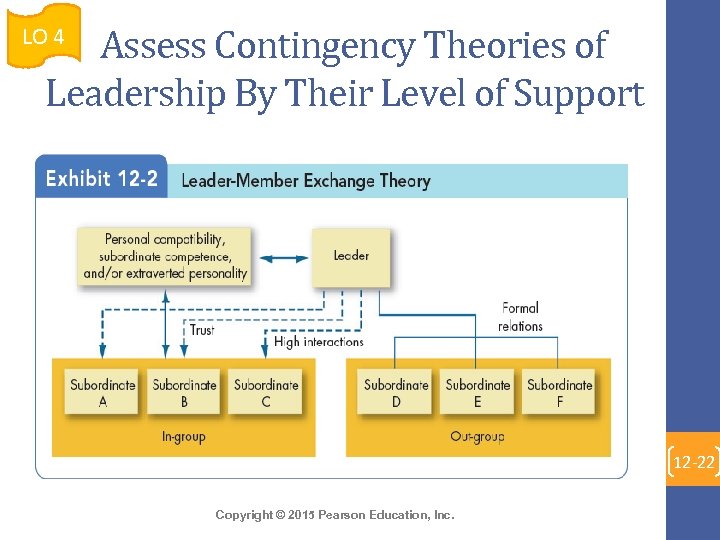 Assess Contingency Theories of Leadership By Their Level of Support LO 4 12 -22 Copyright © 2015 Pearson Education, Inc.
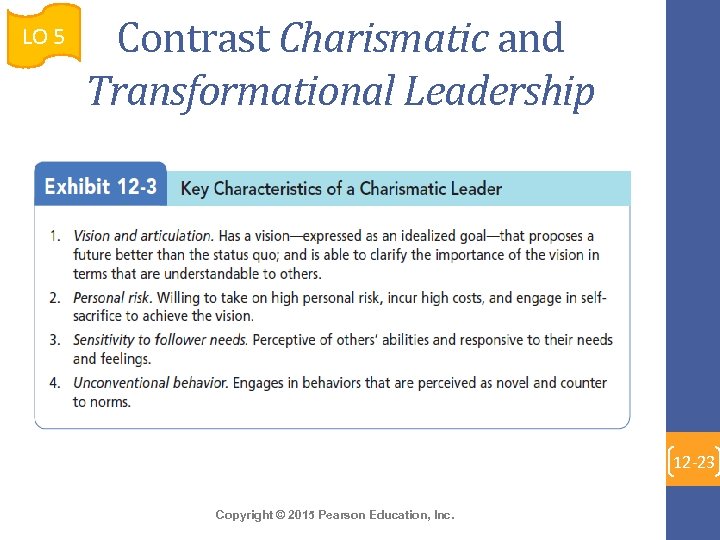 LO 5 Contrast Charismatic and Transformational Leadership 12 -23 Copyright © 2015 Pearson Education, Inc.
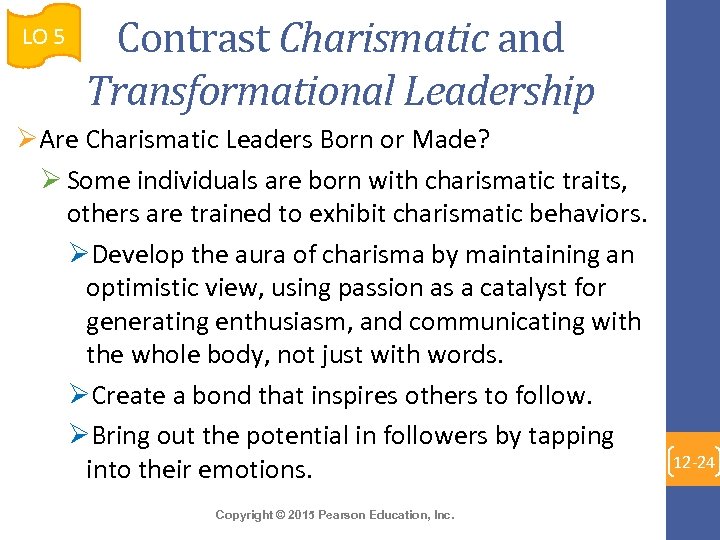 LO 5 Contrast Charismatic and Transformational Leadership ØAre Charismatic Leaders Born or Made? Ø Some individuals are born with charismatic traits, others are trained to exhibit charismatic behaviors. ØDevelop the aura of charisma by maintaining an optimistic view, using passion as a catalyst for generating enthusiasm, and communicating with the whole body, not just with words. ØCreate a bond that inspires others to follow. ØBring out the potential in followers by tapping into their emotions. Copyright © 2015 Pearson Education, Inc. 12 -24
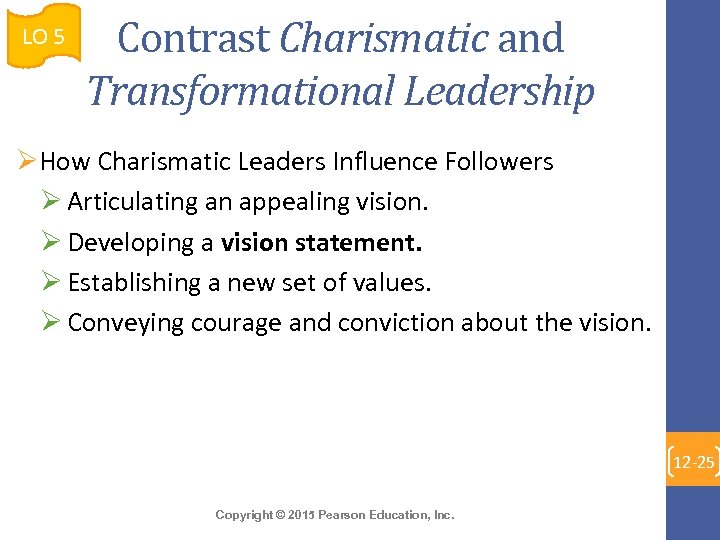 LO 5 Contrast Charismatic and Transformational Leadership ØHow Charismatic Leaders Influence Followers Ø Articulating an appealing vision. Ø Developing a vision statement. Ø Establishing a new set of values. Ø Conveying courage and conviction about the vision. 12 -25 Copyright © 2015 Pearson Education, Inc.
 LO 5 Contrast Charismatic and Transformational Leadership ØDoes Effective Charismatic Leadership Depend on the Situation? Ø People are especially receptive when they sense a crisis, when they are under stress, or when they fear for their lives. 12 -26 Copyright © 2015 Pearson Education, Inc.
 LO 5 Contrast Charismatic and Transformational Leadership ØThe Dark Side of Charismatic Leadership Ø Many leaders have allowed their personal goals to override the goals of the organization. ØIndividuals who are narcissistic are also higher in some behaviors associated with charismatic leadership. Ø Some charismatic leaders are too successful at convincing followers to pursue a vision that can be disastrous. Copyright © 2015 Pearson Education, Inc. 12 -27
 LO 5 Contrast Charismatic and Transformational Leadership 12 -28 Copyright © 2015 Pearson Education, Inc.
 LO 5 Contrast Charismatic and Transformational Leadership 12 -29 Copyright © 2015 Pearson Education, Inc.
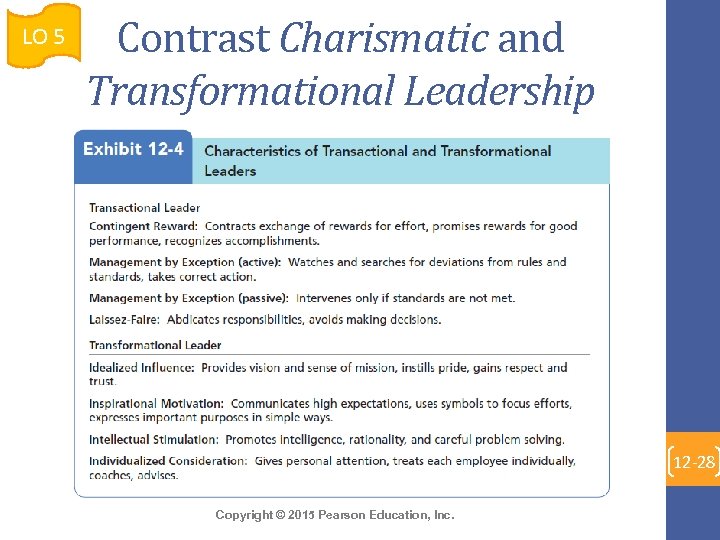
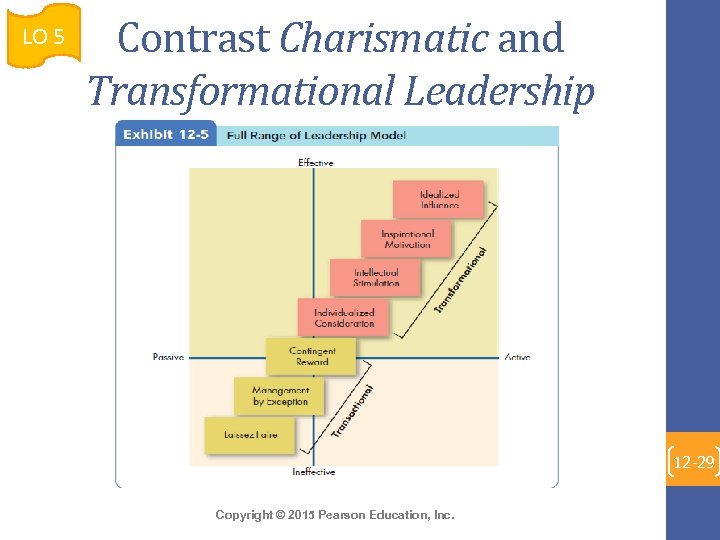
 LO 5 Contrast Charismatic and Transformational Leadership ØHow Transformational Leadership Works Ø Creativity – theirs and others. Ø Decentralization of responsibility. Ø Propensity to take risks. Ø Compensation is geared toward long-term results. Ø Greater agreement among top managers about the organization’s goals. Ø Increase follower self-efficacy, giving the group a “can do” spirit. Copyright © 2015 Pearson Education, Inc. 12 -30
 LO 5 Contrast Charismatic and Transformational Leadership ØEvaluation of Transformational Leadership Ø Transformational leadership has been supported at diverse job levels and occupations, but isn’t equally effective in all situations. ØIt has a greater impact on the bottom line in smaller, privately held firms than in more complex organizations. 12 -31 Copyright © 2015 Pearson Education, Inc.
 LO 5 Contrast Charismatic and Transformational Leadership ØThe GLOBE study of 18, 000 leaders from 825 organizations in 62 countries links a number of elements of transformational leadership with effective leadership, regardless of country. Ø Very important because it disputes the contingency view that leadership style needs to adapt to cultural differences. Ø Universal elements are vision, foresight, providing encouragement, trustworthiness, dynamism, positiveness, and proactiveness. Copyright © 2015 Pearson Education, Inc. 12 -32
 LO 6 Define Authentic Leadership ØWhat is Authentic Leadership? Ø Authentic leaders: ØKnow who they are. ØKnow what they believe in and value. ØAct on those values and beliefs openly and candidly. Ø The result: people come to have faith in them. 12 -33 Copyright © 2015 Pearson Education, Inc.
 LO 6 Define Authentic Leadership ØEthical Leadership Ø Ethics touches on leadership at a number of junctures. Ø Efforts have been made to combine ethical and charismatic leadership into an idea of socialized charismatic leadership – leadership that conveys other-centered values by leaders who model ethical conduct. 12 -34 Copyright © 2015 Pearson Education, Inc.
 LO 6 Define Authentic Leadership ØServant Leadership Ø Servant leaders go beyond their self-interest and instead focus on opportunities to help followers grow and develop. ØEmphasize persuasion. Ø Characteristic behaviors include listening, empathizing, persuading, accepting stewardship, and actively developing followers’ potential. 12 -35 Copyright © 2015 Pearson Education, Inc.
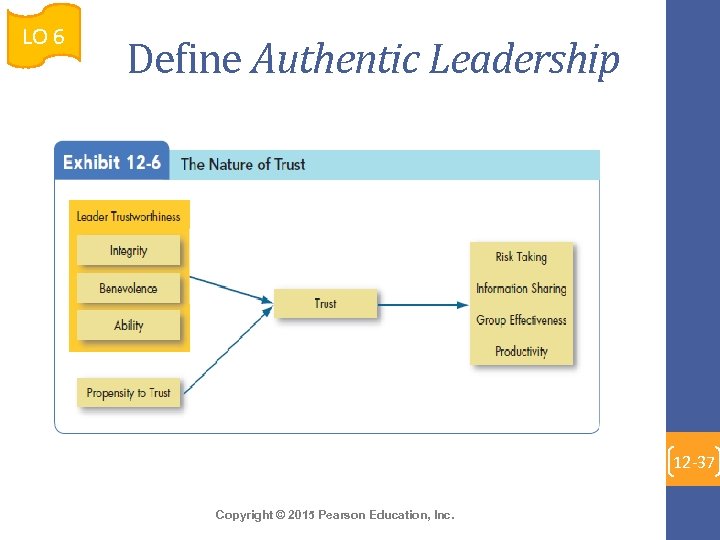
 LO 6 Define Authentic Leadership ØTrust and Leadership Ø Trust – a psychological state that exists when you agree to make yourself vulnerable to another because you have positive expectations about how things are going to turn out. ØA primary attribute associated with leadership. ØWhen trust is broken, it can have serious adverse effects on a group’s performance. 12 -36 Copyright © 2015 Pearson Education, Inc.
 LO 6 Define Authentic Leadership 12 -37 Copyright © 2015 Pearson Education, Inc.
 LO 6 Define Authentic Leadership ØTrust as a Process Ø Trust propensity – how likely a particular employee is to trust a leader. ØTime: we come to trust people based on observing their behavior over time. ØCan also be won by demonstrating competence. Ø Leaders who break the psychological contract with workers, demonstrating they aren’t trustworthy, will find employees are less satisfied and less committed, have higher intentions to turnover, engage in less citizenship behavior, and have lower task performance. Copyright © 2015 Pearson Education, Inc. 12 -38
 LO 6 Define Authentic Leadership ØWhat Are the Consequences of Trust? Ø Trust encourages taking risks. Ø Trust facilitates information sharing. Ø Trusting groups are more effective. Ø Trust enhances productivity. 12 -39 Copyright © 2015 Pearson Education, Inc.
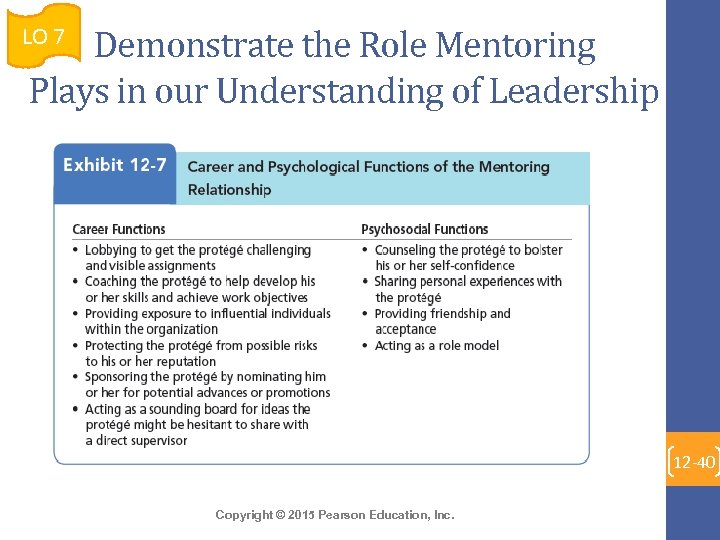 LO 7 Demonstrate the Role Mentoring Plays in our Understanding of Leadership 12 -40 Copyright © 2015 Pearson Education, Inc.
 LO 8 Address Challenges to the Effectiveness of Leadership ØMuch of an organization’s success or failure is due to factors outside the influence of leadership. Ø In many cases, success or failure is just a matter of being in the right or wrong place at a given time. ØThe attribution theory of leadership says leadership is merely an attribution people make about other individuals. 12 -41 Copyright © 2015 Pearson Education, Inc.
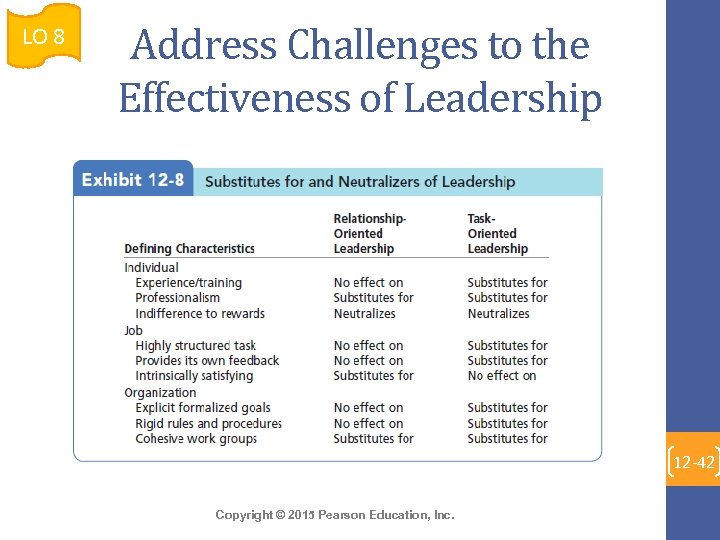 LO 8 Address Challenges to the Effectiveness of Leadership 12 -42 Copyright © 2015 Pearson Education, Inc.
 LO 8 Address Challenges to the Effectiveness of Leadership ØOnline Leadership Ø Needs more research. Ø Today’s managers and employees are increasingly linked by networks rather than geographic proximity. ØOnline leaders have to think carefully about what actions they want their digital messages to initiate. ØIdentification-based trust is difficult to achieve without face-to-face interaction. ØWriting skills are likely to become an extension of interpersonal skills. Copyright © 2015 Pearson Education, Inc. 12 -43
 LO 8 Address Challenges to the Effectiveness of Leadership ØSelecting Leaders Ø Identifying effective leaders: ØReview specific requirements for the position. ØConsider personality tests to identify leadership traits. ØSituation-specific experience is relevant. Ø Plan for a change in leadership. 12 -44 Copyright © 2015 Pearson Education, Inc.
 LO 8 Address Challenges to the Effectiveness of Leadership ØTraining Leaders Ø Leadership training is likely to be more successful with high self-monitors. Ø Teach implementation skills. Ø Teach trust building, mentoring, and situationalanalysis. Ø Behavioral training through modeling exercises can increase an individual’s charismatic leadership qualities. Ø Review leadership after key organizational events. Ø Train in transformational leadership skills. Copyright © 2015 Pearson Education, Inc. 12 -45
 Implications for Managers ØFor management positions, hire candidates who exhibit transformational leadership qualities and who have demonstrated vision and charisma. ØTests and interviews can help you identify people with leadership qualities. ØHire candidates whom you believe are ethical and trustworthy for management roles and train current managers in your organization’s ethical standards in order to increase leadership effectiveness. Copyright © 2015 Pearson Education, Inc. 12 -46
 Implications for Managers ØSeek to develop trusting relationships with followers because, as organizations have become less stable and predictable, strong bonds of trust are replacing bureaucratic rules in defining expectations and relationships. ØConsider investing in leadership training such as formal courses, workshops, rotating job responsibilities, coaching, and mentoring. 12 -47 Copyright © 2015 Pearson Education, Inc.
 All rights reserved. No part of this publication may be reproduced, stored in a retrieval system, or transmitted, in any form or by any means, electronic, mechanical, photocopying, recording, or otherwise, without the prior written permission of the publisher. Printed in the United States of America. Copyright © 2015 Pearson Education, Inc. 12 -48 Copyright © 2015 Pearson Education, Inc.