 Скачать презентацию 11 September 2009 European Issuers Securities Reference Data
f6f6c3d35a1173e6ddda883344d39bae.ppt
- Количество слайдов: 17



11 September 2009 European. Issuers Securities Reference Data Utility An outline of the concept Francis Gross DG Statistics, External Statistics Division
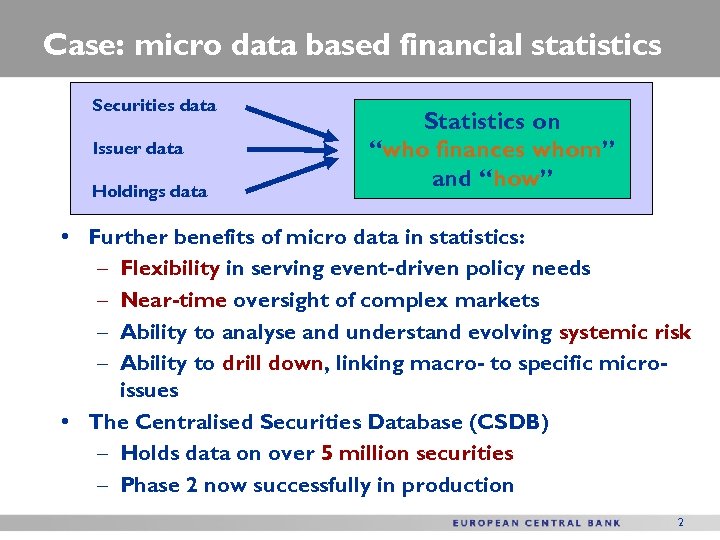
Case: micro data based financial statistics Securities data Issuer data Holdings data Statistics on “who finances whom” and “how” • Further benefits of micro data in statistics: – Flexibility in serving event-driven policy needs – Near-time oversight of complex markets – Ability to analyse and understand evolving systemic risk – Ability to drill down, linking macro- to specific microissues • The Centralised Securities Database (CSDB) – Holds data on over 5 million securities – Phase 2 now successfully in production 2
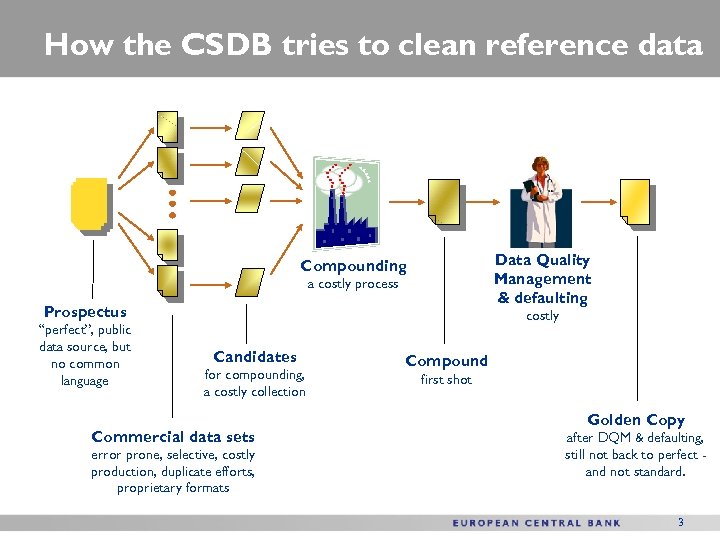
How the CSDB tries to clean reference data Data Quality Management & defaulting Compounding a costly process Prospectus “perfect”, public data source, but no common language costly Candidates for compounding, a costly collection Commercial data sets error prone, selective, costly production, duplicate efforts, proprietary formats Compound first shot Golden Copy after DQM & defaulting, still not back to perfect and not standard. 3
The broader context 4
The broader context: • A tale of progress in politics, education, technology; but • Complexity, volume & speed hit human limitations; thus • Automation must be trusted ever more. • Data from ever more independent sources is a limiting factor, • As each source speaks its own “data dialect”; • Differences can be subtle, but sufficient to defeat automation. • More “data dialects” might end up defeating all known fixes. Are we re-building the Tower of Babel, but this time with data? 5
Weak data harbour key risk in two ways… • Weak data limits essential functions such as automation, market transparency, regulation and systemic risk diagnosis; • Weak data certainly worsened the current crisis. • Data is taken for granted, thus not a board issue; therefore • Data-induced risks grow largely unnoticed by the board. • With evolving markets and IT, weak data act as a slow poison. • Moreover, a single organisation can’t solve it, hence inaction, • even when data weakness is recognised by the board as a risk. Double risk in weak data: (i) a danger growing unnoticed, (ii) met with inaction. 6
… that standardisation can solve. • Data will be good for all users or for none. • Good data ? standards, discipline and rigour; not more IT ! • Diversity in “data dialects” is toxic for systems and processes • There must be less diversity in “data dialects” • Especially in reference data and identifiers. • That the backbone of data is a shared strategic resource. • Top down action is needed, therefore: • We must help leaders understand how critical good data is. Data standards must be driven from the top. Technicians must convey the case to the top! 7

So, what can be done? 8
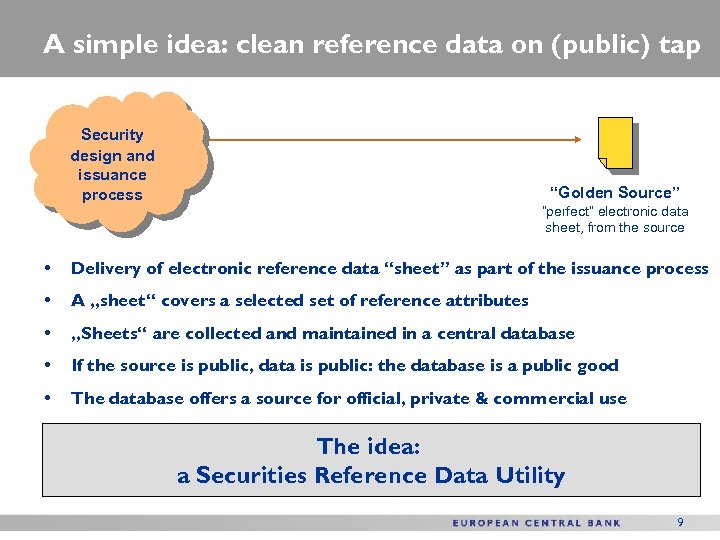
A simple idea: clean reference data on (public) tap Security design and issuance process “Golden Source” “perfect” electronic data sheet, from the source • Delivery of electronic reference data “sheet” as part of the issuance process • A „sheet“ covers a selected set of reference attributes • „Sheets“ are collected and maintained in a central database • If the source is public, data is public: the database is a public good • The database offers a source for official, private & commercial use The idea: a Securities Reference Data Utility 9
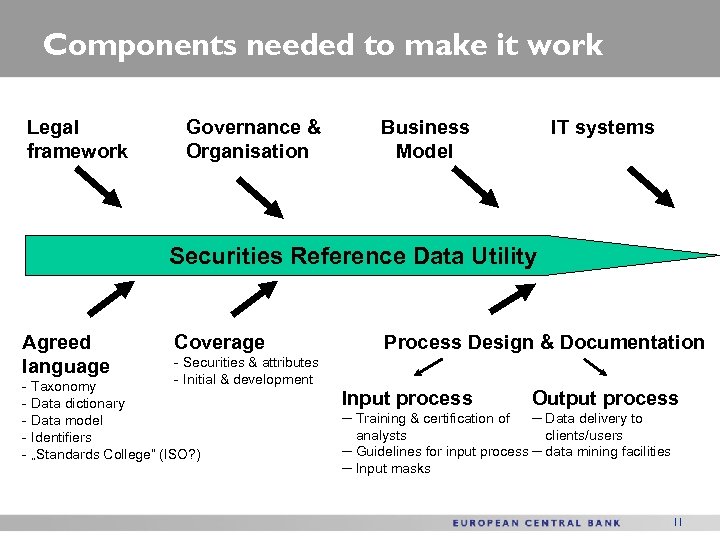
Components needed to make it work Legal framework Governance & Organisation Business Model IT systems Securities Reference Data Utility Agreed language Coverage - Securities & attributes - Initial & development - Taxonomy - Data dictionary - Data model - Identifiers - „Standards College“ (ISO? ) Process Design & Documentation Input process Output process ─ Training & certification of ─ Data delivery to analysts clients/users ─ Guidelines for input process ─ data mining facilities ─ Input masks 11
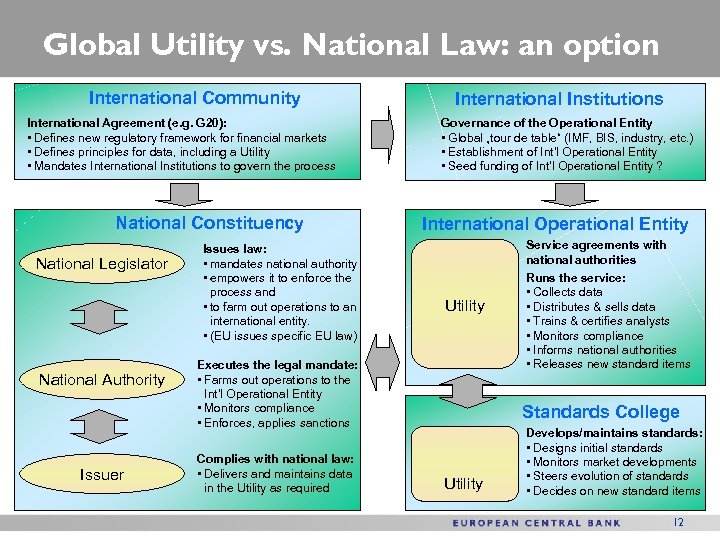
Global Utility vs. National Law: an option International Community International Agreement (e. g. G 20): • Defines new regulatory framework for financial markets • Defines principles for data, including a Utility • Mandates International Institutions to govern the process National Constituency National Legislator National Authority Issuer Issues law: • mandates national authority • empowers it to enforce the process and • to farm out operations to an international entity. • (EU issues specific EU law) International Institutions Governance of the Operational Entity • Global „tour de table“ (IMF, BIS, industry, etc. ) • Establishment of Int’l Operational Entity • Seed funding of Int’l Operational Entity ? International Operational Entity Service agreements with national authorities Utility Executes the legal mandate: • Farms out operations to the Int’l Operational Entity • Monitors compliance • Enforces, applies sanctions Complies with national law: • Delivers and maintains data in the Utility as required Runs the service: • Collects data • Distributes & sells data • Trains & certifies analysts • Monitors compliance • Informs national authorities • Releases new standard items Standards College Utility Develops/maintains standards: • Designs initial standards • Monitors market developments • Steers evolution of standards • Decides on new standard items 12
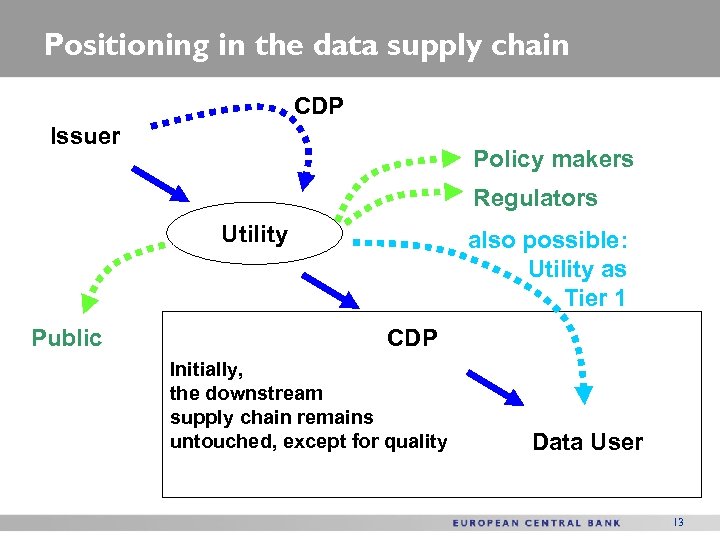
Positioning in the data supply chain CDP Issuer Policy makers Regulators Utility Public also possible: Utility as Tier 1 CDP Initially, the downstream supply chain remains untouched, except for quality Data User 13

Alternative: Multilateral Self-Organisation • Indispensable for agreeing on high-level principles and initiatives • Hard to insulate from the competitive game • Less well suited for converging rapidly on technical solutions 14

Evolution of the Utility Faced with the thick woods of the securities world… 15
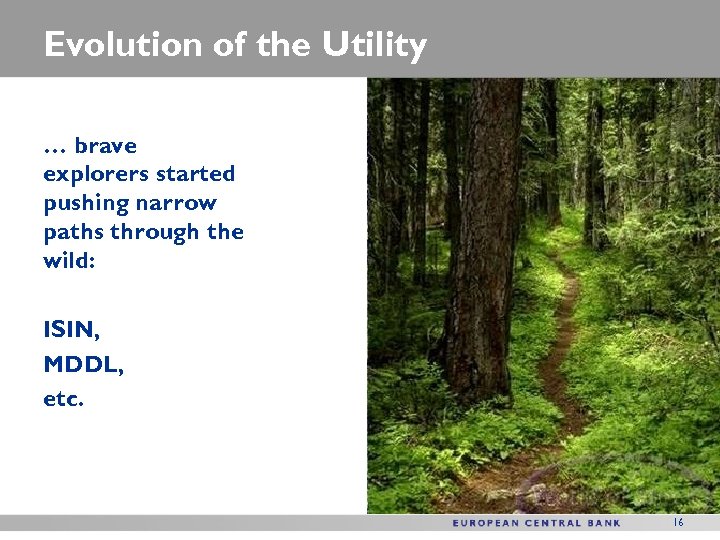
Evolution of the Utility … brave explorers started pushing narrow paths through the wild: ISIN, MDDL, etc. 16
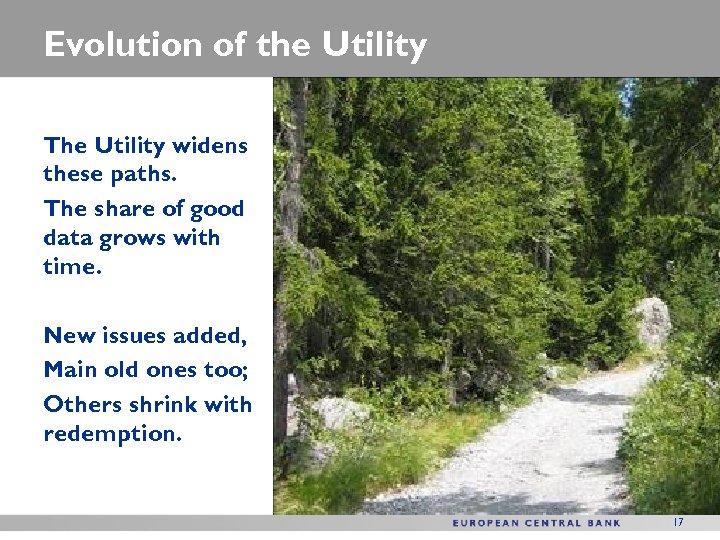
Evolution of the Utility The Utility widens these paths. The share of good data grows with time. New issues added, Main old ones too; Others shrink with redemption. 17

Evolution of the Utility Coverage expands to More types of Securities, More Markets, More Attributes. 18
Скачать презентацию 11 September 2009 European Issuers Securities Reference Data
f6f6c3d35a1173e6ddda883344d39bae.ppt