 Скачать презентацию 11 e Database Systems Design Implementation and Management
640f519d5b6997ef8608a69c633beafb.ppt
- Количество слайдов: 46



11 e Database Systems Design, Implementation, and Management Coronel | Morris Chapter 13 Business Intelligence and Data Warehouses © 2015 Cengage Learning. All Rights Reserved. May not be scanned, copied or duplicated, or posted to a publicly accessible website, in whole or in part.
Learning Objectives § In this chapter, students will learn: § How business intelligence provides a comprehensive business decision support framework § About business intelligence architecture, its evolution, and reporting styles § About the relationship and differences between operational data and decision support data § What a data warehouse is and how to prepare data for one © 2015 Cengage Learning. All Rights Reserved. May not be scanned, copied or duplicated, or posted to a publicly accessible website, in whole or in part. 2
Learning Objectives § In this chapter, students will learn: § What star schemas are and how they are constructed § About data analytics, data mining, and predictive analytics § About online analytical processing (OLAP) § How SQL extensions are used to support OLAP-type data manipulations © 2015 Cengage Learning. All Rights Reserved. May not be scanned, copied or duplicated, or posted to a publicly accessible website, in whole or in part. 3
Business Intelligence (BI) § Comprehensive, cohesive, integrated set of tools and processes § Captures, collects, integrates, stores, and analyzes data § Purpose - Generate and present information to support business decision making § Allows a business to transform: § Data into information § Information into knowledge § Knowledge into wisdom © 2015 Cengage Learning. All Rights Reserved. May not be scanned, copied or duplicated, or posted to a publicly accessible website, in whole or in part. 4
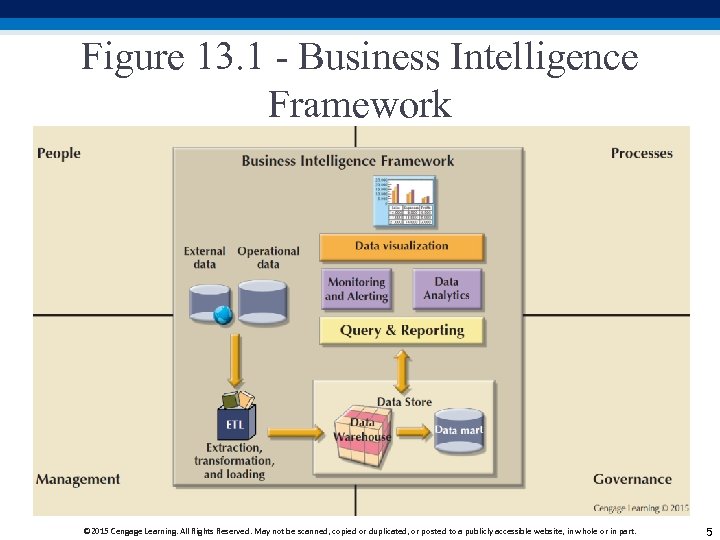
Figure 13. 1 - Business Intelligence Framework © 2015 Cengage Learning. All Rights Reserved. May not be scanned, copied or duplicated, or posted to a publicly accessible website, in whole or in part. 5
Business Intelligence Tools § Dashboards and business activity monitoring § Dashboards: Shows key business performance indicators in a single integrated view § Portals: Integrate data using web browser from multiple sources into a single webpage § Data analysis and reporting tools § Data-mining tools § Data warehouses (DW) § OLAP tools and data visualization © 2015 Cengage Learning. All Rights Reserved. May not be scanned, copied or duplicated, or posted to a publicly accessible website, in whole or in part. 6
Practices to Manage Data § Master data management (MDM): Collection of concepts, techniques, and processes for identification, definition, and management of data elements § Governance: Method of government for controlling business health and for consistent decision making § Key performance indicators (KPI): Numeric or scale-based measurements that assess company’s effectiveness in reaching its goals © 2015 Cengage Learning. All Rights Reserved. May not be scanned, copied or duplicated, or posted to a publicly accessible website, in whole or in part. 7
Practices to Manage Data § Data visualization: Abstracting data to provide information in a visual format § Enhances the user’s ability to efficiently comprehend the meaning of the data § Techniques § Pie charts and bar charts § Line graphs § Scatter plots § Gantt charts § Heat maps © 2015 Cengage Learning. All Rights Reserved. May not be scanned, copied or duplicated, or posted to a publicly accessible website, in whole or in part. 8
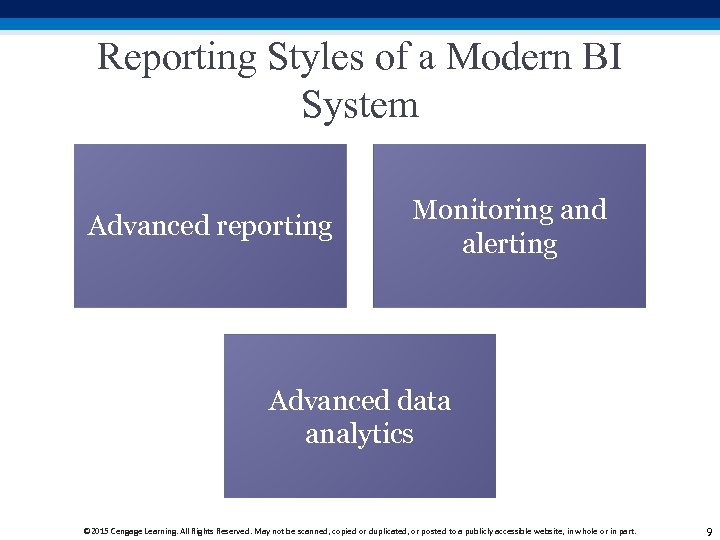
Reporting Styles of a Modern BI System Advanced reporting Monitoring and alerting Advanced data analytics © 2015 Cengage Learning. All Rights Reserved. May not be scanned, copied or duplicated, or posted to a publicly accessible website, in whole or in part. 9
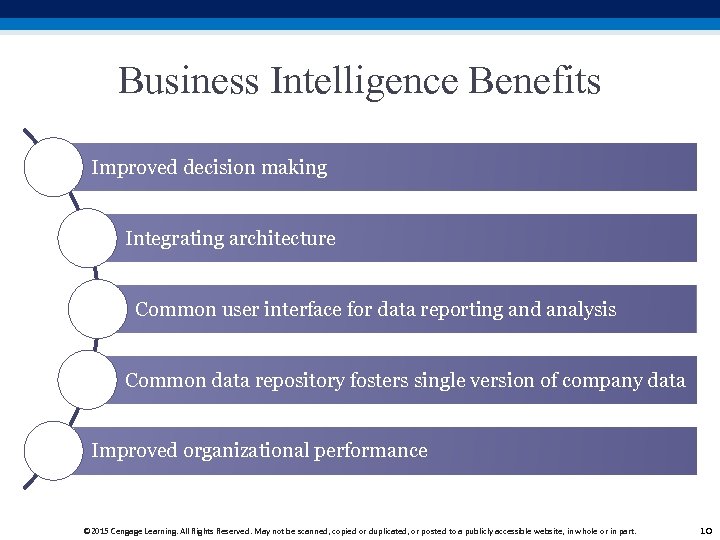
Business Intelligence Benefits Improved decision making Integrating architecture Common user interface for data reporting and analysis Common data repository fosters single version of company data Improved organizational performance © 2015 Cengage Learning. All Rights Reserved. May not be scanned, copied or duplicated, or posted to a publicly accessible website, in whole or in part. 10
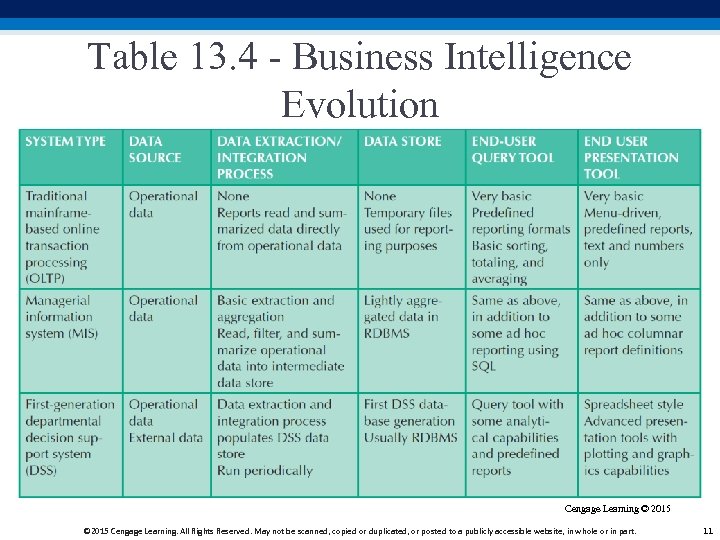
Table 13. 4 - Business Intelligence Evolution Cengage Learning © 2015 Cengage Learning. All Rights Reserved. May not be scanned, copied or duplicated, or posted to a publicly accessible website, in whole or in part. 11
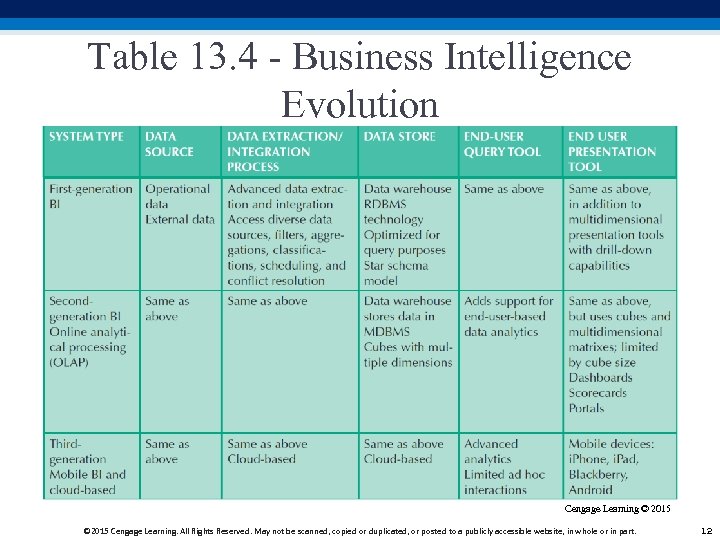
Table 13. 4 - Business Intelligence Evolution Cengage Learning © 2015 Cengage Learning. All Rights Reserved. May not be scanned, copied or duplicated, or posted to a publicly accessible website, in whole or in part. 12
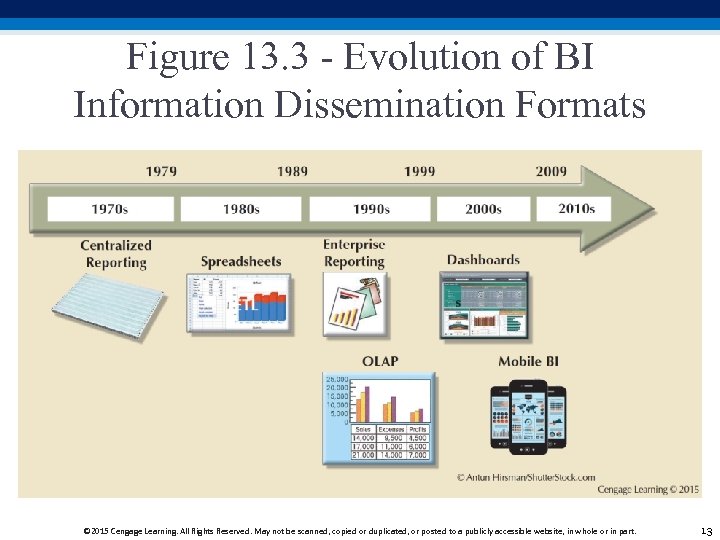
Figure 13. 3 - Evolution of BI Information Dissemination Formats © 2015 Cengage Learning. All Rights Reserved. May not be scanned, copied or duplicated, or posted to a publicly accessible website, in whole or in part. 13
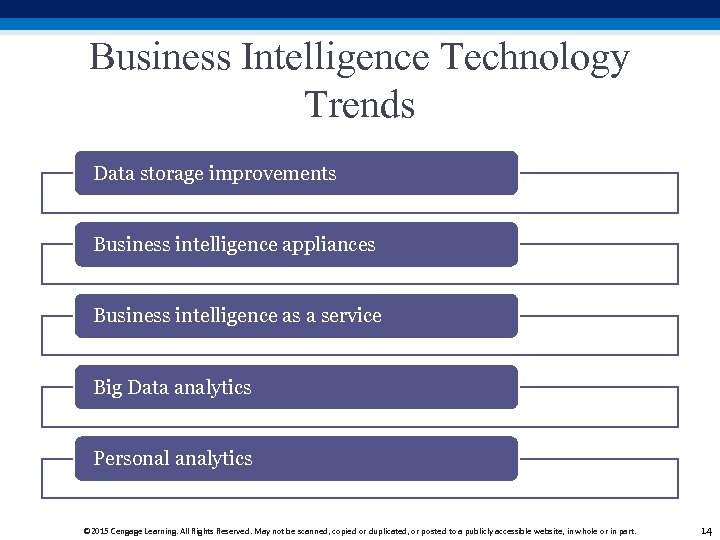
Business Intelligence Technology Trends Data storage improvements Business intelligence appliances Business intelligence as a service Big Data analytics Personal analytics © 2015 Cengage Learning. All Rights Reserved. May not be scanned, copied or duplicated, or posted to a publicly accessible website, in whole or in part. 14
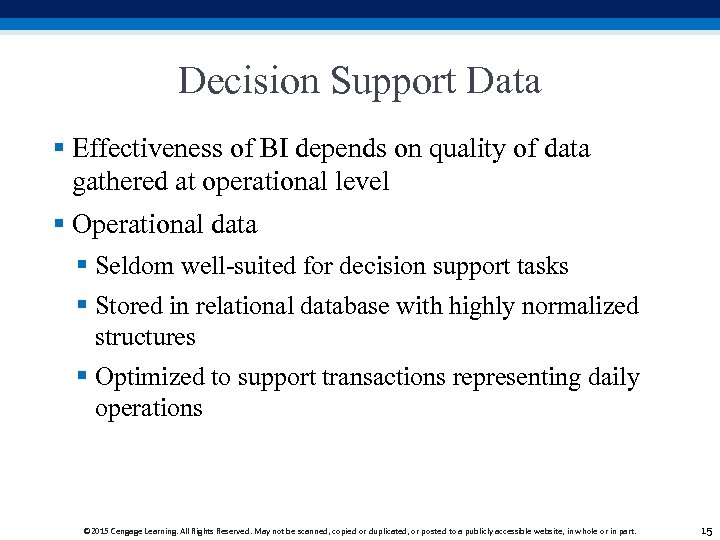
Decision Support Data § Effectiveness of BI depends on quality of data gathered at operational level § Operational data § Seldom well-suited for decision support tasks § Stored in relational database with highly normalized structures § Optimized to support transactions representing daily operations © 2015 Cengage Learning. All Rights Reserved. May not be scanned, copied or duplicated, or posted to a publicly accessible website, in whole or in part. 15
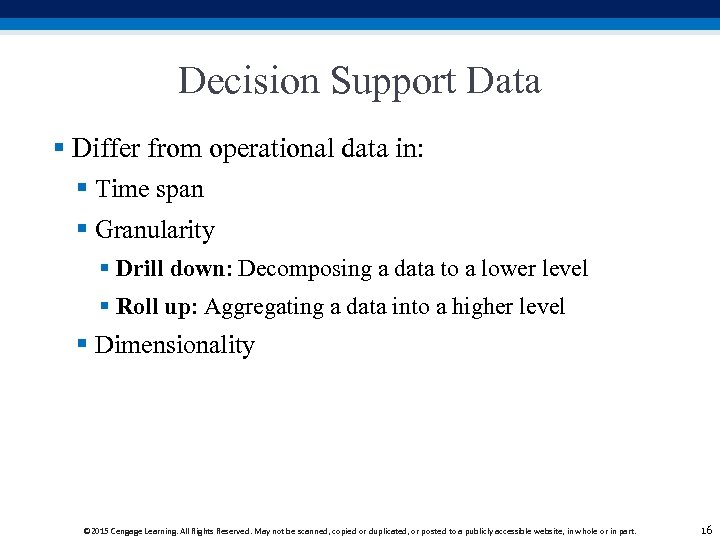
Decision Support Data § Differ from operational data in: § Time span § Granularity § Drill down: Decomposing a data to a lower level § Roll up: Aggregating a data into a higher level § Dimensionality © 2015 Cengage Learning. All Rights Reserved. May not be scanned, copied or duplicated, or posted to a publicly accessible website, in whole or in part. 16
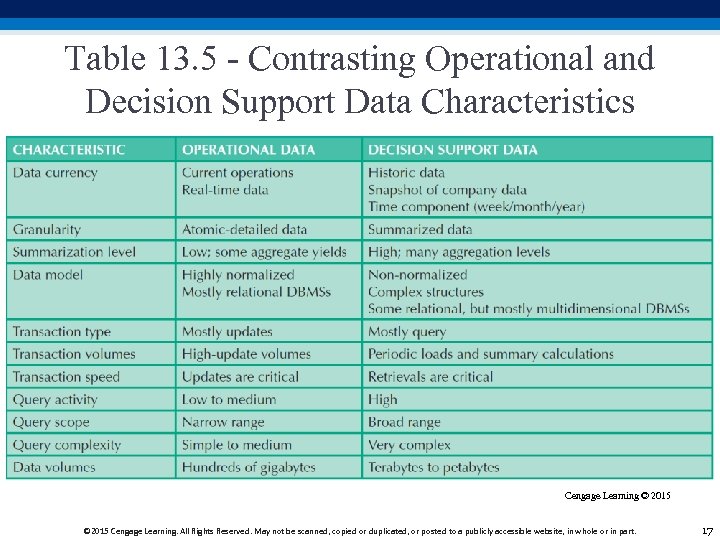
Table 13. 5 - Contrasting Operational and Decision Support Data Characteristics Cengage Learning © 2015 Cengage Learning. All Rights Reserved. May not be scanned, copied or duplicated, or posted to a publicly accessible website, in whole or in part. 17
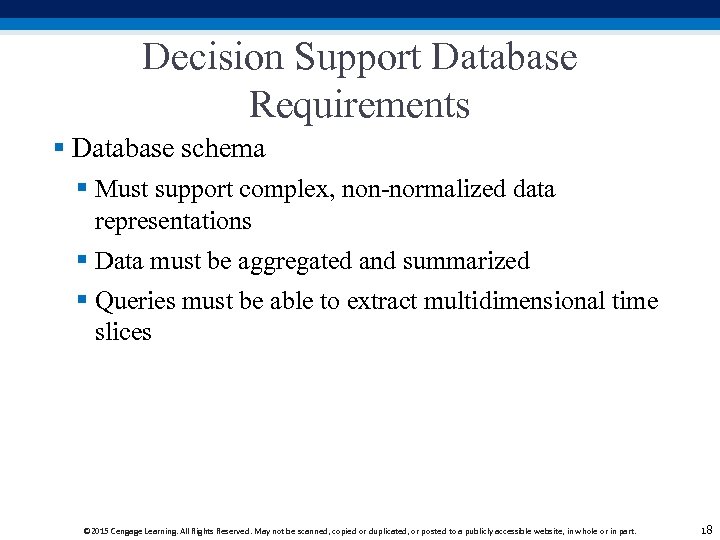
Decision Support Database Requirements § Database schema § Must support complex, non-normalized data representations § Data must be aggregated and summarized § Queries must be able to extract multidimensional time slices © 2015 Cengage Learning. All Rights Reserved. May not be scanned, copied or duplicated, or posted to a publicly accessible website, in whole or in part. 18
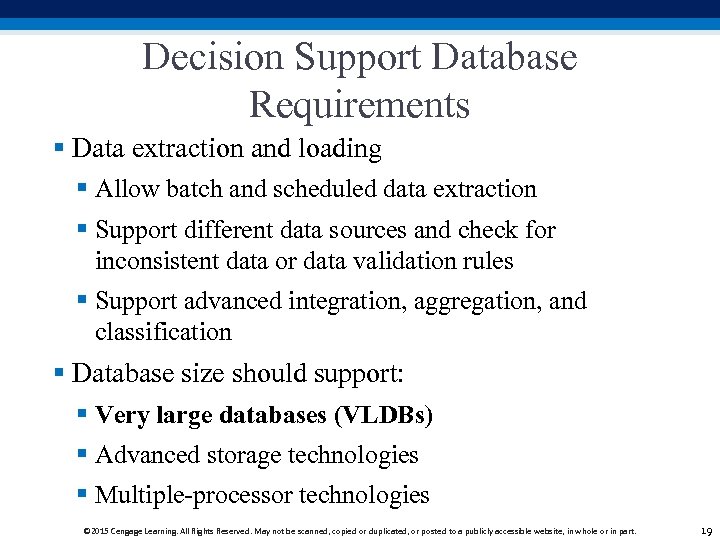
Decision Support Database Requirements § Data extraction and loading § Allow batch and scheduled data extraction § Support different data sources and check for inconsistent data or data validation rules § Support advanced integration, aggregation, and classification § Database size should support: § Very large databases (VLDBs) § Advanced storage technologies § Multiple-processor technologies © 2015 Cengage Learning. All Rights Reserved. May not be scanned, copied or duplicated, or posted to a publicly accessible website, in whole or in part. 19
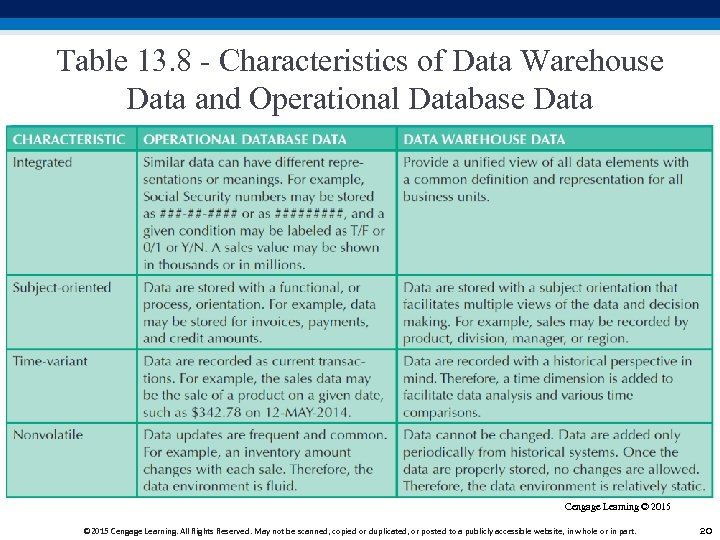
Table 13. 8 - Characteristics of Data Warehouse Data and Operational Database Data Cengage Learning © 2015 Cengage Learning. All Rights Reserved. May not be scanned, copied or duplicated, or posted to a publicly accessible website, in whole or in part. 20
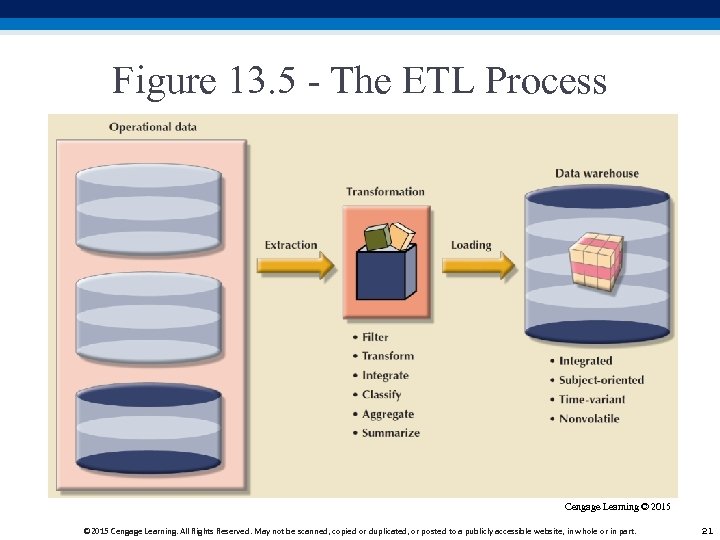
Figure 13. 5 - The ETL Process Cengage Learning © 2015 Cengage Learning. All Rights Reserved. May not be scanned, copied or duplicated, or posted to a publicly accessible website, in whole or in part. 21
Data Marts § Small, single-subject data warehouse subset § Provide decision support to a small group of people § Benefits over data warehouses § Lower cost and shorter implementation time § Technologically advanced § Inevitable people issues © 2015 Cengage Learning. All Rights Reserved. May not be scanned, copied or duplicated, or posted to a publicly accessible website, in whole or in part. 22
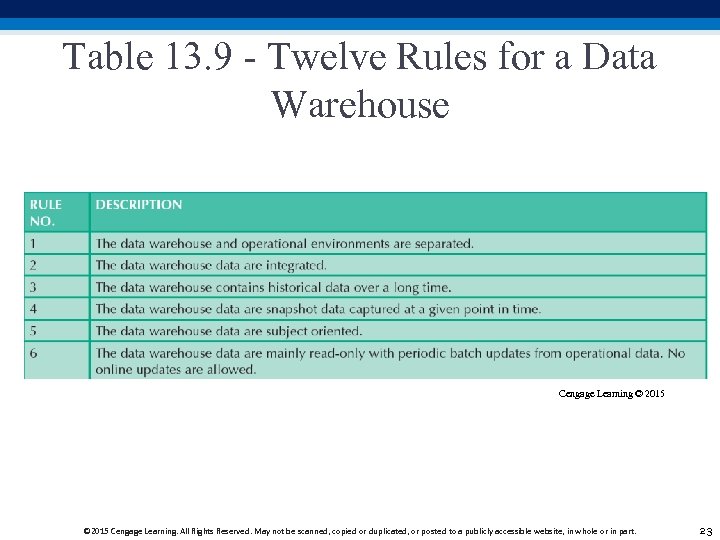
Table 13. 9 - Twelve Rules for a Data Warehouse Cengage Learning © 2015 Cengage Learning. All Rights Reserved. May not be scanned, copied or duplicated, or posted to a publicly accessible website, in whole or in part. 23
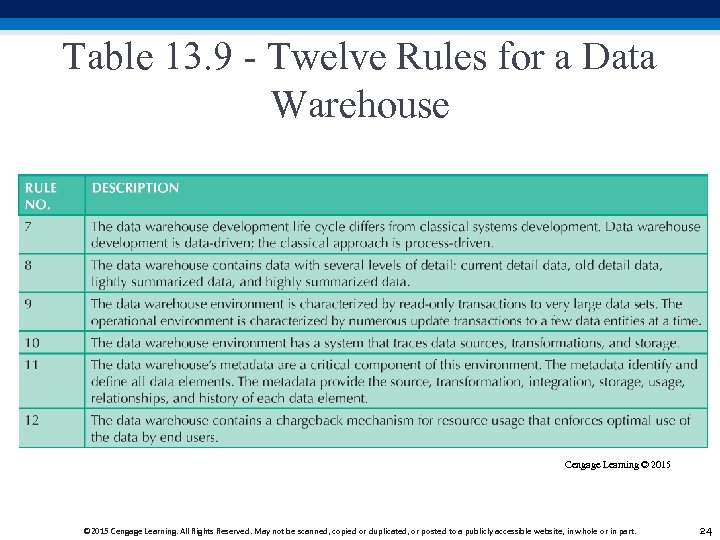
Table 13. 9 - Twelve Rules for a Data Warehouse Cengage Learning © 2015 Cengage Learning. All Rights Reserved. May not be scanned, copied or duplicated, or posted to a publicly accessible website, in whole or in part. 24
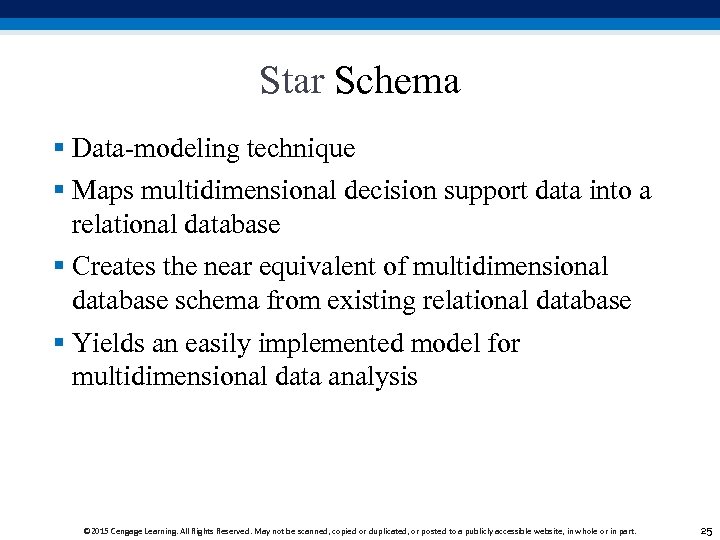
Star Schema § Data-modeling technique § Maps multidimensional decision support data into a relational database § Creates the near equivalent of multidimensional database schema from existing relational database § Yields an easily implemented model for multidimensional data analysis © 2015 Cengage Learning. All Rights Reserved. May not be scanned, copied or duplicated, or posted to a publicly accessible website, in whole or in part. 25
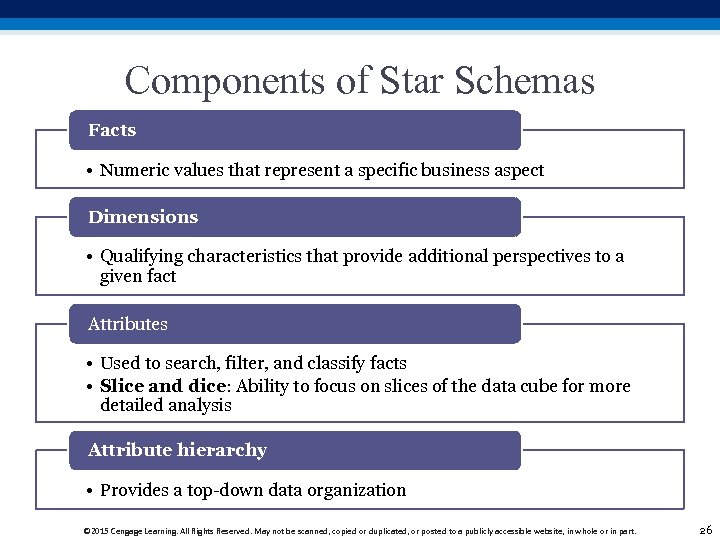
Components of Star Schemas Facts • Numeric values that represent a specific business aspect Dimensions • Qualifying characteristics that provide additional perspectives to a given fact Attributes • Used to search, filter, and classify facts • Slice and dice: Ability to focus on slices of the data cube for more detailed analysis Attribute hierarchy • Provides a top-down data organization © 2015 Cengage Learning. All Rights Reserved. May not be scanned, copied or duplicated, or posted to a publicly accessible website, in whole or in part. 26
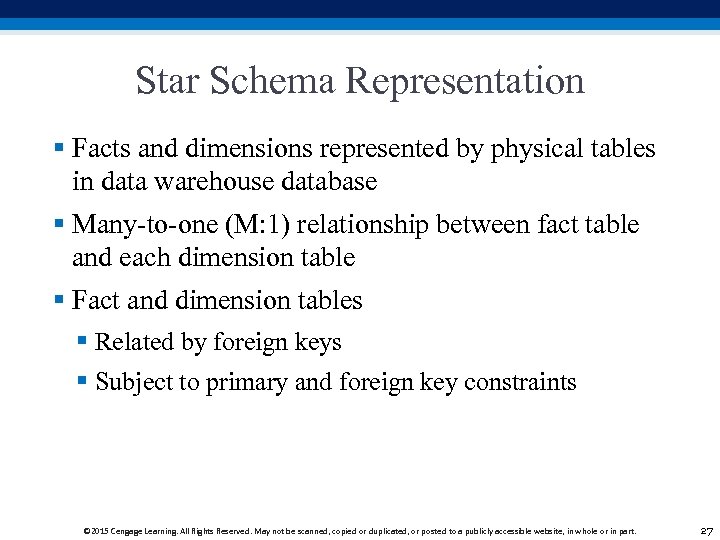
Star Schema Representation § Facts and dimensions represented by physical tables in data warehouse database § Many-to-one (M: 1) relationship between fact table and each dimension table § Fact and dimension tables § Related by foreign keys § Subject to primary and foreign key constraints © 2015 Cengage Learning. All Rights Reserved. May not be scanned, copied or duplicated, or posted to a publicly accessible website, in whole or in part. 27
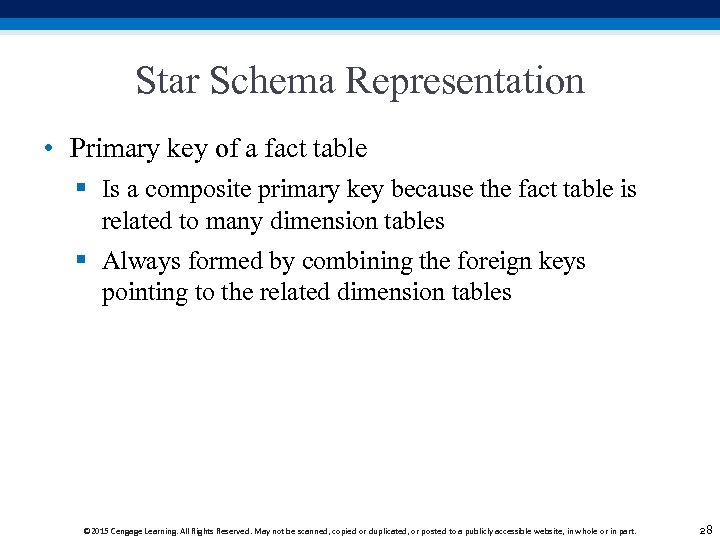
Star Schema Representation • Primary key of a fact table § Is a composite primary key because the fact table is related to many dimension tables § Always formed by combining the foreign keys pointing to the related dimension tables © 2015 Cengage Learning. All Rights Reserved. May not be scanned, copied or duplicated, or posted to a publicly accessible website, in whole or in part. 28
Techniques Used to Optimize Data Warehouse Design § Normalizing dimensional tables § Snowflake schema: Dimension tables can have their own dimension tables § Maintaining multiple fact tables to represent different aggregation levels § Denormalizing fact tables © 2015 Cengage Learning. All Rights Reserved. May not be scanned, copied or duplicated, or posted to a publicly accessible website, in whole or in part. 29
Techniques Used to Optimize Data Warehouse Design § Partitioning and replicating tables § Partitioning: Splits tables into subsets of rows or columns and places them close to customer location § Replication: Makes copy of table and places it in a different location § Periodicity: Provides information about the time span of the data stored in the table © 2015 Cengage Learning. All Rights Reserved. May not be scanned, copied or duplicated, or posted to a publicly accessible website, in whole or in part. 30
Data Analytics § Encompasses a wide range of mathematical, statistical, and modeling techniques to extract knowledge from data § Subset of BI functionality § Classification of tools § Explanatory analytics: Focuses on discovering and explaining data characteristics and relationships based on existing data § Predictive analytics: Focuses on predicting future outcomes with a high degree of accuracy © 2015 Cengage Learning. All Rights Reserved. May not be scanned, copied or duplicated, or posted to a publicly accessible website, in whole or in part. 31
Data Mining § Analyzing massive amounts of data to: § Uncover hidden trends, patterns, and relationships § Form computer models to stimulate and explain the findings § Use the models to support business decision making § Run in two modes § Guided § Automated © 2015 Cengage Learning. All Rights Reserved. May not be scanned, copied or duplicated, or posted to a publicly accessible website, in whole or in part. 32
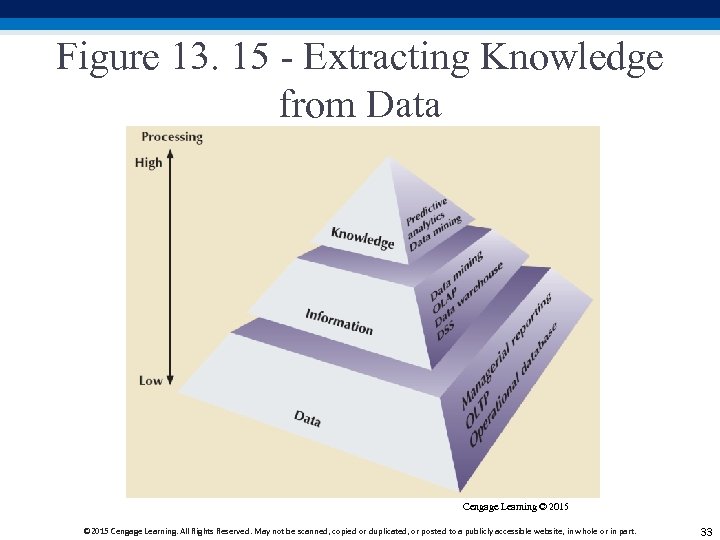
Figure 13. 15 - Extracting Knowledge from Data Cengage Learning © 2015 Cengage Learning. All Rights Reserved. May not be scanned, copied or duplicated, or posted to a publicly accessible website, in whole or in part. 33
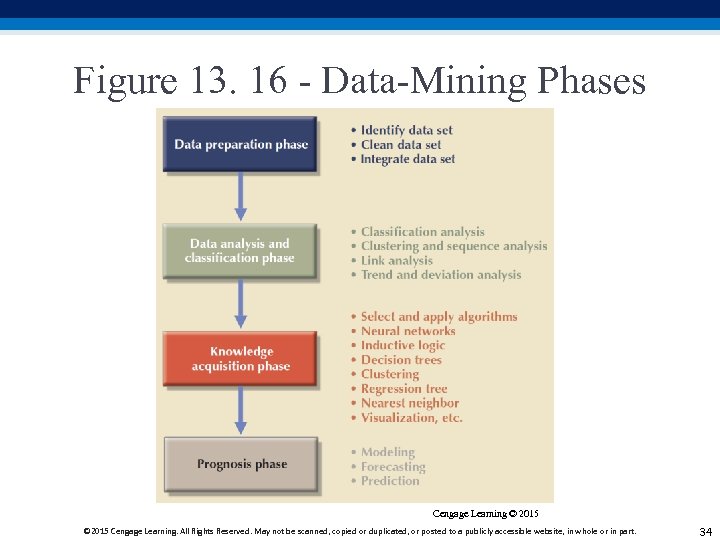
Figure 13. 16 - Data-Mining Phases Cengage Learning © 2015 Cengage Learning. All Rights Reserved. May not be scanned, copied or duplicated, or posted to a publicly accessible website, in whole or in part. 34
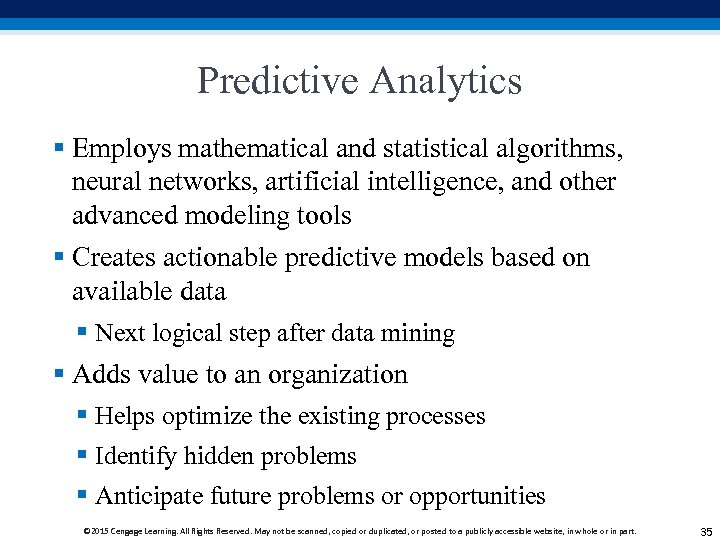
Predictive Analytics § Employs mathematical and statistical algorithms, neural networks, artificial intelligence, and other advanced modeling tools § Creates actionable predictive models based on available data § Next logical step after data mining § Adds value to an organization § Helps optimize the existing processes § Identify hidden problems § Anticipate future problems or opportunities © 2015 Cengage Learning. All Rights Reserved. May not be scanned, copied or duplicated, or posted to a publicly accessible website, in whole or in part. 35
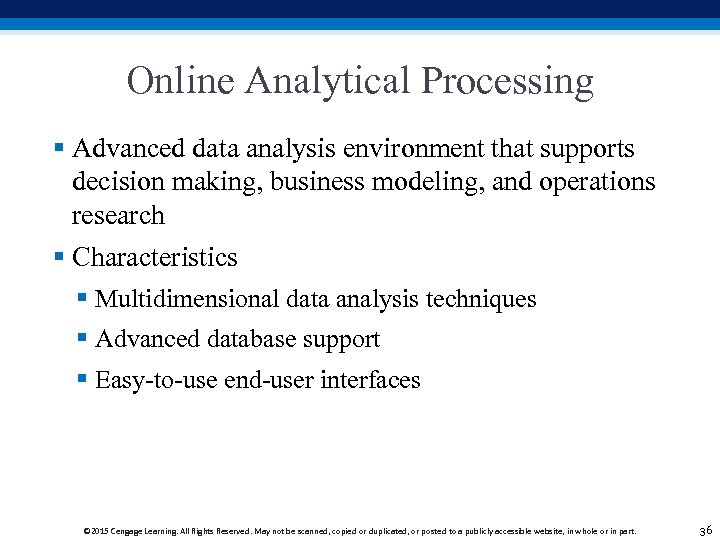
Online Analytical Processing § Advanced data analysis environment that supports decision making, business modeling, and operations research § Characteristics § Multidimensional data analysis techniques § Advanced database support § Easy-to-use end-user interfaces © 2015 Cengage Learning. All Rights Reserved. May not be scanned, copied or duplicated, or posted to a publicly accessible website, in whole or in part. 36
Multidimensional Data Analysis Techniques § Data are processed and viewed as part of a multidimensional structure § Augmenting functions § Advanced data presentation functions § Advanced data aggregation, consolidation, and classification functions § Advanced computational functions § Advanced data-modeling functions © 2015 Cengage Learning. All Rights Reserved. May not be scanned, copied or duplicated, or posted to a publicly accessible website, in whole or in part. 37
Advanced Database Support § Advanced data access features § Access to many different kinds of DBMSs, flat files, and internal and external data sources § Access to aggregated data warehouse data and to the detail data found in operational databases § Advanced data navigation features § Rapid and consistent query response times § Ability to map end-user requests to appropriate data source and to proper data access language § Support for very large databases © 2015 Cengage Learning. All Rights Reserved. May not be scanned, copied or duplicated, or posted to a publicly accessible website, in whole or in part. 38
Easy-to-Use End-User Interface § Proper implementation leads to simple navigation and accelerated decision making or data analysis § Advanced OLAP features are more useful when access is kept simple § Many interface features are borrowed from previous generations of data analysis tools © 2015 Cengage Learning. All Rights Reserved. May not be scanned, copied or duplicated, or posted to a publicly accessible website, in whole or in part. 39
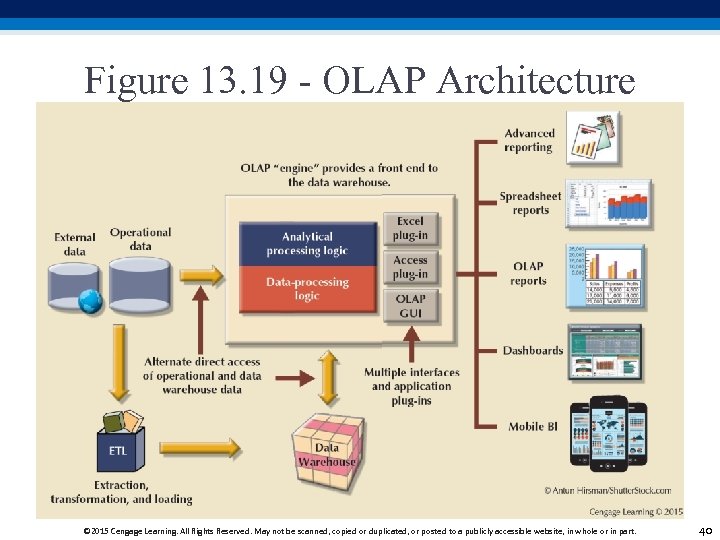
Figure 13. 19 - OLAP Architecture © 2015 Cengage Learning. All Rights Reserved. May not be scanned, copied or duplicated, or posted to a publicly accessible website, in whole or in part. 40
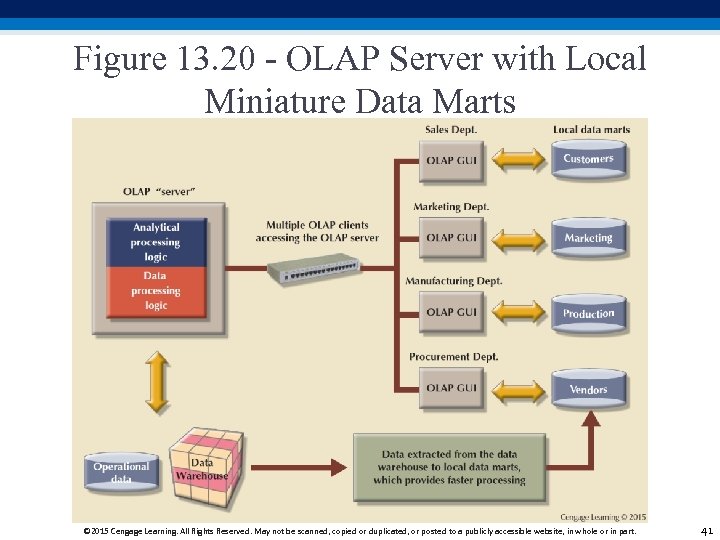
Figure 13. 20 - OLAP Server with Local Miniature Data Marts © 2015 Cengage Learning. All Rights Reserved. May not be scanned, copied or duplicated, or posted to a publicly accessible website, in whole or in part. 41
Relational Online Analytical Processing (ROLAP) § Provides OLAP functionality using relational databases and familiar relational tools to store and analyze multidimensional data § Extensions added to traditional RDBMS technology § Multidimensional data schema support within the RDBMS § Data access language and query performance optimized for multidimensional data § Support for very large databases (VLDBs) © 2015 Cengage Learning. All Rights Reserved. May not be scanned, copied or duplicated, or posted to a publicly accessible website, in whole or in part. 42
Multidimensional Online Analytical Processing (MOLAP) § Extends OLAP functionality to multidimensional database management systems (MDBMSs) § MDBMS: Uses proprietary techniques store data in matrix-like n-dimensional arrays § End users visualize stored data as a 3 D data cube § Grow to n dimensions, becoming hypercubes § Held in memory in a cube cache to speed access § Sparsity: Measures the density of the data held in the data cube © 2015 Cengage Learning. All Rights Reserved. May not be scanned, copied or duplicated, or posted to a publicly accessible website, in whole or in part. 43
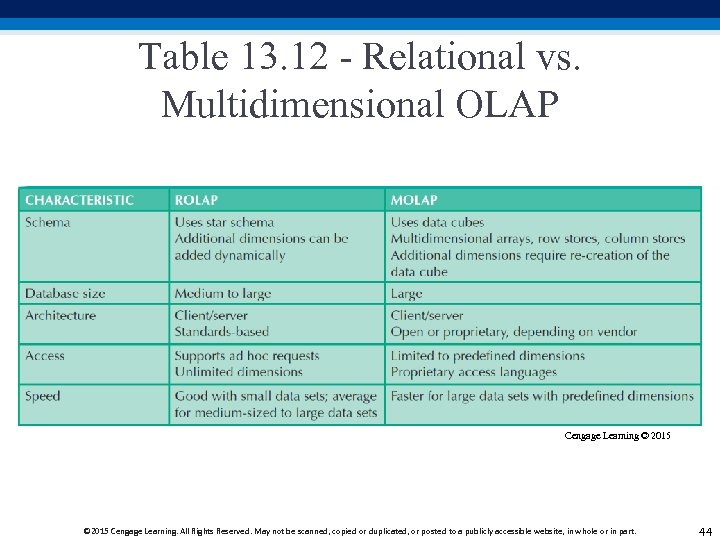
Table 13. 12 - Relational vs. Multidimensional OLAP Cengage Learning © 2015 Cengage Learning. All Rights Reserved. May not be scanned, copied or duplicated, or posted to a publicly accessible website, in whole or in part. 44
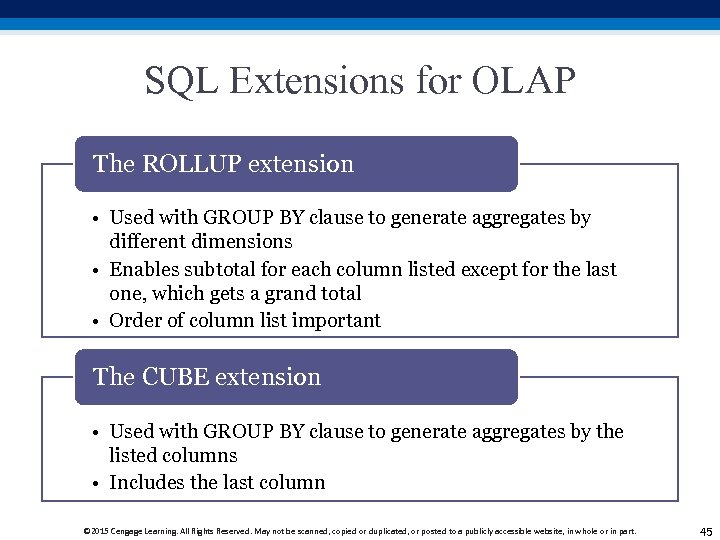
SQL Extensions for OLAP The ROLLUP extension • Used with GROUP BY clause to generate aggregates by different dimensions • Enables subtotal for each column listed except for the last one, which gets a grand total • Order of column list important The CUBE extension • Used with GROUP BY clause to generate aggregates by the listed columns • Includes the last column © 2015 Cengage Learning. All Rights Reserved. May not be scanned, copied or duplicated, or posted to a publicly accessible website, in whole or in part. 45
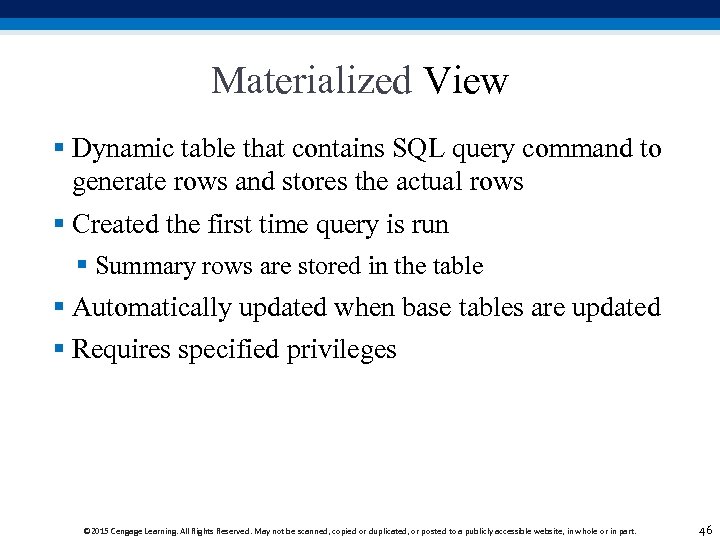
Materialized View § Dynamic table that contains SQL query command to generate rows and stores the actual rows § Created the first time query is run § Summary rows are stored in the table § Automatically updated when base tables are updated § Requires specified privileges © 2015 Cengage Learning. All Rights Reserved. May not be scanned, copied or duplicated, or posted to a publicly accessible website, in whole or in part. 46
Скачать презентацию 11 e Database Systems Design Implementation and Management
640f519d5b6997ef8608a69c633beafb.ppt