


 Скачать презентацию 100 years of living science Strategic Planning Imperial
fdd6a917e80717af918331653a2faa4e.ppt
- Количество слайдов: 25
 100 years of living science Strategic Planning Imperial College: Rees Rawlings Pro Rector (Educational Quality) 23 March 2007 7 May 2007
 Outline of Presentation v Introduction to Imperial College v. Organisation v. Mission/Strategic Intents v. College Strategic Plan v. Learning and Teaching Strategy v. Finance and Planning Round v. Questions
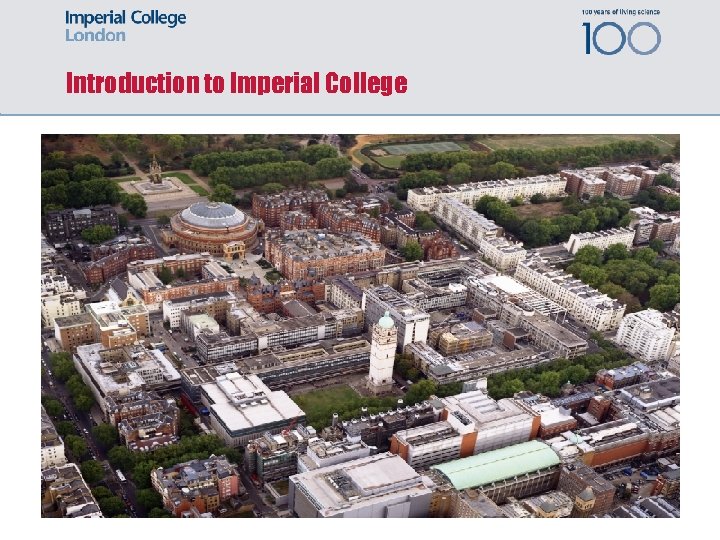 Introduction to Imperial College
 How did we come to exist? v 1851 -1890 – Establishment of Constituent Colleges v Imperial College founded in 1907 through merger of three older institutions: City & Guilds College, Royal College of Science, Royal School of Mines v Mergers with other London Medical Schools: St Mary’s Medical School (1988), National Heart and Lung Institute (1995), Charing Cross/Westminster & Royal Postgraduate Medical Schools (1997) v Merger with Wye College (2000) v Merger with Kennedy Institute of Rheumatology (2000)
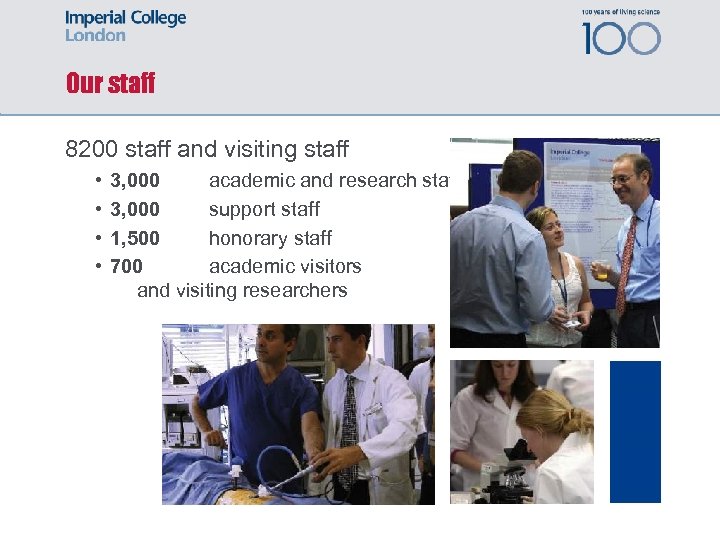 Our staff 8200 staff and visiting staff • • 3, 000 academic and research staff 3, 000 support staff 1, 500 honorary staff 700 academic visitors and visiting researchers
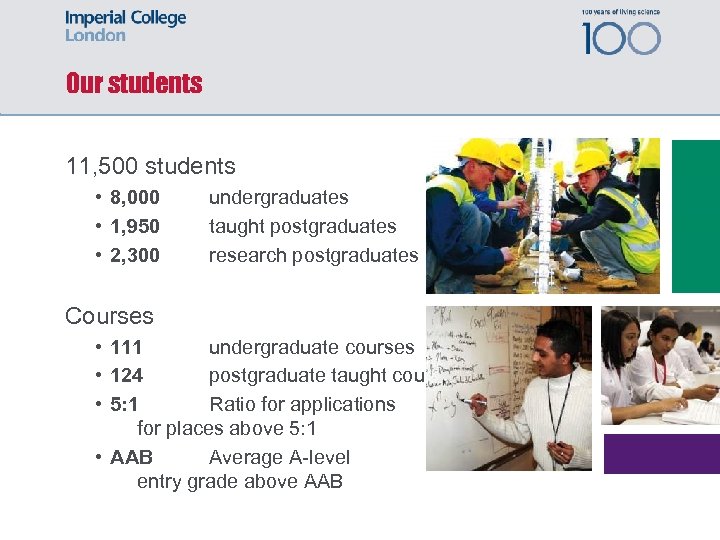 Our students 11, 500 students • 8, 000 • 1, 950 • 2, 300 undergraduates taught postgraduates research postgraduates Courses • 111 undergraduate courses • 124 postgraduate taught courses • 5: 1 Ratio for applications for places above 5: 1 • AAB Average A-level entry grade above AAB
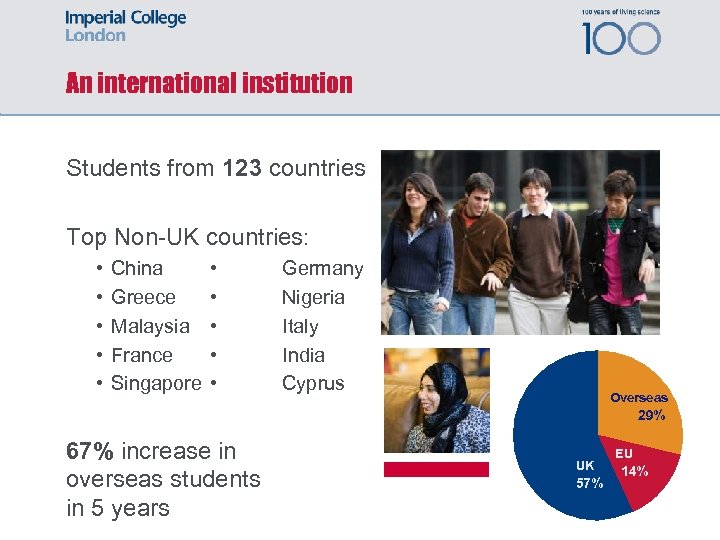 An international institution Students from 123 countries Top Non-UK countries: • • • China Greece Malaysia France Singapore • • • Germany Nigeria Italy India Cyprus Overseas 29% 67% increase in overseas students in 5 years UK 57% EU 14%
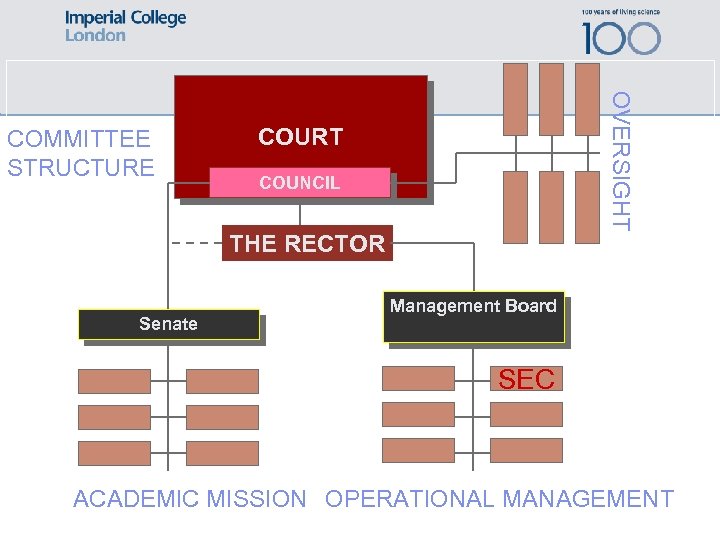 OVERSIGHT COMMITTEE STRUCTURE COURT COUNCIL THE RECTOR Senate Management Board SEC ACADEMIC MISSION OPERATIONAL MANAGEMENT
 Status World Rankings Overall 9 th Engineering 4 th Science 9 th Biomedicine 4 th
 Mission Statement Imperial College London embodies and delivers worldclass scholarship, education and research in science, engineering and medicine, with particular regard to their application in industry, commerce and healthcare. We foster interdisciplinary working internally and collaborate widely externally.
 Strategic Intent v. To remain amongst the top tier of scientific, engineering and medical research and teaching institutions in the world v. To develop our range of academic activities to meet the changing needs of society, industry and healthcare v. To continue to attract and develop the most able students and staff worldwide v. To establish our Business School as one of the leading such institutions in the world v. To communicate widely the significance of science in general, and the purpose and ultimate benefits of our activities in particular
 College Strategic Plan It is constructed using a traditional strategic planning framework to provide a means for managing and communicating necessary and desired changes within the College over the period covered by the plan. “A living document”
 Strategic Plan v The Strategy and Planning Division has the responsibility for producing the College Strategic Plan. v Plan must be consistent with College Mission. v Senior staff are widely consulted. v Plan approval by Management Board. v Plan is for three years. v Required by Higher Education Funding Council for England.
 Learning and Teaching Strategy The Pro Rector (Educational Quality) has the responsibility for producing this Strategy. v Significant input from the Centre for Educational Development. v Also input from Faculties and other sections of College. v Must be consistent with College Strategic Plan. v Plan is for three years. v Required by Higher Educational Funding Council for England. v Approved by Senate. v
 College Strategic Plan (CSP) at higher level than Learning and Teaching Strategy (LTS). Examples of CSP Cap undergraduate student numbers at 8200. Do not expand distance learning programmes. Make the Certificate of Advanced Study in Learning and Teaching mandatory. Examples of LTS Development of online course on information retrieval, plagiarism, etc for postgraduates. CED to make greater use of e-learning in its own practices.
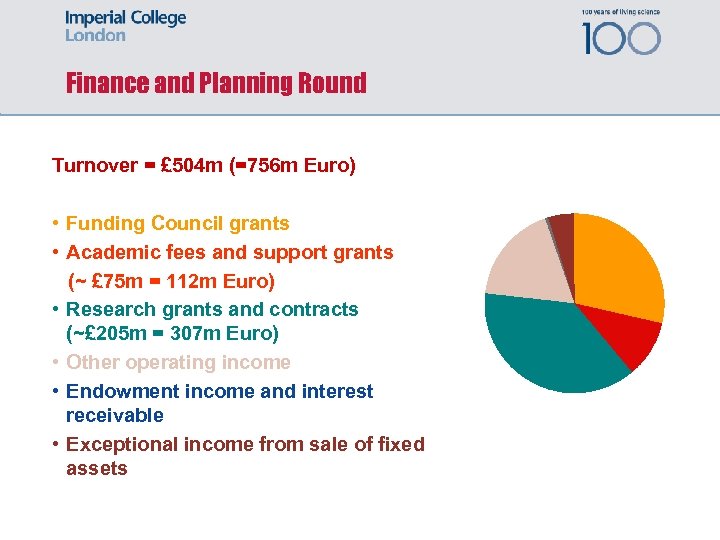 Finance and Planning Round Turnover = £ 504 m (=756 m Euro) • Funding Council grants • Academic fees and support grants (~ £ 75 m = 112 m Euro) • Research grants and contracts (~£ 205 m = 307 m Euro) • Other operating income • Endowment income and interest receivable • Exceptional income from sale of fixed assets
 Planning Round Strategy and Planning has the responsibility to manage the planning process, including the provision of comparative informative, qualitative analysis and advice. Two stages: (i) Planning (ii) Budget
 Planning v Head of Department/Division produces three year plan. v Plan is mainly text with just high level financial figures. v Representatives from the Department/Division meet with a College Panel. v Conclusions from meeting should inform the budget stage
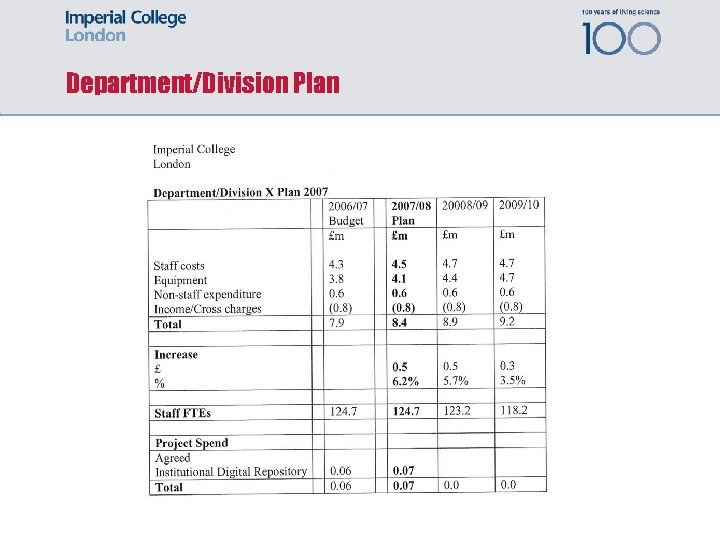 Department/Division Plan
 Budget Stage v A template is supplied by Finance Division with detailed figures for the last two years. v Figures for the next three years are entered by the Department/Division. v Negotiations take place with Strategy & Planning and Finance Divisions. v Department/Division budget finally approved by Management Board and the College budget by Council.
 Quality Assurance and Quality Enhancement Need to demonstrate: v quality of learning and teaching is as good as that of research v continual improvement is quality v teaching and learning is not harming research
 Quality Assurance vquinquennial reviews of undergraduate programmes, posgraduate taught programmes and training of research students v quinquennial Institutional Audit by Quality Assurance Agency v accreditation of programmes by professional bodies v peer review of teaching v annual online student survey of undergraduate and postgraduate students v national survey of final year undergraduates
 Quality Enhancement and Encouragement established the Centre for Educational Development v mandatory Certificate of Advanced Studies in Learning and Teaching (CASLAT) v Supporting Learning and Teaching Programme (SLTP) v higher profile for teaching in promotions v grants for development of and research into teaching v teaching excellence awards and teaching fellowships v honoraria for teaching administration and student support v
 SUMMARY Cannot develop a learning and teaching strategy in isolation.
 Any questions?