


 Скачать презентацию 10 th Annual Technologies for Critical Incident Preparedness
ef31f96e4378213fd4935d2c51434133.ppt
- Количество слайдов: 17
 10 th Annual Technologies for Critical Incident Preparedness Conference & Exposition 2008 Personnel Location and Tracking: Needs, Requirements and Technologies DOD Perspectives Paul Olson, Chief Engineer, Battle Command Division CERDEC / C 2 D Distribution Statement “A” (Approved for Public Release, Distribution Unlimited)
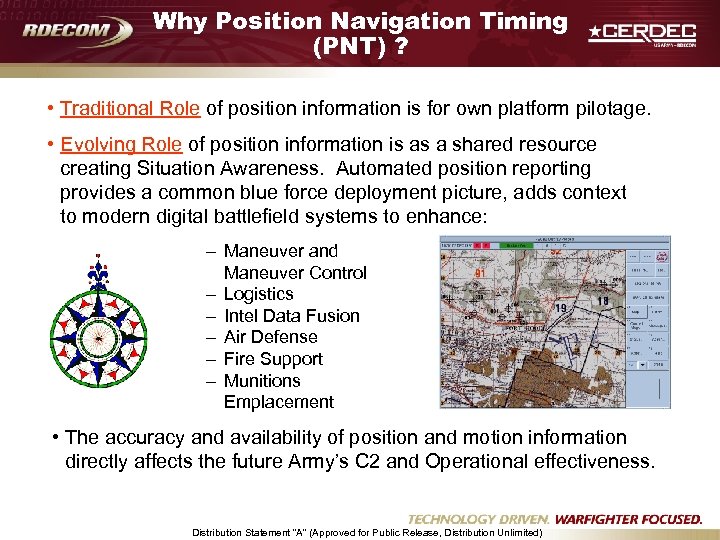 Why Position Navigation Timing (PNT) ? • Traditional Role of position information is for own platform pilotage. • Evolving Role of position information is as a shared resource creating Situation Awareness. Automated position reporting provides a common blue force deployment picture, adds context to modern digital battlefield systems to enhance: – Maneuver and Maneuver Control – Logistics – Intel Data Fusion – Air Defense – Fire Support – Munitions Emplacement • The accuracy and availability of position and motion information directly affects the future Army’s C 2 and Operational effectiveness. Distribution Statement “A” (Approved for Public Release, Distribution Unlimited)
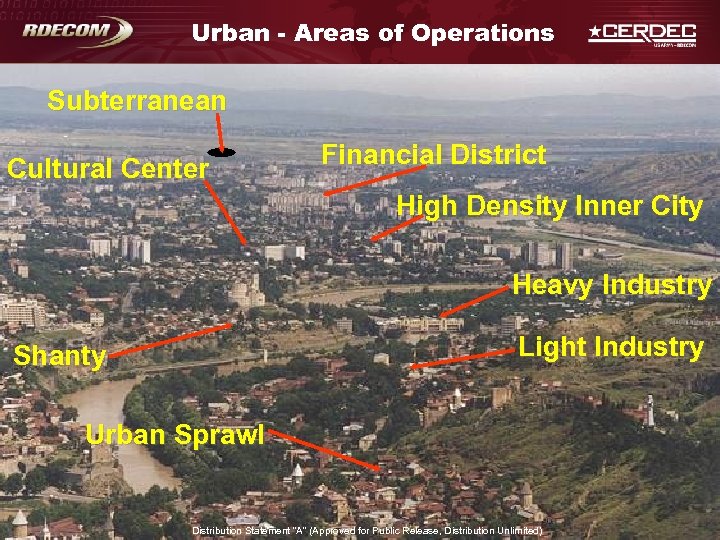 Urban - Areas of Operations Subterranean Cultural Center Financial District High Density Inner City Heavy Industry Light Industry Shanty Urban Sprawl Distribution Statement “A” (Approved for Public Release, Distribution Unlimited)
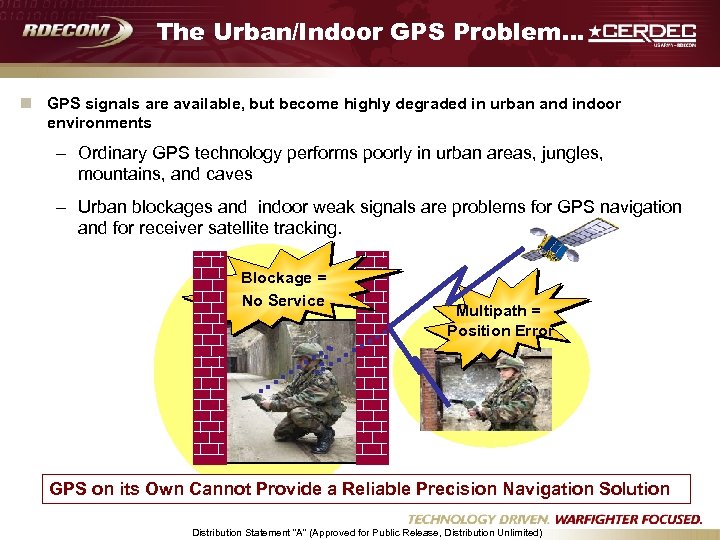 The Urban/Indoor GPS Problem… n GPS signals are available, but become highly degraded in urban and indoor environments – Ordinary GPS technology performs poorly in urban areas, jungles, mountains, and caves – Urban blockages and indoor weak signals are problems for GPS navigation and for receiver satellite tracking. Blockage = No Service Multipath = Position Error GPS on its Own Cannot Provide a Reliable Precision Navigation Solution Distribution Statement “A” (Approved for Public Release, Distribution Unlimited)
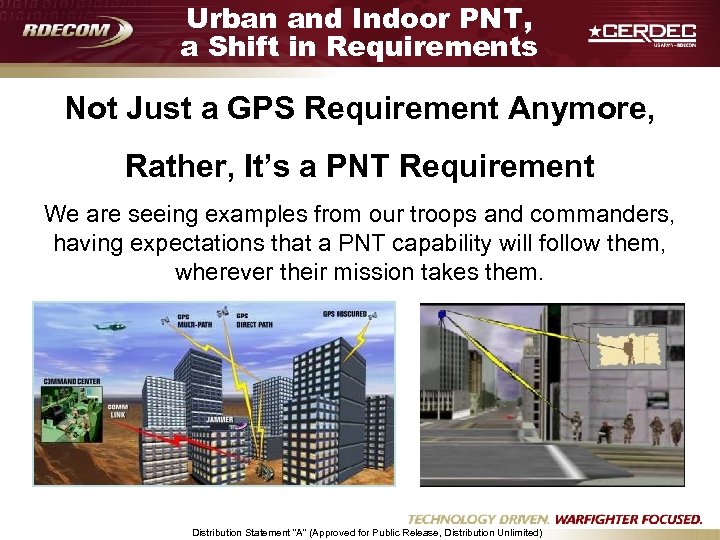 Urban and Indoor PNT, a Shift in Requirements Not Just a GPS Requirement Anymore, Rather, It’s a PNT Requirement We are seeing examples from our troops and commanders, having expectations that a PNT capability will follow them, wherever their mission takes them. Distribution Statement “A” (Approved for Public Release, Distribution Unlimited)
 US Army User Requirements for PNT • TRADOC PAM 525 -66 Force Operating Capabilities – FOC-03 -01: Command Control: (6) – FOC-05 -01: Mounted/Dismounted Maneuver: – FOC-05 -03: Operations in Urban and Complex Terrain: – FOC-06 -01: NLOS Lethality: (13) (e) • Operational Requirements Documents: – Operational Requirements Documents for the Future Combat Systems (FCS) – Land Warrior Capability Development Document (CDD) for Ground Soldier System, Block III Objective requirements can be summed up as “An Affordable Precise PNT Capability for All Environments/Conditions” Distribution Statement “A” (Approved for Public Release, Distribution Unlimited)
 Alternative Technical Options to Improve PNT Robustness • Increase power from GPS satellites • Signal processing improvements • RF Aiding: – Beacons/Pseudolites at the GPS Frequency – RF ranging/aiding systems (TOA, TDOA, RSS, So. OP) – Network aided navigation • Sensor aiding: – Inertial Navigation Systems – Doppler Radar Sensor – Visually Aided Navigation Distribution Statement “A” (Approved for Public Release, Distribution Unlimited)
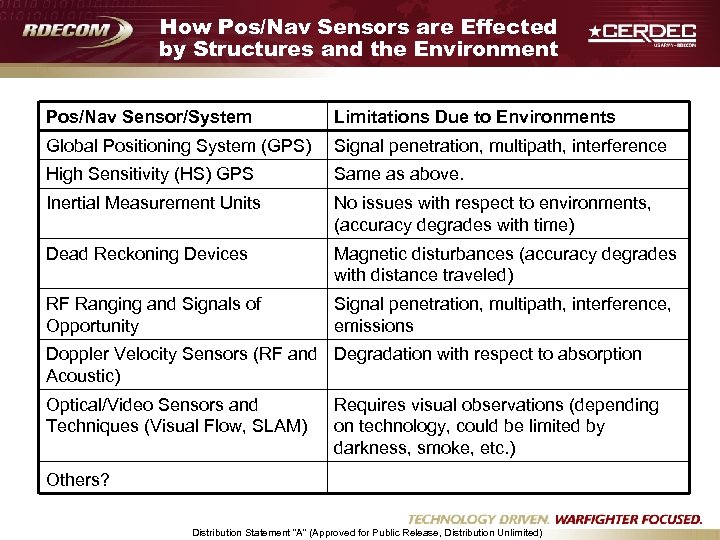 How Pos/Nav Sensors are Effected by Structures and the Environment Pos/Nav Sensor/System Limitations Due to Environments Global Positioning System (GPS) Signal penetration, multipath, interference High Sensitivity (HS) GPS Same as above. Inertial Measurement Units No issues with respect to environments, (accuracy degrades with time) Dead Reckoning Devices Magnetic disturbances (accuracy degrades with distance traveled) RF Ranging and Signals of Opportunity Signal penetration, multipath, interference, emissions Doppler Velocity Sensors (RF and Degradation with respect to absorption Acoustic) Optical/Video Sensors and Techniques (Visual Flow, SLAM) Requires visual observations (depending on technology, could be limited by darkness, smoke, etc. ) Others? Distribution Statement “A” (Approved for Public Release, Distribution Unlimited)
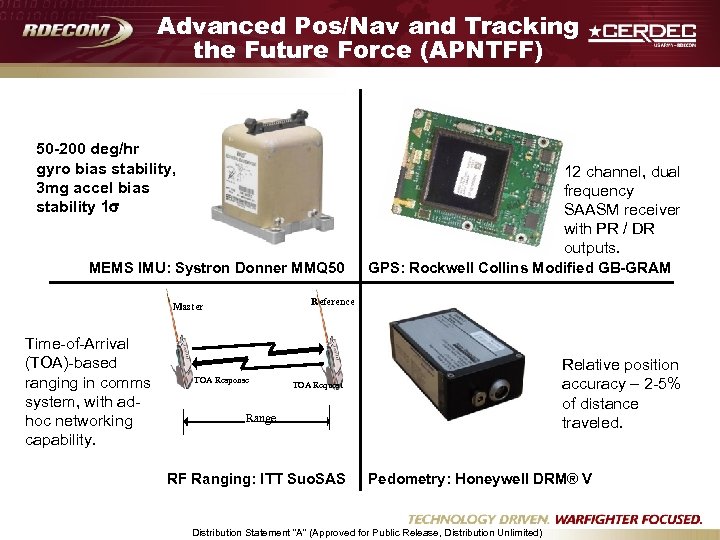 Advanced Pos/Nav and Tracking the Future Force (APNTFF) 50 -200 deg/hr gyro bias stability, 3 mg accel bias stability 1 s 12 channel, dual frequency SAASM receiver with PR / DR outputs. MEMS IMU: Systron Donner MMQ 50 Reference Master Time-of-Arrival (TOA)-based ranging in comms system, with adhoc networking capability. GPS: Rockwell Collins Modified GB-GRAM TOA Response Relative position accuracy – 2 -5% of distance traveled. TOA Request Range RF Ranging: ITT Suo. SAS Pedometry: Honeywell DRM® V Distribution Statement “A” (Approved for Public Release, Distribution Unlimited)
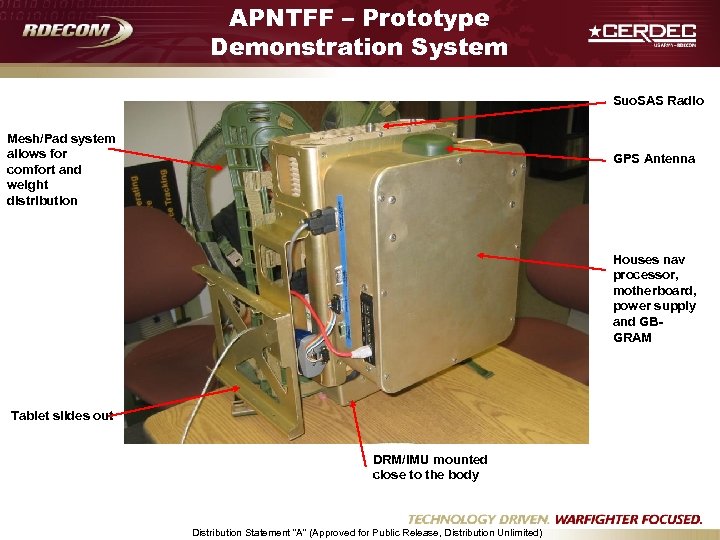 APNTFF – Prototype Demonstration System Suo. SAS Radio Mesh/Pad system allows for comfort and weight distribution GPS Antenna Houses nav processor, motherboard, power supply and GBGRAM Tablet slides out DRM/IMU mounted close to the body Distribution Statement “A” (Approved for Public Release, Distribution Unlimited)
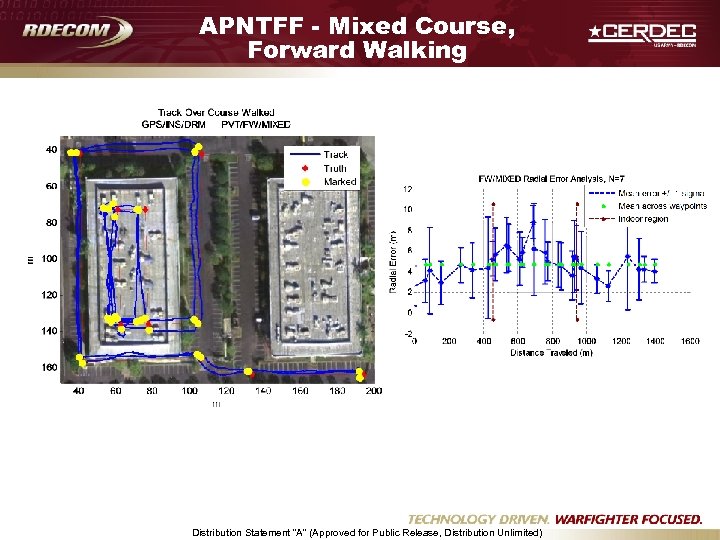 APNTFF - Mixed Course, Forward Walking Distribution Statement “A” (Approved for Public Release, Distribution Unlimited)
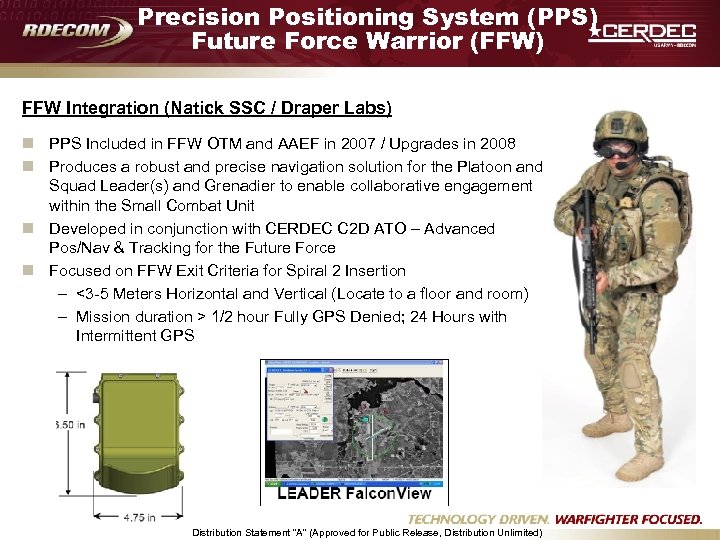 Precision Positioning System (PPS) Future Force Warrior (FFW) FFW Integration (Natick SSC / Draper Labs) n PPS Included in FFW OTM and AAEF in 2007 / Upgrades in 2008 n Produces a robust and precise navigation solution for the Platoon and Squad Leader(s) and Grenadier to enable collaborative engagement within the Small Combat Unit n Developed in conjunction with CERDEC C 2 D ATO – Advanced Pos/Nav & Tracking for the Future Force n Focused on FFW Exit Criteria for Spiral 2 Insertion – <3 -5 Meters Horizontal and Vertical (Locate to a floor and room) – Mission duration > 1/2 hour Fully GPS Denied; 24 Hours with Intermittent GPS Distribution Statement “A” (Approved for Public Release, Distribution Unlimited)
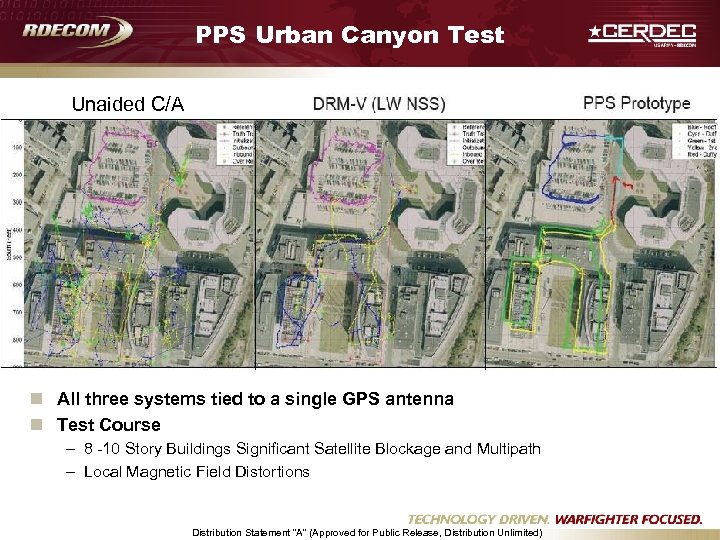 PPS Urban Canyon Test Unaided C/A n All three systems tied to a single GPS antenna n Test Course – 8 -10 Story Buildings Significant Satellite Blockage and Multipath – Local Magnetic Field Distortions Distribution Statement “A” (Approved for Public Release, Distribution Unlimited)
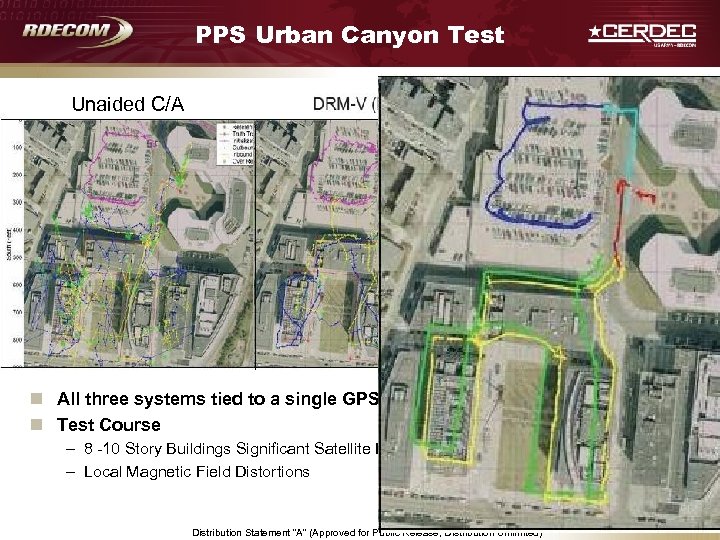 PPS Urban Canyon Test Unaided C/A n All three systems tied to a single GPS antenna n Test Course – 8 -10 Story Buildings Significant Satellite Blockage and Multipath – Local Magnetic Field Distortions Distribution Statement “A” (Approved for Public Release, Distribution Unlimited) Color coding: > 4 satellites blue 3: cyan 2: green 1: yellow 0: red
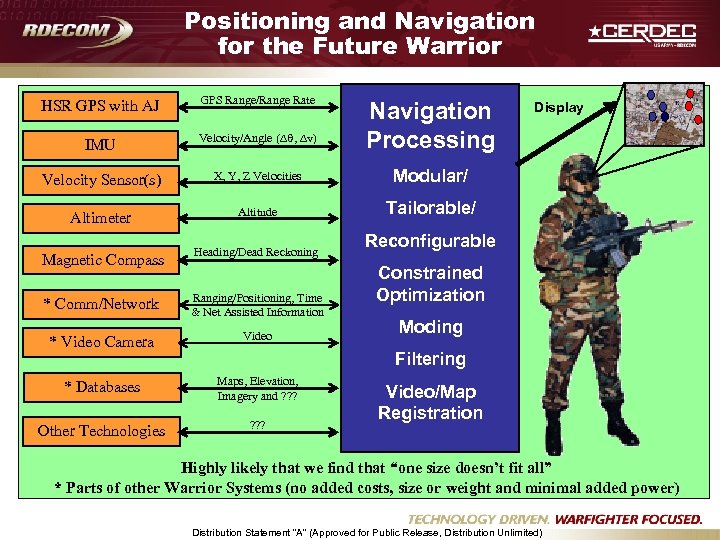 Positioning and Navigation for the Future Warrior HSR GPS with AJ GPS Range/Range Rate IMU Velocity/Angle (Dq, Dv) Velocity Sensor(s) X, Y, Z Velocities Modular/ Altimeter Altitude Tailorable/ Magnetic Compass Heading/Dead Reckoning * Comm/Network Ranging/Positioning, Time & Net Assisted Information * Video Camera Video * Databases Maps, Elevation, Imagery and ? ? ? Other Technologies ? ? ? Navigation Processing Display Reconfigurable Constrained Optimization Moding Filtering Video/Map Registration Highly likely that we find that “one size doesn’t fit all” * Parts of other Warrior Systems (no added costs, size or weight and minimal added power) Distribution Statement “A” (Approved for Public Release, Distribution Unlimited)
 Personnel Location and Tracking: Needs, Requirements and Technologies DOD Perspectives • Positioning, Navigation and Timing (PNT) information is enormously important to the Warfighter, the Commander, and hence to all Command Control. • Size, Weight, Power and Cost have been traditionally the performance limiting factors in PNT equipment and continue to be as we integrate on the Soldier. • Areas for Concentration: User Interfaces (Commander’s and Soldier’s) and the development of standardized metrics, instrumentation systems and test methodology for system evaluation • CERDEC and associate Do. D labs are undergoing efforts to overcome these limiting factors by employing: – Advanced MEMS IMUs – Software GPS Receivers – RF Ranging – Datalinks to Assist GPS Performance – Merging of Communication and Navigation Functions Distribution Statement “A” (Approved for Public Release, Distribution Unlimited)
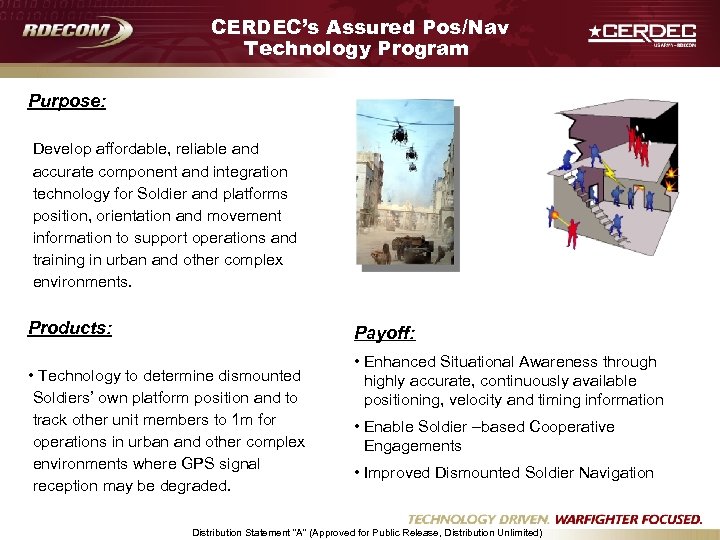 CERDEC’s Assured Pos/Nav Technology Program Purpose: Develop affordable, reliable and accurate component and integration technology for Soldier and platforms position, orientation and movement information to support operations and training in urban and other complex environments. Products: Payoff: • Technology to determine dismounted Soldiers’ own platform position and to track other unit members to 1 m for operations in urban and other complex environments where GPS signal reception may be degraded. • Enhanced Situational Awareness through highly accurate, continuously available positioning, velocity and timing information • Enable Soldier –based Cooperative Engagements • Improved Dismounted Soldier Navigation Distribution Statement “A” (Approved for Public Release, Distribution Unlimited)