


 Скачать презентацию 10 MAINTENANCE Software Engineering Roadmap Chapter 10
bc16848c86d45a0894bbc2b69608aac5.ppt
- Количество слайдов: 58
 10. MAINTENANCE
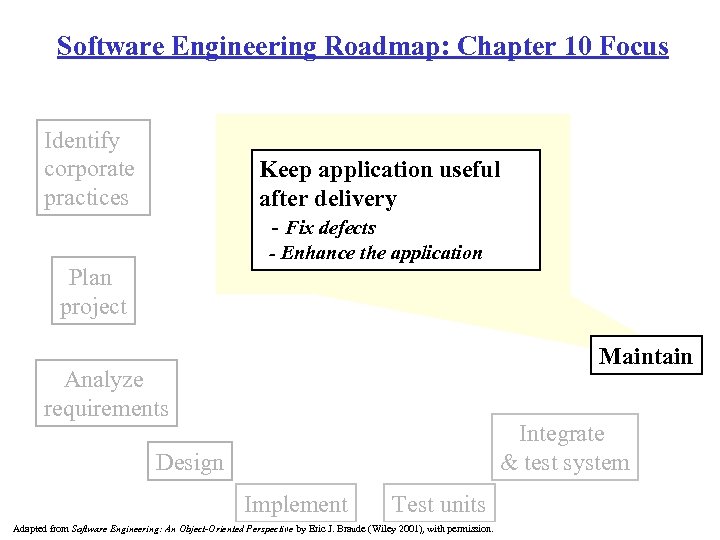 Software Engineering Roadmap: Chapter 10 Focus Identify corporate practices Keep application useful after delivery - Fix defects - Enhance the application Plan project Maintain Analyze requirements Integrate & test system Design Implement Test units Adapted from Software Engineering: An Object-Oriented Perspective by Eric J. Braude (Wiley 2001), with permission.
 Learning Goals of This Chapter $ Development Maintenance • Understand how “Software Maintenance” is defined • Appreciate the cost of maintenance • Understand software maintenance issues • Organize for maintenance • Use IEEE maintenance standard • Apply maintenance metrics Adapted from Software Engineering: An Object-Oriented Perspective by Eric J. Braude (Wiley 2001), with permission.
 1. Introduction
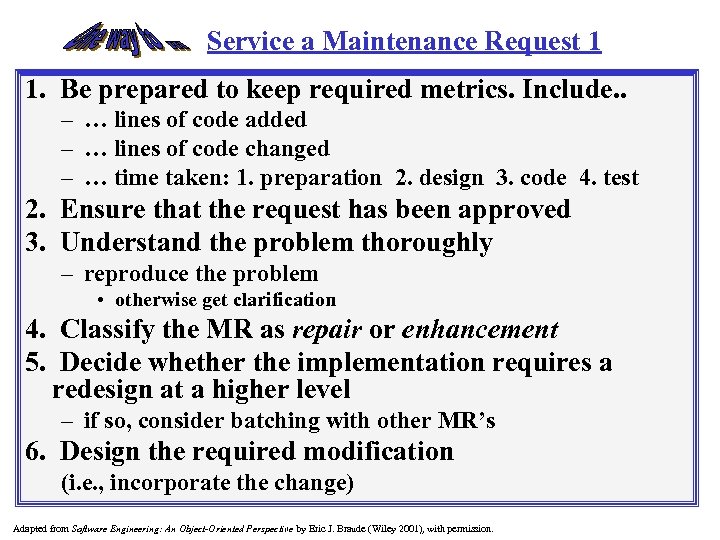 Service a Maintenance Request 1 1. Be prepared to keep required metrics. Include. . – … lines of code added – … lines of code changed – … time taken: 1. preparation 2. design 3. code 4. test 2. Ensure that the request has been approved 3. Understand the problem thoroughly – reproduce the problem • otherwise get clarification 4. Classify the MR as repair or enhancement 5. Decide whether the implementation requires a redesign at a higher level – if so, consider batching with other MR’s 6. Design the required modification (i. e. , incorporate the change) Adapted from Software Engineering: An Object-Oriented Perspective by Eric J. Braude (Wiley 2001), with permission.
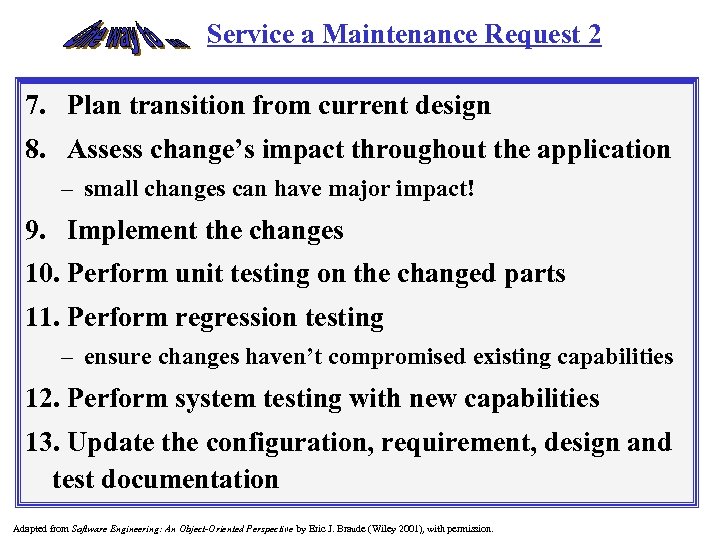 Service a Maintenance Request 2 7. Plan transition from current design 8. Assess change’s impact throughout the application – small changes can have major impact! 9. Implement the changes 10. Perform unit testing on the changed parts 11. Perform regression testing – ensure changes haven’t compromised existing capabilities 12. Perform system testing with new capabilities 13. Update the configuration, requirement, design and test documentation Adapted from Software Engineering: An Object-Oriented Perspective by Eric J. Braude (Wiley 2001), with permission.
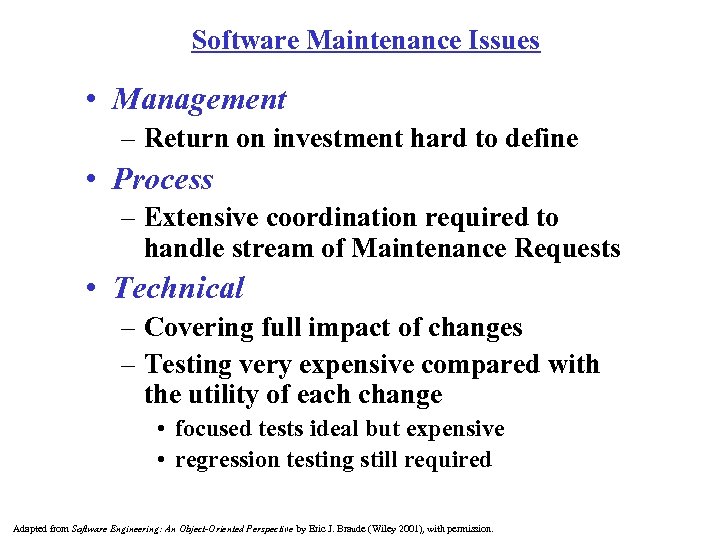 Software Maintenance Issues • Management – Return on investment hard to define • Process – Extensive coordination required to handle stream of Maintenance Requests • Technical – Covering full impact of changes – Testing very expensive compared with the utility of each change • focused tests ideal but expensive • regression testing still required Adapted from Software Engineering: An Object-Oriented Perspective by Eric J. Braude (Wiley 2001), with permission.
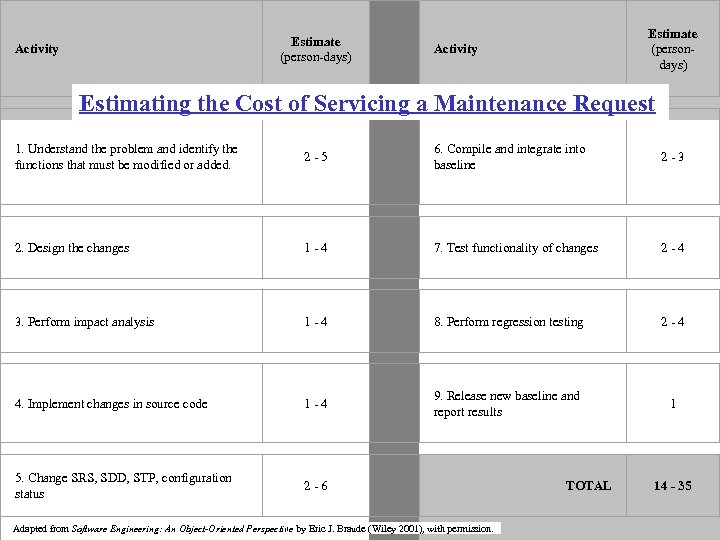 Estimate (person-days) Activity Estimate (persondays) Activity Estimating the Cost of Servicing a Maintenance Request 1. Understand the problem and identify the functions that must be modified or added. 6. Compile and integrate into baseline 2 - 3 7. Test functionality of changes 2 - 4 8. Perform regression testing 2 - 5 2 - 4 9. Release new baseline and report results 1 2. Design the changes 1 - 4 3. Perform impact analysis 1 - 4 4. Implement changes in source code 5. Change SRS, SDD, STP, configuration status 1 - 4 2 - 6 Adapted from Software Engineering: An Object-Oriented Perspective by Eric J. Braude (Wiley 2001), with permission. TOTAL 14 - 35
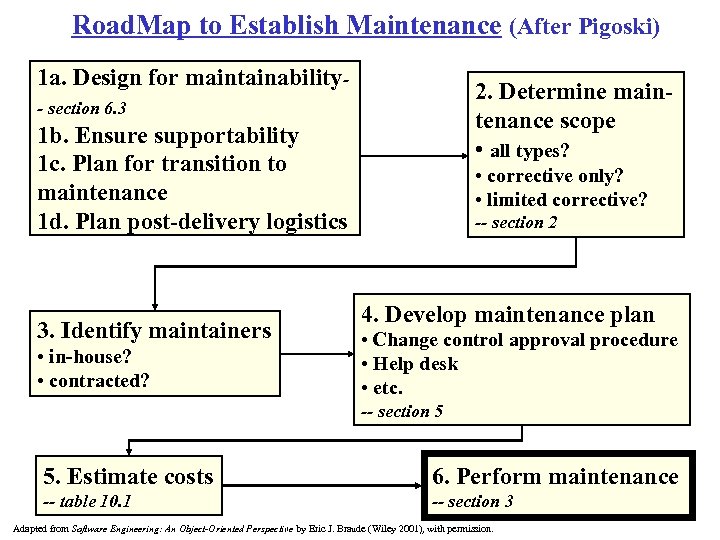 Road. Map to Establish Maintenance (After Pigoski) 1 a. Design for maintainability- section 6. 3 1 b. Ensure supportability 1 c. Plan for transition to maintenance 1 d. Plan post-delivery logistics 3. Identify maintainers • in-house? • contracted? 2. Determine maintenance scope • all types? • corrective only? • limited corrective? -- section 2 4. Develop maintenance plan • Change control approval procedure • Help desk • etc. -- section 5 5. Estimate costs 6. Perform maintenance -- table 10. 1 -- section 3 Adapted from Software Engineering: An Object-Oriented Perspective by Eric J. Braude (Wiley 2001), with permission.
 2. Types of software maintenance
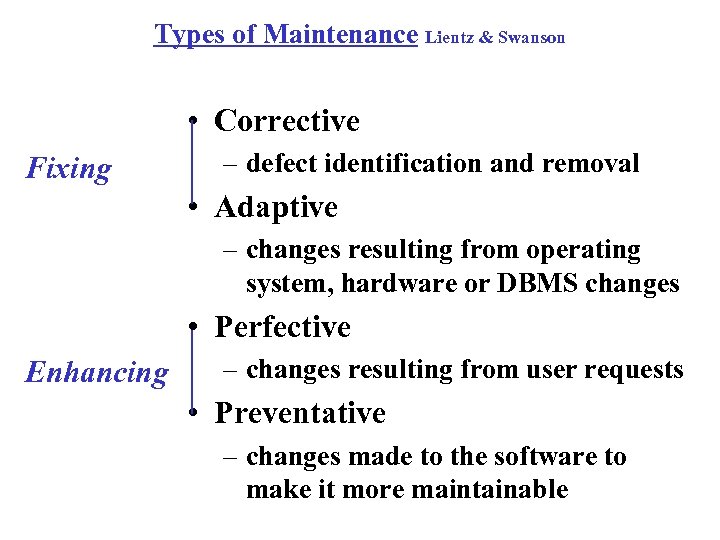 Types of Maintenance Lientz & Swanson • Corrective Fixing – defect identification and removal • Adaptive – changes resulting from operating system, hardware or DBMS changes • Perfective Enhancing – changes resulting from user requests • Preventative – changes made to the software to make it more maintainable
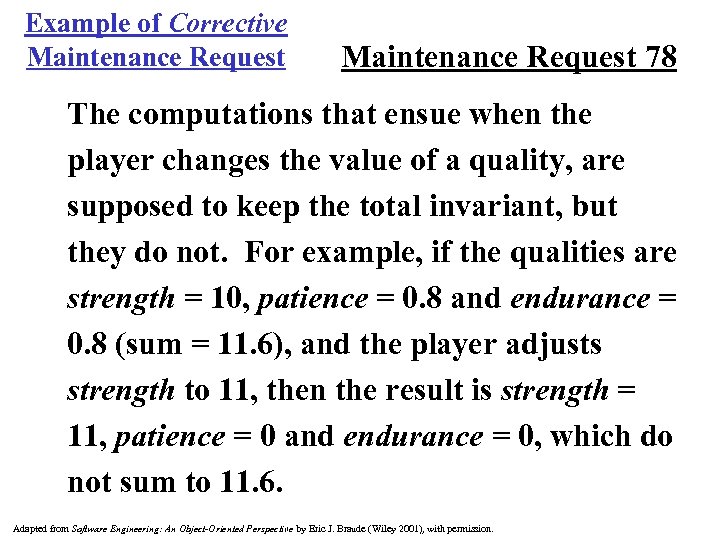 Example of Corrective Maintenance Request 78 The computations that ensue when the player changes the value of a quality, are supposed to keep the total invariant, but they do not. For example, if the qualities are strength = 10, patience = 0. 8 and endurance = 0. 8 (sum = 11. 6), and the player adjusts strength to 11, then the result is strength = 11, patience = 0 and endurance = 0, which do not sum to 11. 6. Adapted from Software Engineering: An Object-Oriented Perspective by Eric J. Braude (Wiley 2001), with permission.
 Example of Perfective Maintenance Request 162 Modify Encounter so that the game begins with areas and connections a coordinated style.
 Example of Perfective Maintenance Request 162 Modify Encounter so that the game begins with areas and connections in a coordinated style. When the player achieves level 2 status, all areas and connections are displayed in an enhanced coordinated style, which is special to level 2 etc. The art department will provide the required images. Adapted from Software Engineering: An Object-Oriented Perspective by Eric J. Braude (Wiley 2001), with permission.
 3. Maintenance techniques
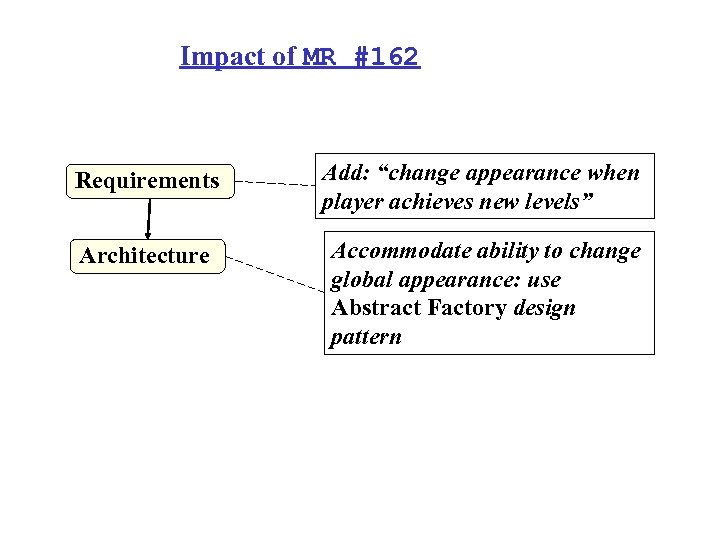 Impact of MR #162 Requirements Add: “change appearance when player achieves new levels” Architecture Accommodate ability to change global appearance: use Abstract Factory design pattern
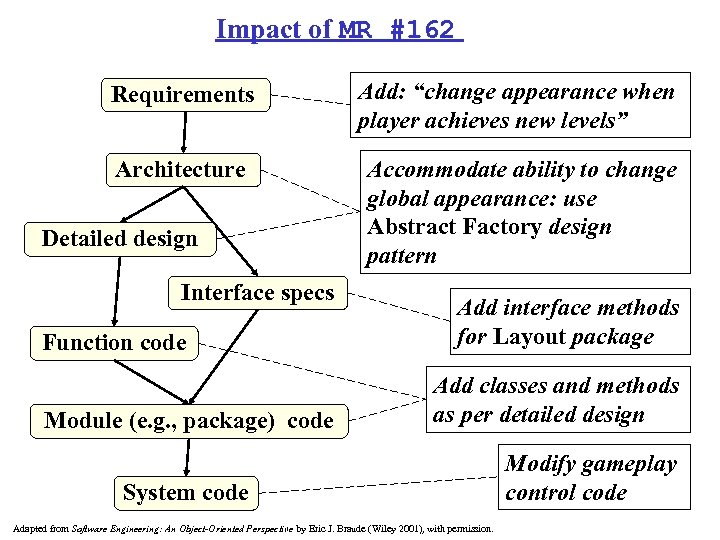 Impact of MR #162 Requirements Add: “change appearance when player achieves new levels” Architecture Accommodate ability to change global appearance: use Abstract Factory design pattern Detailed design Interface specs Function code Module (e. g. , package) code Add interface methods for Layout package Add classes and methods as per detailed design System code Adapted from Software Engineering: An Object-Oriented Perspective by Eric J. Braude (Wiley 2001), with permission. Modify gameplay control code
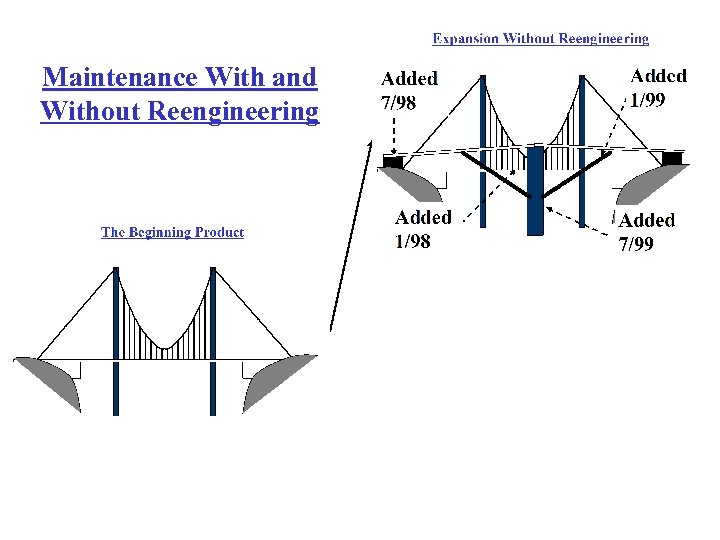 Maintenance With and Without Reengineering
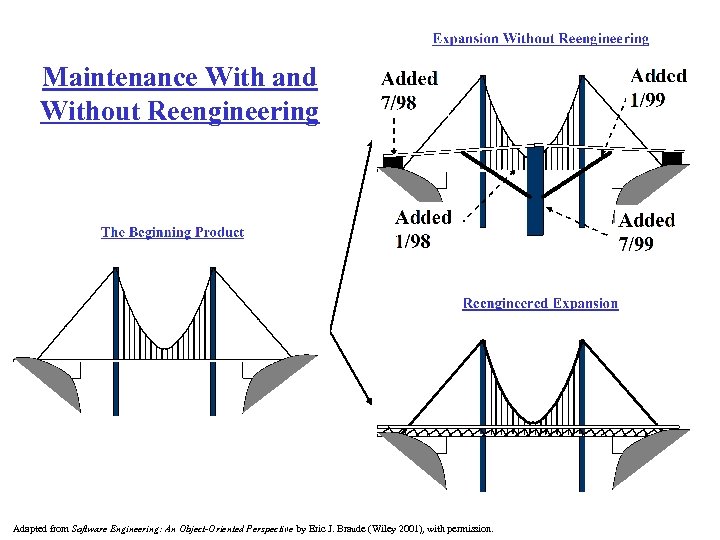 Maintenance With and Without Reengineering Adapted from Software Engineering: An Object-Oriented Perspective by Eric J. Braude (Wiley 2001), with permission.
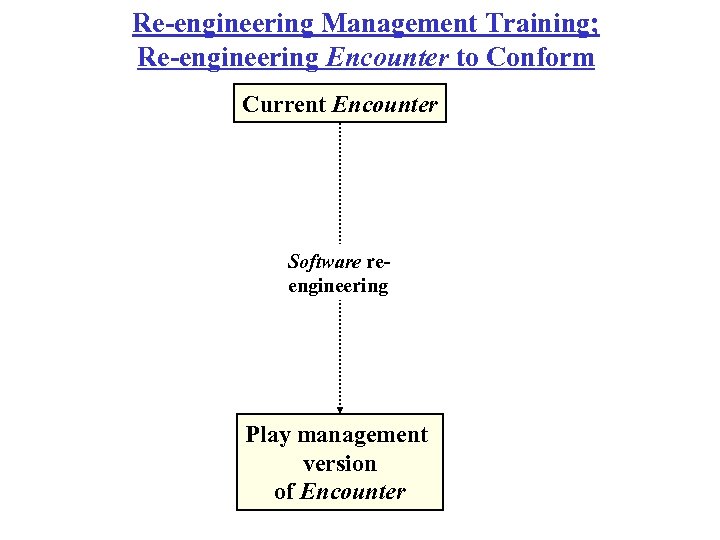 Re-engineering Management Training; Re-engineering Encounter to Conform Current Encounter Software reengineering Play management version of Encounter
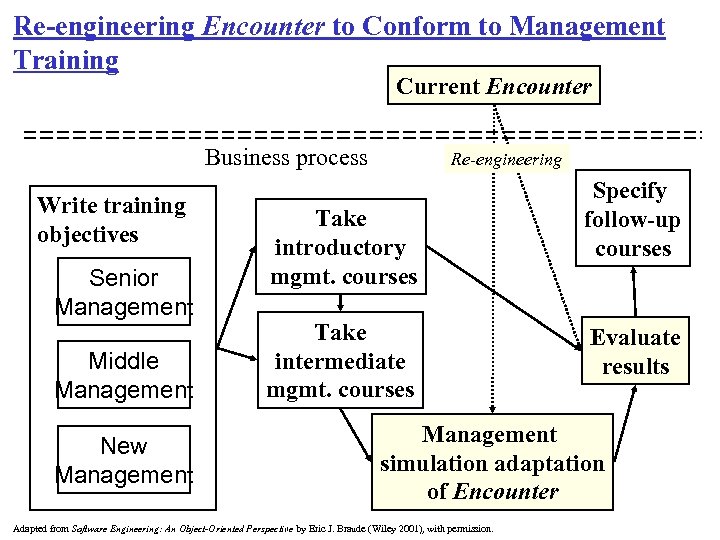 Re-engineering Encounter to Conform to Management Training Current Encounter Business process Write training objectives Senior Management Middle Management New Management Re-engineering Take introductory mgmt. courses Take intermediate mgmt. courses Specify follow-up courses Evaluate results Management simulation adaptation of Encounter Adapted from Software Engineering: An Object-Oriented Perspective by Eric J. Braude (Wiley 2001), with permission.
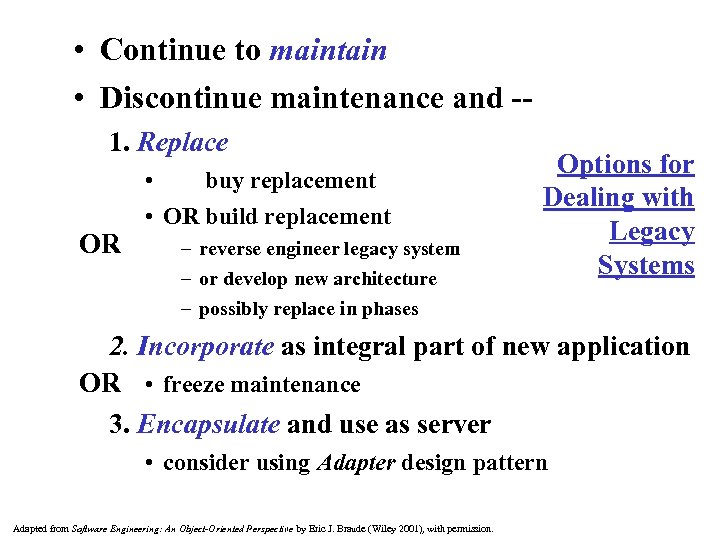 • Continue to maintain • Discontinue maintenance and -1. Replace OR • buy replacement • OR build replacement – reverse engineer legacy system – or develop new architecture – possibly replace in phases Options for Dealing with Legacy Systems 2. Incorporate as integral part of new application OR • freeze maintenance 3. Encapsulate and use as server • consider using Adapter design pattern Adapted from Software Engineering: An Object-Oriented Perspective by Eric J. Braude (Wiley 2001), with permission.
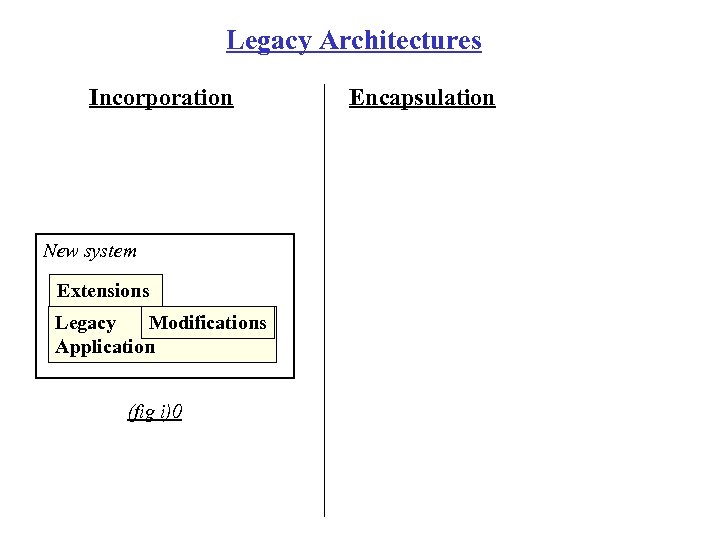 Legacy Architectures Incorporation New system Extensions Legacy Modifications Application (fig i)0 Encapsulation
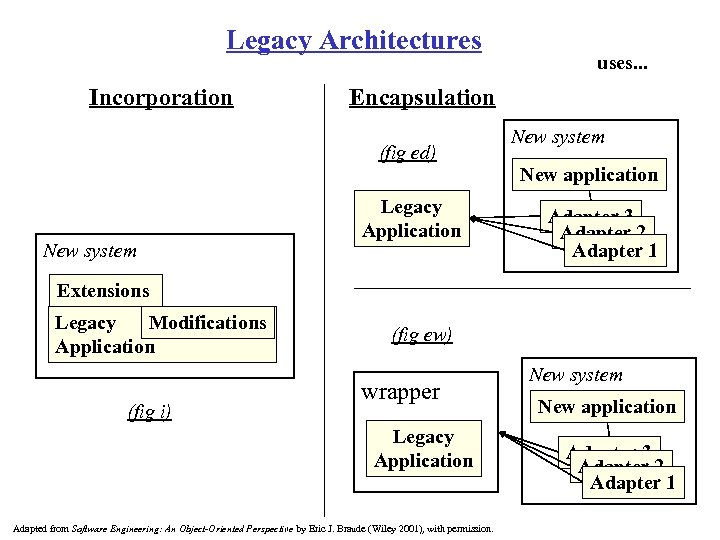 Legacy Architectures Incorporation uses. . . Encapsulation (fig ed) New system New application New system Legacy Application Adapter 3 Adapter 2 Adapter 1 Extensions Legacy Modifications Application (fig i) (fig ew) wrapper Legacy Application Adapted from Software Engineering: An Object-Oriented Perspective by Eric J. Braude (Wiley 2001), with permission. New system New application Adapter 3 Adapter 2 Adapter 1
 4. IEEE standard 840 -1992
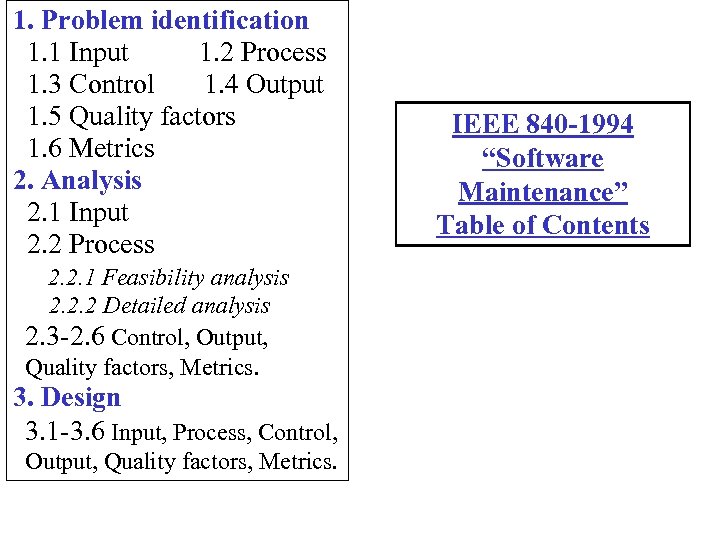 1. Problem identification 1. 1 Input 1. 2 Process 1. 3 Control 1. 4 Output 1. 5 Quality factors 1. 6 Metrics 2. Analysis 2. 1 Input 2. 2 Process 2. 2. 1 Feasibility analysis 2. 2. 2 Detailed analysis 2. 3 -2. 6 Control, Output, Quality factors, Metrics. 3. Design 3. 1 -3. 6 Input, Process, Control, Output, Quality factors, Metrics. IEEE 840 -1994 “Software Maintenance” Table of Contents
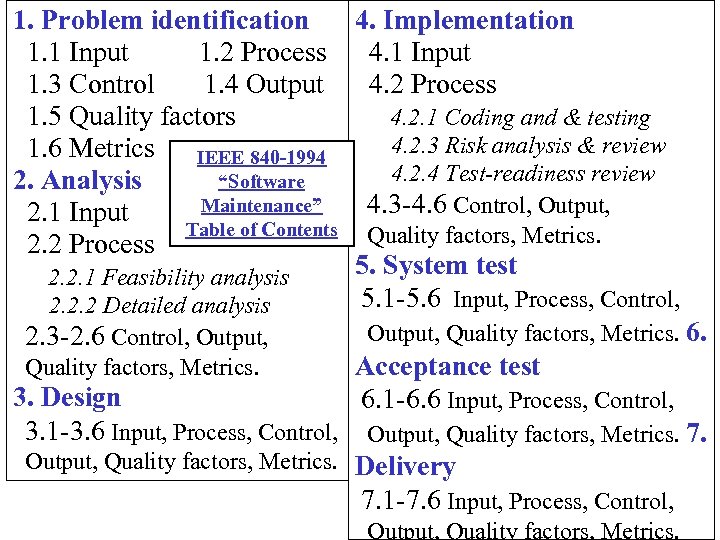 1. Problem identification 4. Implementation 1. 1 Input 1. 2 Process 4. 1 Input 1. 3 Control 1. 4 Output 4. 2 Process 1. 5 Quality factors 4. 2. 1 Coding and & testing 4. 2. 3 Risk analysis & review 1. 6 Metrics IEEE 840 -1994 4. 2. 4 Test-readiness review “Software 2. Analysis Maintenance” 4. 3 -4. 6 Control, Output, 2. 1 Input Table of Contents Quality factors, Metrics. 2. 2 Process 5. System test 2. 2. 1 Feasibility analysis 5. 1 -5. 6 Input, Process, Control, 2. 2. 2 Detailed analysis Output, Quality factors, Metrics. 6. 2. 3 -2. 6 Control, Output, Acceptance test Quality factors, Metrics. 3. Design 6. 1 -6. 6 Input, Process, Control, 3. 1 -3. 6 Input, Process, Control, Output, Quality factors, Metrics. 7. Output, Quality factors, Metrics. Delivery 7. 1 -7. 6 Input, Process, Control, Output, Quality factors, Metrics.
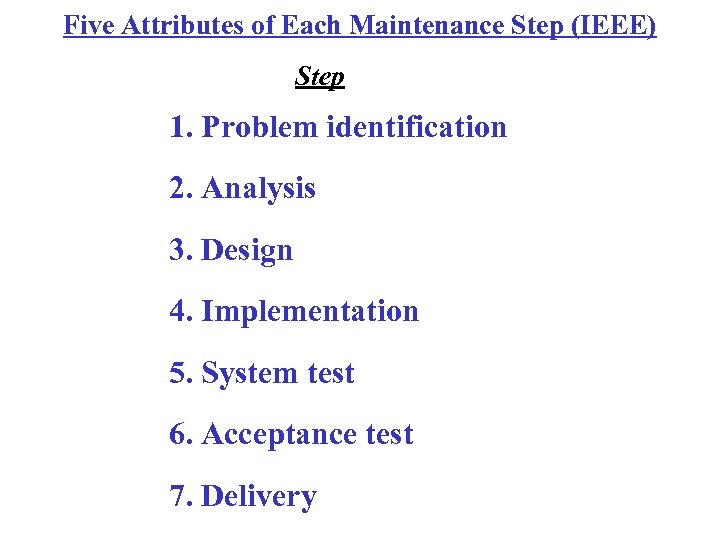 Five Attributes of Each Maintenance Step (IEEE) Step 1. Problem identification 2. Analysis 3. Design 4. Implementation 5. System test 6. Acceptance test 7. Delivery
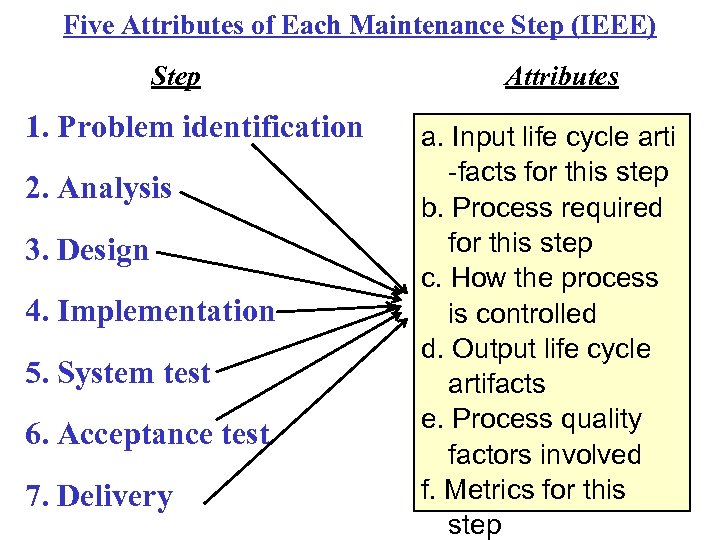 Five Attributes of Each Maintenance Step (IEEE) Step 1. Problem identification 2. Analysis 3. Design 4. Implementation 5. System test 6. Acceptance test 7. Delivery Attributes a. Input life cycle arti -facts for this step b. Process required for this step c. How the process is controlled d. Output life cycle artifacts e. Process quality factors involved f. Metrics for this step
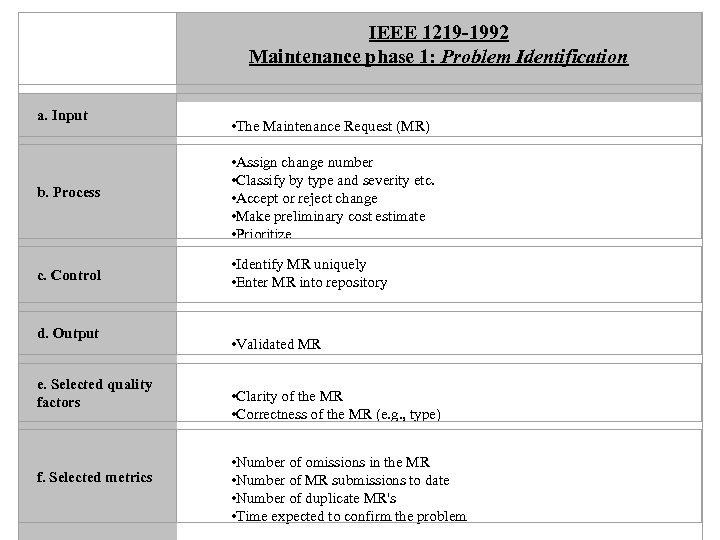 a. Input IEEE 1219 -1992 Maintenance phase 1: Problem Identification • The Maintenance Request (MR) b. Process • Assign change number • Classify by type and severity etc. • Accept or reject change • Make preliminary cost estimate • Prioritize c. Control • Identify MR uniquely • Enter MR into repository d. Output e. Selected quality factors f. Selected metrics • Validated MR • Clarity of the MR • Correctness of the MR (e. g. , type) • Number of omissions in the MR • Number of MR submissions to date • Number of duplicate MR's • Time expected to confirm the problem
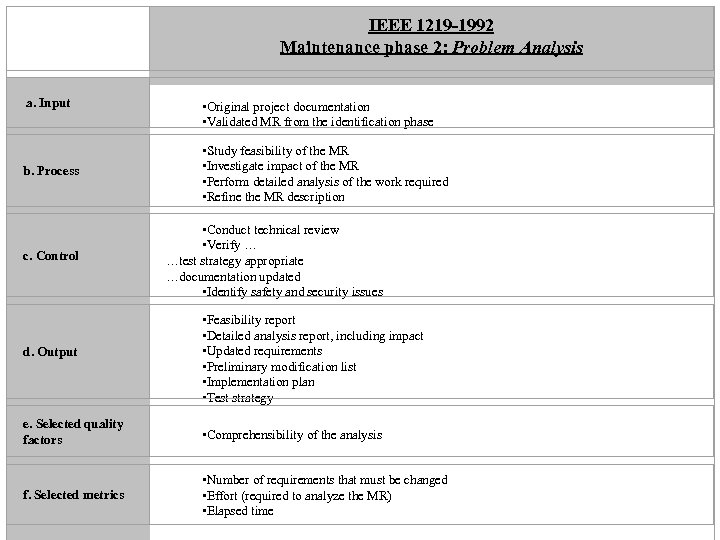 a. Input b. Process c. Control d. Output IEEE 1219 -1992 Maintenance phase 2: Problem Analysis • Original project documentation • Validated MR from the identification phase • Study feasibility of the MR • Investigate impact of the MR • Perform detailed analysis of the work required • Refine the MR description • Conduct technical review • Verify … …test strategy appropriate …documentation updated • Identify safety and security issues • Feasibility report • Detailed analysis report, including impact • Updated requirements • Preliminary modification list • Implementation plan • Test strategy e. Selected quality factors • Comprehensibility of the analysis f. Selected metrics • Number of requirements that must be changed • Effort (required to analyze the MR) • Elapsed time
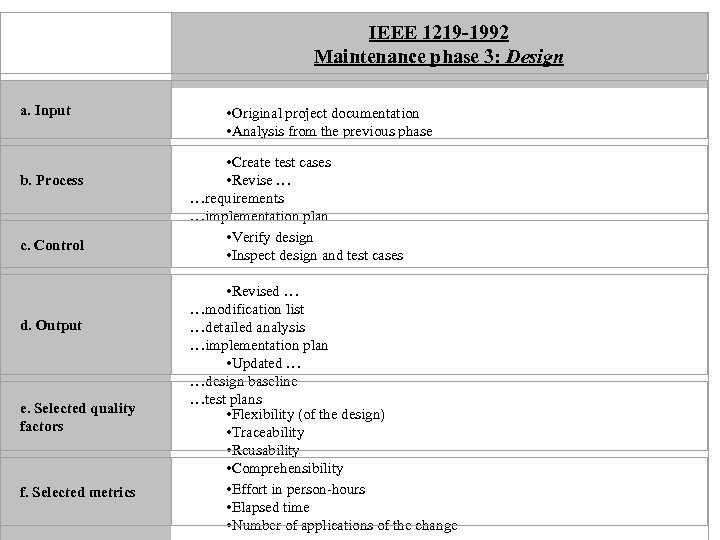 a. Input b. Process c. Control d. Output e. Selected quality factors f. Selected metrics IEEE 1219 -1992 Maintenance phase 3: Design • Original project documentation • Analysis from the previous phase • Create test cases • Revise … …requirements …implementation plan • Verify design • Inspect design and test cases • Revised … …modification list …detailed analysis …implementation plan • Updated … …design baseline …test plans • Flexibility (of the design) • Traceability • Reusability • Comprehensibility • Effort in person-hours • Elapsed time • Number of applications of the change
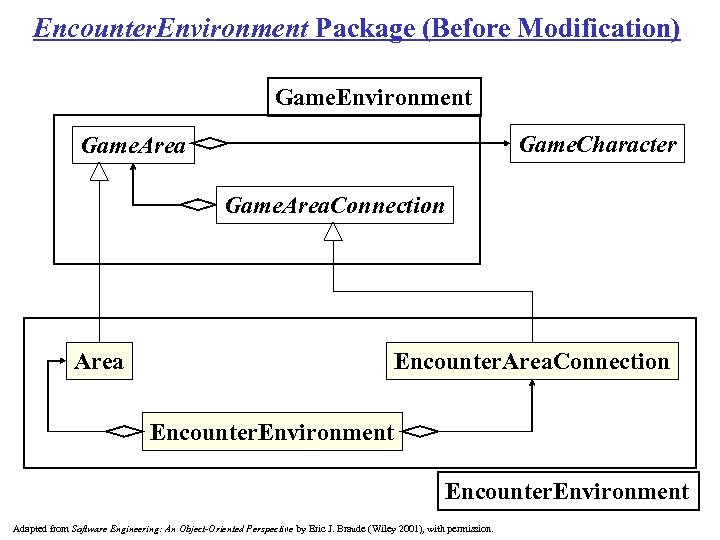 Encounter. Environment Package (Before Modification) Game. Environment Game. Character Game. Area. Connection Area Encounter. Area. Connection Encounter. Environment Adapted from Software Engineering: An Object-Oriented Perspective by Eric J. Braude (Wiley 2001), with permission.
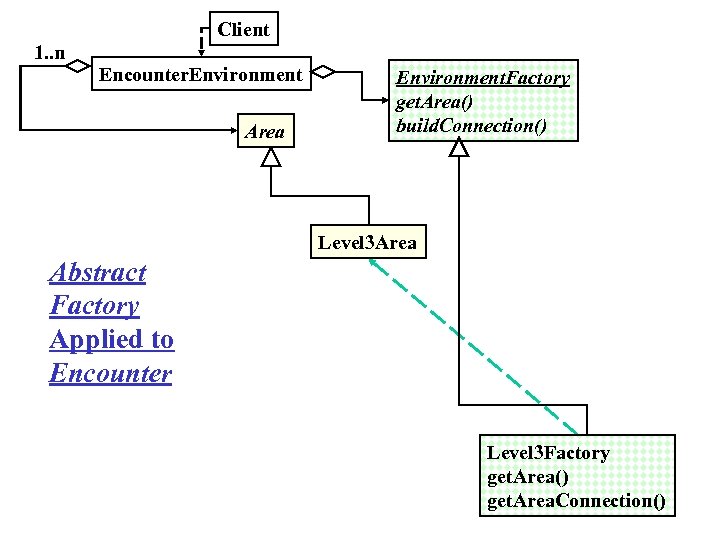 Client 1. . n Encounter. Environment Area Environment. Factory get. Area() build. Connection() Level 3 Area Abstract Factory Applied to Encounter Level 3 Factory get. Area() get. Area. Connection()
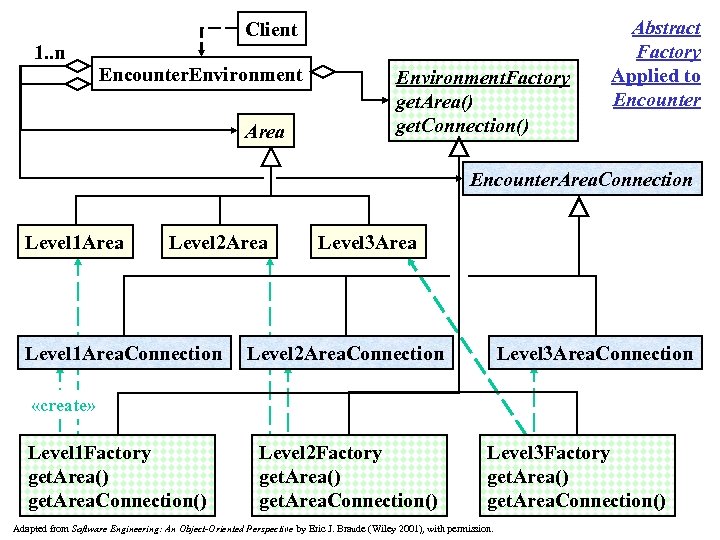 Client 1. . n Encounter. Environment Area Environment. Factory get. Area() get. Connection() Abstract Factory Applied to Encounter. Area. Connection Level 1 Area Level 2 Area Level 1 Area. Connection Level 3 Area Level 2 Area. Connection Level 3 Area. Connection «create» Level 1 Factory get. Area() get. Area. Connection() Level 2 Factory get. Area() get. Area. Connection() Level 3 Factory get. Area() get. Area. Connection() Adapted from Software Engineering: An Object-Oriented Perspective by Eric J. Braude (Wiley 2001), with permission.
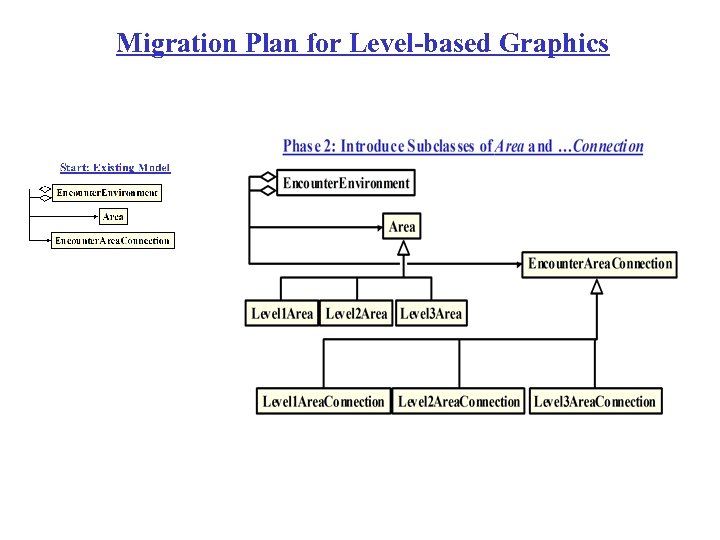 Migration Plan for Level-based Graphics
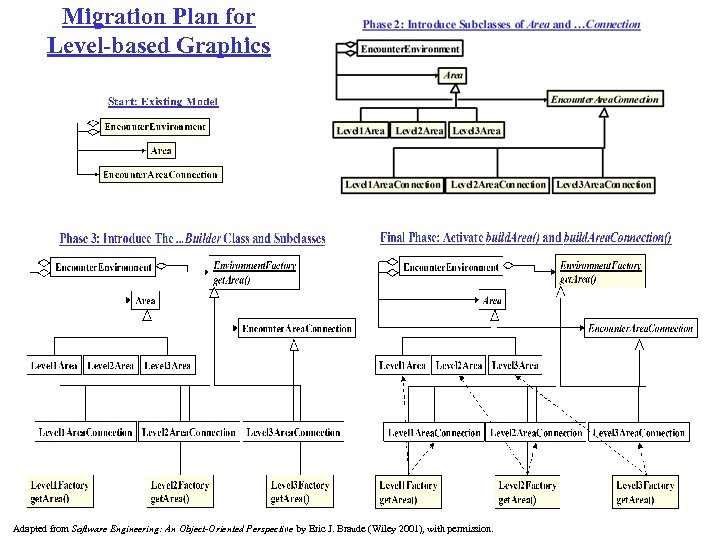 Migration Plan for Level-based Graphics Adapted from Software Engineering: An Object-Oriented Perspective by Eric J. Braude (Wiley 2001), with permission.
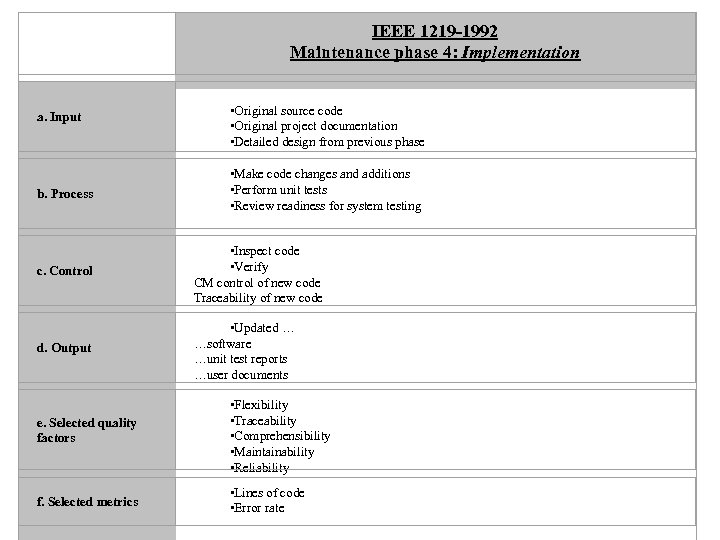 a. Input b. Process IEEE 1219 -1992 Maintenance phase 4: Implementation • Original source code • Original project documentation • Detailed design from previous phase • Make code changes and additions • Perform unit tests • Review readiness for system testing c. Control • Inspect code • Verify CM control of new code Traceability of new code d. Output • Updated … …software …unit test reports …user documents e. Selected quality factors • Flexibility • Traceability • Comprehensibility • Maintainability • Reliability f. Selected metrics • Lines of code • Error rate
 5. The management of maintenance
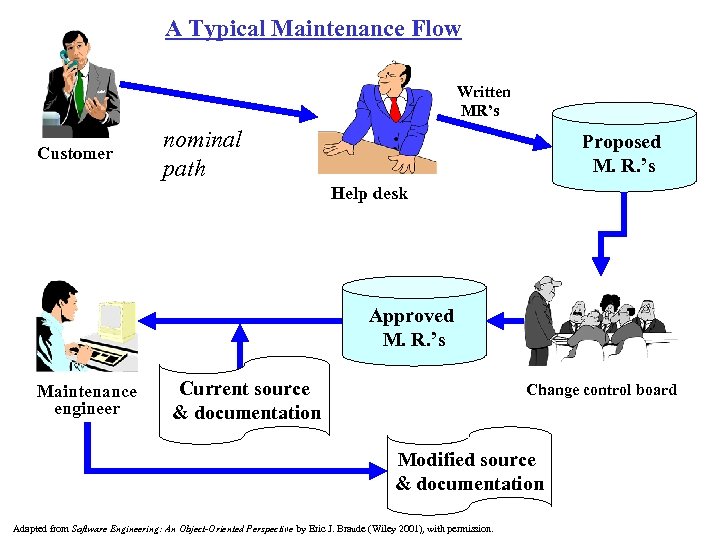 A Typical Maintenance Flow Written MR’s Customer nominal path Proposed M. R. ’s Help desk Approved M. R. ’s Maintenance engineer Current source & documentation Change control board Modified source & documentation Adapted from Software Engineering: An Object-Oriented Perspective by Eric J. Braude (Wiley 2001), with permission.
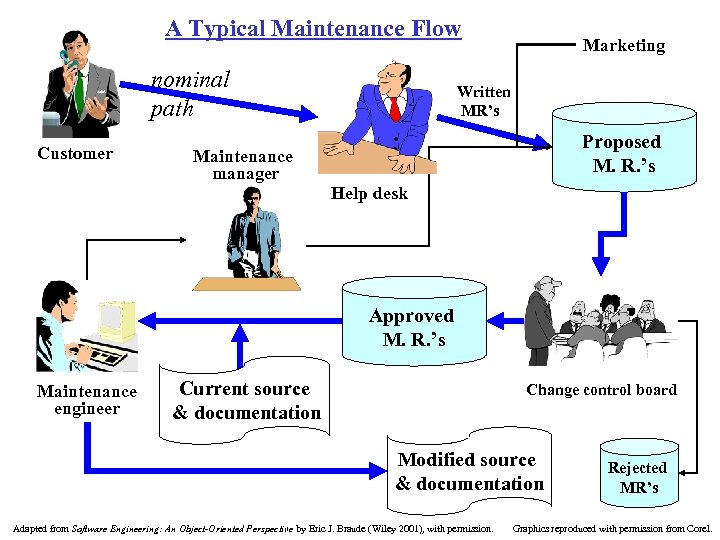 A Typical Maintenance Flow nominal path Customer Marketing Written MR’s Proposed M. R. ’s Maintenance manager Help desk Approved M. R. ’s Maintenance engineer Current source & documentation Change control board Modified source & documentation Adapted from Software Engineering: An Object-Oriented Perspective by Eric J. Braude (Wiley 2001), with permission. Rejected MR’s Graphics reproduced with permission from Corel.
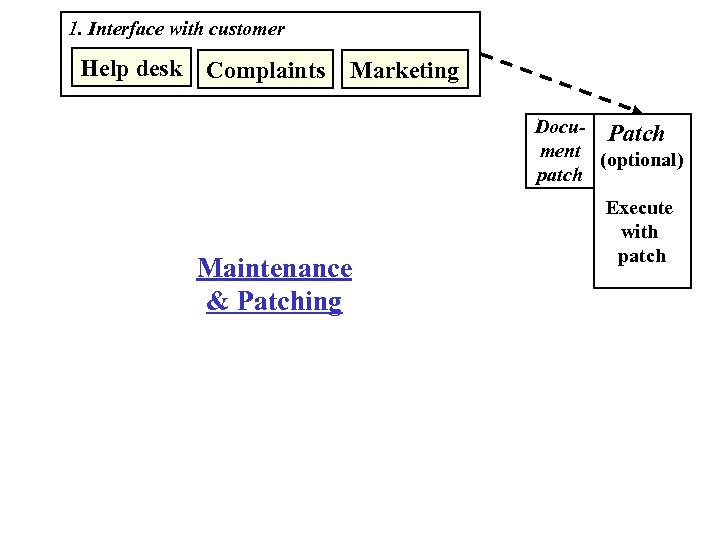 1. Interface with customer Help desk Complaints Marketing Docu- Patch ment (optional) patch Maintenance & Patching Execute with patch
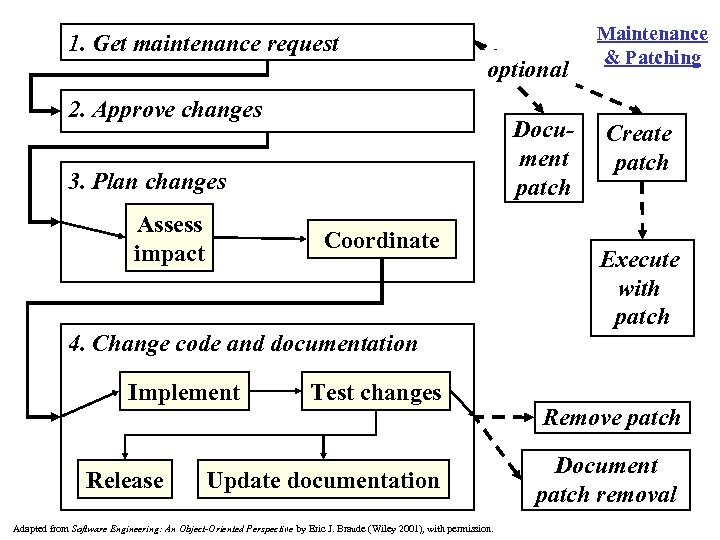 1. Get maintenance request optional 2. Approve changes Document patch 3. Plan changes Assess impact Coordinate 4. Change code and documentation Implement Release Test changes Update documentation Adapted from Software Engineering: An Object-Oriented Perspective by Eric J. Braude (Wiley 2001), with permission. Maintenance & Patching Create patch Execute with patch Remove patch Document patch removal
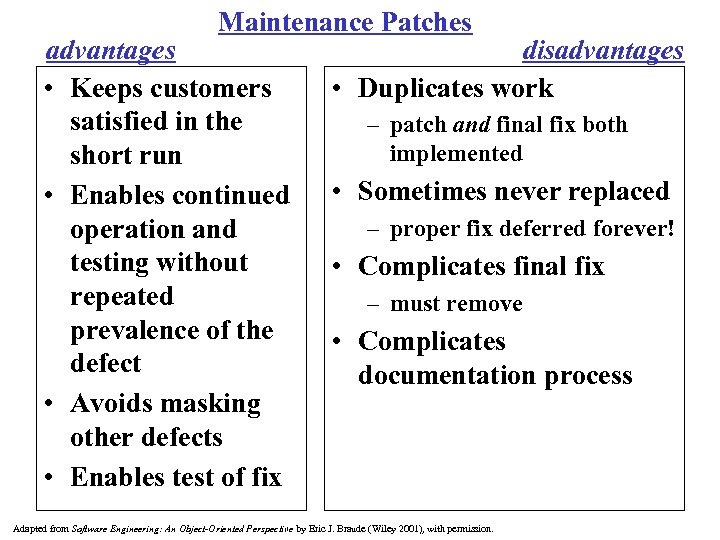 Maintenance Patches advantages • Keeps customers satisfied in the short run • Enables continued operation and testing without repeated prevalence of the defect • Avoids masking other defects • Enables test of fix disadvantages • Duplicates work – patch and final fix both implemented • Sometimes never replaced – proper fix deferred forever! • Complicates final fix – must remove • Complicates documentation process Adapted from Software Engineering: An Object-Oriented Perspective by Eric J. Braude (Wiley 2001), with permission.
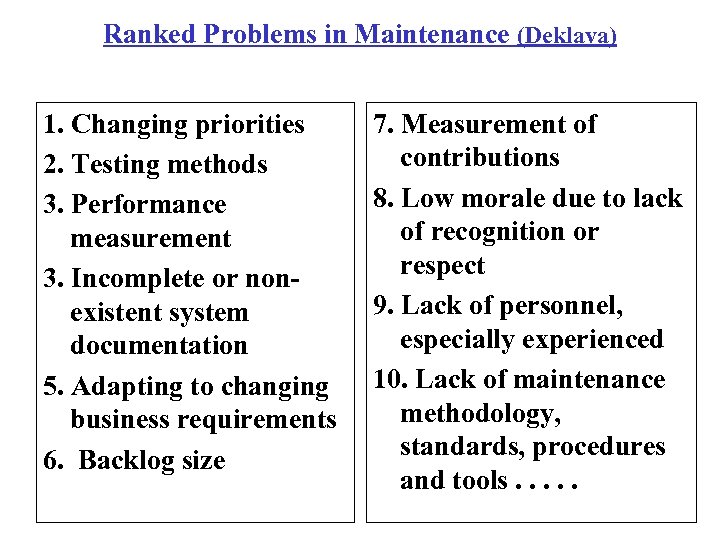 Ranked Problems in Maintenance (Deklava) 1. Changing priorities 2. Testing methods 3. Performance measurement 3. Incomplete or nonexistent system documentation 5. Adapting to changing business requirements 6. Backlog size 7. Measurement of contributions 8. Low morale due to lack of recognition or respect 9. Lack of personnel, especially experienced 10. Lack of maintenance methodology, standards, procedures and tools. . .
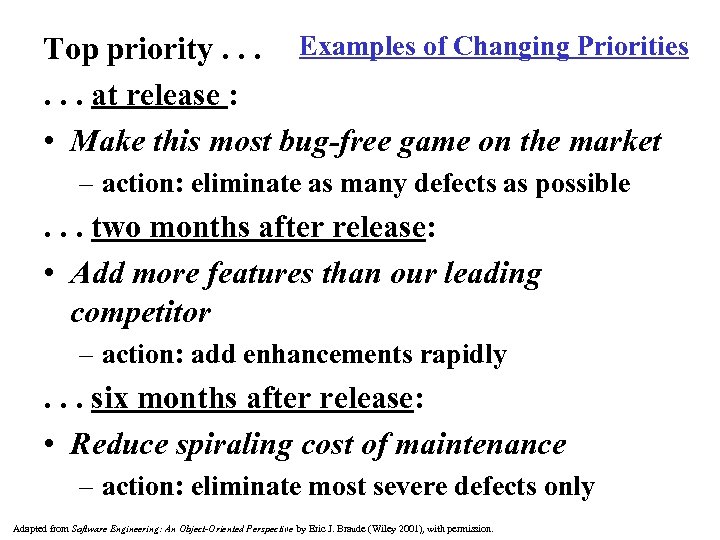 Top priority. . . Examples of Changing Priorities. . . at release : • Make this most bug-free game on the market – action: eliminate as many defects as possible . . . two months after release: • Add more features than our leading competitor – action: add enhancements rapidly . . . six months after release: • Reduce spiraling cost of maintenance – action: eliminate most severe defects only Adapted from Software Engineering: An Object-Oriented Perspective by Eric J. Braude (Wiley 2001), with permission.
 6. Qualities in maintenance
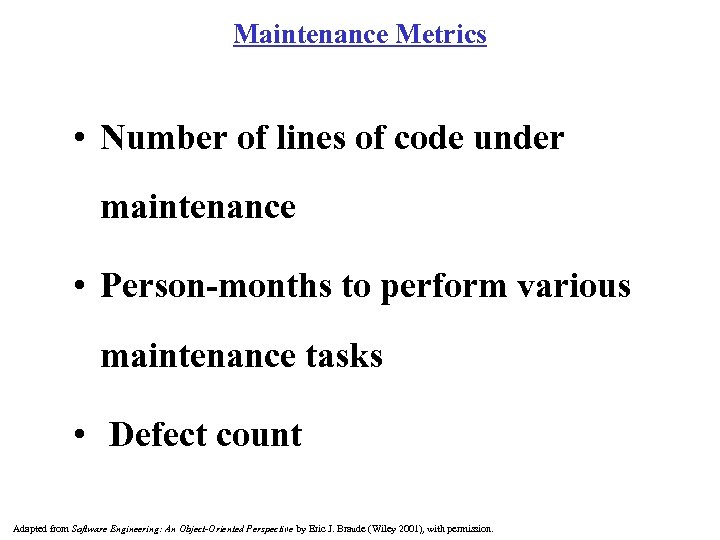 Maintenance Metrics • Number of lines of code under maintenance • Person-months to perform various maintenance tasks • Defect count Adapted from Software Engineering: An Object-Oriented Perspective by Eric J. Braude (Wiley 2001), with permission.
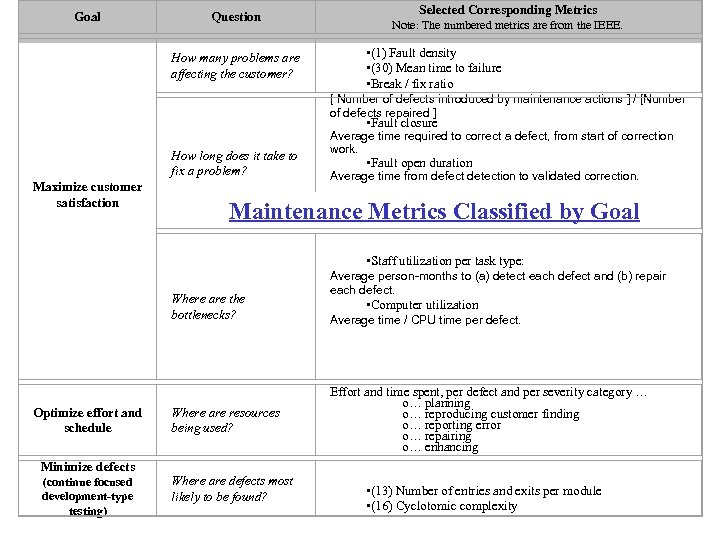 Goal Question How many problems are affecting the customer? Selected Corresponding Metrics Note: The numbered metrics are from the IEEE. • (1) Fault density • (30) Mean time to failure • Break / fix ratio [ Number of defects introduced by maintenance actions ] / [Number of defects repaired ] • Fault closure How long does it take to fix a problem? Maximize customer satisfaction Average time required to correct a defect, from start of correction work. • Fault open duration Average time from defect detection to validated correction. Maintenance Metrics Classified by Goal • Staff utilization per task type: Where are the bottlenecks? Optimize effort and schedule Minimize defects (continue focused development-type testing) Where are resources being used? Where are defects most likely to be found? Average person-months to (a) detect each defect and (b) repair each defect. • Computer utilization Average time / CPU time per defect. Effort and time spent, per defect and per severity category … o… planning o… reproducing customer finding o… reporting error o… repairing o… enhancing • (13) Number of entries and exits per module • (16) Cyclotomic complexity
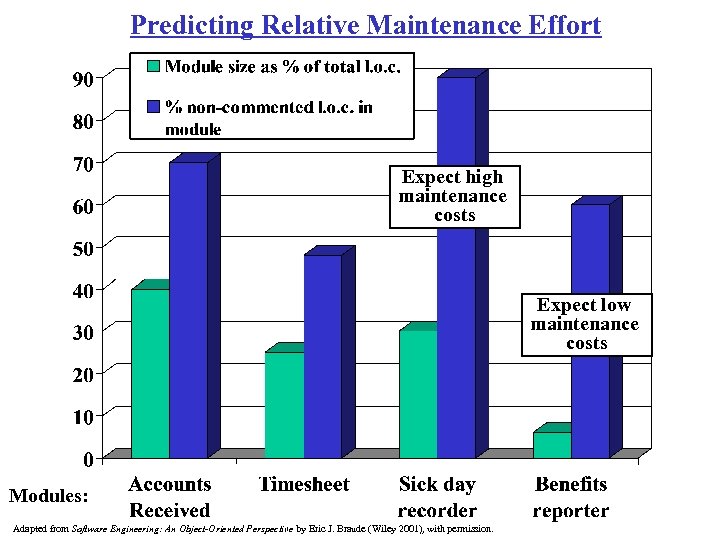 Predicting Relative Maintenance Effort Expect high maintenance costs Expect low maintenance costs Modules: Adapted from Software Engineering: An Object-Oriented Perspective by Eric J. Braude (Wiley 2001), with permission.
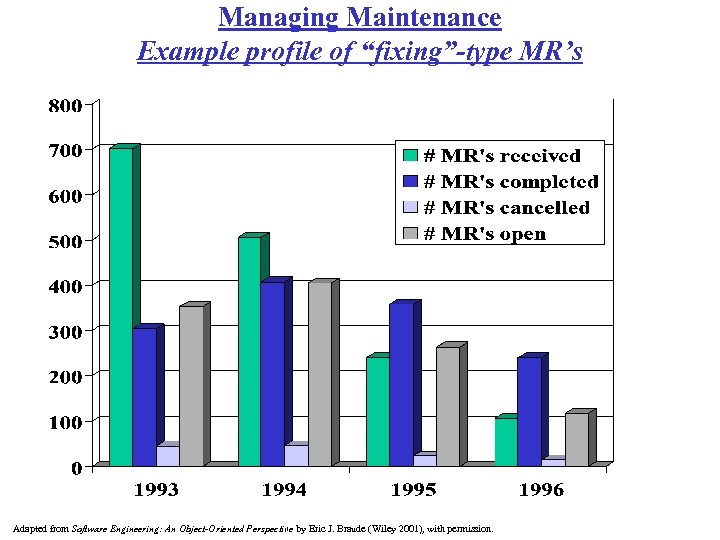 Managing Maintenance Example profile of “fixing”-type MR’s Adapted from Software Engineering: An Object-Oriented Perspective by Eric J. Braude (Wiley 2001), with permission.
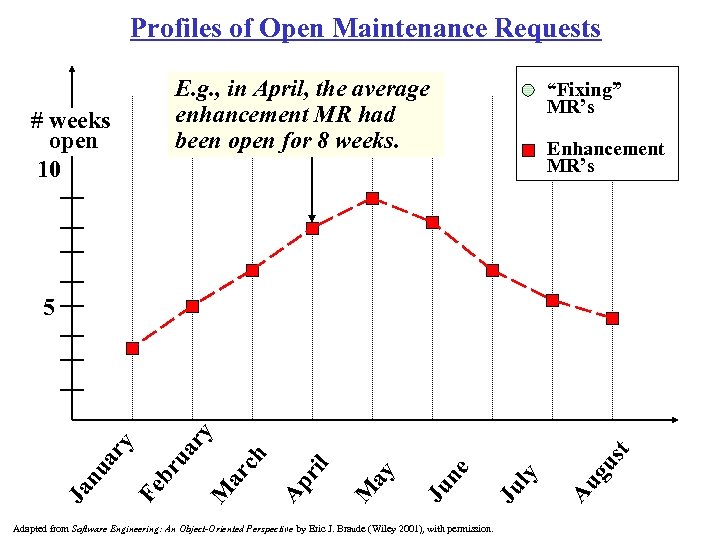 Profiles of Open Maintenance Requests E. g. , in April, the average enhancement MR had been open for 8 weeks. # weeks open 10 “Fixing” MR’s Enhancement MR’s Adapted from Software Engineering: An Object-Oriented Perspective by Eric J. Braude (Wiley 2001), with permission. gu Au Ju ly ne Ju ay M ril Ap ch ar M st ry ua br Fe Ja nu ar y 5
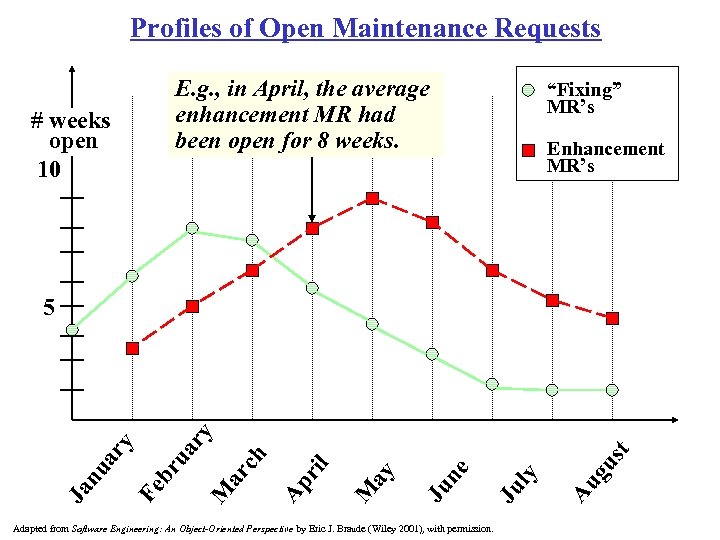 Profiles of Open Maintenance Requests E. g. , in April, the average enhancement MR had been open for 8 weeks. # weeks open 10 “Fixing” MR’s Enhancement MR’s Adapted from Software Engineering: An Object-Oriented Perspective by Eric J. Braude (Wiley 2001), with permission. gu Au Ju ly ne Ju ay M ril Ap ch ar M st ry ua br Fe Ja nu ar y 5
![Effects on Maintainability of Source Code Properties . . From Oman [Om 1]](https://present5.com/presentation/bc16848c86d45a0894bbc2b69608aac5/image-54.jpg "Effects on Maintainability of Source Code Properties . . From Oman [Om 1]") Effects on Maintainability of Source Code Properties . . From Oman [Om 1]
Effects on Maintainability of Source Code Properties . . From Oman [Om 1]
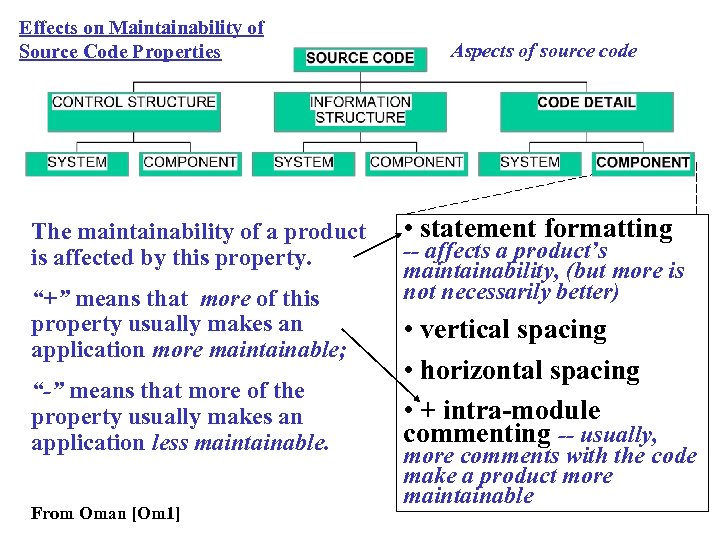 Effects on Maintainability of Source Code Properties The maintainability of a product is affected by this property. “+” means that more of this property usually makes an application more maintainable; “-” means that more of the property usually makes an application less maintainable. From Oman [Om 1] Aspects of source code • statement formatting -- affects a product’s maintainability, (but more is not necessarily better) • vertical spacing • horizontal spacing • + intra-module commenting -- usually, more comments with the code make a product more maintainable
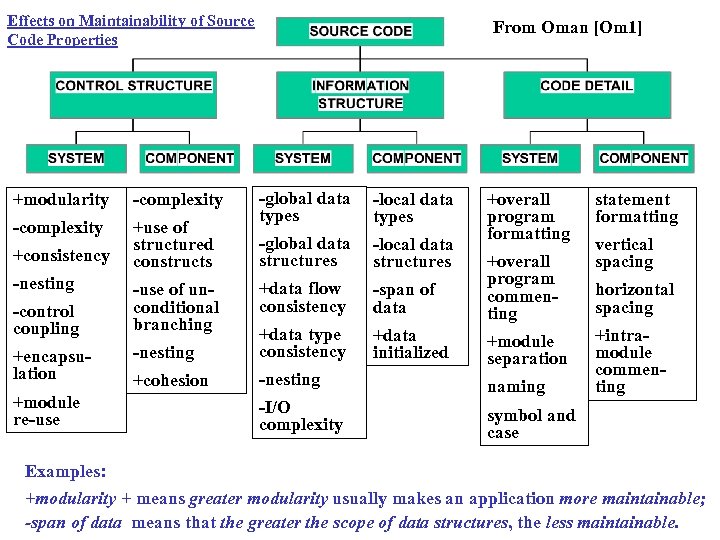 Effects on Maintainability of Source Code Properties -global data types -local data types -global data structures -local data structures +data flow consistency -span of data +overall program commenting -nesting +data type consistency +data initialized +module separation +cohesion -nesting naming -I/O complexity symbol and case +modularity -complexity +use of structured constructs +consistency -nesting -control coupling +encapsulation +module re-use From Oman [Om 1] -use of unconditional branching +overall program formatting statement formatting vertical spacing horizontal spacing +intramodule commenting Examples: +modularity + means greater modularity usually makes an application more maintainable; -span of data means that the greater the scope of data structures, the less maintainable.
 7. Summary
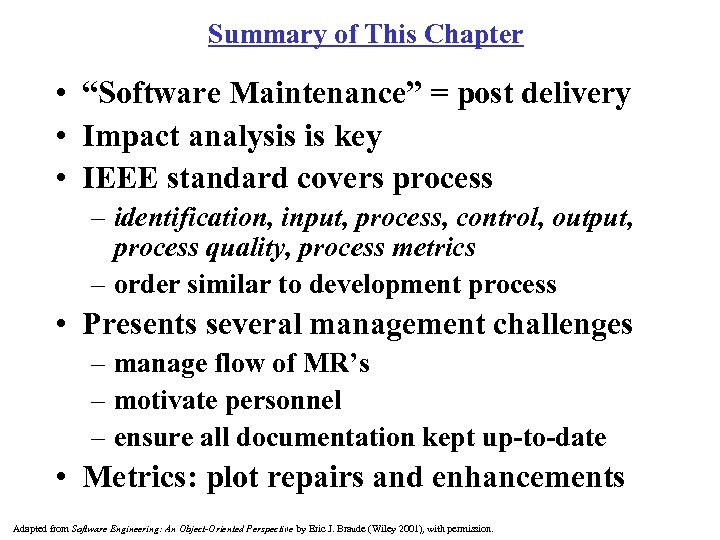 Summary of This Chapter • “Software Maintenance” = post delivery • Impact analysis is key • IEEE standard covers process – identification, input, process, control, output, process quality, process metrics – order similar to development process • Presents several management challenges – manage flow of MR’s – motivate personnel – ensure all documentation kept up-to-date • Metrics: plot repairs and enhancements Adapted from Software Engineering: An Object-Oriented Perspective by Eric J. Braude (Wiley 2001), with permission.