


 Скачать презентацию 10 16 Admin issues n n Evan Williams of
bde1d4e86498a6a983e02bef4765ab9d.ppt
- Количество слайдов: 50
 10/16 Admin issues n n Evan Williams of Blogger will join us next week. Early demo n n October 30 th – first three projects. November 6 th – next three projects.
 Tasks n Describe several tasks that a user can perform on your site. n Think procedurally n n n How many steps does it take to get the job done? How long does it take? Think functionally n What is the user trying to accomplish?
 Information Design with XML Front-end and Backend Documents and Databases Presentation and Organization Web Browsers and Web Services
 Information Design Information Architect 1. n Organizing and presenting information for a user-directed purpose. Structural Engineer 2. n Describing the structure of information for processing by a program or human.
 The Information Architect n Information Architecture for the World Wide Web by Rosenfeld & Morville (O'Reilly) n The job of an Information Architect is to establish a user-centered design process.
 Job of Information Architect (p. 11) n n Clarify mission and vision for site Determine site's content and functionality Define site's organization, navigation, labeling and searching system. Figure out how site will develop/change over time.
 Design Disciplines n Graphic Design n Information or Library Science n Journalism n Usability Engineering n Marketing n Computer Science
 Corporate Design n Internal n n n Fulfill Corporate Mission Solve Organizational Problem External n Serve customer need n Create or expand market opportunity
 The organizational site vs the well-organized site n n Edward Tufte remarked that most sites reflect the organization's structure rather than the information needs of the user. Most corporate sites have to serve multiple missions, multiple departments. Is there a central site serving all? Does each department have a site? Does each product have a site.
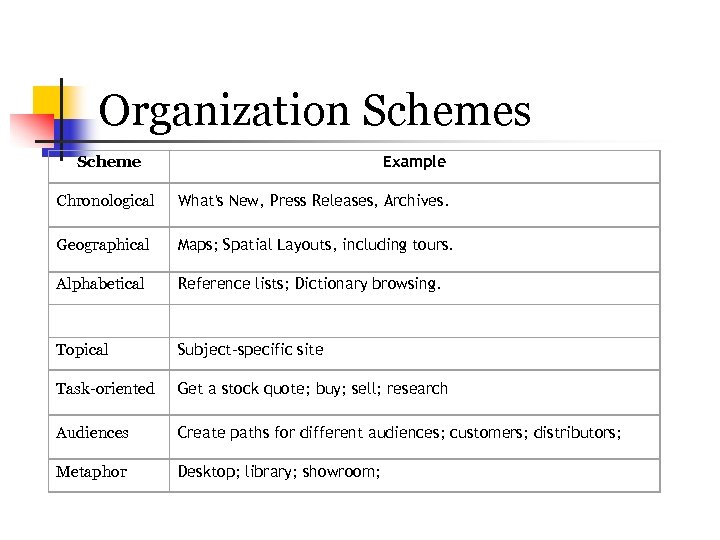 Organization Schemes Example Scheme Chronological What's New, Press Releases, Archives. Geographical Maps; Spatial Layouts, including tours. Alphabetical Reference lists; Dictionary browsing. Topical Subject-specific site Task-oriented Get a stock quote; buy; sell; research Audiences Create paths for different audiences; customers; distributors; Metaphor Desktop; library; showroom;
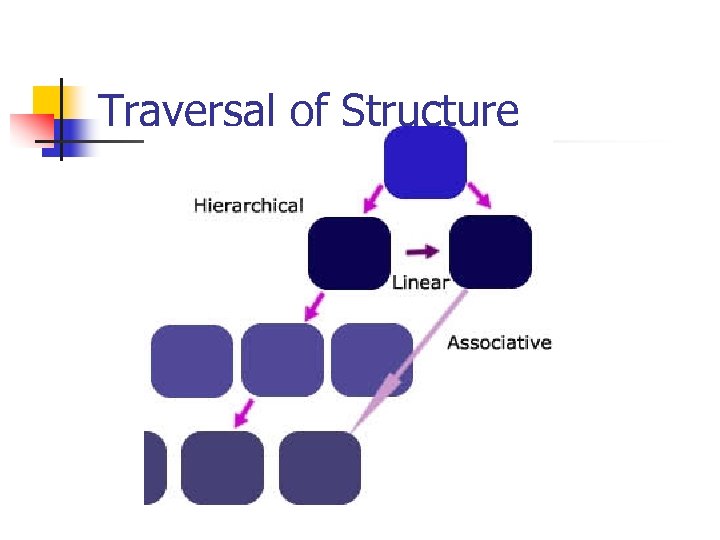 Traversal of Structure
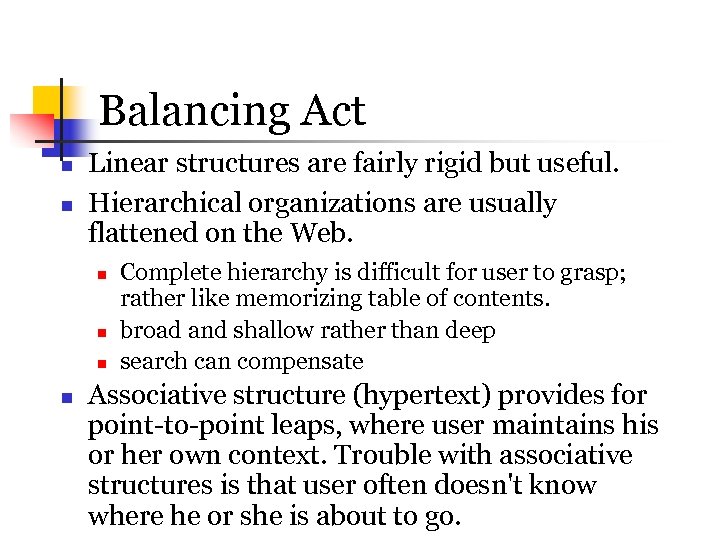 Balancing Act n n Linear structures are fairly rigid but useful. Hierarchical organizations are usually flattened on the Web. n n Complete hierarchy is difficult for user to grasp; rather like memorizing table of contents. broad and shallow rather than deep search can compensate Associative structure (hypertext) provides for point-to-point leaps, where user maintains his or her own context. Trouble with associative structures is that user often doesn't know where he or she is about to go.
 Navigation n Navigation systems • • express how information is organized on the site identify key functions (help, search) direct different audiences to different parts of site Help provide context for user's browsing (e. g. location).
 Linking Strategy n Complementary or contrary to navigational structure? n n n Menus; Drop-down boxes. Internal vs. External links Embedded links in paras Textual vs. graphical links Automated Linking
 Minimalist Linking n n Links represent decision points for users; don't overuse them. Embedded links do not often stand out as clear choices. Isolate them. Graphical links can be too subtle. Use cues. Links need descriptive task- or actionoriented labels.
 First vs. Repeat Use n How does first-time user experience site? n n n Is the site’s mission obvious? Is it available from all levels? Do repeat users “learn” to use the site? n n Are there shortcuts? Can they return to a previous state?
 Change n What changes on the site? n n n How often is new information produced? Do different parts of the site change at different rates? Does the user know what’s new and does it drive the site? How is updated information indicated? What elements are permanent?
 Making things familiar n Are there things that users are already familiar with, handles that they can grab on to? n n n Familiarity with Print models With an identity or brand With the structure of information
 The Structural Engineer n n n Describing how information is organized separately from presentation Identifying the source and destination of information XML as “Self-describing information” n Interchange and interoperability
 Information-centric Applications Highlights n XML promotes an information-centric, as opposed to browser-centric, view of the Web. n XML is part of a next generation Web that is more functional, and not driven exclusively by the browser. n XML will be implemented first on the backend where information is managed and can be accessed by information-savvy programs.
 Structured Documents n n n XML is based on the idea that documents can be represented as structured information, gaining many of the benefits of databases. An interesting corollary idea is that databases can be represented as documents to provide interchange and portability. Similar to object-oriented or componentbased models.
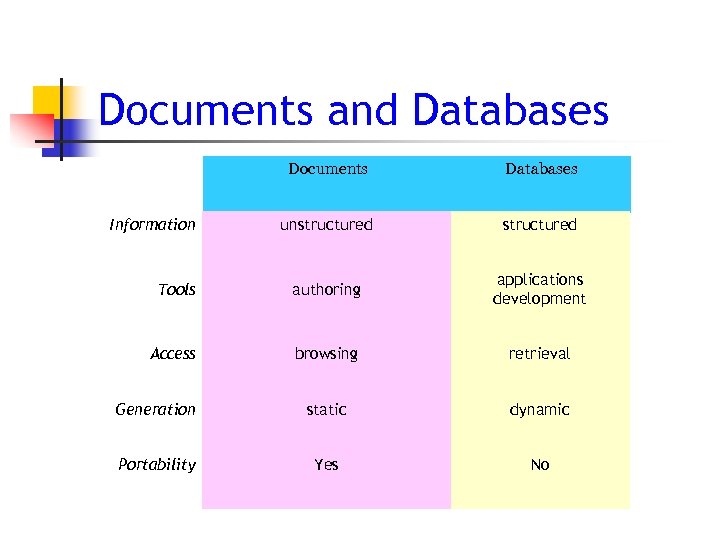 Documents and Databases Documents Databases Information unstructured Tools authoring applications development Access browsing retrieval Generation static dynamic Portability Yes No
 “Stretching the Concept of the Document” n Tim Bray, Web Techniques (12/98) n “both the nature of computing and the nature of XML will force document weenies (sometimes) to think like database geeks, and engineers (sometimes) to think like editors. ”
 XML is standardizing syntax. n n n XML represents structured information as documents that are both human readable and easily processed by programs. An XML document consists of elements and attributes inside a single root element. Might also reference a DTD that describes a “grammar” for a tagset.
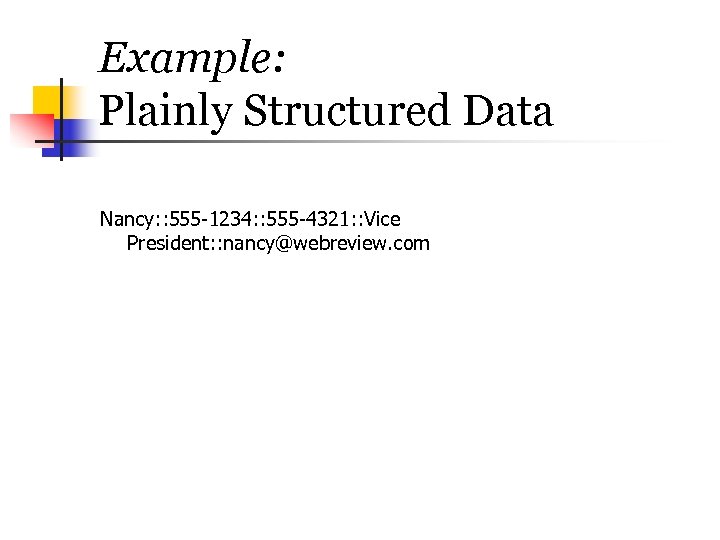 Example: Plainly Structured Data Nancy: : 555 -1234: : 555 -4321: : Vice President: : nancy@webreview. com
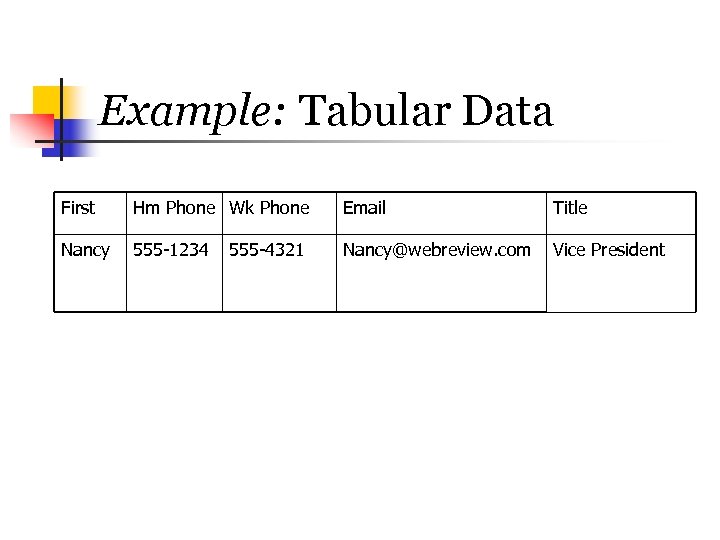 Example: Tabular Data First Hm Phone Wk Phone Email Title Nancy 555 -1234 Nancy@webreview. com Vice President 555 -4321
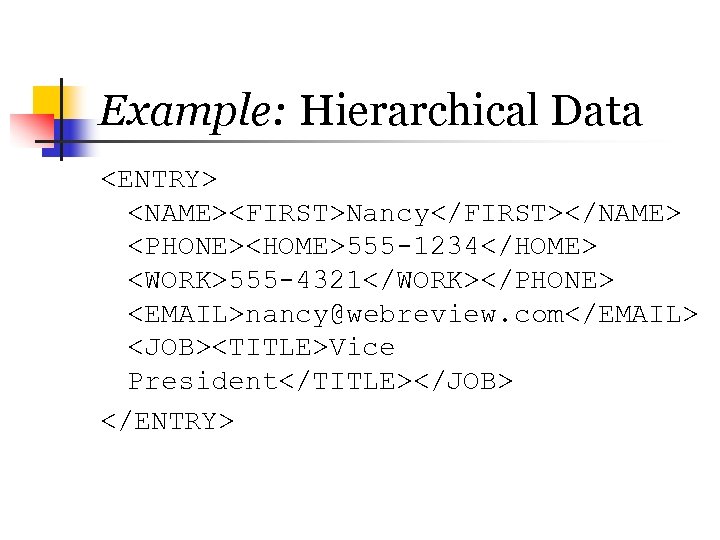 Example: Hierarchical Data
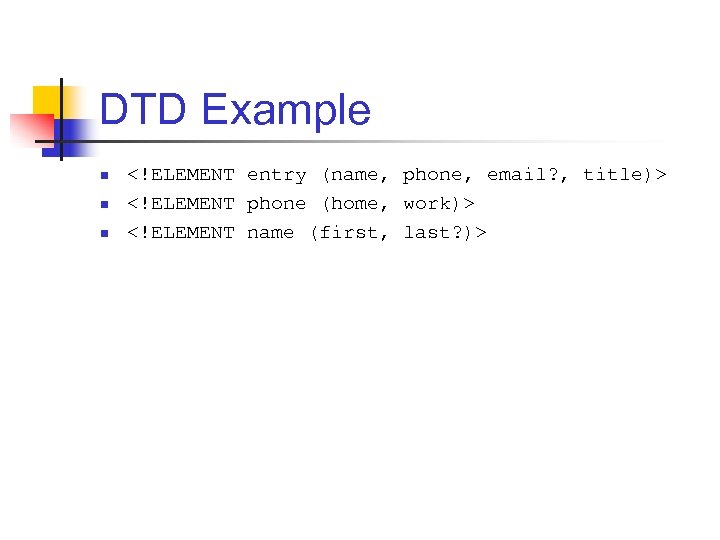 DTD Example n n n
 XML Provides Ways to Validate Information n The ENTRY is well-formed, in that it respects the syntax of XML. You could validate an XML document against a DTD, which is a formal definition of the structure of this tagset. A validation process could determine that the entry is missing a LAST name, which might be a required element.
 Syntax, Not Semantics n n n Semantics is a potential pitfall. XML does not tell an application what the tags and the enclosed content mean or represent. DTDs and Schemas are one approach to organizing semantics but for the most part this falls to the application.
 XML Tools n n A common syntax benefits programmers, who can use a general-purpose tools for processing all XML documents. XML Parser n Tree or Stream Processing Models n n n Manipulate the document structure (DOM) Perform actions when element is found in input stream Getting Started With XML Programming by Norm Walsh
 XML serves as the foundation for a family of standards n XSL n n XLink n n New Linking Types Namespaces n n Extensible Style Language Necessary to establish context of tagset, especially when exchanging XML fragments Schema n A DTD replacement that supports data types.
 XML and HTML n n n XML is a separate track from HTML XML does not replace HTML. XML relieves pressure on HTML to change. HTML is simple markup and you can't extend HTML much further without sacrificing its simplicity. XML applications may convert documents to HTML for delivery to all browsers.
 "When will XML be implemented in the browser? " n n n In the short term, XML is not dependent on the browser for acceptance. Standards are beginning to drive the Web. Widespread support for XML is a sign that the World Wide Web Consortium (W 3 C) is getting traction in laying out a open, standards-based path for the Web.
 XHTML n Article by Peter Wiggin n Main Differences n n Tags are case sensitive. Attribute values must be quoted. Empty tags like are specified as . Elements may not overlap.
 Data Interchange n n n XML is intended for interchange between systems. Once you automate a site so that it is generated from a database, then you might lose the benefit of having a search engine index the pages on your site. This is an interchange problem. An XML-based metadata standard would allow you to interchange information with search engines.
 XML and Distributed Computing n n n Business relationships are largely based on information interchange. Imagine if you had to send your product database to another company? How do you tell them how the database is structured? Instead you might express this information in XML and make it available on your site for real-time access.
 XML-based Web Services n n Schulman: The Web is the API URLs are command-line interfaces into computing power available on distributed computers. Example of quote. yahoo. com Unix pipeline
 Automating Access to Information n Think "Beyond the Browser" Think of programs as consumers of HTML today. Programs talk to programs on other machines. Servers talk to servers. Soon, the conversation will be encoded in XML and these programs will be smarter about the information they retrieve and process.
 Sample User Application Shipping Report n A “client” program hit three different sites (UPS, Fed. EX, and DHL). n Access your account to retrieve shipping information: n n n Option a: grab this information from HTML interface Option b: grab an XML document with the same information. Integrate the results into a single report available to others in your company.
 Web Services n An application can make use of services available anywhere on the Internet n Microsoft’s. NET strategy
 Web Services Frameworks n n n XML-RPC – Remote Procedure Call SOAP – Simple Object Access Protocol UDDI – Universal Description and Discovery Interface
 RSS – Rich Site Summary See my. userland. com
 An RSS Example n n “Open. AL Explained” on Oreilly. linux. com The information is gathered in CS n n It is published as an article And as an RSS feed.
 Building Information Interfaces n n User Application layer Web application layer n n New roles for developers and designers Figure out what kinds of information needs to be exchanged with partners across different sites.
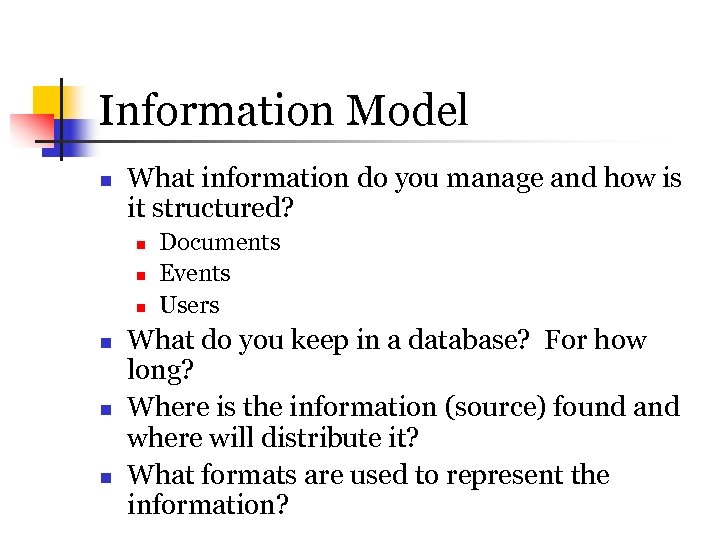 Information Model n What information do you manage and how is it structured? n n n Documents Events Users What do you keep in a database? For how long? Where is the information (source) found and where will distribute it? What formats are used to represent the information?