 Скачать презентацию 1 www salga org za Welcome Briefing by
44667b16aec91f08e7548cb8a5562137.ppt
- Количество слайдов: 44



1 www. salga. org. za Welcome… Briefing by SALGA on: Review of OLGA, Full-time Councillors, Councillor Induction Programme & Revenue Enhancement 21 June 2011 Portfolio Committee: Co. GTA
2 www. salga. org. za Outline 1. Background/Context for OLGA Review 2. Emerging Proposals 3. Summary of previous decisions 4. Proposals for discussion 4. 1 Affirmation of SALGA as unitary structure 4. 2 Full-time Leadership 5. Councillor Induction Programme (CIP) 6. Revenue Enhancement Model
3 www. salga. org. za 1. Background/Context q q q In order for Organised Local Government (OLG) to effectively fulfil its mandate to its members in legislative and IGR processes, it is necessary for OLG to act as a collective & position LG favourably in our cooperative governance model. The OLG Act puts in place a process for nomination of the SALGA Delegation to NCOP via provincial associations and a process for nomination of members to the FFC. IGR Framework Act makes provision for SALGA’s participation and membership on the PCC, Min. MECs and Provincial IGR Forums. In addition, SALGA participates in the Budget Forum & numerous other committees.
4 www. salga. org. za 2. Emerging Proposals q To optimise LG’s participation in key national and provincial structures, the following proposals are emerging: § amending the OLG Act so as to recognise the unitary nature of SALGA; and § full-time political leadership at its helm who will also, amongst others, represent SALGA in the NCOP.
5 www. salga. org. za 3. Summary of previous decisions 2009 National Members Assembly (NMA), East London, Eastern Cape q Engage in consultation processes in provinces to make inputs on the following recommendations: § Affirmation of SALGA as a unitary structure. § OLGA to reflect unitary structure. § Idea of full-time leadership at both national and provincial levels q There is acknowledgement of the need to retain expertise and experience of cllrs in LG for the purpose of continuity; and q A study needed to be undertaken on how best to create a pool of experienced councillors for deployment to assist LG and OLG. 2010 NMA, Kimberley, Northern Cape q Note the proposals on Review of Organised Local Government for final resolution at the 2011 National Conference.
6 www. salga. org. za 4. Proposals for discussion 4. 1 Affirmation of SALGA as unitary structure q q The OLG Act should be amended to reflect the unified nature of SALGA including the logistical consequence that its NCOP delegates are nominated at national level. Thus, section 2(1)(a) of the OLG Act should be amended to read that the national body is to be the representative body of the majority of municipalities. § This proposal only affects the recognition requirement of the national association it does not affect the status of provincial associations. They would continue to exist and represent the majority of municipalities in their respective provinces for purposes of provincial engagement.
7 www. salga. org. za Proposals for discussion (continued) 4. 2 Full-time political leadership q q As outlined, SALGA is playing a crucial role in the intergovernmental arena on behalf of LG. In order to play its role effectively, it needs adequate resources, both human and financial, so that the voice of LG can be strengthened within the national and provincial spheres of govt. PROPOSAL: 10 Full-time Councillors to represent the LG sphere in all IGR structures where its participation is required, and to advance the LG agenda, is a critical lever if SALGA is to be effective as a representative body of LG. Failing this, SALGA will continuously struggle to represent LG at the least, adequately, or at best, effectively.
8 www. salga. org. za Proposals for discussion (continued) q q A case is made for the deployment of experienced political leadership from municipalities on a full-time basis, in order that SALGA may play its rightful part in the IGR system. The form of the full-time members could be that of a National Working Committee who would be responsible for the day-to-day political leadership of the Association in between National Executive Committee meetings. It would convene monthly and represent SALGA in all national IGR forums and engagement, including Parliament and its committees. This proposal would need to be accommodated by legislative amendments, particularly to enable the nomination of 10 Councillors to serve as full-time for OLG, including the funding framework for such councillors.
9 www. salga. org. za 5. CIP Introduction q q q The Councillor Induction Programme (CIP) is aimed at ensuring that the newly elected Councillors are capacitated with a general understanding of their leadership role, legislation that guides local government, key municipal processes, developmental local government and service delivery. A Technical Committee was established to drive the preparatory process and to ensure successful roll-out. The Committee comprised of officials from Co. GTA, DWAF, GIZ, DBSA and SALGA.
10 www. salga. org. za Why is CIP important? “The CIP seeks to provide Councillors with the essential information to orientate them to their new role. It enables Councillors to become familiar with the complexities of their role and to set a positive tone for their term in office. ” The Purpose of CIP is to: q Orientate towards a common understanding of the tasks ahead; q Provide information and updates on legislative roles and responsibilities; q Provide insight on policies and procedures; q Create a realistic impression of Local Government; and q To provide the incumbent Councillors with tools necessary to perform their function effectively.
11 www. salga. org. za Context within which CIP takes place q q q q Wave of service delivery protests not seen since the apartheid era. Gains made in providing services to our people, BUT significant challenges, not least capacity, confront local government. National Government in 2009 committed to doing things differently and immediately introduced the LGTAS to ‘turn the tide on Local Government’. The new Cabinet also adopted an Outcomes Based Approach - the delivery agreement for Outcome 9 is aimed at ensuring “a more effective, efficient and accountable local government system”. Councillors are the face of government to the people and in that context, must be equipped to balance the needs of communities within the state's limitations. Yet, the 2011 Elections saw a number of Mayors reach the end of their two-term limit and also a turnover of over 50% of new Councillors. Thus, many vastly experienced Councillors, were lost to Local Government. There is therefore a critical need to develop the capacity of new Councillors to tackle the service delivery and development challenges facing the Local Government sphere, if the objective of Outcome 9 is to be achieved.
12 www. salga. org. za Target Audience & Content q ALL elected Councillors will be inducted. q A total of 9, 088 Councillors is expected to participate. Content of the CIP includes: q The National context of Local Government q Systems and structures of Local Government q Regulatory policies and Legal Framework guiding Local Government q Functions of Key Municipal Structures q Integrated Development Planning q Municipal Finance and Economic Development q q q Performance Management Public Participation Roles and Responsibilities of Councillors Co-Operative Governance International Protocol procedures
13 www. salga. org. za Trainers & Implementation Plan q q q q 50/50 ratio of Councillors and senior officials as Trainers in all centres. Provincial structures had nominated 172 Trainers who were trained at a National Train-the-Trainer Workshop on 13 -15 June 2011. The CIP is implemented nationally through Provincial structures. A Technical Steering Committee performs an oversight role on all aspects of implementation. A National launch for the CIP will be held 23 June at the Park Hyatt Hotel, Rosebank. Invitees include the President, Ministers, Premiers, MEC’s, Mayors of Metropolitan & District Municipalities & Gauteng Local Municipalities, Chapter 9 Institutions and Stakeholders. 82 Venues are secured nationally to conduct the CIP. The Councillor Induction Manual was developed by specialist developers to be used in all venues. A Facilitators’ Guide was developed as an aide to trainers on training methodology with a standardized Presentation for all trainers.
14 www. salga. org. za Effectiveness & Participation q All aspects of CIP is monitored by progress reports. q Provincial SALGA officials will monitor the Induction at all venues. q An Impact Assessment will be done following CIP. q q q A Skills Profiling will be done to clearly define their profiles and development plans for purposes of LGSETA training. Political Parties will address all venues of CIP on the first day to motivate and encourage participation throughout. In addition, Political Parties will address their caucuses on day 5 for purposes of party-related induction to Local Government
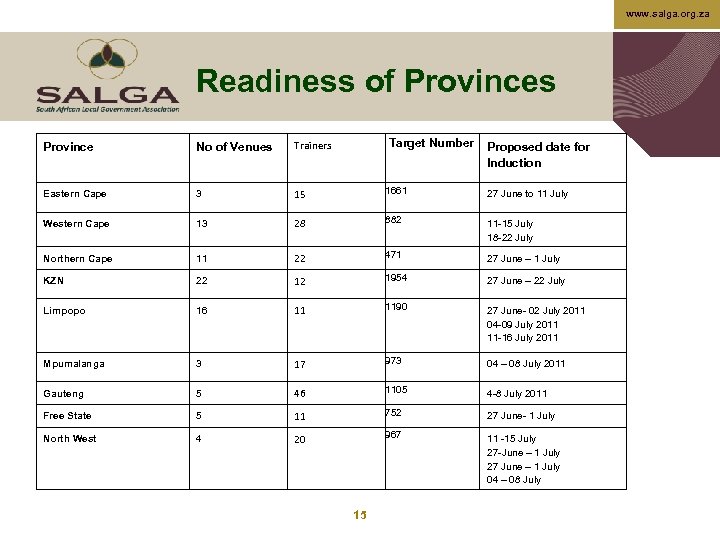
www. salga. org. za Readiness of Provinces Target Number Province No of Venues Trainers Eastern Cape 3 15 1661 27 June to 11 July Western Cape 13 28 882 11 -15 July 18 -22 July Northern Cape 11 22 471 27 June – 1 July KZN 22 12 1954 27 June – 22 July Limpopo 16 11 1190 27 June- 02 July 2011 04 -09 July 2011 11 -16 July 2011 Mpumalanga 3 17 973 04 – 08 July 2011 Gauteng 5 46 1105 4 -8 July 2011 Free State 5 11 752 27 June- 1 July North West 4 20 967 11 -15 July 27 -June – 1 July 27 June – 1 July 04 – 08 July 15 Proposed date for Induction
16 www. salga. org. za Further Training q q As identified in the Impact Assessment done following the 2006 Induction, a structured Councillor support programme for development of Councillors is anticipated. Aspects of development will include, but are not limited to, the following: § Executive Leadership Development Programme (with UP); § Portfolio-based training in the areas of q Municipal Finance q Human Settlements and Sanitation q Councillor support and Mentorship programmes q Governance and intergovernmental relations q Basic services and infrastructure q Local economic development, job creation
17 www. salga. org. za 6. Revenue Enhancement Model PART 1 BACKGROUND
18 www. salga. org. za Current SALGA Funding q q Membership fees § Local Municipalities = 0. 5% of total salary and allowances budget § District Municipalities = 0. 6% of total salary and allowances budget § Metropolitan Municipalities = a flat rate of R 8. 5 million Government Grants § The annual grant received by SALGA from Co. GTA Donors § Donor funds secured have decreased significantly since the 2001/02 Financial Year; trend suggests downward spiralling of donor support Sponsorships § SALGA holds a number of constitutional events and public activities each year that draws on the support of sponsors
19 www. salga. org. za Background q q experiencing challenges in terms of meeting mandate to exercise its mandate and demonstrate its relevance to its key stakeholders, requires finances to fund its activities substantially reliant on subscriptions from municipalities and a grant allocation by Co. GTA RISK - current funding may not be sustainable in the longer-term and if additional sources of revenue are not obtained, the activities may have to scale down
20 www. salga. org. za PART 2 CATEGORISATION OF SALGA ACTIVITIES
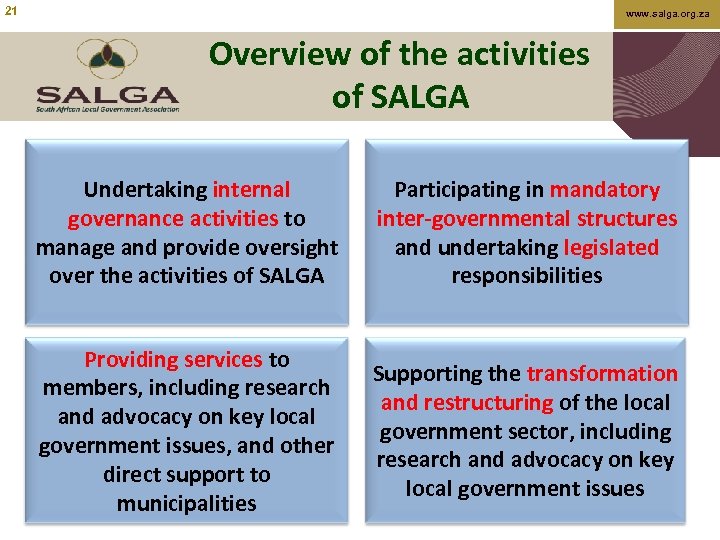
21 www. salga. org. za Overview of the activities of SALGA Undertaking internal governance activities to manage and provide oversight over the activities of SALGA Participating in mandatory inter-governmental structures and undertaking legislated responsibilities Providing services to members, including research and advocacy on key local government issues, and other direct support to municipalities Supporting the transformation and restructuring of the local government sector, including research and advocacy on key local government issues
22 www. salga. org. za PART 2 A INTERNAL GOVERNANCE
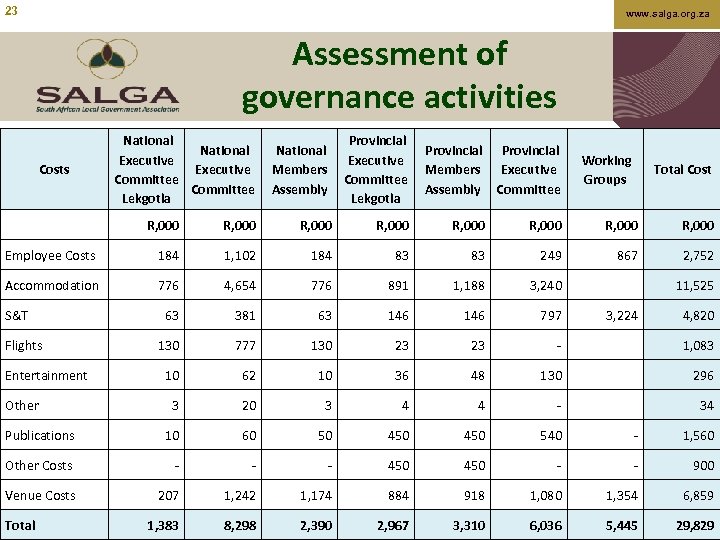
23 www. salga. org. za Assessment of governance activities Costs National Provincial Executive Members Executive Committee Assembly Committee Lekgotla Working Groups Total Cost R, 000 R, 000 Employee Costs 184 1, 102 184 83 83 249 867 2, 752 Accommodation 776 4, 654 776 891 1, 188 3, 240 11, 525 63 381 63 146 797 3, 224 4, 820 130 777 130 23 23 1, 083 10 62 10 36 48 296 3 20 3 4 4 34 10 60 50 450 S&T Flights Entertainment Other Publications Other Costs Venue Costs Total - 130 - 540 - 1, 560 - 900 - 450 - 207 1, 242 1, 174 884 918 1, 080 1, 354 6, 859 1, 383 8, 298 2, 390 2, 967 3, 310 6, 036 5, 445 29, 829
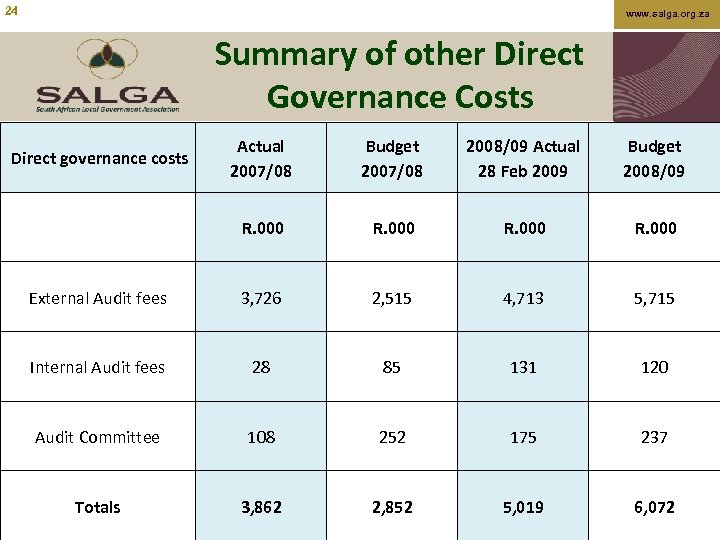
24 www. salga. org. za Summary of other Direct Governance Costs Direct governance costs Actual 2007/08 Budget 2007/08 2008/09 Actual 28 Feb 2009 Budget 2008/09 R. 000 External Audit fees 3, 726 2, 515 4, 713 5, 715 Internal Audit fees 28 85 131 120 Audit Committee 108 252 175 237 Totals 3, 862 2, 852 5, 019 6, 072
25 www. salga. org. za Possible financing of Governance Costs q q q Membership fees § Governance structures that exist, are in accordance with the Constitution. § Governance structures enhance accountability to stakeholders; members should ensure that governance structures that promote accountability and provide the necessary oversight are put in place. § No other stakeholder will be able to impose a governance structure on SALGA other than through national legislation. Government grant financing § Suggesting that government should fund the cost of governance would not be appropriate and could demonstrate a lack of commitment to implementing good governance structures and would be counter-productive. § However, the legislative obligations placed on the organisation should be funded (audit fees) Donors and sponsorships § inappropriate for external bodies (donors) to contribute to finance governance costs
26 www. salga. org. za PART 2 B LEGISLATED IGR PARTICIPATION
27 www. salga. org. za Participating in IGR Structures q Summary of IGR structures: - § National Council of Provinces (NCOP) (Organised Local Government Act); § Finance and Fiscal Commission (Organised Local Government Act); § Budget Forum (Intergovernmental Fiscal Relations Act); § Various structures in terms of the Inter-governmental Relations Framework Act (PCC, Min. MECs, PCFs, etc)
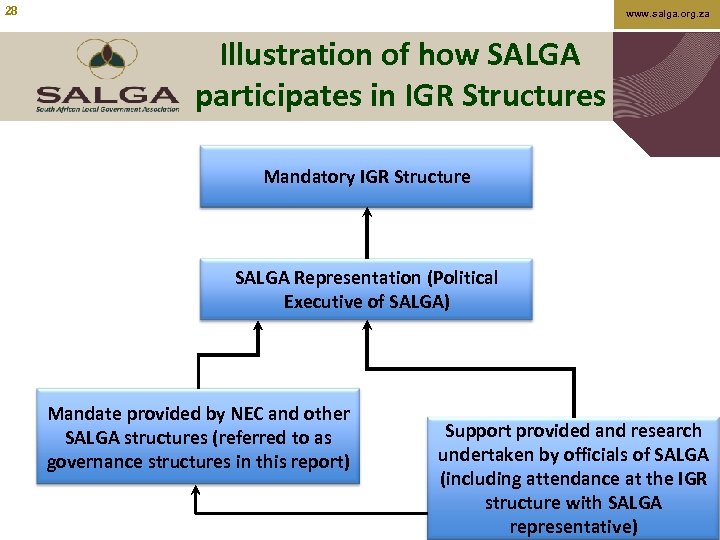
28 www. salga. org. za Illustration of how SALGA participates in IGR Structures Mandatory IGR Structure SALGA Representation (Political Executive of SALGA) Mandate provided by NEC and other SALGA structures (referred to as governance structures in this report) Support provided and research undertaken by officials of SALGA (including attendance at the IGR structure with SALGA representative)
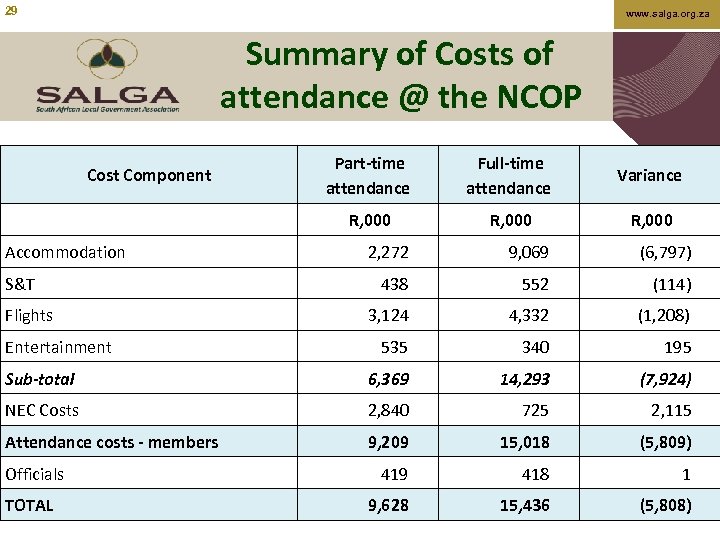
29 www. salga. org. za Summary of Costs of attendance @ the NCOP Part-time attendance Full-time attendance Variance R, 000 Accommodation 2, 272 9, 069 (6, 797) S&T 438 552 (114) Flights 3, 124 4, 332 (1, 208) Entertainment 535 340 195 Sub-total 6, 369 14, 293 (7, 924) NEC Costs 2, 840 725 2, 115 Attendance costs - members 9, 209 15, 018 (5, 809) Officials 419 418 1 TOTAL 9, 628 15, 436 (5, 808) Cost Component
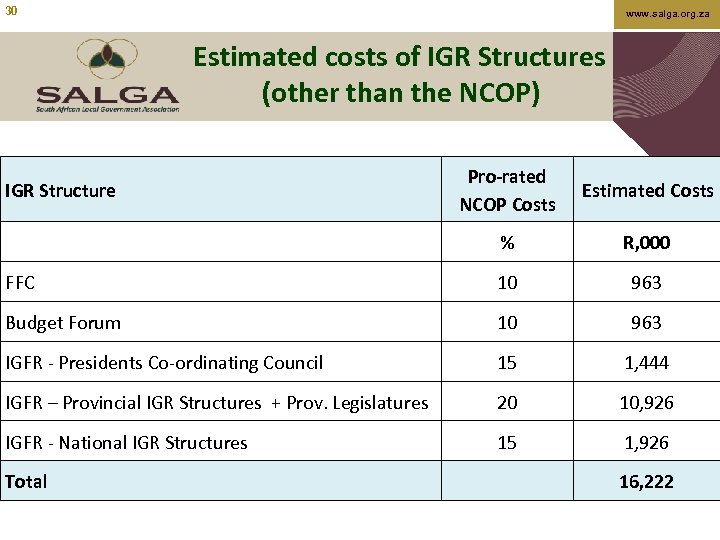
30 www. salga. org. za Estimated costs of IGR Structures (other than the NCOP) Pro-rated NCOP Costs Estimated Costs % R, 000 FFC 10 963 Budget Forum 10 963 IGFR - Presidents Co-ordinating Council 15 1, 444 IGFR – Provincial IGR Structures + Prov. Legislatures 20 10, 926 IGFR - National IGR Structures 15 1, 926 IGR Structure Total 16, 222
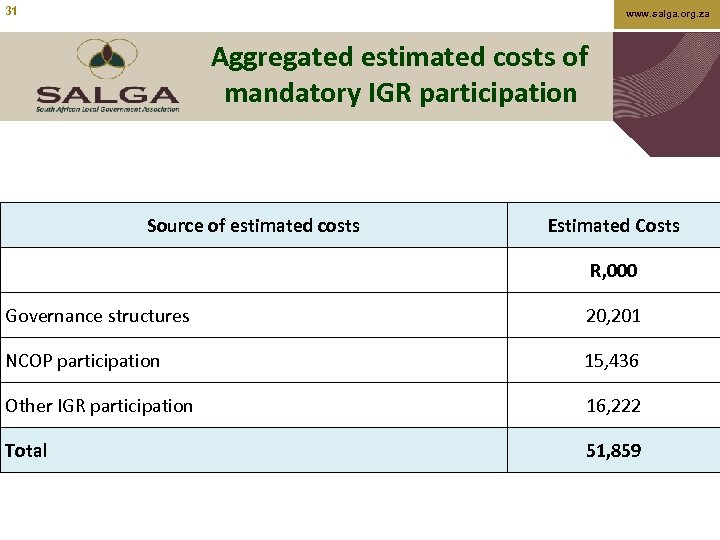
31 www. salga. org. za Aggregated estimated costs of mandatory IGR participation Source of estimated costs Estimated Costs R, 000 Governance structures 20, 201 NCOP participation 15, 436 Other IGR participation 16, 222 Total 51, 859
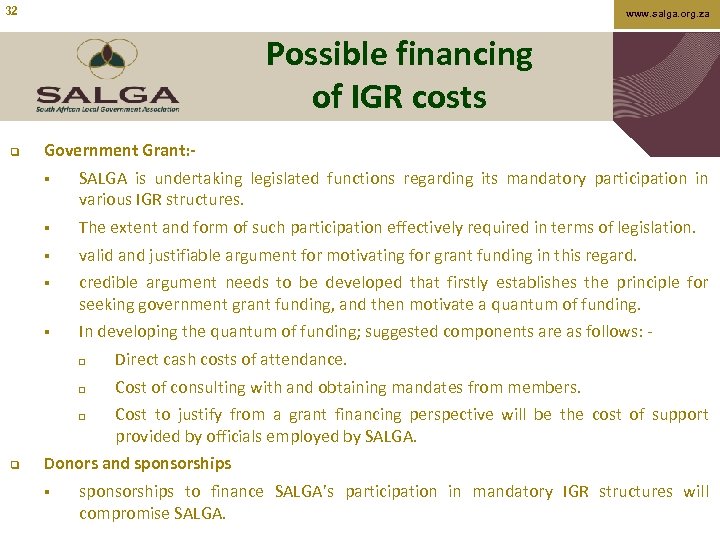
32 www. salga. org. za Possible financing of IGR costs q Government Grant: § SALGA is undertaking legislated functions regarding its mandatory participation in various IGR structures. § The extent and form of such participation effectively required in terms of legislation. § valid and justifiable argument for motivating for grant funding in this regard. § credible argument needs to be developed that firstly establishes the principle for seeking government grant funding, and then motivate a quantum of funding. § In developing the quantum of funding; suggested components are as follows: q Direct cash costs of attendance. q Cost of consulting with and obtaining mandates from members. q q Cost to justify from a grant financing perspective will be the cost of support provided by officials employed by SALGA. Donors and sponsorships § sponsorships to finance SALGA’s participation in mandatory IGR structures will compromise SALGA.
33 www. salga. org. za PART 2 C PROVIDING SERVICES TO MEMBERS
34 www. salga. org. za Providing services to members Employer representative role -tangible service that has benefits to all members and adds value to membership. q Advocacy and research role - very difficult to quantify as a value added benefit to members. q Transformation of local government - difficult to quantify and to demonstrate benefit to members. Challenges: q motivate for increased membership fees to finance activities that tend to benefit the Local Government sector as a whole rather than individual municipalities. q q q difficult to demonstrate a direct benefit for the research and advocacy work that is undertaken or from its participation in IGR structures. provide a support service to individual municipalities, who use the expertise of SALGA officials instead of procuring the services of external consultants.
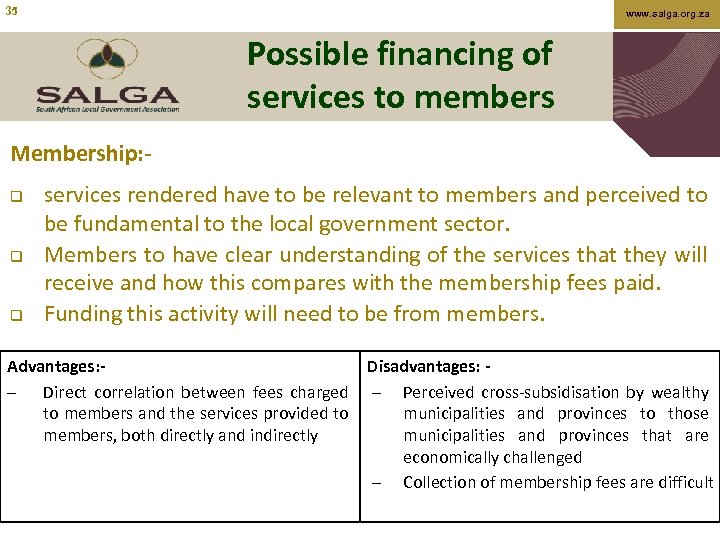
35 www. salga. org. za Possible financing of services to members Membership: q q q services rendered have to be relevant to members and perceived to be fundamental to the local government sector. Members to have clear understanding of the services that they will receive and how this compares with the membership fees paid. Funding this activity will need to be from members. Advantages: - Disadvantages: – Direct correlation between fees charged – Perceived cross-subsidisation by wealthy to members and the services provided to municipalities and provinces to those members, both directly and indirectly municipalities and provinces that are economically challenged – Collection of membership fees are difficult
36 www. salga. org. za PART 2 D SUPPORTING TRANSFORMATION / RESTRUCTURING INITIATIVES
37 www. salga. org. za Supporting transformation of Local Government Summary of role in the transformation of local government q q has an objective to support the transformation of Local Government. sees itself as participating in transformation initiatives that are initiated by National Government and other related parties, such as the introduction of REDs. transformation issues that are driven by national departments and the participation of SALGA in national department led initiatives, is often required. initiatives that SALGA itself initiates based on feedback from its members and based on challenges facing the sector.
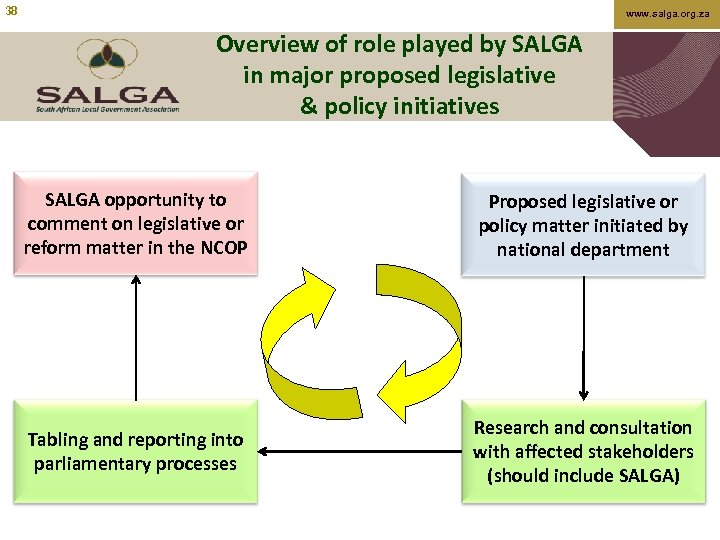
38 www. salga. org. za Overview of role played by SALGA in major proposed legislative & policy initiatives SALGA opportunity to comment on legislative or reform matter in the NCOP Proposed legislative or policy matter initiated by national department Tabling and reporting into parliamentary processes Research and consultation with affected stakeholders (should include SALGA)
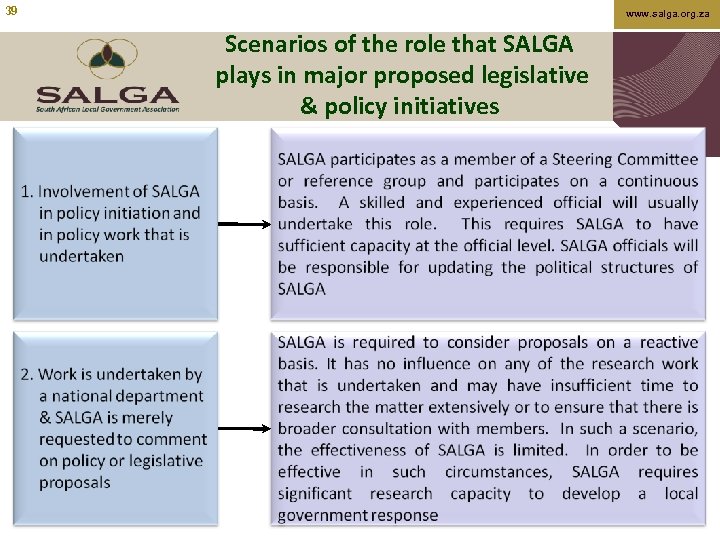
39 www. salga. org. za Scenarios of the role that SALGA plays in major proposed legislative & policy initiatives
40 www. salga. org. za Possible financing of support to the transformation of the Local Government Sector q q q Membership fees § It would be appropriate that membership fees finance the support that SALGA provides in the transformation of the local government sector. § A further advantage of using membership fees is that the structures that SALGA puts in place to support this role have to be affordable and appropriate. § The disadvantage of using membership fees is that there are major challenges facing local governments § These require significant resources to finance from an individual municipality perspective Government grant financing § SALGA requires access to research capacity and has to be in a position to communicate and consult with its membership base. § This requires access to financing and therefore there is a valid argument for funding from government. Donors and sponsorships § The possibility of obtaining donor funding on a project specific basis is high. § Consultations with donors confirm that there is a willingness to finance specific projects.
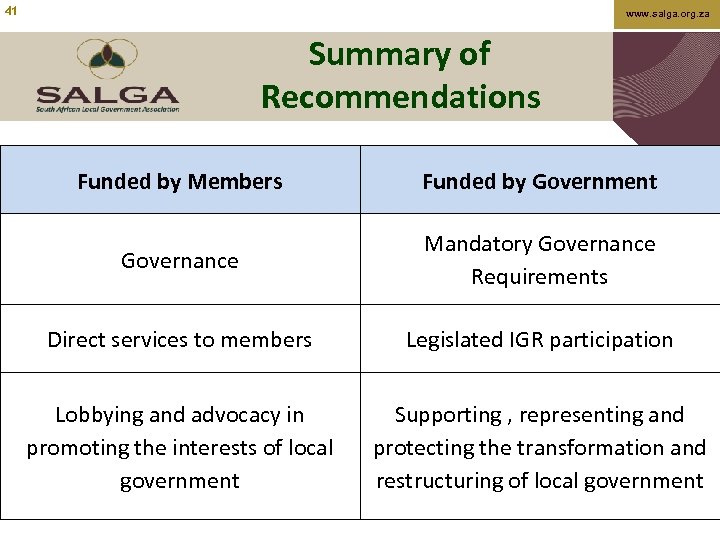
41 www. salga. org. za Summary of Recommendations Funded by Members Funded by Government Governance Mandatory Governance Requirements Direct services to members Legislated IGR participation Lobbying and advocacy in promoting the interests of local government Supporting , representing and protecting the transformation and restructuring of local government
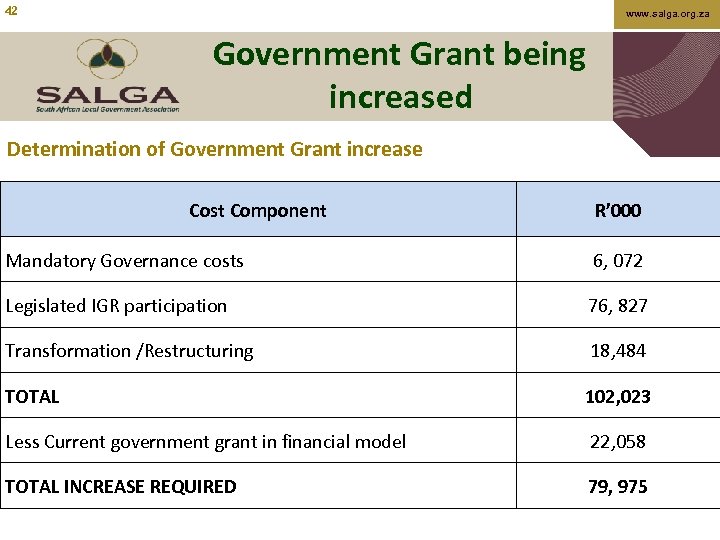
42 www. salga. org. za Government Grant being increased Determination of Government Grant increase Cost Component R’ 000 Mandatory Governance costs 6, 072 Legislated IGR participation 76, 827 Transformation /Restructuring 18, 484 TOTAL 102, 023 Less Current government grant in financial model 22, 058 TOTAL INCREASE REQUIRED 79, 975
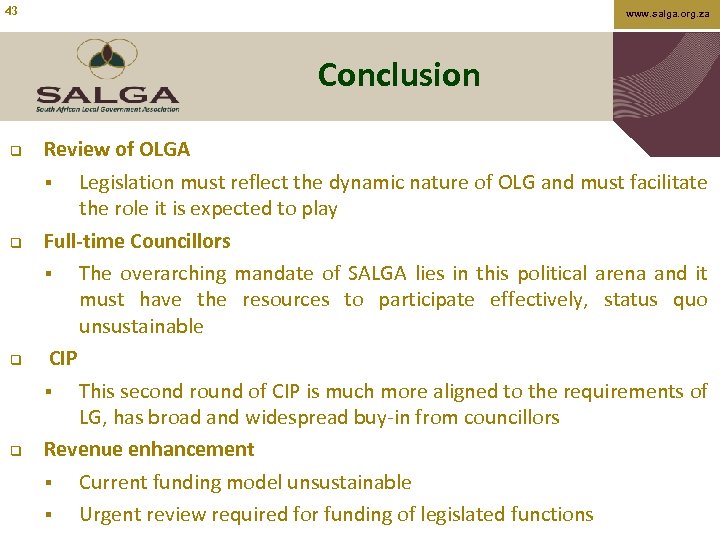
43 www. salga. org. za Conclusion q q Review of OLGA § Legislation must reflect the dynamic nature of OLG and must facilitate the role it is expected to play Full-time Councillors § The overarching mandate of SALGA lies in this political arena and it must have the resources to participate effectively, status quo unsustainable CIP § This second round of CIP is much more aligned to the requirements of LG, has broad and widespread buy-in from councillors Revenue enhancement § Current funding model unsustainable § Urgent review required for funding of legislated functions

44 www. salga. org. za THANK YOU
Скачать презентацию 1 www salga org za Welcome Briefing by
44667b16aec91f08e7548cb8a5562137.ppt