


 Скачать презентацию 1 Welcome to INRIA Sophia Antipolis 2
184f9da130f28b718a152ecee36ef4eb.ppt
- Количество слайдов: 42
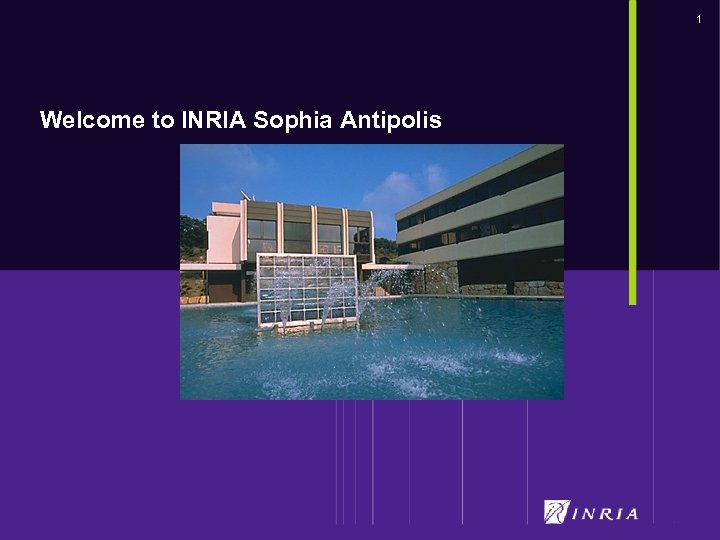 1 Welcome to INRIA Sophia Antipolis
 2 The INRIA French National Institute for Research in Computer Science and Control
 French National Institute for Research in Computer Science and Control An institute at the heart of Information and Communication Science and Technology (ICST) • • Researching Experimenting Sharing and transmitting Creating points of reference A public scientific and technological institute under the dual authority of the Ministry of Research and the Ministry of Industry 3
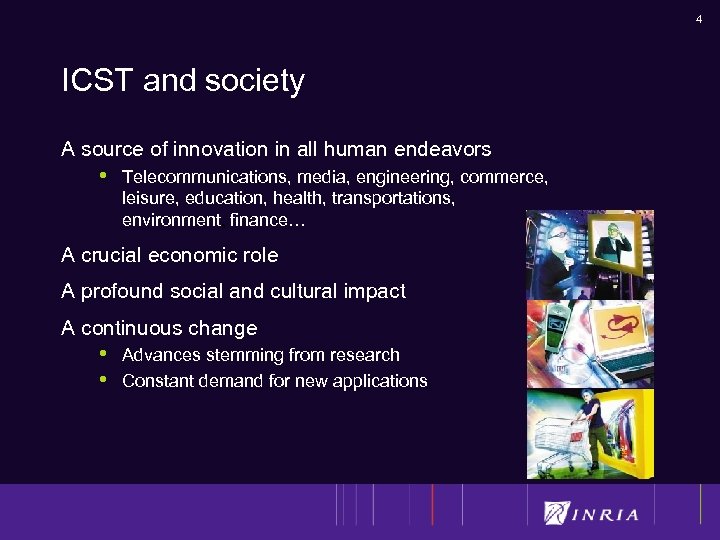 4 ICST and society A source of innovation in all human endeavors • Telecommunications, media, engineering, commerce, leisure, education, health, transportations, environment, finance… A crucial economic role A profound social and cultural impact A continuous change • • Advances stemming from research Constant demand for new applications
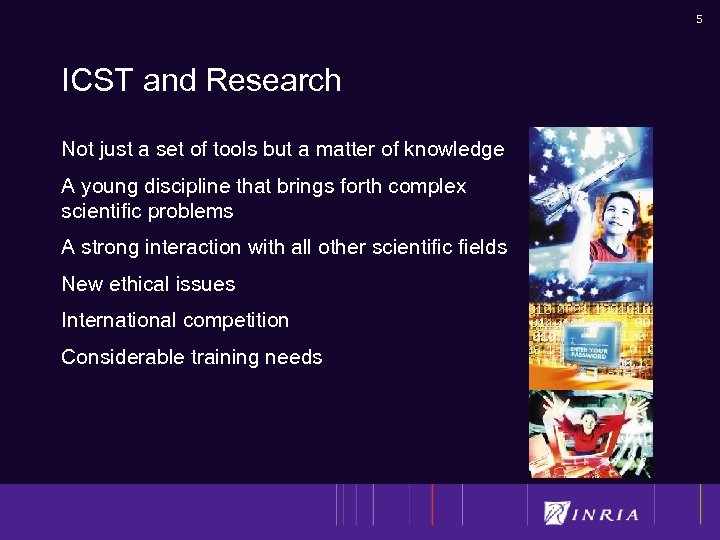 5 ICST and Research Not just a set of tools but a matter of knowledge A young discipline that brings forth complex scientific problems A strong interaction with all other scientific fields New ethical issues International competition Considerable training needs
 Scientific positioning • Strong theoretical background • • • Automatic control, signal and image processing Numerical Analysis Applied Probabilities Discrete mathematics, combinatorics, cryptography … • Technology transfer • • • Development of software prototypes Creation of start-up companies Participation in the elaboration of norms Classes in Universities (Master) … 6
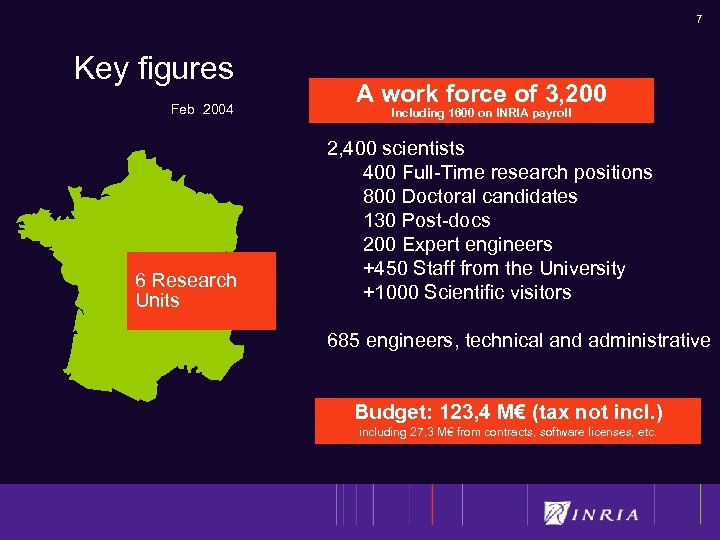 7 Key figures Feb 2004 6 Research Units A work force of 3, 200 Including 1600 on INRIA payroll 2, 400 scientists 400 Full-Time research positions 800 Doctoral candidates 130 Post-docs 200 Expert engineers +450 Staff from the University +1000 Scientific visitors 685 engineers, technical and administrative Budget: 123, 4 M€ (tax not incl. ) including 27, 3 M€ from contracts, software licenses, etc.
 8 Scientific Production 2003 § 2000 scientific publications § 20 international conferences organized § 3500 attendees § 60 start-ups, 7 created 2003 § 800 ongoing research contracts, 300 signed in the year § 150 softwares in free access or licensed
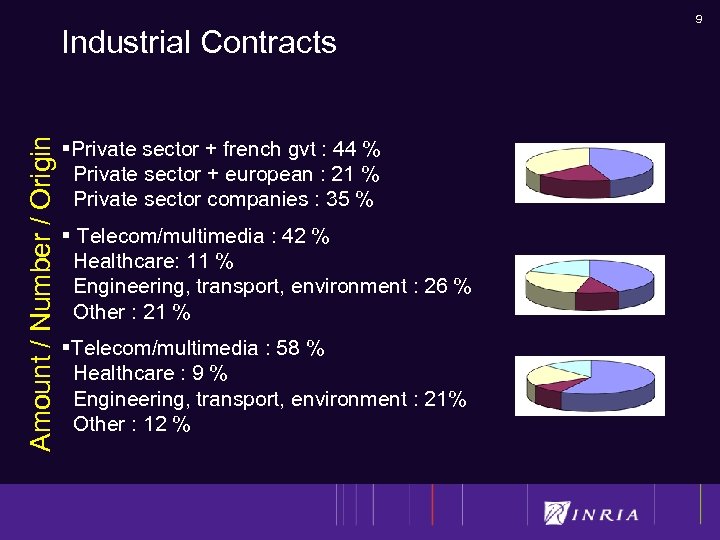 Amount / Number / Origin Industrial Contracts §Private sector + french gvt : 44 % Private sector + european : 21 % Private sector companies : 35 % § Telecom/multimedia : 42 % Healthcare: 11 % Engineering, transport, environment : 26 % Other : 21 % §Telecom/multimedia : 58 % Healthcare : 9 % Engineering, transport, environment : 21% Other : 12 % 9
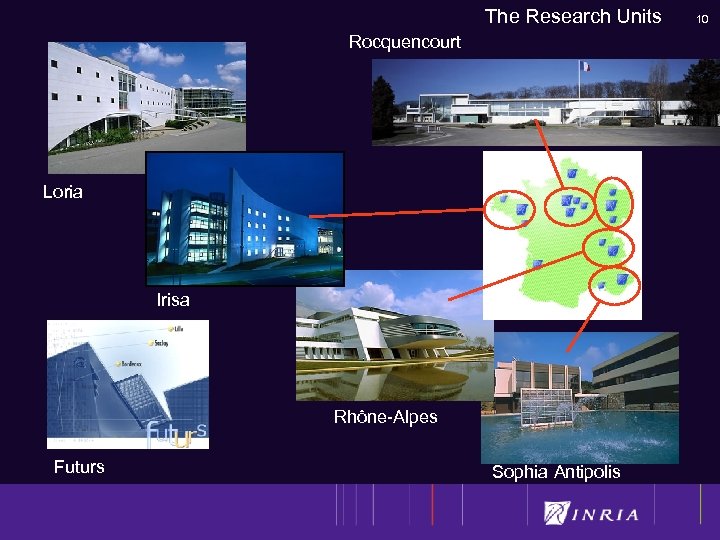 The Research Units Rocquencourt Loria Irisa Rhône-Alpes Futurs Sophia Antipolis 10
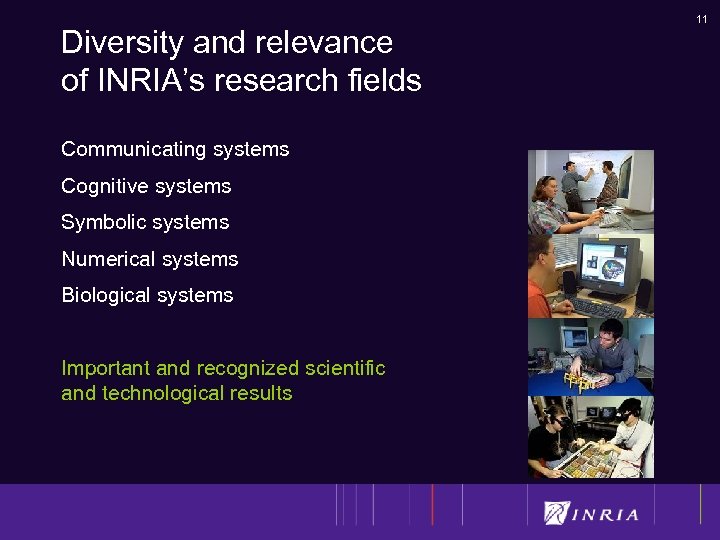 Diversity and relevance of INRIA’s research fields Communicating systems Cognitive systems Symbolic systems Numerical systems Biological systems Important and recognized scientific and technological results 11
 12 Mid-term Scientific Challenges • Conceive and master future infrastructures of networks and services. ► architectures, protocols, modeling, optimization, planning monitoring and management of communication networks • Develop the processing and transmission of multimedia data • Guarantee the security and reliability of software-based Sys • Couple data and models for control and simulation of Sys • Combine simulation, visualization, and interaction • Model the mechanisms of life • Integrate ICST into medical technologies
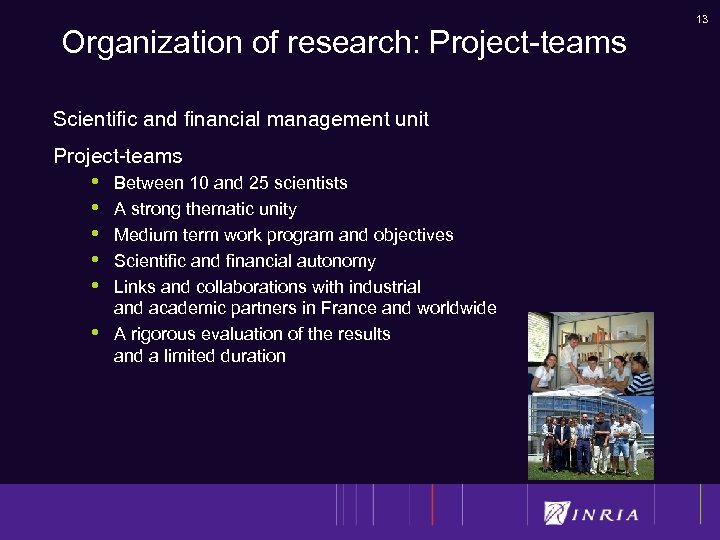 Organization of research: Project-teams Scientific and financial management unit Project-teams • • • Between 10 and 25 scientists A strong thematic unity Medium term work program and objectives Scientific and financial autonomy Links and collaborations with industrial and academic partners in France and worldwide A rigorous evaluation of the results and a limited duration 13
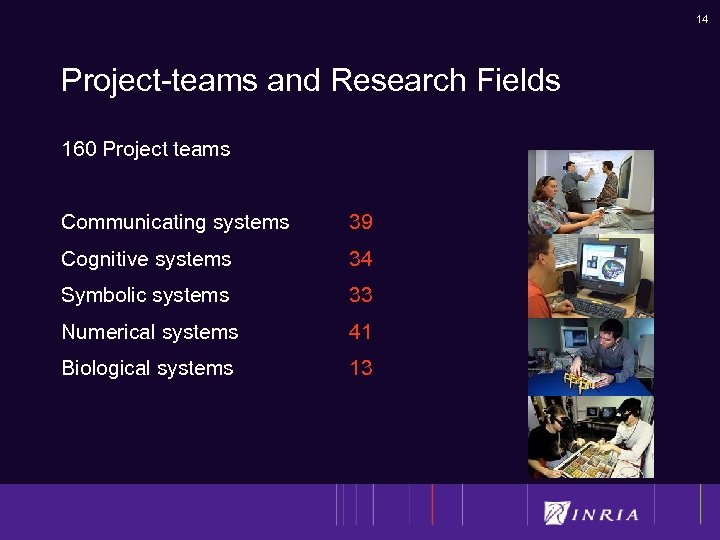 14 Project-teams and Research Fields 160 Project teams Communicating systems 39 Cognitive systems 34 Symbolic systems 33 Numerical systems 41 Biological systems 13
 Technology transfer, an economic ambition Research with an eye on business An essential element of the Institute’s culture Objectives • • • Lower the transfer time between an idea and its marketing Optimizing the economic impact on the short, medium and long terms Creating standards to achieve technological breakthroughs This transfer policy is asserted in INRIA’s strategic plan: “Building strong partnerships with major French and foreign companies that are leaders on their market” 15
 16 Working and talking with companies A long standing experience in terms of relations with the economic sector • • • Over 800 ongoing research contracts (Jan. 1 st, 2004) Participation in over 250 European projects, mainly with industry Software distribution (contracts and open source) Continuous exchanges • • • INRIA-Industry meetings Technological partnership clubs with small and medium-sized companies Welcoming engineers from industry
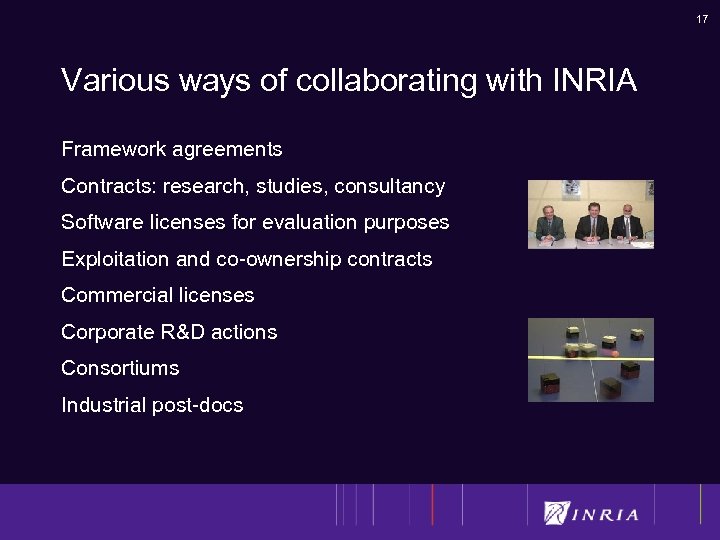 17 Various ways of collaborating with INRIA Framework agreements Contracts: research, studies, consultancy Software licenses for evaluation purposes Exploitation and co-ownership contracts Commercial licenses Corporate R&D actions Consortiums Industrial post-docs
 18 International relations (1) Collaborations with European research centers and industry • • • Participation in more than 250 European projects ERCIM (European Research Consortium for Informatics and Mathematics) AIR&D Joint virtual laboratory on ambient intelligence (INRIA, Philips, Thomson) Joint laboratories • • • Franco-Russian Liapunov Institute LIAMA Franco-Chinese laboratory France-Hong Kong center for Financial and Insurance Engineering INRIA-Hongkong University Joint Research Center LAFMI Franco-Mexican laboratory
 19 International relations (2) International standards • • Hosting the W 3 C Participation at the IETF International Cooperation in Research • • NSF Involvement in Asia Participation with CIMPA in Africa Intership program
 20 INRIA Sophia-Antipolis A Research Unit created in 1984
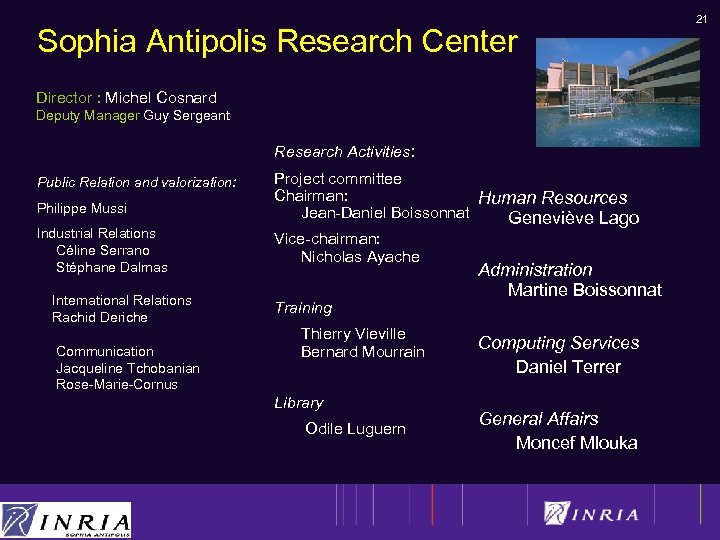 Sophia Antipolis Research Center Director : Michel Cosnard Deputy Manager Guy Sergeant Research Activities: Public Relation and valorization: Philippe Mussi Industrial Relations Céline Serrano Stéphane Dalmas International Relations Rachid Deriche Communication Jacqueline Tchobanian Rose-Marie-Cornus Project committee Chairman: Human Resources Jean-Daniel Boissonnat Geneviève Lago Vice-chairman: Nicholas Ayache Training Thierry Vieville Bernard Mourrain Library Odile Luguern Administration Martine Boissonnat Computing Services Daniel Terrer General Affairs Moncef Mlouka 21
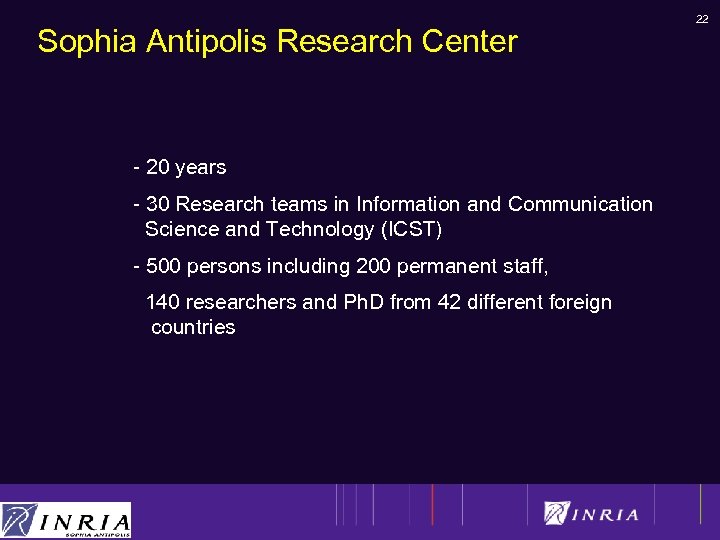 Sophia Antipolis Research Center - 20 years - 30 Research teams in Information and Communication Science and Technology (ICST) - 500 persons including 200 permanent staff, 140 researchers and Ph. D from 42 different foreign countries 22
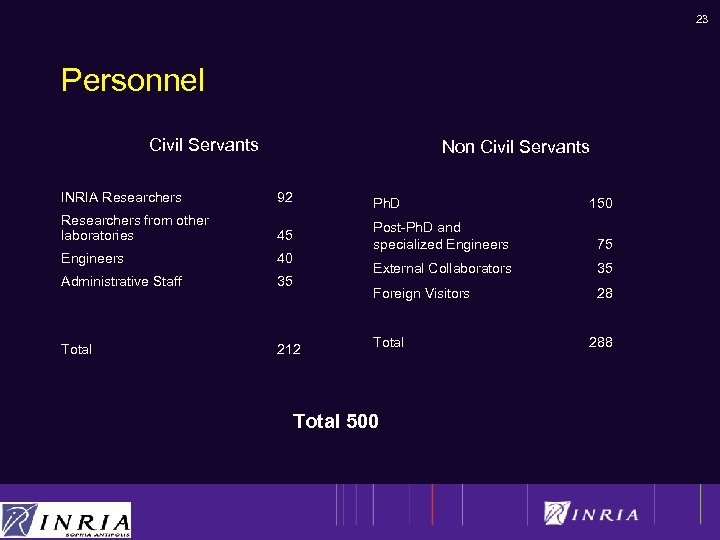 23 Personnel Civil Servants Non Civil Servants INRIA Researchers 92 Ph. D 150 Researchers from other laboratories 45 Engineers 40 Post-Ph. D and specialized Engineers 75 Administrative Staff 35 External Collaborators 35 Foreign Visitors 28 Total 212 Total 288 Total 500
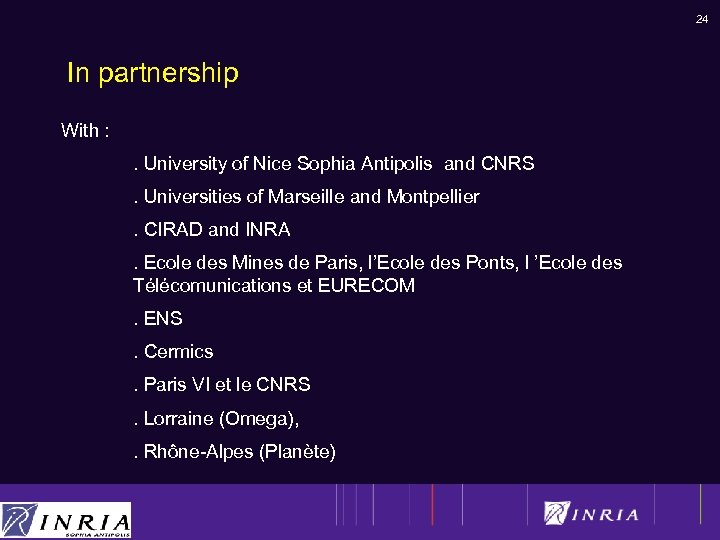 24 In partnership With : . University of Nice Sophia Antipolis and CNRS . Universities of Marseille and Montpellier. CIRAD and INRA. Ecole des Mines de Paris, l’Ecole des Ponts, l ’Ecole des Télécomunications et EURECOM. ENS. Cermics . Paris VI et le CNRS . Lorraine (Omega), . Rhône-Alpes (Planète)
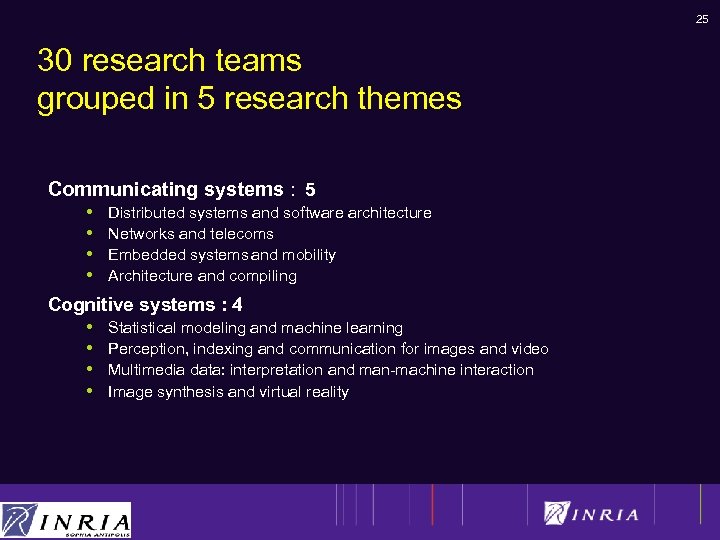 25 30 research teams grouped in 5 research themes Communicating systems : 5 • • Distributed systems and software architecture Networks and telecoms Embedded systems and mobility Architecture and compiling Cognitive systems : 4 • • Statistical modeling and machine learning Perception, indexing and communication for images and video Multimedia data: interpretation and man-machine interaction Image synthesis and virtual reality
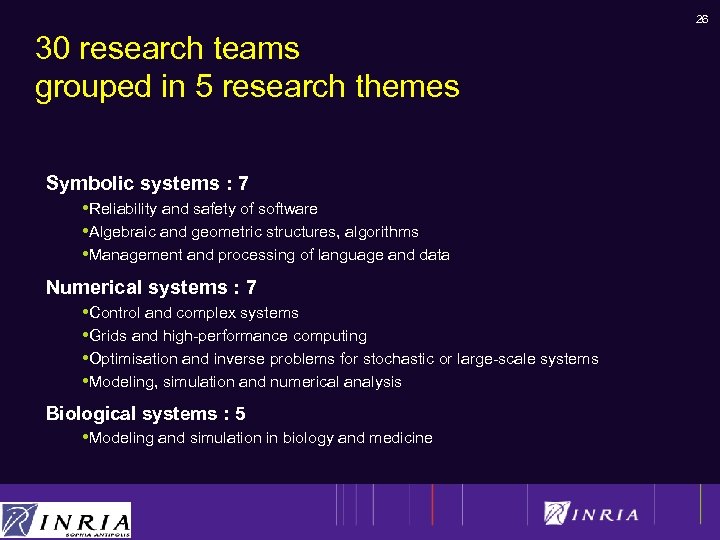 26 30 research teams grouped in 5 research themes Symbolic systems : 7 • Reliability and safety of software • Algebraic and geometric structures, algorithms • Management and processing of language and data Numerical systems : 7 • Control and complex systems • Grids and high-performance computing • Optimisation and inverse problems for stochastic or large-scale systems • Modeling, simulation and numerical analysis Biological systems : 5 • Modeling and simulation in biology and medicine
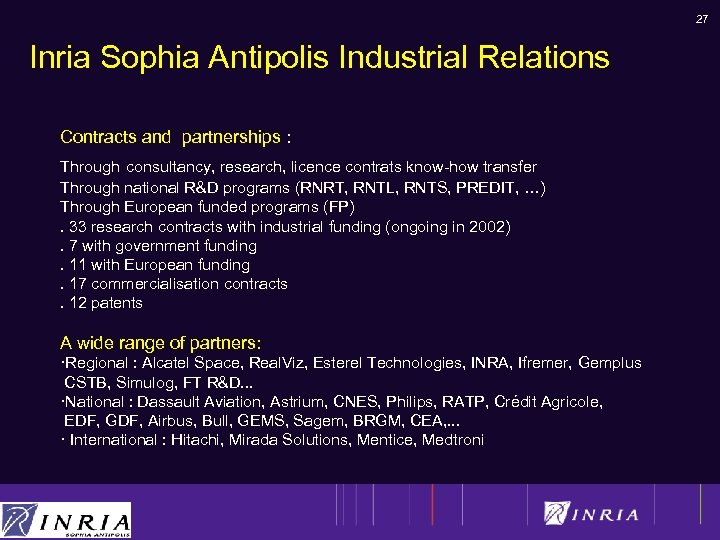 27 Inria Sophia Antipolis Industrial Relations Contracts and partnerships : Through consultancy, research, licence contrats know-how transfer Through national R&D programs (RNRT, RNTL, RNTS, PREDIT, …) Through European funded programs (FP) . 33 research contracts with industrial funding (ongoing in 2002). 7 with government funding. 11 with European funding. 17 commercialisation contracts . 12 patents A wide range of partners: ·Regional : Alcatel Space, Real. Viz, Esterel Technologies, INRA, Ifremer, Gemplus CSTB, Simulog, FT R&D. . . ·National : Dassault Aviation, Astrium, CNES, Philips, RATP, Crédit Agricole, EDF, GDF, Airbus, Bull, GEMS, Sagem, BRGM, CEA, . . . · International : Hitachi, Mirada Solutions, Mentice, Medtroni
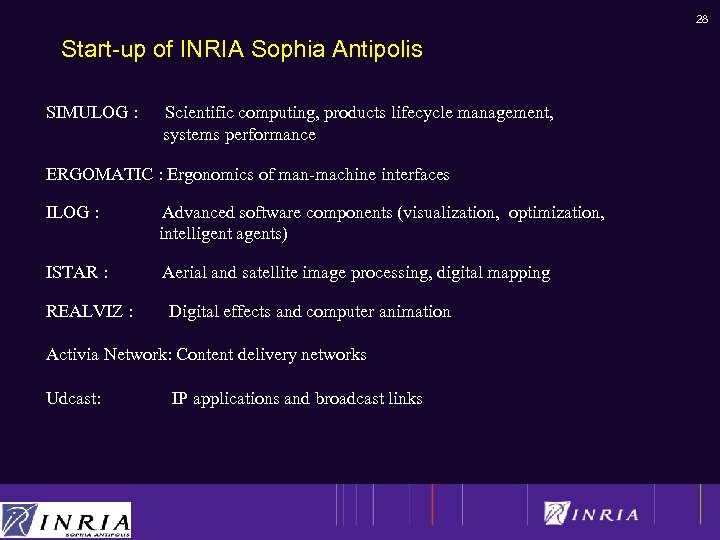 28 Start-up of INRIA Sophia Antipolis SIMULOG : Scientific computing, products lifecycle management, systems performance ERGOMATIC : Ergonomics of man-machine interfaces ILOG : Advanced software components (visualization, optimization, intelligent agents) ISTAR : Aerial and satellite image processing, digital mapping REALVIZ : Digital effects and computer animation Activia Network: Content delivery networks Udcast: IP applications and broadcast links
 29 And also Esterel Technologies : Solutions for embedded software, SOC design validation and verification Infobjects : Managing and sharing complex and heterogeneous information Quantificare : Medical image analysis for pharmaceutical applications Geometry Factory: Software components for computational geometry
 30 European and international relations. 245 foreigners (40 researchers, 75 Ph. D students, 30 post-Ph. D, 50 invited scientists and 50 students). 42 nationalities. 34 international collaborations (IST, HPMT, EEC, EVK 4, PAI) French, European and international organizations hosted by the research unit - CMA: Centre de Mathématiques Appliquées. Joint laboratory with Ecole des Mines de Paris - CERMICS: Centre d'Enseignement et de Recherche en Mathématiques, Informatique et Calcul Scientifique. Joint laboratory with Ecole Nationale des Ponts et Chaussées - ERCIM : European Consortium for Informatics and Mathematics - W 3 C : World Wide Web Consortium
 Training and knowledge dissemination Training through research • 150 Ph. D and students • Complementary training : courses at ESSI, ISIA , thematic seminars, Colloquium (scientific conferences) • Activities in computing engineery, training in industrial companies • Most advanced equipement Post-doctoral training • Welcoming young foreign researchers • Post-doctoral periods abroad • ERCIM fellowships in European countries • Fellowships for industrial post-docs Teaching • University degree courses (DEA, DESS) • Engineering schools (École Polytechnique, ENS, etc. ) Organizing courses and seminars • Setting up INRIA courses, seminars and working groups • Organizing national and international conferences 31
 32 Library • A partnership with I 3 S laboratory (UMR Cnrs-Unsa) • Open to specialized users, it offers, - 34000 books, Ph. D theses, conferences proceedings, research reports - 320 specialized reviews covering all the research themes (including 230 on line) - specialized bibliographies on ligne -Access to resources of Inria – Unsa libraries - Web site , library portal http: //www-sop. inria. fr/dias/ • A participation in the following networks: – Bibliothèques françaises de mathématiques (RNBM) – Bibliothèque Nationale (BNF) - pôle associé Informatique
 INRIA in Provence-Alpes-Côte d’Azur Scientific Partnerships : Joint research teams with: -Ecole des Mines (CMA - Centre de Mathématiques Appliquées) -UNSA (Université de Nice) et CNRS -Ecole des Ponts et Chaussées (CERMICS) -Université de Provence Collaborations with : -Laboratories of Nice Sophia Antipolis university -Institut Eurecom -Universities of Marseille, Provence and Méditerranée, -Observatoire de la Côte d’Azur, -Observatoire Océanographique de Villefranche (Paris VI) Ifremer, IMT etc. Institutional Partnerships -R 3 T 2 , médiathèque (IRIS) Participation to professional clubs or associations : - Telecom Valley, PERSAN, Club Hi. Tech, Pôle Santé, Ime. T, MITSA, Méditerranée-Technologie… 33
 34 Research in “Com” at INRIA-Sophia Theme Com A : Distributed systems and software architecture OASIS - Active objects, semantics, Internet and security Theme Com B : Networks and telecoms MAESTRO - Models for the performance analysis and the control of networks MASCOTTE - Algorithms, simulation, combinatorics and optimization for telecommunications PLANETE - Protocols and applications for the Internet Theme Com C : Embedded systems and mobility MIMOSA - Migration and mobility : semantics and applications Theme Com D : Architecture and compiling
 35 Research in “Com B” at INRIA Theme Com B : Networks and telecoms ARES - Architectures of networks of services ARMOR - Architectures and network models DISTRIBCOM - Distributed and Iterative Algorithms in Management and Signal Processing for Telecommunications GYROWEB - Dynamic graphs and the web graph HIPERCOM - High performance communication MADYNES - Management of dynamic networks and services MAESTRO - Models for the perf. analysis and the control of networks MASCOTTE - Algos, simulation, combinatorics and optim. for telecoms PLANETE - Protocols and applications for the Internet RAP - Networks, Algorithms and Probabilities TREC - Theory of networks and communications
 36 The MAESTRO project-team Modeling, Performance Evaluation and Control of Networks
 The MAESTRO Project Created end 2003. Head: Philippe Nain Joint with U. Montpellier 2 Sequel of MISTRAL (1993 -2003) headed by F. Baccelli Personnel (2003 -2004) • 5 permanent staff • 2 post-doc fellows • 2 research engineers (under contract) • 8 Ph. D students • 4 Master interns • 20+ scientific visitors 37
 38 The MAESTRO Project (ctd) Publications (1999 -2002) 2003 • 6 Ph. D theses 2 • 56 journal publications 8 • 70 conference publications 18 • 2 books + 2 book chapters 1 • 24 technical reports 3 • 25 contract deliverables -
 39 Industrial contracts MAESTRO 9+ Research Grants 2000 -2003 Main sources of funding: • RNRT: National Network for Research in Telecom • France Telecom R&D programs for Research Collaborations Form of the funding • Grants for post-doctoral fellows / trainees / research engineers • (rarely) Ph. D grants
 40 Industrial contracts MAESTRO (ctd) Research themes France Telecom R&D • Analysis of TCP. Throughput, loss process • Game theory for non-cooperative routing and pricing • Resource allocation in UMTS networks Alcatel Space • Simulation of TCP networks, access control methods • Qo. S of TCP/ATM on satellite networks • Resource allocations for satellite networks (w/ MASCOTTE)
 41 Industrial contracts MAESTRO (ctd) Cegetel – Delta Partners • Performance evaluation environment – fast simulations Large consortiums • Project VTHD++ : “Really Very Large Bandwidth” • Development of Wagon: traffic analyzer and generator for data, multimedia, voice traffic • Experimentation on the VTHD 2. 5 Gbps platform
 42 Industrial contracts MAESTRO (ctd) • Scientific outcome of the projects • • Publications Participation in (commercial? ) software Patents IETF Proposals