 Скачать презентацию 1 Using Audio Books to Improve Reading
73cbbab69a9184f19673764d6b5c41d1.ppt
- Количество слайдов: 66



1
Using Audio Books to Improve Reading and Academic Performance Joel Montgomery, Ed. D, MAT Dr. M-MS-Resources. wikispaces. com ELL Teacher Canton Middle School District U-46 Streamwood, IL © 2009 by J. R. Montgomery 2
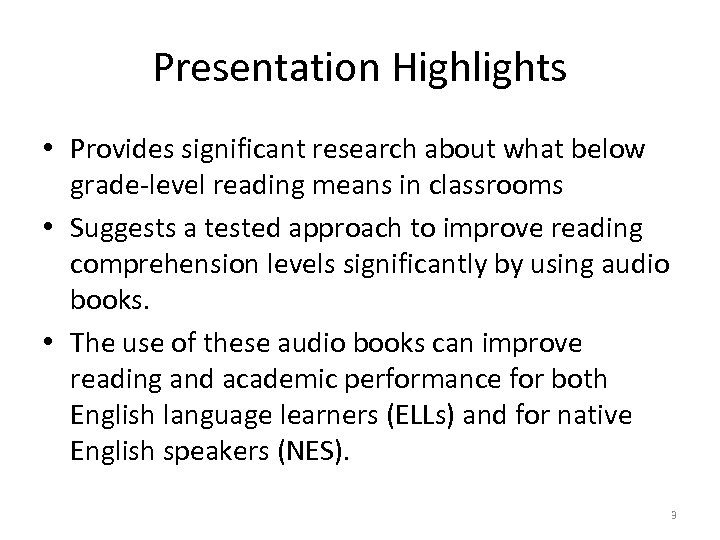
Presentation Highlights • Provides significant research about what below grade-level reading means in classrooms • Suggests a tested approach to improve reading comprehension levels significantly by using audio books. • The use of these audio books can improve reading and academic performance for both English language learners (ELLs) and for native English speakers (NES). 3
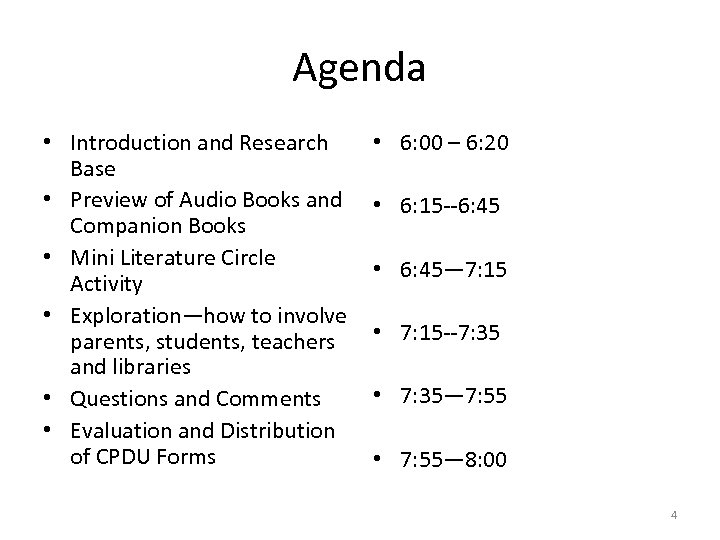
Agenda • Introduction and Research Base • Preview of Audio Books and Companion Books • Mini Literature Circle Activity • Exploration—how to involve parents, students, teachers and libraries • Questions and Comments • Evaluation and Distribution of CPDU Forms • 6: 00 – 6: 20 • 6: 15 --6: 45 • 6: 45— 7: 15 • 7: 15 --7: 35 • 7: 35— 7: 55 • 7: 55— 8: 00 4
Reading is Important • Literate adults need to be capable readers and capable readers must enjoy reading. • Reading needs to be a “flow” activity which Csikszentmihalyi describes as “the way people describe their state of mind when consciousness is harmoniously ordered, and they want to pursue whatever they are doing for its own sake” (1991, p. 6). 5
What Research Says • Only one-third of students in the United States read at levels that are likely to assure them academic success and good jobs and that nearly the same number of students cannot function at the most basic level of literacy (Carbo, 1996, p. 8) 6
STUDENTS LOSE ENTHUSIASM FOR LEARNING TO READ 7
What Research Says • While most students enter school with an enthusiasm for learning to read, many become progressively less motivated to read (Carbo, 1983) 8
What Research Says • “At virtually all levels of performance…an achievement gap inevitably emerges and enlarges over time that negatively affects students in high poverty schools and minority students” (Mc. Call, Hauser, Cronin, Kingsbury, and Hauser, 2006, p. 43). 9
What Research Says • Eighty-five percent of Latino students in fourth through eighth grade read below grade level, as much a four years below their native English-speaking counterparts in middle and high schools (Preciado, Horner, and Baker, 2009). 10
Action Research from the Classroom • Reading RIT scores (NWEA, 2009 c) on the Northwest Evaluation Association’s (NWEA) Measures of Academic Performance (MAP) test (2009 a) taken in December 2008 by seventy-four seventh and eighth-grade English language learners, averaged at least four years below grade-level. 11
Action Research from the Classroom • The average Reading RIT score was 202 (NWEA, 2009 b) for seventh-graders and 198 for eighthgraders. • Converting the Lexile ranges (Meta. Metrics, 2009) reported by NWEA for these scores into reading grade-levels, resulted in reading grade-level ranges between 2. 9 and 4. 0 for seventh graders and between 2. 6 and 3. 5 for eighth-graders (Advantage Learning Systems, 2009). 12
CONSEQUENCES OF BELOW-GRADELEVEL READING 13
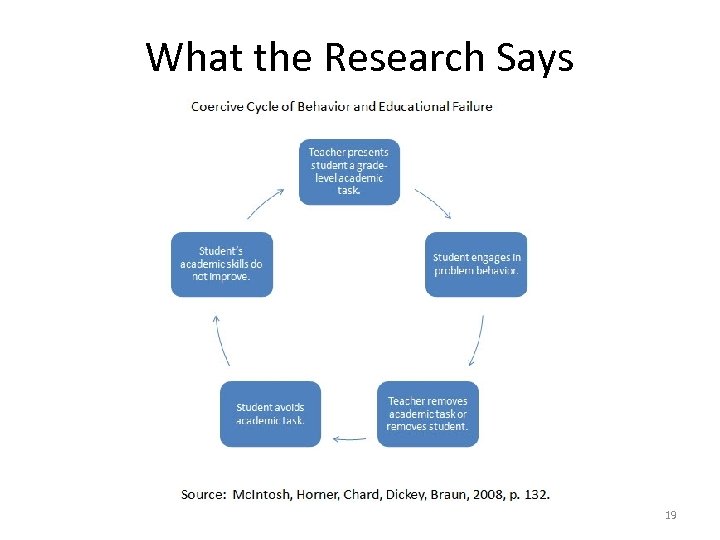
What Research Says • Students reading significantly below grade level have trouble keeping up with academic requirements expected …. Students who struggle academically are more likely to develop problem behaviors designed to escape and avoid academic demands (Mc. Intosh, Flannery, Sugai, Braun, and Cochrane, 2008; Moore, Anderson, and Kumar, 2005; Morgan, Farkas, Tufis, and Sperling, 2008; Preciado et al. , 2009). 14
Research into Practice • Because they are unable to read and understand academic textbooks often containing above grade-level language, students become frustrated when trying to complete assignments in the classroom. • At the same time, students who are unaccustomed to listening to English and reading grade-level Englishlanguage textbooks also find it extremely difficult to take meaningful notes in class. • When asked to complete routine written assignments, students unaccustomed to reading English at gradelevel are unable to communicate effectively at gradelevel in spoken or written English. (Montgomery, 2009) 15
What the Research Says • When the majority of students in a classroom are significantly challenged by grade-level academic expectations, they are also less likely to engage effectively in cooperative or independent learning activities and are more likely to engage in off-task behavior (Preciado et al. , 2009). 16
What the Research Says • “When students disrupt the educational environment, they stop teaching from occurring, thereby preventing their own learning” (Mc. Intosh, Horner, Chard, Dickey and Braun, 2008, p. 132). 17
What the Research Says • Carefully selected behavioral and academic interventions are required for students who have developed the habit of repeatedly choosing off-task behavior to avoid engaging in academic tasks beyond their skill level (Mc. Intosh, Flannery et al. , 2008; Moore et al. , 2005; Morgan et al. , 2008; Preciado et al. , 2009). 18
What the Research Says 19
AUDIO MODELS IMPROVE FLUENCY AND COMPREHENSION 20
What the Research Says • Two most effective models for teaching reading--storytelling and reading aloud-familiarize students with the “sound and sense” of written language (Carbo, 1996, p. 8). 21
What the Research Says • Audio books offer a way to recapture enthusiasm for reading. Carbo reports that poor readers frequently have a “global/tactile/kinesthetic” reading style, best addressed through holistic reading methods (Carbo, 1990, p. 26). • For these learners, listening to stories recorded at a slower-than-usual pace (the recorded book method) reduces much of the stress involved in reading and has been found to increase fluency and comprehension (Carbo, 1987, 1990). 22
What the Research Says • “Repeated exposure to the correct reading methods and interesting, well-written books is the fastest way to reach high standards of literacy in our classrooms” (Carbo, 1990, pp. 27 -28). 23
What the Research Says • “Repeated exposure to the correct reading methods and interesting, well-written books is the fastest way to reach high standards of literacy in our classrooms” (Carbo, 1990, pp. 27 -28). 24
What the Research Says • Much of has been learned to improve first language literacy applies to building literacy in a second language (Daniel and Hoelting, 2008). 25
Research into Practice • Both NES and ELLs benefit from using audio books. Audio models provide a form of scaffolding that makes it possible for students to read material that is more difficult and to focus on meaning (Koskinen et al. 2000). Students capable of independent reading (grades 2 -12 and beyond) can benefit from using books and audio books. 26
What the Research Says • . “Providing access to books and corresponding (audio) gives language learners an opportunity to simultaneously hear sounds and see the corresponding graphic representation” (Drucker, 2003, p. 25). 27
What the Research Says • “A second language learner has to develop an ear for differentiating between the sounds of a language before he or she can comprehend” (Daniel and Hoelting, 2008, p. 6). 28
What the Research Says • Developing effective listening skills is important to learning and creates a foundation for speaking, reading and writing (Glasser, 2008; Montgomery, 2009 b, Vygotsky, 1978). 29
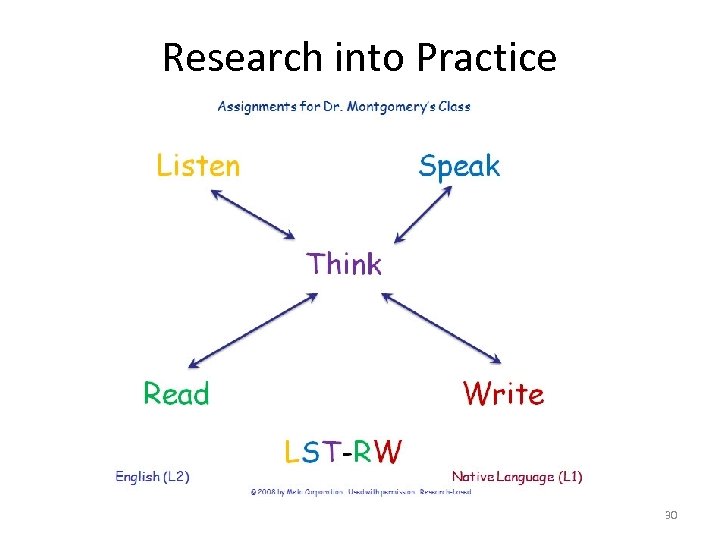
Research into Practice 30
What the Research Says • Audio models of fluent English in the home environment encourage more parent awareness of the student’s reading progress and provide a way for parents who do not speak English to participate as a partner/learner in their child’s home reading. English words “in the air” in student homes appear to capture the attention of others and to increase the social interaction related to books—important to progress in learning to read (Blum et al, 1995). 31
GENERATING RENEWED ENTHUSIASM FOR READING 32
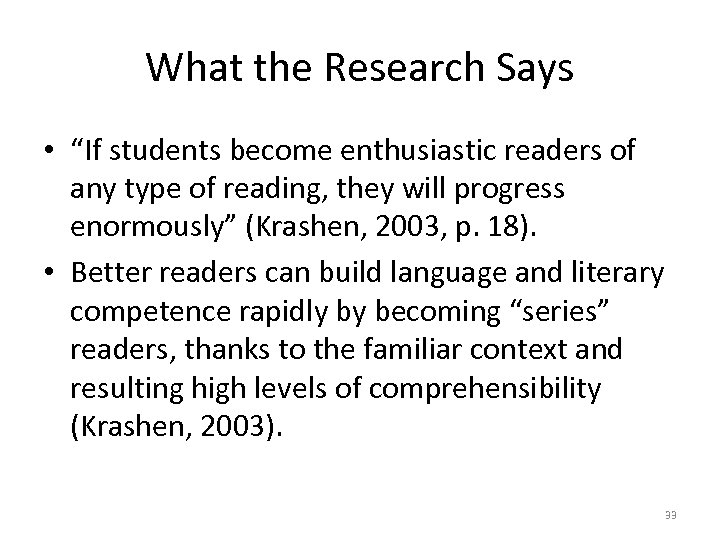
What the Research Says • “If students become enthusiastic readers of any type of reading, they will progress enormously” (Krashen, 2003, p. 18). • Better readers can build language and literary competence rapidly by becoming “series” readers, thanks to the familiar context and resulting high levels of comprehensibility (Krashen, 2003). 33
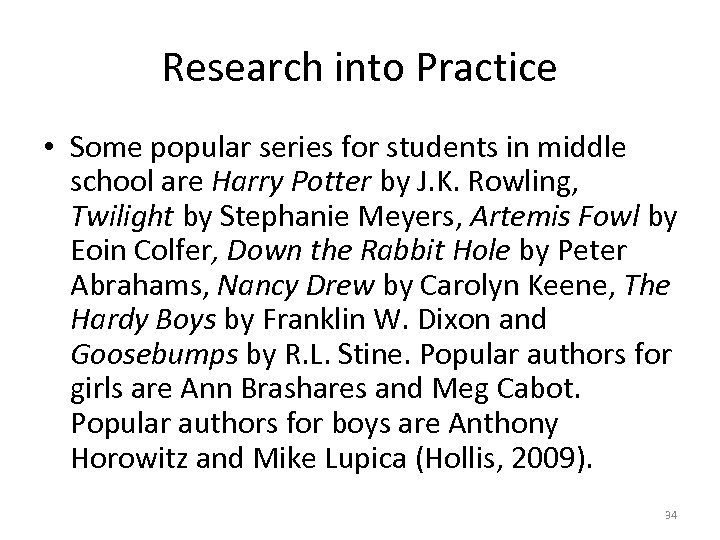
Research into Practice • Some popular series for students in middle school are Harry Potter by J. K. Rowling, Twilight by Stephanie Meyers, Artemis Fowl by Eoin Colfer, Down the Rabbit Hole by Peter Abrahams, Nancy Drew by Carolyn Keene, The Hardy Boys by Franklin W. Dixon and Goosebumps by R. L. Stine. Popular authors for girls are Ann Brashares and Meg Cabot. Popular authors for boys are Anthony Horowitz and Mike Lupica (Hollis, 2009). 34
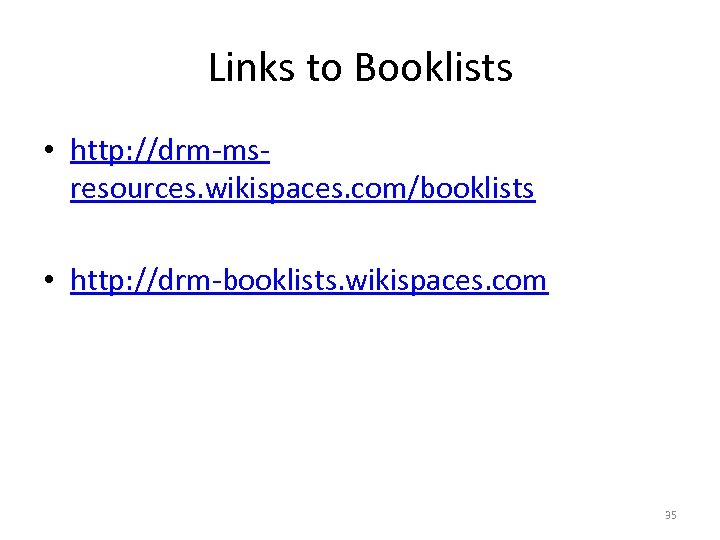
Links to Booklists • http: //drm-msresources. wikispaces. com/booklists • http: //drm-booklists. wikispaces. com 35
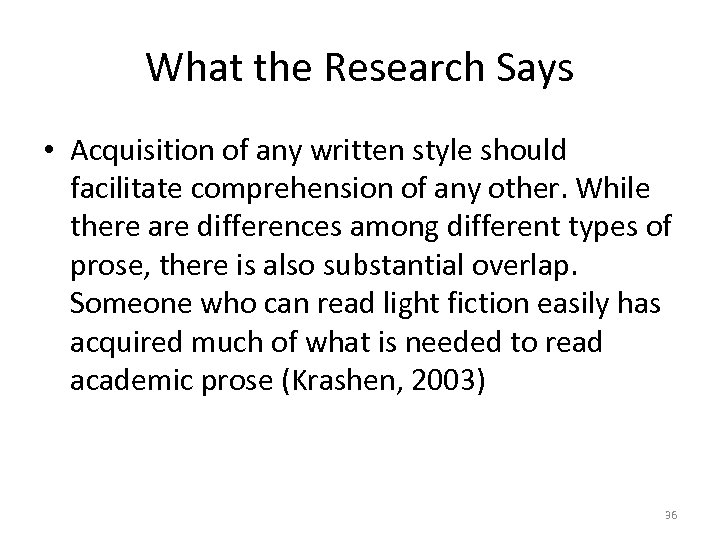
What the Research Says • Acquisition of any written style should facilitate comprehension of any other. While there are differences among different types of prose, there is also substantial overlap. Someone who can read light fiction easily has acquired much of what is needed to read academic prose (Krashen, 2003) 36
What the Research Says • The evidence is “overwhelming” to show that recreational reading is a means of increasing second-language competence. He calls it the “most thoroughly investigated and bestsupported technique” in the field of teaching second languages (Krashen, 2003, p. 18). 37
AUDIO BOOKS AND COMPANION BOOKS AT PUBLIC LIBRARIES 38
Public Library Support • Many award-winning audio books and companion books for a wide variety of grade levels are part of the youth collections in public libraries. Encouraging students to go with their parents to get a library card and to make use of the inter-library-loan provisions of these public libraries assure that students can access a wide variety of high-interest unabridged audio books and companion books. 39
Classroom Resources • Many public libraries are changing the media format for their audio books. As they replace cassette tapes with CD-ROMs, they sometimes make the used audio books on cassette available to teachers for use in their classroom libraries. Schools can purchase a few inexpensive cassette players for students to use if they do not have any cassette players in the home. These audio books can supplement the companion books available in school and classroom libraries and further extend the reach of public libraries in support of education. 40
Library Resources • Directors of youth services at public libraries are eager to work with teachers, parents and students to stimulate reading and are tremendous resources for helping students select audio books appropriate for current and growing reading levels. 41
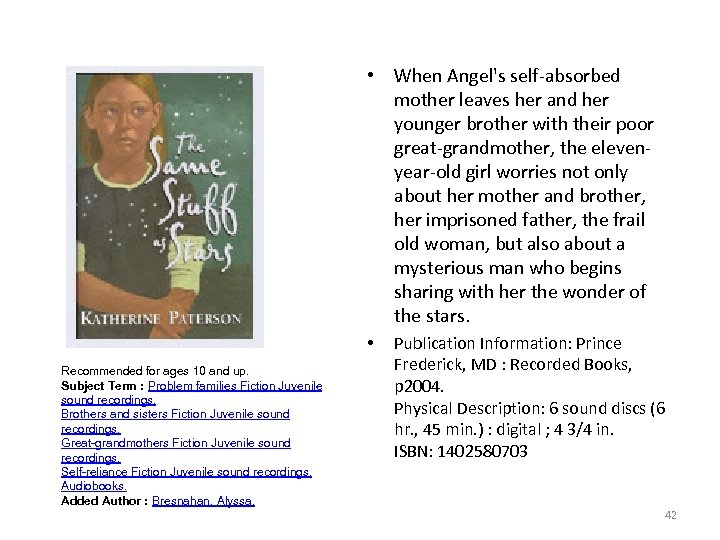
• When Angel's self-absorbed mother leaves her and her younger brother with their poor great-grandmother, the elevenyear-old girl worries not only about her mother and brother, her imprisoned father, the frail old woman, but also about a mysterious man who begins sharing with her the wonder of the stars. • Recommended for ages 10 and up. Subject Term : Problem families Fiction Juvenile sound recordings. Brothers and sisters Fiction Juvenile sound recordings. Great-grandmothers Fiction Juvenile sound recordings. Self-reliance Fiction Juvenile sound recordings. Audiobooks. Added Author : Bresnahan, Alyssa. Publication Information: Prince Frederick, MD : Recorded Books, p 2004. Physical Description: 6 sound discs (6 hr. , 45 min. ) : digital ; 4 3/4 in. ISBN: 1402580703 42
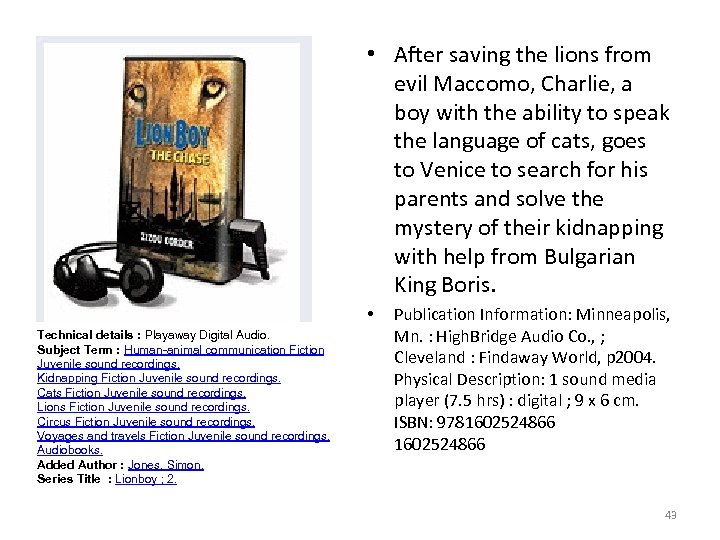
• After saving the lions from evil Maccomo, Charlie, a boy with the ability to speak the language of cats, goes to Venice to search for his parents and solve the mystery of their kidnapping with help from Bulgarian King Boris. • Technical details : Playaway Digital Audio. Subject Term : Human-animal communication Fiction Juvenile sound recordings. Kidnapping Fiction Juvenile sound recordings. Cats Fiction Juvenile sound recordings. Lions Fiction Juvenile sound recordings. Circus Fiction Juvenile sound recordings. Voyages and travels Fiction Juvenile sound recordings. Audiobooks. Added Author : Jones, Simon, Series Title : Lionboy ; 2. Publication Information: Minneapolis, Mn. : High. Bridge Audio Co. , ; Cleveland : Findaway World, p 2004. Physical Description: 1 sound media player (7. 5 hrs) : digital ; 9 x 6 cm. ISBN: 9781602524866 43
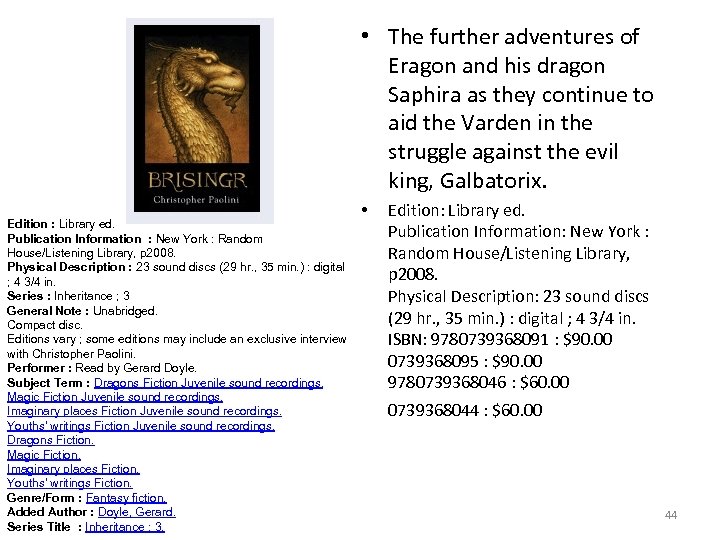
• The further adventures of Eragon and his dragon Saphira as they continue to aid the Varden in the struggle against the evil king, Galbatorix. Edition : Library ed. Publication Information : New York : Random House/Listening Library, p 2008. Physical Description : 23 sound discs (29 hr. , 35 min. ) : digital ; 4 3/4 in. Series : Inheritance ; 3 General Note : Unabridged. Compact disc. Editions vary ; some editions may include an exclusive interview with Christopher Paolini. Performer : Read by Gerard Doyle. Subject Term : Dragons Fiction Juvenile sound recordings. Magic Fiction Juvenile sound recordings. Imaginary places Fiction Juvenile sound recordings. Youths' writings Fiction Juvenile sound recordings. Dragons Fiction. Magic Fiction. Imaginary places Fiction. Youths' writings Fiction. Genre/Form : Fantasy fiction. Added Author : Doyle, Gerard. Series Title : Inheritance ; 3. • Edition: Library ed. Publication Information: New York : Random House/Listening Library, p 2008. Physical Description: 23 sound discs (29 hr. , 35 min. ) : digital ; 4 3/4 in. ISBN: 9780739368091 : $90. 00 0739368095 : $90. 00 9780739368046 : $60. 00 0739368044 : $60. 00 44
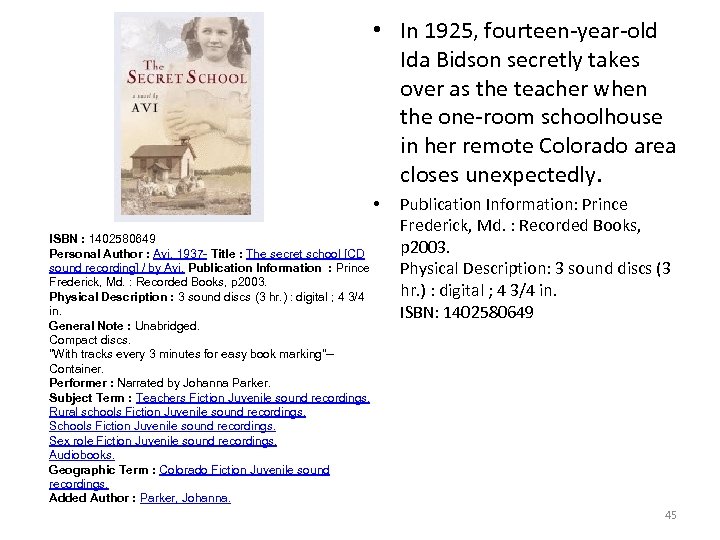
• In 1925, fourteen-year-old Ida Bidson secretly takes over as the teacher when the one-room schoolhouse in her remote Colorado area closes unexpectedly. • ISBN : 1402580649 Personal Author : Avi, 1937 - Title : The secret school [CD sound recording] / by Avi. Publication Information : Prince Frederick, Md. : Recorded Books, p 2003. Physical Description : 3 sound discs (3 hr. ) : digital ; 4 3/4 in. General Note : Unabridged. Compact discs. "With tracks every 3 minutes for easy book marking"-Container. Performer : Narrated by Johanna Parker. Subject Term : Teachers Fiction Juvenile sound recordings. Rural schools Fiction Juvenile sound recordings. Sex role Fiction Juvenile sound recordings. Audiobooks. Geographic Term : Colorado Fiction Juvenile sound recordings. Added Author : Parker, Johanna. Publication Information: Prince Frederick, Md. : Recorded Books, p 2003. Physical Description: 3 sound discs (3 hr. ) : digital ; 4 3/4 in. ISBN: 1402580649 45
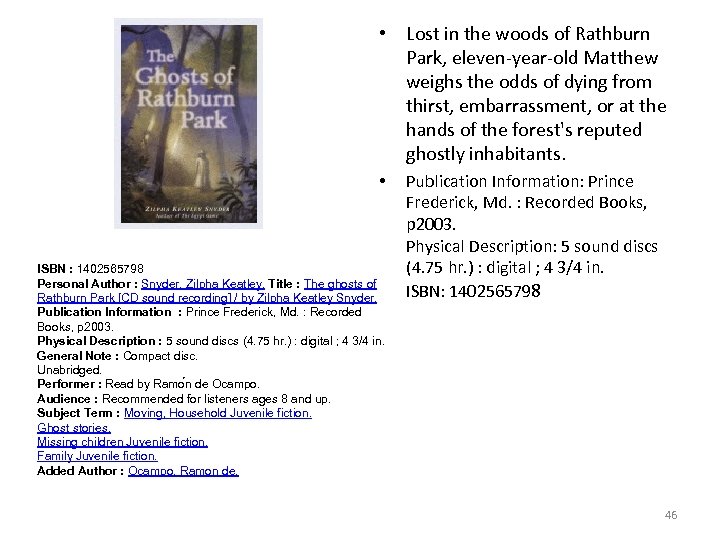
• Lost in the woods of Rathburn Park, eleven-year-old Matthew weighs the odds of dying from thirst, embarrassment, or at the hands of the forest's reputed ghostly inhabitants. • ISBN : 1402565798 Personal Author : Snyder, Zilpha Keatley. Title : The ghosts of Rathburn Park [CD sound recording] / by Zilpha Keatley Snyder. Publication Information : Prince Frederick, Md. : Recorded Books, p 2003. Physical Description : 5 sound discs (4. 75 hr. ) : digital ; 4 3/4 in. General Note : Compact disc. Unabridged. Performer : Read by Ramo n de Ocampo. Audience : Recommended for listeners ages 8 and up. Subject Term : Moving, Household Juvenile fiction. Ghost stories. Missing children Juvenile fiction. Family Juvenile fiction. Added Author : Ocampo, Ramon de. Publication Information: Prince Frederick, Md. : Recorded Books, p 2003. Physical Description: 5 sound discs (4. 75 hr. ) : digital ; 4 3/4 in. ISBN: 1402565798 46
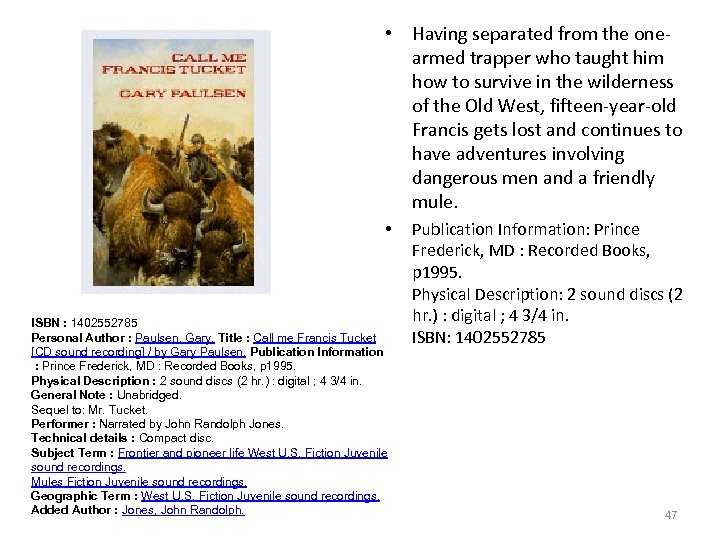
• Having separated from the onearmed trapper who taught him how to survive in the wilderness of the Old West, fifteen-year-old Francis gets lost and continues to have adventures involving dangerous men and a friendly mule. • ISBN : 1402552785 Personal Author : Paulsen, Gary. Title : Call me Francis Tucket [CD sound recording] / by Gary Paulsen. Publication Information : Prince Frederick, MD : Recorded Books, p 1995. Physical Description : 2 sound discs (2 hr. ) : digital ; 4 3/4 in. General Note : Unabridged. Sequel to: Mr. Tucket. Performer : Narrated by John Randolph Jones. Technical details : Compact disc. Subject Term : Frontier and pioneer life West U. S. Fiction Juvenile sound recordings. Mules Fiction Juvenile sound recordings. Geographic Term : West U. S. Fiction Juvenile sound recordings. Added Author : Jones, John Randolph. Publication Information: Prince Frederick, MD : Recorded Books, p 1995. Physical Description: 2 sound discs (2 hr. ) : digital ; 4 3/4 in. ISBN: 1402552785 47
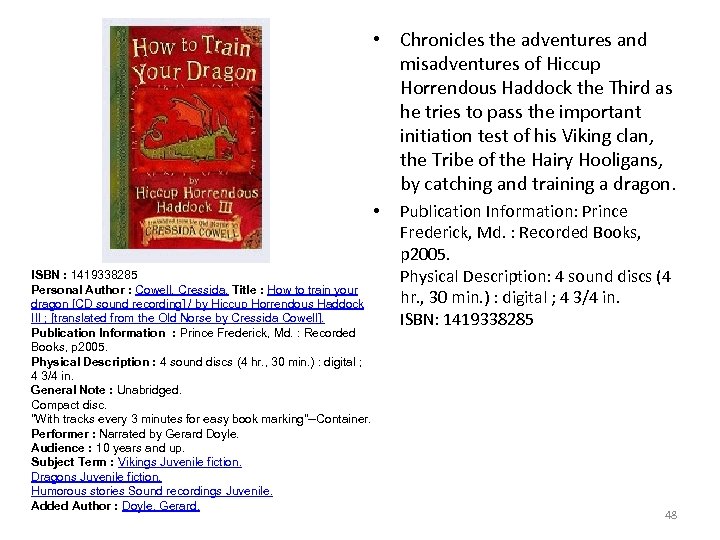
• Chronicles the adventures and misadventures of Hiccup Horrendous Haddock the Third as he tries to pass the important initiation test of his Viking clan, the Tribe of the Hairy Hooligans, by catching and training a dragon. • ISBN : 1419338285 Personal Author : Cowell, Cressida. Title : How to train your dragon [CD sound recording] / by Hiccup Horrendous Haddock III ; [translated from the Old Norse by Cressida Cowell]. Publication Information : Prince Frederick, Md. : Recorded Books, p 2005. Physical Description : 4 sound discs (4 hr. , 30 min. ) : digital ; 4 3/4 in. General Note : Unabridged. Compact disc. "With tracks every 3 minutes for easy book marking"--Container. Performer : Narrated by Gerard Doyle. Audience : 10 years and up. Subject Term : Vikings Juvenile fiction. Dragons Juvenile fiction. Humorous stories Sound recordings Juvenile. Added Author : Doyle, Gerard. Publication Information: Prince Frederick, Md. : Recorded Books, p 2005. Physical Description: 4 sound discs (4 hr. , 30 min. ) : digital ; 4 3/4 in. ISBN: 1419338285 48
INFORMAL LITERATURE CIRCLES WITH AUDIO BOOKS 49
Lunchtime Literature Circles • While much of the audio book listening will take place outside the classroom, it is important to create some time during the regular school day to reinforce the practice. Teachers can encourage students to participate in informal, lunch-time literature circles where students can listen to popular audio books. Students could then take the books home that they were interested in. 50
Literature Conversations • Time can also be provided for students to talk with each other and with an interested teacher about the audio books they are currently listening to. • When presented as an enrichment opportunity rather than a requirement, students interested in sharing more about their reading look forward to participating. 51
MOTIVATION AND PARENT-STUDENTTEACHER CONFERENCES 52
Parent-Student-Teacher Conferences • One way to stimulate parent support for students in working with audio books and companion books is to have parent-studentteacher conferences that focus on reading levels tied to test results, academic performance, career goals and the benefits of working with audio books from the public libraries. 53
Library Connections • Providing parents and students with directions to local libraries and with forms or procedures to obtain library cards and with lists of recommended audio books greatly increase the support parents and students feel about getting involved with audio books. 54
“Almost Painless” Practice in Listening, Reading, and Writing • Teachers can also offer “points” for students who bring in their first audio books and companion books and can encourage students to share what they like about what they are “reading. ” • It is also good to recommend these activities for vacation time activities. • Working with audio books and companion books is an “almost painless” way to increase fluency and comprehension in English. • When students want to practice writing, they can try to write a sequel or a story based on their favorite author or series. 55
ASSESSMENT AND NEXT STEPS 56
Look for Growing Enthusiasm for Reading • Growing enthusiasm for reading will be a primary informal indicator that students are actively engaging in more reading. Recreational reading needs to be kept free of academic demands. 57
Improvement over Time • Over time, as learning from listening to audio books and reading companion books is integrated by the students, changes in academic performance and on standardized test scores can be expected. It is critical not to hold unrealistic expectations for immediate turn-around in academic performance or for unreasonable progress to be reflected in test scores (Montgomery 1992). 58
Learning Strategies for Underperforming Students • Teachers need to work with these underperforming students to make sure they learn strategies for cooperative learning and for social-emotional learning as well as challenging them with skill-level appropriate academic tasks (Glasser, 2008; Mc. Intosh, Flannery et al. , 2008; Moore et al. , 2005; Morgan et al. , 2008; Preciado et al. , 2009). 59
Summary • This presentation highlighted significant research regarding factors influencing below grade-level reading and the impact of this challenge on academic performance and behavior of students, especially at the middle school level (grades seven and eight). The author proposed using audio books to generate renewed enthusiasm for reading and made suggestions for assessment and for involvement of public libraries, parents, and students. 60
![References • Advantage Learning Systems. (2009). Lexile Grade Level Conversion Chart [Web Page]. Retrieved](https://present5.com/presentation/73cbbab69a9184f19673764d6b5c41d1/image-61.jpg "References • Advantage Learning Systems. (2009). Lexile Grade Level Conversion Chart [Web Page]. Retrieved")
References • Advantage Learning Systems. (2009). Lexile Grade Level Conversion Chart [Web Page]. Retrieved on March 15, 2009, from http: //www. dupage 88. net/aths/resources/AT%20 MCweb 02/TEAM S/ ELLResources/Lexile. Conversion. Chart. pdf. • Blum, I. H. , Koskinen, P. S. , Tennant, N. , Parker, E. M. , Straub, M. , Curry, C. (1995). Using audiotaped books to extend classroom literacy instruction into the homes of second language learners. Reading Research Report No. 39, National Reading Research Center, Athens, GA. (Eric Document Reproduction Services No. ED 387789). Retrieved from http: //eric. ed. gov/ERICDocs/data/ericdocs 2 sql/ content_storage_01/0000019 b/80/14/33/27. pdf. • Carbo, M. (1983). Reading Styles Change Between Second and Eighth Grade. Educational Leadership, 40(5), 56 -59. Retrieved from Professional Development Collection database. 61
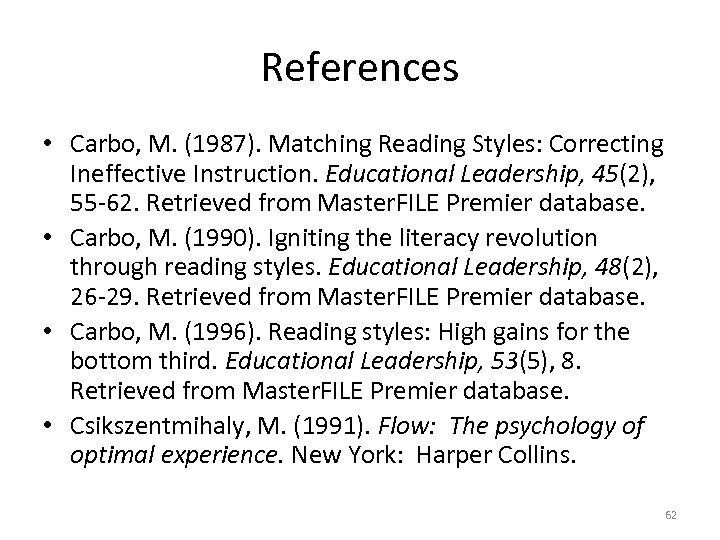
References • Carbo, M. (1987). Matching Reading Styles: Correcting Ineffective Instruction. Educational Leadership, 45(2), 55 -62. Retrieved from Master. FILE Premier database. • Carbo, M. (1990). Igniting the literacy revolution through reading styles. Educational Leadership, 48(2), 26 -29. Retrieved from Master. FILE Premier database. • Carbo, M. (1996). Reading styles: High gains for the bottom third. Educational Leadership, 53(5), 8. Retrieved from Master. FILE Premier database. • Csikszentmihaly, M. (1991). Flow: The psychology of optimal experience. New York: Harper Collins. 62
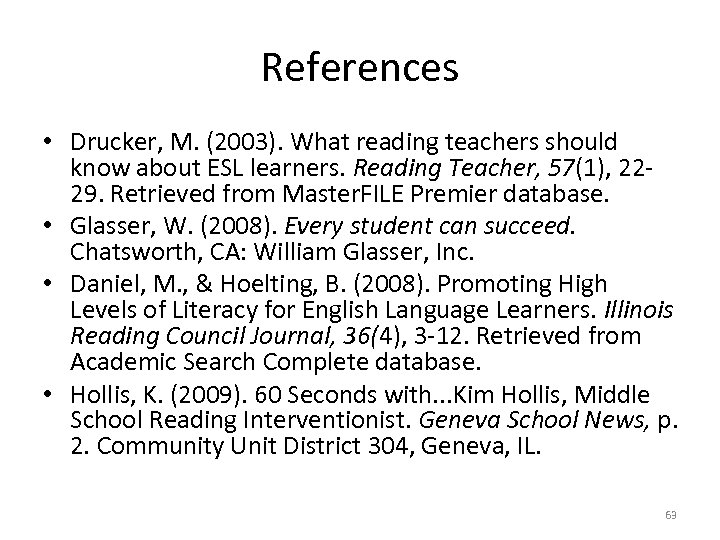
References • Drucker, M. (2003). What reading teachers should know about ESL learners. Reading Teacher, 57(1), 2229. Retrieved from Master. FILE Premier database. • Glasser, W. (2008). Every student can succeed. Chatsworth, CA: William Glasser, Inc. • Daniel, M. , & Hoelting, B. (2008). Promoting High Levels of Literacy for English Language Learners. Illinois Reading Council Journal, 36(4), 3 -12. Retrieved from Academic Search Complete database. • Hollis, K. (2009). 60 Seconds with. . . Kim Hollis, Middle School Reading Interventionist. Geneva School News, p. 2. Community Unit District 304, Geneva, IL. 63
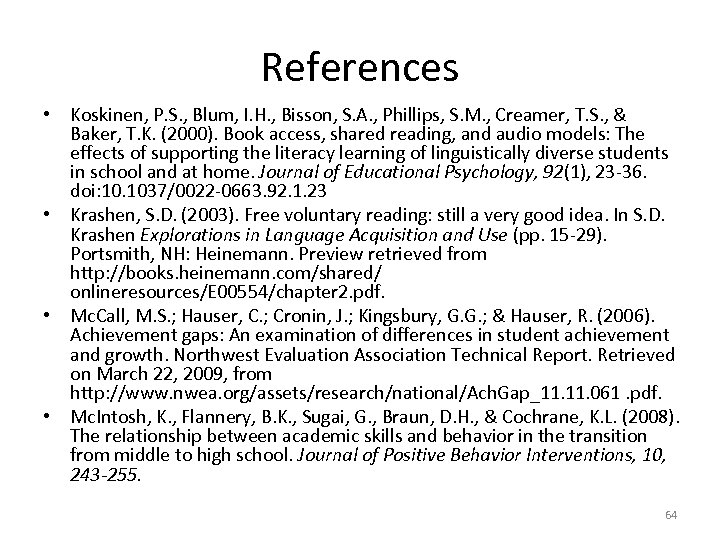
References • Koskinen, P. S. , Blum, I. H. , Bisson, S. A. , Phillips, S. M. , Creamer, T. S. , & Baker, T. K. (2000). Book access, shared reading, and audio models: The effects of supporting the literacy learning of linguistically diverse students in school and at home. Journal of Educational Psychology, 92(1), 23 -36. doi: 10. 1037/0022 -0663. 92. 1. 23 • Krashen, S. D. (2003). Free voluntary reading: still a very good idea. In S. D. Krashen Explorations in Language Acquisition and Use (pp. 15 -29). Portsmith, NH: Heinemann. Preview retrieved from http: //books. heinemann. com/shared/ onlineresources/E 00554/chapter 2. pdf. • Mc. Call, M. S. ; Hauser, C. ; Cronin, J. ; Kingsbury, G. G. ; & Hauser, R. (2006). Achievement gaps: An examination of differences in student achievement and growth. Northwest Evaluation Association Technical Report. Retrieved on March 22, 2009, from http: //www. nwea. org/assets/research/national/Ach. Gap_11. 061. pdf. • Mc. Intosh, K. , Flannery, B. K. , Sugai, G. , Braun, D. H. , & Cochrane, K. L. (2008). The relationship between academic skills and behavior in the transition from middle to high school. Journal of Positive Behavior Interventions, 10, 243 -255. 64
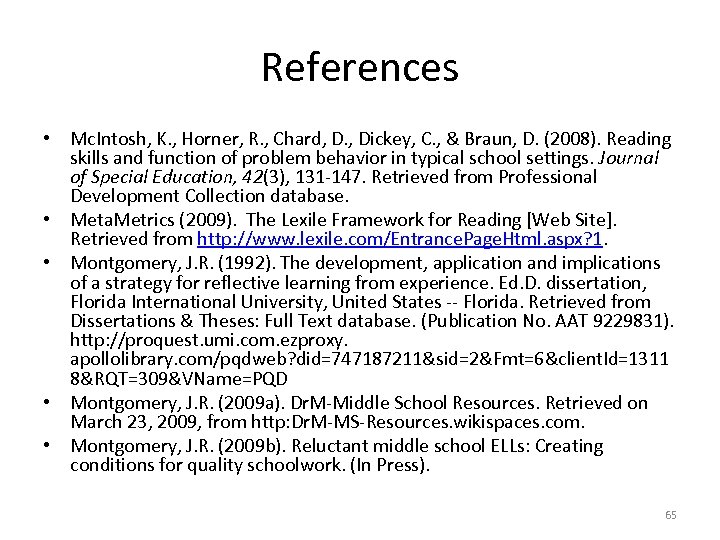
References • Mc. Intosh, K. , Horner, R. , Chard, D. , Dickey, C. , & Braun, D. (2008). Reading skills and function of problem behavior in typical school settings. Journal of Special Education, 42(3), 131 -147. Retrieved from Professional Development Collection database. • Meta. Metrics (2009). The Lexile Framework for Reading [Web Site]. Retrieved from http: //www. lexile. com/Entrance. Page. Html. aspx? 1. • Montgomery, J. R. (1992). The development, application and implications of a strategy for reflective learning from experience. Ed. D. dissertation, Florida International University, United States -- Florida. Retrieved from Dissertations & Theses: Full Text database. (Publication No. AAT 9229831). http: //proquest. umi. com. ezproxy. apollolibrary. com/pqdweb? did=747187211&sid=2&Fmt=6&client. Id=1311 8&RQT=309&VName=PQD • Montgomery, J. R. (2009 a). Dr. M-Middle School Resources. Retrieved on March 23, 2009, from http: Dr. M-MS-Resources. wikispaces. com. • Montgomery, J. R. (2009 b). Reluctant middle school ELLs: Creating conditions for quality schoolwork. (In Press). 65
References • • Moore, D. , Anderson, A. , & Kumar, K. (2005). Instructional adaptation in the management of escape-maintained behavior in a classroom. Journal of Positive Behavior Interventions, 7(4), 216 -223. Retrieved from CINAHL Plus with Full Text database. Morgan, P. , Farkas, G. , Tufis, P. , & Sperling, R. (2008). Are reading and behavior problems risk factors for each other? Journal of Learning Disabilities, 41(5), 417436. Retrieved from Professional Development Collection database. Northwest Evaluation Association (NWEA). (2009 a). Assessments [Web Page]. Retrieved from http: //www. nwea. org/assessments/map. asp. NWEA (2009 b). Assessment--Reading RIT Chart [Web Page]. Retrieved from http: //www. nwea. org/assets/documentlibrary/Reading_single. pdf. NWEA (2009 c). Assessment System-Research-based Accuracy [Web Page]. Retrieved from http: //www. nwea. org/assessments/researchbased. asp. Preciado, J. , Horner, R. , & Baker, S. (2009). Using a function-based approach to decrease problem behaviors and increase academic engagement for Latino English language learners. Journal of Special Education, 42(4), 227 -240. Retrieved from Professional Development Collection database. Sherman, E. (1991). Flow: The psychology of optimal experience (Review). Teachers College Record Volume 93 Number 1, 1991, p. 184 -186 http: //www. tcrecord. org/library ID Number: 266, Date Accessed: 4/5/2009 12: 56: 54 AM. Vygotsky, L. S. (1978). Mind in society: The development of higher psychological processes. Cambridge, MA: Harvard University Press. 66
Скачать презентацию 1 Using Audio Books to Improve Reading
73cbbab69a9184f19673764d6b5c41d1.ppt